

The DOI matches its Crossref record; 72 of the 73 references it cites were found in a registry or an index; none of the 33 sources its claims cite is checked for support yet.
Supported employment: Meta-analysis and review of randomized controlled trials of individual placement and support
Open accessAbstract
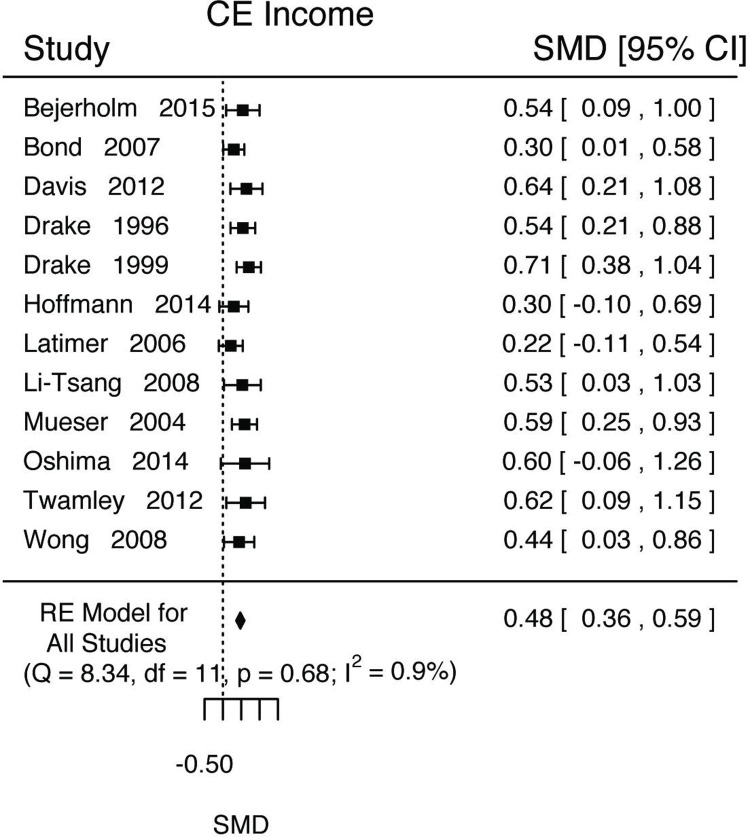
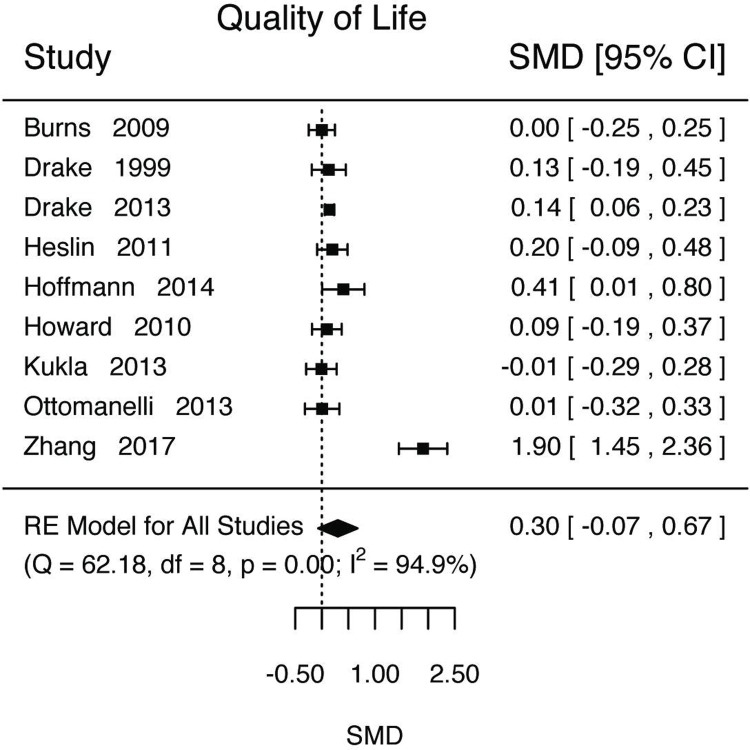
Supported employment is a treatment whereby those with severe mental illness (or other disabilities) receive aid searching for competitive employment and mental health (or other) treatments concurrently. The most popular implementation of supported employment is individual placement and support (IPS). We conducted meta-analytic analyses of the randomized controlled trials of IPS. We found that subjects in IPS, compared to usual treatment conditions, had better vocational outcomes (obtained any competitive employment: RR = 1.63, 95%CI = [1.46, 1.82]; job tenure: d = 0.55, 95%CI = [0.33, 0.79]; job length: d = 0.46, 95%CI = [0.35, 0.57]; income: d = 0.48, 95%CI = [0.36, 0.59]) Non-vocational outcomes estimates, while favoring IPS, included the null (quality of life: d = 0.30, 95%CI = [-0.07, 0.67]; global functioning: d = 0.09, 95%CI = [-0.09, 0.27]; mental health: d = 0.03, 95%CI = [-0.15, 0.21]). Analysis of the expected proportion of studies with a true effect on non-vocational outcomes with d>0.2 showed some reason to expect a possible improvement for quality of life for at least some settings (Prop = 0.57, 95%CI = [0.30, 0.84]).
Overview
AI snapshot
Written from the paper’s full text.
TL;DR
This meta-analysis of randomized controlled trials found that individual placement and support (IPS) supported employment reliably improves vocational outcomes compared with usual treatment, while non-vocational outcomes were smaller and mostly included the null. A novel proportion-of-settings analysis suggested possible quality-of-life benefits in some settings.
Key findings
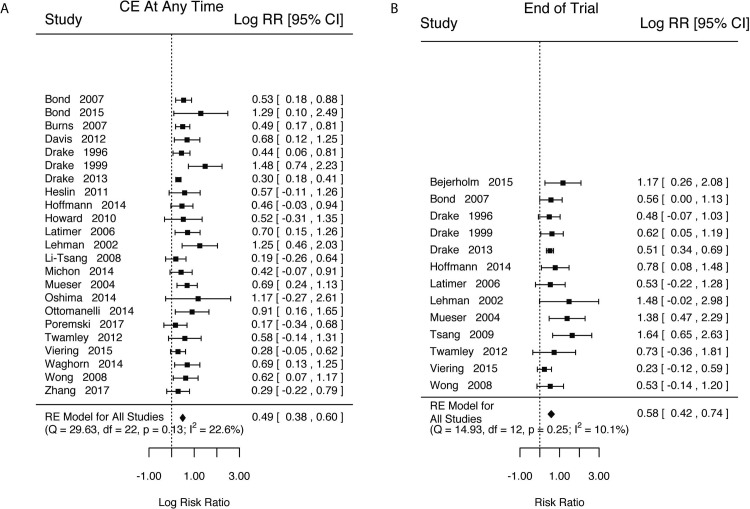
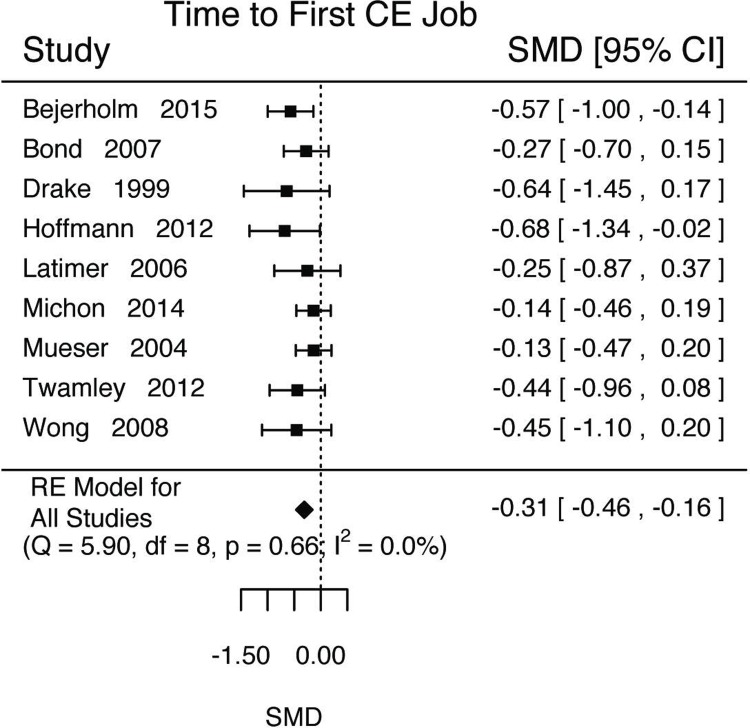
- IPS increased any competitive employment (RR = 1.63, 95% CI [1.46, 1.82]) and end-of-study competitive employment (reported as 1.8x more likely; log(RR) = 0.58, 95% CI [0.42, 0.74]), and shortened time to first competitive employment (d = -0.31, 95% CI [-0.46, -0.15]).
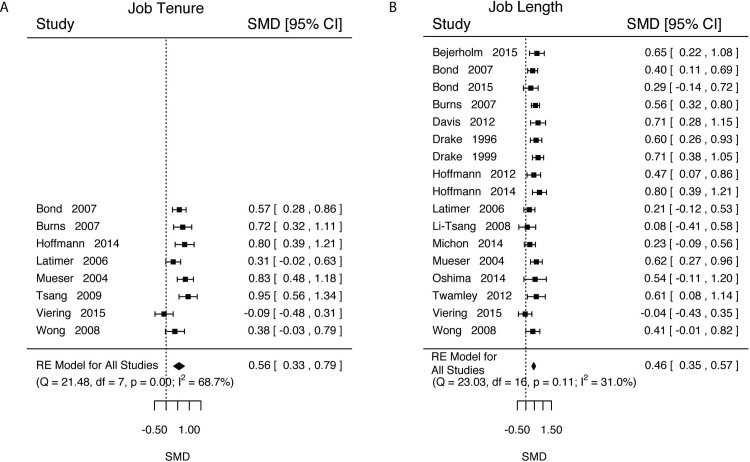
- Secondary vocational outcomes favored IPS: job tenure d = 0.55, 95% CI [0.33, 0.79]; job length d = 0.46, 95% CI [0.35, 0.57]; income d = 0.48, 95% CI [0.36, 0.59].
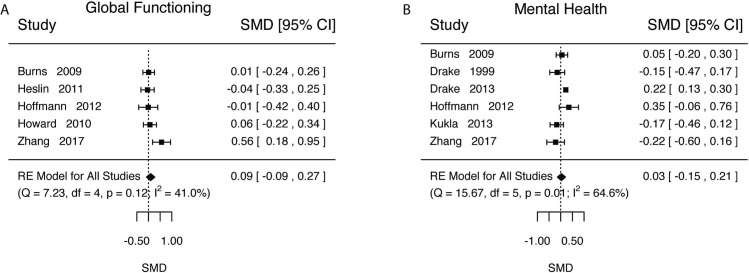
- Non-vocational pooled estimates favored IPS but all confidence intervals included the null: quality of life d = 0.30, 95% CI [-0.07, 0.67]; global functioning d = 0.09, 95% CI [-0.09, 0.27]; mental health d = 0.03, 95% CI [-0.15, 0.21].
- The estimated proportion of settings with a true quality-of-life effect d > 0.2 was 0.57, 95% CI [0.30, 0.84], suggesting possible benefit in some settings.
Methods
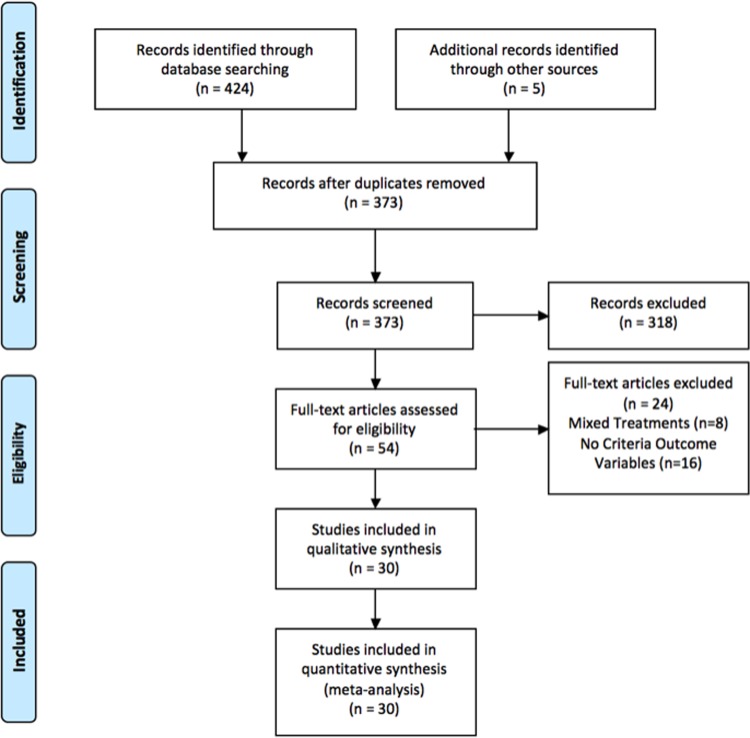
- Searched PsycINFO; the primary query “supported employment AND randomized controlled trial” returned 111 results, a broader search returned 313, and after de-duplication 368 unique publications were screened. The final analysis included 30 articles: 25 original RCTs, 2 follow-up studies, and 3 secondary analyses comparing IPS with treatment as usual.
- Random-effects meta-analyses were run in R using the metafor package; binary outcomes used log relative risk and continuous outcomes used standardized mean differences, with intent-to-treat analyses using randomized Ns.
- The authors also estimated the proportion of settings with scientifically meaningful effects (RR > 1.2 or < 0.8; d > 0.2 or < -0.2) using the EValue library for samples with five or more articles.
Limitations
- The paper states that included articles varied greatly in quality, that some non-significant results were reported without estimates and could not be included, and that sample sizes were often powered only for the main outcome, limiting secondary outcomes.
- The paper reports substantial heterogeneity for some outcomes (e.g., quality of life I² = 94.90%; job tenure I² = 68.68%; mental health I² = 64.55%), and some analyses had few studies (job tenure k = 5; global functioning k = 5; mental health k = 6), making estimates imprecise.
- Evident from the text: the search and data extraction were done by the first author alone, and the discussion notes that cost-benefit evidence for SE/IPS is mixed and that SE/IPS is “not a panacea.”
Model-written summary. Check it against the paper before relying on it.
Integrity signals
Registry
Cites
Statistics
Figures
Verification
Claims the paper makes
44 Own result · 27 Not checked yet · 10 Own method · 10 Own interpretation · 2 No basis given
A result the paper reports from its own data — it cites no other source for it, so there is none to check. The quote shows it is in the paper.
In the paper
“We estimated that scientific meaningful effects that we expect to be observed with d>0.2 was 0.90 (95%CI = [0.68, 1])”
§ Supported employment: Meta-analysis and review of randomized controlled trials of individual placement and support > Results > Job tenure & length of competitive employment
hedged- Asserted: passes — The authors put it forward as true.
- Checkable: passes — It can be checked against evidence.
- Load-bearing: unclear — It is unclear whether the paper’s conclusions depend on it.
- Based: passes — The paper gives a reason why it holds.
A result the paper reports from its own data — it cites no other source for it, so there is none to check. The quote shows it is in the paper.
In the paper
“and the proportion with d<-0.2 to be essentially zero (Prop = <0.001, 95%CI = [0, <0.001]).”
§ Supported employment: Meta-analysis and review of randomized controlled trials of individual placement and support > Results > Job tenure & length of competitive employment
hedged- Asserted: passes — The authors put it forward as true.
- Checkable: passes — It can be checked against evidence.
- Load-bearing: unclear — It is unclear whether the paper’s conclusions depend on it.
- Based: passes — The paper gives a reason why it holds.
A result the paper reports from its own data — it cites no other source for it, so there is none to check. The quote shows it is in the paper.
In the paper
“Our estimates showed that there was significant heterogeneity in the underlying study populations.”
§ Supported employment: Meta-analysis and review of randomized controlled trials of individual placement and support > Results > Competitive employment status
plain- Asserted: passes — The authors put it forward as true.
- Checkable: passes — It can be checked against evidence.
- Load-bearing: unclear — It is unclear whether the paper’s conclusions depend on it.
- Based: passes — The paper gives a reason why it holds.
A result the paper reports from its own data — it cites no other source for it, so there is none to check. The quote shows it is in the paper.
In the paper
“We estimated that those in IPS conditions would have significantly more income (Fig 5, k = 12; d = 0.48, SE = 0.06, Z = 8.31, p<0.0001, 95%CI = [0.36, 0.59], τ2 (SE) = 0.0004(0.02), I2 = 0.90%, H2 = 1.01, Q(11) = 8.3404, p = 0.6825).”
- Also stated in: § Discussion · plain
“and higher total income (d = 0.48, 95%CI = [0.36, 0.59], Fig 5).”
§ Supported employment: Meta-analysis and review of randomized controlled trials of individual placement and support > Results > Income from competitive employment
plaindirect- Asserted: passes — The authors put it forward as true.
- Checkable: passes — It can be checked against evidence.
- Load-bearing: passes — The paper’s conclusions depend on it.
- Based: passes — The paper gives a reason why it holds.
- Also stated in: § Discussion · plain
A result the paper reports from its own data — it cites no other source for it, so there is none to check. The quote shows it is in the paper.
In the paper
“Length was not a significant moderator (Length = -0.004, 95%CI = [-0.01, 0.005]).”
§ Supported employment: Meta-analysis and review of randomized controlled trials of individual placement and support > Results > Income from competitive employment
plain- Asserted: passes — The authors put it forward as true.
- Checkable: passes — It can be checked against evidence.
- Load-bearing: unclear — It is unclear whether the paper’s conclusions depend on it.
- Based: passes — The paper gives a reason why it holds.
A result the paper reports from its own data — it cites no other source for it, so there is none to check. The quote shows it is in the paper.
In the paper
“For finding CE during any part of a study, the proportion of studies with true RR>1.2 is estimated to be >0.99 (95%CI = [0.95, 1])”
§ Supported employment: Meta-analysis and review of randomized controlled trials of individual placement and support > Results > Competitive employment status
hedged- Asserted: passes — The authors put it forward as true.
- Checkable: passes — It can be checked against evidence.
- Load-bearing: passes — The paper’s conclusions depend on it.
- Based: passes — The paper gives a reason why it holds.
A result the paper reports from its own data — it cites no other source for it, so there is none to check. The quote shows it is in the paper.
In the paper
“RR<0.8, Proportion = <0.001, 95%CI = [0, <0.01]”
§ Supported employment: Meta-analysis and review of randomized controlled trials of individual placement and support > Results > Competitive employment status
plain- Asserted: passes — The authors put it forward as true.
- Checkable: passes — It can be checked against evidence.
- Load-bearing: passes — The paper’s conclusions depend on it.
- Based: passes — The paper gives a reason why it holds.
A result the paper reports from its own data — it cites no other source for it, so there is none to check. The quote shows it is in the paper.
In the paper
“job length: d = 0.46, 95%CI = [0.35, 0.57]”
§ Supported employment: Meta-analysis and review of randomized controlled trials of individual placement and support > Abstract
plaindirect- Asserted: passes — The authors put it forward as true.
- Checkable: passes — It can be checked against evidence.
- Load-bearing: passes — The paper’s conclusions depend on it.
- Based: passes — The paper gives a reason why it holds.
A result the paper reports from its own data — it cites no other source for it, so there is none to check. The quote shows it is in the paper.
In the paper
“For total time worked in CE, we estimated that those in the IPS condition worked significantly more than controls (Fig 4B, k = 17, d = 0.46, SE = 0.06, Z = 8.23, p<0.0001, 95%CI = [0.35, 0.57], τ2 (SE) = 0.02(0.02), I2 = 31.03%, H2 = 1.45).”
- Also stated in: § Discussion · plain
“longer durations of work (d = 0.46, 95%CI = [0.35, 0.57], Fig 4B)”
§ Supported employment: Meta-analysis and review of randomized controlled trials of individual placement and support > Results > Job tenure & length of competitive employment
plaindirect- Asserted: passes — The authors put it forward as true.
- Checkable: passes — It can be checked against evidence.
- Load-bearing: passes — The paper’s conclusions depend on it.
- Based: passes — The paper gives a reason why it holds.
- Also stated in: § Discussion · plain
A result the paper reports from its own data — it cites no other source for it, so there is none to check. The quote shows it is in the paper.
In the paper
“with the proportion of studies with true RR<0.8 expected to be <0.001 (95%CI = [0, <0.01])”
§ Supported employment: Meta-analysis and review of randomized controlled trials of individual placement and support > Results > Competitive employment status
hedged- Asserted: passes — The authors put it forward as true.
- Checkable: passes — It can be checked against evidence.
- Load-bearing: passes — The paper’s conclusions depend on it.
- Based: passes — The paper gives a reason why it holds.
- It may state two separate claims as one. 15
- Probably not a substantial claim. 24
A result the paper reports from its own data — it cites no other source for it, so there is none to check. The quote shows it is in the paper.
In the paper
“global functioning: d = 0.09, 95%CI = [-0.09, 0.27]”
§ Supported employment: Meta-analysis and review of randomized controlled trials of individual placement and support > Abstract
plain- Asserted: passes — The authors put it forward as true.
- Checkable: passes — It can be checked against evidence.
- Load-bearing: passes — The paper’s conclusions depend on it.
- Based: passes — The paper gives a reason why it holds.
It may state two separate claims as one.
A result the paper reports from its own data — it cites no other source for it, so there is none to check. The quote shows it is in the paper.
In the paper
“mental health: d = 0.03, 95%CI = [-0.15, 0.21]”
§ Supported employment: Meta-analysis and review of randomized controlled trials of individual placement and support > Abstract
plain- Asserted: passes — The authors put it forward as true.
- Checkable: passes — It can be checked against evidence.
- Load-bearing: passes — The paper’s conclusions depend on it.
- Based: passes — The paper gives a reason why it holds.
It may state two separate claims as one.
The paper states this without a source or data behind it here, so there is nothing to check it against. The quote shows it is in the paper.
In the paper
“Because of this, we were unable to include all outcomes that researchers said that they had measured.”
§ Supported employment: Meta-analysis and review of randomized controlled trials of individual placement and support > Discussion > Methodological interpretation and critique
plaindirect- Asserted: passes — The authors put it forward as true.
- Checkable: passes — It can be checked against evidence.
- Load-bearing: unclear — It is unclear whether the paper’s conclusions depend on it.
- Based: passes — The paper gives a reason why it holds.
It may state two separate claims as one.
A result the paper reports from its own data — it cites no other source for it, so there is none to check. The quote shows it is in the paper.
In the paper
“We estimated that those in IPS had a slightly higher global functioning, but that the confidence intervals of the estimate include the null (Fig 7A, k = 5, d = 0.09, SE = 0.09, Z = 0.9957, p = 0.3194, 95%CI = [-0.0891, 0.2731]).”
§ Supported employment: Meta-analysis and review of randomized controlled trials of individual placement and support > Results > Global functioning
hedged- Asserted: passes — The authors put it forward as true.
- Checkable: passes — It can be checked against evidence.
- Load-bearing: unclear — It is unclear whether the paper’s conclusions depend on it.
- Based: passes — The paper gives a reason why it holds.
It may state two separate claims as one.
A result the paper reports from its own data — it cites no other source for it, so there is none to check. The quote shows it is in the paper.
In the paper
“We estimated that those in IPS conditions had a higher levels of QOL, but that the confidence intervals for the estimate included the null (Fig 6, k = 9, d = 0.30, SE = 0.19, Z = 1.60, p = 0.11, 95%CI = [-0.07 0.67], τ2 (SE) = 0.2955(0.1602), I2 = 94.90%, H2 = 19.59, Q(8) = 62.1751, p<0.0001).”
§ Supported employment: Meta-analysis and review of randomized controlled trials of individual placement and support > Results > Quality of life
hedged- Asserted: passes — The authors put it forward as true.
- Checkable: passes — It can be checked against evidence.
- Load-bearing: unclear — It is unclear whether the paper’s conclusions depend on it.
- Based: passes — The paper gives a reason why it holds.
It may state two separate claims as one.
A result the paper reports from its own data — it cites no other source for it, so there is none to check. The quote shows it is in the paper.
In the paper
“We estimated a very small effect and that the confidence intervals of the estimate include the null (Fig 7B, k = 6, d = 0.03, SE = 0.09, Z = 0.3320, p = 0.7399, 95%CI-0.15, 0.21], τ2 (SE) = 0.03(0.03), I2 = 64.55%, H2 = 2.82, Q(5) = 15.67, p = 0.0078).”
§ Supported employment: Meta-analysis and review of randomized controlled trials of individual placement and support > Results > General mental health
hedged- Asserted: passes — The authors put it forward as true.
- Checkable: passes — It can be checked against evidence.
- Load-bearing: unclear — It is unclear whether the paper’s conclusions depend on it.
- Based: passes — The paper gives a reason why it holds.
It may state two separate claims as one.
A result the paper reports from its own data — it cites no other source for it, so there is none to check. The quote shows it is in the paper.
In the paper
“Given the heterogeneity and the different scales used, we also tested to see if scale was a significant moderator and we estimated that it may be with the Personal Wellbeing Index having the highest estimate (Table 11).”
§ Supported employment: Meta-analysis and review of randomized controlled trials of individual placement and support > Results > Quality of life
hedgedcorrelational- Asserted: passes — The authors put it forward as true.
- Checkable: passes — It can be checked against evidence.
- Load-bearing: unclear — It is unclear whether the paper’s conclusions depend on it.
- Based: passes — The paper gives a reason why it holds.
It may state two separate claims as one.
In the paper
“or mental health symptoms (d = -0.20, 95%CI = [-0.62, 0.23]).”
§ Supported employment: Meta-analysis and review of randomized controlled trials of individual placement and support > Results > Literature search results and data extraction
What the sources say
- Not checked yetcites [53] RM van Rijn, 2016, Work as treatment? The effectiveness of re-employment programmes for unemployed persons with severe mental health problems on health and quality of life: a systematic review and meta-analysis, Occupational and Environmental Medicine source
plain- Asserted: passes — The authors put it forward as true.
- Checkable: passes — It can be checked against evidence.
- Load-bearing: fails — The paper’s conclusions may not depend on it.
- Based: passes — The paper gives a reason why it holds.
Probably not a substantial claim. The paper’s conclusions may not depend on it.
In the paper
“and of finding any employment by 3.24-fold (RR = 3.24 95%CI = [2.17, 4.82]) [15].”
§ Supported employment: Meta-analysis and review of randomized controlled trials of individual placement and support > Introduction
What the sources say
- Not checked yetcites [15] Y Kinoshita, 2013, Supported employment for adults with severe mental illness, The Cochrane database of systematic reviews
hedgeddirect- Asserted: passes — The authors put it forward as true.
- Checkable: passes — It can be checked against evidence.
- Load-bearing: fails — The paper’s conclusions may not depend on it.
- Based: passes — The paper gives a reason why it holds.
Probably not a substantial claim. The paper’s conclusions may not depend on it.
What the paper did — it cites no source for this, so there is none to check. The quote shows it is in the paper.
In the paper
“For reproducibility, we saved the relevant data as R data files and have included them as supplemental materials along with the needed R script file (S2 and S3 Files, respectively).”
§ Supported employment: Meta-analysis and review of randomized controlled trials of individual placement and support > Methods > Statistical methods
plain- Asserted: passes — The authors put it forward as true.
- Checkable: passes — It can be checked against evidence.
- Load-bearing: fails — The paper’s conclusions may not depend on it.
- Based: passes — The paper gives a reason why it holds.
Probably not a substantial claim. The paper’s conclusions may not depend on it.
What the paper did — it cites no source for this, so there is none to check. The quote shows it is in the paper.
In the paper
“All articles reported the results of randomized controlled trials (RCT) that focused on comparing supported employment (SE) as implemented via individual placement and support (IPS) to a control condition, which was usually the locally available best usual practice.”
§ Supported employment: Meta-analysis and review of randomized controlled trials of individual placement and support > Results > Literature search results and data extraction
plain- Asserted: passes — The authors put it forward as true.
- Checkable: passes — It can be checked against evidence.
- Load-bearing: passes — The paper’s conclusions depend on it.
- Based: passes — The paper gives a reason why it holds.
It may state two separate claims as one.
In the paper
“but no significant effects on global functioning (d = -0.01, 95%CI = [-0.13, -0.11])”
§ Supported employment: Meta-analysis and review of randomized controlled trials of individual placement and support > Results > Literature search results and data extraction
What the sources say
- Not checked yetcites [53] RM van Rijn, 2016, Work as treatment? The effectiveness of re-employment programmes for unemployed persons with severe mental health problems on health and quality of life: a systematic review and meta-analysis, Occupational and Environmental Medicine source
plain- Asserted: passes — The authors put it forward as true.
- Checkable: passes — It can be checked against evidence.
- Load-bearing: fails — The paper’s conclusions may not depend on it.
- Based: passes — The paper gives a reason why it holds.
Probably not a substantial claim. The paper’s conclusions may not depend on it.
In the paper
“The researchers found a significant effect on quality of life with those in IPS having a higher level (d = 0.28, 95%CI = [0.04, 0.52])”
§ Supported employment: Meta-analysis and review of randomized controlled trials of individual placement and support > Results > Literature search results and data extraction
What the sources say
- Not checked yetcites [53] RM van Rijn, 2016, Work as treatment? The effectiveness of re-employment programmes for unemployed persons with severe mental health problems on health and quality of life: a systematic review and meta-analysis, Occupational and Environmental Medicine source
plaincorrelational- Asserted: passes — The authors put it forward as true.
- Checkable: passes — It can be checked against evidence.
- Load-bearing: fails — The paper’s conclusions may not depend on it.
- Based: passes — The paper gives a reason why it holds.
Probably not a substantial claim. The paper’s conclusions may not depend on it.
What the paper did — it cites no source for this, so there is none to check. The quote shows it is in the paper.
In the paper
“Articles also varied by whether or not they reported measures of fidelity to the study protocol.”
§ Supported employment: Meta-analysis and review of randomized controlled trials of individual placement and support > Results > Literature search results and data extraction
plain- Asserted: passes — The authors put it forward as true.
- Checkable: passes — It can be checked against evidence.
- Load-bearing: fails — The paper’s conclusions may not depend on it.
- Based: passes — The paper gives a reason why it holds.
Probably not a substantial claim. The paper’s conclusions may not depend on it.
What the paper did — it cites no source for this, so there is none to check. The quote shows it is in the paper.
In the paper
“If a study reported both intent-to-treat and conditional statistics, we selected to use the intent-to-treat values.”
§ Supported employment: Meta-analysis and review of randomized controlled trials of individual placement and support > Results > Secondary vocational outcomes
plain- Asserted: passes — The authors put it forward as true.
- Checkable: passes — It can be checked against evidence.
- Load-bearing: passes — The paper’s conclusions depend on it.
- Based: passes — The paper gives a reason why it holds.
Probably not a substantial claim.
What the paper did — it cites no source for this, so there is none to check. The quote shows it is in the paper.
In the paper
“We only performed meta-analysis from papers that only used competitive employment for these statistics. We omit from analysis statistics that combined all types of employment (i.e., competitive and not).”
§ Supported employment: Meta-analysis and review of randomized controlled trials of individual placement and support > Results > Secondary vocational outcomes
plain- Asserted: passes — The authors put it forward as true.
- Checkable: passes — It can be checked against evidence.
- Load-bearing: passes — The paper’s conclusions depend on it.
- Based: passes — The paper gives a reason why it holds.
Probably not a substantial claim. It may state two separate claims as one.
In the paper
“In that study, Nordt et al. estimated that one in five suicides might be attributable to unemployment for the period of 2000–2011 within sixty-three countries sampled [8].”
§ Supported employment: Meta-analysis and review of randomized controlled trials of individual placement and support > Introduction
What the sources say
- Not checked yetcites [8] C Nordt, 2015, Modelling suicide and unemployment: a longitudinal analysis covering 63 countries, 2000–11, The Lancet Psychiatry source
hedgedconditional- Asserted: passes — The authors put it forward as true.
- Checkable: passes — It can be checked against evidence.
- Load-bearing: fails — The paper’s conclusions may not depend on it.
- Based: passes — The paper gives a reason why it holds.
Probably not a substantial claim. The paper’s conclusions may not depend on it.
What the paper did — it cites no source for this, so there is none to check. The quote shows it is in the paper.
In the paper
“Researchers measured the same outcome variable in a number of ways. For example, competitive employment was often measured as having had any competitive employment during the study period and/or as having been employed at the end of the study.”
§ Supported employment: Meta-analysis and review of randomized controlled trials of individual placement and support > Results > Literature search results and data extraction
plain- Asserted: passes — The authors put it forward as true.
- Checkable: passes — It can be checked against evidence.
- Load-bearing: fails — The paper’s conclusions may not depend on it.
- Based: passes — The paper gives a reason why it holds.
Probably not a substantial claim. The paper’s conclusions may not depend on it.
In the paper
“Past meta-analyses have estimated that supported employment increases the likelihood of achieving competitive employment by 2.4-fold (RR = 2.40 95%CI = [1.99, 2.90]) [14]”
§ Supported employment: Meta-analysis and review of randomized controlled trials of individual placement and support > Introduction
What the sources say
- Not checked yetcites [14] M Modini, 2016, Supported employment for people with severe mental illness: Systematic review and meta-analysis of the international evidence, Br J Psychiatry source
hedgeddirect- Asserted: passes — The authors put it forward as true.
- Checkable: passes — It can be checked against evidence.
- Load-bearing: fails — The paper’s conclusions may not depend on it.
- Based: passes — The paper gives a reason why it holds.
Probably not a substantial claim. The paper’s conclusions may not depend on it.
In the paper
“In general, research articles varied greatly in quality, as has been previously reported [15].”
§ Supported employment: Meta-analysis and review of randomized controlled trials of individual placement and support > Results > Literature search results and data extraction
What the sources say
- Not checked yetcites [15] Y Kinoshita, 2013, Supported employment for adults with severe mental illness, The Cochrane database of systematic reviews
plain- Asserted: passes — The authors put it forward as true.
- Checkable: passes — It can be checked against evidence.
- Load-bearing: fails — The paper’s conclusions may not depend on it.
- Based: passes — The paper gives a reason why it holds.
Probably not a substantial claim. The paper’s conclusions may not depend on it.
What the paper did — it cites no source for this, so there is none to check. The quote shows it is in the paper.
In the paper
“Finally, given that we had access to the total number of subjects randomized, we performed the analyses following the intent-to-treat paradigm.”
§ Supported employment: Meta-analysis and review of randomized controlled trials of individual placement and support > Results > Competitive employment status
plain- Asserted: passes — The authors put it forward as true.
- Checkable: passes — It can be checked against evidence.
- Load-bearing: passes — The paper’s conclusions depend on it.
- Based: passes — The paper gives a reason why it holds.
Probably not a substantial claim. It may state two separate claims as one.
None of the sources cited for this claim have been checked yet.
In the paper
“Employment may be associated with positive outcomes such as increased physical and mental health [11–13].”
§ Supported employment: Meta-analysis and review of randomized controlled trials of individual placement and support > Introduction
What the sources say
- Not checked yetcites [11] RE Lucas, 2004, Unemployment Alters the Set Point for Life Satisfaction, Psychological Science source
- Not checked yetcites [12] 2012, Association of Returning to Work With Better Health in Working-Aged Adults: A Systematic Review, Am J Public Health source
- Not checked yetcites [13] 2006, Is Work Good for your Health and Well-being?
hedgedcorrelational- Asserted: passes — The authors put it forward as true.
- Checkable: passes — It can be checked against evidence.
- Load-bearing: fails — The paper’s conclusions may not depend on it.
- Based: passes — The paper gives a reason why it holds.
Probably not a substantial claim. The paper’s conclusions may not depend on it.
None of the sources cited for this claim have been checked yet.
In the paper
“Unemployment may be associated with negative outcomes [9, 10], such as suicide, in the most extreme.”
§ Supported employment: Meta-analysis and review of randomized controlled trials of individual placement and support > Introduction
What the sources say
hedgedcorrelational- Asserted: passes — The authors put it forward as true.
- Checkable: passes — It can be checked against evidence.
- Load-bearing: fails — The paper’s conclusions may not depend on it.
- Based: passes — The paper gives a reason why it holds.
Probably not a substantial claim. The paper’s conclusions may not depend on it.
In the paper
“A recent study using mediation analysis suggest improvement in quality of life may be fully mediated via competitive employment [54].”
§ Supported employment: Meta-analysis and review of randomized controlled trials of individual placement and support > Discussion
What the sources say
- Not checked yetcites [54] D Jäckel, 2017, Effects of Sustained Competitive Employment on Psychiatric Hospitalizations and Quality of Life, Psychiatric Services
hedgedconditional- Asserted: passes — The authors put it forward as true.
- Checkable: passes — It can be checked against evidence.
- Load-bearing: fails — The paper’s conclusions may not depend on it.
- Based: passes — The paper gives a reason why it holds.
Probably not a substantial claim. The paper’s conclusions may not depend on it.
A conclusion the paper draws from its own results — it cites no other source for it, so there is none to check. The quote shows it is in the paper.
In the paper
“Furthermore, there is some evidence that IPS may also improve quality of life and maybe global functioning, but more research with larger sample sizes are needed to know for sure.”
§ Supported employment: Meta-analysis and review of randomized controlled trials of individual placement and support > Discussion
hedgedconditional- Asserted: passes — The authors put it forward as true.
- Checkable: passes — It can be checked against evidence.
- Load-bearing: unclear — It is unclear whether the paper’s conclusions depend on it.
- Based: passes — The paper gives a reason why it holds.
It may state two separate claims as one.
In the paper
“They found that while the test group increased their knowledge of fundamental concepts of the workplace (e.g., job performance), they did not differ from controls on a host of other outcomes.”
§ Supported employment: Meta-analysis and review of randomized controlled trials of individual placement and support > Discussion > Can we make supportive employment more effective?
What the sources say
- Not checked yetcites [66] KT Mueser, 2005, The effectiveness of skills training for improving outcomes in supported employment, Psychiatric services (Washington, DC) source
plaindirect- Asserted: passes — The authors put it forward as true.
- Checkable: passes — It can be checked against evidence.
- Load-bearing: fails — The paper’s conclusions may not depend on it.
- Based: passes — The paper gives a reason why it holds.
Probably not a substantial claim. The paper’s conclusions may not depend on it.
A conclusion the paper draws from its own results — it cites no other source for it, so there is none to check. The quote shows it is in the paper.
In the paper
“The answer appears to be “yes” that, in the limit, IPS could be provided to everyone.”
§ Supported employment: Meta-analysis and review of randomized controlled trials of individual placement and support > Discussion > Can we expand supportive employment to more groups?
hedged- Asserted: passes — The authors put it forward as true.
- Checkable: fails — It may be too vague to check against evidence.
- Load-bearing: fails — The paper’s conclusions may not depend on it.
- Based: passes — The paper gives a reason why it holds.
Probably not a substantial claim. It may be too vague to check against evidence. The paper’s conclusions may not depend on it.
A conclusion the paper draws from its own results — it cites no other source for it, so there is none to check. The quote shows it is in the paper.
In the paper
“If this is a true effect, a possible route of causation for increased quality of life and other non-vocational outcomes could be via the competitive employment.”
§ Supported employment: Meta-analysis and review of randomized controlled trials of individual placement and support > Discussion
hedgedconditional- Asserted: passes — The authors put it forward as true.
- Checkable: passes — It can be checked against evidence.
- Load-bearing: fails — The paper’s conclusions may not depend on it.
- Based: passes — The paper gives a reason why it holds.
Probably not a substantial claim. The paper’s conclusions may not depend on it.
A conclusion the paper draws from its own results — it cites no other source for it, so there is none to check. The quote shows it is in the paper.
In the paper
“Given the effectiveness of IPS, are there additional groups that could benefit. The answer appears to be a ‘yes’ from our above results and past literature.”
§ Supported employment: Meta-analysis and review of randomized controlled trials of individual placement and support > Discussion > Can we expand supportive employment to more groups?
hedgedconditional- Asserted: passes — The authors put it forward as true.
- Checkable: passes — It can be checked against evidence.
- Load-bearing: passes — The paper’s conclusions depend on it.
- Based: passes — The paper gives a reason why it holds.
It may state two separate claims as one.
- Rests on an assumption: SE and IPS were originally developed for and used with populations that had severe mental illness.
In the paper
“They found that while the test group increased their knowledge of fundamental concepts of the workplace (e.g., job performance), they did not differ from controls on a host of other outcomes.”
§ Supported employment: Meta-analysis and review of randomized controlled trials of individual placement and support > Discussion > Can we make supportive employment more effective?
What the sources say
- Not checked yetcites [66] KT Mueser, 2005, The effectiveness of skills training for improving outcomes in supported employment, Psychiatric services (Washington, DC) source
plain- Asserted: passes — The authors put it forward as true.
- Checkable: passes — It can be checked against evidence.
- Load-bearing: fails — The paper’s conclusions may not depend on it.
- Based: passes — The paper gives a reason why it holds.
Probably not a substantial claim. The paper’s conclusions may not depend on it.
In the paper
“Previous research reported that for populations with schizophrenia or schizoaffective disorder, IPS proved more effective than TAU as measured by subjects finding competitive employment (57% vs. 29%)[44].”
§ Supported employment: Meta-analysis and review of randomized controlled trials of individual placement and support > Discussion > Can we expand supportive employment to more groups?
What the sources say
- Not checked yetcites [44] EW Twamley, 2012, The efficacy of supported employment for middle-aged and older people with schizophrenia, Schizophrenia research source
plaindirect- Asserted: passes — The authors put it forward as true.
- Checkable: passes — It can be checked against evidence.
- Load-bearing: fails — The paper’s conclusions may not depend on it.
- Based: passes — The paper gives a reason why it holds.
Probably not a substantial claim. The paper’s conclusions may not depend on it.
What the paper did — it cites no source for this, so there is none to check. The quote shows it is in the paper.
In the paper
“For the following analyses, as above, we used only values that were derived from competitive employment (i.e., if the reported statistic was from income of competitive and non-competitive employment sources, we did not use it).”
§ Supported employment: Meta-analysis and review of randomized controlled trials of individual placement and support > Results > Income from competitive employment
plain- Asserted: passes — The authors put it forward as true.
- Checkable: passes — It can be checked against evidence.
- Load-bearing: passes — The paper’s conclusions depend on it.
- Based: passes — The paper gives a reason why it holds.
Probably not a substantial claim. It may state two separate claims as one.
In the paper
“Most recently, they found that for those that didn’t respond to IPS, the individual receiving cognitive enhancement treatments (the “Thinking Skills for Work Program”) had higher employment (60% vs. 36%), worked longer (23.9 vs. 9.2 weeks), and earned more ($3,421 vs. $1,728) than the control group that had an enhanced version of SE [65].”
§ Supported employment: Meta-analysis and review of randomized controlled trials of individual placement and support > Discussion > Can we make supportive employment more effective?
What the sources say
- Not checked yetcites [65] SR McGurk, 2015, Cognitive Enhancement Treatment for People With Mental Illness Who Do Not Respond to Supported Employment: A Randomized Controlled Trial, The American journal of psychiatry source
plaindirect- Asserted: passes — The authors put it forward as true.
- Checkable: passes — It can be checked against evidence.
- Load-bearing: unclear — It is unclear whether the paper’s conclusions depend on it.
- Based: passes — The paper gives a reason why it holds.
It may state two separate claims as one.
A conclusion the paper draws from its own results — it cites no other source for it, so there is none to check. The quote shows it is in the paper.
In the paper
“This latter result is suggestive that there may be a significant effect of IPS on these outcomes, but that the effect is sensitive to the setting.”
§ Supported employment: Meta-analysis and review of randomized controlled trials of individual placement and support > Discussion
hedgedconditional- Asserted: passes — The authors put it forward as true.
- Checkable: passes — It can be checked against evidence.
- Load-bearing: passes — The paper’s conclusions depend on it.
- Based: passes — The paper gives a reason why it holds.
It may state two separate claims as one.
In the paper
“For example, there may be a difference in the structural (white matter) between bipolar and unipolar depression [63].”
§ Supported employment: Meta-analysis and review of randomized controlled trials of individual placement and support > Discussion > Can we expand supportive employment to more groups?
What the sources say
- Not checked yetcites [63] G Serafini, 2014, Brain changes in early-onset bipolar and unipolar depressive disorders: a systematic review in children and adolescents, Eur Child Adolesc Psychiatry source
hedgedcorrelational- Asserted: passes — The authors put it forward as true.
- Checkable: passes — It can be checked against evidence.
- Load-bearing: fails — The paper’s conclusions may not depend on it.
- Based: passes — The paper gives a reason why it holds.
Probably not a substantial claim. The paper’s conclusions may not depend on it.
What the paper did — it cites no source for this, so there is none to check. The quote shows it is in the paper.
In the paper
“Given the heterogeneity and the different scales used, we also tested to see if scale was a significant moderator”
§ Supported employment: Meta-analysis and review of randomized controlled trials of individual placement and support > Results > Quality of life
plaincorrelational- Asserted: passes — The authors put it forward as true.
- Checkable: passes — It can be checked against evidence.
- Load-bearing: fails — The paper’s conclusions may not depend on it.
- Based: passes — The paper gives a reason why it holds.
Probably not a substantial claim. The paper’s conclusions may not depend on it.
The paper relies on this without support.
Working is better than not working.
“In our society, it is generally thought that working is better than not working.”
The paper relies on this without support.
SE and IPS were originally developed for and used with populations that had severe mental illness.
“SE and IPS were originally developed for and used with populations that had severe mental illness.”
The paper relies on this without support.
Subjects still work below full time and still suffer from their underlying disorder.
“Subjects still work below full time and still suffer from their underlying disorder.”
Claims other papers make about this one
Each is checked against this paper’s own text: does it say what the citing paper says it does?
In the citing paper
“Meta-analytic studies confirm that standard IPS is superior to all non IPS interventions [6–9].”
From An enhanced individual placement and support (iPS) intervention based on the model of human occupation (MOHO); a prospective cohort study (2020) · cites this paper as [7]
Statistics that don’t add up
Each reported p-value recomputed from its test statistic and degrees of freedom.
Rated minor: it would not touch a result — a value no result rests on, a p-value that stays on the same side of the significance level, or a conflict that is clerical, resolved elsewhere in the paper, or outside its own findings.
In the paper
“Q(22) = 29.64, p = 0.1277”
§ Supported employment: Meta-analysis and review of randomized controlled trials of individual placement and support > Results > Competitive employment status
Reported p = .1277 · recomputed p = .127
Statistics recomputed
Every reported test result, recomputed from its test statistic and degrees of freedom. A result shows as not adding up only once an independent check has confirmed it.
- Doesn’t add upQ(22) = 29.64reported p = .1277 · recomputed p = .127
“Q(22) = 29.64, p = .1277”
- Consistentz = 8.7reported p < .0001 · recomputed p < .001
“Z = 8.70, p < .0001”
- Consistentz = 7.23reported p < .0001 · recomputed p < .001
“Z = 7.23, p < .0001”
- ConsistentQ(12) = 14.93reported p = .2451 · recomputed p = .245
“Q(12) = 14.93, p = .2451”
- Consistentz = -3.93reported p < .0001 · recomputed p < .001
“Z = -3.93, p < .0001”
- ConsistentQ(8) = 5.8994reported p = .6585 · recomputed p = .658
“Q(8) = 5.8994, p = .6585”
- Consistentz = 1.42reported p = .16 · recomputed p = .156
“Z = 1.42, p = .16”
- Consistentz = 4.72reported p < .0001 · recomputed p < .001
“Z = 4.72, p < .0001”
- ConsistentQ(7) = 21.477reported p = .0031 · recomputed p = .003
“Q(7) = 21.4770, p = .0031”
- Consistentz = 8.23reported p < .0001 · recomputed p < .001
“Z = 8.23, p < .0001”
- Consistentz = 8.31reported p < .0001 · recomputed p < .001
“Z = 8.31, p < .0001”
- ConsistentQ(11) = 8.3404reported p = .6825 · recomputed p = .683
“Q(11) = 8.3404, p = .6825”
- Consistentz = 1.6reported p = .11 · recomputed p = .110
“Z = 1.60, p = .11”
- ConsistentQ(8) = 62.1751reported p < .0001 · recomputed p < .001
“Q(8) = 62.1751, p < .0001”
- Consistentz = 0.9957reported p = .3194 · recomputed p = .319
“Z = 0.9957, p = .3194”
- Consistentz = 0.332reported p = .7399 · recomputed p = .740
“Z = 0.3320, p = .7399”
- ConsistentQ(5) = 15.67reported p = .0078 · recomputed p = .008
“Q(5) = 15.67, p = .0078”
- Consistentz = 1.46reported p = .14 · recomputed p = .144
“Z = 1.46, p = .14”
Self-check
Percentages, sums and reported differences re-computed from the paper’s own numbers.
Each contradiction between two passages listed here was confirmed by an independent check.
Rated major: it would touch a result — a value a result rests on, reported and recomputed p-values on opposite sides of the significance level, two passages that conflict with no sign which is right, or a cited work retracted before this paper was published.
In the paper
§ Supported employment: Meta-analysis and review of randomized controlled trials of individual placement and support > Results > Competitive employment status
“| Drake et al. 1996 | 526 | 47 | 347 | 31 | 281 | 25 | 158 | 14 |”
§ Supported employment: Meta-analysis and review of randomized controlled trials of individual placement and support > Results > Literature search results and data extraction
“| Drake et al. 1996 | 18 | Group Skills Training | 74 | 69 |”
Rated minor: it would not touch a result — a value no result rests on, a p-value that stays on the same side of the significance level, or a conflict that is clerical, resolved elsewhere in the paper, or outside its own findings.
In the paper
§ Supported employment: Meta-analysis and review of randomized controlled trials of individual placement and support > Results > Literature search results and data extraction
“but no significant effects on global functioning”
§ Supported employment: Meta-analysis and review of randomized controlled trials of individual placement and support > Results > Literature search results and data extraction
“(d = -0.01, 95%CI = [-0.13, -0.11])”
Rated minor: it would not touch a result — a value no result rests on, a p-value that stays on the same side of the significance level, or a conflict that is clerical, resolved elsewhere in the paper, or outside its own findings.
In the paper
§ Supported employment: Meta-analysis and review of randomized controlled trials of individual placement and support > Results > Literature search results and data extraction
“We excluded 24 articles for these reasons.”
§ Supported employment: Meta-analysis and review of randomized controlled trials of individual placement and support > Results > Literature search results and data extraction
“We then read the papers to ensure that they had the needed outcome measures and were in fact RCT studies between IPS and a treatment as usual control group. We removed 26 articles.”
Rated minor: it would not touch a result — a value no result rests on, a p-value that stays on the same side of the significance level, or a conflict that is clerical, resolved elsewhere in the paper, or outside its own findings.
In the paper
§ Supported employment: Meta-analysis and review of randomized controlled trials of individual placement and support > Results > Job tenure & length of competitive employment
“For job tenure, we estimated that persons in IPS held a CE job longer than those in control conditions (Fig 4A, k = 5, d = 0.56”
§ Supported employment: Meta-analysis and review of randomized controlled trials of individual placement and support > Results > Job tenure & length of competitive employment
“Q(7) = 21.4770, p = 0.0031”
Citations
Cites
Conducting Meta-Analyses in R with the metafor Package
Viechtbauer, W. (2010) · Journal of Statistical Software · doi:10.18637/jss.v036.i03 · Cited by 20,464
Unemployment impairs mental health: Meta-analyses
Paul, K. I., & Moser, K. (2009) · Journal of Vocational Behavior · doi:10.1016/j.jvb.2009.01.001 · Cited by 2,706
Psychological and physical well-being during unemployment: a meta-analytic study
McKee-Ryan, F., Song, Z., Wanberg, C. R., & Kinicki, A. J. (2005) · Journal of Applied Psychology · doi:10.1037/0021-9010.90.1.53 · Cited by 2,269
On the promotion of human flourishing
VanderWeele, T. J. (2017) · Proceedings of the National Academy of Sciences · doi:10.1073/pnas.1702996114 · Cited by 1,387
Self-citationAn Evidence-Based Model of Work Engagement
Bakker, A. B. (2011) · Current Directions in Psychological Science · doi:10.1177/0963721411414534 · Cited by 1,381
Unemployment Alters the Set Point for Life Satisfaction
Lucas, R. E., Clark, A. E., Georgellis, Y., & Diener, E. (2004) · Psychological Science · doi:10.1111/j.0963-7214.2004.01501002.x · Cited by 1,327
Job crafting and its relationships with person–job fit and meaningfulness: A three-wave study
Tims, M., Derks, D., & Bakker, A. B. (2015) · Journal of Vocational Behavior · doi:10.1016/j.jvb.2015.11.007 · Cited by 783
Is Work Good for Your Health and Well-being?
Waddell, G., & Burton, K. A. (2006) · University of Huddersfield Repository (University of Huddersfield) · Cited by 780
Supported Employment: Evidence for an Evidence-Based Practice.
Bond, G. R. (2004) · Psychiatric Rehabilitation Journal · doi:10.2975/27.2004.345.359 · Cited by 636
Burns, T., Catty, J., Becker, T., Drake, R. E., Fioritti, A., Knapp, M., Lauber, C., Rössler, W., Tomov, T., van Busschbach, J., et al. (2007) · The Lancet · doi:10.1016/s0140-6736(07)61516-5 · Cited by 613 · cited 1×
“Article IPS TAU Mean SD N Mean SD N Bond 2007 a 27.51 33.11 92 11.06 23.94 95 Burns 2007 b 213.6 159.42 83 108.4 111.95 39 Hoffman 2014a,c 104.8 102.7 46 35.5 68.8 54 Latimer 2006 a 5.8 10.9 75 2.8 8.4 74 Mueser 2004 a 25.54 31.05 68 5.3 14.89 69 Tsang 2009 a 12.34 16.02 56 1.05 4.5 55 Viering 2015…”
Influential
Research works printed but not linked: 1
- GR Bond, 1997, A fidelity scale for the Individual Placement and Support model of supported employment, Rehabilitation Counseling Bulletin, 40, 265
Cited by
Sorted by citations
Hickie, I. B., Scott, E. M., Cross, S. P., Iorfino, F., Davenport, T. A., Guastella, A. J., Naismith, S. L., Carpenter, J. S., Rohleder, C., Crouse, J. J., et al. (2019) · Medical Journal of Australia · doi:10.5694/mja2.50383 · Cited by 208
Employment is a critical mental health intervention
Drake, R. E., & Wallach, M. A. (2020) · Epidemiology and Psychiatric Sciences · doi:10.1017/s2045796020000906 · Cited by 158
Solmi, M., Croatto, G., Piva, G., Rosson, S., Fusar-Poli, P., Rubio, J. M., Carvalho, A. F., Vieta, E., Arango, C., DeTore, N. R., et al. (2023) · Molecular Psychiatry · doi:10.1038/s41380-022-01727-z · Cited by 147
An update on Individual Placement and Support
Bond, G. R., Drake, R. E., & Becker, D. R. (2020) · World Psychiatry · doi:10.1002/wps.20784 · Cited by 129
Recent Advances on Social Determinants of Mental Health: Looking Fast Forward
Alegria, M. M., Álvarez, K., Cheng, M., & Falgas‐Bagué, I. (2023) · American Journal of Psychiatry · doi:10.1176/appi.ajp.20230371 · Cited by 123
Metcalfe, J. D., Drake, R. E., & Bond, G. R. (2018) · Schizophrenia Bulletin · doi:10.1093/schbul/sbx132 · Cited by 82
Arena, A. F. A., Mobbs, S., Sanatkar, S., Williams, D. O., Collins, D., Harris, M., Harvey, S. B., & Deady, M. (2023) · Journal of Affective Disorders · doi:10.1016/j.jad.2023.05.027 · Cited by 96
Bond, G. R., Al-Abdulmunem, M., Marbacher, J., Christensen, T. N., Sveinsdottir, V., & Drake, R. E. (2023) · Administration and Policy in Mental Health and Mental Health Services Research · doi:10.1007/s10488-022-01228-9 · Cited by 79
“In addition, the overall effect size for duration of employment was small (g = 0.34), compared to meta-analyses of the general IPS literature (d effect sizes 1 3 of 0.55 for job tenure and 0.46 for job length) (Frederick & VanderWeele, 2019).”
BackgroundResultInfluentialSchizophrenia: A Narrative Review of Etiopathogenetic, Diagnostic and Treatment Aspects
Orsolini, L., Pompili, S., & Volpe, U. (2022) · Journal of Clinical Medicine · doi:10.3390/jcm11175040 · Cited by 89
Individual placement and support: History, current status, and future directions
Drake, R. E., & Bond, G. R. (2023) · Psychiatry and Clinical Neurosciences Reports · doi:10.1002/pcn5.122 · Cited by 72
“53 Another meta ‐ analysis 54 provided effect sizes for multiple employment outcome measures (time to first job, job tenure, job length, income, and employment rate at the end of the trial).”
InfluentialThe revolving door phenomenon in severe psychiatric disorders: A systematic review
Barbosa, J. F., & Marques, J. G. (2023) · International Journal of Social Psychiatry · doi:10.1177/00207640221143282 · Cited by 48
“Offering patients concurrent means of receiving care and help in finding employment at the same time, which is designated as Supported Employment, provides greater competitive employment and may also contribute to a higher level of quality of life (Frederick & VanderWeele, 2019).”
BackgroundOswald, T. K., Nguyen, M. T., Mirza, L., Lund, C., Jones, H. G., Crowley, G., Aslanyan, D., Dean, K., Schofield, P., Hotopf, M. H., et al. (2024) · Psychological Medicine · doi:10.1017/s0033291724000333 · Cited by 66
The societal cost of treatment-seeking patients with borderline personality disorder in Germany
Wagner, T., Assmann, N., Köhne, S., Schaich, A., Alvarez‐Fischer, D., Borgwardt, S., Arntz, A. R., Schweiger, U., & Faßbinder, E. (2021) · European Archives of Psychiatry and Clinical Neuroscience · doi:10.1007/s00406-021-01332-1 · Cited by 51
A New Agenda for Optimizing Investments in Community Mental Health and Reducing Disparities
Alegria, M. M., Zhen‐Duan, J., O’Malley, I. S., & DiMarzio, K. (2022) · American Journal of Psychiatry · doi:10.1176/appi.ajp.21100970 · Cited by 46
van Rensburg, A. J., & Brooke‐Sumner, C. (2023) · Cambridge Prisms Global Mental Health · doi:10.1017/gmh.2023.10 · Cited by 39
“…interventions with a focus on SMIwas undertaken (Brooke-Sumner et al., 2015; Lutgens et al., 2017; Sin and Spain, 2017; Davies et al., 2018; Frederick and VanderWeele, 2019; Alhadidi et al., 2020; Al-Sawafi et al., 2020; Bighelli et al., 2021; Morillo et al., 2022; Rodolico et al., 2022;…”
Weld-Blundell, I., Shields, M., Devine, A. E., Dickinson, H., Kavanagh, A. M., & Marck, C. H. (2021) · International Journal of Environmental Research and Public Health · doi:10.3390/ijerph182212083 · Cited by 34
“Non-trial based research that has been conducted indicates that IPS holds its effectiveness outside of trials and may be effective for other groups; with the strongest evidence directed towards veterans with PTSD, and pilot program data of a small cohort of young people with ASD supportive of further trialing and rese…”
BackgroundResultSmith, M. J., Smith, J. D., Blajeski, S. M., Ross, B., Jordan, N., Bell, M. D., McGurk, S. R., Mueser, K. T., Burke-Miller, J. K., Oulvey, E. A., et al. (2022) · Psychiatric Services · doi:10.1176/appi.ps.202100516 · Cited by 33
Prior, S., Maciver, D., Aas, R. W., Kirsh, B., Lexen, A., van Niekerk, L., Irvine Fitzpatrick, L., & Forsyth, K. (2020) · BMC Psychiatry · doi:10.1186/s12888-020-02745-3 · Cited by 26
Erickson, D. H., Roes, M., DiGiacomo, A., & Burns, A. (2020) · Early Intervention in Psychiatry · doi:10.1111/eip.13005 · Cited by 26
“Clients receiving IPS services, compared to those receiving other employment-support services, have a “relative risk” of being employed of 1.6 to 1.8 (Frederick & VanderWeele, 2019), where the pooled employment rate rises from 22% among controls to 55%among clients receiving IPS (Drake, Bond,…”
BackgroundInfluentialMcDowell, C., Ennals, P., & Fossey, E. M. (2021) · Frontiers in Psychiatry · doi:10.3389/fpsyt.2021.668716 · Cited by 25
“In summary, the best available evidence suggests that IPS programs achieve superior employment outcomes compared to alternative vocational services (7, 19).”
BackgroundResultKlodnick, V. V., Malina, C., Fagan, M. A., Johnson, R. P., Brenits, A., Zeidner, E., & Viruet, J. (2020) · The Journal of Behavioral Health Services & Research · doi:10.1007/s11414-020-09699-0 · Cited by 21
“Career focus Emerge uses an enhanced version of evidence-based Individual Placement and Support (IPS) Supported Employment.42 IPS is highly effective and widely adopted in the US.43 IPS has eight principles, including zero exclusion (participation not based on absence of symptoms) and rapid job placement (within 1 mon…”
BackgroundMarsden, J., Anders, P., Shaw, C., Amasiatu, C., Collate, W., Eastwood, B., Horgan, P., Khetani, M., Knight, J., Knight, S., et al. (2024) · EClinicalMedicine · doi:10.1016/j.eclinm.2023.102400 · Cited by 20
Gjersøe, H. M., & Strand, A. H. (2021) · Journal of Social Policy · doi:10.1017/s0047279421000933 · Cited by 20
Capon, W., Hickie, I. B., Varidel, M., Prodan, A., Crouse, J. J., Carpenter, J. S., Cross, S. P. M., Nichles, A., Zmicerevska, N., Guastella, A. J., et al. (2022) · BMC Medicine · doi:10.1186/s12916-022-02666-w · Cited by 22
Psychosocial therapies in severe mental illness: update on evidence and recommendations
Gühne, U., Weinmann, S., Riedel-Heller, S. G., & Becker, T. (2020) · Current Opinion in Psychiatry · doi:10.1097/yco.0000000000000618 · Cited by 19
“There is some evidence that IPS may also improve quality of life and may improve global functioning, but further studies are needed [41].”
BackgroundGühne, U., Pabst, A., Kösters, M., Hasan, A., Falkai, P., Kilian, R., Allgöwer, A., Ajayi, K., Baumgärtner, J., Brieger, P., et al. (2022) · Journal of Occupational Medicine and Toxicology · doi:10.1186/s12995-022-00345-3 · Cited by 19
“Several reviews and metaanalyses have demonstrated the superiority of IPS over traditional vocational rehabilitation approaches, such as pre-vocational training or transitional employment, in terms of obtaining and maintaining employment of individuals with SMI [39, 42, 43] across a variety of settings and economic co…”
BackgroundSamuel, R., Abirame, S., & Jacob, K. (2020) · Indian Journal of Psychological Medicine · doi:10.1177/0253717620938244 · Cited by 19
Hussenoeder, F. S., Koschig, M., Conrad, I., Gühne, U., Pabst, A., Kühne, S.-E., Alberti, M., Stengler, K., & Riedel-Heller, S. G. (2021) · BMC Psychiatry · doi:10.1186/s12888-021-03416-7 · Cited by 18
Marsden, J., Anders, P., Clark, H., Colocassis, K., Eastwood, B., Knight, J., Melaugh, A., Quinn, D. I., Wright, V., & Stannard, J. (2020) · Trials · doi:10.1186/s13063-020-4099-4 · Cited by 18
Patmisari, E., Huang, Y., Orr, M., Govindasamy, S., Hielscher, E., & McLaren, H. (2024) · PLoS ONE · doi:10.1371/journal.pone.0304527 · Cited by 25
Bond, G. R., Al‐Abdulmunem, M., Ressler, D. R., Gade, D. M., & Drake, R. E. (2022) · Administration and Policy in Mental Health and Mental Health Services Research · doi:10.1007/s10488-022-01208-z · Cited by 16
“Prior studies of employment programs shown to be effective in improving employment outcomes have often failed to show a direct program impact on health outcomes (Frederick & VanderWeele, 2019; Wallstroem et al., 2021).”
BackgroundWormdahl, I., Husum, T., Rugkåsa, J., & Rise, M. B. (2020) · International Journal of Mental Health Systems · doi:10.1186/s13033-020-00417-z · Cited by 14
System-level efforts to address pain-related workplace challenges
Main, C. J., Shaw, W. S., Nicholas, M. K., & Linton, S. J. (2021) · Pain · doi:10.1097/j.pain.0000000000002548 · Cited by 16
“One example of system-level changes to prevent disability is the Individual Placement and Support model to prevent disability that has overwhelming efficacy support to improve employment outcomes for patients with severe mental illness, an effect that is doubled with sufficient policy and stakeholder support.(11,28) T…”
BackgroundWehman, P. (2023) · Journal of Vocational Rehabilitation · doi:10.3233/jvr-230022 · Cited by 16
“…Ottomanelli et al., 2014; Wehman & Revell, 1996), sensory impairments (Dutta et al., 2008; Wehman & Revell, 1996), and psychiatric disabilities (Becker et al., 2011; Bond et al., 2007; Cook et al., 2006; Davis et al., 2018; Davis et al., 2022; Frederick & VanderWeele, 2019; Larson et al., 2007).”
Üstel, P., Smith, M. J., Blajeski, S. M., Johnson, J. M., Butler, V. G., Nicolia-Adkins, J., Ortquist, M. J., Razzano, L. A., & Lapidos, A. (2021) · Journal of Technology in Human Services · doi:10.1080/15228835.2021.1915924 · Cited by 16
“VR-JIT is now being evaluated within Individual Placement and Support (IPS) services (Smith, Graham, et al., 2019; Smith, Smith, Graham, et al., 2019), the gold standard supported employment model (Drake, Becker, & Bond, 2020; Frederick & VanderWeele, 2019).”
MethodChristensen, T. N., Wallstrøm, I. G., Bojesen, A. B., Nordentoft, M., & Eplov, L. F. (2021) · Social Psychiatry and Psychiatric Epidemiology · doi:10.1007/s00127-021-02107-8 · Cited by 15
Yamaguchi, S., Sato, S., Shiozawa, T., Matsunaga, A., Ojio, Y., & Fujii, C. (2021) · Administration and Policy in Mental Health and Mental Health Services Research · doi:10.1007/s10488-021-01161-3 · Cited by 15
Bhalla, I. P., Stefanovics, E. A., & Rosenheck, R. A. (2020) · BMC Public Health · doi:10.1186/s12889-020-09402-0 · Cited by 19
Pichler, E. M., Stulz, N., Wyder, L., Heim, S., Watzke, B., & Kawohl, W. (2021) · Frontiers in Psychiatry · doi:10.3389/fpsyt.2021.709732 · Cited by 14
Zürcher, S. J., Zürcher, M., Burkhalter, M., & Richter, D. (2022) · Administration and Policy in Mental Health and Mental Health Services Research · doi:10.1007/s10488-022-01227-w · Cited by 13
“…approach of directly placing individuals into competitive jobs, evidence largely supports its effectiveness and superiority in comparison to other vocational rehabilitation interventions (de Winter et al., 2022; Frederick & VanderWeele, 2019; Richter & Hoffmann, 2019a; Suijkerbuijk et al., 2017).”
ResultAdams, W. E., Rogers, E. S., McKnight, L., & Lynde, D. (2023) · Administration and Policy in Mental Health and Mental Health Services Research · doi:10.1007/s10488-023-01267-w · Cited by 14
“…characteristics, healthcare delivery systems, and geographic contexts (Bond, et al., Campbell, et al., 2010; Cotner, et al., 2018; Davis et al., 2012; Frederick & VanderWeele, 2019; LiTsang, et al., 2008; McLaren, et al., 2017; Poremski, et al., 2017; Wallstroem, et al., 2021; Yamaguchi et al.,…”
BackgroundInfluentialFyhn, T., Øverland, S. N., & Rème, S. E. (2020) · International Journal of Social Psychiatry · doi:10.1177/0020764020934841 · Cited by 12
“The method has proven consistently more effective than other vocational rehabilitation efforts and treatment as usual (TAU) for obtaining employment, across many different contexts (Frederick & VanderWeele, 2019).”
MethodEvaluation of an Employment Intervention for Veterans Transitioning From the Military
Bond, G. R., Al‐Abdulmunem, M., Ressler, D. R., Drake, R. E., Davis, L. L., Meyer, T. S., Gade, D. M., Frueh, B. C., & Dickman, R. B. (2021) · The Journal of Nervous and Mental Disease · doi:10.1097/nmd.0000000000001472 · Cited by 11
“These findings are somewhat surprising in that prior studies examining the direct impact of employment services on nonvocational outcomes have had mixed results (Frederick and VanderWeele, 2019).”
ResultJäckel, D., Bechdolf, A., Burkhardt, E., Kallenbach, M., Gamig, M., Mößnang, A., & Leopold, K. (2025) · Brain and Behavior · doi:10.1002/brb3.70469 · Cited by 15
Bjørkedal, S. T. B., Fisker, J. P., Hellström, L. C., Hoff, A., Poulsen, R. M., Hjorthøj, C. R., Bojesen, A. B., Rosenberg, N. G., & Eplov, L. F. (2023) · International Archives of Occupational and Environmental Health · doi:10.1007/s00420-023-01968-7 · Cited by 10
“2001; Frederick and VanderWeele 2019; Kinoshita et al.”
BackgroundInfluentialJäckel, D., Willert, A., Brose, A., Leopold, K., Nischk, D., Senner, S., Pogarell, O. M., Sachenbacher, S., Lambert, M., Rohenkohl, A. C., et al. (2023) · Trials · doi:10.1186/s13063-023-07462-2 · Cited by 11
Sivakumar, T., & Thirthalli, J. (2023) · Journal of Psychosocial Rehabilitation and Mental Health · doi:10.1007/s40737-023-00358-z · Cited by 10
Zheng, K., Stern, B. Z., Wafford, Q. E., & Kohli-Lynch, C. N. (2022) · Administration and Policy in Mental Health and Mental Health Services Research · doi:10.1007/s10488-021-01174-y · Cited by 11
“Several systematic reviews and meta-analyses conclude that IPS leads to higher rates of competitive employment compared to TVR programs, both within the US and internationally (Frederick & VanderWeele, 2019; Kinoshita et al., 2013; Modini et al., 2016).”
BackgroundMethodReims, N., Tophoven, S., & Rauch, A. (2024) · Zeitschrift für Sozialreform · doi:10.1515/zsr-2024-0006 · Cited by 11
Job retention for people with bipolar disorder: A qualitative analysis
Marion‐Paris, E., Beetlestone, E., Paris, R., Bouhadfane, M., Villa, A. F., & Lehucher‐Michel, M. (2022) · Scandinavian Journal of Psychology · doi:10.1111/sjop.12876 · Cited by 11
Schall, C. M., Avellone, L., & Wehman, P. (2024) · Intellectual and developmental disabilities · doi:10.1352/1934-9556-62.1.27 · Cited by 9
“SE has a well-established history of success promoting CIE outcomes for people with a wide range of disabilities, including IDD (Ahnole et al., 2020; Frederick & VanderWeele, 2019; Ottomaneli et al., 2018; Weh-man, et al., 2014; Wehman et al., 2020).”
BackgroundAdam, S. H., Junne, F., Schlachter, S., Mehler, M., Gündel, H., Rüsch, N., von Wietersheim, J., Giel, K. E., Zipfel, S., & Erschens, R. S. (2025) · JMIR Public Health and Surveillance · doi:10.2196/65698 · Cited by 8
“…the evidence-based salutogenic effect of employment [6,12], which is further supported by growing research on individual placement and support [1,13,14] and the frequent wish for normal employment among people with mental illness [15,16], a negative correlation between the severity of mental…”
Yamaguchi, S., Sato, S., Ojio, Y., Shiozawa, T., Matsunaga, A., Taneda, A., Sawada, U., Yoshida, K., & Fujii, C. (2021) · Neuropsychopharmacology Reports · doi:10.1002/npr2.12172 · Cited by 8
Bond, G. R., & Mueser, K. T. (2022) · Springer eBooks · doi:10.1007/978-3-031-10239-4_37 · Cited by 10
A longitudinal analysis of employment in people with severe mental illnesses in India
Khare, C., McGurk, S. R., Fulford, D., Watve, V. G., Karandikar, N. J., Khare, S., Karandikar, D. N., & Mueser, K. T. (2021) · Schizophrenia Research · doi:10.1016/j.schres.2021.01.004 · Cited by 9
“In contrast to developed countries, where supported employment has been shown to improve vocational outcomes for persons with SMI (Frederick and VanderWeele, 2019), little progress has been made in vocational rehabilitation in developing countries (Harish et al.”
ResultStroupe, K. T., Jordan, N., Richman, J., Bond, G. R., Pogoda, T. K., Cao, L., Kertesz, S. G., Kyriakides, T. C., & Davis, L. L. (2021) · Administration and Policy in Mental Health and Mental Health Services Research · doi:10.1007/s10488-021-01173-z · Cited by 9
Kukla, M., McGuire, A. B., Weber, K. C., Hatfield, J., Henry, N. H., Kulesza, E. T., & Rollins, A. L. (2024) · Behavioral Sciences · doi:10.3390/bs14030246 · Cited by 8
“In concert with CBTw, vocational rehabilitation approaches assist individuals with SMI to achieve their personal work goals in a manner and setting of their choosing [32].”
BackgroundCrosland, P., Ho, N., Nguyen, K., Tran, K., Hosseini, S. H., Vacher, C., Skinner, A., van Rosmalen, J., Rosenberg, S. P., Iorfino, F., et al. (2025) · Nature Mental Health · doi:10.1038/s44220-025-00459-7 · Cited by 9
“Systematic reviews with meta-analysis have found that IPS is effective in terms of vocational outcomes but has only indirect effects on nonvocational outcomes, such as quality life and mental health 105,106 .”
Adding Cognitive Remediation to Employment Support Services: A Randomized Controlled Trial
Burns, A. M. N., & Erickson, D. H. (2022) · Psychiatric Services · doi:10.1176/appi.ps.202100249 · Cited by 7
Khalifa, N. R., Hadfield, S., Thomson, L., Talbot, E., Bird, Y., Schneider, J. M., Attfield, J., Vӧllm, B., Bates, P., & Walker, D. (2019) · British Journal of Occupational Therapy · doi:10.1177/0308022619879334 · Cited by 7
“IPS is regarded as the most effective approach in supporting people with severe mental illness to secure paid employment (Bond et al., 2008; Burns et al., 2007; Crowther et al., 2001; Frederick and VanderWeele, 2019; Kinoshita et al., 2013; Metcalfe et al., 2018; Modini et al., 2016; Rinaldi et al., 2008).”
BackgroundGal, G., Shadmi, E., Ishay, G. H., Gelkopf, M., & Roe, D. (2020) · International Journal for Quality in Health Care · doi:10.1093/intqhc/mzaa030 · Cited by 9
Rethinking Why We Do What We Do: Individual Placement and Support
Atterbury, K. (2021) · Psychiatric Services · doi:10.1176/appi.ps.202000654 · Cited by 7
The Role of Social Determinants in Racial and Ethnic Mental Health Disparities: Getting It Right
Alegria, M. M., Xiong, M., & González, M. L. S. (2025) · Harvard Review of Psychiatry · doi:10.1097/hrp.0000000000000421 · Cited by 9
Blomgren, S., Saikku, P., & Partanen, J. (2025) · International Journal of Social Welfare · doi:10.1111/ijsw.70004 · Cited by 6
Butenko, D., Rinaldi, M., Moe, C. F., Brinchmann, B., Wittlund, S., Killackey, E. J., Borg, M., & Mykletun, A. (2024) · Journal of Vocational Rehabilitation · doi:10.3233/jvr-240027 · Cited by 6
“…approach, a recognized evidence-based practice, has repeatedly demonstrated superiority over other vocational rehabilitation approaches in enabling people with mental health problems to gain and retain employment (Brinchmann et al., 2020; de Winter et al., 2022; Frederick & VanderWeele, 2019).”
Kerdar, S. H., Kirchhoff, B. M., Bächler, L., & Adolph, L. (2022) · Disabilities · doi:10.3390/disabilities2030038 · Cited by 6
“Work, necessary to making a living in the current economic structure, can enhance individual wellbeing [1].”
BackgroundWitte, I., Strandberg, T., Granberg, S., & Gustafsson, J. (2022) · Work · doi:10.3233/wor-211155 · Cited by 7
“This problem 540 was also noticed in previous reviews [14, 16].”
ResultBond, G. R., Mascayano, F., Metcalfe, J. D., Riley, J., & Drake, R. E. (2023) · Journal of Vocational Rehabilitation · doi:10.3233/jvr-230007 · Cited by 7
Blajeski, S. M., Smith, M. J., Harrington, M. M., Johnson, J. M., Oulvey, E. A., Mueser, K. T., McGurk, S. R., & Razzano, L. A. (2023) · Psychiatric Rehabilitation Journal · doi:10.1037/prj0000574 · Cited by 6
Kashiwagi, H., Yamada, Y., Umegaki, Y., Takeda, K., & Hirabayashi, N. (2020) · Frontiers in Psychiatry · doi:10.3389/fpsyt.2020.575529 · Cited by 6
“Nevertheless, work is a protective factor against the risk of violent behavior (12), and individual placement and support are known to increase employment rate and improve the prognosis of service users with severe disorders, such as schizophrenia (40, 41).”
BackgroundMorant, N. J., Milton, A. C., Gilbert, E., Johnson, S., Parsons, N., Singh, S. P., & Marwaha, S. (2021) · BMC Psychiatry · doi:10.1186/s12888-021-03577-5 · Cited by 6
“The most widely advocated type of supported employment for those recovering from mental health problems is individual placement and support (IPS) in which support is provided to search for competitive open market employment, and subsequently to employees and employers in maintaining employment once a job has been obta…”
BackgroundSupported employment as a global mental health intervention
Mascayano, F., & Drake, R. E. (2024) · Cambridge Prisms Global Mental Health · doi:10.1017/gmh.2024.112 · Cited by 5
“…and meta-analyses shows that evidence-based supported employment consistently increases competitive, integrated employment and that those who become employed benefit in economic, psychological and social domains (Frederick and VanderWeele, 2019; Brinch-mann et al., 2020; Drake and Bond, 2023).”
BackgroundHijdra, R. W., Robroek, S. J., Sadigh, Y., Burdorf, A., & Schuring, M. (2024) · International Archives of Occupational and Environmental Health · doi:10.1007/s00420-023-02039-7 · Cited by 5
“…internationally with positive effects on mental health and entering paid employment among persons with severe mental disorders (Bond et al. 2023; Frederick and VanderWeele 2019; Hellström et al. 2021; Luciano et al. 2014; Modini et al. 2016; Poulsen et al. 2022; Suijkerbuijk et al. 2017).”
BackgroundInfluentialHillörn, M., Hillborg, H., Lövgren, V., & Rosenberg, D. (2024) · Nordic Social Work Research · doi:10.1080/2156857x.2024.2368162 · Cited by 5
“…and some regions, in Sweden, offer vocational support for people with mental health problems, it is still mostly in the form of traditional vocational rehabilitation, even though evidence shows that IPS leads to higher employment rates (Bond et al. 2022; Frederick, VanderWeele, and Pompili 2019).”
Tanaka, S., Kuge, R. I., Nakano, M., Inukai, S., Hamamoto, M., Terasawa, M., Nakamura, T., Sugiyama, N., Kobayashi, M., & Washizuka, S. (2022) · Work · doi:10.3233/wor-211144 · Cited by 6
“A meta-analysis found that IPS showed a better vocational outcome compared with usual treatment conditions [16].”
BackgroundPercudani, M., Iardino, R., Porcellana, M., Lisoni, J., Brogonzoli, L., Barlati, S., & Vita, A. (2023) · Brain Sciences · doi:10.3390/brainsci13050822 · Cited by 5
“If the initial suggestion is to avoid drug discontinuation through LAI treatments [66,67] and to carefully manage substance abuse disorders [65], then further recommendations should concern the application of non-pharmacological evidence-based interventions, such as psychoeducation for patients and their families [68]…”
BackgroundKukla, M., Strasburger, A. M., Salyers, M. P., Rollins, A. L., & Lysaker, P. H. (2020) · Journal of Clinical Psychology · doi:10.1002/jclp.23048 · Cited by 5
Parpouchi, M., Moniruzzaman, A., Buxton, J. A., & Somers, J. M. (2021) · Scientific Reports · doi:10.1038/s41598-021-96186-x · Cited by 5
A Case Study on Outpatient Based Supported Employment for a Person with Schizophrenia
Andrade, J. R., Jain, P., & Praharaj, S. K. (2022) · Journal of Psychosocial Rehabilitation and Mental Health · doi:10.1007/s40737-022-00291-7 · Cited by 5
“Multiple studies have supported the finding that vocational rehabilitation, especially IPS, helps individuals with mental illness sustain the job (Kessler et al. 2005; Bond et al. 2019; Frederick and VanderWeele 2019; Prior et al. 2020; Drake et al. 2020).”
BackgroundSmith, M. J., Burke-Miller, J. K., Bornheimer, L. A., Ross, B., Bell, M. D., McGurk, S. R., Mueser, K. T., Brown, A., Prestipino, J., Borghani, N., et al. (2023) · Frontiers in Psychiatry · doi:10.3389/fpsyt.2023.1150307 · Cited by 5
Schlachter, S., Adam, S. H., Baxendale, M., Gantner, M., Gralla, M., Junne, F., Martus, P., Mehler, M., Nischk, D., Pumptow, M., et al. (2024) · BMC Public Health · doi:10.1186/s12889-024-20323-0 · Cited by 4
Dorado, J., Rubio, A., Cantarero, R., Santofimia, M. J., García, X., Villanueva, F. J., & López, J. C. (2022) · IEEE Access · doi:10.1109/access.2022.3206008 · Cited by 6
Christensen, T. N., Wallstrøm, I. G., Stenager, E. N., Hellström, L. C., Bojesen, A. B., Nordentoft, M., & Eplov, L. F. (2023) · Psychiatry Journal · doi:10.1155/2023/2789891 · Cited by 5
“Most IPS trials have follow-up periods of 18 months or less, and the evidence of long-term effectiveness beyond 24 months is less established [7].”
BackgroundPoutanen, J., Juvonen-Posti, P., & Unkila, K. (2024) · Journal of Vocational Rehabilitation · doi:10.3233/jvr-240029 · Cited by 5
“Supported employment (SE) and Individual Placement and Support (IPS) are vocational rehabilitation approaches typically applied to persons with disabilities and which provide aid for searching for competitive employment and health treatments concurrently (Frederick & VanderWeele, 2019).”
InfluentialGitonga, I., Syurina, E. V., Tele, A., & Ebuenyi, I. D. (2021) · Pan African Medical Journal · doi:10.11604/pamj.2021.38.323.28509 · Cited by 4
“employer support and cooperation are critical for the success of these interventions and for the sustained employment of the PWPD [16-18].”
BackgroundSchniedermann, I., Dehn, L. B., Micheel, S. A., Beblo, T., Drießen, M., & for the StAB project group (2022) · PLoS ONE · doi:10.1371/journal.pone.0271803 · Cited by 4
Supported Employment and Psychiatric Intervention
Drake, R. E., Becker, D. R., & Dixon, L. B. (2022) · JAMA Psychiatry · doi:10.1001/jamapsychiatry.2022.3007 · Cited by 4
Smith, P., & Pavlidis, L. (2026) · Psychotherapy and Counselling Journal of Australia · doi:10.59158/001c.158758 · Cited by 3
Poutanen, J., Gluschkoff, K., Kausto, J., et al. (2023) · Scandinavian Journal of Public Health · doi:10.1177/14034948231210347 · Cited by 3
Nagata, S., Yamaguchi, S., Tanaka, K., Kono, S., & Tomura, T. (2024) · Journal of Vocational Rehabilitation · doi:10.3233/jvr-240021 · Cited by 3
“…factors that determine the link between life meaning and purpose, which can possibly explain why employment had only a small effect on well-being (Frederick & Vanderweele, 2019; Wallstroem et al., 2021; van Rijn et al., 2016) because not all of them derive life meaning and purpose from…”
Harkko, J., Nordquist, H., & Kouvonen, A. M. (2024) · Social Policy and Administration · doi:10.1111/spol.13056 · Cited by 3
Støren-Váczy, B., & Bakkeli, V. (2024) · Nordic Journal of Working Life Studies · doi:10.18291/njwls.148590 · Cited by 3
van Ommen, F., Duijts, S. F. A., Coenen, P., Dalton, S. O., Kliffen, A., van Hummel, R., de Boer, A. G. E. M., & Greidanus, M. A. (2024) · Trials · doi:10.1186/s13063-024-08441-x · Cited by 3
“Supported employment is an example of an intervention that combines job search and placement assistance with workplace support, aiming to help unemployed individuals secure paid employment [20, 21].”
BackgroundMetcalfe, J. D., & Drake, R. E. (2024) · Psychiatric Services · doi:10.1176/appi.ps.20230612 · Cited by 3
Jacobi, C. B. (2024) · Nordic Social Work Research · doi:10.1080/2156857x.2024.2414099 · Cited by 3
“…method obeying a fidelity scale, and it has shown good job outcomes for unemployed individuals with severe mental illness across national contexts (Bejerholm et al. 2015; Bond et al. 2012; Christensen et al. 2021; Drake, Bond, and Becker 2012; Frederick, VanderWeele, and Pompili 2019).”
Assessing Program Fidelity Patterns within the IPS for Young Adults in Norway
Malmberg-Heimonen, I. E., Tøge, A. G., Bråthen, M., Frøyland, K., Spjelkavik, Ø., & Bond, G. R. (2025) · Journal of Evidence-Based Social Work · doi:10.1080/26408066.2025.2528910 · Cited by 3
Chauhan, N., Leeming, D., & Wattis, J. P. (2021) · Community Mental Health Journal · doi:10.1007/s10597-021-00819-4 · Cited by 3
“However, it is less clear from a meta-analysis of RCTs that IPS supports improved mental health as effectively as it supports improved employment outcomes (Frederick & VanderWeele, 2019).”
BackgroundDingenen, D., & Raeymaeckers, P. (2022) · International Journal of Social Welfare · doi:10.1111/ijsw.12565 · Cited by 3
Blajeski, S. M., Smith, M. J., Harrington, M. M., Johnson, J. M., Ross, B., Weaver, A., Razzano, L. A., Pashka, N. J., Brown, A., Prestipino, J., et al. (2023) · Psychiatric Services · doi:10.1176/appi.ps.20230023 · Cited by 4
Witte, I., Strandberg, T., & Gustafsson, J. (2023) · Disability and Rehabilitation · doi:10.1080/09638288.2023.2247975 · Cited by 3
Metadata
- Authors
- Frederick, D. E., & VanderWeele, T. J.
- Affiliations
- Harvard University (US)
- Corresponding author
- Frederick, Donald E.
- Venue
- PLOS ONE
- Publisher
- Public Library of Science (PLoS)
- Published
- 2019-02-20
- Volume
- 14
- Issue
- 2
- Pages
- e0212208
- ISSN
- 1932-6203 (ISSN-L)
- PMC
- PMC6382127
- OpenAlex
- W2915389400
- Semantic Scholar
- f71bf620a9a024e38e5b0ada1aa81d168778204b
- Cited by
- 219
- References
- 73
- Citations by year
- 2026: 26 · 2025: 31 · 2024: 41 · 2023: 32 · 2022: 39 · 2021: 25 · 2020: 18 · 2019: 6
- FWCI
- 5.78
- Type
- journal article
- Language
- en
- Open access
- gold
- doi.org
- Licence
- Locations
- PLoS ONE (publishedVersion, cc-by)
- Europe PMC (PubMed Central) (publishedVersion, cc-by)
- PubMed Central (publishedVersion, cc-by)
- PubMed (publishedVersion)
- RePEc: Research Papers in Economics (submittedVersion)
- DOAJ (DOAJ: Directory of Open Access Journals) (submittedVersion, cc-by-sa)
- Figshare (submittedVersion, cc-by)
- Topics
- Social Sciences › Education › Disability Education and Employment
- Health Sciences › Medicine › Psychiatry and Mental health › Schizophrenia research and treatment
- Health Sciences › Medicine › Public Health, Environmental and Occupational Health › Employment and Welfare Studies
- Keywords
- supported employment, Individual Placement and Support, severe mental illness, competitive employment, career outcomes, job tenure, income, quality of life, global functioning, mental health, randomized controlled trials
- MeSH terms
- Mental Disorders, Female, Humans, Income, Male, Mental Health, Quality of Life, Randomized Controlled Trials as Topic, Employment, Supported
About these checks
Registry, retraction, Cites and statistics results are computed, not judged, with one exception: a printed reference that no index lists is read once by a model before it counts as a citation error. Claims are extracted by a model and kept only when their quote appears verbatim in the text; each cited source is then checked, with a model’s help, for whether it says what the claim relies on. Those verdicts can be wrong — read the claim’s quote and the cited source before relying on one.
A language model drew the claims from the paper on 2026-10-10, under version 3 of the claim definition (model deepseek-v4.1-flash, prompt extract-v3).
A second model labelled each claim on 2026-10-10 (model jev-1.13-20260917, definition revision gold-guideline-v0.2).
Statistics and arithmetic are recomputed, not judged.
Confidence bands are shown only for fields calibrated on our annotated test set. None is calibrated yet, so no band is shown.
What counts as a claim ›How we measure confidence ›How we check this ›
Are you an author, or do you see a problem with this page? Request a review
