

The DOI matches its Crossref record; 60 of the 60 references it cites were found in a registry or an index; none of the 165 sources its claims cite is checked for support yet.
’It’s like a burden on the head’: Redefining adequate menstrual hygiene management throughout women’s varied life stages in Odisha, India.
Open accessAbstract
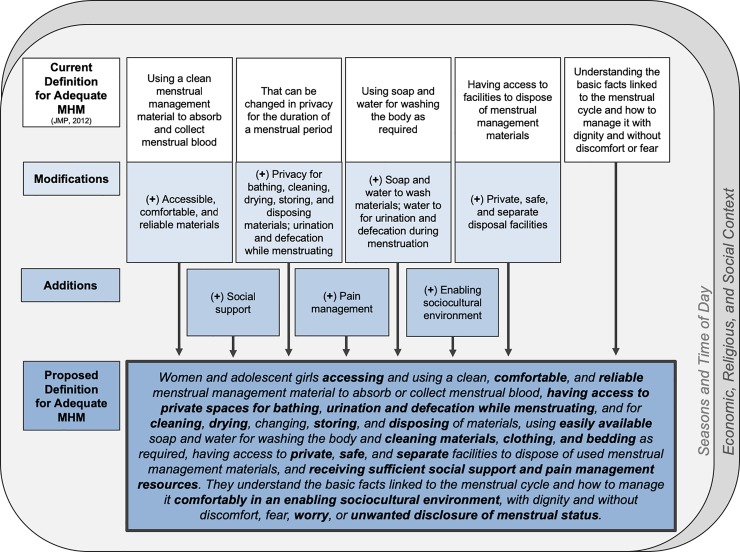
There has been growing recognition of menstrual hygiene management (MHM) as a significant public health issue. However, research has predominately focused on the experiences of adolescent girls in school settings. The purpose of this research is to examine detailed accounts of menstruation for women in rural Odisha, India at various life stages with a view toward improving international monitoring of MHM. Focus group discussions and in-depth interviews were conducted to understand women's experiences of menstruation across four life stages (unmarried women, recently married women, married women, and older women). Thematic analysis was used to identify menstruation-related challenges and needs. We found women voiced needs that aligned with those captured by the WHO/UNICEF Joint Monitoring Programme for Water Supply, Sanitation and Hygiene (JMP) definition for MHM: access to clean materials, privacy for changing materials, soap and water for bathing, and disposal facilities for materials. However, we also found women require materials that are not only clean but comfortable and reliable; soap and water for more than bathing; privacy for the full spectrum of menstruation-related practices, not just when changing; and disposal facilities that are private and safe, not just accessible. Additionally, we identified needs that extend beyond the existing definition: pain management, social support, and an enabling sociocultural environment. Overall, women representing all life stages discussed menstruation challenges, including bathing, pain, and washing, drying, and storing cloth materials. Cloth management challenges were most acute for unmarried and recently married women, who were concerned that practices could reveal their menstrual status and harm their reputations, thus informing their preference for disposable materials, if attainable. We propose a revised definition of adequate MHM for this population that more comprehensively captures their needs. This definition may also prove useful for other populations, future research, creating measures of assessment, and guiding interventions and program priorities.
Overview
AI snapshot
Written from the paper’s full text.
TL;DR
This qualitative study in rural Odisha, India, finds women across life stages face the menstrual hygiene management (MHM) challenges captured by the WHO/UNICEF JMP definition, but also need comfortable and reliable materials, broader privacy, private and safe disposal, pain management, social support, and an enabling sociocultural environment. The authors propose a revised, expanded definition of adequate MHM for this population.
Key findings
- Women’s needs aligned with the JMP definition—clean materials, privacy for changing, soap and water for bathing, and disposal facilities—but extended beyond it: materials needed to be comfortable and reliable; soap and water were needed for washing clothing, bedding, and materials and for managing urination/defecation; privacy was needed for bathing, washing, drying, storing, disposing, urination, and defecation; disposal needed to be private and safe; and pain management, social support, and an enabling sociocultural environment were additional needs.
- Cloth use was common: 54% of FLI and 54% of FGD participants used cloth; exclusive cloth use was reported by 68% of married women in FLIs and 87% in FGDs, and by 94% of older women in FLIs and 100% in FGDs. A mix of cloth and pads was most common among unmarried women (63% FLIs, 52% FGDs) and recently married women (67% FLIs), while exclusive pad use was a minority (13% FLIs, 18% FGDs).
- Among menstruating women with latrines, 66% of FLI and 100% of FGD participants claimed to use latrines during menstruation, but activity-specific use was low: 94% of FLI and 62% of FGD participants never used latrines for urination; 94% of FLIs and 95% of FGDs never for bathing; 79% of FLIs and 63% of FGDs never for cleaning; and 80% of FLIs and 71% of FGDs never for changing materials.
- Cloth management challenges were most acute for unmarried and recently married women, who worried that practices could reveal their menstrual status and harm their reputations, informing a preference for disposable pads if attainable. Women in all life stages discussed bathing, pain, and washing, drying, and storing cloth, and older women no longer menstruating still reported these issues as persistent.
Methods
- Qualitative study conducted in 12 rural Odisha communities in March–April 2014 as part of a broader sanitation study; participants were over age 18 and purposively sampled by life stage: unmarried women, recently married women (past 3 years), married women (over 3 years), and older women (over 49).
- Data included 68 of 69 free-list interviews (16 unmarried, 12 recently married, 22 married, 18 older) and 8 focus group discussions with 46 participants (23 unmarried, 16 married, 7 older; recently married women did not participate in FGDs because family members did not give permission). FLIs were conducted in 8 communities and FGDs in 4; a brief demographic and menstruation survey preceded each.
- Interviews and FGDs were recorded, translated and transcribed into English, managed and coded in MAXQDA with a deductive and inductive codebook, and analyzed using thematic analysis by life stage; results were presented using the JMP MHM framework, and a revised definition and conceptual framework were proposed.
Limitations
- The paper states that the study engaged rural women in Odisha exclusively, so findings are limited to this population; it did not intentionally sample castes equally or include specific caste questions; recently married women did not participate in FGDs, though 12 were interviewed in FLIs; FGDs had mixed-caste groups, which may have affected openness; not all caste categories were represented for each life stage; and adolescent girls were not included.
- The paper also states that older women were no longer menstruating and provided retrospective insights, and that the research could not compare adolescent girls’ experiences with those of the women studied.
- Evident from the text: the design is cross-sectional and qualitative, relying on self-reported experiences of a sensitive topic, which may invite social desirability bias; no quantitative measures or causal inferences are made, and findings may not generalize beyond this population and context.
Model-written summary. Check it against the paper before relying on it.
Integrity signals
Registry
Cites
Statistics
Figures
Verification
Claims the paper makes
84 Own result · 50 Not checked yet · 28 Own interpretation · 20 Own method · 4 No basis given
A result the paper reports from its own data — it cites no other source for it, so there is none to check. The quote shows it is in the paper.
In the paper
“However, we also found women require materials that are not only clean but comfortable and reliable; soap and water for more than bathing; privacy for the full spectrum of menstruation-related practices, not just when changing; and disposal facilities that are private and safe, not just accessible.”
§ 'It’s like a burden on the head': Redefining adequate menstrual hygiene management throughout women’s varied life stages in Odisha, India > Abstract
plain- Asserted: passes — The authors put it forward as true.
- Checkable: passes — It can be checked against evidence.
- Load-bearing: passes — The paper’s conclusions depend on it.
- Based: passes — The paper gives a reason why it holds.
A result the paper reports from its own data — it cites no other source for it, so there is none to check. The quote shows it is in the paper.
In the paper
“Cloth management challenges were most acute for unmarried and recently married women, who were concerned that practices could reveal their menstrual status and harm their reputations, thus informing their preference for disposable materials, if attainable.”
§ 'It’s like a burden on the head': Redefining adequate menstrual hygiene management throughout women’s varied life stages in Odisha, India > Abstract
plain- Asserted: passes — The authors put it forward as true.
- Checkable: passes — It can be checked against evidence.
- Load-bearing: passes — The paper’s conclusions depend on it.
- Based: passes — The paper gives a reason why it holds.
- The authors state this as an assumption: The four life stage categories (unmarried, recently married, married, older) capture diversity of MHM experience.
A result the paper reports from its own data — it cites no other source for it, so there is none to check. The quote shows it is in the paper.
In the paper
“However, we also found women require materials that are not only clean but comfortable and reliable; soap and water for more than bathing; privacy for the full spectrum of menstruation-related practices, not just when changing; and disposal facilities that are private and safe, not just accessible.”
§ 'It’s like a burden on the head': Redefining adequate menstrual hygiene management throughout women’s varied life stages in Odisha, India > Abstract
plain- Asserted: passes — The authors put it forward as true.
- Checkable: passes — It can be checked against evidence.
- Load-bearing: passes — The paper’s conclusions depend on it.
- Based: passes — The paper gives a reason why it holds.
A result the paper reports from its own data — it cites no other source for it, so there is none to check. The quote shows it is in the paper.
In the paper
“Additionally, we identified needs that extend beyond the existing definition: pain management, social support, and an enabling sociocultural environment.”
§ 'It’s like a burden on the head': Redefining adequate menstrual hygiene management throughout women’s varied life stages in Odisha, India > Abstract
plain- Asserted: passes — The authors put it forward as true.
- Checkable: passes — It can be checked against evidence.
- Load-bearing: passes — The paper’s conclusions depend on it.
- Based: passes — The paper gives a reason why it holds.
A result the paper reports from its own data — it cites no other source for it, so there is none to check. The quote shows it is in the paper.
In the paper
“However, we also found women require materials that are not only clean but comfortable and reliable; soap and water for more than bathing; privacy for the full spectrum of menstruation-related practices, not just when changing; and disposal facilities that are private and safe, not just accessible.”
§ 'It’s like a burden on the head': Redefining adequate menstrual hygiene management throughout women’s varied life stages in Odisha, India > Abstract
plain- Asserted: passes — The authors put it forward as true.
- Checkable: passes — It can be checked against evidence.
- Load-bearing: passes — The paper’s conclusions depend on it.
- Based: passes — The paper gives a reason why it holds.
A result the paper reports from its own data — it cites no other source for it, so there is none to check. The quote shows it is in the paper.
In the paper
“We found women voiced needs that aligned with those captured by the WHO/UNICEF Joint Monitoring Programme for Water Supply, Sanitation and Hygiene (JMP) definition for MHM: access to clean materials, privacy for changing materials, soap and water for bathing, and disposal facilities for materials.”
§ 'It’s like a burden on the head': Redefining adequate menstrual hygiene management throughout women’s varied life stages in Odisha, India > Abstract
plaincorrelational- Asserted: passes — The authors put it forward as true.
- Checkable: passes — It can be checked against evidence.
- Load-bearing: passes — The paper’s conclusions depend on it.
- Based: passes — The paper gives a reason why it holds.
A result the paper reports from its own data — it cites no other source for it, so there is none to check. The quote shows it is in the paper.
In the paper
“Additionally, we identified needs that extend beyond the existing definition: pain management, social support, and an enabling sociocultural environment.”
§ 'It’s like a burden on the head': Redefining adequate menstrual hygiene management throughout women’s varied life stages in Odisha, India > Abstract
plain- Asserted: passes — The authors put it forward as true.
- Checkable: passes — It can be checked against evidence.
- Load-bearing: passes — The paper’s conclusions depend on it.
- Based: passes — The paper gives a reason why it holds.
A result the paper reports from its own data — it cites no other source for it, so there is none to check. The quote shows it is in the paper.
In the paper
“However, we also found women require materials that are not only clean but comfortable and reliable; soap and water for more than bathing; privacy for the full spectrum of menstruation-related practices, not just when changing; and disposal facilities that are private and safe, not just accessible.”
§ 'It’s like a burden on the head': Redefining adequate menstrual hygiene management throughout women’s varied life stages in Odisha, India > Abstract
plain- Asserted: passes — The authors put it forward as true.
- Checkable: passes — It can be checked against evidence.
- Load-bearing: passes — The paper’s conclusions depend on it.
- Based: passes — The paper gives a reason why it holds.
A result the paper reports from its own data — it cites no other source for it, so there is none to check. The quote shows it is in the paper.
In the paper
“Women often felt dirty from washing their cloth.”
§ 'It’s like a burden on the head': Redefining adequate menstrual hygiene management throughout women’s varied life stages in Odisha, India > Results > Concerns extending beyond JMP definition
plain- Asserted: passes — The authors put it forward as true.
- Checkable: passes — It can be checked against evidence.
- Load-bearing: unclear — It is unclear whether the paper’s conclusions depend on it.
- Based: passes — The paper gives a reason why it holds.
- The quote only partly states this claim. 2
- It may state two separate claims as one. 68
- Probably not a substantial claim. 53
A result the paper reports from its own data — it cites no other source for it, so there is none to check. The quote shows it is in the paper.
In the paper
“Overall, women representing all life stages discussed menstruation challenges, including bathing, pain, and washing, drying, and storing cloth materials.”
§ 'It’s like a burden on the head': Redefining adequate menstrual hygiene management throughout women’s varied life stages in Odisha, India > Abstract
plain- Asserted: passes — The authors put it forward as true.
- Checkable: passes — It can be checked against evidence.
- Load-bearing: passes — The paper’s conclusions depend on it.
- Based: passes — The paper gives a reason why it holds.
The quote only partly states this claim.
- The authors state this as an assumption: The four life stage categories (unmarried, recently married, married, older) capture diversity of MHM experience.
A result the paper reports from its own data — it cites no other source for it, so there is none to check. The quote shows it is in the paper.
In the paper
“Cloth management challenges were most acute for unmarried and recently married women, who were concerned that practices could reveal their menstrual status and harm their reputations, thus informing their preference for disposable materials, if attainable.”
§ 'It’s like a burden on the head': Redefining adequate menstrual hygiene management throughout women’s varied life stages in Odisha, India > Abstract
plaincorrelational- Asserted: passes — The authors put it forward as true.
- Checkable: passes — It can be checked against evidence.
- Load-bearing: passes — The paper’s conclusions depend on it.
- Based: passes — The paper gives a reason why it holds.
The quote only partly states this claim.
- The authors state this as an assumption: The four life stage categories (unmarried, recently married, married, older) capture diversity of MHM experience.
A result the paper reports from its own data — it cites no other source for it, so there is none to check. The quote shows it is in the paper.
In the paper
“Women needed others to retrieve water for them; they were not allowed to touch water given perceptions that doing so during this state would contaminate the water source.”
§ 'It’s like a burden on the head': Redefining adequate menstrual hygiene management throughout women’s varied life stages in Odisha, India > Results > Requirements for menstrual hygiene management according to the JMP
plaindirect- Asserted: passes — The authors put it forward as true.
- Checkable: passes — It can be checked against evidence.
- Load-bearing: unclear — It is unclear whether the paper’s conclusions depend on it.
- Based: passes — The paper gives a reason why it holds.
It may state two separate claims as one.
A result the paper reports from its own data — it cites no other source for it, so there is none to check. The quote shows it is in the paper.
In the paper
“Materials impacted women’s management of other needs, frustrating the processes of urinating and defecating.”
§ 'It’s like a burden on the head': Redefining adequate menstrual hygiene management throughout women’s varied life stages in Odisha, India > Results > Concerns extending beyond JMP definition
plaindirect- Asserted: passes — The authors put it forward as true.
- Checkable: passes — It can be checked against evidence.
- Load-bearing: passes — The paper’s conclusions depend on it.
- Based: passes — The paper gives a reason why it holds.
It may state two separate claims as one.
The paper states this without a source or data behind it here, so there is nothing to check it against. The quote shows it is in the paper.
In the paper
“Specifically, women’s material use varied by life stage, but the manner in which they used their latrines during menstruation was fairly uniform.”
§ 'It’s like a burden on the head': Redefining adequate menstrual hygiene management throughout women’s varied life stages in Odisha, India > Results > Menstruation experiences by life stage
plain- Asserted: passes — The authors put it forward as true.
- Checkable: passes — It can be checked against evidence.
- Load-bearing: unclear — It is unclear whether the paper’s conclusions depend on it.
- Based: passes — The paper gives a reason why it holds.
It may state two separate claims as one.
- The authors state this as an assumption: The four life stage categories (unmarried, recently married, married, older) capture diversity of MHM experience.
A result the paper reports from its own data — it cites no other source for it, so there is none to check. The quote shows it is in the paper.
In the paper
“Beyond the absence of specific disposal facilities, women perceived harms connected to their lack of privacy for disposal and took specific steps to mitigate those harms.”
§ 'It’s like a burden on the head': Redefining adequate menstrual hygiene management throughout women’s varied life stages in Odisha, India > Results > Concerns extending beyond JMP definition
plaincorrelational- Asserted: passes — The authors put it forward as true.
- Checkable: passes — It can be checked against evidence.
- Load-bearing: passes — The paper’s conclusions depend on it.
- Based: passes — The paper gives a reason why it holds.
It may state two separate claims as one.
A result the paper reports from its own data — it cites no other source for it, so there is none to check. The quote shows it is in the paper.
In the paper
“Seasons further complicated private drying practices. Women found drying cloth during the summers to be quick, allowing for more regular washing, but were concerned about drying materials during monsoons. Cloth would not dry if outside in the rain, protected places to dry cloth were limited, and cloth could become dirty again due to weather conditions:”
§ 'It’s like a burden on the head': Redefining adequate menstrual hygiene management throughout women’s varied life stages in Odisha, India > Results > Concerns extending beyond JMP definition
plaindirect- Asserted: passes — The authors put it forward as true.
- Checkable: passes — It can be checked against evidence.
- Load-bearing: unclear — It is unclear whether the paper’s conclusions depend on it.
- Based: passes — The paper gives a reason why it holds.
It may state two separate claims as one.
A result the paper reports from its own data — it cites no other source for it, so there is none to check. The quote shows it is in the paper.
In the paper
“Sixty-nine percent of FLI participants and 80% of FGD participants were still experiencing monthly menstruation at the time of the study (Table 2)”
§ 'It’s like a burden on the head': Redefining adequate menstrual hygiene management throughout women’s varied life stages in Odisha, India > Results > Participant characteristics
plain- Asserted: passes — The authors put it forward as true.
- Checkable: passes — It can be checked against evidence.
- Load-bearing: fails — The paper’s conclusions may not depend on it.
- Based: passes — The paper gives a reason why it holds.
Probably not a substantial claim. The paper’s conclusions may not depend on it. It may state two separate claims as one.
A result the paper reports from its own data — it cites no other source for it, so there is none to check. The quote shows it is in the paper.
In the paper
“The use of pads depended on availability and accessibility, as many women could not purchase pads, due to markets being as far as 5–6 kilometers away, or had household level economic restrictions:”
§ 'It’s like a burden on the head': Redefining adequate menstrual hygiene management throughout women’s varied life stages in Odisha, India > Results > Concerns extending beyond JMP definition
plaindirect- Asserted: passes — The authors put it forward as true.
- Checkable: passes — It can be checked against evidence.
- Load-bearing: passes — The paper’s conclusions depend on it.
- Based: passes — The paper gives a reason why it holds.
It may state two separate claims as one.
A result the paper reports from its own data — it cites no other source for it, so there is none to check. The quote shows it is in the paper.
In the paper
“Women understood that drying cloth in the sunlight could prevent germs from developing on the cloth that may result in infection, yet the need to hide cloths prevented this practice.”
§ 'It’s like a burden on the head': Redefining adequate menstrual hygiene management throughout women’s varied life stages in Odisha, India > Results > Concerns extending beyond JMP definition
hedgedconditional- Asserted: passes — The authors put it forward as true.
- Checkable: passes — It can be checked against evidence.
- Load-bearing: passes — The paper’s conclusions depend on it.
- Based: passes — The paper gives a reason why it holds.
It may state two separate claims as one.
A result the paper reports from its own data — it cites no other source for it, so there is none to check. The quote shows it is in the paper.
In the paper
“A few women mentioned challenges accessing soap: one MW reflected on the absence of soap during menstruation and three other women (one RMW, two MW) expressed financial restrictions related to buying soap.”
§ 'It’s like a burden on the head': Redefining adequate menstrual hygiene management throughout women’s varied life stages in Odisha, India > Results > Requirements for menstrual hygiene management according to the JMP
plainn = 3- Asserted: passes — The authors put it forward as true.
- Checkable: passes — It can be checked against evidence.
- Load-bearing: unclear — It is unclear whether the paper’s conclusions depend on it.
- Based: passes — The paper gives a reason why it holds.
It may state two separate claims as one.
A result the paper reports from its own data — it cites no other source for it, so there is none to check. The quote shows it is in the paper.
In the paper
“All groups expressed concerns about washing, drying, and storing cloth used for menstruation, along with managing bathing practices during menstruation.”
§ 'It’s like a burden on the head': Redefining adequate menstrual hygiene management throughout women’s varied life stages in Odisha, India > Results > Menstruation experiences by life stage
plain- Asserted: passes — The authors put it forward as true.
- Checkable: passes — It can be checked against evidence.
- Load-bearing: unclear — It is unclear whether the paper’s conclusions depend on it.
- Based: passes — The paper gives a reason why it holds.
It may state two separate claims as one.
A result the paper reports from its own data — it cites no other source for it, so there is none to check. The quote shows it is in the paper.
In the paper
“Generally, women felt cloth was problematic to clean, dry, and store, and wanted to use pads instead, which could be disposed of after use.”
§ 'It’s like a burden on the head': Redefining adequate menstrual hygiene management throughout women’s varied life stages in Odisha, India > Results > Requirements for menstrual hygiene management according to the JMP
plain- Asserted: passes — The authors put it forward as true.
- Checkable: passes — It can be checked against evidence.
- Load-bearing: unclear — It is unclear whether the paper’s conclusions depend on it.
- Based: passes — The paper gives a reason why it holds.
It may state two separate claims as one.
A result the paper reports from its own data — it cites no other source for it, so there is none to check. The quote shows it is in the paper.
In the paper
“Exclusive use of disposable pads was reported by only a minority of participants (13% in FLIs, 18% in FGDs), most often by unmarried (13% in FLIs, 35% in FGDs) and recently married (25% in FLIs) women.”
§ 'It’s like a burden on the head': Redefining adequate menstrual hygiene management throughout women’s varied life stages in Odisha, India > Results > Menstruation experiences by life stage
plaincorrelational- Asserted: passes — The authors put it forward as true.
- Checkable: passes — It can be checked against evidence.
- Load-bearing: unclear — It is unclear whether the paper’s conclusions depend on it.
- Based: passes — The paper gives a reason why it holds.
It may state two separate claims as one.
A result the paper reports from its own data — it cites no other source for it, so there is none to check. The quote shows it is in the paper.
In the paper
“Women worried cloth would change positions, fall out of their underwear, or become saturated while moving or sleeping, causing stains on clothes and bedding.”
§ 'It’s like a burden on the head': Redefining adequate menstrual hygiene management throughout women’s varied life stages in Odisha, India > Results > Concerns extending beyond JMP definition
plain- Asserted: passes — The authors put it forward as true.
- Checkable: passes — It can be checked against evidence.
- Load-bearing: passes — The paper’s conclusions depend on it.
- Based: passes — The paper gives a reason why it holds.
It may state two separate claims as one.
A result the paper reports from its own data — it cites no other source for it, so there is none to check. The quote shows it is in the paper.
In the paper
“Beyond the need for privacy to change materials, women articulated the desire for privacy for bathing, washing, drying, storing, and disposing of materials, urination, and defecation.”
§ 'It’s like a burden on the head': Redefining adequate menstrual hygiene management throughout women’s varied life stages in Odisha, India > Results > Concerns extending beyond JMP definition
plain- Asserted: passes — The authors put it forward as true.
- Checkable: passes — It can be checked against evidence.
- Load-bearing: passes — The paper’s conclusions depend on it.
- Based: passes — The paper gives a reason why it holds.
It may state two separate claims as one.
A result the paper reports from its own data — it cites no other source for it, so there is none to check. The quote shows it is in the paper.
In the paper
“Overall, according to the pre-qualitative survey, 54% of women in FLIs and 54% of women in FGDs indicated that they used cloth for managing menstruation”
§ 'It’s like a burden on the head': Redefining adequate menstrual hygiene management throughout women’s varied life stages in Odisha, India > Results > Menstruation experiences by life stage
hedged- Asserted: passes — The authors put it forward as true.
- Checkable: passes — It can be checked against evidence.
- Load-bearing: unclear — It is unclear whether the paper’s conclusions depend on it.
- Based: passes — The paper gives a reason why it holds.
It may state two separate claims as one.
A result the paper reports from its own data — it cites no other source for it, so there is none to check. The quote shows it is in the paper.
In the paper
“Women wanted to hide their cloth from men to prevent shame and, in doing so, felt they may be using dirty, germ-infested locations:”
§ 'It’s like a burden on the head': Redefining adequate menstrual hygiene management throughout women’s varied life stages in Odisha, India > Results > Concerns extending beyond JMP definition
hedgedconditional- Asserted: passes — The authors put it forward as true.
- Checkable: passes — It can be checked against evidence.
- Load-bearing: passes — The paper’s conclusions depend on it.
- Based: passes — The paper gives a reason why it holds.
It may state two separate claims as one.
A result the paper reports from its own data — it cites no other source for it, so there is none to check. The quote shows it is in the paper.
In the paper
“Women in this study had many questions about the menstrual cycle. They sought clarity about pain and menstrual irregularity and worried that something might be wrong with their bodies.”
§ 'It’s like a burden on the head': Redefining adequate menstrual hygiene management throughout women’s varied life stages in Odisha, India > Results > Requirements for menstrual hygiene management according to the JMP
plain- Asserted: passes — The authors put it forward as true.
- Checkable: passes — It can be checked against evidence.
- Load-bearing: unclear — It is unclear whether the paper’s conclusions depend on it.
- Based: passes — The paper gives a reason why it holds.
It may state two separate claims as one.
A result the paper reports from its own data — it cites no other source for it, so there is none to check. The quote shows it is in the paper.
In the paper
“Concerns about access to materials were primarily expressed by UMW and RWM as they, more than MW and OW, preferred pads. Much of this preference stemmed from challenges related to cleaning, drying, and storing reusable cloth.”
§ 'It’s like a burden on the head': Redefining adequate menstrual hygiene management throughout women’s varied life stages in Odisha, India > Results > Menstruation experiences by life stage
plaindirect- Asserted: passes — The authors put it forward as true.
- Checkable: passes — It can be checked against evidence.
- Load-bearing: unclear — It is unclear whether the paper’s conclusions depend on it.
- Based: passes — The paper gives a reason why it holds.
It may state two separate claims as one.
A result the paper reports from its own data — it cites no other source for it, so there is none to check. The quote shows it is in the paper.
In the paper
“Women in this study did not report accessing specific facilities for disposal. Rather, they disposed of their menstrual materials in a variety of places outside of the home and in the surrounding environment, including the pond, river, jungle, or buried in the ground.”
§ 'It’s like a burden on the head': Redefining adequate menstrual hygiene management throughout women’s varied life stages in Odisha, India > Results > Requirements for menstrual hygiene management according to the JMP
plain- Asserted: passes — The authors put it forward as true.
- Checkable: passes — It can be checked against evidence.
- Load-bearing: unclear — It is unclear whether the paper’s conclusions depend on it.
- Based: passes — The paper gives a reason why it holds.
It may state two separate claims as one.
A result the paper reports from its own data — it cites no other source for it, so there is none to check. The quote shows it is in the paper.
In the paper
“Women also worried cloth would become dirty between periods and came up with practices for storing and assuring cloth cleanliness before use:”
§ 'It’s like a burden on the head': Redefining adequate menstrual hygiene management throughout women’s varied life stages in Odisha, India > Results > Requirements for menstrual hygiene management according to the JMP
plaindirect- Asserted: passes — The authors put it forward as true.
- Checkable: passes — It can be checked against evidence.
- Load-bearing: unclear — It is unclear whether the paper’s conclusions depend on it.
- Based: passes — The paper gives a reason why it holds.
It may state two separate claims as one.
A result the paper reports from its own data — it cites no other source for it, so there is none to check. The quote shows it is in the paper.
In the paper
“RMW faced specific barriers to pad access. Due to mobility restrictions, one RMW depended on others to purchase pads and because she felt embarrassed to request them, she used cloth available at the house. Another RMW had to switch to using cloths after marriage because she moved to a new village that did not sell pads.”
§ 'It’s like a burden on the head': Redefining adequate menstrual hygiene management throughout women’s varied life stages in Odisha, India > Results > Concerns extending beyond JMP definition
plaindirect- Asserted: passes — The authors put it forward as true.
- Checkable: passes — It can be checked against evidence.
- Load-bearing: unclear — It is unclear whether the paper’s conclusions depend on it.
- Based: passes — The paper gives a reason why it holds.
It may state two separate claims as one.
A result the paper reports from its own data — it cites no other source for it, so there is none to check. The quote shows it is in the paper.
In the paper
“However none of the older women (over age 49) were still experiencing menstruation, but still provided insights about their experiences when they were menstruating.”
§ 'It’s like a burden on the head': Redefining adequate menstrual hygiene management throughout women’s varied life stages in Odisha, India > Results > Participant characteristics
plain- Asserted: passes — The authors put it forward as true.
- Checkable: passes — It can be checked against evidence.
- Load-bearing: fails — The paper’s conclusions may not depend on it.
- Based: passes — The paper gives a reason why it holds.
Probably not a substantial claim. The paper’s conclusions may not depend on it. It may state two separate claims as one.
A result the paper reports from its own data — it cites no other source for it, so there is none to check. The quote shows it is in the paper.
In the paper
“this included all participants who were unmarried and recently married, and the majority of women married over three years (86% in FLIs, 88% in FGDs).”
§ 'It’s like a burden on the head': Redefining adequate menstrual hygiene management throughout women’s varied life stages in Odisha, India > Results > Participant characteristics
plain- Asserted: passes — The authors put it forward as true.
- Checkable: passes — It can be checked against evidence.
- Load-bearing: unclear — It is unclear whether the paper’s conclusions depend on it.
- Based: passes — The paper gives a reason why it holds.
It may state two separate claims as one.
A result the paper reports from its own data — it cites no other source for it, so there is none to check. The quote shows it is in the paper.
In the paper
“Some women expressed how this pain negatively affected their ability to complete regular household tasks (e.g., cook, harvest crops), maintain healthy behaviors such as eating and sleeping, move normally (e.g., ride a bike), and care for their children, which could further result in “tension” or stress:”
§ 'It’s like a burden on the head': Redefining adequate menstrual hygiene management throughout women’s varied life stages in Odisha, India > Results > Concerns extending beyond JMP definition
hedgeddirect- Asserted: passes — The authors put it forward as true.
- Checkable: passes — It can be checked against evidence.
- Load-bearing: passes — The paper’s conclusions depend on it.
- Based: passes — The paper gives a reason why it holds.
It may state two separate claims as one.
A result the paper reports from its own data — it cites no other source for it, so there is none to check. The quote shows it is in the paper.
In the paper
“Women in Odisha were specifically concerned about the reliability of materials to prevent leaks and stains, the comfort or lack thereof that they may experience, and compatibility of their materials with other daily needs, including mobility, work, urination, and defecation.”
§ 'It’s like a burden on the head': Redefining adequate menstrual hygiene management throughout women’s varied life stages in Odisha, India > Discussion
plain- Asserted: passes — The authors put it forward as true.
- Checkable: passes — It can be checked against evidence.
- Load-bearing: passes — The paper’s conclusions depend on it.
- Based: passes — The paper gives a reason why it holds.
It may state two separate claims as one.
A result the paper reports from its own data — it cites no other source for it, so there is none to check. The quote shows it is in the paper.
In the paper
“Women experienced discomfort using a cloth–it smelled and felt thick and heavy in their underwear–making sitting and standing difficult.”
§ 'It’s like a burden on the head': Redefining adequate menstrual hygiene management throughout women’s varied life stages in Odisha, India > Results > Concerns extending beyond JMP definition
plaindirect- Asserted: passes — The authors put it forward as true.
- Checkable: passes — It can be checked against evidence.
- Load-bearing: passes — The paper’s conclusions depend on it.
- Based: passes — The paper gives a reason why it holds.
It may state two separate claims as one.
A result the paper reports from its own data — it cites no other source for it, so there is none to check. The quote shows it is in the paper.
In the paper
“Women of all life stages required the support and physical assistance of others during menstruation, which is not accounted for in the JMP definition:”
§ 'It’s like a burden on the head': Redefining adequate menstrual hygiene management throughout women’s varied life stages in Odisha, India > Results > Concerns extending beyond JMP definition
plain- Asserted: passes — The authors put it forward as true.
- Checkable: passes — It can be checked against evidence.
- Load-bearing: passes — The paper’s conclusions depend on it.
- Based: passes — The paper gives a reason why it holds.
It may state two separate claims as one.
A result the paper reports from its own data — it cites no other source for it, so there is none to check. The quote shows it is in the paper.
In the paper
“Additionally, women were restricted from participating in puja, daily rituals in the home performed by women, during menstruation and needed others to perform it on their behalf:”
§ 'It’s like a burden on the head': Redefining adequate menstrual hygiene management throughout women’s varied life stages in Odisha, India > Results > Concerns extending beyond JMP definition
plaindirectSingle case- Asserted: passes — The authors put it forward as true.
- Checkable: passes — It can be checked against evidence.
- Load-bearing: unclear — It is unclear whether the paper’s conclusions depend on it.
- Based: passes — The paper gives a reason why it holds.
It may state two separate claims as one.
A result the paper reports from its own data — it cites no other source for it, so there is none to check. The quote shows it is in the paper.
In the paper
“Women were restricted from entering the kitchen, preparing food, and touching utensils while menstruating, so others in the household completed this work.”
§ 'It’s like a burden on the head': Redefining adequate menstrual hygiene management throughout women’s varied life stages in Odisha, India > Results > Concerns extending beyond JMP definition
plaindirect- Asserted: passes — The authors put it forward as true.
- Checkable: passes — It can be checked against evidence.
- Load-bearing: passes — The paper’s conclusions depend on it.
- Based: passes — The paper gives a reason why it holds.
It may state two separate claims as one.
A result the paper reports from its own data — it cites no other source for it, so there is none to check. The quote shows it is in the paper.
In the paper
“Unmarried and recently married women in this population face social and financial restrictions to acquiring pads, requiring them to seek support to get materials they want.”
§ 'It’s like a burden on the head': Redefining adequate menstrual hygiene management throughout women’s varied life stages in Odisha, India > Discussion
plaindirect- Asserted: passes — The authors put it forward as true.
- Checkable: passes — It can be checked against evidence.
- Load-bearing: passes — The paper’s conclusions depend on it.
- Based: passes — The paper gives a reason why it holds.
It may state two separate claims as one.
A result the paper reports from its own data — it cites no other source for it, so there is none to check. The quote shows it is in the paper.
In the paper
“Women provided detailed accounts of physical pain during menstruation, including both menstrual pain and the previously noted pain from uncomfortable materials, which affected women’s ability to move, work, and eat normally.”
§ 'It’s like a burden on the head': Redefining adequate menstrual hygiene management throughout women’s varied life stages in Odisha, India > Discussion
plaindirect- Asserted: passes — The authors put it forward as true.
- Checkable: passes — It can be checked against evidence.
- Load-bearing: passes — The paper’s conclusions depend on it.
- Based: passes — The paper gives a reason why it holds.
It may state two separate claims as one.
A result the paper reports from its own data — it cites no other source for it, so there is none to check. The quote shows it is in the paper.
In the paper
“However, our findings present another dimension of inadequate information about menstruation, specifically regarding irregularity and menstrual pain, both of which led to fear and worry for women in this study that something was wrong with their bodies.”
§ 'It’s like a burden on the head': Redefining adequate menstrual hygiene management throughout women’s varied life stages in Odisha, India > Discussion
plaindirect- Asserted: passes — The authors put it forward as true.
- Checkable: passes — It can be checked against evidence.
- Load-bearing: passes — The paper’s conclusions depend on it.
- Based: passes — The paper gives a reason why it holds.
It may state two separate claims as one.
A result the paper reports from its own data — it cites no other source for it, so there is none to check. The quote shows it is in the paper.
In the paper
“Women in this study experienced a range of restrictions during menstruation and relied on others to manage their household and menstruation-related obligations.”
§ 'It’s like a burden on the head': Redefining adequate menstrual hygiene management throughout women’s varied life stages in Odisha, India > Discussion
plain- Asserted: passes — The authors put it forward as true.
- Checkable: passes — It can be checked against evidence.
- Load-bearing: passes — The paper’s conclusions depend on it.
- Based: passes — The paper gives a reason why it holds.
It may state two separate claims as one.
A conclusion the paper draws from its own results — it cites no other source for it, so there is none to check. The quote shows it is in the paper.
In the paper
“We propose a revised definition of adequate MHM for this population that more comprehensively captures their needs.”
§ 'It’s like a burden on the head': Redefining adequate menstrual hygiene management throughout women’s varied life stages in Odisha, India > Abstract
plain- Asserted: passes — The authors put it forward as true.
- Checkable: fails — It may be too vague to check against evidence.
- Load-bearing: passes — The paper’s conclusions depend on it.
- Based: passes — The paper gives a reason why it holds.
Probably not a substantial claim. It may be too vague to check against evidence.
- The authors state this as an assumption: The four life stage categories (unmarried, recently married, married, older) capture diversity of MHM experience.
- Rests on an assumption: The JMP definition is a valid benchmark for assessing MHM needs in this population.
None of the sources cited for this claim have been checked yet.
In the paper
“Structural challenges include inadequate provision of clean water and soap, sanitation infrastructure, private places to clean and change, and disposal facilities [7, 8, 11–22].”
§ 'It’s like a burden on the head': Redefining adequate menstrual hygiene management throughout women’s varied life stages in Odisha, India > Introduction
What the sources say
- Not checked yetcites [7] M Sommer, 2013, Overcoming the taboo: advancing the global agenda for menstrual hygiene management for schoolgirls, Am J Public Health source
- Not checked yetcites [8] AM van Eijk, 2016, Menstrual hygiene management among adolescent girls in India: a systematic review and meta-analysis, BMJ open source
- Not checked yetcites [11] M Sommer, 2015, Comfortably, Safely, and Without Shame: Defining Menstrual Hygiene Management as a Public Health Issue, Am J Public Health source
- Not checked yetcites [12] M Sommer, 2014, A comparison of the menstruation and education experiences of girls in Tanzania, Ghana, Cambodia and Ethiopia, Compare: A Journal of Comparative and International Education source
- Not checked yetcites [13] J Haver, 2013, WASH in Schools Empowers Girls' Education in Masbate Province and Metro Manila, Philippines An Assessment of Menstrual Hygiene Management in Schools, WASH in Schools Empowers Girls' Education in Masbate Province and Metro Manila, Philippines An Assessment of Menstrual Hygiene Management in Schools
- Not checked yetcites [14] LC Loughnan, 2016, What can existing data on water and sanitation tell us about menstrual hygiene management?, Waterlines source
- Not checked yetcites [15] UNICEF. WASH in Schools Empowers Girls’ Education: Proceedings of the Menstrual Hygiene Management in Schools Virtual Conference. 2014.
- Not checked yetcites [16] UNICEF. WASH in Schools Empowers Girls’ Education: Proceedings of the Menstrual Hygiene Management in Schools Virtual Conference. 2012.
- Not checked yetcites [17] UNICEF. WASH in Schools Empowers Girls’ Education: Proceedings of the Menstrual Hygiene Management in Schools Virtual Conference. 2013.
- Not checked yetcites [18] UNICEF. WASH in Schools Empowers Girls’ Education: Proceedings of the Menstrual Hygiene Management in Schools Virtual Conference. 2015.
plain- Asserted: passes — The authors put it forward as true.
- Checkable: passes — It can be checked against evidence.
- Load-bearing: unclear — It is unclear whether the paper’s conclusions depend on it.
- Based: passes — The paper gives a reason why it holds.
It may state two separate claims as one.
None of the sources cited for this claim have been checked yet.
In the paper
“Experiencing menstruation without proper structural environments, resources, information, and support may impact women and girls’ sense of agency, self-esteem, confidence, bodily autonomy, educational experiences, and influence participation in and negative health outcomes associated with risky sexual behaviors [1–10].”
§ 'It’s like a burden on the head': Redefining adequate menstrual hygiene management throughout women’s varied life stages in Odisha, India > Introduction
What the sources say
- Not checked yetcites [1] PA Phillips-Howard, 2016, Menstrual hygiene management among adolescent schoolgirls in low- and middle-income countries: research priorities, Global health action source
- Not checked yetcites [2] M Sommer, 2015, Putting menarche and girls into the global population health agenda, Reproductive health source
- Not checked yetcites [3] MU Alam, 2017, Menstrual hygiene management among Bangladeshi adolescent schoolgirls and risk factors affecting school absence: results from a cross-sectional survey, BMJ open source
- Not checked yetcites [4] BA Caruso, 2013, WASH in Schools Empowers Girls’ Education in Freetown, Sierra Leone: An assessment of menstrual hygiene management in schools
- Not checked yetcites [5] JL Long, 2015, Developing games as a qualitative method for researching menstrual hygiene management in rural Bolivia, Waterlines source
- Not checked yetcites [6] T Mahon, 2010, Menstrual hygiene in South Asia: a neglected issue for WASH (water, sanitation and hygiene) programmes, Gender & Development source
- Not checked yetcites [7] M Sommer, 2013, Overcoming the taboo: advancing the global agenda for menstrual hygiene management for schoolgirls, Am J Public Health source
- Not checked yetcites [8] AM van Eijk, 2016, Menstrual hygiene management among adolescent girls in India: a systematic review and meta-analysis, BMJ open source
- Not checked yetcites [9] PA Phillips-Howard, 2015, Menstrual Needs and Associations with Sexual and Reproductive Risks in Rural Kenyan Females: A Cross-Sectional Behavioral Survey Linked with HIV Prevalence, Journal of Women’s Health source
- Not checked yetcites [10] PA Phillips-Howard, 2016, Menstrual cups and sanitary pads to reduce school attrition, and sexually transmitted and reproductive tract infections: a cluster randomised controlled feasibility study in rural Western Kenya, BMJ open source
hedgedconditional- Asserted: passes — The authors put it forward as true.
- Checkable: passes — It can be checked against evidence.
- Load-bearing: passes — The paper’s conclusions depend on it.
- Based: passes — The paper gives a reason why it holds.
It may state two separate claims as one.
None of the sources cited for this claim have been checked yet.
In the paper
“Further, the taboo and stigma around menstruation can lead to secrecy, shame, decreased mobility, social and religious restrictions, and impacts on confidence and self-efficacy [2, 11, 21, 26, 34, 35].”
§ 'It’s like a burden on the head': Redefining adequate menstrual hygiene management throughout women’s varied life stages in Odisha, India > Introduction
What the sources say
- Not checked yetcites [2] M Sommer, 2015, Putting menarche and girls into the global population health agenda, Reproductive health source
- Not checked yetcites [11] M Sommer, 2015, Comfortably, Safely, and Without Shame: Defining Menstrual Hygiene Management as a Public Health Issue, Am J Public Health source
- Not checked yetcites [21] L Mason, 2013, 'We keep it secret so no one should know'—a qualitative study to explore young schoolgirls attitudes and experiences with menstruation in rural western Kenya, PLoS One source
- Not checked yetcites [26] SA McMahon, 2011, 'The girl with her period is the one to hang her head' Reflections on menstrual management among schoolgirls in rural Kenya, BMC Int Health Hum Rights source
- Not checked yetcites [34] E Wilson, 2018, Dismantling menstrual taboos to overcome gender inequality, The Lancet Child & Adolescent Health source
- Not checked yetcites [35] M Crawford, 2014, This is a natural process’: managing menstrual stigma in Nepal, Culture, Health & Sexuality source
plaindirect- Asserted: passes — The authors put it forward as true.
- Checkable: passes — It can be checked against evidence.
- Load-bearing: unclear — It is unclear whether the paper’s conclusions depend on it.
- Based: passes — The paper gives a reason why it holds.
It may state two separate claims as one.
None of the sources cited for this claim have been checked yet.
In the paper
“In addition to these structural and resource barriers, women and girls face information and social support challenges: girls are often unprepared, uninformed, misinformed, and lack adequate support for understanding and managing menarche, menstruation, and puberty, resulting in fear, uncertainty, and potentially harmful behaviors, like risky sex, reduced bathing, and limited food and water intake”
§ 'It’s like a burden on the head': Redefining adequate menstrual hygiene management throughout women’s varied life stages in Odisha, India > Introduction
What the sources say
- Not checked yetcites [1] PA Phillips-Howard, 2016, Menstrual hygiene management among adolescent schoolgirls in low- and middle-income countries: research priorities, Global health action source
- Not checked yetcites [2] M Sommer, 2015, Putting menarche and girls into the global population health agenda, Reproductive health source
- Not checked yetcites [7] M Sommer, 2013, Overcoming the taboo: advancing the global agenda for menstrual hygiene management for schoolgirls, Am J Public Health source
- Not checked yetcites [8] AM van Eijk, 2016, Menstrual hygiene management among adolescent girls in India: a systematic review and meta-analysis, BMJ open source
- Not checked yetcites [11] M Sommer, 2015, Comfortably, Safely, and Without Shame: Defining Menstrual Hygiene Management as a Public Health Issue, Am J Public Health source
- Not checked yetcites [12] M Sommer, 2014, A comparison of the menstruation and education experiences of girls in Tanzania, Ghana, Cambodia and Ethiopia, Compare: A Journal of Comparative and International Education source
- Not checked yetcites [21] L Mason, 2013, 'We keep it secret so no one should know'—a qualitative study to explore young schoolgirls attitudes and experiences with menstruation in rural western Kenya, PLoS One source
- Not checked yetcites [23] MA Farage, 2011, Cultural aspects of menstruation and menstrual hygiene in adolescents, Expert Rev Obstet Gynecol source
- Not checked yetcites [24] A Khanna, 2005, Menstrual Practices and Reproductive Problems:A Study of Adolescent Girls in Rajasthan, Journal of Health Management source
- Not checked yetcites [26] SA McMahon, 2011, 'The girl with her period is the one to hang her head' Reflections on menstrual management among schoolgirls in rural Kenya, BMC Int Health Hum Rights source
plaindirect- Asserted: passes — The authors put it forward as true.
- Checkable: passes — It can be checked against evidence.
- Load-bearing: passes — The paper’s conclusions depend on it.
- Based: passes — The paper gives a reason why it holds.
It may state two separate claims as one.
None of the sources cited for this claim have been checked yet.
In the paper
“As a result, much of the literature on MHM centers on education and barriers for girls in school settings, in particular how the experience of menstruation in unsupportive environments can result in poor educational and social outcomes [11, 31, 32].”
§ 'It’s like a burden on the head': Redefining adequate menstrual hygiene management throughout women’s varied life stages in Odisha, India > Introduction
What the sources say
- Not checked yetcites [11] M Sommer, 2015, Comfortably, Safely, and Without Shame: Defining Menstrual Hygiene Management as a Public Health Issue, Am J Public Health source
- Not checked yetcites [31] M Sommer, 2010, Where the education system and women's bodies collide: The social and health impact of girls' experiences of menstruation and schooling in Tanzania, J Adolesc source
- Not checked yetcites [32] M Sommer, 2016, A Time for Global Action: Addressing Girls’ Menstrual Hygiene Management Needs in Schools, PLoS Med source
plaindirect- Asserted: passes — The authors put it forward as true.
- Checkable: passes — It can be checked against evidence.
- Load-bearing: passes — The paper’s conclusions depend on it.
- Based: passes — The paper gives a reason why it holds.
Probably not a substantial claim.
None of the sources cited for this claim have been checked yet.
In the paper
“Studies in India, and Odisha specifically, have explored women’s MHM challenges beyond adolescence, but have focused primarily on issues related to water, sanitation, and hygiene (WASH) conditions, including sanitation insecurity, experiences with sanitation-related psychosocial stress, and reproductive tract infections [19, 28, 44–46].”
§ 'It’s like a burden on the head': Redefining adequate menstrual hygiene management throughout women’s varied life stages in Odisha, India > Introduction
What the sources say
- Not checked yetcites [19] BA Caruso, 2017, Understanding and defining sanitation insecurity: women's gendered experiences of urination, defecation and menstruation in rural Odisha, India, BMJ global health source
- Not checked yetcites [28] P Das, 2015, Menstrual Hygiene Practices, WASH Access and the Risk of Urogenital Infection in Women from Odisha, India, PLoS One source
- Not checked yetcites [44] KR Hulland, 2015, Sanitation, Stress, and Life Stage: A Systematic Data Collection Study among Women in Odisha, India, PLoS One source
- Not checked yetcites [45] KC Sahoo, 2015, Sanitation-related psychosocial stress: A grounded theory study of women across the life-course in Odisha, India, Soc Sci Med source
- Not checked yetcites [46] BA Caruso, 2017, Assessing Women's Negative Sanitation Experiences and Concerns: The Development of a Novel Sanitation Insecurity Measure, Int J Environ Res Public Health source
plain- Asserted: passes — The authors put it forward as true.
- Checkable: passes — It can be checked against evidence.
- Load-bearing: passes — The paper’s conclusions depend on it.
- Based: passes — The paper gives a reason why it holds.
It may state two separate claims as one.
In the paper
“According to a systematic review, only half of girls in India reported being informed about menstruation prior to menarche and a quarter of girls reported missing school during menstruation [8].”
§ 'It’s like a burden on the head': Redefining adequate menstrual hygiene management throughout women’s varied life stages in Odisha, India > Methods > Setting
What the sources say
- Not checked yetcites [8] AM van Eijk, 2016, Menstrual hygiene management among adolescent girls in India: a systematic review and meta-analysis, BMJ open source
plain- Asserted: passes — The authors put it forward as true.
- Checkable: passes — It can be checked against evidence.
- Load-bearing: fails — The paper’s conclusions may not depend on it.
- Based: passes — The paper gives a reason why it holds.
Probably not a substantial claim. The paper’s conclusions may not depend on it. It may state two separate claims as one.
What the paper did — it cites no source for this, so there is none to check. The quote shows it is in the paper.
In the paper
“Women were purposively sampled for variation in life stage: (1) unmarried women (UMW) living with their parents, (2) women who had recently (past 3 years) married (RMW), (3) women married (MW) over 3 years, and (4) women older than 49 years (OW).”
§ 'It’s like a burden on the head': Redefining adequate menstrual hygiene management throughout women’s varied life stages in Odisha, India > Methods > Participants
plain- Asserted: passes — The authors put it forward as true.
- Checkable: passes — It can be checked against evidence.
- Load-bearing: passes — The paper’s conclusions depend on it.
- Based: passes — The paper gives a reason why it holds.
Probably not a substantial claim.
- The authors state this as an assumption: The four life stage categories (unmarried, recently married, married, older) capture diversity of MHM experience.
What the paper did — it cites no source for this, so there is none to check. The quote shows it is in the paper.
In the paper
“Communities were purposively selected for variation by previous intervention status, toilet coverage, water access, and geographic conditions.”
§ 'It’s like a burden on the head': Redefining adequate menstrual hygiene management throughout women’s varied life stages in Odisha, India > Methods > Participants
plain- Asserted: passes — The authors put it forward as true.
- Checkable: passes — It can be checked against evidence.
- Load-bearing: passes — The paper’s conclusions depend on it.
- Based: passes — The paper gives a reason why it holds.
Probably not a substantial claim.
None of the sources cited for this claim have been checked yet.
In the paper
“Yet, menstruation concerns extend beyond adolescence and WASH.”
§ 'It’s like a burden on the head': Redefining adequate menstrual hygiene management throughout women’s varied life stages in Odisha, India > Introduction
What the sources say
- Not checked yetcites [45] KC Sahoo, 2015, Sanitation-related psychosocial stress: A grounded theory study of women across the life-course in Odisha, India, Soc Sci Med source
- Not checked yetcites [46] BA Caruso, 2017, Assessing Women's Negative Sanitation Experiences and Concerns: The Development of a Novel Sanitation Insecurity Measure, Int J Environ Res Public Health source
plain- Asserted: passes — The authors put it forward as true.
- Checkable: passes — It can be checked against evidence.
- Load-bearing: passes — The paper’s conclusions depend on it.
- Based: passes — The paper gives a reason why it holds.
It may state two separate claims as one.
None of the sources cited for this claim have been checked yet.
In the paper
“Inadequate facilities in schools for water, sanitation, private changing, and disposal, and gendered and unsupportive school environments can lead to school absenteeism and potential disruptions in academic engagement and progress [2–8, 11–13, 15–18, 21, 26, 30, 36, 37].”
§ 'It’s like a burden on the head': Redefining adequate menstrual hygiene management throughout women’s varied life stages in Odisha, India > Introduction
What the sources say
- Not checked yetcites [2] M Sommer, 2015, Putting menarche and girls into the global population health agenda, Reproductive health source
- Not checked yetcites [3] MU Alam, 2017, Menstrual hygiene management among Bangladeshi adolescent schoolgirls and risk factors affecting school absence: results from a cross-sectional survey, BMJ open source
- Not checked yetcites [4] BA Caruso, 2013, WASH in Schools Empowers Girls’ Education in Freetown, Sierra Leone: An assessment of menstrual hygiene management in schools
- Not checked yetcites [5] JL Long, 2015, Developing games as a qualitative method for researching menstrual hygiene management in rural Bolivia, Waterlines source
- Not checked yetcites [6] T Mahon, 2010, Menstrual hygiene in South Asia: a neglected issue for WASH (water, sanitation and hygiene) programmes, Gender & Development source
- Not checked yetcites [7] M Sommer, 2013, Overcoming the taboo: advancing the global agenda for menstrual hygiene management for schoolgirls, Am J Public Health source
- Not checked yetcites [8] AM van Eijk, 2016, Menstrual hygiene management among adolescent girls in India: a systematic review and meta-analysis, BMJ open source
- Not checked yetcites [11] M Sommer, 2015, Comfortably, Safely, and Without Shame: Defining Menstrual Hygiene Management as a Public Health Issue, Am J Public Health source
- Not checked yetcites [12] M Sommer, 2014, A comparison of the menstruation and education experiences of girls in Tanzania, Ghana, Cambodia and Ethiopia, Compare: A Journal of Comparative and International Education source
- Not checked yetcites [13] J Haver, 2013, WASH in Schools Empowers Girls' Education in Masbate Province and Metro Manila, Philippines An Assessment of Menstrual Hygiene Management in Schools, WASH in Schools Empowers Girls' Education in Masbate Province and Metro Manila, Philippines An Assessment of Menstrual Hygiene Management in Schools
plaindirect- Asserted: passes — The authors put it forward as true.
- Checkable: passes — It can be checked against evidence.
- Load-bearing: unclear — It is unclear whether the paper’s conclusions depend on it.
- Based: passes — The paper gives a reason why it holds.
It may state two separate claims as one.
None of the sources cited for this claim have been checked yet.
In the paper
“the improper cleaning and drying of these materials for reuse may potentially lead to infection, although more research is needed to substantiate this connection [27–29].”
§ 'It’s like a burden on the head': Redefining adequate menstrual hygiene management throughout women’s varied life stages in Odisha, India > Introduction
What the sources say
- Not checked yetcites [27] KK Baker, 2017, From menarche to menopause: A population-based assessment of water, sanitation, and hygiene risk factors for reproductive tract infection symptoms over life stages in rural girls and women in India, PLoS One source
- Not checked yetcites [28] P Das, 2015, Menstrual Hygiene Practices, WASH Access and the Risk of Urogenital Infection in Women from Odisha, India, PLoS One source
- Not checked yetcites [29] C Sumpter, 2013, A systematic review of the health and social effects of menstrual hygiene management, PLoS One source
hedgedconditional- Asserted: passes — The authors put it forward as true.
- Checkable: passes — It can be checked against evidence.
- Load-bearing: fails — The paper’s conclusions may not depend on it.
- Based: passes — The paper gives a reason why it holds.
Probably not a substantial claim. The paper’s conclusions may not depend on it. It may state two separate claims as one.
What the paper did — it cites no source for this, so there is none to check. The quote shows it is in the paper.
In the paper
“Data from 68 of 69 FLIs (16 UMW, 12 RMW, 22 MW, 18 OW) and 8 FGDs (each group had 5 to 7 participants; 23 UMW, 16 MW, 7 OW) were included in the analysis.”
§ 'It’s like a burden on the head': Redefining adequate menstrual hygiene management throughout women’s varied life stages in Odisha, India > Results > Participant characteristics
plain- Asserted: passes — The authors put it forward as true.
- Checkable: passes — It can be checked against evidence.
- Load-bearing: fails — The paper’s conclusions may not depend on it.
- Based: passes — The paper gives a reason why it holds.
Probably not a substantial claim. The paper’s conclusions may not depend on it.
What the paper did — it cites no source for this, so there is none to check. The quote shows it is in the paper.
In the paper
“One interview with an OW was excluded because she did not complete the portion of the interview related to menstruation because she needed to attend to a domestic matter.”
§ 'It’s like a burden on the head': Redefining adequate menstrual hygiene management throughout women’s varied life stages in Odisha, India > Results > Participant characteristics
plaindirectSingle case- Asserted: passes — The authors put it forward as true.
- Checkable: passes — It can be checked against evidence.
- Load-bearing: fails — The paper’s conclusions may not depend on it.
- Based: passes — The paper gives a reason why it holds.
Probably not a substantial claim. The paper’s conclusions may not depend on it.
What the paper did — it cites no source for this, so there is none to check. The quote shows it is in the paper.
In the paper
“Oral consent was approved as it was anticipated that not all women in the communities engaged would be literate and asking them to sign a document they are not able to read could instigate feelings of vulnerability.”
§ 'It’s like a burden on the head': Redefining adequate menstrual hygiene management throughout women’s varied life stages in Odisha, India > Methods > Ethics
hedgedconditional- Asserted: passes — The authors put it forward as true.
- Checkable: passes — It can be checked against evidence.
- Load-bearing: fails — The paper’s conclusions may not depend on it.
- Based: passes — The paper gives a reason why it holds.
Probably not a substantial claim. The paper’s conclusions may not depend on it. It may state two separate claims as one.
A conclusion the paper draws from its own results — it cites no other source for it, so there is none to check. The quote shows it is in the paper.
In the paper
“While the JMP definition indicates that materials should collect and absorb blood, there is no consideration for how reliable, comfortable, or compatible these materials should be with women’s lives, or even if they be accessible.”
§ 'It’s like a burden on the head': Redefining adequate menstrual hygiene management throughout women’s varied life stages in Odisha, India > Results > Concerns extending beyond JMP definition
plain- Asserted: passes — The authors put it forward as true.
- Checkable: passes — It can be checked against evidence.
- Load-bearing: passes — The paper’s conclusions depend on it.
- Based: passes — The paper gives a reason why it holds.
Probably not a substantial claim. It may state two separate claims as one.
What the paper did — it cites no source for this, so there is none to check. The quote shows it is in the paper.
In the paper
“The Emory University Institutional Review Board (Atlanta, Georgia, USA; IRB00072840) and KIIT University Ethics Review Committee (Bhubaneswar, India; KIMS/KIIT/IEC/795/2014) approved study protocols.”
§ 'It’s like a burden on the head': Redefining adequate menstrual hygiene management throughout women’s varied life stages in Odisha, India > Methods > Ethics
plain- Asserted: passes — The authors put it forward as true.
- Checkable: passes — It can be checked against evidence.
- Load-bearing: passes — The paper’s conclusions depend on it.
- Based: passes — The paper gives a reason why it holds.
Probably not a substantial claim. It may state two separate claims as one.
What the paper did — it cites no source for this, so there is none to check. The quote shows it is in the paper.
In the paper
“FGD participants were 18 to 70 years old, 98% were Hindu, 98% had at least some primary education, 70% had water within their household compound, and 59% had a toilet within their household compound (Table 1).”
§ 'It’s like a burden on the head': Redefining adequate menstrual hygiene management throughout women’s varied life stages in Odisha, India > Results > Participant characteristics
plain- Asserted: passes — The authors put it forward as true.
- Checkable: passes — It can be checked against evidence.
- Load-bearing: fails — The paper’s conclusions may not depend on it.
- Based: passes — The paper gives a reason why it holds.
Probably not a substantial claim. The paper’s conclusions may not depend on it. It may state two separate claims as one.
What the paper did — it cites no source for this, so there is none to check. The quote shows it is in the paper.
In the paper
“FLIs were conducted in eight communities and FGDs were conducted in four different communities (12 total) to enable new voices and opinions to be represented in the data.”
§ 'It’s like a burden on the head': Redefining adequate menstrual hygiene management throughout women’s varied life stages in Odisha, India > Methods > Data collection and preparation
plaindirect- Asserted: passes — The authors put it forward as true.
- Checkable: passes — It can be checked against evidence.
- Load-bearing: fails — The paper’s conclusions may not depend on it.
- Based: passes — The paper gives a reason why it holds.
Probably not a substantial claim. The paper’s conclusions may not depend on it. It may state two separate claims as one.
What the paper did — it cites no source for this, so there is none to check. The quote shows it is in the paper.
In the paper
“Women provided oral consent prior to participation.”
§ 'It’s like a burden on the head': Redefining adequate menstrual hygiene management throughout women’s varied life stages in Odisha, India > Methods > Ethics
plain- Asserted: passes — The authors put it forward as true.
- Checkable: passes — It can be checked against evidence.
- Load-bearing: fails — The paper’s conclusions may not depend on it.
- Based: passes — The paper gives a reason why it holds.
Probably not a substantial claim. The paper’s conclusions may not depend on it.
A conclusion the paper draws from its own results — it cites no other source for it, so there is none to check. The quote shows it is in the paper.
In the paper
“Concerns surrounding physical pain and the need for social support were expressed by women in this study and are presented below as additions to the definition for adequate MHM.”
§ 'It’s like a burden on the head': Redefining adequate menstrual hygiene management throughout women’s varied life stages in Odisha, India > Results > Concerns extending beyond JMP definition
plain- Asserted: passes — The authors put it forward as true.
- Checkable: passes — It can be checked against evidence.
- Load-bearing: passes — The paper’s conclusions depend on it.
- Based: passes — The paper gives a reason why it holds.
Probably not a substantial claim. It may state two separate claims as one.
In the paper
“A minimum of 64 one-on-one interviews, with two women of each life stage per community, was targeted due to the recommendation of 30 interviews for free-listing data collection as well as the variability in the sample [54].”
§ 'It’s like a burden on the head': Redefining adequate menstrual hygiene management throughout women’s varied life stages in Odisha, India > Methods > Data collection and preparation
What the sources say
- Not checked yetcites [54] SP Borgatti, 1999, Elicitation techniques for cultural domain analysis Enhanced ethnographic methods: audiovisual techniques, focused group interviews, and elicitation techniques ethnographer toolkit, Elicitation techniques for cultural domain analysis Enhanced ethnographic methods: audiovisual techniques, focused group interviews, and elicitation techniques ethnographer toolkit
plaindirectn = 2- Asserted: passes — The authors put it forward as true.
- Checkable: passes — It can be checked against evidence.
- Load-bearing: fails — The paper’s conclusions may not depend on it.
- Based: passes — The paper gives a reason why it holds.
Probably not a substantial claim. The paper’s conclusions may not depend on it. It may state two separate claims as one.
A conclusion the paper draws from its own results — it cites no other source for it, so there is none to check. The quote shows it is in the paper.
In the paper
“The JMP definition does not address pain and discomfort during menstruation, however a general sense of discomfort was frequently expressed by women in this study.”
§ 'It’s like a burden on the head': Redefining adequate menstrual hygiene management throughout women’s varied life stages in Odisha, India > Results > Concerns extending beyond JMP definition
plain- Asserted: passes — The authors put it forward as true.
- Checkable: passes — It can be checked against evidence.
- Load-bearing: passes — The paper’s conclusions depend on it.
- Based: passes — The paper gives a reason why it holds.
Probably not a substantial claim.
In the paper
“A total of eight FGDs were held throughout four communities: four for UMW and four for women who were ever-married (RMW, MW, OW), with 5–7 participants each to allow them to comfortably share on the sensitive topic [55].”
§ 'It’s like a burden on the head': Redefining adequate menstrual hygiene management throughout women’s varied life stages in Odisha, India > Methods > Data collection and preparation
What the sources say
- Not checked yetcites [55] MM Hennink, 2007, International focus group research: A handbook for the health and social sciences source
plainn = 4- Asserted: passes — The authors put it forward as true.
- Checkable: passes — It can be checked against evidence.
- Load-bearing: passes — The paper’s conclusions depend on it.
- Based: passes — The paper gives a reason why it holds.
Probably not a substantial claim. It may state two separate claims as one.
What the paper did — it cites no source for this, so there is none to check. The quote shows it is in the paper.
In the paper
“In the FLIs, women’s ages ranged from 18 to 75, 100% were Hindu, 76% had at least some primary education, 63% had water within their household compound, and 54% had a toilet within their household compound (Table 1).”
§ 'It’s like a burden on the head': Redefining adequate menstrual hygiene management throughout women’s varied life stages in Odisha, India > Results > Participant characteristics
plain- Asserted: passes — The authors put it forward as true.
- Checkable: passes — It can be checked against evidence.
- Load-bearing: fails — The paper’s conclusions may not depend on it.
- Based: passes — The paper gives a reason why it holds.
Probably not a substantial claim. The paper’s conclusions may not depend on it. It may state two separate claims as one.
What the paper did — it cites no source for this, so there is none to check. The quote shows it is in the paper.
In the paper
“Recently married women did not participate in the FGDs, as their family members did not give permission.”
§ 'It’s like a burden on the head': Redefining adequate menstrual hygiene management throughout women’s varied life stages in Odisha, India > Results > Participant characteristics
plaindirect- Asserted: passes — The authors put it forward as true.
- Checkable: passes — It can be checked against evidence.
- Load-bearing: fails — The paper’s conclusions may not depend on it.
- Based: passes — The paper gives a reason why it holds.
Probably not a substantial claim. The paper’s conclusions may not depend on it.
A conclusion the paper draws from its own results — it cites no other source for it, so there is none to check. The quote shows it is in the paper.
In the paper
“The JMP specifically articulates the need for soap and water for washing the body during menstruation, however we found the need for soap and water extends to washing clothing, bedding, and materials, and managing urination and defecation while menstruating, as noted above.”
§ 'It’s like a burden on the head': Redefining adequate menstrual hygiene management throughout women’s varied life stages in Odisha, India > Results > Concerns extending beyond JMP definition
plain- Asserted: passes — The authors put it forward as true.
- Checkable: passes — It can be checked against evidence.
- Load-bearing: passes — The paper’s conclusions depend on it.
- Based: passes — The paper gives a reason why it holds.
It may state two separate claims as one.
What the paper did — it cites no source for this, so there is none to check. The quote shows it is in the paper.
In the paper
“Data were collected through free-list interviews (FLIs) and focus group discussions (FGDs) by two female Research Assistants in their late twenties from Odisha who were fluent in English and Odia, the local language. One was experienced in qualitative methods while the other was an experienced journalist. Both were engaged in a multi-day training on qualitative methods and research ethics.”
§ 'It’s like a burden on the head': Redefining adequate menstrual hygiene management throughout women’s varied life stages in Odisha, India > Methods > Data collection and preparation
plain- Asserted: passes — The authors put it forward as true.
- Checkable: passes — It can be checked against evidence.
- Load-bearing: fails — The paper’s conclusions may not depend on it.
- Based: passes — The paper gives a reason why it holds.
Probably not a substantial claim. The paper’s conclusions may not depend on it. It may state two separate claims as one.
None of the sources cited for this claim have been checked yet.
In the paper
“The need for privacy beyond changing and inclusive of bathing, urination and defecation while menstruating, and washing, drying, and storing cloth, has been noted by other studies in India and Odisha specifically [8, 44, 45].”
§ 'It’s like a burden on the head': Redefining adequate menstrual hygiene management throughout women’s varied life stages in Odisha, India > Discussion
What the sources say
- Not checked yetcites [8] AM van Eijk, 2016, Menstrual hygiene management among adolescent girls in India: a systematic review and meta-analysis, BMJ open source
- Not checked yetcites [44] KR Hulland, 2015, Sanitation, Stress, and Life Stage: A Systematic Data Collection Study among Women in Odisha, India, PLoS One source
- Not checked yetcites [45] KC Sahoo, 2015, Sanitation-related psychosocial stress: A grounded theory study of women across the life-course in Odisha, India, Soc Sci Med source
plain- Asserted: passes — The authors put it forward as true.
- Checkable: passes — It can be checked against evidence.
- Load-bearing: fails — The paper’s conclusions may not depend on it.
- Based: passes — The paper gives a reason why it holds.
Probably not a substantial claim. The paper’s conclusions may not depend on it.
None of the sources cited for this claim have been checked yet.
In the paper
“Research from Kenya found women and girls engage in transactional sex to access pads because of economic barriers, putting them at risk for sexually transmitted infections [9, 56].”
§ 'It’s like a burden on the head': Redefining adequate menstrual hygiene management throughout women’s varied life stages in Odisha, India > Discussion
What the sources say
- Not checked yetcites [9] PA Phillips-Howard, 2015, Menstrual Needs and Associations with Sexual and Reproductive Risks in Rural Kenyan Females: A Cross-Sectional Behavioral Survey Linked with HIV Prevalence, Journal of Women’s Health source
- Not checked yetcites [56] K Oruko, 2015, 'He is the one who is providing you with everything so whatever he says is what you do': A Qualitative Study on Factors Affecting Secondary Schoolgirls' Dropout in Rural Western Kenya, PLoS One source
plaindirect- Asserted: passes — The authors put it forward as true.
- Checkable: passes — It can be checked against evidence.
- Load-bearing: fails — The paper’s conclusions may not depend on it.
- Based: passes — The paper gives a reason why it holds.
Probably not a substantial claim. The paper’s conclusions may not depend on it. It may state two separate claims as one.
A conclusion the paper draws from its own results — it cites no other source for it, so there is none to check. The quote shows it is in the paper.
In the paper
“however additional restrictions may exist for women as they seek to hide menstrual status from boys as well.”
§ 'It’s like a burden on the head': Redefining adequate menstrual hygiene management throughout women’s varied life stages in Odisha, India > Discussion
hedgedconditional- Asserted: passes — The authors put it forward as true.
- Checkable: passes — It can be checked against evidence.
- Load-bearing: fails — The paper’s conclusions may not depend on it.
- Based: fails — The paper may give no reason why it holds.
Probably not a substantial claim. The paper’s conclusions may not depend on it. The paper may give no reason why it holds.
A conclusion the paper draws from its own results — it cites no other source for it, so there is none to check. The quote shows it is in the paper.
In the paper
“The lack of privacy for these management activities and for coping with pain threatens women’s ability to keep their menstrual status hidden, resulting in feelings of shame.”
§ 'It’s like a burden on the head': Redefining adequate menstrual hygiene management throughout women’s varied life stages in Odisha, India > Discussion
plaindirect- Asserted: passes — The authors put it forward as true.
- Checkable: passes — It can be checked against evidence.
- Load-bearing: passes — The paper’s conclusions depend on it.
- Based: passes — The paper gives a reason why it holds.
It may state two separate claims as one.
None of the sources cited for this claim have been checked yet.
In the paper
“Concerns about the reliability of materials, whether cloth or commercial products, have been discussed widely in research with girls in school who describe distraction and reduced participation because they are worried about leaks that could reveal their menstrual status and cause shame [4, 21, 57].”
§ 'It’s like a burden on the head': Redefining adequate menstrual hygiene management throughout women’s varied life stages in Odisha, India > Discussion
What the sources say
- Not checked yetcites [4] BA Caruso, 2013, WASH in Schools Empowers Girls’ Education in Freetown, Sierra Leone: An assessment of menstrual hygiene management in schools
- Not checked yetcites [21] L Mason, 2013, 'We keep it secret so no one should know'—a qualitative study to explore young schoolgirls attitudes and experiences with menstruation in rural western Kenya, PLoS One source
- Not checked yetcites [57] L Mason, 2015, Adolescent schoolgirls' experiences of menstrual cups and pads in rural western Kenya: a qualitative study, Waterlines source
boosteddirect- Asserted: passes — The authors put it forward as true.
- Checkable: passes — It can be checked against evidence.
- Load-bearing: fails — The paper’s conclusions may not depend on it.
- Based: passes — The paper gives a reason why it holds.
Probably not a substantial claim. The paper’s conclusions may not depend on it.
In the paper
“As Sommer et al (2015) have noted, this shame is common across contexts and has been “perceived as an inevitable part of the social order”, and thus has garnered less attention and action [11].”
§ 'It’s like a burden on the head': Redefining adequate menstrual hygiene management throughout women’s varied life stages in Odisha, India > Discussion
What the sources say
- Not checked yetcites [11] M Sommer, 2015, Comfortably, Safely, and Without Shame: Defining Menstrual Hygiene Management as a Public Health Issue, Am J Public Health source
plaindirect- Asserted: passes — The authors put it forward as true.
- Checkable: passes — It can be checked against evidence.
- Load-bearing: fails — The paper’s conclusions may not depend on it.
- Based: passes — The paper gives a reason why it holds.
Probably not a substantial claim. The paper’s conclusions may not depend on it. It may state two separate claims as one.
None of the sources cited for this claim have been checked yet.
In the paper
“Several of these needs and concerns have been noted elsewhere, suggesting applicability to other populations and contexts:”
§ 'It’s like a burden on the head': Redefining adequate menstrual hygiene management throughout women’s varied life stages in Odisha, India > Discussion
What the sources say
- Not checked yetcites [8] AM van Eijk, 2016, Menstrual hygiene management among adolescent girls in India: a systematic review and meta-analysis, BMJ open source
- Not checked yetcites [31] M Sommer, 2010, Where the education system and women's bodies collide: The social and health impact of girls' experiences of menstruation and schooling in Tanzania, J Adolesc source
- Not checked yetcites [45] KC Sahoo, 2015, Sanitation-related psychosocial stress: A grounded theory study of women across the life-course in Odisha, India, Soc Sci Med source
- Not checked yetcites [9] PA Phillips-Howard, 2015, Menstrual Needs and Associations with Sexual and Reproductive Risks in Rural Kenyan Females: A Cross-Sectional Behavioral Survey Linked with HIV Prevalence, Journal of Women’s Health source
- Not checked yetcites [56] K Oruko, 2015, 'He is the one who is providing you with everything so whatever he says is what you do': A Qualitative Study on Factors Affecting Secondary Schoolgirls' Dropout in Rural Western Kenya, PLoS One source
hedged- Asserted: passes — The authors put it forward as true.
- Checkable: passes — It can be checked against evidence.
- Load-bearing: fails — The paper’s conclusions may not depend on it.
- Based: passes — The paper gives a reason why it holds.
Probably not a substantial claim. The paper’s conclusions may not depend on it.
None of the sources cited for this claim have been checked yet.
In the paper
“which is consistent with findings reported from India, Tanzania, and South Asia [6, 8, 12, 20].”
§ 'It’s like a burden on the head': Redefining adequate menstrual hygiene management throughout women’s varied life stages in Odisha, India > Discussion
What the sources say
- Not checked yetcites [6] T Mahon, 2010, Menstrual hygiene in South Asia: a neglected issue for WASH (water, sanitation and hygiene) programmes, Gender & Development source
- Not checked yetcites [8] AM van Eijk, 2016, Menstrual hygiene management among adolescent girls in India: a systematic review and meta-analysis, BMJ open source
- Not checked yetcites [12] M Sommer, 2014, A comparison of the menstruation and education experiences of girls in Tanzania, Ghana, Cambodia and Ethiopia, Compare: A Journal of Comparative and International Education source
- Not checked yetcites [20] D Joshi, 2011, hygiene and appropriate sanitation: experiences and perceptions of the urban poor, Environ Urban source
plain- Asserted: passes — The authors put it forward as true.
- Checkable: passes — It can be checked against evidence.
- Load-bearing: fails — The paper’s conclusions may not depend on it.
- Based: passes — The paper gives a reason why it holds.
Probably not a substantial claim. The paper’s conclusions may not depend on it.
A conclusion the paper draws from its own results — it cites no other source for it, so there is none to check. The quote shows it is in the paper.
In the paper
“Women’s inability to manage menstruation is constrained by their inability to control resources (e.g., to purchase materials and soap), move freely (e.g., to access markets, get water, find privacy to bathe and wash, socialize), and make decisions about and independently act on their personal needs (e.g., to bathe without need for social support).”
§ 'It’s like a burden on the head': Redefining adequate menstrual hygiene management throughout women’s varied life stages in Odisha, India > Results > Concerns extending beyond JMP definition
plaindirect- Asserted: passes — The authors put it forward as true.
- Checkable: passes — It can be checked against evidence.
- Load-bearing: passes — The paper’s conclusions depend on it.
- Based: passes — The paper gives a reason why it holds.
It may state two separate claims as one.
In the paper
“Similar to findings from this study, research with adolescent girls in Kenya has also documented how materials can be painful, itchy, and cause rashes and sores, representing an unnecessary additional burden to have to cope with regularly for a normal part of life [57].”
§ 'It’s like a burden on the head': Redefining adequate menstrual hygiene management throughout women’s varied life stages in Odisha, India > Discussion
What the sources say
- Not checked yetcites [57] L Mason, 2015, Adolescent schoolgirls' experiences of menstrual cups and pads in rural western Kenya: a qualitative study, Waterlines source
plaindirect- Asserted: passes — The authors put it forward as true.
- Checkable: passes — It can be checked against evidence.
- Load-bearing: fails — The paper’s conclusions may not depend on it.
- Based: passes — The paper gives a reason why it holds.
Probably not a substantial claim. The paper’s conclusions may not depend on it.
None of the sources cited for this claim have been checked yet.
In the paper
“Studies have explored the connection between the type and condition of materials with urogenital infections”
§ 'It’s like a burden on the head': Redefining adequate menstrual hygiene management throughout women’s varied life stages in Odisha, India > Discussion
What the sources say
- Not checked yetcites [6] T Mahon, 2010, Menstrual hygiene in South Asia: a neglected issue for WASH (water, sanitation and hygiene) programmes, Gender & Development source
- Not checked yetcites [27] KK Baker, 2017, From menarche to menopause: A population-based assessment of water, sanitation, and hygiene risk factors for reproductive tract infection symptoms over life stages in rural girls and women in India, PLoS One source
- Not checked yetcites [28] P Das, 2015, Menstrual Hygiene Practices, WASH Access and the Risk of Urogenital Infection in Women from Odisha, India, PLoS One source
- Not checked yetcites [29] C Sumpter, 2013, A systematic review of the health and social effects of menstrual hygiene management, PLoS One source
plaincorrelational- Asserted: passes — The authors put it forward as true.
- Checkable: passes — It can be checked against evidence.
- Load-bearing: fails — The paper’s conclusions may not depend on it.
- Based: passes — The paper gives a reason why it holds.
Probably not a substantial claim. The paper’s conclusions may not depend on it.
A conclusion the paper draws from its own results — it cites no other source for it, so there is none to check. The quote shows it is in the paper.
In the paper
“Further, the sociocultural perception of menstruation as polluting further drives women’s behaviors and compromises their ability to manage.”
§ 'It’s like a burden on the head': Redefining adequate menstrual hygiene management throughout women’s varied life stages in Odisha, India > Results > Concerns extending beyond JMP definition
plaindirect- Asserted: passes — The authors put it forward as true.
- Checkable: passes — It can be checked against evidence.
- Load-bearing: passes — The paper’s conclusions depend on it.
- Based: passes — The paper gives a reason why it holds.
It may state two separate claims as one.
None of the sources cited for this claim have been checked yet.
In the paper
“Concerns for appropriate disposal have been voiced by girls in Ghana who worried about infertility if animals touched their pads and girls in Bolivia who believed they could get cancer if they burned their menstrual blood [12, 67].”
§ 'It’s like a burden on the head': Redefining adequate menstrual hygiene management throughout women’s varied life stages in Odisha, India > Discussion
What the sources say
- Not checked yetcites [12] M Sommer, 2014, A comparison of the menstruation and education experiences of girls in Tanzania, Ghana, Cambodia and Ethiopia, Compare: A Journal of Comparative and International Education source
- Not checked yetcites [67] J Long, 2013, WASH in Schools Empowers Girls’ Education in Rural Cochabamba, Bolivia: An assessment of menstrual hygiene management in schools
plain- Asserted: passes — The authors put it forward as true.
- Checkable: passes — It can be checked against evidence.
- Load-bearing: fails — The paper’s conclusions may not depend on it.
- Based: passes — The paper gives a reason why it holds.
Probably not a substantial claim. The paper’s conclusions may not depend on it. It may state two separate claims as one.
What the paper did — it cites no source for this, so there is none to check. The quote shows it is in the paper.
In the paper
“A key strength of this study is its reliance on two methods of qualitative data collection: individual interviews and FGDs.”
§ 'It’s like a burden on the head': Redefining adequate menstrual hygiene management throughout women’s varied life stages in Odisha, India > Discussion > Strengths and limitations
plain- Asserted: passes — The authors put it forward as true.
- Checkable: passes — It can be checked against evidence.
- Load-bearing: fails — The paper’s conclusions may not depend on it.
- Based: passes — The paper gives a reason why it holds.
Probably not a substantial claim. The paper’s conclusions may not depend on it.
None of the sources cited for this claim have been checked yet.
In the paper
“Many researchers have explored girls’ fear and confusion at menarche due to insufficient information and preparation [4, 12, 21, 23, 67, 69].”
§ 'It’s like a burden on the head': Redefining adequate menstrual hygiene management throughout women’s varied life stages in Odisha, India > Discussion
What the sources say
- Not checked yetcites [4] BA Caruso, 2013, WASH in Schools Empowers Girls’ Education in Freetown, Sierra Leone: An assessment of menstrual hygiene management in schools
- Not checked yetcites [12] M Sommer, 2014, A comparison of the menstruation and education experiences of girls in Tanzania, Ghana, Cambodia and Ethiopia, Compare: A Journal of Comparative and International Education source
- Not checked yetcites [21] L Mason, 2013, 'We keep it secret so no one should know'—a qualitative study to explore young schoolgirls attitudes and experiences with menstruation in rural western Kenya, PLoS One source
- Not checked yetcites [23] MA Farage, 2011, Cultural aspects of menstruation and menstrual hygiene in adolescents, Expert Rev Obstet Gynecol source
- Not checked yetcites [67] J Long, 2013, WASH in Schools Empowers Girls’ Education in Rural Cochabamba, Bolivia: An assessment of menstrual hygiene management in schools
- Not checked yetcites [69] V Trinies, 2015, Uncovering the challenges to menstrual hygiene management in schools in Mali, Waterlines source
plaindirect- Asserted: passes — The authors put it forward as true.
- Checkable: passes — It can be checked against evidence.
- Load-bearing: fails — The paper’s conclusions may not depend on it.
- Based: passes — The paper gives a reason why it holds.
Probably not a substantial claim. The paper’s conclusions may not depend on it.
What the paper did — it cites no source for this, so there is none to check. The quote shows it is in the paper.
In the paper
“For each life stage, not all caste categories were represented, which may limit the breadth of the results.”
§ 'It’s like a burden on the head': Redefining adequate menstrual hygiene management throughout women’s varied life stages in Odisha, India > Discussion > Strengths and limitations
hedgedconditional- Asserted: passes — The authors put it forward as true.
- Checkable: passes — It can be checked against evidence.
- Load-bearing: fails — The paper’s conclusions may not depend on it.
- Based: passes — The paper gives a reason why it holds.
Probably not a substantial claim. The paper’s conclusions may not depend on it.
What the paper did — it cites no source for this, so there is none to check. The quote shows it is in the paper.
In the paper
“The FGDs had mixed-caste groups, which may have affected the openness to which participants expressed their thoughts.”
§ 'It’s like a burden on the head': Redefining adequate menstrual hygiene management throughout women’s varied life stages in Odisha, India > Discussion > Strengths and limitations
hedgedconditional- Asserted: passes — The authors put it forward as true.
- Checkable: passes — It can be checked against evidence.
- Load-bearing: fails — The paper’s conclusions may not depend on it.
- Based: fails — The paper may give no reason why it holds.
Probably not a substantial claim. The paper’s conclusions may not depend on it. The paper may give no reason why it holds.
In the paper
“Such concerns may also be attributed to perceptions of regular menstruation as symbolic of women’s abilities to be fecund and therefore their ability to be good wives and mothers [34].”
§ 'It’s like a burden on the head': Redefining adequate menstrual hygiene management throughout women’s varied life stages in Odisha, India > Discussion
What the sources say
- Not checked yetcites [34] E Wilson, 2018, Dismantling menstrual taboos to overcome gender inequality, The Lancet Child & Adolescent Health source
hedgedconditional- Asserted: passes — The authors put it forward as true.
- Checkable: passes — It can be checked against evidence.
- Load-bearing: fails — The paper’s conclusions may not depend on it.
- Based: passes — The paper gives a reason why it holds.
Probably not a substantial claim. The paper’s conclusions may not depend on it.
A conclusion the paper draws from its own results — it cites no other source for it, so there is none to check. The quote shows it is in the paper.
In the paper
“A focus on private, safe, and separate disposal facilities, where materials can be confined and out of view of others, may reduce women’s concerns about menstrual materials being accessed by animals, contaminating others through contact, or revealing their menstrual status if seen in the open.”
§ 'It’s like a burden on the head': Redefining adequate menstrual hygiene management throughout women’s varied life stages in Odisha, India > Discussion
hedgedconditional- Asserted: passes — The authors put it forward as true.
- Checkable: passes — It can be checked against evidence.
- Load-bearing: fails — The paper’s conclusions may not depend on it.
- Based: passes — The paper gives a reason why it holds.
Probably not a substantial claim. The paper’s conclusions may not depend on it.
None of the sources cited for this claim have been checked yet.
In the paper
“Our findings contribute detailed accounts of disposal practices and further demonstrate the need for access to “female-friendly toilets” with disposal bins inside [8, 14, 21, 62].”
§ 'It’s like a burden on the head': Redefining adequate menstrual hygiene management throughout women’s varied life stages in Odisha, India > Discussion
What the sources say
- Not checked yetcites [8] AM van Eijk, 2016, Menstrual hygiene management among adolescent girls in India: a systematic review and meta-analysis, BMJ open source
- Not checked yetcites [14] LC Loughnan, 2016, What can existing data on water and sanitation tell us about menstrual hygiene management?, Waterlines source
- Not checked yetcites [21] L Mason, 2013, 'We keep it secret so no one should know'—a qualitative study to explore young schoolgirls attitudes and experiences with menstruation in rural western Kenya, PLoS One source
- Not checked yetcites [62] M Schmitt, 2018, Making the Case for a Female-Friendly Toilet, Water source
boosted- Asserted: passes — The authors put it forward as true.
- Checkable: passes — It can be checked against evidence.
- Load-bearing: passes — The paper’s conclusions depend on it.
- Based: passes — The paper gives a reason why it holds.
Probably not a substantial claim.
A conclusion the paper draws from its own results — it cites no other source for it, so there is none to check. The quote shows it is in the paper.
In the paper
“This study engaged rural women in Odisha exclusively and the findings are limited to this population”
§ 'It’s like a burden on the head': Redefining adequate menstrual hygiene management throughout women’s varied life stages in Odisha, India > Discussion > Strengths and limitations
plain- Asserted: passes — The authors put it forward as true.
- Checkable: passes — It can be checked against evidence.
- Load-bearing: passes — The paper’s conclusions depend on it.
- Based: passes — The paper gives a reason why it holds.
It may state two separate claims as one.
What the paper did — it cites no source for this, so there is none to check. The quote shows it is in the paper.
In the paper
“While various castes and tribes were represented in the study population, we did not intentionally sample to have castes equally represented or include specific questions about caste to enable identification of varied practices, experiences, and concerns by caste.”
§ 'It’s like a burden on the head': Redefining adequate menstrual hygiene management throughout women’s varied life stages in Odisha, India > Discussion > Strengths and limitations
plain- Asserted: passes — The authors put it forward as true.
- Checkable: passes — It can be checked against evidence.
- Load-bearing: fails — The paper’s conclusions may not depend on it.
- Based: passes — The paper gives a reason why it holds.
Probably not a substantial claim. The paper’s conclusions may not depend on it. It may state two separate claims as one.
A conclusion the paper draws from its own results — it cites no other source for it, so there is none to check. The quote shows it is in the paper.
In the paper
“Restrictions related to menstruation permeate other facets of life and can result in missed opportunities.”
§ 'It’s like a burden on the head': Redefining adequate menstrual hygiene management throughout women’s varied life stages in Odisha, India > Discussion
plaindirect- Asserted: passes — The authors put it forward as true.
- Checkable: passes — It can be checked against evidence.
- Load-bearing: passes — The paper’s conclusions depend on it.
- Based: passes — The paper gives a reason why it holds.
It may state two separate claims as one.
What the paper did — it cites no source for this, so there is none to check. The quote shows it is in the paper.
In the paper
“RMW did not participate in FGDs, however they are represented in the FLI sampling frame (12 interviews with RMW), so we do not believe this exclusion impacted our findings.”
§ 'It’s like a burden on the head': Redefining adequate menstrual hygiene management throughout women’s varied life stages in Odisha, India > Discussion > Strengths and limitations
hedged- Asserted: passes — The authors put it forward as true.
- Checkable: passes — It can be checked against evidence.
- Load-bearing: fails — The paper’s conclusions may not depend on it.
- Based: passes — The paper gives a reason why it holds.
Probably not a substantial claim. The paper’s conclusions may not depend on it. It may state two separate claims as one.
In the paper
“Notably, research in Bangladesh found girls who had restrictions imposed on them were at greater odds of missing school during their periods [3].”
§ 'It’s like a burden on the head': Redefining adequate menstrual hygiene management throughout women’s varied life stages in Odisha, India > Discussion
What the sources say
- Not checked yetcites [3] MU Alam, 2017, Menstrual hygiene management among Bangladeshi adolescent schoolgirls and risk factors affecting school absence: results from a cross-sectional survey, BMJ open source
plaincorrelational- Asserted: passes — The authors put it forward as true.
- Checkable: passes — It can be checked against evidence.
- Load-bearing: fails — The paper’s conclusions may not depend on it.
- Based: passes — The paper gives a reason why it holds.
Probably not a substantial claim. The paper’s conclusions may not depend on it.
In the paper
“Research from other fields has found women’s reports of pain to not be taken seriously, causing them to endure pain unnecessarily for extended periods or to not receive needed treatment [68].”
§ 'It’s like a burden on the head': Redefining adequate menstrual hygiene management throughout women’s varied life stages in Odisha, India > Discussion
What the sources say
- Not checked yetcites [68] DE Hoffmann, 2001, The Girl Who Cried Pain: A Bias against Women in the Treatment of Pain, The Journal of Law, Medicine & Ethics source
plaindirect- Asserted: passes — The authors put it forward as true.
- Checkable: passes — It can be checked against evidence.
- Load-bearing: passes — The paper’s conclusions depend on it.
- Based: passes — The paper gives a reason why it holds.
Probably not a substantial claim. It may state two separate claims as one.
A conclusion the paper draws from its own results — it cites no other source for it, so there is none to check. The quote shows it is in the paper.
In the paper
“Knowledge about the process of menstruation that includes information beyond the most typical patterns and how to manage menstrual pain could help improve women’s experience of MHM.”
§ 'It’s like a burden on the head': Redefining adequate menstrual hygiene management throughout women’s varied life stages in Odisha, India > Discussion
hedgedconditional- Asserted: passes — The authors put it forward as true.
- Checkable: fails — It may be too vague to check against evidence.
- Load-bearing: passes — The paper’s conclusions depend on it.
- Based: passes — The paper gives a reason why it holds.
Probably not a substantial claim. It may be too vague to check against evidence.
What the paper did — it cites no source for this, so there is none to check. The quote shows it is in the paper.
In the paper
“Finally, this research did not capture the experiences of adolescent girls, so it could not compare their experiences to those of the women in this study.”
§ 'It’s like a burden on the head': Redefining adequate menstrual hygiene management throughout women’s varied life stages in Odisha, India > Discussion > Strengths and limitations
plain- Asserted: passes — The authors put it forward as true.
- Checkable: passes — It can be checked against evidence.
- Load-bearing: fails — The paper’s conclusions may not depend on it.
- Based: passes — The paper gives a reason why it holds.
Probably not a substantial claim. The paper’s conclusions may not depend on it. It may state two separate claims as one.
In the paper
“As reported in another study in India, hiding signs of menstruation from men made washing cloth more difficult [61].”
§ 'It’s like a burden on the head': Redefining adequate menstrual hygiene management throughout women’s varied life stages in Odisha, India > Discussion
What the sources say
- Not checked yetcites [61] H Thakur, 2014, Knowledge, Practices, and Restrictions Related to Menstruation among Young Women from Low Socioeconomic Community in Mumbai, India, Frontiers in public health source
plaindirect- Asserted: passes — The authors put it forward as true.
- Checkable: passes — It can be checked against evidence.
- Load-bearing: fails — The paper’s conclusions may not depend on it.
- Based: passes — The paper gives a reason why it holds.
Probably not a substantial claim. The paper’s conclusions may not depend on it.
What the paper did — it cites no source for this, so there is none to check. The quote shows it is in the paper.
In the paper
“The FGDs took place following the FLIs and corroborated findings from the interviews, contributing to the study’s validity.”
§ 'It’s like a burden on the head': Redefining adequate menstrual hygiene management throughout women’s varied life stages in Odisha, India > Discussion > Strengths and limitations
plaindirect- Asserted: passes — The authors put it forward as true.
- Checkable: passes — It can be checked against evidence.
- Load-bearing: fails — The paper’s conclusions may not depend on it.
- Based: passes — The paper gives a reason why it holds.
Probably not a substantial claim. The paper’s conclusions may not depend on it. It may state two separate claims as one.
A conclusion the paper draws from its own results — it cites no other source for it, so there is none to check. The quote shows it is in the paper.
In the paper
“Given our findings, we posit that a broader definition for MHM may better capture the range of menstruation-related needs of women and further the discourse on MHM in the sector and is an important first step for creating appropriate measures to assess the extent that these experiences and circumstances may actually contribute to negative health outcomes.”
§ 'It’s like a burden on the head': Redefining adequate menstrual hygiene management throughout women’s varied life stages in Odisha, India > Conclusion
hedgedconditional- Asserted: passes — The authors put it forward as true.
- Checkable: fails — It may be too vague to check against evidence.
- Load-bearing: passes — The paper’s conclusions depend on it.
- Based: passes — The paper gives a reason why it holds.
Probably not a substantial claim. It may be too vague to check against evidence. It may state two separate claims as one.
In the paper
“Researchers have previously engaged the JMP definition quantitatively to guide research and assessment [72]”
§ 'It’s like a burden on the head': Redefining adequate menstrual hygiene management throughout women’s varied life stages in Odisha, India > Conclusion
What the sources say
- Not checked yetcites [72] J Hennegan, 2016, Measuring the prevalence and impact of poor menstrual hygiene management: a quantitative survey of schoolgirls in rural Uganda, BMJ open source
plain- Asserted: passes — The authors put it forward as true.
- Checkable: passes — It can be checked against evidence.
- Load-bearing: fails — The paper’s conclusions may not depend on it.
- Based: passes — The paper gives a reason why it holds.
Probably not a substantial claim. The paper’s conclusions may not depend on it.
A conclusion the paper draws from its own results — it cites no other source for it, so there is none to check. The quote shows it is in the paper.
In the paper
“Experiences of shame, restrictions, and fear may be hard to capture in a definition, however are integral to women’s experience of menstruation as well as their overall health and well-being.”
§ 'It’s like a burden on the head': Redefining adequate menstrual hygiene management throughout women’s varied life stages in Odisha, India > Conclusion
hedgedcorrelational- Asserted: passes — The authors put it forward as true.
- Checkable: fails — It may be too vague to check against evidence.
- Load-bearing: passes — The paper’s conclusions depend on it.
- Based: passes — The paper gives a reason why it holds.
Probably not a substantial claim. It may be too vague to check against evidence. It may state two separate claims as one.
A conclusion the paper draws from its own results — it cites no other source for it, so there is none to check. The quote shows it is in the paper.
In the paper
“Our expanded definition for adequate MHM can inform monitoring efforts, program priorities, measures of assessment, and future research to account for the scope of menstrual management needs of women in Odisha, and potentially beyond.”
§ 'It’s like a burden on the head': Redefining adequate menstrual hygiene management throughout women’s varied life stages in Odisha, India > Conclusion
plainconditional- Asserted: passes — The authors put it forward as true.
- Checkable: fails — It may be too vague to check against evidence.
- Load-bearing: passes — The paper’s conclusions depend on it.
- Based: passes — The paper gives a reason why it holds.
Probably not a substantial claim. It may be too vague to check against evidence.
A conclusion the paper draws from its own results — it cites no other source for it, so there is none to check. The quote shows it is in the paper.
In the paper
“however our definition, though particularly suitable to the Indian context, may be more comprehensive in other locations as well since many of our modifications and additions have been identified in studies from various locations.”
§ 'It’s like a burden on the head': Redefining adequate menstrual hygiene management throughout women’s varied life stages in Odisha, India > Conclusion
hedged- Asserted: passes — The authors put it forward as true.
- Checkable: fails — It may be too vague to check against evidence.
- Load-bearing: fails — The paper’s conclusions may not depend on it.
- Based: fails — The paper may give no reason why it holds.
Probably not a substantial claim. It may be too vague to check against evidence. The paper’s conclusions may not depend on it. The paper may give no reason why it holds.
The authors state this as an assumption.
The four life stage categories (unmarried, recently married, married, older) capture diversity of MHM experience.
“Sampling across these categories was believed to capture diversity of MHM experience.”
The paper relies on this without support.
Women's reports about the concerns of 'women in this community' accurately reflect community norms.
“Specifically, women first were asked to list the concerns that “women in this community” experienced while menstruating”
“The FGDs were conducted to gather greater detail about women’s concerns and determine if the concerns were normative within the community.”
The paper relies on this without support.
The JMP definition is a valid benchmark for assessing MHM needs in this population.
“The resulting themes and issues are described and presented utilizing the JMP framework.”
The paper relies on this without support.
The participants in this study are representative of women in rural Odisha.
“The findings from this research demonstrate that women in rural Odisha face the challenges to adequate menstrual hygiene management codified in the JMP definition [47].”
The authors state this as an assumption.
Definitions designed to inform research require testing in order to determine if they are adequate.
“However, definitions designed to inform research require testing in order to determine if they are adequate.”
The authors state this as an assumption.
Specific quantitative measures of MHM per the JMP definition have yet to be codified and used widely.
“Specific quantitative measures of MHM per this definition have yet to be codified and used widely, making an evaluation of the definition all the more timely in both our population of interest and elsewhere.”
Claims other papers make about this one
Each is checked against this paper’s own text: does it say what the citing paper says it does?
In the citing paper
“Research in India found that family members (often husbands, fathers, and in-laws) restricted water fetching and sanitation-related movements, most intensely for unmarried daughters [174,182,190] and recently married and pregnant women, [178, 182, 189] (less intensely for women of lower castes [135] and widows [174]).”
From Water, sanitation, and women’s empowerment: A systematic review and qualitative metasynthesis (2022) · cites this paper as [178]
In the citing paper
“Movement restrictions influenced women and girls' access to water [101, 110, 178] and defecation, urination, and menstrual management locations, and are most widely reported in India [62, 135, 174, 181, 182, 184, 187], [101,110,187,[189][190][191].”
From Water, sanitation, and women’s empowerment: A systematic review and qualitative metasynthesis (2022) · cites this paper as [178]
In the citing paper
“Women reported experiencing or fearing diarrhea, vomiting, dysentery, cholera, hepatitis, schistosomiasis, and skin diseases due to polluted water, [65,70,86,111,144,177,178,197,199,214,220,225,231,248,259,273,288] and experiencing diarrhea due to limitations on hygiene in times of water scarcity [70,123,202].”
From Water, sanitation, and women’s empowerment: A systematic review and qualitative metasynthesis (2022) · cites this paper as [178]
In the citing paper
“Fears or experiences of harm from domestic and wild animals and insects were reported for both water collection and sanitation activities [62, 135, 143, 170, 172-174, 177-179, 184, 187, 189-191, 198, 201, 214, 226, 229, 257, 258, 296].Women and girls reported fear and actual experiences of injury at and when accessing sanitation locations, regardless of sanitation type [135, 168, 172, 174, 184, 18”
From Water, sanitation, and women’s empowerment: A systematic review and qualitative metasynthesis (2022) · cites this paper as [178]
Self-check
Percentages, sums and reported differences re-computed from the paper’s own numbers.
Each contradiction between two passages listed here was confirmed by an independent check.
Rated minor: it would not touch a result — a value no result rests on, a p-value that stays on the same side of the significance level, or a conflict that is clerical, resolved elsewhere in the paper, or outside its own findings.
In the paper
§ 'It’s like a burden on the head': Redefining adequate menstrual hygiene management throughout women’s varied life stages in Odisha, India > Results > Participant characteristics
“| Latrine Use During Menstruation for Cleaning Cloth/Pad4 | Latrine Use During Menstruation for Cleaning Cloth/Pad4 | | | | | | | | | | | | | | | | | | |”
§ 'It’s like a burden on the head': Redefining adequate menstrual hygiene management throughout women’s varied life stages in Odisha, India > Results > Participant characteristics
“| | Always | 2 | 14% | 0 | 0% | 1 | 14% | 1 | 25% | 0 | 0% | 1 | 5% | 1 | 8% | 0 | 0% | 0 | 0% | | | Sometimes | 1 | 7% | 1 | 33% | 0 | 0% | 0 | 0% | 0 | 0% | 6 | 32% | 4 | 33% | 2 | 29% | 0 | 0% | | | Never | 11 | 79% | 2 | 67% | 6 | 86% | 3 | 75% | 0 | 0% | 12 | 63% | 7 | 58% | 5 | 71% | 0 | 0% |”
Rated minor: it would not touch a result — a value no result rests on, a p-value that stays on the same side of the significance level, or a conflict that is clerical, resolved elsewhere in the paper, or outside its own findings.
In the paper
§ 'It’s like a burden on the head': Redefining adequate menstrual hygiene management throughout women’s varied life stages in Odisha, India > Results > Menstruation experiences by life stage
“54% of women in FLIs and 54% of women in FGDs indicated that they used cloth for managing menstruation”
§ 'It’s like a burden on the head': Redefining adequate menstrual hygiene management throughout women’s varied life stages in Odisha, India > Results > Participant characteristics
“| | Cloth | 37 | 54% | 4 | 25% | 1 | 8% | 15 | 68% | 17 | 94% | 23 | 51% | 3 | 13% | 13 | 87% | 7 | 100% |”
Rated minor: it would not touch a result — a value no result rests on, a p-value that stays on the same side of the significance level, or a conflict that is clerical, resolved elsewhere in the paper, or outside its own findings.
In the paper
§ 'It’s like a burden on the head': Redefining adequate menstrual hygiene management throughout women’s varied life stages in Odisha, India > Results > Concerns extending beyond JMP definition
“The JMP definition does not address pain and discomfort during menstruation”
§ 'It’s like a burden on the head': Redefining adequate menstrual hygiene management throughout women’s varied life stages in Odisha, India > Introduction
“They understand the basic facts linked to the menstrual cycle and how to manage it with dignity and without discomfort or fear”
Citations
Cites
The Girl Who Cried Pain: A Bias against Women in the Treatment of Pain
Hoffmann, D. E., & Tarzian, A. J. (2001) · Journal of Law, Medicine & Ethics · doi:10.1111/j.1748-720x.2001.tb00037.x · Cited by 622
Hennegan, J., Shannon, A. K., Rubli, J., Schwab, K. J., & Melendez-Torres, G. J. (2019) · PLOS Medicine · doi:10.1371/journal.pmed.1002803 · Cited by 577 · cited 1×
“Outside of a few key papers that highlight the menstrual experiences of women in the workplace, emergency context, or vaginal bleeding throughout the life course, experiences of menstruation among adult women and outside of school settings remains underexplored [38, 39, 43, 70].”
BackgroundA systematic review of the health and social effects of menstrual hygiene management
Sumpter, C., & Torondel, B. (2013) · PLoS ONE · doi:10.1371/journal.pone.0062004 · Cited by 518
Menstrual hygiene management among adolescent girls in India: a systematic review and meta-analysis
van Eijk, A. M., Sivakami, M., Thakkar, M. B., Bauman, A., Laserson, K. F., Coates, S., & Phillips-Howard, P. A. (2016) · BMJ Open · doi:10.1136/bmjopen-2015-010290 · Cited by 471
Das, P., Baker, K. K., Dutta, A., Swain, T., Sahoo, S., Das, B. S., Panda, B., Nayak, A., Bara, M., Bilung, B., et al. (2015) · PLOS ONE · doi:10.1371/journal.pone.0130777 · Cited by 441
A Time for Global Action: Addressing Girls’ Menstrual Hygiene Management Needs in Schools
Sommer, M., Caruso, B. A., Sahin, M., Calderon, T., Cavill, S., Mahon, T., & Phillips-Howard, P. A. (2016) · PLOS Medicine · doi:10.1371/journal.pmed.1001962 · Cited by 435
Self-citationKaur, R., Kaur, K., & Kaur, R. (2018) · Journal of Environmental and Public Health · doi:10.1155/2018/1730964 · Cited by 430
Chandra-Mouli, V., & Patel, S. V. (2017) · Reproductive Health · doi:10.1186/s12978-017-0293-6 · Cited by 423
Sommer, M., Hirsch, J. S., Nathanson, C., & Parker, R. G. (2015) · American Journal of Public Health · doi:10.2105/ajph.2014.302525 · Cited by 401
Mason, L., Nyothach, E., Alexander, K., Odhiambo, F. O., Eleveld, A., Vulule, J., Rheingans, R., Laserson, K. F., Mohammed, A., & Phillips-Howard, P. A. (2013) · PLoS ONE · doi:10.1371/journal.pone.0079132 · Cited by 375
Research works printed but not linked: 7
- J Haver, 2013, WASH in Schools Empowers Girls' Education in Masbate Province and Metro Manila, Philippines An Assessment of Menstrual Hygiene Management in Schools, WASH in Schools Empowers Girls' Education in Masbate Province and Metro Manila, Philippines An Assessment of Menstrual Hygiene Management in Schools
- UNICEF. WASH in Schools Empowers Girls’ Education: Proceedings of the Menstrual Hygiene Management in Schools Virtual Conference. 2014.
- UNICEF. WASH in Schools Empowers Girls’ Education: Proceedings of the Menstrual Hygiene Management in Schools Virtual Conference. 2012.
- UNICEF. WASH in Schools Empowers Girls’ Education: Proceedings of the Menstrual Hygiene Management in Schools Virtual Conference. 2013.
- UNICEF. WASH in Schools Empowers Girls’ Education: Proceedings of the Menstrual Hygiene Management in Schools Virtual Conference. 2015.
- 2014, ‘MHM in Ten’: Advancing the MHM Agenda in WASH in Schools, ‘MHM in Ten’: Advancing the MHM Agenda in WASH in Schools
- SP Borgatti, 1999, Elicitation techniques for cultural domain analysis Enhanced ethnographic methods: audiovisual techniques, focused group interviews, and elicitation techniques ethnographer toolkit, Elicitation techniques for cultural domain analysis Enhanced ethnographic methods: audiovisual techniques, focused group interviews, and elicitation techniques ethnographer toolkit, 15
Cited by
Sorted by citations
Menstrual health: a definition for policy, practice, and research
Hennegan, J. M., Winkler, I. T., Bobel, C., Keiser, D., Hampton, J., Larsson, G., Chandra‐Mouli, V., Plesons, M., & Mahon, T. (2021) · Sexual and Reproductive Health Matters · doi:10.1080/26410397.2021.1911618 · Cited by 517
Hennegan, J. M., Nansubuga, A., Smith, C., Redshaw, M., Akullo, A., & Schwab, K. J. (2020) · BMJ Open · doi:10.1136/bmjopen-2019-034461 · Cited by 117
Menstrual hygiene practices among adolescent women in rural India: a cross-sectional study
Singh, A., Chakrabarty, M., Singh, S., Chandra, R. K., Chowdhury, S., & Singh, A. (2022) · BMC Public Health · doi:10.1186/s12889-022-14622-7 · Cited by 106
Water, sanitation, and women’s empowerment: A systematic review and qualitative metasynthesis
Caruso, B. A., Conrad, A., Patrick, M., Owens, A., Kviten, K., Zarella, O., Rogers, H., & Sinharoy, S. S. (2022) · PLOS Water · doi:10.1371/journal.pwat.0000026 · Cited by 94
Self-citationKambala, C., Chinangwa, A., Chipeta, E. K., Torondel, B., & Morse, T. (2020) · Reproductive Health · doi:10.1186/s12978-020-01045-z · Cited by 85
Metadata
- Authors
- MacRae, E. R., Clasen, T., Dasmohapatra, M., & Caruso, B. A.
- Affiliations
- Emory University (US)
- London School of Hygiene & Tropical Medicine (GB)
- Corresponding author
- MacRae, Elizabeth R.
- Venue
- PLOS ONE
- Publisher
- Public Library of Science (PLoS)
- Published
- 2019-08-01
- Volume
- 14
- Issue
- 8
- Pages
- e0220114
- ISSN
- 1932-6203 (ISSN-L)
- PMC
- PMC6675075
- OpenAlex
- W2965517785
- Cited by
- 111
- References
- 60
- Citations by year
- 2026: 14 · 2025: 15 · 2024: 14 · 2023: 21 · 2022: 11 · 2021: 22 · 2020: 13 · 2019: 1
- FWCI
- 10.82
- Type
- journal article
- Language
- en
- Open access
- gold
- doi.org
- Licence
- Locations
- PLoS ONE (publishedVersion, cc-by)
- PubMed Central (publishedVersion, cc-by)
- PubMed (publishedVersion)
- LSHTM Research Online (London School of Hygiene and Tropical Medicine) (acceptedVersion)
- DOAJ (DOAJ: Directory of Open Access Journals) (submittedVersion, cc-by-sa)
- Funders
- Bill and Melinda Gates Foundation
- Kalinga Institute of Industrial Technology
- National Institutes of Health
- National Institute of General Medical Sciences (GM000680, K12GM000680)
- Topics
- Health Sciences › Medicine › Public Health, Environmental and Occupational Health › Menstrual Health and Disorders
- Social Sciences › Gender Studies › Gender Studies and Social Issues
- Health Sciences › Medicine › Reproductive Medicine › Hypothalamic control of reproductive hormones
- Keywords
- menstrual hygiene management, life stages, rural women, privacy, menstrual pain management, social stigma, sociocultural norms, Odisha
- MeSH terms
- Adolescent, Adult, Aged, Female, Humans, Hygiene, India, Health Knowledge, Attitudes, Practice, Menstruation, Middle Aged, Rural Population, Sanitation, Social Support, Water Supply, Focus Groups, Menstrual Hygiene Products, Young Adult
About these checks
Registry, retraction, Cites and statistics results are computed, not judged, with one exception: a printed reference that no index lists is read once by a model before it counts as a citation error. Claims are extracted by a model and kept only when their quote appears verbatim in the text; each cited source is then checked, with a model’s help, for whether it says what the claim relies on. Those verdicts can be wrong — read the claim’s quote and the cited source before relying on one.
A language model drew the claims from the paper on 2026-10-08, under version 3 of the claim definition (model deepseek-v4.1-flash, prompt extract-v3).
A second model labelled each claim on 2026-10-08 (model jev-1.13-20260917, definition revision gold-guideline-v0.2).
Statistics and arithmetic are recomputed, not judged.
Confidence bands are shown only for fields calibrated on our annotated test set. None is calibrated yet, so no band is shown.
What counts as a claim ›How we measure confidence ›How we check this ›
Are you an author, or do you see a problem with this page? Request a review
