

High-Resolution Phenotypic Profiling Defines Genes Essential for Mycobacterial Growth and Cholesterol Catabolism
Open accessThe DOI matches its Crossref record; 47 of the 47 references it cites were found in a registry or an index.
Abstract
The pathways that comprise cellular metabolism are highly interconnected, and alterations in individual enzymes can have far-reaching effects. As a result, global profiling methods that measure gene expression are of limited value in predicting how the loss of an individual function will affect the cell. In this work, we employed a new method of global phenotypic profiling to directly define the genes required for the growth of Mycobacterium tuberculosis. A combination of high-density mutagenesis and deep-sequencing was used to characterize the composition of complex mutant libraries exposed to different conditions. This allowed the unambiguous identification of the genes that are essential for Mtb to grow in vitro, and proved to be a significant improvement over previous approaches. To further explore functions that are required for persistence in the host, we defined the pathways necessary for the utilization of cholesterol, a critical carbon source during infection. Few of the genes we identified had previously been implicated in this adaptation by transcriptional profiling, and only a fraction were encoded in the chromosomal region known to encode sterol catabolic functions. These genes comprise an unexpectedly large percentage of those previously shown to be required for bacterial growth in mouse tissue. Thus, this single nutritional change accounts for a significant fraction of the adaption to the host. This work provides the most comprehensive genetic characterization of a sterol catabolic pathway to date, suggests putative roles for uncharacterized virulence genes, and precisely maps genes encoding potential drug targets.
Overview
The claims and statistics of this paper haven’t been checked yet.
Free: it reads the open-access text and checks the first 5 claims that cite a source we can check. Create a free account to check every claim.
Integrity signals
Registry
Cites
Statistics
Figures


Verification
Claims the paper makes
The claims and statistics of this paper haven’t been checked yet.
Free: it reads the open-access text and checks the first 5 claims that cite a source we can check. Create a free account to check every claim.
Claims other papers make about this one
Each is checked against this paper’s own text: does it say what the citing paper says it does?
The check wasn’t confident either way, so it gives no verdict — never disputed.
In the citing paper
“A recent transposon-site hybridization (TraSH) screen in M. tuberculosis suggested that SDH1 but not SDH2 was essential for growth under aerobic conditions on standard medium (26).”
From Energetics of Respiration and Oxidative Phosphorylation in Mycobacteria (2014) · cites this paper as [26]
Experimental — accuracy not yet measuredThe check wasn’t confident either way, so it gives no verdict — never disputed.
In the citing paper
“Several studies have suggested that ndh is essential for growth of M. tuberculosis (12, 26, 28, 29) (Table 1).”
From Energetics of Respiration and Oxidative Phosphorylation in Mycobacteria (2014) · cites this paper as [26]
Experimental — accuracy not yet measured
Self-check
Percentages, sums and reported differences re-computed from the paper’s own numbers.
The self-check needs the paper’s full text.
Citations
Cites
Deciphering the biology of Mycobacterium tuberculosis from the complete genome sequence
Cole, S. T., Brosch, R., Parkhill, J., Garnier, T., Churcher, C., Harris, D., Gordon, S. V., Eiglmeier, K., Gas, S., Barry, C. E., et al. (1998) · Nature · doi:10.1038/31159 · Cited by 7,847
SOAP: Short oligonucleotide alignment program
Li, R., Li, Y., Kristiansen, K., & Wang, J. (2008) · Bioinformatics · doi:10.1093/bioinformatics/btn025 · Cited by 3,597 · cited 1×
“11 alignment software [48] at default settings (2 mismatches allowed per read).”
BackgroundGenes required for mycobacterial growth defined by high density mutagenesis
Sassetti, C. M., Boyd, D. H., & Rubin, E. J. (2003) · Molecular Microbiology · doi:10.1046/j.1365-2958.2003.03425.x · Cited by 2,544 · cited 3×
“About 15% of the Mtb genome, or 614 genes, were previously predicted to be required for optimal growth in vitro using microarray hybridization to map insertions sites [6].”
BackgroundSelf-citationMcKinney, J. D., zu Bentrup, K. H., Muñoz-Elías, E. J., Miczak, A., Chen, B., Chan, W.-T., Swenson, D., Sacchettini, J. C., Jacobs, W. R., & Russell, D. G. (2000) · Nature · doi:10.1038/35021074 · Cited by 1,360 · cited 1×
“A few genes that we found to contain very significant gaps in transposon coverage have been successfully deleted, and produce strains that grow normally under similar conditions to those used in our study [33,34,35,36,37,38].”
Genetic requirements for mycobacterial survival during infection
Sassetti, C. M., & Rubin, E. J. (2003) · Proceedings of the National Academy of Sciences · doi:10.1073/pnas.2134250100 · Cited by 1,354 · cited 2×
“When we compared these data to previous genome-wide screens for mutants attenuated in mouse models of infection [46] we found that a full ten percent of genes specifically required for bacterial growth in vivo are also required for the utilization of cholesterol in vitro (Table S3).”
MethodResultSelf-citationComprehensive transposon mutant library of Pseudomonas aeruginosa
Jacobs, M. A., Alwood, A., Thaipisuttikul, I., Spencer, D., Haugen, E., Ernst, S., Will, O., Kaul, R., Raymond, C., Levy, R., et al. (2003) · Proceedings of the National Academy of Sciences · doi:10.1073/pnas.2036282100 · Cited by 1,126 · cited 1×
“[5,6] or conventional sequencing [7,8,9] to map the sites of transposon insertions in large libraries of random mutants and identify regions of the chromosome that were unable to sustain mutation.”
BackgroundMycobacterial persistence requires the utilization of host cholesterol
Pandey, A. K., & Sassetti, C. M. (2008) · Proceedings of the National Academy of Sciences · doi:10.1073/pnas.0711159105 · Cited by 1,064 · cited 5×
“Disruption of Mce4 function by deleting an essential transmembrane component has been shown to cause specific defects in cholesterol uptake and growth in this carbon source [14].”
BackgroundMethodResultInfluentialSelf-citationvan Opijnen, T., Bodi, K. L., & Camilli, A. (2009) · Nature Methods · doi:10.1038/nmeth.1377 · Cited by 933
Global Transposon Mutagenesis and a Minimal Mycoplasma Genome
Hutchison, C. A., Peterson, S. N., Gill, S. R., Cline, R. T., White, O., Fraser, C. M., Smith, H. O., & Craig Venter, J. (1999) · Science · doi:10.1126/science.286.5447.2165 · Cited by 932
Muñoz-Elías, E. J., & McKinney, J. D. (2005) · Nature Medicine · doi:10.1038/nm1252 · Cited by 756 · cited 1×
“tuberculosis H37Rv encodes a multifunctional protein with both isocitrate lyase and methylisocitrate lyase activity, which is required for both pathways [25,26].”
BackgroundIdentifying Genetic Determinants Needed to Establish a Human Gut Symbiont in Its Habitat
Goodman, A. L., McNulty, N. P., Zhao, Y., Leip, D., Mitra, R. D., Lozupone, C. A., Knight, R., & Gordon, J. I. (2009) · Cell Host & Microbe · doi:10.1016/j.chom.2009.08.003 · Cited by 731 · cited 1×
“others have used similar deep sequencing methods to map insertion sites in other organisms [28,29,30,31,32] our new analytical tools allowed the statistically rigorous prediction of the”
MethodGenome-wide requirements for Mycobacterium tuberculosis adaptation and survival in macrophages
Rengarajan, J., Bloom, B. R., & Rubin, E. J. (2005) · Proceedings of the National Academy of Sciences · doi:10.1073/pnas.0503272102 · Cited by 676 · cited 1×
“binding are valuable for understanding cellular responses, gene regulation has proven to be a poor predictor of essentiality [3,4].”
Simultaneous assay of every Salmonella Typhi gene using one million transposon mutants
Langridge, G. C., Phan, M.-D., Turner, D. J., Perkins, T. T., Parts, L., Haase, J., Charles, I., Maskell, D. J., Peters, S. E., Dougan, G., et al. (2009) · Genome Research · doi:10.1101/gr.097097.109 · Cited by 618 · cited 1×
“others have used similar deep sequencing methods to map insertion sites in other organisms [28,29,30,31,32] our new analytical tools allowed the statistically rigorous prediction of the”
MethodComprehensive identification of conditionally essential genes in mycobacteria
Sassetti, C. M., Boyd, D. H., & Rubin, E. J. (2001) · Proceedings of the National Academy of Sciences · doi:10.1073/pnas.231275498 · Cited by 616 · cited 3×
“Transposon mapping and identification of genes required for Mtb growth in vitro A library of transposon mutants consisting of approximately 10(5) independent insertion events was generated in the H37Rv strain of Mtb using a modified himar1 based transposon [5].”
BackgroundMethodSelf-citationVan der Geize, R., Yam, K., Heuser, T., Wilbrink, M. H., Hara, H., Anderton, M. C., Sim, E., Dijkhuizen, L., Davies, J. E., Mohn, W. W., et al. (2007) · Proceedings of the National Academy of Sciences · doi:10.1073/pnas.0605728104 · Cited by 554 · cited 4×
“This ‘‘Cho region’’ comprises over 80 genes and includes the mce4 operon [15,17].”
BackgroundMethodInfluentialRodriguez, G. M., Voskuil, M. I., Gold, B., Schoolnik, G. K., & Smith, I. (2002) · Infection and Immunity · doi:10.1128/iai.70.7.3371-3381.2002 · Cited by 490 · cited 1×
“This phenomenon is well-documented for mutants generated by homologous recombination [39], but is very unlikely to affect transposon-mapping studies.”
BackgroundA purified mariner transposase is sufficient to mediate transposition in vitro.
Lampe, D. J., Churchill, M. E., & Robertson, H. M. (1996) · The EMBO Journal · doi:10.1002/j.1460-2075.1996.tb00930.x · Cited by 457
Gawronski, J. D., Wong, S. M. S., Giannoukos, G., Ward, D. V., & Akerley, B. J. (2009) · Proceedings of the National Academy of Sciences · doi:10.1073/pnas.0906627106 · Cited by 371 · cited 1×
“others have used similar deep sequencing methods to map insertion sites in other organisms [28,29,30,31,32] our new analytical tools allowed the statistically rigorous prediction of the”
MethodSelf-citationIn vivo transposition of mariner -based elements in enteric bacteria and mycobacteria
Rubin, E. J., Akerley, B. J., Novik, V. N., Lampe, D. J., Husson, R. N., & Mekalanos, J. J. (1999) · Proceedings of the National Academy of Sciences · doi:10.1073/pnas.96.4.1645 · Cited by 358 · cited 1×
“This corresponded to approximately one insertion every 100 base pairs on average and was consistent with the previously described random insertion of this element [9,10,11].”
ResultSelf-citationLamichhane, G., Zignol, M., Blades, N. J., Geiman, D. E., Dougherty, A., Grosset, J., Broman, K. W., & Bishai, W. R. (2003) · Proceedings of the National Academy of Sciences · doi:10.1073/pnas.1231432100 · Cited by 357 · cited 2×
“[5,6] or conventional sequencing [7,8,9] to map the sites of transposon insertions in large libraries of random mutants and identify regions of the chromosome that were unable to sustain mutation.”
BackgroundResultMarrero, J., Rhee, K. Y., Schnappinger, D., Pethe, K., & Ehrt, S. (2010) · Proceedings of the National Academy of Sciences · doi:10.1073/pnas.1000715107 · Cited by 347 · cited 1×
“For example, gluconeogenesis under these conditions is likely to be initiated by the conversion of pyruvate to PEP via the action of pyruvate phosphate dikinase (PpdK), whereas this pathway relies exclusively on phosphenolpyruvate carboxykinase (PckA) during growth on acetate [42].”
BackgroundNg, V. H., Cox, J. S., Sousa, A. O., MacMicking, J. D., & McKinney, J. D. (2004) · Molecular Microbiology · doi:10.1111/j.1365-2958.2004.04078.x · Cited by 342 · cited 1×
“A few genes that we found to contain very significant gaps in transposon coverage have been successfully deleted, and produce strains that grow normally under similar conditions to those used in our study [33,34,35,36,37,38].”
The Stringent Response of Mycobacterium tuberculosis Is Required for Long-Term Survival
Primm, T. P., Andersen, S. J., Mizrahi, V., Avarbock, D., Rubin, H., & Barry, C. E. (2000) · Journal of Bacteriology · doi:10.1128/jb.182.17.4889-4898.2000 · Cited by 332 · cited 1×
“A few genes that we found to contain very significant gaps in transposon coverage have been successfully deleted, and produce strains that grow normally under similar conditions to those used in our study [33,34,35,36,37,38].”
Systematic identification of essential genes by in vitro mariner mutagenesis
Akerley, B. J., Rubin, E. J., Camilli, A., Lampe, D. J., Robertson, H. M., & Mekalanos, J. J. (1998) · Proceedings of the National Academy of Sciences · doi:10.1073/pnas.95.15.8927 · Cited by 271 · cited 1×
“In contrast, we found that other likely essential genes could harbor a small number of insertions (not shown), consistent with previous observations [12].”
ResultSelf-citationGenome-Scale Identification of Resistance Functions in Pseudomonas aeruginosa Using Tn-seq
Gallagher, L. A., Shendure, J., & Manoil, C. (2011) · mBio · doi:10.1128/mbio.00315-10 · Cited by 253
MmpL8 is required for sulfolipid-1 biosynthesis and Mycobacterium tuberculosis virulence
Converse, S. E., Mougous, J. D., Leavell, M. D., Leary, J. A., Bertozzi, C. R., & Cox, J. S. (2003) · Proceedings of the National Academy of Sciences · doi:10.1073/pnas.1030024100 · Cited by 250 · cited 1×
“A few genes that we found to contain very significant gaps in transposon coverage have been successfully deleted, and produce strains that grow normally under similar conditions to those used in our study [33,34,35,36,37,38].”
Yam, K. C., D'Angelo, I., Kalscheuer, R., Zhu, H., Wang, J.-X., Snieckus, V., Ly, L. H., Converse, P. J., Jacobs, W. R., Strynadka, N., et al. (2009) · PLoS Pathogens · doi:10.1371/journal.ppat.1000344 · Cited by 224 · cited 2×
“While cholesterol is metabolized by the bacterium throughout infection [13,41], we have shown that this ability is not required for the initial growth of the pathogen in acutely-infected animals or in the resting macrophages that model this early pre-immune period.”
BackgroundResultNesbitt, N. M., Yang, X., Fontán, P., Kolesnikova, I., Smith, I., Sampson, N. S., & Dubnau, E. (2010) · Infection and Immunity · doi:10.1128/iai.00893-09 · Cited by 198 · cited 3×
“This ‘‘Cho region’’ comprises over 80 genes and includes the mce4 operon [15,17].”
BackgroundResultMycobacterium tuberculosis Wears What It Eats
Russell, D. G., VanderVen, B. C., Lee, W., Abramovitch, R. B., Kim, M.-J., Homolka, S., Niemann, S., & Rohde, K. H. (2010) · Cell Host & Microbe · doi:10.1016/j.chom.2010.06.002 · Cited by 195 · cited 1×
“of a chronic infection [2], and understanding the physiological state of the pathogen in these sites is central to the design of more”
BackgroundGould, T. A., Van De Langemheen, H., Muñoz‐Elías, E. J., McKinney, J. D., & Sacchettini, J. C. (2006) · Molecular Microbiology · doi:10.1111/j.1365-2958.2006.05297.x · Cited by 184 · cited 1×
“tuberculosis H37Rv encodes a multifunctional protein with both isocitrate lyase and methylisocitrate lyase activity, which is required for both pathways [25,26].”
BackgroundCharacterization of mycobacterial virulence genes through genetic interaction mapping
Joshi, S. M., Pandey, A. K., Capite, N., Fortune, S. M., Rubin, E. J., & Sassetti, C. M. (2006) · Proceedings of the National Academy of Sciences · doi:10.1073/pnas.0603179103 · Cited by 178 · cited 1×
“Consistent with these observations, we found that mutations in every gene of this operon, as well as the associated ATPase [16], resulted in severely impaired growth in cholesterol relative to glycerol (Figure 3A).”
BackgroundSelf-citationigr Genes and Mycobacterium tuberculosis Cholesterol Metabolism
Chang, J. C., Miner, M. D., Pandey, A. K., Gill, W., Harik, N., Sassetti, C. M., & Sherman, D. R. (2009) · Journal of Bacteriology · doi:10.1128/jb.00452-09 · Cited by 176 · cited 3×
“While cholesterol is metabolized by the bacterium throughout infection [13,41], we have shown that this ability is not required for the initial growth of the pathogen in acutely-infected animals or in the resting macrophages that model this early pre-immune period.”
BackgroundMethodResultSelf-citationMycobacterial Cytochrome P450 125 (Cyp125) Catalyzes the Terminal Hydroxylation of C27 Steroids
Capyk, J. K., Kalscheuer, R., Stewart, G. R., Liu, J., Kwon, H., Zhao, R., Okamoto, S., Jacobs, W. R., Eltis, L. D., & Mohn, W. W. (2009) · Journal of Biological Chemistry · doi:10.1074/jbc.m109.072132 · Cited by 174 · cited 1×
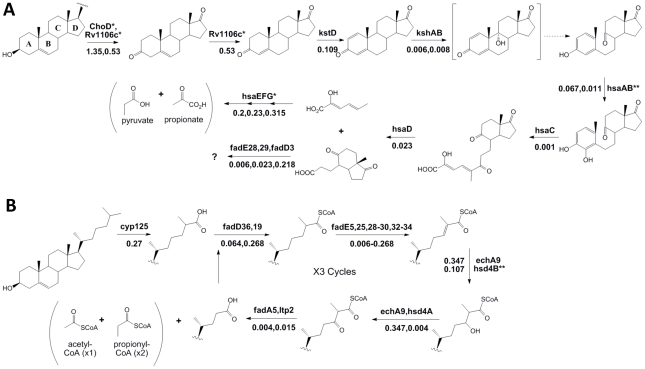
“In Mtb, the Cyp125 ortholog serves a similar function [21,22], although Cyp142 has been shown to serve a functionally redundant role [23].”
BackgroundMycobacterium tuberculosis pks12 Produces a Novel Polyketide Presented by CD1c to T Cells
Matsunaga, I., Bhatt, A., Young, D. C., Cheng, T.-Y., Eyles, S. J., Besra, G. S., Briken, V., Porcelli, S. A., Costello, C. E., Jacobs, W. R., et al. (2004) · The Journal of Experimental Medicine · doi:10.1084/jem.20041429 · Cited by 174 · cited 1×
“A few genes that we found to contain very significant gaps in transposon coverage have been successfully deleted, and produce strains that grow normally under similar conditions to those used in our study [33,34,35,36,37,38].”
Selection analyses of insertional mutants using subgenic-resolution arrays
Badarinarayana, V., Estep, P. W., Shendure, J., Edwards, J. S., Tavazoie, S., Lam, F. H., & Church, G. M. (2001) · Nature Biotechnology · doi:10.1038/nbt1101-1060 · Cited by 160 · cited 1×
“binding are valuable for understanding cellular responses, gene regulation has proven to be a poor predictor of essentiality [3,4].”
BackgroundTwo Nonredundant SecA Homologues Function in Mycobacteria
Braunstein, M., Brown, A. M., Kurtz, S., & Jacobs, W. R. (2001) · Journal of Bacteriology · doi:10.1128/jb.183.24.6979-6990.2001 · Cited by 141 · cited 1×
“A few genes that we found to contain very significant gaps in transposon coverage have been successfully deleted, and produce strains that grow normally under similar conditions to those used in our study [33,34,35,36,37,38].”
Rosłoniec, K. Z., Wilbrink, M. H., Capyk, J. K., Mohn, W. W., Ostendorf, M., van der Geize, R., Dijkhuizen, L., & Eltis, L. D. (2009) · Molecular Microbiology · doi:10.1111/j.1365-2958.2009.06915.x · Cited by 134 · cited 1×
“Side-chain degradation In the related actinomycete, Rhodococcus jostii RHA1, the initial hydroxylation of C26 during side-chain degradation is mediated by the cytochrome P450 encoded by the cyp125 gene [20].”
BackgroundOuellet, H., Guan, S., Johnston, J. B., Chow, E. D., Kells, P. M., Burlingame, A. L., Cox, J. S., Podust, L. M., & de Montellano, P. R. O. (2010) · Molecular Microbiology · doi:10.1111/j.1365-2958.2010.07243.x · Cited by 134 · cited 1×
“In Mtb, the Cyp125 ortholog serves a similar function [21,22], although Cyp142 has been shown to serve a functionally redundant role [23].”
BackgroundCholesterol oxidase is required for virulence ofMycobacterium tuberculosis
Brzostek, A. M., Dziadek, B. R., Rumijowska-Galewicz, A., Pawełczyk, J., & Dziadek, J. (2007) · FEMS Microbiology Letters · doi:10.1111/j.1574-6968.2007.00865.x · Cited by 124 · cited 1×
“Two distinct enzymes have been suggested to be involved in this transformation; a ketosteroid dehydrogenase, Rv1106c, and a cholesterol oxidase, ChoD [18,19].”
BackgroundCholesterol Metabolism Increases the Metabolic Pool of Propionate in Mycobacterium tuberculosis
Yang, X., Nesbitt, N. M., Dubnau, E., Smith, I., & Sampson, N. S. (2009) · Biochemistry · doi:10.1021/bi9005418 · Cited by 122 · cited 1×
“Cholesterol catabolism is thought to result in the production of a mixture of metabolites including the C2 unit acetyl CoA, the C3 unit propionyl CoA, and pyruvate [14,15,24].”
Background3-Ketosteroid 9α-hydroxylase is an essential factor in the pathogenesis ofMycobacterium tuberculosis
Hu, Y., van der Geize, R., Besra, G. S., Gurcha, S. S., Liu, A., Rohde, M., Singh, M., & Coates, A. R. M. (2009) · Molecular Microbiology · doi:10.1111/j.1365-2958.2009.06957.x · Cited by 118 · cited 1×
“A number of recent studies have demonstrated that Mtb mutants lacking the capacity to acquire or degrade cholesterol are defective for growth in animal models of TB [13,14,17,40,41].”
ResultJohnston, J. B., Ouellet, H., & de Montellano, P. R. O. (2010) · Journal of Biological Chemistry · doi:10.1074/jbc.m110.161117 · Cited by 108 · cited 1×
“In Mtb, the Cyp125 ortholog serves a similar function [21,22], although Cyp142 has been shown to serve a functionally redundant role [23].”
BackgroundRv1106c from Mycobacterium tuberculosis Is a 3β-Hydroxysteroid Dehydrogenase
Yang, X., Dubnau, E., Smith, I., & Sampson, N. S. (2007) · Biochemistry · doi:10.1021/bi700688x · Cited by 102 · cited 1×
“Two distinct enzymes have been suggested to be involved in this transformation; a ketosteroid dehydrogenase, Rv1106c, and a cholesterol oxidase, ChoD [18,19].”
BackgroundMicklinghoff, J. C., Breitinger, K. J., Schmidt, M., Geffers, R., Eikmanns, B. J., & Bange, F. (2009) · Journal of Bacteriology · doi:10.1128/jb.01009-09 · Cited by 53 · cited 1×
“expression [27], resulted in the opposite effect (a nine-fold overrepresentation in the cholesterol-grown pool).”
BackgroundCholesterol Is Not an Essential Source of Nutrition for Mycobacterium tuberculosis during Infection
Yang, X., Gao, J., Smith, I., Dubnau, E., & Sampson, N. S. (2011) · Journal of Bacteriology · doi:10.1128/jb.01210-10 · Cited by 44 · cited 1×
“A recent study demonstrating that cholesterol catabolism is not necessary for bacterial growth in acutely-infected guinea pigs or a macrophage cell line confirms these observations [45].”
ResultPyruvate-Phosphate Dikinase and the Control of Gluconeogenesis in Acetobacter xylinum
Benziman, M., & Eizen, N. (1971) · Journal of Biological Chemistry · doi:10.1016/s0021-9258(18)62531-1 · Cited by 37 · cited 1×
“In other bacteria, PpdKmediated gluconeogensis is favored during growth in the presence of pyruvate [43,44].”
BackgroundØsterås, M., Driscoll, B. T., & Finan, T. M. (1997) · Microbiology · doi:10.1099/00221287-143-5-1639 · Cited by 35 · cited 1×
“In other bacteria, PpdKmediated gluconeogensis is favored during growth in the presence of pyruvate [43,44].”
Background
Cited by
Structure of mycobacterial maltokinase, the missing link in the essential GlgE-pathway
Fraga, J., Maranha, A., Mendes, V., Pereira, P. J. B., Empadinhas, N., & Macedo-Ribeiro, S. (2015) · Scientific Reports · doi:10.1038/srep08026 · Cited by 819
DeJesus, M. A., Gerrick, E. R., Xu, W., Park, S. W., Long, J. E., Boutte, C. C., Rubin, E. J., Schnappinger, D., Ehrt, S., Fortune, S. M., et al. (2017) · mBio · doi:10.1128/mbio.02133-16 · Cited by 668
“This set was largely consistent with previous studies (4), though there were some differences.”
InfluentialSelf-citationMycolic Acids: Structures, Biosynthesis, and Beyond
Marrakchi, H., Lanéelle, M.-A., & Daffé, M. (2014) · Chemistry & Biology · doi:10.1016/j.chembiol.2013.11.011 · Cited by 623
Luo, H., Lin, Y., Gao, F., Zhang, C.-T., & Zhang, R. (2014) · Nucleic Acids Research · doi:10.1093/nar/gkt1131 · Cited by 530
“Mycobacterium tuberculosis 774 Tn-seq Yes (24) Mycobacterium tuberculosis 742 35 Tn-seq Yes (21) Mycoplasma genitalium 382 Transposon mutagenesis followed by Sanger sequencing, Single-gene knockout Yes (12,59)”
BackgroundMethodTransposon insertion sequencing: a new tool for systems-level analysis of microorganisms
van Opijnen, T., & Camilli, A. (2013) · Nature Reviews Microbiology · doi:10.1038/nrmicro3033 · Cited by 494
Metadata
- Authors
- Griffin, J. E., Gawronski, J. D., DeJesus, M. A., Ioerger, T. R., Akerley, B. J., & Sassetti, C. M.
- Affiliations
- University of Massachusetts Chan Medical School (US)
- Texas A&M University (US)
- Howard Hughes Medical Institute (US)
- Corresponding author
- Sassetti, Christopher M.
- Venue
- PLoS Pathogens
- Publisher
- Public Library of Science (PLoS)
- Published
- 2011-09-29
- Volume
- 7
- Issue
- 9
- Pages
- e1002251
- ISSN
- 1553-7366 (ISSN-L)
- 1553-7374
- PMC
- PMC3182942
- OpenAlex
- W2067576392
- Cited by
- 1,048
- References
- 47
- Citations by year
- 2026: 32 · 2025: 50 · 2024: 56 · 2023: 58 · 2022: 50 · 2021: 85 · 2020: 79 · 2019: 102 · 2018: 90 · 2017: 89 · 2016: 82 · 2015: 99 · 2014: 79 · 2013: 68 · 2012: 27
- FWCI
- 38.15
- Type
- journal article
- Language
- en
- Open access
- gold
- doi.org
- Locations
- PLoS Pathogens (publishedVersion, cc-by)
- Europe PMC (PubMed Central) (publishedVersion, cc-by)
- PubMed Central (publishedVersion, cc-by)
- PubMed (publishedVersion)
- The Journal of the American Medical Association (JAMA) Network (American Medical Association) (submittedVersion, cc-by)
- DOAJ (DOAJ: Directory of Open Access Journals) (submittedVersion, cc-by-sa)
- Figshare (submittedVersion, cc-by)
- OakTrust (Texas A&M University Libraries) (submittedVersion)
- Funders
- Howard Hughes Medical Institute
- Bill and Melinda Gates Foundation
- National Institutes of Health
- National Institute of Allergy and Infectious Diseases (AI064282, AI073509, R21AI073509, R01AI064282)
- Topics
- Health Sciences › Medicine › Infectious Diseases › Tuberculosis Research and Epidemiology
- Life Sciences › Biochemistry, Genetics and Molecular Biology › Genetics › Bacterial Genetics and Biotechnology
- Physical Sciences › Chemistry › Organic Chemistry › Steroid Chemistry and Biochemistry
- Keywords
- Mycobacterium tuberculosis, essential genes, phenotypic profiling, cholesterol catabolism, bacterial growth, mutant library, host adaptation, virulence genes, therapeutic target, carbon source utilization
- MeSH terms
- Animals, Cholesterol, Genes, Bacterial, Mycobacterium tuberculosis, Tuberculosis, Virulence, Gene Expression Regulation, Bacterial, Mutagenesis, Gene Expression Profiling, Mice
About these checks
Registry, retraction, Cites and statistics results are computed, not judged, with one exception: a printed reference that no index lists is read once by a model before it counts as a citation error. Claims are extracted by a model and kept only when their quote appears verbatim in the text; each cited source is then checked, with a model’s help, for whether it says what the claim relies on. Those verdicts can be wrong — read the claim’s quote and the cited source before relying on one.
Statistics and arithmetic are recomputed, not judged.
Confidence bands are shown only for fields calibrated on our annotated test set. None is calibrated yet, so no band is shown.
What counts as a claim ›How we measure confidence ›How we check this ›
Are you an author, or do you see a problem with this page? Request a review
Data sources
Bibliographic data: Semantic Scholar, OpenAlex, Crossref.
Contains information from the Semantic Scholar Academic Graph Datasets, made available under the ODC Attribution License (ODC-BY 1.0).
Semantic Scholar’s data is described in: Kinney, R., et al. (2023). The Semantic Scholar Open Data Platform. arXiv:2301.10140.
