

The DOI matches its Crossref record; 67 of the 67 references it cites were found in a registry or an index.
Synaptic Mechanisms of Memory Consolidation during Sleep Slow Oscillations
Open accessAbstract
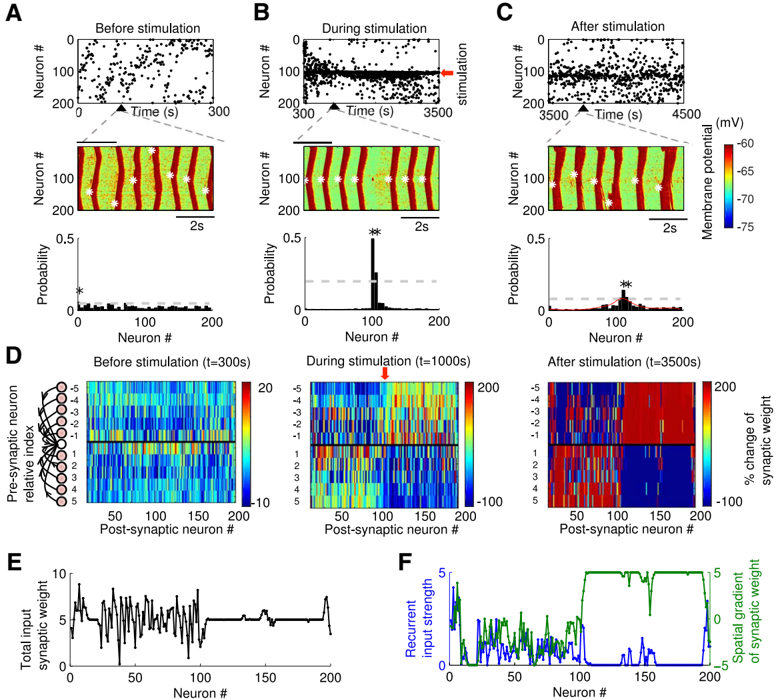
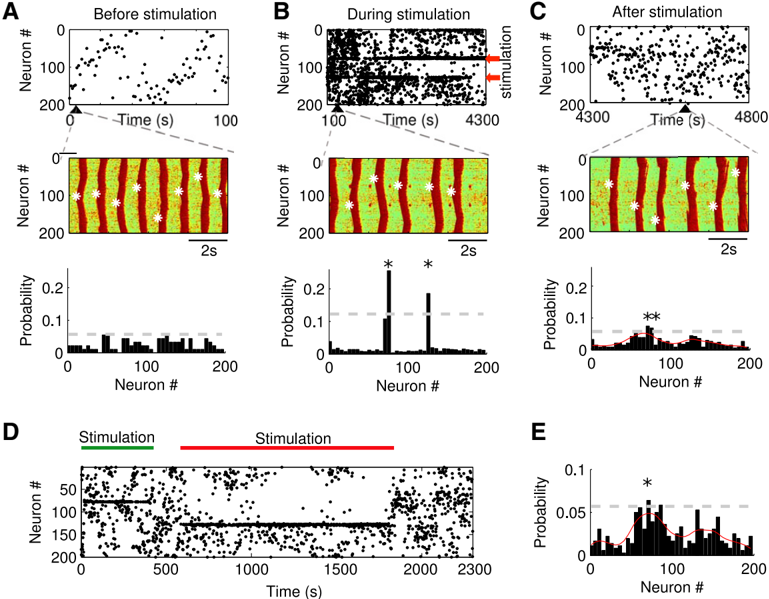
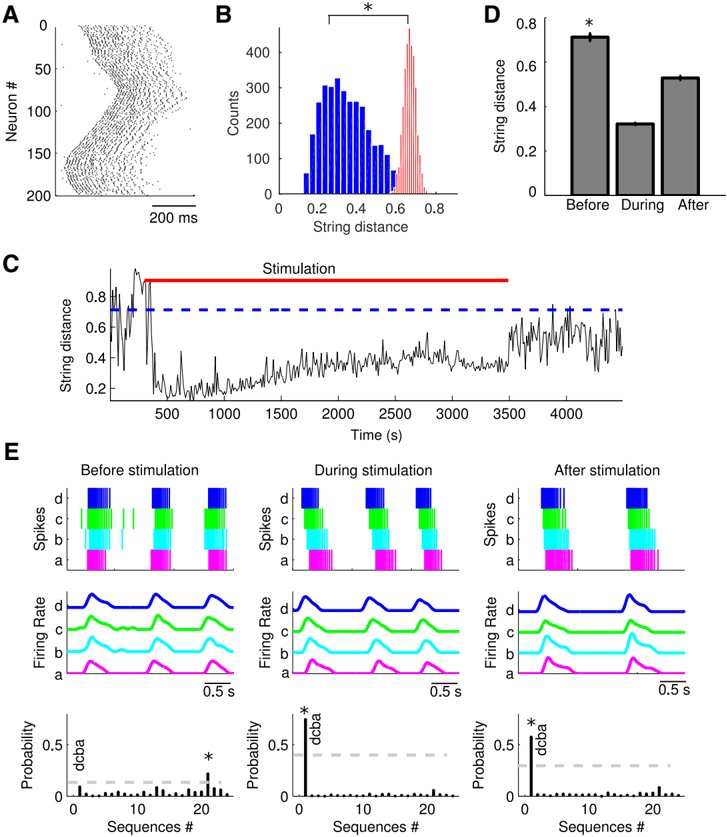
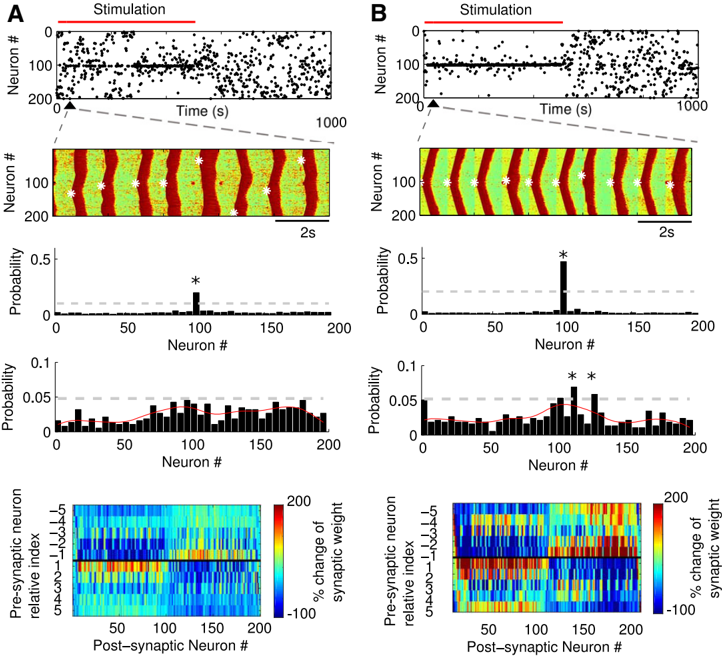
Sleep is critical for regulation of synaptic efficacy, memories, and learning. However, the underlying mechanisms of how sleep rhythms contribute to consolidating memories acquired during wakefulness remain unclear. Here we studied the role of slow oscillations, 0.2–1 Hz rhythmic transitions between Up and Down states during stage 3/4 sleep, on dynamics of synaptic connectivity in the thalamocortical network model implementing spike-timing-dependent synaptic plasticity. We found that the spatiotemporal pattern of Up-state propagation determines the changes of synaptic strengths between neurons. Furthermore, an external input, mimicking hippocampal ripples, delivered to the cortical network results in input-specific changes of synaptic weights, which persisted after stimulation was removed. These synaptic changes promoted replay of specific firing sequences of the cortical neurons. Our study proposes a neuronal mechanism on how an interaction between hippocampal input, such as mediated by sharp wave-ripple events, cortical slow oscillations, and synaptic plasticity, may lead to consolidation of memories through preferential replay of cortical cell spike sequences during slow-wave sleep. SIGNIFICANCE STATEMENT Sleep is critical for memory and learning. Replay during sleep of temporally ordered spike sequences related to a recent experience was proposed to be a neuronal substrate of memory consolidation. However, specific mechanisms of replay or how spike sequence replay leads to synaptic changes that underlie memory consolidation are still poorly understood. Here we used a detailed computational model of the thalamocortical system to report that interaction between slow cortical oscillations and synaptic plasticity during deep sleep can underlie mapping hippocampal memory traces to persistent cortical representation. This study provided, for the first time, a mechanistic explanation of how slow-wave sleep may promote consolidation of recent memory events.
Overview
The claims and statistics of this paper haven’t been checked yet.
Run the check — free, no account needed. It reads the open-access text and checks the sources it cites.
Integrity signals
Registry
Cites
Statistics
Figures
Verification
Claims the paper makes
The claims and statistics of this paper haven’t been checked yet.
Run the check — free, no account needed. It reads the open-access text and checks the sources it cites.
Claims other papers make about this one
Each is checked against this paper’s own text: does it say what the citing paper says it does?
In the citing paper
“Many of these selective synaptic pruning and refinement processes occur during sleep, and sleep is crucial for proper circuit maturation and long-term memory formation in humans and animals201–204.”
From Rhythms of life: circadian disruption and brain disorders across the lifespan (2019) · cites this paper as [201]
Self-check
Percentages, sums and reported differences re-computed from the paper’s own numbers.
The self-check needs the paper’s full text.
Citations
Cites
McClelland, J. L., McNaughton, B. L., & O'Reilly, R. C. (1995) · Psychological Review · doi:10.1037/0033-295x.102.3.419 · Cited by 5,256
Competitive Hebbian learning through spike-timing-dependent synaptic plasticity
Song, S., Miller, K. D., & Abbott, L. F. (2000) · Nature Neuroscience · doi:10.1038/78829 · Cited by 2,794
Boosting slow oscillations during sleep potentiates memory
Marshall, L., Helgadóttir, H., Mölle, M., & Born, J. (2006) · Nature · doi:10.1038/nature05278 · Cited by 1,792
Coordinated memory replay in the visual cortex and hippocampus during sleep
Ji, D., & Wilson, M. A. (2007) · Nature Neuroscience · doi:10.1038/nn1825 · Cited by 1,669
Cellular and network mechanisms of rhythmic recurrent activity in neocortex
Sanchez-Vives, M. V., & McCormick, D. A. (2000) · Nature Neuroscience · doi:10.1038/79848 · Cited by 1,539
Anatomical analysis of afferent projections to the medial prefrontal cortex in the rat
Hoover, W. B., & Vertes, R. P. (2007) · Brain Structure and Function · doi:10.1007/s00429-007-0150-4 · Cited by 1,365
Natural waking and sleep states: a view from inside neocortical neurons
Steriade, M., Timofeev, I., & Grenier, F. (2001) · Journal of Neurophysiology · doi:10.1152/jn.2001.85.5.1969 · Cited by 1,296
Memory of sequential experience in the hippocampus during slow wave sleep
Lee, A. K., & Wilson, M. A. (2002) · Neuron · doi:10.1016/s0896-6273(02)01096-6 · Cited by 1,296
Influence of dendritic structure on firing pattern in model neocortical neurons
Mainen, Z. F., & Sejnowski, T. J. (1996) · Nature · doi:10.1038/382363a0 · Cited by 1,231
The sleep slow oscillation as a traveling wave
Massimini, M., Huber, R., Ferrarelli, F., Hill, S., & Tononi, G. (2004) · The Journal of Neuroscience · doi:10.1523/jneurosci.1318-04.2004 · Cited by 1,221
A neuronal learning rule for sub-millisecond temporal coding
Wulfram Gerstner, B., Kempter, R., van Hemmen, J. L., & Wagner, H. (1996) · Nature · doi:10.1038/383076a0 · Cited by 1,118
Coordinated interactions between hippocampal Ripples and Cortical Spindles during Slow-Wave Sleep
Siapas, A. G., & Wilson, M. A. (1998) · Neuron · doi:10.1016/s0896-6273(00)80629-7 · Cited by 1,052
The Hippocampo-Neocortical Dialogue
Buzsáki, G. (1996) · Cerebral Cortex · doi:10.1093/cercor/6.2.81 · Cited by 938
Communication between neocortex and hippocampus during sleep in rodents
Sirota, A., Csicsvari, J., Buhl, D., & Buzsáki, G. (2003) · Proceedings of the National Academy of Sciences · doi:10.1073/pnas.0437938100 · Cited by 930
Steriade, M., Nunez, A., & Amzica, F. (1993) · Journal of Neuroscience · doi:10.1523/jneurosci.13-08-03266.1993 · Cited by 894
Semantic Cognition: A Parallel Distributed Processing Approach
Rogers, T. T., & McClelland, J. L. (2004) · Cited by 891
Disruption of ripple‐associated hippocampal activity during rest impairs spatial learning in the rat
Ego‐Stengel, V., & Wilson, M. A. (2010) · Hippocampus · doi:10.1002/hipo.20707 · Cited by 842
Jay, T. M., & Witter, M. P. (1991) · The Journal of Comparative Neurology · doi:10.1002/cne.903130404 · Cited by 841
Staresina, B. P., Bergmann, T. O., Bonnefond, M., van der Meij, R., Jensen, O., Deuker, L., Elger, C. E., Axmacher, N., & Fell, J. (2015) · Nature Neuroscience · doi:10.1038/nn.4119 · Cited by 831
Neuromodulation: acetylcholine and memory consolidation
Hasselmo, M. E. (1999) · Trends in Cognitive Sciences · doi:10.1016/s1364-6613(99)01365-0 · Cited by 809
Neuronal Networks of the Hippocampus
Traub, R. D., & Miles, R. (1991) · doi:10.1017/cbo9780511895401 · Cited by 802
Replay of rule-learning related neural patterns in the prefrontal cortex during sleep
Peyrache, A., Khamassi, M., Benchenane, K., Wiener, S. I., & Battaglia, F. P. (2009) · Nature Neuroscience · doi:10.1038/nn.2337 · Cited by 767
Origin of Slow Cortical Oscillations in Deafferented Cortical Slabs
Timofeev, I. (2000) · Cerebral Cortex · doi:10.1093/cercor/10.12.1185 · Cited by 710
The thalamic matrix and thalamocortical synchrony
Jones, E. G. (2001) · Trends in Neurosciences · doi:10.1016/s0166-2236(00)01922-6 · Cited by 688
The contribution of sleep to hippocampus-dependent memory consolidation
Marshall, L., & Born, J. (2007) · Trends in Cognitive Sciences · doi:10.1016/j.tics.2007.09.001 · Cited by 667
Hebbian learning and spiking neurons
Kempter, R., Wulfram Gerstner, B., & van Hemmen, J. L. (1999) · Physical review. E, Statistical physics, plasmas, fluids, and related interdisciplinary topics · doi:10.1103/physreve.59.4498 · Cited by 667
Huguenard, J., & Prince, D. A. (1992) · Journal of Neuroscience · doi:10.1523/jneurosci.12-10-03804.1992 · Cited by 563
Early sleep triggers memory for early visual discrimination skills
Gais, S., Plihal, W., Wagner, U., & Born, J. (2000) · Nature Neuroscience · doi:10.1038/81881 · Cited by 558
Mölle, M., Bergmann, T. O., Marshall, L., & Born, J. (2011) · Sleep · doi:10.5665/sleep.1290 · Cited by 557
Compte, A., Sanchez-Vives, M. V., McCormick, D. A., & Wang, X. (2003) · Journal of Neurophysiology · doi:10.1152/jn.00845.2002 · Cited by 536
Isomura, Y., Sirota, A., Özen, S., Montgomery, S., Mizuseki, K., Henze, D. A., & Buzsáki, G. (2006) · Neuron · doi:10.1016/j.neuron.2006.10.023 · Cited by 500
Simulation of the currents involved in rhythmic oscillations in thalamic relay neurons
Huguenard, J. R., & McCormick, D. A. (1992) · Journal of Neurophysiology · doi:10.1152/jn.1992.68.4.1373 · Cited by 493
Play it again: reactivation of waking experience and memory
O’Neill, J., Pleydell-Bouverie, B., Dupret, D., & Csicsvari, J. (2010) · Trends in Neurosciences · doi:10.1016/j.tins.2010.01.006 · Cited by 480
Model of Thalamocortical Slow-Wave Sleep Oscillations and Transitions to Activated States
Bazhenov, M., Timofeev, I., Steriade, M., & B, T. J. S. A. (2002) · Journal of Neuroscience · doi:10.1523/jneurosci.22-19-08691.2002 · Cited by 461
Self-citationFunctional maps of neocortical local circuitry.
Thomson, A. M. (2007) · Frontiers in Neuroscience · doi:10.3389/neuro.01.1.1.002.2007 · Cited by 434
Alain Destexhe, A., Bal, T., McCormick, D. A., & B, T. J. S. A. (1996) · Journal of Neurophysiology · doi:10.1152/jn.1996.76.3.2049 · Cited by 418
Modeling Sleep and Wakefulness in the Thalamocortical System
Hill, S., & Tononi, G. (2005) · Journal of Neurophysiology · doi:10.1152/jn.00915.2004 · Cited by 417
Pattern-Specific Associative Long-Term Potentiation Induced by a Sleep Spindle-Related Spike Train
Rosanova, M., & Ulrich, D. (2005) · The Journal of Neuroscience · doi:10.1523/jneurosci.2149-05.2005 · Cited by 413
Low-frequency rhythms in the thalamus of intact-cortex and decorticated cats
Timofeev, I., & Steriade, M. (1996) · Journal of Neurophysiology · doi:10.1152/jn.1996.76.6.4152 · Cited by 353
Hippocampal Sharp Wave-Ripples Linked to Slow Oscillations in Rat Slow-Wave Sleep
Mölle, M., Yeshenko, O., Marshall, L., Sara, S. J., & Born, J. (2006) · Journal of Neurophysiology · doi:10.1152/jn.00014.2006 · Cited by 337
Esser, S. K., Hill, S. L., & Tononi, G. (2007) · Sleep · doi:10.1093/sleep/30.12.1617 · Cited by 315
Hippocampal sharp wave bursts coincide with neocortical “up-state” transitions
Battaglia, F. P., Sutherland, G. R., & McNaughton, B. L. (2004) · Learning & Memory · doi:10.1101/lm.73504 · Cited by 310 · cited 1×
“Several studies supported the hypothesis that SPW-R events occur mainly in the neocortical transition from Down to Up states (Battaglia et al., 2004), and suppression of hippocampal ripple results in poor performance in memory tasks (Ego-Stengel and Wilson, 2010).”
BackgroundSullivan, D. W., Csicsvari, J., Mizuseki, K., Montgomery, S. M., Diba, K., & Buzsáki, G. (2011) · Journal of Neuroscience · doi:10.1523/jneurosci.0294-11.2011 · Cited by 309
Volgushev, M., Chauvette, S., Mukovski, M., & Timofeev, I. (2006) · The Journal of Neuroscience · doi:10.1523/jneurosci.0279-06.2006 · Cited by 289
Sustained increase in hippocampal sharp-wave ripple activity during slow-wave sleep after learning
Eschenko, O., Ramadan, W., Mölle, M., Born, J., & Sara, S. J. (2008) · Learning & Memory · doi:10.1101/lm.726008 · Cited by 277
Blake, H., & Gerard, R. W. (1937) · American Journal of Physiology-Legacy Content · doi:10.1152/ajplegacy.1937.119.4.692 · Cited by 276
Origin of Active States in Local Neocortical Networks during Slow Sleep Oscillation
Chauvette, S., Volgushev, M., & Timofeev, I. (2010) · Cerebral Cortex · doi:10.1093/cercor/bhq009 · Cited by 266
Alain Destexhe, A., Contreras, D., Steriade, M., B, T. J. S. A., & Huguenard, J. (1996) · Journal of Neuroscience · doi:10.1523/jneurosci.16-01-00169.1996 · Cited by 260
Quantal release of neurotransmitter and long-term potentiation.
Stevens, C. (1993) · Cell · doi:10.1016/s0092-8674(05)80028-5 · Cited by 222
The Impact of Cortical Deafferentation on the Neocortical Slow Oscillation
Lemieux, M., Chen, J., Lonjers, P., Bazhenov, M., & Timofeev, I. (2014) · Journal of Neuroscience · doi:10.1523/jneurosci.1156-13.2014 · Cited by 182
Self-citationIdentification of the Hippocampal Input to Medial Prefrontal Cortex In Vitro
Parent, M. A., Wang, L., Su, J., Netoff, T. I., & Yuan, L. (2009) · Cerebral Cortex · doi:10.1093/cercor/bhp108 · Cited by 165
Slow-wave sleep and the consolidation of long-term memory
Jan Born, A. (2010) · The World Journal of Biological Psychiatry · doi:10.3109/15622971003637637 · Cited by 147
Prange, O., & Murphy, T. H. (1999) · Journal of Neuroscience · doi:10.1523/jneurosci.19-15-06427.1999 · Cited by 127
Sleep and Synaptic Renormalization: A Computational Study
Olcese, U., Esser, S. K., & Tononi, G. (2010) · Journal of Neurophysiology · doi:10.1152/jn.00593.2010 · Cited by 117
Slow-Wave Sleep-Imposed Replay Modulates Both Strength and Precision of Memory
Barnes, D. C., & Wilson, D. A. (2014) · Journal of Neuroscience · doi:10.1523/jneurosci.5274-13.2014 · Cited by 117
Bonjean, M., Baker, T. I., Bazhenov, M., Cash, S. S., Halgren, E., & B, T. J. S. A. (2012) · Journal of Neuroscience · doi:10.1523/jneurosci.6141-11.2012 · Cited by 111
Self-citationExtending the effects of spike-timing-dependent plasticity to behavioral timescales
Drew, P. J., & Abbott, L. F. (2006) · Proceedings of the National Academy of Sciences · doi:10.1073/pnas.0600676103 · Cited by 111
Hippocampal–cortical interactions and the dynamics of memory trace reactivation
Schwindel, C. D., & McNaughton, B. L. (2011) · Progress in brain research · doi:10.1016/b978-0-444-53839-0.00011-9 · Cited by 107
Interneuron‐mediated inhibition synchronizes neuronal activity during slow oscillation
Chen, J., Chauvette, S., Skorheim, S. W., Timofeev, I., & Bazhenov, M. (2012) · The Journal of Physiology · doi:10.1113/jphysiol.2012.227462 · Cited by 99
Self-citationCellular and Network Models for Intrathalamic Augmenting Responses During 10-Hz Stimulation
Bazhenov, M., Timofeev, I., Steriade, M., & B, T. J. S. A. (1998) · Journal of Neurophysiology · doi:10.1152/jn.1998.79.5.2730 · Cited by 95
Self-citationHeterosynaptic Plasticity Prevents Runaway Synaptic Dynamics
Chen, J., Lonjers, P., Lee, C. M., Chistiakova, M., Volgushev, M., & Bazhenov, M. (2013) · Journal of Neuroscience · doi:10.1523/jneurosci.5088-12.2013 · Cited by 90
Self-citationCortico-hippocampal interaction during up-down states and memory consolidation
Mehta, M. R. (2006) · Nature Neuroscience · doi:10.1038/nn0107-13 · Cited by 70
Paré, D., Lebel, E., & Lang, E. J. (1997) · Journal of Neurophysiology · doi:10.1152/jn.1997.78.3.1735 · Cited by 58
Bazhenov, M., Lonjers, P., Skorheim, S. W., Bedard, C., & Alain Destexhe, A. (2011) · Philosophical Transactions of the Royal Society A Mathematical Physical and Engineering Sciences · doi:10.1098/rsta.2011.0119 · Cited by 39
Self-citationStructure of Spontaneous UP and DOWN Transitions Self-Organizing in a Cortical Network Model
Kang, S., Kitano, K., & Fukai, T. (2008) · PLoS Computational Biology · doi:10.1371/journal.pcbi.1000022 · Cited by 38
Enhancement of Neocortical-Medial Temporal EEG Correlations during Non-REM Sleep
Axmacher, N., Helmstaedter, C., Elger, C. E., & Fell, J. (2008) · Neural Plasticity · doi:10.1155/2008/563028 · Cited by 22
Frank, M. G. (2012) · Cited by 7
Cited by
Sorted by citations
Rhythms of life: circadian disruption and brain disorders across the lifespan
Logan, R. W., & McClung, C. A. (2019) · Nature Reviews Neuroscience · doi:10.1038/s41583-018-0088-y · Cited by 713
NREM sleep in the rodent neocortex and hippocampus reflects excitable dynamics
Levenstein, D., Buzsáki, G., & Rinzel, J. (2019) · Nature Communications · doi:10.1038/s41467-019-10327-5 · Cited by 155
Cellular and neurochemical basis of sleep stages in the thalamocortical network
Krishnan, G. P., Chauvette, S., Shamie, I., Soltani, S., Timofeev, I., Cash, S. S., Halgren, E., & Bazhenov, M. (2016) · eLife · doi:10.7554/elife.18607 · Cited by 125
Self-citationAlain Destexhe, A., & Sejknowski, T. (2023) · doi:10.1093/oso/9780198864998.001.0001 · Cited by 115
Replay in Deep Learning: Current Approaches and Missing Biological Elements
Hayes, T. L., Krishnan, G. P., Bazhenov, M., Siegelmann, H. T., Sejnowski, T. J., & Kanan, C. (2021) · Neural Computation · doi:10.1162/neco_a_01433 · Cited by 106
Self-citation
Metadata
- Authors
- Wei, Y., Krishnan, G. P., & Bazhenov, M.
- Affiliations
- University of California, Riverside (US)
- Venue
- The Journal of Neuroscience
- Publisher
- Society for Neuroscience
- Published
- 2016-04-13
- Volume
- 36
- Issue
- 15
- Pages
- 4231-4247
- ISSN
- 0270-6474 (ISSN-L)
- 1529-2401
- PMC
- PMC4829648
- OpenAlex
- W2340922036
- Cited by
- 116
- References
- 67
- Citations by year
- 2026: 8 · 2025: 7 · 2024: 8 · 2023: 28 · 2022: 15 · 2021: 9 · 2020: 13 · 2019: 8 · 2018: 9 · 2017: 8 · 2016: 3
- FWCI
- 5.94
- Type
- journal article
- Language
- en
- Open access
- hybrid
- doi.org
- Licence
- Locations
- Journal of Neuroscience (publishedVersion, cc-by-nc-sa)
- PubMed Central (publishedVersion)
- PubMed (publishedVersion)
- Funders
- National Institutes of Health (MH099645)
- Multidisciplinary University Research Initiative
- Office of Naval Research (N00014-13-1-0672, R01 EB009282, R01 MH099645)
- National Institute of Mental Health (R01MH099645)
- National Institute of Biomedical Imaging and Bioengineering (R01EB009282)
- Topics
- Life Sciences › Neuroscience › Cognitive Neuroscience › Sleep and Wakefulness Research
- Life Sciences › Neuroscience › Cognitive Neuroscience › Neural dynamics and brain function
- Life Sciences › Neuroscience › Cognitive Neuroscience › Memory and Neural Mechanisms
- Keywords
- memory consolidation, slow oscillations, slow-wave sleep, synaptic plasticity, spike-timing-dependent plasticity, thalamocortical network, hippocampal ripples, sharp-wave ripples, computational model
- MeSH terms
- Algorithms, Cerebral Cortex, Computer Simulation, Electroencephalography, Humans, Memory, Models, Neurological, Neuronal Plasticity, Neurons, Sleep, Synapses, Thalamus, Calcium Channels, Sodium Channels, Neural Networks, Computer
About these checks
Registry, retraction, Cites and statistics results are computed, not judged, with one exception: a printed reference that no index lists is read once by a model before it counts as a citation error. Claims are extracted by a model and kept only when their quote appears verbatim in the text; each cited source is then checked, with a model’s help, for whether it says what the claim relies on. Those verdicts can be wrong — read the claim’s quote and the cited source before relying on one.
Statistics and arithmetic are recomputed, not judged.
Confidence bands are shown only for fields calibrated on our annotated test set. None is calibrated yet, so no band is shown.
What counts as a claim ›How we measure confidence ›How we check this ›
Are you an author, or do you see a problem with this page? Request a review
