

sTREM2 cerebrospinal fluid levels are a potential biomarker for microglia activity in early‐stage Alzheimer's disease and associate with neuronal injury markers
Open accessThe DOI matches its Crossref record; 53 of the 54 references it cites were found in a registry or an index.
Abstract
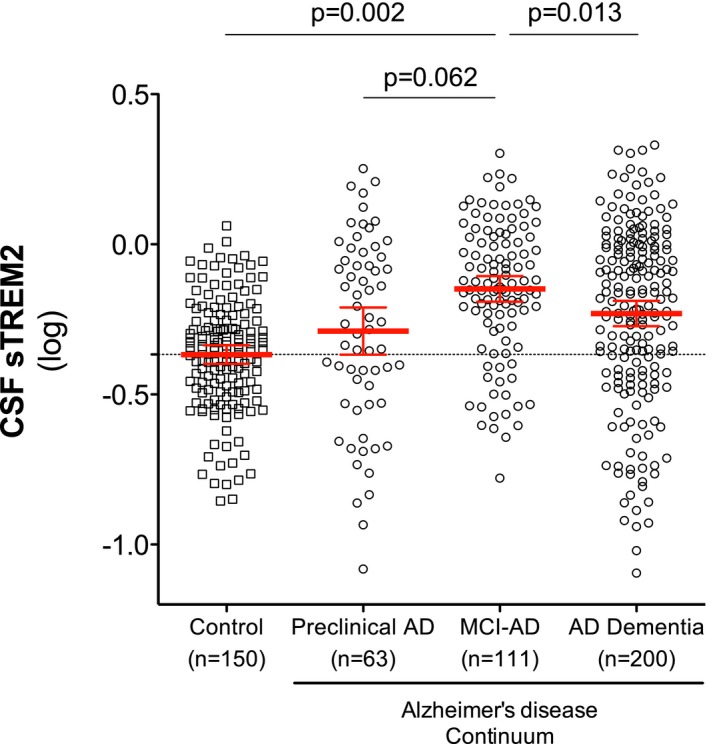
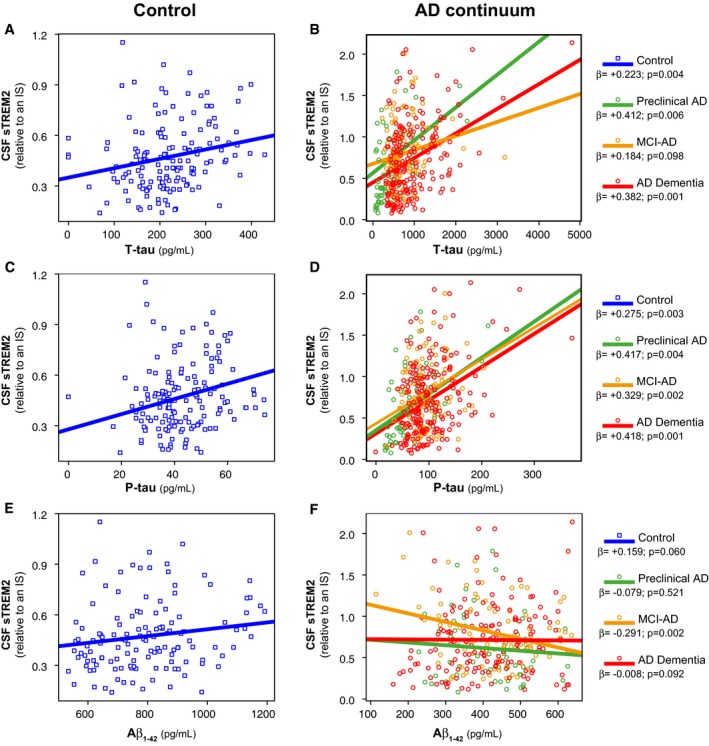
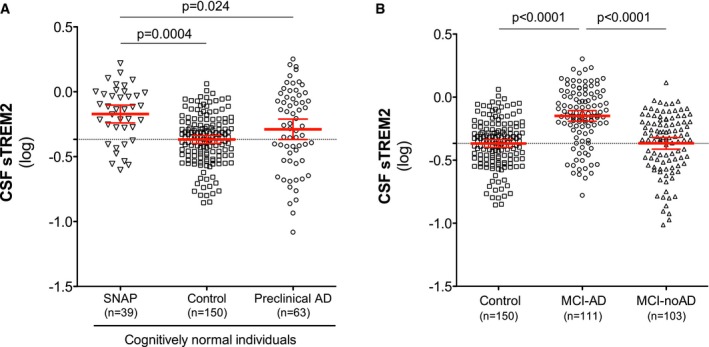
TREM2 is an innate immune receptor expressed on the surface of microglia. Loss-of-function mutations of TREM2 are associated with increased risk of Alzheimer's disease (AD). TREM2 is a type-1 protein with an ectodomain that is proteolytically cleaved and released into the extracellular space as a soluble variant (sTREM2), which can be measured in the cerebrospinal fluid (CSF). In this cross-sectional multicenter study, we investigated whether CSF levels of sTREM2 are changed during the clinical course of AD, and in cognitively normal individuals with suspected non-AD pathology (SNAP). CSF sTREM2 levels were higher in mild cognitive impairment due to AD than in all other AD groups and controls. SNAP individuals also had significantly increased CSF sTREM2 compared to controls. Moreover, increased CSF sTREM2 levels were associated with higher CSF total tau and phospho-tau181P, which are markers of neuronal degeneration and tau pathology. Our data demonstrate that CSF sTREM2 levels are increased in the early symptomatic phase of AD, probably reflecting a corresponding change of the microglia activation status in response to neuronal degeneration.
Overview
The claims and statistics of this paper haven’t been checked yet.
Free: it reads the open-access text and checks the first 5 claims that cite a source we can check. Create a free account to check every claim.
Integrity signals
Registry
Cites
Statistics
Figures
Verification
Claims the paper makes
The claims and statistics of this paper haven’t been checked yet.
Free: it reads the open-access text and checks the first 5 claims that cite a source we can check. Create a free account to check every claim.
Claims other papers make about this one
Each is checked against this paper’s own text: does it say what the citing paper says it does?
The cited source says what the claim attributes to it.
In the citing paper
“cerebrospinal fluid levels of soluble TREM2 are a potential biomarker for microglia activity in early-stage AD and correlate with neuronal injury markers (135, 136).”
From Microglia Function in the Central Nervous System During Health and Neurodegeneration (2017) · cites this paper as [135]
In the citing paper
“Moreover, an increase in secreted extracellular fragment of TREM2 appears to be a CSF biomarker of disease progression in AD (Suárez-Calvet et al., 2016).”
From Elevated TREM2 Gene Dosage Reprograms Microglia Responsivity and Ameliorates Pathological Phenotypes in Alzheimer’s Disease Models (2018) · cites this paper as Suárez-Calvet et al., 2016
Self-check
Percentages, sums and reported differences re-computed from the paper’s own numbers.
The self-check needs the paper’s full text.
Citations
Cites
McKhann, G. M., Knopman, D. S., Chertkow, H., Hyman, B. T., Jack, C. R., Kawas, C. H., Klunk, W. E., Koroshetz, W. J., Manly, J. J., Mayeux, R., et al. (2011) · Alzheimer's & Dementia · doi:10.1016/j.jalz.2011.03.005 · Cited by 18,657 · cited 7×
“Likewise, AD dementia was defined following NIA-AA criteria (McKhann et al, 2011) for probable AD, with the requirment of decreased Ab1–42 and increased T-tau and/or P-tau181P.”
BackgroundMethodInfluentialAlbert, M. S., DeKosky, S. T., Dickson, D., Dubois, B., Feldman, H. H., Fox, N. C., Gamst, A., Holtzman, D. M., Jagust, W. J., Petersen, R. C., et al. (2011) · Alzheimer's & Dementia · doi:10.1016/j.jalz.2011.03.008 · Cited by 10,152 · cited 8×
“Therefore, the diagnostic criteria of the present study were based both on the clinical diagnosis and on the AD CSF core biomarker profile, following NIA-AA recommendations (Albert et al, 2011; McKhann et al, 2011; Sperling et al, 2011).”
BackgroundMethodInfluentialSperling, R. A., Aisen, P. S., Beckett, L. A., Bennett, D. A., Craft, S., Fagan, A. M., Iwatsubo, T., Jack, C. R., Kaye, J., Montine, T. J., et al. (2011) · Alzheimer's & Dementia · doi:10.1016/j.jalz.2011.03.003 · Cited by 7,155 · cited 4×
“…AD, mild cognitive impairment (MCI) due to AD (MCI-AD), and AD dementia and controls, defined by clinical and CSF biomarker criteria as recommended by the National Institute on Aging-Alzheimer’s Association (NIA-AA) criteria (Albert et al, 2011; McKhann et al, 2011; Sperling et al, 2011).”
MethodInfluentialNeuroinflammation in Alzheimer's disease
Heneka, M. T., Carson, M. J., Khoury, J. E., Landreth, G. E., Brosseron, F., Feinstein, D. L., Jacobs, A. H., Wyss-Coray, T., Vitorica, J., Ransohoff, R. M., et al. (2015) · The Lancet Neurology · doi:10.1016/s1474-4422(15)70016-5 · Cited by 6,226 · cited 3×
“Increased microglial activation and neuroinflammation frequently accompanies the early development of Ab and tau pathology (Mosher & WyssCoray, 2014; Streit et al, 2014; Heneka et al, 2015; Tanzi, 2015).”
BackgroundInfluentialSelf-citationWinblad, B., Palmer, K., Kivipelto, M., Jelic, V., Fratiglioni, L., Wahlund, L. ‐., Nordberg, A., Bäckman, L., Albert, M., Almkvist, O., et al. (2004) · Journal of Internal Medicine · doi:10.1111/j.1365-2796.2004.01380.x · Cited by 4,946 · cited 1×
“In brief, these subjects were clinically diagnosed as MCI (following standard criteria) (Winblad et al, 2004) or with CDR = 0.5 or CDR-SOB = 0.5–4, in combination with decreased Ab1–42 and increased T-tau and/or P-tau181P.”
BackgroundInfluentialSelf-citationTREM2 Variants in Alzheimer's Disease
Guerreiro, R., Wojtas, A., Bras, J., Carrasquillo, M., Rogaeva, E., Majounie, E., Cruchaga, C., Sassi, C., Kauwe, J. S. K., Younkin, S., et al. (2013) · New England Journal of Medicine · doi:10.1056/nejmoa1211851 · Cited by 3,020 · cited 4×
“However, it is very unlikely that the possibility of TREM2 mutations in the current patient sample affected our results because TREM2 mutations show a low prevalence in the population and even in AD dementia patients (Guerreiro et al, 2013a; Jonsson et al, 2013).”
BackgroundInfluentialAlbert, M. S., DeKosky, S. T., Dickson, D., Dubois, B., Feldman, H. H., Fox, N. C., Gamst, A., Holtzman, D. M., Jagust, W. J., Petersen, R. C., et al. (2013) · Focus · doi:10.1176/appi.focus.11.1.96 · Cited by 2,621
Variant of TREM2 Associated with the Risk of Alzheimer's Disease
Jonsson, T., Stefansson, H., Steinberg, S., Jonsdottir, I., Jonsson, P. V., Snaedal, J., Bjornsson, S., Huttenlocher, J., Levey, A. I., Lah, J. J., et al. (2013) · New England Journal of Medicine · doi:10.1056/nejmoa1211103 · Cited by 2,558 · cited 3×
“However, it is very unlikely that the possibility of TREM2 mutations in the current patient sample affected our results because TREM2 mutations show a low prevalence in the population and even in AD dementia patients (Guerreiro et al, 2013a; Jonsson et al, 2013).”
BackgroundCerebrospinal fluid biomarker signature in Alzheimer's disease neuroimaging initiative subjects
Shaw, L. M., Vanderstichele, H., Knapik‐Czajka, M., Clark, C. M., Aisen, P. S., Petersen, R. C., Blennow, K., Soares, H., Simon, A., Lewczuk, P., et al. (2009) · Annals of Neurology · doi:10.1002/ana.21610 · Cited by 2,065 · cited 1×
“…has clearly demonstrated to increase the accuracy of the diagnosis of AD, to predict whether AD is the underlying pathology responsible of the cognitive symptoms and has shown to be valuable in detecting the earlier stages of the disease (Clark et al, 2003; Shaw et al, 2009; Molinuevo et al, 2014).”
BackgroundSelf-citationCerebrospinal fluid and plasma biomarkers in Alzheimer disease
Blennow, K., Hampel, H., Weiner, M., & Zetterberg, H. (2010) · Nature Reviews Neurology · doi:10.1038/nrneurol.2010.4 · Cited by 1,863 · cited 3×
“Published under the terms of the CC BY 4.0 license466”
BackgroundMethodInfluentialSelf-citation
Cited by
Items 401–500 of 575
Biomarker advancements in cerebral small vessel disease: An overview
Luo, W., Cao, C., Li, W., Wei, T., Zhao, Z., Wang, G., Li, X., Li, Y., & Liu, B. (2025) · Neural Regeneration Research · doi:10.4103/nrr.nrr-d-24-01329 · Cited by 4
“The PITX2 -encoded transcription factor interacts with FOXC1 , and evidence suggests that FOXC1 and PITX2 may jointly contribute to CSVD through a shared molecular pathway (French et al., 2014; Neurology Working Group of the Cohorts for et al., 2016).”
Athanasaki, A., Tsantzali, I., Theodorou, A., Michalopoulou, A., Constantinides, V. C., Boufidou, F., Tzartos, J. S., Tsalouchidou, P., Zompola, C., Paraskevas, S. G., et al. (2025) · International Journal of Molecular Sciences · doi:10.3390/ijms26199531 · Cited by 4
Edwards, L., Gonzalez, A. I., Thomas, K. R., Smirnov, D. S., Brenner, E. K., Nation, D. A., Chang, F., Blennow, K., Salmon, D. P., Galasko, D., et al. (2025) · Alzheimer s & Dementia · doi:10.1002/alz.70910 · Cited by 4
Self-citationWang, H., Wen, R., Parker, E., & Yang, L. (2026) · Cell Communication and Signaling · doi:10.1186/s12964-026-03083-9 · Cited by 4
Where do white matter alterations dovetail with the cascade model of Alzheimer’s disease?
Jacobs, H. I. L., & Buckley, R. F. (2018) · Brain · doi:10.1093/brain/awy243 · Cited by 4
Design of Novel PPAR Agonist for Neurodegenerative Disease
Steinke, I., & Amin, R. (2021) · Springer eBooks · doi:10.1007/978-3-030-78315-0_10 · Cited by 4
Shirotani, K., Asai, M., & Iwata, N. (2017) · The Journal of Biochemistry · doi:10.1093/jb/mvx015 · Cited by 5
Fluid Biomarkers in Alzheimer’s Disease and Frontotemporal Dementia
Mattsson, N., Grigoriou, S., & Zetterberg, H. (2018) · Springer eBooks · doi:10.1007/978-3-319-72938-1_11 · Cited by 4
Self-citationGiroux, P., Vialaret, J., Kindermans, J., Gabelle, A., Bauchet, L., Hirtz, C., Lehmann, S., & Colinge, J. (2024) · Journal of Proteome Research · doi:10.1021/acs.jproteome.4c00059 · Cited by 4
Current status of fluid biomarkers for early Alzheimer's disease and FDA regulation implications
Jamerlan, A., An, S. S. A., & Hulme, J. (2024) · Journal of the Neurological Sciences · doi:10.1016/j.jns.2024.123325 · Cited by 3
Chen, Y., Guo, C., Liang, X., Chi, X., Zhang, Z., Chang, Z., & Zhang, Y. (2025) · Cellular and Molecular Neurobiology · doi:10.1007/s10571-025-01583-9 · Cited by 3
Increased plasma soluble TREM2 levels in non-Alzheimer’s dementia
Güven, G., Gezegen, H., Şahin, E., Samancı, B., Hanağası, H. A., Gurvit, H. I., Alaylıoğlu, M., Gezen‐Ak, D., Dursun, E., & Bılgıç, B. (2026) · Acta Neurologica Belgica · doi:10.1007/s13760-026-03042-8 · Cited by 3
Gong, M., Lan, J. X., & Miao, J. (2026) · Frontiers in Aging Neuroscience · doi:10.3389/fnagi.2026.1908574 · Cited by 3
“Fluid biomarkers of astrocyte reactivity (plasma and CSF GFAP) and of microglial activation (soluble TREM2, YKL-40) change dynamically across the AD continuum and correlate with amyloid, tau, and cognitive trajectories (Suárez-Calvet et al., 2016; Benedet et al., 2021).”
Emerging Microglial Therapies and Targets in Clinical Trial
Yan, L., & Crotti, A. (2024) · Advances in neurobiology · doi:10.1007/978-3-031-55529-9_35 · Cited by 3
Hu, W. W., Zeng, H., Lü, J., Li, T., Liu, X., Liu, Y., Wen, W., Shen, W., Chen, H., & Chen, Z. (2025) · Scientific Reports · doi:10.1038/s41598-025-09262-x · Cited by 3
“Several studies have confirmed that AD patients have higher levels of sTREM2 in their CSF compared to normal individuals 16 .”
Gouilly, D., Da-Costa, A., Vrillon, A., Pistono, A., Goubeaud, M., Bertrand, E., Germain, J., Ainaoui, N., Bras, S., Catalá, H., et al. (2025) · Journal of Neuroinflammation · doi:10.1186/s12974-025-03625-x · Cited by 3
New Research on Biomarkers in Alzheimer’s Continuum
Vecchio, I., & Colica, C. (2025) · Reviews on Recent Clinical Trials · doi:10.2174/0115748871331138250114052615 · Cited by 3
Plasmonic Interferometers as TREM2 Sensors for Alzheimer’s Disease
Li, D., Odessey, R., Li, D., & Pacifici, D. (2021) · Biosensors · doi:10.3390/bios11070217 · Cited by 3
“Moreover, TREM2 could be used as an effective biomarker for early stage detection of AD [12] and other neurodegenarative diseases [21].”
BackgroundBiomarkers for Alzheimer's Disease – An Overview
Tyagi, U., Tripathy, D. B., Gupta, A., Bisht, K., & Nain, A. (2024) · Macromolecular Symposia · doi:10.1002/masy.202200218 · Cited by 3
Translational control of microglial inflammatory and neurodegenerative responsesPreprint
Bermudez, S., Choi, J., Vogel, J. W., Kim, S., Mahmood, N., Zhu, V. Y., Cozachenco, D., Yaqubi, M., Zhou, L., Stratton, J. A., et al. (2024) · bioRxiv (Cold Spring Harbor Laboratory) · doi:10.1101/2024.04.06.587750 · Cited by 3
“We used soluble TREM2 (sTREM2) levels, a marker of microglia activation, and Neurofilament light (NfL), a widely used measure of neurodegeneration (52, 53).”
MethodThe flexible stalk domain of sTREM2 modulates its interactions with brain-based phospholipids
(2025) · doi:10.7554/elife.102269.3 · Cited by 2
“Further, there is a strong correlation between sTREM2 levels in cerebrospinal fluid and those of Tau, although correlation with A β is inconclusive.”
Wang, L.-Y., Hu, H., Sheng, Z.-H., Hu, H., Zhang, Z.-H., & Tan, L. (2024) · Journal of Alzheimer s Disease · doi:10.1177/13872877241291969 · Cited by 2
“20 Moreover, two studies have shown that certain lifestyle factors, such as not getting enough sleep, not exercising regularly, eating poorly, and having high blood pressure, can affect microglia ’ s neurodegenerative function and cause neuroin fl ammation.”
Rodríguez‐Fernández, B., González‐Escalante, A., Genius, P., Evans, T. E., Ortiz-Romero, P. L., Minguillón, C., Kollmorgen, G., Ashton, N. J., Zetterberg, H., Blennow, K., et al. (2025) · EBioMedicine · doi:10.1016/j.ebiom.2025.105886 · Cited by 3
“…dysfunction (neuro-granin and alpha-synuclein [ α -synuclein]), astrocytic reactivity (glial fibrillary acidic protein [GFAP], chiti-nase-3-like protein 1 [YKL-40], and s100 calcium-binding protein B [s100B]), microglial reactivity (soluble TREM2 [sTREM2]), and inflammation (interleukin-6 [IL-6]).”
Self-citationAsih, P. R., Morris, C. W., Wang, H., Pedrini, S., Goozee, K. G., Laws, S. M., Chatterjee, P., Taddei, K., Sohrabi, H. R., Rainey‐Smith, S. R., et al. (2025) · Journal of Alzheimer s Disease · doi:10.1177/13872877251400780 · Cited by 2
“While CSF sTREM2 levels might serve as a biomarker for in fl ammatory diseases including AD, particularly as a marker for microglia activity in the early stage of the disease, 13,14 it is unclear whether there is a relationship between blood sTREM2 and (neuro)in fl ammation markers.”
Self-citationde Miranda, A. S., Vieira, É. L. M., Teixeira, A. L., & Bauer, M. E. (2026) · NeuroImmunoModulation · doi:10.1159/000550781 · Cited by 2
Agnello, L., Ciaccio, A. M., Ben, F. D., Gambino, C. M., Piccoli, T., Midiri, M., Scazzone, C., Masucci, A., Tamburello, M., & Ciaccio, M. (2026) · Journal of Clinical Laboratory Analysis · doi:10.1002/jcla.70217 · Cited by 2
Liu, F.-Y., Huang, Y.-P., Li, Z.-Q., Li, X., Zhang, J.-S., Guan, L., & Qiao, W.-J. (2026) · Frontiers in Medicine · doi:10.3389/fmed.2026.1746161 · Cited by 4
“(1) Longitudinal neuroimaging biomarkers: establishing a multimodal neuroimaging research framework is essential for elucidating CNS involvement in MG. Specific techniques include: (i) combined PET-MRI imaging: using translocator protein (TSPO) ligands (such as [ 11 ) (174, 175).”
Innate immune crosstalk in ALS/FTD pathogenesis
Shu, X., Yu, X., Xu, P., & Wang, A. (2026) · Cell Insight · doi:10.1016/j.cellin.2026.100340 · Cited by 2
Fawzy, M. N. (2026) · Inflammopharmacology · doi:10.1007/s10787-026-02363-7 · Cited by 2
Dejanovic, B., Figley, M. D., Weisman, E. F., Kiragasi, B., Gergits, F. W., Larson, K., Renoux, A. J., Rajagovindan, R., Pandya, B. A., Houze, J. B., et al. (2026) · Science Translational Medicine · doi:10.1126/scitranslmed.aec5740 · Cited by 2
Qian, S., Zheng, Y., Jiang, T., Hou, J., Cao, R., Cai, J., Ma, E., Wang, W., Song, W., & Xie, C. (2024) · The Journals of Gerontology Series A · doi:10.1093/gerona/glae185 · Cited by 2
TREM2 Gene Compound Heterozygosity in Neurodegenerative Disorders
Berdyński, M., Ludwiczak, J., Barczak, A. K., Barcikowska, M., Kuźma‐Kozakiewicz, M., Dunin-Horkawicz, S., Żekanowski, C., & Borzemska, B. (2022) · Journal of Alzheimer s Disease · doi:10.3233/jad-220210 · Cited by 2
CSF biomarkers of neurotoxicity in childhood cancer survivors after cranial radiotherapy or surgery
Fernström, E., Jarfelt, M., Blomstrand, M., Lannering, B., Axelsson, M., Wasling, P., Björk‐Eriksson, T., Zetterberg, H., & Kalm, M. (2024) · Annals of Clinical and Translational Neurology · doi:10.1002/acn3.52152 · Cited by 2
“23 We found numerically elevated levels in this cohort, but the comparison with healthy controls did not reach statistical significance.”
BackgroundSelf-citationsTREM2 in discordant CSF Aβ42 and p‐tau181
Li, D., Mantyh, W. G., Men, L., Jain, I., Glittenberg, M., An, B., Zhang, L., Li, L., & Initiative, A. D. N. (2025) · Alzheimer s & Dementia Diagnosis Assessment & Disease Monitoring · doi:10.1002/dad2.70072 · Cited by 2
Lee, A. J., Howard, E., Saltiel, N. A., Hayes, J. P., & Hayes, S. M. (2024) · Brain Communications · doi:10.1093/braincomms/fcaf068 · Cited by 2
“15,43,44 Two missing CSF sTREM2 values and one missing plasma NfL value were imputed using each biomarker’s sample median value.”
More fit KL‐VS heterozygotes have more favorable AD‐relevant biomarker profiles
Jarchow, M., Driscoll, I. F., Breidenbach, B. M., Cook, N., Gallagher, C. L., Johnson, S. C., Asthana, S., Hermann, B. P., Sager, M. A., Blennow, K., et al. (2025) · Alzheimer s & Dementia Translational Research & Clinical Interventions · doi:10.1002/trc2.70133 · Cited by 2
“44 In AD, the elevation of sTREM2 is seen across different stages of the disease, with the largest increase reported during the mild cognitive impairment (MCI) phase before transitioning to AD.”
Self-citationMicroglial Biology and Physiology
Butovsky, O., Madore, C., & Weiner, H. L. (2016) · Springer eBooks · doi:10.1007/978-3-319-44022-4_13 · Cited by 2
Diagnostic and Prognostic Laboratory Testing for Alzheimer Disease
Winder, Z., Wilcock, D. M., & Jicha, G. A. (2020) · Clinics in Laboratory Medicine · doi:10.1016/j.cll.2020.05.003 · Cited by 2
Association of daily sleep duration with the incident dementia by serum soluble TREM2 in a community
Ohara, T., Hata, J., Tanaka, M., Honda, T., Yamakage, H., Inoue, T., Hirakawa, Y., Kusakabe, T., Shibata, M., Kitazono, T., et al. (2021) · Journal of the American Geriatrics Society · doi:10.1111/jgs.17634 · Cited by 2
Gantenerumab in Dominantly Inherited Alzheimer Disease—Reply
Wagemann, O., McDade, E., & Bateman, R. J. (2024) · JAMA Neurology · doi:10.1001/jamaneurol.2024.3828 · Cited by 2
Li, Q., Fu, Y., Cui, X.-J., Wang, Z.-T., Tan, L., & Initiative, A. D. N. (2024) · Frontiers in Aging Neuroscience · doi:10.3389/fnagi.2024.1339163 · Cited by 1
Biomarkers for Alzheimer's Disease: Early Diagnosis
Panwar, D., Sharma, P., Sharma, S., Malik, M., & Kaur, J. (2024) · Advances in bioinformatics and biomedical engineering book series · doi:10.4018/979-8-3693-6442-0.ch003 · Cited by 1
Shaikh, Z. P., & Bhise, S. B. (2025) · IGI Global eBooks · doi:10.4018/979-8-3693-5464-3.ch004 · Cited by 1
Myers, S. J., Medapati, M. R., Allman, B. L., Pasternak, S., Whitehead, S. N., & Roseborough, A. D. (2026) · Brain Behavior & Immunity - Health · doi:10.1016/j.bbih.2026.101261 · Cited by 1
“Previous investigation into TREM2 as a biomarker has focused on its soluble form (sTREM2), with evidence that sTREM2 in cerebrospinal fluid rises in early AD but declines later in disease progression (Hanamsagar et al., 2017; Gustafson et al., 2015).”
Fluid and Imaging Markers of Glial Reactivity
Suárez‐Calvet, M. (2025) · Springer eBooks · doi:10.1007/978-3-031-80849-4_6 · Cited by 1
Self-citationWang, Y.-C., Huang, L.-Y., Yan-Fu, Xiong, S.-Y., Wang, Z.-T., Tan, C., & Tan, L. (2025) · Journal of Translational Medicine · doi:10.1186/s12967-025-06729-3 · Cited by 1
Genotype–phenotype interaction in Alzheimer's disease immune activation
Knudtzon, S. L., Kirsebom, B., Pålhaugen, L., Bettella, F., Gísladóttir, B., Bahrami, S., Athanasiu, L., Rongve, A., Nakling, A. E., Almdahl, I. S., et al. (2026) · Alzheimer s & Dementia · doi:10.1002/alz.70978 · Cited by 1
Wei, Y., Ullah, H., Liao, G., Xiao, X., Yao, J., Du, Q., Li, Q., & Li, K. (2026) · PLoS ONE · doi:10.1371/journal.pone.0343814 · Cited by 1
Yuan, Q., He, S., Elhassan, M. A. M., Yu, C., Lu, J., Fang, L., Zhu, X., Wu, Z., He, J., & Gu, W. (2026) · Journal of Affective Disorders · doi:10.1016/j.jad.2026.121830 · Cited by 1
TDP-43: a critical amplifier of Alzheimer’s disease beyond amyloid and tau
Roy, A., Chhetry, S., Deka, H., Roy, R., Bhattacharya, P., Patel, B. K., & Borah, A. (2026) · Neuroscience · doi:10.1016/j.neuroscience.2026.05.024 · Cited by 1
Lietzke, E. E., Saeb, D., Aldrich, E. C., de Menezes, R. F., Bruce, K. D., & Sprenger, K. G. (2026) · Progress in Biophysics and Molecular Biology · doi:10.1016/j.pbiomolbio.2026.06.002 · Cited by 1
Yang, G., Xu, X., & Xu, Y. (2026) · Frontiers in Immunology · doi:10.3389/fimmu.2026.1893545 · Cited by 1
“Its temporal pattern tracks more closely with markers of neuronal injury, such as phosphorylated tau and neuro fi lament light chain, than with A b , supporting the interpretation that sTREM2 indexes microglial activation and neuroaxonal stress rather than amyloid deposition per se (59, 98).”
Gao, Y., Ásbjörnsdóttir, B., Vinther‐Jensen, T., von Essen, M. R., Hellem, M. N. N., Hjermind, L. E., Ejlerskov, P., Landwehrmeyer, G. B., Sellebjerg, F. T., Nielsen, J. E., et al. (2026) · Neurology Neuroimmunology & Neuroinflammation · doi:10.1212/nxi.0000000000200632 · Cited by 1
“29 Indeed, also CSF nitrogen oxides (NOx), a degradation product of nitric oxide, usually produced by inducible nitric oxide synthase in microglia, was reportedly higher in pre-manifest HD CSF when compared with both controls and patients with manifest HD 13 compatible with involvement of the…”
Developmental brain programmes and biomarker activation in Alzheimer’s disease
Pini, L., Margoni, M., Filippi, M., & Imbimbo, B. P. (2026) · Brain Communications · doi:10.1093/braincomms/fcag337 · Cited by 1
“21,22 Oligodendrocytes and their precursor cells may represent another underappreciated arm of this attempted rescue.”
Genetics of Alzheimer's disease in adults with Down syndrome
Lee, J. H., Dang, L. T., Pang, D. I., Krinsky‐McHale, S. J., & Schupf, N. (2021) · Elsevier eBooks · doi:10.1016/b978-0-12-818845-3.00001-3 · Cited by 1
The Bacterial Blood Microbiota/Microbiome
Burd, E. M., & Westblade, L. F. (2017) · doi:10.1128/9781555819811.ch13 · Cited by 1
Inflammation and insulin resistance in Alzheimer’s disease
Nash, Y., & Frenkel, D. (2020) · Elsevier eBooks · doi:10.1016/b978-0-12-815868-5.00025-6 · Cited by 1
The Role of Adaptive and Innate Immunity in Alzheimer’s Disease
Holmes, C. (2021) · Cambridge University Press eBooks · doi:10.1017/9781108539623.012 · Cited by 1
Biomarkers for Alzheimer's disease and the APOE polymorphism
Lautner, R. (2019) · Gothenburg University Publications Electronic Archive (Gothenburg University) · Cited by 1
Sadlon, A., Takousis, P., Εvangelou, Ε., Prokopenko, I., Alexopoulos, P., Udeh‐Momoh, C. T., Price, G. J., Middleton, L. T., Perneczky, R., & Initiative, T. A. D. N. (2022) · medRxiv · doi:10.1101/2022.06.17.22276532 · Cited by 1
Vrillon, A. (2022) · theses.fr (ABES) · doi:10.70675/58f64870z23eaz429bz9f78z6d92e769384b · Cited by 1
The flexible stalk domain of sTREM2 modulates its interactions with phospholipids in the brainPreprint
Saeb, D., Lietzke, E. E., Fuchs, D. I., Aldrich, E. C., Bruce, K. D., & Sprenger, K. G. (2024) · eLife · doi:10.7554/elife.102269.1 · Cited by 1
Human CSF proteogenomics links genetic variation to neurodegenerative disease proteinsPreprint
Puerta, R., García‐González, P., de Rojas, I., Capdevila-Bayo, M., Olivé, C., Muñoz-Morales, Á., Bayón-Buján, P., Valenzuela, A., Yang, C., Timsina, J., et al. (2026) · medRxiv · doi:10.64898/2026.02.12.26345733 · Cited by 1
“Previous studies have reported significant elevated CSF TREM2 levels in AD cases 63,64 , with the highest levels observed in MCI due to AD individuals 65 , suggesting that plays a role in AD pathological mechanisms.”
MiRNAs and risk gene interactions in Alzheimer's disease: from mechanisms to therapeutics
Oliveira, A. R. (2016) · Portuguese National Funding Agency for Science, Research and Technology (RCAAP Project by FCT)
Microglia phenotypes in aging-associated diseases
Yin, Z. (2017) · University of Groningen research database (University of Groningen / Centre for Information Technology)
Variants rares et analyse d'exomes : application à la maladie d'Alzheimer du sujet jeune
Guennec, K. L. (2017) · theses.fr (ABES) · doi:10.70675/a8d5f155z38b8z444dzb5eaz8426b28b16d0
Abud, E. M. (2017) · eScholarship (California Digital Library)
A Selected Reaction Monitoring Protocol for the Measurement of sTREM2 in Cerebrospinal Fluid
Heslegrave, A., Heywood, W., Mills, K. A., & Zetterberg, H. (2018) · Neuromethods · doi:10.1007/978-1-4939-7674-4_11
Self-citationInvestigating genetic variation in Alzheimer’s disease
Patel, T. (2018) · Nottingham ePrints (University of Nottingham)
Molecular mechanisms and biomarkers of familial FTD/ALS
Lehmer, C. (2018) · Elektronische Hochschulschriften der LMU München (Ludwig-Maximilians-Universität München) · doi:10.5282/edoc.23915
The role of TREM2 in pathogenesis and treatment of Alzheimer’s disease
Xiang, X. (2019) · Electronic Theses of LMU Munich (Ludwig-Maximilians-Universität München) · doi:10.5282/edoc.24548
HDL-Mimetic Peptides as Potential Therapeutics for Alzheimer's Disease
Chernick, D. (2018) · University of Minnesota Digital Conservancy (University of Minnesota)
EFECTO DEL ESTEROIDE SINTÉTICO TIBOLONA SOBRE LA GLIOSIS REACTIVA
Castrillo, A. C. (2019) · DIGITAL.CSIC (Spanish National Research Council (CSIC))
Use of cerebrospinal fluid in diagnosis of dementia
Nuti, A., Carlesi, C., Ienco, E. C., Cipriani, G., & Dotto, P. D. (2020) · Elsevier eBooks · doi:10.1016/b978-0-12-815854-8.00014-8
Multimodal biomarkers studies in the continuum dementia with lewy bodies – alzheimer´s disease
Morenas‐Rodríguez, E. (2020) · LA Referencia (Red Federada de Repositorios Institucionales de Publicaciones Científicas)
The role of TREM2 in microglia function and Alzheimer's disease
Lu, Y. (2020) · D-Scholarship@Pitt (University of Pittsburgh)
Hurst, M. (2009) · RePEc: Research Papers in Economics
McKeever, P. M. (2018) · TSpace (University of Toronto)
Zhang, X., Liu, J., Cao, M., Yang, T., Wang, Y., Hou, Y., Song, Q., Cui, Y., & Wang, P. (2020) · Research Square · doi:10.21203/rs.3.rs-71430/v1
Variaciones de la respuesta microglial según el contexto patológico en la Enfermedad de Alzheimer
Romero‐Molina, C. (2021) · Deposito de Investigacion Universidad de Sevilla (University of Seville)
Brück, A. (2021) · OPen Access Repositorium der Universität Ulm (OPARU) (Ulm University) · doi:10.18725/oparu-38536
Shinomoto, M., Kasai, T., Tatebe, H., Kitani‐Morii, F., Ohmichi, T., Fujino, Y., Allsop, D., Mizuno, T., & Tokuda, T. (2020) · Research Square · doi:10.21203/rs.3.rs-66188/v1
Emerging Roles of TREM2 in Neurodegenerative Diseases
Kabir, M. T. (2022) · Springer eBooks · doi:10.1007/978-981-16-7606-2_7
CSF 14-3-3ζ is associated with tau pathology and elevated across the Alzheimer’s disease continuumPreprint
Qiang, Q., Skudder‐Hill, L., Toyota, T., Huang, Z., Wei, W., & Adachi, H. (2022) · Research Square · doi:10.21203/rs.3.rs-2229567/v1
CSF 14-3-3ζ is associated with tau pathology and elevated across the Alzheimer’s disease continuumPreprint
Qiang, Q., Skudder‐Hill, L., Toyota, T., Huang, Z., Wei, W., & Adachi, H. (2022) · Research Square · doi:10.21203/rs.3.rs-2229567/v2
Contemporary diagnosis of Alzheimer's disease: IImportance of different biomarkers
Stefanova, E. D. (2023) · Galenika Medical Journal · doi:10.5937/galmed2305068s
Orihashi, R., Imamura, Y., & Mizoguchi, Y. (2024) · Journal of Rural Medicine · doi:10.2185/jrm.2024-018
“Although previous studies have shown that CSF sTREM2 levels are higher in patients compared than in healthy controls 17–19) , others have reported no difference CDR: clinical dementia rating; 95% CI: 95% confidence interval; OR: odds ratio; sTREM2: soluble triggering receptor expressed on myeloid…”
ResultEnabling Population Protein Dynamics Through Bayesian Modeling
Lehmann, S., Vialaret, J., Gabelle, A., Bauchet, L., Villemin, J.-P., Hirtz, C., & Colinge, J. (2024) · Bioinformatics · doi:10.1093/bioinformatics/btae484
Saeb, D., Lietzke, E. E., Fuchs, D. I., Aldrich, E. C., Bruce, K. D., & Sprenger, K. G. (2024) · eLife · doi:10.7554/elife.102269.1.sa3
Neuroimaging and Fluid Biomarkers of Alzheimer’s Disease
Gordon, B. A., & Schindler, S. E. (2025) · Oxford University Press eBooks · doi:10.1093/med/9780197640654.003.0054
Marqueurs biologiques des maladies neurodégénératives
Vrillon, A., Aveneau, C., & Paquet, C. (2025) · Encyclopédie médico-chirurgicale. Neurologie · doi:10.1016/s0246-0378(25)48607-2
The flexible stalk domain of sTREM2 modulates its interactions with brain-based phospholipidsPreprint
Saeb, D., Lietzke, E. E., Fuchs, D. I., Aldrich, E. C., Bruce, K. D., & Sprenger, K. G. (2025) · eLife · doi:10.7554/elife.102269.2
Special Issue: “New Insights of Biomarkers in Neurodegenerative Diseases”
Liampas, I. (2025) · International Journal of Molecular Sciences · doi:10.3390/ijms262210869
Understanding Cognitive Variability in Alzheimer’s Disease
Doherty, T. (2023) · WestminsterResearch (University of Westminster) · doi:10.34737/w166v
Brendel, M. (2021) · Elektronische Hochschulschriften der LMU München (Ludwig-Maximilians-Universität München) · doi:10.5282/edoc.27189
Self-citationAichholzer, F., Klafki, H., Ogorek, I., Vogelgsang, J. S., Wiltfang, J., Scherbaum, N., Weggen, S., & Wirths, O. (2021) · Figshare · doi:10.6084/m9.figshare.14538839
Aichholzer, F., Klafki, H., Ogorek, I., Vogelgsang, J. S., Wiltfang, J., Scherbaum, N., Weggen, S., & Wirths, O. (2021) · Figshare · doi:10.6084/m9.figshare.14538842
Metadata
- Authors
- Suárez‐Calvet, M., Kleinberger, G., Araque Caballero, M. Á., Brendel, M., Rominger, A., Alcolea, D., Fortea, J., Lleó, A., Blesa, R., Gispert, J. D., Sánchez‐Valle, R., Antonell, A., Rami, L., Molinuevo, J. L., Brosseron, F., Traschütz, A., Heneka, M. T., Struyfs, H., Engelborghs, S., Sleegers, K., Van Broeckhoven, C., Zetterberg, H., Nellgård, B., Blennow, K., Crispin, A., Ewers, M., & Haass, C.
- Affiliations
- German Center for Neurodegenerative Diseases (DE)
- Munich Cluster for Systems Neurology (DE)
- LMU Klinikum (DE)
- Universitat Autònoma de Barcelona (ES)
- Biomedical Research Networking Center in Bioengineering, Biomaterials and Nanomedicine (ES)
- Hospital Clínic de Barcelona (ES)
- Pasqual Maragall Foundation (ES)
- University Hospital Bonn (DE)
- University of Antwerp (BE)
- UCL Queen Square Institute of Neurology (GB)
- University of Gothenburg (SE)
- Institut für Medizinische Informationsverarbeitung, Biometrie und Epidemiologie (DE)
- Corresponding author
- Ewers, Michael
- Haass, Christian
- ORCID
- Suárez‐Calvet, Marc
- Kleinberger, Gernot
- Brendel, Matthias
- Rominger, Axel
- Alcolea, Daniel
- Fortea, Juan
- Lleó, Alberto
- Blesa, Rafael
- Gispert, Juan Domingo
- Sánchez‐Valle, Raquel
- Antonell, Anna
- Rami, Lorena
- Molinuevo, José L
- Brosseron, Frederic
- Traschütz, Andreas
- Heneka, Michael T
- Engelborghs, Sebastiaan
- Sleegers, Kristel
- Zetterberg, Henrik
- Nellgård, Bengt
- Blennow, Kaj
- Crispin, Alexander
- Ewers, Michael
- Haass, Christian
- Venue
- EMBO Molecular Medicine
- Published
- 2016-03-03
- Volume
- 8
- Issue
- 5
- Pages
- 466-476
- ISSN
- 1757-4676 (ISSN-L)
- 1757-4684
- PMC
- PMC5120370
- OpenAlex
- W2289098957
- Cited by
- 522
- References
- 54
- Citations by year
- 2026: 46 · 2025: 45 · 2024: 66 · 2023: 52 · 2022: 59 · 2021: 63 · 2020: 67 · 2019: 42 · 2018: 43 · 2017: 27 · 2016: 11
- FWCI
- 22.46
- Type
- journal article
- Language
- en
- Open access
- gold
- doi.org
- Licence
- other-oa
- creativecommons.org/licenses/by/4.0/ (tdm)
- creativecommons.org/licenses/by/4.0/ (vor)
- Locations
- EMBO Molecular Medicine (publishedVersion, other-oa)
- PubMed Central (publishedVersion, cc-by)
- PubMed (publishedVersion)
- LA Referencia (Red Federada de Repositorios Institucionales de Publicaciones Científicas) (publishedVersion, cc-by)
- Dipòsit Digital de Documents de la UAB (Universitat Autònoma de Barcelona) (submittedVersion, cc-by)
- Open Repository and Bibliography (University of Luxembourg) (submittedVersion, other-oa)
- DOAJ (DOAJ: Directory of Open Access Journals) (submittedVersion)
- UCL Discovery (University College London) (submittedVersion)
- DZNE Pub (submittedVersion, cc-by)
- Funders
- European Commission (PCIG12‐GA‐2012‐334259)
- European Research Council (FP7/2007–2013, 321366)
- Deutsche Forschungsgemeinschaft (115372)
- Cure Alzheimer's Fund
- MetLife Foundation Award
- Swedish Research Council
- Torsten Söderberg Foundation
- Royal Swedish Academy of Sciences
- Knut and Alice Wallenberg Foundation
- Frimurarestiftelsen (115372)
- University Research Fund of the University of Antwerp
- Institute Born‐Bunge
- Foundation for Alzheimer Research
- Neurosearch Antwerp
- Research Foundation—Flanders
- Agency for Innovation by Science and Technology
- Interuniversity Attraction Poles (IAP) Program of the Belgian Science Policy Office
- Flemish Government Methusalem Excellence Program, Belgium
- Flanders Impulse Program on Networks for Dementia Research
- EU Joint Program for Neurodegenerative Disease Research (321366)
- EU/EFPIA Innovative Medicines Initiative Joint Undertaking (115372)
- Belgian Science Policy Office Interuniversity Attraction Poles Program
- Flanders Government Initiated Impulse Program on Networks for Dementia Research
- Flemish government Initiated Methusalem Excellence Program
- University of Antwerp Research Fund, Belgium
- Janssen
- ADx Neurosciences
- Innogenetics/Fujirebio Europe
- Lundbeck
- Pfizer (115372)
- Novartis
- UCB
- Roche Diagnostics
- Nutricia/Danone (115372)
- Topics
- Life Sciences › Neuroscience › Neurology › Neuroinflammation and Neurodegeneration Mechanisms
- Life Sciences › Neuroscience › Cellular and Molecular Neuroscience › Alzheimer's disease research and treatments
- Health Sciences › Medicine › Psychiatry and Mental health › Dementia and Cognitive Impairment Research
- Keywords
- soluble TREM2, sTREM2, TREM2, microglial activation, Alzheimer's disease, cerebrospinal fluid biomarkers, mild cognitive impairment, tau protein, neuronal injury, innate immunity, early Alzheimer's disease, cognitively normal individuals
- MeSH terms
- Aged, Aged, 80 and over, Alzheimer Disease, Cerebrospinal Fluid, Cross-Sectional Studies, Female, Humans, Male, Membrane Glycoproteins, Middle Aged, Receptors, Immunologic, Biomarkers, Microglia
About these checks
Registry, retraction, Cites and statistics results are computed, not judged, with one exception: a printed reference that no index lists is read once by a model before it counts as a citation error. Claims are extracted by a model and kept only when their quote appears verbatim in the text; each cited source is then checked, with a model’s help, for whether it says what the claim relies on. Those verdicts can be wrong — read the claim’s quote and the cited source before relying on one.
Statistics and arithmetic are recomputed, not judged.
Confidence bands are shown only for fields calibrated on our annotated test set. None is calibrated yet, so no band is shown.
What counts as a claim ›How we measure confidence ›How we check this ›
Are you an author, or do you see a problem with this page? Request a review
Data sources
Bibliographic data: Semantic Scholar, OpenAlex, Crossref.
Contains information from the Semantic Scholar Academic Graph Datasets, made available under the ODC Attribution License (ODC-BY 1.0).
Semantic Scholar’s data is described in: Kinney, R., et al. (2023). The Semantic Scholar Open Data Platform. arXiv:2301.10140.
