

sTREM2 cerebrospinal fluid levels are a potential biomarker for microglia activity in early‐stage Alzheimer's disease and associate with neuronal injury markers
Open accessThe DOI matches its Crossref record; 53 of the 54 references it cites were found in a registry or an index.
Abstract
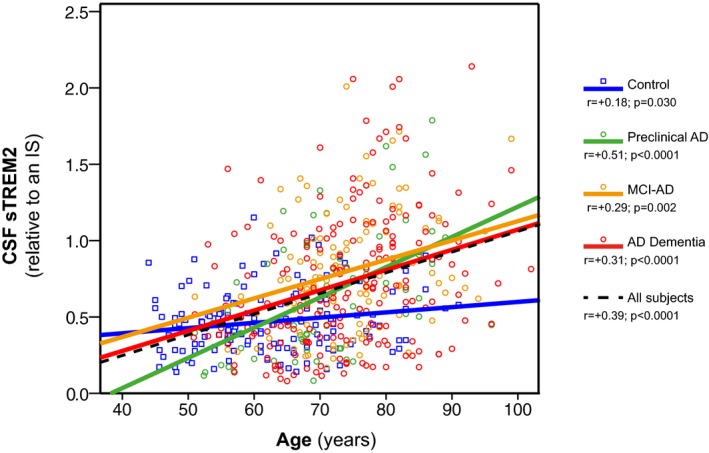
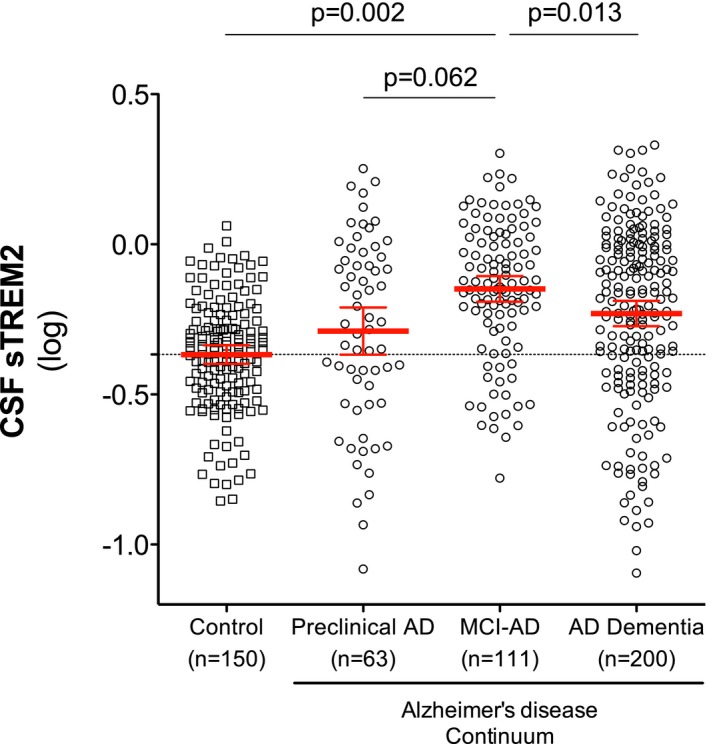
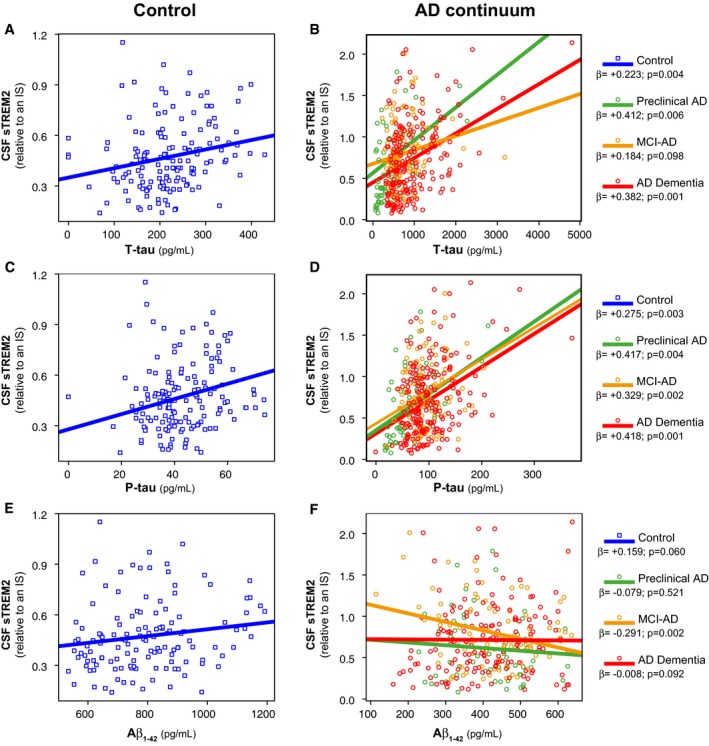
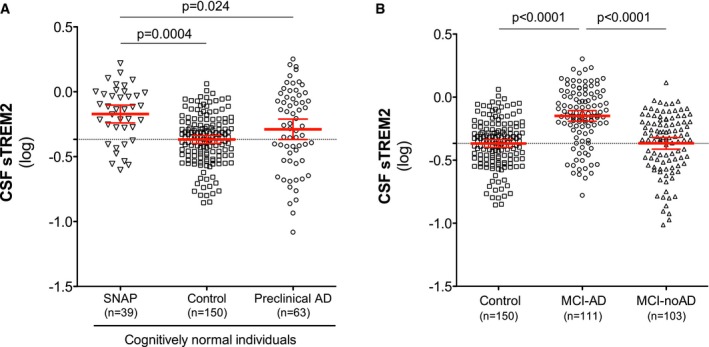
TREM2 is an innate immune receptor expressed on the surface of microglia. Loss-of-function mutations of TREM2 are associated with increased risk of Alzheimer's disease (AD). TREM2 is a type-1 protein with an ectodomain that is proteolytically cleaved and released into the extracellular space as a soluble variant (sTREM2), which can be measured in the cerebrospinal fluid (CSF). In this cross-sectional multicenter study, we investigated whether CSF levels of sTREM2 are changed during the clinical course of AD, and in cognitively normal individuals with suspected non-AD pathology (SNAP). CSF sTREM2 levels were higher in mild cognitive impairment due to AD than in all other AD groups and controls. SNAP individuals also had significantly increased CSF sTREM2 compared to controls. Moreover, increased CSF sTREM2 levels were associated with higher CSF total tau and phospho-tau181P, which are markers of neuronal degeneration and tau pathology. Our data demonstrate that CSF sTREM2 levels are increased in the early symptomatic phase of AD, probably reflecting a corresponding change of the microglia activation status in response to neuronal degeneration.
Overview
The claims and statistics of this paper haven’t been checked yet.
Free: it reads the open-access text and checks the first 5 claims that cite a source we can check. Create a free account to check every claim.
Integrity signals
Registry
Cites
Statistics
Figures
Verification
Claims the paper makes
The claims and statistics of this paper haven’t been checked yet.
Free: it reads the open-access text and checks the first 5 claims that cite a source we can check. Create a free account to check every claim.
Claims other papers make about this one
Each is checked against this paper’s own text: does it say what the citing paper says it does?
The cited source says what the claim attributes to it.
In the citing paper
“cerebrospinal fluid levels of soluble TREM2 are a potential biomarker for microglia activity in early-stage AD and correlate with neuronal injury markers (135, 136).”
From Microglia Function in the Central Nervous System During Health and Neurodegeneration (2017) · cites this paper as [135]
In the citing paper
“Moreover, an increase in secreted extracellular fragment of TREM2 appears to be a CSF biomarker of disease progression in AD (Suárez-Calvet et al., 2016).”
From Elevated TREM2 Gene Dosage Reprograms Microglia Responsivity and Ameliorates Pathological Phenotypes in Alzheimer’s Disease Models (2018) · cites this paper as Suárez-Calvet et al., 2016
Self-check
Percentages, sums and reported differences re-computed from the paper’s own numbers.
The self-check needs the paper’s full text.
Citations
Cites
McKhann, G. M., Knopman, D. S., Chertkow, H., Hyman, B. T., Jack, C. R., Kawas, C. H., Klunk, W. E., Koroshetz, W. J., Manly, J. J., Mayeux, R., et al. (2011) · Alzheimer's & Dementia · doi:10.1016/j.jalz.2011.03.005 · Cited by 18,657 · cited 7×
“Likewise, AD dementia was defined following NIA-AA criteria (McKhann et al, 2011) for probable AD, with the requirment of decreased Ab1–42 and increased T-tau and/or P-tau181P.”
BackgroundMethodInfluentialAlbert, M. S., DeKosky, S. T., Dickson, D., Dubois, B., Feldman, H. H., Fox, N. C., Gamst, A., Holtzman, D. M., Jagust, W. J., Petersen, R. C., et al. (2011) · Alzheimer's & Dementia · doi:10.1016/j.jalz.2011.03.008 · Cited by 10,152 · cited 8×
“Therefore, the diagnostic criteria of the present study were based both on the clinical diagnosis and on the AD CSF core biomarker profile, following NIA-AA recommendations (Albert et al, 2011; McKhann et al, 2011; Sperling et al, 2011).”
BackgroundMethodInfluentialSperling, R. A., Aisen, P. S., Beckett, L. A., Bennett, D. A., Craft, S., Fagan, A. M., Iwatsubo, T., Jack, C. R., Kaye, J., Montine, T. J., et al. (2011) · Alzheimer's & Dementia · doi:10.1016/j.jalz.2011.03.003 · Cited by 7,155 · cited 4×
“…AD, mild cognitive impairment (MCI) due to AD (MCI-AD), and AD dementia and controls, defined by clinical and CSF biomarker criteria as recommended by the National Institute on Aging-Alzheimer’s Association (NIA-AA) criteria (Albert et al, 2011; McKhann et al, 2011; Sperling et al, 2011).”
MethodInfluentialNeuroinflammation in Alzheimer's disease
Heneka, M. T., Carson, M. J., Khoury, J. E., Landreth, G. E., Brosseron, F., Feinstein, D. L., Jacobs, A. H., Wyss-Coray, T., Vitorica, J., Ransohoff, R. M., et al. (2015) · The Lancet Neurology · doi:10.1016/s1474-4422(15)70016-5 · Cited by 6,226 · cited 3×
“Increased microglial activation and neuroinflammation frequently accompanies the early development of Ab and tau pathology (Mosher & WyssCoray, 2014; Streit et al, 2014; Heneka et al, 2015; Tanzi, 2015).”
BackgroundInfluentialSelf-citationWinblad, B., Palmer, K., Kivipelto, M., Jelic, V., Fratiglioni, L., Wahlund, L. ‐., Nordberg, A., Bäckman, L., Albert, M., Almkvist, O., et al. (2004) · Journal of Internal Medicine · doi:10.1111/j.1365-2796.2004.01380.x · Cited by 4,946 · cited 1×
“In brief, these subjects were clinically diagnosed as MCI (following standard criteria) (Winblad et al, 2004) or with CDR = 0.5 or CDR-SOB = 0.5–4, in combination with decreased Ab1–42 and increased T-tau and/or P-tau181P.”
BackgroundInfluentialSelf-citationTREM2 Variants in Alzheimer's Disease
Guerreiro, R., Wojtas, A., Bras, J., Carrasquillo, M., Rogaeva, E., Majounie, E., Cruchaga, C., Sassi, C., Kauwe, J. S. K., Younkin, S., et al. (2013) · New England Journal of Medicine · doi:10.1056/nejmoa1211851 · Cited by 3,020 · cited 4×
“However, it is very unlikely that the possibility of TREM2 mutations in the current patient sample affected our results because TREM2 mutations show a low prevalence in the population and even in AD dementia patients (Guerreiro et al, 2013a; Jonsson et al, 2013).”
BackgroundInfluentialAlbert, M. S., DeKosky, S. T., Dickson, D., Dubois, B., Feldman, H. H., Fox, N. C., Gamst, A., Holtzman, D. M., Jagust, W. J., Petersen, R. C., et al. (2013) · Focus · doi:10.1176/appi.focus.11.1.96 · Cited by 2,621
Variant of TREM2 Associated with the Risk of Alzheimer's Disease
Jonsson, T., Stefansson, H., Steinberg, S., Jonsdottir, I., Jonsson, P. V., Snaedal, J., Bjornsson, S., Huttenlocher, J., Levey, A. I., Lah, J. J., et al. (2013) · New England Journal of Medicine · doi:10.1056/nejmoa1211103 · Cited by 2,558 · cited 3×
“However, it is very unlikely that the possibility of TREM2 mutations in the current patient sample affected our results because TREM2 mutations show a low prevalence in the population and even in AD dementia patients (Guerreiro et al, 2013a; Jonsson et al, 2013).”
BackgroundCerebrospinal fluid biomarker signature in Alzheimer's disease neuroimaging initiative subjects
Shaw, L. M., Vanderstichele, H., Knapik‐Czajka, M., Clark, C. M., Aisen, P. S., Petersen, R. C., Blennow, K., Soares, H., Simon, A., Lewczuk, P., et al. (2009) · Annals of Neurology · doi:10.1002/ana.21610 · Cited by 2,065 · cited 1×
“…has clearly demonstrated to increase the accuracy of the diagnosis of AD, to predict whether AD is the underlying pathology responsible of the cognitive symptoms and has shown to be valuable in detecting the earlier stages of the disease (Clark et al, 2003; Shaw et al, 2009; Molinuevo et al, 2014).”
BackgroundSelf-citationCerebrospinal fluid and plasma biomarkers in Alzheimer disease
Blennow, K., Hampel, H., Weiner, M., & Zetterberg, H. (2010) · Nature Reviews Neurology · doi:10.1038/nrneurol.2010.4 · Cited by 1,863 · cited 3×
“Published under the terms of the CC BY 4.0 license466”
BackgroundMethodInfluentialSelf-citation
Cited by
The amyloid hypothesis of Alzheimer's disease at 25 years
Selkoe, D. J., & Hardy, J. (2016) · EMBO Molecular Medicine · doi:10.15252/emmm.201606210 · Cited by 6,164
Microglia Function in the Central Nervous System During Health and Neurodegeneration
Colonna, M., & Butovsky, O. (2017) · Annual Review of Immunology · doi:10.1146/annurev-immunol-051116-052358 · Cited by 2,894
Neuroinflammation in neurodegenerative disorders: the roles of microglia and astrocytes
Kwon, H. S., & Koh, S.-H. (2020) · Translational Neurodegeneration · doi:10.1186/s40035-020-00221-2 · Cited by 2,595
Microglia emerge as central players in brain disease
Salter, M. W., & Stevens, B. (2017) · Nature Medicine · doi:10.1038/nm.4397 · Cited by 1,767
Microglia in neurodegeneration
Hickman, S., Izzy, S., Sen, P., Morsett, L., & El Khoury, J. (2018) · Nature Neuroscience · doi:10.1038/s41593-018-0242-x · Cited by 1,710
TREM2 — a key player in microglial biology and Alzheimer disease
Ulland, T. K., & Colonna, M. (2018) · Nature Reviews Neurology · doi:10.1038/s41582-018-0072-1 · Cited by 735
The Physiology, Pathology, and Potential Therapeutic Applications of the TREM2 Signaling Pathway
Deczkowska, A., Weiner, A., & Amit, I. (2020) · Cell · doi:10.1016/j.cell.2020.05.003 · Cited by 648
Plasma GFAP is an early marker of amyloid-β but not tau pathology in Alzheimer's disease
Pereira, J. B., Janelidze, S., Smith, R., Mattsson-Carlgren, N., Palmqvist, S., Teunissen, C. E., Zetterberg, H., Stomrud, E., Ashton, N. J., Blennow, K., et al. (2021) · Brain · doi:10.1093/brain/awab223 · Cited by 598
Self-citationInflammation: the link between comorbidities, genetics, and Alzheimer’s disease
Newcombe, E. A., Camats-Perna, J., Silva, M. L., Valmas, N., Huat, T. J., & Medeiros, R. (2018) · Journal of Neuroinflammation · doi:10.1186/s12974-018-1313-3 · Cited by 532
Current state of Alzheimer’s fluid biomarkers
Molinuevo, J. L., Ayton, S., Batrla, R., Bednar, M. M., Bittner, T., Cummings, J., Fagan, A. M., Hampel, H., Mielke, M. M., Mikulskis, A., et al. (2018) · Acta Neuropathologica · doi:10.1007/s00401-018-1932-x · Cited by 518
Self-citationSynaptic degeneration in Alzheimer disease
Tzioras, M., McGeachan, R. I., Durrant, C. S., & Spires-Jones, T. L. (2023) · Nature Reviews Neurology · doi:10.1038/s41582-022-00749-z · Cited by 504
TREM2, microglia, and neurodegenerative diseases
Yeh, F. L., Hansen, D. V., & Sheng, M. (2017) · Trends in Molecular Medicine · doi:10.1016/j.molmed.2017.03.008 · Cited by 440
TREM2 in Neurodegenerative Diseases
Jay, T. R., von Saucken, V. E., & Landreth, G. E. (2017) · Molecular Neurodegeneration · doi:10.1186/s13024-017-0197-5 · Cited by 427
“In AD patients, CSF sTREM2 was not associated with changes in CSF Aβ42 [86, 202, 314, 316] but positively correlated with CSF biomarkers total tau [86, 202] and phosphorylated tau [202, 314, 316], including in cross-sectional cohorts with dominantly inherited AD [202].”
BackgroundResultInfluentialAn early and late peak in microglial activation in Alzheimer’s disease trajectory
Fan, Z., Brooks, D. J., Okello, A., & Edison, P. (2017) · Brain · doi:10.1093/brain/aww349 · Cited by 424
“While previous studies have reported discrepant results for TREM2 levels in Alzheimer’s disease, recently a large number of subjects have demonstrated that the level of soluble TREM2 might be dependent on the different stages of Alzheimer’s disease, where TREM2 has a protective role and peaks during the early stage of…”
Lee, C. Y. D., Daggett, A., Gu, X., Jiang, L.-L., Langfelder, P., Li, X., Wang, N., Zhao, Y., Park, C. S., Cooper, Y., et al. (2018) · Neuron · doi:10.1016/j.neuron.2018.02.002 · Cited by 396
“Moreover, an increase in secreted extracellular fragment of TREM2 appears to be a CSF biomarker of disease progression in AD (Suárez-Calvet et al., 2016).”
BackgroundColonna, M. (2023) · Nature Reviews Immunology · doi:10.1038/s41577-023-00837-1 · Cited by 394
TREM2 Acts Downstream of CD33 in Modulating Microglial Pathology in Alzheimer's Disease
Griciuc, A., Patel, S., Federico, A. N., Choi, S. H., Innes, B. J., Oram, M. K., Cereghetti, G., McGinty, D., Anselmo, A., Sadreyev, R. I., et al. (2019) · Neuron · doi:10.1016/j.neuron.2019.06.010 · Cited by 378
“Soluble TREM2 is elevated in AD cerebrospinal fluid (Suarez-Calvet et al., 2016).”
Biomarkers for Alzheimer’s disease—preparing for a new era of disease-modifying therapies
Zetterberg, H., & Bendlin, B. B. (2021) · Molecular Psychiatry · doi:10.1038/s41380-020-0721-9 · Cited by 377
Self-citationThe complexity of tau in Alzheimer’s disease
Naseri, N. N., Wang, H., Guo, J., Sharma, M., & Luo, W. (2019) · Neuroscience Letters · doi:10.1016/j.neulet.2019.04.022 · Cited by 373
Zhong, L., Xu, Y., Zhuo, R., Wang, T., Wang, K., Huang, R., Wang, D., Gao, Y., Zhu, Y., Sheng, X., et al. (2019) · Nature Communications · doi:10.1038/s41467-019-09118-9 · Cited by 371
Soluble TREM2 induces inflammatory responses and enhances microglial survival
Zhong, L., Chen, X.-F., Wang, T., Wang, Z., Liao, C., Wang, Z., Huang, R., Wang, D., Li, X., Wu, L., et al. (2017) · Journal of Experimental Medicine · doi:10.1084/jem.20160844 · Cited by 362
“Several recent studies have reported that the levels of soluble TREM2 in the CSF of MCI-AD and AD dementia patients were in the 3–6 ng/ml range (∼0.17–0.33 nM; Gispert et al., 2016; Piccio et al., 2016; Suárez-Calvet et al., 2016).”
InfluentialTREM2 deficiency impairs chemotaxis and microglial responses to neuronal injury
Mazaheri, F., Snaidero, N., Kleinberger, G., Madore, C., Daria, A., Werner, G., Krasemann, S., Capell, A., Trümbach, D., Wurst, W., et al. (2017) · The EMBO Reports · doi:10.15252/embr.201743922 · Cited by 351
Self-citationInitiative, F. T. A. D. N., Suárez-Calvet, M., Morenas-Rodríguez, E., Kleinberger, G., Schlepckow, K., Araque Caballero, M. Á., Franzmeier, N., Capell, A., Fellerer, K., Nuscher, B., et al. (2019) · Molecular Neurodegeneration · doi:10.1186/s13024-018-0301-5 · Cited by 347
Self-citationThe clinical promise of biomarkers of synapse damage or loss in Alzheimer’s disease
the Synaptic Health Endpoints Working Group, Colom-Cadena, M., Spires-Jones, T., Zetterberg, H., Blennow, K., Caggiano, A., DeKosky, S. T., Fillit, H., Harrison, J. E., Schneider, L. S., et al. (2020) · Alzheimer's Research & Therapy · doi:10.1186/s13195-020-00588-4 · Cited by 328
Self-citationEwers, M., Franzmeier, N., Suárez-Calvet, M., Morenas-Rodriguez, E., Caballero, M. A. A., Kleinberger, G., Piccio, L., Cruchaga, C., Deming, Y., Dichgans, M., et al. (2019) · Science Translational Medicine · doi:10.1126/scitranslmed.aav6221 · Cited by 327
Self-citationElucidating the Role of TREM2 in Alzheimer’s Disease
Ulrich, J. D., Ulland, T. K., Colonna, M., & Holtzman, D. M. (2017) · Neuron · doi:10.1016/j.neuron.2017.02.042 · Cited by 325
Enhancing protective microglial activities with a dual function TREM2 antibody to the stalk region
Schlepckow, K., Monroe, K. M., Kleinberger, G., Cantuti‐Castelvetri, L., Parhizkar, S., Xia, D., Willem, M., Werner, G., Pettkus, N., Brunner, B., et al. (2020) · EMBO Molecular Medicine · doi:10.15252/emmm.201911227 · Cited by 324
“Moreover, sTREM2 positively correlates with total tau and phospho-tau but not with Ab (Suarez-Calvet et al, 2016b).”
BackgroundSelf-citationLewczuk, P., Riederer, P., O’Bryant, S. E., Verbeek, M. M., Dubois, B., Visser, P. J., Jellinger, K. A., Engelborghs, S., Ramirez, A., Parnetti, L., et al. (2018) · The World Journal of Biological Psychiatry · doi:10.1080/15622975.2017.1375556 · Cited by 307
Self-citationNeuroinflammatory Markers: Key Indicators in the Pathology of Neurodegenerative Diseases
Rauf, A., Badoni, H., Abu-Izneid, T., Olatunde, A., Rahman, M. M., Painuli, S., Semwal, P., Wilairatana, P., & Mubarak, M. S. (2022) · Molecules · doi:10.3390/molecules27103194 · Cited by 306
RetractedMicroglial TREM2/DAP12 signaling: a double-edged sword in neural diseases
Konishi, H., & Kiyama, H. (2018) · Frontiers in Cellular Neuroscience · doi:10.3389/fncel.2018.00206 · Cited by 300
“As the concentration of sTREM2 in cerebrospinal fluid increases in AD patients, sTREM2 could be a potential biomarker for AD (Heslegrave et al., 2016; Piccio et al., 2016; Suárez-Calvet et al., 2016).”
BackgroundMicroglia in Alzheimer’s disease: pathogenesis, mechanisms, and therapeutic potentials
Miao, J., Ma, H., Yang, Y., Liao, Y., Lin, C., Zheng, J., Yu, M., & Lan, J. (2023) · Frontiers in Aging Neuroscience · doi:10.3389/fnagi.2023.1201982 · Cited by 293
TREM2-Ligand Interactions in Health and Disease
Kober, D. L., & Brett, T. J. (2017) · Journal of Molecular Biology · doi:10.1016/j.jmb.2017.04.004 · Cited by 284
Glial activation and inflammation along the Alzheimer’s disease continuum
Nordengen, K., Kirsebom, B.-E., Henjum, K., Selnes, P., Gísladóttir, B., Wettergreen, M., Torsetnes, S. B., Grøntvedt, G. R., Waterloo, K. K., Aarsland, D., et al. (2019) · Journal of Neuroinflammation · doi:10.1186/s12974-019-1399-2 · Cited by 274
Suárez-Calvet, M., Araque Caballero, M. Á., Kleinberger, G., Bateman, R. J., Fagan, A. M., Morris, J. C., Levin, J., Danek, A., Ewers, M., Haass, C., et al. (2016) · Science Translational Medicine · doi:10.1126/scitranslmed.aag1767 · Cited by 272
Self-citationThe MS4A gene cluster is a key modulator of soluble TREM2 and Alzheimer’s disease risk
Deming, Y., Filipello, F., Cignarella, F., Cantoni, C., Hsu, S., Mikesell, R., Li, Z., Del-Aguila, J. L., Dube, U., Farias, F. G., et al. (2019) · Science Translational Medicine · doi:10.1126/scitranslmed.aau2291 · Cited by 271
Self-citationSchlepckow, K., Kleinberger, G., Fukumori, A., Feederle, R., Lichtenthaler, S. F., Steiner, H., & Haass, C. (2017) · EMBO Molecular Medicine · doi:10.15252/emmm.201707672 · Cited by 261
“Shedding by ADAM10 results in the liberation of soluble TREM2 (sTREM2), which can be detected in human cerebrospinal fluid (CSF) (Kleinberger et al, 2014; Heslegrave et al, 2016; Piccio et al, 2016; Suarez-Calvet et al, 2016a,b).”
BackgroundSelf-citationImpact of TREM2R47H variant on tau pathology–induced gliosis and neurodegeneration
Gratuze, M., Leyns, C. E. G., Sauerbeck, A. D., St-Pierre, M.-K., Xiong, M., Kim, N., Serrano, J. R., Tremblay, M.-È., Kummer, T. T., Colonna, M., et al. (2020) · Journal of Clinical Investigation · doi:10.1172/jci138179 · Cited by 252
Kleinberger, G., Brendel, M., Mracsko, E., Wefers, B., Groeneweg, L., Xiang, X., Focke, C., Deußing, M., Suárez‐Calvet, M., Mazaheri, F., et al. (2017) · The EMBO Journal · doi:10.15252/embj.201796516 · Cited by 251
“The age-dependent increase of sTrem2 is consistent with previous studies measuring sTREM2 in human CSF (Henjum et al , 2016; Piccio et al , 2016; Suarez-Calvet et al , 2016a,b).”
Self-citationThe role of TREM2 in Alzheimer's disease and other neurodegenerative disorders
Carmona, S., Zahs, K., Wu, E., Dakin, K., Bras, J., & Guerreiro, R. (2018) · The Lancet Neurology · doi:10.1016/s1474-4422(18)30232-1 · Cited by 244
Microglia in Alzheimer's Disease: Exploring How Genetics and Phenotype Influence Risk
McQuade, A., & Blurton-Jones, M. (2019) · Journal of Molecular Biology · doi:10.1016/j.jmb.2019.01.045 · Cited by 244
Milà‐Alomà, M., Salvadó, G., Gispert, J. D., Vilor‐Tejedor, N., Grau‐Rivera, O., Sala‐Vila, A., Sánchez‐Benavides, G., Arenaza‐Urquijo, E. M., Crous‐Bou, M., González‐de‐Echávarri, J. M., et al. (2020) · Alzheimer's & Dementia · doi:10.1002/alz.12131 · Cited by 241
Self-citationMolecular biomarkers of Alzheimer's disease: progress and prospects
Lashley, T., Schott, J. M., Weston, P., Murray, C. E., Wellington, H., Keshavan, A., Foti, S. C., Foiani, M., Toombs, J., Rohrer, J. D., et al. (2018) · Disease Models & Mechanisms · doi:10.1242/dmm.031781 · Cited by 230
Self-citationJurcău, M. C., Andronie-Cioara, F. L., Jurcău, A., Marcu, F., Ţiț, D. M., Pașcalău, N., & Nistor-Cseppentö, D. C. (2022) · Antioxidants · doi:10.3390/antiox11112167 · Cited by 226
“Proteolytic processing of TREM2 leads to the release of soluble fragments (sTREM2) that can be detected both in CSF and serum and which are increased in the CSF of AD patients, being correlated with levels of phosphorylated tau and tau pathology [185].”
BackgroundThe roles of inflammation and immune mechanisms in Alzheimer's disease
Van Eldik, L. J., Carrillo, M. C., Cole, P. E., Feuerbach, D., Greenberg, B. D., Hendrix, J. A., Kennedy, M., Kozauer, N., Margolin, R. A., Molinuevo, J. L., et al. (2016) · Alzheimer's & Dementia: Translational Research & Clinical Interventions · doi:10.1016/j.trci.2016.05.001 · Cited by 225
“Furthermore, the TREM2 protein can be measured as a soluble variant (sTREM2) in the cerebrospinal fluid (CSF), demonstrating recent data that CSF sTREM2 levels are increased in the early symptomatic phase of AD, probably reflecting a corresponding change of the microglia activation status in response to neuronal death…”
BackgroundSelf-citationUntangling Genetic Risk for Alzheimer’s Disease
Pimenova, A. A., Raj, T., & Goate, A. M. (2018) · Biological Psychiatry · doi:10.1016/j.biopsych.2017.05.014 · Cited by 223
“TREM2 expression is increased in response to brain injur y in AD (124, 125) and is found on both resident microglia and infiltrating monocytes and macrophages”
BackgroundEmerging Microglia Biology Defines Novel Therapeutic Approaches for Alzheimer’s Disease
Lewcock, J. W., Schlepckow, K., Di Paolo, G., Tahirovic, S., Monroe, K. M., & Haass, C. (2020) · Neuron · doi:10.1016/j.neuron.2020.09.029 · Cited by 221
Self-citationThornton, P., Sevalle, J., Deery, M. J., Fraser, G., Zhou, Y., Ståhl, S., Franssen, E. H., Dodd, R. B., Qamar, S., Gomez Perez‐Nievas, B., et al. (2017) · EMBO Molecular Medicine · doi:10.15252/emmm.201707673 · Cited by 200
Alzheimer’s Disease, Oligomers, and Inflammation
Forloni, G., & Balducci, C. (2018) · Journal of Alzheimer’s Disease · doi:10.3233/jad-170819 · Cited by 194
The role of innate immune genes in Alzheimer's disease
Griciuc, A., & Tanzi, R. E. (2021) · Current Opinion in Neurology · doi:10.1097/wco.0000000000000911 · Cited by 192
“Soluble (s)TREM2 is elevated in Alzheimer’s disease cerebrospinal fluid (CSF) compared with controls [83].”
BackgroundTREM2 dependent and independent functions of microglia in Alzheimer’s disease
Hou, J., Chen, Y., Grajales-Reyes, G., & Colonna, M. (2022) · Molecular Neurodegeneration · doi:10.1186/s13024-022-00588-y · Cited by 191
The Role of APOE and TREM2 in Alzheimer′s Disease—Current Understanding and Perspectives
Wolfe, C. M., Fitz, N. F., Nam, K. N., Lefterov, I., & Koldamova, R. (2018) · International Journal of Molecular Sciences · doi:10.3390/ijms20010081 · Cited by 187
White matter diffusion alterations precede symptom onset in autosomal dominant Alzheimer’s disease
Araque Caballero, M. Á., Suárez-Calvet, M., Duering, M., Franzmeier, N., Benzinger, T., Fagan, A. M., Bateman, R. J., Jack, C. R., Levin, J., Dichgans, M., et al. (2018) · Brain · doi:10.1093/brain/awy229 · Cited by 184
Self-citationTREM2 deficiency reduces the efficacy of immunotherapeutic amyloid clearance
Xiang, X., Werner, G., Bohrmann, B., Liesz, A., Mazaheri, F., Capell, A., Feederle, R., Knuesel, I., Kleinberger, G., & Haass, C. (2016) · EMBO Molecular Medicine · doi:10.15252/emmm.201606370 · Cited by 183
“In that regard, we recently demonstrated that in AD patients, sTREM2 levels significantly increase very early before onset of AD and tend to decrease in later phases of the disease (Suarez-Calvet et al, 2016).”
Self-citationMorenas-Rodríguez, E., Li, Y., Nuscher, B., Franzmeier, N., Xiong, C., Suárez-Calvet, M., Fagan, A. M., Schultz, S., Gordon, B. A., Benzinger, T. L. S., et al. (2022) · The Lancet Neurology · doi:10.1016/s1474-4422(22)00027-8 · Cited by 178
Self-citationFeuerbach, D., Schindler, P., Barske, C., Joller, S., Beng-Louka, E., Worringer, K. A., Kommineni, S., Kaykas, A., Ho, D. J., Ye, C., et al. (2017) · Neuroscience Letters · doi:10.1016/j.neulet.2017.09.034 · Cited by 175
CSF biomarkers of neuroinflammation in distinct forms and subtypes of neurodegenerative dementia
Abu-Rumeileh, S., Steinacker, P., Polischi, B., Mammana, A., Bartoletti-Stella, A., Oeckl, P., Baiardi, S., Zenesini, C., Huss, A., Cortelli, P., et al. (2020) · Alzheimer's Research & Therapy · doi:10.1186/s13195-019-0562-4 · Cited by 154
Biomarkers for Alzheimer’s Disease Early Diagnosis
Ausó, E., Gómez-Vicente, V., & Esquiva, G. (2020) · Journal of Personalized Medicine · doi:10.3390/jpm10030114 · Cited by 149
“An increased level of CSF soluble TREM2 has been seen in carriers of an autosomal dominant AD mutation, at least five years before the onset of symptoms, although later to brain amyloidosis and Tau pathology [54].”
BackgroundCerebrospinal Fluid Biomarkers of Alzheimer’s Disease: Current Evidence and Future Perspectives
McGrowder, D. A., Miller, F., Vaz, K., Nwokocha, C., Wilson-Clarke, C., Anderson-Cross, M., Brown, J., Anderson-Jackson, L., Williams, L., Latore, L., et al. (2021) · Brain Sciences · doi:10.3390/brainsci11020215 · Cited by 167
Glial cells in Alzheimer’s disease: From neuropathological changes to therapeutic implications
Uddin, M. S., & Lim, L. W. (2022) · Ageing Research Reviews · doi:10.1016/j.arr.2022.101622 · Cited by 145
Long, H., Simmons, A., Mayorga, A., Burgess, B., Nguyen, T., Budda, B., Rychkova, A., Rhinn, H., Tassi, I., Ward, M., et al. (2024) · Alzheimer's Research & Therapy · doi:10.1186/s13195-024-01599-1 · Cited by 124
“Studies exploring CSF sTREM2 as a potential bio-marker in AD disease progression have largely found that CSF sTREM2 is elevated in AD and changes during disease progression [49, 51, 52], with peak CSF sTREM2 occurring during the early symptomatic stages of AD [49].”
BackgroundResultHüttenrauch, M., Ogorek, I., Klafki, H., Otto, M., Stadelmann, C., Weggen, S., Wiltfang, J., & Wirths, O. (2018) · Acta Neuropathologica Communications · doi:10.1186/s40478-018-0612-3 · Cited by 166
“Although not consistent between all published studies, elevated sTREM2 levels have been reported in CSF samples of sporadic AD patients versus non-demented controls [11, 12, 36, 47].”
ResultThe Past and the Future of Alzheimer’s Disease Fluid Biomarkers
Blennow, K., & Zetterberg, H. (2018) · Journal of Alzheimer’s Disease · doi:10.3233/jad-170773 · Cited by 146
Self-citationMolecular Mechanisms of Neuroinflammation in Aging and Alzheimer’s Disease Progression
Andronie-Cioara, F. L., Ardelean, A. I., Nistor-Cseppento, C. D., Jurcau, A., Jurcau, M. C., Pascalau, N., & Marcu, F. (2023) · International Journal of Molecular Sciences · doi:10.3390/ijms24031869 · Cited by 164
Innate immune activation in neurodegenerative diseases
Castro-Gomez, S., & Heneka, M. T. (2024) · Immunity · doi:10.1016/j.immuni.2024.03.010 · Cited by 162
Self-citationAbdelhak, A., Hottenrott, T., Morenas-Rodríguez, E., Suárez-Calvet, M., Zettl, U. K., Haass, C., Meuth, S. G., Rauer, S., Otto, M., Tumani, H., et al. (2019) · Frontiers in Neurology · doi:10.3389/fneur.2019.00280 · Cited by 141
Self-citationGalectin-3, a rising star in modulating microglia activation under conditions of neurodegeneration
García-Revilla, J., Boza-Serrano, A., Espinosa-Oliva, A. M., Soto, M. S., Deierborg, T., Ruiz, R., de Pablos, R. M., Burguillos, M. A., & Venero, J. L. (2022) · Cell Death & Disease · doi:10.1038/s41419-022-05058-3 · Cited by 156
“Indeed, Gal-3 expression is strictly associated with microglial cell activation around Aβ plaques, and, similar to sTREM2, Gal-3 is released by activated microglial cells under disease conditions [64, 65].”
BackgroundBiomarkers used in Alzheimer’s disease diagnosis, treatment, and prevention
Mahaman, Y. A. R., Embaye, K. S., Huang, F., Li, L., Zhu, F., Wang, J.-Z., Liu, R., Feng, J., & Wang, X. (2022) · Ageing Research Reviews · doi:10.1016/j.arr.2021.101544 · Cited by 149
Microglial inflammation and phagocytosis in Alzheimer's disease: Potential therapeutic targets
Nizami, S., Hall‐Roberts, H., Warrier, S., Cowley, S. A., & Di Daniel, E. (2019) · British Journal of Pharmacology · doi:10.1111/bph.14618 · Cited by 147
Frontotemporal Dementia, Where Do We Stand? A Narrative Review
Antonioni, A., Raho, E. M., Lopriore, P., Pace, A. P., Latino, R. R., Assogna, M., Mancuso, M., Gragnaniello, D., Granieri, E., Pugliatti, M., et al. (2023) · International Journal of Molecular Sciences · doi:10.3390/ijms241411732 · Cited by 145
“Therefore, it could be used as a marker of microglial activity in patients affected by FTD [159], and its soluble fraction (sTREM2) is measurable in both CSF and blood [199].”
BackgroundVan Hulle, C., Jonaitis, E. M., Betthauser, T. J., Batrla, R., Wild, N., Kollmorgen, G., Andreasson, U., Okonkwo, O., Bendlin, B. B., Asthana, S., et al. (2021) · Alzheimer's & Dementia · doi:10.1002/alz.12204 · Cited by 138
Self-citationThe tetraspan MS4A family in homeostasis, immunity, and disease
Mattiola, I., Mantovani, A., & Locati, M. (2021) · Trends in Immunology · doi:10.1016/j.it.2021.07.002 · Cited by 140
Evolution of neuroinflammation across the lifespan of individuals with Down syndrome
Flores-Aguilar, L., Iulita, M. F., Kovecses, O., Torres, M. D., Levi, S. M., Zhang, Y., Askenazi, M., Wisniewski, T., Busciglio, J., & Cuello, A. C. (2020) · Brain · doi:10.1093/brain/awaa326 · Cited by 138
“, 2020) and in Alzheimer’s disease (Kleinberger et al., 2014; Suarez-Calvet et al., 2016).”
Alcolea, D., Clarimón, J., Carmona‐Iragui, M., Illán‐Gala, I., Morenas‐Rodríguez, E., Barroeta, I., Ribosa‐Nogué, R., Sala, I., Sánchez‐Saudinós, M. B., Videla, L., et al. (2019) · Alzheimer's & Dementia: Translational Research & Clinical Interventions · doi:10.1016/j.trci.2019.09.005 · Cited by 119
Self-citationSoluble TREM2: Innocent bystander or active player in neurological diseases?
Filipello, F., Goldsbury, C., You, S. F., Locca, A., Karch, C. M., & Piccio, L. (2022) · Neurobiology of Disease · doi:10.1016/j.nbd.2022.105630 · Cited by 134
Staging of Alzheimer's disease: past, present, and future perspectives
Therriault, J., Zimmer, E. R., Benedet, A. L., Pascoal, T. A., Gauthier, S., & Rosa-Neto, P. (2022) · Trends in Molecular Medicine · doi:10.1016/j.molmed.2022.05.008 · Cited by 113
Ewers, M., Biechele, G., Suárez‐Calvet, M., Sacher, C., Blume, T., Morenas‐Rodriguez, E., Deming, Y., Piccio, L., Cruchaga, C., Kleinberger, G., et al. (2020) · EMBO Molecular Medicine · doi:10.15252/emmm.202012308 · Cited by 133
Self-citationJensen, C. S., Bahl, J. M., Østergaard, L. B., Høgh, P., Wermuth, L., Heslegrave, A., Zetterberg, H., Heegaard, N. H. H., Hasselbalch, S. G., & Simonsen, A. H. (2019) · Experimental Gerontology · doi:10.1016/j.exger.2019.04.003 · Cited by 121
Self-citationAlosco, M. L., Tripodis, Y., Fritts, N. G., Heslegrave, A., Baugh, C. M., Conneely, S., Mariani, M., Martin, B. M., Frank, S., Mez, J., et al. (2018) · Alzheimer's & Dementia · doi:10.1016/j.jalz.2018.05.004 · Cited by 121
Self-citationGenetic architecture of Alzheimer's disease
Neuner, S. M., TCW, J., & Goate, A. M. (2020) · Neurobiology of Disease · doi:10.1016/j.nbd.2020.104976 · Cited by 126
Dhiman, K., Blennow, K., Zetterberg, H., Martins, R. N., & Gupta, V. B. (2019) · Cellular and Molecular Life Sciences · doi:10.1007/s00018-019-03040-5 · Cited by 123
Self-citationNeuroinflammation, Its Role in Alzheimer's Disease and Therapeutic Strategies
Király, M., Foss, J. F., & Giordano, T. (2023) · The Journal of Prevention of Alzheimer s Disease · doi:10.14283/jpad.2023.109 · Cited by 121
Alawode, D. O. T., Heslegrave, A. J., Ashton, N. J., Karikari, T. K., Simrén, J., Montoliu‐Gaya, L., Pannee, J., O´Connor, A., Weston, P. S. J., Lantero‐Rodriguez, J., et al. (2021) · Journal of Internal Medicine · doi:10.1111/joim.13332 · Cited by 104
Self-citationGispert, J. D., Suárez‐Calvet, M., Monté, G. C., Tucholka, A., Falcon, C., Rojas, S., Rami, L., Sánchez‐Valle, R., Lladó, A., Kleinberger, G., et al. (2016) · Alzheimer's & Dementia · doi:10.1016/j.jalz.2016.06.005 · Cited by 115
“The sTREM2 measurements used in the present study were previously published in the context of a broader multicenter study [32].”
BackgroundMethodResultInfluentialSelf-citationLi, T., Lu, L., Pember, E., Li, X., Zhang, B., & Zhu, Z. (2022) · Cells · doi:10.3390/cells11121925 · Cited by 104
“Furthermore, several clinical trials found an increased level of sTREM2 in CSF of AD patients, suggesting the potential role of sTREM2 as a biomarker, which requires further study [105].”
BackgroundBrosseron, F., Traschütz, A., Widmann, C. N., Kummer, M. P., Tacik, P., Santarelli, F., Jessen, F., & Heneka, M. T. (2018) · Alzheimer's Research & Therapy · doi:10.1186/s13195-018-0353-3 · Cited by 113
Self-citationTREM2 ectodomain and its soluble form in Alzheimer’s disease
Yang, J., Fu, Z., Zhang, X., Xiong, M., Meng, L., & Zhang, Z. (2020) · Journal of Neuroinflammation · doi:10.1186/s12974-020-01878-2 · Cited by 113
“sTREM2 is also a reliable biomarker of AD [39].”
BackgroundInfluentialAn update on fluid biomarkers for neurodegenerative diseases: recent success and challenges ahead
Simrén, J., Ashton, N. J., Blennow, K., & Zetterberg, H. (2020) · Current Opinion in Neurobiology · doi:10.1016/j.conb.2019.11.019 · Cited by 107
Self-citationSuárez‐Calvet, M., Capell, A., Araque Caballero, M. Á., Morenas‐Rodríguez, E., Fellerer, K., Franzmeier, N., Kleinberger, G., Eren, E., Deming, Y., Piccio, L., et al. (2018) · EMBO Molecular Medicine · doi:10.15252/emmm.201809712 · Cited by 109
Self-citationSoluble TREM2 and biomarkers of central and peripheral inflammation in neurodegenerative disease
Bekris, L. M., Khrestian, M., Dyne, E., Shao, Y., Pillai, J. A., Rao, S. M., Bemiller, S. M., Lamb, B., Fernandez, H. H., & Leverenz, J. B. (2018) · Journal of Neuroimmunology · doi:10.1016/j.jneuroim.2018.03.003 · Cited by 99
From Cerebrospinal Fluid to Blood: The Third Wave of Fluid Biomarkers for Alzheimer’s Disease
Zetterberg, H., & Blennow, K. (2018) · Journal of Alzheimer's Disease · doi:10.3233/jad-179926 · Cited by 94
Self-citationSoluble TREM2 is elevated in Parkinson’s disease subgroups with increased CSF tau
Wilson, E. N., Swarovski, M. S., Linortner, P., Shahid, M., Zuckerman, A. J., Wang, Q., Channappa, D., Minhas, P. S., Mhatre, S. D., Plowey, E. D., et al. (2020) · Brain · doi:10.1093/brain/awaa021 · Cited by 99
New fluid biomarkers tracking non-amyloid-β and non-tau pathology in Alzheimer’s disease
Park, S. A., Han, S. M., & Kim, C. E. (2020) · Experimental & Molecular Medicine · doi:10.1038/s12276-020-0418-9 · Cited by 91
Molecular and Imaging Biomarkers in Alzheimer’s Disease: A Focus on Recent Insights
Villa, C., Lavitrano, M., Salvatore, E., & Combi, R. (2020) · Journal of Personalized Medicine · doi:10.3390/jpm10030061 · Cited by 89
Neuroinflammation as a Potential Therapeutic Target in Alzheimer’s Disease
Liu, P., Wang, Y., Sun, Y., & Peng, G. (2022) · Clinical Interventions in Aging · doi:10.2147/cia.s357558 · Cited by 89
“effect; however, its expression may exert a pathogenic influence in the later stages of AD via over-activation of the inflammatory responses.(25) Another top-ranked risk gene of LOAD identified using GWAS, CD33 has an effect size much smaller than that of APOE or TREM2 and belongs to the sialic acid-binding immunoglob…”
BackgroundZhang, X., Tang, L., Yang, J., Meng, L., Chen, J., Zhou, L., Wang, J., Xiong, M., & Zhang, Z. (2023) · Nature Communications · doi:10.1038/s41467-023-42505-x · Cited by 84
“The levels of sTREM2 in the cerebrospinal fl uid (CSF) are increased in AD subjects, especially in the early stage of AD 23,24 .”
Noh, M., Kwon, H. S., Kwon, M., Nahm, M., Jin, H. K., Bae, J., & Kim, S. H. (2025) · Molecular Neurodegeneration · doi:10.1186/s13024-025-00867-4 · Cited by 97
“Elevated CSF sTREM2 levels have been observed in AD, particularly during the early symptomatic stages [78, 80, 81].”
InfluentialTREM2 and sTREM2 in Alzheimer’s disease: from mechanisms to therapies
Zhang, L., Xiang, X., Li, Y., Bu, G., & Chen, X. (2025) · Molecular Neurodegeneration · doi:10.1186/s13024-025-00834-z · Cited by 97
“AD is characterized by regional brain hypometabolism, a hallmark dysfunction measurable using 2-Deoxy-2-[18 F] fluoro-D-glucose positron emission tomography (FDG-PET) [62].”
InfluentialTagliatti, E., Desiato, G., Mancinelli, S., Bizzotto, M., Gagliani, M. C., Faggiani, E., Hernández-Soto, R., Cugurra, A., Poliseno, P., Miotto, M., et al. (2024) · Immunity · doi:10.1016/j.immuni.2023.12.002 · Cited by 88
Dynamic changes of CSF sTREM2 in preclinical Alzheimer’s disease: the CABLE study
Ma, L.-Z., Tan, L., Bi, Y.-L., Shen, X.-N., Xu, W., Ma, Y.-H., Li, H.-Q., Dong, Q., & Yu, J.-T. (2020) · Molecular Neurodegeneration · doi:10.1186/s13024-020-00374-8 · Cited by 84
Body Fluid Biomarkers for Alzheimer’s Disease—An Up-To-Date Overview
Bălașa, A. F., Chircov, C., & Grumezescu, A. M. (2020) · Biomedicines · doi:10.3390/biomedicines8100421 · Cited by 81
Metadata
- Authors
- Suárez‐Calvet, M., Kleinberger, G., Araque Caballero, M. Á., Brendel, M., Rominger, A., Alcolea, D., Fortea, J., Lleó, A., Blesa, R., Gispert, J. D., Sánchez‐Valle, R., Antonell, A., Rami, L., Molinuevo, J. L., Brosseron, F., Traschütz, A., Heneka, M. T., Struyfs, H., Engelborghs, S., Sleegers, K., Van Broeckhoven, C., Zetterberg, H., Nellgård, B., Blennow, K., Crispin, A., Ewers, M., & Haass, C.
- Affiliations
- German Center for Neurodegenerative Diseases (DE)
- Munich Cluster for Systems Neurology (DE)
- LMU Klinikum (DE)
- Universitat Autònoma de Barcelona (ES)
- Biomedical Research Networking Center in Bioengineering, Biomaterials and Nanomedicine (ES)
- Hospital Clínic de Barcelona (ES)
- Pasqual Maragall Foundation (ES)
- University Hospital Bonn (DE)
- University of Antwerp (BE)
- UCL Queen Square Institute of Neurology (GB)
- University of Gothenburg (SE)
- Institut für Medizinische Informationsverarbeitung, Biometrie und Epidemiologie (DE)
- Corresponding author
- Ewers, Michael
- Haass, Christian
- ORCID
- Suárez‐Calvet, Marc
- Kleinberger, Gernot
- Brendel, Matthias
- Rominger, Axel
- Alcolea, Daniel
- Fortea, Juan
- Lleó, Alberto
- Blesa, Rafael
- Gispert, Juan Domingo
- Sánchez‐Valle, Raquel
- Antonell, Anna
- Rami, Lorena
- Molinuevo, José L
- Brosseron, Frederic
- Traschütz, Andreas
- Heneka, Michael T
- Engelborghs, Sebastiaan
- Sleegers, Kristel
- Zetterberg, Henrik
- Nellgård, Bengt
- Blennow, Kaj
- Crispin, Alexander
- Ewers, Michael
- Haass, Christian
- Venue
- EMBO Molecular Medicine
- Published
- 2016-03-03
- Volume
- 8
- Issue
- 5
- Pages
- 466-476
- ISSN
- 1757-4676 (ISSN-L)
- 1757-4684
- PMC
- PMC5120370
- OpenAlex
- W2289098957
- Cited by
- 522
- References
- 54
- Citations by year
- 2026: 46 · 2025: 45 · 2024: 66 · 2023: 52 · 2022: 59 · 2021: 63 · 2020: 67 · 2019: 42 · 2018: 43 · 2017: 27 · 2016: 11
- FWCI
- 22.46
- Type
- journal article
- Language
- en
- Open access
- gold
- doi.org
- Licence
- other-oa
- creativecommons.org/licenses/by/4.0/ (tdm)
- creativecommons.org/licenses/by/4.0/ (vor)
- Locations
- EMBO Molecular Medicine (publishedVersion, other-oa)
- PubMed Central (publishedVersion, cc-by)
- PubMed (publishedVersion)
- LA Referencia (Red Federada de Repositorios Institucionales de Publicaciones Científicas) (publishedVersion, cc-by)
- Dipòsit Digital de Documents de la UAB (Universitat Autònoma de Barcelona) (submittedVersion, cc-by)
- Open Repository and Bibliography (University of Luxembourg) (submittedVersion, other-oa)
- DOAJ (DOAJ: Directory of Open Access Journals) (submittedVersion)
- UCL Discovery (University College London) (submittedVersion)
- DZNE Pub (submittedVersion, cc-by)
- Funders
- European Commission (PCIG12‐GA‐2012‐334259)
- European Research Council (FP7/2007–2013, 321366)
- Deutsche Forschungsgemeinschaft (115372)
- Cure Alzheimer's Fund
- MetLife Foundation Award
- Swedish Research Council
- Torsten Söderberg Foundation
- Royal Swedish Academy of Sciences
- Knut and Alice Wallenberg Foundation
- Frimurarestiftelsen (115372)
- University Research Fund of the University of Antwerp
- Institute Born‐Bunge
- Foundation for Alzheimer Research
- Neurosearch Antwerp
- Research Foundation—Flanders
- Agency for Innovation by Science and Technology
- Interuniversity Attraction Poles (IAP) Program of the Belgian Science Policy Office
- Flemish Government Methusalem Excellence Program, Belgium
- Flanders Impulse Program on Networks for Dementia Research
- EU Joint Program for Neurodegenerative Disease Research (321366)
- EU/EFPIA Innovative Medicines Initiative Joint Undertaking (115372)
- Belgian Science Policy Office Interuniversity Attraction Poles Program
- Flanders Government Initiated Impulse Program on Networks for Dementia Research
- Flemish government Initiated Methusalem Excellence Program
- University of Antwerp Research Fund, Belgium
- Janssen
- ADx Neurosciences
- Innogenetics/Fujirebio Europe
- Lundbeck
- Pfizer (115372)
- Novartis
- UCB
- Roche Diagnostics
- Nutricia/Danone (115372)
- Topics
- Life Sciences › Neuroscience › Neurology › Neuroinflammation and Neurodegeneration Mechanisms
- Life Sciences › Neuroscience › Cellular and Molecular Neuroscience › Alzheimer's disease research and treatments
- Health Sciences › Medicine › Psychiatry and Mental health › Dementia and Cognitive Impairment Research
- Keywords
- soluble TREM2, sTREM2, TREM2, microglial activation, Alzheimer's disease, cerebrospinal fluid biomarkers, mild cognitive impairment, tau protein, neuronal injury, innate immunity, early Alzheimer's disease, cognitively normal individuals
- MeSH terms
- Aged, Aged, 80 and over, Alzheimer Disease, Cerebrospinal Fluid, Cross-Sectional Studies, Female, Humans, Male, Membrane Glycoproteins, Middle Aged, Receptors, Immunologic, Biomarkers, Microglia
About these checks
Registry, retraction, Cites and statistics results are computed, not judged, with one exception: a printed reference that no index lists is read once by a model before it counts as a citation error. Claims are extracted by a model and kept only when their quote appears verbatim in the text; each cited source is then checked, with a model’s help, for whether it says what the claim relies on. Those verdicts can be wrong — read the claim’s quote and the cited source before relying on one.
Statistics and arithmetic are recomputed, not judged.
Confidence bands are shown only for fields calibrated on our annotated test set. None is calibrated yet, so no band is shown.
What counts as a claim ›How we measure confidence ›How we check this ›
Are you an author, or do you see a problem with this page? Request a review
Data sources
Bibliographic data: Semantic Scholar, OpenAlex, Crossref.
Contains information from the Semantic Scholar Academic Graph Datasets, made available under the ODC Attribution License (ODC-BY 1.0).
Semantic Scholar’s data is described in: Kinney, R., et al. (2023). The Semantic Scholar Open Data Platform. arXiv:2301.10140.
