

sTREM2 cerebrospinal fluid levels are a potential biomarker for microglia activity in early‐stage Alzheimer's disease and associate with neuronal injury markers
Open accessThe DOI matches its Crossref record; 53 of the 54 references it cites were found in a registry or an index.
Abstract
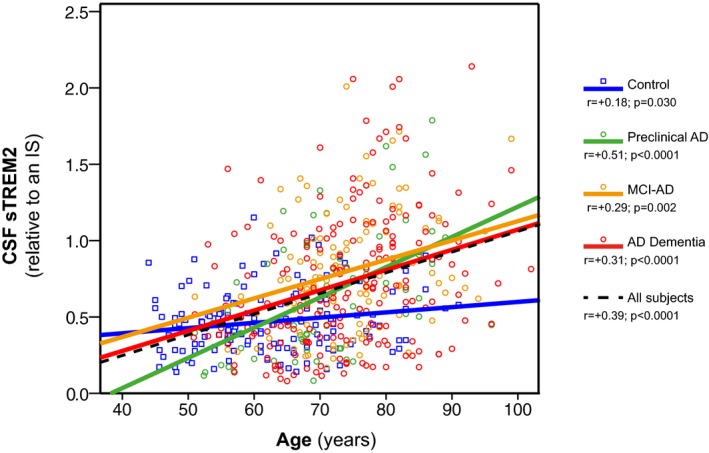
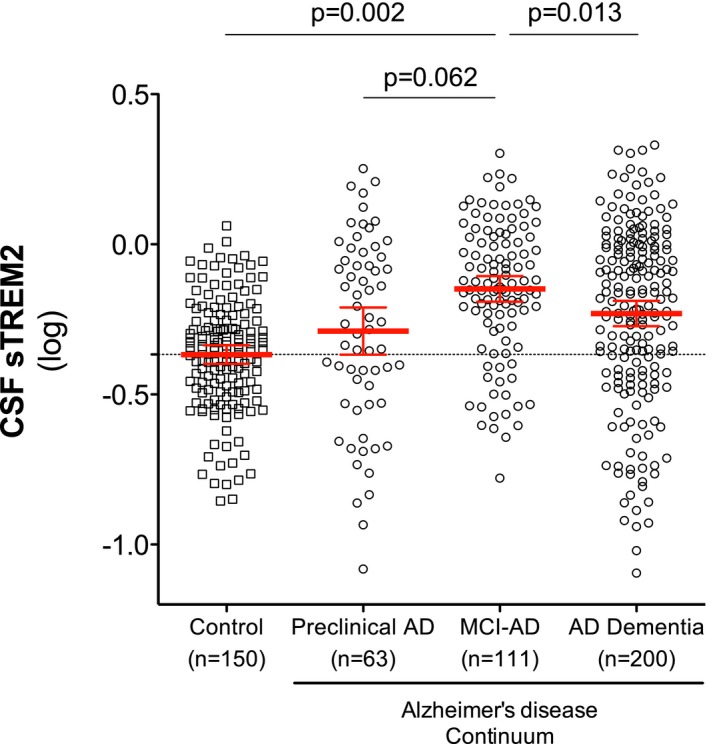
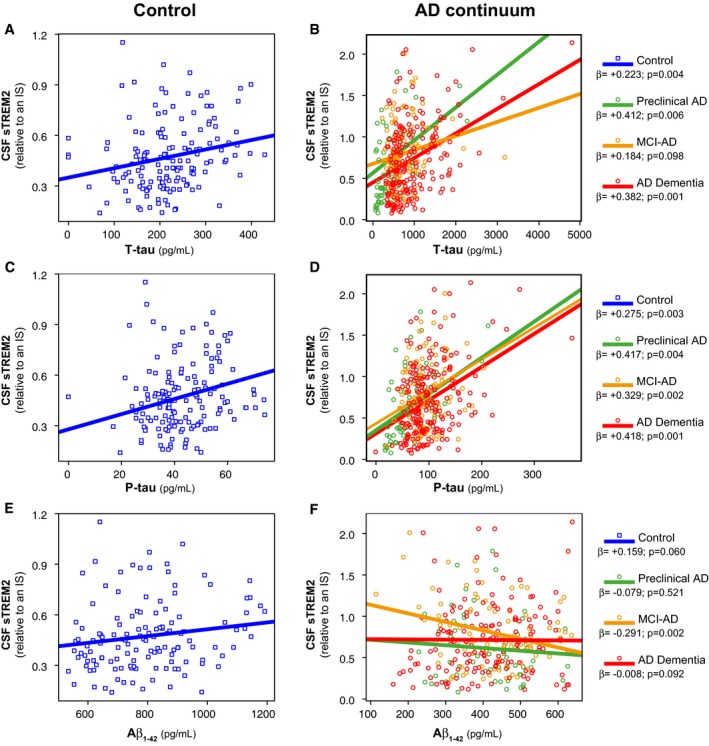
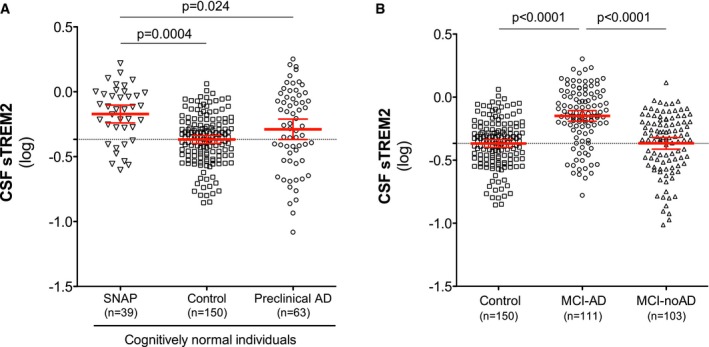
TREM2 is an innate immune receptor expressed on the surface of microglia. Loss-of-function mutations of TREM2 are associated with increased risk of Alzheimer's disease (AD). TREM2 is a type-1 protein with an ectodomain that is proteolytically cleaved and released into the extracellular space as a soluble variant (sTREM2), which can be measured in the cerebrospinal fluid (CSF). In this cross-sectional multicenter study, we investigated whether CSF levels of sTREM2 are changed during the clinical course of AD, and in cognitively normal individuals with suspected non-AD pathology (SNAP). CSF sTREM2 levels were higher in mild cognitive impairment due to AD than in all other AD groups and controls. SNAP individuals also had significantly increased CSF sTREM2 compared to controls. Moreover, increased CSF sTREM2 levels were associated with higher CSF total tau and phospho-tau181P, which are markers of neuronal degeneration and tau pathology. Our data demonstrate that CSF sTREM2 levels are increased in the early symptomatic phase of AD, probably reflecting a corresponding change of the microglia activation status in response to neuronal degeneration.
Overview
The claims and statistics of this paper haven’t been checked yet.
Free: it reads the open-access text and checks the first 5 claims that cite a source we can check. Create a free account to check every claim.
Integrity signals
Registry
Cites
Statistics
Figures
Verification
Claims the paper makes
The claims and statistics of this paper haven’t been checked yet.
Free: it reads the open-access text and checks the first 5 claims that cite a source we can check. Create a free account to check every claim.
Claims other papers make about this one
Each is checked against this paper’s own text: does it say what the citing paper says it does?
The cited source says what the claim attributes to it.
In the citing paper
“cerebrospinal fluid levels of soluble TREM2 are a potential biomarker for microglia activity in early-stage AD and correlate with neuronal injury markers (135, 136).”
From Microglia Function in the Central Nervous System During Health and Neurodegeneration (2017) · cites this paper as [135]
In the citing paper
“Moreover, an increase in secreted extracellular fragment of TREM2 appears to be a CSF biomarker of disease progression in AD (Suárez-Calvet et al., 2016).”
From Elevated TREM2 Gene Dosage Reprograms Microglia Responsivity and Ameliorates Pathological Phenotypes in Alzheimer’s Disease Models (2018) · cites this paper as Suárez-Calvet et al., 2016
Self-check
Percentages, sums and reported differences re-computed from the paper’s own numbers.
The self-check needs the paper’s full text.
Citations
Cites
McKhann, G. M., Knopman, D. S., Chertkow, H., Hyman, B. T., Jack, C. R., Kawas, C. H., Klunk, W. E., Koroshetz, W. J., Manly, J. J., Mayeux, R., et al. (2011) · Alzheimer's & Dementia · doi:10.1016/j.jalz.2011.03.005 · Cited by 18,657 · cited 7×
“Likewise, AD dementia was defined following NIA-AA criteria (McKhann et al, 2011) for probable AD, with the requirment of decreased Ab1–42 and increased T-tau and/or P-tau181P.”
BackgroundMethodInfluentialAlbert, M. S., DeKosky, S. T., Dickson, D., Dubois, B., Feldman, H. H., Fox, N. C., Gamst, A., Holtzman, D. M., Jagust, W. J., Petersen, R. C., et al. (2011) · Alzheimer's & Dementia · doi:10.1016/j.jalz.2011.03.008 · Cited by 10,152 · cited 8×
“Therefore, the diagnostic criteria of the present study were based both on the clinical diagnosis and on the AD CSF core biomarker profile, following NIA-AA recommendations (Albert et al, 2011; McKhann et al, 2011; Sperling et al, 2011).”
BackgroundMethodInfluentialSperling, R. A., Aisen, P. S., Beckett, L. A., Bennett, D. A., Craft, S., Fagan, A. M., Iwatsubo, T., Jack, C. R., Kaye, J., Montine, T. J., et al. (2011) · Alzheimer's & Dementia · doi:10.1016/j.jalz.2011.03.003 · Cited by 7,155 · cited 4×
“…AD, mild cognitive impairment (MCI) due to AD (MCI-AD), and AD dementia and controls, defined by clinical and CSF biomarker criteria as recommended by the National Institute on Aging-Alzheimer’s Association (NIA-AA) criteria (Albert et al, 2011; McKhann et al, 2011; Sperling et al, 2011).”
MethodInfluentialNeuroinflammation in Alzheimer's disease
Heneka, M. T., Carson, M. J., Khoury, J. E., Landreth, G. E., Brosseron, F., Feinstein, D. L., Jacobs, A. H., Wyss-Coray, T., Vitorica, J., Ransohoff, R. M., et al. (2015) · The Lancet Neurology · doi:10.1016/s1474-4422(15)70016-5 · Cited by 6,226 · cited 3×
“Increased microglial activation and neuroinflammation frequently accompanies the early development of Ab and tau pathology (Mosher & WyssCoray, 2014; Streit et al, 2014; Heneka et al, 2015; Tanzi, 2015).”
BackgroundInfluentialSelf-citationWinblad, B., Palmer, K., Kivipelto, M., Jelic, V., Fratiglioni, L., Wahlund, L. ‐., Nordberg, A., Bäckman, L., Albert, M., Almkvist, O., et al. (2004) · Journal of Internal Medicine · doi:10.1111/j.1365-2796.2004.01380.x · Cited by 4,946 · cited 1×
“In brief, these subjects were clinically diagnosed as MCI (following standard criteria) (Winblad et al, 2004) or with CDR = 0.5 or CDR-SOB = 0.5–4, in combination with decreased Ab1–42 and increased T-tau and/or P-tau181P.”
BackgroundInfluentialSelf-citationTREM2 Variants in Alzheimer's Disease
Guerreiro, R., Wojtas, A., Bras, J., Carrasquillo, M., Rogaeva, E., Majounie, E., Cruchaga, C., Sassi, C., Kauwe, J. S. K., Younkin, S., et al. (2013) · New England Journal of Medicine · doi:10.1056/nejmoa1211851 · Cited by 3,020 · cited 4×
“However, it is very unlikely that the possibility of TREM2 mutations in the current patient sample affected our results because TREM2 mutations show a low prevalence in the population and even in AD dementia patients (Guerreiro et al, 2013a; Jonsson et al, 2013).”
BackgroundInfluentialAlbert, M. S., DeKosky, S. T., Dickson, D., Dubois, B., Feldman, H. H., Fox, N. C., Gamst, A., Holtzman, D. M., Jagust, W. J., Petersen, R. C., et al. (2013) · Focus · doi:10.1176/appi.focus.11.1.96 · Cited by 2,621
Variant of TREM2 Associated with the Risk of Alzheimer's Disease
Jonsson, T., Stefansson, H., Steinberg, S., Jonsdottir, I., Jonsson, P. V., Snaedal, J., Bjornsson, S., Huttenlocher, J., Levey, A. I., Lah, J. J., et al. (2013) · New England Journal of Medicine · doi:10.1056/nejmoa1211103 · Cited by 2,558 · cited 3×
“However, it is very unlikely that the possibility of TREM2 mutations in the current patient sample affected our results because TREM2 mutations show a low prevalence in the population and even in AD dementia patients (Guerreiro et al, 2013a; Jonsson et al, 2013).”
BackgroundCerebrospinal fluid biomarker signature in Alzheimer's disease neuroimaging initiative subjects
Shaw, L. M., Vanderstichele, H., Knapik‐Czajka, M., Clark, C. M., Aisen, P. S., Petersen, R. C., Blennow, K., Soares, H., Simon, A., Lewczuk, P., et al. (2009) · Annals of Neurology · doi:10.1002/ana.21610 · Cited by 2,065 · cited 1×
“…has clearly demonstrated to increase the accuracy of the diagnosis of AD, to predict whether AD is the underlying pathology responsible of the cognitive symptoms and has shown to be valuable in detecting the earlier stages of the disease (Clark et al, 2003; Shaw et al, 2009; Molinuevo et al, 2014).”
BackgroundSelf-citationCerebrospinal fluid and plasma biomarkers in Alzheimer disease
Blennow, K., Hampel, H., Weiner, M., & Zetterberg, H. (2010) · Nature Reviews Neurology · doi:10.1038/nrneurol.2010.4 · Cited by 1,863 · cited 3×
“Published under the terms of the CC BY 4.0 license466”
BackgroundMethodInfluentialSelf-citation
Cited by
Items 501–575 of 575
Wang, L., Nykänen, N.-P., Western, D., Gorijala, P., Timsina, J., Li, F., Wang, Z., Ali, M., Yang, C., Liu, M., et al. (2024) · Figshare · doi:10.6084/m9.figshare.24940635
Ma, L.-Z., Tan, L., Bi, Y.-L., Shen, X.-N., Xu, W., Ma, Y.-H., Li, H.-Q., Dong, Q., & Yu, J.-T. (2020) · Figshare · doi:10.6084/m9.figshare.12114753
Franzmeier, N., Suárez‐Calvet, M., Frontzkowski, L. K., Moore, A. M., Hohman, T. J., Morenas‐Rodríguez, E., Nuscher, B., Shaw, L. M. J., Trojanowski, J. Q., Dichgans, M., et al. (2020) · Figshare · doi:10.6084/m9.figshare.13071124
Self-citationNordengen, K., Kirsebom, B.-E., Richter, G., Pålhaugen, L., Gísladóttir, B., Siafarikas, N., Nakling, A. E., Rongve, A., Bråthen, G., Grøntvedt, G. R., et al. (2024) · Figshare · doi:10.6084/m9.figshare.26653528
Self-citationAichholzer, F., Klafki, H., Ogorek, I., Vogelgsang, J. S., Wiltfang, J., Scherbaum, N., Weggen, S., & Wirths, O. (2021) · Figshare · doi:10.6084/m9.figshare.14538845
Trambauer, J. (2020) · Elektronische Hochschulschriften der LMU München (Ludwig-Maximilians-Universität München) · doi:10.5282/edoc.26870
Choi, H., Choi, Y., Lee, E. J., Kim, H., Lee, Y., Kwon, S., Hwang, D. W., & Lee, D. S. (2021) · Figshare · doi:10.6084/m9.figshare.16551264
Nordengen, K., Kirsebom, B.-E., Richter, G., Pålhaugen, L., Gísladóttir, B., Siafarikas, N., Nakling, A. E., Rongve, A., Bråthen, G., Grøntvedt, G. R., et al. (2024) · Figshare · doi:10.6084/m9.figshare.26653531
Self-citationWang, L., Nykänen, N.-P., Western, D., Gorijala, P., Timsina, J., Li, F., Wang, Z., Ali, M., Yang, C., Liu, M., et al. (2024) · Figshare · doi:10.6084/m9.figshare.24940872
Aspetti genetici e biomarcatori nella demenza frontotemporale: stato dell’arte e prospettive future.
Pendenza, D., & Pendenza, E. (2025) · Journal of Biomedical Practitioners · doi:10.13135/2532-7925/12016
Svenningsson, A. L., Stomrud, E., Palmqvist, S., Hansson, O., & Ossenkoppele, R. (2022) · Figshare · doi:10.6084/m9.figshare.21269527
Nordengen, K., Kirsebom, B.-E., Richter, G., Pålhaugen, L., Gísladóttir, B., Siafarikas, N., Nakling, A. E., Rongve, A., Bråthen, G., Grøntvedt, G. R., et al. (2024) · Figshare · doi:10.6084/m9.figshare.26653534
Self-citationYin, S., Gao, P.-Y., Ou, Y.-N., Fu, Y., Liu, Y., Wang, Z.-T., Han, B.-L., & Tan, L. (2024) · Figshare · doi:10.6084/m9.figshare.26698214
Brosseron, F., Maaß, A., Kleineidam, L., Ravichandran, K. A., Kolbe, C.-C., Wolfsgruber, S., Santarelli, F., Häsler, L. M., McManus, R. M., Ising, C., et al. (2023) · Figshare · doi:10.6084/m9.figshare.22602371
Self-citationWang, Y., Ye, M., Ji, Q., Liu, Q., Xu, X., & Zhan, Y. (2024) · Figshare · doi:10.6084/m9.figshare.26739390
Aichholzer, F., Klafki, H., Ogorek, I., Vogelgsang, J. S., Wiltfang, J., Scherbaum, N., Weggen, S., & Wirths, O. (2021) · Figshare · doi:10.6084/m9.figshare.14538848
Hok‐A‐Hin, Y. S., del Campo, M., Boiten, W. A., Stoops, E., Vanhooren, M., Lemstra, A. W., van der Flier, W. M., & Teunissen, C. E. (2023) · Figshare · doi:10.6084/m9.figshare.22774331
Aichholzer, F., Klafki, H., Ogorek, I., Vogelgsang, J. S., Wiltfang, J., Scherbaum, N., Weggen, S., & Wirths, O. (2021) · Figshare · doi:10.6084/m9.figshare.14538851
Barranco, N., Plá, V., Alcolea, D. A., Sánchez-Domínguez, I., Fischer‐Colbrie, R., Ferrer, I., Lleó, A., & Aguado, F. (2021) · Figshare · doi:10.6084/m9.figshare.16682952
Self-citationWinfree, R. L., Nolan, E., Dumitrescu, L., Blennow, K., Zetterberg, H., Gifford, K. A., Pechman, K. R., Seto, M., Petyuk, V. A., Wang, Y., et al. (2024) · Figshare · doi:10.6084/m9.figshare.25852991
Self-citationDetection of early cerebral amyloid-β deposition by PET imaging and its downstream effect
Blasco, G. S. (2021) · Dipòsit Digital de la Universitat de Barcelona (Universitat de Barcelona)
Investigating polygenic risk scores in Alzheimer's disease
Chaudhury, S. R. (2024) · Nottingham ePrints (University of Nottingham)
Investigation into patterns of epigenetic regulation of Alzheimer’s disease
Boden, K. A. (2019) · Nottingham ePrints (University of Nottingham)
Resilience against Alzheimer’s disease pathology and atrophy
Svenningsson, A. L. (2024) · Lund University Publications (Lund University)
Toppala, S. (2022) · UTUPub (University of Turku)
Determining the Molecular Mechanisms of Soluble TREM2 in Alzheimer’s Disease
Saeb, D. (2024) · CU Scholar (University of Colorado Boulder)
Wessolowski, L. (2024) · MACAU: Open Access Repository of Kiel University (University Library Kiel)
The TREM2 Receptor Directs Microglial Activity in Neurodegeneration and Neurodevelopment
Jay, T. R. (2019) · OhioLink ETD Center (Ohio Library and Information Network)
Sánchez-Domínguez, I. (2022) · Dipòsit Digital de la Universitat de Barcelona (Universitat de Barcelona)
Marcatori biologici delle malattie neurodegenerative
Vrillon, A., Aveneau, C., & Paquet, C. (2025) · EMC - Neurologia · doi:10.1016/s1634-7072(25)51074-7
The Role of TREM2 in atherosclerosis
Schulz, D. (2025) · Online Publication Service of Würzburg University (Würzburg University) · doi:10.25972/opus-42597
Rodríguez‐Fernández, B., Escalante, A. G., Genius, P., Evans, T. E., Ortiz‐Romero, P., Minguillón, C., Kollmorgen, G., Ashton, N. J., Zetterberg, H., Blennow, K., et al. (2025) · Alzheimer s & Dementia · doi:10.1002/alz70856_098828
Self-citationSoluble TREM2 Is Elevated in Pediatric Patients with Anti-NMDAR Encephalitis
Zhou, A., Ch, R., Zhou, J., Ren, X., & Zhang, W. (2026) · Journal of Clinical Medicine · doi:10.3390/jcm15031010
Omer, A., Jagtap, S., Morrison, E., Carito, L. M., Prinzen, A. L., McDonough, S. I., & Andreone, B. J. (2026) · bioRxiv (Cold Spring Harbor Laboratory) · doi:10.64898/2026.01.28.701050
Priya, Mittal, R., Banerjee, J., & Dixit, A. B. (2026) · International review of neurobiology · doi:10.1016/bs.irn.2026.02.006
Vautheny, A. (2019) · theses.fr (ABES) · doi:10.70675/1812d71aze8d9z48d6z87d1z5a23a4e81953
Implication du fragment C99 dans l’avènement des phénotypes pathologiques de la maladie d’Alzheimer
Bourgeois, A. (2019) · theses.fr (ABES) · doi:10.70675/bb8ccf34zec6cz4bb6z82b4z3030b9cb28f7
Freyssin, A. (2020) · theses.fr (ABES) · doi:10.70675/0db2e37dz547bz4731z852dz9b843c062cba
Exploration de nouveaux biomarqueurs plasmatiques pour le diagnostic de la maladie d’Alzheimer
Rossi, E. (2021) · theses.fr (ABES) · doi:10.70675/71230be4z1955z4fafzb1b8z8ff71a4edaff
Schmidt-Morgenroth, I. (2023) · theses.fr (ABES) · doi:10.70675/f89a7c1ez54acz49f7zbb58z4be7d3ab8c1f
Régulation de la phagocytose microgliale de l’amyloïde-β par le VEGF
Gea, P. D. (2023) · theses.fr (ABES) · doi:10.70675/ea344be6zc0bbz4b3bz9a85z51a1e1f7f2c6
Role of T-cell immunity in the pathophysiology of Alzheimer’s disease and other Tauopathies
Matta, K. (2024) · theses.fr (ABES) · doi:10.70675/cea4fe5ez67c3z4445z92f7z39af62ba059b
Application, validation and optimisation of antibody-based TREM2 PET
Schäfer, R. (2026) · Electronic Theses of LMU Munich (Ludwig-Maximilians-Universität München) · doi:10.5282/edoc.36730
Soluble TREM2 reduces DAP12 surface expression by dissociating the TREM2–DAP12 complexPreprint
Yamada, A., Yatame, S., & Tsuruta, F. (2026) · bioRxiv (Cold Spring Harbor Laboratory) · doi:10.64898/2026.05.05.723083
“Interestingly, levels of sTREM2 are elevated during the early stages of disease in the cerebrospinal fluid (CSF) of patients with neurodegenerative diseases, followed by a decline from the mid to late stages (38–40).”
Targeting microglia: A new strategy for the treatment of Alzheimer's disease
Zheng, M., Yang, M., Su, W., Tian, L., & Gao, W. (2026) · Journal of Neuroimmunology · doi:10.1016/j.jneuroim.2026.578966
Xu, G., Xu, P., Lei, Y., Zhou, Z., Chen, Y., Zhan, J., Feng, F., Cai, Z., & Chen, F. (2026) · Alcohol and Alcoholism · doi:10.1093/alcalc/agag036
Biochemical mechanisms of Alzheimer's disease: Narrative Review
Mahdi, I. N. M., Ismail, F. Y. M., & Ahmad, N. R. (2026) · Open Access Research Journal of Multidisciplinary Studies · doi:10.53022/oarjms.2026.11.2.0033
Ahmad, N. R., & Mahdi, I. N. M. (2026) · World Journal of Chemical and Pharmaceutical Sciences · doi:10.53346/wjcps.2026.8.2.0018
Association of sTREM2 and YKL-40 With Alzheimer’s Disease Progression: A Systematic Review
Mohamed, R. O. B., Elamin, A. M. M., Ahmed, S. S. A., Mahmuod, S. B. H., Hamid, H. A. M., Ahmed, R. A. A., & Aboaly, M. M. (2026) · Cureus · doi:10.7759/cureus.111423
“…with both amyloid and tau pathology across multiple diagnostic groups [14,15,18,20] is broadly consistent with prior work by Suárez-Calvet et al. [27], who first demonstrated that CSF sTREM2 is increased in the early symptomatic phase of AD and correlates with markers of neuronal injury, and…”
Clinical Indication of the Role of Inflammation in Alzheimer’s Disease
Kumar, A., Sarkar, N., Kundu, M., Singh, V., & Dasgupta, D. (2026) · BENTHAM SCIENCE PUBLISHERS eBooks · doi:10.2174/9798898815646126010010
Zhu, Z., Zhang, M., Xu, Y., Wen, W., Wang, W., Lee, H., & Li, X. (2026) · Veterinary Microbiology · doi:10.1016/j.vetmic.2026.111154
Morenas‐Rodríguez, E., Zaragoza-Ballester, P., Alcolea, D. A., Esteller, D., Nuscher, B., Chacón, S., Fernández‐León, Á., Rodríguez‐Baz, Í., Bejanin, A., Vera, E., et al. (2026) · Research Square · doi:10.21203/rs.3.rs-10429506/v1
“This pattern contrasts with what has been observed in early stages of AD, where sTREM2 levels in APOEε4 carriers are similar to or slightly higher than in non-carriers 32,34 .”
Self-citationDu, L., & Yan, J. (2026) · Neurobiology of Disease · doi:10.1016/j.nbd.2026.107556
Decoding TREM2: A microglial receptor governing the fate of myelin
Zhang, Z., Zhang, W., Jin, L., Wei, C., Chen, H., 程相树, & Wei, J. (2026) · Cellular Signalling · doi:10.1016/j.cellsig.2026.112815
Neurodegenerative Diseases and Pivotal Therapies
Rasool, S. (2026) · Online Journal of Clinical and Medical Case Reports · doi:10.64258/3067-7130.2026.1020043
Soluble TREM2 Mediates Blood Brain Barrier Permeability through Astrocyte ReactivityPreprint
Martínez-Meza, S., Sealy, B. A., Lopez, L., Nixon, D. F., & Berman, J. W. (2026) · Research Square · doi:10.21203/rs.3.rs-10730833/v1
Jahanbin, K., & Initiative, A. D. N. (2026) · FASEB BioAdvances · doi:10.1096/fba.2026-00194
Gong, Q., Yu, X., Chen, S., Wan, K., Wang, Z., Tian, B., Zhu, X., Zhou, X., & Sun, Z. (2026) · Frontiers in Aging Neuroscience · doi:10.3389/fnagi.2026.1937413
Identification of RNA-Binding Proteins Regulating the Alternative Splicing of TREM2 Exon 4
Yamada, H., Yanaizu, M., Iwai, N., Kato, M., Suzuki, H., 若井, 瑞., Araki, M., & Kino, Y. (2026) · Genes · doi:10.3390/genes17101188
Wu, H., Wang, Y., Gao, Z., & Zhang, H. (2026) · Frontiers in Aging Neuroscience · doi:10.3389/fnagi.2026.1899745
Mesquita, V. A., Arze, B. B. D. O., Linhares, N. J. D. O., Madeira, C. S., de Freitas, T. L., Santos, F. S. D., Júnior, H. D. S. E. S., Moreno, A. M., & Orsini, M. A. (2026) · Revista brasileira de neurologia · doi:10.46979/rbn.v62i3.72687
Jeskanen, H. (2026) · UEF eRepo (University of Eastern Finland)
miR‐214‐3p and NCKAP1: A microglial functional dimension of Alzheimer's progression
Noh, M., 문연실, Kang, S., Moon, W., Kim, H., Seo, S. W., Ahn, S., Kang, M., Kim, Y. S., Kim, H., et al. (2026) · Alzheimer s & Dementia · doi:10.1002/alz.71903
Dolado, A. O. (2026) · Lund University Publications (Lund University)
Zhang, K., Zhang, Y., Jiang, X., & Chen, X. (2026) · Aging and Disease · doi:10.14336/ad.2026.0888
“CSF sTREM2 is associated with early microglial response, tau-related neurodegeneration, clinical trajectory, and metabolic changes [110 – 113].”
Bermudez, S., Choi, J.-H., Mahmood, N., Vogel, J. W., Almousa, H. A., Huang, Z., Kim, S.-H., Zhu, V. Y., Zhou, L., Casas-Antillon, D., et al. (2026) · Proceedings of the National Academy of Sciences · doi:10.1073/pnas.2610766123
Innate Immunity in Alzheimer's disease
Martins, A. T. R. (2018) · Portuguese National Funding Agency for Science, Research and Technology (RCAAP Project by FCT)
Sun, J., Gao, G., Wang, S., Li, S., Tang, J., Liu, H., & Tang, T.-S. (2026) · Signal Transduction and Targeted Therapy · doi:10.1038/s41392-026-02776-4
Kale, M. B., Yadav, A., Sangamwar, S., Wankhede, N. L., Taksande, B. G., Umekar, M. J., & Upaganlawar, A. B. (2026) · Elsevier eBooks · doi:10.1016/b978-0-443-44253-7.00011-4
Saeb, D., Lietzke, E. E., Wood, E. A., Costa, A. F., Aldrich, E. C., Fuchs, D. I., Chaghajerdi, A. E., Bruce, K. D., & Sprenger, K. G. (2026) · bioRxiv (Cold Spring Harbor Laboratory) · doi:10.64898/2026.10.30.763206
Zhang, T., & Sun, K. (2026) · Brain Sciences · doi:10.3390/brainsci16111239
Hu, S., Pan, N., Liu, C., Wang, Y., & Zhang, T. (2021) · doi:10.3389/fnagi.2021.775432.s001
Qin, Q., Wan, H., Wang, D., Li, J., Qu, Y., Zhao, J., Li, J., & Xue, Z. (2022) · doi:10.3389/fnagi.2022.892493.s001
Metadata
- Authors
- Suárez‐Calvet, M., Kleinberger, G., Araque Caballero, M. Á., Brendel, M., Rominger, A., Alcolea, D., Fortea, J., Lleó, A., Blesa, R., Gispert, J. D., Sánchez‐Valle, R., Antonell, A., Rami, L., Molinuevo, J. L., Brosseron, F., Traschütz, A., Heneka, M. T., Struyfs, H., Engelborghs, S., Sleegers, K., Van Broeckhoven, C., Zetterberg, H., Nellgård, B., Blennow, K., Crispin, A., Ewers, M., & Haass, C.
- Affiliations
- German Center for Neurodegenerative Diseases (DE)
- Munich Cluster for Systems Neurology (DE)
- LMU Klinikum (DE)
- Universitat Autònoma de Barcelona (ES)
- Biomedical Research Networking Center in Bioengineering, Biomaterials and Nanomedicine (ES)
- Hospital Clínic de Barcelona (ES)
- Pasqual Maragall Foundation (ES)
- University Hospital Bonn (DE)
- University of Antwerp (BE)
- UCL Queen Square Institute of Neurology (GB)
- University of Gothenburg (SE)
- Institut für Medizinische Informationsverarbeitung, Biometrie und Epidemiologie (DE)
- Corresponding author
- Ewers, Michael
- Haass, Christian
- ORCID
- Suárez‐Calvet, Marc
- Kleinberger, Gernot
- Brendel, Matthias
- Rominger, Axel
- Alcolea, Daniel
- Fortea, Juan
- Lleó, Alberto
- Blesa, Rafael
- Gispert, Juan Domingo
- Sánchez‐Valle, Raquel
- Antonell, Anna
- Rami, Lorena
- Molinuevo, José L
- Brosseron, Frederic
- Traschütz, Andreas
- Heneka, Michael T
- Engelborghs, Sebastiaan
- Sleegers, Kristel
- Zetterberg, Henrik
- Nellgård, Bengt
- Blennow, Kaj
- Crispin, Alexander
- Ewers, Michael
- Haass, Christian
- Venue
- EMBO Molecular Medicine
- Published
- 2016-03-03
- Volume
- 8
- Issue
- 5
- Pages
- 466-476
- ISSN
- 1757-4676 (ISSN-L)
- 1757-4684
- PMC
- PMC5120370
- OpenAlex
- W2289098957
- Cited by
- 522
- References
- 54
- Citations by year
- 2026: 46 · 2025: 45 · 2024: 66 · 2023: 52 · 2022: 59 · 2021: 63 · 2020: 67 · 2019: 42 · 2018: 43 · 2017: 27 · 2016: 11
- FWCI
- 22.46
- Type
- journal article
- Language
- en
- Open access
- gold
- doi.org
- Licence
- other-oa
- creativecommons.org/licenses/by/4.0/ (tdm)
- creativecommons.org/licenses/by/4.0/ (vor)
- Locations
- EMBO Molecular Medicine (publishedVersion, other-oa)
- PubMed Central (publishedVersion, cc-by)
- PubMed (publishedVersion)
- LA Referencia (Red Federada de Repositorios Institucionales de Publicaciones Científicas) (publishedVersion, cc-by)
- Dipòsit Digital de Documents de la UAB (Universitat Autònoma de Barcelona) (submittedVersion, cc-by)
- Open Repository and Bibliography (University of Luxembourg) (submittedVersion, other-oa)
- DOAJ (DOAJ: Directory of Open Access Journals) (submittedVersion)
- UCL Discovery (University College London) (submittedVersion)
- DZNE Pub (submittedVersion, cc-by)
- Funders
- European Commission (PCIG12‐GA‐2012‐334259)
- European Research Council (FP7/2007–2013, 321366)
- Deutsche Forschungsgemeinschaft (115372)
- Cure Alzheimer's Fund
- MetLife Foundation Award
- Swedish Research Council
- Torsten Söderberg Foundation
- Royal Swedish Academy of Sciences
- Knut and Alice Wallenberg Foundation
- Frimurarestiftelsen (115372)
- University Research Fund of the University of Antwerp
- Institute Born‐Bunge
- Foundation for Alzheimer Research
- Neurosearch Antwerp
- Research Foundation—Flanders
- Agency for Innovation by Science and Technology
- Interuniversity Attraction Poles (IAP) Program of the Belgian Science Policy Office
- Flemish Government Methusalem Excellence Program, Belgium
- Flanders Impulse Program on Networks for Dementia Research
- EU Joint Program for Neurodegenerative Disease Research (321366)
- EU/EFPIA Innovative Medicines Initiative Joint Undertaking (115372)
- Belgian Science Policy Office Interuniversity Attraction Poles Program
- Flanders Government Initiated Impulse Program on Networks for Dementia Research
- Flemish government Initiated Methusalem Excellence Program
- University of Antwerp Research Fund, Belgium
- Janssen
- ADx Neurosciences
- Innogenetics/Fujirebio Europe
- Lundbeck
- Pfizer (115372)
- Novartis
- UCB
- Roche Diagnostics
- Nutricia/Danone (115372)
- Topics
- Life Sciences › Neuroscience › Neurology › Neuroinflammation and Neurodegeneration Mechanisms
- Life Sciences › Neuroscience › Cellular and Molecular Neuroscience › Alzheimer's disease research and treatments
- Health Sciences › Medicine › Psychiatry and Mental health › Dementia and Cognitive Impairment Research
- Keywords
- soluble TREM2, sTREM2, TREM2, microglial activation, Alzheimer's disease, cerebrospinal fluid biomarkers, mild cognitive impairment, tau protein, neuronal injury, innate immunity, early Alzheimer's disease, cognitively normal individuals
- MeSH terms
- Aged, Aged, 80 and over, Alzheimer Disease, Cerebrospinal Fluid, Cross-Sectional Studies, Female, Humans, Male, Membrane Glycoproteins, Middle Aged, Receptors, Immunologic, Biomarkers, Microglia
About these checks
Registry, retraction, Cites and statistics results are computed, not judged, with one exception: a printed reference that no index lists is read once by a model before it counts as a citation error. Claims are extracted by a model and kept only when their quote appears verbatim in the text; each cited source is then checked, with a model’s help, for whether it says what the claim relies on. Those verdicts can be wrong — read the claim’s quote and the cited source before relying on one.
Statistics and arithmetic are recomputed, not judged.
Confidence bands are shown only for fields calibrated on our annotated test set. None is calibrated yet, so no band is shown.
What counts as a claim ›How we measure confidence ›How we check this ›
Are you an author, or do you see a problem with this page? Request a review
Data sources
Bibliographic data: Semantic Scholar, OpenAlex, Crossref.
Contains information from the Semantic Scholar Academic Graph Datasets, made available under the ODC Attribution License (ODC-BY 1.0).
Semantic Scholar’s data is described in: Kinney, R., et al. (2023). The Semantic Scholar Open Data Platform. arXiv:2301.10140.
