

sTREM2 cerebrospinal fluid levels are a potential biomarker for microglia activity in early‐stage Alzheimer's disease and associate with neuronal injury markers
Open accessThe DOI matches its Crossref record; 53 of the 54 references it cites were found in a registry or an index.
Abstract
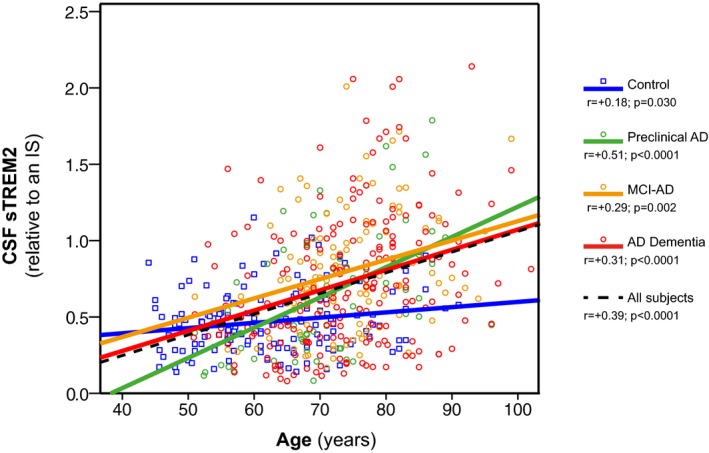
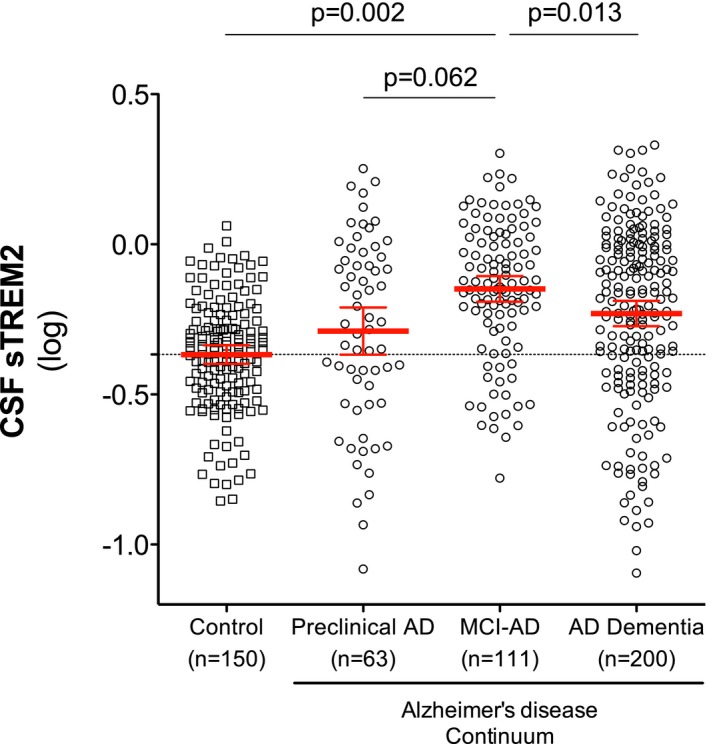
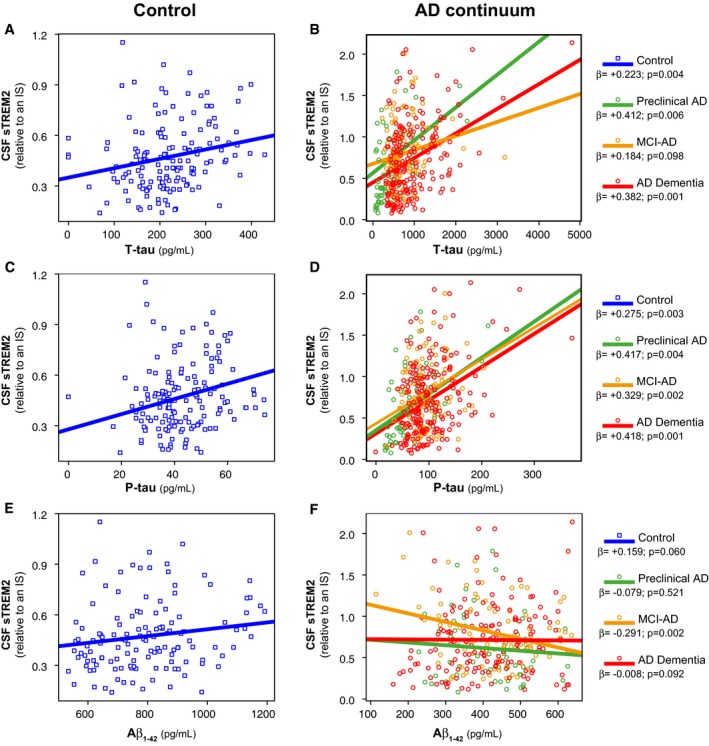
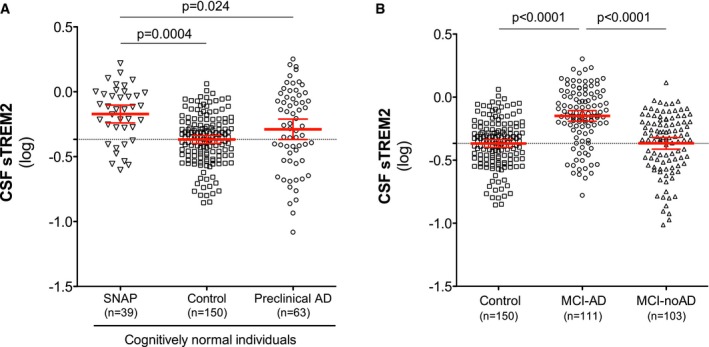
TREM2 is an innate immune receptor expressed on the surface of microglia. Loss-of-function mutations of TREM2 are associated with increased risk of Alzheimer's disease (AD). TREM2 is a type-1 protein with an ectodomain that is proteolytically cleaved and released into the extracellular space as a soluble variant (sTREM2), which can be measured in the cerebrospinal fluid (CSF). In this cross-sectional multicenter study, we investigated whether CSF levels of sTREM2 are changed during the clinical course of AD, and in cognitively normal individuals with suspected non-AD pathology (SNAP). CSF sTREM2 levels were higher in mild cognitive impairment due to AD than in all other AD groups and controls. SNAP individuals also had significantly increased CSF sTREM2 compared to controls. Moreover, increased CSF sTREM2 levels were associated with higher CSF total tau and phospho-tau181P, which are markers of neuronal degeneration and tau pathology. Our data demonstrate that CSF sTREM2 levels are increased in the early symptomatic phase of AD, probably reflecting a corresponding change of the microglia activation status in response to neuronal degeneration.
Overview
The claims and statistics of this paper haven’t been checked yet.
Free: it reads the open-access text and checks the first 5 claims that cite a source we can check. Create a free account to check every claim.
Integrity signals
Registry
Cites
Statistics
Figures
Verification
Claims the paper makes
The claims and statistics of this paper haven’t been checked yet.
Free: it reads the open-access text and checks the first 5 claims that cite a source we can check. Create a free account to check every claim.
Claims other papers make about this one
Each is checked against this paper’s own text: does it say what the citing paper says it does?
The cited source says what the claim attributes to it.
In the citing paper
“cerebrospinal fluid levels of soluble TREM2 are a potential biomarker for microglia activity in early-stage AD and correlate with neuronal injury markers (135, 136).”
From Microglia Function in the Central Nervous System During Health and Neurodegeneration (2017) · cites this paper as [135]
In the citing paper
“Moreover, an increase in secreted extracellular fragment of TREM2 appears to be a CSF biomarker of disease progression in AD (Suárez-Calvet et al., 2016).”
From Elevated TREM2 Gene Dosage Reprograms Microglia Responsivity and Ameliorates Pathological Phenotypes in Alzheimer’s Disease Models (2018) · cites this paper as Suárez-Calvet et al., 2016
Self-check
Percentages, sums and reported differences re-computed from the paper’s own numbers.
The self-check needs the paper’s full text.
Citations
Cites
McKhann, G. M., Knopman, D. S., Chertkow, H., Hyman, B. T., Jack, C. R., Kawas, C. H., Klunk, W. E., Koroshetz, W. J., Manly, J. J., Mayeux, R., et al. (2011) · Alzheimer's & Dementia · doi:10.1016/j.jalz.2011.03.005 · Cited by 18,657 · cited 7×
“Likewise, AD dementia was defined following NIA-AA criteria (McKhann et al, 2011) for probable AD, with the requirment of decreased Ab1–42 and increased T-tau and/or P-tau181P.”
BackgroundMethodInfluentialAlbert, M. S., DeKosky, S. T., Dickson, D., Dubois, B., Feldman, H. H., Fox, N. C., Gamst, A., Holtzman, D. M., Jagust, W. J., Petersen, R. C., et al. (2011) · Alzheimer's & Dementia · doi:10.1016/j.jalz.2011.03.008 · Cited by 10,152 · cited 8×
“Therefore, the diagnostic criteria of the present study were based both on the clinical diagnosis and on the AD CSF core biomarker profile, following NIA-AA recommendations (Albert et al, 2011; McKhann et al, 2011; Sperling et al, 2011).”
BackgroundMethodInfluentialSperling, R. A., Aisen, P. S., Beckett, L. A., Bennett, D. A., Craft, S., Fagan, A. M., Iwatsubo, T., Jack, C. R., Kaye, J., Montine, T. J., et al. (2011) · Alzheimer's & Dementia · doi:10.1016/j.jalz.2011.03.003 · Cited by 7,155 · cited 4×
“…AD, mild cognitive impairment (MCI) due to AD (MCI-AD), and AD dementia and controls, defined by clinical and CSF biomarker criteria as recommended by the National Institute on Aging-Alzheimer’s Association (NIA-AA) criteria (Albert et al, 2011; McKhann et al, 2011; Sperling et al, 2011).”
MethodInfluentialNeuroinflammation in Alzheimer's disease
Heneka, M. T., Carson, M. J., Khoury, J. E., Landreth, G. E., Brosseron, F., Feinstein, D. L., Jacobs, A. H., Wyss-Coray, T., Vitorica, J., Ransohoff, R. M., et al. (2015) · The Lancet Neurology · doi:10.1016/s1474-4422(15)70016-5 · Cited by 6,226 · cited 3×
“Increased microglial activation and neuroinflammation frequently accompanies the early development of Ab and tau pathology (Mosher & WyssCoray, 2014; Streit et al, 2014; Heneka et al, 2015; Tanzi, 2015).”
BackgroundInfluentialSelf-citationWinblad, B., Palmer, K., Kivipelto, M., Jelic, V., Fratiglioni, L., Wahlund, L. ‐., Nordberg, A., Bäckman, L., Albert, M., Almkvist, O., et al. (2004) · Journal of Internal Medicine · doi:10.1111/j.1365-2796.2004.01380.x · Cited by 4,946 · cited 1×
“In brief, these subjects were clinically diagnosed as MCI (following standard criteria) (Winblad et al, 2004) or with CDR = 0.5 or CDR-SOB = 0.5–4, in combination with decreased Ab1–42 and increased T-tau and/or P-tau181P.”
BackgroundInfluentialSelf-citationTREM2 Variants in Alzheimer's Disease
Guerreiro, R., Wojtas, A., Bras, J., Carrasquillo, M., Rogaeva, E., Majounie, E., Cruchaga, C., Sassi, C., Kauwe, J. S. K., Younkin, S., et al. (2013) · New England Journal of Medicine · doi:10.1056/nejmoa1211851 · Cited by 3,020 · cited 4×
“However, it is very unlikely that the possibility of TREM2 mutations in the current patient sample affected our results because TREM2 mutations show a low prevalence in the population and even in AD dementia patients (Guerreiro et al, 2013a; Jonsson et al, 2013).”
BackgroundInfluentialAlbert, M. S., DeKosky, S. T., Dickson, D., Dubois, B., Feldman, H. H., Fox, N. C., Gamst, A., Holtzman, D. M., Jagust, W. J., Petersen, R. C., et al. (2013) · Focus · doi:10.1176/appi.focus.11.1.96 · Cited by 2,621
Variant of TREM2 Associated with the Risk of Alzheimer's Disease
Jonsson, T., Stefansson, H., Steinberg, S., Jonsdottir, I., Jonsson, P. V., Snaedal, J., Bjornsson, S., Huttenlocher, J., Levey, A. I., Lah, J. J., et al. (2013) · New England Journal of Medicine · doi:10.1056/nejmoa1211103 · Cited by 2,558 · cited 3×
“However, it is very unlikely that the possibility of TREM2 mutations in the current patient sample affected our results because TREM2 mutations show a low prevalence in the population and even in AD dementia patients (Guerreiro et al, 2013a; Jonsson et al, 2013).”
BackgroundCerebrospinal fluid biomarker signature in Alzheimer's disease neuroimaging initiative subjects
Shaw, L. M., Vanderstichele, H., Knapik‐Czajka, M., Clark, C. M., Aisen, P. S., Petersen, R. C., Blennow, K., Soares, H., Simon, A., Lewczuk, P., et al. (2009) · Annals of Neurology · doi:10.1002/ana.21610 · Cited by 2,065 · cited 1×
“…has clearly demonstrated to increase the accuracy of the diagnosis of AD, to predict whether AD is the underlying pathology responsible of the cognitive symptoms and has shown to be valuable in detecting the earlier stages of the disease (Clark et al, 2003; Shaw et al, 2009; Molinuevo et al, 2014).”
BackgroundSelf-citationCerebrospinal fluid and plasma biomarkers in Alzheimer disease
Blennow, K., Hampel, H., Weiner, M., & Zetterberg, H. (2010) · Nature Reviews Neurology · doi:10.1038/nrneurol.2010.4 · Cited by 1,863 · cited 3×
“Published under the terms of the CC BY 4.0 license466”
BackgroundMethodInfluentialSelf-citation
Cited by
Items 301–400 of 575
Ashwini, P., Bodhankar, S. L., Muthal, A., Kumar, D., Pawar, A., & Kulkarni, R. (2024) · Acta Pharmaceutica Sinica B · doi:10.1016/j.apsb.2024.11.016 · Cited by 19
“Even in the case of AD, just activating or suppressing TREM2 does not appear to be beneficial. sTREM2 levels in CSF have been reported to differ between male and female subjects in certain investigations, but not all 196,197 .”
Jiao, L., Yang, J., Wang, W., Liu, X., Fu, Y., & Fan, D. (2024) · Frontiers in Neurology · doi:10.3389/fneur.2024.1515252 · Cited by 19
Neuroimmunity in amyotrophic lateral sclerosis: focus on microglia
Moțățăianu, A., Bărcuţean, L., & Bălașa, R. (2020) · Amyotrophic Lateral Sclerosis and Frontotemporal Degeneration · doi:10.1080/21678421.2019.1708949 · Cited by 19
“Furthermore, mean levels of TREM-2 are significantly higher in early-stage compared to late-stage disease, but in late-stage disease, higher levels are associated with a slower disease progression (62).”
BackgroundMicroglia and its role in neurodegenerative diseases
Yıldızhan, K., & Nazıroğlu, M. (2019) · Journal of Cellular Neuroscience and Oxidative Stress · doi:10.37212/jcnos.683407 · Cited by 19
Abdelhak, A., Huss, A. M., Brück, A., Sebert, U., Mayer, B., Müller, H., Tumani, H., Otto, M., Yilmazer‐Hanke, D., Ludolph, A. C., et al. (2020) · Neurological Research and Practice · doi:10.1186/s42466-020-00062-4 · Cited by 19
“Thus, more specific microglial markers such as sTREM2 [38] may be promising additional candidate markers for understanding the role of microglia in CSVD in future studies.”
BackgroundThe Role of TREML2 in Alzheimer’s Disease
Wang, S., Gong, P., Yan, E., Zhang, Y., & Jiang, T. (2020) · Journal of Alzheimer s Disease · doi:10.3233/jad-200406 · Cited by 19
Torso, M., Ridgway, G. R., Hardingham, I., Schwarz, A. J., & Chance, S. A. (2022) · The Journal of Prevention of Alzheimer s Disease · doi:10.14283/jpad.2022.59 · Cited by 19
“CSF sTREM2 and PGRN were measured by ELISA protocols previously established by the Haass group using the MSD Platform comprehensively described in previous publications (20-23).”
MethodIs liquid biopsy mature enough for the diagnosis of Alzheimer’s disease?
Gong, X., Zhang, H., Liu, X., Liu, Y., Liu, J., Fapohunda, F. O., Lü, P., Wang, K., & Tang, M. (2022) · Frontiers in Aging Neuroscience · doi:10.3389/fnagi.2022.977999 · Cited by 20
Li, T., Initiative, A. D. N., Lyu, D., & Liu, F. (2022) · Journal of Alzheimer s Disease · doi:10.3233/jad-220598 · Cited by 19
CSF sTREM2 is elevated in a subset in GRN-related frontotemporal dementia
van der Ende, E. L., Morenas‐Rodríguez, E., McMillan, C. T., Grossman, M., Irwin, D. J., Sánchez‐Valle, R., Graff, C., Vandenberghe, R. R., Pijnenburg, Y. A. L., Laforce, R. J., et al. (2021) · Neurobiology of Aging · doi:10.1016/j.neurobiolaging.2021.02.024 · Cited by 19
Self-citationHigher plasma soluble TREM2 correlates with reduced cerebral tau accumulation in Alzheimer’s disease
Lan, G., Li, A., González‐Ortiz, F., Lv, J., Ran, W., Cai, Y. Q., Sun, P., Liu, L., Yang, J., Zhang, L., et al. (2025) · Molecular Psychiatry · doi:10.1038/s41380-025-02976-4 · Cited by 18
“CSF sTREM2 displays potential neuroprotective effects on reducing the depositions of A β and tau pathology [13 – 15].”
Self-citationMassa, F., Meli, R., Morbelli, S. D., Nobili, F. M., & Pardini, M. (2019) · Annals of Translational Medicine · doi:10.21037/atm.2019.05.81 · Cited by 18
As48, a first-in-class dual-function TREM2 modulator: Receptor activation and shedding inhibition
Cho, S., Gaamouch, F. E., Upadhyay, S., Nada, H., Kuncewicz, K., & Gabr, M. T. (2025) · Biomedicine & Pharmacotherapy · doi:10.1016/j.biopha.2025.118862 · Cited by 17
Dense core vesicle markers in CSF and cortical tissues of patients with Alzheimer’s disease
Barranco, N., Plá, V., Alcolea, D. A., Sánchez-Domínguez, I., Fischer‐Colbrie, R., Ferrer, I., Lleó, A., & Aguado, F. (2021) · Translational Neurodegeneration · doi:10.1186/s40035-021-00263-0 · Cited by 17
Self-citationWang, K., Cao, X., Li, Z., Liu, S., Zhou, Y., Guo, L., & Li, P. (2022) · BMC Anesthesiology · doi:10.1186/s12871-022-01955-4 · Cited by 17
“A growing number of studies demonstrated that CSF sTREM2 was increased in the late-onset AD [32, 33] and early-onset familial AD [34].”
BackgroundNeuroinflammation als Motor der Alzheimer-Erkrankung
Castro‐Gomez, S., Binder, J., & Heneka, M. T. (2019) · Der Nervenarzt · doi:10.1007/s00115-019-0778-3 · Cited by 17
Self-citationMo, M., Tang, Y., Wei, L., Qiu, J., Peng, G., Lin, Y., Zhou, M., Dai, W., Zhang, Z., Chen, X. '., et al. (2021) · Frontiers in Aging Neuroscience · doi:10.3389/fnagi.2021.753210 · Cited by 17
A review of imaging genetics in Alzheimer's disease
Yu, X., Sheng, J., Miao, M., Wang, L., Yang, Z. X., & Huang, H. (2022) · Journal of Clinical Neuroscience · doi:10.1016/j.jocn.2022.04.017 · Cited by 17
Cerebrospinal fluid in the dementias
Zetterberg, H., Rohrer, J. D., & Schott, J. M. (2017) · Handbook of clinical neurology · doi:10.1016/b978-0-12-804279-3.00006-x · Cited by 18
Self-citationFemale sex is linked to a stronger association between sTREM2 and CSF p-tau in Alzheimer’s disease
Biel, D., Suárez‐Calvet, M., Dewenter, A., Steward, A., Roemer, S. N., Dehsarvi, A., Zhu, Z., Pescoller, J., Frontzkowski, L. K., Kreuzer, A., et al. (2025) · EMBO Molecular Medicine · doi:10.1038/s44321-024-00190-3 · Cited by 16
Self-citationP-tau and neurodegeneration mediate the effect of β-amyloid on cognition in non-demented elders
Ma, L., Hu, H., Wang, Z.-T., Ou, Y., Dong, Q., Tan, L., & Yu, J. (2021) · Alzheimer s Research & Therapy · doi:10.1186/s13195-021-00943-z · Cited by 16
“CSF sTREM2 measurements (unit: pg/mL) were done with an MSD platform-based assay, previously reported and validated [17].”
MethodThe longitudinal trajectory of CSF sTREM2: the alzheimer’s disease neuroimaging initiative
Wang, Y. T., Ye, M., Ji, Q., Liu, Q., Xu, X., & Zhan, Y. (2024) · Alzheimer s Research & Therapy · doi:10.1186/s13195-024-01506-8 · Cited by 16
“Moreover , this Regarding the sTREM2 trajectory, in contrast to the results of Suárez-Calvet et al., our study did not observe a faster increase in sTREM2 levels among individuals with MCI or dementia compared to cognitively normal individuals [42].”
BackgroundResultInfluentialBiological mechanisms of resilience to tau pathology in Alzheimer’s disease
Svenningsson, A. L., Bocancea, D. I., Stomrud, E., van Loenhoud, A. C., Barkhof, F., Mattsson, N., Palmqvist, S., Hansson, O., & Ossenkoppele, R. (2024) · Alzheimer s Research & Therapy · doi:10.1186/s13195-024-01591-9 · Cited by 15
Sheng, Z.-H., Wang, L., Chen, M., Zhong, F., Wu, S., Liang, S., Song, J., Chen, L., Chen, Y., Chen, S., et al. (2025) · Alzheimer s Research & Therapy · doi:10.1186/s13195-024-01665-8 · Cited by 16
Inflammation in the CNS: Understanding Various Aspects of the Pathogenesis of Alzheimer's Disease
Doroszkiewicz, J., Mroczko, P., & Kulczyńska‐Przybik, A. (2021) · Current Alzheimer Research · doi:10.2174/1567205018666211202143935 · Cited by 15
Axonal degeneration and amyloid pathology predict cognitive decline beyond cortical atrophy
Svenningsson, A. L., Stomrud, E., Palmqvist, S., Hansson, O., & Ossenkoppele, R. (2022) · Alzheimer s Research & Therapy · doi:10.1186/s13195-022-01081-w · Cited by 15
Role of triggering receptor expressed on myeloid cells 2 (TREM2) in neurodegenerative dementias
Shafi, S., Singh, A., Ibrahim, A. M., Alhajri, N., Izneid, T. A., & Pottoo, F. H. (2021) · European Journal of Neuroscience · doi:10.1111/ejn.15215 · Cited by 16
Moyse, E., Haddad, M., Benlabiod, C., Ramassamy, C., & Krantic, S. M. (2019) · Current Alzheimer Research · doi:10.2174/1567205016666191106094356 · Cited by 16
Wang, T., Liu, X., Wang, X., Hua, F., & Yan, L. (2026) · Frontiers in Immunology · doi:10.3389/fimmu.2026.1739875 · Cited by 14
“The rise in CSF sTREM2 is widely interpreted as a proxy for microglial activation (79, 81), a hallmark of early neuroin fl ammatory processes in AD (82).”
Jiahuan, X., Ying, Z., Hongyu, J., Wei, Z., Guan, S., Chengyue, D., Liangyu, F., Fan, L., & Wang, W. (2022) · Frontiers in Aging Neuroscience · doi:10.3389/fnagi.2022.843828 · Cited by 14
Phase 1, First‐In‐Human, Single‐/Multiple‐Ascending Dose Study of Iluzanebart in Healthy Volunteers
Meier, A., Papapetropoulos, S., Marsh, A., Neelon, K., Stiles, D. A., O'Mara, R., Thackaberry, E. A., Colonna, M., & Rajagovindan, R. (2025) · Annals of Clinical and Translational Neurology · doi:10.1002/acn3.70033 · Cited by 13
“Research showing associations among neuronal injury, microglial activation, and sTREM2 shedding suggests that sTREM2 concentrations in CSF can be used as a surrogate immune biomarker of microglial activity [18, 19, 30].”
CSF glial markers are elevated in a subset of patients with genetic frontotemporal dementia
Woollacott, I., Swift, I. J., Sogorb‐Esteve, A., Heller, C., Knowles, K., Bouzigues, A., Russell, L. L., Peakman, G., Greaves, C. V., Convery, R. S., et al. (2022) · Annals of Clinical and Translational Neurology · doi:10.1002/acn3.51672 · Cited by 13
Self-citationLack of association between TREM2 rs75932628 variant and amyotrophic lateral sclerosis
Siokas, V., Aloizou, A., Liampas, I., Tsouris, Z., Mentis, A. A., Nasios, G., Papadimitriou, D. A., Bogdanos, D. P., Hadjigeorgiou, G. M., & Dardiotis, E. (2021) · Molecular Biology Reports · doi:10.1007/s11033-021-06312-1 · Cited by 13
The association between waist-to-height ratio and cognitive function in older adults
Tang, H., Li, Q., & Du, C. (2024) · Nutritional Neuroscience · doi:10.1080/1028415x.2024.2339729 · Cited by 12
Suk, K. (2026) · Experimental Neurology · doi:10.1016/j.expneurol.2026.115737 · Cited by 13
Yang, F., Yang, L., Fang, X., Deng, Y., Mao, R., Yan, A., & Wei, W. (2023) · Journal of Alzheimer s Disease · doi:10.3233/jad-221180 · Cited by 12
Qiang, Q., Skudder‐Hill, L., Toyota, T., Huang, Z., Wei, W., & Adachi, H. (2024) · Journal of the Neurological Sciences · doi:10.1016/j.jns.2023.122861 · Cited by 12
“…located in the plasma membrane of microglia, microglial cell surface TREM2 can be shed by proteases, which then releases soluble TREM2 (sTREM2) into biological fluid such as the CSF and blood [32,33]. sTREM2 in CSF can be considered as a microglial and neuro-inflammatory biomarker of AD [34].”
Variants in the MS4A cluster interact with soluble TREM2 expression on biomarkers of neuropathology
Winfree, R. L., Nolan, E., Dumitrescu, L. C., Blennow, K., Zetterberg, H., Gifford, K. A., Pechman, K. R., Seto, M., Petyuk, V., Wang, Y., et al. (2024) · Molecular Neurodegeneration · doi:10.1186/s13024-024-00727-7 · Cited by 12
“In the case of TREM2 , numerous lines of functional evidence have implicated TREM2 in AD pathogenesis [11] and also shaped the characterization of soluble TREM2 protein (sTREM2) as a biomarker in cerebrospinal fluid (CSF) [12, 13].”
BackgroundMethodSelf-citationLeng, F., Initiative, O. B. O. A. D. N., Zhan, Z., Sun, Y., Liu, F., Edison, P., Sun, Y., & Wang, Z. (2022) · Journal of Alzheimer s Disease · doi:10.3233/jad-220102 · Cited by 12
Microglia in Alzheimer’s Disease: A Favorable Cellular Target to Ameliorate Alzheimer’s Pathogenesis
Sumsuzzman, D. M., Uddin, M. S., Kabir, M. T., Hasana, S., Perveen, A., Alanazi, I. S., Albadrani, G. M., Abdel‐Daim, M. M., & Ashraf, G. M. (2022) · Mediators of Inflammation · doi:10.1155/2022/6052932 · Cited by 12
Zhou, W., Zhou, Y., & Li, J. (2023) · Journal of Clinical Medicine · doi:10.3390/jcm12103589 · Cited by 13
Xu, Y., Jiang, H., Zhu, B., Cao, M., Feng, T., Sun, Z., Du, G., & Zhao, Z. (2023) · CNS Neuroscience & Therapeutics · doi:10.1111/cns.14238 · Cited by 11
Cosma, N. C., Eren, N., Üsekes, B., Gerike, S., Heuser, I., Peters, O., & Hellmann‐Regen, J. (2023) · Cellular and Molecular Neurobiology · doi:10.1007/s10571-023-01351-7 · Cited by 11
Biofluid biomarkers for Alzheimer’s disease
Wang, S., Xie, S., Zheng, Q., Zhang, Z., Wang, T., & Zhang, G. (2024) · Frontiers in Aging Neuroscience · doi:10.3389/fnagi.2024.1380237 · Cited by 11
Evidence for reduced anti-inflammatory microglial phagocytic response in late-life major depression
Plaska, C. R., Heslegrave, A., Bruno, D., Ramos‐Cejudo, J., Lee, S., Osorio, R. S., Imbimbo, B. P., Zetterberg, H., Blennow, K., & Pomara, N. (2024) · Brain Behavior and Immunity · doi:10.1016/j.bbi.2024.05.030 · Cited by 11
“These changes in sTREM2 correspond with increased amyloid deposition and cognitive impairment 12 .”
BackgroundSelf-citationKaur, G., Poljak, A., Braidy, N., Crawford, J. D., Lo, J., & Sachdev, P. S. (2020) · Journal of Alzheimer s Disease · doi:10.3233/jad-200052 · Cited by 11
Novel CSF Biomarkers Tracking Autoimmune Inflammatory and Neurodegenerative Aspects of CNS Diseases
Kapaki, E. N., Vakrakou, A. G., & Boufidou, F. (2022) · Diagnostics · doi:10.3390/diagnostics13010073 · Cited by 11
Atherton, E., Brown, S., Papiez, E., Restrepo, M. I., & Borton, D. A. (2021) · Scientific Reports · doi:10.1038/s41598-021-01616-5 · Cited by 10
Kanda, A., Rani, A., & Mazumder, A. (2025) · Pharmacogenomics · doi:10.1080/14622416.2025.2560296 · Cited by 10
Neuronal inflammasomes: balancing immunity, neuroinflammation, and homeostasis
Vaccari, J. P. D. R., & Keane, R. W. (2025) · Trends in Immunology · doi:10.1016/j.it.2025.11.007 · Cited by 10
Olğun, Y., Poyraz, C. A., Bozluolçay, M., Konukoğlu, D., & Poyraz, B. Ç. (2024) · Current Alzheimer Research · doi:10.2174/0115672050313419240520051751 · Cited by 10
Association of plasma endothelial lipase levels on cognitive impairment
Yun, S., Park, J.-Y., Seo, S. W., & Song, J. (2019) · BMC Psychiatry · doi:10.1186/s12888-019-2174-8 · Cited by 10
Orihashi, R., Mizoguchi, Y., Imamura, Y., Yamada, S., & Monji, A. (2021) · Frontiers in Aging Neuroscience · doi:10.3389/fnagi.2021.665612 · Cited by 10
“Several studies reported an association between sTREM2 levels in the CSF or peripheral blood and AD (Hu et al., 2014; Henjum et al., 2016; Heslegrave et al., 2016; Piccio et al., 2016; Suárez-Calvet et al., 2016; Liu et al., 2018).”
BackgroundResultNeurodegenerative Disease Risk in Carriers of Autosomal Recessive Disease
Vieira, S. R. L., & Morris, H. R. (2021) · Frontiers in Neurology · doi:10.3389/fneur.2021.679927 · Cited by 10
“Intriguing findings of CSF soluble TREM2 levels as a dynamic marker of microglial activity and thus AD progression, indicate the need to validate its use as a biomarker (142).”
BackgroundThe Inflammasome Adaptor Protein ASC in Plasma as a Biomarker of Early Cognitive Changes
Cyr, B. S., Curiel, R. E., Loewenstein, D., Vontell, R., Dietrich, W. D., Keane, R. W., & Vaccari, J. P. D. R. (2024) · International Journal of Molecular Sciences · doi:10.3390/ijms25147758 · Cited by 9
Liu, X., Yu, G.-X., Xue, M., Huang, L., Fu, Y., Wang, Z.-T., Tan, L., & Ou, Y. (2024) · Alzheimer s Research & Therapy · doi:10.1186/s13195-024-01550-4 · Cited by 9
“The measurement of CSF sTREM2 was used the ELISA method described in a previous study [22].”
MethodProteomic examination of the neuroglial secretome: lessons for the clinic
Kim, J., Afridi, R., Lee, W., & Suk, K. (2020) · Expert Review of Proteomics · doi:10.1080/14789450.2020.1745069 · Cited by 9
Wang, Z.-T., Fu, Y., Chen, S., Huang, Y., Ma, Y., Wang, Y., Tan, L., & Yu, J. (2023) · CNS Neuroscience & Therapeutics · doi:10.1111/cns.14129 · Cited by 9
Wu, C., Initiative, A. D. N., Ma, Y., Hu, H., Zhao, B. T., & Tan, L. (2023) · Journal of Alzheimer s Disease · doi:10.3233/jad-220731 · Cited by 9
“Considering that preclinical findings showed that sTREM2 dynamically changed with pathological biomarkers of AD (amyloid-(cid:2) [A (cid:2) ] and phosphorylated tau [P-tau] proteins) in CSF [12, 13], we further tested the hypothesis that AD pathological proteins in CSF (i.e.”
Sexual dimorphisms in innate immune activation markers in predementia Alzheimer’s disease
Knudtzon, S. L., Nordengen, K., Pålhaugen, L., Gísladóttir, B., Jarholm, J. A., Bråthen, G., Skogseth, R. E., Waterloo, K. K., Selnes, P., Fladby, T., et al. (2025) · Brain Communications · doi:10.1093/braincomms/fcaf161 · Cited by 8
Microglia protein profiles in CSF across Alzheimer’s disease clinical stages
Blujdea, E. R., van Bokhoven, P., Adami, P. V. M., Marshe, V. S., Vromen, E., Hok‐A‐Hin, Y. S., Boiten, W. A., Irwin, D. J., Chen‐Plotkin, A. S., Lemstra, A. W., et al. (2026) · Nature Aging · doi:10.1038/s43587-026-01088-0 · Cited by 8
“26–30), MIF 27 and sAXL 10 , that are elevated in earlier stages of AD, possibly as a protective response to the accumulation of amyloid pathology 10,25,28,31–33 .”
Self-citationEren, N., Gerike, S., Üsekes, B., Peters, O., Cosma, N. C., & Hellmann‐Regen, J. (2023) · Immunity & Ageing · doi:10.1186/s12979-023-00376-2 · Cited by 8
“Together, these results suggest that M0-and M2-macrophages from AD-derived cells together with microglia can be a main source of sTREM2 in the CNS.”
BackgroundInfluentialChang, M., & Brainerd, C. J. (2022) · Journal of Clinical and Experimental Neuropsychology · doi:10.1080/13803395.2022.2115015 · Cited by 8
Wang, Z., Tan, L., Zong, Y., Ma, Y., Wang, Z., Initiative, A. D. N., Wang, H.-F., & Tan, L. (2023) · Journal of Alzheimer s Disease · doi:10.3233/jad-220725 · Cited by 8
Emerging concepts towards a translational framework in Alzheimer’s disease
Cozachenco, D., Zimmer, E. R., & Lourenco, M. V. (2023) · Neuroscience & Biobehavioral Reviews · doi:10.1016/j.neubiorev.2023.105246 · Cited by 8
Sex Differences of Longitudinal Brain Changes in Cognitively Unimpaired Adults
Falcón, C., Grau‐Rivera, O., Suárez‐Calvet, M., Bosch, B., Sánchez‐Valle, R., Arenaza‐Urquijo, E. M., Gónzalez‐de‐Echávarri, J. M., Gispert, J. D., Rami, L., & Molinuevo, J. L. (2020) · Journal of Alzheimer s Disease · doi:10.3233/jad-200293 · Cited by 8
Self-citationBiochemical Parameters in Cognitive Functions
Popiołek, A. K., Chyrek-Tomaszewska, A., Stachowicz-Karpińska, A., Bieliński, M. K., & Borkowska, A. (2020) · Neuropsychiatric Disease and Treatment · doi:10.2147/ndt.s267673 · Cited by 8
Hu, S., Pan, N., Liu, C., Wang, Y., & Zhang, T. (2021) · Frontiers in Aging Neuroscience · doi:10.3389/fnagi.2021.775432 · Cited by 8
“…confirmed AD and neuropathologically confirmed cognitively unimpaired individuals (Gispert et al., 2016, 2017; Henjum et al., 2016; Piccio et al., 2016; Suarez-Calvet et al., 2016, 2019; Brosseron et al., 2018; Deming et al., 2019; Morenas-Rodríguez et al., 2019; Knapskog et al., 2020).”
BackgroundSoluble CSF1R promotes microglial activation and amyloid clearance in Alzheimer’s disease
Zhang, L., Chen, K., Zeng, R., Bu, G., & Chen, X.-F. (2025) · Journal of Neuroinflammation · doi:10.1186/s12974-025-03558-5 · Cited by 7
The Role of TREM2 After Stroke: From Mechanisms to Therapeutic Potential
Zhou, T., Chen, A., Sun, Y., Huang, B., Xu, Y., & He, Q. (2025) · Molecular Neurobiology · doi:10.1007/s12035-025-05622-w · Cited by 7
Zhang, Z.-H., Chen, X., Sheng, Z.-H., Jiang, N., & Zou, W. (2025) · Journal of Neuroinflammation · doi:10.1186/s12974-025-03545-w · Cited by 7
“Moreover, sTREM2 has been reported to be more strongly associated with P-tau than T-tau, possibly reflecting that under neuroin-flammatory conditions, glial responses are more engaged with abnormal phosphorylated tau than with overall tau burden [15, 37].”
Structural and functional properties of meprin β metalloproteinase with regard to cell signaling
Li, W., Lückstädt, W., Wöhner, B., Bub, S., Schulz, A., Socher, E., & Arnold, P. (2021) · Biochimica et Biophysica Acta (BBA) - Molecular Cell Research · doi:10.1016/j.bbamcr.2021.119136 · Cited by 7
A Multi-Dimensional Comparison of Alzheimer’s Disease Neurodegenerative Biomarkers
Liu, Y., Initiative, A. D. N., Han, P.-R., Hu, H., Wang, Z.-T., Guo, Y., Ou, Y.-N., Cao, X.-P., Tan, L., & Yu, J.-T. (2022) · Journal of Alzheimer s Disease · doi:10.3233/jad-215724 · Cited by 7
Soluble TREM2 in body fluid in Alzheimer’s disease and Parkinson’s disease
Gu, L., Shu, H., & Wang, Y. (2023) · Neurological Sciences · doi:10.1007/s10072-023-06729-5 · Cited by 7
Development of Wearable Biosensors for Continuous Monitoring of Neurological Biomarkers
Haque, K., & Kaushik, A. (2023) · Biosensors and nanotheranostics. · doi:10.25163/biosensors.217330 · Cited by 7
Walz, W. (2023) · Springer eBooks · doi:10.1007/978-3-031-48105-5_16 · Cited by 7
The flexible stalk domain of sTREM2 modulates its interactions with brain-based phospholipidsPreprint
Saeb, D., Lietzke, E. E., Fuchs, D. I., Aldrich, E. C., Bruce, K. D., & Sprenger, K. G. (2025) · eLife · doi:10.7554/elife.102269 · Cited by 7
Chen, B., Lu, H.-C., Huang, L., Wang, J., Bujold, M., Tang, L., Du, X., & Wang, Y. (2026) · Journal of Neuroinflammation · doi:10.1186/s12974-026-03733-2 · Cited by 7
Pinheiro, J. P., Lima, P., Pestana, R., Sousa, M., Alves, J., Ribeiro, H., D’Almeida, G. N., & Santana, I. J. (2026) · Biomedicines · doi:10.3390/biomedicines14030557 · Cited by 6
“Candidate molecules proposed in broader neuroinflammatory contexts include triggering receptor expressed on myeloid cells 2 (TREM2), particularly its soluble form (sTREM2), and YKL-40 (CHI3L1), both investigated as markers of microglial activation in human CNS disorders [66,67].”
Glial dynamics in brain aging: Cellular heterogeneity and regional vulnerability
Suk, K. (2026) · Progress in Neurobiology · doi:10.1016/j.pneurobio.2026.102915 · Cited by 6
Glial Contributions to Lafora Disease: A Systematic Review
Vecchia, S. D., Marchese, M., & Santorelli, F. M. (2022) · Biomedicines · doi:10.3390/biomedicines10123103 · Cited by 6
Bonomi, C. G., Chiaravalloti, A., Camedda, R., Ricci, F., Mercuri, N. B., Schillaci, O., Koch, G., Martorana, A., & Motta, C. (2023) · Biomedicines · doi:10.3390/biomedicines11030725 · Cited by 6
Wang, Y., Huang, L., Guo, H., Liu, M., Zhang, Y., Zhang, Z., Hao, Q., Tan, C., & Tan, L. (2024) · Journal of Neurochemistry · doi:10.1111/jnc.16273 · Cited by 6
The late-onset Alzheimer’s disease risk factor RHBDF2 is a modifier of microglial TREM2 proteolysis
Jocher, G., Müller, S. A., Hsia, H., Osua, M. L., Özcelik, G., Hofmann, L. I., Aßfalg, M., Dinkel, L., Feng, X. M., Schlepckow, K., et al. (2025) · Life Science Alliance · doi:10.26508/lsa.202403080 · Cited by 6
Self-citationSwain, P. S., Panda, S., Pati, S., & Dehury, B. (2023) · Journal of Molecular Modeling · doi:10.1007/s00894-023-05770-7 · Cited by 6
Liu, J., Zhang, Z., Zhou, M., Ling, S., Zhou, X., Yuan, B., Zhao, X., Qi, M., Han, Y., Qin, F., et al. (2024) · Frontiers in Bioscience-Landmark · doi:10.31083/j.fbl2902050 · Cited by 6
“The sTREM2 level in the CSF has been suggested to be used as a biomarker of Alzheimer’s disease [36].”
MethodProgranulin and neuropathological features of Alzheimer’s disease: longitudinal study
Nabizadeh, F., Zafari, R., & Initiative, A. D. N. (2024) · Aging Clinical and Experimental Research · doi:10.1007/s40520-024-02715-9 · Cited by 6
Vermunt, L., Sutphen, C. L., Dicks, E., de Leeuw, D. M., Allegri, R., Berman, S., Cash, D. M., Chhatwal, J. P., Cruchaga, C., Day, G. S., et al. (2024) · Brain Communications · doi:10.1093/braincomms/fcae357 · Cited by 6
“28,29,58 In the current study, the association between sTREM2 levels and grey matter networks disappeared in mutation carriers when analyses were corrected for age.”
BackgroundSelf-citationNative fluorescence of tear fluid as a tool for diagnostics of glaucoma
Krajčíková, K., Skirková, M., Moravská, M., Birková, A., & Tomečková, V. (2021) · RSC Advances · doi:10.1039/d1ra00473e · Cited by 6
Race and Alzheimer Disease Biomarkers: A Neglected Race
Lleó, A., & Suárez-Calvet, M. (2021) · Neurology Genetics · doi:10.1212/nxg.0000000000000574 · Cited by 5
“In summary, the study by Schindler et al., adds on an important and under-investigated aspect of AD.”
BackgroundInfluentialSelf-citationEmerging nano-derived therapy for the treatment of dementia: a comprehensive review
Ahmad, S., Ahmad, L., Adil, M., Sharma, R., khan, S., Hasan, N., & Aqil, M. (2025) · Drug Delivery and Translational Research · doi:10.1007/s13346-025-01863-3 · Cited by 5
Desiato, G., Bosco, P., Cintoli, S., Biagi, L., Braschi, C., Nero, C. D., Minichiello, I., Noale, M., Faggiani, E., Rossi, A., et al. (2025) · Brain Behavior & Immunity - Health · doi:10.1016/j.bbih.2025.101062 · Cited by 5
“…positively associated with IL-1 β , IL-12p70, and soluble TREM2 — a microglial activation marker implicated in Alzheimer ’ s disease (Morenas-Rodríguez et al., 2022; Su ´ arez-Calvet et al., 2016) — despite these markers not being elevated in MCI versus Healthy subjects (eTable 6 , Supplement 2 ).”
Stephenson, H. G., Betthauser, T. J., Jonaitis, E. M., Hulle, C. V., Kollmorgen, G., Quijano‐Rubio, C., Ewers, M., Denecke, J., Ulland, T. K., Chin, N. A., et al. (2026) · Brain Behavior and Immunity · doi:10.1016/j.bbi.2026.106468 · Cited by 6
Self-citationLi, X., Wang, X., Dou, J., Wang, J., & Xue, F. (2026) · Cells · doi:10.3390/cells15131208 · Cited by 5
“In parallel, soluble TREM2 (sTREM2) in CSF or plasma reflects microglial activation dynamics and may help identify patients with active myeloid responses who could benefit from microglia-targeted interventions [43,44].”
ANU-ADRI scores, tau pathology, and cognition in non-demented adults: the CABLE study
Yin, S., Gao, P., Ou, Y., Fu, Y., Liu, Y., Wang, Z.-T., Han, B.-L., & Tan, L. (2024) · Alzheimer s Research & Therapy · doi:10.1186/s13195-024-01427-6 · Cited by 5
CSF sTREM2: marking the tipping point between preclinical AD and dementia?
Schindler, S. E., & Holtzman, D. M. (2016) · EMBO Molecular Medicine · doi:10.15252/emmm.201606245 · Cited by 5
Plasma Biomarkers in Alzheimer’s Disease
Sohma, H., & Kokai, Y. (2016) · InTech eBooks · doi:10.5772/64512 · Cited by 5
“AD, Alzheimer’s disease; DLB, dementia with Lewy bodies; MCI, mild cognitive impairment.”
InfluentialKnockdown of astrocytic TREM2 in the hippocampus relieves cognitive decline in elderly male mice
Wei, M.-D., Lan, Y.-X., Lu, K., Wang, Y., & Chen, W. (2020) · Behavioural Brain Research · doi:10.1016/j.bbr.2020.112939 · Cited by 5
Fluid Biomarkers in Clinical Trials for Alzheimer’s Disease: Current and Future Application
Yang, J., Jia, L., Li, Y., Qiu, Q., Quan, M., & Jia, J. (2021) · Journal of Alzheimer s Disease · doi:10.3233/jad-201068 · Cited by 5
Wang, X., Tang, J., Lu, F., Zhang, X., Yao, J., Gu, P., Sun, M., & Wang, Y. (2024) · Clinical and Experimental Rheumatology · doi:10.55563/clinexprheumatol/1tcgmj · Cited by 4
“This soluble form, detectable in both serum and CSF, serves as an indicator of microglial activation (21).”
Metadata
- Authors
- Suárez‐Calvet, M., Kleinberger, G., Araque Caballero, M. Á., Brendel, M., Rominger, A., Alcolea, D., Fortea, J., Lleó, A., Blesa, R., Gispert, J. D., Sánchez‐Valle, R., Antonell, A., Rami, L., Molinuevo, J. L., Brosseron, F., Traschütz, A., Heneka, M. T., Struyfs, H., Engelborghs, S., Sleegers, K., Van Broeckhoven, C., Zetterberg, H., Nellgård, B., Blennow, K., Crispin, A., Ewers, M., & Haass, C.
- Affiliations
- German Center for Neurodegenerative Diseases (DE)
- Munich Cluster for Systems Neurology (DE)
- LMU Klinikum (DE)
- Universitat Autònoma de Barcelona (ES)
- Biomedical Research Networking Center in Bioengineering, Biomaterials and Nanomedicine (ES)
- Hospital Clínic de Barcelona (ES)
- Pasqual Maragall Foundation (ES)
- University Hospital Bonn (DE)
- University of Antwerp (BE)
- UCL Queen Square Institute of Neurology (GB)
- University of Gothenburg (SE)
- Institut für Medizinische Informationsverarbeitung, Biometrie und Epidemiologie (DE)
- Corresponding author
- Ewers, Michael
- Haass, Christian
- ORCID
- Suárez‐Calvet, Marc
- Kleinberger, Gernot
- Brendel, Matthias
- Rominger, Axel
- Alcolea, Daniel
- Fortea, Juan
- Lleó, Alberto
- Blesa, Rafael
- Gispert, Juan Domingo
- Sánchez‐Valle, Raquel
- Antonell, Anna
- Rami, Lorena
- Molinuevo, José L
- Brosseron, Frederic
- Traschütz, Andreas
- Heneka, Michael T
- Engelborghs, Sebastiaan
- Sleegers, Kristel
- Zetterberg, Henrik
- Nellgård, Bengt
- Blennow, Kaj
- Crispin, Alexander
- Ewers, Michael
- Haass, Christian
- Venue
- EMBO Molecular Medicine
- Published
- 2016-03-03
- Volume
- 8
- Issue
- 5
- Pages
- 466-476
- ISSN
- 1757-4676 (ISSN-L)
- 1757-4684
- PMC
- PMC5120370
- OpenAlex
- W2289098957
- Cited by
- 522
- References
- 54
- Citations by year
- 2026: 46 · 2025: 45 · 2024: 66 · 2023: 52 · 2022: 59 · 2021: 63 · 2020: 67 · 2019: 42 · 2018: 43 · 2017: 27 · 2016: 11
- FWCI
- 22.46
- Type
- journal article
- Language
- en
- Open access
- gold
- doi.org
- Licence
- other-oa
- creativecommons.org/licenses/by/4.0/ (tdm)
- creativecommons.org/licenses/by/4.0/ (vor)
- Locations
- EMBO Molecular Medicine (publishedVersion, other-oa)
- PubMed Central (publishedVersion, cc-by)
- PubMed (publishedVersion)
- LA Referencia (Red Federada de Repositorios Institucionales de Publicaciones Científicas) (publishedVersion, cc-by)
- Dipòsit Digital de Documents de la UAB (Universitat Autònoma de Barcelona) (submittedVersion, cc-by)
- Open Repository and Bibliography (University of Luxembourg) (submittedVersion, other-oa)
- DOAJ (DOAJ: Directory of Open Access Journals) (submittedVersion)
- UCL Discovery (University College London) (submittedVersion)
- DZNE Pub (submittedVersion, cc-by)
- Funders
- European Commission (PCIG12‐GA‐2012‐334259)
- European Research Council (FP7/2007–2013, 321366)
- Deutsche Forschungsgemeinschaft (115372)
- Cure Alzheimer's Fund
- MetLife Foundation Award
- Swedish Research Council
- Torsten Söderberg Foundation
- Royal Swedish Academy of Sciences
- Knut and Alice Wallenberg Foundation
- Frimurarestiftelsen (115372)
- University Research Fund of the University of Antwerp
- Institute Born‐Bunge
- Foundation for Alzheimer Research
- Neurosearch Antwerp
- Research Foundation—Flanders
- Agency for Innovation by Science and Technology
- Interuniversity Attraction Poles (IAP) Program of the Belgian Science Policy Office
- Flemish Government Methusalem Excellence Program, Belgium
- Flanders Impulse Program on Networks for Dementia Research
- EU Joint Program for Neurodegenerative Disease Research (321366)
- EU/EFPIA Innovative Medicines Initiative Joint Undertaking (115372)
- Belgian Science Policy Office Interuniversity Attraction Poles Program
- Flanders Government Initiated Impulse Program on Networks for Dementia Research
- Flemish government Initiated Methusalem Excellence Program
- University of Antwerp Research Fund, Belgium
- Janssen
- ADx Neurosciences
- Innogenetics/Fujirebio Europe
- Lundbeck
- Pfizer (115372)
- Novartis
- UCB
- Roche Diagnostics
- Nutricia/Danone (115372)
- Topics
- Life Sciences › Neuroscience › Neurology › Neuroinflammation and Neurodegeneration Mechanisms
- Life Sciences › Neuroscience › Cellular and Molecular Neuroscience › Alzheimer's disease research and treatments
- Health Sciences › Medicine › Psychiatry and Mental health › Dementia and Cognitive Impairment Research
- Keywords
- soluble TREM2, sTREM2, TREM2, microglial activation, Alzheimer's disease, cerebrospinal fluid biomarkers, mild cognitive impairment, tau protein, neuronal injury, innate immunity, early Alzheimer's disease, cognitively normal individuals
- MeSH terms
- Aged, Aged, 80 and over, Alzheimer Disease, Cerebrospinal Fluid, Cross-Sectional Studies, Female, Humans, Male, Membrane Glycoproteins, Middle Aged, Receptors, Immunologic, Biomarkers, Microglia
About these checks
Registry, retraction, Cites and statistics results are computed, not judged, with one exception: a printed reference that no index lists is read once by a model before it counts as a citation error. Claims are extracted by a model and kept only when their quote appears verbatim in the text; each cited source is then checked, with a model’s help, for whether it says what the claim relies on. Those verdicts can be wrong — read the claim’s quote and the cited source before relying on one.
Statistics and arithmetic are recomputed, not judged.
Confidence bands are shown only for fields calibrated on our annotated test set. None is calibrated yet, so no band is shown.
What counts as a claim ›How we measure confidence ›How we check this ›
Are you an author, or do you see a problem with this page? Request a review
Data sources
Bibliographic data: Semantic Scholar, OpenAlex, Crossref.
Contains information from the Semantic Scholar Academic Graph Datasets, made available under the ODC Attribution License (ODC-BY 1.0).
Semantic Scholar’s data is described in: Kinney, R., et al. (2023). The Semantic Scholar Open Data Platform. arXiv:2301.10140.
