

“Why Should I Trust You?”: Explaining the Predictions of Any Classifier
Open accessThe DOI matches its Crossref record; 12 of the 13 references it cites were found in a registry or an index.
Abstract
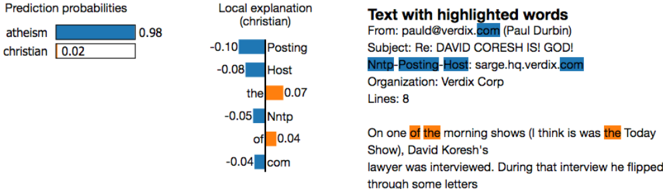
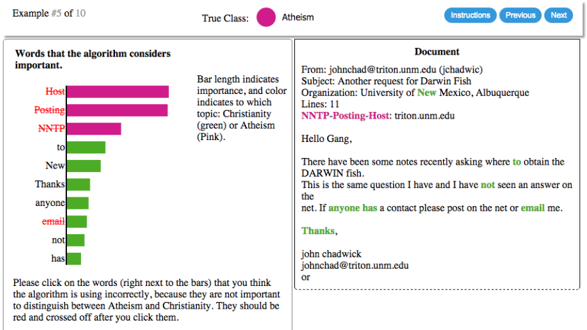
Despite widespread adoption in NLP, machine learning models remain mostly black boxes.Understanding the reasons behind predictions is, however, quite important in assessing trust in a model.Trust is fundamental if one plans to take action based on a prediction, or when choosing whether or not to deploy a new model.In this work, we describe LIME, a novel explanation technique that explains the predictions of any classifier in an interpretable and faithful manner.We further present a method to explain models by presenting representative individual predictions and their explanations in a non-redundant manner.We propose a demonstration of these ideas on different NLP tasks such as document classification, politeness detection, and sentiment analysis, with classifiers like neural networks and SVMs.The user interactions include explanations of free-form text, challenging users to identify the better classifier from a pair, and perform basic feature engineering to improve the classifiers.
Overview
The claims and statistics of this paper haven’t been checked yet.
Free: it reads the open-access text and checks the first 5 claims that cite a source we can check. Create a free account to check every claim.
Integrity signals
Registry
Cites
Statistics
Figures
Verification
Claims the paper makes
The claims and statistics of this paper haven’t been checked yet.
Free: it reads the open-access text and checks the first 5 claims that cite a source we can check. Create a free account to check every claim.
Claims other papers make about this one
Each is checked against this paper’s own text: does it say what the citing paper says it does?
The source backs part of the claim, not all of it — or backs it for a different population, condition or comparison.
In the citing paper
“While providing individuals with grounds to contest individual decisions is often cited as a central motivation of the field of explainable artificial intelligence (XAI) (Ribeiro, Singh, and Guestrin 2016;Lipton 2018;Adadi and Berrada 2018;Molnar 2020), only very few technical works address contestability in greater detail (Mansi, Karusala, and Riedl 2025).”
From Explainable AI Isn't Enough! Rethinking Algorithmic Contestability (2026) · cites this paper as Ribeiro, Singh, and Guestrin 2016
Experimental — accuracy not yet measuredThe source backs part of the claim, not all of it — or backs it for a different population, condition or comparison.
In the citing paper
“We show that standard XAI explanations, such as counterfactuals, LIME, or Anchors, even when combined with human intuitions about decision continuity or monotonicity, reveal only errors in the neighborhood of the individual, but provide insufficient grounds for overturning the decision at hand.”
From Explainable AI Isn't Enough! Rethinking Algorithmic Contestability (2026) · cites this paper as Ribeiro, Singh, and Guestrin 2016
Experimental — accuracy not yet measuredThe cited source says what the claim attributes to it.
In the citing paper
“Post hoc interpretability approaches such as Local Interpretable Model-agnostic Explanation [164] and Shapley Additive Explanations [116], widely adopted in defect prediction [81, 82], performance analysis [173], code analysis [177, 188], and code generation [112], explain the predictions after the model training and without altering the models.”
From A 2030 Roadmap for Software Engineering (2025) · cites this paper as [164]
The cited source says what the claim attributes to it.
In the citing paper
“Self-explanations are a prevailing approach on par with traditional model explanations like LIME saliency maps [71] for understanding LLM-generated responses [25, 32, 53] and are widely used in analyzing language model behavior [66, 99].”
From Thinking in Space: How Multimodal Large Language Models See, Remember, and Recall Spaces (2025) · cites this paper as [71]
In the citing paper
“Techniques such as LIME [25] and SHAP [26] are examples of post-hoc explainability methods commonly used in healthcare.”
From Ethical Framework for Harnessing the Power of AI in Healthcare and Beyond (2024) · cites this paper as [25]
1 more claim about this paper
Create a free account to see every claim other papers make about this one.
Self-check
Percentages, sums and reported differences re-computed from the paper’s own numbers.
The self-check needs the paper’s full text.
Citations
Cites
"Why Should I Trust You?": Explaining the Predictions of Any Classifier
Ribeiro, M. T., Singh, S., & Guestrin, C. (2016) · Proceedings of the 22nd ACM SIGKDD International Conference on Knowledge Discovery and Data Mining · doi:10.1145/2939672.2939778 · Cited by 17,555
Self-citationEfron, B., Hastie, T., Johnstone, I., & Tibshirani, R. (2004) · The Annals of Statistics · doi:10.1214/009053604000000067 · Cited by 9,357
Recursive Deep Models for Semantic Compositionality Over a Sentiment Treebank
Socher, R., Perelygin, A., Wu, J., Chuang, J., Manning, C. D., Ng, A., & Potts, C. (2013) · Proceedings of the 2013 Conference on Empirical Methods in Natural Language Processing · doi:10.18653/v1/d13-1170 · Cited by 6,878
A threshold of ln n for approximating set cover
Feige, U. (1998) · Journal of the ACM · doi:10.1145/285055.285059 · Cited by 3,086
Explaining collaborative filtering recommendations
Herlocker, J. L., Konstan, J. A., & Riedl, J. (2000) · Proceedings of the 2000 ACM conference on Computer supported cooperative work · doi:10.1145/358916.358995 · Cited by 1,731
Dataset Shift in Machine Learning
(2008) · doi:10.7551/mitpress/9780262170055.001.0001 · Cited by 1,553
The role of trust in automation reliance
Dzindolet, M. T., Peterson, S. A., Pomranky, R. A., Pierce, L. G., & Beck, H. P. (2003) · International Journal of Human-Computer Studies · doi:10.1016/s1071-5819(03)00038-7 · Cited by 1,276
Submodular Function Maximization
Krause, A., & Golovin, D. (2014) · Tractability · doi:10.1017/cbo9781139177801.004 · Cited by 751
Leakage in data mining: formulation, detection, and avoidance
Kaufman, S., Rosset, S., & Perlich, C. (2011) · Proceedings of the 17th ACM SIGKDD international conference on Knowledge discovery and data mining · doi:10.1145/2020408.2020496 · Cited by 137
Investigating statistical machine learning as a tool for software development
Patel, K., Fogarty, J., Landay, J. A., & Harrison, B. (2008) · Proceedings of the SIGCHI Conference on Human Factors in Computing Systems · doi:10.1145/1357054.1357160 · Cited by 129
Research works printed but not linked: 3
- Cristian Danescu-Niculescu-Mizil, Moritz Sudhof, Dan Jurafsky, Jure Leskovec, and Christopher Potts. 2013. A computational approach to politeness with applica- tion to social factors. In Proceedings of ACL.
- Jonathan L. Herlocker, Joseph A. Konstan, and John Riedl. 2000. Explaining collaborative filtering recommenda- tions. In Conference on Computer Supported Coopera- tive Work (CSCW).
- Andreas Krause and Daniel Golovin. 2014. Submodu- lar function maximization. In Tractability: Practical Approaches to Hard Problems. Cambridge University Press, February.
Cited by
Items 901–1,000 of 1,091
Deep learning can see the unseeable: predicting molecular markers from MRI of brain gliomas
Korfiatis, P., & Erickson, B. (2019) · Clinical Radiology · doi:10.1016/j.crad.2019.01.028 · Cited by 56
Rajaraman, S., Thoma, G. R., Antani, S., & Candemir, S. (2019) · SPIE Medical Imaging: Computer-Aided Diagnosis · doi:10.1117/12.2512752 · Cited by 56
Foundations of explanations as model reconciliation
Sreedharan, S., Chakraborti, T., & Kambhampati, S. (2021) · Artificial Intelligence · doi:10.1016/j.artint.2021.103558 · Cited by 88
Albahri, A. S., Hamid, R. A., Abdulnabi, A. R., Albahri, O. S., Alamoodi, A. H., Deveci, M., Pedrycz, W., Alzubaidi, L., Santamaría, J., & Gu, Y. (2024) · Information Fusion · doi:10.1016/j.inffus.2023.102208 · Cited by 55
A prediction and interpretation framework of acute kidney injury in critical care
Gong, K., Lee, H. K., Yu, K., Xie, X., & Li, J. (2020) · Journal of Biomedical Informatics · doi:10.1016/j.jbi.2020.103653 · Cited by 57
Machine learning for prediction of diabetes risk in middle-aged Swedish people
Lama, L., Wilhelmsson, O., Norlander, E., Gustafsson, L., Lager, A., Tynelius, P., Wärvik, L., & Östenson, C. (2021) · Heliyon · doi:10.1016/j.heliyon.2021.e07419 · Cited by 60
Pitfalls of Machine Learning-Based Personnel Selection: Fairness, Transparency, and Data Quality
Goretzko, D., & Israel, L. (2021) · Journal of Personnel Psychology · doi:10.1027/1866-5888/a000287 · Cited by 67
Mobility pattern recognition based prediction for the subway station related bike-sharing trips
Lv, Y., Zhi, D., Sun, H., & Qi, G. (2021) · Transportation Research Part C Emerging Technologies · doi:10.1016/j.trc.2021.103404 · Cited by 55
Autoencoders and variational autoencoders in medical image analysis
Ehrhardt, J., & Wilms, M. (2022) · Elsevier eBooks · doi:10.1016/b978-0-12-824349-7.00015-3 · Cited by 77
Liang, D., & Xue, F. (2023) · Computers in Industry · doi:10.1016/j.compind.2023.103883 · Cited by 59
Comprehensible Artificial Intelligence on Knowledge Graphs: A survey
Schramm, S., Wehner, C., & Schmid, U. (2023) · Journal of Web Semantics · doi:10.1016/j.websem.2023.100806 · Cited by 66
Explainable machine learning models for defects detection in industrial processes
Oliveira, R. M. A., Sant’Anna, Â. M. O., & Ferreira, P. H. (2024) · Computers & Industrial Engineering · doi:10.1016/j.cie.2024.110214 · Cited by 63
Machine learning for the advancement of genome-scale metabolic modeling
Kundu, P., Beura, S., Mondal, S., Das, A. K., & Ghosh, A. (2024) · Biotechnology Advances · doi:10.1016/j.biotechadv.2024.108400 · Cited by 57
Uyanık, H., Şengür, A., Salvi, M., Tan, R., Tan, J. H., & Acharya, U. R. (2025) · Wiley Interdisciplinary Reviews Data Mining and Knowledge Discovery · doi:10.1002/widm.70002 · Cited by 71
Data science vs. statistics: two cultures?
Carmichael, I. D., & Marron, J. S. (2018) · Japanese Journal of Statistics and Data Science · doi:10.1007/s42081-018-0009-3 · Cited by 68
A task-and-technique centered survey on visual analytics for deep learning model engineering
Garcia, R., Telea, A. C., Castro da Silva, B., Tørresen, J., & Dihl Comba, J. L. (2018) · Computers & Graphics · doi:10.1016/j.cag.2018.09.018 · Cited by 54
Fountain‐Jones, N. M., Machado, G., Carver, S., Packer, C., Recamonde‐Mendoza, M., & Craft, M. E. (2019) · Journal of Animal Ecology · doi:10.1111/1365-2656.13076 · Cited by 55
Karhade, A. V., Bongers, M. E. R., Groot, O. Q., Cha, T. D., Doorly, T. P., Fogel, H. A., Hershman, S. H., Tobert, D. G., Schoenfeld, A. J., Kang, J. D., et al. (2020) · The Spine Journal · doi:10.1016/j.spinee.2020.02.021 · Cited by 60
Tree Space Prototypes: Another Look at Making Tree Ensembles Interpretable
Tan, S., Soloviev, M., Hooker, G., & Wells, M. T. (2020) · Proceedings of the 2020 ACM-IMS on Foundations of Data Science Conference · doi:10.1145/3412815.3416893 · Cited by 49
SliceLine: Fast, Linear-Algebra-based Slice Finding for ML Model Debugging
Sagadeeva, S., & Böehm, M. (2021) · ACM SIGMOD International Conference on Management of Data (SIGMOD) · doi:10.1145/3448016.3457323 · Cited by 79
Selecting Directors Using Machine Learning
Erel, I., Stern, L. H., Tan, C., & Weisbach, M. S. (2018) · National Bureau of Economic Research · doi:10.3386/w24435 · Cited by 71
Behavioral Use Licensing for Responsible AI
Contractor, D., McDuff, D., Haines, J. K., Lee, J., Hines, C., Hecht, B., Vincent, N., & Li, H. (2022) · 2022 ACM Conference on Fairness Accountability and Transparency · doi:10.1145/3531146.3533143 · Cited by 54
Math Education with Large Language Models: Peril or Promise?
Kumar, H., Rothschild, D. M., Goldstein, D. G., & Hofman, J. (2023) · doi:10.2139/ssrn.4641653 · Cited by 54
Math Education With Large Language Models: Peril or Promise?
Kumar, H., Rothschild, D. M., Goldstein, D. G., & Hofman, J. M. (2025) · Lecture Notes in Computer Science · doi:10.1007/978-3-031-98459-4_5 · Cited by 54
LocalGLMnet: interpretable deep learning for tabular data
Richman, R., & Wüthrich, M. V. (2022) · Scandinavian Actuarial Journal · doi:10.1080/03461238.2022.2081816 · Cited by 69
Ghosh, I., Chaudhuri, T. D., Alfaro, E., Gámez, M., & García, N. (2022) · Technological Forecasting and Social Change · doi:10.1016/j.techfore.2022.121757 · Cited by 56
Machine learning in U.S. Bank Merger Prediction: A Text-Based Approach
Katsafados, A. G., Leledakis, G. N., Pyrgiotakis, E. G., Androutsopoulos, I., & Fergadiotis, M. (2021) · European Journal of Operational Research · doi:10.1016/j.ejor.2023.07.039 · Cited by 59
Enhancing Household Energy Consumption Predictions Through Explainable AI Frameworks
Bhandary, A., Dobariya, V., Yenduri, G., Jhaveri, R. H., Gochhait, S., & Benedetto, F. (2024) · IEEE Access · doi:10.1109/access.2024.3373552 · Cited by 58
Explainable Data-Driven Digital Twins for Predicting Battery States in Electric Vehicles
Njoku, J. N., Nwakanma, C. I., & Kim, D. (2024) · IEEE Access · doi:10.1109/access.2024.3413075 · Cited by 63
Saifullah, S., Mercier, D., Lucieri, A., Dengel, A., & Ahmed, S. (2024) · Frontiers in Artificial Intelligence · doi:10.3389/frai.2024.1236947 · Cited by 66
RecExplainer: Aligning Large Language Models for Explaining Recommendation Models
Lei, Y., Lian, J., Yao, J., Huang, X., Lian, D., & Xie, X. (2024) · ACM SIGKDD Conference on Knowledge Discovery and Data Mining (KDD) · doi:10.1145/3637528.3671802 · Cited by 83
Ghamisi, P., Yu, W., Marinoni, A., Gevaert, C. M., Persello, C., Selvakumaran, S., Girotto, M., Horton, B. P., Rufin, P., Hostert, P., et al. (2025) · IEEE Geoscience and Remote Sensing Magazine · doi:10.1109/mgrs.2025.3529726 · Cited by 68
Andreas, J., Dragan, A., & Klein, D. (2017) · Proceedings of the 55th Annual Meeting of the Association for Computational Linguistics (Volume 1: Long Papers) · doi:10.18653/v1/p17-1022 · Cited by 39
On Guaranteed Optimal Robust Explanations for NLP Models
Malfa, E. L., Michelmore, R., Zbrzezny, A. M., Paoletti, N., & Kwiatkowska, M. (2021) · International Joint Conference on Artificial Intelligence · doi:10.24963/ijcai.2021/366 · Cited by 89
Kim, M., Kim, S., Kim, J., Song, T.-J., & Kim, Y. (2024) · International Journal of Human-Computer Studies · doi:10.1016/j.ijhcs.2023.103160 · Cited by 53
From Large AI Models to Agentic AI: A Tutorial on Future Intelligent Communications
Jiang, F., Pan, C., Wang, K., Michiardi, P., Dobre, O. A., & Debbah, M. (2026) · IEEE Journal on Selected Areas in Communications · doi:10.1109/jsac.2026.3660010 · Cited by 53
Local and global explanations of agent behavior: Integrating strategy summaries with saliency maps
Huber, T., Weitz, K., André, E., & Amir, O. (2021) · Artificial Intelligence · doi:10.1016/j.artint.2021.103571 · Cited by 53
Untangling hybrid hydrological models with explainable artificial intelligence
Althoff, D., Bazame, H. C., & Nascimento, J. G. (2021) · H2Open Journal · doi:10.2166/h2oj.2021.066 · Cited by 56
Exploring the Efficacy of Automatically Generated Counterfactuals for Sentiment Analysis
Yang, L., Li, J., Cunningham, P., Zhang, Y., Smyth, B., & Dong, R. (2021) · doi:10.18653/v1/2021.acl-long.26 · Cited by 75
This looks More Like that: Enhancing Self-Explaining Models by Prototypical Relevance Propagation
Gautam, S., Höhne, M., Hansen, S., Jenssen, R., & Kampffmeyer, M. (2022) · Pattern Recognition · doi:10.1016/j.patcog.2022.109172 · Cited by 71
Artificial intelligence in the analysis of glycosylation data
Li, H., Chiang, A. W. T., & Lewis, N. E. (2022) · Biotechnology Advances · doi:10.1016/j.biotechadv.2022.108008 · Cited by 60
Deep feature extraction based brain image classification model using preprocessed images: PDRNet
Taşçı, B., & Taşçı, İ. (2022) · Biomedical Signal Processing and Control · doi:10.1016/j.bspc.2022.103948 · Cited by 54
EdgeSHAPer: Bond-centric Shapley value-based explanation method for graph neural networks
Mastropietro, A., Pasculli, G., Feldmann, C., Rodríguez-Pérez, R., & Bajorath, J. (2022) · iScience · doi:10.1016/j.isci.2022.105043 · Cited by 62
A quantitative approach for the comparison of additive local explanation methods
Doumard, E., Aligon, J., Escriva, E., Excoffier, J.-B., Monsarrat, P., & Soulé-Dupuy, C. (2022) · Information Systems · doi:10.1016/j.is.2022.102162 · Cited by 61
Mill, E., Garn, W., Ryman-Tubb, N. F., & Turner, C. J. (2023) · International Journal of Advanced Computer Science and Applications · doi:10.14569/ijacsa.2023.01405121 · Cited by 66
Xu, Y., Zuo, R., & Zhang, G. (2023) · Applied Geochemistry · doi:10.1016/j.apgeochem.2023.105722 · Cited by 56
Pârcălăbescu, L., & Frank, A. (2023) · Proceedings of the conference - Association for Computational Linguistics. Meeting · doi:10.18653/v1/2023.acl-long.223 · Cited by 88
Performance Comparison and Visualization of AI-Generated-Image Detection Methods
Park, D., Na, H., & Choi, D. (2024) · IEEE Access · doi:10.1109/access.2024.3394250 · Cited by 63
On Interpretation of Network Embedding via Taxonomy Induction
Liu, N., Huang, X. X., Li, J., & Hu, X. (2018) · ACM SIGKDD Conference on Knowledge Discovery and Data Mining (KDD) · doi:10.1145/3219819.3220001 · Cited by 64
Egoistic and altruistic motivation: How to induce users’ willingness to help for imperfect AI
Lee, Y., Ha, M., Kwon, S., Shim, Y., & Kim, J. (2019) · Computers in Human Behavior · doi:10.1016/j.chb.2019.06.009 · Cited by 47
Extending the Tsetlin Machine With Integer-Weighted Clauses for Increased Interpretability
Abeyrathna, K. D., Granmo, O., & Goodwin, M. (2021) · IEEE Access · doi:10.1109/access.2021.3049569 · Cited by 61
Maintenance intervention predictions using entity-embedding neural networks
Bukhsh, Z. A., Stipanović, I., Saeed, A., & Dorée, A. G. (2020) · Automation in Construction · doi:10.1016/j.autcon.2020.103202 · Cited by 56
Parsa, A. B., Shabanpour, R., Mohammadian, A., Auld, J., & Stephens, T. (2020) · Transportation Letters · doi:10.1080/19427867.2020.1776956 · Cited by 55
Constraining Uncertainty in Projected Gross Primary Production With Machine Learning
Schlund, M., Eyring, V., Camps‐Valls, G., Friedlingstein, P., Gentine, P., & Reichstein, M. (2020) · Journal of Geophysical Research Biogeosciences · doi:10.1029/2019jg005619 · Cited by 57
Solanke, A. A. (2022) · Forensic Science International: Digital Investigation · doi:10.1016/j.fsidi.2022.301403 · Cited by 52
Leveraging rationales to improve human task performance
Das, D., & Chernova, S. (2020) · Proceedings of the 25th International Conference on Intelligent User Interfaces · doi:10.1145/3377325.3377512 · Cited by 52
Kovalchuk, S. V., Kopanitsa, G., Derevitskii, I. V., Matveev, G. A., & Savitskaya, D. A. (2022) · Journal of Biomedical Informatics · doi:10.1016/j.jbi.2022.104013 · Cited by 60
Deep Learning for Chatter Detection in Machining
Kounta, C. A. K. A., Arnaud, L., Kamsu-Foguem, B., & Tangara, F. (2022) · Advances in Engineering Software · doi:10.1016/j.advengsoft.2023.103445 · Cited by 54
XML-GBM lung: An explainable machine learning-based application for the diagnosis of lung cancer
Rikta, S. T., Uddin, K. M. M., Biswas, N., Mostafiz, R., Sharmin, F., & Dey, S. K. (2023) · Journal of Pathology Informatics · doi:10.1016/j.jpi.2023.100307 · Cited by 56
Murray, J. D., Lange, J. J., Bennett-Lenane, H., Holm, R., Kuentz, M., O’Dwyer, P. J., & Griffin, B. T. (2023) · European Journal of Pharmaceutical Sciences · doi:10.1016/j.ejps.2023.106562 · Cited by 61
Khalil, A., Farman, H., Nasralla, M. M., Jan, B., & Ahmad, J. (2024) · Ain Shams Engineering Journal · doi:10.1016/j.asej.2023.102616 · Cited by 54
Awuah, W. A., Adebusoye, F. T., Wellington, J., David, L., Salam, A., Yee, A. L. W., Lansiaux, É., Yarlagadda, R., Garg, T., Abdul‐Rahman, T., et al. (2024) · World Neurosurgery X · doi:10.1016/j.wnsx.2024.100301 · Cited by 58
Shen, Y., Wu, S., Wang, Y., Wang, J., & Yang, Z. (2024) · Underground Space · doi:10.1016/j.undsp.2024.09.002 · Cited by 53
Badhon, B., Chakrabortty, R. K., Anavatti, S. G., & Vanhoucke, M. (2025) · Engineering Applications of Artificial Intelligence · doi:10.1016/j.engappai.2025.110427 · Cited by 61
Global, N., & Kazanskaia, A. N. (2025) · doi:10.64357/ai-and-machine-learning-2025 · Cited by 53
Instance-Based Learning of Span Representations: A Case Study through Named Entity Recognition
Ouchi, H., Suzuki, J., Kobayashi, S., Yokoi, S., Kuribayashi, T., Konno, R., & Inui, K. (2020) · Proceedings of the conference - Association for Computational Linguistics. Meeting · doi:10.18653/v1/2020.acl-main.575 · Cited by 56
Machine learning approaches classify clinical malaria outcomes based on haematological parameters
Morang’a, C. M., Amenga-Etego, L. N.-K., Bah, S. Y., Appiah, V., Amuzu, D. S. Y., Amoako, N., Abugri, J., Oduro, A. R., Cunnington, A. J., Awandare, G. A., et al. (2020) · BMC Medicine · doi:10.1186/s12916-020-01823-3 · Cited by 58
Explain and improve: LRP-inference fine-tuning for image captioning models
Sun, J., Lapuschkin, S., Samek, W., & Binder, A. (2021) · Information Fusion · doi:10.1016/j.inffus.2021.07.008 · Cited by 57
Review of machine learning‐driven design of polymer‐based dielectrics
Zhu, M., Deng, T., Dong, L., Chen, J., & Dang, Z. (2021) · IET Nanodielectrics · doi:10.1049/nde2.12029 · Cited by 52
Proceedings of the Third Workshop on Abusive Language Online
(2019) · doi:10.18653/v1/w19-35 · Cited by 54
AI Trust: Can Explainable AI Enhance Warranted Trust?
de Brito Duarte, R., Correia, F., Arriaga, P., & Paiva, A. (2023) · Human Behavior and Emerging Technologies · doi:10.1155/2023/4637678 · Cited by 52
Beyond Trivial Counterfactual Explanations with Diverse Valuable Explanations
Rodríguez, P., Caccia, M., Lacoste, A., Zamparo, L., Laradji, I., Charlin, L., & Vázquez, D. (2021) · IEEE/CVF International Conference on Computer Vision (ICCV) · doi:10.1109/iccv48922.2021.00109 · Cited by 84
Midtfjord, A. D., Bin, R. D., & Huseby, A. B. (2022) · Cold Regions Science and Technology · doi:10.1016/j.coldregions.2022.103556 · Cited by 60
Li, Z. (2023) · Travel Behaviour and Society · doi:10.1016/j.tbs.2022.12.006 · Cited by 53
Review of Graph-Based Hazardous Event Detection Methods for Autonomous Driving Systems
Xiao, D., Dianati, M., Geiger, W. G., & Woodman, R. (2023) · IEEE Transactions on Intelligent Transportation Systems · doi:10.1109/tits.2023.3240104 · Cited by 60
Modern Tendencies in Vehicle-Based Condition Monitoring of the Railway Track
Fernández-Bobadilla, H. A., & Martin, U. (2023) · IEEE Transactions on Instrumentation and Measurement · doi:10.1109/tim.2023.3243673 · Cited by 51
A Study of LIME and SHAP Model Explainers for Autonomous Disease Predictions
Rao, S., Mehta, S., Kulkarni, S., Dalvi, H., Katre, N., & Narvekar, M. (2022) · IEEE Bombay Section Signature Conference (IBSSC) · doi:10.1109/ibssc56953.2022.10037324 · Cited by 51
An interpretable decision-support model for breast cancer diagnosis using histopathology images
Krishna, S., Suganthi, S. S., Bhavsar, A. V., Yesodharan, J., & Krishnamoorthy, S. (2023) · Journal of Pathology Informatics · doi:10.1016/j.jpi.2023.100319 · Cited by 52
Nakanishi, T. (2023) · IEEE Access · doi:10.1109/access.2023.3314336 · Cited by 57
Ifraheem, S., Rasheed, M., & Siddiqui, A. (2024) · Journal of Asian Development Studies · doi:10.62345/jads.2024.13.2.22 · Cited by 51
Hoque, M. N., & Mueller, K. D. (2021) · IEEE Transactions on Visualization and Computer Graphics · doi:10.1109/tvcg.2021.3102051 · Cited by 55
SQAPlanner: Generating Data-Informed Software Quality Improvement Plans
Rajapaksha, D., Tantithamthavorn, C. K., Jiarpakdee, J., Bergmeir, C., Grundy, J., & Buntine, W. (2021) · IEEE Transactions on Software Engineering · doi:10.1109/tse.2021.3070559 · Cited by 55
Visual explanation of black-box model: Similarity Difference and Uniqueness (SIDU) method
Muddamsetty, S. M., Jahromi, M. N. S., Ciontos, A. E., Fenoy, L. M., & Moeslund, T. B. (2022) · Pattern Recognition · doi:10.1016/j.patcog.2022.108604 · Cited by 55
Explainability Methods for Identifying Root-Cause of SLA Violation Prediction in 5G Network
Terra, A., Inam, R., Baskaran, S., Batista, P., Burdick, I., & Fersman, E. (2020) · GLOBECOM 2020 - 2020 IEEE Global Communications Conference · doi:10.1109/globecom42002.2020.9322496 · Cited by 50
Davazdahemami, B., Zolbanin, H. M., & Delen, D. (2022) · Decision Support Systems · doi:10.1016/j.dss.2022.113730 · Cited by 50
Deep Neural Network-Based Novel Mathematical Model for 3D Brain Tumor Segmentation
Ladkat, A. S., Bangare, S. L., Jagota, V., Sanober, S., Beram, S. M., Rane, K. P., & Singh, B. K. (2022) · Computational Intelligence and Neuroscience · doi:10.1155/2022/4271711 · Cited by 53
An explainable knowledge distillation method with XGBoost for ICU mortality prediction
Liu, M., Guo, C., & Guo, S. (2022) · Computers in Biology and Medicine · doi:10.1016/j.compbiomed.2022.106466 · Cited by 51
Improving the interpretability of deep reinforcement learning in urban drainage system operation
Tian, W., Fu, G., Xin, K., Zhang, Z., & Liao, Z. (2023) · Water Research · doi:10.1016/j.watres.2023.120912 · Cited by 52
Kibriya, H., Siddiqa, A., Khan, W. Z., & Khan, M. K. (2024) · Computers & Electrical Engineering · doi:10.1016/j.compeleceng.2024.109153 · Cited by 60
Explainable Artificial Intelligence for Resilient Security Applications in the Internet of Things
Masud, M. T., Keshk, M., Moustafa, N., Linkov, I., & Emge, D. K. (2024) · IEEE Open Journal of the Communications Society · doi:10.1109/ojcoms.2024.3413790 · Cited by 73
FaultExplainer: Leveraging large language models for interpretable fault detection and diagnosis
Khan, A., Nahar, R., Chen, H., Constante‐Flores, G. E., & Li, C. (2025) · Computers & Chemical Engineering · doi:10.1016/j.compchemeng.2025.109152 · Cited by 56
SafeCity: Understanding Diverse Forms of Sexual Harassment Personal Stories
Karlekar, S., & Bansal, M. (2018) · Conference on Empirical Methods in Natural Language Processing (EMNLP) · doi:10.18653/v1/d18-1303 · Cited by 50
A Comparison of Sentiment Analysis Methods on Amazon Reviews of Mobile Phones
Aljuhani, S. A., & Alghamdi, N. S. (2019) · International Journal of Advanced Computer Science and Applications · doi:10.14569/ijacsa.2019.0100678 · Cited by 57
Anomaly explanation with random forests
Kopp, M., Pevný, T., & Holeňa, M. (2020) · Expert Systems with Applications · doi:10.1016/j.eswa.2020.113187 · Cited by 57
Kampaktsis, P. Ν., Tzani, A. I., Doulamis, I. P., Moustakidis, S., Drosou, A., Diakos, N., Drakos, S. G., & Briasoulis, Α. (2021) · Clinical Transplantation · doi:10.1111/ctr.14388 · Cited by 50
Fiok, K., Karwowski, W., Gutiérrez-Franco, E., & Wilamowski, M. (2021) · Expert Systems with Applications · doi:10.1016/j.eswa.2021.115771 · Cited by 57
Explainable heat demand forecasting for the novel control strategies of district heating systems
Zdravković, M. M., Ciric, I. S., & Ignjatović, M. (2022) · Annual Reviews in Control · doi:10.1016/j.arcontrol.2022.03.009 · Cited by 51
Legal Judgment Prediction: A Survey of the State of the Art
Feng, Y., Li, C., & Ng, V. (2022) · International Joint Conference on Artificial Intelligence · doi:10.24963/ijcai.2022/765 · Cited by 89
Seedat, N., Imrie, F., & van der Schaar, M. (2023) · IEEE Transactions on Artificial Intelligence · doi:10.1109/tai.2023.3345805 · Cited by 65
Challenges in Applying Explainability Methods to Improve the Fairness of NLP Models
Balkır, E., Kiritchenko, S., Nejadgholi, I., & Fraser, K. (2022) · Workshop on Trustworthy Natural Language Processing (TrustNLP) · doi:10.18653/v1/2022.trustnlp-1.8 · Cited by 69
Metadata
- Authors
- Ribeiro, M., Singh, S., & Guestrin, C.
- Affiliations
- University of Washington (US)
- Venue
- Proceedings of the 2016 Conference of the North American Chapter of the Association for Computational Linguistics: Demonstrations
- Published
- 2016
- Pages
- 97-101
- OpenAlex
- W2516809705
- Cited by
- 6,682
- References
- 13
- Citations by year
- 2026: 742 · 2025: 1562 · 2024: 1239 · 2023: 1039 · 2022: 778 · 2021: 581 · 2020: 364 · 2019: 225 · 2018: 109 · 2017: 38 · 2016: 3
- FWCI
- 67.53
- Type
- conference paper
- Language
- en
- Open access
- hybrid
- doi.org
- Licence
- cc-by
- Locations
- Conference of the North American Chapter of the Association for Computational Linguistics: Human Language Technologies (NAACL-HLT) (publishedVersion, cc-by)
- Funders
- Semiconductor Research Corporation
- Defense Advanced Research Projects Agency
- Topics
- Physical Sciences › Computer Science › Artificial Intelligence › Explainable Artificial Intelligence (XAI)
- Physical Sciences › Computer Science › Software › Software Testing and Debugging Techniques
- Physical Sciences › Computer Science › Artificial Intelligence › Topic Modeling
- Keywords
- lime, explainable AI, classifier interpretability, model trust, local interpretable model-agnostic explanations, feature importance, document classification, sentiment analysis, artificial neural networks, support vector machine, user interaction
About these checks
Registry, retraction, Cites and statistics results are computed, not judged, with one exception: a printed reference that no index lists is read once by a model before it counts as a citation error. Claims are extracted by a model and kept only when their quote appears verbatim in the text; each cited source is then checked, with a model’s help, for whether it says what the claim relies on. Those verdicts can be wrong — read the claim’s quote and the cited source before relying on one.
Statistics and arithmetic are recomputed, not judged.
Confidence bands are shown only for fields calibrated on our annotated test set. None is calibrated yet, so no band is shown.
What counts as a claim ›How we measure confidence ›How we check this ›
Are you an author, or do you see a problem with this page? Request a review
Data sources
Bibliographic data: Semantic Scholar, OpenAlex, Crossref.
Contains information from the Semantic Scholar Academic Graph Datasets, made available under the ODC Attribution License (ODC-BY 1.0).
Semantic Scholar’s data is described in: Kinney, R., et al. (2023). The Semantic Scholar Open Data Platform. arXiv:2301.10140.
