

“Why Should I Trust You?”: Explaining the Predictions of Any Classifier
Open accessThe DOI matches its Crossref record; 12 of the 13 references it cites were found in a registry or an index.
Abstract
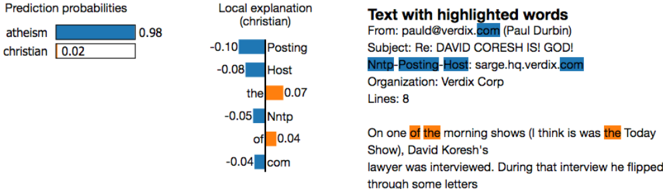
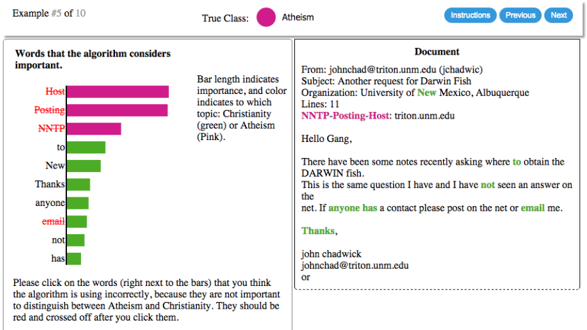
Despite widespread adoption in NLP, machine learning models remain mostly black boxes.Understanding the reasons behind predictions is, however, quite important in assessing trust in a model.Trust is fundamental if one plans to take action based on a prediction, or when choosing whether or not to deploy a new model.In this work, we describe LIME, a novel explanation technique that explains the predictions of any classifier in an interpretable and faithful manner.We further present a method to explain models by presenting representative individual predictions and their explanations in a non-redundant manner.We propose a demonstration of these ideas on different NLP tasks such as document classification, politeness detection, and sentiment analysis, with classifiers like neural networks and SVMs.The user interactions include explanations of free-form text, challenging users to identify the better classifier from a pair, and perform basic feature engineering to improve the classifiers.
Overview
The claims and statistics of this paper haven’t been checked yet.
Free: it reads the open-access text and checks the first 5 claims that cite a source we can check. Create a free account to check every claim.
Integrity signals
Registry
Cites
Statistics
Figures
Verification
Claims the paper makes
The claims and statistics of this paper haven’t been checked yet.
Free: it reads the open-access text and checks the first 5 claims that cite a source we can check. Create a free account to check every claim.
Claims other papers make about this one
Each is checked against this paper’s own text: does it say what the citing paper says it does?
The source backs part of the claim, not all of it — or backs it for a different population, condition or comparison.
In the citing paper
“While providing individuals with grounds to contest individual decisions is often cited as a central motivation of the field of explainable artificial intelligence (XAI) (Ribeiro, Singh, and Guestrin 2016;Lipton 2018;Adadi and Berrada 2018;Molnar 2020), only very few technical works address contestability in greater detail (Mansi, Karusala, and Riedl 2025).”
From Explainable AI Isn't Enough! Rethinking Algorithmic Contestability (2026) · cites this paper as Ribeiro, Singh, and Guestrin 2016
Experimental — accuracy not yet measuredThe source backs part of the claim, not all of it — or backs it for a different population, condition or comparison.
In the citing paper
“We show that standard XAI explanations, such as counterfactuals, LIME, or Anchors, even when combined with human intuitions about decision continuity or monotonicity, reveal only errors in the neighborhood of the individual, but provide insufficient grounds for overturning the decision at hand.”
From Explainable AI Isn't Enough! Rethinking Algorithmic Contestability (2026) · cites this paper as Ribeiro, Singh, and Guestrin 2016
Experimental — accuracy not yet measuredThe cited source says what the claim attributes to it.
In the citing paper
“Post hoc interpretability approaches such as Local Interpretable Model-agnostic Explanation [164] and Shapley Additive Explanations [116], widely adopted in defect prediction [81, 82], performance analysis [173], code analysis [177, 188], and code generation [112], explain the predictions after the model training and without altering the models.”
From A 2030 Roadmap for Software Engineering (2025) · cites this paper as [164]
The cited source says what the claim attributes to it.
In the citing paper
“Self-explanations are a prevailing approach on par with traditional model explanations like LIME saliency maps [71] for understanding LLM-generated responses [25, 32, 53] and are widely used in analyzing language model behavior [66, 99].”
From Thinking in Space: How Multimodal Large Language Models See, Remember, and Recall Spaces (2025) · cites this paper as [71]
In the citing paper
“Techniques such as LIME [25] and SHAP [26] are examples of post-hoc explainability methods commonly used in healthcare.”
From Ethical Framework for Harnessing the Power of AI in Healthcare and Beyond (2024) · cites this paper as [25]
1 more claim about this paper
Create a free account to see every claim other papers make about this one.
Self-check
Percentages, sums and reported differences re-computed from the paper’s own numbers.
The self-check needs the paper’s full text.
Citations
Cites
"Why Should I Trust You?": Explaining the Predictions of Any Classifier
Ribeiro, M. T., Singh, S., & Guestrin, C. (2016) · Proceedings of the 22nd ACM SIGKDD International Conference on Knowledge Discovery and Data Mining · doi:10.1145/2939672.2939778 · Cited by 17,555
Self-citationEfron, B., Hastie, T., Johnstone, I., & Tibshirani, R. (2004) · The Annals of Statistics · doi:10.1214/009053604000000067 · Cited by 9,357
Recursive Deep Models for Semantic Compositionality Over a Sentiment Treebank
Socher, R., Perelygin, A., Wu, J., Chuang, J., Manning, C. D., Ng, A., & Potts, C. (2013) · Proceedings of the 2013 Conference on Empirical Methods in Natural Language Processing · doi:10.18653/v1/d13-1170 · Cited by 6,878
A threshold of ln n for approximating set cover
Feige, U. (1998) · Journal of the ACM · doi:10.1145/285055.285059 · Cited by 3,086
Explaining collaborative filtering recommendations
Herlocker, J. L., Konstan, J. A., & Riedl, J. (2000) · Proceedings of the 2000 ACM conference on Computer supported cooperative work · doi:10.1145/358916.358995 · Cited by 1,731
Dataset Shift in Machine Learning
(2008) · doi:10.7551/mitpress/9780262170055.001.0001 · Cited by 1,553
The role of trust in automation reliance
Dzindolet, M. T., Peterson, S. A., Pomranky, R. A., Pierce, L. G., & Beck, H. P. (2003) · International Journal of Human-Computer Studies · doi:10.1016/s1071-5819(03)00038-7 · Cited by 1,276
Submodular Function Maximization
Krause, A., & Golovin, D. (2014) · Tractability · doi:10.1017/cbo9781139177801.004 · Cited by 751
Leakage in data mining: formulation, detection, and avoidance
Kaufman, S., Rosset, S., & Perlich, C. (2011) · Proceedings of the 17th ACM SIGKDD international conference on Knowledge discovery and data mining · doi:10.1145/2020408.2020496 · Cited by 137
Investigating statistical machine learning as a tool for software development
Patel, K., Fogarty, J., Landay, J. A., & Harrison, B. (2008) · Proceedings of the SIGCHI Conference on Human Factors in Computing Systems · doi:10.1145/1357054.1357160 · Cited by 129
Research works printed but not linked: 3
- Cristian Danescu-Niculescu-Mizil, Moritz Sudhof, Dan Jurafsky, Jure Leskovec, and Christopher Potts. 2013. A computational approach to politeness with applica- tion to social factors. In Proceedings of ACL.
- Jonathan L. Herlocker, Joseph A. Konstan, and John Riedl. 2000. Explaining collaborative filtering recommenda- tions. In Conference on Computer Supported Coopera- tive Work (CSCW).
- Andreas Krause and Daniel Golovin. 2014. Submodu- lar function maximization. In Tractability: Practical Approaches to Hard Problems. Cambridge University Press, February.
Cited by
Arrieta, A. B., Díaz-Rodríguez, N., Del Ser, J., Bennetot, A., Tabik, S., Barbado, A., García, S., Gil-López, S., Molina, D., Benjamins, R., et al. (2019) · arXiv · doi:10.48550/arxiv.1910.10045 · Cited by 11,321
Barredo Arrieta, A., Díaz-Rodríguez, N., Del Ser, J., Bennetot, A., Tabik, S., Barbado, A., Garcia, S., Gil-Lopez, S., Molina, D., Benjamins, R., et al. (2020) · Information Fusion · doi:10.1016/j.inffus.2019.12.012 · Cited by 10,423
Review of deep learning: concepts, CNN architectures, challenges, applications, future directions
Alzubaidi, L., Zhang, J., Humaidi, A. J., Al-Dujaili, A., Duan, Y., Al-Shamma, O., Santamaría, J., Fadhel, M. A., Al-Amidie, M., & Farhan, L. (2021) · Journal of Big Data · doi:10.1186/s40537-021-00444-8 · Cited by 7,906
Grad-CAM: Visual Explanations from Deep Networks via Gradient-Based Localization
Selvaraju, R. R., Cogswell, M., Das, A., Vedantam, R., Parikh, D., & Batra, D. (2020) · International Journal of Computer Vision · doi:10.1007/s11263-019-01228-7 · Cited by 6,909
Explanation in Artificial Intelligence: Insights from the Social Sciences
Miller, T. (2017) · arXiv · doi:10.48550/arxiv.1706.07269 · Cited by 5,338
Explanation in artificial intelligence: Insights from the social sciences
Miller, T. (2019) · Artificial Intelligence · doi:10.1016/j.artint.2018.07.007 · Cited by 5,302
Grad-CAM++: Generalized Gradient-Based Visual Explanations for Deep Convolutional Networks
Chattopadhay, A., Sarkar, A., Howlader, P., & Balasubramanian, V. N. (2018) · 2018 IEEE Winter Conference on Applications of Computer Vision (WACV) · doi:10.1109/wacv.2018.00097 · Cited by 3,639
Temporal Fusion Transformers for interpretable multi-horizon time series forecasting
Lim, B., Arık, S. Ö., Loeff, N., & Pfister, T. (2021) · International Journal of Forecasting · doi:10.1016/j.ijforecast.2021.03.012 · Cited by 3,291
Key challenges for delivering clinical impact with artificial intelligence
Kelly, C. J., Karthikesalingam, A., Suleyman, M., Corrado, G., & King, D. (2019) · BMC Medicine · doi:10.1186/s12916-019-1426-2 · Cited by 3,136
Artificial intelligence in healthcare
Yu, K.-H., Beam, A. L., & Kohane, I. S. (2018) · Nature Biomedical Engineering · doi:10.1038/s41551-018-0305-z · Cited by 2,817
Methods for interpreting and understanding deep neural networks
Montavon, G., Samek, W., & Müller, K.-R. (2018) · Digital Signal Processing · doi:10.1016/j.dsp.2017.10.011 · Cited by 2,665
A Survey on Explainable Artificial Intelligence (XAI): Toward Medical XAI
Tjoa, E., & Guan, C. (2021) · IEEE Transactions on Neural Networks and Learning Systems · doi:10.1109/tnnls.2020.3027314 · Cited by 2,524
Opportunities and obstacles for deep learning in biology and medicine
Ching, T., Himmelstein, D. S., Beaulieu-Jones, B. K., Kalinin, A. A., Do, B. T., Way, G. P., Ferrero, E., Agapow, P.-M., Zietz, M., Hoffman, M. M., et al. (2018) · Journal of The Royal Society Interface · doi:10.1098/rsif.2017.0387 · Cited by 2,310
Time-series forecasting with deep learning: a survey
Lim, B., & Zohren, S. (2021) · Philosophical Transactions of the Royal Society A: Mathematical, Physical and Engineering Sciences · doi:10.1098/rsta.2020.0209 · Cited by 1,787
Shortcut learning in deep neural networks
Geirhos, R., Jacobsen, J.-H., Michaelis, C., Zemel, R., Brendel, W., Bethge, M., & Wichmann, F. A. (2020) · Nature Machine Intelligence · doi:10.1038/s42256-020-00257-z · Cited by 2,224
Definitions, methods, and applications in interpretable machine learning
Murdoch, W. J., Singh, C., Kumbier, K., Abbasi-Asl, R., & Yu, B. (2019) · Proceedings of the National Academy of Sciences · doi:10.1073/pnas.1900654116 · Cited by 2,167
Self-supervised Learning: Generative or Contrastive
Liu, X., Zhang, F., Hou, Z., Mian, L., Wang, Z., Zhang, J., & Tang, J. (2021) · IEEE Transactions on Knowledge and Data Engineering · doi:10.1109/tkde.2021.3090866 · Cited by 1,087
The false hope of current approaches to explainable artificial intelligence in health care
Ghassemi, M., Oakden-Rayner, L., & Beam, A. L. (2021) · The Lancet Digital Health · doi:10.1016/s2589-7500(21)00208-9 · Cited by 1,724
Investigating Ad Transparency Mechanisms in Social Media: A Case Study of Facebook's Explanations
Andreou, A., Venkatadri, G., Goga, O., Gummadi, K. P., Loiseau, P., & Mislove, A. (2018) · Proceedings 2018 Network and Distributed System Security Symposium · doi:10.14722/ndss.2018.23191 · Cited by 1,477
Explaining Deep Neural Networks and Beyond: A Review of Methods and Applications
Samek, W., Montavon, G., Lapuschkin, S., Anders, C. J., & Muller, K.-R. (2021) · Proceedings of the IEEE · doi:10.1109/jproc.2021.3060483 · Cited by 1,477
Deep Neural Networks and Tabular Data: A Survey
Borisov, V., Leemann, T., Seßler, K., Haug, J., Pawelczyk, M., & Kasneci, G. (2024) · IEEE Transactions on Neural Networks and Learning Systems · doi:10.1109/tnnls.2022.3229161 · Cited by 1,025
Explainable artificial intelligence (XAI) in deep learning-based medical image analysis
van der Velden, B. H. M., Kuijf, H. J., Gilhuijs, K. G. A., & Viergever, M. A. (2022) · Medical Image Analysis · doi:10.1016/j.media.2022.102470 · Cited by 1,328
Li, Z. (2022) · Computers, Environment and Urban Systems · doi:10.1016/j.compenvurbsys.2022.101845 · Cited by 1,195
Aas, K., Jullum, M., & Løland, A. (2021) · Artificial Intelligence · doi:10.1016/j.artint.2021.103502 · Cited by 1,023
Techniques for interpretable machine learning
Du, M., Liu, N., & Hu, X. (2019) · Communications of the ACM · doi:10.1145/3359786 · Cited by 1,268
Techniques for Interpretable Machine Learning
Du, M., Liu, N., & Hu, X. (2018) · arXiv · doi:10.48550/arxiv.1808.00033 · Cited by 1,261
Explaining machine learning classifiers through diverse counterfactual explanations
Mothilal, R. K., Sharma, A., & Tan, C. (2020) · Proceedings of the 2020 Conference on Fairness, Accountability, and Transparency · doi:10.1145/3351095.3372850 · Cited by 1,233
Building better biomarkers: brain models in translational neuroimaging
Woo, C.-W., Chang, L. J., Lindquist, M. A., & Wager, T. D. (2017) · Nature Neuroscience · doi:10.1038/nn.4478 · Cited by 1,056
Abioye, S. O., Oyedele, L. O., Akanbi, L., Ajayi, A., Davila Delgado, J. M., Bilal, M., Akinade, O. O., & Ahmed, A. (2021) · Journal of Building Engineering · doi:10.1016/j.jobe.2021.103299 · Cited by 1,015
A Survey on the Explainability of Supervised Machine Learning
Burkart, N., & Huber, M. F. (2021) · Journal of Artificial Intelligence Research · doi:10.1613/jair.1.12228 · Cited by 1,008
Machine Learning Approaches for Clinical Psychology and Psychiatry
Dwyer, D. B., Falkai, P., & Koutsouleris, N. (2018) · Annual Review of Clinical Psychology · doi:10.1146/annurev-clinpsy-032816-045037 · Cited by 966
Chowdhury, S., Dey, P., Joel-Edgar, S., Bhattacharya, S., Rodriguez-Espindola, O., Abadie, A., & Truong, L. (2023) · Human Resource Management Review · doi:10.1016/j.hrmr.2022.100899 · Cited by 927
A Survey on Neural Network Interpretability
Zhang, Y., Tino, P., Leonardis, A., & Tang, K. (2021) · IEEE Transactions on Emerging Topics in Computational Intelligence · doi:10.1109/tetci.2021.3100641 · Cited by 923
Safety Verification of Deep Neural Networks
Huang, X., Kwiatkowska, M., Wang, S., & Wu, M. (2017) · Lecture Notes in Computer Science · doi:10.1007/978-3-319-63387-9_1 · Cited by 818
Beyond Accuracy: Behavioral Testing of NLP models with CheckList
Ribeiro, M. T., Wu, T., Guestrin, C., & Singh, S. (2020) · arXiv · doi:10.48550/arxiv.2005.04118 · Cited by 901
Self-citationFooling LIME and SHAP: Adversarial Attacks on Post hoc Explanation Methods
Slack, D., Hilgard, S., Jia, E., Singh, S., & Lakkaraju, H. (2020) · Proceedings of the AAAI/ACM Conference on AI, Ethics, and Society · doi:10.1145/3375627.3375830 · Cited by 900
Self-citationA Perspective on Explainable Artificial Intelligence Methods: SHAP and LIME
Salih, A. M., Raisi‐Estabragh, Z., Galazzo, I. B., Radeva, P., Petersen, S. E., Lekadir, K., & Menegaz, G. (2025) · Advanced Intelligent Systems · doi:10.1002/aisy.202400304 · Cited by 897
A primer on deep learning in genomics
Zou, J., Huss, M., Abid, A., Mohammadi, P., Torkamani, A., & Telenti, A. (2019) · Nature Genetics · doi:10.1038/s41588-018-0295-5 · Cited by 891
Beyond accuracy: behavioral testing of NLP models with CheckList
Ribeiro, M. T., Wu, T., Guestrin, C., & Singh, S. (2020) · Proceedings of the 58th Annual Meeting of the Association for Computational Linguistics · doi:10.18653/v1/2020.acl-main.442 · Cited by 890
Self-citationExplainable Artificial Intelligence in education
Khosravi, H., Shum, S. B., Chen, G., Conati, C., Tsai, Y.-S., Kay, J., Knight, S., Martinez-Maldonado, R., Sadiq, S., & Gašević, D. (2022) · Computers and Education: Artificial Intelligence · doi:10.1016/j.caeai.2022.100074 · Cited by 863
Ahmed, I., Jeon, G., & Piccialli, F. (2022) · IEEE Transactions on Industrial Informatics · doi:10.1109/tii.2022.3146552 · Cited by 853
Machine learning for digital soil mapping: Applications, challenges and suggested solutions
Wadoux, A. M. J.-C., Minasny, B., & McBratney, A. B. (2020) · Earth-Science Reviews · doi:10.1016/j.earscirev.2020.103359 · Cited by 731
Markus, A. F., Kors, J. A., & Rijnbeek, P. R. (2021) · Journal of Biomedical Informatics · doi:10.1016/j.jbi.2020.103655 · Cited by 811
Díaz-Rodríguez, N., Del Ser, J., Coeckelbergh, M., López de Prado, M., Herrera-Viedma, E., & Herrera, F. (2023) · Information Fusion · doi:10.1016/j.inffus.2023.101896 · Cited by 800
A survey of human-in-the-loop for machine learning
Wu, X., Xiao, L., Sun, Y., Zhang, J., Ma, T., & He, L. (2022) · Future Generation Computer Systems · doi:10.1016/j.future.2022.05.014 · Cited by 800
Zio, E. (2022) · Reliability Engineering & System Safety · doi:10.1016/j.ress.2021.108119 · Cited by 714
Deep Transfer Learning for Image‐Based Structural Damage Recognition
Gao, Y., & Mosalam, K. M. (2018) · Computer-Aided Civil and Infrastructure Engineering · doi:10.1111/mice.12363 · Cited by 766
Deep learning in medical imaging and radiation therapy
Sahiner, B., Pezeshk, A., Hadjiiski, L. M., Wang, X., Drukker, K., Cha, K. H., Summers, R. M., & Giger, M. L. (2019) · Medical Physics · doi:10.1002/mp.13264 · Cited by 740
Explainable Recommendation: A Survey and New Perspectives
Zhang, Y., & Chen, X. (2020) · Foundations and Trends® in Information Retrieval · doi:10.1561/1500000066 · Cited by 755
Loh, H. W., Ooi, C. P., Seoni, S., Barua, P. D., Molinari, F., & Acharya, U. R. (2022) · Computer Methods and Programs in Biomedicine · doi:10.1016/j.cmpb.2022.107161 · Cited by 734
Albahri, A. S., Duhaim, A. M., Fadhel, M. A., Alnoor, A., Baqer, N. S., Alzubaidi, L., Albahri, O. S., Alamoodi, A. H., Bai, J., Salhi, A., et al. (2023) · Information Fusion · doi:10.1016/j.inffus.2023.03.008 · Cited by 716
The Future of Sensitivity Analysis: An essential discipline for systems modeling and policy support
Razavi, S., Jakeman, A., Saltelli, A., Prieur, C., Iooss, B., Borgonovo, E., Plischke, E., Lo Piano, S., Iwanaga, T., Becker, W., et al. (2021) · Environmental Modelling & Software · doi:10.1016/j.envsoft.2020.104954 · Cited by 628
Towards Explainable Artificial Intelligence
Samek, W., & Müller, K.-R. (2019) · Lecture Notes in Computer Science · doi:10.1007/978-3-030-28954-6_1 · Cited by 580
Opportunities and Adoption Challenges of AI in the Construction Industry: A PRISMA Review
Regona, M., Yigitcanlar, T., Xia, B., & Li, R. Y. M. (2022) · Journal of Open Innovation: Technology, Market, and Complexity · doi:10.3390/joitmc8010045 · Cited by 543
'It's Reducing a Human Being to a Percentage': Perceptions of Justice in Algorithmic Decisions
Binns, R., Van Kleek, M., Veale, M., Lyngs, U., Zhao, J., & Shadbolt, N. (2018) · Proceedings of the 2018 CHI Conference on Human Factors in Computing Systems · doi:10.1145/3173574.3173951 · Cited by 691
Interpretable Machine Learning – A Brief History, State-of-the-Art and Challenges
Molnar, C., Casalicchio, G., & Bischl, B. (2020) · Communications in Computer and Information Science · doi:10.1007/978-3-030-65965-3_28 · Cited by 677
Neural Attentional Rating Regression with Review-level Explanations
Chen, C., Zhang, M., Liu, Y., & Ma, S. (2018) · Proceedings of the 2018 World Wide Web Conference on World Wide Web - WWW '18 · doi:10.1145/3178876.3186070 · Cited by 622
Zitnik, M., Nguyen, F., Wang, B., Leskovec, J., Goldenberg, A., & Hoffman, M. M. (2019) · Information Fusion · doi:10.1016/j.inffus.2018.09.012 · Cited by 675
Langer, M., Oster, D., Speith, T., Hermanns, H., Kästner, L., Schmidt, E., Sesing, A., & Baum, K. (2021) · Artificial Intelligence · doi:10.1016/j.artint.2021.103473 · Cited by 652
Ross, A., & Doshi-Velez, F. (2018) · Proceedings of the AAAI Conference on Artificial Intelligence · doi:10.1609/aaai.v32i1.11504 · Cited by 589
Huang, X., Kroening, D., Ruan, W., Sharp, J., Sun, Y., Thamo, E., Wu, M., & Yi, X. (2020) · Computer Science Review · doi:10.1016/j.cosrev.2020.100270 · Cited by 532
Accountable Artificial Intelligence: Holding Algorithms to Account
Busuioc, M. (2021) · Public Administration Review · doi:10.1111/puar.13293 · Cited by 652
Longo, L., Brcic, M., Cabitza, F., Choi, J., Confalonieri, R., Ser, J. D., Guidotti, R., Hayashi, Y., Herrera, F., Holzinger, A., et al. (2024) · Information Fusion · doi:10.1016/j.inffus.2024.102301 · Cited by 626
González, S., García, S., Del Ser, J., Rokach, L., & Herrera, F. (2020) · Information Fusion · doi:10.1016/j.inffus.2020.07.007 · Cited by 582
Deep learning in the construction industry: A review of present status and future innovations
Akinosho, T. D., Oyedele, L. O., Bilal, M., Ajayi, A. O., Delgado, M. D., Akinade, O. O., & Ahmed, A. A. (2020) · Journal of Building Engineering · doi:10.1016/j.jobe.2020.101827 · Cited by 537
Approximating XGBoost with an interpretable decision tree
Sagi, O., & Rokach, L. (2021) · Information Sciences · doi:10.1016/j.ins.2021.05.055 · Cited by 554
A Review of Explainable Artificial Intelligence in Healthcare
Sadeghi, Z., Alizadehsani, R., CIFCI, M. A., Kausar, S., Rehman, R., Mahanta, P., Bora, P. K., Almasri, A., Alkhawaldeh, R. S., Hussain, S., et al. (2024) · Computers and Electrical Engineering · doi:10.1016/j.compeleceng.2024.109370 · Cited by 598
Notions of explainability and evaluation approaches for explainable artificial intelligence
Vilone, G., & Longo, L. (2021) · Information Fusion · doi:10.1016/j.inffus.2021.05.009 · Cited by 598
Explainable Prediction of Medical Codes from Clinical Text
Mullenbach, J., Wiegreffe, S., Duke, J., Sun, J., & Eisenstein, J. (2018) · Proceedings of the 2018 Conference of the North American Chapter of the Association for Computational Linguistics: Human Language Technologies, Volume 1 (Long Papers) · doi:10.18653/v1/n18-1100 · Cited by 597
Explainability in Graph Neural Networks: A Taxonomic Survey
Yuan, H., Yu, H., Gui, S., & Ji, S. (2022) · IEEE Transactions on Pattern Analysis and Machine Intelligence · doi:10.1109/tpami.2022.3204236 · Cited by 583
Meaningful Human Control over Autonomous Systems: A Philosophical Account
Santoni de Sio, F., & van den Hoven, J. (2018) · Frontiers in Robotics and AI · doi:10.3389/frobt.2018.00015 · Cited by 566
ERASER: A Benchmark to Evaluate Rationalized NLP Models
DeYoung, J., Jain, S., Rajani, N. F., Lehman, E., Xiong, C., Socher, R., & Wallace, B. C. (2020) · Proceedings of the 58th Annual Meeting of the Association for Computational Linguistics · doi:10.18653/v1/2020.acl-main.408 · Cited by 561
Opening the black box: the promise and limitations of explainable machine learning in cardiology
Petch, J., Di, S., & Nelson, W. (2022) · Canadian Journal of Cardiology · doi:10.1016/j.cjca.2021.09.004 · Cited by 552
Explainable Deep Learning: A Field Guide for the Uninitiated
Ras, G., Xie, N., Van Gerven, M., & Doran, D. (2022) · Journal of Artificial Intelligence Research · doi:10.1613/jair.1.13200 · Cited by 446
Fink, O., Wang, Q., Svensén, M., Dersin, P., Lee, W.-J., & Ducoffe, M. (2020) · Engineering Applications of Artificial Intelligence · doi:10.1016/j.engappai.2020.103678 · Cited by 549
Ekanayake, I. U., Meddage, D. P. P., & Rathnayake, U. (2022) · Case Studies in Construction Materials · doi:10.1016/j.cscm.2022.e01059 · Cited by 498
Proceedings of the ACM Web Conference 2022
(2022) · doi:10.1145/3485447 · Cited by 522
GraphLIME: Local Interpretable Model Explanations for Graph Neural Networks
Huang, Q., Yamada, M., Tian, Y., Singh, D., & Chang, Y. (2023) · IEEE Transactions on Knowledge and Data Engineering · doi:10.1109/tkde.2022.3187455 · Cited by 424
Hong, S., Zhou, Y., Shang, J., Xiao, C., & Sun, J. (2020) · Computers in Biology and Medicine · doi:10.1016/j.compbiomed.2020.103801 · Cited by 464
Security and Privacy for 6G: A Survey on Prospective Technologies and Challenges
Nguyen, V.-L., Lin, P.-C., Cheng, B.-C., Hwang, R.-H., & Lin, Y.-D. (2021) · IEEE Communications Surveys & Tutorials · doi:10.1109/comst.2021.3108618 · Cited by 515
Right for the Right Reasons: Training Differentiable Models by Constraining their Explanations
Ross, A. S., Hughes, M. C., & Doshi-Velez, F. (2017) · Proceedings of the Twenty-Sixth International Joint Conference on Artificial Intelligence · doi:10.24963/ijcai.2017/371 · Cited by 515
Statistical and machine learning models in credit scoring: A systematic literature survey
Dastile, X., Celik, T., & Potsane, M. (2020) · Applied Soft Computing · doi:10.1016/j.asoc.2020.106263 · Cited by 404
Actionable Recourse in Linear Classification
Ustun, B., Spangher, A., & Liu, Y. (2019) · Proceedings of the Conference on Fairness, Accountability, and Transparency · doi:10.1145/3287560.3287566 · Cited by 501
Explaining anomalies detected by autoencoders using Shapley Additive Explanations
Antwarg, L., Miller, R. M., Shapira, B., & Rokach, L. (2021) · Expert Systems with Applications · doi:10.1016/j.eswa.2021.115736 · Cited by 496
Neural Machine Translation: A Review
Stahlberg, F. (2020) · Journal of Artificial Intelligence Research · doi:10.1613/jair.1.12007 · Cited by 397
Legal and human rights issues of AI: Gaps, challenges and vulnerabilities
Rodrigues, R. (2020) · Journal of Responsible Technology · doi:10.1016/j.jrt.2020.100005 · Cited by 494
Opening the black box: interpretable machine learning for geneticists
Azodi, C. B., Tang, J., & Shiu, S.-H. (2020) · Trends in Genetics · doi:10.1016/j.tig.2020.03.005 · Cited by 473
Improving palliative care with deep learning
Avati, A., Jung, K., Harman, S., Downing, L., Ng, A., & Shah, N. H. (2017) · 2017 IEEE International Conference on Bioinformatics and Biomedicine (BIBM) · doi:10.1109/bibm.2017.8217669 · Cited by 439
Machine learning for enterprises: Applications, algorithm selection, and challenges
Lee, I., & Shin, Y. J. (2020) · Business Horizons · doi:10.1016/j.bushor.2019.10.005 · Cited by 389
TabNet: Attentive Interpretable Tabular Learning
Arik, S. Ö., & Pfister, T. (2021) · Proceedings of the AAAI Conference on Artificial Intelligence · doi:10.1609/aaai.v35i8.16826 · Cited by 1,771
Security and Privacy Challenges of Large Language Models: A Survey
Das, B. C., Amini, M. H., & Wu, Y. (2025) · ACM Computing Surveys · doi:10.1145/3712001 · Cited by 445
Transparency and trust in artificial intelligence systems
Schmidt, P., Biessmann, F., & Teubner, T. (2020) · Journal of Decision Systems · doi:10.1080/12460125.2020.1819094 · Cited by 440
Pre-Trained Language Models and Their Applications
Wang, H., Li, J., Wu, H., Hovy, E., & Sun, Y. (2023) · Engineering · doi:10.1016/j.eng.2022.04.024 · Cited by 385
Deterministic Local Interpretable Model-Agnostic Explanations for Stable Explainability
Zafar, M. R., & Khan, N. (2021) · Machine Learning and Knowledge Extraction · doi:10.3390/make3030027 · Cited by 374
Solving the Black Box Problem: A Normative Framework for Explainable Artificial Intelligence
Zednik, C. (2021) · Philosophy & Technology · doi:10.1007/s13347-019-00382-7 · Cited by 419
The Disagreement Problem in Explainable Machine Learning: A Practitioner's Perspective
Krishna, S., Han, T., Gu, A., Jabbari, S., Wu, Z. S., & Lakkaraju, H. (2023) · Research Square · doi:10.21203/rs.3.rs-2963888/v1 · Cited by 201
Holzinger, A., Carrington, A., & Müller, H. (2020) · KI - Künstliche Intelligenz · doi:10.1007/s13218-020-00636-z · Cited by 406
Deep learning in bioinformatics: Introduction, application, and perspective in the big data era
Li, Y., Huang, C., Ding, L., Li, Z., Pan, Y., & Gao, X. (2019) · Methods · doi:10.1016/j.ymeth.2019.04.008 · Cited by 401
Explainability in deep reinforcement learning
Heuillet, A., Couthouis, F., & Díaz-Rodríguez, N. (2021) · Knowledge-Based Systems · doi:10.1016/j.knosys.2020.106685 · Cited by 319
Lai, V., & Tan, C. (2019) · Proceedings of the Conference on Fairness, Accountability, and Transparency · doi:10.1145/3287560.3287590 · Cited by 377
Metadata
- Authors
- Ribeiro, M., Singh, S., & Guestrin, C.
- Affiliations
- University of Washington (US)
- Venue
- Proceedings of the 2016 Conference of the North American Chapter of the Association for Computational Linguistics: Demonstrations
- Published
- 2016
- Pages
- 97-101
- OpenAlex
- W2516809705
- Cited by
- 6,682
- References
- 13
- Citations by year
- 2026: 742 · 2025: 1562 · 2024: 1239 · 2023: 1039 · 2022: 778 · 2021: 581 · 2020: 364 · 2019: 225 · 2018: 109 · 2017: 38 · 2016: 3
- FWCI
- 67.53
- Type
- conference paper
- Language
- en
- Open access
- hybrid
- doi.org
- Licence
- cc-by
- Locations
- Conference of the North American Chapter of the Association for Computational Linguistics: Human Language Technologies (NAACL-HLT) (publishedVersion, cc-by)
- Funders
- Semiconductor Research Corporation
- Defense Advanced Research Projects Agency
- Topics
- Physical Sciences › Computer Science › Artificial Intelligence › Explainable Artificial Intelligence (XAI)
- Physical Sciences › Computer Science › Software › Software Testing and Debugging Techniques
- Physical Sciences › Computer Science › Artificial Intelligence › Topic Modeling
- Keywords
- lime, explainable AI, classifier interpretability, model trust, local interpretable model-agnostic explanations, feature importance, document classification, sentiment analysis, artificial neural networks, support vector machine, user interaction
About these checks
Registry, retraction, Cites and statistics results are computed, not judged, with one exception: a printed reference that no index lists is read once by a model before it counts as a citation error. Claims are extracted by a model and kept only when their quote appears verbatim in the text; each cited source is then checked, with a model’s help, for whether it says what the claim relies on. Those verdicts can be wrong — read the claim’s quote and the cited source before relying on one.
Statistics and arithmetic are recomputed, not judged.
Confidence bands are shown only for fields calibrated on our annotated test set. None is calibrated yet, so no band is shown.
What counts as a claim ›How we measure confidence ›How we check this ›
Are you an author, or do you see a problem with this page? Request a review
Data sources
Bibliographic data: Semantic Scholar, OpenAlex, Crossref.
Contains information from the Semantic Scholar Academic Graph Datasets, made available under the ODC Attribution License (ODC-BY 1.0).
Semantic Scholar’s data is described in: Kinney, R., et al. (2023). The Semantic Scholar Open Data Platform. arXiv:2301.10140.
