

“Why Should I Trust You?”: Explaining the Predictions of Any Classifier
Open accessThe DOI matches its Crossref record; 12 of the 13 references it cites were found in a registry or an index.
Abstract
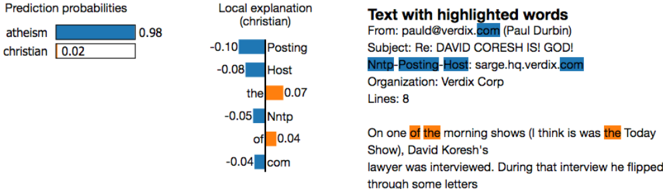
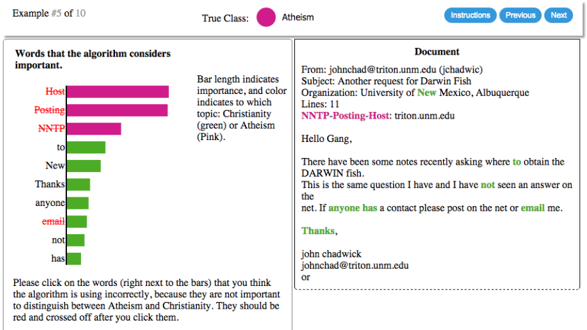
Despite widespread adoption in NLP, machine learning models remain mostly black boxes.Understanding the reasons behind predictions is, however, quite important in assessing trust in a model.Trust is fundamental if one plans to take action based on a prediction, or when choosing whether or not to deploy a new model.In this work, we describe LIME, a novel explanation technique that explains the predictions of any classifier in an interpretable and faithful manner.We further present a method to explain models by presenting representative individual predictions and their explanations in a non-redundant manner.We propose a demonstration of these ideas on different NLP tasks such as document classification, politeness detection, and sentiment analysis, with classifiers like neural networks and SVMs.The user interactions include explanations of free-form text, challenging users to identify the better classifier from a pair, and perform basic feature engineering to improve the classifiers.
Overview
The claims and statistics of this paper haven’t been checked yet.
Free: it reads the open-access text and checks the first 5 claims that cite a source we can check. Create a free account to check every claim.
Integrity signals
Registry
Cites
Statistics
Figures
Verification
Claims the paper makes
The claims and statistics of this paper haven’t been checked yet.
Free: it reads the open-access text and checks the first 5 claims that cite a source we can check. Create a free account to check every claim.
Claims other papers make about this one
Each is checked against this paper’s own text: does it say what the citing paper says it does?
The source backs part of the claim, not all of it — or backs it for a different population, condition or comparison.
In the citing paper
“While providing individuals with grounds to contest individual decisions is often cited as a central motivation of the field of explainable artificial intelligence (XAI) (Ribeiro, Singh, and Guestrin 2016;Lipton 2018;Adadi and Berrada 2018;Molnar 2020), only very few technical works address contestability in greater detail (Mansi, Karusala, and Riedl 2025).”
From Explainable AI Isn't Enough! Rethinking Algorithmic Contestability (2026) · cites this paper as Ribeiro, Singh, and Guestrin 2016
Experimental — accuracy not yet measuredThe source backs part of the claim, not all of it — or backs it for a different population, condition or comparison.
In the citing paper
“We show that standard XAI explanations, such as counterfactuals, LIME, or Anchors, even when combined with human intuitions about decision continuity or monotonicity, reveal only errors in the neighborhood of the individual, but provide insufficient grounds for overturning the decision at hand.”
From Explainable AI Isn't Enough! Rethinking Algorithmic Contestability (2026) · cites this paper as Ribeiro, Singh, and Guestrin 2016
Experimental — accuracy not yet measuredThe cited source says what the claim attributes to it.
In the citing paper
“Post hoc interpretability approaches such as Local Interpretable Model-agnostic Explanation [164] and Shapley Additive Explanations [116], widely adopted in defect prediction [81, 82], performance analysis [173], code analysis [177, 188], and code generation [112], explain the predictions after the model training and without altering the models.”
From A 2030 Roadmap for Software Engineering (2025) · cites this paper as [164]
The cited source says what the claim attributes to it.
In the citing paper
“Self-explanations are a prevailing approach on par with traditional model explanations like LIME saliency maps [71] for understanding LLM-generated responses [25, 32, 53] and are widely used in analyzing language model behavior [66, 99].”
From Thinking in Space: How Multimodal Large Language Models See, Remember, and Recall Spaces (2025) · cites this paper as [71]
In the citing paper
“Techniques such as LIME [25] and SHAP [26] are examples of post-hoc explainability methods commonly used in healthcare.”
From Ethical Framework for Harnessing the Power of AI in Healthcare and Beyond (2024) · cites this paper as [25]
1 more claim about this paper
Create a free account to see every claim other papers make about this one.
Self-check
Percentages, sums and reported differences re-computed from the paper’s own numbers.
The self-check needs the paper’s full text.
Citations
Cites
"Why Should I Trust You?": Explaining the Predictions of Any Classifier
Ribeiro, M. T., Singh, S., & Guestrin, C. (2016) · Proceedings of the 22nd ACM SIGKDD International Conference on Knowledge Discovery and Data Mining · doi:10.1145/2939672.2939778 · Cited by 17,555
Self-citationEfron, B., Hastie, T., Johnstone, I., & Tibshirani, R. (2004) · The Annals of Statistics · doi:10.1214/009053604000000067 · Cited by 9,357
Recursive Deep Models for Semantic Compositionality Over a Sentiment Treebank
Socher, R., Perelygin, A., Wu, J., Chuang, J., Manning, C. D., Ng, A., & Potts, C. (2013) · Proceedings of the 2013 Conference on Empirical Methods in Natural Language Processing · doi:10.18653/v1/d13-1170 · Cited by 6,878
A threshold of ln n for approximating set cover
Feige, U. (1998) · Journal of the ACM · doi:10.1145/285055.285059 · Cited by 3,086
Explaining collaborative filtering recommendations
Herlocker, J. L., Konstan, J. A., & Riedl, J. (2000) · Proceedings of the 2000 ACM conference on Computer supported cooperative work · doi:10.1145/358916.358995 · Cited by 1,731
Dataset Shift in Machine Learning
(2008) · doi:10.7551/mitpress/9780262170055.001.0001 · Cited by 1,553
The role of trust in automation reliance
Dzindolet, M. T., Peterson, S. A., Pomranky, R. A., Pierce, L. G., & Beck, H. P. (2003) · International Journal of Human-Computer Studies · doi:10.1016/s1071-5819(03)00038-7 · Cited by 1,276
Submodular Function Maximization
Krause, A., & Golovin, D. (2014) · Tractability · doi:10.1017/cbo9781139177801.004 · Cited by 751
Leakage in data mining: formulation, detection, and avoidance
Kaufman, S., Rosset, S., & Perlich, C. (2011) · Proceedings of the 17th ACM SIGKDD international conference on Knowledge discovery and data mining · doi:10.1145/2020408.2020496 · Cited by 137
Investigating statistical machine learning as a tool for software development
Patel, K., Fogarty, J., Landay, J. A., & Harrison, B. (2008) · Proceedings of the SIGCHI Conference on Human Factors in Computing Systems · doi:10.1145/1357054.1357160 · Cited by 129
Research works printed but not linked: 3
- Cristian Danescu-Niculescu-Mizil, Moritz Sudhof, Dan Jurafsky, Jure Leskovec, and Christopher Potts. 2013. A computational approach to politeness with applica- tion to social factors. In Proceedings of ACL.
- Jonathan L. Herlocker, Joseph A. Konstan, and John Riedl. 2000. Explaining collaborative filtering recommenda- tions. In Conference on Computer Supported Coopera- tive Work (CSCW).
- Andreas Krause and Daniel Golovin. 2014. Submodu- lar function maximization. In Tractability: Practical Approaches to Hard Problems. Cambridge University Press, February.
Cited by
Items 601–700 of 1,091
Translational machine learning for psychiatric neuroimaging
Walter, M., Alizadeh, S., Jamalabadi, H., Lueken, U., Dannlowski, U., Walter, H., Olbrich, S., Čolić, L., Kambeitz, J. P., Koutsouleris, N., et al. (2018) · Progress in Neuro-Psychopharmacology and Biological Psychiatry · doi:10.1016/j.pnpbp.2018.09.014 · Cited by 91
Human-Centric Justification of Machine Learning Predictions
Biran, O., & McKeown, K. (2017) · Proceedings of the Twenty-Sixth International Joint Conference on Artificial Intelligence · doi:10.24963/ijcai.2017/202 · Cited by 84
Keane, M. T., & Kenny, E. M. (2019) · Lecture Notes in Computer Science · doi:10.1007/978-3-030-29249-2_11 · Cited by 84
Obfuscating Gender in Social Media Writing
Reddy, S., & Knight, K. (2016) · Proceedings of the First Workshop on NLP and Computational Social Science · doi:10.18653/v1/w16-5603 · Cited by 86
AI applications in renal pathology
Huo, Y., Deng, R., Liu, Q., Fogo, A. B., & Yang, H. (2021) · Kidney International · doi:10.1016/j.kint.2021.01.015 · Cited by 104
An interpretable forecasting framework for energy consumption and CO2 emissions
Aras, S., & Van, M. H. (2022) · Applied Energy · doi:10.1016/j.apenergy.2022.120163 · Cited by 89
Hasan, M. H., Rahman, M. S., Janicke, H., & Sarker, I. H. (2024) · Blockchain Research and Applications · doi:10.1016/j.bcra.2024.100207 · Cited by 115
Tigges, M., Mestwerdt, S., Tschirner, S., & Mauer, R. (2024) · Technological Forecasting and Social Change · doi:10.1016/j.techfore.2024.123491 · Cited by 98
Ukwuoma, C. C., Cai, D., Eziefuna, E. O., Oluwasanmi, A., Abdi, S. F., Muoka, G. W., Thomas, D., & Sarpong, K. (2025) · Biomedical Signal Processing and Control · doi:10.1016/j.bspc.2024.107014 · Cited by 83
Explainable AI for COVID-19 CT Classifiers: An Initial Comparison Study
Ye, Q., Xia, J., & Yang, G. (2021) · 2021 IEEE 34th International Symposium on Computer-Based Medical Systems (CBMS) · doi:10.1109/cbms52027.2021.00103 · Cited by 83
Explainability of Machine Learning Models for Bankruptcy Prediction
Park, M. S., Son, H., Hyun, C., & Hwang, H. J. (2021) · IEEE Access · doi:10.1109/access.2021.3110270 · Cited by 83
The challenges of deploying artificial intelligence models in a rapidly evolving pandemic
Hu, Y., Jacob, J., Parker, G. J. M., Hawkes, D. J., Hurst, J. R., & Stoyanov, D. (2020) · Nature Machine Intelligence · doi:10.1038/s42256-020-0185-2 · Cited by 78
Interpretability in the medical field: A systematic mapping and review study
Hakkoum, H., Abnane, I., & Idri, A. (2021) · Applied Soft Computing · doi:10.1016/j.asoc.2021.108391 · Cited by 93
Use of machine learning in osteoarthritis research: a systematic literature review
Binvignat, M., Pedoia, V., Butte, A. J., Louati, K., Klatzmann, D., Berenbaum, F., Mariotti‐Ferrandiz, E., & Sellam, J. (2022) · RMD Open · doi:10.1136/rmdopen-2021-001998 · Cited by 83
Kinney, M. N., Anastasiadou, M., Naranjo-Zolotov, M., & Santos, V. (2024) · Heliyon · doi:10.1016/j.heliyon.2024.e28562 · Cited by 97
Recent endeavors in machine learning-powered intrusion detection systems for the Internet of Things
Manivannan, D. (2024) · Journal of Network and Computer Applications · doi:10.1016/j.jnca.2024.103925 · Cited by 94
Human centred explainable AI decision-making in healthcare
van Leersum, C. M., & Maathuis, C. (2025) · Journal of Responsible Technology · doi:10.1016/j.jrt.2025.100108 · Cited by 102
Pelegrina, G. D., Duarte, L. T., & Grabisch, M. (2023) · Artificial Intelligence · doi:10.1016/j.artint.2023.104014 · Cited by 99
Asif, D., Arif, M. S., & Mukheimer, A. A. (2025) · Results in Engineering · doi:10.1016/j.rineng.2025.104629 · Cited by 92
Public procurement of artificial intelligence systems: new risks and future proofing
Hickok, M. (2024) · AI & SOCIETY · doi:10.1007/s00146-022-01572-2 · Cited by 81
A hybrid machine learning framework for analyzing human decision-making through learning preferences
Guo, M., Zhang, Q., Liao, X., Chen, F. Y., & Zeng, D. D. (2020) · Omega · doi:10.1016/j.omega.2020.102263 · Cited by 94
Pérez, E., Reyes, Ó., & Ventura, S. (2020) · Medical Image Analysis · doi:10.1016/j.media.2020.101858 · Cited by 85
SIRUS: Stable and Interpretable RUle Set for classification
Bénard, C., Biau, G., da Veiga, S., & Scornet, E. (2021) · Electronic Journal of Statistics · doi:10.1214/20-ejs1792 · Cited by 98
Shams Amiri, S., Mottahedi, S., Lee, E. R., & Hoque, S. (2021) · Computers, Environment and Urban Systems · doi:10.1016/j.compenvurbsys.2021.101647 · Cited by 77
Zorro: Valid, Sparse, and Stable Explanations in Graph Neural Networks
Funke, T., Khosla, M., Rathee, M., & Anand, A. (2022) · IEEE Transactions on Knowledge and Data Engineering · doi:10.1109/tkde.2022.3201170 · Cited by 117
Entropy-Based Logic Explanations of Neural Networks
Barbiero, P., Ciravegna, G., Giannini, F., Lió, P., Gori, M., & Melacci, S. (2022) · Proceedings of the AAAI Conference on Artificial Intelligence · doi:10.1609/aaai.v36i6.20551 · Cited by 125
A systematic survey on explainable AI applied to fake news detection
Athira, A. B., Kumar, S. D. M., & Chacko, A. M. (2023) · Engineering Applications of Artificial Intelligence · doi:10.1016/j.engappai.2023.106087 · Cited by 97
Bouazizi, S., & Ltifi, H. (2023) · Decision Support Systems · doi:10.1016/j.dss.2023.114126 · Cited by 92
Nascita, A., Aceto, G., Ciuonzo, D., Montieri, A., Persico, V., & Pescapè, A. (2024) · IEEE Communications Surveys & Tutorials · doi:10.1109/comst.2024.3504955 · Cited by 102
Counterfactual state explanations for reinforcement learning agents via generative deep learning
Olson, M., Khanna, R., Neal, L., Li, F., & Wong, W. (2021) · Artificial Intelligence · doi:10.1016/j.artint.2021.103455 · Cited by 113
Park, H.-S., & Park, D. Y. (2021) · Building and Environment · doi:10.1016/j.buildenv.2021.107744 · Cited by 84
Recurrent neural networks enable design of multifunctional synthetic human gut microbiome dynamics
Baranwal, M., Clark, R. L., Thompson, J. C., Sun, Z., Hero, A. O., & Venturelli, O. S. (2022) · eLife · doi:10.7554/elife.73870 · Cited by 86
Wagan, S. A., Koo, J., Siddiqui, I. F., Attique, M., Shin, D. R., & Qureshi, N. M. F. (2022) · Journal of King Saud University - Computer and Information Sciences · doi:10.1016/j.jksuci.2022.09.005 · Cited by 88
The Different Faces of AI Ethics Across the World: A Principle-to-Practice Gap Analysis
Tidjon, L. N., & Khomh, F. (2022) · IEEE Transactions on Artificial Intelligence · doi:10.1109/tai.2022.3225132 · Cited by 89
An Explainable Model for Identifying At-Risk Student at Higher Education
Alwarthan, S., Aslam, N., & Khan, I. U. (2022) · IEEE Access · doi:10.1109/access.2022.3211070 · Cited by 97
Gholami, H., Mohammadifar, A., Golzari, S., Song, Y., & Pradhan, B. (2023) · The Science of The Total Environment · doi:10.1016/j.scitotenv.2023.166960 · Cited by 82
Visual exploration of machine learning results using data cube analysis
Kahng, M., Fang, D., & Chau, D. H. (. (2016) · Proceedings of the Workshop on Human-In-the-Loop Data Analytics · doi:10.1145/2939502.2939503 · Cited by 77
Analysis of Travel Mode Choice in Seoul Using an Interpretable Machine Learning Approach
Kim, E.-J. (2021) · Journal of Advanced Transportation · doi:10.1155/2021/6685004 · Cited by 104
Dabass, M., Vashisth, S., & Vig, R. (2022) · Computers in Biology and Medicine · doi:10.1016/j.compbiomed.2022.105680 · Cited by 83
Jin, W., Li, X., & Hamarneh, G. (2022) · Proceedings of the AAAI Conference on Artificial Intelligence · doi:10.1609/aaai.v36i11.21452 · Cited by 21
Kothadiya, D., Bhatt, C., Rehman, A. U., Alamri, F. S., & Saba, T. (2023) · IEEE Access · doi:10.1109/access.2023.3274851 · Cited by 84
A.I. Robustness: a Human-Centered Perspective on Technological Challenges and Opportunities
Tocchetti, A., Corti, L., Balayn, A., Yurrita, M., Lippmann, P., Brambilla, M., & Yang, J. (2025) · ACM Computing Surveys · doi:10.1145/3665926 · Cited by 98
Schultebraucks, K., & Galatzer‐Levy, I. R. (2019) · Journal of Traumatic Stress · doi:10.1002/jts.22384 · Cited by 76
How Do We Assess the Trustworthiness of AI? Introducing the Trustworthiness Assessment Model (TrAM)
Schlicker, N., Baum, K., Uhde, A., Sterz, S., Hirsch, M. C., & Langer, M. (2022) · doi:10.31234/osf.io/qhwvx · Cited by 79
Mehdiyev, N., & Fettke, P. (2021) · Studies in Computational Intelligence · doi:10.1007/978-3-030-64949-4_1 · Cited by 78
Charte, D., Charte, F., del Jesús, M. J., & Herrera, F. (2020) · Neurocomputing · doi:10.1016/j.neucom.2020.04.057 · Cited by 90
Roa, L., Correa-Bahnsen, A., Suárez, G., Cort'es-Tejada, F., Luque, M. A., & Bravo, C. (2020) · Expert Systems with Applications · doi:10.1016/j.eswa.2020.114486 · Cited by 96
Beyond Supervised Learning in Remote Sensing: A Systematic Review of Deep Learning Approaches
Hosseiny, B., Mahdianpari, M., Hemati, M., Radman, A., Mohammadimanesh, F., & Chanussot, J. (2023) · IEEE Journal of Selected Topics in Applied Earth Observations and Remote Sensing · doi:10.1109/jstars.2023.3316733 · Cited by 89
Chakrabarty, A., Ahmed, S. T., Fahim-Ul-Islam, M., Aziz, S. M., & Maidin, S. S. (2024) · Ecological Informatics · doi:10.1016/j.ecoinf.2024.102718 · Cited by 98
Barbado, A., Corcho, Ó., & Benjamins, R. (2022) · Expert Systems with Applications · doi:10.1016/j.eswa.2021.116100 · Cited by 77
Interpretable machine learning approach in estimating traffic volume on low-volume roadways
Das, S., & Tsapakis, I. (2019) · International Journal of Transportation Science and Technology · doi:10.1016/j.ijtst.2019.09.004 · Cited by 77
CapitalVX: A machine learning model for startup selection and exit prediction
Ross, G., Das, S. R., Sciro, D., & Raza, H. (2021) · The Journal of Finance and Data Science · doi:10.1016/j.jfds.2021.04.001 · Cited by 96
Leveraging explanations in interactive machine learning: An overview
Teso, S., Alkan, Ö., Stammer, W., & Daly, E. (2023) · Frontiers in Artificial Intelligence · doi:10.3389/frai.2023.1066049 · Cited by 106
Explaining Deep Learning Models for Credit Scoring with SHAP: A Case Study Using Open Banking Data
Hjelkrem, L. O., & de Lange, P. E. (2023) · Journal of risk and financial management · doi:10.3390/jrfm16040221 · Cited by 91
Explainable AI framework for reliable and transparent automated energy management in buildings
Teixeira, B., Carvalhais, L., Pinto, T. D. O., & Vale, Z. (2025) · Energy and Buildings · doi:10.1016/j.enbuild.2025.116246 · Cited by 93
Representation Learning for Tabular Data: A Comprehensive Survey
Jiang, J., Liu, S.-Y., Cai, H.-R., Zhou, Q.-L., & Ye, H.-J. (2026) · IEEE Transactions on Pattern Analysis and Machine Intelligence · doi:10.1109/tpami.2026.3657217 · Cited by 120
Watson, P. A. G. (2019) · Journal of Advances in Modeling Earth Systems · doi:10.1029/2018ms001597 · Cited by 75
XAI Evaluation: Evaluating Black-Box Model Explanations for Prediction
Zhang, Y., Xu, F., Zou, J., Petrosian, O. L., & Krinkin, K. V. (2021) · 2021 II International Conference on Neural Networks and Neurotechnologies (NeuroNT) · doi:10.1109/neuront53022.2021.9472817 · Cited by 76
Psychological foundations of explainability and interpretability in artificial intelligence
Broniatowski, D. A. (2021) · doi:10.6028/nist.ir.8367 · Cited by 76
Williford, J. R., May, B. B., & Byrne, J. (2020) · Lecture Notes in Computer Science · doi:10.1007/978-3-030-58621-8_15 · Cited by 76
Polce, E. M., Kunze, K. N., Fu, M. C., Garrigues, G. E., Forsythe, B., Nicholson, G. P., Cole, B. J., & Verma, N. N. (2020) · Journal of Shoulder and Elbow Surgery · doi:10.1016/j.jse.2020.09.007 · Cited by 77
Chen, C., Lin, K., Rudin, C. D., Shaposhnik, Y., Wang, S., & Wang, T. (2021) · Decision Support Systems · doi:10.1016/j.dss.2021.113647 · Cited by 101
Viana, C. M., Santos, M., Freire, D., Abrantes, P. C. D. R. M., & Rocha, J. (2021) · Ecological Indicators · doi:10.1016/j.ecolind.2021.108200 · Cited by 79
Identifying and Mitigating Spurious Correlations for Improving Robustness in NLP Models
Wang, T., Sridhar, R., Yang, D., & Wang, X. (2022) · Findings of the Association for Computational Linguistics: NAACL 2022 · doi:10.18653/v1/2022.findings-naacl.130 · Cited by 40
The Conflict Between Explainable and Accountable Decision-Making Algorithms
Lima, G., Grgić-Hlača, N., Jeong, J. K., & Cha, M. (2022) · ACM Conference on Fairness, Accountability, and Transparency (FAccT) · doi:10.1145/3531146.3534628 · Cited by 99
CodedPaddedFL and CodedSecAgg: Straggler Mitigation and Secure Aggregation in Federated Learning
Schlegel, R., Kumar, S., Rosnes, E., & Amat, A. G. I. (2023) · IEEE Transactions on Communications · doi:10.1109/tcomm.2023.3244243 · Cited by 90
Modeling industrial hydrocyclone operational variables by SHAP-CatBoost - A “conscious lab” approach
Chelgani, S. C., Nasiri, H., Tohry, A., & Heidari, H. R. (2023) · Powder Technology · doi:10.1016/j.powtec.2023.118416 · Cited by 84
Berne, J. V., Saadi, S. B., Politis, C., & Jacobs, R. (2023) · Journal of Dentistry · doi:10.1016/j.jdent.2023.104581 · Cited by 81
How do Decisions Emerge across Layers in Neural Models? Interpretation with Differentiable Masking
De Cao, N., Schlichtkrull, M. S., Aziz, W., & Titov, I. (2020) · Proceedings of the 2020 Conference on Empirical Methods in Natural Language Processing (EMNLP) · doi:10.18653/v1/2020.emnlp-main.262 · Cited by 75
LINDA-BN: An interpretable probabilistic approach for demystifying black-box predictive models
Moreira, C., Chou, Y.-L., Velmurugan, M., Ouyang, C., Sindhgatta, R., & Bruza, P. (2021) · Decision Support Systems · doi:10.1016/j.dss.2021.113561 · Cited by 80
de Souza, L. A., Mendel, R., Strasser, S., Ebigbo, A., Probst, A., Messmann, H., Papa, J. P., & Palm, C. (2021) · Computers in Biology and Medicine · doi:10.1016/j.compbiomed.2021.104578 · Cited by 72
Explainable Artificial Intelligence for Sarcasm Detection in Dialogues
Kumar, A., Dikshit, S., & de Albuquerque, V. H. C. (2021) · Wireless Communications and Mobile Computing · doi:10.1155/2021/2939334 · Cited by 87
Ethically Responsible Machine Learning in Fintech
Rizinski, M., Peshov, H., Mishev, K., Chitkushev, L. T., Vodenska, I., & Trajanov, D. (2022) · IEEE Access · doi:10.1109/access.2022.3202889 · Cited by 93
Ghosh, I., Alfaro, E., Gámez, M., & García, N. (2023) · International Review of Financial Analysis · doi:10.1016/j.irfa.2023.102558 · Cited by 78
Phan, M., Caigny, A. D., & Coussement, K. (2023) · Decision Support Systems · doi:10.1016/j.dss.2023.113940 · Cited by 83
Deep Learning-Empowered Semantic Communication Systems With a Shared Knowledge Base
Yi, P., Cao, Y., Kang, X., & Liang, Y. (2023) · IEEE Transactions on Wireless Communications · doi:10.1109/twc.2023.3330744 · Cited by 94
Khan, I. A., Razzak, I., Pi, D., Zia, U., Kamal, S., & Hussain, Y. (2024) · IEEE Journal of Biomedical and Health Informatics · doi:10.1109/jbhi.2024.3352013 · Cited by 75
Contextual Outlier Interpretation
Liu, N., Shin, D., & Hu, X. (2018) · Proceedings of the Twenty-Seventh International Joint Conference on Artificial Intelligence · doi:10.24963/ijcai.2018/341 · Cited by 74
Building and Interpreting Deep Similarity Models
Eberle, O., Buttner, J., Krautli, F., Muller, K.-R., Valleriani, M., & Montavon, G. (2022) · IEEE Transactions on Pattern Analysis and Machine Intelligence · doi:10.1109/tpami.2020.3020738 · Cited by 68
Counterfactual Explanations for Neural Recommenders
Tran, K. H., Ghazimatin, A., & Roy, R. S. (2021) · International ACM SIGIR Conference on Research and Development in Information Retrieval (SIGIR) · doi:10.1145/3404835.3463005 · Cited by 97
Standardized Reporting of Machine Learning Applications in Urology: The STREAM-URO Framework
Kwong, J. C. C., McLoughlin, L. C., Haider, M. A., Goldenberg, M. G., Erdman, L., Rickard, M., Lorenzo, A. J., Hung, A. J., Farcas, M. A., Goldenberg, L., et al. (2021) · European Urology Focus · doi:10.1016/j.euf.2021.07.004 · Cited by 78
Fairness via Explanation Quality: Evaluating Disparities in the Quality of Post hoc Explanations
Dai, J. C., Upadhyay, S., Aïvodji, U., Bach, S. H., & Lakkaraju, H. (2022) · Proceedings of the AAAI/ACM Conference on AI Ethics and Society · doi:10.1145/3514094.3534159 · Cited by 130
On Tackling Explanation Redundancy in Decision Trees
Izza, Y., Ignatiev, A., & Marques-Silva, J. P. (2022) · Journal of Artificial Intelligence Research · doi:10.1613/jair.1.13575 · Cited by 120
Deep learning in economics: a systematic and critical review
Zheng, Y., Xu, Z., & Xiao, A. (2023) · Artificial Intelligence Review · doi:10.1007/s10462-022-10272-8 · Cited by 92
Faithful Multimodal Explanation for Visual Question Answering
Wu, J., & Mooney, R. (2019) · Proceedings of the 2019 ACL Workshop BlackboxNLP: Analyzing and Interpreting Neural Networks for NLP · doi:10.18653/v1/w19-4812 · Cited by 73
Deep learning for inferring transcription factor binding sites
Koo, P. K., & Ploenzke, M. (2020) · Current Opinion in Systems Biology · doi:10.1016/j.coisb.2020.04.001 · Cited by 70
A robust and interpretable end-to-end deep learning model for cytometry data
Hu, Z., Tang, A., Singh, J., Bhattacharya, S., & Butte, A. J. (2020) · Proceedings of the National Academy of Sciences · doi:10.1073/pnas.2003026117 · Cited by 78
Can We Trust Your Explanations? Sanity Checks for Interpreters in Android Malware Analysis
Fan, M., Wei, W., Xie, X., Liu, Y., Guan, X., & Liu, T. (2021) · IEEE Transactions on Information Forensics and Security · doi:10.1109/tifs.2020.3021924 · Cited by 65
Deep Entity Matching: Challenges and Opportunities
Li, Y., Li, J., Suhara, Y., Wang, J., Hirota, W., & Tan, W.-C. (2021) · Journal of Data and Information Quality · doi:10.1145/3431816 · Cited by 108
Promises and pitfalls of deep neural networks in neuroimaging-based psychiatric research
Eitel, F., Schulz, M.-A., Seiler, M., Walter, H., & Ritter, K. (2021) · Experimental Neurology · doi:10.1016/j.expneurol.2021.113608 · Cited by 80
Poppi, S., Cornia, M., Baraldi, L., & Cucchiara, R. (2021) · IEEE/CVF Conference on Computer Vision and Pattern Recognition Workshops (CVPRW) · doi:10.1109/cvprw53098.2021.00260 · Cited by 95
Akula, A. R., Wang, K., Liu, C., Saba-Sadiya, S., Lu, H., Todorovic, S., Chai, J., & Zhu, S.-C. (2022) · iScience · doi:10.1016/j.isci.2021.103581 · Cited by 64
Local Interpretations for Explainable Natural Language Processing: A Survey
Luo, S., Ivison, H., Han, S. C., & Poon, J. (2024) · ACM Computing Surveys · doi:10.1145/3649450 · Cited by 105
Understanding Model Predictions: A Comparative Analysis of SHAP and LIME on Various ML Algorithms
Hasan, M. M. (2024) · Journal of Scientific and Technological Research · doi:10.59738/jstr.v5i1.23(17-26).eaqr5800 · Cited by 83
Sharma, V., Tripathi, A. K., Mittal, H., & Nkenyereye, L. (2024) · Expert Systems with Applications · doi:10.1016/j.eswa.2024.125385 · Cited by 81
The role of generative artificial intelligence in digital agri-food
Shahriar, S., Corradini, M. G., Sharif, S., Moussa, M. A., & Dara, R. A. (2025) · Journal of Agriculture and Food Research · doi:10.1016/j.jafr.2025.101787 · Cited by 92
Explaining A Black-box By Using A Deep Variational Information Bottleneck Approach
Bang, S., Xie, P., Lee, H., Wu, W., & Xing, E. P. (2021) · Proceedings of the AAAI Conference on Artificial Intelligence · doi:10.1609/aaai.v35i13.17358 · Cited by 96
Variance Reduction for Estimation of Shapley Effects and Adaptation to Unknown Input Distribution
Broto, B., Bachoc, F., & Depecker, M. (2020) · SIAM/ASA Journal on Uncertainty Quantification · doi:10.1137/18m1234631 · Cited by 72
From Contrastive to Abductive Explanations and Back Again
Ignatiev, A., Narodytska, N., Asher, N. M., & Marques-Silva, J. P. (2021) · Lecture notes in computer science · doi:10.1007/978-3-030-77091-4_21 · Cited by 141
Metadata
- Authors
- Ribeiro, M., Singh, S., & Guestrin, C.
- Affiliations
- University of Washington (US)
- Venue
- Proceedings of the 2016 Conference of the North American Chapter of the Association for Computational Linguistics: Demonstrations
- Published
- 2016
- Pages
- 97-101
- OpenAlex
- W2516809705
- Cited by
- 6,682
- References
- 13
- Citations by year
- 2026: 742 · 2025: 1562 · 2024: 1239 · 2023: 1039 · 2022: 778 · 2021: 581 · 2020: 364 · 2019: 225 · 2018: 109 · 2017: 38 · 2016: 3
- FWCI
- 67.53
- Type
- conference paper
- Language
- en
- Open access
- hybrid
- doi.org
- Licence
- cc-by
- Locations
- Conference of the North American Chapter of the Association for Computational Linguistics: Human Language Technologies (NAACL-HLT) (publishedVersion, cc-by)
- Funders
- Semiconductor Research Corporation
- Defense Advanced Research Projects Agency
- Topics
- Physical Sciences › Computer Science › Artificial Intelligence › Explainable Artificial Intelligence (XAI)
- Physical Sciences › Computer Science › Software › Software Testing and Debugging Techniques
- Physical Sciences › Computer Science › Artificial Intelligence › Topic Modeling
- Keywords
- lime, explainable AI, classifier interpretability, model trust, local interpretable model-agnostic explanations, feature importance, document classification, sentiment analysis, artificial neural networks, support vector machine, user interaction
About these checks
Registry, retraction, Cites and statistics results are computed, not judged, with one exception: a printed reference that no index lists is read once by a model before it counts as a citation error. Claims are extracted by a model and kept only when their quote appears verbatim in the text; each cited source is then checked, with a model’s help, for whether it says what the claim relies on. Those verdicts can be wrong — read the claim’s quote and the cited source before relying on one.
Statistics and arithmetic are recomputed, not judged.
Confidence bands are shown only for fields calibrated on our annotated test set. None is calibrated yet, so no band is shown.
What counts as a claim ›How we measure confidence ›How we check this ›
Are you an author, or do you see a problem with this page? Request a review
Data sources
Bibliographic data: Semantic Scholar, OpenAlex, Crossref.
Contains information from the Semantic Scholar Academic Graph Datasets, made available under the ODC Attribution License (ODC-BY 1.0).
Semantic Scholar’s data is described in: Kinney, R., et al. (2023). The Semantic Scholar Open Data Platform. arXiv:2301.10140.
