

“Why Should I Trust You?”: Explaining the Predictions of Any Classifier
Open accessThe DOI matches its Crossref record; 12 of the 13 references it cites were found in a registry or an index.
Abstract
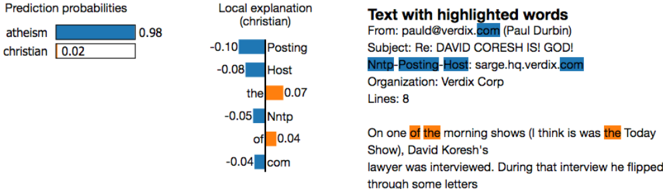
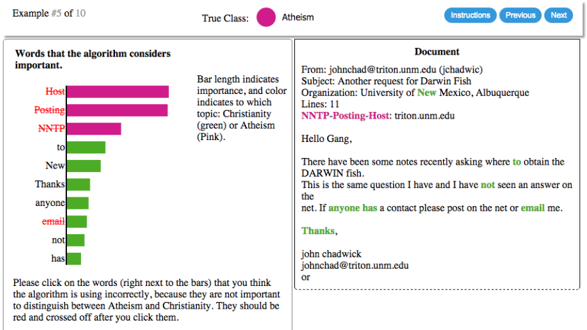
Despite widespread adoption in NLP, machine learning models remain mostly black boxes.Understanding the reasons behind predictions is, however, quite important in assessing trust in a model.Trust is fundamental if one plans to take action based on a prediction, or when choosing whether or not to deploy a new model.In this work, we describe LIME, a novel explanation technique that explains the predictions of any classifier in an interpretable and faithful manner.We further present a method to explain models by presenting representative individual predictions and their explanations in a non-redundant manner.We propose a demonstration of these ideas on different NLP tasks such as document classification, politeness detection, and sentiment analysis, with classifiers like neural networks and SVMs.The user interactions include explanations of free-form text, challenging users to identify the better classifier from a pair, and perform basic feature engineering to improve the classifiers.
Overview
The claims and statistics of this paper haven’t been checked yet.
Free: it reads the open-access text and checks the first 5 claims that cite a source we can check. Create a free account to check every claim.
Integrity signals
Registry
Cites
Statistics
Figures
Verification
Claims the paper makes
The claims and statistics of this paper haven’t been checked yet.
Free: it reads the open-access text and checks the first 5 claims that cite a source we can check. Create a free account to check every claim.
Claims other papers make about this one
Each is checked against this paper’s own text: does it say what the citing paper says it does?
The source backs part of the claim, not all of it — or backs it for a different population, condition or comparison.
In the citing paper
“While providing individuals with grounds to contest individual decisions is often cited as a central motivation of the field of explainable artificial intelligence (XAI) (Ribeiro, Singh, and Guestrin 2016;Lipton 2018;Adadi and Berrada 2018;Molnar 2020), only very few technical works address contestability in greater detail (Mansi, Karusala, and Riedl 2025).”
From Explainable AI Isn't Enough! Rethinking Algorithmic Contestability (2026) · cites this paper as Ribeiro, Singh, and Guestrin 2016
Experimental — accuracy not yet measuredThe source backs part of the claim, not all of it — or backs it for a different population, condition or comparison.
In the citing paper
“We show that standard XAI explanations, such as counterfactuals, LIME, or Anchors, even when combined with human intuitions about decision continuity or monotonicity, reveal only errors in the neighborhood of the individual, but provide insufficient grounds for overturning the decision at hand.”
From Explainable AI Isn't Enough! Rethinking Algorithmic Contestability (2026) · cites this paper as Ribeiro, Singh, and Guestrin 2016
Experimental — accuracy not yet measuredThe cited source says what the claim attributes to it.
In the citing paper
“Post hoc interpretability approaches such as Local Interpretable Model-agnostic Explanation [164] and Shapley Additive Explanations [116], widely adopted in defect prediction [81, 82], performance analysis [173], code analysis [177, 188], and code generation [112], explain the predictions after the model training and without altering the models.”
From A 2030 Roadmap for Software Engineering (2025) · cites this paper as [164]
The cited source says what the claim attributes to it.
In the citing paper
“Self-explanations are a prevailing approach on par with traditional model explanations like LIME saliency maps [71] for understanding LLM-generated responses [25, 32, 53] and are widely used in analyzing language model behavior [66, 99].”
From Thinking in Space: How Multimodal Large Language Models See, Remember, and Recall Spaces (2025) · cites this paper as [71]
In the citing paper
“Techniques such as LIME [25] and SHAP [26] are examples of post-hoc explainability methods commonly used in healthcare.”
From Ethical Framework for Harnessing the Power of AI in Healthcare and Beyond (2024) · cites this paper as [25]
1 more claim about this paper
Create a free account to see every claim other papers make about this one.
Self-check
Percentages, sums and reported differences re-computed from the paper’s own numbers.
The self-check needs the paper’s full text.
Citations
Cites
"Why Should I Trust You?": Explaining the Predictions of Any Classifier
Ribeiro, M. T., Singh, S., & Guestrin, C. (2016) · Proceedings of the 22nd ACM SIGKDD International Conference on Knowledge Discovery and Data Mining · doi:10.1145/2939672.2939778 · Cited by 17,555
Self-citationEfron, B., Hastie, T., Johnstone, I., & Tibshirani, R. (2004) · The Annals of Statistics · doi:10.1214/009053604000000067 · Cited by 9,357
Recursive Deep Models for Semantic Compositionality Over a Sentiment Treebank
Socher, R., Perelygin, A., Wu, J., Chuang, J., Manning, C. D., Ng, A., & Potts, C. (2013) · Proceedings of the 2013 Conference on Empirical Methods in Natural Language Processing · doi:10.18653/v1/d13-1170 · Cited by 6,878
A threshold of ln n for approximating set cover
Feige, U. (1998) · Journal of the ACM · doi:10.1145/285055.285059 · Cited by 3,086
Explaining collaborative filtering recommendations
Herlocker, J. L., Konstan, J. A., & Riedl, J. (2000) · Proceedings of the 2000 ACM conference on Computer supported cooperative work · doi:10.1145/358916.358995 · Cited by 1,731
Dataset Shift in Machine Learning
(2008) · doi:10.7551/mitpress/9780262170055.001.0001 · Cited by 1,553
The role of trust in automation reliance
Dzindolet, M. T., Peterson, S. A., Pomranky, R. A., Pierce, L. G., & Beck, H. P. (2003) · International Journal of Human-Computer Studies · doi:10.1016/s1071-5819(03)00038-7 · Cited by 1,276
Submodular Function Maximization
Krause, A., & Golovin, D. (2014) · Tractability · doi:10.1017/cbo9781139177801.004 · Cited by 751
Leakage in data mining: formulation, detection, and avoidance
Kaufman, S., Rosset, S., & Perlich, C. (2011) · Proceedings of the 17th ACM SIGKDD international conference on Knowledge discovery and data mining · doi:10.1145/2020408.2020496 · Cited by 137
Investigating statistical machine learning as a tool for software development
Patel, K., Fogarty, J., Landay, J. A., & Harrison, B. (2008) · Proceedings of the SIGCHI Conference on Human Factors in Computing Systems · doi:10.1145/1357054.1357160 · Cited by 129
Research works printed but not linked: 3
- Cristian Danescu-Niculescu-Mizil, Moritz Sudhof, Dan Jurafsky, Jure Leskovec, and Christopher Potts. 2013. A computational approach to politeness with applica- tion to social factors. In Proceedings of ACL.
- Jonathan L. Herlocker, Joseph A. Konstan, and John Riedl. 2000. Explaining collaborative filtering recommenda- tions. In Conference on Computer Supported Coopera- tive Work (CSCW).
- Andreas Krause and Daniel Golovin. 2014. Submodu- lar function maximization. In Tractability: Practical Approaches to Hard Problems. Cambridge University Press, February.
Cited by
Items 1,001–1,091 of 1,091
PLENARY: Explaining black-box models in natural language through fuzzy linguistic summaries
Kaczmarek-Majer, K., Casalino, G., Castellano, G., Dominiak, M., Hryniewicz, O., Kamińska, O., Vessio, G., & Díaz-Rodríguez, N. (2022) · Information Sciences · doi:10.1016/j.ins.2022.10.010 · Cited by 46
UNR-IDD: Intrusion Detection Dataset using Network Port Statistics
Das, T., Hamdan, O. A., Shukla, R. M., Sengupta, S., & Arslan, E. (2023) · IEEE Consumer Communications and Networking Conference · doi:10.1109/ccnc51644.2023.10059640 · Cited by 58
Annuzzi, G., Apicella, A., Arpaïa, P., Bozzetto, L., Criscuolo, S., Benedetto, E. D., Pesola, M., & Prevete, R. (2023) · IEEE Journal of Biomedical and Health Informatics · doi:10.1109/jbhi.2023.3348334 · Cited by 53
Investigating explainable transfer learning for battery lifetime prediction under state transitions
Lin, T., Chen, S., Harris, S. J., Zhao, T. S., Liu, Y., & Wan, J. (2024) · eScience · doi:10.1016/j.esci.2024.100280 · Cited by 52
Explainable artificial intelligence prediction of defect characterization in composite materials
Daghigh, V., Ramezani, S. B., Daghigh, H., & Lacy, T. E. (2024) · Composites Science and Technology · doi:10.1016/j.compscitech.2024.110759 · Cited by 49
Müller, R. (2024) · International Journal of Human-Computer Interaction · doi:10.1080/10447318.2024.2381929 · Cited by 54
Deep Learning-Assisted Unmanned Aerial Vehicle Flight Data Anomaly Detection: A Review
Yang, L., Li, S., Zhang, Y., Zhu, C., & Liao, Z. (2024) · IEEE Sensors Journal · doi:10.1109/jsen.2024.3451648 · Cited by 58
Yousefimehr, B., & Ghatee, M. (2024) · Expert Systems with Applications · doi:10.1016/j.eswa.2024.125661 · Cited by 54
Electrocardiogram Detection of Pulmonary Hypertension Using Deep Learning
ARAS, M. A., ABREAU, S., MILLS, H., RADHAKRISHNAN, L., KLEIN, L., MANTRI, N., RUBIN, B., BARRIOS, J., CHEHOUD, C., KOGAN, E., et al. (2023) · Journal of Cardiac Failure · doi:10.1016/j.cardfail.2022.12.016 · Cited by 46
ScienceWorld: Is your Agent Smarter than a 5th Grader?
Wang, R., Jansen, P., Côté, M.-A., & Ammanabrolu, P. (2022) · Proceedings of the 2022 Conference on Empirical Methods in Natural Language Processing · doi:10.18653/v1/2022.emnlp-main.775 · Cited by 45
Machine Learning Explanations to Prevent Overtrust in Fake News Detection
Mohseni, S., Yang, F., Pentyala, S., Du, M., Liu, Y., Lupfer, N., Hu, X., Ji, S., & Ragan, E. (2021) · Proceedings of the International AAAI Conference on Web and Social Media · doi:10.1609/icwsm.v15i1.18072 · Cited by 44
Generative modeling of single-cell gene expression for dose-dependent chemical perturbations
Kana, O., Nault, R., Filipovic, D., Marri, D., Zacharewski, T., & Bhattacharya, S. (2023) · Patterns · doi:10.1016/j.patter.2023.100817 · Cited by 44
A Collaborative Federated Learning Framework for Lung and Colon Cancer Classifications
Hossain, M. M., Islam, M. R., Ahamed, M. F., Ahsan, M., & Haider, J. (2024) · Technologies · doi:10.3390/technologies12090151 · Cited by 44
(2019) · doi:10.18653/v1/w19-4807 · Cited by 43
Current State and Prospects of Artificial Intelligence in Allergy
van Breugel, M., Fehrmann, R. S. N., Bügel, M., Rezwan, F. I., Holloway, J. W., Nawijn, M. C., Fontanella, S., Custovic, A., & Koppelman, G. H. (2023) · Allergy · doi:10.1111/all.15849 · Cited by 43
Artificial intelligence for dementia prevention
Newby, D., Orgeta, V., Marshall, C. R., Lourida, I., Albertyn, C. P., Tamburin, S., Raymont, V., Veldsman, M., Koychev, I., Bauermeister, S., et al. (2023) · Alzheimer's & Dementia · doi:10.1002/alz.13463 · Cited by 42
Darvishvand, L., Kamkari, B., Huang, M. J., & Hewitt, N. J. (2025) · Sustainable Cities and Society · doi:10.1016/j.scs.2025.106492 · Cited by 42
AcME - accelerated model-agnostic explanations: fast whitening of the machine-learning black box
Dandolo, D., Masiero, C., Carletti, M., Dalle Pezze, D., & Susto, G. A. (2023) · Expert Systems with Applications · doi:10.1016/j.eswa.2022.119115 · Cited by 41
Explainable artificial intelligence, lawyer's perspective
Górski, Ł., & Ramakrishna, S. (2021) · Proceedings of the Eighteenth International Conference on Artificial Intelligence and Law · doi:10.1145/3462757.3466145 · Cited by 40
Hopkins, A., & Booth, S. (2021) · Proceedings of the 2021 AAAI/ACM Conference on AI, Ethics, and Society · doi:10.1145/3461702.3462527 · Cited by 40
The ethics of machine learning in medical sciences: Where do we stand today?
Basu, T., Menzer, O., & Engel-Wolf, S. (2020) · Indian Journal of Dermatology · doi:10.4103/ijd.ijd_419_20 · Cited by 39
Perera, U. A. K. K., Coralage, D. T. S., Ekanayake, I. U., Alawatugoda, J., & Meddage, D. P. P. (2024) · Results in Engineering · doi:10.1016/j.rineng.2024.101920 · Cited by 39
Evidence-based Factual Error Correction
Thorne, J., & Vlachos, A. (2021) · Proceedings of the 59th Annual Meeting of the Association for Computational Linguistics and the 11th International Joint Conference on Natural Language Processing (Volume 1: Long Papers) · doi:10.18653/v1/2021.acl-long.256 · Cited by 39
Regional Tree Regularization for Interpretability in Deep Neural Networks
Wu, M., Parbhoo, S., Hughes, M., Kindle, R., Celi, L., Zazzi, M., Roth, V., & Doshi-Velez, F. (2020) · Proceedings of the AAAI Conference on Artificial Intelligence · doi:10.1609/aaai.v34i04.6112 · Cited by 38
Relation-Based Counterfactual Explanations for Bayesian Network Classifiers
Albini, E., Rago, A., Baroni, P., & Toni, F. (2020) · Proceedings of the Twenty-Ninth International Joint Conference on Artificial Intelligence · doi:10.24963/ijcai.2020/63 · Cited by 39
The design of reciprocal learning between human and artificial intelligence
Zagalsky, A., Te'eni, D., Yahav, I., Schwartz, D. G., Silverman, G., Cohen, D., Mann, Y., & Lewinsky, D. (2021) · Proceedings of the ACM on Human-Computer Interaction · doi:10.1145/3479587 · Cited by 35
Explaining Multi-Criteria Decision Aiding Models with an Extended Shapley Value
Labreuche, C., & Fossier, S. (2018) · Proceedings of the Twenty-Seventh International Joint Conference on Artificial Intelligence · doi:10.24963/ijcai.2018/46 · Cited by 35
Weak-to-Strong Generalization: Eliciting Strong Capabilities With Weak Supervision
Burns, C., Izmailov, P., Kirchner, J. H., Baker, B., Gao, L., Aschenbrenner, L., Chen, Y., Ecoffet, A., Joglekar, M., Leike, J., et al. (2023) · arXiv · doi:10.48550/arxiv.2312.09390 · Cited by 34
de Jong, S., Paananen, V., Tag, B., & van Berkel, N. (2025) · Proceedings of the ACM on Human-Computer Interaction · doi:10.1145/3710946 · Cited by 32
Explainable outlier detection: What, for Whom and Why?
Sejr, J. H., & Schneider-Kamp, A. (2021) · Machine Learning with Applications · doi:10.1016/j.mlwa.2021.100172 · Cited by 32
Large Language Models Can be Lazy Learners: Analyze Shortcuts in In-Context Learning
Tang, R., Kong, D., Huang, L., & Xue, H. (2023) · Findings of the Association for Computational Linguistics: ACL 2023 · doi:10.18653/v1/2023.findings-acl.284 · Cited by 31
Can Rationalization Improve Robustness?
Chen, H., He, J., Narasimhan, K., & Chen, D. (2022) · Proceedings of the 2022 Conference of the North American Chapter of the Association for Computational Linguistics: Human Language Technologies · doi:10.18653/v1/2022.naacl-main.278 · Cited by 31
Chen, H.-T., Zhang, M. J. Q., & Choi, E. (2022) · arXiv · doi:10.48550/arxiv.2210.13701 · Cited by 31
Chen, H.-T., Zhang, M., & Choi, E. (2022) · Proceedings of the 2022 Conference on Empirical Methods in Natural Language Processing · doi:10.18653/v1/2022.emnlp-main.146 · Cited by 31
Additive Explanations for Anomalies Detected from Multivariate Temporal Data
Giurgiu, I., & Schumann, A. (2019) · Proceedings of the 28th ACM International Conference on Information and Knowledge Management · doi:10.1145/3357384.3358121 · Cited by 27
Extendable and explainable deep learning for pan-cancer radiogenomics research
Liu, Q., & Hu, P. (2022) · Current Opinion in Chemical Biology · doi:10.1016/j.cbpa.2021.102111 · Cited by 27
A Decision Theoretic Framework for Measuring AI Reliance
Guo, Z., Wu, Y., Hartline, J. D., & Hullman, J. (2024) · The 2024 ACM Conference on Fairness, Accountability, and Transparency · doi:10.1145/3630106.3658901 · Cited by 27
Coupland, H., Scheidwasser, N., Katsiferis, A., Davies, M., Flaxman, S., Hulvej Rod, N., Mishra, S., Bhatt, S., & Unwin, H. J. T. (2025) · BMC Public Health · doi:10.1186/s12889-025-22705-4 · Cited by 26
Exploring explainable AI features in the vocal biomarkers of lung disease
Chen, Z., Liang, N., Li, H., Zhang, H., Li, H., Yan, L., Hu, Z., Chen, Y., Zhang, Y., Wang, Y., et al. (2024) · Computers in Biology and Medicine · doi:10.1016/j.compbiomed.2024.108844 · Cited by 26
Formatting biological big data for modern machine learning in drug discovery
Duran‐Frigola, M., Fernández‐Torras, A., Bertoni, M., & Aloy, P. (2019) · WIREs Computational Molecular Science · doi:10.1002/wcms.1408 · Cited by 25
A survey of post-hoc xai methods from a visualization perspective: Challenges and opportunities
Bhati, D., Amiruzzaman, M., Zhao, Y., Guercio, A., & Le, T. (2025) · IEEE Access · doi:10.1109/access.2025.3581136 · Cited by 24
Chou, T.-N. (2019) · 2019 IEEE 2nd International Conference on Knowledge Innovation and Invention (ICKII) · doi:10.1109/ickii46306.2019.9042639 · Cited by 23
Faithful Chain-of-Thought Reasoning
Lyu, Q., Havaldar, S., Stein, A., Zhang, L., Rao, D., Wong, E., Apidianaki, M., & Callison-Burch, C. (2023) · arXiv · doi:10.48550/arxiv.2301.13379 · Cited by 23
Hasan, M. J., Mazumdar, S., & Momen, S. (2025) · IEEE Access · doi:10.1109/access.2025.3595390 · Cited by 23
Developing and Operating Artificial Intelligence Models in Trustworthy Autonomous Systems
Martínez-Fernández, S., Franch, X., Jedlitschka, A., Oriol, M., & Trendowicz, A. (2020) · arXiv · doi:10.48550/arxiv.2003.05434 · Cited by 22
Contesting automated decisions
Bayamlioglu, E. (2018) · European Data Protection Law Review · doi:10.21552/edpl/2018/4/6 · Cited by 21
Practitioners’ expectations on log anomaly detection
Ma, X., Li, Y., Keung, J., Yu, X., Zou, H., Yang, Z., Sarro, F., & Barr, E. T. (2025) · IEEE Transactions on Software Engineering · doi:10.1109/tse.2025.3586700 · Cited by 21
Reinforcing Pretrained Models for Generating Attractive Text Advertisements
Wang, X., Gu, X., Cao, J., Zhao, Z., Yan, Y., Middha, B., & Xie, X. (2021) · Proceedings of the 27th ACM SIGKDD Conference on Knowledge Discovery & Data Mining · doi:10.1145/3447548.3467105 · Cited by 20
Using deep learning and electronic health records to detect Noonan syndrome in pediatric patients
Yang, Z., Shikany, A., Ni, Y., Zhang, G., Weaver, K. N., & Chen, J. (2022) · Genetics in Medicine · doi:10.1016/j.gim.2022.08.002 · Cited by 20
Dalal, S., Tilwani, D., Gaur, M., Jain, S., Shalin, V. L., & Sheth, A. P. (2025) · IEEE Journal of Biomedical and Health Informatics · doi:10.1109/jbhi.2024.3483577 · Cited by 19
Color for Characters - Effects of Visual Explanations of AI on Trust and Observability
Schrills, T., & Franke, T. (2020) · Lecture Notes in Computer Science · doi:10.1007/978-3-030-50334-5_8 · Cited by 17
Explainable AI-Aided Feature Selection and Model Reduction for DRL-Based V2X Resource Allocation
Khan, N., Abdallah, A., Celik, A., Eltawil, A. M., & Coleri, S. (2025) · IEEE Transactions on Communications · doi:10.1109/tcomm.2025.3554655 · Cited by 20
Ren, R., Wang, Y., Liu, F., Li, Z., & Xie, G. (2023) · 2023 IEEE/ACM 31st International Symposium on Quality of Service (IWQoS) · doi:10.1109/iwqos57198.2023.10188773 · Cited by 16
Zhang, Z., Wang, T., Hu, Z., Yang, L.-Z., & Li, H. (2025) · IEEE Journal of Biomedical and Health Informatics · doi:10.1109/jbhi.2024.3509620 · Cited by 17
Predicting and explaining with machine learning models: Social science as a touchstone
Buchholz, O., & Grote, T. (2023) · Studies in History and Philosophy of Science · doi:10.1016/j.shpsa.2023.10.004 · Cited by 15
Self-Tuned Descriptive Document Clustering Using a Predictive Network
Brockmeier, A. J., Mu, T., Ananiadou, S., & Goulermas, J. Y. (2018) · IEEE Transactions on Knowledge and Data Engineering · doi:10.1109/tkde.2017.2781721 · Cited by 15
Mosca, E., Abdalla, M. H. I., Basso, P., Musumeci, M., & Groh, G. (2023) · Proceedings of the 3rd Workshop on Trustworthy Natural Language Processing (TrustNLP 2023) · doi:10.18653/v1/2023.trustnlp-1.17 · Cited by 14
LS-Tree: Model Interpretation When the Data Are Linguistic
Chen, J., & Jordan, M. (2020) · Proceedings of the AAAI Conference on Artificial Intelligence · doi:10.1609/aaai.v34i04.5749 · Cited by 14
A 2030 Roadmap for Software Engineering
Pezzè, M., Abrahão, S., Penzenstadler, B., Poshyvanyk, D., Roychoudhury, A., & Yue, T. (2025) · ACM Transactions on Software Engineering and Methodology · doi:10.1145/3731559 · Cited by 13
Time to audit your AI algorithms
Sandu, I., Wiersma, M., & Manichand, D. (2022) · Maandblad voor Accountancy en Bedrijfseconomie · doi:10.5117/mab.96.90108 · Cited by 12
Harnessing AI in critical care: opportunities, challenges and key steps for success
Kalimouttou, A., Stevens, R. D., & Pirracchio, R. (2026) · Thorax · doi:10.1136/thorax-2024-222125 · Cited by 12
An Empirical Comparison of Interpretable Models to Post-Hoc Explanations
Mahya, P., & Fürnkranz, J. (2023) · AI · doi:10.3390/ai4020023 · Cited by 17
Sevillano-García, I., Luengo, J., & Herrera, F. (2023) · International Journal of Intelligent Systems · doi:10.1155/2023/8068569 · Cited by 10
Widmer, C. L., Sarker, M. K., Nadella, S., Fiechter, J., Juvina, I., Minnery, B., Hitzler, P., Schwartz, J., & Raymer, M. (2023) · Journal of Web Semantics · doi:10.1016/j.websem.2023.100807 · Cited by 10
A Human-Centric Perspective on Fairness and Transparency in Algorithmic Decision-Making
Schoeffer, J. (2022) · CHI Conference on Human Factors in Computing Systems Extended Abstracts · doi:10.1145/3491101.3503811 · Cited by 9
Explaining and predicting abnormal expenses at large scale using knowledge graph based reasoning
Lecue, F., & Wu, J. (2017) · Journal of Web Semantics · doi:10.1016/j.websem.2017.05.003 · Cited by 9
Explainable vs. Interpretable Artificial Intelligence Frameworks in Oncology
Bertsimas, D., & Margonis, G. A. (2023) · Translational Cancer Research · doi:10.21037/tcr-22-2427 · Cited by 8
Wimalagunarathna, N. D., Dharmarathne, G., Ekanayake, I. U., Rathanayake, U., Alwatugoda, J., & Meddage, D. P. P. (2024) · Case Studies in Chemical and Environmental Engineering · doi:10.1016/j.cscee.2024.100919 · Cited by 8
The great methods bake-off: Comparing performance of machine learning algorithms
Kigerl, A., Hamilton, Z., Kowalski, M., & Mei, X. (2022) · Journal of Criminal Justice · doi:10.1016/j.jcrimjus.2022.101946 · Cited by 8
Detection and Classification of Anomalies in WSN-Enabled Cyber-Physical Systems
Gutierrez-Rojas, D., Kalalas, C., Christou, I., Almeida, G., Eldeeb, E., Bakri, S., Marchetti, N., Sant'Ana, J. M. S., Alcaraz López, O. L., Alves, H., et al. (2025) · IEEE Sensors Journal · doi:10.1109/jsen.2024.3520507 · Cited by 7
Study on the Helpfulness of Explainable Artificial Intelligence
Labarta, T., Kulicheva, E., Froelian, R., Geißler, C., Melman, X., & von Klitzing, J. (2024) · Communications in Computer and Information Science · doi:10.1007/978-3-031-63803-9_16 · Cited by 8
Explainable knowledge graph embeddings for industrial process monitoring & control
Weyns, M., Blyau, T., Steenwinckel, B., De Turck, F., Van Hoecke, S., & Ongenae, F. (2025) · Information Fusion · doi:10.1016/j.inffus.2025.103242 · Cited by 7
Exploring incel group dynamics: a computational study of hierarchy and group-boundary policing
Solopova, V., Popa-Wyatt, M., & Berškytė, J. (2025) · Journal of Computational Social Science · doi:10.1007/s42001-024-00357-5 · Cited by 6
Trust-Building in Peer-to-Peer Carsharing: Design Case Study for Algorithm-Based Reputation Systems
Neifer, T., Bossauer, P., Pakusch, C., Boehm, L., & Lawo, D. (2024) · Computer Supported Cooperative Work (CSCW) · doi:10.1007/s10606-022-09461-4 · Cited by 6
DEMASQ: unmasking the ChatGPT wordsmith
Kumari, K., Pegoraro, A., Fereidooni, H., & Sadeghi, A.-R. (2023) · arXiv · doi:10.48550/arxiv.2311.05019 · Cited by 5
Prediction of enzyme function using an interpretable optimized ensemble learning framework
Dhibar, S., Basak, S., & Jana, B. (2025) · Chemical Science · doi:10.1039/d5sc04513d · Cited by 5
Prediction of Enzyme function using interpretable optimized Ensemble learning framework
(2025) · doi:10.1101/2025.01.28.635225 · Cited by 5
Conceptualising Contestability: Perspectives on Contesting Algorithmic Decisions
Lyons, H., Velloso, E., & Miller, T. (2021) · Proceedings of the ACM on Human-Computer Interaction · doi:10.1145/3449180 · Cited by 4
Sanity Checks for Saliency Metrics
Tomsett, R., Harborne, D., Chakraborty, S., Gurram, P., & Preece, A. (2020) · Proceedings of the AAAI Conference on Artificial Intelligence · doi:10.1609/aaai.v34i04.6064 · Cited by 3
Huang, Y., Yang, X., Wang, Q., Abula, A., Dong, Y., & Li, W. (2025) · Frontiers in Aging Neuroscience · doi:10.3389/fnagi.2025.1532884 · Cited by 3
Díaz-Rodríguez, N., Lamas, A., Sanchez, J., Franchi, G., Donadello, I., Tabik, S., Filliat, D., Cruz, P., Montes, R., & Herrera, F. (2022) · Information Fusion · doi:10.1016/j.inffus.2021.09.022 · Cited by 2
ISFL-AE: Insider-Specific Feature Learning Autoencoder for Lightweight Insider Threat Detection
Kim, Y., & Kim, Y.-G. (2026) · IEEE Transactions on Information Forensics and Security · doi:10.1109/tifs.2026.3659000 · Cited by 1
Barki, C., Chouchen, M., Sediri, A., Ceylan, H. İ., Rahmouni, H. B., Muntean, R. I., El-Seedi, H. R., Bragazzi, N. L., & Dergaa, I. (2026) · Frontiers in Systems Biology · doi:10.3389/fsysb.2026.1892418 · Cited by 1
EMERSK -- Explainable Multimodal Emotion Recognition with Situational Knowledge
Palash, M., & Bhargava, B. (2023) · arXiv · doi:10.48550/arxiv.2306.08657 · Cited by 25
Explainable Anomaly Detection for System Logs in Distributed Environments
Gu, Z., Yue, W., & Liu, C. (2026) · Computers, Materials & Continua · doi:10.32604/cmc.2026.077388
AgentSHAP: Interpreting LLM Agent Tool Importance with Monte Carlo Shapley Value Estimation
Horovicz, M. (2025) · arXiv · doi:10.48550/arxiv.2512.12597
L'acte administratif algorithmique
Stepanov, A. (2026) · doi:10.70675/adc05be3za62ez4b4fz81e7zabf744e60dbf
Explainability of decoder-only clinical large language models: A scoping review
Mishra, N., Abu-Hanna, A., & Calixto, I. (2026) · Artificial Intelligence in Medicine · doi:10.1016/j.artmed.2026.103501
Explainable AI Isn't Enough! Rethinking Algorithmic Contestability
Freiesleben, T., Meding, K., & König, G. (2026) · arXiv · doi:10.48550/arxiv.2605.16041
Mohamed, A. S., Fritz, C., Saber, A. M., Ma, Y., Kaur, R., Al-Darwbi, M., Friedrich, D., & Kundur, D. (2026) · arXiv · doi:10.48550/arxiv.2609.00171
Informing EEG-Based Error Decoding With Explainable AI
Jeremy Chan, H. T., Wimmer, M., Šimić, I., Müller-Putz, G. R., & Veas, E. (2025) · 2025 IEEE International Conference on Systems, Man, and Cybernetics (SMC) · doi:10.1109/smc58881.2025.11343575
Metadata
- Authors
- Ribeiro, M., Singh, S., & Guestrin, C.
- Affiliations
- University of Washington (US)
- Venue
- Proceedings of the 2016 Conference of the North American Chapter of the Association for Computational Linguistics: Demonstrations
- Published
- 2016
- Pages
- 97-101
- OpenAlex
- W2516809705
- Cited by
- 6,682
- References
- 13
- Citations by year
- 2026: 742 · 2025: 1562 · 2024: 1239 · 2023: 1039 · 2022: 778 · 2021: 581 · 2020: 364 · 2019: 225 · 2018: 109 · 2017: 38 · 2016: 3
- FWCI
- 67.53
- Type
- conference paper
- Language
- en
- Open access
- hybrid
- doi.org
- Licence
- cc-by
- Locations
- Conference of the North American Chapter of the Association for Computational Linguistics: Human Language Technologies (NAACL-HLT) (publishedVersion, cc-by)
- Funders
- Semiconductor Research Corporation
- Defense Advanced Research Projects Agency
- Topics
- Physical Sciences › Computer Science › Artificial Intelligence › Explainable Artificial Intelligence (XAI)
- Physical Sciences › Computer Science › Software › Software Testing and Debugging Techniques
- Physical Sciences › Computer Science › Artificial Intelligence › Topic Modeling
- Keywords
- lime, explainable AI, classifier interpretability, model trust, local interpretable model-agnostic explanations, feature importance, document classification, sentiment analysis, artificial neural networks, support vector machine, user interaction
About these checks
Registry, retraction, Cites and statistics results are computed, not judged, with one exception: a printed reference that no index lists is read once by a model before it counts as a citation error. Claims are extracted by a model and kept only when their quote appears verbatim in the text; each cited source is then checked, with a model’s help, for whether it says what the claim relies on. Those verdicts can be wrong — read the claim’s quote and the cited source before relying on one.
Statistics and arithmetic are recomputed, not judged.
Confidence bands are shown only for fields calibrated on our annotated test set. None is calibrated yet, so no band is shown.
What counts as a claim ›How we measure confidence ›How we check this ›
Are you an author, or do you see a problem with this page? Request a review
Data sources
Bibliographic data: Semantic Scholar, OpenAlex, Crossref.
Contains information from the Semantic Scholar Academic Graph Datasets, made available under the ODC Attribution License (ODC-BY 1.0).
Semantic Scholar’s data is described in: Kinney, R., et al. (2023). The Semantic Scholar Open Data Platform. arXiv:2301.10140.
