

“Why Should I Trust You?”: Explaining the Predictions of Any Classifier
Open accessThe DOI matches its Crossref record; 12 of the 13 references it cites were found in a registry or an index.
Abstract
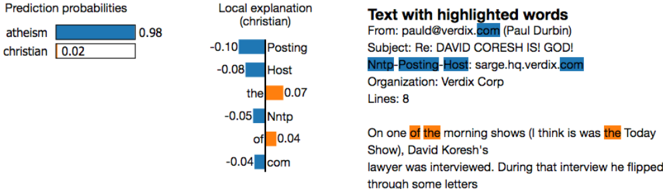
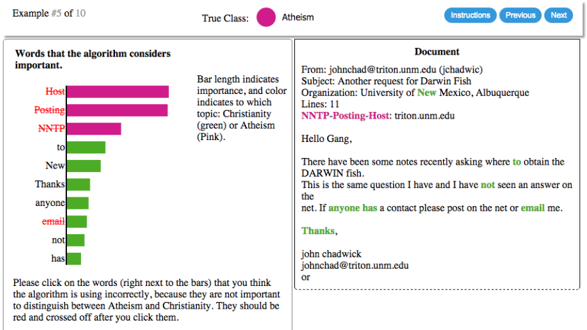
Despite widespread adoption in NLP, machine learning models remain mostly black boxes.Understanding the reasons behind predictions is, however, quite important in assessing trust in a model.Trust is fundamental if one plans to take action based on a prediction, or when choosing whether or not to deploy a new model.In this work, we describe LIME, a novel explanation technique that explains the predictions of any classifier in an interpretable and faithful manner.We further present a method to explain models by presenting representative individual predictions and their explanations in a non-redundant manner.We propose a demonstration of these ideas on different NLP tasks such as document classification, politeness detection, and sentiment analysis, with classifiers like neural networks and SVMs.The user interactions include explanations of free-form text, challenging users to identify the better classifier from a pair, and perform basic feature engineering to improve the classifiers.
Overview
The claims and statistics of this paper haven’t been checked yet.
Free: it reads the open-access text and checks the first 5 claims that cite a source we can check. Create a free account to check every claim.
Integrity signals
Registry
Cites
Statistics
Figures
Verification
Claims the paper makes
The claims and statistics of this paper haven’t been checked yet.
Free: it reads the open-access text and checks the first 5 claims that cite a source we can check. Create a free account to check every claim.
Claims other papers make about this one
Each is checked against this paper’s own text: does it say what the citing paper says it does?
The source backs part of the claim, not all of it — or backs it for a different population, condition or comparison.
In the citing paper
“While providing individuals with grounds to contest individual decisions is often cited as a central motivation of the field of explainable artificial intelligence (XAI) (Ribeiro, Singh, and Guestrin 2016;Lipton 2018;Adadi and Berrada 2018;Molnar 2020), only very few technical works address contestability in greater detail (Mansi, Karusala, and Riedl 2025).”
From Explainable AI Isn't Enough! Rethinking Algorithmic Contestability (2026) · cites this paper as Ribeiro, Singh, and Guestrin 2016
Experimental — accuracy not yet measuredThe source backs part of the claim, not all of it — or backs it for a different population, condition or comparison.
In the citing paper
“We show that standard XAI explanations, such as counterfactuals, LIME, or Anchors, even when combined with human intuitions about decision continuity or monotonicity, reveal only errors in the neighborhood of the individual, but provide insufficient grounds for overturning the decision at hand.”
From Explainable AI Isn't Enough! Rethinking Algorithmic Contestability (2026) · cites this paper as Ribeiro, Singh, and Guestrin 2016
Experimental — accuracy not yet measuredThe cited source says what the claim attributes to it.
In the citing paper
“Post hoc interpretability approaches such as Local Interpretable Model-agnostic Explanation [164] and Shapley Additive Explanations [116], widely adopted in defect prediction [81, 82], performance analysis [173], code analysis [177, 188], and code generation [112], explain the predictions after the model training and without altering the models.”
From A 2030 Roadmap for Software Engineering (2025) · cites this paper as [164]
The cited source says what the claim attributes to it.
In the citing paper
“Self-explanations are a prevailing approach on par with traditional model explanations like LIME saliency maps [71] for understanding LLM-generated responses [25, 32, 53] and are widely used in analyzing language model behavior [66, 99].”
From Thinking in Space: How Multimodal Large Language Models See, Remember, and Recall Spaces (2025) · cites this paper as [71]
In the citing paper
“Techniques such as LIME [25] and SHAP [26] are examples of post-hoc explainability methods commonly used in healthcare.”
From Ethical Framework for Harnessing the Power of AI in Healthcare and Beyond (2024) · cites this paper as [25]
1 more claim about this paper
Create a free account to see every claim other papers make about this one.
Self-check
Percentages, sums and reported differences re-computed from the paper’s own numbers.
The self-check needs the paper’s full text.
Citations
Cites
"Why Should I Trust You?": Explaining the Predictions of Any Classifier
Ribeiro, M. T., Singh, S., & Guestrin, C. (2016) · Proceedings of the 22nd ACM SIGKDD International Conference on Knowledge Discovery and Data Mining · doi:10.1145/2939672.2939778 · Cited by 17,555
Self-citationEfron, B., Hastie, T., Johnstone, I., & Tibshirani, R. (2004) · The Annals of Statistics · doi:10.1214/009053604000000067 · Cited by 9,357
Recursive Deep Models for Semantic Compositionality Over a Sentiment Treebank
Socher, R., Perelygin, A., Wu, J., Chuang, J., Manning, C. D., Ng, A., & Potts, C. (2013) · Proceedings of the 2013 Conference on Empirical Methods in Natural Language Processing · doi:10.18653/v1/d13-1170 · Cited by 6,878
A threshold of ln n for approximating set cover
Feige, U. (1998) · Journal of the ACM · doi:10.1145/285055.285059 · Cited by 3,086
Explaining collaborative filtering recommendations
Herlocker, J. L., Konstan, J. A., & Riedl, J. (2000) · Proceedings of the 2000 ACM conference on Computer supported cooperative work · doi:10.1145/358916.358995 · Cited by 1,731
Dataset Shift in Machine Learning
(2008) · doi:10.7551/mitpress/9780262170055.001.0001 · Cited by 1,553
The role of trust in automation reliance
Dzindolet, M. T., Peterson, S. A., Pomranky, R. A., Pierce, L. G., & Beck, H. P. (2003) · International Journal of Human-Computer Studies · doi:10.1016/s1071-5819(03)00038-7 · Cited by 1,276
Submodular Function Maximization
Krause, A., & Golovin, D. (2014) · Tractability · doi:10.1017/cbo9781139177801.004 · Cited by 751
Leakage in data mining: formulation, detection, and avoidance
Kaufman, S., Rosset, S., & Perlich, C. (2011) · Proceedings of the 17th ACM SIGKDD international conference on Knowledge discovery and data mining · doi:10.1145/2020408.2020496 · Cited by 137
Investigating statistical machine learning as a tool for software development
Patel, K., Fogarty, J., Landay, J. A., & Harrison, B. (2008) · Proceedings of the SIGCHI Conference on Human Factors in Computing Systems · doi:10.1145/1357054.1357160 · Cited by 129
Research works printed but not linked: 3
- Cristian Danescu-Niculescu-Mizil, Moritz Sudhof, Dan Jurafsky, Jure Leskovec, and Christopher Potts. 2013. A computational approach to politeness with applica- tion to social factors. In Proceedings of ACL.
- Jonathan L. Herlocker, Joseph A. Konstan, and John Riedl. 2000. Explaining collaborative filtering recommenda- tions. In Conference on Computer Supported Coopera- tive Work (CSCW).
- Andreas Krause and Daniel Golovin. 2014. Submodu- lar function maximization. In Tractability: Practical Approaches to Hard Problems. Cambridge University Press, February.
Cited by
Items 301–400 of 1,091
Deformable ProtoPNet: An Interpretable Image Classifier Using Deformable Prototypes
Donnelly, J. P., Barnett, A. J., & Chen, C. (2022) · IEEE Computer Society Conference on Computer Vision and Pattern Recognition/Proceedings - IEEE Computer Society Conference on Computer Vision and Pattern Recognition/Proceedings · doi:10.1109/cvpr52688.2022.01002 · Cited by 249
Amgad, M., Atteya, L. A., Hussein, H., Mohammed, K. H., Hafiz, E., Elsebaie, M. A. T., Alhusseiny, A. M., AlMoslemany, M. A., Elmatboly, A. M., Pappalardo, P. A., et al. (2022) · GigaScience · doi:10.1093/gigascience/giac037 · Cited by 115
Sun, D., Gu, Q., Wen, H., Xu, J., Zhang, Y., Shi, S., Xue, M., & Zhou, X. (2022) · Gondwana Research · doi:10.1016/j.gr.2022.07.013 · Cited by 157
van Ooijen, C., Ubaldi, B., & Welby, B. (2019) · OECD working papers on public governance · doi:10.1787/09ab162c-en · Cited by 274
Interpretable Neural Predictions with Differentiable Binary Variables
Bastings, J., Aziz, W. F., & Titov, I. (2019) · Proceedings of the conference - Association for Computational Linguistics. Meeting · doi:10.18653/v1/p19-1284 · Cited by 291
Chakraborty, D., Başağaoğlu, H., & Winterle, J. R. (2020) · Expert Systems with Applications · doi:10.1016/j.eswa.2020.114498 · Cited by 158
Bifarin, O. O. (2023) · PLoS ONE · doi:10.1371/journal.pone.0284315 · Cited by 161
Ethical Dimensions of Visualization Research
Correll, M. (2019) · Proceedings of the 2019 CHI Conference on Human Factors in Computing Systems · doi:10.1145/3290605.3300418 · Cited by 150
Pairwise Acquisition Prediction with SHAP Value Interpretation
Futagami, K., Fukazawa, Y., Kapoor, N., & Kito, T. (2020) · The Journal of Finance and Data Science · doi:10.1016/j.jfds.2021.02.001 · Cited by 162
Pichler, M., Boreux, V., Klein, A., Schleuning, M., & Hartig, F. (2020) · Methods in Ecology and Evolution · doi:10.1111/2041-210x.13329 · Cited by 149
Ahsan, M. M., Gupta, K. D., Islam, M. M., Sen, S., Rahman, M. L., & Shakhawat Hossain, M. (2020) · Machine Learning and Knowledge Extraction · doi:10.3390/make2040027 · Cited by 97
Morabito, A., Simone, G. D., Pastorelli, R., Brunelli, L., & Ferrario, M. (2025) · Journal of Translational Medicine · doi:10.1186/s12967-025-06446-x · Cited by 163
Herm, L.-V., Heinrich, K., Wanner, J., & Janiesch, C. (2022) · International Journal of Information Management · doi:10.1016/j.ijinfomgt.2022.102538 · Cited by 202
A review of machine learning for modeling air quality: Overlooked but important issues
Tang, D., Zhan, Y., & Yang, F. (2024) · Atmospheric Research · doi:10.1016/j.atmosres.2024.107261 · Cited by 157
“Shortcuts” Causing Bias in Radiology Artificial Intelligence: Causes, Evaluation, and Mitigation
Banerjee, I., Bhattacharjee, K., Burns, J. L., Trivedi, H., Purkayastha, S., Seyyed-Kalantari, L., Patel, B. N., Shiradkar, R., & Gichoya, J. (2023) · Journal of the American College of Radiology · doi:10.1016/j.jacr.2023.06.025 · Cited by 122
Interpretable Machine Learning: A brief survey from the predictive maintenance perspective
Vollert, S., Atzmueller, M., & Theissler, A. (2021) · IEEE International Conference on Emerging Technologies and Factory Automation (ETFA) · doi:10.1109/etfa45728.2021.9613467 · Cited by 175
SurvSHAP(t): Time-dependent explanations of machine learning survival models
Krzyziński, M., Spytek, M., Baniecki, H., & Biecek, P. (2022) · Knowledge-Based Systems · doi:10.1016/j.knosys.2022.110234 · Cited by 175
Understanding the Role of Human Intuition on Reliance in Human-AI Decision-Making with Explanations
Chen, V., Liao, Q. V., Wortman Vaughan, J., & Bansal, G. (2023) · Proceedings of the ACM on Human-Computer Interaction · doi:10.1145/3610219 · Cited by 220
Wu, Z., Lei, T., Shen, C., Wang, Z., Cao, D., & Hou, T. (2019) · Journal of Chemical Information and Modeling · doi:10.1021/acs.jcim.9b00801 · Cited by 141
Social Collaborative Viewpoint Regression with Explainable Recommendations
Ren, Z., Liang, S., Li, P., Wang, S., & de Rijke, M. (2017) · ACM International Conference on Web Search and Data Mining (WSDM) · doi:10.1145/3018661.3018686 · Cited by 157
From Clustering to Cluster Explanations via Neural Networks
Kauffmann, J., Esders, M., Ruff, L., Montavon, G., Samek, W., & Müller, K. (2022) · IEEE Transactions on Neural Networks and Learning Systems · doi:10.1109/tnnls.2022.3185901 · Cited by 161
Deep transfer learning approaches for Monkeypox disease diagnosis
Ahsan, M. M., Uddin, M. R., Ali, M. S., Islam, M. K., Farjana, M., Sakib, A. N., Momin, K. A., & Luna, S. A. (2023) · Expert Systems with Applications · doi:10.1016/j.eswa.2022.119483 · Cited by 156
Gao, M., Yang, H., Xiao, Q., & Goh, M. (2021) · Renewable Energy · doi:10.1016/j.renene.2021.09.072 · Cited by 148
A Survey on Deep Learning and Explainability for Automatic Report Generation from Medical Images
Messina, P., Pino, P., Parra, D., Soto, A., Besa, C., Uribe, S., Andía, M., Tejos, C., Prieto, C., & Capurro, D. (2022) · ACM Computing Surveys · doi:10.1145/3522747 · Cited by 142
Enslaving the Algorithm: From a “Right to an Explanation” to a “Right to Better Decisions”?
Edwards, L., & Veale, M. (2018) · IEEE Security & Privacy · doi:10.1109/msp.2018.2701152 · Cited by 141
A Just and Comprehensive Strategy for Using NLP to Address Online Abuse
Jurgens, D., Hemphill, L., & Chandrasekharan, E. (2019) · Proceedings of the 57th Annual Meeting of the Association for Computational Linguistics · doi:10.18653/v1/p19-1357 · Cited by 121
S-LIME: Stabilized-LIME for Model Explanation
Zhou, Z., Hooker, G., & Wang, F. (2021) · ACM SIGKDD Conference on Knowledge Discovery and Data Mining (KDD) · doi:10.1145/3447548.3467274 · Cited by 189
Shapley variable importance cloud for interpretable machine learning
Ning, Y., Ong, M. E. H., Chakraborty, B., Goldstein, B. A., Ting, D. S. W., VAUGHAN, R. D., & Liu, N. (2022) · Patterns · doi:10.1016/j.patter.2022.100452 · Cited by 160
GLocalX—From Local to Global Explanations of Black Box AI Models
Setzu, M., Guidotti, R., Monreale, A., Turini, F., Pedreschi, D., & Giannotti, F. (2021) · Artificial Intelligence · doi:10.1016/j.artint.2021.103457 · Cited by 140
Mapping the Risk Terrain for Crime Using Machine Learning
Wheeler, A. P., & Steenbeek, W. (2020) · Journal of Quantitative Criminology · doi:10.1007/s10940-020-09457-7 · Cited by 163
DACE: Distribution-Aware Counterfactual Explanation by Mixed-Integer Linear Optimization
Kanamori, K., Takagi, T., Kobayashi, K., & Arimura, H. (2020) · Proceedings of the Twenty-Ninth International Joint Conference on Artificial Intelligence · doi:10.24963/ijcai.2020/395 · Cited by 119
Meier, F., Köhler, N., Brunner, A., Wanka, J.-M. H., Voytik, E., Strauss, M. T., Theis, F. J., & Mann, M. (2021) · Nature Communications · doi:10.1038/s41467-021-21352-8 · Cited by 146
Nagpal, M., Siddique, M. A., Sharma, K., Sharma, N., & Mittal, A. K. (2024) · Water Science & Technology · doi:10.2166/wst.2024.259 · Cited by 157
Designing AI Using a Human-Centered Approach: Explainability and Accuracy Toward Trustworthiness
Schoenherr, J. R., Abbas, R., Michael, K., Rivas, P., & Anderson, T. D. (2023) · IEEE Transactions on Technology and Society · doi:10.1109/tts.2023.3257627 · Cited by 105
NILE : Natural Language Inference with Faithful Natural Language Explanations
Kumar, S., & Talukdar, P. (2020) · Proceedings of the 58th Annual Meeting of the Association for Computational Linguistics · doi:10.18653/v1/2020.acl-main.771 · Cited by 110
Dahal, A., & Lombardo, L. (2023) · Computers & Geosciences · doi:10.1016/j.cageo.2023.105364 · Cited by 140
Artificial intelligence in metabolomics: a current review
Chi, J., Shu, J., Li, M., Mudappathi, R., Jin, Y., Lewis, F., Boon, A., Qin, X., Liu, L., & Gu, H. (2024) · TrAC Trends in Analytical Chemistry · doi:10.1016/j.trac.2024.117852 · Cited by 151
Tenney, I., Wexler, J., Bastings, J., Bolukbasi, T., Coenen, A., Gehrmann, S., Jiang, E., Pushkarna, M., Radebaugh, C., Reif, E., et al. (2020) · Proceedings of the 2020 Conference on Empirical Methods in Natural Language Processing: System Demonstrations · doi:10.18653/v1/2020.emnlp-demos.15 · Cited by 138
How We Do Things With Words: Analyzing Text as Social and Cultural Data
Nguyen, D., Liakata, M., DeDeo, S., Eisenstein, J., Mimno, D., Tromble, R., & Winters, J. (2020) · Frontiers in Artificial Intelligence · doi:10.3389/frai.2020.00062 · Cited by 168
Predicting Defective Lines Using a Model-Agnostic Technique
Wattanakriengkrai, S., Thongtanunam, P., Tantithamthavorn, C., Hata, H., & Matsumoto, K. (2022) · IEEE Transactions on Software Engineering · doi:10.1109/tse.2020.3023177 · Cited by 137
Interpretable and Steerable Sequence Learning via Prototypes
Ming, Y., Xu, P., Qu, H., & Ren, L. (2019) · Proceedings of the 25th ACM SIGKDD International Conference on Knowledge Discovery & Data Mining · doi:10.1145/3292500.3330908 · Cited by 97
The value of text for small business default prediction: A Deep Learning approach
Stevenson, M., Mues, C., & Bravo, C. (2021) · European Journal of Operational Research · doi:10.1016/j.ejor.2021.03.008 · Cited by 162
A Review on Machine Learning Strategies for Real-World Engineering Applications
Jhaveri, R. H., Revathi, A. R., Ramana, K., Raut, R., & Dhanaraj, R. K. (2022) · Mobile Information Systems · doi:10.1155/2022/1833507 · Cited by 173
Four Principles of Explainable Artificial Intelligence
Phillips, P. J., Hahn, C. A., Fontana, P. C., Broniatowski, D. A., & Przybocki, M. A. (2020) · doi:10.6028/nist.ir.8312-draft · Cited by 136
From Representation to Mediation: A New Agenda for Conceptual Modeling Research in a Digital World
Recker, J., Lukyanenko, R., Jabbari, M., Samuel, B. M., & Castellanos, A. (2021) · MIS Quarterly · doi:10.25300/misq/2021/16027 · Cited by 114
Detecting Harmful Memes and Their Targets
Pramanick, S., Dimitrov, D., Mukherjee, R., Sharma, S., Akhtar, M. S., Nakov, P., & Chakraborty, T. (2021) · Findings of the Association for Computational Linguistics: ACL (Findings of ACL) · doi:10.18653/v1/2021.findings-acl.246 · Cited by 207
Deep learning for computational cytology: A survey
Jiang, H., Zhou, Y., Lin, Y., Chan, R., Liu, J., & Chen, H. (2022) · Medical Image Analysis · doi:10.1016/j.media.2022.102691 · Cited by 150
Explaining Data-Driven Decisions made by AI Systems: The Counterfactual Approach
Fernández-Loría, C., Provost, F. J., & Han, X. (2022) · MIS Quarterly · doi:10.25300/misq/2022/16749 · Cited by 165
Berman, A., Licht, K. D. F., & Carlsson, V. (2024) · Technology in Society · doi:10.1016/j.techsoc.2024.102471 · Cited by 172
The explainability paradox: Challenges for xAI in digital pathology
Evans, T., Retzlaff, C. O., Geißler, C., Kargl, M., Plass, M., Müller, H., Kiehl, T.-R., Zerbe, N., & Holzinger, A. (2022) · Future Generation Computer Systems · doi:10.1016/j.future.2022.03.009 · Cited by 135
Explainable Outfit Recommendation with Joint Outfit Matching and Comment Generation
Lin, Y., Ren, P., Chen, Z., Ren, Z., Ma, J., & de Rijke, M. (2019) · IEEE Transactions on Knowledge and Data Engineering · doi:10.1109/tkde.2019.2906190 · Cited by 153
Predicting the mechanical response of oligocrystals with deep learning
Frankel, A., Jones, R. E., Alleman, C. N., & Templeton, J. A. (2019) · Computational Materials Science · doi:10.1016/j.commatsci.2019.109099 · Cited by 142
Oswald, M. (2018) · Philosophical Transactions of the Royal Society A: Mathematical, Physical and Engineering Sciences · doi:10.1098/rsta.2017.0359 · Cited by 132
Do Feature Attribution Methods Correctly Attribute Features?
Zhou, Y., Booth, S., Ribeiro, M. T., & Shah, J. (2022) · Proceedings of the AAAI Conference on Artificial Intelligence · doi:10.1609/aaai.v36i9.21196 · Cited by 103
Self-citationA Survey on Explainable Anomaly Detection
Li, Z., Zhu, Y., & Van Leeuwen, M. (2024) · ACM Transactions on Knowledge Discovery from Data · doi:10.1145/3609333 · Cited by 139
A survey on XAI and natural language explanations
Cambria, E., Malandri, L., Mercorio, F., Mezzanzanica, M., & Nobani, N. (2023) · Information Processing & Management · doi:10.1016/j.ipm.2022.103111 · Cited by 131
Hilbert, A., Ramos, L. A., van Os, H. J. A., Olabarriaga, S. D., Tolhuisen, M. L., Wermer, M. J. H., Barros, R. S., van der Schaaf, I., Dippel, D., Roos, Y. B. W. E. M., et al. (2019) · Computers in Biology and Medicine · doi:10.1016/j.compbiomed.2019.103516 · Cited by 121
Neto, M. P., & Paulovich, F. V. (2021) · IEEE Transactions on Visualization and Computer Graphics · doi:10.1109/tvcg.2020.3030354 · Cited by 119
GPUTreeShap: massively parallel exact calculation of SHAP scores for tree ensembles
Mitchell, R., Frank, E., & Holmes, G. (2022) · PeerJ Computer Science · doi:10.7717/peerj-cs.880 · Cited by 110
Explainable AI for earth observation: A review including societal and regulatory perspectives
Gevaert, C. M. (2022) · International Journal of Applied Earth Observation and Geoinformation · doi:10.1016/j.jag.2022.102869 · Cited by 179
Bluwstein, K., Buckmann, M., Joseph, A. C., Kapadia, S., & Şimşek, Ö. (2023) · Journal of International Economics · doi:10.1016/j.jinteco.2023.103773 · Cited by 155
Hassan, S. U., Abdulkadir, S. J., Zahid, M. S. M., & Al-Selwi, S. M. (2025) · Computers in Biology and Medicine · doi:10.1016/j.compbiomed.2024.109569 · Cited by 108
Rethinking Cooperative Rationalization: Introspective Extraction and Complement Control
Yu, M., Chang, S., Zhang, Y., & Jaakkola, T. (2019) · Proceedings of the 2019 Conference on Empirical Methods in Natural Language Processing and the 9th International Joint Conference on Natural Language Processing (EMNLP-IJCNLP) · doi:10.18653/v1/d19-1420 · Cited by 118
Identifying child abuse through text mining and machine learning
Amrit, C., Paauw, T., Aly, R., & Lavric, M. (2017) · Expert Systems with Applications · doi:10.1016/j.eswa.2017.06.035 · Cited by 117
Das, D., Banerjee, S., & Chernova, S. (2021) · Proceedings of the 2021 ACM/IEEE International Conference on Human-Robot Interaction · doi:10.1145/3434073.3444657 · Cited by 107
State-of-the-Art Deep Learning Methods on Electrocardiogram Data: Systematic Review
Πετμεζάς, Γ., Stefanopoulos, L., Kilintzis, V., Tzavelis, A., Rogers, J. A., Katsaggelos, A. K., & Maglaveras, N. (2022) · JMIR Medical Informatics · doi:10.2196/38454 · Cited by 149
Analyzing Employee Attrition Using Explainable AI for Strategic HR Decision-Making
Díaz, G. M., Galán-Hernández, J. J., & Salvador, J. L. G. (2023) · Mathematics · doi:10.3390/math11224677 · Cited by 166
Advancing 6G: Survey for Explainable AI on Communications and Network Slicing
Sun, H., Liu, Y., Al-Tahmeesschi, A., Nag, A., Soleimanpour-Moghadam, M., Canberk, B., Arslan, H., & Ahmadi, H. (2025) · IEEE Open Journal of the Communications Society · doi:10.1109/ojcoms.2025.3534626 · Cited by 159
Khan, F. S., Mazhar, S. S., Mazhar, K., AlSaleh, D., & Mazhar, A. (2025) · Artificial Intelligence Review · doi:10.1007/s10462-025-11215-9 · Cited by 152
Wang, S., Wang, Q., & Zhao, J. (2020) · Transportation Research Part C Emerging Technologies · doi:10.1016/j.trc.2020.102701 · Cited by 155
Wang, S., Mo, B., & Zhao, J. (2020) · Transportation Research Part C Emerging Technologies · doi:10.1016/j.trc.2020.01.012 · Cited by 153
Explainable Artificial Intelligence for Fault Diagnosis of Industrial Processes
Jang, K., Pilario, K. E., Lee, N., Moon, I., & Na, J. (2023) · IEEE Transactions on Industrial Informatics · doi:10.1109/tii.2023.3240601 · Cited by 148
EEG-Based Multimodal Emotion Recognition: A Machine Learning Perspective
Liu, H., Lou, T., Zhang, Y., Wu, Y., Xiao, Y., Jensen, C. S., & Zhang, D. (2024) · IEEE Transactions on Instrumentation and Measurement · doi:10.1109/tim.2024.3369130 · Cited by 178
A Survey on XAI for 5G and Beyond Security: Technical Aspects, Challenges and Research Directions
Senevirathna, T., La, V. H., Marchal, S., Siniarski, B., Liyanage, M., & Wang, S. (2024) · IEEE Communications Surveys & Tutorials · doi:10.1109/comst.2024.3437248 · Cited by 153
Co-design of human-centered, explainable AI for clinical decision support
Panigutti, C., Beretta, A., Fadda, D., Giannotti, F., Pedreschi, D., Perotti, A., & Rinzivillo, S. (2023) · ACM Transactions on Interactive Intelligent Systems · doi:10.1145/3587271 · Cited by 127
Towards Accountable AI: Hybrid Human-Machine Analyses for Characterizing System Failure
Nushi, B., Kamar, E., & Horvitz, E. (2018) · Proceedings of the AAAI Conference on Human Computation and Crowdsourcing · doi:10.1609/hcomp.v6i1.13337 · Cited by 126
FairSight: Visual Analytics for Fairness in Decision Making
Ahn, Y., & Lin, Y.-R. (2019) · IEEE Transactions on Visualization and Computer Graphics · doi:10.1109/tvcg.2019.2934262 · Cited by 126
Confronting Abusive Language Online: A Survey from the Ethical and Human Rights Perspective
Kiritchenko, S., Nejadgholi, I., & Fraser, K. (2021) · Journal of Artificial Intelligence Research · doi:10.1613/jair.1.12590 · Cited by 174
Explainable stock prices prediction from financial news articles using sentiment analysis
Gite, S., Khatavkar, H., Kotecha, K. V., Srivastava, S., Maheshwari, P., & Pandey, N. (2021) · PeerJ Computer Science · doi:10.7717/peerj-cs.340 · Cited by 141
Zhou, M., Chen, G. H., Ferreira, P., & Smith, M. D. (2021) · Journal of Marketing Research · doi:10.1177/00222437211042013 · Cited by 147
Afzaal, M., Nouri, J., Zia, A., Papapetrou, P., Fors, U., Wu, Y., Li, X., & Weegar, R. (2021) · Frontiers in Artificial Intelligence · doi:10.3389/frai.2021.723447 · Cited by 125
Explaining machine learning models with interactive natural language conversations using TalkToModel
Slack, D., Krishna, S., Lakkaraju, H., & Singh, S. (2023) · Nature Machine Intelligence · doi:10.1038/s42256-023-00692-8 · Cited by 125
Self-citationCoussement, K., Phan, M., De Caigny, A., Benoit, D. F., & Raes, A. (2020) · Decision Support Systems · doi:10.1016/j.dss.2020.113325 · Cited by 125
Towards Trustable Explainable AI
Ignatiev, A. (2020) · International Joint Conference on Artificial Intelligence · doi:10.24963/ijcai.2020/726 · Cited by 189
Deep Learning for Android Malware Defenses: A Systematic Literature Review
Liu, Y., Tantithamthavorn, C., Li, L., & Liu, Y. (2023) · ACM Computing Surveys · doi:10.1145/3544968 · Cited by 101
An explainable artificial intelligence approach for financial distress prediction
Zhang, Z., Wu, C., Qu, S., & Chen, X. (2022) · Information Processing & Management · doi:10.1016/j.ipm.2022.102988 · Cited by 139
Explainable AI and Interpretable Machine Learning: A Case Study in Perspective
Vishwarupe, V., Joshi, P. M., Mathias, N., Maheshwari, S., Mhaisalkar, S., & Pawar, V. (2022) · Procedia Computer Science · doi:10.1016/j.procs.2022.08.105 · Cited by 152
EXplainable Artificial Intelligence (XAI)—From Theory to Methods and Applications
Ortigossa, E. S., Gonçalves, T., & Nonato, L. G. (2024) · IEEE Access · doi:10.1109/access.2024.3409843 · Cited by 124
Nicolescu, R., Huth, M., Radanliev, P., & De Roure, D. (2018) · Journal of Information Technology · doi:10.1057/s41265-018-0054-1 · Cited by 104
The Emerging Landscape of Explainable Automated Planning & Decision Making
Chakraborti, T., Sreedharan, S., & Kambhampati, S. (2020) · Proceedings of the Twenty-Ninth International Joint Conference on Artificial Intelligence · doi:10.24963/ijcai.2020/669 · Cited by 74
Explaining NLP Models via Minimal Contrastive Editing (MiCE)
Ross, A., Marasović, A., & Peters, M. (2021) · Findings of the Association for Computational Linguistics: ACL-IJCNLP 2021 · doi:10.18653/v1/2021.findings-acl.336 · Cited by 86
An analysis of explainability methods for convolutional neural networks
Vonderhaar, L., Elvira, T., & Ochoa, O. (2022) · Engineering Applications of Artificial Intelligence · doi:10.1016/j.engappai.2022.105606 · Cited by 154
Khare, S. K., & Acharya, U. R. (2023) · Computers in Biology and Medicine · doi:10.1016/j.compbiomed.2023.106676 · Cited by 138
Advances in intelligent and autonomous navigation systems for small UAS
Bijjahalli, S., Sabatini, R., & Gardi, A. (2020) · Progress in Aerospace Sciences · doi:10.1016/j.paerosci.2020.100617 · Cited by 123
Detecting and visualizing hate speech in social media: A cyber Watchdog for surveillance
Modha, S., Majumder, P., Mandl, T., & Mandalia, C. (2020) · Expert Systems with Applications · doi:10.1016/j.eswa.2020.113725 · Cited by 109
Measurable Counterfactual Local Explanations for Any Classifier
Adam, W., & Artur, D. G. (2020) · Frontiers in Artificial Intelligence and Applications · doi:10.3233/faia200387 · Cited by 68
Twitter for disaster relief through sentiment analysis for COVID-19 and natural hazard crises
Behl, S., Rao, A., Aggarwal, S., Chadha, S., & Pannu, H. S. (2021) · International Journal of Disaster Risk Reduction · doi:10.1016/j.ijdrr.2021.102101 · Cited by 128
Is Attention Explanation? An Introduction to the Debate
Bibal, A., Cardon, R., Alfter, D., Wilkens, R., Wang, X., François, T., & Watrin, P. (2022) · Proceedings of the conference - Association for Computational Linguistics. Meeting · doi:10.18653/v1/2022.acl-long.269 · Cited by 229
CRAFT: Concept Recursive Activation FacTorization for Explainability
Fel, T., Picard, A. M., Béthune, L., Boissin, T., Vigouroux, D., Colin, J., Cadénc, R., & Serre, T. (2023) · IEEE Computer Society Conference on Computer Vision and Pattern Recognition/Proceedings - IEEE Computer Society Conference on Computer Vision and Pattern Recognition/Proceedings · doi:10.1109/cvpr52729.2023.00266 · Cited by 253
AI in HVAC fault detection and diagnosis: A systematic review
Bi, J. Q., Wang, H., Yan, E., Wang, C., Yan, K., Jiang, L., & Yang, B. (2024) · Energy Reviews · doi:10.1016/j.enrev.2024.100071 · Cited by 147
Metadata
- Authors
- Ribeiro, M., Singh, S., & Guestrin, C.
- Affiliations
- University of Washington (US)
- Venue
- Proceedings of the 2016 Conference of the North American Chapter of the Association for Computational Linguistics: Demonstrations
- Published
- 2016
- Pages
- 97-101
- OpenAlex
- W2516809705
- Cited by
- 6,682
- References
- 13
- Citations by year
- 2026: 742 · 2025: 1562 · 2024: 1239 · 2023: 1039 · 2022: 778 · 2021: 581 · 2020: 364 · 2019: 225 · 2018: 109 · 2017: 38 · 2016: 3
- FWCI
- 67.53
- Type
- conference paper
- Language
- en
- Open access
- hybrid
- doi.org
- Licence
- cc-by
- Locations
- Conference of the North American Chapter of the Association for Computational Linguistics: Human Language Technologies (NAACL-HLT) (publishedVersion, cc-by)
- Funders
- Semiconductor Research Corporation
- Defense Advanced Research Projects Agency
- Topics
- Physical Sciences › Computer Science › Artificial Intelligence › Explainable Artificial Intelligence (XAI)
- Physical Sciences › Computer Science › Software › Software Testing and Debugging Techniques
- Physical Sciences › Computer Science › Artificial Intelligence › Topic Modeling
- Keywords
- lime, explainable AI, classifier interpretability, model trust, local interpretable model-agnostic explanations, feature importance, document classification, sentiment analysis, artificial neural networks, support vector machine, user interaction
About these checks
Registry, retraction, Cites and statistics results are computed, not judged, with one exception: a printed reference that no index lists is read once by a model before it counts as a citation error. Claims are extracted by a model and kept only when their quote appears verbatim in the text; each cited source is then checked, with a model’s help, for whether it says what the claim relies on. Those verdicts can be wrong — read the claim’s quote and the cited source before relying on one.
Statistics and arithmetic are recomputed, not judged.
Confidence bands are shown only for fields calibrated on our annotated test set. None is calibrated yet, so no band is shown.
What counts as a claim ›How we measure confidence ›How we check this ›
Are you an author, or do you see a problem with this page? Request a review
Data sources
Bibliographic data: Semantic Scholar, OpenAlex, Crossref.
Contains information from the Semantic Scholar Academic Graph Datasets, made available under the ODC Attribution License (ODC-BY 1.0).
Semantic Scholar’s data is described in: Kinney, R., et al. (2023). The Semantic Scholar Open Data Platform. arXiv:2301.10140.
