

“Why Should I Trust You?”: Explaining the Predictions of Any Classifier
Open accessThe DOI matches its Crossref record; 12 of the 13 references it cites were found in a registry or an index.
Abstract
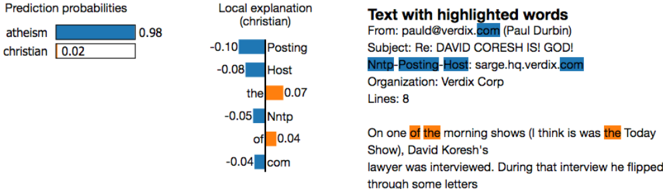
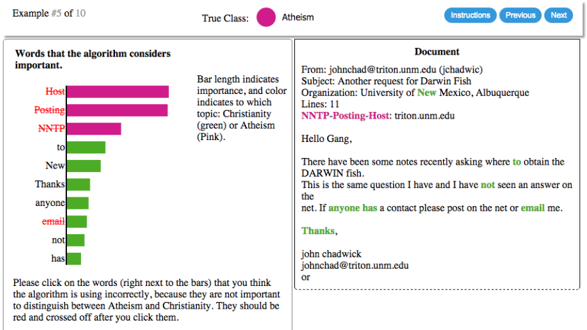
Despite widespread adoption in NLP, machine learning models remain mostly black boxes.Understanding the reasons behind predictions is, however, quite important in assessing trust in a model.Trust is fundamental if one plans to take action based on a prediction, or when choosing whether or not to deploy a new model.In this work, we describe LIME, a novel explanation technique that explains the predictions of any classifier in an interpretable and faithful manner.We further present a method to explain models by presenting representative individual predictions and their explanations in a non-redundant manner.We propose a demonstration of these ideas on different NLP tasks such as document classification, politeness detection, and sentiment analysis, with classifiers like neural networks and SVMs.The user interactions include explanations of free-form text, challenging users to identify the better classifier from a pair, and perform basic feature engineering to improve the classifiers.
Overview
The claims and statistics of this paper haven’t been checked yet.
Free: it reads the open-access text and checks the first 5 claims that cite a source we can check. Create a free account to check every claim.
Integrity signals
Registry
Cites
Statistics
Figures
Verification
Claims the paper makes
The claims and statistics of this paper haven’t been checked yet.
Free: it reads the open-access text and checks the first 5 claims that cite a source we can check. Create a free account to check every claim.
Claims other papers make about this one
Each is checked against this paper’s own text: does it say what the citing paper says it does?
The source backs part of the claim, not all of it — or backs it for a different population, condition or comparison.
In the citing paper
“While providing individuals with grounds to contest individual decisions is often cited as a central motivation of the field of explainable artificial intelligence (XAI) (Ribeiro, Singh, and Guestrin 2016;Lipton 2018;Adadi and Berrada 2018;Molnar 2020), only very few technical works address contestability in greater detail (Mansi, Karusala, and Riedl 2025).”
From Explainable AI Isn't Enough! Rethinking Algorithmic Contestability (2026) · cites this paper as Ribeiro, Singh, and Guestrin 2016
Experimental — accuracy not yet measuredThe source backs part of the claim, not all of it — or backs it for a different population, condition or comparison.
In the citing paper
“We show that standard XAI explanations, such as counterfactuals, LIME, or Anchors, even when combined with human intuitions about decision continuity or monotonicity, reveal only errors in the neighborhood of the individual, but provide insufficient grounds for overturning the decision at hand.”
From Explainable AI Isn't Enough! Rethinking Algorithmic Contestability (2026) · cites this paper as Ribeiro, Singh, and Guestrin 2016
Experimental — accuracy not yet measuredThe cited source says what the claim attributes to it.
In the citing paper
“Post hoc interpretability approaches such as Local Interpretable Model-agnostic Explanation [164] and Shapley Additive Explanations [116], widely adopted in defect prediction [81, 82], performance analysis [173], code analysis [177, 188], and code generation [112], explain the predictions after the model training and without altering the models.”
From A 2030 Roadmap for Software Engineering (2025) · cites this paper as [164]
The cited source says what the claim attributes to it.
In the citing paper
“Self-explanations are a prevailing approach on par with traditional model explanations like LIME saliency maps [71] for understanding LLM-generated responses [25, 32, 53] and are widely used in analyzing language model behavior [66, 99].”
From Thinking in Space: How Multimodal Large Language Models See, Remember, and Recall Spaces (2025) · cites this paper as [71]
In the citing paper
“Techniques such as LIME [25] and SHAP [26] are examples of post-hoc explainability methods commonly used in healthcare.”
From Ethical Framework for Harnessing the Power of AI in Healthcare and Beyond (2024) · cites this paper as [25]
1 more claim about this paper
Create a free account to see every claim other papers make about this one.
Self-check
Percentages, sums and reported differences re-computed from the paper’s own numbers.
The self-check needs the paper’s full text.
Citations
Cites
"Why Should I Trust You?": Explaining the Predictions of Any Classifier
Ribeiro, M. T., Singh, S., & Guestrin, C. (2016) · Proceedings of the 22nd ACM SIGKDD International Conference on Knowledge Discovery and Data Mining · doi:10.1145/2939672.2939778 · Cited by 17,555
Self-citationEfron, B., Hastie, T., Johnstone, I., & Tibshirani, R. (2004) · The Annals of Statistics · doi:10.1214/009053604000000067 · Cited by 9,357
Recursive Deep Models for Semantic Compositionality Over a Sentiment Treebank
Socher, R., Perelygin, A., Wu, J., Chuang, J., Manning, C. D., Ng, A., & Potts, C. (2013) · Proceedings of the 2013 Conference on Empirical Methods in Natural Language Processing · doi:10.18653/v1/d13-1170 · Cited by 6,878
A threshold of ln n for approximating set cover
Feige, U. (1998) · Journal of the ACM · doi:10.1145/285055.285059 · Cited by 3,086
Explaining collaborative filtering recommendations
Herlocker, J. L., Konstan, J. A., & Riedl, J. (2000) · Proceedings of the 2000 ACM conference on Computer supported cooperative work · doi:10.1145/358916.358995 · Cited by 1,731
Dataset Shift in Machine Learning
(2008) · doi:10.7551/mitpress/9780262170055.001.0001 · Cited by 1,553
The role of trust in automation reliance
Dzindolet, M. T., Peterson, S. A., Pomranky, R. A., Pierce, L. G., & Beck, H. P. (2003) · International Journal of Human-Computer Studies · doi:10.1016/s1071-5819(03)00038-7 · Cited by 1,276
Submodular Function Maximization
Krause, A., & Golovin, D. (2014) · Tractability · doi:10.1017/cbo9781139177801.004 · Cited by 751
Leakage in data mining: formulation, detection, and avoidance
Kaufman, S., Rosset, S., & Perlich, C. (2011) · Proceedings of the 17th ACM SIGKDD international conference on Knowledge discovery and data mining · doi:10.1145/2020408.2020496 · Cited by 137
Investigating statistical machine learning as a tool for software development
Patel, K., Fogarty, J., Landay, J. A., & Harrison, B. (2008) · Proceedings of the SIGCHI Conference on Human Factors in Computing Systems · doi:10.1145/1357054.1357160 · Cited by 129
Research works printed but not linked: 3
- Cristian Danescu-Niculescu-Mizil, Moritz Sudhof, Dan Jurafsky, Jure Leskovec, and Christopher Potts. 2013. A computational approach to politeness with applica- tion to social factors. In Proceedings of ACL.
- Jonathan L. Herlocker, Joseph A. Konstan, and John Riedl. 2000. Explaining collaborative filtering recommenda- tions. In Conference on Computer Supported Coopera- tive Work (CSCW).
- Andreas Krause and Daniel Golovin. 2014. Submodu- lar function maximization. In Tractability: Practical Approaches to Hard Problems. Cambridge University Press, February.
Cited by
Items 201–300 of 1,091
A Review on Explainability in Multimodal Deep Neural Nets
Joshi, G., Walambe, R., & Kotecha, K. (2021) · IEEE Access · doi:10.1109/access.2021.3070212 · Cited by 204
Bikmukhametov, T., & Jäschke, J. (2020) · Computers & Chemical Engineering · doi:10.1016/j.compchemeng.2020.106834 · Cited by 194
Bridging observations, theory and numerical simulation of the ocean using machine learning
Sonnewald, M., Lguensat, R., Jones, D. C., Dueben, P. D., Brajard, J., & Balaji, V (2021) · Environmental Research Letters · doi:10.1088/1748-9326/ac0eb0 · Cited by 164
Ryo, M. (2022) · Artificial Intelligence in Agriculture · doi:10.1016/j.aiia.2022.11.003 · Cited by 166
Abdollahi, A., & Pradhan, B. (2023) · Science of The Total Environment · doi:10.1016/j.scitotenv.2023.163004 · Cited by 179
Applications, Challenges, and Future Directions of Human-in-the-Loop Learning
Kumar, S., Datta, S., Singh, V., Datta, D., Kumar Singh, S., & Sharma, R. (2024) · IEEE Access · doi:10.1109/access.2024.3401547 · Cited by 168
Self-citationA Review on Explainable Artificial Intelligence for Healthcare: Why, How, and When?
Bharati, S., Mondal, M. R. H., & Podder, P. (2024) · IEEE Transactions on Artificial Intelligence · doi:10.1109/tai.2023.3266418 · Cited by 203
Explainable Deep Reinforcement Learning: State of the Art and Challenges
Vouros, G. A. (2023) · ACM Computing Surveys · doi:10.1145/3527448 · Cited by 160
Allgaier, J., Mulansky, L., Draelos, R. L., & Pryss, R. (2023) · Artificial Intelligence in Medicine · doi:10.1016/j.artmed.2023.102616 · Cited by 170
Fan, C., Yan, D., Xiao, F., Li, A., An, J., & Kang, X. (2021) · Building Simulation · doi:10.1007/s12273-020-0723-1 · Cited by 186
Why model why? Assessing the strengths and limitations of LIMEPreprint
Dieber, J., & Kirrane, S. (2020) · arXiv (Cornell University) · doi:10.48550/arxiv.2012.00093 · Cited by 255
Faithful Chain-of-Thought Reasoning
Lyu, Q., Havaldar, S., Stein, A., Zhang, L., Rao, D., Wong, E., Apidianaki, M., & Callison-Burch, C. (2023) · Proceedings of the 13th International Joint Conference on Natural Language Processing and the 3rd Conference of the Asia-Pacific Chapter of the Association for Computational Linguistics (Volume 1: Long Papers) · doi:10.18653/v1/2023.ijcnlp-main.20 · Cited by 201
Towards Explainable NLP: A Generative Explanation Framework for Text Classification
Liu, H., Yin, Q., & Wang, W. Y. (2019) · Proceedings of the 57th Annual Meeting of the Association for Computational Linguistics · doi:10.18653/v1/p19-1560 · Cited by 160
Leichtmann, B., Humer, C., Hinterreiter, A., Streit, M., & Mara, M. (2023) · Computers in Human Behavior · doi:10.1016/j.chb.2022.107539 · Cited by 200
Guidelines and evaluation of clinical explainable AI in medical image analysis
Jin, W., Li, X., Fatehi, M., & Hamarneh, G. (2023) · Medical Image Analysis · doi:10.1016/j.media.2022.102684 · Cited by 199
ILDC for CJPE: Indian Legal Documents Corpus for Court Judgment Prediction and Explanation
Malik, V., Sanjay, R., Nigam, S. K., Ghosh, K., Guha, S. K., Bhattacharya, A., & Modi, A. (2021) · Annual Meeting of the Association for Computational Linguistics · doi:10.18653/v1/2021.acl-long.313 · Cited by 296
Alantari, H. J., Currim, I. S., Deng, Y., & Singh, S. (2022) · International Journal of Research in Marketing · doi:10.1016/j.ijresmar.2021.10.011 · Cited by 164
Self-citationTransparency: Motivations and Challenges
Weller, A. (2019) · Lecture Notes in Computer Science · doi:10.1007/978-3-030-28954-6_2 · Cited by 198
Liang, C., Le, T.-H., Ham, Y., Mantha, B. R. K., Cheng, M. H., & Lin, J. J. (2024) · Automation in Construction · doi:10.1016/j.autcon.2024.105369 · Cited by 225
Ash, E., & Hansen, S. (2023) · Annual Review of Economics · doi:10.1146/annurev-economics-082222-074352 · Cited by 197
Ahmad, S., Shakeel, I., Mehfuz, S., & Ahmad, J. (2023) · Computer Science Review · doi:10.1016/j.cosrev.2023.100568 · Cited by 197
Text classification using capsules
Kim, J., Jang, S., Park, E., & Choi, S. (2020) · Neurocomputing · doi:10.1016/j.neucom.2019.10.033 · Cited by 189
Explainable Automated Fact-Checking for Public Health Claims
Kotonya, N., & Toni, F. (2020) · Proceedings of the 2020 Conference on Empirical Methods in Natural Language Processing (EMNLP) · doi:10.18653/v1/2020.emnlp-main.623 · Cited by 195
Explainable artificial intelligence in Alzheimer’s disease classification: a systematic review
Viswan, V., Shaffi, N., Mahmud, M., Subramanian, K., & Hajamohideen, F. (2024) · Cognitive Computation · doi:10.1007/s12559-023-10192-x · Cited by 195
The Dangers of Post-hoc Interpretability: Unjustified Counterfactual Explanations
Laugel, T., Lesot, M.-J., Marsala, C., Renard, X., & Detyniecki, M. (2019) · Proceedings of the Twenty-Eighth International Joint Conference on Artificial Intelligence · doi:10.24963/ijcai.2019/388 · Cited by 194
Deep learning models in genomics; are we there yet?
Koumakis, L. (2020) · Computational and Structural Biotechnology Journal · doi:10.1016/j.csbj.2020.06.017 · Cited by 176
Predicting mortgage default using convolutional neural networks
Kvamme, H., Sellereite, N., Aas, K., & Sjursen, S. (2018) · Expert Systems with Applications · doi:10.1016/j.eswa.2018.02.029 · Cited by 179
Fan, C., Xiao, F., Yan, C., Liu, C., Li, Z., & Wang, J. (2019) · Applied Energy · doi:10.1016/j.apenergy.2018.11.081 · Cited by 183
Comparing Automatic and Human Evaluation of Local Explanations for Text Classification
Nguyen, D. (2018) · Proceedings of the 2018 Conference of the North American Chapter of the Association for Computational Linguistics: Human Language Technologies, Volume 1 (Long Papers) · doi:10.18653/v1/n18-1097 · Cited by 173
Yu, F., Wei, C., Deng, P., Peng, T., & Hu, X. (2021) · Science Advances · doi:10.1126/sciadv.abf4130 · Cited by 187
MOMENTA: A Multimodal Framework for Detecting Harmful Memes and Their Targets
Pramanick, S., Sharma, S., Dimitrov, D., Akhtar, M. S., Nakov, P., & Chakraborty, T. (2021) · Findings of the Association for Computational Linguistics: EMNLP (Findings of EMNLP) · doi:10.18653/v1/2021.findings-emnlp.379 · Cited by 310
Interpretable machine learning for imbalanced credit scoring datasets
Chen, Y., Calabrese, R., & Martin-Barragan, B. (2024) · European Journal of Operational Research · doi:10.1016/j.ejor.2023.06.036 · Cited by 190
Biohorology and biomarkers of aging: Current state-of-the-art, challenges and opportunities
Galkin, F., Mamoshina, P., Aliper, A., de Magalhães, J. P., Gladyshev, V. N., & Zhavoronkov, A. (2020) · Ageing Research Reviews · doi:10.1016/j.arr.2020.101050 · Cited by 189
Explainable decision forest: Transforming a decision forest into an interpretable tree
Sagi, O., & Rokach, L. (2020) · Information Fusion · doi:10.1016/j.inffus.2020.03.013 · Cited by 189
DARPA's explainable AI(XAI) program: A retrospective
Gunning, D., Vorm, E., Wang, J. Y., & Turek, M. (2021) · Applied AI Letters · doi:10.1002/ail2.61 · Cited by 188
Spread of misinformation on social media: What contributes to it and how to combat it
Chen, S., Xiao, L., & Kumar, A. (2023) · Computers in Human Behavior · doi:10.1016/j.chb.2022.107643 · Cited by 187
Machine learning for intelligent optical networks: A comprehensive survey
Gu, R., Yang, Z., & Ji, Y. (2020) · Journal of Network and Computer Applications · doi:10.1016/j.jnca.2020.102576 · Cited by 160
Coordinating Human and Machine Learning for Effective Organizational Learning
Sturm, T., Gerlach, J. P., Pumplun, L., Mesbah, N., Peters, F., Tauchert, C., Nan, N., & Buxmann, P. (2021) · MIS Quarterly · doi:10.25300/misq/2021/16543 · Cited by 144
Choice modelling in the age of machine learning - Discussion paper
van Cranenburgh, S., Wang, S., Vij, A., Pereira, F. C., & Walker, J. L. (2021) · Journal of Choice Modelling · doi:10.1016/j.jocm.2021.100340 · Cited by 221
Learning to Faithfully Rationalize by Construction
Jain, S., Wiegreffe, S., Pinter, Y., & Wallace, B. C. (2020) · Proceedings of the 58th Annual Meeting of the Association for Computational Linguistics · doi:10.18653/v1/2020.acl-main.409 · Cited by 136
Enhancing discrete choice models with representation learning
Sifringer, B., Lurkin, V., & Alahi, A. (2020) · Transportation Research Part B Methodological · doi:10.1016/j.trb.2020.08.006 · Cited by 224
Thinking about GPT-3 In-Context Learning for Biomedical IE? Think Again
Jimenez Gutierrez, B., McNeal, N., Washington, C., Chen, Y., Li, L., Sun, H., & Su, Y. (2022) · Findings of the Association for Computational Linguistics: EMNLP 2022 · doi:10.18653/v1/2022.findings-emnlp.329 · Cited by 115
Elyan, E., Vuttipittayamongkol, P., Johnston, P., Martin, K., McPherson, K., Moreno-García, C. F., Jayne, C., & Mostafa Kamal Sarker, M. (2022) · Artificial Intelligence Surgery · doi:10.20517/ais.2021.15 · Cited by 161
Explainable Artificial Intelligence by Genetic Programming: A Survey
Mei, Y., Chen, Q., Lensen, A., Xue, B., & Zhang, M. (2023) · IEEE Transactions on Evolutionary Computation · doi:10.1109/tevc.2022.3225509 · Cited by 164
A survey on interpretable reinforcement learning
Glanois, C., Weng, P., Zimmer, M., Li, D., Yang, T., Hao, J., & Liu, W. (2024) · Machine Learning · doi:10.1007/s10994-024-06543-w · Cited by 246
Bhati, D., Neha, F., & Amiruzzaman, M. (2024) · Journal of Imaging · doi:10.3390/jimaging10100239 · Cited by 217
A literature review on applications of explainable artificial intelligence (XAI)
Kalasampath, K., Spoorthi, K. N., Sajeev, S., Kuppa, S. S., Ajay, K., & Maruthamuthu, A. (2025) · IEEE Access · doi:10.1109/access.2025.3546681 · Cited by 180
Relative evaluation of regression tools for urban area electrical energy demand forecasting
Johannesen, N. J., Kolhe, M., & Goodwin, M. (2019) · Journal of Cleaner Production · doi:10.1016/j.jclepro.2019.01.108 · Cited by 174
A Scoping Review of Machine Learning in Psychotherapy Research
Aafjes-van Doorn, K., Kamsteeg, C., Bate, J., & Aafjes, M. (2021) · Psychotherapy Research · doi:10.1080/10503307.2020.1808729 · Cited by 179
Personality Research and Assessment in the Era of Machine Learning
Stachl, C., Pargent, F., Hilbert, S., Harari, G. M., Schoedel, R., Vaid, S. S., Gosling, S. D., & Bühner, M. (2020) · European Journal of Personality · doi:10.1002/per.2257 · Cited by 201
BS-Net: Learning COVID-19 pneumonia severity on a large chest X-ray dataset
Signoroni, A., Savardi, M., Benini, S., Adami, N., Leonardi, R., Gibellini, P., Vaccher, F., Ravanelli, M., Borghesi, A., Maroldi, R., et al. (2021) · Medical Image Analysis · doi:10.1016/j.media.2021.102046 · Cited by 185
Kakogeorgiou, I., & Karantzalos, K. (2021) · International Journal of Applied Earth Observation and Geoinformation · doi:10.1016/j.jag.2021.102520 · Cited by 158
Grading buildings on energy performance using city benchmarking data
Papadopoulos, S., & Kontokosta, C. E. (2019) · Applied Energy · doi:10.1016/j.apenergy.2018.10.053 · Cited by 177
Langer, M., & König, C. J. (2021) · Human Resource Management Review · doi:10.1016/j.hrmr.2021.100881 · Cited by 196
Hemmerich, J., & Ecker, G. F. (2020) · WIREs Computational Molecular Science · doi:10.1002/wcms.1475 · Cited by 169
Interpretability research of deep learning: A literature survey
Xu, B., & Yang, G. (2024) · Information Fusion · doi:10.1016/j.inffus.2024.102721 · Cited by 216
The Butterfly Effect in artificial intelligence systems: Implications for AI bias and fairness
Ferrara, E. (2024) · Machine Learning with Applications · doi:10.1016/j.mlwa.2024.100525 · Cited by 125
Interpretation and visualization techniques for deep learning models in medical imaging
Huff, D. T., Weisman, A. J., & Jeraj, R. (2021) · Physics in Medicine & Biology · doi:10.1088/1361-6560/abcd17 · Cited by 172
Color and engagement in touristic Instagram pictures: A machine learning approach
Yu, J., & Egger, R. (2021) · Annals of Tourism Research · doi:10.1016/j.annals.2021.103204 · Cited by 171
Hendricks, L. A., Hu, R., Darrell, T., & Akata, Z. (2018) · Lecture notes in computer science · doi:10.1007/978-3-030-01216-8_17 · Cited by 171
Bock, K. W. D., Coussement, K., Caigny, A. D., Słowiński, R., Baesens, B., Boute, R. N., Choi, T., Delen, D., Kraus, M., Lessmann, S., et al. (2023) · European Journal of Operational Research · doi:10.1016/j.ejor.2023.09.026 · Cited by 213
Explainable AI for 6G Use Cases: Technical Aspects and Research Challenges
Wang, S., Qureshi, M. A., Miralles-Pechuán, L., Huynh-The, T., Gadekallu, T. R., & Liyanage, M. (2024) · IEEE Open Journal of the Communications Society · doi:10.1109/ojcoms.2024.3386872 · Cited by 170
Data engineering for fraud detection
Baesens, B., Höppner, S., & Verdonck, T. (2021) · Decision Support Systems · doi:10.1016/j.dss.2021.113492 · Cited by 170
Naiseh, M., Al-Thani, D., Jiang, N., & Ali, R. (2023) · International Journal of Human-Computer Studies · doi:10.1016/j.ijhcs.2022.102941 · Cited by 170
Scoring of tumor-infiltrating lymphocytes: From visual estimation to machine learning
Klauschen, F., Müller, K.-R., Binder, A., Bockmayr, M., Hägele, M., Seegerer, P., Wienert, S., Pruneri, G., de Maria, S., Badve, S., et al. (2018) · Seminars in Cancer Biology · doi:10.1016/j.semcancer.2018.07.001 · Cited by 168
Beyond explaining: Opportunities and challenges of XAI-based model improvement
Weber, L., Lapuschkin, S., Binder, A., & Samek, W. (2023) · Information Fusion · doi:10.1016/j.inffus.2022.11.013 · Cited by 143
Explainable machine learning model for liquefaction potential assessment of soils using XGBoost-SHAP
Jas, K., & Dodagoudar, G. R. (2022) · Soil Dynamics and Earthquake Engineering · doi:10.1016/j.soildyn.2022.107662 · Cited by 177
Koçak, B., Ponsiglione, A., Stanzione, A., Bluethgen, C., Santinha, J., Ugga, L., Huisman, M., Klontzas, M. E., Cannella, R., & Cuocolo, R. (2024) · Diagnostic and Interventional Radiology · doi:10.4274/dir.2024.242854 · Cited by 168
TimeSHAP: Explaining Recurrent Models through Sequence Perturbations
Bento, J., Saleiro, P., Cruz, A. F., Figueiredo, M. A. T., & Bizarro, P. (2021) · ACM SIGKDD Conference on Knowledge Discovery and Data Mining (KDD) · doi:10.1145/3447548.3467166 · Cited by 249
Machine learning and deep learning methods that use omics data for metastasis prediction
Albaradei, S., Thafar, M., Alsaedi, A., Van Neste, C., Gojobori, T., Essack, M., & Gao, X. (2021) · Computational and Structural Biotechnology Journal · doi:10.1016/j.csbj.2021.09.001 · Cited by 162
Explaining deep neural networks: A survey on the global interpretation methods
Saleem, R., Yuan, B., Kurugöllü, F., Anjum, A., & Liu, L. (2022) · Neurocomputing · doi:10.1016/j.neucom.2022.09.129 · Cited by 222
Explaining Black Box Predictions and Unveiling Data Artifacts through Influence Functions
Han, X., Wallace, B. C., & Tsvetkov, Y. (2020) · Proceedings of the 58th Annual Meeting of the Association for Computational Linguistics · doi:10.18653/v1/2020.acl-main.492 · Cited by 104
Did the Model Understand the Question?
Mudrakarta, P. K., Taly, A., Sundararajan, M., & Dhamdhere, K. (2018) · Proceedings of the 56th Annual Meeting of the Association for Computational Linguistics (Volume 1: Long Papers) · doi:10.18653/v1/p18-1176 · Cited by 166
Reviewing the Need for Explainable Artificial Intelligence (xAI)
Gerlings, J., Shollo, A., & Constantiou, I. (2021) · Proceedings of the Annual Hawaii International Conference on System Sciences · doi:10.24251/hicss.2021.156 · Cited by 115
Explainable Predictive Maintenance: A Survey of Current Methods, Challenges and Opportunities
Cummins, L., Sommers, A., Ramezani, S. B., Mittal, S., Jabour, J. E., Seale, M. A., & Rahimi, S. (2024) · IEEE Access · doi:10.1109/access.2024.3391130 · Cited by 209
Explainable Artificial Intelligence for Neuroscience: Behavioral Neurostimulation
Fellous, J.-M., Sapiro, G., Rossi, A., Mayberg, H., & Ferrante, M. (2019) · Frontiers in Neuroscience · doi:10.3389/fnins.2019.01346 · Cited by 155
Molnar, C., König, G., Bischl, B., & Casalicchio, G. (2024) · Data Mining and Knowledge Discovery · doi:10.1007/s10618-022-00901-9 · Cited by 120
Uddin, M. Z., & Soylu, A. (2021) · Scientific Reports · doi:10.1038/s41598-021-95947-y · Cited by 147
Nigar, N., Faisal, H. M., Umer, M., Oki, O. A., & Lukose, J. M. (2024) · IEEE Access · doi:10.1109/access.2024.3428553 · Cited by 185
Cross‐validated permutation feature importance considering correlation between features
Kaneko, H. (2022) · Analytical Science Advances · doi:10.1002/ansa.202200018 · Cited by 189
Visible Machine Learning for Biomedicine
Yu, M. K., Ma, J., Fisher, J., Kreisberg, J. F., Raphael, B. J., & Ideker, T. (2018) · Cell · doi:10.1016/j.cell.2018.05.056 · Cited by 162
A combined convolutional and recurrent neural network for enhanced glaucoma detection
Gheisari, S., Shariflou, S., Phu, J., Kennedy, P. J., Agar, A., Kalloniatis, M., & Golzan, M. (2021) · Scientific Reports · doi:10.1038/s41598-021-81554-4 · Cited by 173
Automatic sleep staging of EEG signals: recent development, challenges, and future directions
Phan, H., & Mikkelsen, K. B. (2022) · Physiological Measurement · doi:10.1088/1361-6579/ac6049 · Cited by 207
Ye, H., Jiang, X., Luo, Z., & Chao, W. (2018) · Proceedings of the 2018 Conference of the North American Chapter of the Association for Computational Linguistics: Human Language Technologies, Volume 1 (Long Papers) · doi:10.18653/v1/n18-1168 · Cited by 136
Yang, Z., Zhang, A., & Sudjianto, A. (2021) · Pattern Recognition · doi:10.1016/j.patcog.2021.108192 · Cited by 231
'It's Reducing a Human Being to a Percentage'; Perceptions of Justice in Algorithmic Decisions
(2018) · doi:10.31235/osf.io/9wqxr · Cited by 161
Deep learning for precision agriculture: A bibliometric analysis
Coulibaly, S., Kamsu-Foguem, B., Kamissoko, D., & Traoré, D. (2022) · Intelligent Systems with Applications · doi:10.1016/j.iswa.2022.200102 · Cited by 206
Explainable AI improves task performance in human–AI collaboration
Senoner, J., Schallmoser, S., Kratzwald, B., Feuerriegel, S., & Netland, T. H. (2024) · Scientific Reports · doi:10.1038/s41598-024-82501-9 · Cited by 205
Explainable software analytics
Dam, H. K., Tran, T., & Ghose, A. (2018) · Proceedings of the 40th International Conference on Software Engineering: New Ideas and Emerging Results · doi:10.1145/3183399.3183424 · Cited by 120
The Impact of Feature Importance Methods on the Interpretation of Defect Classifiers
Rajbahadur, G. K., Wang, S., Oliva, G. A., Kamei, Y., & Hassan, A. E. (2021) · IEEE Transactions on Software Engineering · doi:10.1109/tse.2021.3056941 · Cited by 182
Trustworthy AI and robotics: Implications for the AEC industry
Emaminejad, N., & Akhavian, R. (2022) · Automation in Construction · doi:10.1016/j.autcon.2022.104298 · Cited by 136
Efficient Data Representation by Selecting Prototypes with Importance Weights
Gurumoorthy, K. S., Dhurandhar, A., Cecchi, G., & Aggarwal, C. (2019) · 2019 IEEE International Conference on Data Mining (ICDM) · doi:10.1109/icdm.2019.00036 · Cited by 131
Chatterjee, J., & Dethlefs, N. (2021) · Renewable and Sustainable Energy Reviews · doi:10.1016/j.rser.2021.111051 · Cited by 180
Kraus, M., & Feuerriegel, S. (2019) · Decision Support Systems · doi:10.1016/j.dss.2019.113100 · Cited by 139
Learning the PE Header, Malware Detection with Minimal Domain Knowledge
Raff, E., Sylvester, J., & Nicholas, C. (2017) · ACM Workshop on Artificial Intelligence and Security (AISec) · doi:10.1145/3128572.3140442 · Cited by 178
Contextualizing Hate Speech Classifiers with Post-hoc Explanation
Kennedy, B., Jin, X., Mostafazadeh Davani, A., Dehghani, M., & Ren, X. (2020) · Proceedings of the 58th Annual Meeting of the Association for Computational Linguistics · doi:10.18653/v1/2020.acl-main.483 · Cited by 127
Yang, Z., Zhang, W., & Feng, J. (2021) · Safety Science · doi:10.1016/j.ssci.2021.105522 · Cited by 166
Baur, L., Ditschuneit, K., Schambach, M., Kaymakci, C., Wollmann, T., & Sauer, A. (2024) · Energy and AI · doi:10.1016/j.egyai.2024.100358 · Cited by 175
On the Explainability of Natural Language Processing Deep Models
Zini, J. E., & Awad, M. (2023) · ACM Computing Surveys · doi:10.1145/3529755 · Cited by 120
Ethical Framework for Harnessing the Power of AI in Healthcare and Beyond
Nasir, S., Khan, R. A., & Bai, S. (2024) · IEEE Access · doi:10.1109/access.2024.3369912 · Cited by 152
Metadata
- Authors
- Ribeiro, M., Singh, S., & Guestrin, C.
- Affiliations
- University of Washington (US)
- Venue
- Proceedings of the 2016 Conference of the North American Chapter of the Association for Computational Linguistics: Demonstrations
- Published
- 2016
- Pages
- 97-101
- OpenAlex
- W2516809705
- Cited by
- 6,682
- References
- 13
- Citations by year
- 2026: 742 · 2025: 1562 · 2024: 1239 · 2023: 1039 · 2022: 778 · 2021: 581 · 2020: 364 · 2019: 225 · 2018: 109 · 2017: 38 · 2016: 3
- FWCI
- 67.53
- Type
- conference paper
- Language
- en
- Open access
- hybrid
- doi.org
- Licence
- cc-by
- Locations
- Conference of the North American Chapter of the Association for Computational Linguistics: Human Language Technologies (NAACL-HLT) (publishedVersion, cc-by)
- Funders
- Semiconductor Research Corporation
- Defense Advanced Research Projects Agency
- Topics
- Physical Sciences › Computer Science › Artificial Intelligence › Explainable Artificial Intelligence (XAI)
- Physical Sciences › Computer Science › Software › Software Testing and Debugging Techniques
- Physical Sciences › Computer Science › Artificial Intelligence › Topic Modeling
- Keywords
- lime, explainable AI, classifier interpretability, model trust, local interpretable model-agnostic explanations, feature importance, document classification, sentiment analysis, artificial neural networks, support vector machine, user interaction
About these checks
Registry, retraction, Cites and statistics results are computed, not judged, with one exception: a printed reference that no index lists is read once by a model before it counts as a citation error. Claims are extracted by a model and kept only when their quote appears verbatim in the text; each cited source is then checked, with a model’s help, for whether it says what the claim relies on. Those verdicts can be wrong — read the claim’s quote and the cited source before relying on one.
Statistics and arithmetic are recomputed, not judged.
Confidence bands are shown only for fields calibrated on our annotated test set. None is calibrated yet, so no band is shown.
What counts as a claim ›How we measure confidence ›How we check this ›
Are you an author, or do you see a problem with this page? Request a review
Data sources
Bibliographic data: Semantic Scholar, OpenAlex, Crossref.
Contains information from the Semantic Scholar Academic Graph Datasets, made available under the ODC Attribution License (ODC-BY 1.0).
Semantic Scholar’s data is described in: Kinney, R., et al. (2023). The Semantic Scholar Open Data Platform. arXiv:2301.10140.
