

“Why Should I Trust You?”: Explaining the Predictions of Any Classifier
Open accessThe DOI matches its Crossref record; 12 of the 13 references it cites were found in a registry or an index.
Abstract
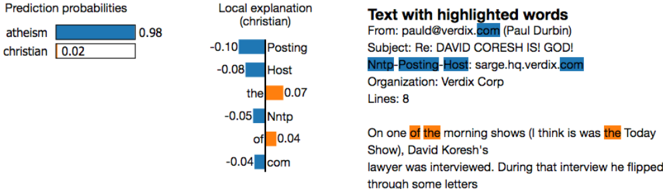
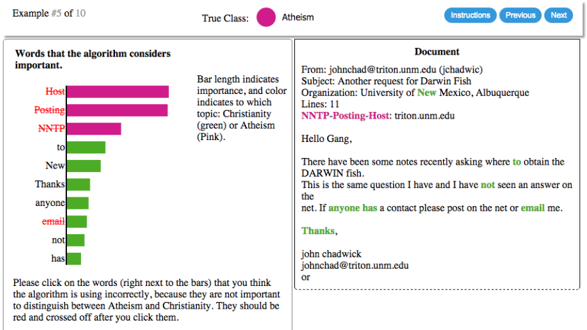
Despite widespread adoption in NLP, machine learning models remain mostly black boxes.Understanding the reasons behind predictions is, however, quite important in assessing trust in a model.Trust is fundamental if one plans to take action based on a prediction, or when choosing whether or not to deploy a new model.In this work, we describe LIME, a novel explanation technique that explains the predictions of any classifier in an interpretable and faithful manner.We further present a method to explain models by presenting representative individual predictions and their explanations in a non-redundant manner.We propose a demonstration of these ideas on different NLP tasks such as document classification, politeness detection, and sentiment analysis, with classifiers like neural networks and SVMs.The user interactions include explanations of free-form text, challenging users to identify the better classifier from a pair, and perform basic feature engineering to improve the classifiers.
Overview
The claims and statistics of this paper haven’t been checked yet.
Free: it reads the open-access text and checks the first 5 claims that cite a source we can check. Create a free account to check every claim.
Integrity signals
Registry
Cites
Statistics
Figures
Verification
Claims the paper makes
The claims and statistics of this paper haven’t been checked yet.
Free: it reads the open-access text and checks the first 5 claims that cite a source we can check. Create a free account to check every claim.
Claims other papers make about this one
Each is checked against this paper’s own text: does it say what the citing paper says it does?
The source backs part of the claim, not all of it — or backs it for a different population, condition or comparison.
In the citing paper
“While providing individuals with grounds to contest individual decisions is often cited as a central motivation of the field of explainable artificial intelligence (XAI) (Ribeiro, Singh, and Guestrin 2016;Lipton 2018;Adadi and Berrada 2018;Molnar 2020), only very few technical works address contestability in greater detail (Mansi, Karusala, and Riedl 2025).”
From Explainable AI Isn't Enough! Rethinking Algorithmic Contestability (2026) · cites this paper as Ribeiro, Singh, and Guestrin 2016
Experimental — accuracy not yet measuredThe source backs part of the claim, not all of it — or backs it for a different population, condition or comparison.
In the citing paper
“We show that standard XAI explanations, such as counterfactuals, LIME, or Anchors, even when combined with human intuitions about decision continuity or monotonicity, reveal only errors in the neighborhood of the individual, but provide insufficient grounds for overturning the decision at hand.”
From Explainable AI Isn't Enough! Rethinking Algorithmic Contestability (2026) · cites this paper as Ribeiro, Singh, and Guestrin 2016
Experimental — accuracy not yet measuredThe cited source says what the claim attributes to it.
In the citing paper
“Post hoc interpretability approaches such as Local Interpretable Model-agnostic Explanation [164] and Shapley Additive Explanations [116], widely adopted in defect prediction [81, 82], performance analysis [173], code analysis [177, 188], and code generation [112], explain the predictions after the model training and without altering the models.”
From A 2030 Roadmap for Software Engineering (2025) · cites this paper as [164]
The cited source says what the claim attributes to it.
In the citing paper
“Self-explanations are a prevailing approach on par with traditional model explanations like LIME saliency maps [71] for understanding LLM-generated responses [25, 32, 53] and are widely used in analyzing language model behavior [66, 99].”
From Thinking in Space: How Multimodal Large Language Models See, Remember, and Recall Spaces (2025) · cites this paper as [71]
In the citing paper
“Techniques such as LIME [25] and SHAP [26] are examples of post-hoc explainability methods commonly used in healthcare.”
From Ethical Framework for Harnessing the Power of AI in Healthcare and Beyond (2024) · cites this paper as [25]
1 more claim about this paper
Create a free account to see every claim other papers make about this one.
Self-check
Percentages, sums and reported differences re-computed from the paper’s own numbers.
The self-check needs the paper’s full text.
Citations
Cites
"Why Should I Trust You?": Explaining the Predictions of Any Classifier
Ribeiro, M. T., Singh, S., & Guestrin, C. (2016) · Proceedings of the 22nd ACM SIGKDD International Conference on Knowledge Discovery and Data Mining · doi:10.1145/2939672.2939778 · Cited by 17,555
Self-citationEfron, B., Hastie, T., Johnstone, I., & Tibshirani, R. (2004) · The Annals of Statistics · doi:10.1214/009053604000000067 · Cited by 9,357
Recursive Deep Models for Semantic Compositionality Over a Sentiment Treebank
Socher, R., Perelygin, A., Wu, J., Chuang, J., Manning, C. D., Ng, A., & Potts, C. (2013) · Proceedings of the 2013 Conference on Empirical Methods in Natural Language Processing · doi:10.18653/v1/d13-1170 · Cited by 6,878
A threshold of ln n for approximating set cover
Feige, U. (1998) · Journal of the ACM · doi:10.1145/285055.285059 · Cited by 3,086
Explaining collaborative filtering recommendations
Herlocker, J. L., Konstan, J. A., & Riedl, J. (2000) · Proceedings of the 2000 ACM conference on Computer supported cooperative work · doi:10.1145/358916.358995 · Cited by 1,731
Dataset Shift in Machine Learning
(2008) · doi:10.7551/mitpress/9780262170055.001.0001 · Cited by 1,553
The role of trust in automation reliance
Dzindolet, M. T., Peterson, S. A., Pomranky, R. A., Pierce, L. G., & Beck, H. P. (2003) · International Journal of Human-Computer Studies · doi:10.1016/s1071-5819(03)00038-7 · Cited by 1,276
Submodular Function Maximization
Krause, A., & Golovin, D. (2014) · Tractability · doi:10.1017/cbo9781139177801.004 · Cited by 751
Leakage in data mining: formulation, detection, and avoidance
Kaufman, S., Rosset, S., & Perlich, C. (2011) · Proceedings of the 17th ACM SIGKDD international conference on Knowledge discovery and data mining · doi:10.1145/2020408.2020496 · Cited by 137
Investigating statistical machine learning as a tool for software development
Patel, K., Fogarty, J., Landay, J. A., & Harrison, B. (2008) · Proceedings of the SIGCHI Conference on Human Factors in Computing Systems · doi:10.1145/1357054.1357160 · Cited by 129
Research works printed but not linked: 3
- Cristian Danescu-Niculescu-Mizil, Moritz Sudhof, Dan Jurafsky, Jure Leskovec, and Christopher Potts. 2013. A computational approach to politeness with applica- tion to social factors. In Proceedings of ACL.
- Jonathan L. Herlocker, Joseph A. Konstan, and John Riedl. 2000. Explaining collaborative filtering recommenda- tions. In Conference on Computer Supported Coopera- tive Work (CSCW).
- Andreas Krause and Daniel Golovin. 2014. Submodu- lar function maximization. In Tractability: Practical Approaches to Hard Problems. Cambridge University Press, February.
Cited by
Items 101–200 of 1,091
Challenges and opportunities for artificial intelligence in auditing: Evidence from the field
Kokina, J., Blanchette, S., Davenport, T. H., & Pachamanova, D. (2025) · International Journal of Accounting Information Systems · doi:10.1016/j.accinf.2025.100734 · Cited by 375
Explainable, trustworthy, and ethical machine learning for healthcare: A survey
Rasheed, K., Qayyum, A., Ghaly, M., Al-Fuqaha, A., Razi, A., & Qadir, J. (2022) · Computers in Biology and Medicine · doi:10.1016/j.compbiomed.2022.106043 · Cited by 372
Generative Adversarial Networks for face generation: A survey
Kammoun, A., Slama, R., Tabia, H., Ouni, T., & Abid, M. (2022) · ACM Computing Surveys · doi:10.1145/1122445.1122456 · Cited by 311
Kim, Y., & Kim, Y. (2022) · Sustainable Cities and Society · doi:10.1016/j.scs.2022.103677 · Cited by 348
Tripathy, K. P., & Mishra, A. K. (2024) · Journal of Hydrology · doi:10.1016/j.jhydrol.2023.130458 · Cited by 336
S Band, S., Yarahmadi, A., Hsu, C.-C., Biyari, M., Sookhak, M., Ameri, R., Dehzangi, I., Chronopoulos, A. T., & Liang, H.-W. (2023) · Informatics in Medicine Unlocked · doi:10.1016/j.imu.2023.101286 · Cited by 297
El-Sappagh, S., Alonso, J. M., Islam, S. M. R., Sultan, A. M., & Kwak, K. S. (2021) · Scientific Reports · doi:10.1038/s41598-021-82098-3 · Cited by 363
Explaining Recurrent Neural Network Predictions in Sentiment Analysis
Arras, L., Montavon, G., Müller, K.-R., & Samek, W. (2017) · Proceedings of the 8th Workshop on Computational Approaches to Subjectivity, Sentiment and Social Media Analysis · doi:10.18653/v1/w17-5221 · Cited by 361
Mental health monitoring with multimodal sensing and machine learning: A survey
Garcia-Ceja, E., Riegler, M., Nordgreen, T., Jakobsen, P., Oedegaard, K. J., & Tørresen, J. (2018) · Pervasive and Mobile Computing · doi:10.1016/j.pmcj.2018.09.003 · Cited by 356
Deep learning for detecting financial statement fraud
Craja, P., Kim, A., & Lessmann, S. (2020) · Decision Support Systems · doi:10.1016/j.dss.2020.113421 · Cited by 290
Deep Learning applications for COVID-19
Shorten, C., Khoshgoftaar, T. M., & Furht, B. (2021) · Journal of Big Data · doi:10.1186/s40537-020-00392-9 · Cited by 350
Detecting formal thought disorder by deep contextualized word representations
Sarzynska-Wawer, J., Wawer, A., Pawlak, A., Szymanowska, J., Stefaniak, I., Jarkiewicz, M., & Okruszek, L. (2021) · Psychiatry Research · doi:10.1016/j.psychres.2021.114135 · Cited by 335
DeepLOB: Deep Convolutional Neural Networks for Limit Order Books
Zhang, Z., Zohren, S., & Roberts, S. (2019) · IEEE Transactions on Signal Processing · doi:10.1109/tsp.2019.2907260 · Cited by 285
Lee, C., Yoon, J., & Schaar, M. V. D. (2020) · IEEE Transactions on Biomedical Engineering · doi:10.1109/tbme.2019.2909027 · Cited by 294
BERTology Meets Biology: Interpreting Attention in Protein Language Models
Vig, J., Madani, A., Varshney, L. R., Xiong, C., Socher, R., & Rajani, N. F. (2020) · doi:10.1101/2020.06.26.174417 · Cited by 338
To trust or not to trust? An assessment of trust in AI-based systems: Concerns, ethics and contexts
Omrani, N., Rivieccio, G., Fiore, U., Schiavone, F., & Agreda, S. G. (2022) · Technological Forecasting and Social Change · doi:10.1016/j.techfore.2022.121763 · Cited by 269
Muhammad, D., & Bendechache, M. (2024) · Computational and Structural Biotechnology Journal · doi:10.1016/j.csbj.2024.08.005 · Cited by 258
Explainable Artificial Intelligence in CyberSecurity: A Survey
Capuano, N., Fenza, G., Loia, V., & Stanzione, C. (2022) · IEEE Access · doi:10.1109/access.2022.3204171 · Cited by 330
The impact of site-specific digital histology signatures on deep learning model accuracy and bias
Howard, F. M., Dolezal, J., Kochanny, S., Schulte, J., Chen, H., Heij, L., Huo, D., Nanda, R., Olopade, O. I., Kather, J. N., et al. (2021) · Nature Communications · doi:10.1038/s41467-021-24698-1 · Cited by 330
Computer vision applications in construction safety assurance
Fang, W., Ding, L., Love, P. E. D., Luo, H., Li, H., Peña-Mora, F., Zhong, B., & Zhou, C. (2020) · Automation in Construction · doi:10.1016/j.autcon.2019.103013 · Cited by 288
Bai, X., Wang, X., Liu, X., Liu, Q., Song, J., Sebe, N., & Kim, B. (2021) · Pattern Recognition · doi:10.1016/j.patcog.2021.108102 · Cited by 313
How Convolutional Neural Networks Diagnose Plant Disease
Toda, Y., & Okura, F. (2019) · Plant Phenomics · doi:10.34133/2019/9237136 · Cited by 274
Yun, K. K., Yoon, S. W., & Won, D. (2021) · Expert Systems with Applications · doi:10.1016/j.eswa.2021.115716 · Cited by 287
An explainable deep learning-enabled intrusion detection framework in IoT networks
Keshk, M., Koroniotis, N., Pham, N., Moustafa, N., Turnbull, B., & Zomaya, A. Y. (2023) · Information Sciences · doi:10.1016/j.ins.2023.119000 · Cited by 261
The future of service: The power of emotion in human-robot interaction
Chuah, S. H.-W., & Yu, J. (2021) · Journal of Retailing and Consumer Services · doi:10.1016/j.jretconser.2021.102551 · Cited by 265
Accelerating Climate Resilient Plant Breeding by Applying Next-Generation Artificial Intelligence
Harfouche, A. L., Jacobson, D. A., Kainer, D., Romero, J. C., Harfouche, A. H., Scarascia Mugnozza, G., Moshelion, M., Tuskan, G. A., Keurentjes, J. J. B., & Altman, A. (2019) · Trends in Biotechnology · doi:10.1016/j.tibtech.2019.05.007 · Cited by 292
Interpretable machine learning with an ensemble of gradient boosting machines
Konstantinov, A. V., & Utkin, L. V. (2021) · Knowledge-Based Systems · doi:10.1016/j.knosys.2021.106993 · Cited by 271
Combustion machine learning: Principles, progress and prospects
Ihme, M., Chung, W. T., & Mishra, A. A. (2022) · Progress in Energy and Combustion Science · doi:10.1016/j.pecs.2022.101010 · Cited by 265
Uncertainty as a Form of Transparency: Measuring, Communicating, and Using Uncertainty
Bhatt, U., Antorán, J., Zhang, Y., Liao, Q. V., Sattigeri, P., Fogliato, R., Melançon, G., Krishnan, R., Stanley, J., Tickoo, O., et al. (2021) · Proceedings of the 2021 AAAI/ACM Conference on AI, Ethics, and Society · doi:10.1145/3461702.3462571 · Cited by 300
Machine learning in materials science: From explainable predictions to autonomous design
Pilania, G. (2021) · Computational Materials Science · doi:10.1016/j.commatsci.2021.110360 · Cited by 281
Magesh, P. R., Myloth, R. D., & Tom, R. J. (2020) · Computers in Biology and Medicine · doi:10.1016/j.compbiomed.2020.104041 · Cited by 295
Kwon, B. C., Choi, M.-J., Kim, J. T., Choi, E., Kim, Y. B., Kwon, S., Sun, J., & Choo, J. (2019) · IEEE Transactions on Visualization and Computer Graphics · doi:10.1109/tvcg.2018.2865027 · Cited by 294
"What is relevant in a text document?": An interpretable machine learning approach
Arras, L., Horn, F., Montavon, G., Müller, K.-R., & Samek, W. (2017) · PLOS ONE · doi:10.1371/journal.pone.0181142 · Cited by 257
Driving with LLMs: Fusing Object-Level Vector Modality for Explainable Autonomous Driving
Chen, L., Sinavski, O., Hünermann, J., Karnsund, A., Willmott, A. J., Birch, D., Maund, D., & Shotton, J. (2024) · 2024 IEEE International Conference on Robotics and Automation (ICRA) · doi:10.1109/icra57147.2024.10611018 · Cited by 178
Explaining models: an empirical study of how explanations impact fairness judgment
Dodge, J., Liao, Q. V., Zhang, Y., Bellamy, R. K. E., & Dugan, C. (2019) · Proceedings of the 24th International Conference on Intelligent User Interfaces · doi:10.1145/3301275.3302310 · Cited by 286
Nazir, S., Dickson, D. M., & Akram, M. U. (2023) · Computers in Biology and Medicine · doi:10.1016/j.compbiomed.2023.106668 · Cited by 283
Relation between prognostics predictor evaluation metrics and local interpretability SHAP values
Baptista, M. L., Goebel, K., & Henriques, E. M. P. (2022) · Artificial Intelligence · doi:10.1016/j.artint.2022.103667 · Cited by 270
Interpretable tree-based ensemble model for predicting beach water quality
Li, L., Qiao, J., Yu, G., Wang, L., Li, H.-Y., Liao, C., & Zhu, Z. (2022) · Water Research · doi:10.1016/j.watres.2022.118078 · Cited by 245
Hydrological concept formation inside long short-term memory (LSTM) networks
Lees, T., Reece, S., Kratzert, F., Klotz, D., Gauch, M., De Bruijn, J., Kumar Sahu, R., Greve, P., Slater, L., & Dadson, S. J. (2022) · Hydrology and Earth System Sciences · doi:10.5194/hess-26-3079-2022 · Cited by 226
Towards Human-Centered Explainable AI: A Survey of User Studies for Model Explanations
Rong, Y., Leemann, T., Nguyen, T.-T., Fiedler, L., Qian, P., Unhelkar, V., Seidel, T., Kasneci, G., & Kasneci, E. (2024) · IEEE Transactions on Pattern Analysis and Machine Intelligence · doi:10.1109/tpami.2023.3331846 · Cited by 278
Deep learning for credit scoring: Do or don’t?
Gunnarsson, B. R., vanden Broucke, S., Baesens, B., Óskarsdóttir, M., & Lemahieu, W. (2021) · European Journal of Operational Research · doi:10.1016/j.ejor.2021.03.006 · Cited by 235
Machine Learning in Radiology: Applications Beyond Image Interpretation
Lakhani, P., Prater, A. B., Hutson, R. K., Andriole, K. P., Dreyer, K. J., Morey, J., Prevedello, L. M., Clark, T. J., Geis, J. R., Itri, J. N., et al. (2018) · Journal of the American College of Radiology · doi:10.1016/j.jacr.2017.09.044 · Cited by 250
AI-driven healthcare: A review on ensuring fairness and mitigating bias
Chinta, S. V., Wang, Z., Palikhe, A., Zhang, X., Kashif, A., Smith, M. A., Liu, J., & Zhang, W. (2025) · PLOS Digital Health · doi:10.1371/journal.pdig.0000864 · Cited by 171
Hossain, S., Chakrabarty, A., Gadekallu, T. R., Alazab, M., & Piran, M. J. (2024) · IEEE Journal of Biomedical and Health Informatics · doi:10.1109/jbhi.2023.3266614 · Cited by 239
You Are What You Do: Hunting Stealthy Malware via Data Provenance Analysis
Wang, Q., Hassan, W. U., Li, D., Jee, K., Yu, X., Zou, K., Rhee, J., Chen, Z., Cheng, W., Gunter, C. A., et al. (2020) · Proceedings 2020 Network and Distributed System Security Symposium · doi:10.14722/ndss.2020.24167 · Cited by 230
Moustafa, N., Koroniotis, N., Keshk, M., Zomaya, A. Y., & Tari, Z. (2023) · IEEE Communications Surveys & Tutorials · doi:10.1109/comst.2023.3280465 · Cited by 266
Concrete Problems for Autonomous Vehicle Safety: Advantages of Bayesian Deep Learning
McAllister, R., Gal, Y., Kendall, A., van der Wilk, M., Shah, A., Cipolla, R., & Weller, A. (2017) · Proceedings of the Twenty-Sixth International Joint Conference on Artificial Intelligence · doi:10.24963/ijcai.2017/661 · Cited by 229
Makumbura, R. K., Mampitiya, L., Rathnayake, N., Meddage, D. P. P., Henna, S., Dang, T. L., Hoshino, Y., & Rathnayake, U. (2024) · Results in Engineering · doi:10.1016/j.rineng.2024.102831 · Cited by 223
Four principles of explainable artificial intelligence
Phillips, P. J., Hahn, C. A., Fontana, P. C., Yates, A. N., Greene, K., Broniatowski, D. A., & Przybocki, M. A. (2021) · doi:10.6028/nist.ir.8312 · Cited by 262
Improving Robot Controller Transparency Through Autonomous Policy Explanation
Hayes, B., & Shah, J. A. (2017) · Proceedings of the 2017 ACM/IEEE International Conference on Human-Robot Interaction · doi:10.1145/2909824.3020233 · Cited by 230
Gehrmann, S., Dernoncourt, F., Li, Y., Carlson, E. T., Wu, J. T., Welt, J., Foote, J., Moseley, E. T., Grant, D. W., Tyler, P. D., et al. (2018) · PLOS ONE · doi:10.1371/journal.pone.0192360 · Cited by 208
Socially Responsible AI Algorithms: Issues, Purposes, and Challenges
Cheng, L., Varshney, K. R., & Liu, H. (2021) · Journal of Artificial Intelligence Research · doi:10.1613/jair.1.12814 · Cited by 261
Machine Learning for Clinical Outcome Prediction
Shamout, F., Zhu, T., & Clifton, D. A. (2021) · IEEE Reviews in Biomedical Engineering · doi:10.1109/rbme.2020.3007816 · Cited by 239
Rawal, A., McCoy, J., Rawat, D. B., Sadler, B. M., & Amant, R. S. (2022) · IEEE Transactions on Artificial Intelligence · doi:10.1109/tai.2021.3133846 · Cited by 239
Explainability in human–agent systems
Rosenfeld, A., & Richardson, A. (2019) · Autonomous Agents and Multi-Agent Systems · doi:10.1007/s10458-019-09408-y · Cited by 224
Take a Look Around: Using Street View and Satellite Images to Estimate House Prices
Law, S., Paige, B., & Russell, C. (2019) · ACM Transactions on Intelligent Systems and Technology · doi:10.1145/3342240 · Cited by 203
Górriz, J. M., Álvarez-Illán, I., Álvarez-Marquina, A., Arco, J. E., Atzmueller, M., Ballarini, F., Barakova, E., Bologna, G., Bonomini, P., Castellanos-Dominguez, G., et al. (2023) · Information Fusion · doi:10.1016/j.inffus.2023.101945 · Cited by 214
Temenos, A., Temenos, N., Kaselimi, M., Doulamis, A., & Doulamis, N. (2023) · IEEE Geoscience and Remote Sensing Letters · doi:10.1109/lgrs.2023.3251652 · Cited by 219
Visualizing the Impact of Feature Attribution Baselines
Sturmfels, P., Lundberg, S., & Lee, S.-I. (2020) · Distill · doi:10.23915/distill.00022 · Cited by 200
Zhao, Z., Zou, Y., Liu, P., Lai, Z., Wen, L., & Jin, Y. (2022) · Electrochimica Acta · doi:10.1016/j.electacta.2022.140350 · Cited by 241
Meaningful Explanations of Black Box AI Decision Systems
Pedreschi, D., Giannotti, F., Guidotti, R., Monreale, A., Ruggieri, S., & Turini, F. (2019) · Proceedings of the AAAI Conference on Artificial Intelligence · doi:10.1609/aaai.v33i01.33019780 · Cited by 213
An explainable AI (XAI) model for landslide susceptibility modeling
Pradhan, B., Dikshit, A., Lee, S., & Kim, H. (2023) · Applied Soft Computing · doi:10.1016/j.asoc.2023.110324 · Cited by 224
Jacobs, M., Pradier, M. F., McCoy, T. H., Perlis, R. H., Doshi-Velez, F., & Gajos, K. Z. (2021) · Translational Psychiatry · doi:10.1038/s41398-021-01224-x · Cited by 247
Fernandez, A., Herrera, F., Cordon, O., Jose del Jesus, M., & Marcelloni, F. (2019) · IEEE Computational Intelligence Magazine · doi:10.1109/mci.2018.2881645 · Cited by 232
A Symbolic Approach to Explaining Bayesian Network Classifiers
Shih, A., Choi, A., & Darwiche, A. (2018) · Proceedings of the Twenty-Seventh International Joint Conference on Artificial Intelligence · doi:10.24963/ijcai.2018/708 · Cited by 193
Deep learning for drug response prediction in cancer
Baptista, D., Ferreira, P. G., & Rocha, M. (2021) · Briefings in Bioinformatics · doi:10.1093/bib/bbz171 · Cited by 237
Park, J., Lee, W. H., Kim, K. T., Park, C. Y., Lee, S., & Heo, T.-Y. (2022) · Science of The Total Environment · doi:10.1016/j.scitotenv.2022.155070 · Cited by 243
"How do I fool you?": Manipulating User Trust via Misleading Black Box Explanations
Lakkaraju, H., & Bastani, O. (2020) · Proceedings of the AAAI/ACM Conference on AI, Ethics, and Society · doi:10.1145/3375627.3375833 · Cited by 241
Understanding Convolutional Neural Networks for Text Classification
Jacovi, A., Sar Shalom, O., & Goldberg, Y. (2018) · Proceedings of the 2018 EMNLP Workshop BlackboxNLP: Analyzing and Interpreting Neural Networks for NLP · doi:10.18653/v1/w18-5408 · Cited by 226
Perturbation-based methods for explaining deep neural networks: A survey
Ivanovs, M., Kadikis, R., & Ozols, K. (2021) · Pattern Recognition Letters · doi:10.1016/j.patrec.2021.06.030 · Cited by 204
Toward personalized XAI: A case study in intelligent tutoring systems
Conati, C., Barral, O., Putnam, V., & Rieger, L. (2021) · Artificial Intelligence · doi:10.1016/j.artint.2021.103503 · Cited by 192
Gaspar, D., Silva, P., & Silva, C. (2024) · IEEE Access · doi:10.1109/access.2024.3368377 · Cited by 234
Deep learning for survival analysis: a review
Wiegrebe, S., Kopper, P., Sonabend, R., Bischl, B., & Bender, A. (2024) · Artificial Intelligence Review · doi:10.1007/s10462-023-10681-3 · Cited by 175
A Review of Trust in Artificial Intelligence: Challenges, Vulnerabilities and Future Directions
Lockey, S., Gillespie, N., Holm, D., & Someh, I. A. (2021) · Proceedings of the Annual Hawaii International Conference on System Sciences · doi:10.24251/hicss.2021.664 · Cited by 205
Post-hoc vs ante-hoc explanations: xAI design guidelines for data scientists
Retzlaff, C. O., Angerschmid, A., Saranti, A., Schneeberger, D., Röttger, R., Müller, H., & Holzinger, A. (2024) · Cognitive Systems Research · doi:10.1016/j.cogsys.2024.101243 · Cited by 194
Naser, M. Z. (2021) · Automation in Construction · doi:10.1016/j.autcon.2021.103821 · Cited by 215
Hagos, D. H., Battle, R., & Rawat, D. B. (2024) · IEEE Transactions on Artificial Intelligence · doi:10.1109/tai.2024.3444742 · Cited by 308
Machine learning and applications in microbiology
Goodswen, S. J., Barratt, J. L. N., Kennedy, P. J., Kaufer, A., Calarco, L., & Ellis, J. T. (2021) · FEMS Microbiology Reviews · doi:10.1093/femsre/fuab015 · Cited by 209
CLEVR-XAI: A benchmark dataset for the ground truth evaluation of neural network explanations
Arras, L., Osman, A., & Samek, W. (2022) · Information Fusion · doi:10.1016/j.inffus.2021.11.008 · Cited by 179
Artificial Communication: How Algorithms Produce Social Intelligence
Esposito, E. (2022) · The MIT Press eBooks · doi:10.7551/mitpress/14189.001.0001 · Cited by 195
Passi, S., & Jackson, S. J. (2018) · Proceedings of the ACM on Human-Computer Interaction · doi:10.1145/3274405 · Cited by 225
Punn, N. S., & Agarwal, S. (2021) · Applied Intelligence · doi:10.1007/s10489-020-01900-3 · Cited by 157
Vision transformer meets convolutional neural network for plant disease classification
Thakur, P. S., Chaturvedi, S., Khanna, P., Sheorey, T., & Ojha, A. (2023) · Ecological Informatics · doi:10.1016/j.ecoinf.2023.102245 · Cited by 188
A survey of visual analytics for Explainable Artificial Intelligence methods
Alicioglu, G., & Sun, B. (2022) · Computers & Graphics · doi:10.1016/j.cag.2021.09.002 · Cited by 221
Houda, Z. A. E., Brik, B., & Khoukhi, L. (2022) · IEEE Open Journal of the Communications Society · doi:10.1109/ojcoms.2022.3188750 · Cited by 220
Online prediction of mechanical properties of hot rolled steel plate using machine learning
Xie, Q., Suvarna, M., Li, J., Zhu, X., Cai, J., & Wang, X. (2021) · Materials & Design · doi:10.1016/j.matdes.2020.109201 · Cited by 215
Routing optimization meets Machine Intelligence: A perspective for the future network
Dai, B., Cao, Y., Wu, Z., Dai, Z., Yao, R., & Xu, Y. (2021) · Neurocomputing · doi:10.1016/j.neucom.2021.06.093 · Cited by 215
Explainable Recommendation: A Survey and New Perspectives
Zhang, Y., & Chen, X. (2020) · doi:10.1561/9781680836592 · Cited by 199
AudioMNIST: Exploring Explainable Artificial Intelligence for audio analysis on a simple benchmark
Becker, S., Vielhaben, J., Ackermann, M., Müller, K.-R., Lapuschkin, S., & Samek, W. (2024) · Journal of the Franklin Institute · doi:10.1016/j.jfranklin.2023.11.038 · Cited by 73
Ding, W., Abdel-Basset, M., Hawash, H., & Ali, A. M. (2022) · Information Sciences · doi:10.1016/j.ins.2022.10.013 · Cited by 183
Investigating Explainability of Generative AI for Code through Scenario-based Design
Sun, J., Liao, Q. V., Muller, M., Agarwal, M., Houde, S., Talamadupula, K., & Weisz, J. D. (2022) · 27th International Conference on Intelligent User Interfaces · doi:10.1145/3490099.3511119 · Cited by 219
A causal framework for explaining the predictions of black-box sequence-to-sequence models
Alvarez-Melis, D., & Jaakkola, T. (2017) · Proceedings of the 2017 Conference on Empirical Methods in Natural Language Processing · doi:10.18653/v1/d17-1042 · Cited by 178
On the failings of Shapley values for explainability
Huang, X., & Marques-Silva, J. (2024) · International Journal of Approximate Reasoning · doi:10.1016/j.ijar.2023.109112 · Cited by 165
Beyond Sparsity: Tree Regularization of Deep Models for Interpretability
Wu, M., Hughes, M., Parbhoo, S., Zazzi, M., Roth, V., & Doshi-Velez, F. (2018) · Proceedings of the AAAI Conference on Artificial Intelligence · doi:10.1609/aaai.v32i1.11501 · Cited by 213
Mienye, I. D., Obaido, G., Jere, N., Mienye, E., Aruleba, K., Emmanuel, I. D., & Ogbuokiri, B. (2024) · Informatics in Medicine Unlocked · doi:10.1016/j.imu.2024.101587 · Cited by 212
Kenny, E. M., Ford, C., Quinn, M., & Keane, M. T. (2021) · Artificial Intelligence · doi:10.1016/j.artint.2021.103459 · Cited by 211
Human-centered XAI: Developing design patterns for explanations of clinical decision support systems
Schoonderwoerd, T. A. J., Jorritsma, W., Neerincx, M. A., & van den Bosch, K. (2021) · International Journal of Human-Computer Studies · doi:10.1016/j.ijhcs.2021.102684 · Cited by 210
Selecting Directors Using Machine Learning
Erel, I., Stern, L. H., Tan, C., & Weisbach, M. S. (2021) · The Review of Financial Studies · doi:10.1093/rfs/hhab050 · Cited by 210
Trustworthy Graph Neural Networks: Aspects, Methods, and Trends
Zhang, H., Wu, B., Yuan, X., Pan, S., Tong, H., & Pei, J. (2024) · Proceedings of the IEEE · doi:10.1109/jproc.2024.3369017 · Cited by 144
Bastings, J., & Filippova, K. (2020) · Proceedings of the Third BlackboxNLP Workshop on Analyzing and Interpreting Neural Networks for NLP · doi:10.18653/v1/2020.blackboxnlp-1.14 · Cited by 150
Metadata
- Authors
- Ribeiro, M., Singh, S., & Guestrin, C.
- Affiliations
- University of Washington (US)
- Venue
- Proceedings of the 2016 Conference of the North American Chapter of the Association for Computational Linguistics: Demonstrations
- Published
- 2016
- Pages
- 97-101
- OpenAlex
- W2516809705
- Cited by
- 6,682
- References
- 13
- Citations by year
- 2026: 742 · 2025: 1562 · 2024: 1239 · 2023: 1039 · 2022: 778 · 2021: 581 · 2020: 364 · 2019: 225 · 2018: 109 · 2017: 38 · 2016: 3
- FWCI
- 67.53
- Type
- conference paper
- Language
- en
- Open access
- hybrid
- doi.org
- Licence
- cc-by
- Locations
- Conference of the North American Chapter of the Association for Computational Linguistics: Human Language Technologies (NAACL-HLT) (publishedVersion, cc-by)
- Funders
- Semiconductor Research Corporation
- Defense Advanced Research Projects Agency
- Topics
- Physical Sciences › Computer Science › Artificial Intelligence › Explainable Artificial Intelligence (XAI)
- Physical Sciences › Computer Science › Software › Software Testing and Debugging Techniques
- Physical Sciences › Computer Science › Artificial Intelligence › Topic Modeling
- Keywords
- lime, explainable AI, classifier interpretability, model trust, local interpretable model-agnostic explanations, feature importance, document classification, sentiment analysis, artificial neural networks, support vector machine, user interaction
About these checks
Registry, retraction, Cites and statistics results are computed, not judged, with one exception: a printed reference that no index lists is read once by a model before it counts as a citation error. Claims are extracted by a model and kept only when their quote appears verbatim in the text; each cited source is then checked, with a model’s help, for whether it says what the claim relies on. Those verdicts can be wrong — read the claim’s quote and the cited source before relying on one.
Statistics and arithmetic are recomputed, not judged.
Confidence bands are shown only for fields calibrated on our annotated test set. None is calibrated yet, so no band is shown.
What counts as a claim ›How we measure confidence ›How we check this ›
Are you an author, or do you see a problem with this page? Request a review
Data sources
Bibliographic data: Semantic Scholar, OpenAlex, Crossref.
Contains information from the Semantic Scholar Academic Graph Datasets, made available under the ODC Attribution License (ODC-BY 1.0).
Semantic Scholar’s data is described in: Kinney, R., et al. (2023). The Semantic Scholar Open Data Platform. arXiv:2301.10140.
