

“Why Should I Trust You?”: Explaining the Predictions of Any Classifier
Open accessThe DOI matches its Crossref record; 12 of the 13 references it cites were found in a registry or an index.
Abstract
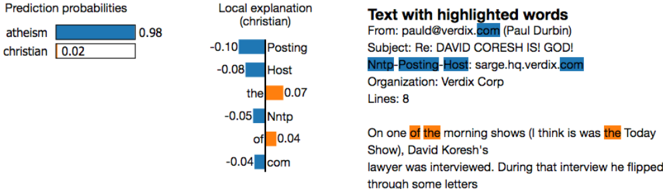
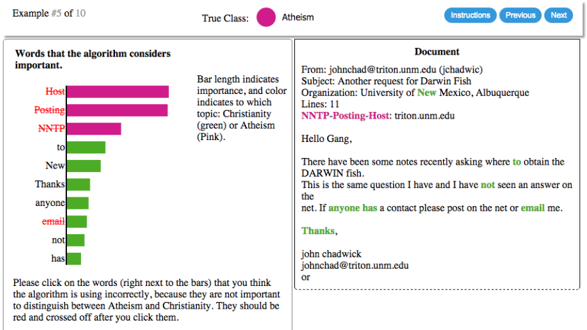
Despite widespread adoption in NLP, machine learning models remain mostly black boxes.Understanding the reasons behind predictions is, however, quite important in assessing trust in a model.Trust is fundamental if one plans to take action based on a prediction, or when choosing whether or not to deploy a new model.In this work, we describe LIME, a novel explanation technique that explains the predictions of any classifier in an interpretable and faithful manner.We further present a method to explain models by presenting representative individual predictions and their explanations in a non-redundant manner.We propose a demonstration of these ideas on different NLP tasks such as document classification, politeness detection, and sentiment analysis, with classifiers like neural networks and SVMs.The user interactions include explanations of free-form text, challenging users to identify the better classifier from a pair, and perform basic feature engineering to improve the classifiers.
Overview
The claims and statistics of this paper haven’t been checked yet.
Free: it reads the open-access text and checks the first 5 claims that cite a source we can check. Create a free account to check every claim.
Integrity signals
Registry
Cites
Statistics
Figures
Verification
Claims the paper makes
The claims and statistics of this paper haven’t been checked yet.
Free: it reads the open-access text and checks the first 5 claims that cite a source we can check. Create a free account to check every claim.
Claims other papers make about this one
Each is checked against this paper’s own text: does it say what the citing paper says it does?
The source backs part of the claim, not all of it — or backs it for a different population, condition or comparison.
In the citing paper
“While providing individuals with grounds to contest individual decisions is often cited as a central motivation of the field of explainable artificial intelligence (XAI) (Ribeiro, Singh, and Guestrin 2016;Lipton 2018;Adadi and Berrada 2018;Molnar 2020), only very few technical works address contestability in greater detail (Mansi, Karusala, and Riedl 2025).”
From Explainable AI Isn't Enough! Rethinking Algorithmic Contestability (2026) · cites this paper as Ribeiro, Singh, and Guestrin 2016
Experimental — accuracy not yet measuredThe source backs part of the claim, not all of it — or backs it for a different population, condition or comparison.
In the citing paper
“We show that standard XAI explanations, such as counterfactuals, LIME, or Anchors, even when combined with human intuitions about decision continuity or monotonicity, reveal only errors in the neighborhood of the individual, but provide insufficient grounds for overturning the decision at hand.”
From Explainable AI Isn't Enough! Rethinking Algorithmic Contestability (2026) · cites this paper as Ribeiro, Singh, and Guestrin 2016
Experimental — accuracy not yet measuredThe cited source says what the claim attributes to it.
In the citing paper
“Post hoc interpretability approaches such as Local Interpretable Model-agnostic Explanation [164] and Shapley Additive Explanations [116], widely adopted in defect prediction [81, 82], performance analysis [173], code analysis [177, 188], and code generation [112], explain the predictions after the model training and without altering the models.”
From A 2030 Roadmap for Software Engineering (2025) · cites this paper as [164]
The cited source says what the claim attributes to it.
In the citing paper
“Self-explanations are a prevailing approach on par with traditional model explanations like LIME saliency maps [71] for understanding LLM-generated responses [25, 32, 53] and are widely used in analyzing language model behavior [66, 99].”
From Thinking in Space: How Multimodal Large Language Models See, Remember, and Recall Spaces (2025) · cites this paper as [71]
In the citing paper
“Techniques such as LIME [25] and SHAP [26] are examples of post-hoc explainability methods commonly used in healthcare.”
From Ethical Framework for Harnessing the Power of AI in Healthcare and Beyond (2024) · cites this paper as [25]
1 more claim about this paper
Create a free account to see every claim other papers make about this one.
Self-check
Percentages, sums and reported differences re-computed from the paper’s own numbers.
The self-check needs the paper’s full text.
Citations
Cites
"Why Should I Trust You?": Explaining the Predictions of Any Classifier
Ribeiro, M. T., Singh, S., & Guestrin, C. (2016) · Proceedings of the 22nd ACM SIGKDD International Conference on Knowledge Discovery and Data Mining · doi:10.1145/2939672.2939778 · Cited by 17,555
Self-citationEfron, B., Hastie, T., Johnstone, I., & Tibshirani, R. (2004) · The Annals of Statistics · doi:10.1214/009053604000000067 · Cited by 9,357
Recursive Deep Models for Semantic Compositionality Over a Sentiment Treebank
Socher, R., Perelygin, A., Wu, J., Chuang, J., Manning, C. D., Ng, A., & Potts, C. (2013) · Proceedings of the 2013 Conference on Empirical Methods in Natural Language Processing · doi:10.18653/v1/d13-1170 · Cited by 6,878
A threshold of ln n for approximating set cover
Feige, U. (1998) · Journal of the ACM · doi:10.1145/285055.285059 · Cited by 3,086
Explaining collaborative filtering recommendations
Herlocker, J. L., Konstan, J. A., & Riedl, J. (2000) · Proceedings of the 2000 ACM conference on Computer supported cooperative work · doi:10.1145/358916.358995 · Cited by 1,731
Dataset Shift in Machine Learning
(2008) · doi:10.7551/mitpress/9780262170055.001.0001 · Cited by 1,553
The role of trust in automation reliance
Dzindolet, M. T., Peterson, S. A., Pomranky, R. A., Pierce, L. G., & Beck, H. P. (2003) · International Journal of Human-Computer Studies · doi:10.1016/s1071-5819(03)00038-7 · Cited by 1,276
Submodular Function Maximization
Krause, A., & Golovin, D. (2014) · Tractability · doi:10.1017/cbo9781139177801.004 · Cited by 751
Leakage in data mining: formulation, detection, and avoidance
Kaufman, S., Rosset, S., & Perlich, C. (2011) · Proceedings of the 17th ACM SIGKDD international conference on Knowledge discovery and data mining · doi:10.1145/2020408.2020496 · Cited by 137
Investigating statistical machine learning as a tool for software development
Patel, K., Fogarty, J., Landay, J. A., & Harrison, B. (2008) · Proceedings of the SIGCHI Conference on Human Factors in Computing Systems · doi:10.1145/1357054.1357160 · Cited by 129
Research works printed but not linked: 3
- Cristian Danescu-Niculescu-Mizil, Moritz Sudhof, Dan Jurafsky, Jure Leskovec, and Christopher Potts. 2013. A computational approach to politeness with applica- tion to social factors. In Proceedings of ACL.
- Jonathan L. Herlocker, Joseph A. Konstan, and John Riedl. 2000. Explaining collaborative filtering recommenda- tions. In Conference on Computer Supported Coopera- tive Work (CSCW).
- Andreas Krause and Daniel Golovin. 2014. Submodu- lar function maximization. In Tractability: Practical Approaches to Hard Problems. Cambridge University Press, February.
Cited by
Items 401–500 of 1,091
Artificial intelligence and explanation: How, why, and when to explain black boxes
Marcus, E., & Teuwen, J. (2024) · European Journal of Radiology · doi:10.1016/j.ejrad.2024.111393 · Cited by 139
DeepAID: Interpreting and Improving Deep Learning-based Anomaly Detection in Security Applications
Han, D., Wang, Z., Chen, W., Zhong, Y., Wang, S., Zhang, H., Yang, J., Shi, X., & Yin, X. (2021) · Proceedings of the 2021 ACM SIGSAC Conference on Computer and Communications Security · doi:10.1145/3460120.3484589 · Cited by 121
Visualizing Deep Networks by Optimizing with Integrated Gradients
Qi, Z., Khorram, S., & Fuxin, L. (2020) · Proceedings of the AAAI Conference on Artificial Intelligence · doi:10.1609/aaai.v34i07.6863 · Cited by 146
SurvLIME: A method for explaining machine learning survival models
Kovalev, M. S., Utkin, L. V., & Kasimov, E. M. (2020) · Knowledge-Based Systems · doi:10.1016/j.knosys.2020.106164 · Cited by 147
A Perspective on Explanations of Molecular Prediction Models
Wellawatte, G. P., Gandhi, H. A., Seshadri, A., & White, A. D. (2023) · Journal of Chemical Theory and Computation · doi:10.1021/acs.jctc.2c01235 · Cited by 140
Thinking in Space: How Multimodal Large Language Models See, Remember, and Recall Spaces
Yang, J., Yang, S., Gupta, A. W., Han, R., Fei-Fei, L., & Xie, S. (2025) · 2025 IEEE/CVF Conference on Computer Vision and Pattern Recognition (CVPR) · doi:10.1109/cvpr52734.2025.00994 · Cited by 120
A Machine Learning Approach for Classifying Ischemic Stroke Onset Time From Imaging
Ho, K. C., Speier, W., Zhang, H., Scalzo, F., El-Saden, S., & Arnold, C. W. (2019) · IEEE Transactions on Medical Imaging · doi:10.1109/tmi.2019.2901445 · Cited by 117
Machine learning in medicine: should the pursuit of enhanced interpretability be abandoned?
Yoon, C. H., Torrance, R., & Scheinerman, N. (2022) · Journal of Medical Ethics · doi:10.1136/medethics-2020-107102 · Cited by 116
Interpretable machine learning to model biomass and waste gasification
Ascher, S., Wang, X., Watson, I., Sloan, W. T., & You, S. (2022) · Bioresource Technology · doi:10.1016/j.biortech.2022.128062 · Cited by 131
Opening the Black Box: A systematic review on explainable artificial intelligence in remote sensing
Höhl, A., Obadić, I., Fernández‐Torres, M., Najjar, H., Oliveira, D. A. B., Akata, Z., Dengel, A. R., & Zhu, X. X. (2024) · IEEE Geoscience and Remote Sensing Magazine · doi:10.1109/mgrs.2024.3467001 · Cited by 142
Ten challenges for the future of pedometrics
Wadoux, A. M. J. ‐., Heuvelink, G. B. M., Lark, R. M., Lagacherie, P., Bouma, J., Mulder, V. L., Libohova, Z., Yang, L., & McBratney, A. B. (2021) · Geoderma · doi:10.1016/j.geoderma.2021.115155 · Cited by 124
Heuillet, A., Couthouis, F., & Díaz-Rodríguez, N. (2022) · IEEE Computational Intelligence Magazine · doi:10.1109/mci.2021.3129959 · Cited by 143
Explainability in AI-based behavioral malware detection systems
Galli, A., Gatta, V. L., Moscato, V., Postiglione, M., & Sperlí, G. (2024) · Computers & Security · doi:10.1016/j.cose.2024.103842 · Cited by 145
Zhang, S., Chen, W., Xu, J., & Xie, T. (2024) · Engineering Applications of Artificial Intelligence · doi:10.1016/j.engappai.2024.109170 · Cited by 122
Cruz-Jesus, F., Castelli, M., Oliveira, T., Mendes, R., Nunes, C., Sa-Velho, M., & Rosa-Louro, A. (2020) · Heliyon · doi:10.1016/j.heliyon.2020.e04081 · Cited by 118
Chugunova, M., & Sele, D. (2022) · Journal of Behavioral and Experimental Economics · doi:10.1016/j.socec.2022.101897 · Cited by 118
Object-sensitive Deep Reinforcement Learning
Li, Y., Sycara, K. P., & Iyer, R. (2018) · EPiC series in computing · doi:10.29007/xtgm · Cited by 124
Human Evaluation of Models Built for Interpretability
Lage, I., Chen, E., He, J., Narayanan, M., Kim, B., Gershman, S. J., & Doshi-Velez, F. (2019) · Proceedings of the AAAI Conference on Human Computation and Crowdsourcing · doi:10.1609/hcomp.v7i1.5280 · Cited by 110
Interpreting Deep Learning-Based Networking Systems
Meng, Z., Wang, M., Bai, J., Xu, M., Mao, H., & Hu, H. (2020) · Proceedings of the Annual conference of the ACM Special Interest Group on Data Communication on the applications, technologies, architectures, and protocols for computer communication · doi:10.1145/3387514.3405859 · Cited by 99
A review of drought monitoring with big data: Issues, methods, challenges and research directions
Balti, H., Abbes, A. B., Mellouli, N., Farah, I. R., Sang, Y., & Lamolle, M. (2020) · Ecological Informatics · doi:10.1016/j.ecoinf.2020.101136 · Cited by 125
FastIF: Scalable Influence Functions for Efficient Model Interpretation and Debugging
Guo, H., Rajani, N., Hase, P., Bansal, M., & Xiong, C. (2021) · Proceedings of the 2021 Conference on Empirical Methods in Natural Language Processing · doi:10.18653/v1/2021.emnlp-main.808 · Cited by 55
ExAID: A multimodal explanation framework for computer-aided diagnosis of skin lesions
Lucieri, A., Bajwa, M. N., Braun, S. A., Malik, M. I., Dengel, A., & Ahmed, S. (2022) · Computer Methods and Programs in Biomedicine · doi:10.1016/j.cmpb.2022.106620 · Cited by 105
Social Media Hate Speech Detection Using Explainable Artificial Intelligence (XAI)
Mehta, H., & Passi, K. (2022) · Algorithms · doi:10.3390/a15080291 · Cited by 106
Kim, S., & Lee, S. (2023) · Sustainable Cities and Society · doi:10.1016/j.scs.2023.104419 · Cited by 123
Huang, Q., Peng, S., Deng, J., Zeng, H., Zhang, Z., Liu, Y., & Yuan, P. (2023) · Heliyon · doi:10.1016/j.heliyon.2023.e13883 · Cited by 150
Explainable AI and Law: An Evidential Survey
Richmond, K. M., Muddamsetty, S. M., Gammeltoft‐Hansen, T., Olsen, H. P., & Moeslund, T. B. (2023) · Digital Society · doi:10.1007/s44206-023-00081-z · Cited by 160
Akkem, Y., Biswas, S. K., & Varanasi, A. (2024) · Neural Computing and Applications · doi:10.1007/s00521-024-10208-z · Cited by 126
Learning What Makes a Difference from Counterfactual Examples and Gradient Supervision
Teney, D., Abbasnedjad, E., & van den Hengel, A. (2020) · Lecture notes in computer science · doi:10.1007/978-3-030-58607-2_34 · Cited by 153
Early prediction of learners at risk in self-paced education: A neural network approach
Waheed, H., Hassan, S., Nawaz, R., Aljohani, N. R., Chen, G., & Gašević, D. (2022) · Expert Systems with Applications · doi:10.1016/j.eswa.2022.118868 · Cited by 132
Interpretable machine learning prediction of all-cause mortality
Qiu, W., Chen, H., Dincer, A. B., Lundberg, S., Kaeberlein, M. R., & Lee, S. (2022) · Communications Medicine · doi:10.1038/s43856-022-00180-x · Cited by 128
Khalil, M., AlSayed, A., Liu, Y., & Vanrolleghem, P. A. (2023) · Water Research · doi:10.1016/j.watres.2023.120667 · Cited by 117
Wang, N., Zhang, H., Dahal, A., Cheng, W., Zhao, M. J., & Lombardo, L. (2024) · Geoscience Frontiers · doi:10.1016/j.gsf.2024.101800 · Cited by 126
AllenNLP Interpret: A Framework for Explaining Predictions of NLP Models
Wallace, E., Tuyls, J., Wang, J., Subramanian, S., Gardner, M., & Singh, S. (2019) · Proceedings of the 2019 Conference on Empirical Methods in Natural Language Processing and the 9th International Joint Conference on Natural Language Processing (EMNLP-IJCNLP): System Demonstrations · doi:10.18653/v1/d19-3002 · Cited by 116
Self-citationNourani, M., King, J., & Ragan, E. (2020) · Proceedings of the AAAI Conference on Human Computation and Crowdsourcing · doi:10.1609/hcomp.v8i1.7469 · Cited by 116
Simpler is better: Lifting interpretability-performance trade-off via automated feature engineering
Gosiewska, A., Kozak, A., & Biecek, P. (2021) · Decision Support Systems · doi:10.1016/j.dss.2021.113556 · Cited by 135
Explainable, Domain-Adaptive, and Federated Artificial Intelligence in Medicine
Chaddad, A., Lu, Q., Li, J., Katib, Y., Kateb, R., Tanougast, C., Bouridane, A., & Abdulkadir, A. (2023) · IEEE/CAA Journal of Automatica Sinica · doi:10.1109/jas.2023.123123 · Cited by 141
Deep learning based detection of monkeypox virus using skin lesion images
Nayak, T., Chadaga, K., Sampathila, N., Mayrose, H., Gokulkrishnan, N., Bairy, G. M., Prabhu, S., Swathi, K. S., & Umakanth, S. (2023) · Medicine in Novel Technology and Devices · doi:10.1016/j.medntd.2023.100243 · Cited by 116
Toward Interpretable Deep Reinforcement Learning with Linear Model U-Trees
Liu, G., Schulte, O., Wang, Z., & Li, Q. (2019) · Lecture notes in computer science · doi:10.1007/978-3-030-10928-8_25 · Cited by 115
Machine learning and AI-based approaches for bioactive ligand discovery and GPCR-ligand recognition
Raschka, S., & Kaufman, B. (2020) · Methods · doi:10.1016/j.ymeth.2020.06.016 · Cited by 107
Noninterpretive Uses of Artificial Intelligence in Radiology
Richardson, M. L., Garwood, E. R., Lee, Y. Z., Li, M., Lo, H. S., Nagaraju, A., Nguyen, X. V., Probyn, L. J., Rajiah, P. S., Sin, J. M., et al. (2020) · Academic Radiology · doi:10.1016/j.acra.2020.01.012 · Cited by 123
Alves, M. A., de Castro, G. Z., Oliveira, B. A. S., Ferreira, L. A., Ramírez, J. A., Silva, R., & Guimarães, F. G. (2021) · Computers in Biology and Medicine · doi:10.1016/j.compbiomed.2021.104335 · Cited by 125
Prognostics and Health Management of Industrial Assets: Current Progress and Road Ahead
Biggio, L., & Kastanis, I. (2020) · Frontiers in Artificial Intelligence · doi:10.3389/frai.2020.578613 · Cited by 131
Quaghebeur, W., Torfs, E., Baets, B. D., & Nopens, I. (2022) · Water Research · doi:10.1016/j.watres.2022.118166 · Cited by 122
Charting the Sociotechnical Gap in Explainable AI: A Framework to Address the Gap in XAI
Ehsan, U., Saha, K., De Choudhury, M., & Riedl, M. O. (2023) · Proceedings of the ACM on Human-Computer Interaction · doi:10.1145/3579467 · Cited by 85
Advances of machine learning in materials science: Ideas and techniques
Chong, S. S., Ng, Y. S., Wang, H., & Zheng, J. (2023) · Frontiers of Physics · doi:10.1007/s11467-023-1325-z · Cited by 126
Credit Risk Assessment and Financial Decision Support Using Explainable Artificial Intelligence
Nallakaruppan, M., Chaturvedi, H., Grover, V., Balusamy, B., Jaraut, P., Bahadur, J., Meena, V., & Hameed, I. (2024) · Risks · doi:10.3390/risks12100164 · Cited by 79
Jacobs, P. G., Herrero, P., Facchinetti, A., Vehi, J., Kovatchev, B., Breton, M. D., Cinar, A., Nikita, K. S., Doyle, F. J., Bondia, J., et al. (2024) · IEEE Reviews in Biomedical Engineering · doi:10.1109/rbme.2023.3331297 · Cited by 113
Pereira, S., Meier, R., McKinley, R., Wiest, R., Alves, V., Silva, C. A., & Reyes, M. (2017) · Medical Image Analysis · doi:10.1016/j.media.2017.12.009 · Cited by 116
Automated Essay Scoring and the Deep Learning Black Box: How Are Rubric Scores Determined?
Kumar, V. S., & Boulanger, D. (2021) · International Journal of Artificial Intelligence in Education · doi:10.1007/s40593-020-00211-5 · Cited by 92
Explainable AI for Interpretable Credit Scoring
Demajo, L. M., Vella, V., & Dingli, A. (2020) · Computer Science & Information Technology (CS & IT) · doi:10.5121/csit.2020.101516 · Cited by 123
Explainable diabetes classification using hybrid Bayesian-optimized TabNet architecture
Joseph, L. P., Joseph, E. A., & Prasad, R. (2022) · Computers in Biology and Medicine · doi:10.1016/j.compbiomed.2022.106178 · Cited by 106
Smith-Renner, A., Fan, R., Birchfield, M., Wu, T., Boyd-Graber, J., Weld, D. S., & Findlater, L. (2020) · Proceedings of the 2020 CHI Conference on Human Factors in Computing Systems · doi:10.1145/3313831.3376624 · Cited by 112
A multi-view context-aware approach to Android malware detection and malicious code localization
Narayanan, A. S., Chandramohan, M., Chen, L., & Liu, Y. (2017) · Empirical Software Engineering · doi:10.1007/s10664-017-9539-8 · Cited by 112
Hybrid interpretable predictive machine learning model for air pollution prediction
Gu, Y., Li, B., & Meng, Q. (2021) · Neurocomputing · doi:10.1016/j.neucom.2021.09.051 · Cited by 112
Explainable long-term building energy consumption prediction using QLattice
Wenninger, S., Kaymakci, C., & Wiethe, C. (2021) · Applied Energy · doi:10.1016/j.apenergy.2021.118300 · Cited by 127
Hickling, T., Aouf, N., & Spencer, P. (2023) · IEEE Transactions on Intelligent Vehicles · doi:10.1109/tiv.2023.3296227 · Cited by 130
Liu, H., Lai, V., & Tan, C. (2021) · Proceedings of the ACM on Human-Computer Interaction · doi:10.1145/3479552 · Cited by 111
A game-based approximate verification of deep neural networks with provable guarantees
Wu, M., Wicker, M., Ruan, W., Huang, X., & Kwiatkowska, M. (2019) · Theoretical Computer Science · doi:10.1016/j.tcs.2019.05.046 · Cited by 127
SDRL: Interpretable and Data-Efficient Deep Reinforcement Learning Leveraging Symbolic Planning
Lyu, D., Yang, F., Liu, B., & Gustafson, S. (2019) · Proceedings of the AAAI Conference on Artificial Intelligence · doi:10.1609/aaai.v33i01.33012970 · Cited by 96
Wu, S., Zheng, L., Hu, W., Yu, R., & Liu, B. (2020) · Journal of Modern Power Systems and Clean Energy · doi:10.35833/mpce.2019.000058 · Cited by 115
An Information Bottleneck Approach for Controlling Conciseness in Rationale Extraction
Paranjape, B., Joshi, M., Thickstun, J., Hajishirzi, H., & Zettlemoyer, L. (2020) · Proceedings of the 2020 Conference on Empirical Methods in Natural Language Processing (EMNLP) · doi:10.18653/v1/2020.emnlp-main.153 · Cited by 86
Evaluating local explanation methods on ground truth
Guidotti, R. (2021) · Artificial Intelligence · doi:10.1016/j.artint.2020.103428 · Cited by 98
Peng, J., Zou, K., Ζhou, M., Teng, Y., Zhu, X., Zhang, F., & Xu, J. (2021) · Journal of Medical Systems · doi:10.1007/s10916-021-01736-5 · Cited by 127
Brik, B., Chergui, H., Zanzi, L., Devoti, F., Ksentini, A., Siddiqui, M. S., Costa‐Pérez, X., & Verikoukis, C. V. (2024) · IEEE Communications Surveys & Tutorials · doi:10.1109/comst.2024.3510543 · Cited by 151
How do we assess the trustworthiness of AI? Introducing the trustworthiness assessment model (TrAM)
Schlicker, N., Baum, K., Uhde, A., Sterz, S., Hirsch, M. C., & Langer, M. (2025) · Computers in Human Behavior · doi:10.1016/j.chb.2025.108671 · Cited by 76
Koshiyama, A., Kazim, E., Treleaven, P., Rai, P., Szpruch, L., Pavey, G., Ahamat, G., Leutner, F., Goebel, R., Knight, A., et al. (2024) · Royal Society Open Science · doi:10.1098/rsos.230859 · Cited by 110
Nourani, M., Kabir, S., Mohseni, S., & Ragan, E. D. (2019) · Proceedings of the AAAI Conference on Human Computation and Crowdsourcing · doi:10.1609/hcomp.v7i1.5284 · Cited by 100
Pham, T., Bui, T., Mai, L., & Nguyen, A. (2021) · Findings of the Association for Computational Linguistics: ACL-IJCNLP 2021 · doi:10.18653/v1/2021.findings-acl.98 · Cited by 79
A BERT based dual-channel explainable text emotion recognition system
Kumar, P., & Raman, B. (2022) · Neural Networks · doi:10.1016/j.neunet.2022.03.017 · Cited by 120
XRan: Explainable deep learning-based ransomware detection using dynamic analysis
Gulmez, S., Kakisim, A. G., & Soğukpınar, İ. (2024) · Computers & Security · doi:10.1016/j.cose.2024.103703 · Cited by 130
Ciravegna, G., Barbiero, P., Giannini, F., Gori, M., Lió, P., Maggini, M., & Melacci, S. (2022) · Artificial Intelligence · doi:10.1016/j.artint.2022.103822 · Cited by 146
Wang, J. Z., Zhao, S., Wu, C., Adams, R. B., Newman, M. G., Shafir, T., & Tsachor, R. P. (2023) · Proceedings of the IEEE · doi:10.1109/jproc.2023.3273517 · Cited by 137
Busch, F., Hoffmann, L., Truhn, D., Ortiz-Prado, E., Makowski, M. R., Bressem, K. K., Adams, L. C., COMFORT Consortium, Abdala, N., Navarro, Á. A., et al. (2024) · BMC Medical Education · doi:10.1186/s12909-024-06035-4 · Cited by 108
Model interpretability of financial fraud detection by group SHAP
Lin, K., & Gao, Y. (2022) · Expert Systems with Applications · doi:10.1016/j.eswa.2022.118354 · Cited by 108
Junaid, M., Ali, S., Eid, F., El-Sappagh, S., & Abuhmed, T. (2023) · Computer Methods and Programs in Biomedicine · doi:10.1016/j.cmpb.2023.107495 · Cited by 99
AI in medical diagnosis: AI prediction & human judgment
Göndöcs, D., & Dörfler, V. (2024) · Artificial Intelligence in Medicine · doi:10.1016/j.artmed.2024.102769 · Cited by 90
Hooshyar, D., & Yang, Y. (2024) · IEEE Access · doi:10.1109/access.2024.3463948 · Cited by 138
Ada-WHIPS: explaining AdaBoost classification with applications in the health sciences
Hatwell, J., Gaber, M. M., & Atif Azad, R. M. (2020) · BMC Medical Informatics and Decision Making · doi:10.1186/s12911-020-01201-2 · Cited by 102
GraphSVX: Shapley Value Explanations for Graph Neural Networks
Duval, A., & Malliaros, F. D. (2021) · Lecture notes in computer science · doi:10.1007/978-3-030-86520-7_19 · Cited by 194
Evaluating pointwise reliability of machine learning prediction
Nicora, G., Rios, M., Abu-Hanna, A., & Bellazzi, R. (2022) · Journal of Biomedical Informatics · doi:10.1016/j.jbi.2022.103996 · Cited by 97
Beyond prediction: methods for interpreting complex models of soil variation
Wadoux, A. M. J. ‐., & Molnar, C. (2022) · Geoderma · doi:10.1016/j.geoderma.2022.115953 · Cited by 115
Explanations, Fairness, and Appropriate Reliance in Human-AI Decision-Making
Schoeffer, J., De-Arteaga, M., & Kühl, N. (2024) · Proceedings of the CHI Conference on Human Factors in Computing Systems · doi:10.1145/3613904.3642621 · Cited by 68
Rodis, N., Sardianos, C., Grammatikis, P. I. R., Sarigiannidis, P. G., Varlamis, I., & Papadopoulos, G. T. (2024) · IEEE Access · doi:10.1109/access.2024.3467062 · Cited by 123
Does Explainable Artificial Intelligence Improve Human Decision-Making?
Alufaisan, Y., Marusich, L. R., Bakdash, J. Z., Zhou, Y., & Kantarcioglu, M. (2021) · Proceedings of the AAAI Conference on Artificial Intelligence · doi:10.1609/aaai.v35i8.16819 · Cited by 106
Luz, C. F., Vollmer, M., Decruyenaere, J., Nijsten, M. W., Glasner, C., & Sinha, B. (2020) · Clinical Microbiology and Infection · doi:10.1016/j.cmi.2020.02.003 · Cited by 106
ML-LOO: Detecting Adversarial Examples with Feature Attribution
Yang, P., Chen, J., Hsieh, C., Wang, J.-L., & Jordan, M. I. (2020) · Proceedings of the AAAI Conference on Artificial Intelligence · doi:10.1609/aaai.v34i04.6140 · Cited by 143
AI/ML for Network Security: The Emperor has no Clothes
Jacobs, A. S., Beltiukov, R., Willinger, W., Ferreira, R. A., Gupta, A. K., & Granville, L. Z. (2022) · ACM SIGSAC Conference on Computer and Communications Security (CCS) · doi:10.1145/3548606.3560609 · Cited by 157
Artificial Intelligence: A Promising Tool for Application in Phytopathology
González‐Rodríguez, V. E., Izquierdo‐Bueno, I., Cantoral, J. M., Carbú, M., & Garrido, C. (2024) · Horticulturae · doi:10.3390/horticulturae10030197 · Cited by 131
A Critical Survey on Fairness Benefits of Explainable AI
Deck, L., Schoeffer, J., De‐Arteaga, M., & Kühl, N. (2024) · ACM Conference on Fairness, Accountability, and Transparency (FAccT) · doi:10.1145/3630106.3658990 · Cited by 144
A Robust Interpretable Deep Learning Classifier for Heart Anomaly Detection Without Segmentation
Dissanayake, T., Fernando, T., Denman, S., Sridharan, S., Ghaemmaghami, H., & Fookes, C. (2021) · IEEE Journal of Biomedical and Health Informatics · doi:10.1109/jbhi.2020.3027910 · Cited by 105
Intelligent fault diagnosis methods toward gas turbine: A review
Liu, X., Yingjie, C. H. E. N., Xiong, L., Wang, J., Luo, C., Zhang, L., & Kehuan, W. A. N. G. (2023) · Chinese Journal of Aeronautics · doi:10.1016/j.cja.2023.09.024 · Cited by 113
Hakkoum, H., Idri, A., & Abnane, I. (2024) · Engineering Applications of Artificial Intelligence · doi:10.1016/j.engappai.2023.107829 · Cited by 118
Contestable AI by Design: Towards a Framework
Alfrink, K., Keller, I., Kortuem, G., & Doorn, N. (2022) · Minds and Machines · doi:10.1007/s11023-022-09611-z · Cited by 169
Building more accurate decision trees with the additive tree
Luna, J. M., Gennatas, E. D., Ungar, L. H., Eaton, E., Diffenderfer, E. S., Jensen, S. T., Simone, C. B., Friedman, J. H., Solberg, T. D., & Valdes, G. (2019) · Proceedings of the National Academy of Sciences · doi:10.1073/pnas.1816748116 · Cited by 98
Requirements Classification with Interpretable Machine Learning and Dependency Parsing
Dalpiaz, F., Dell’Anna, D., Aydemir, F. B., & Çevikol, S. (2019) · IEEE International Requirements Engineering Conference (RE) · doi:10.1109/re.2019.00025 · Cited by 144
Extract interpretability-accuracy balanced rules from artificial neural networks: A review
He, C., Ma, M., & Wang, P. (2020) · Neurocomputing · doi:10.1016/j.neucom.2020.01.036 · Cited by 124
Modelling urban-scale occupant behaviour, mobility, and energy in buildings: A survey
Salim, F. D., Dong, B., Ouf, M. M., Wang, Q., Pigliautile, I., Kang, X., Hong, T., Wu, W., Liu, Y., Rumi, S. K., et al. (2020) · Building and Environment · doi:10.1016/j.buildenv.2020.106964 · Cited by 113
To trust or not to trust an explanation: using LEAF to evaluate local linear XAI methods
Amparore, E., Perotti, A., & Bajardi, P. (2021) · PeerJ Computer Science · doi:10.7717/peerj-cs.479 · Cited by 90
Rymarczyk, D., Struski, Ł., Tabor, J., & Zieliński, B. (2021) · ACM SIGKDD Conference on Knowledge Discovery and Data Mining (KDD) · doi:10.1145/3447548.3467245 · Cited by 177
Roshan, K., & Zafar, A. (2021) · International journal of Computer Networks & Communications · doi:10.5121/ijcnc.2021.13607 · Cited by 84
Metadata
- Authors
- Ribeiro, M., Singh, S., & Guestrin, C.
- Affiliations
- University of Washington (US)
- Venue
- Proceedings of the 2016 Conference of the North American Chapter of the Association for Computational Linguistics: Demonstrations
- Published
- 2016
- Pages
- 97-101
- OpenAlex
- W2516809705
- Cited by
- 6,682
- References
- 13
- Citations by year
- 2026: 742 · 2025: 1562 · 2024: 1239 · 2023: 1039 · 2022: 778 · 2021: 581 · 2020: 364 · 2019: 225 · 2018: 109 · 2017: 38 · 2016: 3
- FWCI
- 67.53
- Type
- conference paper
- Language
- en
- Open access
- hybrid
- doi.org
- Licence
- cc-by
- Locations
- Conference of the North American Chapter of the Association for Computational Linguistics: Human Language Technologies (NAACL-HLT) (publishedVersion, cc-by)
- Funders
- Semiconductor Research Corporation
- Defense Advanced Research Projects Agency
- Topics
- Physical Sciences › Computer Science › Artificial Intelligence › Explainable Artificial Intelligence (XAI)
- Physical Sciences › Computer Science › Software › Software Testing and Debugging Techniques
- Physical Sciences › Computer Science › Artificial Intelligence › Topic Modeling
- Keywords
- lime, explainable AI, classifier interpretability, model trust, local interpretable model-agnostic explanations, feature importance, document classification, sentiment analysis, artificial neural networks, support vector machine, user interaction
About these checks
Registry, retraction, Cites and statistics results are computed, not judged, with one exception: a printed reference that no index lists is read once by a model before it counts as a citation error. Claims are extracted by a model and kept only when their quote appears verbatim in the text; each cited source is then checked, with a model’s help, for whether it says what the claim relies on. Those verdicts can be wrong — read the claim’s quote and the cited source before relying on one.
Statistics and arithmetic are recomputed, not judged.
Confidence bands are shown only for fields calibrated on our annotated test set. None is calibrated yet, so no band is shown.
What counts as a claim ›How we measure confidence ›How we check this ›
Are you an author, or do you see a problem with this page? Request a review
Data sources
Bibliographic data: Semantic Scholar, OpenAlex, Crossref.
Contains information from the Semantic Scholar Academic Graph Datasets, made available under the ODC Attribution License (ODC-BY 1.0).
Semantic Scholar’s data is described in: Kinney, R., et al. (2023). The Semantic Scholar Open Data Platform. arXiv:2301.10140.
