

“Why Should I Trust You?”: Explaining the Predictions of Any Classifier
Open accessThe DOI matches its Crossref record; 12 of the 13 references it cites were found in a registry or an index.
Abstract
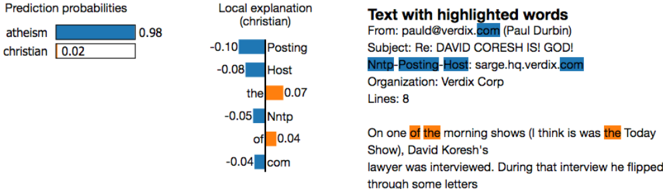
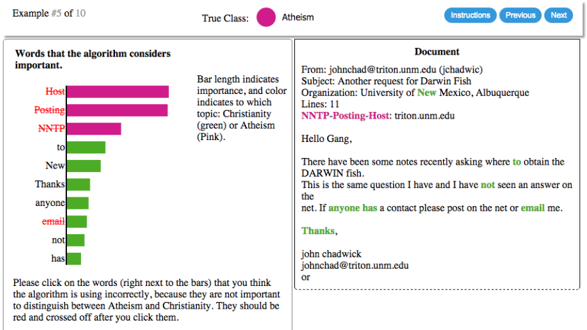
Despite widespread adoption in NLP, machine learning models remain mostly black boxes.Understanding the reasons behind predictions is, however, quite important in assessing trust in a model.Trust is fundamental if one plans to take action based on a prediction, or when choosing whether or not to deploy a new model.In this work, we describe LIME, a novel explanation technique that explains the predictions of any classifier in an interpretable and faithful manner.We further present a method to explain models by presenting representative individual predictions and their explanations in a non-redundant manner.We propose a demonstration of these ideas on different NLP tasks such as document classification, politeness detection, and sentiment analysis, with classifiers like neural networks and SVMs.The user interactions include explanations of free-form text, challenging users to identify the better classifier from a pair, and perform basic feature engineering to improve the classifiers.
Overview
The claims and statistics of this paper haven’t been checked yet.
Free: it reads the open-access text and checks the first 5 claims that cite a source we can check. Create a free account to check every claim.
Integrity signals
Registry
Cites
Statistics
Figures
Verification
Claims the paper makes
The claims and statistics of this paper haven’t been checked yet.
Free: it reads the open-access text and checks the first 5 claims that cite a source we can check. Create a free account to check every claim.
Claims other papers make about this one
Each is checked against this paper’s own text: does it say what the citing paper says it does?
The source backs part of the claim, not all of it — or backs it for a different population, condition or comparison.
In the citing paper
“While providing individuals with grounds to contest individual decisions is often cited as a central motivation of the field of explainable artificial intelligence (XAI) (Ribeiro, Singh, and Guestrin 2016;Lipton 2018;Adadi and Berrada 2018;Molnar 2020), only very few technical works address contestability in greater detail (Mansi, Karusala, and Riedl 2025).”
From Explainable AI Isn't Enough! Rethinking Algorithmic Contestability (2026) · cites this paper as Ribeiro, Singh, and Guestrin 2016
Experimental — accuracy not yet measuredThe source backs part of the claim, not all of it — or backs it for a different population, condition or comparison.
In the citing paper
“We show that standard XAI explanations, such as counterfactuals, LIME, or Anchors, even when combined with human intuitions about decision continuity or monotonicity, reveal only errors in the neighborhood of the individual, but provide insufficient grounds for overturning the decision at hand.”
From Explainable AI Isn't Enough! Rethinking Algorithmic Contestability (2026) · cites this paper as Ribeiro, Singh, and Guestrin 2016
Experimental — accuracy not yet measuredThe cited source says what the claim attributes to it.
In the citing paper
“Post hoc interpretability approaches such as Local Interpretable Model-agnostic Explanation [164] and Shapley Additive Explanations [116], widely adopted in defect prediction [81, 82], performance analysis [173], code analysis [177, 188], and code generation [112], explain the predictions after the model training and without altering the models.”
From A 2030 Roadmap for Software Engineering (2025) · cites this paper as [164]
The cited source says what the claim attributes to it.
In the citing paper
“Self-explanations are a prevailing approach on par with traditional model explanations like LIME saliency maps [71] for understanding LLM-generated responses [25, 32, 53] and are widely used in analyzing language model behavior [66, 99].”
From Thinking in Space: How Multimodal Large Language Models See, Remember, and Recall Spaces (2025) · cites this paper as [71]
In the citing paper
“Techniques such as LIME [25] and SHAP [26] are examples of post-hoc explainability methods commonly used in healthcare.”
From Ethical Framework for Harnessing the Power of AI in Healthcare and Beyond (2024) · cites this paper as [25]
1 more claim about this paper
Create a free account to see every claim other papers make about this one.
Self-check
Percentages, sums and reported differences re-computed from the paper’s own numbers.
The self-check needs the paper’s full text.
Citations
Cites
"Why Should I Trust You?": Explaining the Predictions of Any Classifier
Ribeiro, M. T., Singh, S., & Guestrin, C. (2016) · Proceedings of the 22nd ACM SIGKDD International Conference on Knowledge Discovery and Data Mining · doi:10.1145/2939672.2939778 · Cited by 17,555
Self-citationEfron, B., Hastie, T., Johnstone, I., & Tibshirani, R. (2004) · The Annals of Statistics · doi:10.1214/009053604000000067 · Cited by 9,357
Recursive Deep Models for Semantic Compositionality Over a Sentiment Treebank
Socher, R., Perelygin, A., Wu, J., Chuang, J., Manning, C. D., Ng, A., & Potts, C. (2013) · Proceedings of the 2013 Conference on Empirical Methods in Natural Language Processing · doi:10.18653/v1/d13-1170 · Cited by 6,878
A threshold of ln n for approximating set cover
Feige, U. (1998) · Journal of the ACM · doi:10.1145/285055.285059 · Cited by 3,086
Explaining collaborative filtering recommendations
Herlocker, J. L., Konstan, J. A., & Riedl, J. (2000) · Proceedings of the 2000 ACM conference on Computer supported cooperative work · doi:10.1145/358916.358995 · Cited by 1,731
Dataset Shift in Machine Learning
(2008) · doi:10.7551/mitpress/9780262170055.001.0001 · Cited by 1,553
The role of trust in automation reliance
Dzindolet, M. T., Peterson, S. A., Pomranky, R. A., Pierce, L. G., & Beck, H. P. (2003) · International Journal of Human-Computer Studies · doi:10.1016/s1071-5819(03)00038-7 · Cited by 1,276
Submodular Function Maximization
Krause, A., & Golovin, D. (2014) · Tractability · doi:10.1017/cbo9781139177801.004 · Cited by 751
Leakage in data mining: formulation, detection, and avoidance
Kaufman, S., Rosset, S., & Perlich, C. (2011) · Proceedings of the 17th ACM SIGKDD international conference on Knowledge discovery and data mining · doi:10.1145/2020408.2020496 · Cited by 137
Investigating statistical machine learning as a tool for software development
Patel, K., Fogarty, J., Landay, J. A., & Harrison, B. (2008) · Proceedings of the SIGCHI Conference on Human Factors in Computing Systems · doi:10.1145/1357054.1357160 · Cited by 129
Research works printed but not linked: 3
- Cristian Danescu-Niculescu-Mizil, Moritz Sudhof, Dan Jurafsky, Jure Leskovec, and Christopher Potts. 2013. A computational approach to politeness with applica- tion to social factors. In Proceedings of ACL.
- Jonathan L. Herlocker, Joseph A. Konstan, and John Riedl. 2000. Explaining collaborative filtering recommenda- tions. In Conference on Computer Supported Coopera- tive Work (CSCW).
- Andreas Krause and Daniel Golovin. 2014. Submodu- lar function maximization. In Tractability: Practical Approaches to Hard Problems. Cambridge University Press, February.
Cited by
Items 501–600 of 1,091
Deep learning technology for construction machinery and robotics
You, K., Zhou, C., & Ding, L. (2023) · Automation in Construction · doi:10.1016/j.autcon.2023.104852 · Cited by 112
Chaturvedi, U., Chauhan, S. B., & Singh, I. (2025) · Intelligent Pharmacy · doi:10.1016/j.ipha.2024.12.003 · Cited by 130
A Nutritional Label for Rankings
Yang, K., Stoyanovich, J., Asudeh, A., Howe, B., Jagadish, H., & Miklau, G. (2018) · Proceedings of the 2018 International Conference on Management of Data · doi:10.1145/3183713.3193568 · Cited by 103
Bell, A., Solano-Kamaiko, I., Nov, O., & Stoyanovich, J. (2022) · 2022 ACM Conference on Fairness Accountability and Transparency · doi:10.1145/3531146.3533090 · Cited by 103
Anik, A. I., & Bunt, A. (2021) · Proceedings of the 2021 CHI Conference on Human Factors in Computing Systems · doi:10.1145/3411764.3445736 · Cited by 103
Towards explaining anomalies: A deep Taylor decomposition of one-class models
Kauffmann, J., Müller, K.-R., & Montavon, G. (2020) · Pattern Recognition · doi:10.1016/j.patcog.2020.107198 · Cited by 101
Non-intrusive load disaggregation based on composite deep long short-term memory network
Xia, M., Liu, W., Wang, K., Song, W., Chen, C., & Li, Y. (2020) · Expert Systems with Applications · doi:10.1016/j.eswa.2020.113669 · Cited by 108
Meddage, D. P. P., Ekanayake, I. U., Weerasuriya, A. U., Lewangamage, C. S., Tse, K. T., Miyanawala, T. P., & Ramanayaka, C. D. E. (2022) · Journal of Wind Engineering and Industrial Aerodynamics · doi:10.1016/j.jweia.2022.105027 · Cited by 98
Large language model-based interpretable machine learning control in building energy systems
Zhang, L., & Chen, Z. (2024) · Energy and Buildings · doi:10.1016/j.enbuild.2024.114278 · Cited by 117
Machine learning in business process management: A systematic literature review
Weinzierl, S., Zilker, S., Dunzer, S., & Matzner, M. (2024) · Expert Systems with Applications · doi:10.1016/j.eswa.2024.124181 · Cited by 126
Schlögl, M., Stütz, R., Laaha, G., & Melcher, M. (2019) · Accident Analysis & Prevention · doi:10.1016/j.aap.2019.02.008 · Cited by 109
Artificial Intelligence and Transparency: Opening the Black Box
Wischmeyer, T. (2019) · Springer eBooks · doi:10.1007/978-3-030-32361-5_4 · Cited by 178
Meske, C., & Bunde, E. (2020) · Lecture notes in computer science · doi:10.1007/978-3-030-50334-5_4 · Cited by 131
Assessing effects of economic factors on construction cost estimation using deep neural networks
Wang, R., Asghari, V., Cheung, C. M., Hsu, S., & Lee, C.-J. (2021) · Automation in Construction · doi:10.1016/j.autcon.2021.104080 · Cited by 111
Generating Hierarchical Explanations on Text Classification via Feature Interaction Detection
Chen, H., Zheng, G., & Ji, Y. (2020) · Proceedings of the conference - Association for Computational Linguistics. Meeting · doi:10.18653/v1/2020.acl-main.494 · Cited by 143
Han, L., Yang, G., Yang, X., Song, X., Xu, B., Li, Z., Wu, J., Yang, H. F., & Wu, J. (2022) · Computers and Electronics in Agriculture · doi:10.1016/j.compag.2022.106804 · Cited by 106
Spatiotemporal exploration of the non-linear impacts of accessibility on metro ridership
Du, Q., Zhou, Y., Huang, Y., Wang, Y., & Bai, L. (2022) · Journal of Transport Geography · doi:10.1016/j.jtrangeo.2022.103380 · Cited by 101
Dataset level explanation of heat demand forecasting ANN with SHAP
Białek, J., Bujalski, W., Wojdan, K., Guzek, M., & Kurek, T. (2022) · Energy · doi:10.1016/j.energy.2022.125075 · Cited by 112
Lin, J., Liu, Z., Guo, Y., Wang, S., Zhang, T., Xue, X., Li, R., Feng, S., Wang, L., Liu, J., et al. (2023) · Nano Today · doi:10.1016/j.nantod.2023.101802 · Cited by 103
Toward a Collective Agenda on AI for Earth Science Data Analysis
Tuia, D., Roscher, R., Wegner, J. D., Jacobs, N., Zhu, X. X., & Camps‐Valls, G. (2021) · IEEE Geoscience and Remote Sensing Magazine · doi:10.1109/mgrs.2020.3043504 · Cited by 116
Zhang, H., Luo, G., Li, Y., & Wang, F. (2022) · IEEE Transactions on Systems Man and Cybernetics Systems · doi:10.1109/tsmc.2022.3228314 · Cited by 115
Principles and Practice of Explainable Machine Learning
Belle, V., & Papantonis, I. (2021) · Frontiers in Big Data · doi:10.3389/fdata.2021.688969 · Cited by 99
Is there a role for statistics in artificial intelligence?
Friedrich, S., Antes, G., Behr, S., Binder, H., Brannath, W., Dumpert, F., Ickstadt, K., Kestler, H. A., Lederer, J., Leitgöb, H., et al. (2021) · Advances in Data Analysis and Classification · doi:10.1007/s11634-021-00455-6 · Cited by 118
Explainable Diabetic Retinopathy Detection and Retinal Image Generation
Niu, Y., Gu, L., Zhao, Y., & Lu, F. (2021) · IEEE Journal of Biomedical and Health Informatics · doi:10.1109/jbhi.2021.3110593 · Cited by 112
Li, S., Li, T., Sun, C., Chen, X., & Yan, R. (2023) · IEEE Transactions on Neural Networks and Learning Systems · doi:10.1109/tnnls.2023.3282599 · Cited by 110
Understanding the black-box: towards interpretable and reliable deep learning models
Qamar, T., & Bawany, N. Z. (2023) · PeerJ Computer Science · doi:10.7717/peerj-cs.1629 · Cited by 117
Nam, W.-J., Gur, S., Choi, J., Wolf, L., & Lee, S.-W. (2020) · Proceedings of the AAAI Conference on Artificial Intelligence · doi:10.1609/aaai.v34i03.5632 · Cited by 98
Explainable AI reveals changes in skin microbiome composition linked to phenotypic differences
Carrieri, A. P., Haiminen, N., Maudsley-Barton, S., Gardiner, L.-J., Murphy, B., Mayes, A. E., Paterson, S., Grimshaw, S., Winn, M., Shand, C., et al. (2021) · Scientific Reports · doi:10.1038/s41598-021-83922-6 · Cited by 94
Zou, L., Goh, H. L., Liew, C. J. Y., Quah, J. L., Gu, G. T., Chew, J. J., Kumar, M. P., Ang, C. G. L., & Ta, A. W. A. (2023) · IEEE Transactions on Artificial Intelligence · doi:10.1109/tai.2022.3153754 · Cited by 92
CAMF: An Interpretable Infrared and Visible Image Fusion Network Based on Class Activation Mapping
Tang, L., Chen, Z., Huang, J., & Ma, J. (2023) · IEEE Transactions on Multimedia · doi:10.1109/tmm.2023.3326296 · Cited by 108
(2024) · International Research Journal of Modernization in Engineering Technology and Science · doi:10.56726/irjmets61029 · Cited by 37
The Threat of Offensive AI to Organizations
Mirsky, Y., Demontis, A., Kotak, J., Shankar, R., Gelei, D., Yang, L., Zhang, X., Pintor, M., Lee, W., Elovici, Y., et al. (2023) · Computers & Security · doi:10.1016/j.cose.2022.103006 · Cited by 97
Making Deep Learning-Based Predictions for Credit Scoring Explainable
Dastile, X., & Çelik, T. (2021) · IEEE Access · doi:10.1109/access.2021.3068854 · Cited by 113
Detecting Deepfake Images Using Deep Learning Techniques and Explainable AI Methods
Abir, W. H., Khanam, F. R., Alam, K. N., Hadjouni, M., Elmannai, H., Bourouis, S., Dey, R., & Khan, M. M. (2022) · Intelligent Automation & Soft Computing · doi:10.32604/iasc.2023.029653 · Cited by 112
Explainable prediction of loan default based on machine learning models
Zhu, X., Chu, Q., Song, X., Hu, P., & Peng, L. (2023) · Data Science and Management · doi:10.1016/j.dsm.2023.04.003 · Cited by 97
Identifying regions of importance in wall-bounded turbulence through explainable deep learning
Cremades, A., Hoyas, S., Deshpande, R., Quintero, P., Lellep, M., Lee, W. J., Monty, J., Hutchins, N. T., Linkmann, M., Maruŝiĉ, I., et al. (2024) · Nature Communications · doi:10.1038/s41467-024-47954-6 · Cited by 114
Lim, G., Bellemo, V., Xie, Y., Lee, X. Q., Yip, M. Y. T., & Ting, D. S. W. (2020) · Eye and Vision · doi:10.1186/s40662-020-00182-7 · Cited by 96
COGAM: Measuring and Moderating Cognitive Load in Machine Learning Model Explanations
Abdul, A., von der Weth, C., Kankanhalli, M., & Lim, B. Y. (2020) · Proceedings of the 2020 CHI Conference on Human Factors in Computing Systems · doi:10.1145/3313831.3376615 · Cited by 96
Examining CNN Representations With Respect to Dataset Bias
Zhang, Q., Wang, W., & Zhu, S.-C. (2018) · Proceedings of the AAAI Conference on Artificial Intelligence · doi:10.1609/aaai.v32i1.11833 · Cited by 90
What Do People Really Want When They Say They Want "Explainable AI?" We Asked 60 Stakeholders.
Brennen, A. (2020) · Extended Abstracts of the 2020 CHI Conference on Human Factors in Computing Systems · doi:10.1145/3334480.3383047 · Cited by 76
Provenance documentation to enable explainable and trustworthy AI: A literature review
Kale, A., Nguyen, T., Harris, F. C., Li, C., Zhang, J., & Ma, X. (2023) · Data Intelligence · doi:10.1162/dint_a_00119 · Cited by 77
A Survey of Industrial AIoT: Opportunities, Challenges, and Directions
Awaisi, K. S., Ye, Q., & Sampalli, S. (2024) · IEEE Access · doi:10.1109/access.2024.3426279 · Cited by 112
Self-attentive deep learning method for online traffic classification and its interpretability
Xie, G., Li, Q., & Jiang, Y. (2021) · Computer Networks · doi:10.1016/j.comnet.2021.108267 · Cited by 97
Explainable AI, But Explainable to Whom? An Exploratory Case Study of xAI in Healthcare
Gerlings, J., Jensen, M. S., & Shollo, A. (2022) · Intelligent Systems Reference Library · doi:10.1007/978-3-030-83620-7_7 · Cited by 68
Alonso, J. M., Castiello, C., Magdalena, L., & Mencar, C. (2021) · Studies in computational intelligence · doi:10.1007/978-3-030-71098-9 · Cited by 95
EXPLAIN-IT: Towards Explainable AI for Unsupervised Network Traffic Analysis
Morichetta, A., Casas, P., & Mellia, M. (2019) · Proceedings of the 3rd ACM CoNEXT Workshop on Big DAta, Machine Learning and Artificial Intelligence for Data Communication Networks · doi:10.1145/3359992.3366639 · Cited by 82
Riveiro, M., & Thill, S. (2021) · Artificial Intelligence · doi:10.1016/j.artint.2021.103507 · Cited by 79
SemEval-2021 Task 5: Toxic Spans Detection
Pavlopoulos, J., Sorensen, J. S., Laugier, L., & Androutsopoulos, I. (2021) · International Workshop on Semantic Evaluation (SemEval) · doi:10.18653/v1/2021.semeval-1.6 · Cited by 213
Diwali, A., Saeedi, K., Dashtipour, K. K., Gogate, M., Cambria, E., & Hussain, A. (2023) · IEEE Transactions on Affective Computing · doi:10.1109/taffc.2023.3296373 · Cited by 115
Kalakoti, R., Bahsi, H., & Nõmm, S. (2024) · IEEE Internet of Things Journal · doi:10.1109/jiot.2024.3360626 · Cited by 93
Jha, A., K. Aicher, J., R. Gazzara, M., Singh, D., & Barash, Y. (2020) · Genome Biology · doi:10.1186/s13059-020-02055-7 · Cited by 93
Machine learning–based preoperative predictive analytics for lumbar spinal stenosis
Siccoli, A., de Wispelaere, M. P., Schröder, M. L., & Staartjes, V. E. (2019) · Neurosurgical FOCUS · doi:10.3171/2019.2.focus18723 · Cited by 93
Explainable artificial intelligence modeling to forecast bitcoin prices
Goodell, J. W., Jabeur, S. B., Saâdaoui, F., & Nasir, M. A. (2023) · International Review of Financial Analysis · doi:10.1016/j.irfa.2023.102702 · Cited by 107
Clinical Applications of Machine Learning Algorithms: Beyond the Black BoxPreprint
Watson, D., Krutzinna, J. I., Bruce, I. N., Griffiths, C. E. M., McInnes, I. B., Barnes, M. R., & Floridi, L. (2019) · SSRN Electronic Journal · doi:10.2139/ssrn.3352454 · Cited by 95
What can AI do for me?: evaluating machine learning interpretations in cooperative play
Feng, S., & Boyd-Graber, J. (2019) · Proceedings of the 24th International Conference on Intelligent User Interfaces · doi:10.1145/3301275.3302265 · Cited by 92
The Recent Applications of Machine Learning in Rail Track Maintenance: A Survey
Nakhaee, M. C., Hiemstra, D., Stoelinga, M. I. A., & van Noort, M. (2019) · Lecture notes in computer science · doi:10.1007/978-3-030-18744-6_6 · Cited by 106
Predictive analytics with ensemble modeling in laparoscopic surgery: A technical note
Zhang, Z., Chen, L., Xu, P., & Hong, Y. (2022) · Laparoscopic, Endoscopic and Robotic Surgery · doi:10.1016/j.lers.2021.12.003 · Cited by 92
Who needs explanation and when? Juggling explainable AI and user epistemic uncertainty
Jiang, J., Kahai, S., & Yang, M. (2022) · International Journal of Human-Computer Studies · doi:10.1016/j.ijhcs.2022.102839 · Cited by 84
Madushani, J. P. S. S., Sandamal, K., Meddage, D. P. P., Pasindu, H. R., & Gomes, P. I. A. (2023) · Transportation Engineering · doi:10.1016/j.treng.2023.100190 · Cited by 103
AI Security for Geoscience and Remote Sensing: Challenges and future trends
Xu, Y., Bai, T., Yu, W., Chang, S., Atkinson, P. M., & Ghamisi, P. (2023) · IEEE Geoscience and Remote Sensing Magazine · doi:10.1109/mgrs.2023.3272825 · Cited by 109
Mahim, S. M., Ali, M. S., Hasan, M. O., Nafi, A. A. N., Sadat, A. K. M., Hasan, S. A., Shareef, B., Ahsan, M. M., Islam, M. K., Miah, M. S., et al. (2024) · IEEE Access · doi:10.1109/access.2024.3351809 · Cited by 102
Shimizu, R., Matsutani, M., & Goto, M. (2021) · Knowledge-Based Systems · doi:10.1016/j.knosys.2021.107970 · Cited by 94
Barragán-Montero, A., Bibal, A., Dastarac, M. H., Draguet, C., Valdés, G., Nguyen, D., Willems, S., Vandewinckele, L., Holmström, M., Löfman, F., et al. (2022) · Physics in Medicine & Biology · doi:10.1088/1361-6560/ac678a · Cited by 84
Lundberg, H., Mowla, N. I., Abedin, S. F., Thar, K., Mahmood, A., Gidlund, M., & Raza, S. (2022) · IEEE Access · doi:10.1109/access.2022.3208573 · Cited by 106
Çelik, T. B., İcan, Ö., & Bulut, E. (2022) · Applied Soft Computing · doi:10.1016/j.asoc.2022.109876 · Cited by 100
Adazd-Net: Automated adaptive and explainable Alzheimer’s disease detection system using EEG signals
Khare, S. K., & Acharya, U. R. (2023) · Knowledge-Based Systems · doi:10.1016/j.knosys.2023.110858 · Cited by 104
Chen, G., Yuan, J., Zhang, Y., Zhu, H., Huang, R., Wang, F., & Li, W. (2024) · IEEE Access · doi:10.1109/access.2024.3430010 · Cited by 106
GPT2SP: A Transformer-Based Agile Story Point Estimation Approach
Fu, M., & Tantithamthavorn, C. (2023) · IEEE Transactions on Software Engineering · doi:10.1109/tse.2022.3158252 · Cited by 71
Chen, Z., Wu, M., Chan, A., Li, X., & Ong, Y.-S. (2023) · IEEE Computational Intelligence Magazine · doi:10.1109/mci.2023.3245733 · Cited by 105
Examining the effect of explanation on satisfaction and trust in AI diagnostic systems
Alam, L., & Mueller, S. (2021) · BMC Medical Informatics and Decision Making · doi:10.1186/s12911-021-01542-6 · Cited by 81
Probing Toxic Content in Large Pre-Trained Language Models
Ousidhoum, N., Zhao, X., Fang, T., Song, Y., & Yeung, D.-Y. (2021) · Proceedings of the 59th Annual Meeting of the Association for Computational Linguistics and the 11th International Joint Conference on Natural Language Processing (Volume 1: Long Papers) · doi:10.18653/v1/2021.acl-long.329 · Cited by 69
Machine learning for optical fiber communication systems: An introduction and overview
Nevin, J. W., Nallaperuma, S., Shevchenko, N. A., Li, X., Faruk, M. S., & Savory, S. J. (2021) · APL Photonics · doi:10.1063/5.0070838 · Cited by 95
Thisovithan, P., Aththanayake, H., Meddage, D. P. P., Ekanayake, I. U., & Rathnayake, U. (2023) · Results in Engineering · doi:10.1016/j.rineng.2023.101388 · Cited by 97
Methods That Support the Validation of Agent-Based Models: An Overview and Discussion
Collins, A. J., Koehler, M., & Lynch, C. J. (2024) · Journal of Artificial Societies and Social Simulation · doi:10.18564/jasss.5258 · Cited by 108
Rashidi, H. H., Pantanowitz, J., Hanna, M. G., Tafti, A. P., Sanghani, P., Buchinsky, A., Fennell, B. D., Deebajah, M., Wheeler, S., Pearce, T. M., et al. (2025) · Modern Pathology · doi:10.1016/j.modpat.2024.100688 · Cited by 113
Manthena, H., Shajarian, S., Kimmell, J. C., Abdelsalam, M., Khorsandroo, S., & Gupta, M. (2025) · IEEE Access · doi:10.1109/access.2025.3555926 · Cited by 100
PRINCE: Provider-side Interpretability with Counterfactual Explanations in Recommender Systems
Ghazimatin, A., Balalau, O., Saha Roy, R., & Weikum, G. (2020) · Proceedings of the 13th International Conference on Web Search and Data Mining · doi:10.1145/3336191.3371824 · Cited by 88
Counterfactual Explanations for Multivariate Time Series
Ates, E., Aksar, B., Leung, V. J., & Coskun, A. K. (2021) · 2021 International Conference on Applied Artificial Intelligence (ICAPAI) · doi:10.1109/icapai49758.2021.9462056 · Cited by 88
Evaluating Recurrent Neural Network Explanations
Arras, L., Osman, A., Müller, K.-R., & Samek, W. (2019) · Proceedings of the 2019 ACL Workshop BlackboxNLP: Analyzing and Interpreting Neural Networks for NLP · doi:10.18653/v1/w19-4813 · Cited by 70
A study on the Interpretability of Neural Retrieval Models using DeepSHAP
Fernando, Z. T., Singh, J., & Anand, A. (2019) · International ACM SIGIR Conference on Research and Development in Information Retrieval (SIGIR) · doi:10.1145/3331184.3331312 · Cited by 103
Invertible Concept-based Explanations for CNN Models with Non-negative Concept Activation Vectors
Zhang, R., Madumal, P., Miller, T., Ehinger, K. A., & Rubinstein, B. I. P. (2021) · Proceedings of the AAAI Conference on Artificial Intelligence · doi:10.1609/aaai.v35i13.17389 · Cited by 169
Towards Explainable CNNs for Android Malware Detection
Kinkead, M., Millar, S., McLaughlin, N., & O’Kane, P. (2021) · Procedia Computer Science · doi:10.1016/j.procs.2021.03.118 · Cited by 98
Goodwin, N. L., Nilsson, S. R. O., Choong, J. J., & Golden, S. A. (2022) · Current Opinion in Neurobiology · doi:10.1016/j.conb.2022.102544 · Cited by 101
Toward Explainable Affective Computing: A Review
Cortiñas-Lorenzo, K., & Lacey, G. (2023) · IEEE Transactions on Neural Networks and Learning Systems · doi:10.1109/tnnls.2023.3270027 · Cited by 112
Tamagusko, T., Correia, M. G., & Ferreira, A. (2024) · Infrastructures · doi:10.3390/infrastructures9120213 · Cited by 102
Exact and Consistent Interpretation for Piecewise Linear Neural Networks: A Closed Form Solution
Chu, L., Hu, X., Hu, J., Wang, L., & Pei, J. (2018) · Proceedings of the 24th ACM SIGKDD International Conference on Knowledge Discovery & Data Mining · doi:10.1145/3219819.3220063 · Cited by 87
Kenny, E. M., & Keane, M. T. (2019) · Proceedings of the Twenty-Eighth International Joint Conference on Artificial Intelligence · doi:10.24963/ijcai.2019/376 · Cited by 79
Explainable Machine Learning for Fraud Detection
Psychoula, I., Gutmann, A., Mainali, P., Lee, S. H., Dunphy, P., & Petitcolas, F. A. P. (2021) · Computer · doi:10.1109/mc.2021.3081249 · Cited by 111
Feature selection revisited in the single-cell era
Yang, P., Huang, H., & Liu, C. (2021) · Genome Biology · doi:10.1186/s13059-021-02544-3 · Cited by 83
Asphalt pavement fatigue crack severity classification by infrared thermography and deep learning
Liu, F., Liu, J., & Wang, L. (2022) · Automation in Construction · doi:10.1016/j.autcon.2022.104575 · Cited by 91
Fair and Explainable Depression Detection in Social Media
Adarsh, V., Kumar, P. A., Lavanya, V., & Gangadharan, G. R. (2022) · Information Processing & Management · doi:10.1016/j.ipm.2022.103168 · Cited by 100
Neuro-Fuzzy Random Vector Functional Link Neural Network for Classification and Regression Problems
Sajid, M., Malik, A. K., Tanveer, M., & Suganthan, P. N. (2024) · IEEE Transactions on Fuzzy Systems · doi:10.1109/tfuzz.2024.3359652 · Cited by 95
Ladbury, C., Zarinshenas, R., Semwal, H., Tam, A., Vaidehi, N., Rodin, A. S., Liu, A., Glaser, S., Salgia, R., & Amini, A. (2022) · Translational Cancer Research · doi:10.21037/tcr-22-1626 · Cited by 86
Evaluating neural network explanation methods using hybrid documents and morphosyntactic agreement
Poerner, N., Schütze, H., & Roth, B. (2018) · Proceedings of the 56th Annual Meeting of the Association for Computational Linguistics (Volume 1: Long Papers) · doi:10.18653/v1/p18-1032 · Cited by 77
Honeycutt, D., Nourani, M., & Ragan, E. (2020) · Proceedings of the AAAI Conference on Human Computation and Crowdsourcing · doi:10.1609/hcomp.v8i1.7464 · Cited by 72
Zhu, L., Cui, T., Runa, A., Pan, X., Zhao, W., Xiang, J., & Cao, M. (2024) · ISPRS Journal of Photogrammetry and Remote Sensing · doi:10.1016/j.isprsjprs.2024.04.007 · Cited by 86
Lewis, P. R., & Marsh, S. (2021) · Cognitive Systems Research · doi:10.1016/j.cogsys.2021.11.001 · Cited by 101
Ayodeji, A., Amidu, M. A., Olatubosun, S. A., Addad, Y., & Ahmed, H. (2022) · Progress in Nuclear Energy · doi:10.1016/j.pnucene.2022.104339 · Cited by 90
Concrete compressive strength prediction using an explainable boosting machine model
Liu, G.-J., & Sun, B.-C. (2023) · Case Studies in Construction Materials · doi:10.1016/j.cscm.2023.e01845 · Cited by 91
Huang, F., Mao, D., Jiang, S., Zhou, C., Fan, X., Zeng, Z., Catani, F., Yu, C., Chang, Z., Huang, J., et al. (2024) · Geoscience Frontiers · doi:10.1016/j.gsf.2024.101886 · Cited by 90
Metadata
- Authors
- Ribeiro, M., Singh, S., & Guestrin, C.
- Affiliations
- University of Washington (US)
- Venue
- Proceedings of the 2016 Conference of the North American Chapter of the Association for Computational Linguistics: Demonstrations
- Published
- 2016
- Pages
- 97-101
- OpenAlex
- W2516809705
- Cited by
- 6,682
- References
- 13
- Citations by year
- 2026: 742 · 2025: 1562 · 2024: 1239 · 2023: 1039 · 2022: 778 · 2021: 581 · 2020: 364 · 2019: 225 · 2018: 109 · 2017: 38 · 2016: 3
- FWCI
- 67.53
- Type
- conference paper
- Language
- en
- Open access
- hybrid
- doi.org
- Licence
- cc-by
- Locations
- Conference of the North American Chapter of the Association for Computational Linguistics: Human Language Technologies (NAACL-HLT) (publishedVersion, cc-by)
- Funders
- Semiconductor Research Corporation
- Defense Advanced Research Projects Agency
- Topics
- Physical Sciences › Computer Science › Artificial Intelligence › Explainable Artificial Intelligence (XAI)
- Physical Sciences › Computer Science › Software › Software Testing and Debugging Techniques
- Physical Sciences › Computer Science › Artificial Intelligence › Topic Modeling
- Keywords
- lime, explainable AI, classifier interpretability, model trust, local interpretable model-agnostic explanations, feature importance, document classification, sentiment analysis, artificial neural networks, support vector machine, user interaction
About these checks
Registry, retraction, Cites and statistics results are computed, not judged, with one exception: a printed reference that no index lists is read once by a model before it counts as a citation error. Claims are extracted by a model and kept only when their quote appears verbatim in the text; each cited source is then checked, with a model’s help, for whether it says what the claim relies on. Those verdicts can be wrong — read the claim’s quote and the cited source before relying on one.
Statistics and arithmetic are recomputed, not judged.
Confidence bands are shown only for fields calibrated on our annotated test set. None is calibrated yet, so no band is shown.
What counts as a claim ›How we measure confidence ›How we check this ›
Are you an author, or do you see a problem with this page? Request a review
Data sources
Bibliographic data: Semantic Scholar, OpenAlex, Crossref.
Contains information from the Semantic Scholar Academic Graph Datasets, made available under the ODC Attribution License (ODC-BY 1.0).
Semantic Scholar’s data is described in: Kinney, R., et al. (2023). The Semantic Scholar Open Data Platform. arXiv:2301.10140.
