

Consumer-Based Wearable Activity Trackers Increase Physical Activity Participation: Systematic Review and Meta-Analysis
Open accessPublished version of a preprint
The DOI matches its Crossref record; 99 of the 99 references it cites were found in a registry or an index; 139 of the 166 sources its claims cite were checked for support.
Abstract
Background: The range of benefits associated with regular physical activity participation is irrefutable. Despite the well-known benefits, physical inactivity remains one of the major contributing factors to ill-health throughout industrialized countries. Traditional lifestyle interventions such as group education or telephone counseling are effective at increasing physical activity participation; however, physical activity levels tend to decline over time. Consumer-based wearable activity trackers that allow users to objectively monitor activity levels are now widely available and may offer an alternative method for assisting individuals to remain physically active. Objective: This review aimed to determine the effects of interventions utilizing consumer-based wearable activity trackers on physical activity participation and sedentary behavior when compared with interventions that do not utilize activity tracker feedback. Methods: A systematic review was performed searching the following databases for studies that included the use of a consumer-based wearable activity tracker to improve physical activity participation: Cochrane Controlled Register of Trials, MEDLINE, PubMed, Scopus, Web of Science, Cumulative Index of Nursing and Allied Health Literature, SPORTDiscus, and Health Technology Assessments. Controlled trials of adults comparing the use of a consumer-based wearable activity tracker with other nonactivity tracker–based interventions were included. The main outcome measures were physical activity participation and sedentary behavior. All studies were assessed for risk of bias, and the Grades of Recommendation, Assessment, Development, and Evaluation system was used to rank the quality of evidence. The guidelines of the Preferred Reporting Items for Systematic Reviews and Meta-Analyses statement were followed. A random-effects meta-analysis was completed on the included outcome measures to estimate the treatment effect of interventions that included an activity tracker compared with a control group. Results: There was a significant increase in daily step count (standardized mean difference [SMD] 0.24; 95% CI 0.16 to 0.33; P<.001), moderate and vigorous physical activity (SMD 0.27; 95% CI 0.15 to 0.39; P<.001), and energy expenditure (SMD 0.28; 95% CI 0.03 to 0.54; P=.03) and a nonsignificant decrease in sedentary behavior (SMD −0.20; 95% CI −0.43 to 0.03; P=.08) following the intervention versus control comparator across all studies in the meta-analyses. In general, included studies were at low risk of bias, except for performance bias. Heterogeneity varied across the included meta-analyses ranging from low (I2=3%) for daily step count through to high (I2=67%) for sedentary behavior. Conclusions: Utilizing a consumer-based wearable activity tracker as either the primary component of an intervention or as part of a broader physical activity intervention has the potential to increase physical activity participation. As the effects of physical activity interventions are often short term, the inclusion of a consumer-based wearable activity tracker may provide an effective tool to assist health professionals to provide ongoing monitoring and support.
Overview
CoChat Summary
TL;DR
This systematic review and meta-analysis found that interventions using consumer-based wearable activity trackers increased physical activity participation versus non-tracker controls, with significant effects on daily steps, moderate-to-vigorous physical activity (MVPA), and energy expenditure, but not sedentary behavior. Evidence quality was rated low to very low.
Key findings
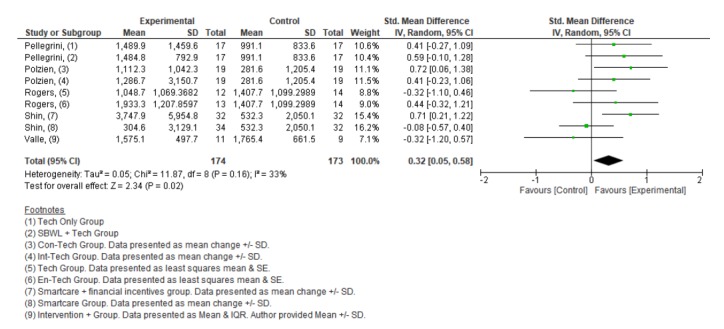
- Across 28 randomized controlled trials (3646 participants, 9 countries), the Results section reports significant increases versus control for daily steps (SMD 0.23; 95% CI 0.15–0.32; P<.001; ~627 steps/day), MVPA (SMD 0.28; 95% CI 0.14–0.41; P<.001; ~75 min/day), and energy expenditure (SMD 0.32; 95% CI 0.05–0.58; P=.02; ~300 kcal/week). The abstract reports slightly different SMDs for these outcomes (0.24, 0.27, and 0.28, respectively).
- Sedentary behavior showed a nonsignificant decrease (SMD −0.21; 95% CI −0.46 to 0.03; P=.09; ~37 min/day less), with moderate significant heterogeneity (I2=60%, P=.02); the abstract reports SMD −0.20, P=.08.
- Subgroup analyses found larger effects for multifaceted interventions than wearable-based-only interventions for steps (SMD 0.26 vs 0.20) and MVPA (SMD 0.33 vs 0.17, the latter nonsignificant); for sedentary behavior, wearable-based interventions showed a larger but nonsignificant decrease (SMD −0.60 vs −0.08).
- Quality of evidence was low for daily steps and energy expenditure and very low for MVPA and sedentary behavior; all studies were assessed as high risk of performance bias because blinding was not feasible.
Methods
- Systematic review and random-effects meta-analysis following PRISMA; databases searched from inception to March 15, 2017 included CENTRAL, MEDLINE, PubMed, Scopus, Web of Science, CINAHL, SPORTDiscus, and Health Technology Assessment.
- Included controlled trials of adults aged over 18 years comparing a consumer-based wearable activity tracker intervention with a non-tracker control; 28 RCTs were included, with 26 studies in the meta-analyses.
- Outcomes analyzed as standardized mean differences (SMD) for daily step count, MVPA, energy expenditure, and sedentary behavior; risk of bias was assessed across 7 domains and GRADE was used to rate evidence quality.
Limitations
- The paper states that the broad range of included interventions, comparators, populations, and settings created indirectness and heterogeneity, lowering the overall quality of evidence; comparator interventions also differed greatly, making synthesis difficult.
- The paper states that blinding of participants and personnel was not feasible, so all studies were at high risk of performance bias; publication bias could not be assessed for outcomes with fewer than 10 included studies.
- The text makes evident an inconsistency between the abstract and Results section for several effect estimates (e.g., steps SMD 0.24 vs 0.23; MVPA 0.27 vs 0.28; energy expenditure 0.28 vs 0.32; sedentary behavior −0.20 vs −0.21), which may complicate interpretation.
Model-written summary. Check it against the paper before relying on it.
Integrity signals
Registry
Cites
Statistics
Figures



Verification
Claims the paper makes
41 Valid · 5 Not valid · 9 Not checked · 82 Own results and interpretations
The cited sources support only part of this claim — read each source’s verdict below.
In the paper
“Blinding of outcome assessors (detection bias) was assessed as high risk for 7 studies [31,43,45-48,52] because of the use of subjective outcome measures.”
§ Consumer-Based Wearable Activity Trackers Increase Physical Activity Participation: Systematic Review and Meta-Analysis > Results > Risk of Bias
What the sources say
- Supportedcites [31] source
The Methods > Outcome measures section (page unavailable) describes this trial’s activity measures as participant-completed logs and questionnaires, and its wellness measure as responses to 103 self-statements. That supports citing this trial as one that used subjective outcome measures; the high-risk rating and count of seven studies are the citing authors’ assessment, not findings attributed to this trial. (LLM, conf=0.88)
- Supportedcites [43] source
The Methods and Procedures > Outcome measures section (page unavailable) describes questionnaire-based measures of physical activity, dietary intake, and eating behaviors, supporting the stated reason for the citing authors’ assessment. The high-risk detection-bias rating is the citing authors’ own assessment, not a rating the source paper needed to make. (LLM, conf=0.85)
- Partly supportedcites [45] sourceExperimental — accuracy not yet measured
The Assessments section (page unavailable) describes self-reported physical activity and questionnaire-based dietary intake, supporting the presence of subjective measures. It also says body weight was measured with a calibrated scale. The paper does not itself assess outcome-assessor blinding or classify the study as high risk of detection bias; that classification is the citing authors’ judgment. (LLM, conf=0.82)
- Supportedcites [46] source
The Methods > Outcome measures section (page unavailable) identifies participant-reported physical activity and questionnaire-based dietary intake and eating behaviors as outcomes, supporting this paper's inclusion among studies using subjective outcome measures. The high-risk detection-bias rating is the citing authors' assessment, not a finding attributed to this trial. (LLM, conf=0.86)
- Supportedcites [47] source
The Abstract describes this as an open-label randomized trial. The Measures and follow-up section lists questionnaire-based physical activity and diet measures, supporting its identification as a study with subjective outcome measures. The high-risk designation is the citing review’s assessment, not a finding the trial itself needs to report. (LLM, conf=0.85)
- Supportedcites [48] source
The Methods (Measurements; page unavailable) describe the primary physical-activity outcome as a participant-completed questionnaire. The Discussion (Limitations; page unavailable) explicitly says the primary outcome and some secondary outcomes were self-reported and prone to misreporting. This supports including this trial among studies using subjective outcome measures; the high-risk classification is the citing authors’ assessment. (LLM, conf=0.88)
- Partly supportedcites [52] sourceExperimental — accuracy not yet measured
The Discussion (page unavailable) identifies a lack of blinded outcome assessors as a limitation and says self-reported measures could bias some outcomes. The Methods > Measures section (page unavailable) also describes objectively measured outcomes, including weight. The paper therefore supports concerns about blinding and subjective measures in this trial, but it does not assess seven studies as high risk or say that its lack of blinding was high risk specifically because of subjective outcomes. (LLM, conf=0.86)
plain- Asserted: passes — The authors put it forward as true.
- Checkable: passes — It can be checked against evidence.
- Load-bearing: unclear — It is unclear whether the paper’s conclusions depend on it.
- Based: passes — The paper gives a reason why it holds.
- Supported
The cited sources support only part of this claim — read each source’s verdict below.
In the paper
“Randomized controlled trials have shown that these devices have promise in relation to increasing physical activity participation [21,22]”
§ Consumer-Based Wearable Activity Trackers Increase Physical Activity Participation: Systematic Review and Meta-Analysis > Introduction > Wearable Activity Trackers
What the sources say
- Supportedcites [21] source
The Results report increased physical activity in the Fitbit group, and the Discussion describes the Fitbit-based intervention as associated with increased activity. The Discussion also notes that between-group differences were not statistically significant and that the sample was small; the citing sentence’s cautious phrase “have promise” is consistent with those limits. (LLM, conf=0.90)
- Partly supportedcites [22] sourceExperimental — accuracy not yet measured
The Results > Mobility and Pain section (page unavailable) reports a significantly greater increase in daily steps in the intervention group, supporting the claim that this approach has promise. However, the Methods > Study Design section shows that patients received both a wearable tracker and a smartphone app, while the comparison group also wore a tracker without access to its data. The trial therefore does not establish an effect of consumer wearable trackers alone, and its participants were patients with knee osteoarthritis rather than a general population. (LLM, conf=0.86)
hedgedstates a possible cause- Asserted: passes — The authors put it forward as true.
- Checkable: passes — It can be checked against evidence.
- Load-bearing: passes — The paper’s conclusions depend on it.
- Based: passes — The paper gives a reason why it holds.
- Supported
The sources with a verdict support this claim; the rest weren’t checked yet, have no full text we could read, or their verdicts aren’t rated yet.
In the paper
“however, evidence regarding their long-term effectiveness is limited [15-17].”
§ Consumer-Based Wearable Activity Trackers Increase Physical Activity Participation: Systematic Review and Meta-Analysis > Introduction > Traditional Interventions to Increase Physical Activity Participation
What the sources say
- Supportedcites [15] source
The Authors’ Conclusions (Implications for practice) state that there is “only very limited evidence” of the long-term effectiveness of physical-activity interventions. The Discussion likewise says their long-term effectiveness is not established because most studies stopped after 12 months. (LLM, conf=0.90)
- Not checked — no full text of the sourcecites [16] source
- Not checked — no full text of the sourcecites [17] van der Bij, AK, 2002, Am J Prev Med source
plain- Asserted: passes — The authors put it forward as true.
- Checkable: passes — It can be checked against evidence.
- Load-bearing: passes — The paper’s conclusions depend on it.
- Based: passes — The paper gives a reason why it holds.
- Supported
Every source the paper cites for this claim was checked and supports it.
In the paper
“In addition, these types of interventions are often labor and resource intensive [18].”
§ Consumer-Based Wearable Activity Trackers Increase Physical Activity Participation: Systematic Review and Meta-Analysis > Introduction > Traditional Interventions to Increase Physical Activity Participation
What the sources say
- Supportedcites [18] Coughlin, SS, 2016, J Environ Health Sci source
The Introduction says established physical-activity and weight-loss interventions are resource-intensive and time-consuming. This directly supports the claim about traditional lifestyle interventions. (LLM, conf=0.94)
plain- Asserted: passes — The authors put it forward as true.
- Checkable: passes — It can be checked against evidence.
- Load-bearing: passes — The paper’s conclusions depend on it.
- Based: passes — The paper gives a reason why it holds.
- Supported
The cited sources support only part of this claim — read each source’s verdict below.
In the paper
“Interventions utilizing these methods have shown to be effective at increasing physical activity participation in the short term [12,14]”
§ Consumer-Based Wearable Activity Trackers Increase Physical Activity Participation: Systematic Review and Meta-Analysis > Introduction > Traditional Interventions to Increase Physical Activity Participation
What the sources say
- Partly supportedcites [12] sourceExperimental — accuracy not yet measured
The Conclusion reports that combined diet and physical activity interventions produced clinically meaningful HbA1c reductions at 3 and 6 months, supporting short-term effectiveness in adults with type 2 diabetes. It does not establish that the interventions increased physical activity participation; the reported outcome is glycaemic control. (LLM, conf=0.84)
- Not checked — no full text of the sourcecites [14] source
plainstates a cause- Asserted: passes — The authors put it forward as true.
- Checkable: passes — It can be checked against evidence.
- Load-bearing: unclear — It is unclear whether the paper’s conclusions depend on it.
- Based: passes — The paper gives a reason why it holds.
- Partly supported
53 more claims · 6 with their cited sources checked
Create a free account to see all 137 claims and to verify the 1 reference still open.
- Probably not a substantial claim. 54
- It may state two separate claims as one. 39
Claims other papers make about this one
Each is checked against this paper’s own text: does it say what the citing paper says it does?
The source backs part of the claim, not all of it — or backs it for a different population, condition or comparison.
In the citing paper
“They showed that the multifaceted interventions yielded effects around 50% larger than those using wearable activity trackers alone.”
From Effectiveness of wearable activity trackers to increase physical activity and improve health: a systematic review of systematic reviews and meta-analyses. (2022) · cites this paper as [8]
Experimental — accuracy not yet measuredThe cited source says what the claim attributes to it.
In the citing paper
“This is in contrast with a systematic review that showed a positive effect for CWATs, even when interventions were separated into CWAT-only and multifaceted interventions [74].”
The cited source says what the claim attributes to it.
In the citing paper
“However, a larger effect size for interventions that were multifaceted was found compared to CWAT-only interventions.”
The cited source says what the claim attributes to it.
In the citing paper
“their use has been associated with increased physical activity.[7][8][9]”
The cited source says what the claim attributes to it.
In the citing paper
“For step count, three meta-analyses of consumer activity trackers reported effect sizes 8,55,66 ranging from 0•23 (95% CI 0•15 to 0•32) to 0•33 (0•16 to 0•50; ie, small effects), all statistically significant (appendix p 35).”
3 more claims about this paper
Create a free account to see every claim other papers make about this one.
Self-check
Percentages, sums and reported differences re-computed from the paper’s own numbers.
Each contradiction between two passages listed here was confirmed by an independent check.
Rated major: it would touch a result — a value a result rests on, reported and recomputed p-values on opposite sides of the significance level, two passages that conflict with no sign which is right, or a cited work retracted before this paper was published.
In the paper
§ Consumer-Based Wearable Activity Trackers Increase Physical Activity Participation: Systematic Review and Meta-Analysis > Results > Physical Activity Participation
“These findings represent an approximate increase of 75 min (95% CI 42 to 109 min) per day of MVPA.”
§ Consumer-Based Wearable Activity Trackers Increase Physical Activity Participation: Systematic Review and Meta-Analysis > Methods > Data Synthesis
“Data presented as minutes of MVPA per day were multiplied by 7 to calculate minutes of MVPA per week to allow for greater transferability to current physical activity guidelines.”
Rated major: it would touch a result — a value a result rests on, reported and recomputed p-values on opposite sides of the significance level, two passages that conflict with no sign which is right, or a cited work retracted before this paper was published.
In the paper
§ Consumer-Based Wearable Activity Trackers Increase Physical Activity Participation: Systematic Review and Meta-Analysis > Abstract > Results
“energy expenditure (SMD 0.28; 95% CI 0.03 to 0.54; P=.03)”
§ Consumer-Based Wearable Activity Trackers Increase Physical Activity Participation: Systematic Review and Meta-Analysis > Results > Physical Activity Participation
“A random effects meta-analysis using SMD performed on the five included studies showed a significant increase in energy expenditure following the intervention versus control comparator (SMD 0.32; 95%CI 0.05 to 0.58; P=.02; Figure 5)”
Rated major: it would touch a result — a value a result rests on, reported and recomputed p-values on opposite sides of the significance level, two passages that conflict with no sign which is right, or a cited work retracted before this paper was published.
In the paper
§ Consumer-Based Wearable Activity Trackers Increase Physical Activity Participation: Systematic Review and Meta-Analysis > Discussion > Principal Findings
“The results show a significant improvement in all measures of physical activity participation when compared with control groups, even when interventions were separated into wearable-based and multifaceted.”
§ Consumer-Based Wearable Activity Trackers Increase Physical Activity Participation: Systematic Review and Meta-Analysis > Results > Physical Activity Participation
“There was a nonsignificant increase in minutes per day spent in MVPA following the intervention versus control comparator (SMD 0.17; 95% CI −0.00 to 0.34; P=.05; Figure 4) across studies included in the wearable-based meta-analysis”
Rated minor: it would not touch a result — a value no result rests on, a p-value that stays on the same side of the significance level, or a conflict that is clerical, resolved elsewhere in the paper, or outside its own findings.
In the paper
§ Consumer-Based Wearable Activity Trackers Increase Physical Activity Participation: Systematic Review and Meta-Analysis > Results > Physical Activity Participation
“Sedentary behavior was objectively measured except for 1 study [38], which utilized a self-reported questionnaire to obtain daily sitting time.”
§ Consumer-Based Wearable Activity Trackers Increase Physical Activity Participation: Systematic Review and Meta-Analysis > Results > Physical Activity Participation
“| Barwais et al, 2013 [31] | Sitting time (hours/day) | 7-day Sedentary and Light Intensity Physical Activity Log | Subjective |”
Rated minor: it would not touch a result — a value no result rests on, a p-value that stays on the same side of the significance level, or a conflict that is clerical, resolved elsewhere in the paper, or outside its own findings.
In the paper
§ Consumer-Based Wearable Activity Trackers Increase Physical Activity Participation: Systematic Review and Meta-Analysis > Abstract > Results
“moderate and vigorous physical activity (SMD 0.27; 95% CI 0.15 to 0.39; P<.001)”
§ Consumer-Based Wearable Activity Trackers Increase Physical Activity Participation: Systematic Review and Meta-Analysis > Results > Physical Activity Participation
“There was a significant increase in minutes per day spent in MVPA following the intervention versus control comparator (SMD 0.28; 95% CI 0.14 to 0.41; P<.001; Figure 4) across all studies in the meta-analysis”
7 more findings
Create a free account to see every finding of this check.
Citations
Cites
Ryan, R. M., & Deci, E. L. (2000) · American Psychologist · doi:10.1037//0003-066x.55.1.68 · Cited by 54,599 · cited 1×
“All studies included some form of behavioral change techniques ranging from basic techniques such as the provision of feedback and goal setting to interventions based on the Coventry, Aberdeen and London-Refined taxonomy [55], social cognitive theory [56], and social determination theory [57].”
Health benefits of physical activity: the evidence
Warburton, D. E. R. (2006) · Canadian Medical Association Journal · doi:10.1503/cmaj.051351 · Cited by 8,007
Global physical activity levels: surveillance progress, pitfalls, and prospects
Hallal, P. C., Andersen, L. B., Bull, F. C., Guthold, R., Haskell, W., & Ekelund, U. (2012) · The Lancet · doi:10.1016/s0140-6736(12)60646-1 · Cited by 5,711
Moral Identity and Developmental Theory
Lapsley, D. (2015) · Human Development · doi:10.1159/000435926 · Cited by 3,819
Sedentary Behavior Research Network (SBRN)—Terminology Consensus Project process and outcome
on behalf of SBRN Terminology Consensus Project Participants, Tremblay, M. S., Aubert, S., Barnes, J. D., Saunders, T. J., Carson, V., Latimer-Cheung, A. E., Chastin, S. F. M., Altenburg, T. M., & Chinapaw, M. J. M. (2017) · International Journal of Behavioral Nutrition and Physical Activity · doi:10.1186/s12966-017-0525-8 · Cited by 3,793
Lee, P. H., Macfarlane, D. J., Lam, T., & Stewart, S. M. (2011) · International Journal of Behavioral Nutrition and Physical Activity · doi:10.1186/1479-5868-8-115 · Cited by 3,370 · cited 1×
“Although the use of these types of questionnaires is widely accepted, self-reported questionnaires have been shown to be less robust in measuring energy expenditure and MVPA when compared with objective measures [98,99].”
Biswas, A., Oh, P. I., Faulkner, G. E., Bajaj, R. R., Silver, M. A., Mitchell, M. S., & Alter, D. A. (2015) · Annals of Internal Medicine · doi:10.7326/m14-1651 · Cited by 2,726 · cited 1×
“In addition, sedentary behavior, which is defined as any waking behavior while in a sitting, reclining, or lying position [7], is independently associated with poor health outcomes, including all-cause and cardiovascular disease mortality [8,9].”
The role and interpretation of pilot studies in clinical research
Leon, A. C., Davis, L. L., & Kraemer, H. C. (2011) · Journal of Psychiatric Research · doi:10.1016/j.jpsychires.2010.10.008 · Cited by 1,917 · cited 1×
“Potential reasons why other included studies did not find a significant intervention effect or observed a reduction in physical activity participation may be because of several of the studies being pilot studies [29,30,40,47,52], which often have insufficient power because of small sample sizes [93]; a moderate-to-hig…”
Bandura, A. (2008) · The International Encyclopedia of Communication · doi:10.1002/9781405186407.wbiecs053 · Cited by 1,902
Michie, S., Ashford, S., Sniehotta, F. F., Dombrowski, S. U., Bishop, A., & French, D. P. (2011) · Psychology & Health · doi:10.1080/08870446.2010.540664 · Cited by 1,756 · cited 1×
“All studies included some form of behavioral change techniques ranging from basic techniques such as the provision of feedback and goal setting to interventions based on the Coventry, Aberdeen and London-Refined taxonomy [55], social cognitive theory [56], and social determination theory [57].”
Research works printed but not linked: 3
- Higgins, JT, 2011, Cochrane Handbook for Systematic Reviews of Interventions Version 5.1.0
- Fu, R, 2013, Handling continuous outcomes in quantitative synthesis. Methods guide for comparative effectiveness reviews
- Schunemann, H, 2015, The GRADE Working Group, 2013
Cited by
Items 501–600 of 647
Is the Portuguese Software Industry Ready for eHealth? An Exploratory Study
Pereira, L. T., Queirós, A., & Rocha, N. P. (2021) · Procedia Computer Science · doi:10.1016/j.procs.2021.01.183 · Cited by 1
McDermott, J. (2020) · Carolina Digital Repository (University of North Carolina at Chapel Hill) · doi:10.17615/nr4k-vr86
Physical Sensors: Motion Sensors for Physical Activity Assessment
Sasaki, J. E., & Motl, R. W. (2021) · Elsevier eBooks · doi:10.1016/b978-0-12-822548-6.00056-x · Cited by 3
Ummels, D. (2021) · Research Publications (Maastricht University) · doi:10.26481/dis.20211001du · Cited by 1
Posture Recognition in the Critical Care Settings using Wearable DevicesPreprint
Davoudi, A., Tighe, P. J., Bihorac, A., & Rashidi, P. (2021) · arXiv (Cornell University) · doi:10.48550/arxiv.2110.02768
Physical activity and cardiovascular disease risk in women with polycystic ovary syndrome
Woodward, A. (2021) · Sheffield Hallam University · doi:10.7190/shu-thesis-00398 · Cited by 2
Wearable Technology in Football Further Education Settings in the United Kingdom
Tierney, P. (2021) · Liverpool John Moores University · doi:10.24377/ljmu.t.00015733 · Cited by 3
Strahlentherapie und Bewegung: Die OnkoFit- I/II-(ARO-2020-2/3)-Studien
Hauth, F., & Gani, C. (2021) · Forum · doi:10.1007/s12312-021-01023-x
Digital health in obstetric care
van den Heuvel, J. F. M. (2021) · Utrecht University Repository (Utrecht University) · doi:10.33540/605 · Cited by 3
Östlind, E., Sant’Anna, A., Eek, F., Stigmar, K., & Hansson, E. E. (2020) · doi:10.21203/rs.3.rs-70745/v1
Mobile Sensors and Wearable Technology
Yao, C. A., & Ho, K. (2021) · Springer eBooks · doi:10.1007/978-3-030-69262-9_30
Utilizing wearable devices to improve patient care: Cross-sectional survey (Preprint)Preprint
Vaughan, A., Warner, H. L., Gannon, M., & Pearlman, A. M. (2022) · doi:10.2196/preprints.39853
Santo, K. (2022) · Current Atherosclerosis Reports · doi:10.1007/s11883-022-01050-6
Ein Fitnesscoach für Menschen mit Querschnittslähmung
Nickel, K., & Bolz, J. (2022) · ASIM Symposium Simulationstechnik (ASIM SST) · doi:10.11128/arep.20.a2026
Fitness motivations in United States Airmen
Howard, P., & Deutsch, J. (2022) · Journal of Human Sciences · doi:10.14687/jhs.v19i3.6275
Wenz, B., Graf, J., Du, Y., Teti, A., & Gabrys, L. (2022) · Healthcare · doi:10.3390/healthcare10101857
Franssen, W. M. A. (2022) · Research Publications (Maastricht University) · doi:10.26481/dis.20221121wf · Cited by 1
Kodama, K. (2022) · Future of business and finance · doi:10.1007/978-981-19-4230-3_7
Intervention at Appropriate Timing to Increase Steps Based on FBM
Yuasa, T., Harada, F., & Shimakawa, H. (2023) · Advances in Social Sciences Research Journal · doi:10.14738/assrj.101.13906
Howland, C. (2022) · MOspace Institutional Repository (University of Missouri) · doi:10.32469/10355/94065
Viselhető technológia használat a Debreceni Egyetem hallgatói körében
Ráthonyi, G., Ráthonyi-Ódor, K., Szabados, G. N., Bács, Z., & Bába, É. B. (2023) · International Journal of Engineering and Management Sciences · doi:10.21791/ijems.2023.1.5
Revenäs, Å., Ström, L., Cicchetti, A., & Ehn, M. (2023) · Digital Health · doi:10.1177/20552076231180973
Kim, Y., Yoo, L., Kim, M., & Moon, C. S. (2023) · Research Square · doi:10.21203/rs.3.rs-3104872/v1
Physical activity, sedentary behavior and sleep measured by smartwatch: a scoping review protocol
da Silva, J. F., Germano-Soares, A. H., Filho, V. C. B., Mota, J. G., Silva, L. C. B., de Oliveira, T. R., & Tassitano, R. M. (2023) · Revista Brasileira de Atividade Física & Saúde · doi:10.12820/rbafs.28e0301 · Cited by 1
Transforming the performance of runners with AI-driven training planning and daily adaptivityPreprint
Nilsson, L., Södergård, O., Rogestedt, J., Mattsson, C. M., & Larsen, F. (2023) · bioRxiv (Cold Spring Harbor Laboratory) · doi:10.1101/2023.10.06.561160
The Vitality Active Rewards with Apple Watch Benefit: A follow-up study
Romanelli, R. J., Parkinson, S., Phillips, W., Stockwell, S., & Stolk, C. V. (2023) · RAND Corporation eBooks · doi:10.7249/rra2623-1
Designing Novel Approaches to Personalise Behaviour Change in Intelligent Systems
Scott, D. (2024) · Cronfa (Swansea University) · doi:10.23889/suthesis.65829 · Cited by 1
Behandlungskonzepte bei Adipositas
(2024) · Elsevier eBooks · doi:10.1016/b978-3-437-23026-4.00003-4
Usage of Fitness Applications by the Sports People: A Bibliometric Analysis
Khan, S. A., Khatri, B., Saxena, C., & Arora, S. (2024) · Innovations in Sustainable Technologies and Computing · doi:10.1007/978-981-97-1111-6_27
Ching, J., Duff, S., & Hernandez, J. (2024) · medRxiv · doi:10.1101/2024.06.05.24306788 · Cited by 1
Azemmour, Y., Beddaa, H., Chamlal, H., Elkhalloufi, F., Rouani, A., Fares, R., & Boutayeb, S. (2024) · International Journal of Innovative Research in Medical Science · doi:10.23958/ijirms/vol09-i07/1933
The Role of Exercise in the CVD Prevention
Lewek, J., Bytyçi, I., & Banach, M. (2024) · Advances in biochemistry in health and disease · doi:10.1007/978-3-031-62806-1_18
Uso de aplicaciones móviles en la actividad física: teoría de la tecnología persuasiva
Cuevas-Castro, C. S., Valencia-Falcón, T., & Colmenero, B. R. R. (2024) · Revista Ciencia UANL · doi:10.29105/cienciauanl27.127-1 · Cited by 2
Technology Interventions and Support for Total Worker Health ®
Tapp, L. (2024) · Wiley eBooks · doi:10.1002/9781394302147.ch7
Shi, L., Fiscella, N., & Leung, W. C. W. (2024) · Disability and Rehabilitation Assistive Technology · doi:10.1080/17483107.2024.2436128
Electronic Activity Monitoring
Lewis, Z. H., & Christopherson, U. (2023) · Cambridge University Press eBooks · doi:10.1017/9781107165250.017
Technologies in Cyber Behavior
Yukang, X., & Zhu, L. (2023) · Cambridge University Press eBooks · doi:10.1017/9781107165250.010
Evaluating a Treatment Package to Increase Aerobic Activity in University Students
Simone, M. N., Reeve, S. A., DeBar, R. M., Meyer, L. S., & Hickey, C. R. (2024) · Journal of Behavioral Education · doi:10.1007/s10864-024-09575-3
“Various studies have used fitness trackers to increase physical activity, such as moderate to vigorous physical activity (MVPA), energy expenditure and most commonly, step count (Brickwood et al., 2019; Gal et al., 2018; Kurti & Dallery, 2013; Valbuena et al., 2019).”
African Journal of Biomedical Research
Yahya, S. M. N. S., Jamaludin, K. A., & Mazalan, N. S. (2024) · doi:10.53555//ajbr.v28i1.3085
Pinelli, M., Pantusa, E., Lettieri, E., & Galli, M. (2024) · IEEE Canada International Humanitarian Technology Conference · doi:10.1109/ihtc61819.2024.10855046
Mindfulness, Mind-body Exercises, and Health Promotion
Zhang, G. (2025) · Frontiers research topics · doi:10.3389/978-2-8325-6009-9
Cardiometabolic-Based Chronic Disease
Hernández-Sevillano, J., Babagoli, M. A., Mellacheruvu, P., & Mechanick, J. I. (2025) · Springer eBooks · doi:10.1007/978-3-031-82888-1_6
Kraaijkamp, J. J. M., de Waal, M. W. M., Chavannes, N. H., Achterberg, W. P., van Isselt, E. F. V. D., & Punt, M. (2025) · Journal of Rehabilitation Medicine – Clinical Communications · doi:10.2340/jrm-cc.v8.43129
O‘tkirvich, Z. A., Olimov, A. I., Бахромов, О. Т., Egamberdiyev, R., Abdulxayitovich, A. X., Taniberdiyev, A., & Anvarovich, S. E. (2025) · International Journal of Environmental Sciences · doi:10.64252/e8p56713
Current Global Trends in Behavioral Medicine
Vichou, M. D., Pilafas, G., & Louka, P. (2025) · International Journal of Science and Healthcare Research · doi:10.52403/ijshr.20250303
The Effect of Personality on the Achievement of Physical Activity GoalsPreprint
AlMulhem, S. (2025) · SSRN Electronic Journal · doi:10.2139/ssrn.5374967
มุมมองต่อการใช้นาฬิกาอัจฉริยะเพื่อสุขภาพ: การศึกษาเชิงคุณภาพ
วงศ์หาญชัย, ส., หัตถีรัตน์, ส., & สุขโต, ก. (2025) · Ramathibodi Medical Journal · doi:10.33165/rmj.48.03.e273323
Ho, H. H. S., Chen, Z., Godino, J., Multhaup, M., Chan, D. K. C., Yeung, S. L. A., Luo, S., Chung, B. H., Griffin, S. J., & Kim, Y. (2025) · JMIR Research Protocols · doi:10.2196/65012
Kondepudi, G. M., Pothula, V. S., & Sivaji, K. (2025) · Information systems engineering and management · doi:10.1007/978-3-031-98897-4_9
Leung, W. C. W., Hubbard, M., Lee, J., Kim, M., & Shi, L. (2025) · Journal of Asthma · doi:10.1080/02770903.2025.2555301
Yang, R., Zeng, H., Peng, J., Chen, B., & Hao, L. (2025) · Osteoarthritis and Cartilage · doi:10.1016/j.joca.2025.09.003
Secades‐Villa, R., Cuesta‐López, I., & González‐Roz, A. (2025) · Drug and Alcohol Dependence · doi:10.1016/j.drugalcdep.2025.112893
Huang, W., Wong, M. K. F., Loh, E. D. W., Koh, T., Tan, A. W., Shen, X., Varli, O., Kong, S. C., Chin, C., Tan, S. Y., et al. (2025) · JMIR mhealth and uhealth · doi:10.2196/71213 · Cited by 1
McCullen, M. N., & Zerger, H. M. (2025) · Journal of Applied Behavior Analysis · doi:10.1002/jaba.70032
Dijck, S. V., Groef, A. D., Mertens, M. G., Devoogdt, N., Overbeke, M. V., Meeus, M., der Gucht, E. V., & Dams, L. (2025) · Journal of Behavioral Medicine · doi:10.1007/s10865-025-00607-5
Özsoy, A., Yıldız, N. O., Çar, B., Salamone, E. A., Mazzara, F., Gürer, M., Agbulut, B., Erkadam, E. K., Karakus, Z., Ahraz, A. O., et al. (2025) · Spor Bilimleri Araştırmaları Dergisi · doi:10.25307/jssr.1591617 · Cited by 1
Bélanger, M. F., Registe, P. P. W., Faivre, P., Tanguay, P., Jemaa, S., Gallant, F., Giroux, M.-A., Thibault, V., Hakim, J., Clément, J.-F., et al. (2025) · Journal of Behavioral Medicine · doi:10.1007/s10865-025-00611-9
Rowe, G., Weight, D., Rea, A., Conlon, J. A., Wood, F. M., & Edgar, D. W. (2025) · PLoS ONE · doi:10.1371/journal.pone.0333504 · Cited by 1
Godoy-Cumillaf, A. E. R., Fuentes-Merino, P., Giakoni-Ramírez, F., Muñoz-Strale, C., de Souza-Lima, J., Bastías, D. M. D., Parra-Saldías, M., Bruneau-Chávez, J., & Merellano-Navarro, E. (2025) · JMIR Research Protocols · doi:10.2196/83983
Multimodal Sensing and Modeling of Endocrine Therapy Adherence in Breast Cancer Survivors
Yuan, F., Kaur, N., Wang, Z., Gonzales, M., Alcaraz, C. G., Estrella, G., Wells, K. J., & Barnes, L. E. (2025) · Proceedings of the ACM on Interactive Mobile Wearable and Ubiquitous Technologies · doi:10.1145/3770864 · Cited by 1
Multimorbidity measurement strategies for predicting hospital visits
Neves, B. D., Moreira, J. M., Gonçalves, S., Cerejo, J., Mota, I., Silva, N. A., Leite, F., & Silva, M. J. (2025) · BMC Health Services Research · doi:10.1186/s12913-025-13817-z
Joisten, C., & Wolfarth, B. (2025) · CME · doi:10.1007/s11298-025-4431-0
Hannan, A. L., Hing, W., Coombes, J. S., Gough, S., Climstein, M., Adsett, G., Jayasinghe, R., & Furness, J. W. (2021) · Figshare · doi:10.6084/m9.figshare.16780917
Franssen, W. M. A., Franssen, G. H. L. M., Spaas, J., Solmi, F., & Eijnde, B. O. (2020) · Figshare · doi:10.6084/m9.figshare.12284660
Casado-Robles, C., Viciana, J., Guijarro-Romero, S., & Mayorga-Vega, D. (2022) · Figshare · doi:10.6084/m9.figshare.19102005
Weber, M. B., Ziolkowski, S., Bootwala, A., Bienvenida, A., Anand, S., & Lobelo, F. (2021) · Figshare · doi:10.6084/m9.figshare.16986687
Casado-Robles, C., Viciana, J., Guijarro-Romero, S., & Mayorga-Vega, D. (2022) · Figshare · doi:10.6084/m9.figshare.19102029
Casado-Robles, C., Viciana, J., Guijarro-Romero, S., & Mayorga-Vega, D. (2022) · Figshare · doi:10.6084/m9.figshare.19102032
Casado-Robles, C., Viciana, J., Guijarro-Romero, S., & Mayorga-Vega, D. (2022) · Figshare · doi:10.6084/m9.figshare.19102026
Antoun, J., Shehab, R., Sakr, G., Hlais, S., Awad, M., & Romani, M. (2022) · Figshare · doi:10.6084/m9.figshare.19159111
Casado-Robles, C., Viciana, J., Guijarro-Romero, S., & Mayorga-Vega, D. (2022) · Figshare · doi:10.6084/m9.figshare.19102014
Casado-Robles, C., Viciana, J., Guijarro-Romero, S., & Mayorga-Vega, D. (2022) · Figshare · doi:10.6084/m9.figshare.19102008
Casado-Robles, C., Viciana, J., Guijarro-Romero, S., & Mayorga-Vega, D. (2022) · Figshare · doi:10.6084/m9.figshare.19102011
Casado-Robles, C., Viciana, J., Guijarro-Romero, S., & Mayorga-Vega, D. (2022) · Figshare · doi:10.6084/m9.figshare.19102017
Franssen, W. M. A., Franssen, G. H. L. M., Spaas, J., Solmi, F., & Eijnde, B. O. (2020) · Figshare · doi:10.6084/m9.figshare.12284657
Hannan, A. L., Hing, W., Coombes, J. S., Gough, S., Climstein, M., Adsett, G., Jayasinghe, R., & Furness, J. W. (2021) · Figshare · doi:10.6084/m9.figshare.16780920
Casado-Robles, C., Viciana, J., Guijarro-Romero, S., & Mayorga-Vega, D. (2022) · Figshare · doi:10.6084/m9.figshare.19102023
Casado-Robles, C., Viciana, J., Guijarro-Romero, S., & Mayorga-Vega, D. (2022) · Figshare · doi:10.6084/m9.figshare.19102035
Franssen, W. M. A., Franssen, G. H. L. M., Spaas, J., Solmi, F., & Eijnde, B. O. (2020) · Figshare · doi:10.6084/m9.figshare.12284666
Casado-Robles, C., Viciana, J., Guijarro-Romero, S., & Mayorga-Vega, D. (2022) · Figshare · doi:10.6084/m9.figshare.19102020
Weber, M. B., Ziolkowski, S., Bootwala, A., Bienvenida, A., Anand, S., & Lobelo, F. (2021) · Figshare · doi:10.6084/m9.figshare.16986684
Longhini, J., Marzaro, C., Bargeri, S., Palese, A., Dell’Isola, A., Turolla, A., Pillastrini, P., Battista, S., Castellini, G., Cook, C., et al. (2024) · Figshare · doi:10.6084/m9.figshare.24997198
Gitlin, L. N., & Czaja, S. J. (2025) · Elsevier eBooks · doi:10.1016/b978-0-443-21664-0.00015-5 · Cited by 1
Understanding the Impact of Physical Inactivity on Exercise and Health
Burton, H. M., & Dial, M. B. (2025) · ACSMʼs Health & Fitness Journal · doi:10.1249/fit.0000000000001125
Ahmed, F., Almutairi, B. M., & Alharbi, S. S. (2026) · Nutrition & Metabolism · doi:10.1186/s12986-026-01078-4
Yamakita, M., Ando, D., Sato, M., Akiyama, Y., Yamaguchi, K., & Yamagata, Z. (2026) · Children · doi:10.3390/children13020184
Digital Health Tools Embedded in a Cancer Genetics Clinic: Observational Study
Nagaraj, S., Rabinowicz, R., Goodday, S., Brunga, L., Korenblum, C., Villani, A., Kim, R. H., Karlin, E., Greer, R. W., Balaci, H., et al. (2026) · JMIR Formative Research · doi:10.2196/74375
Huang, J., Ren, L., Xu, J., Wang, J., Wang, T., Yuan, D., Huang, B., & Zhao, J. (2026) · Trials · doi:10.1186/s13063-025-08948-x
Lev, A., & Landgren, J. (2026) · American Behavioral Scientist · doi:10.1177/00027642261421300 · Cited by 2
Physical Activity Levels of Early Childhood Educators: A Systematic Review and Meta‐Analysis
Hawthorne, M., Inniss, B., Heydon, R. M., Burke, S. M., & Tucker, P. (2026) · Child Care Health and Development · doi:10.1111/cch.70259 · Cited by 1
“This outcome was selected, as it provides a standardized, policy-relevant benchmark for adult PA. Studies presenting proportions meeting equivalent guidelines (e.g., the Physical Activity Guidelines for Americans) (Brickwood et al. 2019) were also accepted if comparable to the WHO Guidelines.”
Rauzi, M. R., Weeks, C., Thurston, T. S., Fitzpatrick, J., Plew, J. T., Fuller, M., Forster, J. E., Abbate, L. M., Christiansen, C. L., & Stevens‐Lapsley, J. E. (2026) · Physical Therapy · doi:10.1093/ptj/pzag030
Naunton, J., Jiang, Y., Bini, R. R., Kidgell, D. J., Bennell, K., Haines, T. P., Kulić, D., & Malliaras, P. (2026) · European Journal of Sport Science · doi:10.1002/ejsc.70167
Bayram, G. A., Tarakçı, D., Sahin, G. E., Cevlan, G. S., Ceylan, A., Atılgan, E., Ozkan, K., & Kunter, E. (2026) · BMJ Open · doi:10.1136/bmjopen-2026-117541
Mesure de la fragilité par capteurs embarqués chez les aînés : enjeux et réception
Prud’homm, J. (2024) · theses.fr (ABES) · doi:10.70675/e1929601zed2az4a1czb9d7z23c12c697592
Hu, S., & Zhang, Z. (2026) · CHI Conference on Human Factors in Computing Systems · doi:10.1145/3772318.3791978 · Cited by 1
Association between the use of fitness trackers, perfectionism, motivation and anxiety in athletes
Huguet-López, I., Barbera, S. T., & López-Mora, C. (2026) · Frontiers in Psychology · doi:10.3389/fpsyg.2026.1805652 · Cited by 1
“Despite its growing use, most studies have focused on clinical populations (McDonough et al., 2021) and its potential to increase physical activity (Brickwood et al., 2019), leaving a gap in our knowledge about its relationship with classic psychological variables in the context of sports…”
Advancing Obesity Care: Innovations in Devices and Treatment Strategies
Jaber, N., Al-Remawi, M. M., Abdel‐Rahem, R. A., Jaber, A., & Albustanji, M. (2025) · Palestinian medical and pharmaceutical journal/Palestinian medical & pharmaceutical journal · doi:10.59049/2790-0231.12.1.2649
Pelletier, J., Wingood, M., Alcon, C. A., & Nedimyer, A. K. (2026) · doi:10.2196/preprints.96988
Biet, R. (2026) · Kinestetik Jurnal Ilmiah Pendidikan Jasmani · doi:10.33369/jk.v10i1.46906
Aumento semanal de pasos reduce presión arterial en adultos jóvenes normotensos sanos
Espinoza-Salinas, A., Alarcón, R., Curín, E., & Russell-Guzmán, J. (2026) · Journal of Sport and Health Research · doi:10.58727/jshr.115256
Metadata
- Authors
- Brickwood, K.-J., Watson, G., O'Brien, J., & Williams, A. D.
- Affiliations
- University of Tasmania (AU)
- Corresponding author
- Brickwood, Katie-Jane
- Venue
- JMIR mHealth and uHealth
- Publisher
- JMIR Publications Inc.
- Published
- 2019-04-12
- Volume
- 7
- Issue
- 4
- Pages
- e11819
- ISSN
- 2291-5222 (ISSN-L)
- PMC
- PMC6484266
- OpenAlex
- W2913335608
- Cited by
- 689
- References
- 99
- Citations by year
- 2026: 96 · 2025: 91 · 2024: 90 · 2023: 100 · 2022: 117 · 2021: 114 · 2020: 65 · 2019: 14
- FWCI
- 10.66
- Type
- journal article
- Language
- en
- Open access
- gold
- doi.org
- Licence
- cc-by
- Locations
- JMIR mhealth and uhealth (publishedVersion, cc-by)
- PubMed Central (publishedVersion, cc-by)
- PubMed (publishedVersion)
- UTAS Research Repository (acceptedVersion)
- Murdoch University Research Portal (submittedVersion, cc-by)
- QUT ePrints (Queensland University of Technology) (submittedVersion, cc-by)
- DOAJ (DOAJ: Directory of Open Access Journals) (submittedVersion, cc-by-sa)
- Figshare (submittedVersion, cc-by)
- Topics
- Health Sciences › Medicine › Public Health, Environmental and Occupational Health › Physical Activity and Health
- Health Sciences › Health Professions › General Health Professions › Mobile Health and mHealth Applications
- Physical Sciences › Computer Science › Computer Vision and Pattern Recognition › Context-Aware Activity Recognition Systems
- Keywords
- wearable activity trackers, physical activity participation, sedentary behavior, step count, moderate-to-vigorous physical activity, energy expenditure, physical inactivity, lifestyle intervention, adults, self-monitoring, performance bias, risk of bias, heterogeneity, quality of evidence, GRADE, risk of bias assessment
- MeSH terms
- Fitness Trackers, Humans, Patient Participation, Quality of Life, Exercise, Sedentary Behavior
About these checks
Registry, retraction, Cites and statistics results are computed, not judged, with one exception: a printed reference that no index lists is read once by a model before it counts as a citation error. Claims are extracted by a model and kept only when their quote appears verbatim in the text; each cited source is then checked, with a model’s help, for whether it says what the claim relies on. Those verdicts can be wrong — read the claim’s quote and the cited source before relying on one.
The claim verdicts this report counts are experimental: their accuracy is not yet measured.
A language model drew the claims from the paper on 2026-10-09, under version 3 of the claim definition (model deepseek-v4.1-flash, prompt extract-v3).
A second model labelled each claim on 2026-10-09 (model jev-1.13-20260917, definition revision gold-guideline-v0.2).
Cited sources are checked with a language model’s help (gpt-6-sol).
Statistics and arithmetic are recomputed, not judged.
Confidence bands are shown only for fields calibrated on our annotated test set. None is calibrated yet, so no band is shown.
What counts as a claim ›How we measure confidence ›How we check this ›
Are you an author, or do you see a problem with this page? Request a review
Data sources
Bibliographic data: Semantic Scholar, OpenAlex, Crossref.
Contains information from the Semantic Scholar Academic Graph Datasets, made available under the ODC Attribution License (ODC-BY 1.0).
Semantic Scholar’s data is described in: Kinney, R., et al. (2023). The Semantic Scholar Open Data Platform. arXiv:2301.10140.
