

Consumer-Based Wearable Activity Trackers Increase Physical Activity Participation: Systematic Review and Meta-Analysis
Open accessPublished version of a preprint
The DOI matches its Crossref record; 99 of the 99 references it cites were found in a registry or an index; 139 of the 166 sources its claims cite were checked for support.
Abstract
Background: The range of benefits associated with regular physical activity participation is irrefutable. Despite the well-known benefits, physical inactivity remains one of the major contributing factors to ill-health throughout industrialized countries. Traditional lifestyle interventions such as group education or telephone counseling are effective at increasing physical activity participation; however, physical activity levels tend to decline over time. Consumer-based wearable activity trackers that allow users to objectively monitor activity levels are now widely available and may offer an alternative method for assisting individuals to remain physically active. Objective: This review aimed to determine the effects of interventions utilizing consumer-based wearable activity trackers on physical activity participation and sedentary behavior when compared with interventions that do not utilize activity tracker feedback. Methods: A systematic review was performed searching the following databases for studies that included the use of a consumer-based wearable activity tracker to improve physical activity participation: Cochrane Controlled Register of Trials, MEDLINE, PubMed, Scopus, Web of Science, Cumulative Index of Nursing and Allied Health Literature, SPORTDiscus, and Health Technology Assessments. Controlled trials of adults comparing the use of a consumer-based wearable activity tracker with other nonactivity tracker–based interventions were included. The main outcome measures were physical activity participation and sedentary behavior. All studies were assessed for risk of bias, and the Grades of Recommendation, Assessment, Development, and Evaluation system was used to rank the quality of evidence. The guidelines of the Preferred Reporting Items for Systematic Reviews and Meta-Analyses statement were followed. A random-effects meta-analysis was completed on the included outcome measures to estimate the treatment effect of interventions that included an activity tracker compared with a control group. Results: There was a significant increase in daily step count (standardized mean difference [SMD] 0.24; 95% CI 0.16 to 0.33; P<.001), moderate and vigorous physical activity (SMD 0.27; 95% CI 0.15 to 0.39; P<.001), and energy expenditure (SMD 0.28; 95% CI 0.03 to 0.54; P=.03) and a nonsignificant decrease in sedentary behavior (SMD −0.20; 95% CI −0.43 to 0.03; P=.08) following the intervention versus control comparator across all studies in the meta-analyses. In general, included studies were at low risk of bias, except for performance bias. Heterogeneity varied across the included meta-analyses ranging from low (I2=3%) for daily step count through to high (I2=67%) for sedentary behavior. Conclusions: Utilizing a consumer-based wearable activity tracker as either the primary component of an intervention or as part of a broader physical activity intervention has the potential to increase physical activity participation. As the effects of physical activity interventions are often short term, the inclusion of a consumer-based wearable activity tracker may provide an effective tool to assist health professionals to provide ongoing monitoring and support.
Overview
CoChat Summary
TL;DR
This systematic review and meta-analysis found that interventions using consumer-based wearable activity trackers increased physical activity participation versus non-tracker controls, with significant effects on daily steps, moderate-to-vigorous physical activity (MVPA), and energy expenditure, but not sedentary behavior. Evidence quality was rated low to very low.
Key findings
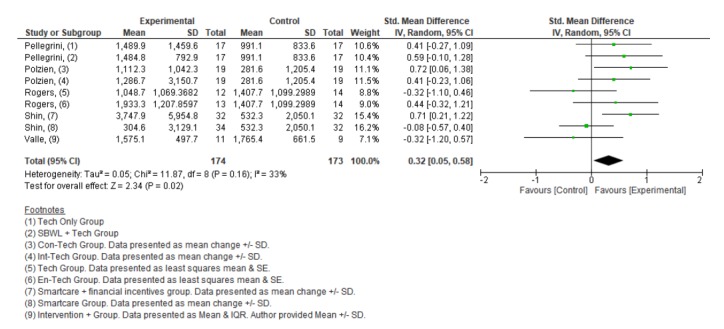
- Across 28 randomized controlled trials (3646 participants, 9 countries), the Results section reports significant increases versus control for daily steps (SMD 0.23; 95% CI 0.15–0.32; P<.001; ~627 steps/day), MVPA (SMD 0.28; 95% CI 0.14–0.41; P<.001; ~75 min/day), and energy expenditure (SMD 0.32; 95% CI 0.05–0.58; P=.02; ~300 kcal/week). The abstract reports slightly different SMDs for these outcomes (0.24, 0.27, and 0.28, respectively).
- Sedentary behavior showed a nonsignificant decrease (SMD −0.21; 95% CI −0.46 to 0.03; P=.09; ~37 min/day less), with moderate significant heterogeneity (I2=60%, P=.02); the abstract reports SMD −0.20, P=.08.
- Subgroup analyses found larger effects for multifaceted interventions than wearable-based-only interventions for steps (SMD 0.26 vs 0.20) and MVPA (SMD 0.33 vs 0.17, the latter nonsignificant); for sedentary behavior, wearable-based interventions showed a larger but nonsignificant decrease (SMD −0.60 vs −0.08).
- Quality of evidence was low for daily steps and energy expenditure and very low for MVPA and sedentary behavior; all studies were assessed as high risk of performance bias because blinding was not feasible.
Methods
- Systematic review and random-effects meta-analysis following PRISMA; databases searched from inception to March 15, 2017 included CENTRAL, MEDLINE, PubMed, Scopus, Web of Science, CINAHL, SPORTDiscus, and Health Technology Assessment.
- Included controlled trials of adults aged over 18 years comparing a consumer-based wearable activity tracker intervention with a non-tracker control; 28 RCTs were included, with 26 studies in the meta-analyses.
- Outcomes analyzed as standardized mean differences (SMD) for daily step count, MVPA, energy expenditure, and sedentary behavior; risk of bias was assessed across 7 domains and GRADE was used to rate evidence quality.
Limitations
- The paper states that the broad range of included interventions, comparators, populations, and settings created indirectness and heterogeneity, lowering the overall quality of evidence; comparator interventions also differed greatly, making synthesis difficult.
- The paper states that blinding of participants and personnel was not feasible, so all studies were at high risk of performance bias; publication bias could not be assessed for outcomes with fewer than 10 included studies.
- The text makes evident an inconsistency between the abstract and Results section for several effect estimates (e.g., steps SMD 0.24 vs 0.23; MVPA 0.27 vs 0.28; energy expenditure 0.28 vs 0.32; sedentary behavior −0.20 vs −0.21), which may complicate interpretation.
Model-written summary. Check it against the paper before relying on it.
Integrity signals
Registry
Cites
Statistics
Figures



Verification
Claims the paper makes
41 Valid · 5 Not valid · 9 Not checked · 82 Own results and interpretations
The cited sources support only part of this claim — read each source’s verdict below.
In the paper
“Blinding of outcome assessors (detection bias) was assessed as high risk for 7 studies [31,43,45-48,52] because of the use of subjective outcome measures.”
§ Consumer-Based Wearable Activity Trackers Increase Physical Activity Participation: Systematic Review and Meta-Analysis > Results > Risk of Bias
What the sources say
- Supportedcites [31] source
The Methods > Outcome measures section (page unavailable) describes this trial’s activity measures as participant-completed logs and questionnaires, and its wellness measure as responses to 103 self-statements. That supports citing this trial as one that used subjective outcome measures; the high-risk rating and count of seven studies are the citing authors’ assessment, not findings attributed to this trial. (LLM, conf=0.88)
- Supportedcites [43] source
The Methods and Procedures > Outcome measures section (page unavailable) describes questionnaire-based measures of physical activity, dietary intake, and eating behaviors, supporting the stated reason for the citing authors’ assessment. The high-risk detection-bias rating is the citing authors’ own assessment, not a rating the source paper needed to make. (LLM, conf=0.85)
- Partly supportedcites [45] sourceExperimental — accuracy not yet measured
The Assessments section (page unavailable) describes self-reported physical activity and questionnaire-based dietary intake, supporting the presence of subjective measures. It also says body weight was measured with a calibrated scale. The paper does not itself assess outcome-assessor blinding or classify the study as high risk of detection bias; that classification is the citing authors’ judgment. (LLM, conf=0.82)
- Supportedcites [46] source
The Methods > Outcome measures section (page unavailable) identifies participant-reported physical activity and questionnaire-based dietary intake and eating behaviors as outcomes, supporting this paper's inclusion among studies using subjective outcome measures. The high-risk detection-bias rating is the citing authors' assessment, not a finding attributed to this trial. (LLM, conf=0.86)
- Supportedcites [47] source
The Abstract describes this as an open-label randomized trial. The Measures and follow-up section lists questionnaire-based physical activity and diet measures, supporting its identification as a study with subjective outcome measures. The high-risk designation is the citing review’s assessment, not a finding the trial itself needs to report. (LLM, conf=0.85)
- Supportedcites [48] source
The Methods (Measurements; page unavailable) describe the primary physical-activity outcome as a participant-completed questionnaire. The Discussion (Limitations; page unavailable) explicitly says the primary outcome and some secondary outcomes were self-reported and prone to misreporting. This supports including this trial among studies using subjective outcome measures; the high-risk classification is the citing authors’ assessment. (LLM, conf=0.88)
- Partly supportedcites [52] sourceExperimental — accuracy not yet measured
The Discussion (page unavailable) identifies a lack of blinded outcome assessors as a limitation and says self-reported measures could bias some outcomes. The Methods > Measures section (page unavailable) also describes objectively measured outcomes, including weight. The paper therefore supports concerns about blinding and subjective measures in this trial, but it does not assess seven studies as high risk or say that its lack of blinding was high risk specifically because of subjective outcomes. (LLM, conf=0.86)
plain- Asserted: passes — The authors put it forward as true.
- Checkable: passes — It can be checked against evidence.
- Load-bearing: unclear — It is unclear whether the paper’s conclusions depend on it.
- Based: passes — The paper gives a reason why it holds.
- Supported
The cited sources support only part of this claim — read each source’s verdict below.
In the paper
“Randomized controlled trials have shown that these devices have promise in relation to increasing physical activity participation [21,22]”
§ Consumer-Based Wearable Activity Trackers Increase Physical Activity Participation: Systematic Review and Meta-Analysis > Introduction > Wearable Activity Trackers
What the sources say
- Supportedcites [21] source
The Results report increased physical activity in the Fitbit group, and the Discussion describes the Fitbit-based intervention as associated with increased activity. The Discussion also notes that between-group differences were not statistically significant and that the sample was small; the citing sentence’s cautious phrase “have promise” is consistent with those limits. (LLM, conf=0.90)
- Partly supportedcites [22] sourceExperimental — accuracy not yet measured
The Results > Mobility and Pain section (page unavailable) reports a significantly greater increase in daily steps in the intervention group, supporting the claim that this approach has promise. However, the Methods > Study Design section shows that patients received both a wearable tracker and a smartphone app, while the comparison group also wore a tracker without access to its data. The trial therefore does not establish an effect of consumer wearable trackers alone, and its participants were patients with knee osteoarthritis rather than a general population. (LLM, conf=0.86)
hedgedstates a possible cause- Asserted: passes — The authors put it forward as true.
- Checkable: passes — It can be checked against evidence.
- Load-bearing: passes — The paper’s conclusions depend on it.
- Based: passes — The paper gives a reason why it holds.
- Supported
The sources with a verdict support this claim; the rest weren’t checked yet, have no full text we could read, or their verdicts aren’t rated yet.
In the paper
“however, evidence regarding their long-term effectiveness is limited [15-17].”
§ Consumer-Based Wearable Activity Trackers Increase Physical Activity Participation: Systematic Review and Meta-Analysis > Introduction > Traditional Interventions to Increase Physical Activity Participation
What the sources say
- Supportedcites [15] source
The Authors’ Conclusions (Implications for practice) state that there is “only very limited evidence” of the long-term effectiveness of physical-activity interventions. The Discussion likewise says their long-term effectiveness is not established because most studies stopped after 12 months. (LLM, conf=0.90)
- Not checked — no full text of the sourcecites [16] source
- Not checked — no full text of the sourcecites [17] van der Bij, AK, 2002, Am J Prev Med source
plain- Asserted: passes — The authors put it forward as true.
- Checkable: passes — It can be checked against evidence.
- Load-bearing: passes — The paper’s conclusions depend on it.
- Based: passes — The paper gives a reason why it holds.
- Supported
Every source the paper cites for this claim was checked and supports it.
In the paper
“In addition, these types of interventions are often labor and resource intensive [18].”
§ Consumer-Based Wearable Activity Trackers Increase Physical Activity Participation: Systematic Review and Meta-Analysis > Introduction > Traditional Interventions to Increase Physical Activity Participation
What the sources say
- Supportedcites [18] Coughlin, SS, 2016, J Environ Health Sci source
The Introduction says established physical-activity and weight-loss interventions are resource-intensive and time-consuming. This directly supports the claim about traditional lifestyle interventions. (LLM, conf=0.94)
plain- Asserted: passes — The authors put it forward as true.
- Checkable: passes — It can be checked against evidence.
- Load-bearing: passes — The paper’s conclusions depend on it.
- Based: passes — The paper gives a reason why it holds.
- Supported
The cited sources support only part of this claim — read each source’s verdict below.
In the paper
“Interventions utilizing these methods have shown to be effective at increasing physical activity participation in the short term [12,14]”
§ Consumer-Based Wearable Activity Trackers Increase Physical Activity Participation: Systematic Review and Meta-Analysis > Introduction > Traditional Interventions to Increase Physical Activity Participation
What the sources say
- Partly supportedcites [12] sourceExperimental — accuracy not yet measured
The Conclusion reports that combined diet and physical activity interventions produced clinically meaningful HbA1c reductions at 3 and 6 months, supporting short-term effectiveness in adults with type 2 diabetes. It does not establish that the interventions increased physical activity participation; the reported outcome is glycaemic control. (LLM, conf=0.84)
- Not checked — no full text of the sourcecites [14] source
plainstates a cause- Asserted: passes — The authors put it forward as true.
- Checkable: passes — It can be checked against evidence.
- Load-bearing: unclear — It is unclear whether the paper’s conclusions depend on it.
- Based: passes — The paper gives a reason why it holds.
- Partly supported
53 more claims · 6 with their cited sources checked
Create a free account to see all 137 claims and to verify the 1 reference still open.
- Probably not a substantial claim. 54
- It may state two separate claims as one. 39
Claims other papers make about this one
Each is checked against this paper’s own text: does it say what the citing paper says it does?
The source backs part of the claim, not all of it — or backs it for a different population, condition or comparison.
In the citing paper
“They showed that the multifaceted interventions yielded effects around 50% larger than those using wearable activity trackers alone.”
From Effectiveness of wearable activity trackers to increase physical activity and improve health: a systematic review of systematic reviews and meta-analyses. (2022) · cites this paper as [8]
Experimental — accuracy not yet measuredThe cited source says what the claim attributes to it.
In the citing paper
“This is in contrast with a systematic review that showed a positive effect for CWATs, even when interventions were separated into CWAT-only and multifaceted interventions [74].”
The cited source says what the claim attributes to it.
In the citing paper
“However, a larger effect size for interventions that were multifaceted was found compared to CWAT-only interventions.”
The cited source says what the claim attributes to it.
In the citing paper
“their use has been associated with increased physical activity.[7][8][9]”
The cited source says what the claim attributes to it.
In the citing paper
“For step count, three meta-analyses of consumer activity trackers reported effect sizes 8,55,66 ranging from 0•23 (95% CI 0•15 to 0•32) to 0•33 (0•16 to 0•50; ie, small effects), all statistically significant (appendix p 35).”
3 more claims about this paper
Create a free account to see every claim other papers make about this one.
Self-check
Percentages, sums and reported differences re-computed from the paper’s own numbers.
Each contradiction between two passages listed here was confirmed by an independent check.
Rated major: it would touch a result — a value a result rests on, reported and recomputed p-values on opposite sides of the significance level, two passages that conflict with no sign which is right, or a cited work retracted before this paper was published.
In the paper
§ Consumer-Based Wearable Activity Trackers Increase Physical Activity Participation: Systematic Review and Meta-Analysis > Results > Physical Activity Participation
“These findings represent an approximate increase of 75 min (95% CI 42 to 109 min) per day of MVPA.”
§ Consumer-Based Wearable Activity Trackers Increase Physical Activity Participation: Systematic Review and Meta-Analysis > Methods > Data Synthesis
“Data presented as minutes of MVPA per day were multiplied by 7 to calculate minutes of MVPA per week to allow for greater transferability to current physical activity guidelines.”
Rated major: it would touch a result — a value a result rests on, reported and recomputed p-values on opposite sides of the significance level, two passages that conflict with no sign which is right, or a cited work retracted before this paper was published.
In the paper
§ Consumer-Based Wearable Activity Trackers Increase Physical Activity Participation: Systematic Review and Meta-Analysis > Abstract > Results
“energy expenditure (SMD 0.28; 95% CI 0.03 to 0.54; P=.03)”
§ Consumer-Based Wearable Activity Trackers Increase Physical Activity Participation: Systematic Review and Meta-Analysis > Results > Physical Activity Participation
“A random effects meta-analysis using SMD performed on the five included studies showed a significant increase in energy expenditure following the intervention versus control comparator (SMD 0.32; 95%CI 0.05 to 0.58; P=.02; Figure 5)”
Rated major: it would touch a result — a value a result rests on, reported and recomputed p-values on opposite sides of the significance level, two passages that conflict with no sign which is right, or a cited work retracted before this paper was published.
In the paper
§ Consumer-Based Wearable Activity Trackers Increase Physical Activity Participation: Systematic Review and Meta-Analysis > Discussion > Principal Findings
“The results show a significant improvement in all measures of physical activity participation when compared with control groups, even when interventions were separated into wearable-based and multifaceted.”
§ Consumer-Based Wearable Activity Trackers Increase Physical Activity Participation: Systematic Review and Meta-Analysis > Results > Physical Activity Participation
“There was a nonsignificant increase in minutes per day spent in MVPA following the intervention versus control comparator (SMD 0.17; 95% CI −0.00 to 0.34; P=.05; Figure 4) across studies included in the wearable-based meta-analysis”
Rated minor: it would not touch a result — a value no result rests on, a p-value that stays on the same side of the significance level, or a conflict that is clerical, resolved elsewhere in the paper, or outside its own findings.
In the paper
§ Consumer-Based Wearable Activity Trackers Increase Physical Activity Participation: Systematic Review and Meta-Analysis > Results > Physical Activity Participation
“Sedentary behavior was objectively measured except for 1 study [38], which utilized a self-reported questionnaire to obtain daily sitting time.”
§ Consumer-Based Wearable Activity Trackers Increase Physical Activity Participation: Systematic Review and Meta-Analysis > Results > Physical Activity Participation
“| Barwais et al, 2013 [31] | Sitting time (hours/day) | 7-day Sedentary and Light Intensity Physical Activity Log | Subjective |”
Rated minor: it would not touch a result — a value no result rests on, a p-value that stays on the same side of the significance level, or a conflict that is clerical, resolved elsewhere in the paper, or outside its own findings.
In the paper
§ Consumer-Based Wearable Activity Trackers Increase Physical Activity Participation: Systematic Review and Meta-Analysis > Abstract > Results
“moderate and vigorous physical activity (SMD 0.27; 95% CI 0.15 to 0.39; P<.001)”
§ Consumer-Based Wearable Activity Trackers Increase Physical Activity Participation: Systematic Review and Meta-Analysis > Results > Physical Activity Participation
“There was a significant increase in minutes per day spent in MVPA following the intervention versus control comparator (SMD 0.28; 95% CI 0.14 to 0.41; P<.001; Figure 4) across all studies in the meta-analysis”
7 more findings
Create a free account to see every finding of this check.
Citations
Cites
Ryan, R. M., & Deci, E. L. (2000) · American Psychologist · doi:10.1037//0003-066x.55.1.68 · Cited by 54,599 · cited 1×
“All studies included some form of behavioral change techniques ranging from basic techniques such as the provision of feedback and goal setting to interventions based on the Coventry, Aberdeen and London-Refined taxonomy [55], social cognitive theory [56], and social determination theory [57].”
Health benefits of physical activity: the evidence
Warburton, D. E. R. (2006) · Canadian Medical Association Journal · doi:10.1503/cmaj.051351 · Cited by 8,007
Global physical activity levels: surveillance progress, pitfalls, and prospects
Hallal, P. C., Andersen, L. B., Bull, F. C., Guthold, R., Haskell, W., & Ekelund, U. (2012) · The Lancet · doi:10.1016/s0140-6736(12)60646-1 · Cited by 5,711
Moral Identity and Developmental Theory
Lapsley, D. (2015) · Human Development · doi:10.1159/000435926 · Cited by 3,819
Sedentary Behavior Research Network (SBRN)—Terminology Consensus Project process and outcome
on behalf of SBRN Terminology Consensus Project Participants, Tremblay, M. S., Aubert, S., Barnes, J. D., Saunders, T. J., Carson, V., Latimer-Cheung, A. E., Chastin, S. F. M., Altenburg, T. M., & Chinapaw, M. J. M. (2017) · International Journal of Behavioral Nutrition and Physical Activity · doi:10.1186/s12966-017-0525-8 · Cited by 3,793
Lee, P. H., Macfarlane, D. J., Lam, T., & Stewart, S. M. (2011) · International Journal of Behavioral Nutrition and Physical Activity · doi:10.1186/1479-5868-8-115 · Cited by 3,370 · cited 1×
“Although the use of these types of questionnaires is widely accepted, self-reported questionnaires have been shown to be less robust in measuring energy expenditure and MVPA when compared with objective measures [98,99].”
Biswas, A., Oh, P. I., Faulkner, G. E., Bajaj, R. R., Silver, M. A., Mitchell, M. S., & Alter, D. A. (2015) · Annals of Internal Medicine · doi:10.7326/m14-1651 · Cited by 2,726 · cited 1×
“In addition, sedentary behavior, which is defined as any waking behavior while in a sitting, reclining, or lying position [7], is independently associated with poor health outcomes, including all-cause and cardiovascular disease mortality [8,9].”
The role and interpretation of pilot studies in clinical research
Leon, A. C., Davis, L. L., & Kraemer, H. C. (2011) · Journal of Psychiatric Research · doi:10.1016/j.jpsychires.2010.10.008 · Cited by 1,917 · cited 1×
“Potential reasons why other included studies did not find a significant intervention effect or observed a reduction in physical activity participation may be because of several of the studies being pilot studies [29,30,40,47,52], which often have insufficient power because of small sample sizes [93]; a moderate-to-hig…”
Bandura, A. (2008) · The International Encyclopedia of Communication · doi:10.1002/9781405186407.wbiecs053 · Cited by 1,902
Michie, S., Ashford, S., Sniehotta, F. F., Dombrowski, S. U., Bishop, A., & French, D. P. (2011) · Psychology & Health · doi:10.1080/08870446.2010.540664 · Cited by 1,756 · cited 1×
“All studies included some form of behavioral change techniques ranging from basic techniques such as the provision of feedback and goal setting to interventions based on the Coventry, Aberdeen and London-Refined taxonomy [55], social cognitive theory [56], and social determination theory [57].”
Paterson, D. H., & Warburton, D. E. (2010) · International Journal of Behavioral Nutrition and Physical Activity · doi:10.1186/1479-5868-7-38 · Cited by 953 · cited 1×
“In addition, regular participation in physical activity plays an important role in maintaining functional independence into aging and decreases the risk of morbidity and mortality [5].”
Hunter, J. E., & Schmidt, F. L. (2000) · International Journal of Selection and Assessment · doi:10.1111/1468-2389.00156 · Cited by 833 · cited 1×
“Due to the variability of the included studies, random-effects meta-analyses [26] were performed on the following physical activity outcomes using Review Manager (RevMan) [27]: daily step count, minutes per week spent in moderate and vigorous physical activity (MVPA; min/week), energy expenditure”
Samdal, G. B., Eide, G. E., Barth, T., Williams, G., & Meland, E. (2017) · International Journal of Behavioral Nutrition and Physical Activity · doi:10.1186/s12966-017-0494-y · Cited by 788 · cited 1×
“Previously, both group behavioral interventions and telephone counseling have been demonstrated to be effective in increasing physical activity participation [14,95,96].”
Post-randomisation exclusions: the intention to treat principle and excluding patients from analysis
Fergusson, D., Aaron, S. D., Guyatt, G., & Hébert, P. (2002) · BMJ · doi:10.1136/bmj.325.7365.652 · Cited by 708 · cited 1×
“Despite this, this style of analysis is less likely to show a positive treatment effect [94].”
Interventions for promoting physical activity
Foster, C., Hillsdon, M., Thorogood, M., Kaur, A., & Wedatilake, T. (2005) · Cochrane Database of Systematic Reviews · doi:10.1002/14651858.cd003180.pub2 · Cited by 692
Rosenbaum, S., Tiedemann, A., Sherrington, C., Curtis, J., & Ward, P. B. (2014) · The Journal of Clinical Psychiatry · doi:10.4088/jcp.13r08765 · Cited by 692 · cited 1×
“There is significant evidence to support the varied physical and mental health benefits of participation in regular physical activity [1-4].”
Practical Guide to Measuring Physical Activity
Sylvia, L. G., Bernstein, E. E., Hubbard, J. L., Keating, L., & Anderson, E. J. (2014) · Journal of the Academy of Nutrition and Dietetics · doi:10.1016/j.jand.2013.09.018 · Cited by 637 · cited 1×
“Although the use of these types of questionnaires is widely accepted, self-reported questionnaires have been shown to be less robust in measuring energy expenditure and MVPA when compared with objective measures [98,99].”
Sedentary Behaviors and Health Outcomes Among Adults
Proper, K. I., Singh, A. S., van Mechelen, W., & Chinapaw, M. J. M. (2011) · American Journal of Preventive Medicine · doi:10.1016/j.amepre.2010.10.015 · Cited by 633
Jakicic, J. M., Davis, K. K., Rogers, R. J., King, W. C., Marcus, M. D., Helsel, D., Rickman, A. D., Wahed, A. S., & Belle, S. H. (2016) · JAMA · doi:10.1001/jama.2016.12858 · Cited by 621 · cited 10×
“9 years) [30-34,37,38,42,44,46-48,50], 15 included middle-aged adults (40-64.”
InfluentialAccuracy of Fitbit Devices: Systematic Review and Narrative Syntheses of Quantitative Data
Feehan, L. M., Geldman, J., Sayre, E. C., Park, C., Ezzat, A. M., Yoo, J. Y., Hamilton, C. B., & Li, L. C. (2018) · JMIR mHealth and uHealth · doi:10.2196/10527 · Cited by 616 · cited 1×
“however, a recent review into the use of Fitbit activity trackers suggests that steps are overestimated in free-living conditions [81].”
Hupin, D., Roche, F., Gremeaux, V., Chatard, J.-C., Oriol, M., Gaspoz, J.-M., Barthélémy, J.-C., & Edouard, P. (2015) · British Journal of Sports Medicine · doi:10.1136/bjsports-2014-094306 · Cited by 565 · cited 1×
“There is significant evidence to support the varied physical and mental health benefits of participation in regular physical activity [1-4].”
Lyons, E. J., Lewis, Z. H., Mayrsohn, B. G., & Rowland, J. L. (2014) · Journal of Medical Internet Research · doi:10.2196/jmir.3469 · Cited by 547 · cited 1×
“In addition, when combined with the use of smartphone and computer apps, they may assist users through a range of motivational and tracking tools to better manage their personal health [19].”
Effectiveness of physical activity interventions for older adults a review
van der Bij, A. (2002) · American Journal of Preventive Medicine · doi:10.1016/s0749-3797(01)00413-5 · Cited by 505 · cited 2×
“Interventions utilizing these methods have shown to be effective at increasing physical activity participation in the short term [12,14]; however, evidence regarding their long-term effectiveness is limited [15-17].”
Randomized Trial of a Fitbit-Based Physical Activity Intervention for Women
Cadmus-Bertram, L. A., Marcus, B. H., Patterson, R. E., Parker, B. A., & Morey, B. L. (2015) · American Journal of Preventive Medicine · doi:10.1016/j.amepre.2015.01.020 · Cited by 469 · cited 8×
“A total of 28 randomized controlled trials were included in this systematic review [21,22,29-54].”
InfluentialFerguson, T., Rowlands, A. V., Olds, T., & Maher, C. (2015) · International Journal of Behavioral Nutrition and Physical Activity · doi:10.1186/s12966-015-0201-9 · Cited by 468
Howlett, N., Trivedi, D., Troop, N. A., & Chater, A. M. (2019) · Translational Behavioral Medicine · doi:10.1093/tbm/iby010 · Cited by 448 · cited 1×
“In addition, lifestyle interventions have shown to be effective in reducing sedentary behavior [13].”
Finkelstein, E. A., Haaland, B. A., Bilger, M., Sahasranaman, A., Sloan, R. A., Nang, E. E. K., & Evenson, K. R. (2016) · The Lancet Diabetes & Endocrinology · doi:10.1016/s2213-8587(16)30284-4 · Cited by 402 · cited 8×
“9 years) [30-34,37,38,42,44,46-48,50], 15 included middle-aged adults (40-64.”
InfluentialO’Halloran, P. D., Blackstock, F., Shields, N., Holland, A., Iles, R., Kingsley, M., Bernhardt, J., Lannin, N., Morris, M. E., & Taylor, N. F. (2014) · Clinical Rehabilitation · doi:10.1177/0269215514536210 · Cited by 398 · cited 2×
“Interventions utilizing these methods have shown to be effective at increasing physical activity participation in the short term [12,14]; however, evidence regarding their long-term effectiveness is limited [15-17].”
Prince, S. A., Saunders, T. J., Gresty, K., & Reid, R. D. (2014) · Obesity Reviews · doi:10.1111/obr.12215 · Cited by 382 · cited 1×
“Although a reduction of sitting time is often observed in interventions targeting physical activity promotion, interventions that specifically target sedentary behaviors are more effective [100-102].”
Patnode, C. D., Evans, C. V., Senger, C. A., Redmond, N., & Lin, J. S. (2017) · JAMA · doi:10.1001/jama.2017.3303 · Cited by 380 · cited 1×
“The use of structured lifestyle interventions is reported to be effective in increasing physical activity participation and reducing the progression of chronic diseases [10-12].”
Reliability and validity of ten consumer activity trackers
Kooiman, T. J. M., Dontje, M. L., Sprenger, S. R., Krijnen, W. P., van der Schans, C. P., & de Groot, M. (2015) · BMC Sports Science, Medicine and Rehabilitation · doi:10.1186/s13102-015-0018-5 · Cited by 360
Cradock, K. A., ÓLaighin, G., Finucane, F. M., Gainforth, H. L., Quinlan, L. R., & Ginis, K. A. M. (2017) · International Journal of Behavioral Nutrition and Physical Activity · doi:10.1186/s12966-016-0436-0 · Cited by 343 · cited 2×
“The use of structured lifestyle interventions is reported to be effective in increasing physical activity participation and reducing the progression of chronic diseases [10-12].”
Interventions with potential to reduce sedentary time in adults: systematic review and meta-analysis
Martin, A., Fitzsimons, C., Jepson, R., Saunders, D. H., van der Ploeg, H. P., Teixeira, P. J., Gray, C. M., & Mutrie, N. (2015) · British Journal of Sports Medicine · doi:10.1136/bjsports-2014-094524 · Cited by 326 · cited 1×
“Although a reduction of sitting time is often observed in interventions targeting physical activity promotion, interventions that specifically target sedentary behaviors are more effective [100-102].”
Financial incentives for exercise adherence in adults
Mitchell, M. S., Goodman, J. M., Alter, D. A., John, L. K., Oh, P. I., Pakosh, M. T., & Faulkner, G. E. (2013) · American Journal of Preventive Medicine · doi:10.1016/j.amepre.2013.06.017 · Cited by 303 · cited 1×
“Financial incentives have previously been shown to be effective at increasing exercise adherence [92].”
Martin, S. S., Feldman, D. I., Blumenthal, R. S., Jones, S. R., Post, W. S., McKibben, R. A., Michos, E. D., Ndumele, C. E., Ratchford, E. V., Coresh, J., et al. (2015) · Journal of the American Heart Association · doi:10.1161/jaha.115.002239 · Cited by 267 · cited 9×
“A total of 28 randomized controlled trials were included in this systematic review [21,22,29-54].”
InfluentialGal, R., May, A. M., van Overmeeren, E. J., Simons, M., & Monninkhof, E. M. (2018) · Sports Medicine - Open · doi:10.1186/s40798-018-0157-9 · Cited by 257 · cited 1×
“A small-to-moderate effect on physical activity participation was also reported by a review that looked at the effect of wearables and smartphone apps as an intervention modality [91].”
Telephone-Delivered Interventions for Physical Activity and Dietary Behavior Change
Goode, A. D., Reeves, M. M., & Eakin, E. G. (2012) · American Journal of Preventive Medicine · doi:10.1016/j.amepre.2011.08.025 · Cited by 253 · cited 2×
“Interventions utilizing these methods have shown to be effective at increasing physical activity participation in the short term [12,14]; however, evidence regarding their long-term effectiveness is limited [15-17].”
Murray, J. M., Brennan, S. F., French, D. P., Patterson, C. C., Kee, F., & Hunter, R. F. (2017) · Social Science & Medicine · doi:10.1016/j.socscimed.2017.09.021 · Cited by 229 · cited 1×
“Previously, both group behavioral interventions and telephone counseling have been demonstrated to be effective in increasing physical activity participation [14,95,96].”
Lyons, E. J., Swartz, M. C., Lewis, Z. H., Martinez, E., & Jennings, K. (2017) · JMIR mhealth and uhealth · doi:10.2196/mhealth.6967 · Cited by 220 · cited 10×
“A total of 26 studies were included across all meta-analyses [21,22,29-48,50-53].”
InfluentialHartman, S. J., Nelson, S. H., Myers, E., Natarajan, L., Sears, D. D., Palmer, B. W., Weiner, L. S., Parker, B. A., & Patterson, R. E. (2018) · Cancer · doi:10.1002/cncr.30987 · Cited by 188 · cited 10×
“As of December 2017, 3 authors had since published study results [22,36,39] and 1 author [33] had provided unpublished results, which were therefore included in the current systematic review and meta-analysis.”
InfluentialUsing an electronic activity monitor system as an intervention modality: A systematic review
Lewis, Z. H., Lyons, E. J., Jarvis, J. M., & Baillargeon, J. (2015) · BMC Public Health · doi:10.1186/s12889-015-1947-3 · Cited by 185 · cited 1×
“A recent review [89] into the use of an electronic activity monitor system as an intervention modality also concluded that activity monitors have the potential to increase physical activity levels as did a review into the inclusion of an activity monitor in addition to a behavioral physical activity intervention for o…”
Commissaris, D. A., Huysmans, M. A., Mathiassen, S. E., Srinivasan, D., Koppes, L. L., & Hendriksen, I. J. (2015) · Scandinavian Journal of Work, Environment & Health · doi:10.5271/sjweh.3544 · Cited by 179 · cited 1×
“Although a reduction of sitting time is often observed in interventions targeting physical activity promotion, interventions that specifically target sedentary behaviors are more effective [100-102].”
Liu, L., Shi, Y., Li, T., Qin, Q., Yin, J., Pang, S., Nie, S., & Wei, S. (2016) · British Journal of Sports Medicine · doi:10.1136/bjsports-2015-094728 · Cited by 158 · cited 1×
“There is significant evidence to support the varied physical and mental health benefits of participation in regular physical activity [1-4].”
The Comparison of a Technology‐Based System and an In‐Person Behavioral Weight Loss Intervention
Pellegrini, C. A., Verba, S. D., Otto, A. D., Helsel, D. L., Davis, K. K., & Jakicic, J. M. (2012) · Obesity · doi:10.1038/oby.2011.13 · Cited by 155 · cited 10×
“A total of 28 randomized controlled trials were included in this systematic review [21,22,29-54].”
Influentialvan der Weegen, S., Verwey, R., Spreeuwenberg, M., Tange, H., van der Weijden, T., & de Witte, L. (2015) · Journal of Medical Internet Research · doi:10.2196/jmir.4579 · Cited by 154 · cited 11×
“A total of 26 studies were included across all meta-analyses [21,22,29-48,50-53].”
InfluentialThe Efficacy of a Technology‐based System in a Short‐term Behavioral Weight Loss Intervention
Polzien, K. M., Jakicic, J. M., Tate, D. F., & Otto, A. D. (2007) · Obesity · doi:10.1038/oby.2007.584 · Cited by 154 · cited 10×
“A total of 28 randomized controlled trials were included in this systematic review [21,22,29-54].”
InfluentialBock, C., Jarczok, M. N., & Litaker, D. (2014) · Journal of Science and Medicine in Sport · doi:10.1016/j.jsams.2013.04.009 · Cited by 137 · cited 1×
“The use of structured lifestyle interventions is reported to be effective in increasing physical activity participation and reducing the progression of chronic diseases [10-12].”
Department of Clinical and Digital Health Sciences, C. O. A. H. S., Coughlin, S. S., & Stewart, J. (2016) · Journal of Environment and Health Science · doi:10.15436/2378-6841.16.1123 · Cited by 137 · cited 1×
“In addition, these types of interventions are often labor and resource intensive [18].”
Wahl, Y., Düking, P., Droszez, A., Wahl, P., & Mester, J. (2017) · Frontiers in Physiology · doi:10.3389/fphys.2017.00725 · Cited by 133
Older Adults’ Acceptance of Activity Trackers
Preusse, K. C., Mitzner, T. L., Fausset, C. B., & Rogers, W. A. (2017) · Journal of Applied Gerontology · doi:10.1177/0733464815624151 · Cited by 128 · cited 1×
“This type of emerging technology may provide an alternative means of providing ongoing support and motivation to individuals both looking to increase their activity levels or to maintain activity levels following a structured lifestyle intervention [20].”
de Vries, H. J., Kooiman, T. J. M., van Ittersum, M. W., van Brussel, M., & de Groot, M. (2016) · Obesity · doi:10.1002/oby.21619 · Cited by 123 · cited 3×
“The benefits of using a consumer-based wearable activity tracker in addition to behavioral interventions have previously been demonstrated [90], meaning this review adds further support for the use of consumer-based wearable activity trackers in a range of different settings.”
Vaes, A. W., Cheung, A., Atakhorrami, M., Groenen, M. T. J., Amft, O., Franssen, F. M. E., Wouters, E. F. M., & Spruit, M. A. (2013) · Annals of Medicine · doi:10.3109/07853890.2013.810891 · Cited by 119 · cited 1×
“Previous reviews have focused on specific chronic condition populations [103] and patient subgroups such as overweight and obese adults [90].”
“Go4Life” exercise counseling, accelerometer feedback, and activity levels in older people
Thompson, W. G., Kuhle, C. L., Koepp, G. A., MCCRADY-SPITZER, S. K., & Levine, J. A. (2014) · Archives of Gerontology and Geriatrics · doi:10.1016/j.archger.2014.01.004 · Cited by 111 · cited 10×
“A total of 28 randomized controlled trials were included in this systematic review [21,22,29-54].”
InfluentialPoirier, J., Bennett, W. L., Jerome, G. J., Shah, N. G., Lazo, M., Yeh, H.-C., Clark, J. M., & Cobb, N. K. (2016) · Journal of Medical Internet Research · doi:10.2196/jmir.5295 · Cited by 111 · cited 9×
“9 years) [30-34,37,38,42,44,46-48,50], 15 included middle-aged adults (40-64.”
InfluentialAshton, L. M., Morgan, P. J., Hutchesson, M. J., Rollo, M. E., & Collins, C. E. (2017) · Nutrition Journal · doi:10.1186/s12937-017-0227-8 · Cited by 111 · cited 9×
“9 years) [30-34,37,38,42,44,46-48,50], 15 included middle-aged adults (40-64.”
InfluentialBrakenridge, C. L., Fjeldsoe, B. S., Young, D. C., Winkler, E. A. H., Dunstan, D. W., Straker, L. M., & Healy, G. N. (2016) · International Journal of Behavioral Nutrition and Physical Activity · doi:10.1186/s12966-016-0441-3 · Cited by 109 · cited 9×
“9 years) [30-34,37,38,42,44,46-48,50], 15 included middle-aged adults (40-64.”
InfluentialBarwais, F. A., Cuddihy, T. F., & Tomson, L. (2013) · Health and Quality of Life Outcomes · doi:10.1186/1477-7525-11-183 · Cited by 104 · cited 1×
“…Steps/day and MVPA (min/week)Ashton et al, 2017 [30] Subjective7-day Sedentary and Light Intensity Physical Activity Log Sitting time (hours/day)Barwais et al, 2013 [31] ObjectiveActivPal activity monitorSteps/day and sitting time (min/16 hours) Brakeridge et al, 2016 [32] ObjectiveActiGraph…”
Ashe, M. C., Winters, M., Hoppmann, C. A., Dawes, M. G., Gardiner, P. A., Giangregorio, L. M., Madden, K. M., McAllister, M. M., Wong, G., Puyat, J. H., et al. (2015) · Pilot and Feasibility Studies · doi:10.1186/2055-5784-1-4 · Cited by 103 · cited 10×
“A total of 26 studies were included across all meta-analyses [21,22,29-48,50-53].”
InfluentialSlootmaker, S. M., Chinapaw, M. J. M., Schuit, A. J., Seidell, J. C., & Van Mechelen, W. (2009) · Journal of Medical Internet Research · doi:10.2196/jmir.1139 · Cited by 99 · cited 11×
“9 years) [30-34,37,38,42,44,46-48,50], 15 included middle-aged adults (40-64.”
InfluentialHassett, L. M., van den Berg, M., Lindley, R. I., Crotty, M., McCluskey, A., van der Ploeg, H. P., Smith, S., Schurr, K., Killington, M., Bongers, B., et al. (2016) · BMJ Open · doi:10.1136/bmjopen-2016-012074 · Cited by 93 · cited 2×
“One author provided unpublished results [33], 2 protocol authors did not return contact [66,76], and 9 authors were still collecting data or preparing manuscripts [58,60,62-64,67,69,70,73].”
Valle, C. G., Deal, A. M., & Tate, D. F. (2017) · Journal of Cancer Survivorship · doi:10.1007/s11764-016-0571-2 · Cited by 89 · cited 10×
“A total of 28 randomized controlled trials were included in this systematic review [21,22,29-54].”
InfluentialSkrepnik, N., Spitzer, A., Altman, R., Hoekstra, J., Stewart, J., & Toselli, R. (2017) · JMIR mHealth and uHealth · doi:10.2196/mhealth.7179 · Cited by 88 · cited 9×
“As of December 2017, 3 authors had since published study results [22,36,39] and 1 author [33] had provided unpublished results, which were therefore included in the current systematic review and meta-analysis.”
InfluentialLindahl, B., Nilssön, T. K., Borch-Johnsen, K., Røder, M. E., Söderberg, S., Widman, L., Johnson, O., Hallmans, G., & Jansson, J.-H. (2009) · Scandinavian Journal of Public Health · doi:10.1177/1403494808101373 · Cited by 87 · cited 1×
“Issues with long-term adherence to lifestyle and behavioral change interventions are well recognized [16,17,97].”
Technology- and Phone-Based Weight Loss Intervention
Hartman, S. J., Nelson, S. H., Cadmus-Bertram, L. A., Patterson, R. E., Parker, B. A., & Pierce, J. P. (2016) · American Journal of Preventive Medicine · doi:10.1016/j.amepre.2016.06.024 · Cited by 86 · cited 10×
“A total of 26 studies were included across all meta-analyses [21,22,29-48,50-53].”
InfluentialJauho, A.-M., Pyky, R., Ahola, R., Kangas, M., Virtanen, P., Korpelainen, R., & Jämsä, T. (2015) · Preventive Medicine Reports · doi:10.1016/j.pmedr.2015.07.005 · Cited by 84 · cited 11×
“One additional study [38] was excluded from the MVPA meta-analysis because of the graphical representation of data but was not excluded from all meta-analyses as other data were presented in a tabular format.”
InfluentialLi, L. C., Sayre, E. C., Xie, H., Clayton, C., & Feehan, L. M. (2017) · JMIR mHealth and uHealth · doi:10.2196/mhealth.7863 · Cited by 74 · cited 11×
“As of December 2017, 3 authors had since published study results [22,36,39] and 1 author [33] had provided unpublished results, which were therefore included in the current systematic review and meta-analysis.”
InfluentialShin, D. W., Yun, J. M., Shin, J., Kwon, H., Min, H. Y., Joh, H., Chung, W. J., Park, J. H., Jung, K., & Cho, B. (2017) · Obesity · doi:10.1002/oby.21731 · Cited by 70 · cited 10×
“9 years) [30-34,37,38,42,44,46-48,50], 15 included middle-aged adults (40-64.”
InfluentialSlootmaker, S. M., Chin A Paw, M. J. M., Schuit, A. J., Van Mechelen, W., & Koppes, L. L. J. (2009) · Scandinavian Journal of Medicine & Science in Sports · doi:10.1111/j.1600-0838.2007.00740.x · Cited by 69
Thorndike, A. N., Mills, S., Sonnenberg, L., Palakshappa, D., Gao, T., Pau, C. T., & Regan, S. (2014) · PLoS ONE · doi:10.1371/journal.pone.0100251 · Cited by 66 · cited 9×
“9 years) [30-34,37,38,42,44,46-48,50], 15 included middle-aged adults (40-64.”
InfluentialEchouffo-Tcheugui, J. B., Butler, J., Yancy, C. W., & Fonarow, G. C. (2015) · Circulation: Heart Failure · doi:10.1161/circheartfailure.115.002070 · Cited by 64 · cited 1×
“There is significant evidence to support the varied physical and mental health benefits of participation in regular physical activity [1-4].”
Wrist-worn accelerometers in assessment of energy expenditure during intensive training
Kinnunen, H., Tanskanen, M., Kyröläinen, H., & Westerterp, K. R. (2012) · Physiological Measurement · doi:10.1088/0967-3334/33/11/1841 · Cited by 53 · cited 1×
“74) with the doubly labeled water technique for assessing energy expenditure during military training, which related to the study setting [82].”
Hasselmann, V., Oesch, P. R., Fernández-Luque, L., & Bachmann, S. (2015) · BMC Geriatrics · doi:10.1186/s12877-015-0106-0 · Cited by 52 · cited 2×
“One author provided unpublished results [33], 2 protocol authors did not return contact [66,76], and 9 authors were still collecting data or preparing manuscripts [58,60,62-64,67,69,70,73].”
Amorim, A. B., Pappas, E., Simić, M., Ferreira, M. L., Tiedemann, A., Jennings, M. D., & Ferreira, P. H. (2016) · BMC Musculoskeletal Disorders · doi:10.1186/s12891-015-0852-3 · Cited by 47 · cited 2×
“One author provided unpublished results [33], 2 protocol authors did not return contact [66,76], and 9 authors were still collecting data or preparing manuscripts [58,60,62-64,67,69,70,73].”
Brakenridge, C. L., Fjeldsoe, B. S., Young, D. C., WINKLER, E. A. H., Dunstan, D. W., Straker, L. M., Brakenridge, C. J., & Healy, G. N. (2016) · JMIR Research Protocols · doi:10.2196/resprot.5438 · Cited by 45 · cited 2×
“The initial search resulted in 21 protocol publications being identified [33,58-77].”
Granado‐Font, E., Flores‐Mateo, G., Sorlí-Aguilar, M., Montaña‐Carreras, X., Ferré‐Grau, C., Uriarte, M. L. B., Oriol-Colominas, E., Rey‐Reñones, C., Caules, I., Satué-Gracia, E. M., et al. (2015) · BMC Public Health · doi:10.1186/s12889-015-1845-8 · Cited by 43 · cited 2×
“One author provided unpublished results [33], 2 protocol authors did not return contact [66,76], and 9 authors were still collecting data or preparing manuscripts [58,60,62-64,67,69,70,73].”
Hartman, S. J., Natarajan, L., Palmer, B. W., Parker, B. A., Patterson, R. E., & Sears, D. D. (2015) · Contemporary Clinical Trials · doi:10.1016/j.cct.2015.09.021 · Cited by 43 · cited 2×
“The initial search resulted in 21 protocol publications being identified [33,58-77].”
Duncan, M. J., Vandelanotte, C., Trost, S. G., Rebar, A. L., Rogers, N., Burton, N. W., Murawski, B., Rayward, A., Fenton, S., & Brown, W. J. (2016) · BMC Public Health · doi:10.1186/s12889-016-3256-x · Cited by 43 · cited 11×
“As of December 2017, 3 authors had since published study results [22,36,39] and 1 author [33] had provided unpublished results, which were therefore included in the current systematic review and meta-analysis.”
InfluentialWilmot, E. G., Davies, M. J., Edwardson, C. L., Gorely, T., Khunti, K., Nimmo, M., Yates, T., & Biddle, S. J. (2011) · BMC Public Health · doi:10.1186/1471-2458-11-908 · Cited by 42 · cited 1×
“98) [86] and is recommended for use in interventions aiming to reduce sedentary behavior [87].”
Applying a technology‐based system for weight loss in adults with obesity
Rogers, R. J., Lang, W., Barone Gibbs, B., Davis, K. K., Burke, L. E., Kovacs, S. J., Portzer, L. A., & Jakicic, J. M. (2016) · Obesity Science & Practice · doi:10.1002/osp4.18 · Cited by 40 · cited 11×
“9 years) [30-34,37,38,42,44,46-48,50], 15 included middle-aged adults (40-64.”
InfluentialSlootmaker, S. M., Paw, M. J. C. A., Schuit, A. J., Seidell, J. C., & van Mechelen, W. (2005) · BMC Public Health · doi:10.1186/1471-2458-5-134 · Cited by 36 · cited 2×
“The initial search resulted in 21 protocol publications being identified [33,58-77].”
Melton, B. F., Buman, M. P., Vogel, R. L., Harris, B. S., & Bigham, L. E. (2016) · Journal of Black Studies · doi:10.1177/0021934716653349 · Cited by 36
Different Location of Triaxial Accelerometer and Different Energy Expenditures
Kim, D. Y., Jung, Y.-S., Park, R.-W., & Joo, N.-S. (2014) · Yonsei Medical Journal · doi:10.3349/ymj.2014.55.4.1145 · Cited by 34
Verwey, R., van der Weegen, S., Spreeuwenberg, M. D., Tange, H. J., van der Weijden, T., & de Witte, L. (2014) · BMC Family Practice · doi:10.1186/1471-2296-15-93 · Cited by 32 · cited 2×
“The initial search resulted in 21 protocol publications being identified [33,58-77].”
van der Meij, E., Huirne, J. A. F., Bouwsma, E. V. A., van Dongen, J. M., Terwee, C. B., van de Ven, P. M., den Bakker, C. M., van der Meij, S., van Baal, W. M., Leclercq, W. K. G., et al. (2016) · JMIR Research Protocols · doi:10.2196/resprot.6580 · Cited by 31
The Impact of Different Degrees of Feedback on Physical Activity Levels: A 4-Week Intervention Study
Van Hoye, K., Boen, F., & Lefevre, J. (2015) · International Journal of Environmental Research and Public Health · doi:10.3390/ijerph120606561 · Cited by 30 · cited 8×
“A total of 28 randomized controlled trials were included in this systematic review [21,22,29-54].”
InfluentialPeacock, O. J., Western, M. J., Batterham, A. M., Stathi, A., Standage, M., Tapp, A., Bennett, P., & Thompson, D. (2015) · Trials · doi:10.1186/s13063-015-0892-x · Cited by 30 · cited 2×
“One author provided unpublished results [33], 2 protocol authors did not return contact [66,76], and 9 authors were still collecting data or preparing manuscripts [58,60,62-64,67,69,70,73].”
Barry, V., McClain, A. C., Shuger, S. L., Sui, X., Hand, G. A., Wilcox, S., & Blair, S. N. (2011) · Diabetes Metabolic Syndrome and Obesity · doi:10.2147/dmso.s14526 · Cited by 29 · cited 2×
“The initial search resulted in 21 protocol publications being identified [33,58-77].”
Coffeng, J. K., van der Ploeg, H. P., Castellano, J. M., Fernández-Alvira, J. M., Ibáñez, B., García‐Lunar, I., van der Beek, A. J., Fernández‐Ortíz, A., Mocoroa, A., García-Leal, L., et al. (2016) · American Heart Journal · doi:10.1016/j.ahj.2016.11.002 · Cited by 28 · cited 2×
“One author provided unpublished results [33], 2 protocol authors did not return contact [66,76], and 9 authors were still collecting data or preparing manuscripts [58,60,62-64,67,69,70,73].”
Wolk, S., Meißner, T., Linke, S., Müssle, B., Wierick, A., Bogner, A., Sturm, D., Rahbari, N. N., Distler, M., Weitz, J., et al. (2017) · Trials · doi:10.1186/s13063-017-1782-1 · Cited by 28 · cited 2×
“One author provided unpublished results [33], 2 protocol authors did not return contact [66,76], and 9 authors were still collecting data or preparing manuscripts [58,60,62-64,67,69,70,73].”
Norton, M. C., Clark, C. J., Tschanz, J. T., Hartin, P. J., Fauth, E. B., Gast, J. A., Dorsch, T. E., Wengreen, H. J., Nugent, C., Robinson, W. D., et al. (2015) · Alzheimer s & Dementia Translational Research & Clinical Interventions · doi:10.1016/j.trci.2015.05.001 · Cited by 25 · cited 2×
“One author provided unpublished results [33], 2 protocol authors did not return contact [66,76], and 9 authors were still collecting data or preparing manuscripts [58,60,62-64,67,69,70,73].”
Gnagnarella, P., Dragà, D., Baggi, F., Simoncini, M. C., Sabbatini, A., Mazzocco, K., Bassi, F. D., Pravettoni, G., & Maisonneuve, P. (2016) · Trials · doi:10.1186/s13063-016-1487-x · Cited by 22 · cited 2×
“One author provided unpublished results [33], 2 protocol authors did not return contact [66,76], and 9 authors were still collecting data or preparing manuscripts [58,60,62-64,67,69,70,73].”
Brickwood, K.-J., Smith, S., Watson, G., & Williams, A. D. (2017) · BMC Sports Science Medicine and Rehabilitation · doi:10.1186/s13102-016-0066-5 · Cited by 21 · cited 2×
“One author provided unpublished results [33], 2 protocol authors did not return contact [66,76], and 9 authors were still collecting data or preparing manuscripts [58,60,62-64,67,69,70,73].”
Self-citationHoye, K. V., Boen, F., & Lefevre, J. (2012) · International Journal of Telemedicine and Applications · doi:10.1155/2012/460712 · Cited by 20 · cited 2×
“The initial search resulted in 21 protocol publications being identified [33,58-77].”
Shin, D. W., Joh, H., Yun, J. M., Kwon, H. T., Lee, H., Min, H. Y., Shin, J., Chung, W. J., Park, J., & Cho, B. (2015) · Contemporary Clinical Trials · doi:10.1016/j.cct.2015.12.019 · Cited by 20 · cited 2×
“The initial search resulted in 21 protocol publications being identified [33,58-77].”
Unick, J. L., O’Leary, K. C., Bond, D. S., & Wing, R. R. (2012) · ISRN Obesity · doi:10.5402/2012/465158 · Cited by 19 · cited 10×
“A total of 26 studies were included across all meta-analyses [21,22,29-48,50-53].”
InfluentialClayton, C., Feehan, L. M., Goldsmith, C. H., Miller, W. C., Grewal, N., Ye, J., Yoo, J. Y., & LI, L. C. (2015) · Pilot and Feasibility Studies · doi:10.1186/s40814-015-0027-x · Cited by 17
Jones, D., Skrepnik, N. V., Toselli, R. M., & Leroy, B. (2016) · JMIR Research Protocols · doi:10.2196/resprot.5940 · Cited by 15 · cited 2×
“The initial search resulted in 21 protocol publications being identified [33,58-77].”
The Validity of the ActiPed for Physical Activity Monitoring
Brown, D., Grimwade, D., Martinez-Bussion, D., Taylor, M. J., & Gladwell, V. (2012) · International Journal of Sports Medicine · doi:10.1055/s-0032-1323723 · Cited by 13 · cited 1×
“85) [83]; however, currently, there are no validity or reliability data for the Pebble+.”
Manohar, C. U., Koepp, G. A., McCrady-Spitzer, S. K., & Levine, J. A. (2012) · ICAN: Infant, Child, & Adolescent Nutrition · doi:10.1177/1941406412450644 · Cited by 12 · cited 1×
“98) [86] and is recommended for use in interventions aiming to reduce sedentary behavior [87].”
Research works printed but not linked: 3
- Higgins, JT, 2011, Cochrane Handbook for Systematic Reviews of Interventions Version 5.1.0
- Fu, R, 2013, Handling continuous outcomes in quantitative synthesis. Methods guide for comparative effectiveness reviews
- Schunemann, H, 2015, The GRADE Working Group, 2013
Cited by
2021 ESC Guidelines on cardiovascular disease prevention in clinical practice
Visseren, F. L. J., Mach, F., Smulders, Y. M., Carballo, D., Koskinas, K. C., Bäck, M., Benetos, A., Biffi, A., Boavida, J.-M., Capodanno, D., et al. (2021) · European Heart Journal · doi:10.1093/eurheartj/ehab484 · Cited by 6,485
2023 ESC guidelines for the management of cardiovascular disease in patients with diabetes.
Marx, N., Federici, M., Schütt, K., Müller-Wieland, D., Ajjan, R. A., Antunes, M. J., Christodorescu, R. M., Crawford, C., Di Angelantonio, E., Eliasson, B., et al. (2023) · European Heart Journal · doi:10.1093/eurheartj/ehad192 · Cited by 1,642
2021 ESC Guidelines on cardiovascular disease prevention in clinical practice
Visseren, F. L. J., Mach, F., Smulders, Y. M., Carballo, D., Koskinas, K. C., Bäck, M., Benetos, A., Biffi, A., Boavida, J.-M., Capodanno, D., et al. (2022) · European Journal of Preventive Cardiology · doi:10.1093/eurjpc/zwab154 · Cited by 542
Ferguson, T., Olds, T., Curtis, R., Blake, H., Crozier, A. J., Dankiw, K., Dumuid, D., Kasai, D., O'Connor, E., Virgara, R., et al. (2022) · The Lancet Digital Health · doi:10.1016/s2589-7500(22)00111-x · Cited by 605
A Survey on Wearable Technology: History, State-of-the-Art and Current Challenges
Ometov, A., Shubina, V., Klus, L., Skibińska, J., Saafi, S., Pascacio, P., Flueratoru, L., Gaibor, D. Q., Chukhno, N., Chukhno, O., et al. (2021) · Computer Networks · doi:10.1016/j.comnet.2021.108074 · Cited by 506
Metadata
- Authors
- Brickwood, K.-J., Watson, G., O'Brien, J., & Williams, A. D.
- Affiliations
- University of Tasmania (AU)
- Corresponding author
- Brickwood, Katie-Jane
- Venue
- JMIR mHealth and uHealth
- Publisher
- JMIR Publications Inc.
- Published
- 2019-04-12
- Volume
- 7
- Issue
- 4
- Pages
- e11819
- ISSN
- 2291-5222 (ISSN-L)
- PMC
- PMC6484266
- OpenAlex
- W2913335608
- Cited by
- 689
- References
- 99
- Citations by year
- 2026: 96 · 2025: 91 · 2024: 90 · 2023: 100 · 2022: 117 · 2021: 114 · 2020: 65 · 2019: 14
- FWCI
- 10.66
- Type
- journal article
- Language
- en
- Open access
- gold
- doi.org
- Licence
- cc-by
- Locations
- JMIR mhealth and uhealth (publishedVersion, cc-by)
- PubMed Central (publishedVersion, cc-by)
- PubMed (publishedVersion)
- UTAS Research Repository (acceptedVersion)
- Murdoch University Research Portal (submittedVersion, cc-by)
- QUT ePrints (Queensland University of Technology) (submittedVersion, cc-by)
- DOAJ (DOAJ: Directory of Open Access Journals) (submittedVersion, cc-by-sa)
- Figshare (submittedVersion, cc-by)
- Topics
- Health Sciences › Medicine › Public Health, Environmental and Occupational Health › Physical Activity and Health
- Health Sciences › Health Professions › General Health Professions › Mobile Health and mHealth Applications
- Physical Sciences › Computer Science › Computer Vision and Pattern Recognition › Context-Aware Activity Recognition Systems
- Keywords
- wearable activity trackers, physical activity participation, sedentary behavior, step count, moderate-to-vigorous physical activity, energy expenditure, physical inactivity, lifestyle intervention, adults, self-monitoring, performance bias, risk of bias, heterogeneity, quality of evidence, GRADE, risk of bias assessment
- MeSH terms
- Fitness Trackers, Humans, Patient Participation, Quality of Life, Exercise, Sedentary Behavior
About these checks
Registry, retraction, Cites and statistics results are computed, not judged, with one exception: a printed reference that no index lists is read once by a model before it counts as a citation error. Claims are extracted by a model and kept only when their quote appears verbatim in the text; each cited source is then checked, with a model’s help, for whether it says what the claim relies on. Those verdicts can be wrong — read the claim’s quote and the cited source before relying on one.
The claim verdicts this report counts are experimental: their accuracy is not yet measured.
A language model drew the claims from the paper on 2026-10-09, under version 3 of the claim definition (model deepseek-v4.1-flash, prompt extract-v3).
A second model labelled each claim on 2026-10-09 (model jev-1.13-20260917, definition revision gold-guideline-v0.2).
Cited sources are checked with a language model’s help (gpt-6-sol).
Statistics and arithmetic are recomputed, not judged.
Confidence bands are shown only for fields calibrated on our annotated test set. None is calibrated yet, so no band is shown.
What counts as a claim ›How we measure confidence ›How we check this ›
Are you an author, or do you see a problem with this page? Request a review
Data sources
Bibliographic data: Semantic Scholar, OpenAlex, Crossref.
Contains information from the Semantic Scholar Academic Graph Datasets, made available under the ODC Attribution License (ODC-BY 1.0).
Semantic Scholar’s data is described in: Kinney, R., et al. (2023). The Semantic Scholar Open Data Platform. arXiv:2301.10140.
