

Hamiltonian Simulation by Qubitization
Open accessThe DOI matches its Crossref record; 50 of the 50 references it cites were found in a registry or an index.
Abstract
We present the problem of approximating the time-evolution operatore−iH^tto errorϵ, where the HamiltonianH^=(⟨G|⊗I^)U^(|G⟩⊗I^)is the projection of a unitary oracleU^onto the state|G⟩created by another unitary oracle. Our algorithm solves this with a query complexityO(t+log(1/ϵ))to both oracles that is optimal with respect to all parameters in both the asymptotic and non-asymptotic regime, and also with low overhead, using at most two additional ancilla qubits. This approach to Hamiltonian simulation subsumes important prior art considering Hamiltonians which ared-sparse or a linear combination of unitaries, leading to significant improvements in space and gate complexity, such as a quadratic speed-up for precision simulations. It also motivates useful new instances, such as whereH^is a density matrix. A key technical result is `qubitization', which uses the controlled version of these oracles to embed anyH^in an invariantSU(2)subspace. A large class of operator functions ofH^can then be computed with optimal query complexity, of whiche−iH^tis a special case.
Overview
The claims and statistics of this paper haven’t been checked yet.
Free: it reads the open-access text and checks the first 5 claims that cite a source we can check. Create a free account to check every claim.
Integrity signals
Registry
Cites
Statistics
Figures
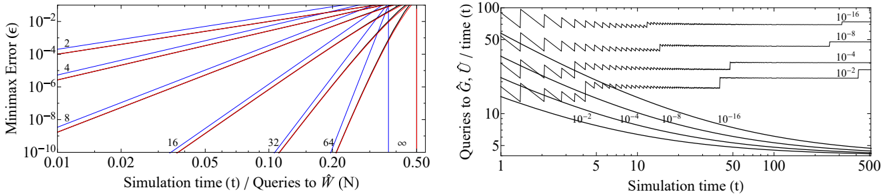
Verification
Claims the paper makes
The claims and statistics of this paper haven’t been checked yet.
Free: it reads the open-access text and checks the first 5 claims that cite a source we can check. Create a free account to check every claim.
Claims other papers make about this one
Each is checked against this paper’s own text: does it say what the citing paper says it does?
In the citing paper
“Trotterization methods are commonly employed, and allow discretization errors that are controlled polynomially in dt, with a number of unitary operations that scales linearly in the number of Hamiltonian terms and simulation time IV .”
From Beyond-classical computation in quantum simulation (2025) · cites this paper as [105]
In the citing paper
“There are many other Hamiltonian simulation methods, an example of a powerful and sophisticated method being qubitization [166] and quantum signal processing [167], which have the provably optimal asymptotic scaling, although it is unclear whether this will translate to better practical applications.”
From The prospects of quantum computing in computational molecular biology (2021) · cites this paper as [166]
Self-check
Percentages, sums and reported differences re-computed from the paper’s own numbers.
The self-check needs the paper’s full text.
Citations
Cites
A fast quantum mechanical algorithm for database search
Grover, L. K. (1996) · Proceedings of the twenty-eighth annual ACM symposium on Theory of computing - STOC '96 · doi:10.1145/237814.237866 · Cited by 8,830 · cited 1×
“After all, (cid:104) G | ˆ S ˆ U ˆ S ˆ U | G (cid:105) = ˆ I implies that ˆ S ˆ U is a reflection when controlled by input state | G (cid:105) , and it is well-known that a Grover iterate [25, 45] is the product of two reflection about start and target subspaces.”
BackgroundQuantum Algorithm for Linear Systems of Equations
Harrow, A. W., Hassidim, A., & Lloyd, S. (2009) · Physical Review Letters · doi:10.1103/physrevlett.103.150502 · Cited by 3,325 · cited 1×
“ralized by Aharonov and Ta-Shma [3] to sparse Hamiltonians. Celebrated achievements over the years [20,8,32,10,33] have each ignited a urry of activity in diverse applications from quantum algorithms [26,19,21,15] to quantum chemistry [46,44,40,41,4,29,39]. In this dawning era of the small quantum computer [5,23], the…”
BackgroundLloyd, S. (1996) · Science · doi:10.1126/science.273.5278.1073 · Cited by 3,088 · cited 2×
“The first explicit quantum algorithms were discovered by Lloyd [31] for local interactions, and then generalized by Aharonov and Ta-Shma [3] to sparse Hamiltonians.”
Method(1964) · doi:10.1115/1.3625776 · Cited by 1,796
Superconducting quantum circuits at the surface code threshold for fault tolerance
Barends, R., Kelly, J., Megrant, A., Veitia, A., Sank, D., Jeffrey, E., White, T. C., Mutus, J., Fowler, A. G., Campbell, B., et al. (2014) · Nature · doi:10.1038/nature13171 · Cited by 1,733
Quantum principal component analysis
Lloyd, S., Mohseni, M., & Rebentrost, P. (2014) · Nature Physics · doi:10.1038/nphys3029 · Cited by 1,385 · cited 2×
“Celebrated achievements over the years [20, 8, 32, 10, 33] have each ignited a flurry of activity in diverse applications from quantum algorithms [26, 19, 21, 15] to quantum chemistry [46, 44, 40, 41, 4, 29, 39].”
BackgroundMethodA computer program for designing optimum FIR linear phase digital filters
McClellan, J., Parks, T., & Rabiner, L. (1973) · IEEE Transactions on Audio and Electroacoustics · doi:10.1109/tau.1973.1162525 · Cited by 1,139 · cited 1×
“We present a systematic framework that furnishes the optimal complexity and a concrete procedure for almost any f and show how an exact connection is made between query complexity and the theory of best function approximations with polynomials [33, 36].”
MethodScalable Quantum Simulation of Molecular Energies
O’Malley, P. J. J., Babbush, R., Kivlichan, I. D., Romero, J., McClean, J. R., Barends, R., Kelly, J., Roushan, P., Tranter, A., Ding, N., et al. (2016) · Physical Review X · doi:10.1103/physrevx.6.031007 · Cited by 1,059 · cited 1×
“Celebrated achievements over the years [3–7] have each ignited a flurry of activity in diverse applications from quantum algorithms [8–11] to quantum chemistry [12–18].”
BackgroundExponential algorithmic speedup by a quantum walk
Childs, A. M., Cleve, R., Deotto, E., Farhi, E., Gutmann, S., & Spielman, D. A. (2003) · Proceedings of the thirty-fifth annual ACM symposium on Theory of computing · doi:10.1145/780542.780552 · Cited by 825
Demonstration of a small programmable quantum computer with atomic qubits
Debnath, S., Linke, N. M., Figgatt, C., Landsman, K. A., Wright, K., & Monroe, C. (2016) · Nature · doi:10.1038/nature18648 · Cited by 777 · cited 1×
“In this dawning era of the small quantum computer [5, 23], the relevance and necessity of space and gate efficient procedures for practical Hamiltonian simulation has intensified.”
Background
Research works printed but not linked: 2
- R. Kothari, Efficient algorithms in quantum query complexity, Ph.D. thesis, University of Waterloo (2014).
- M. Abramowitz, I. A. Stegun, and Others, "Handbook of mathematical functions," Applied mathematics series 55, 62 (1966).
Cited by
Items 301–400 of 1,009
Optimal quantum simulation of linear non-unitary dynamicsPreprint
Low, G. H., & Somma, R. D. (2025) · arXiv (Cornell University) · doi:10.48550/arxiv.2508.19238 · Cited by 50
“Lemma 13 (Linear combination of unitaries [BCC + 15, LC19]) .”
InfluentialSelf-citationClassical and Quantum Algorithms for Tensor Principal Component Analysis
Hastings, M. B. (2020) · Quantum · doi:10.22331/q-2020-02-27-237 · Cited by 50
“[14, 15, 16, 17, 18] to name just a few.”
Fragmented imaginary-time evolution for early-stage quantum signal processors
Silva, T. D. L., Taddei, M. M., Carrazza, S., & Aolita, L. (2023) · Scientific Reports · doi:10.1038/s41598-023-45540-2 · Cited by 50
“These are saturated by optimal RTE algorithms [15, 36, 37].”
BackgroundMethodInfluentialAverage-Case Speedup for Product Formulas
Chen, C.-F., & Brandão, F. G. S. L. (2024) · Communications in Mathematical Physics · doi:10.1007/s00220-023-04912-5 · Cited by 49
“, the gate complexity) has drawn tremendous effort [7, 9, 18, 19, 36], especially given the current limited experimental capability of quantum simulators.”
BackgroundDoubling the efficiency of Hamiltonian simulation via generalized quantum signal processing
Berry, D. W., Motlagh, D., Pantaleoni, G., & Wiebe, N. (2024) · Physical Review A · doi:10.1103/physreva.110.012612 · Cited by 49
Novikau, I., & Joseph, I. (2025) · Computer Physics Communications · doi:10.1016/j.cpc.2025.109498 · Cited by 49
“44 where one splits the simulated temporal interval into a sequence of small intervals and simulates each of them by using the Quantum Signal Processing (QSP) algorithm 45,46 where an output quantum state from a previous interval is used as an initial quantum state for the next temporal interval.”
Quantum simulations of excited states with active-space downfolded Hamiltonians
Bauman, N. P., Low, G. H., & Kowalski, K. (2019) · The Journal of Chemical Physics · doi:10.1063/1.5128103 · Cited by 40
Self-citationNonlinear transformation of complex amplitudes via quantum singular value transformation
Guo, N., Mitarai, K., & Fujii, K. (2024) · Physical Review Research · doi:10.1103/physrevresearch.6.043227 · Cited by 49
A Hybrid Quantum-Classical CFD Methodology with Benchmark HHL SolutionsPreprint
Lapworth, L. B. (2022) · arXiv (Cornell University) · doi:10.48550/arxiv.2206.00419 · Cited by 49
“Qubitisation techniques [20, 21, 22, 23, 24, 25] provide an exact implementation of a unitary decomposition of the matrix of interest at the expense of an additional ancilla register for preparing the coefficients of the unitary decomposition.”
MethodTwo-Unitary Decomposition Algorithm and Open Quantum System Simulation
Suri, N., Barreto, J., Hadfield, S., Wiebe, N., Wudarski, F., & Marshall, J. (2023) · Quantum · doi:10.22331/q-2023-05-15-1002 · Cited by 49
“The Linear Combination of Unitaries (LCU) method allows for a probabilistic implementation of an arbitrary operator in a quantum circuit realized as a linear combination of unitaries [47, 59, 72].”
BackgroundMethodInfluentialDigital quantum simulation of molecular dynamics and control
Magann, A. B., Grace, M., RABITZ, H. A., & Sarovar, M. (2021) · Physical Review Research · doi:10.1103/physrevresearch.3.023165 · Cited by 47
Lanczos recursion on a quantum computer for the Green's function and ground state
Baker, T. E. (2021) · Physical Review A · doi:10.1103/physreva.103.032404 · Cited by 48
“[28] Guang Hao Low and Isaac L Chuang, “Hamiltonian simulation by qubitization,” Quantum 3, 163 (2019).”
BackgroundPerturbative Quantum Simulation
Sun, J., Endo, S., Lin, H., Hayden, P. M., Vedral, V., & Yuan, X. (2022) · Physical Review Letters · doi:10.1103/physrevlett.129.120505 · Cited by 48
Low-Depth Hamiltonian Simulation by an Adaptive Product Formula
Zhang, Z., Sun, J., Yuan, X., & Yung, M. (2023) · Physical Review Letters · doi:10.1103/physrevlett.130.040601 · Cited by 48
Gharibian, S., & Gall, F. L. (2023) · SIAM Journal on Computing · doi:10.1137/22m1513721 · Cited by 47
Hagan, M., & Wiebe, N. (2023) · Quantum · doi:10.22331/q-2023-11-14-1181 · Cited by 47
“As such, there are a plethora of algorithm options for compiling a unitary evolution operator U ( t ) = e − iHt to circuit gates [7, 8, 9, 10, 11, 12, 13, 14].”
BackgroundLow, G. H., & Su, Y. (2024) · Annual Symposium on Foundations of Computer Science · doi:10.1109/focs61266.2024.00070 · Cited by 47
“…norm). block ∥·∥ Given a encoding of A (see [31, Section 2.4] for the formal definition), if A is Hermitian, prior art provides a highly efficient method based on quantum walk for generating p j ( A ) that are Chebyshev polynomials of A using only O ( j ) queries to the block encoding [10], [30].”
InfluentialSelf-citationDesigning a Nearly Optimal Quantum Algorithm for Linear Differential Equations via Lindbladians
Shang, Z.-X., Guo, N., An, D., & Zhao, Q. (2025) · Physical Review Letters · doi:10.1103/cvl9-97qg · Cited by 47
“In particular, the Hamiltonian simulation [12–17], which aims to simulate the Schr¨odinger equation, a special case of ODEs, on quantum computers, is arguably one of the most significant applications and may be among the first to demonstrate practical quantum advantages.”
Computing partition functions in the one-clean-qubit model
Chowdhury, A. C. N., Somma, R. D., & Subaşı, Y. (2021) · Physical Review A · doi:10.1103/physreva.103.032422 · Cited by 47
“(14) is the “unitary iterate” or the quantum walk operator as used recently for Hamiltonian simulation [25] or linear algebra problems [26], and G̃ is a related state-preparation unitary.”
BackgroundVariational quantum eigensolver for dynamic correlation functions
Chen, H., Nusspickel, M., Tilly, J., & Booth, G. H. (2021) · Physical Review A · doi:10.1103/physreva.104.032405 · Cited by 47
Quantum computation for periodic solids in second quantization
Ivanov, A. V., Sünderhauf, C., Holzmann, N., Ellaby, T., Kerber, R. N., Jones, G. A., & Camps, J. (2023) · Physical Review Research · doi:10.1103/physrevresearch.5.013200 · Cited by 49
“The traditional approach to implementing U is via Trotterization [86, 87], and other methods have since been developed including Taylor series [20, 23, 24], randomised methods [88–90] and qubitization approaches [25, 27, 28, 31, 32, 57].”
MethodChallenges for quantum computation of nonlinear dynamical systems using linear representationsPreprint
Lin, Y. T., Lowrie, R. B., Aslangil, D., Subaşı, Y., & Sornborger, A. T. (2022) · arXiv (Cornell University) · doi:10.48550/arxiv.2202.02188 · Cited by 47
“The most recent methods [7, 8] additionally provide an exponential improvement in simulation precision relative to earlier Trotterization methods, making them suitable for repeated use as a simulation module in a larger circuit.”
BackgroundMethodA Vision for the Future of Multiscale Modeling
Capone, M., Romanelli, M., Castaldo, D., Parolin, G., Bello, A., Gil, G., & Vanzan, M. (2024) · ACS Physical Chemistry Au · doi:10.1021/acsphyschemau.3c00080 · Cited by 48
Thermalization in Open Many-Body Systems and KMS Detailed Balance
Scandi, M., & Alhambra, A. M. (2025) · Physical Review X · doi:10.1103/sfp3-3sqf · Cited by 46
Spectral-density estimation with the Gaussian integral transform
Roggero, A. (2020) · Physical Review A · doi:10.1103/physreva.102.022409 · Cited by 46
Quantum Algorithms for Simulating Nuclear Effective Field TheoriesPreprint
Watson, J. D., Bringewatt, J., Shaw, A. F., Childs, A. M., Gorshkov, A. V., & Davoudi, Z. (2023) · arXiv (Cornell University) · doi:10.48550/arxiv.2312.05344 · Cited by 46
A CS guide to the quantum singular value transformation
Tang, E., & Tian, K. (2024) · Society for Industrial and Applied Mathematics eBooks · doi:10.1137/1.9781611977936.13 · Cited by 45
Zeng, P., Sun, J., Jiang, L., & Zhao, Q. (2025) · PRX Quantum · doi:10.1103/prxquantum.6.010359 · Cited by 47
Symmetries, Graph Properties, and Quantum Speedups
Ben-David, S., Childs, A. M., Gilyen, A., Kretschmer, W., Podder, S., & Wang, D. (2020) · Annual Symposium on Foundations of Computer Science · doi:10.1109/focs46700.2020.00066 · Cited by 45
“Once we have a block-encoding we can also perform Hamiltonian simulation [BCK15, LC19] efficiently (or implement polynomials of A [GSLW19]), which in turn enables implementing the algorithm of [CCD + 03 ].”
Algorithm for quantum computation of particle decays
Ciavarella, A. N. (2020) · Physical review. D/Physical review. D. · doi:10.1103/physrevd.102.094505 · Cited by 45
An Algebraic Quantum Circuit Compression Algorithm for Hamiltonian Simulation
Camps, D., Kökcü, E., Oftelie, L. B., de Jong, W. A., Kemper, A. F., & Beeumen, R. V. (2022) · SIAM Journal on Matrix Analysis and Applications · doi:10.1137/21m1439298 · Cited by 45
“Multiple quantum algorithms have been proposed with (near) optimal asymptotic scaling [8,9,14,15,18,22,23].”
Method(2018) · Advanced Quantum Technologies · doi:10.1002/(issn)2511-9044 · Cited by 45
Abadal, S., Han, C. Z., Petrov, V., Galluccio, L., Akyildiz, I. F., & Jornet, J. M. (2024) · IEEE Journal on Selected Areas in Communications · doi:10.1109/jsac.2024.3399253 · Cited by 44
“…for the state transfer of qubits via waveguided quantum-coherent links and for their orchestration via wireless links between quantum cores [17]. that are classically intractable, which has huge implications in fields such as physics [137], chemistry [138], finance [139], and healthcare [140].”
Quantum algorithms for scientific computing
Au-Yeung, R., Camino, B., Rathore, O., & Kendon, V. M. (2024) · Reports on Progress in Physics · doi:10.1088/1361-6633/ad85f0 · Cited by 44
Phase Estimation with Partially Randomized Time Evolution
Günther, J., Witteveen, F., Schmidhuber, A., Miller, M., Christandl, M., & Harrow, A. W. (2026) · PRX Quantum · doi:10.1103/ynxb-p2xq · Cited by 44
“There also exist powerful post-Trotter Hamiltonian simulation methods [10,11]; while they have better scaling, methods based on product formulas are still of great interest due to the small number of ancilla qubits required and their good performance for Hamiltonians of interest [1].”
Generalized Quantum Singular Value TransformationPreprint
Sünderhauf, C. (2023) · arXiv (Cornell University) · doi:10.48550/arxiv.2312.00723 · Cited by 44
“Therefore, qubiti-sation is widely used in quantum chemistry together with phase estimation to find the (arcosines of the) eigenvalues of a block-encoded Hamiltonian matrix [13–16].”
BackgroundOrsucci, D., & Dunjko, V. (2021) · Quantum · doi:10.22331/q-2021-11-08-573 · Cited by 44
“First, using the QSP method of Theorem 8 and the polynomial approximation given in Eq.”
BackgroundMethodInfluentialEnd-To-End Resource Analysis for Quantum Interior-Point Methods and Portfolio Optimization
Dalzell, A. M., Clader, B. D., Salton, G., Berta, M., Lin, C. Y.-Y., Bader, D. A., Stamatopoulos, N., Schuetz, M. J. A., Brandão, F. G. S. L., Katzgraber, H. G., et al. (2023) · PRX Quantum · doi:10.1103/prxquantum.4.040325 · Cited by 43
“[75]) with the walk operator where W is the operator that acts as identity on registers a 4 a 1 L (which host the Hamiltonian H [ s ]) while performing the reflection ( 2 | 0 (cid:15) (cid:18) 0 | a 2 a 3 (cid:18) G − I a 2 a 3 (cid:18) G ) on the remaining qubits.”
BackgroundSachdev-Ye-Kitaev model on a noisy quantum computer
Asaduzzaman, M., Jha, R. G., & Sambasivam, B. (2024) · Physical review. D/Physical review. D. · doi:10.1103/physrevd.109.105002 · Cited by 44
“Another way is to use a controlled version of oracles to embed the Hamiltonian in an invariant SU (2) subspace [16] and a variant of this was used in Ref.”
MethodQuantum Simulation for Quantum Dynamics with Artificial Boundary Conditions
Jin, S., Li, X., Liu, N., & Yu, Y. (2024) · SIAM Journal on Scientific Computing · doi:10.1137/23m1563451 · Cited by 43
Robust Iterative Method for Symmetric Quantum Signal Processing in All Parameter Regimes
Dong, Y., Lin, L., Ni, H., & Wang, J. (2024) · SIAM Journal on Scientific Computing · doi:10.1137/23m1598192 · Cited by 43
Jin, S., Liu, N., Ma, C., Peng, Y., & Yu, Y. (2026) · Communications in Mathematical Sciences · doi:10.4310/cms.260103023937 · Cited by 43
Improved quantum algorithm for A-optimal projection
Pan, S., Wan, L., Liu, H., Wang, Q.-L., Qin, S., Wen, Q., & Gao, F. (2020) · Physical Review A · doi:10.1103/physreva.102.052402 · Cited by 43
Variational Hamiltonian Diagonalization for Dynamical Quantum Simulation
Commeau, B., Cerezo, M., Holmes, Z., Cincio, L., Coles, P. J., & Sornborger, A. (2020) · arXiv · doi:10.48550/arxiv.2009.02559 · Cited by 42
“The potential for fast-forwarding with VHD could allow for simulation beyond the coherence time of NISQ computers, unlike standard iterative approaches [2, 6–8] where the circuit depth grows with simulation time.”
MethodFault-tolerant quantum computation of molecular observables
Steudtner, M., Morley-Short, S., Pol, W., Sim, S., Cortes, C. L., Loipersberger, M., Parrish, R. M., Degroote, M., Moll, N., Santagati, R., et al. (2023) · Quantum · doi:10.22331/q-2023-11-06-1164 · Cited by 42
Sato, Y., Tezuka, H., Kondo, R., & Yamamoto, N. (2025) · Physical Review Applied · doi:10.1103/physrevapplied.23.014063 · Cited by 43
Bellante, A., Fioravanti, T., Carminati, M., Zanero, S., & Luongo, A. (2025) · Computers & Security · doi:10.1016/j.cose.2025.104341 · Cited by 44
Wang, Q., Li, M., Monroe, C. R., & Nam, Y. (2021) · Quantum · doi:10.22331/q-2021-07-26-509 · Cited by 42
Data centers with quantum random access memory and quantum networks
Liu, J., Hann, C. T., & Jiang, L. (2023) · Physical Review A · doi:10.1103/physreva.108.032610 · Cited by 42
Metger, T., & Yuen, H. (2023) · Annual Symposium on Foundations of Computer Science · doi:10.1109/focs57990.2023.00082 · Cited by 41
“6 The solution is encoded in the form of a block encoding [25]– [27], which is a poly( n ) -qubit unitary U whose top left corner approximates X .”
BackgroundQuantum algorithms based on the block-encoding framework for matrix functions by contour integrals
Takahira, S., Ohashi, A., Sogabe, T., & Usuda, T. S. (2022) · Quantum Information and Computation · doi:10.26421/qic22.11-12-4 · Cited by 40
Cao, Y. H., Jin, S., & Liu, N. (2025) · Journal of Physics A Mathematical and Theoretical · doi:10.1088/1751-8121/adb3fe · Cited by 41
Parallel Quantum Algorithm for Hamiltonian Simulation
Zhang, Z., Wang, Q., & Ying, M. (2024) · Quantum · doi:10.22331/q-2024-01-15-1228 · Cited by 40
“The input model was also generalized beyond sparse matrices by subsequent works on qubitization and block-encoding [6, 7, 36].”
BackgroundMethodInfluentialQubit-Efficient Randomized Quantum Algorithms for Linear Algebra
Wang, S., McArdle, S., & Berta, M. (2024) · PRX Quantum · doi:10.1103/prxquantum.5.020324 · Cited by 41
“We detail resources required to obtain a block encoding of (cid:101) H and using a qubitization approach for the time evolution [54].”
BackgroundMethodInfluentialNearly optimal state preparation for quantum simulations of lattice gauge theories
Kane, C. F., Gomes, N., & Kreshchuk, M. (2024) · Physical Review A · doi:10.1103/physreva.110.012455 · Cited by 39
Quantum Lower Bounds by Sample-to-Query Lifting
Wang, Q., & Zhang, Z. (2025) · SIAM Journal on Computing · doi:10.1137/24m1638616 · Cited by 39
“Unitary oracles that encode inputs in a matrix block, known as block-encodings [20], have recently attracted great interest due to that many quantum algorithms can be described in this framework, via the quantum singular value transformation (QSVT) [21].”
InfluentialTowards a variational Jordan–Lee–Preskill quantum algorithm
Liu, J., Li, Z., Zheng, H., Yuan, X., & Sun, J. (2022) · Machine Learning Science and Technology · doi:10.1088/2632-2153/aca06b · Cited by 39
Convergence Guarantees for Discrete Mode Approximations to Non-Markovian Quantum Baths
Trivedi, R., Malz, D., & Cirac, J. I. (2021) · Physical Review Letters · doi:10.1103/physrevlett.127.250404 · Cited by 39
Local Variational Quantum Compilation of Large-Scale Hamiltonian Dynamics
Mizuta, K., Nakagawa, Y. O., Mitarai, K., & Fujii, K. (2022) · PRX Quantum · doi:10.1103/prxquantum.3.040302 · Cited by 39
“The so-called qubitization technique [20] has achieved an optimal scaling in the number of gates needed, but requires many ancilla qubits for its implementation (see e.”
BackgroundEfficient Use of Quantum Linear System Algorithms in Inexact Infeasible IPMs for Linear Optimization
Mohammadisiahroudi, M., Fakhimi, R., & Terlaky, T. (2024) · Journal of Optimization Theory and Applications · doi:10.1007/s10957-024-02452-z · Cited by 39
“A different input model, now known as the quantum operator input model, is proposed in Low and Chuang [32], which is based on the idea of block-encoded matrices.”
Fast digital methods for adiabatic state preparationPreprint
Wan, K., & Kim, I. H. (2020) · arXiv (Cornell University) · doi:10.48550/arxiv.2004.04164 · Cited by 39
“The block-encoding framework, first introduced by [11], is motivated by the fact that it encompasses several widely applicable input models, including standard techniques for encoding sparse Hamiltonians and for encoding Hamiltonians that are specified as a linear combination of unitaries.”
MethodInfluentialTopological data analysis on noisy quantum computers
Akhalwaya, I. Y., Ubaru, S., Clarkson, K. L., Squillante, M. S., Jejjala, V., He, Y., Naidoo, K., Kalantzis, V., & Horesh, L. (2022) · International Conference on Learning Representations · doi:10.48550/arxiv.2209.09371 · Cited by 39
“Then we can use the qubitization idea (Low & Chuang, 2019; Gily ´ en et al., 2019) to obtain a block encoding of T j ( A ) .”
MethodImportance sampling for stochastic quantum simulations
Kiss, O., Grossi, M., & Roggero, A. (2023) · Quantum · doi:10.22331/q-2023-04-13-977 · Cited by 38
“We note that alternative and more refined techniques exist, using extra ancillary qubits and complex gadgets, such as qubitization/quantum signal processing [53, 54], and linear combination of unitaries [55–57].”
MethodSparse Quantum State Preparation for Strongly Correlated Systems
Feniou, C., Adjoua, O., Claudon, B., Zylberman, J., Giner, E., & Piquemal, J. (2024) · The Journal of Physical Chemistry Letters · doi:10.1021/acs.jpclett.3c03159 · Cited by 37
“In a broader context, sparse quantum state preparation methods are used for a range of applications, including Hamiltonian simulation with either linear combination of unitary operators 45 or qubitization, 46 data loading for quantum machine learning 47 or even solving linear system of equations.”
MethodWang, X., Zhang, S., & Li, T. (2024) · IEEE Transactions on Information Theory · doi:10.1109/tit.2024.3382037 · Cited by 38
“Decent efforts had been conducted for Hamiltonian simulation [1], [11], [12] and linear system solving [7], [8], [9], [10], and this work investigates the estimation of statistical properties.”
BackgroundMethodSimulating Effective QED on Quantum Computers
Stetina, T. F., Ciavarella, A. N., Li, X., & Wiebe, N. (2022) · Quantum · doi:10.22331/q-2022-01-18-622 · Cited by 38
Graph optimization perspective for low-depth Trotter-Suzuki decomposition
Schmitz, A. T., Sawaya, N. P. D., Johri, S., & Matsuura, A. Y. (2024) · Physical Review A · doi:10.1103/physreva.109.042418 · Cited by 36
“The most common methods for generating this approximation is the Trotter-Suzuki decomposition [47], though extensions and more advanced methods exist [6, 7, 8, 12, 14, 15, 26, 27].”
MethodToward optimal circuit size for sparse quantum state preparation
Mao, R., Tian, G., & Sun, X. (2024) · Physical Review A · doi:10.1103/physreva.110.032439 · Cited by 37
Quantum Simulation with Sum-of-Squares Spectral Amplification
King, R., Low, G. H., Babbush, R., Somma, R. D., & Rubin, N. C. (2025) · Physical Review Letters · doi:10.1103/m3fj-m4rm · Cited by 37
Self-citationFault-tolerant simulation of Lattice Gauge Theories with gauge covariant codes
Spagnoli, L., Roggero, A., & Wiebe, N. (2026) · Quantum · doi:10.22331/q-2026-01-16-1968 · Cited by 37
Sugisaki, K., Yamamoto, S., Nakazawa, S., Toyota, K., Sato, K., Shiomi, D., & Takui, T. (2018) · Chemical Physics Letters · doi:10.1016/j.cpletx.2018.100002 · Cited by 36
Second-Quantized Fermionic Operators with Polylogarithmic Qubit and Gate Complexity
Kirby, W., Fuller, B., Hadfield, C. F., & Mezzacapo, A. (2022) · PRX Quantum · doi:10.1103/prxquantum.3.020351 · Cited by 36
“(A30) To obtain Wφ for φ 6= 0, we conjugate this by the phases on the ancilla qubit [30], denoted by Rφ as defined in (A27):”
MethodInfluentialGauge theory couplings on anisotropic lattices
Carena, M. S., Gustafson, E., Lamm, H., Li, Y.-Y., & Liu, W. (2022) · Physical review. D/Physical review. D. · doi:10.1103/physrevd.106.114504 · Cited by 36
Quantum Metropolis Solver: a quantum walks approach to optimization problems
Campos, R., Casares, P. A. M., & Martin-Delgado, M. A. (2023) · Quantum Machine Intelligence · doi:10.1007/s42484-023-00119-y · Cited by 36
“[41].”
Quantum Algorithms for Ground-State Preparation and Green's Function CalculationPreprint
Keen, T., Dumitrescu, E., & Wang, Y. (2021) · arXiv (Cornell University) · doi:10.48550/arxiv.2112.05731 · Cited by 37
“…carry on with the next two tasks in solving many-body physics problems, relevant quantum operations can be implemented on a quantum computer by unitary operators (quantum gates) and, in case of nonunitary quantum operations, a linear combinations of unitaries (LCU) method [19] or qubitization [2].”
BackgroundLearning and simulating bosonic systems via finite-energy localityPreprint
Möbus, T., Blühm, A., Caro, M. C., Werner, A. H., & Rouzé, C. (2023) · HAL · doi:10.48550/arxiv.2307.15026 · Cited by 36
Leveraging State Sparsity for More Efficient Quantum Simulations
Jaques, S., & Häner, T. (2022) · ACM Transactions on Quantum Computing · doi:10.1145/3491248 · Cited by 36
“We refer to the papers by Low and Chuang [31] and Lanyon et al. [29], respectively, for more details.”
MethodInfluentialQuantum Algorithms for Testing Hamiltonian Symmetry
LaBorde, M. L., & Wilde, M. M. (2022) · Physical Review Letters · doi:10.1103/physrevlett.129.160503 · Cited by 35
“Much work has been conducted in this field, including work on implementations on near-term hardware [17, 26], simulation by qubitiza-tion [27], simulation of operator spread [28], and more.”
BackgroundHamiltonian dynamics on digital quantum computers without discretization error
Granet, E., & Dreyer, H. (2024) · npj Quantum Information · doi:10.1038/s41534-024-00877-y · Cited by 36
Explicit block encodings of boundary value problems for many-body elliptic operators
Kharazi, T., Alkadri, A. M., Liu, J.-P., Mandadapu, K. K., & Whaley, K. B. (2025) · Quantum · doi:10.22331/q-2025-06-04-1764 · Cited by 35
“Combined with quantum signal processing (QSP) [27, 28] or more generally, the quantum singular value transformation (QSVT) [29], a large class of matrix transformations can be enacted on the block encoded matrix.”
Somma, R. D., King, R., Kothari, R., O’Brien, T. E., & Babbush, R. (2025) · Nature Communications · doi:10.1038/s41467-025-57451-z · Cited by 35
Quantum Algorithms for Quantum Molecular Systems: A Survey
Zhang, Y., Zhang, X., Sun, J., Lin, H., Huang, Y., Lv, D., & Yuan, X. (2025) · Wiley Interdisciplinary Reviews Computational Molecular Science · doi:10.1002/wcms.70020 · Cited by 38
“• Qubitization [54]: The manipulation of SU(2) matrices effectively enables control over the entire system by focusing on these two-level subsystems.”
InfluentialQuantum circuits for partial differential equations in Fourier space
Lubasch, M., Kikuchi, Y., Wright, L., & Keever, C. M. (2025) · Physical Review Research · doi:10.1103/tbzc-w9x8 · Cited by 35
“One possibility is to use the truncated Jacobi-Anger expansion where J ζ is a Bessel function of the first kind and, for error ϵ , D needs to scale as Θ tNr (see [98, 99] and Corollary 32 in [71]).”
A Short Path Quantum Algorithm for Exact Optimization
Hastings, M. B. (2018) · Quantum · doi:10.22331/q-2018-07-26-78 · Cited by 35
Quantum algorithms for escaping from saddle points
Zhang, C., Leng, J., & Li, T. (2021) · Quantum · doi:10.22331/q-2021-08-20-529 · Cited by 35
“There is a rich literature on the cost of quantum simulation [9, 10, 23, 57– 59]; it is typically linear in the evolution time, which is formally known as the “no—fast— forwarding theorem”, see Theorem 3 of [9], and Theorem 3 of [24].”
BackgroundO’Brien, T. E., Ioffe, L. B., Su, Y., Fushman, D., Neven, H., Babbush, R., & Smelyanskiy, V. (2022) · PRX Quantum · doi:10.1103/prxquantum.3.030345 · Cited by 39
Optimal Hamiltonian simulation for time-periodic systems
Mizuta, K., & Fujii, K. (2023) · Quantum · doi:10.22331/q-2023-03-28-962 · Cited by 36
“2 Review on qubitization technique Here, we briefly review so-called qubitization technique to efficiently implement e−iHt for time-independent Hamiltonian H on the Hilbert space H [18].”
BackgroundMethodInfluentialOn variants of multivariate quantum signal processing and their characterizationsPreprint
Németh, B., Kövér, B., Kulcsár, B., Miklósi, R. B., & Gilyén, A. (2023) · arXiv (Cornell University) · doi:10.48550/arxiv.2312.09072 · Cited by 35
“…algorithmic primitive in quantum computing, which allows transforming the eigenvalues of potentially exponentially large Hermitian matrices [LC19, LC17a] or more generally the singular values of arbitrary matrices [GSLW19] with efficient quantum circuits utilising only one or two ancilla…”
BackgroundNearly Optimal Circuit Size for Sparse Quantum State Preparation
Li, L., & Luo, J. (2024) · DROPS (Schloss Dagstuhl – Leibniz Center for Informatics) · doi:10.4230/lipics.icalp.2025.113 · Cited by 35
“Notable examples include Shor’s algorithm [55], Grover’s algorithm [20], HHL algorithm [22], and Hamiltonian simulation algorithms [10, 32, 33, 6], as well as quantum machine learning algorithms [31, 29, 28, 27, 47].”
Sawaya, N. P. D., Schmitz, A. T., & Hadfield, S. (2023) · Quantum · doi:10.22331/q-2023-09-14-1111 · Cited by 35
“We note that there are many Hamiltonian simulation algorithms for implementing the exponential of a Hermitian operator, each with various resource and accuracy trade-offs [125, 126, 127, 128, 129, 130, 131, 132, 133].”
MethodTime-Efficient Quantum Entropy Estimator via Samplizer
Wang, Q., & Zhang, Z. (2025) · IEEE Transactions on Information Theory · doi:10.1109/tit.2025.3576137 · Cited by 35
“In many quantum algorithms, e.g., [49], [50], [73], [76], they used a unitary operator that is a block-encoding of the prepared quantum state, by the technique of purified density matrix [43] (see also [33, Lemma 25]).”
Quantum algorithms for matrix geometric means
Liu, N., Wang, Q., Wilde, M. M., & Zhang, Z. (2025) · npj Quantum Information · doi:10.1038/s41534-025-00973-7 · Cited by 35
“There are many such possible unitary operators, and we choose a formalism called block-encoding 18 – 20 .”
Error Mitigation and Circuit Division for Early Fault-Tolerant Quantum Phase Estimation
Dutkiewicz, A., Polla, S., Scheurer, M., Gogolin, C., Huggins, W. J., & O’Brien, T. E. (2025) · PRX Quantum · doi:10.1103/mlmy-yskj · Cited by 34
“In both cases, we estimate the ground state energy to precision ∆ E by applying MSQPE to a qubitized walk operator W [83].”
A Low-Complexity Quantum Principal Component Analysis Algorithm
He, C., Li, J., Liu, W., Peng, J., & Wang, Z. J. (2022) · IEEE Transactions on Quantum Engineering · doi:10.1109/tqe.2021.3140152 · Cited by 37
Optimal low-depth quantum signal-processing phase estimation
Dong, Y., Gross, J. A., & Niu, M. Y. (2025) · Nature Communications · doi:10.1038/s41467-025-56724-x · Cited by 34
“Lastly, qubitization techniques 15,30 and cosine-sine decomposition 31,32 provide powerful two-dimensional subspace representations associated with any unitary matrix.”
Logical fermions for fault-tolerant quantum simulationPreprint
Landahl, A. J., & Morrison, B. (2021) · arXiv (Cornell University) · doi:10.48550/arxiv.2110.10280 · Cited by 34
“Block-encoding methods [80] have been proposed as an alternative to Trotter-Suzuki decomposition for simulation of the Fermi-Hubbard model and other quantum systems [81].”
MethodIvashkov, P., Huang, P., Koor, K., Pira, L., & Rebentrost, P. (2026) · npj Quantum Information · doi:10.1038/s41534-026-01202-5 · Cited by 33
“Polynomial functions can be applied to the singular values of a block-encoded matrix (or eigenvalues of a Hermitian matrix) through quantum signal processing (QSP) 82,84 and QSVT 23 .”
Resource estimate for quantum many-body ground-state preparation on a quantum computer
Lemieux, J., Duclos-Cianci, G., Sénéchal, D., & Poulin, D. (2021) · Physical Review A · doi:10.1103/physreva.103.052408 · Cited by 35
“[ 7, 30, 36 ] .”
Finding a marked node on any graph via continuous-time quantum walks
Chakraborty, S., Novo, L., & Roland, J. (2020) · Physical Review A · doi:10.1103/physreva.102.022227 · Cited by 21
A quantum interior-point predictor–corrector algorithm for linear programming
Casares, P. A. M., & Martin-Delgado, M. A. (2020) · Journal of Physics A Mathematical and Theoretical · doi:10.1088/1751-8121/abb439 · Cited by 33
“If w is the number of nonzero entries, there is a quantum accessible data structure of size O ( w log 2 ( n 2 )) , which takes time O (log( n 2 )) to store or update a single entry.”
Background
Metadata
- Authors
- Low, G. H., & Chuang, I. L.
- Affiliations
- Massachusetts Institute of Technology (US)
- Venue
- Quantum
- Published
- 2019-07-12
- Volume
- 3
- Pages
- 163
- ISSN
- 2521-327X (ISSN-L)
- OpenAlex
- W2535738892
- Cited by
- 854
- References
- 46
- Citations by year
- 2026: 120 · 2025: 216 · 2024: 160 · 2023: 137 · 2022: 92 · 2021: 70 · 2020: 43 · 2019: 15
- FWCI
- 25.21
- Type
- journal article
- Language
- en
- Open access
- gold
- doi.org
- Locations
- Quantum (publishedVersion, cc-by)
- arXiv (Cornell University) (acceptedVersion)
- DOAJ (DOAJ: Directory of Open Access Journals) (submittedVersion)
- arXiv (Cornell University) (cc-by)
- Topics
- Physical Sciences › Computer Science › Artificial Intelligence › Quantum Computing Algorithms and Architecture
- Physical Sciences › Physics and Astronomy › Atomic and Molecular Physics, and Optics › Quantum many-body systems
- Physical Sciences › Physics and Astronomy › Atomic and Molecular Physics, and Optics › Quantum Mechanics and Applications
- Keywords
- Hamiltonian simulation, qubitization, evolution operator, query complexity, sparse Hamiltonians, linear combination of unitaries, ancilla qubits, operator functions, quantum algorithms
About these checks
Registry, retraction, Cites and statistics results are computed, not judged, with one exception: a printed reference that no index lists is read once by a model before it counts as a citation error. Claims are extracted by a model and kept only when their quote appears verbatim in the text; each cited source is then checked, with a model’s help, for whether it says what the claim relies on. Those verdicts can be wrong — read the claim’s quote and the cited source before relying on one.
Statistics and arithmetic are recomputed, not judged.
Confidence bands are shown only for fields calibrated on our annotated test set. None is calibrated yet, so no band is shown.
What counts as a claim ›How we measure confidence ›How we check this ›
Are you an author, or do you see a problem with this page? Request a review
Data sources
Bibliographic data: Semantic Scholar, OpenAlex, Crossref.
Contains information from the Semantic Scholar Academic Graph Datasets, made available under the ODC Attribution License (ODC-BY 1.0).
Semantic Scholar’s data is described in: Kinney, R., et al. (2023). The Semantic Scholar Open Data Platform. arXiv:2301.10140.
