

Hamiltonian Simulation by Qubitization
Open accessThe DOI matches its Crossref record; 50 of the 50 references it cites were found in a registry or an index.
Abstract
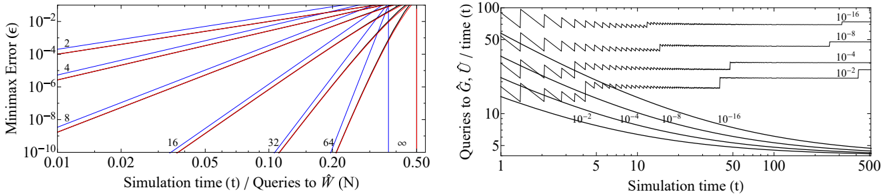
We present the problem of approximating the time-evolution operatore−iH^tto errorϵ, where the HamiltonianH^=(⟨G|⊗I^)U^(|G⟩⊗I^)is the projection of a unitary oracleU^onto the state|G⟩created by another unitary oracle. Our algorithm solves this with a query complexityO(t+log(1/ϵ))to both oracles that is optimal with respect to all parameters in both the asymptotic and non-asymptotic regime, and also with low overhead, using at most two additional ancilla qubits. This approach to Hamiltonian simulation subsumes important prior art considering Hamiltonians which ared-sparse or a linear combination of unitaries, leading to significant improvements in space and gate complexity, such as a quadratic speed-up for precision simulations. It also motivates useful new instances, such as whereH^is a density matrix. A key technical result is `qubitization', which uses the controlled version of these oracles to embed anyH^in an invariantSU(2)subspace. A large class of operator functions ofH^can then be computed with optimal query complexity, of whiche−iH^tis a special case.
Overview
The claims and statistics of this paper haven’t been checked yet.
Free: it reads the open-access text and checks the first 5 claims that cite a source we can check. Create a free account to check every claim.
Integrity signals
Registry
Cites
Statistics
Figures
Verification
Claims the paper makes
The claims and statistics of this paper haven’t been checked yet.
Free: it reads the open-access text and checks the first 5 claims that cite a source we can check. Create a free account to check every claim.
Claims other papers make about this one
Each is checked against this paper’s own text: does it say what the citing paper says it does?
In the citing paper
“Trotterization methods are commonly employed, and allow discretization errors that are controlled polynomially in dt, with a number of unitary operations that scales linearly in the number of Hamiltonian terms and simulation time IV .”
From Beyond-classical computation in quantum simulation (2025) · cites this paper as [105]
In the citing paper
“There are many other Hamiltonian simulation methods, an example of a powerful and sophisticated method being qubitization [166] and quantum signal processing [167], which have the provably optimal asymptotic scaling, although it is unclear whether this will translate to better practical applications.”
From The prospects of quantum computing in computational molecular biology (2021) · cites this paper as [166]
Self-check
Percentages, sums and reported differences re-computed from the paper’s own numbers.
The self-check needs the paper’s full text.
Citations
Cites
A fast quantum mechanical algorithm for database search
Grover, L. K. (1996) · Proceedings of the twenty-eighth annual ACM symposium on Theory of computing - STOC '96 · doi:10.1145/237814.237866 · Cited by 8,830 · cited 1×
“After all, (cid:104) G | ˆ S ˆ U ˆ S ˆ U | G (cid:105) = ˆ I implies that ˆ S ˆ U is a reflection when controlled by input state | G (cid:105) , and it is well-known that a Grover iterate [25, 45] is the product of two reflection about start and target subspaces.”
BackgroundQuantum Algorithm for Linear Systems of Equations
Harrow, A. W., Hassidim, A., & Lloyd, S. (2009) · Physical Review Letters · doi:10.1103/physrevlett.103.150502 · Cited by 3,325 · cited 1×
“ralized by Aharonov and Ta-Shma [3] to sparse Hamiltonians. Celebrated achievements over the years [20,8,32,10,33] have each ignited a urry of activity in diverse applications from quantum algorithms [26,19,21,15] to quantum chemistry [46,44,40,41,4,29,39]. In this dawning era of the small quantum computer [5,23], the…”
BackgroundLloyd, S. (1996) · Science · doi:10.1126/science.273.5278.1073 · Cited by 3,088 · cited 2×
“The first explicit quantum algorithms were discovered by Lloyd [31] for local interactions, and then generalized by Aharonov and Ta-Shma [3] to sparse Hamiltonians.”
Method(1964) · doi:10.1115/1.3625776 · Cited by 1,796
Superconducting quantum circuits at the surface code threshold for fault tolerance
Barends, R., Kelly, J., Megrant, A., Veitia, A., Sank, D., Jeffrey, E., White, T. C., Mutus, J., Fowler, A. G., Campbell, B., et al. (2014) · Nature · doi:10.1038/nature13171 · Cited by 1,733
Quantum principal component analysis
Lloyd, S., Mohseni, M., & Rebentrost, P. (2014) · Nature Physics · doi:10.1038/nphys3029 · Cited by 1,385 · cited 2×
“Celebrated achievements over the years [20, 8, 32, 10, 33] have each ignited a flurry of activity in diverse applications from quantum algorithms [26, 19, 21, 15] to quantum chemistry [46, 44, 40, 41, 4, 29, 39].”
BackgroundMethodA computer program for designing optimum FIR linear phase digital filters
McClellan, J., Parks, T., & Rabiner, L. (1973) · IEEE Transactions on Audio and Electroacoustics · doi:10.1109/tau.1973.1162525 · Cited by 1,139 · cited 1×
“We present a systematic framework that furnishes the optimal complexity and a concrete procedure for almost any f and show how an exact connection is made between query complexity and the theory of best function approximations with polynomials [33, 36].”
MethodScalable Quantum Simulation of Molecular Energies
O’Malley, P. J. J., Babbush, R., Kivlichan, I. D., Romero, J., McClean, J. R., Barends, R., Kelly, J., Roushan, P., Tranter, A., Ding, N., et al. (2016) · Physical Review X · doi:10.1103/physrevx.6.031007 · Cited by 1,059 · cited 1×
“Celebrated achievements over the years [3–7] have each ignited a flurry of activity in diverse applications from quantum algorithms [8–11] to quantum chemistry [12–18].”
BackgroundExponential algorithmic speedup by a quantum walk
Childs, A. M., Cleve, R., Deotto, E., Farhi, E., Gutmann, S., & Spielman, D. A. (2003) · Proceedings of the thirty-fifth annual ACM symposium on Theory of computing · doi:10.1145/780542.780552 · Cited by 825
Demonstration of a small programmable quantum computer with atomic qubits
Debnath, S., Linke, N. M., Figgatt, C., Landsman, K. A., Wright, K., & Monroe, C. (2016) · Nature · doi:10.1038/nature18648 · Cited by 777 · cited 1×
“In this dawning era of the small quantum computer [5, 23], the relevance and necessity of space and gate efficient procedures for practical Hamiltonian simulation has intensified.”
Background
Research works printed but not linked: 2
- R. Kothari, Efficient algorithms in quantum query complexity, Ph.D. thesis, University of Waterloo (2014).
- M. Abramowitz, I. A. Stegun, and Others, "Handbook of mathematical functions," Applied mathematics series 55, 62 (1966).
Cited by
Items 801–900 of 1,009
Catterall, S. M., Harnik, R., Hubeny, V. E., Bauer, C., Berlin, A., Davoudi, Z., Faulkner, T., Hartman, T., Headrick, M., Kahn, Y. F., et al. (1900) · OSTI OAI (U.S. Department of Energy Office of Scientific and Technical Information) · doi:10.2172/1892238 · Cited by 10
Ground state preparation with shallow variational warm-startPreprint
Wang, Y., Zhu, C., Jing, M., & Wang, X. (2023) · arXiv (Cornell University) · doi:10.48550/arxiv.2303.11204 · Cited by 10
“preparation with two different Hamiltonian input modes: one is the real-time Hamiltonian evolution U = eiH , and the other uses the block encoding operator [47], which is a unitary matrix UH = [ H/α · · · ] with a scaled Hamiltonian in the upper-left corner.”
MethodQuantum Imaginary Time Propagation algorithm for preparing thermal statesPreprint
Turro, F. (2023) · arXiv (Cornell University) · doi:10.48550/arxiv.2306.16580 · Cited by 10
Mixed Quantum-Semiclassical SimulationPreprint
Gonzalez-Conde, J., & Sornborger, A. T. (2023) · arXiv (Cornell University) · doi:10.48550/arxiv.2308.16147 · Cited by 10
QudCom: Towards Quantum Compilation for Qudit SystemsPreprint
Volya, D., & Mishra, P. (2023) · arXiv (Cornell University) · doi:10.48550/arxiv.2311.07015 · Cited by 10
DiaQ: Efficient State-Vector Quantum SimulationPreprint
Chundury, S., Li, J., Suh, I., & Mueller, F. (2024) · arXiv (Cornell University) · doi:10.48550/arxiv.2405.01250 · Cited by 10
“…with a variety of algorithms like Variational Quantum Eigen-Solvers (VQE), Quantum Approximate Optimization Algorithms (QAOA), Quantum Neural Networks (QNN) in many fields like cryptography [1], [2], optimization [3] [4], physics/chemistry [5], [6], machine learning [7], [8], and finance [9], [10].”
MethodThe Hitchhiker's Guide to QSP pre-processingPreprint
Skelton, S. E. (2025) · arXiv (Cornell University) · doi:10.48550/arxiv.2501.05977 · Cited by 10
“We review QSP 4 using the framework and notation introduced in [60, 6].”
InfluentialPreparation of Hamming-Weight-Preserving Quantum States with Log-Depth Quantum CircuitsPreprint
Li, Y., Tian, G., He, X., Nie, J., Zhu, J., & Sun, X. (2025) · arXiv (Cornell University) · doi:10.48550/arxiv.2508.14470 · Cited by 10
“A particularly versatile family is the Hamming-Weight-Preserving (HWP) states, which span the fixed-excitation subspaces dictated by particle-number or magnetization conservation.”
Simulating near-infrared spectroscopy on a quantum computer for enhanced chemical detectionPreprint
Loaiza, I., Fomichev, S., Motlagh, D., Casares, P. A. M., Menendez, D. H., Shum, S., Delgado, A., & Arrazola, J. M. (2025) · arXiv (Cornell University) · doi:10.48550/arxiv.2504.10602 · Cited by 10
“…in the mid-IR entails a renormalization of the initial wavefunction by a factor of Before continuing the discussion of the algorithm, we now explain why using a product formula implementation of the time-evolution operator is more attractive than using a qubitization-based framework [97–100].”
Strategies for optimizing double-bracket quantum algorithmsPreprint
Xiaoyue, L., Robbiati, M., Pasquale, A., Pedicillo, E., Wright, A., Carrazza, S., & Gluza, M. (2024) · arXiv (Cornell University) · doi:10.48550/arxiv.2408.07431 · Cited by 10
“[8] reduced DBQA compilation from the abstract DBI equations to a sequence of queries to Hamiltonian simulation which can be compiled by known methods [9, 10, 11, 12], but left open quantitative questions about the precise cost of compiling DBIs into circuits.”
MethodEnd-to-End Simulation of Chemical Dynamics on a Quantum ComputerPreprint
Eklund, E. C., Tikku, A., Sinnott, P., Huggins, W. J., Low, G. H., Berry, D. W., & Kassal, I. (2026) · arXiv (Cornell University) · doi:10.48550/arxiv.2603.19007 · Cited by 10
Self-citationGauss law codes and vacuum codes from lattice gauge theoriesPreprint
Lacambra, J., Chatwin-Davies, A., Honda, M., & Höhn, P. A. (2026) · arXiv (Cornell University) · doi:10.48550/arxiv.2604.06087 · Cited by 11
Sign Embedding Quantum Algorithms for Matrix Equations and Matrix FunctionsPreprint
Wang, Y., & Liu, J.-P. (2026) · arXiv (Cornell University) · doi:10.48550/arxiv.2604.25333 · Cited by 10
Simulating Condensed Matter Physics on Quantum HardwarePreprint
Shen, R., Chen, T., Tai, T., Koh, J. M., Ghaemi, P., & Lee, C. H. (2026) · arXiv (Cornell University) · doi:10.48550/arxiv.2606.02721 · Cited by 12
Quantum Time-Space Tradeoffs for Matrix Problems
Beame, P. W., Kornerup, N., & Whitmeyer, M. (2026) · SIAM Journal on Computing · doi:10.1137/24m1710164 · Cited by 9
Simulating optically active spin defects with a quantum computer
Baker, J. S., Casares, P. A. M., Zini, M. S., Thik, J., Banerjee, D., Ling, C., Delgado, A., & Arrazola, J. M. (2024) · Physical Review A · doi:10.1103/physreva.110.032606 · Cited by 9
An adversary bound for quantum signal processing
Laneve, L. (2026) · Quantum · doi:10.22331/q-2026-03-13-2025 · Cited by 9
“This is motivated by our objective, since in the context of the block-encoding framework [13] or quantum signal processing [17, 18], we usually care about the behaviour of τ only in a portion of the space, implying that the residual can be chosen freely to optimize the complexity measures.”
Peng, B., & Zhang, Y. (2026) · The Journal of Chemical Physics · doi:10.1063/5.0312309 · Cited by 9
Mehendale, S. G., Martínez-Martínez, L. Á., Kamath, P. D., & Izmaylov, A. F. (2025) · Digital Discovery · doi:10.1039/d5dd00185d · Cited by 10
Kanasugi, S., Toshio, R., Maruyama, K., & Oshima, H. (2026) · PRX Quantum · doi:10.1103/863w-jxzp · Cited by 10
“These implementations therefore depart from the qubitization-based approaches [21–26, 48, 49] typically assumed in resource estimation studies for full-fledged FTQC architectures.”
Toward chemically accurate quantum simulations on quantum hardware: A quantum-HPC hybrid approach
V., A. K. S., Patra, A., Mukherjee, M., Shukla, A., Sai Shankar, P., Bhat, R., L., R. T. S., & Jaiganesh, G. (2026) · The Journal of Chemical Physics · doi:10.48550/arxiv.2604.01983 · Cited by 10
Mathematical and Numerical Analysis of Quantum Signal Processing
Lin, L. (2026) · doi:10.1137/25m1806120 · Cited by 9
“[39, 22, 42].”
Quantum eigenvalue transformations for arbitrary matrices
Gutiérrez, X., Laneve, L., & Sanz, M. (2026) · Physical Review Research · doi:10.1103/sm6w-5ttl · Cited by 9
Laskar, M. R., Mondal, S., & Dutta, A. K. (2022) · IEEE Transactions on Communications · doi:10.1109/tcomm.2022.3167057 · Cited by 9
Faster spectral density calculation using energy moments
Hartse, J., & Roggero, A. (2023) · The European Physical Journal A · doi:10.1140/epja/s10050-023-00952-6 · Cited by 9
“If simulations schemes with optimal asymptotic scaling with the error are used, like the one based on qubitization [16,17], the Chebyshev GIT will have an advantage in terms of gate counts over its Fourier version described here.”
MethodCalculating response functions of coupled oscillators using quantum phase estimation
Danz, S., Berta, M., Schröder, S., Kienast, P., Wilhelm, F. K., & Ciani, A. (2025) · Physical Review Research · doi:10.1103/5c6d-r1fb · Cited by 9
“In this work, we focus on the latter, and in particular on a formulation of standard QPE for eigenvalue estimation that relies on the block-encoding of the matrix of interest in a (larger) unitary [4, 10–16].”
Cortes, C. L., Rocca, D., Gonthier, J. F., Ollitrault, P. J., Parrish, R. M., Anselmetti, G.-L., Degroote, M., Moll, N., Santagati, R., & Streif, M. (2024) · Physical Review A · doi:10.1103/physreva.110.022420 · Cited by 9
QUASIM: Quantum Computing Enhanced Service Ecosystem for Simulation in Manufacturing
Maaß, W., Agrawal, A., Ciani, A., Danz, S., Delgadillo, A., Ganser, P., Kienast, P., Kulig, M., König, V., Rodellas-Gràcia, N., et al. (2024) · Künstliche Intell. · doi:10.1007/s13218-024-00860-x · Cited by 9
“In recent years, the seminal works of Low and Chuang [47,48] allowed the formulation of the previous algorithms under the general framework of block-encoding of matrices into unitaries.”
MethodNear-optimal quantum kernel principal component analysis
Wang, Y. (2024) · Quantum Science and Technology · doi:10.1088/2058-9565/ad9176 · Cited by 9
“We use lemma 7 from [37], which shows that using an additional swap operator and a register C is sufficient to block-encode the state.”
Gate-based counterdiabatic driving with complexity guarantees
van Vreumingen, D. (2024) · Physical Review A · doi:10.1103/physreva.110.052419 · Cited by 10
“We use a technique known as qubitisation [45] for its optimality in the relevant parameters.”
InfluentialQuantum Algorithms for the Pathwise Lasso
Doriguello, J. F., Lim, D., Pun, C. S., Rebentrost, P., & Vaidya, T. S. (2025) · Quantum · doi:10.22331/q-2025-03-25-1674 · Cited by 10
“Finally, it would be interesting to design a fully quantum LARS algorithm by using efficient quantum subroutines for matrix multiplication and matrix inversion, e.g., based on block-encoding techniques [LC19, GSLW19, CGJ19].”
Quantum hypothesis testing with group structure
Rossi, Z. M., & Chuang, I. L. (2021) · Physical Review A · doi:10.1103/physreva.104.012425 · Cited by 9
Self-citationSumeet, Prasannaa, V. S., Das, B. P., & Sahoo, B. K. (2022) · Quantum Reports · doi:10.3390/quantum4020012 · Cited by 9
Quantum-Compute Algorithm for Exact Laser-Driven Electron Dynamics in Molecules
Langkabel, F., & Bande, A. (2022) · Journal of Chemical Theory and Computation · doi:10.1021/acs.jctc.2c00878 · Cited by 9
Variational quantum eigensolver with embedded entanglement using a tensor-network ansatz
Watanabe, R., Fujii, K., & Ueda, H. (2024) · Physical Review Research · doi:10.1103/physrevresearch.6.023009 · Cited by 9
“Actually, quantum algorithms such as the quantum phase estimation [1], the qubitization [2], and the quantum singular value transformation [3] with quantum acceleration, unable us to access the ground state for large quantum many-body systems that intractable for classical computers.”
BackgroundQuantum Merlin-Arthur proof systems for synthesizing quantum states
Delavenne, H., Gall, F. L., Liu, Y., & Miyamoto, M. (2025) · Quantum · doi:10.22331/q-2025-04-03-1688 · Cited by 9
“This technique generalizes the qubitization technique introduced by Low and Chuang [LC19] that inspired by the aforementioned decomposition property.”
Bayesian Inference with Engineered Likelihood Functions for Robust Amplitude Estimation
Wang, G., Koh, D. E., Johnson, P. D., & Cao, Y. (2020) · Cited by 9
Learning from Physics Experiments with Quantum Computers: Applications in Muon Spectroscopy
McArdle, S. (2021) · PRX Quantum · doi:10.1103/prxquantum.2.020349 · Cited by 9
Efficient and Fail-Safe Collisionless Quantum Boltzmann MethodPreprint
Schalkers, M. A., & Möller, M. (2023) · SSRN Electronic Journal · doi:10.2139/ssrn.4353577 · Cited by 9
Quantum Semidefinite Programming with Thermal Pure Quantum StatesPreprint
Watts, O., Kikuchi, Y., & Coopmans, L. (2023) · arXiv (Cornell University) · doi:10.48550/arxiv.2310.07774 · Cited by 9
Scalable Quantum Algorithms for Noisy Quantum Computers
Gacon, J. (2024) · arXiv (Cornell University) · doi:10.5075/epfl-thesis-11132 · Cited by 9
Projective squeezing for translation symmetric bosonic codesPreprint
Endo, S., Anai, K., Matsuzaki, Y., Tokunaga, Y., & Suzuki, Y. (2024) · arXiv (Cornell University) · doi:10.48550/arxiv.2403.14218 · Cited by 9
Dong, Y., & Lin, L. (2024) · arXiv (Cornell University) · doi:10.48550/arxiv.2406.02086 · Cited by 9
“The original formulation of QSP-based methods requires matrix access models using block encodings [24].”
MethodToward end-to-end quantum simulation for protein dynamicsPreprint
Liu, Z., Li, X., Wang, C., & Liu, J.-P. (2024) · arXiv (Cornell University) · doi:10.48550/arxiv.2411.03972 · Cited by 9
The quantum super-Krylov methodPreprint
Byrne, A., Kirby, W., Soodhalter, K. M., & Zhuk, S. M. (2024) · arXiv (Cornell University) · doi:10.48550/arxiv.2412.17289 · Cited by 9
“This transformation is performed in qubitization [37], quantum phase estimation [4], and quantum linear system solvers [38, 39].”
Trotterization, Operator Scrambling, and EntanglementPreprint
Feng, T., Yue, C., & Zhao, Q. (2025) · arXiv (Cornell University) · doi:10.48550/arxiv.2506.23345 · Cited by 9
The Complexity of Thermalization in Finite Quantum SystemsPreprint
Devulapalli, D., Mooney, T. C., & Watson, J. D. (2025) · arXiv (Cornell University) · doi:10.48550/arxiv.2507.00405 · Cited by 9
“Block encodings allow the implementation of arbitrary sub-normalized matrices as the upper left block of a unitary [33, 34, 35, 36, 37].”
Wu, H., Paine, A. E., Philip, E., Gentile, A. A., & Kyriienko, O. (2025) · arXiv (Cornell University) · doi:10.48550/arxiv.2504.13174 · Cited by 10
“[115], noting that block-encodings require implementing linear combinations of unitaries or or-acles for loading matrix elements.”
InfluentialQuantum Advantage in Learning Quantum Dynamics via Fourier coefficient extractionPreprint
Barthe, A., Rad, M. Y., Grossi, M., & Dunjko, V. (2025) · arXiv (Cornell University) · doi:10.48550/arxiv.2506.17089 · Cited by 9
“For simplicity, we propose to use Trotterization, where the depth scales polynomially with the error, but, for more optimal schemes [9, 19], the depth scales logarithmically with the error.”
Henze, F., Tran, V. T., Ostermann, B., Kueng, R., de Wolff, T., & Gross, D. (2025) · arXiv (Cornell University) · doi:10.48550/arxiv.2502.15426 · Cited by 9
A Monte Carlo approach to bound Trotter errorPreprint
Blunt, N. S., Ivanov, A. V., & Bay-Smidt, A. J. (2025) · arXiv (Cornell University) · doi:10.48550/arxiv.2510.11621 · Cited by 9
“In the fault-tolerant setting, resource estimation studies of phase estimation have often favored qubitiza-tion [22–24] over Trotterization, as assessed by non-Clifford gate counts [25, 26].”
Mirror codes: High-threshold quantum LDPC codes beyond the CSS regimePreprint
Khesin, A. B., & Lu, J. Z. (2026) · arXiv (Cornell University) · doi:10.48550/arxiv.2603.05496 · Cited by 10
Query-Optimal and Gate-Efficient Lindbladian SimulationPreprint
Chen, B., Gao, M., Wang, X., & Zhou, S. (2026) · arXiv (Cornell University) · doi:10.48550/arxiv.2609.18757 · Cited by 9
Priyadharshini, M., Murugesh, V., Mahesh, T. R., Albalawi, E. M., Saidani, O., & Algarni, A. D. (2025) · Frontiers in Medicine · doi:10.3389/fmed.2025.1677234 · Cited by 8
Filtered quantum phase estimation
Lee, G., Kang, M.-S., Hong, J., Fomichev, S., & Huh, J. (2026) · Quantum Science and Technology · doi:10.1088/2058-9565/aea127 · Cited by 9
Fault-Tolerant Quantum Computations of Vibrational Wave Functions
Majland, M., Jensen, R. B., Ettenhuber, P., Shaik, I., Zinner, N. T., & Christiansen, O. (2025) · Journal of Chemical Theory and Computation · doi:10.1021/acs.jctc.5c01419 · Cited by 8
Quantum simulation of electron energy loss spectroscopy for battery materials
Kunitsa, A. A., Dhawan, D., Fomichev, S., Arrazola, J. M., Zhang, M., & Stetina, T. F. (2025) · The Journal of Chemical Physics · doi:10.1063/5.0300557 · Cited by 8
“We typically choose to implement e − iHt via Trotter product formulas due to their reduced qubit cost compared to qubitization-based methods [73], as detailed in the following section.”
Efficient quantum access model for sparse structured matrices using linear combination of “things”
Gnanasekaran, A., & Surana, A. (2026) · Physical Review A · doi:10.1103/x4b2-9d94 · Cited by 8
Schrödinger–Navier–Stokes equation for the quantum simulation of Navier–Stokes flows
Cappelli, L., Succi, S., Lăcătuş, M., Zecchi, A. A., & Roggero, A. (2026) · Quantum Science and Technology · doi:10.1088/2058-9565/ae9339 · Cited by 8
Provable Quantum Speedups for Reaction-Rate Estimation in High-Dimensional Fokker-Planck Dynamics
Anonymous (2026) · PRX Quantum · doi:10.1103/r888-s8t3 · Cited by 8
Naito, S., Suzuki, Y., & Tokunaga, Y. (2026) · IEEE Transactions on Quantum Engineering · doi:10.1109/tqe.2026.3722428 · Cited by 8
“In addition, we evaluate NBQC using a SELECT circuit, which are bottleneck subroutines in the current state-of-the-art quantum phase estimation [2], [43], [68], [69].”
Explicit decoders using fixed-point amplitude amplification based on QSVT
Utsumi, T., & Nakata, Y. (2026) · Quantum · doi:10.22331/q-2026-03-13-2024 · Cited by 8
“We then show in 3.1.2 that the protocol can be lifted up to a decoder using the QSVT-based FPAA.”
InfluentialProgrammable silicon-photonic quantum simulator based on a linear combination of unitaries
Yu, Y., Chi, Y., Zhai, C., Huang, J., Gong, Q., & Wang, J. (2024) · Photonics Research · doi:10.1364/prj.517294 · Cited by 8
A differentiable quantum phase estimation algorithm
Castaldo, D., Jahangiri, S., Migliore, A., Arrazola, J. M., & Corni, S. (2024) · Quantum Science and Technology · doi:10.1088/2058-9565/ad69bc · Cited by 8
Quantum-enhanced mean value estimation via adaptive measurement
Wada, K., Fukuchi, K., & Yamamoto, N. (2024) · Quantum · doi:10.22331/q-2024-09-09-1463 · Cited by 8
“We denote | A ⟩ and | A ⊥ ⟩ as | ¯0 ⟩ and | ¯1 ⟩ , respectively, and identify S as the 1-qubit Hilbert space likewise the idea of qubiti-zation [69, 70].”
BackgroundQuantum Computational Complexity of Matrix Functions
Cifuentes, S., Wang, S., Silva, T. D. L., Berta, M., & Aolita, L. (2026) · PRX Quantum · doi:10.1103/g5x4-jcsz · Cited by 9
Warm-Start Variational Quantum Policy Iteration
Meyer, N., Murauer, J., Popov, A., Ufrecht, C., Plinge, A., Mutschler, C., & Scherer, D. D. (2024) · IEEE International Conference on Quantum Computing and Engineering (QCE) · doi:10.1109/qce60285.2024.00172 · Cited by 8
“Quantum-enhanced methods like HHL [15] or modern variants [16], [22] promise poly-logarithmic scaling in the system size N .”
Classical and quantum algorithms for many-body problems
Ayral, T. (2025) · Comptes Rendus Physique · doi:10.5802/crphys.229 · Cited by 8
Exploring the experimental limit of deep quantum signal processing using a trapped-ion simulator
Bu, J.-T., Zhang, L., Yu, Z., Wang, J.-B., Ding, W.-Q., Yuan, W.-F., Wang, B., Du, H., Chen, W.-J., Chen, L., et al. (2025) · Physical Review Applied · doi:10.1103/physrevapplied.23.034073 · Cited by 8
Lower Bounds for Unitary Property Testing with Proofs and Advice
Weggemans, J. R. (2025) · Quantum · doi:10.22331/q-2025-04-18-1717 · Cited by 8
“The next two examples are not unitary property testing cases, but quantum algorithmic primitives involving the implementation of some unitary given access to some building block in the form of a block-encoding [51, 52].”
Accelerating two-dimensional electronic spectroscopy simulations with a probe qubit protocol
Guimarães, J. D., Lim, J., Vasilevskiy, M. I., Huelga, S. F., & Plenio, M. B. (2025) · Physical Review Research · doi:10.1103/physrevresearch.7.023130 · Cited by 8
“The SQSP of a 2DES experiment can be performed with several proposed time-evolution methods, namely via quantum signal processing and qubitization [75, 76], holographic [77, 78], variational methods [45, 46, 79– 81] or product formulas [47–49, 82, 83].”
Kanasugi, S., Hidaka, Y., Nakagawa, Y. O., Tsutsui, S., Matsumoto, N., Maruyama, K., Oshima, H., & Sato, S. (2025) · Physical Review Research · doi:10.1103/kb94-tf7t · Cited by 8
Chen, I.-C., Getelina, J. C., Pollock, K., Khindanov, A., Sen, S., Yao, Y., & Iadecola, T. (2025) · Communications Physics · doi:10.1038/s42005-025-02281-0 · Cited by 8
Spectral quantum algorithm for passive scalar transport in shear flows
Pfeffer, P., Brearley, P., Laizet, S., & Schumacher, J. (2025) · Scientific Reports · doi:10.1038/s41598-025-27219-y · Cited by 8
“Quantum algorithms for simulating the unitary dynamics governed by the Schrödinger equation id ⃗ φ / dt = H ⃗ φ with Hermitian H = H † , collectively known as Hamiltonian simulation algorithms, are well-established, 6 with applications in quantum chemistry, materials, and particle physics.”
Symmetric Channel Verification for Purifying Noisy Quantum Channels
Tsubouchi, K., Mitsuhashi, Y., Takagi, R., & Yoshioka, N. (2025) · PRX Quantum · doi:10.1103/jcd6-lft3 · Cited by 8
Randomization accelerating series-truncated quantum algorithms
Wang, Y., & Zhao, Q. (2026) · Physical Review A · doi:10.1103/5bbv-wr5n · Cited by 8
Minimal qubit representations of Hamiltonians via conserved charges
Gunderman, L. G., Jena, A., & Dellantonio, L. (2024) · Physical Review A · doi:10.1103/physreva.109.022618 · Cited by 9
David, I. J., Sinayskiy, I., & Petruccione, F. (2024) · EPJ Quantum Technology · doi:10.1140/epjqt/s40507-024-00224-2 · Cited by 10
Hu, J., Jin, S., Liu, N., & Zhang, L. (2025) · Studies in Applied Mathematics · doi:10.1111/sapm.70047 · Cited by 8
Modal Analysis on Quantum Computers via Qubitization
Lee, Y., & Kanno, K. (2025) · IEEE International Conference on Quantum Computing and Engineering (QCE) · doi:10.1109/qce65121.2025.00237 · Cited by 9
“In the past few years, a novel powerful method called qubitization [4] has been developed, and utilizing it significantly reduced the number of necessary non-Clifford gates (at the expense of a moderate number of qubits), see e.g. [5], [6], [7], [8], [9], [10], [11], [12], [13], 1 Strictly…”
The Short Path Algorithm Applied to a Toy Model
Hastings, M. B. (2019) · Quantum · doi:10.22331/q-2019-05-20-145 · Cited by 8
“The polynomial time to perform the evolution arises from the time required to perform the evolution over this interval to high accuracy use any of a number of different algorithms[2–4, 10, 11].”
MethodEngineering analog quantum chemistry Hamiltonians using cold atoms in optical lattices
Argüello-Luengo, J., Shi, T., & González-Tudela, A. (2021) · Physical Review A · doi:10.1103/physreva.103.043318 · Cited by 8
“…the initial pessimistic scaling of the gate complexity with the number of orbitals (polynomial but with a large exponent), recent improvements through the use of more efficient algorithms [23] or different basis sets, e.g., plane waves [24–26], have reduced significantly the gate scaling complexity.”
Empirical determination of the simulation capacity of a near-term quantum computerPreprint
Rines, R., Obenland, K., & Chuang, I. L. (2019) · arXiv (Cornell University) · doi:10.48550/arxiv.1905.10724 · Cited by 8
“The original efficiency claims of the QSP algorithm [8, 9] assumed finite-time arbitrary-precision arithmetic for phase calculation.”
BackgroundMethodInfluentialSelf-citationQuantum implementation of circulant matrices and its use in quantum string processingPreprint
Daskin, A. (2022) · arXiv (Cornell University) · doi:10.48550/arxiv.2206.09364 · Cited by 8
Robustness of Quantum Algorithms for Nonconvex Optimization
Gong, W., Zhang, C., & Li, T. (2025) · International Conference on Learning Representations · doi:10.48550/arxiv.2212.02548 · Cited by 8
Augustino, B., Nannicini, G., Tamás Terlaky, B., & Zuluaga, L. F. (2023) · arXiv (Cornell University) · doi:10.48550/arxiv.2301.04237 · Cited by 8
Ito, Y., Tanaka, Y., & Fujii, K. (2023) · arXiv (Cornell University) · doi:10.48550/arxiv.2311.15628 · Cited by 8
Quantum walk informed variational algorithm designPreprint
Matwiejew, E., & Wang, J. B. (2024) · arXiv · doi:10.48550/arxiv.2406.11620 · Cited by 8
Quantum Recurrent Embedding Neural NetworkPreprint
Jing, M., Huang, E., Shi, X., Zhang, S., & Wang, X. (2025) · arXiv (Cornell University) · doi:10.48550/arxiv.2506.13185 · Cited by 8
Space-time tradeoff for sparse quantum state preparationPreprint
Luo, J., Li, G., & Li, L. (2025) · arXiv (Cornell University) · doi:10.48550/arxiv.2506.16964 · Cited by 8
Inverse-free quantum state estimation with Heisenberg scalingPreprint
Chen, K. (2025) · arXiv (Cornell University) · doi:10.48550/arxiv.2510.25750 · Cited by 8
“Van Apeldoorn, Cornelissen, Gily´en and Nannicini [vACGN23] developed a family of quantum state estimation protocols based on block encoding techniques [LC19, CGJ19, vAG19] and quantum singular value transformation [GSLW19].”
Fundamentals of quantum Boltzmann machine learning with visible and hidden unitsPreprint
Wilde, M. M. (2025) · arXiv (Cornell University) · doi:10.48550/arxiv.2512.19819 · Cited by 8
Transmutation based Quantum Simulation for Non-unitary DynamicsPreprint
Jin, S., Ma, C., & Zuazua, E. (2026) · arXiv (Cornell University) · doi:10.48550/arxiv.2601.03616 · Cited by 8
“This mismatch helps explain why Hamiltonian simulation—the simulation of Schr¨odinger dynamics—became an early and central target of quantum algorithms, leading to a mature toolkit with near-optimal complexity guarantees [7, 9, 8, 38, 39, 13, 32, 28, 4, 18].”
Halving the cost of QROMPreprint
Motlagh, D., & Pocrnic, M. (2026) · arXiv (Cornell University) · doi:10.48550/arxiv.2605.20334 · Cited by 8
Practical Estimation of Trotter Error for Hamiltonian SimulationPreprint
Maxwell, W., Casares, P. A. M., Lang, R. A., Fomichev, S., Arrazola, J. M., Jahangiri, S., Asadi, A., Meneses, L. A. N., Germain, T., & Motlagh, D. (2026) · arXiv (Cornell University) · doi:10.48550/arxiv.2606.30738 · Cited by 8
Predict and Conquer: Navigating Algorithm Trade-Offs with Quantum Design Automation
Thelen, S., & Mauerer, W. (2025) · IEEE International Conference on Quantum Computing and Engineering (QCE) · doi:10.1109/qce65121.2025.00071 · Cited by 7
“For the simulation of physical systems, for instance, various algorithms exist [1]–[3], which, depending on the precise characteristics of the system, have vastly different scaling behaviour, qubit usage and approximation errors.”
Trotter-based quantum algorithm for solving transport equations with exponentially fewer time-steps
Zylberman, J., Fredon, T., Loureiro, N., & Debbasch, F. (2026) · Quantum Science and Technology · doi:10.1088/2058-9565/ae488e · Cited by 8
“P The authors use a matrix product operators (MPO) decomposition of the shift operators ˆ S + = P 18 The simulation is classical, reproducing the evolution step of the quantum numerical scheme.”
Linear-combination-of-unitaries decomposition for the Laplace operator
Hogancamp, T., Demirdjian, R., & Gunlycke, D. (2026) · Physical Review A · doi:10.1103/vdnz-1lsn · Cited by 7
Dissipative continuation for ground-state preparation at chemical transition states
Anonymous, Sarkar, S. K., Collins, D., Nguyen, N., Quezada, L., Bremner, M. J., & Elman, S. J. (2026) · Physical Review A · doi:10.1103/8s88-x43b · Cited by 8
Quantum state driving along arbitrary trajectories
Hu, L., & Jordan, A. N. (2023) · Physical Review Research · doi:10.1103/physrevresearch.5.033045 · Cited by 7
Metadata
- Authors
- Low, G. H., & Chuang, I. L.
- Affiliations
- Massachusetts Institute of Technology (US)
- Venue
- Quantum
- Published
- 2019-07-12
- Volume
- 3
- Pages
- 163
- ISSN
- 2521-327X (ISSN-L)
- OpenAlex
- W2535738892
- Cited by
- 854
- References
- 46
- Citations by year
- 2026: 120 · 2025: 216 · 2024: 160 · 2023: 137 · 2022: 92 · 2021: 70 · 2020: 43 · 2019: 15
- FWCI
- 25.21
- Type
- journal article
- Language
- en
- Open access
- gold
- doi.org
- Locations
- Quantum (publishedVersion, cc-by)
- arXiv (Cornell University) (acceptedVersion)
- DOAJ (DOAJ: Directory of Open Access Journals) (submittedVersion)
- arXiv (Cornell University) (cc-by)
- Topics
- Physical Sciences › Computer Science › Artificial Intelligence › Quantum Computing Algorithms and Architecture
- Physical Sciences › Physics and Astronomy › Atomic and Molecular Physics, and Optics › Quantum many-body systems
- Physical Sciences › Physics and Astronomy › Atomic and Molecular Physics, and Optics › Quantum Mechanics and Applications
- Keywords
- Hamiltonian simulation, qubitization, evolution operator, query complexity, sparse Hamiltonians, linear combination of unitaries, ancilla qubits, operator functions, quantum algorithms
About these checks
Registry, retraction, Cites and statistics results are computed, not judged, with one exception: a printed reference that no index lists is read once by a model before it counts as a citation error. Claims are extracted by a model and kept only when their quote appears verbatim in the text; each cited source is then checked, with a model’s help, for whether it says what the claim relies on. Those verdicts can be wrong — read the claim’s quote and the cited source before relying on one.
Statistics and arithmetic are recomputed, not judged.
Confidence bands are shown only for fields calibrated on our annotated test set. None is calibrated yet, so no band is shown.
What counts as a claim ›How we measure confidence ›How we check this ›
Are you an author, or do you see a problem with this page? Request a review
Data sources
Bibliographic data: Semantic Scholar, OpenAlex, Crossref.
Contains information from the Semantic Scholar Academic Graph Datasets, made available under the ODC Attribution License (ODC-BY 1.0).
Semantic Scholar’s data is described in: Kinney, R., et al. (2023). The Semantic Scholar Open Data Platform. arXiv:2301.10140.
