

Hamiltonian Simulation by Qubitization
Open accessThe DOI matches its Crossref record; 50 of the 50 references it cites were found in a registry or an index.
Abstract
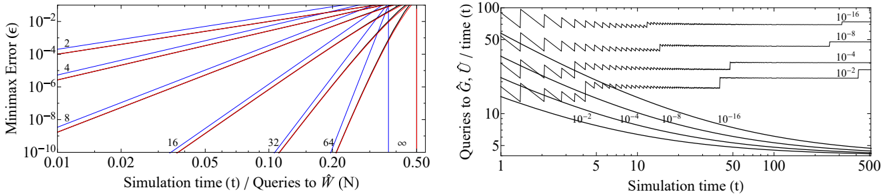
We present the problem of approximating the time-evolution operatore−iH^tto errorϵ, where the HamiltonianH^=(⟨G|⊗I^)U^(|G⟩⊗I^)is the projection of a unitary oracleU^onto the state|G⟩created by another unitary oracle. Our algorithm solves this with a query complexityO(t+log(1/ϵ))to both oracles that is optimal with respect to all parameters in both the asymptotic and non-asymptotic regime, and also with low overhead, using at most two additional ancilla qubits. This approach to Hamiltonian simulation subsumes important prior art considering Hamiltonians which ared-sparse or a linear combination of unitaries, leading to significant improvements in space and gate complexity, such as a quadratic speed-up for precision simulations. It also motivates useful new instances, such as whereH^is a density matrix. A key technical result is `qubitization', which uses the controlled version of these oracles to embed anyH^in an invariantSU(2)subspace. A large class of operator functions ofH^can then be computed with optimal query complexity, of whiche−iH^tis a special case.
Overview
The claims and statistics of this paper haven’t been checked yet.
Free: it reads the open-access text and checks the first 5 claims that cite a source we can check. Create a free account to check every claim.
Integrity signals
Registry
Cites
Statistics
Figures
Verification
Claims the paper makes
The claims and statistics of this paper haven’t been checked yet.
Free: it reads the open-access text and checks the first 5 claims that cite a source we can check. Create a free account to check every claim.
Claims other papers make about this one
Each is checked against this paper’s own text: does it say what the citing paper says it does?
In the citing paper
“Trotterization methods are commonly employed, and allow discretization errors that are controlled polynomially in dt, with a number of unitary operations that scales linearly in the number of Hamiltonian terms and simulation time IV .”
From Beyond-classical computation in quantum simulation (2025) · cites this paper as [105]
In the citing paper
“There are many other Hamiltonian simulation methods, an example of a powerful and sophisticated method being qubitization [166] and quantum signal processing [167], which have the provably optimal asymptotic scaling, although it is unclear whether this will translate to better practical applications.”
From The prospects of quantum computing in computational molecular biology (2021) · cites this paper as [166]
Self-check
Percentages, sums and reported differences re-computed from the paper’s own numbers.
The self-check needs the paper’s full text.
Citations
Cites
A fast quantum mechanical algorithm for database search
Grover, L. K. (1996) · Proceedings of the twenty-eighth annual ACM symposium on Theory of computing - STOC '96 · doi:10.1145/237814.237866 · Cited by 8,830 · cited 1×
“After all, (cid:104) G | ˆ S ˆ U ˆ S ˆ U | G (cid:105) = ˆ I implies that ˆ S ˆ U is a reflection when controlled by input state | G (cid:105) , and it is well-known that a Grover iterate [25, 45] is the product of two reflection about start and target subspaces.”
BackgroundQuantum Algorithm for Linear Systems of Equations
Harrow, A. W., Hassidim, A., & Lloyd, S. (2009) · Physical Review Letters · doi:10.1103/physrevlett.103.150502 · Cited by 3,325 · cited 1×
“ralized by Aharonov and Ta-Shma [3] to sparse Hamiltonians. Celebrated achievements over the years [20,8,32,10,33] have each ignited a urry of activity in diverse applications from quantum algorithms [26,19,21,15] to quantum chemistry [46,44,40,41,4,29,39]. In this dawning era of the small quantum computer [5,23], the…”
BackgroundLloyd, S. (1996) · Science · doi:10.1126/science.273.5278.1073 · Cited by 3,088 · cited 2×
“The first explicit quantum algorithms were discovered by Lloyd [31] for local interactions, and then generalized by Aharonov and Ta-Shma [3] to sparse Hamiltonians.”
Method(1964) · doi:10.1115/1.3625776 · Cited by 1,796
Superconducting quantum circuits at the surface code threshold for fault tolerance
Barends, R., Kelly, J., Megrant, A., Veitia, A., Sank, D., Jeffrey, E., White, T. C., Mutus, J., Fowler, A. G., Campbell, B., et al. (2014) · Nature · doi:10.1038/nature13171 · Cited by 1,733
Quantum principal component analysis
Lloyd, S., Mohseni, M., & Rebentrost, P. (2014) · Nature Physics · doi:10.1038/nphys3029 · Cited by 1,385 · cited 2×
“Celebrated achievements over the years [20, 8, 32, 10, 33] have each ignited a flurry of activity in diverse applications from quantum algorithms [26, 19, 21, 15] to quantum chemistry [46, 44, 40, 41, 4, 29, 39].”
BackgroundMethodA computer program for designing optimum FIR linear phase digital filters
McClellan, J., Parks, T., & Rabiner, L. (1973) · IEEE Transactions on Audio and Electroacoustics · doi:10.1109/tau.1973.1162525 · Cited by 1,139 · cited 1×
“We present a systematic framework that furnishes the optimal complexity and a concrete procedure for almost any f and show how an exact connection is made between query complexity and the theory of best function approximations with polynomials [33, 36].”
MethodScalable Quantum Simulation of Molecular Energies
O’Malley, P. J. J., Babbush, R., Kivlichan, I. D., Romero, J., McClean, J. R., Barends, R., Kelly, J., Roushan, P., Tranter, A., Ding, N., et al. (2016) · Physical Review X · doi:10.1103/physrevx.6.031007 · Cited by 1,059 · cited 1×
“Celebrated achievements over the years [3–7] have each ignited a flurry of activity in diverse applications from quantum algorithms [8–11] to quantum chemistry [12–18].”
BackgroundExponential algorithmic speedup by a quantum walk
Childs, A. M., Cleve, R., Deotto, E., Farhi, E., Gutmann, S., & Spielman, D. A. (2003) · Proceedings of the thirty-fifth annual ACM symposium on Theory of computing · doi:10.1145/780542.780552 · Cited by 825
Demonstration of a small programmable quantum computer with atomic qubits
Debnath, S., Linke, N. M., Figgatt, C., Landsman, K. A., Wright, K., & Monroe, C. (2016) · Nature · doi:10.1038/nature18648 · Cited by 777 · cited 1×
“In this dawning era of the small quantum computer [5, 23], the relevance and necessity of space and gate efficient procedures for practical Hamiltonian simulation has intensified.”
Background
Research works printed but not linked: 2
- R. Kothari, Efficient algorithms in quantum query complexity, Ph.D. thesis, University of Waterloo (2014).
- M. Abramowitz, I. A. Stegun, and Others, "Handbook of mathematical functions," Applied mathematics series 55, 62 (1966).
Cited by
Items 401–500 of 1,009
A quantum algorithm for simulating non-sparse Hamiltonians
Wang, C., & Wossnig, L. (2020) · Quantum Information and Computation · doi:10.26421/qic20.7-8-5 · Cited by 33
Q# and NWChem: Tools for Scalable Quantum Chemistry on Quantum ComputersPreprint
Low, G. H., Bauman, N. P., Granade, C., Peng, B., Wiebe, N., Bylaska, E. J., Wecker, D., Krishnamoorthy, S., Roetteler, M., Kowalski, K., et al. (2019) · arXiv (Cornell University) · doi:10.48550/arxiv.1904.01131 · Cited by 33
“Qubitization is chosen as the simulation method, both with and without optimization, following Line 24 of Listing 15.”
MethodInfluentialSelf-citationReport of the Snowmass 2021 Theory Frontier Topical Group on Quantum Information SciencePreprint
Catterall, S. M., Harnik, R., Hubeny, V. E., Bauer, C., Berlin, A., Davoudi, Z., Faulkner, T., Hartman, T., Headrick, M., Kahn, Y. F., et al. (2022) · arXiv (Cornell University) · doi:10.48550/arxiv.2209.14839 · Cited by 33
“Other approximations of U(t) exist: QDRIFT [155], variational approaches [156–158], Taylor series [159], use of nonlinear effects to increase the Trotter step [139, 160] and qubitization [161].”
MethodReal-Time Scattering on Quantum Computers via Hamiltonian TruncationPreprint
Ingoldby, J., Spannowsky, M., Sypchenko, T., Williams, S., & Wingate, M. (2025) · arXiv (Cornell University) · doi:10.48550/arxiv.2505.03878 · Cited by 34
“Techniques based on quantum walks and block-encoded oracles, such as those developed in Refs [67–70] offer better asymptotic scaling of gate depth with system size for sparse Hamiltonians.”
Babbush, R., Huggins, W. J., Berry, D. W., Ung, S. F., Zhao, A., Reichman, D. R., Neven, H., Baczewski, A. D., & Lee, J. (2023) · Nature Communications · doi:10.1038/s41467-023-39024-0 · Cited by 32
Single-shot Quantum Signal Processing Interferometry
Sinanan-Singh, J., Mintzer, G., Chuang, I. L., & Liu, Y. (2024) · Quantum · doi:10.22331/q-2024-07-30-1427 · Cited by 34
“Thus, the cat state sensing protocol is indeed a special case of a 1-QSPI protocol!”
BackgroundSelf-citationStrategies for simulating the time evolution of Hamiltonian lattice field theories
Hariprakash, S., Modi, N. S., Kreshchuk, M., Kane, C. F., & Bauer, C. (2025) · Physical Review A · doi:10.1103/physreva.111.022419 · Cited by 32
Exponentially faster implementations of Select(H) for fermionic Hamiltonians
Wan, K. (2021) · Quantum · doi:10.22331/q-2021-01-12-380 · Cited by 32
“in the spectrum of the interpolating Hamiltonian [9, 10]. Several techniques are useful for realising these schemes on a gate-based quantum computer. For instance, the qubitisation procedure of Refs. [11, 12] can implement the time-evolution operator exp(−iHt) or, more directly, a walk operator corresponding to exp[−i…”
MethodImproved Hamiltonian simulation via a truncated Taylor series and corrections
Novo, L., & Berry, D. W. (2017) · Quantum Information and Computation · doi:10.26421/qic17.7-8-5 · Cited by 33
Hamiltonian singular value transformation and inverse block encodingPreprint
Lloyd, S., Kiani, B. T., Arvidsson-Shukur, D. R. M., Bosch, S., Palma, G. D., Kaminsky, W. M., Liu, Z.-W., & Marvian, M. (2021) · arXiv (Cornell University) · doi:10.48550/arxiv.2104.01410 · Cited by 32
Chakraborty, S., Hazra, S., Li, T., Shao, C., Wang, X., & Zhang, Y. (2025) · arXiv (Cornell University) · doi:10.48550/arxiv.2504.02385 · Cited by 32
Peng, B., Su, Y., Claudino, D., Kowalski, K., Low, G. H., & Roetteler, M. (2025) · Quantum Science and Technology · doi:10.1088/2058-9565/adbf42 · Cited by 31
“Specifically, we assume that the Hamiltonian can be decomposed as where for some χ > 0 and 0 ≤ r 1.”
Self-citationEarly Fault-Tolerant Quantum Algorithms in Practice: Application to Ground-State Energy Estimation
Kiss, O., Azad, U., Requena, B., Roggero, A., Wakeham, D., & Arrazola, J. M. (2025) · Quantum · doi:10.22331/q-2025-04-01-1682 · Cited by 31
“In order to keep the Heisenberg scaling, it is necessary to use asymptotically optimal meth-ods based on linear combinations of unitaries (LCU) [81, 82], generally scaling as O ( ∥H∥ 1 τD + log ϵ − 1 ) queries to the LCU decomposition.”
TE-PAI: exact time evolution by sampling random circuits
Kiumi, C., & Koczor, B. (2025) · Quantum Science and Technology · doi:10.1088/2058-9565/ae1160 · Cited by 31
“Indeed, sophisticated quantum algorithms, such as linear combination of unitaries (LCU) [9– 11], quantum signal processing [12, 13] or quantum walks [14, 15], can achieve a fundamentally improved circuit-depth scaling compared to Trotterisation; however, they require significant overheads in…”
Quantum simulation of second-quantized Hamiltonians in compact encoding
Kirby, W. M., Hadi, S., Kreshchuk, M., & Love, P. J. (2021) · Physical Review A · doi:10.1103/physreva.104.042607 · Cited by 31
“Finally, if our Hamiltonian is time-independent, then by using qubitization [29] the total number of oracle queries required to simulate time-evolution is”
BackgroundMethodInfluentialDoes Qubit Connectivity Impact Quantum Circuit Complexity?
Yuan, P., Allcock, J., & Zhang, S. (2023) · IEEE Transactions on Computer-Aided Design of Integrated Circuits and Systems · doi:10.1109/tcad.2023.3311734 · Cited by 31
Quantum Control Machine: The Limits of Control Flow in Quantum Programming
Yuan, C., Villanyi, A., & Carbin, M. (2024) · Proceedings of the ACM on Programming Languages · doi:10.1145/3649811 · Cited by 32
“…} representing the branches, branching transforms the data from This Í | ⟩ | ⟩ ↦→ Í | ⟩ ( | ⟩ operation is used in algorithms for physical simulation [Babbush et al. 2018; Childs and Wiebe 2012; Low and Chuang 2019], in which each 𝑈 𝑖 encodes a component of the description of the target system.”
MethodLow-depth simulations of fermionic systems on square-grid quantum hardware
Algaba, M. G., Sriluckshmy, P. V., Leib, M., & Šimkovic, F. (2024) · Quantum · doi:10.22331/q-2024-04-30-1327 · Cited by 31
A Primer on Quantum Machine LearningPreprint
Chang, S. Y., & Cerezo, M. (2025) · arXiv (Cornell University) · doi:10.48550/arxiv.2511.15969 · Cited by 32
Double-bracket quantum algorithms for diagonalization
Gluza, M. (2024) · Quantum · doi:10.22331/q-2024-04-09-1316 · Cited by 32
Modeling Heterogeneous Catalysis Using Quantum Computers: An Academic and Industry Perspective
Hariharan, S., Kinge, S., & Visscher, L. (2024) · Journal of Chemical Information and Modeling · doi:10.1021/acs.jcim.4c01212 · Cited by 31
Halving the cost of quantum algorithms with randomization
Martyn, J. M., & Rall, P. (2025) · npj Quantum Information · doi:10.1038/s41534-025-01003-2 · Cited by 31
“The quantum signal processing (QSP) algorithm is a systematic method of implementing polynomial transformations on a quantum subsystem 17,18,23 .”
Experimental Quantum Channel Discrimination Using Metastable States of a Trapped Ion
DeBry, K., Sinanan-Singh, J., Bruzewicz, C., Reens, D., Kim, M. E., Roychowdhury, M., McConnell, R., Chuang, I. L., & Chiaverini, J. (2023) · Physical Review Letters · doi:10.1103/physrevlett.131.170602 · Cited by 30
Self-citationAn efficient quantum circuit for block encoding a pairing Hamiltonian
Liu, D., Du, W., Lin, L., Vary, J. P., & Chao, Y. (2024) · Journal of Computational Science · doi:10.1016/j.jocs.2024.102480 · Cited by 30
Paine, A. E., Elfving, V. E., & Kyriienko, O. (2023) · arXiv (Cornell University) · doi:10.48550/arxiv.2308.01827 · Cited by 31
Fast simulation of fermions with reconfigurable qubitsPreprint
Maskara, N., Kalinowski, M., González-Cuadra, D., & Lukin, M. D. (2025) · arXiv (Cornell University) · doi:10.48550/arxiv.2509.08898 · Cited by 30
“In a Trotter-based method, we evolve under e − iH α SYK dt and for a QSP-based method we query a block-encoding of H α SYK [66, 67].”
Hamiltonian simulation for low-energy states with optimal time dependence
Zlokapa, A., & Somma, R. D. (2024) · Quantum · doi:10.22331/q-2024-08-27-1449 · Cited by 29
Scattering Processes from Quantum Simulation Algorithms for Scalar Field Theories
Hardy, A., Mukhopadhyay, P., Alam, M. S., Konik, R., Hormozi, L., Rieffel, E. G., Hadfield, S., Barata, J., Venugopalan, R., Kharzeev, D. E., et al. (2026) · PRX Quantum · doi:10.1103/3krb-wwfx · Cited by 29
Probing spectral features of quantum many-body systems with quantum simulators
Sun, J., Vilchez-Estevez, L., Vedral, V., Timothy, B. A., & Kim, M. S. (2025) · Nature Communications · doi:10.1038/s41467-025-55955-2 · Cited by 29
Efficient quantum simulation of QCD jets on the light front
Qian, W., Li, M., Salgado, C. A., & Kreshchuk, M. (2025) · Physical review. D/Physical review. D. · doi:10.1103/physrevd.111.096001 · Cited by 29
Discontinuous Galerkin discretization for quantum simulation of chemistry
McClean, J. R., Faulstich, F. M., Zhu, Q., O’Gorman, B., Qiu, Y., White, S. R., Babbush, R., & Lin, L. (2020) · New Journal of Physics · doi:10.1088/1367-2630/ab9d9f · Cited by 29
“This family includes Taylor series methods [64] (applied to chemistry in [14, 42]), qubitization [65] (applied to chemistry in [38, 65, 66]) and Hamiltonian simulation in the interaction picture [41] (applied to chemistry in [40, 41]).”
MethodSuccinct Description and Efficient Simulation of Non-Markovian Open Quantum Systems
Li, X., & Wang, C. (2023) · Communications in Mathematical Physics · doi:10.1007/s00220-023-04638-4 · Cited by 29
“The optimal Hamiltonian simulation was achieved by quantum signal processing due to Low and Chuang [21], which has been generalized to quantum singular value transformation by Gilyén, Su, Low, and Wiebe [24].”
MethodQuantum tomography using state-preparation unitaries
van Apeldoorn, J., Cornelissen, A., Gilyén, A., & Nannicini, G. (2022) · Repository of the Academy's Library (Library of the Hungarian Academy of Sciences) · doi:10.48550/arxiv.2207.08800 · Cited by 29
The Future of Drug Development with Quantum Computing
Bonde, B. K., Patil, P., & Choubey, B. (2023) · Methods in molecular biology · doi:10.1007/978-1-0716-3449-3_7 · Cited by 29
Manenti, R., & Motta, M. (2023) · doi:10.1093/oso/9780198787488.001.0001 · Cited by 29
Doubling the order of approximation via the randomized product formula
Cho, C., Berry, D. W., & Hsieh, M.-H. (2024) · Physical Review A · doi:10.1103/physreva.109.062431 · Cited by 29
Multi-Product Hamiltonian Simulation with Explicit Commutator ScalingPreprint
Aftab, J., An, D., & Trivisa, K. (2024) · arXiv (Cornell University) · doi:10.48550/arxiv.2403.08922 · Cited by 29
“The µ parameter is at least no worse than O ( γ ∥ H γ ∥ ) in the complexity estimate given in [27] [29] for electronic structure, simulation based on the Lieb-Robinson bound [30] for power law with α ∈ (2 d, ∞ ), and qubitization [22] or quantum singular value transformation [23] for other systems.”
Over, P., Bengoechea, S., Brearley, P., Laizet, S., & Rung, T. (2025) · Physical Review A · doi:10.1103/d8hb-fv93 · Cited by 28
“Each time step requires the implementation of a Hamiltonian simulation, where optimal algorithms [15] require a number of two-qubit gates that grow linearly with the sparsity of the Hamiltonian H , the largest absolute element of H and the evolution time.”
Kumar, E. D., & Frankel, S. H. (2025) · AVS Quantum Science · doi:10.1116/5.0245082 · Cited by 28
Quantum circuits for the heat equation with physical boundary conditions via Schrödingerization
Jin, S., Liu, N., & Yu, Y. (2025) · Journal of Computational Physics · doi:10.1016/j.jcp.2025.114138 · Cited by 28
Kan, A., & Symons, B. C. B. (2025) · npj Quantum Information · doi:10.1038/s41534-025-01091-0 · Cited by 30
Post-Hartree–Fock method in quantum chemistry for quantum computer
Shikano, Y., Watanabe, H. C., Nakanishi, K. M., & Ohnishi, Y. (2021) · The European Physical Journal Special Topics · doi:10.1140/epjs/s11734-021-00087-z · Cited by 29
Effects of cosine tapering window on quantum phase estimation
Rendon, G., Izubuchi, T., & Kikuchi, Y. (2022) · Physical review. D/Physical review. D. · doi:10.1103/physrevd.106.034503 · Cited by 29
Toward density functional theory on quantum computers?
Senjean, B., Yalouz, S., & Saubanère, M. (2023) · SciPost Physics · doi:10.21468/scipostphys.14.3.055 · Cited by 28
Quantum computing Floquet energy spectra
Fauseweh, B., & Zhu, J. (2023) · Quantum · doi:10.22331/q-2023-07-20-1063 · Cited by 30
Interconnect Fabrics for Multi-Core Quantum Processors: A Context Analysis
Escofet, P., Rached, S. B., Rodrigo, S., Almudéver, C. G., Alarcón, E., & Abadal, S. (2023) · International Workshop on Network on Chip Architectures (NoCArc) · doi:10.1145/3610396.3623267 · Cited by 28
“As a result, this technology offers a vast array of potential applications spanning across various fields, including prime factorization [50], database search [12], physics [28], chemistry [37], finance [55], and healthcare [53].”
BackgroundQuantum Algorithm for Estimating Largest Eigenvalues
Nghiem, N. A., & Wei, T.-C. (2023) · Physics Letters A · doi:10.1016/j.physleta.2023.129138 · Cited by 28
Route-Forcing: Scalable Quantum Circuit Mapping for Scalable Quantum Computing Architectures
Escofet, P., Gonzalvo, A., Alarcón, E., Almudéver, C. G., & Abadal, S. (2024) · IEEE International Conference on Quantum Computing and Engineering (QCE) · doi:10.1109/qce60285.2024.00110 · Cited by 27
“The potential applications of quantum computing span diverse domains, ranging from cryptography, exemplified by Shor’s prime factorization algorithm [2], to optimized database searches, facilitated by Grover’s algorithm [3], or the simulation of physical systems [4].”
MethodZylberman, J., Nzongani, U., Simonetto, A., & Debbasch, F. (2025) · ACM Transactions on Quantum Computing · doi:10.1145/3718348 · Cited by 27
“Solving ordinary differential equations is also possible using non-unitary operations within the LCU framework [28, 29] and many quantum partial differential equations solvers are based on non-unitary operations [30, 31].”
LSQCA: Resource-Efficient Load/Store Architecture for Limited-Scale Fault-Tolerant Quantum Computing
Kobori, T., Suzuki, Y., Ueno, Y., Tanimoto, T., Todo, S., & Tokunaga, Y. (2025) · IEEE International Symposium on High-Performance Computer Architecture (HPCA) · doi:10.1109/hpca61900.2025.00033 · Cited by 26
“Fault-tolerant quantum computing (FTQC) is expected to enable faster computation that surpasses classical computers [6], [33], [37], [50], [53], [57], [65].”
Quantum Artificial Intelligence Scalability in the NISQ Era: Pathways to Quantum Utility
Moreau, G. S., Pisani, L., Profir, M., Podda, C., Leoni, L., & Cao, G. (2025) · Advanced Quantum Technologies · doi:10.1002/qute.202400716 · Cited by 27
Lee, M., Song, Z., Kocherla, S., Adams, A. J., Alexeev, A., & Bryngelson, S. H. (2025) · Future Generation Computer Systems · doi:10.1016/j.future.2025.107975 · Cited by 27
“Suppose we split A into a linear combination of unitary matrices, C 1 and C 2 , related to the original matrix as As A = ( C 1 + C 2 ) / 2, an operation with A is computed via block encoding [82, 83], where C 1 and C 2 are unitary, but A is, in general, not.”
Quantum algorithm for neighborhood preserving embedding
Pan, S., Wan, L., Liu, H., Wu, Y., Qin, S., Wen, Q., & Gao, F. (2022) · Chinese Physics B · doi:10.1088/1674-1056/ac523a · Cited by 27
Quantum signal processing for simulating cold plasma waves
Novikau, I., Startsev, E. A., & Dodin, I. Y. (2022) · Physical Review A · doi:10.1103/physreva.105.062444 · Cited by 27
Quantum-Enhanced DC Optimal Power Flow
Amani, F., Mahroo, R., & Kargarian, A. (2023) · IEEE Texas Power and Energy Conference (TPEC) · doi:10.1109/tpec56611.2023.10078612 · Cited by 28
“In contrast, the quantum signal processing method needs much fewer resources, with a gate complexity of , where is the system size [25].”
BackgroundMartínez-Martínez, L. Á., Yen, T.-C., & Izmaylov, A. F. (2023) · Quantum · doi:10.22331/q-2023-08-16-1086 · Cited by 27
“Within a faulttolerant paradigm, several approaches have been put forward to address this problem: oracle querybased algorithms [2], quantum walks [3], qubitization [4], linear combination of unitaries [5] and product formulas [6].”
MethodZhong, W.-H., Li, W.-L., Chen, Y. L., & Yu, X.-J. (2024) · Physical Review A · doi:10.1103/physreva.110.022212 · Cited by 27
Baker, T. E., & Poulin, D. (2020) · Physical Review Research · doi:10.1103/physrevresearch.2.043238 · Cited by 27
Implementation of measurement reduction for the variational quantum eigensolver
Ralli, A., Love, P. J., Tranter, A., & Coveney, P. V. (2021) · Physical Review Research · doi:10.1103/physrevresearch.3.033195 · Cited by 27
“To maximize the circuit simplifications on the ancilla and work qubit registers, we show how a Gray encoding of ULCU should be used.”
MethodInfluentialBF-QC: Belief functions on quantum circuits
Zhou, Q., Tian, G., & Deng, Y. (2023) · Expert Systems with Applications · doi:10.1016/j.eswa.2023.119885 · Cited by 27
“In [58], it proved that the s -sparse 5 Hamiltonian can be simulated within O ( s + log ( 1/ (cid:101) ) loglog ( 1/ (cid:101) ) ) .”
BackgroundQuantum signal processing with continuous variablesPreprint
Rossi, Z. M., Bastidas, V. M., Munro, W. J., & Chuang, I. L. (2023) · arXiv (Cornell University) · doi:10.48550/arxiv.2304.14383 · Cited by 27
“The theory of QSP has roots in the study of composite pulse techniques for NMR [3, 18, 19] but was first named for use in Hamiltonian simulation [4, 5], in which the single-qubit nature of QSP was suitably lifted to apply to systems of multiple qubits by a technique known as qubitization.”
MethodSelf-citationQuantifying fault tolerant simulation of strongly correlated systems using the Fermi-Hubbard modelPreprint
Agrawal, A. A., Job, J., Wilson, T. L., Saadatmand, S. N., Hodson, M. J., Mutus, J., Caesura, A., Johnson, P. D., Elenewski, J. E., Morrell, K. J., et al. (2024) · arXiv (Cornell University) · doi:10.48550/arxiv.2406.06511 · Cited by 27
Quantum algorithms for Uhlmann transformationPreprint
Utsumi, T., Nakata, Y., Wang, Q., & Takagi, R. (2025) · arXiv (Cornell University) · doi:10.48550/arxiv.2509.03619 · Cited by 27
A Denser Planar Surface CodePreprint
Low, G. H., Huggins, W. J., Berry, D. W., Khattar, T., White, A. F., Rubin, N. C., & Babbush, R. (2026) · arXiv (Cornell University) · doi:10.48550/arxiv.2605.30455 · Cited by 29
Self-citationLow-depth Hamiltonian Simulation by Adaptive Product Formula
Zhang, Z.-J., Sun, J., Yuan, X., & Yung, M.-H. (2020) · arXiv · doi:10.48550/arxiv.2011.05283 · Cited by 26
Implementing smooth functions of a Hermitian matrix on a quantum computer
Subramanian, S., Brierley, S., & Jozsa, R. (2019) · Journal of Physics Communications · doi:10.1088/2399-6528/ab25a2 · Cited by 26
“More recently, Low and Chuang [ LC16] have introduced a method called Qubitization and Quantum Signal Processing (QSP) (also referred to as the block-encoding method).”
BackgroundMethodToyoizumi, K., Yamamoto, N., & Hoshino, K. (2024) · Physical Review A · doi:10.1103/physreva.109.012430 · Cited by 26
Improved Precision Scaling for Simulating Coupled Quantum-Classical Dynamics
Simon, S., Santagati, R., Degroote, M., Moll, N., Streif, M., & Wiebe, N. (2024) · PRX Quantum · doi:10.1103/prxquantum.5.010343 · Cited by 26
Complexity of Digital Quantum Simulation in the Low-Energy Subspace: Applications and a Lower Bound
Gong, W., Zhou, S., & Li, T. (2024) · Quantum · doi:10.22331/q-2024-07-15-1409 · Cited by 26
“Alternative principles have also led to advanced digital quantum simulation approaches such as linear combinations of unitaries [11, 12], qubitization [13], truncated Taylor series [14], quantum signal processing [15, 16], etc.”
BackgroundA Quantum Speed-Up for Approximating the Top Eigenvectors of a Matrix
Chen, Y., Gilyén, A., & de Wolf, R. (2025) · Society for Industrial and Applied Mathematics eBooks · doi:10.1137/1.9781611978322.29 · Cited by 26
Marti-Dafcik, D., Burton, H. G. A., & Tew, D. P. (2025) · Physical Review Research · doi:10.1103/physrevresearch.7.013191 · Cited by 27
“This is often the time-evolution operator U = e − iHt ,[29, 31, 50] but it can also be a qubitized quantum walk U = e i arcsin( H/λ ) ,[65, 113, 114] where λ is a rescaling parameter proportional to the norm of the Hamiltonian.”
Block encoding bosons by signal processing
Kane, C. F., Hariprakash, S., Modi, N. S., Kreshchuk, M., & Bauer, C. (2025) · Quantum · doi:10.22331/q-2025-05-15-1747 · Cited by 26
“[66, 71]), given by: where J k is the k th Bessel function of the first kind.”
InfluentialLoaiza, I., Brahmachari, A. S., & Izmaylov, A. F. (2025) · Quantum Science and Technology · doi:10.1088/2058-9565/add9c1 · Cited by 26
Modular quantum signal processing in many variables
Rossi, Z. M., Ceroni, J., & Chuang, I. L. (2025) · Quantum · doi:10.22331/q-2025-06-18-1776 · Cited by 26
Self-citationQuantum Boltzmann machine learning of ground-state energies
Patel, D., Koch, D., Patel, S., & Wilde, M. M. (2026) · Physical Review A · doi:10.1103/zyqp-zb3p · Cited by 27
Exploiting fermion number in factorized decompositions of the electronic structure Hamiltonian
McArdle, S., Campbell, E. T., & Su, Y. (2022) · Physical Review A · doi:10.1103/physreva.105.012403 · Cited by 26
“Pauli strings), and uses circuits to ‘block encode’ H in a subspace of a Hilbert space enlarged by additional ancilla qubits [76].”
MethodFourier-based quantum signal processingPreprint
Silva, T. D. L., Borges, L., & Aolita, L. (2022) · arXiv (Cornell University) · doi:10.48550/arxiv.2206.02826 · Cited by 26
“Here, qubitization [3] is not required.”
InfluentialRobust Angle Finding for Generalized Quantum Signal ProcessingPreprint
Yamamoto, S., & Yoshioka, N. (2024) · arXiv (Cornell University) · doi:10.48550/arxiv.2402.03016 · Cited by 26
“Low and Chuang showed the existence condition of such an angle sequence [3], and later constructive method was provided by Gily´en et al. in Ref.”
MethodPotential Applications of Quantum Computing at Los Alamos National LaboratoryPreprint
Bärtschi, A., Caravelli, F., Coffrin, C., Colina, J., Eidenbenz, S., Jayakumar, A., Kirmani, A. A., Lawrence, S., Lee, M., Lokhov, A. Y., et al. (2024) · arXiv (Cornell University) · doi:10.48550/arxiv.2406.06625 · Cited by 28
Randomly Compiled Quantum Simulation with Exponentially Reduced Circuit DepthsPreprint
Watson, J. D. (2024) · arXiv (Cornell University) · doi:10.48550/arxiv.2411.04240 · Cited by 26
Solving lattice gauge theories using the quantum Krylov algorithm and qubitization
Anderson, L. W., Kiffner, M., O’Leary, T., Crain, J. N., & Jaksch, D. (2025) · Quantum · doi:10.22331/q-2025-03-25-1669 · Cited by 25
“…used to reduce the resources required for other quantum algorithms to study ground states or dynamics of LGTs such as phase estimation and Hamiltonian simulation, both of which have seen significant cost reductions by using qubitization for quantum chemistry in an error corrected setting [30, 106].”
InfluentialOptimizing the information extracted by a single qubit measurement
Polla, S., Anselmetti, G.-L., & O’Brien, T. E. (2023) · Physical Review A · doi:10.1103/physreva.108.012403 · Cited by 28
“[15] Guang Hao Low and Isaac L Chuang, “Hamiltonian simulation by qubitization,” Quantum 3, 163 (2019).”
BackgroundSolving graph problems with single photons and linear optics
Mezher, R., Carvalho, A. F., & Mansfield, S. (2023) · Physical Review A · doi:10.1103/physreva.108.032405 · Cited by 25
Sparse Random Hamiltonians Are Quantumly Easy
Chen, C.-F., Dalzell, A. M., Berta, M., Brandão, F. G. S. L., & Tropp, J. A. (2024) · Physical Review X · doi:10.1103/physrevx.14.011014 · Cited by 25
“…III.1) for the operator norm H PS = (cid:15)/ 6 (using that λ min ( H PS ) ≥ −(cid:107) H PS and that which costs Poly( m, 1 /(cid:15) ) using any off-the-shelf quantum simulation algorithm such as Trotter [39], Qubiti-zation [41], or qDrift [15] for Hamiltonian simulation within phase estimation.”
MethodRiemannian quantum circuit optimization for Hamiltonian simulation
Kotil, A., Banerjee, R., Huang, Q., & Mendl, C. B. (2024) · Journal of Physics A Mathematical and Theoretical · doi:10.1088/1751-8121/ad2d6e · Cited by 25
“Approaches based on quantum signal processing [10, 11] might provide a complexity theoretic advantage in certain situations, but have the disadvantage of requiring additional auxiliary qubits and a block encoding of the Hamiltonian, which can incur a large overhead in practice.”
BackgroundHigher-order quantum transformations of Hamiltonian dynamics
Odake, T., Kristjánsson, H., Soeda, A., & Murao, M. (2024) · Physical Review Research · doi:10.1103/physrevresearch.6.l012063 · Cited by 26
Quantum algorithm to simulate Lindblad master equations
Borras, E., & Marvian, M. (2025) · Physical Review Research · doi:10.1103/physrevresearch.7.023076 · Cited by 25
Efficient Quantum Optimization via Dynamical Simulation
Çatlı, A. B., Simon, S., & Wiebe, N. (2026) · PRX Quantum · doi:10.1103/t59v-8flk · Cited by 25
Analog quantum algorithms for the mixing of Markov chains
Chakraborty, S., Luh, K., & Roland, J. (2020) · Physical Review A · doi:10.1103/physreva.102.022423 · Cited by 25
“The challenge is that most of the underlying techniques that enable this, such as the recently developed techniques in the context of quantum simulation [66–68], are absent in continuous-time.”
BackgroundQuantum advantage from energy measurements of many-body quantum systems
Novo, L., Bermejo-Vega, J., & García−Patrón, R. (2021) · Quantum · doi:10.22331/q-2021-06-02-465 · Cited by 25
“However, it is possible to solve this problem thanks to recently developed quantum simulation algorithms, which are exponentially more precise than the original proposal by Lloyd, and are applicable for most Hamiltonians of interest such as local, sparse, or low-rank ones [52, 58–61].”
BackgroundMethodMeister, R. J., Benjamin, S. C., & Campbell, E. T. (2022) · Quantum · doi:10.22331/q-2022-02-02-637 · Cited by 25
“Extensions of this approach are quantum signal processing [25, 26] and qubitization [27], of which variants specifically for quantum chemistry exist [28].”
BackgroundMethodGreenaway, S., Pol, W., & Sim, S. (2024) · arXiv (Cornell University) · doi:10.48550/arxiv.2404.01396 · Cited by 25
Simulating X-ray absorption spectroscopy of battery materials on a quantum computerPreprint
Fomichev, S., Hejazi, K., Loaiza, I., Zini, M. S., Delgado, A., Voigt, A.-C., Mueller, J. E., & Arrazola, J. M. (2024) · arXiv (Cornell University) · doi:10.48550/arxiv.2405.11015 · Cited by 25
Generalized Quantum Signal Processing and Non-Linear Fourier Transform are equivalentPreprint
Laneve, L. (2025) · arXiv (Cornell University) · doi:10.48550/arxiv.2503.03026 · Cited by 25
“Quantum signal processing (QSP) is a technique that draw significant attention in the past years [1, 2].”
Improved reversible and quantum circuits for Karatsuba-based integer multiplication
Parent, A., Roetteler, M., & Mosca, M. (2018) · Schloss Dagstuhl – Leibniz-Zentrum für Informatik · doi:10.4230/lipics.tqc.2017.7 · Cited by 24
Block encoding of matrix product operators
Nibbi, M., & Mendl, C. B. (2024) · Physical Review A · doi:10.1103/physreva.110.042427 · Cited by 24
“Before illustrating some possible applications, we would like to discuss the cost of a general QET circuit built with our block encoding algorithm in comparison to the linear combination of unitaries (LCU) technique [2, 16, 17] shown in Fig.”
BackgroundMethodProtocols and trade-offs of quantum state purification
Yao, H., Chen, Y.-A., Huang, E., Chen, K., Fu, H., & Wang, X. (2025) · Quantum Science and Technology · doi:10.1088/2058-9565/add17e · Cited by 24
“Then, one can obtain the objective value f 2 using this solution, as follows: where T 12 denotes the partial transpose on system A 2 , and the last equality follows from the fact that | ψ ⟩ for any pure state ψ .”
Parallel Quantum Signal Processing Via Polynomial Factorization
Martyn, J. M., Rossi, Z. M., Cheng, K. Z., Liu, Y., & Chuang, I. L. (2025) · Quantum · doi:10.22331/q-2025-08-27-1834 · Cited by 24
Self-citationZhao, L., Goings, J. J., Aboumrad, W., Arrasmith, A., Calderín, L., Churchill, S., Gabay, D., Harvey-Brown, T., Hiles, M. L., Kaja, M., et al. (2026) · Physical Review Research · doi:10.1103/n1tf-8kr7 · Cited by 24
Topological physics in quantum critical systems
Yu, X.-J., Xu, L., & Lin, H. (2025) · Physics Reports · doi:10.1016/j.physrep.2025.10.005 · Cited by 26
Metadata
- Authors
- Low, G. H., & Chuang, I. L.
- Affiliations
- Massachusetts Institute of Technology (US)
- Venue
- Quantum
- Published
- 2019-07-12
- Volume
- 3
- Pages
- 163
- ISSN
- 2521-327X (ISSN-L)
- OpenAlex
- W2535738892
- Cited by
- 854
- References
- 46
- Citations by year
- 2026: 120 · 2025: 216 · 2024: 160 · 2023: 137 · 2022: 92 · 2021: 70 · 2020: 43 · 2019: 15
- FWCI
- 25.21
- Type
- journal article
- Language
- en
- Open access
- gold
- doi.org
- Locations
- Quantum (publishedVersion, cc-by)
- arXiv (Cornell University) (acceptedVersion)
- DOAJ (DOAJ: Directory of Open Access Journals) (submittedVersion)
- arXiv (Cornell University) (cc-by)
- Topics
- Physical Sciences › Computer Science › Artificial Intelligence › Quantum Computing Algorithms and Architecture
- Physical Sciences › Physics and Astronomy › Atomic and Molecular Physics, and Optics › Quantum many-body systems
- Physical Sciences › Physics and Astronomy › Atomic and Molecular Physics, and Optics › Quantum Mechanics and Applications
- Keywords
- Hamiltonian simulation, qubitization, evolution operator, query complexity, sparse Hamiltonians, linear combination of unitaries, ancilla qubits, operator functions, quantum algorithms
About these checks
Registry, retraction, Cites and statistics results are computed, not judged, with one exception: a printed reference that no index lists is read once by a model before it counts as a citation error. Claims are extracted by a model and kept only when their quote appears verbatim in the text; each cited source is then checked, with a model’s help, for whether it says what the claim relies on. Those verdicts can be wrong — read the claim’s quote and the cited source before relying on one.
Statistics and arithmetic are recomputed, not judged.
Confidence bands are shown only for fields calibrated on our annotated test set. None is calibrated yet, so no band is shown.
What counts as a claim ›How we measure confidence ›How we check this ›
Are you an author, or do you see a problem with this page? Request a review
Data sources
Bibliographic data: Semantic Scholar, OpenAlex, Crossref.
Contains information from the Semantic Scholar Academic Graph Datasets, made available under the ODC Attribution License (ODC-BY 1.0).
Semantic Scholar’s data is described in: Kinney, R., et al. (2023). The Semantic Scholar Open Data Platform. arXiv:2301.10140.
