

Hamiltonian Simulation by Qubitization
Open accessThe DOI matches its Crossref record; 50 of the 50 references it cites were found in a registry or an index.
Abstract
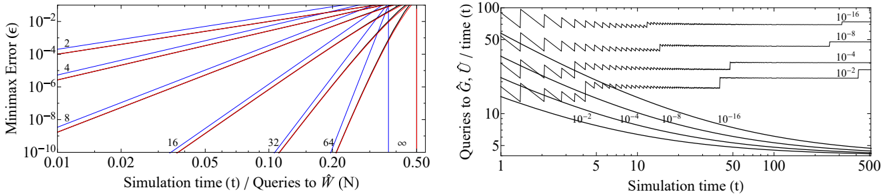
We present the problem of approximating the time-evolution operatore−iH^tto errorϵ, where the HamiltonianH^=(⟨G|⊗I^)U^(|G⟩⊗I^)is the projection of a unitary oracleU^onto the state|G⟩created by another unitary oracle. Our algorithm solves this with a query complexityO(t+log(1/ϵ))to both oracles that is optimal with respect to all parameters in both the asymptotic and non-asymptotic regime, and also with low overhead, using at most two additional ancilla qubits. This approach to Hamiltonian simulation subsumes important prior art considering Hamiltonians which ared-sparse or a linear combination of unitaries, leading to significant improvements in space and gate complexity, such as a quadratic speed-up for precision simulations. It also motivates useful new instances, such as whereH^is a density matrix. A key technical result is `qubitization', which uses the controlled version of these oracles to embed anyH^in an invariantSU(2)subspace. A large class of operator functions ofH^can then be computed with optimal query complexity, of whiche−iH^tis a special case.
Overview
The claims and statistics of this paper haven’t been checked yet.
Free: it reads the open-access text and checks the first 5 claims that cite a source we can check. Create a free account to check every claim.
Integrity signals
Registry
Cites
Statistics
Figures
Verification
Claims the paper makes
The claims and statistics of this paper haven’t been checked yet.
Free: it reads the open-access text and checks the first 5 claims that cite a source we can check. Create a free account to check every claim.
Claims other papers make about this one
Each is checked against this paper’s own text: does it say what the citing paper says it does?
In the citing paper
“Trotterization methods are commonly employed, and allow discretization errors that are controlled polynomially in dt, with a number of unitary operations that scales linearly in the number of Hamiltonian terms and simulation time IV .”
From Beyond-classical computation in quantum simulation (2025) · cites this paper as [105]
In the citing paper
“There are many other Hamiltonian simulation methods, an example of a powerful and sophisticated method being qubitization [166] and quantum signal processing [167], which have the provably optimal asymptotic scaling, although it is unclear whether this will translate to better practical applications.”
From The prospects of quantum computing in computational molecular biology (2021) · cites this paper as [166]
Self-check
Percentages, sums and reported differences re-computed from the paper’s own numbers.
The self-check needs the paper’s full text.
Citations
Cites
A fast quantum mechanical algorithm for database search
Grover, L. K. (1996) · Proceedings of the twenty-eighth annual ACM symposium on Theory of computing - STOC '96 · doi:10.1145/237814.237866 · Cited by 8,830 · cited 1×
“After all, (cid:104) G | ˆ S ˆ U ˆ S ˆ U | G (cid:105) = ˆ I implies that ˆ S ˆ U is a reflection when controlled by input state | G (cid:105) , and it is well-known that a Grover iterate [25, 45] is the product of two reflection about start and target subspaces.”
BackgroundQuantum Algorithm for Linear Systems of Equations
Harrow, A. W., Hassidim, A., & Lloyd, S. (2009) · Physical Review Letters · doi:10.1103/physrevlett.103.150502 · Cited by 3,325 · cited 1×
“ralized by Aharonov and Ta-Shma [3] to sparse Hamiltonians. Celebrated achievements over the years [20,8,32,10,33] have each ignited a urry of activity in diverse applications from quantum algorithms [26,19,21,15] to quantum chemistry [46,44,40,41,4,29,39]. In this dawning era of the small quantum computer [5,23], the…”
BackgroundLloyd, S. (1996) · Science · doi:10.1126/science.273.5278.1073 · Cited by 3,088 · cited 2×
“The first explicit quantum algorithms were discovered by Lloyd [31] for local interactions, and then generalized by Aharonov and Ta-Shma [3] to sparse Hamiltonians.”
Method(1964) · doi:10.1115/1.3625776 · Cited by 1,796
Superconducting quantum circuits at the surface code threshold for fault tolerance
Barends, R., Kelly, J., Megrant, A., Veitia, A., Sank, D., Jeffrey, E., White, T. C., Mutus, J., Fowler, A. G., Campbell, B., et al. (2014) · Nature · doi:10.1038/nature13171 · Cited by 1,733
Quantum principal component analysis
Lloyd, S., Mohseni, M., & Rebentrost, P. (2014) · Nature Physics · doi:10.1038/nphys3029 · Cited by 1,385 · cited 2×
“Celebrated achievements over the years [20, 8, 32, 10, 33] have each ignited a flurry of activity in diverse applications from quantum algorithms [26, 19, 21, 15] to quantum chemistry [46, 44, 40, 41, 4, 29, 39].”
BackgroundMethodA computer program for designing optimum FIR linear phase digital filters
McClellan, J., Parks, T., & Rabiner, L. (1973) · IEEE Transactions on Audio and Electroacoustics · doi:10.1109/tau.1973.1162525 · Cited by 1,139 · cited 1×
“We present a systematic framework that furnishes the optimal complexity and a concrete procedure for almost any f and show how an exact connection is made between query complexity and the theory of best function approximations with polynomials [33, 36].”
MethodScalable Quantum Simulation of Molecular Energies
O’Malley, P. J. J., Babbush, R., Kivlichan, I. D., Romero, J., McClean, J. R., Barends, R., Kelly, J., Roushan, P., Tranter, A., Ding, N., et al. (2016) · Physical Review X · doi:10.1103/physrevx.6.031007 · Cited by 1,059 · cited 1×
“Celebrated achievements over the years [3–7] have each ignited a flurry of activity in diverse applications from quantum algorithms [8–11] to quantum chemistry [12–18].”
BackgroundExponential algorithmic speedup by a quantum walk
Childs, A. M., Cleve, R., Deotto, E., Farhi, E., Gutmann, S., & Spielman, D. A. (2003) · Proceedings of the thirty-fifth annual ACM symposium on Theory of computing · doi:10.1145/780542.780552 · Cited by 825
Demonstration of a small programmable quantum computer with atomic qubits
Debnath, S., Linke, N. M., Figgatt, C., Landsman, K. A., Wright, K., & Monroe, C. (2016) · Nature · doi:10.1038/nature18648 · Cited by 777 · cited 1×
“In this dawning era of the small quantum computer [5, 23], the relevance and necessity of space and gate efficient procedures for practical Hamiltonian simulation has intensified.”
Background
Research works printed but not linked: 2
- R. Kothari, Efficient algorithms in quantum query complexity, Ph.D. thesis, University of Waterloo (2014).
- M. Abramowitz, I. A. Stegun, and Others, "Handbook of mathematical functions," Applied mathematics series 55, 62 (1966).
Cited by
Items 501–600 of 1,009
Ladder Operator Block-Encoding
Simon, W., Gustin, C. M., Serafin, K., Ralli, A., Goldstein, G. R., & Love, P. J. (2025) · Quantum · doi:10.22331/q-2025-12-22-1953 · Cited by 25
“This structure makes LCU block-encodings particularly well-suited for being applied in algorithms based on Qubitization [23].”
Computing Eigenvalues of Diagonalizable Matrices on a Quantum Computer
Shao, C. (2022) · ACM Transactions on Quantum Computing · doi:10.1145/3527845 · Cited by 24
“With the development of quantum singular value estimation (QSVE) , QPE can also be extended to solve eigenvalues of normal matrices (see Reference [26] or the arXiv version of this article).”
Chen, Q., Du, Y., Jiao, Y., Lu, X., Wu, X., & Zhao, Q. (2024) · Quantum Science and Technology · doi:10.1088/2058-9565/ad420a · Cited by 12
“The first-generation quantum computers [1–6] have shown their potential across many scientific domains such as quantum machine learning [7–15], quantum information processing [16–21], and quantum simulation [22–29].”
Polynomial Equivalence of Complexity Geometries
Brown, A. R. (2024) · Quantum · doi:10.22331/q-2024-07-02-1391 · Cited by 24
“[34–38].”
Circuit Partitioning for Multi-Core Quantum Architectures with Deep Reinforcement Learning
Pastor, A., Escofet, P., Rached, S. B., Alarcón, E., Barlet‐Ros, P., & Abadal, S. (2024) · IEEE International Symposium on Circuits and Systems proceedings · doi:10.1109/iscas58744.2024.10557956 · Cited by 24
Large-scale simulations of Floquet physics on near-term quantum computers
Eckstein, T., Mansuroglu, R., Czarnik, P., Zhu, J., Hartmann, M. J., Cincio, Ł., Sornborger, A. T., & Holmes, Z. (2024) · npj Quantum Information · doi:10.1038/s41534-024-00866-1 · Cited by 24
“StandardTrotterization 1 – 3, AlternativeproposalsincludequbitizationofthetruncatedFloquet-Hilbertspace 37 , which require additional ancillae, truncated Taylor 26 and Dyson series 38 which are not guaranteed to be unitary or using variational optimization 34 .”
End-to-end complexity for simulating the Schwinger model on quantum computers
Sakamoto, K., Morisaki, H., Haruna, J., Itou, E., Fujii, K., & Mitarai, K. (2024) · Quantum · doi:10.22331/q-2024-09-17-1474 · Cited by 24
“…measured in operator norm [32]. e It is achieved by various sophisticated techniques, including qubitization by a linear combination of unitaries [66], Hamiltonian simulation in the interaction picture [67], and decomposition of the time evolution operator to local blocks using the Lieb-Robinson…”
MethodAssessment of quantum phase estimation protocols for early fault-tolerant quantum computers
Nelson, J. S., & Baczewski, A. (2024) · Physical Review A · doi:10.1103/physreva.110.042420 · Cited by 24
Noise-adapted recovery circuits for quantum error correction
Biswas, D., Vaidya, G. M., & Mandayam, P. (2024) · Physical Review Research · doi:10.1103/physrevresearch.6.043034 · Cited by 24
“(1) can be realised using the techniques of block encoding [20] and the quantum singular value transform (QSVT) [19], by decomposing the Petz map as sequence of completely positive (CP) maps.”
MethodA variational quantum algorithm for Hamiltonian diagonalization
Zeng, J., Cao, C., Zhang, C., Xu, P., & Zeng, B. (2021) · Quantum Science and Technology · doi:10.1088/2058-9565/ac11a7 · Cited by 24
Hamiltonian Simulation in the Interaction Picture Using the Magnus ExpansionPreprint
Sharma, K., & Tran, M. C. (2024) · arXiv (Cornell University) · doi:10.48550/arxiv.2404.02966 · Cited by 24
“Leading quantum algorithms for such decomposition include product formulas [1–3], linear combinations of unitaries [4, 5], quantum signal processing [6, 7], and stochastic quantum simulation algorithms [8–10].”
BackgroundQuantum simulation of a noisy classical nonlinear dynamicsPreprint
Bravyi, S. B., Sawko, R., Zayats, M., & Zhuk, S. M. (2025) · arXiv (Cornell University) · doi:10.48550/arxiv.2507.06198 · Cited by 24
“A single Trotter step e τB 1 or e τC 11 can be implemented using any available quantum algorithm for simulating unitary time evolution under a sparse Hamiltonian, see e.g. [33, 34, 43, 44, 47].”
A List of Complexity Bounds for Property Testing by Quantum Sample-to-Query LiftingPreprint
Chen, K., Wang, Q., & Zhang, Z. (2025) · arXiv (Cornell University) · doi:10.48550/arxiv.2512.01971 · Cited by 24
On multivariate polynomials achievable with quantum signal processing
Laneve, L., & Wolf, S. (2025) · Quantum · doi:10.22331/q-2025-02-20-1641 · Cited by 23
“Notable examples of such conceptual simplification are block-encoded matrix inversion [18], phase estimation based on binary search [14], Hamiltonian simulation [17, 19, 20], and state preparation [21, 22].”
Trotterization is Substantially Efficient for Low-Energy States
Mizuta, K., & Kuwahara, T. (2025) · Physical Review Letters · doi:10.1103/q87n-5xhz · Cited by 23
“To this goal, various quantum algorithms have been developed in the past few decades, such as Trotterization [1], linear combination of unitaries (LCU) [2], and quantum singular value transform (QSVT) [3–5].”
Exponential Quantum Advantages for Practical Non-Hermitian Eigenproblems
Zhang, X., Zhang, Y., He, W., & Yuan, X. (2025) · Physical Review Letters · doi:10.1103/3n8f-k8pl · Cited by 23
Analytical Lower Bound on Query Complexity for Transformations of Unknown Unitary Operations
Odake, T., Yoshida, S., & Murao, M. (2025) · Physical Review Letters · doi:10.1103/drp2-rzzw · Cited by 23
Fullqubit alchemist: quantum algorithm for alchemical free energy calculations
Huang, P., Boyd, G., Anselmetti, G.-L., Degroote, M., Moll, N., Santagati, R., Streif, M., Ries, B., Marti-Dafcik, D., Jnane, H., et al. (2026) · npj Quantum Information · doi:10.1038/s41534-026-01275-2 · Cited by 23
“We note in the conventional QSP, the eigenvalues λ of the Hamiltonian are transformed into e i arccos λ from the qubitization approach [16] and the error stems from the Chebyshev polynomial approximation error ε D ( f ).”
Space-bounded quantum state testing via space-efficient quantum singular value transformation
Gall, F. L., Liu, Y., & Wang, Q. (2026) · Computational Complexity · doi:10.1007/s00037-025-00284-5 · Cited by 23
Natural gradient and parameter estimation for quantum Boltzmann machines
Patel, D., & Wilde, M. M. (2025) · Physical Review A · doi:10.1103/j8nb-by4l · Cited by 24
“We finally note that this construction can straightfor-wardly be generalized beyond the case of each G j being a Pauli string, if they instead are Hermitian operators block encoded into unitary circuits [61, 62].”
On Estimating the Trace of Quantum State Powers
Liu, Y., & Wang, Q. (2025) · Society for Industrial and Applied Mathematics eBooks · doi:10.1137/1.9781611978322.28 · Cited by 23
Time-Dependent Hamiltonian Simulation via Magnus Expansion: Algorithm and Superconvergence
Fang, D., Liu, D., & Sarkar, R. (2025) · Communications in Mathematical Physics · doi:10.1007/s00220-025-05314-5 · Cited by 23
Simulating Energy Transfer in Molecular Systems with Digital Quantum Computers
Lee, C., Lau, J. W. Z., Shi, L., & Kwek, L. C. (2022) · Journal of Chemical Theory and Computation · doi:10.1021/acs.jctc.1c01296 · Cited by 23
“While there are a number of quantum algorithms to simulate the dynamics of quantum many-body systems, such as those based on Trotterization [31], linear combination of unitaries [32], quantum signal processing [33] and qubitization [34], these algorithms require long circuit depth and are therefore not suitable for NI…”
BackgroundThe Thermodynamic Cost of Ignorance: Thermal State Preparation with One Ancilla QubitPreprint
Hagan, M., & Wiebe, N. (2025) · arXiv (Cornell University) · doi:10.48550/arxiv.2502.03410 · Cited by 23
A quantum computing concept for 1-D elastic wave simulation with exponential speedup
Schade, M., Bösch, C., Hapla, V., & Fichtner, A. (2024) · Geophysical Journal International · doi:10.1093/gji/ggae160 · Cited by 22
“HS has been invented to simulate quantum systems and is among the most promising applications of QCs with the potential for exponential speedup over classical computers (Low and Chuang (2019)).”
BackgroundMethodInfluentialDouble-bracket algorithm for quantum signal processing without post-selection
Suzuki, Y., Tiang, B. H., Son, J., Ng, N. H. Y., Holmes, Z., & Gluza, M. (2025) · Quantum · doi:10.22331/q-2025-12-23-1954 · Cited by 22
“Conversely, in conventional QSP methods [5, 11, 12], a low post-selection success probability could prevent systematic improvements.”
InfluentialLi, X. (2026) · PRX Quantum · doi:10.1103/xm61-ytf7 · Cited by 22
Quantum algorithm for the linear Vlasov equation with collisions
Ameri, A., Ye, E., Cappellaro, P., Krovi, H., & Loureiro, N. (2023) · Physical Review A · doi:10.1103/physreva.107.062412 · Cited by 22
Quantum simulation of colour in perturbative quantum chromodynamics
Chawdhry, H. A., & Pellen, M. (2023) · SciPost Physics · doi:10.21468/scipostphys.15.5.205 · Cited by 22
“2 In the present example, the colour factor reads where encoding [ 19–22 ] or qubitisation [ 23 ] , to the best of our knowledge our implementation is original and has the advantage of allowing multiple independent non-unitary operations to be carried out sequentially while only requiring a small…”
BackgroundSuperconducting qubits in the millions: The potential and limitations of modularity
Saadatmand, S. N., Wilson, T. L., Hodson, M. J., Field, M., Devitt, S. J., Vijayan, M. K., Robertson, A., Le, T. P., Ruh, J., Paler, A., et al. (2026) · Physical Review Applied · doi:10.1103/k3d5-v43c · Cited by 22
“QSP is briefly described below, but more details can be found in [15], [79], [80], and [81].”
Utilizing Resource Estimation for the Development of Quantum Computing Applications
Quetschlich, N., Soeken, M., Murali, P., & Wille, R. (2024) · IEEE International Conference on Quantum Computing and Engineering (QCE) · doi:10.1109/qce60285.2024.00036 · Cited by 22
“2 We evaluate the resources to calculate the ground state energy of a Hamiltonian to chemical accuracy of 1 mHartree using the qubitization quantum simulation algorithm [31] on top of a double-factorized representation of the Hamiltonian [28].”
Unifying framework for quantum simulation algorithms for time-dependent Hamiltonian dynamics
Cao, Y. H., Jin, S., & Liu, N. (2025) · Physical Review Research · doi:10.1103/fkh5-b669 · Cited by 22
“Quantum Signal Processing/Qubitization: The qubitization technique for time-independent Hamiltonian simulation has been shown to achieve optimal complexity scaling, matching the theoretical lower bound [16].”
Quantum advantage for noisy channel discrimination
Rossi, Z. M., Yu, J., Chuang, I. L., & Sugiura, S. (2022) · Physical Review A · doi:10.1103/physreva.105.032401 · Cited by 22
Self-citationSuccess of digital adiabatic simulation with large Trotter step
Yi, C. (2021) · Physical Review A · doi:10.1103/physreva.104.052603 · Cited by 22
“Plenty of novel and efficient methods [2–6] have been studied and implemented over the last few decades.”
MethodEfficient and high-performance routing of lattice-surgery paths on three-dimensional lattice
Hamada, K., Suzuki, Y., & Tokunaga, Y. (2026) · Quantum · doi:10.22331/q-2026-04-13-2061 · Cited by 21
“The SELECT operation is one of the bottleneck components in quantum phase estimation algorithms using qubitization [10, 11, 22].”
InfluentialQuantum algorithms for group convolution, cross-correlation, and equivariant transformations
Castelazo, G., Nguyen, Q. T., Palma, G. D., Englund, D. R., Lloyd, S., & Kiani, B. T. (2022) · Physical Review A · doi:10.1103/physreva.106.032402 · Cited by 21
Dancing the Quantum Waltz: Compiling Three-Qubit Gates on Four Level Architectures
Litteken, A., Seifert, L. M., Chadwick, J. D., Nottingham, N., Roy, T., Li, Z., Schuster, D., Chong, F. T., & Baker, J. M. (2023) · Proceedings - International Symposium on Computer Architecture/Proceedings · doi:10.1145/3579371.3589106 · Cited by 21
“The fourth is a Select circuit, which is a preparation mechanism used in Quantum Phase Estimation (QPE) [36].”
MethodComposite Qdrift-product formulas for quantum and classical simulations in real and imaginary time
Pocrnic, M., Hagan, M., Carrasquilla, J., Segal, D., & Wiebe, N. (2024) · Physical Review Research · doi:10.1103/physrevresearch.6.013224 · Cited by 21
Compilation of a simple chemistry application to quantum error correction primitives
Blunt, N. S., Gehér, G. P., & Moylett, A. E. (2024) · Physical Review Research · doi:10.1103/physrevresearch.6.013325 · Cited by 20
“At the algorithmic level, techniques such as qubitisation have been shown to produce asymptotically shorter quantum circuits [58–61], and could potentially offer improvements even for this minimal example [57].”
MethodImprovements to Quantum Interior Point Method for Linear Optimization
Mohammadisiahroudi, M., Wu, Z., Augustino, B., Carr, A., & Terlaky, T. (2024) · ACM Transactions on Quantum Computing · doi:10.1145/3702244 · Cited by 21
“The block-encoding model was formalized in [14], and it assumes that one has access to unitaries that store the coefficient matrix in their top-left block:”
Learning State Preparation Circuits for Quantum Phases of Matter
Kim, H.-S., Kim, I. H., & Ranard, D. (2026) · Quantum · doi:10.22331/q-2026-11-10-2270 · Cited by 21
Simulating non-completely positive actions via exponentiation of Hermitian-preserving maps
Wei, F., Liu, Z., Liu, G., Han, Z., Deng, D.-L., & Liu, Z. (2024) · npj Quantum Information · doi:10.1038/s41534-024-00949-z · Cited by 21
“Notably, block encoding and quantum singular value transformation is usually adopted to simulate complex evolution of quantum states 78,79 .”
Quantum error mitigation for Fourier moment computation
Kiss, O., Grossi, M., & Roggero, A. (2025) · Physical review. D/Physical review. D. · doi:10.1103/physrevd.111.034504 · Cited by 21
Dilution of Error in Digital Hamiltonian Simulation
Granet, E., & Dreyer, H. (2025) · PRX Quantum · doi:10.1103/prxquantum.6.010333 · Cited by 21
Chatterjee, A., Rappaport, S., Giri, A., Johri, S., Proctor, T. J., Neira, D. E. B., Sathe, P., & Lubinski, T. (2025) · IEEE Transactions on Quantum Engineering · doi:10.1109/tqe.2025.3558090 · Cited by 22
“It captures metrics, such as result”
Emergent hydrodynamic mode on SU(2) plaquette chains and quantum simulation
Turro, F., & Yao, X. (2025) · Physical review. D/Physical review. D. · doi:10.1103/physrevd.111.094502 · Cited by 21
Enabling accuracy-aware Quantum compilers using symbolic resource estimation
Meuli, G., Soeken, M., Roetteler, M., & Häner, T. (2020) · Proceedings of the ACM on Programming Languages · doi:10.1145/3428198 · Cited by 23
“Application domains include cryptography [Bennett and Brassard 2014; Pirandola et al. 2020], machine learning [Havlíček et al. 2019], material science [McArdle et al. 2020], and quantum chemistry [Babbush et al. 2017; Low and Chuang 2019].”
BackgroundSimulation of Condensed-Phase Spectroscopy with Near-Term Digital Quantum Computers
Lee, C., Hsieh, C., Zhang, S., & Shi, L. (2021) · Journal of Chemical Theory and Computation · doi:10.1021/acs.jctc.1c00849 · Cited by 21
“While there are a number of fault-tolerant quantum algorithms for Hamiltonian simulations can be used to compute the TCFs,[25–28] these algorithms require long circuit depth and are therefore not suitable for NISQ devices.”
Quantum Gaussian filter for exploring ground-state properties
He, M.-Q., Zhang, D.-B., & Wang, Z. D. (2022) · Physical Review A · doi:10.1103/physreva.106.032420 · Cited by 21
Controlled gate networks: theory and application to eigenvalue estimation
Bee-Lindgren, M., Qian, Z., DeCross, M. P., Brown, N. C., Gilbreth, C. N., Watkins, J., Zhang, X., & Lee, D. (2025) · The European Physical Journal A · doi:10.1140/epja/s10050-025-01750-y · Cited by 21
“Examples include linear combinations of unitary operators for Hamiltonian simulation and quantum signal processing [35,37], phase estimation [50–53], imaginary time evolution [54,55], and variational subspace methods [56–60].”
Phase estimation with randomized HamiltoniansPreprint
Kivlichan, I., Granade, C., & Wiebe, N. (2019) · arXiv (Cornell University) · doi:10.48550/arxiv.1907.10070 · Cited by 23
Quantum sampling algorithms for quantum state preparation and matrix block-encodingPreprint
Lemieux, J., Lostaglio, M., Pallister, S., Pol, W., Seetharam, K., Sim, S., & Şahinoğlu, B. (2024) · arXiv (Cornell University) · doi:10.48550/arxiv.2405.11436 · Cited by 21
Mörchen, M., Low, G. H., Weymuth, T., Liu, H., Troyer, M., & Reiher, M. (2024) · arXiv (Cornell University) · doi:10.48550/arxiv.2409.08910 · Cited by 21
Self-citationMixing Time of Quantum Gibbs Sampling for Random Sparse HamiltoniansPreprint
Ramkumar, A., & Soleimanifar, M. (2024) · arXiv (Cornell University) · doi:10.4230/lipics.tqc.2025.3 · Cited by 21
Spacetime-Efficient and Hardware-Compatible Complex Quantum Logic Units in qLDPC CodesPreprint
Yang, W., Chadwick, J. D., Teo, M. H., Viszlai, J., & Chong, F. T. (2026) · arXiv (Cornell University) · doi:10.48550/arxiv.2602.14273 · Cited by 21
Toward quantum computing gauge theories of nature
Davoudi, Z. (2026) · The European Physical Journal Special Topics · doi:10.1140/epjs/s11734-026-02313-y · Cited by 20
“Several near-optimal algorithms have been developed in recent years [135, 136, 157–162], but they often are more complex and require abundant ancilla qubits (although the number of ancilla qubits still scales polynomially in system size).”
Novikau, I., Dodin, I. Y., & Startsev, E. A. (2023) · Physical Review Applied · doi:10.1103/physrevapplied.19.054012 · Cited by 20
Trenev, D., Ollitrault, P. J., Harwood, S. M., Gujarati, T. P., Raman, S., Mezzacapo, A., & Mostame, S. (2025) · Quantum · doi:10.22331/q-2025-02-11-1630 · Cited by 20
Universal algorithm for transforming Hamiltonian eigenvalues
Odake, T., Kristjánsson, H., Taranto, P., & Murao, M. (2025) · Physical Review Research · doi:10.1103/physrevresearch.7.013331 · Cited by 21
“…Singular Value Transformation ( QSVT ) [9, 12] are compatible with this black-box setting, they assume access to controlled versions of the Hamiltonian dynamics [13–17] or access to an oracle encoding information of the Hamiltonian, such as block encoding [9] or a quantum walk oracle [18, 19].”
Tensor-based quantum phase difference estimation for large-scale demonstration
Kanno, S., Sugisaki, K., Nakamura, H., Yamauchi, H., Sakuma, R., Kobayashi, T., Gao, Q., & Yamamoto, N. (2025) · Proceedings of the National Academy of Sciences · doi:10.1073/pnas.2425026122 · Cited by 22
Short-depth circuits for efficient expectation-value estimation
Roggero, A., & Baroni, A. (2020) · Physical Review A · doi:10.1103/physreva.101.022328 · Cited by 20
Signal processing techniques for efficient compilation of controlled rotations in trapped ions
Groenland, K., Witteveen, F., Schoutens, K., & Gerritsma, R. (2020) · New Journal of Physics · doi:10.1088/1367-2630/ab8830 · Cited by 20
“seful in many recent breakthroughs in the design of quantum algorithms, such as the quantum singular value transform [27,28], linear combinations of unitaries [29], and ecient Hamiltonian simulation [30,31]. In this paper, we use signal processing in a very dierent context. Our core result is that the action of the MS…”
Quantum Chaos and Universal Trotterisation Behaviours in Digital Quantum Simulations
Kargı, C., Manatuly, A., Sieberer, L. M., Dehollain, J. P., Henriques, F., Olsacher, T., Hauke, P., Heyl, M., Zoller, P., & Langford, N. K. (2025) · Quantum · doi:10.22331/q-2025-12-02-1924 · Cited by 20
“Consequently, alternative, so-called postTrotter DQS algorithms [30, 31, 32, 33], with different overheads such as requirements for auxiliary qubits, have been developed to overcome the apparent inefficiency of Trotterisation.”
Post-variational quantum neural networksPreprint
Huang, P., & Rebentrost, P. (2023) · arXiv (Cornell University) · doi:10.48550/arxiv.2307.10560 · Cited by 21
Manenti, R., & Motta, M. (2023) · Oxford University Press eBooks · doi:10.1093/oso/9780198787488.005.0002 · Cited by 20
Obtaining continuum physics from dynamical simulations of Hamiltonian lattice gauge theoriesPreprint
Kane, C. F., Hariprakash, S., & Bauer, C. W. (2025) · arXiv (Cornell University) · doi:10.48550/arxiv.2506.16559 · Cited by 20
Zecchi, A. A., Sanavio, C., Perotto, S., & Succi, S. (2025) · Quantum Science and Technology · doi:10.1088/2058-9565/addeea · Cited by 19
“The block encoding technique has been proposed as a candidate to address the non-unitarity issue thereby offering an appealing route to advance the development of quantum algorithms for fluid flows [11, 18, 19].”
How to Use Quantum Computers for Biomolecular Free Energies
Günther, J., Weymuth, T., Bensberg, M., Witteveen, F., Teynor, M. S., Thomasen, F. E., Sora, V., Bro‐Jørgensen, W., Husistein, R. T., Eraković, M., et al. (2026) · Journal of Chemical Theory and Computation · doi:10.1021/acs.jctc.5c02088 · Cited by 19
“…qubit-efficient quantum algorithms for groundstate energy estimation [22, 23, 24], as well as the algorithms based on the qubitization framework [25, 26, 27], we can exploit this example to arrive at general conclusions for the constraints on future quantum computers to achieve a quantum…”
Enhancing Optical Imaging via Quantum Computation
Mokeev, A., Saif, B., Lukin, M. D., & Borregaard, J. (2025) · PRX Quantum · doi:10.1103/s94k-929p · Cited by 19
“Combining this approach with standard Gram-Schmidt orthogonalization and block encoding [17, 18] allows us to estimate observables of the individual sources directly.”
Quantum Spectral Clustering of Mixed Graphs
Volya, D., & Mishra, P. (2021) · ACM/IEEE Design Automation Conference (DAC) · doi:10.1109/dac18074.2021.9586308 · Cited by 19
Spin-squeezed Gottesman-Kitaev-Preskill codes for quantum error correction in atomic ensembles
Omanakuttan, S., & Volkoff, T. J. (2023) · Physical Review A · doi:10.1103/physreva.108.022428 · Cited by 19
“[21] Guang Hao Low and Isaac L Chuang, “Hamiltonian simulation by qubitization,” Quantum 3, 163 (2019).”
BackgroundMizuta, K., & Fujii, K. (2024) · Physical Review Research · doi:10.1103/physrevresearch.6.l012007 · Cited by 19
Calculating the many-body density of states on a digital quantum computer
Summer, A., Chiaracane, C., Mitchison, M. T., & Goold, J. (2024) · Physical Review Research · doi:10.1103/physrevresearch.6.013106 · Cited by 19
Tudorovskaya, M., & Ramo, D. M. (2024) · Physical Review A · doi:10.1103/physreva.109.032612 · Cited by 19
Quantum computing and neuroscience for 6G/7G networks: Survey
Glisic, S., & Lorenzo, B. (2024) · Intelligent Systems with Applications · doi:10.1016/j.iswa.2024.200346 · Cited by 19
Block Lanczos method for excited states on a quantum computer
Baker, T. E. (2024) · Physical Review A · doi:10.1103/physreva.110.012420 · Cited by 19
Efficient and precise quantum simulation of ultrarelativistic quark-nucleus scattering
Wu, S., Du, W., Zhao, X., & Vary, J. P. (2024) · Physical review. D/Physical review. D. · doi:10.1103/physrevd.110.056044 · Cited by 19
In the Shadow of the Hadamard Test: Using the Garbage State for Good and Further Modifications
Faehrmann, P. K., Eisert, J., & Kueng, R. (2025) · Physical Review Letters · doi:10.1103/cqjw-kl8s · Cited by 19
“Whereas quantum signal processing and qubitization approaches focus on Chebyshev polynomials as a basis to construct linear combinations of unitaries to approximate spectral functions [50 – 53], the Hadamard test is especially suited to implement Fourier approximations thereof.”
Experimental quantum learning of a spectral decomposition
Geller, M. R., Holmes, Z., Coles, P. J., & Sornborger, A. T. (2021) · Physical Review Research · doi:10.1103/physrevresearch.3.033200 · Cited by 19
“[55] Guang Hao Low and Isaac L Chuang, “Hamiltonian simulation by qubitization,” Quantum 3, 163 (2019).”
BackgroundQuantum Computing 2022Preprint
Whitfield, J. D., Yang, J., Wang, W., Heath, J. T., & Harrison, B. (2022) · arXiv (Cornell University) · doi:10.48550/arxiv.2201.09877 · Cited by 21
“This is the essence of the qubitization idea [110], [111].”
BackgroundTan, A. K., Liu, Y., Tran, M. C., & Chuang, I. L. (2023) · arXiv (Cornell University) · doi:10.48550/arxiv.2301.08542 · Cited by 19
Self-citationLow-Overhead Parallelisation of LCU via Commuting OperatorsPreprint
Boyd, G. (2023) · arXiv (Cornell University) · doi:10.48550/arxiv.2312.00696 · Cited by 19
“…used for the efficient block encoding of operators, that when combined with Quantum Singular Value Transformation (QSVT) [2, 3] leads to asymptotically optimal algorithms for Hamiltonian simulation [4] as well as dissipative ground state finding algorithms [5], and quantum linear algebra [6].”
MethodExponential Separations between Quantum Learning with and without PurificationPreprint
Liu, Z., Gong, W., Du, Z., & Cai, Z. (2024) · arXiv (Cornell University) · doi:10.48550/arxiv.2410.17718 · Cited by 19
Constant-Factor Improvements in Quantum Algorithms for Linear Differential EquationsPreprint
Pocrnic, M., Johnson, P. D., Katabarwa, A., & Wiebe, N. (2025) · arXiv (Cornell University) · doi:10.48550/arxiv.2506.20760 · Cited by 19
“Algorithms for the task of Hamiltonian simulation have been placed on solid theoretical foundations, culminating in asymptotically optimal methods such as quantum signal processing and qubitization [7, 8].”
Constant-Depth Quantum Circuits for Arbitrary Quantum State Preparation via Measurement and FeedbackPreprint
Zi, W., Nie, J., & Sun, X. (2025) · arXiv (Cornell University) · doi:10.48550/arxiv.2503.16208 · Cited by 19
“Quantum state preparation (QSP) has garnered significant attention in recent years [31–33], owing to its critical applications in quantum machine learning [34– 36] and Hamiltonian simulation [37, 38].”
Low-gate-count block encodings for second-quantized fermionic HamiltoniansPreprint
Liu, D., Zhu, S., Lin, L., Low, G. H., & Yang, C. (2025) · arXiv (Cornell University) · doi:10.48550/arxiv.2510.08644 · Cited by 19
Self-citationQuantum Hamiltonian Certification
Gao, M., Ji, Z., Wang, Q., Yu, W., & Zhao, Q. (2026) · Society for Industrial and Applied Mathematics eBooks · doi:10.1137/1.9781611978971.53 · Cited by 18
Quantum Algorithms in Electromagnetic Propagation Modelling for Telecommunications
Novak, R. (2023) · IEEE Access · doi:10.1109/access.2023.3322446 · Cited by 19
“One way to address the problem is to use universal quantum circuits for sparse and dense Hamiltonian simulations, which have been proposed in [66], [84], [85], and [86].”
MethodMiyamoto, K., Yamazaki, S., Uchida, F., Fujisawa, K., & Yoshida, N. (2024) · Physical Review Research · doi:10.1103/physrevresearch.6.013200 · Cited by 18
“(1) to the form to which Hamiltonian simulation [27–36] can be applied.”
BackgroundMethodSolving reaction dynamics with quantum computing algorithms
Weiss, R., Baroni, A., Carlson, J., & Stetcu, I. (2025) · Physical Review C · doi:10.1103/vs78-kwgz · Cited by 18
“Trotter-based time evolution and the associated uncertainty estimation have been studied in different works [40–48], as well as other approaches [49–52].”
Succinct Quantum Testers for Closeness and k-Wise Uniformity of Probability Distributions
Luo, J., Wang, Q., & Li, L. (2024) · IEEE Transactions on Information Theory · doi:10.1109/tit.2024.3393756 · Cited by 18
“In the approach of Gilyén and Li [6], they treated distributions as density operators and thus block-encoded them in unitary operators by purified density matrix technique [21, 40].”
MethodHigh-precision and low-depth quantum algorithm design for eigenstate problems
Sun, J., Zeng, P., Gur, T., & Kim, M. S. (2026) · Science Advances · doi:10.1126/sciadv.aeb1622 · Cited by 18
“The elementary operations in the block encoding of H used in QSP are the select and prepare operations ( 64 ).”
Patel, S., Brahmachari, A. S., Cantin, J. T., Wang, L., & Izmaylov, A. F. (2025) · Journal of Chemical Theory and Computation · doi:10.1021/acs.jctc.4c01390 · Cited by 18
“[7] To build the block encoding, we use a linear combination of unitaries (LCU) decomposition of the Hamiltonian [8] ˆ H = j α j ˆ U j , ˆ U † j ˆ U j = ˆ1 .”
Accelerating quantum imaginary-time evolution with random measurements
Kolotouros, I., Joseph, D., & Narayanan, A. K. (2025) · Physical Review A · doi:10.1103/physreva.111.012424 · Cited by 21
Molecular Properties from Quantum Krylov Subspace Diagonalization
Oumarou, O., Ollitrault, P. J., Cortes, C. L., Scheurer, M., Parrish, R. M., & Gogolin, C. (2025) · Journal of Chemical Theory and Computation · doi:10.1021/acs.jctc.5c00194 · Cited by 18
“[17], that the iterate ˆ W = ˆ R G ˆ U leaves the two-dimensional subspaces B j spanned by the state | G ⟩ a | λ j ⟩ s and ˆ W | G ⟩ a | λ j ⟩ s invariant, i.e., span We see that [ ˆ W ] B | = ˆ R Y (2 arccos( λ j )) = e i arccos( λ j )ˆ σ Y .”
InfluentialIvanov, A. V., Patterson, A. D., Bothe, M., Sünderhauf, C., Berntson, B. K., Mortensen, J. J., Kuisma, M. J., Campbell, E. T., & Izsák, R. (2025) · Journal of Chemical Theory and Computation · doi:10.1021/acs.jctc.5c00551 · Cited by 18
“The quantum algorithm we consider in this work is qubitization-based [25–27] quantum phase estimation (QPE) [28, 29].”
MethodAn Early Investigation of the HHL Quantum Linear Solver for Scientific Applications
Zheng, M., Liu, C., Stein, S., Li, X., Mülmenstädt, J., Chen, Y., & Li, A. (2025) · Algorithms · doi:10.3390/a18080491 · Cited by 18
“A different input model, now known as the quantum operator input model, is from Low and Chuang [46].”
Unified architecture for quantum lookup tables
Zhu, S., Sundaram, A., & Low, G. H. (2025) · Physical Review Research · doi:10.1103/d896-mktn · Cited by 18
Self-citationExponentially Accurate Open Quantum Simulation via Randomized Dissipation with Minimal Ancilla
Kato, J., Wada, K., Ito, K., & Yamamoto, N. (2026) · PRX Quantum · doi:10.1103/91yq-swlv · Cited by 19
“In particular, the previous works for open quantum systems [23–25] achieve a logarithmi-cally short circuit depth with respect to the accuracy for state preparation, likewise the case of closed systems via the state-of-the-art methods for Hamiltonian simulation (HS) [26–28].”
Izdebski, A., & de Wolf, R. (2020) · DROPS (Schloss Dagstuhl – Leibniz Center for Informatics) · doi:10.48550/arxiv.2009.08360 · Cited by 18
Metadata
- Authors
- Low, G. H., & Chuang, I. L.
- Affiliations
- Massachusetts Institute of Technology (US)
- Venue
- Quantum
- Published
- 2019-07-12
- Volume
- 3
- Pages
- 163
- ISSN
- 2521-327X (ISSN-L)
- OpenAlex
- W2535738892
- Cited by
- 854
- References
- 46
- Citations by year
- 2026: 120 · 2025: 216 · 2024: 160 · 2023: 137 · 2022: 92 · 2021: 70 · 2020: 43 · 2019: 15
- FWCI
- 25.21
- Type
- journal article
- Language
- en
- Open access
- gold
- doi.org
- Locations
- Quantum (publishedVersion, cc-by)
- arXiv (Cornell University) (acceptedVersion)
- DOAJ (DOAJ: Directory of Open Access Journals) (submittedVersion)
- arXiv (Cornell University) (cc-by)
- Topics
- Physical Sciences › Computer Science › Artificial Intelligence › Quantum Computing Algorithms and Architecture
- Physical Sciences › Physics and Astronomy › Atomic and Molecular Physics, and Optics › Quantum many-body systems
- Physical Sciences › Physics and Astronomy › Atomic and Molecular Physics, and Optics › Quantum Mechanics and Applications
- Keywords
- Hamiltonian simulation, qubitization, evolution operator, query complexity, sparse Hamiltonians, linear combination of unitaries, ancilla qubits, operator functions, quantum algorithms
About these checks
Registry, retraction, Cites and statistics results are computed, not judged, with one exception: a printed reference that no index lists is read once by a model before it counts as a citation error. Claims are extracted by a model and kept only when their quote appears verbatim in the text; each cited source is then checked, with a model’s help, for whether it says what the claim relies on. Those verdicts can be wrong — read the claim’s quote and the cited source before relying on one.
Statistics and arithmetic are recomputed, not judged.
Confidence bands are shown only for fields calibrated on our annotated test set. None is calibrated yet, so no band is shown.
What counts as a claim ›How we measure confidence ›How we check this ›
Are you an author, or do you see a problem with this page? Request a review
Data sources
Bibliographic data: Semantic Scholar, OpenAlex, Crossref.
Contains information from the Semantic Scholar Academic Graph Datasets, made available under the ODC Attribution License (ODC-BY 1.0).
Semantic Scholar’s data is described in: Kinney, R., et al. (2023). The Semantic Scholar Open Data Platform. arXiv:2301.10140.
