

Hamiltonian Simulation by Qubitization
Open accessThe DOI matches its Crossref record; 50 of the 50 references it cites were found in a registry or an index.
Abstract
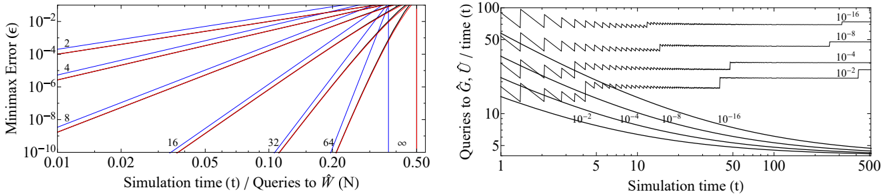
We present the problem of approximating the time-evolution operatore−iH^tto errorϵ, where the HamiltonianH^=(⟨G|⊗I^)U^(|G⟩⊗I^)is the projection of a unitary oracleU^onto the state|G⟩created by another unitary oracle. Our algorithm solves this with a query complexityO(t+log(1/ϵ))to both oracles that is optimal with respect to all parameters in both the asymptotic and non-asymptotic regime, and also with low overhead, using at most two additional ancilla qubits. This approach to Hamiltonian simulation subsumes important prior art considering Hamiltonians which ared-sparse or a linear combination of unitaries, leading to significant improvements in space and gate complexity, such as a quadratic speed-up for precision simulations. It also motivates useful new instances, such as whereH^is a density matrix. A key technical result is `qubitization', which uses the controlled version of these oracles to embed anyH^in an invariantSU(2)subspace. A large class of operator functions ofH^can then be computed with optimal query complexity, of whiche−iH^tis a special case.
Overview
The claims and statistics of this paper haven’t been checked yet.
Free: it reads the open-access text and checks the first 5 claims that cite a source we can check. Create a free account to check every claim.
Integrity signals
Registry
Cites
Statistics
Figures
Verification
Claims the paper makes
The claims and statistics of this paper haven’t been checked yet.
Free: it reads the open-access text and checks the first 5 claims that cite a source we can check. Create a free account to check every claim.
Claims other papers make about this one
Each is checked against this paper’s own text: does it say what the citing paper says it does?
In the citing paper
“Trotterization methods are commonly employed, and allow discretization errors that are controlled polynomially in dt, with a number of unitary operations that scales linearly in the number of Hamiltonian terms and simulation time IV .”
From Beyond-classical computation in quantum simulation (2025) · cites this paper as [105]
In the citing paper
“There are many other Hamiltonian simulation methods, an example of a powerful and sophisticated method being qubitization [166] and quantum signal processing [167], which have the provably optimal asymptotic scaling, although it is unclear whether this will translate to better practical applications.”
From The prospects of quantum computing in computational molecular biology (2021) · cites this paper as [166]
Self-check
Percentages, sums and reported differences re-computed from the paper’s own numbers.
The self-check needs the paper’s full text.
Citations
Cites
A fast quantum mechanical algorithm for database search
Grover, L. K. (1996) · Proceedings of the twenty-eighth annual ACM symposium on Theory of computing - STOC '96 · doi:10.1145/237814.237866 · Cited by 8,830 · cited 1×
“After all, (cid:104) G | ˆ S ˆ U ˆ S ˆ U | G (cid:105) = ˆ I implies that ˆ S ˆ U is a reflection when controlled by input state | G (cid:105) , and it is well-known that a Grover iterate [25, 45] is the product of two reflection about start and target subspaces.”
BackgroundQuantum Algorithm for Linear Systems of Equations
Harrow, A. W., Hassidim, A., & Lloyd, S. (2009) · Physical Review Letters · doi:10.1103/physrevlett.103.150502 · Cited by 3,325 · cited 1×
“ralized by Aharonov and Ta-Shma [3] to sparse Hamiltonians. Celebrated achievements over the years [20,8,32,10,33] have each ignited a urry of activity in diverse applications from quantum algorithms [26,19,21,15] to quantum chemistry [46,44,40,41,4,29,39]. In this dawning era of the small quantum computer [5,23], the…”
BackgroundLloyd, S. (1996) · Science · doi:10.1126/science.273.5278.1073 · Cited by 3,088 · cited 2×
“The first explicit quantum algorithms were discovered by Lloyd [31] for local interactions, and then generalized by Aharonov and Ta-Shma [3] to sparse Hamiltonians.”
Method(1964) · doi:10.1115/1.3625776 · Cited by 1,796
Superconducting quantum circuits at the surface code threshold for fault tolerance
Barends, R., Kelly, J., Megrant, A., Veitia, A., Sank, D., Jeffrey, E., White, T. C., Mutus, J., Fowler, A. G., Campbell, B., et al. (2014) · Nature · doi:10.1038/nature13171 · Cited by 1,733
Quantum principal component analysis
Lloyd, S., Mohseni, M., & Rebentrost, P. (2014) · Nature Physics · doi:10.1038/nphys3029 · Cited by 1,385 · cited 2×
“Celebrated achievements over the years [20, 8, 32, 10, 33] have each ignited a flurry of activity in diverse applications from quantum algorithms [26, 19, 21, 15] to quantum chemistry [46, 44, 40, 41, 4, 29, 39].”
BackgroundMethodA computer program for designing optimum FIR linear phase digital filters
McClellan, J., Parks, T., & Rabiner, L. (1973) · IEEE Transactions on Audio and Electroacoustics · doi:10.1109/tau.1973.1162525 · Cited by 1,139 · cited 1×
“We present a systematic framework that furnishes the optimal complexity and a concrete procedure for almost any f and show how an exact connection is made between query complexity and the theory of best function approximations with polynomials [33, 36].”
MethodScalable Quantum Simulation of Molecular Energies
O’Malley, P. J. J., Babbush, R., Kivlichan, I. D., Romero, J., McClean, J. R., Barends, R., Kelly, J., Roushan, P., Tranter, A., Ding, N., et al. (2016) · Physical Review X · doi:10.1103/physrevx.6.031007 · Cited by 1,059 · cited 1×
“Celebrated achievements over the years [3–7] have each ignited a flurry of activity in diverse applications from quantum algorithms [8–11] to quantum chemistry [12–18].”
BackgroundExponential algorithmic speedup by a quantum walk
Childs, A. M., Cleve, R., Deotto, E., Farhi, E., Gutmann, S., & Spielman, D. A. (2003) · Proceedings of the thirty-fifth annual ACM symposium on Theory of computing · doi:10.1145/780542.780552 · Cited by 825
Demonstration of a small programmable quantum computer with atomic qubits
Debnath, S., Linke, N. M., Figgatt, C., Landsman, K. A., Wright, K., & Monroe, C. (2016) · Nature · doi:10.1038/nature18648 · Cited by 777 · cited 1×
“In this dawning era of the small quantum computer [5, 23], the relevance and necessity of space and gate efficient procedures for practical Hamiltonian simulation has intensified.”
Background
Research works printed but not linked: 2
- R. Kothari, Efficient algorithms in quantum query complexity, Ph.D. thesis, University of Waterloo (2014).
- M. Abramowitz, I. A. Stegun, and Others, "Handbook of mathematical functions," Applied mathematics series 55, 62 (1966).
Cited by
Items 201–300 of 1,009
Towards Quantum Advantage in Financial Market Risk using Quantum Gradient Algorithms
Stamatopoulos, N., Mazzola, G., Woerner, S., & Zeng, W. J. (2022) · Quantum · doi:10.22331/q-2022-07-20-770 · Cited by 77
“While references [15, 16] describe how to perform Hamiltonian simulation and the resources required to realize the necessary unitary evolution, the methods presented therein require postselection, which needs to be factored in for an end-to-end resource estimation.”
MethodAn, D., Fang, D., & Lin, L. (2022) · Quantum · doi:10.22331/q-2022-04-15-690 · Cited by 78
“For example, highly oscillatory wave functions or Hamiltonian with large spectral norm are commonly observed in adiabatic quantum computation [1, 24], k-local Hamiltonians (with a large number of sites) [20, 36, 37], and the electronic structure problem (with a real space discretization) [2, 32, 33, 49].”
BackgroundMethodMultivariable quantum signal processing (M-QSP): prophecies of the two-headed oracle
Rossi, Z. M., & Chuang, I. L. (2022) · Quantum · doi:10.22331/q-2022-09-20-811 · Cited by 77
“(1) The theory of QSP has its origin in the study of composite pulse techniques in NMR [11], though its first instantiation by name appeared in service of improved methods for Hamiltonian simulation [12, 13].”
BackgroundMethodSelf-citationEfficient Quantum Walk Circuits for Metropolis-Hastings Algorithm
Lemieux, J., Heim, B., Poulin, D., Svore, K., & Troyer, M. (2020) · Quantum · doi:10.22331/q-2020-06-29-287 · Cited by 53
Primitive quantum gates for dihedral gauge theories
Alam, M. S., Hadfield, S., Lamm, H., & Li, A. C. Y. (2022) · Physical review. D/Physical review. D. · doi:10.1103/physrevd.105.114501 · Cited by 76
Hamiltonian simulation for hyperbolic partial differential equations by scalable quantum circuits
Sato, Y., Kondo, R., Hamamura, I., Onodera, T., & Yamamoto, N. (2024) · Physical Review Research · doi:10.1103/physrevresearch.6.033246 · Cited by 77
“Note that the time complexity of our algorithm is polynomial with respect to the additive error ε while the state-of-the-art algorithms [41, 42] give the time complexity of poly(log(1 /ε )).”
BackgroundQuantum Algorithm Design: Techniques and Applications
Shao, C., Yang, L., & Li, H. (2019) · Journal of Systems Science and Complexity · doi:10.1007/s11424-019-9008-0 · Cited by 75
Structure Learning of Hamiltonians from Real-Time Evolution
Bakshi, A., Liu, A., Moitra, A., & Tang, E. (2024) · Annual Symposium on Foundations of Computer Science · doi:10.1109/focs61266.2024.00069 · Cited by 75
Resource Analysis of Low-Overhead Transversal Architectures for Reconfigurable Atom Arrays
Zhou, H., Duckering, C., Zhao, C., Bluvstein, D., Cain, M., Kubica, A., Wang, S.-T., & Lukin, M. D. (2025) · Proceedings - International Symposium on Computer Architecture/Proceedings · doi:10.1145/3695053.3731039 · Cited by 75
“A Bell state preparation and Bell basis measurement bends a qubit backward then forward in time , allowing the sequential blocks to be executed in parallel.”
Prospects of quantum computing for molecular sciences
Liu, H., Low, G. H., Steiger, D. S., Häner, T., Reiher, M., & Troyer, M. (2022) · Materials Theory · doi:10.1186/s41313-021-00039-z · Cited by 73
“Although recent developments in quantum hardware and algorithms (Low and Chuang 2019; von Burg et al. 2021; Lee et al. 2020; Pino et al. 2020; Google AI Quantum and et al. 2020; Arute et al. 2019; Zhong et al. 2020) are impressive, a potential quantum advantage has only been demonstrated for toy problems (Arute et al.”
BackgroundSelf-citationOrbital-optimized pair-correlated electron simulations on trapped-ion quantum computers
Zhao, L., Goings, J., Shin, K., Kyoung, W., Fuks, J. I., Kevin Rhee, J.-K., Rhee, Y. M., Wright, K., Nguyen, J., Kim, J., et al. (2023) · npj Quantum Information · doi:10.1038/s41534-023-00730-8 · Cited by 73
Hybridized Methods for Quantum Simulation in the Interaction Picture
Rajput, A., Roggero, A., & Wiebe, N. (2022) · Quantum · doi:10.22331/q-2022-08-17-780 · Cited by 73
“The spectrum can then be transformed efficiently using techniques involving singular value transformations which transform the singular values of an operator by a polynomial function [11, 12].”
BackgroundMethodGuimarães, J. D., Lim, J., Vasilevskiy, M. I., Huelga, S. F., & Plenio, M. B. (2023) · PRX Quantum · doi:10.1103/prxquantum.4.040329 · Cited by 74
“For simulations of closed system dynamics, various methods have been developed, such as hybrid classicalquantum variational approaches [37–40], quantum tensor networks [41–43], and quantum signal processing techniques [44, 45].”
MethodQuantum-classical simulation of two-site dynamical mean-field theory on noisy quantum hardware
Keen, T., Maier, T., Johnston, S., & Lougovski, P. (2020) · Quantum Science and Technology · doi:10.1088/2058-9565/ab7d4c · Cited by 48
Mitigating algorithmic errors in a Hamiltonian simulation
Endo, S., Zhao, Q., Li, Y., Benjamin, S., & Yuan, X. (2019) · Physical Review A · doi:10.1103/physreva.99.012334 · Cited by 72
Hamiltonian simulation with nearly optimal dependence on spectral norm
Low, G. H. (2019) · Proceedings of the 51st Annual ACM SIGACT Symposium on Theory of Computing · doi:10.1145/3313276.3316386 · Cited by 23
“Then previous algorithms [5, 26] for simulating the full H have cost scaling like O ( t ∥ ® α ∥1∥ ® C∥1 ) , which combines the worst-cases of α j andCj .”
BackgroundMethodInfluentialSelf-citationQuantum algorithm for estimating α -Renyi entropies of quantum states
Subramanian, S., & Hsieh, M.-H. (2021) · Physical Review A · doi:10.1103/physreva.104.022428 · Cited by 74
Realization of quantum signal processing on a noisy quantum computer
Kikuchi, Y., Keever, C. M., Coopmans, L., Lubasch, M., & Benedetti, M. (2023) · npj Quantum Information · doi:10.1038/s41534-023-00762-0 · Cited by 73
Approximate quantum circuit synthesis using block encodings
Camps, D., & Beeumen, R. V. (2020) · Physical Review A · doi:10.1103/physreva.102.052411 · Cited by 71
Practical Quantum Computing: Solving the Wave Equation Using a Quantum Approach
Suau, A., Staffelbach, G., & Calandra, H. (2021) · ACM Transactions on Quantum Computing · doi:10.1145/3430030 · Cited by 71
Quantum enhancements for deep reinforcement learning in large spaces
Jerbi, S., Trenkwalder, L. M., Nautrup, H. P., Briegel, H. J., & Dunjko, V. (2019) · arXiv · doi:10.48550/arxiv.1910.12760 · Cited by 69
The impact of hardware specifications on reaching quantum advantage in the fault tolerant regime
Webber, M., Elfving, V., Weidt, S., & Hensinger, W. K. (2022) · AVS Quantum Science · doi:10.1116/5.0073075 · Cited by 40
“Qubitization [36,37] can be used to simulate the Hamiltonian evolution by using quantum signal processing [38] but more commonly it is used to generate a quantum walk [39] upon which one can directly perform phase estimation.”
MethodKreshchuk, M., Jia, S., Kirby, W. M., Goldstein, G. R., Vary, J. P., & Love, P. J. (2021) · Physical Review A · doi:10.1103/physreva.103.062601 · Cited by 69
“[16] Guang Hao Low and Isaac L.”
Linear embedding of nonlinear dynamical systems and prospects for efficient quantum algorithms
Engel, A., Smith, G., & Parker, S. (2021) · Physics of Plasmas · doi:10.1063/5.0040313 · Cited by 68
Primitive quantum gates for an S U ( 2 ) discrete subgroup: Binary octahedral
Gustafson, E., Lamm, H., & Lovelace, F. (2024) · Physical review. D/Physical review. D. · doi:10.1103/physrevd.109.054503 · Cited by 69
Bounds in nonequilibrium quantum dynamics
Gong, Z., & Hamazaki, R. (2022) · International Journal of Modern Physics B · doi:10.1142/s0217979222300079 · Cited by 68
Dynamical simulation via quantum machine learning with provable generalization
Gibbs, J., Holmes, Z., Caro, M. C., Ezzell, N., Huang, H.-Y., Cincio, Ł., Sornborger, A. T., & Coles, P. J. (2024) · Physical Review Research · doi:10.1103/physrevresearch.6.013241 · Cited by 67
“Standard methods like Trotterization grow the circuit depth in proportion to the simulation time, ultimately running into the deco-herence time of the NISQ device [4, 5].”
MethodFirst-Order Trotter Error from a Second-Order Perspective
Layden, D. (2022) · Physical Review Letters · doi:10.1103/physrevlett.128.210501 · Cited by 67
Propagation of errors and quantitative quantum simulation with quantum advantage
Flannigan, S., Pearson, N., Low, G. H., Buyskikh, A. S., Bloch, I., Zoller, P., Troyer, M., & Daley, A. J. (2022) · Quantum Science and Technology · doi:10.1088/2058-9565/ac88f5 · Cited by 67
Self-citationFault-Tolerant Quantum Simulation of Materials Using Bloch Orbitals
Rubin, N. C., Berry, D. W., Malone, F. D., White, A. F., Khattar, T., DePrince, A. E., Sicolo, S., Kühn, M., Kaicher, M., Lee, J., et al. (2023) · PRX Quantum · doi:10.1103/prxquantum.4.040303 · Cited by 67
Exponential Improvements in the Simulation of Lattice Gauge Theories Using Near-Optimal Techniques
Rhodes, M. L., Kreshchuk, M., & Pathak, S. (2024) · PRX Quantum · doi:10.1103/prxquantum.5.040347 · Cited by 65
Entanglement accelerates quantum simulation
Zhao, Q., Zhou, Y., & Childs, A. M. (2025) · Nature Physics · doi:10.1038/s41567-025-02945-2 · Cited by 65
“Two major classes of digital Hamiltonian simulation algorithm are PF methods 15,31 and algorithms based on linear combinations of unitaries 16–20 .”
Quantum algorithms from fluctuation theorems: Thermal-state preparation
Holmes, Z., Muraleedharan, G., Somma, R. D., Subaşı, Y., & Şahinoğlu, B. (2022) · Quantum · doi:10.22331/q-2022-10-06-825 · Cited by 65
“In contrast with approximations based on time evolutions, these polynomials can be constructed and implemented exactly using quantum walks [46,60].”
MethodInfluentialBalducci, G. T., Chen, B., Möller, M., Gerritsma, M. I., & Breuker, R. D. (2022) · Frontiers in Mechanical Engineering · doi:10.3389/fmech.2022.914241 · Cited by 64
“Most recently, an approach based on qubitization achieved an additive lower bound with respect to t and 1/ ε (Low and Chuang, 2019).”
BackgroundEfficient Hamiltonian simulation for solving option price dynamics
Gonzalez-Conde, J., Rodríguez‐Rozas, Á., Solano, E., & Sanz, M. (2023) · Physical Review Research · doi:10.1103/physrevresearch.5.043220 · Cited by 66
Quantum phase processing and its applications in estimating phase and entropies
Wang, Y., Zhang, L., Yu, Z., & Wang, X. (2023) · Physical Review A · doi:10.1103/physreva.108.062413 · Cited by 65
“In this section we review the technique of qubitization purposed by [7].”
BackgroundMethodResultInfluentialQuantum computing for chemistry and physics applications from a Monte Carlo perspective
Mazzola, G. (2024) · The Journal of Chemical Physics · doi:10.1063/5.0173591 · Cited by 64
Fully gauge-fixed SU(2) Hamiltonian for quantum simulations
Grabowska, D. M., Kane, C. F., & Bauer, C. (2025) · Physical review. D/Physical review. D. · doi:10.1103/physrevd.111.114516 · Cited by 65
Preparation of excited states for nuclear dynamics on a quantum computer
Roggero, A., Gu, C., Baroni, A., & Papenbrock, T. (2020) · Physical Review C · doi:10.1103/physrevc.102.064624 · Cited by 64
“[37] Guang Hao Low and Isaac L.”
MethodLattice renormalization of quantum simulations
Carena, M. S., Lamm, H., Li, Y.-Y., & Liu, W. (2021) · Physical review. D/Physical review. D. · doi:10.1103/physrevd.104.094519 · Cited by 63
“Other approximations of U(t) exist: QDRIFT [98], variational approaches [99– 101], Taylor series [102], and qubitization [103].”
MethodFast Multiqubit Gates through Simultaneous Two-Qubit Gates
Gu, X. Q., Fernández-Pendás, J., Vikstål, P., Abad, T., Warren, C., Bengtsson, A., Tancredi, G., Shumeiko, V. S., Bylander, J., Johansson, G., et al. (2021) · PRX Quantum · doi:10.1103/prxquantum.2.040348 · Cited by 63
Pasupuleti, M. K. (2026) · International Journal of Academic and Industrial Research Innovations(IJAIRI) · doi:10.62311/nesx/rp1jy-30072026 · Cited by 63
Simulation of Fermionic circuits using Majorana PropagationPreprint
Miller, A., Favre, J., Holmes, Z., Salehi, Ö., Chakraborty, R., Nykänen, A., Zimborás, Z., Glos, A., & García-Pérez, G. (2025) · arXiv (Cornell University) · doi:10.48550/arxiv.2503.18939 · Cited by 64
“Lemma 11 (Propagation rule) .”
InfluentialTrapped-ion quantum simulation of collective neutrino oscillations
Amitrano, V., Roggero, A., Luchi, P., Turro, F., Vespucci, L., & Pederiva, F. (2023) · Physical review. D/Physical review. D. · doi:10.1103/physrevd.107.023007 · Cited by 61
Quantum simulation of Maxwell’s equations via Schrödingerisation
Jin, S., Liu, N., & Ma, C. (2024) · ESAIM Mathematical Modelling and Numerical Analysis · doi:10.1051/m2an/2024046 · Cited by 63
“…𝐻 = ( ⟨ 𝐺 | ⊗ 𝐼 ) 𝑈 ( | 𝐺 ⟩ ⊗ 𝐼 ) the projection of a unitary oracle 𝑈 onto the state | 𝐺 ⟩ related by another unitary oracle, or 𝐻 = 𝑇𝑟 [ | 𝐺 ⟩⟨ 𝐺 | ] a density matrix obtained by tracing out the ancilla register of a pure state prepared by some oracle 𝐺 , we refer to [6,33,36,37].”
Quantum simulation of Lindbladian dynamics via repeated interactions
Pocrnic, M., Segal, D., & Wiebe, N. (2025) · Journal of Physics A Mathematical and Theoretical · doi:10.1088/1751-8121/adebc4 · Cited by 61
Preparing Bethe Ansatz Eigenstates on a Quantum Computer
Dyke, J. S. V., Barron, G. S., Mayhall, N. J., Barnes, E., & Economou, S. E. (2021) · PRX Quantum · doi:10.1103/prxquantum.2.040329 · Cited by 60
“The evolution here can be per-11 formed using any of the known algorithms for quantum simulation, whether by Trotterization [16, 77, 78], Taylor expansions [52, 79], or other approaches [51, 80].”
Caesura, A., Cortes, C. L., Pol, W., Sim, S., Steudtner, M., Anselmetti, G.-L., Degroote, M., Moll, N., Santagati, R., Streif, M., et al. (2025) · PRX Quantum · doi:10.1103/yngp-5fpm · Cited by 63
Fast Quantum Algorithms for Trace Distance Estimation
Wang, Q., & Zhang, Z. (2023) · IEEE Transactions on Information Theory · doi:10.1109/tit.2023.3321121 · Cited by 59
“The following theorem shows how to construct a unitary block-encoding of density operators, also known as the technique of purified density matrix [79].”
MethodImproved Accuracy for Trotter Simulations Using Chebyshev Interpolation
Rendon, G., Watkins, J., & Wiebe, N. (2024) · Quantum · doi:10.22331/q-2024-02-26-1266 · Cited by 59
High-Order Randomized Compiler for Hamiltonian Simulation
Nakaji, K., Bagherimehrab, M., & Aspuru‐Guzik, A. (2024) · PRX Quantum · doi:10.1103/prxquantum.5.020330 · Cited by 59
Time-Dependent Hamiltonian Simulation Using Discrete-Clock Constructions
Watkins, J., Wiebe, N., Roggero, A., & Lee, D. (2024) · PRX Quantum · doi:10.1103/prxquantum.5.040316 · Cited by 59
“Quantum simulation algorithms have, within recent years, emerged as arguably the preeminent application of quantum computing [1, 2, 3, 4, 5, 6].”
BackgroundVariational Quantum Eigensolvers for Sparse Hamiltonians
Kirby, W. M., & Love, P. J. (2021) · Physical Review Letters · doi:10.1103/physrevlett.127.110503 · Cited by 60
“Quantum simulation of sparse Hamiltonians has undergone extensive study [17–27], culminating in algorithms with optimal (for time-independent Hamiltonians) [25, 26] or near-optimal (for time-dependent Hamiltonians) [27] scaling with all parameters.”
BackgroundQuantum algorithms for quantum dynamics: A performance study on the spin-boson model
Miessen, A., Ollitrault, P. J., & Tavernelli, I. (2021) · Physical Review Research · doi:10.1103/physrevresearch.3.043212 · Cited by 59
“These approaches claim to be more resource-efficient compared with fault-tolerant quantum algorithms for implementing the time evolution operator, Ut = e−iHt, such as product formulas for the decomposition of Ut, commonly known as Trotter formulas [22–26], linear combination of unitaries [27], quantum signal processin…”
BackgroundMethodComplexity of Implementing Trotter Steps
Low, G. H., Su, Y., Tong, Y., & Tran, M. C. (2023) · PRX Quantum · doi:10.1103/prxquantum.4.020323 · Cited by 58
Self-citationEfficient quantum state preparation with Walsh series
Zylberman, J., & Debbasch, F. (2024) · Physical Review A · doi:10.1103/physreva.109.042401 · Cited by 58
Efficient and fail-safe quantum algorithm for the transport equation
Schalkers, M. A., & Möller, M. (2024) · Journal of Computational Physics · doi:10.1016/j.jcp.2024.112816 · Cited by 59
“The collision term is realized using the linear approximation of unitary approach [LC19], which requires a measurement at the end of each time step to check whether the previous computations have been meaningful or ended up in a so-called ‘orthogonal state of no interest’.”
Spacetime-Efficient Low-Depth Quantum State Preparation with Applications
Gui, K., Dalzell, A. M., Achille, A., Suchara, M., & Chong, F. T. (2024) · Quantum · doi:10.22331/q-2024-02-15-1257 · Cited by 58
Analysis of quantum Krylov algorithms with errors
Kirby, W. (2024) · Quantum · doi:10.22331/q-2024-08-29-1457 · Cited by 58
Observation of information flow in the anti-𝒫𝒯-symmetric system with nuclear spins
Wen, J., Qin, G., Zheng, C., Wei, S., Kong, X., Xin, T., & Long, G. (2020) · npj Quantum Information · doi:10.1038/s41534-020-0258-4 · Cited by 59
Quantum Regularized Least Squares
Chakraborty, S., Morolia, A., & Peduri, A. (2023) · Quantum · doi:10.22331/q-2023-04-27-988 · Cited by 57
Double-Bracket Quantum Algorithms for Quantum Imaginary-Time Evolution
Gluza, M., Son, J., Tiang, B. H., Zander, R., Seidel, R., Suzuki, Y., Holmes, Z., & Ng, N. H. Y. (2026) · Physical Review Letters · doi:10.1103/rw81-k8vk · Cited by 59
Resilience of Quantum Random Access Memory to Generic Noise
Hann, C. T., Lee, G., Girvin, S. M., & Jiang, L. (2021) · University of Chicago · doi:10.6082/027wm-z2x67 · Cited by 57
Localized Quantum Chemistry on Quantum Computers
Otten, M., Hermes, M. R., Pandharkar, R., Alexeev, Y., Gray, S. K., & Gagliardi, L. (2022) · Journal of Chemical Theory and Computation · doi:10.1021/acs.jctc.2c00388 · Cited by 56
State Preparation on Quantum Computers via Quantum Steering
Volya, D., & Mishra, P. (2024) · IEEE Transactions on Quantum Engineering · doi:10.1109/tqe.2024.3358193 · Cited by 56
“Rather than physically engineering and realizing a system with the satisfactory Hamiltonian equation (3), we instead simulate the Hamiltonian on a quantum computer through the application of discrete unitary operators [44], [45].”
BackgroundContextuality Test of the Nonclassicality of Variational Quantum Eigensolvers
Kirby, W. M., & Love, P. J. (2019) · Physical Review Letters · doi:10.1103/physrevlett.123.200501 · Cited by 45
Predicting Gibbs-State Expectation Values with Pure Thermal Shadows
Coopmans, L., Kikuchi, Y., & Benedetti, M. (2023) · PRX Quantum · doi:10.1103/prxquantum.4.010305 · Cited by 57
“To this end, we use quantum signal processing [34] (QSP), a framework for performing matrix arithmetics on quantum computers.”
MethodQuantum-inspired machine learning: a survey
Huynh, L., Hong, J. B., Mian, A. S., Suzuki, H., Vallury, H. J., Wu, Y., & Camtepe, S. A. (2026) · Computer Science Review · doi:10.1016/j.cosrev.2026.101072 · Cited by 57
Loaiza, I., & Izmaylov, A. F. (2023) · Journal of Chemical Theory and Computation · doi:10.1021/acs.jctc.3c00912 · Cited by 57
Rocca, D., Cortes, C. L., Gonthier, J. F., Ollitrault, P. J., Parrish, R. M., Anselmetti, G.-L., Degroote, M., Moll, N., Santagati, R., & Streif, M. (2024) · Journal of Chemical Theory and Computation · doi:10.1021/acs.jctc.4c00352 · Cited by 55
“28,29 Within the framework of XDF, the two-electron tensor is first decomposed in terms of eigenvalues and eigenvectors”
MethodQuantum linear system algorithm with optimal queries to initial state preparation
Low, G. H., & Su, Y. (2026) · Quantum · doi:10.22331/q-2026-03-23-2041 · Cited by 55
Self-citationQuantum computing for energy correlators
Lee, K., Turro, F., & Yao, X. (2025) · Physical review. D/Physical review. D. · doi:10.1103/physrevd.111.054514 · Cited by 55
Hamiltonian Operator Approximation for Energy Measurement and Ground-State Preparation
Bespalova, T. A., & Kyriienko, O. (2021) · PRX Quantum · doi:10.1103/prxquantum.2.030318 · Cited by 56
“Asymptotically optimal simulation of quantum dynamics can be achieved with qubitization [79] or LCU-based approaches [54], at the expense of increased system size due to ancillary register.”
BackgroundRealization of arbitrary doubly-controlled quantum phase gatesPreprint
Hill, A. D., Hodson, M. J., Didier, N., & Reagor, M. J. (2021) · arXiv (Cornell University) · doi:10.48550/arxiv.2108.01652 · Cited by 55
Revisiting the Mapping of Quantum Circuits: Entering the Multi-core Era
Escofet, P., Ovide, A., Bandić, M., Prielinger, L., van Someren, H., Feld, S., Alarcón, E., Abadal, S., & Almudéver, C. G. (2025) · ACM Transactions on Quantum Computing · doi:10.1145/3655029 · Cited by 54
“The potential applications of quantum computing span a wide range of domains, from cryptography through algorithms like Shor’s prime factorization [47] to optimized database searches using Grover’s algorithm [24] and even the simulation of complex physical systems [36].”
Distributional Property Testing in a Quantum World
Gilyén, A., & Li, T. (2019) · DROPS (Schloss Dagstuhl – Leibniz Center for Informatics) · doi:10.4230/lipics.itcs.2020.25 · Cited by 54
Quantum algorithms for computing observables of nonlinear partial differential equationsPreprint
Jin, S., & Liu, N. (2022) · arXiv (Cornell University) · doi:10.48550/arxiv.2202.07834 · Cited by 54
“5 in [36] and also Lemma 6 in [42] for an explicit construction.”
Rattew, A. G., & Rebentrost, P. (2023) · arXiv (Cornell University) · doi:10.48550/arxiv.2309.09839 · Cited by 54
“Quantum signal processing [9, 10] and quantum singular value transformation [11] are powerful frameworks encompassing nearly all of quantum computing [12].”
BackgroundBatched high-rate logical operations for quantum LDPC codesPreprint
Xu, Q., Zhou, H., Bluvstein, D., Cain, M., Kalinowski, M., Preskill, J. P., Lukin, M. D., & Maskara, N. (2025) · arXiv (Cornell University) · doi:10.48550/arxiv.2510.06159 · Cited by 54
Polylogarithmic-depth controlled-NOT gates without ancilla qubits
Claudon, B., Zylberman, J., Feniou, C., Debbasch, F., Peruzzo, A., & Piquemal, J. (2024) · Nature Communications · doi:10.1038/s41467-024-50065-x · Cited by 54
“The qubitisation [5] is the central technique to the framework of QSVT.”
Quantum computing methods for electronic states of the water molecule
Bian, T., Murphy, D., Xia, R., Daskin, A., & Kais, S. (2019) · Molecular Physics · doi:10.1080/00268976.2019.1580392 · Cited by 54
“[14] Guang Hao Low and Isaac L Chuang, “Hamiltonian simulation by qubitization,” arXiv preprint arXiv:1610.”
BackgroundMethodQuantum Transformer: Accelerating model inference via quantum linear algebraPreprint
Guo, N., Yu, Z., Choi, M., Han, Y., Agrawal, A., Nakaji, K., Aspuru‐Guzik, A., & Rebentrost, P. (2024) · arXiv (Cornell University) · doi:10.48550/arxiv.2402.16714 · Cited by 53
Spectral analysis of product formulas for quantum simulation
Yi, C., & Crosson, E. (2022) · npj Quantum Information · doi:10.1038/s41534-022-00548-w · Cited by 52
Nguyen, Q. T., Kiani, B. T., & Lloyd, S. (2022) · Quantum · doi:10.22331/q-2022-12-13-876 · Cited by 54
“Throughout this paper, we employ the block-encoding framework to perform matrix computations on a quantum computer [18].”
BackgroundMethodQuantum computing for fusion energy science applications
Joseph, I., Shi, Y., Porter, M. D., Castelli, A. R., Geyko, V., Graziani, F. R., Libby, S. B., & DuBois, J. L. (2023) · Physics of Plasmas · doi:10.1063/5.0123765 · Cited by 56
“22,129 This method works by using QSP to correct the eigenvalue distribution of the Childs walk so that it generates a more accurate approximation of the underlying Hamiltonian.”
BackgroundMethodQuantum simulation of battery materials using ionic pseudopotentials
Zini, M. S., Delgado, A., dos Reis, R., Casares, P. A. M., Mueller, J. E., Voigt, A.-C., & Arrazola, J. M. (2023) · Quantum · doi:10.22331/q-2023-07-10-1049 · Cited by 55
“This progress has been fueled by innovations such as qubitization [60, 61, 12], Hamil-”
MethodLow, G. H., & Su, Y. (2026) · SIAM Journal on Computing · doi:10.1137/24m1689363 · Cited by 53
Self-citationCircuit complexity of quantum access models for encoding classical data
Zhang, X., & Yuan, X. (2024) · npj Quantum Information · doi:10.1038/s41534-024-00835-8 · Cited by 53
“The success of block-encoding enables the realization of Hamiltonian simulation with an optimal query complexity 13,14 .”
InfluentialAlgorithmic Shadow Spectroscopy
Chan, H. H. S., Meister, R., Goh, M. L., & Koczor, B. (2025) · PRX Quantum · doi:10.1103/prxquantum.6.010352 · Cited by 53
“Many such Hamiltonian simulation algorithms are known, such as product formula or Trotterisation [7], quantum signal processing [8], qubiti-zation [9] or linear combination of unitaries [10] to name a few.”
A Perspective on Quantum Computing Applications in Quantum Chemistry Using 25–100 Logical Qubits
Alexeev, Y., Batista, V. S., Bauman, N. P., Bertels, L. W., Claudino, D., Dutta, R., Gagliardi, L., Godwin, S., Govind, N., Head‐Gordon, M., et al. (2025) · Journal of Chemical Theory and Computation · doi:10.1021/acs.jctc.5c01038 · Cited by 53
“…simulation avoids the real-time sign problem and can exploit the reduced term count to achieve gate/query complexities that scale with the Hamiltonian norm and simulation time, making exciton–boson platforms promising early targets for resource-aware quantum dynamics [79– 81, 107, 109, 110].”
Block-encoding-based quantum algorithm for linear systems with displacement structures
Wan, L., Yu, C., Pan, S., Qin, S., Gao, F., & Wen, Q. (2021) · Physical Review A · doi:10.1103/physreva.104.062414 · Cited by 53
Efficient quantum implementation of 2+1 U(1) lattice gauge theories with Gauss law constraintsPreprint
Kane, C., Grabowska, D. M., Nachman, B. P., & Bauer, C. (2022) · arXiv (Cornell University) · doi:10.48550/arxiv.2211.10497 · Cited by 52
Toward simulating superstring/M-theory on a quantum computer
Gharibyan, H., Hanada, M., Honda, M., & Liu, J. (2021) · Journal of High Energy Physics · doi:10.1007/jhep07(2021)140 · Cited by 51
“This type of algorithms includes algorithms based on quantum walks [157, 158], multiproduct formula [159, 160], Taylor expansion [142, 161], fractional-query models [145], Chebyshev polynomial approximations [162], qubitization [12, 147], and quantum signal processing [13, 163].”
MethodQuantum state preparation for multivariate functions
Rosenkranz, M., Brunner, E., Marin-Sanchez, G., Fitzpatrick, N., Dilkes, S., Tang, Y., Kikuchi, Y., & Benedetti, M. (2025) · Quantum · doi:10.22331/q-2025-04-09-1703 · Cited by 51
Quantum algorithms for nonlinear partial differential equations
Jin, S., & Liu, N. (2024) · Bulletin des Sciences Mathématiques · doi:10.1016/j.bulsci.2024.103457 · Cited by 50
“5 in [36] and also Lemma 6 in [42] for an explicit construction.”
Toward quantum simulation of non-Markovian open quantum dynamics: A universal and compact theory
Li, X., Lyu, S.-X., Wang, Y., Xu, R., Zheng, X. H., & Yan, Y. (2024) · Physical Review A · doi:10.1103/physreva.110.032620 · Cited by 51
Quantum simulations of chemistry in first quantization with any basis set
Georges, T. N., Bothe, M., Sünderhauf, C., Berntson, B. K., Izsák, R., & Ivanov, A. V. (2025) · npj Quantum Information · doi:10.1038/s41534-025-00987-1 · Cited by 50
“Speci fi cally,QPEwith qubitization is the leading approach 14 – 16 whichrequires the lowest quantum resources for quantum chemistry problems 2,8,17 – 19 .”
Exponentially Reduced Circuit Depths Using Trotter Error Mitigation
Watson, J. D., & Watkins, J. (2025) · PRX Quantum · doi:10.1103/kw39-yxq5 · Cited by 50
Koridon, E., Yalouz, S., Senjean, B., Buda, F., O’Brien, T. E., & Visscher, L. (2021) · Physical Review Research · doi:10.1103/physrevresearch.3.033127 · Cited by 51
The mixed Schur transform: efficient quantum circuit and applicationsPreprint
Nguyen, Q. T. (2023) · arXiv (Cornell University) · doi:10.48550/arxiv.2310.01613 · Cited by 50
“The basis elements | γ, q γ , p γ ⟩ Sch can be prepared efficiently using the mixed Schur transform, whereas H , being a polynomially sparse Hamiltonian, can be efficiently simulated by standard block-encoding techniques [LC19; Gil+18].”
Method
Metadata
- Authors
- Low, G. H., & Chuang, I. L.
- Affiliations
- Massachusetts Institute of Technology (US)
- Venue
- Quantum
- Published
- 2019-07-12
- Volume
- 3
- Pages
- 163
- ISSN
- 2521-327X (ISSN-L)
- OpenAlex
- W2535738892
- Cited by
- 854
- References
- 46
- Citations by year
- 2026: 120 · 2025: 216 · 2024: 160 · 2023: 137 · 2022: 92 · 2021: 70 · 2020: 43 · 2019: 15
- FWCI
- 25.21
- Type
- journal article
- Language
- en
- Open access
- gold
- doi.org
- Locations
- Quantum (publishedVersion, cc-by)
- arXiv (Cornell University) (acceptedVersion)
- DOAJ (DOAJ: Directory of Open Access Journals) (submittedVersion)
- arXiv (Cornell University) (cc-by)
- Topics
- Physical Sciences › Computer Science › Artificial Intelligence › Quantum Computing Algorithms and Architecture
- Physical Sciences › Physics and Astronomy › Atomic and Molecular Physics, and Optics › Quantum many-body systems
- Physical Sciences › Physics and Astronomy › Atomic and Molecular Physics, and Optics › Quantum Mechanics and Applications
- Keywords
- Hamiltonian simulation, qubitization, evolution operator, query complexity, sparse Hamiltonians, linear combination of unitaries, ancilla qubits, operator functions, quantum algorithms
About these checks
Registry, retraction, Cites and statistics results are computed, not judged, with one exception: a printed reference that no index lists is read once by a model before it counts as a citation error. Claims are extracted by a model and kept only when their quote appears verbatim in the text; each cited source is then checked, with a model’s help, for whether it says what the claim relies on. Those verdicts can be wrong — read the claim’s quote and the cited source before relying on one.
Statistics and arithmetic are recomputed, not judged.
Confidence bands are shown only for fields calibrated on our annotated test set. None is calibrated yet, so no band is shown.
What counts as a claim ›How we measure confidence ›How we check this ›
Are you an author, or do you see a problem with this page? Request a review
Data sources
Bibliographic data: Semantic Scholar, OpenAlex, Crossref.
Contains information from the Semantic Scholar Academic Graph Datasets, made available under the ODC Attribution License (ODC-BY 1.0).
Semantic Scholar’s data is described in: Kinney, R., et al. (2023). The Semantic Scholar Open Data Platform. arXiv:2301.10140.
