

Hamiltonian Simulation by Qubitization
Open accessThe DOI matches its Crossref record; 50 of the 50 references it cites were found in a registry or an index.
Abstract
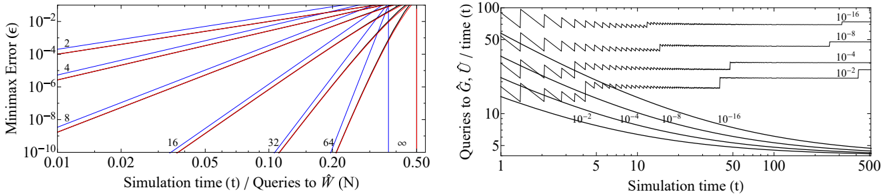
We present the problem of approximating the time-evolution operatore−iH^tto errorϵ, where the HamiltonianH^=(⟨G|⊗I^)U^(|G⟩⊗I^)is the projection of a unitary oracleU^onto the state|G⟩created by another unitary oracle. Our algorithm solves this with a query complexityO(t+log(1/ϵ))to both oracles that is optimal with respect to all parameters in both the asymptotic and non-asymptotic regime, and also with low overhead, using at most two additional ancilla qubits. This approach to Hamiltonian simulation subsumes important prior art considering Hamiltonians which ared-sparse or a linear combination of unitaries, leading to significant improvements in space and gate complexity, such as a quadratic speed-up for precision simulations. It also motivates useful new instances, such as whereH^is a density matrix. A key technical result is `qubitization', which uses the controlled version of these oracles to embed anyH^in an invariantSU(2)subspace. A large class of operator functions ofH^can then be computed with optimal query complexity, of whiche−iH^tis a special case.
Overview
The claims and statistics of this paper haven’t been checked yet.
Free: it reads the open-access text and checks the first 5 claims that cite a source we can check. Create a free account to check every claim.
Integrity signals
Registry
Cites
Statistics
Figures
Verification
Claims the paper makes
The claims and statistics of this paper haven’t been checked yet.
Free: it reads the open-access text and checks the first 5 claims that cite a source we can check. Create a free account to check every claim.
Claims other papers make about this one
Each is checked against this paper’s own text: does it say what the citing paper says it does?
In the citing paper
“Trotterization methods are commonly employed, and allow discretization errors that are controlled polynomially in dt, with a number of unitary operations that scales linearly in the number of Hamiltonian terms and simulation time IV .”
From Beyond-classical computation in quantum simulation (2025) · cites this paper as [105]
In the citing paper
“There are many other Hamiltonian simulation methods, an example of a powerful and sophisticated method being qubitization [166] and quantum signal processing [167], which have the provably optimal asymptotic scaling, although it is unclear whether this will translate to better practical applications.”
From The prospects of quantum computing in computational molecular biology (2021) · cites this paper as [166]
Self-check
Percentages, sums and reported differences re-computed from the paper’s own numbers.
The self-check needs the paper’s full text.
Citations
Cites
A fast quantum mechanical algorithm for database search
Grover, L. K. (1996) · Proceedings of the twenty-eighth annual ACM symposium on Theory of computing - STOC '96 · doi:10.1145/237814.237866 · Cited by 8,830 · cited 1×
“After all, (cid:104) G | ˆ S ˆ U ˆ S ˆ U | G (cid:105) = ˆ I implies that ˆ S ˆ U is a reflection when controlled by input state | G (cid:105) , and it is well-known that a Grover iterate [25, 45] is the product of two reflection about start and target subspaces.”
BackgroundQuantum Algorithm for Linear Systems of Equations
Harrow, A. W., Hassidim, A., & Lloyd, S. (2009) · Physical Review Letters · doi:10.1103/physrevlett.103.150502 · Cited by 3,325 · cited 1×
“ralized by Aharonov and Ta-Shma [3] to sparse Hamiltonians. Celebrated achievements over the years [20,8,32,10,33] have each ignited a urry of activity in diverse applications from quantum algorithms [26,19,21,15] to quantum chemistry [46,44,40,41,4,29,39]. In this dawning era of the small quantum computer [5,23], the…”
BackgroundLloyd, S. (1996) · Science · doi:10.1126/science.273.5278.1073 · Cited by 3,088 · cited 2×
“The first explicit quantum algorithms were discovered by Lloyd [31] for local interactions, and then generalized by Aharonov and Ta-Shma [3] to sparse Hamiltonians.”
Method(1964) · doi:10.1115/1.3625776 · Cited by 1,796
Superconducting quantum circuits at the surface code threshold for fault tolerance
Barends, R., Kelly, J., Megrant, A., Veitia, A., Sank, D., Jeffrey, E., White, T. C., Mutus, J., Fowler, A. G., Campbell, B., et al. (2014) · Nature · doi:10.1038/nature13171 · Cited by 1,733
Quantum principal component analysis
Lloyd, S., Mohseni, M., & Rebentrost, P. (2014) · Nature Physics · doi:10.1038/nphys3029 · Cited by 1,385 · cited 2×
“Celebrated achievements over the years [20, 8, 32, 10, 33] have each ignited a flurry of activity in diverse applications from quantum algorithms [26, 19, 21, 15] to quantum chemistry [46, 44, 40, 41, 4, 29, 39].”
BackgroundMethodA computer program for designing optimum FIR linear phase digital filters
McClellan, J., Parks, T., & Rabiner, L. (1973) · IEEE Transactions on Audio and Electroacoustics · doi:10.1109/tau.1973.1162525 · Cited by 1,139 · cited 1×
“We present a systematic framework that furnishes the optimal complexity and a concrete procedure for almost any f and show how an exact connection is made between query complexity and the theory of best function approximations with polynomials [33, 36].”
MethodScalable Quantum Simulation of Molecular Energies
O’Malley, P. J. J., Babbush, R., Kivlichan, I. D., Romero, J., McClean, J. R., Barends, R., Kelly, J., Roushan, P., Tranter, A., Ding, N., et al. (2016) · Physical Review X · doi:10.1103/physrevx.6.031007 · Cited by 1,059 · cited 1×
“Celebrated achievements over the years [3–7] have each ignited a flurry of activity in diverse applications from quantum algorithms [8–11] to quantum chemistry [12–18].”
BackgroundExponential algorithmic speedup by a quantum walk
Childs, A. M., Cleve, R., Deotto, E., Farhi, E., Gutmann, S., & Spielman, D. A. (2003) · Proceedings of the thirty-fifth annual ACM symposium on Theory of computing · doi:10.1145/780542.780552 · Cited by 825
Demonstration of a small programmable quantum computer with atomic qubits
Debnath, S., Linke, N. M., Figgatt, C., Landsman, K. A., Wright, K., & Monroe, C. (2016) · Nature · doi:10.1038/nature18648 · Cited by 777 · cited 1×
“In this dawning era of the small quantum computer [5, 23], the relevance and necessity of space and gate efficient procedures for practical Hamiltonian simulation has intensified.”
Background
Research works printed but not linked: 2
- R. Kothari, Efficient algorithms in quantum query complexity, Ph.D. thesis, University of Waterloo (2014).
- M. Abramowitz, I. A. Stegun, and Others, "Handbook of mathematical functions," Applied mathematics series 55, 62 (1966).
Cited by
Items 101–200 of 1,009
Quantum simulation of quantum field theory in the light-front formulation
Kreshchuk, M., Kirby, W. M., Goldstein, G. R., Beauchemin, P. H., & Love, P. J. (2022) · Physical Review A · doi:10.1103/physreva.105.032418 · Cited by 140
“Quantum algorithms for quantum simulation with almost optimal scaling are now known [13, 14, 15, 16, 17].”
BackgroundQuantum Algorithm for Linear Non-unitary Dynamics with Near-Optimal Dependence on All Parameters
An, D., Childs, A. M., & Lin, L. (2025) · Communications in Mathematical Physics · doi:10.1007/s00220-025-05509-w · Cited by 140
“Specifically, as L and H are time-independent, instead of the truncated Dyson series method, we can use quantum signal processing (QSP) [7, 48] or QSVT [26] to simulate e − iT ( kL + H ) , so that the query complexity of this step is only O ( ∥ kL + H ∥ T +log(1 /ϵ )).”
Beyond-classical computation in quantum simulation
King, A. D., Nocera, A., Rams, M. M., Dziarmaga, J., Wiersema, R., Bernoudy, W., Raymond, J., Kaushal, N., Heinsdorf, N., Harris, R., et al. (2025) · Science · doi:10.1126/science.ado6285 · Cited by 138
Rodeo Algorithm for Quantum Computing
Choi, K., Lee, D., Bonitati, J., Qian, Z., & Watkins, J. (2021) · Physical Review Letters · doi:10.1103/physrevlett.127.040505 · Cited by 135
Quantum Spectral Methods for Differential Equations
Childs, A. M., & Liu, J.-P. (2020) · Communications in Mathematical Physics · doi:10.1007/s00220-020-03699-z · Cited by 133
“A substantial body of work has developed fast quantum algorithms for that special case [6–9, 11, 13, 28–31].”
BackgroundDrug design on quantum computers
(2024) · doi:10.1038/s41567-024-02411-5 · Cited by 132
Gauss’s law, duality, and the Hamiltonian formulation of U(1) lattice gauge theory
Kaplan, D. B., & Stryker, J. R. (2020) · Physical review. D/Physical review. D. · doi:10.1103/physrevd.102.094515 · Cited by 132
“The above form for Ĥ is bounded and written as a sum of unitary operators, which may be convenient for simulation by quantum walks [20].”
BackgroundDigital quantum simulation of molecular vibrations
McArdle, S., Mayorov, A., Shan, X., Benjamin, S., & Yuan, X. (2019) · Chemical Science · doi:10.1039/c9sc01313j · Cited by 99
Provably accurate simulation of gauge theories and bosonic systems
Tong, Y., Albert, V. V., McClean, J. R., Preskill, J. P., & Su, Y. (2022) · Quantum · doi:10.22331/q-2022-09-22-816 · Cited by 133
“In this way we have an encoding (known as “block-encoding” or “standard-form” in [24, 49]) of the Hamiltonian H̃B, i.”
MethodHamiltonian simulation in the low-energy subspace
Şahinoğlu, B., & Somma, R. D. (2021) · npj Quantum Information · doi:10.1038/s41534-021-00451-w · Cited by 131
Quantum algorithms for quantum dynamics
Miessen, A., Ollitrault, P. J., Tacchino, F., & Tavernelli, I. (2022) · Nature Computational Science · doi:10.1038/s43588-022-00374-2 · Cited by 131
“Qubitization 44,45 leverages a block-encoding of the Hamiltonian combined with QSP and concepts of LCU to concretely simulate Ham-iltonians, maintaining optimal query complexity (Box 2) and without necessitating oracle access to the Hamiltonian matrix.”
MethodSimulating Open Quantum Systems Using Hamiltonian Simulations
Ding, Z., Li, X., & Lin, L. (2024) · PRX Quantum · doi:10.1103/prxquantum.5.020332 · Cited by 128
Quantum circuit optimization with AlphaTensor
Ruiz, F. J. R., Laakkonen, T., Bausch, J., Balog, M., Barekatain, M., Heras, F. J. H., Novikov, A., Fitzpatrick, N., Romera‐Paredes, B., van de Wetering, J., et al. (2025) · Nature Machine Intelligence · doi:10.1038/s42256-025-01001-1 · Cited by 132
Goings, J. J., White, A., Lee, J., Tautermann, C. S., Degroote, M., Gidney, C., Shiozaki, T., Babbush, R., & Rubin, N. C. (2022) · Proceedings of the National Academy of Sciences · doi:10.1073/pnas.2203533119 · Cited by 127
“Recent work (20, 60, 61) has shown that applying phase estimation to the qubitization iterate (62) allows one to learn eigenvalues and prepare eigenstates with error no greater than by repeated application of the relevant quantum operator—the so-called qubitized quantum walk operator—O(λ/ ) (63) times where λ is the L…”
Chakraborty, S., Gilyén, A., & Jeffery, S. (2019) · Schloss Dagstuhl – Leibniz-Zentrum für Informatik · doi:10.4230/lipics.icalp.2019.33 · Cited by 127
“, U, combined with amplitude amplification, can be used to generate the state A|ψi/ A|ψi given a circuit for generating |ψi. The main motivation for using block-encodings is that Low and Chuang showed [LC16] how to perform optimal Hamiltonian simulation given a block-encoded Hamiltonian A. In Ref. [KP16], Kerenidis and…”
MethodResultInfluentialExact and efficient Lanczos method on a quantum computer
Kirby, W., Motta, M., & Mezzacapo, A. (2023) · Quantum · doi:10.22331/q-2023-05-23-1018 · Cited by 66
“The following lemma is based directly on Section IV in [37]: Lemma 1 (Chebyshev polynomials from block encoding).”
BackgroundMethodInfluentialJaques, S., & Rattew, A. G. (2025) · Quantum · doi:10.22331/q-2025-12-02-1922 · Cited by 127
Improvements in Quantum SDP-Solving with Applications
van Apeldoorn, J., & Gilyén, A. (2018) · DROPS (Schloss Dagstuhl – Leibniz Center for Informatics) · doi:10.4230/lipics.icalp.2019.99 · Cited by 125
“In particular, we restate results from [LC16] showing that using “block-encodings” of Hamiltonians, efficient Hamiltonian simulation can be implemented, moreover we show that this input model generalizes both other input models.”
BackgroundMethodResultInfluentialSimulating the dynamics of time-dependent Hamiltonians with a truncated Dyson series
Kieferová, M., Scherer, A., & Berry, D. W. (2019) · Physical Review A · doi:10.1103/physreva.99.042314 · Cited by 65
“Here we present an explicit algorithm for simulating time-dependent Hamiltonians with complexity logarithmic in the allowable error, matching the complexity of the algorithms for the time-independent case in [11, 13], though not those in [14, 15].”
BackgroundMethodVariational Quantum Gibbs State Preparation with a Truncated Taylor Series
Wang, Y., Li, G., & Wang, X. (2021) · Physical Review Applied · doi:10.1103/physrevapplied.16.054035 · Cited by 124
“Recently, the authors of [40] propose a procedure for estimating the von Neumann entropy and free energy that uses tools such as quantum amplitude estimation [45], density matrix exponentiation [46], and techniques for approximating operators by a linear combination of unitaries.”
MethodFault-tolerant quantum simulations of chemistry in first quantization
Su, Y., Berry, D. W., Wiebe, N., Rubin, N., & Babbush, R. (2021) · PRX Quantum · doi:10.1103/prxquantum.2.040332 · Cited by 123
Hamiltonian simulation algorithms for near-term quantum hardware
Clinton, L., Bausch, J., & Cubitt, T. S. (2021) · Nature Communications · doi:10.1038/s41467-021-25196-0 · Cited by 123
“Tighter Error Bounds for Trotter Product Formulas There are by now a number of sophisticated quantum algorithms for Hamiltonian simulation, achieving optimal asymptotic scaling in some or all parameters [35, 36, 37].”
MethodResilience of Quantum Random Access Memory to Generic Noise
Hann, C. T., Lee, G., Girvin, S. M., & Jiang, L. (2021) · PRX Quantum · doi:10.1103/prxquantum.2.020311 · Cited by 125
Budinski, L. (2022) · International Journal of Quantum Information · doi:10.1142/s0219749921500398 · Cited by 123
FABLE: Fast Approximate Quantum Circuits for Block-Encodings
Camps, D., & Beeumen, R. V. (2022) · IEEE International Conference on Quantum Computing and Engineering (QCE) · doi:10.1109/qce53715.2022.00029 · Cited by 123
“The quantum singular value transformation (QSVT) [1], [2] combines and extends qubitization [3] and quantum signal processing [4].”
Measurement reduction in variational quantum algorithms
Zhao, A., Tranter, A., Kirby, W. M., Ung, S. F., Miyake, A., & Love, P. J. (2020) · Physical Review A · doi:10.1103/physreva.101.062322 · Cited by 121
Bauman, N. P., Bylaska, E. J., Krishnamoorthy, S., Low, G. H., Wiebe, N., Granade, C. E., Roetteler, M., Troyer, M., & Kowalski, K. (2019) · The Journal of Chemical Physics · doi:10.1063/1.5094643 · Cited by 98
Self-citationA survey on HHL algorithm: From theory to application in quantum machine learning
Duan, B., Yuan, J., Yu, C., Huang, J., & Hsieh, C. (2020) · Physics Letters A · doi:10.1016/j.physleta.2020.126595 · Cited by 120
A Variational Quantum Algorithm for Preparing Quantum Gibbs States
Chowdhury, A. C. N., Low, G. H., & Wiebe, N. (2020) · arXiv (Cornell University) · doi:10.48550/arxiv.2002.00055 · Cited by 40
Self-citationEfficient quantum thermal simulation
Chen, C.-F., Kastoryano, M. J., Brandão, F. G. S. L., & Gilyén, A. (2025) · Nature · doi:10.1038/s41586-025-09583-x · Cited by 118
Robust and Efficient Hamiltonian Learning
Yu, W., Sun, J., Han, Z., & Yuan, X. (2023) · Quantum · doi:10.22331/q-2023-06-29-1045 · Cited by 116
Analyzing Prospects for Quantum Advantage in Topological Data Analysis
Berry, D. W., Su, Y., Gyurik, C., King, R., Basso, J., Barba, A. D. T., Rajput, A., Wiebe, N., Dunjko, V., & Babbush, R. (2024) · PRX Quantum · doi:10.1103/prxquantum.5.010319 · Cited by 117
“Then in Subsection IIID we describe how to block encode the operator BG in order to provide a quantum walk operator that has eigenvalues related to those of BG, as in [23, 24].”
MethodImplementing any Linear Combination of Unitaries on Intermediate-term Quantum Computers
Chakraborty, S. (2024) · Quantum · doi:10.22331/q-2024-10-10-1496 · Cited by 116
Quantum Algorithm for Petz Recovery Channels and Pretty Good Measurements
Gilyén, A., Lloyd, S., Marvian, I., Quek, Y., & Wilde, M. M. (2022) · Physical Review Letters · doi:10.1103/physrevlett.128.220502 · Cited by 114
“Moreover, if we have access to a quantum circuit U RA that prepares a purification |ψ〉RA B U RA|0〉R|0〉A of σA, such that TrR[|ψ〉〈ψ|RA] = σA, then we can directly implement an exact block-encoding ofσA with only two uses of U RA as follows [35, 36]:”
MethodQuantum complexity of time evolution with chaotic Hamiltonians
Balasubramanian, V. (2023) · OSTI OAI (U.S. Department of Energy Office of Scientific and Technical Information) · doi:10.1007/jhep01%282020%29134 · Cited by 113
Concentration for Random Product Formulas
Chen, C.-F., Huang, H.-Y., Kueng, R., & Tropp, J. A. (2021) · PRX Quantum · doi:10.1103/prxquantum.2.040305 · Cited by 113
“These include linear combination of unitaries [11], quantum signal processing [12], and qubitization [13].”
Classically optimized Hamiltonian simulation
Keever, C. M., & Lubasch, M. (2023) · Physical Review Research · doi:10.1103/physrevresearch.5.023146 · Cited by 112
“jl [15] packages were used to calculate the cost function and its gradients.”
MethodQuantum Enhancements for Deep Reinforcement Learning in Large Spaces
Jerbi, S., Trenkwalder, L. M., Nautrup, H. P., Briegel, H. J., & Dunjko, V. (2021) · PRX Quantum · doi:10.1103/prxquantum.2.010328 · Cited by 118
“[92] G.”
MethodQuantum computing for neutrino-nucleus scattering
Roggero, A., Li, A. C. Y., Carlson, J., Gupta, R., & Perdue, G. N. (2020) · Physical Review D · doi:10.1103/physrevd.101.074038 · Cited by 88
Quantum Algorithm for Spectral Measurement with a Lower Gate Count
Poulin, D., Kitaev, A., Steiger, D. S., Hastings, M. B., & Troyer, M. (2018) · Physical Review Letters · doi:10.1103/physrevlett.121.010501 · Cited by 108
“[21] Guang Hao Low and Isaac L. Chuang, “Hamiltonian simulation by Qubitization,” arXiv preprint arXiv:1610.06546 (2016).”
MethodInfluentialLitinski, D., & Nickerson, N. (2022) · arXiv (Cornell University) · doi:10.48550/arxiv.2211.15465 · Cited by 109
Davoudi, Z., Linke, N. M., & Pagano, G. (2021) · Physical Review Research · doi:10.1103/physrevresearch.3.043072 · Cited by 107
“[157] Guang Hao Low and Isaac L Chuang, “Hamiltonian simulation by qubitization,” Quantum 3, 163 (2019).”
BackgroundA Sparse Model of Quantum HolographyPreprint
Xu, S., Susskind, L., Su, Y., & Swingle, B. G. (2020) · arXiv (Cornell University) · doi:10.48550/arxiv.2008.02303 · Cited by 107
“Now we consider a different quantum algorithm named qubitization [42] to simulate the Hamiltonian dynamics.”
MethodDavoudi, Z., Shaw, A. F., & Stryker, J. R. (2023) · Quantum · doi:10.22331/q-2023-12-20-1213 · Cited by 105
Subspace methods for electronic structure simulations on quantum computers
Motta, M., Kirby, W., Liepuoniute, I., Sung, K. J., Cohn, J. F., Mezzacapo, A., Klymko, K., Nguyen, N., Yoshioka, N., & Rice, J. E. (2024) · Electronic Structure · doi:10.1088/2516-1075/ad3592 · Cited by 107
Quantum Differential Equation Solvers: Limitations and Fast-Forwarding
An, D., Liu, J.-P., Wang, D., & Zhao, Q. (2025) · Communications in Mathematical Physics · doi:10.1007/s00220-025-05358-7 · Cited by 104
Sugisaki, K., Nakazawa, S., Toyota, K., Sato, K., Shiomi, D., & Takui, T. (2019) · ACS Central Science · doi:10.1021/acscentsci.8b00788 · Cited by 90
Quantum tomography using state-preparation unitaries
van Apeldoorn, J., Cornelissen, A., Gilyén, A., & Nannicini, G. (2023) · Society for Industrial and Applied Mathematics eBooks · doi:10.1137/1.9781611977554.ch47 · Cited by 103
Hunting for quantum-classical crossover in condensed matter problems
Yoshioka, N., Okubo, T., Suzuki, Y., Koizumi, Y., & Mizukami, W. (2024) · npj Quantum Information · doi:10.1038/s41534-024-00839-4 · Cited by 105
“We emphasize that while models in condensed matter physics encapsulate various fundamental quantum many-body phenomena, their structure is simpler than that of quantum chemistry Hamiltonians.”
InfluentialBounding the costs of quantum simulation of many-body physics in real space
Kivlichan, I. D., Wiebe, N., Babbush, R., & Aspuru-Guzik, A. (2017) · Journal of Physics A: Mathematical and Theoretical · doi:10.1088/1751-8121/aa77b8 · Cited by 63
Quantum SDP-Solvers: Better Upper and Lower Bounds
van Apeldoorn, J., Gilyén, A., Gribling, S., & de Wolf, R. (2017) · Annual Symposium on Foundations of Computer Science · doi:10.1109/focs.2017.44 · Cited by 102
Nearly tight Trotterization of interacting electrons
Su, Y., Huang, H.-Y., & Campbell, E. T. (2021) · Quantum · doi:10.22331/q-2021-07-05-495 · Cited by 103
Simulating quantum materials with digital quantum computers
Oftelie, L. B., Urbánek, M., Metcalf, M., Carter, J. T., Kemper, A. F., & de Jong, W. A. (2021) · Quantum Science and Technology · doi:10.1088/2058-9565/ac1ca6 · Cited by 102
Efficient quantum amplitude encoding of polynomial functions
Gonzalez-Conde, J., Watts, T. W., Rodriguez-Grasa, P., & Sanz, M. (2024) · Quantum · doi:10.22331/q-2024-03-21-1297 · Cited by 100
Quantum algorithms for estimating physical quantities using block encodings
Rall, P. (2020) · Physical Review A · doi:10.1103/physreva.102.022408 · Cited by 100
Long-time simulations for fixed input states on quantum hardware
Gibbs, J., Gili, K., Holmes, Z., Commeau, B., Arrasmith, A., Cincio, Ł., Coles, P. J., & Sornborger, A. T. (2022) · npj Quantum Information · doi:10.1038/s41534-022-00625-0 · Cited by 100
“Simulation algorithms designed for fault-tolerant quantum computers, such as Trotterization methods 3,4 , qubitization methods 5 , and Taylor series methods 6 , require deeper circuits than viable given the short coherence times of current hardware.”
MethodWell-conditioned multiproduct Hamiltonian simulationPreprint
Low, G. H., Kliuchnikov, V., & Wiebe, N. (2019) · arXiv (Cornell University) · doi:10.48550/arxiv.1907.11679 · Cited by 100
“Whereas the maximum stepsize of product formulas is limited by how well terms in the Hamiltonian commute, LCU approaches are unable to exploit commutation between Hamiltonian terms.”
MethodInfluentialSelf-citationTime-dependent unbounded Hamiltonian simulation with vector norm scaling
An, D., Fang, D., & Lin, L. (2021) · Quantum · doi:10.22331/q-2021-05-26-459 · Cited by 100
Hybrid Oscillator-Qubit Quantum Processors: Simulating Fermions, Bosons, and Gauge Fields
Crane, E., Smith, K. C., Tomesh, T., Eickbusch, A., Martyn, J. M., Kühn, S., Funcke, L., DeMarco, M. A., Chuang, I. L., Wiebe, N., et al. (2026) · Physical Review X · doi:10.1103/s5bn-z4jq · Cited by 100
Self-citationQuantum simulation of out-of-equilibrium dynamics in gauge theoriesPreprint
Halimeh, J. C., Mueller, N., Knolle, J., Papić, Z., & Davoudi, Z. (2025) · arXiv (Cornell University) · doi:10.48550/arxiv.2509.03586 · Cited by 99
Low-overhead fault-tolerant quantum computing using long-range connectivity
Cohen, L. Z., Kim, I. H., Bartlett, S. D., & Brown, B. J. (2022) · Science Advances · doi:10.1126/sciadv.abn1717 · Cited by 98
“We anticipate this to be the case if the goal is to simulate a locally inter-acting many-body quantum spin Hamiltonian using the Trotter-Suzuki method [56], but it is unclear how the two approaches will differ for methods such as qubitiza-tion [57].”
MethodHamiltonian Simulation with Random Inputs
Zhao, Q., Zhou, Y., Shaw, A. F., Li, T., & Childs, A. M. (2022) · Physical Review Letters · doi:10.1103/physrevlett.129.270502 · Cited by 98
Quantum simulation of real-space dynamics
Childs, A. M., Leng, J., Li, T., Liu, J.-P., & Zhang, C. (2022) · Quantum · doi:10.22331/q-2022-11-17-860 · Cited by 97
Expressing and Analyzing Quantum Algorithms with QualtranPreprint
Harrigan, M. P., Khattar, T., Yuan, C., Peduri, A., Yosri, N., Malone, F. D., Babbush, R., & Rubin, N. C. (2024) · arXiv (Cornell University) · doi:10.48550/arxiv.2409.04643 · Cited by 100
“QSVT has been used to design algorithms for many problems, including quantum linear systems [70] and Hamiltonian simulation [61].”
BackgroundMethodInfluentialQuantum Algorithm for Simulating Real Time Evolution of Lattice Hamiltonians
Haah, J., Hastings, M., Kothari, R., & Low, G. H. (2018) · 2018 IEEE 59th Annual Symposium on Foundations of Computer Science (FOCS) · doi:10.1109/focs.2018.00041 · Cited by 65
Self-citationImproving Hamiltonian encodings with the Gray code
Matteo, O. D., McCoy, A. E., Gysbers, P., Miyagi, T., Woloshyn, R. M., & Navrátil, P. (2021) · Physical Review A · doi:10.1103/physreva.103.042405 · Cited by 96
“Studying different Trotter decomposition formulae, or even different Hamiltonian simulation schemes such as qubitization [62] might also reveal interesting differences.”
BackgroundFast-forwarding quantum evolution
Gu, S., Somma, R. D., & Şahinoğlu, B. (2021) · Quantum · doi:10.22331/q-2021-11-15-577 · Cited by 93
“, [39]).”
Quantum state preparation of normal distributions using matrix product states
Iaconis, J., Johri, S., & Zhu, E. Y. (2024) · npj Quantum Information · doi:10.1038/s41534-024-00805-0 · Cited by 92
“…important step in many quantum algorithms such as Monte-Carlo methods for quantum computers 1 , quantum algorithms for systems of linear equations 2 , various quantum machine learning algorithms 3,4 and Hamiltonian simulation 5,6 which are expected to have broad applications in a variety of fields.”
MethodNew Quantum Algorithms for Computing Quantum Entropies and Distances
Wang, Q., Guan, J., Liu, J., Zhang, Z., & Ying, M. (2024) · IEEE Transactions on Information Theory · doi:10.1109/tit.2024.3399014 · Cited by 93
“For this purpose, a technique was provided in [31] to implement a unitary operator that block-encodes a mixed quantum state.”
BackgroundMethodInfluentialQuantum linear system solvers: A survey of algorithms and applications
Morales, M. E. S., Pira, L., Schleich, P., Koor, K., Costa, P. C. S., An, D., Aspuru‐Guzik, A., Lin, L., Rebentrost, P., & Berry, D. W. (2026) · Reviews of Modern Physics · doi:10.1103/x6gh-d8gh · Cited by 94
Quantum algorithm for the Vlasov equation
Engel, A., Smith, G., & Parker, S. (2019) · Physical Review A · doi:10.1103/physreva.100.062315 · Cited by 93
Motta, M., Gujarati, T. P., Rice, J. E., Kumar, A., Masteran, C., Latone, J. A., Lee, E., Valeev, E. F., & Takeshita, T. Y. (2020) · Physical Chemistry Chemical Physics · doi:10.1039/d0cp04106h · Cited by 71
Fast and Parallelizable Logical Computation with Homological Product Codes
Xu, Q., Zhou, H., Zheng, G., Bluvstein, D., Ataides, J. P. B., Lukin, M. D., & Jiang, L. (2025) · Physical Review X · doi:10.1103/physrevx.15.021065 · Cited by 93
“This could be explored both for efficient trotterized Hamiltonian evolution [76], as well as parallelized operations using qubitization for studying electronic spectra in materials [77, 78].”
MethodQuantum Resources Required to Block-Encode a Matrix of Classical Data
Clader, B. D., Dalzell, A. M., Stamatopoulos, N., Salton, G., Berta, M., & Zeng, W. J. (2022) · IEEE Transactions on Quantum Engineering · doi:10.1109/tqe.2022.3231194 · Cited by 90
“Many of these algorithms make use of the quantum singular value transform (QSVT) algorithm [2, 12], which uses a technique known as quantum signal processing (QSP) [8, 13] that performs polynomial transformations on the block-encoded matrix.”
MethodQuantum simulation of the Sachdev-Ye-Kitaev model by asymmetric qubitization
Babbush, R., Berry, D. W., & Neven, H. (2019) · Physical Review A · doi:10.1103/physreva.99.040301 · Cited by 71
Quantum Hamiltonian complexity in thermal equilibrium
Bravyi, S. B., Chowdhury, A. C. N., Gosset, D., & Wocjan, P. (2022) · Nature Physics · doi:10.1038/s41567-022-01742-5 · Cited by 90
Biology and medicine in the landscape of quantum advantages
Cordier, B. A., Sawaya, N. P. D., Guerreschi, G. G., & McWeeney, S. K. (2022) · Journal of The Royal Society Interface · doi:10.1098/rsif.2022.0541 · Cited by 87
“For near term hardware, this is most easily performed using low-order Suzuki-Trotter decompositions [322, 323], though asymptotically more efficient algorithms also exist for fault tolerant devices [324, 325, 326, 327, 328, 329, 330].”
MethodSimulating key properties of lithium-ion batteries with a fault-tolerant quantum computer
Delgado, A., Casares, P. A. M., dos Reis, R., Zini, M. S., Campos, R., Hernández, N. C., Voigt, A.-C., Lowe, A., Jahangiri, S., Martin-Delgado, M. A., et al. (2022) · Physical Review A · doi:10.1103/physreva.106.032428 · Cited by 92
Yuan, P., & Zhang, S. (2023) · Quantum · doi:10.22331/q-2023-03-20-956 · Cited by 88
Efficient quantum computation of molecular forces and other energy gradients
O'Brien, T. E., Streif, M., Rubin, N. C., Santagati, R., Su, Y., Huggins, W. J., Goings, J. J., Moll, N., Kyoseva, E., Degroote, M., et al. (2022) · Physical Review Research · doi:10.1103/physrevresearch.4.043210 · Cited by 50
Primitive quantum gates for an SU(2) discrete subgroup: Binary tetrahedral
Gustafson, E., Lamm, H., Lovelace, F., & Musk, D. (2022) · Physical review. D/Physical review. D. · doi:10.1103/physrevd.106.114501 · Cited by 87
Compilation by stochastic Hamiltonian sparsification
Ouyang, Y., White, D. R., & Campbell, E. T. (2020) · Quantum · doi:10.22331/q-2020-02-27-235 · Cited by 86
“It would be instructive to consider how the ideas in our hybrid approach might extend to other variants of quantum simulation schemes, such as that of the so-called “quantum signal processing” (QSP) [37] techniques, linear combinations of unitaries [38], the use of quantum walks [5, 39], qubitisation [5, 40] and post-…”
BackgroundImproved Hamiltonians for Quantum Simulations of Gauge Theories
Carena, M. S., Lamm, H., Li, Y.-Y., & Liu, W. (2022) · Physical Review Letters · doi:10.1103/physrevlett.129.051601 · Cited by 87
Faster Coherent Quantum Algorithms for Phase, Energy, and Amplitude Estimation
Rall, P. (2021) · Quantum · doi:10.22331/q-2021-10-19-566 · Cited by 84
Randomizing multi-product formulas for Hamiltonian simulation
Faehrmann, P. K., Steudtner, M., Kueng, R., Kieferová, M., & Eisert, J. (2022) · Quantum · doi:10.22331/q-2022-09-19-806 · Cited by 84
“Overall, the method introduced gives rise to a less resource-demanding way of performing Hamiltonian simulation, while also remaining conceptually and technologically simpler than for instance qubitization [18], bringing such ideas to an extent closer to the resources available in early quantum computers.”
MethodQuantum Algorithm for Fidelity Estimation
Wang, Q., Zhang, Z., Chen, K., Guan, J., Fang, W. S., Liu, J., & Ying, M. (2022) · IEEE Transactions on Information Theory · doi:10.1109/tit.2022.3203985 · Cited by 82
“Next, we will introduce a useful tool, which can convert a unitary operator that prepares a density operator to another unitary operator that is a block-encoding of the density operator [15], [41], [42].”
BackgroundMethodAmplitude Estimation from Quantum Signal Processing
Rall, P., & Fuller, B. (2023) · Quantum · doi:10.22331/q-2023-03-02-937 · Cited by 82
Fast Quantum Simulation of Electronic Structure by Spectral Amplification
Low, G. H., King, R., Berry, D. W., Han, Q., DePrince, A. E., White, A. F., Babbush, R., Somma, R. D., & Rubin, N. C. (2025) · Physical Review X · doi:10.1103/pb2g-j9cw · Cited by 81
“Ultimately, the quantum cost of performing phase estimation on a walk operator constructed using the LCU representation scales linearly in the normalization constant associated with a ‘block-encoding’ of the Hamiltonian [16, 17].”
InfluentialSelf-citationEarly fault-tolerant simulations of the Hubbard model
Campbell, E. T. (2022) · Quantum Science and Technology · doi:10.1088/2058-9565/ac3110 · Cited by 81
“[21] G.”
On applications of quantum computing to plasma simulations
Dodin, I. Y., & Startsev, E. A. (2021) · Physics of Plasmas · doi:10.1063/5.0056974 · Cited by 81
Quantum simulation of gauge theory via orbifold lattice
Buser, A. J., Gharibyan, H., Hanada, M., Honda, M., & Liu, J. (2021) · Journal of High Energy Physics · doi:10.1007/jhep09(2021)034 · Cited by 81
“More specifically, one can perform block-encoding and qubitization [40] of the Hamiltonian (in Pauli sum form) and then apply Quantum Signal Processing (QSP) [41] approach.”
MethodInfluentialEfficient fully-coherent quantum signal processing algorithms for real-time dynamics simulation
Martyn, J. M., Liu, Y., Chin, Z. E., & Chuang, I. L. (2023) · The Journal of Chemical Physics · doi:10.1063/5.0124385 · Cited by 81
Self-citationLoaiza, I., Khah, A. M., Wiebe, N., & Izmaylov, A. F. (2023) · Quantum Science and Technology · doi:10.1088/2058-9565/acd577 · Cited by 83
Quantum computation of stopping power for inertial fusion target design
Rubin, N. C., Berry, D. W., Kononov, A., Malone, F. D., Khattar, T., White, A. F., Lee, J., Neven, H., Babbush, R., & Baczewski, A. (2024) · Proceedings of the National Academy of Sciences · doi:10.1073/pnas.2317772121 · Cited by 81
“The first protocol for time-evolution that we consider is using quantum signal processing (QSP) to synthesize the time-independent Hamiltonian propagator [98], which relies on qubitization [99].”
MethodA Novel Iterative Self-Organizing Pixel Matrix Entanglement Classifier for Remote Sensing Imagery
Zhou, G., Qian, L., & Gamba, P. E. (2024) · IEEE Transactions on Geoscience and Remote Sensing · doi:10.1109/tgrs.2024.3424227 · Cited by 80
“…by During the composition of the quantum pixel matrix AB , the density operator of pixel matrix A generates a corresponding reduction [47], [48], [49], [50], i.e., where ρ A is the reduced density operator of pixel matrix A in the process of constituting the composite pixel matrix AB , and tr B…”
BackgroundComputing Ground State Properties with Early Fault-Tolerant Quantum Computers
Zhang, R., Wang, G., & Johnson, P. D. (2022) · Quantum · doi:10.22331/q-2022-07-11-761 · Cited by 79
“More details about the block-encoding model can be found in [35, 28, 36, 37].”
BackgroundMethodGharibian, S., & Gall, F. L. (2022) · ACM Symposium on Theory of Computing (STOC) · doi:10.1145/3519935.3519991 · Cited by 80
“The Quantum Singular Value Transformation (QSVT) is a recent technique developed by Gilyén, Su, Low and Wiebe [29], which both generalizes the Hamiltonian simulation results by Low and Chuang [44] and exploits the framework of “qubitization” introduced in [45] (see also [15]).”
MethodImproved Quantum Algorithms for Fidelity EstimationPreprint
Gilyén, A., & Poremba, A. (2022) · arXiv (Cornell University) · doi:10.48550/arxiv.2203.15993 · Cited by 79
Quantum computation of hadron scattering in a lattice gauge theory
Davoudi, Z., Hsieh, C.-C., & Kadam, S. V. (2026) · Physical review. D/Physical review. D. · doi:10.1103/w6b3-p6kp · Cited by 79
Minimizing Estimation Runtime on Noisy Quantum Computers
Wang, G., Koh, D. E., Johnson, P. D., & Cao, Y. (2021) · PRX Quantum · doi:10.1103/prxquantum.2.010346 · Cited by 77
“The set of SU(2) rotations realizable with such generalized construction has also been rigorously characterized [30] and later used for some of the most advanced Hamiltonian simulation algorithms such as qubitization [31] and signal processing [32].”
Method
Metadata
- Authors
- Low, G. H., & Chuang, I. L.
- Affiliations
- Massachusetts Institute of Technology (US)
- Venue
- Quantum
- Published
- 2019-07-12
- Volume
- 3
- Pages
- 163
- ISSN
- 2521-327X (ISSN-L)
- OpenAlex
- W2535738892
- Cited by
- 854
- References
- 46
- Citations by year
- 2026: 120 · 2025: 216 · 2024: 160 · 2023: 137 · 2022: 92 · 2021: 70 · 2020: 43 · 2019: 15
- FWCI
- 25.21
- Type
- journal article
- Language
- en
- Open access
- gold
- doi.org
- Locations
- Quantum (publishedVersion, cc-by)
- arXiv (Cornell University) (acceptedVersion)
- DOAJ (DOAJ: Directory of Open Access Journals) (submittedVersion)
- arXiv (Cornell University) (cc-by)
- Topics
- Physical Sciences › Computer Science › Artificial Intelligence › Quantum Computing Algorithms and Architecture
- Physical Sciences › Physics and Astronomy › Atomic and Molecular Physics, and Optics › Quantum many-body systems
- Physical Sciences › Physics and Astronomy › Atomic and Molecular Physics, and Optics › Quantum Mechanics and Applications
- Keywords
- Hamiltonian simulation, qubitization, evolution operator, query complexity, sparse Hamiltonians, linear combination of unitaries, ancilla qubits, operator functions, quantum algorithms
About these checks
Registry, retraction, Cites and statistics results are computed, not judged, with one exception: a printed reference that no index lists is read once by a model before it counts as a citation error. Claims are extracted by a model and kept only when their quote appears verbatim in the text; each cited source is then checked, with a model’s help, for whether it says what the claim relies on. Those verdicts can be wrong — read the claim’s quote and the cited source before relying on one.
Statistics and arithmetic are recomputed, not judged.
Confidence bands are shown only for fields calibrated on our annotated test set. None is calibrated yet, so no band is shown.
What counts as a claim ›How we measure confidence ›How we check this ›
Are you an author, or do you see a problem with this page? Request a review
Data sources
Bibliographic data: Semantic Scholar, OpenAlex, Crossref.
Contains information from the Semantic Scholar Academic Graph Datasets, made available under the ODC Attribution License (ODC-BY 1.0).
Semantic Scholar’s data is described in: Kinney, R., et al. (2023). The Semantic Scholar Open Data Platform. arXiv:2301.10140.
