

Hamiltonian Simulation by Qubitization
Open accessThe DOI matches its Crossref record; 50 of the 50 references it cites were found in a registry or an index.
Abstract
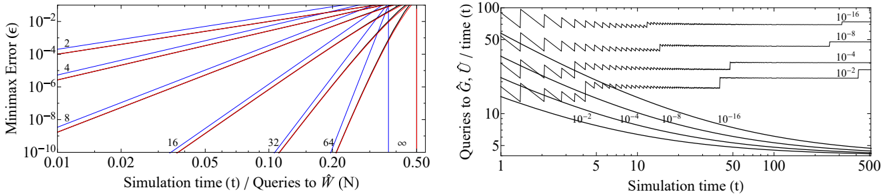
We present the problem of approximating the time-evolution operatore−iH^tto errorϵ, where the HamiltonianH^=(⟨G|⊗I^)U^(|G⟩⊗I^)is the projection of a unitary oracleU^onto the state|G⟩created by another unitary oracle. Our algorithm solves this with a query complexityO(t+log(1/ϵ))to both oracles that is optimal with respect to all parameters in both the asymptotic and non-asymptotic regime, and also with low overhead, using at most two additional ancilla qubits. This approach to Hamiltonian simulation subsumes important prior art considering Hamiltonians which ared-sparse or a linear combination of unitaries, leading to significant improvements in space and gate complexity, such as a quadratic speed-up for precision simulations. It also motivates useful new instances, such as whereH^is a density matrix. A key technical result is `qubitization', which uses the controlled version of these oracles to embed anyH^in an invariantSU(2)subspace. A large class of operator functions ofH^can then be computed with optimal query complexity, of whiche−iH^tis a special case.
Overview
The claims and statistics of this paper haven’t been checked yet.
Free: it reads the open-access text and checks the first 5 claims that cite a source we can check. Create a free account to check every claim.
Integrity signals
Registry
Cites
Statistics
Figures
Verification
Claims the paper makes
The claims and statistics of this paper haven’t been checked yet.
Free: it reads the open-access text and checks the first 5 claims that cite a source we can check. Create a free account to check every claim.
Claims other papers make about this one
Each is checked against this paper’s own text: does it say what the citing paper says it does?
In the citing paper
“Trotterization methods are commonly employed, and allow discretization errors that are controlled polynomially in dt, with a number of unitary operations that scales linearly in the number of Hamiltonian terms and simulation time IV .”
From Beyond-classical computation in quantum simulation (2025) · cites this paper as [105]
In the citing paper
“There are many other Hamiltonian simulation methods, an example of a powerful and sophisticated method being qubitization [166] and quantum signal processing [167], which have the provably optimal asymptotic scaling, although it is unclear whether this will translate to better practical applications.”
From The prospects of quantum computing in computational molecular biology (2021) · cites this paper as [166]
Self-check
Percentages, sums and reported differences re-computed from the paper’s own numbers.
The self-check needs the paper’s full text.
Citations
Cites
A fast quantum mechanical algorithm for database search
Grover, L. K. (1996) · Proceedings of the twenty-eighth annual ACM symposium on Theory of computing - STOC '96 · doi:10.1145/237814.237866 · Cited by 8,830 · cited 1×
“After all, (cid:104) G | ˆ S ˆ U ˆ S ˆ U | G (cid:105) = ˆ I implies that ˆ S ˆ U is a reflection when controlled by input state | G (cid:105) , and it is well-known that a Grover iterate [25, 45] is the product of two reflection about start and target subspaces.”
BackgroundQuantum Algorithm for Linear Systems of Equations
Harrow, A. W., Hassidim, A., & Lloyd, S. (2009) · Physical Review Letters · doi:10.1103/physrevlett.103.150502 · Cited by 3,325 · cited 1×
“ralized by Aharonov and Ta-Shma [3] to sparse Hamiltonians. Celebrated achievements over the years [20,8,32,10,33] have each ignited a urry of activity in diverse applications from quantum algorithms [26,19,21,15] to quantum chemistry [46,44,40,41,4,29,39]. In this dawning era of the small quantum computer [5,23], the…”
BackgroundLloyd, S. (1996) · Science · doi:10.1126/science.273.5278.1073 · Cited by 3,088 · cited 2×
“The first explicit quantum algorithms were discovered by Lloyd [31] for local interactions, and then generalized by Aharonov and Ta-Shma [3] to sparse Hamiltonians.”
Method(1964) · doi:10.1115/1.3625776 · Cited by 1,796
Superconducting quantum circuits at the surface code threshold for fault tolerance
Barends, R., Kelly, J., Megrant, A., Veitia, A., Sank, D., Jeffrey, E., White, T. C., Mutus, J., Fowler, A. G., Campbell, B., et al. (2014) · Nature · doi:10.1038/nature13171 · Cited by 1,733
Quantum principal component analysis
Lloyd, S., Mohseni, M., & Rebentrost, P. (2014) · Nature Physics · doi:10.1038/nphys3029 · Cited by 1,385 · cited 2×
“Celebrated achievements over the years [20, 8, 32, 10, 33] have each ignited a flurry of activity in diverse applications from quantum algorithms [26, 19, 21, 15] to quantum chemistry [46, 44, 40, 41, 4, 29, 39].”
BackgroundMethodA computer program for designing optimum FIR linear phase digital filters
McClellan, J., Parks, T., & Rabiner, L. (1973) · IEEE Transactions on Audio and Electroacoustics · doi:10.1109/tau.1973.1162525 · Cited by 1,139 · cited 1×
“We present a systematic framework that furnishes the optimal complexity and a concrete procedure for almost any f and show how an exact connection is made between query complexity and the theory of best function approximations with polynomials [33, 36].”
MethodScalable Quantum Simulation of Molecular Energies
O’Malley, P. J. J., Babbush, R., Kivlichan, I. D., Romero, J., McClean, J. R., Barends, R., Kelly, J., Roushan, P., Tranter, A., Ding, N., et al. (2016) · Physical Review X · doi:10.1103/physrevx.6.031007 · Cited by 1,059 · cited 1×
“Celebrated achievements over the years [3–7] have each ignited a flurry of activity in diverse applications from quantum algorithms [8–11] to quantum chemistry [12–18].”
BackgroundExponential algorithmic speedup by a quantum walk
Childs, A. M., Cleve, R., Deotto, E., Farhi, E., Gutmann, S., & Spielman, D. A. (2003) · Proceedings of the thirty-fifth annual ACM symposium on Theory of computing · doi:10.1145/780542.780552 · Cited by 825
Demonstration of a small programmable quantum computer with atomic qubits
Debnath, S., Linke, N. M., Figgatt, C., Landsman, K. A., Wright, K., & Monroe, C. (2016) · Nature · doi:10.1038/nature18648 · Cited by 777 · cited 1×
“In this dawning era of the small quantum computer [5, 23], the relevance and necessity of space and gate efficient procedures for practical Hamiltonian simulation has intensified.”
Background
Research works printed but not linked: 2
- R. Kothari, Efficient algorithms in quantum query complexity, Ph.D. thesis, University of Waterloo (2014).
- M. Abramowitz, I. A. Stegun, and Others, "Handbook of mathematical functions," Applied mathematics series 55, 62 (1966).
Cited by
Items 601–700 of 1,009
Smart, S. E., & Mazziotti, D. A. (2022) · Physical Review A · doi:10.1103/physreva.105.062424 · Cited by 18
Quantum computational quantitative trading: high-frequency statistical arbitrage algorithm
Zhuang, X., Chen, Z., Wu, Y.-C., & Guo, G. (2022) · New Journal of Physics · doi:10.1088/1367-2630/ac7f26 · Cited by 18
Casares, P. A. M., Campos, R., & Martin-Delgado, M. A. (2022) · Quantum · doi:10.22331/q-2022-07-20-768 · Cited by 18
“These changes in later articles [7, 44, 62], and in this appendix, we present how the interaction picture can help make more efficient Hamiltonian Simulation algorithms [44].”
BackgroundMethodInfluentialModular Component-Based Quantum Circuit Synthesis
Kang, C. G., & Oh, H. (2023) · Proceedings of the ACM on Programming Languages · doi:10.1145/3586039 · Cited by 18
“Quantum computers are expected to outperform classical computers in applications such as machine learning [Gilyén et al. 2019], quantum system simulation [Low and Chuang 2019], and unstructured search [Grover 1996].”
BackgroundDigital quantum simulation of non-perturbative dynamics of open systems with orthogonal polynomials
Guimarães, J. D., Vasilevskiy, M. I., & Barbosa, L. S. (2024) · Quantum · doi:10.22331/q-2024-02-05-1242 · Cited by 18
“To simulate the system on a quantum computer, the evolution operator may be decomposed with Trotter-Suzuki decompositions [43, 44], truncated Taylor series [45] or qubitization and quantum signal processing techniques [46].”
MethodExponential improvement in quantum simulations of bosonsPreprint
Hanada, M., Matsuura, S., Mendicelli, E., & Rinaldi, E. (2025) · arXiv (Cornell University) · doi:10.48550/arxiv.2505.02553 · Cited by 18
“In fact, in these simple examples, it is possible to improve the circuits by taking different approaches, for example, using qubitization [29] or randomized compiling [30].”
Methods for Reducing Ancilla-Overhead in Block EncodingsPreprint
Vasconcelos, F., & Gilyén, A. (2025) · arXiv (Cornell University) · doi:10.48550/arxiv.2507.07900 · Cited by 18
“Formally, a block encoding embeds a normalized, arbitrary (i.e., not necessary unitary) matrix A into a larger unitary matrix, More generally, the unitary (cid:101) U A is called an ( α, a, ε ) -block encoding of A if Given an arbitrary n -qubit state | ψ ⟩ , A | ψ ⟩ is implemented via the circuit…”
InfluentialBasic Energy Sciences (BES). Scientific User Facilities Division USDOE Office of Science (SC), Camps, D., Rrapaj, E., Klymko, K., Kim, H., Gott, K., Darbha, S., Balewski, J., Austin, B., & Wright, N. (2025) · OSTI OAI (U.S. Department of Energy Office of Scientific and Technical Information) · doi:10.2172/2588210 · Cited by 17
Quantum algorithm for linear matrix equations
Somma, R. D., Low, G. H., Berry, D. W., & Babbush, R. (2026) · npj Quantum Information · doi:10.1038/s41534-026-01360-6 · Cited by 17
Self-citationParallelization techniques for quantum simulation of fermionic systems
Bringewatt, J., & Davoudi, Z. (2023) · Quantum · doi:10.22331/q-2023-04-13-975 · Cited by 17
Pure quantum gradient descent algorithm and full quantum variational eigensolver
Chen, R., Guang, Z., Guo, C., Feng, G., & Hou, S. (2023) · Frontiers of Physics · doi:10.1007/s11467-023-1346-7 · Cited by 17
“(10), we need to construct an oracle on the phase that contains the objective function, that is, we need to construct such an oracle: We notice that the problem can be addressed using the techniques, such as block encoding technique[36, 50], Hamiltonian simulation[36, 51], described in Appendix A.”
MethodEfficient Quantum Algorithm for Filtering Product States
Irmejs, R., Bañuls, M. C., & Cirac, J. I. (2024) · Quantum · doi:10.22331/q-2024-06-27-1389 · Cited by 17
Evolved quantum Boltzmann machines
Minervini, M., Patel, D., & Wilde, M. M. (2026) · Physical Review A · doi:10.1103/k2hw-r25g · Cited by 17
Efficient Simulation of Quantum Chemistry Problems in an Enlarged Basis Set
Luo, M., & Cirac, J. I. (2025) · PRX Quantum · doi:10.1103/prxquantum.6.010355 · Cited by 17
“Third, other quantum algorithms for quantum chemistry based on qubitization that aim at the preparation of eigenstates may be turned into a quantum simulation algorithm when combined with quantum signal processing techniques [7].”
BackgroundEfficient algorithms for quantum information bottleneck
Hayashi, M., & Yang, Y. (2023) · Quantum · doi:10.22331/q-2023-03-02-936 · Cited by 17
Tanaka, Y., & Fujii, K. (2023) · arXiv (Cornell University) · doi:10.48550/arxiv.2305.00653 · Cited by 17
S-FABLE and LS-FABLE: Fast approximate block-encoding algorithms for unstructured sparse matricesPreprint
Kuklinski, P., & Rempfer, B. (2024) · arXiv (Cornell University) · doi:10.48550/arxiv.2401.04234 · Cited by 17
“While for these highly symmetric and structured sparse matrices we find FABLE achieves relatively higher compression and accuracy compared to the sparse methods, alternative bespoke methods exist to block-encode the matrices in question [21].”
BackgroundHybrid Quantum-Classical AlgorithmsPreprint
Campos, R. (2024) · arXiv (Cornell University) · doi:10.48550/arxiv.2406.12371 · Cited by 17
Seetharam, K., Sahinoglu, B., Lostaglio, M., Pallister, S., & da Jornada, F. H. (2025) · Research Square · doi:10.21203/rs.3.rs-7411164/v1 · Cited by 17
Jin, S., Liu, N., Ma, C., & Yu, Y. (2025) · arXiv (Cornell University) · doi:10.48550/arxiv.2505.06866 · Cited by 17
Digital Quantum Simulation of Spin Transport
Lee, Y.-T., Pokharel, B., Cohn, J., Schleife, A., & Banerjee, A. (2026) · Physical Review Letters · doi:10.1103/mx9k-kdlj · Cited by 16
Unitary partitioning and the contextual subspace variational quantum eigensolver
Ralli, A., Weaving, T., Tranter, A., Kirby, W. M., Love, P. J., & Coveney, P. V. (2023) · Physical Review Research · doi:10.1103/physrevresearch.5.013095 · Cited by 17
“However, in contrast to the deterministic sequence-of-rotations approach, this implementation would be probabilistic as it requires postselection on an ancillary register [15,30,52,53].”
BackgroundQudit-based quantum simulation of fermionic systems
Chizzini, M., Tacchino, F., Chiesa, A., Tavernelli, I., Carretta, S., & Santini, P. M. (2024) · Physical Review A · doi:10.1103/physreva.110.062602 · Cited by 16
Quantum and classical algorithms for nonlinear unitary dynamics
Brüstle, N., & Wiebe, N. (2025) · Quantum · doi:10.22331/q-2025-05-13-1741 · Cited by 16
“Given that more recent Hamiltonian simulation results were able to provide logarithmic scaling with the inverse of the error [17] [4], this provides a clear avenue for improvement.”
Solving free fermion problems on a quantum computer
Stroeks, M., Lenterman, D., Terhal, B. M., & Herasymenko, Y. (2025) · Physical Review Research · doi:10.1103/zmwm-gdmw · Cited by 16
Kernpiler: Compiler Optimization for Quantum Hamiltonian Simulation with Partial Trotterization
Decker, E., Goetz, L., McKinney, E., Gustafson, E., Zhou, J., Liu, Y., Jones, A. K., Li, A., Schuckert, A., Stein, S., et al. (2026) · Proceedings - International Symposium on Computer Architecture/Proceedings · doi:10.1109/isca66397.2026.00073 · Cited by 16
“Quantum computing holds immense promise as a paradigm-shifting technology, with one of its most impactful applications lying in Hamiltonian simulation [31, 8, 32, 7]—the process of evolving a qubit array according to the physics (Hamiltonian) of a target quantum system.”
Quantum computing for automotive applications
Riofrío, C. A., Klepsch, J., Finžgar, J. R., Kiwit, F. J., Hölscher, L., Erdmann, M., Müller, L., Kumar, C., Berrada, Y. A., & Luckow, A. (2025) · Elsevier eBooks · doi:10.1016/b978-0-44-330259-6.00020-7 · Cited by 16
Tight bound for estimating expectation values from a system of linear equations
Alase, A., Nerem, R. R., Bagherimehrab, M., Høyer, P., & Sanders, B. C. (2022) · Physical Review Research · doi:10.1103/physrevresearch.4.023237 · Cited by 16
“These techniques have been generalized to the larger class of block-encoded matrices [22], which we discuss in the next section.”
BackgroundMethodInfluentialQuantum mean centering for block-encoding-based quantum algorithm
Liu, H., Yu, C., Wan, L., Qin, S., Gao, F., & Wen, Q. (2022) · Physica A Statistical Mechanics and its Applications · doi:10.1016/j.physa.2022.128227 · Cited by 16
“Next, we can employ the block-encoding technique [6, 33, 34] which has been successfully applied in quantum regression [34], quantum classification [35] and other algorithms to realize MC.”
BackgroundMethodInfluentialFast-forwarding quantum simulation with real-time quantum Krylov subspace algorithms
Cortes, C. L., DePrince, A. E., & Gray, S. K. (2022) · Physical Review A · doi:10.1103/physreva.106.042409 · Cited by 16
“[5] Guang Hao Low and Isaac L Chuang, “Hamiltonian simulation by qubitization,” Quantum 3, 163 (2019).”
BackgroundUnveiling the Non-Abelian Statistics of D ( S 3 ) Anyons Using a Classical Photonic Simulator
Goel, S., Reynolds, M., Girling, M., McCutcheon, W., Leedumrongwatthanakun, S., Srivastav, V., Jennings, D., Malik, M., & Pachos, J. K. (2024) · Physical Review Letters · doi:10.1103/physrevlett.132.110601 · Cited by 16
“[37] Guang Hao Low and Isaac L Chuang, Hamiltonian simulation by qubitization, Quantum 3, 163 (2019).”
Direct application of the phase estimation algorithm to find the eigenvalues of the Hamiltonians
Daskin, A., & Kais, S. (2018) · Chemical Physics · doi:10.1016/j.chemphys.2018.01.002 · Cited by 16
“In general, a computation or an algorithm should be represented by a unitary matrix in order to be implemented on a quantum computer.”
BackgroundEfficient implementation of unitary transformationsPreprint
Lloyd, S., & Maity, R. (2019) · arXiv (Cornell University) · doi:10.48550/arxiv.1901.03431 · Cited by 16
Quantum Machine Learning For Classical DataPreprint
Wossnig, L. (2021) · arXiv (Cornell University) · doi:10.48550/arxiv.2105.03684 · Cited by 16
A Faster Quantum Algorithm for Semidefinite Programming via Robust IPM FrameworkPreprint
Huang, B., Jiang, S., Song, Z., Tao, R., & Zhang, R. (2022) · arXiv (Cornell University) · doi:10.48550/arxiv.2207.11154 · Cited by 16
Quantum signal processing over SU(N)Preprint
Laneve, L. (2023) · arXiv (Cornell University) · doi:10.48550/arxiv.2311.03949 · Cited by 16
Multivariable QSP and Bosonic Quantum Simulation using Iterated Quantum Signal ProcessingPreprint
Gomes, N., Lim, H., & Wiebe, N. (2024) · arXiv (Cornell University) · doi:10.48550/arxiv.2408.03254 · Cited by 16
“From Hamiltonian simulation by QSP [12] [1] [22], we know that to obtain ǫ ′ -approximations for cos ( xt ) and sin ( xt ) using these expansions, we will need to truncate these expansions at sufficiently large degrees of 2 R and 2 R + 1 respectively, where R = r e | t 2 , ǫ ′ , t ∈ R 0 and ǫ ′ ∈ (0…”
MethodOn Speedups for Convex Optimization via Quantum Dynamics
Chakrabarti, S., Herman, D., Watkins, J., Fontana, E., Augustino, B., Kim, J. L., & Pistoia, M. (2025) · DROPS (Schloss Dagstuhl – Leibniz Center for Informatics) · doi:10.4230/lipics.tqc.2026.4 · Cited by 16
Depth-Efficient Quantum Circuit Synthesis for Deterministic Dicke State PreparationPreprint
Yuan, P., & Zhang, S. (2025) · arXiv (Cornell University) · doi:10.48550/arxiv.2505.15413 · Cited by 16
“Over the past decades, Over the past decades, significant progress has been made in developing quantum algorithms for machine learning [BWP + 17], solving linear and di ff erential equations [HHL09, Ber14, CL20, ALL23] and simulating Hamiltonians [BCC + 15, LC17, LC19].”
Lu, R., Li, H.-E., Liu, Z., & Liu, J.-P. (2025) · arXiv (Cornell University) · doi:10.48550/arxiv.2502.19688 · Cited by 16
Time-Dependent Hamiltonian Simulation with Optimal Query ComplexityPreprint
Chen, B., Gao, M., Wang, X., & Zhou, S. (2026) · arXiv (Cornell University) · doi:10.48550/arxiv.2608.06094 · Cited by 17
“For ∥ H ∥ ≤ α and evolution scale αT ≥ 1, the optimal query complexity for achieving error at most ε is Θ αT + log(1 /ε ) log e + log(1 /ε ) / ( αT ) (1) queries [LC19, GSLW19].”
Simulating Energy Transfer in Molecular Systems with Digital Quantum Computers
Lee, C.-K., Lau, J. W. Z., Shi, L., & Kwek, L. C. (2021) · arXiv · doi:10.48550/arxiv.2101.06879 · Cited by 16
“While there are a number of quantum algorithms to simulate the dynamics of quantum many-body systems, such as those based on Trotterization [31], linear combination of unitaries [32], quantum signal processing [33] and qubitization [34], these algorithms require long circuit depth and are therefore not suitable for NI…”
BackgroundSymmetries, Graph Properties, and Quantum Speedups
Ben-David, S., Childs, A. M., Gilyén, A., Kretschmer, W., Podder, S., & Wang, D. (2024) · SIAM Journal on Computing · doi:10.1137/23m1573975 · Cited by 15
A survey on quantum data mining algorithms: challenges, advances and future directions
Qi, H., Wang, L., Gong, C., & Gani, A. (2024) · Quantum Information Processing · doi:10.1007/s11128-024-04279-z · Cited by 15
“Wang et al. proposed a QLR that can obtain the classical information [103], mainly using Low and Chuang’s Hamiltonian simulation algorithm [104] and the matrix inversion algorithm of Childs et al. [76].”
Dictionary-based Block Encoding of Sparse Matrices with Low Subnormalization and Circuit Depth
Yang, C., Li, Z., Yao, H., Fan, Z., Zhang, G., & Liu, J. (2025) · Quantum · doi:10.22331/q-2025-07-22-1805 · Cited by 16
“Special matrices including density operators, the hierarchical matrices, pseudo-differential operators, and pairing Hamiltonians, have been studied in [17–21].”
Going beyond gadgets: the importance of scalability for analogue quantum simulators
Harley, D., Datta, I., Klausen, F. R., Blühm, A., França, D. S., Werner, A. H., & Christandl, M. (2024) · Nature Communications · doi:10.1038/s41467-024-50744-9 · Cited by 16
On Estimating the Trace of Quantum State Powers
Liu, Y., & Wang, Q. (2026) · IEEE Transactions on Information Theory · doi:10.1109/tit.2026.3683891 · Cited by 15
“The second subroutine prepares a purified density matrix, originally stated in [118]: Lemma II.”
Novikau, I., & Joseph, I. (2026) · Journal of Computational Physics · doi:10.1016/j.jcp.2026.115132 · Cited by 15
“24, the cost increase for Q w from the QSVT step that constructs the weights is typically benign relative to the cost of the selector, because the cost of the latter must grow with time.”
InfluentialOptimized quantum circuit partitioning across multiple quantum processors
Kaur, E., Shapourian, H., Zhao, J., Kilzer, M., Kompella, R. R., & Nejabati, R. (2025) · Quantum Computing, Communication, and Simulation · doi:10.1117/12.3042502 · Cited by 15
Partitioned Quantum Subspace Expansion
O’Leary, T., Anderson, L. W., Jaksch, D., & Kiffner, M. (2025) · Quantum · doi:10.22331/q-2025-05-05-1726 · Cited by 15
“Recently, it has been shown [28] that QSE with an exact Krylov basis can be realized via qubitization [29] and applied to problems from condensed matter physics, quantum chemistry and quantum field theory [28, 30].”
Fault-Tolerant Quantum Simulation of Generalized Hubbard Models
Bay-Smidt, A. J., Klausen, F. R., Sünderhauf, C., Izsák, R., Solomon, G. C., & Blunt, N. S. (2025) · PRX Quantum · doi:10.1103/gr4t-b1w5 · Cited by 16
“QPE can also be performed using the more modern qubitization framework [37–39], which has also been developed for the Hub-bard model [40].”
Schrödingerization-Based Quantum Circuits For Maxwell’s Equations With Time-Dependent Source Terms
Ma, C., Jin, S., Liu, N., Wang, K., & Zhang, L. (2026) · Journal of Scientific Computing · doi:10.1007/s10915-026-03349-x · Cited by 15
“A variety of efficient primitives and algorithms have been developed for Hamiltonian simulation [2, 3, 9, 10, 15, 21, 34, 39, 40].”
Theory of Trotter Errors for Time-Dependent Product and Multi-product Formulas
Anonymous, Ikeda, T. N., & Fujii, K. (2026) · PRX Quantum · doi:10.1103/ywv1-7fhf · Cited by 15
Exploiting anticommutation in Hamiltonian simulation
Zhao, Q., & Yuan, X. (2021) · Quantum · doi:10.22331/q-2021-08-31-534 · Cited by 15
“With the help of quantum computers, various quantum algorithms have been to proposed [5, 6, 8, 25, 26] and applied for studying different problems such as spin models [30], fermionic lattice models [36], quantum chemistry [2, 3, 35], and quantum field theories [23].”
MethodShaffer, R., Ren, H., Dyrenkova, E., Yale, C. G., Lobser, D., Burch, A. D., Chow, M. N. H., Revelle, M., Clark, S., & Häffner, H. (2023) · Quantum · doi:10.22331/q-2023-05-04-997 · Cited by 15
“Common approaches to this problem include product formula techniques such as the Suzuki-Trotter decomposition [50] and qubitization [51], which deterministically compile the time-evolution unitary for a given Hamiltonian into a sequence of quantum gates.”
MethodChemically motivated simulation problems are efficiently solvable on a quantum computer
Schleich, P., Kristensen, L. B., Campos-Gonzalez-Angulo, J. A., Aldossary, A., Avagliano, D., Bagherimehrab, M., Gorgulla, C., Fitzsimons, J., & Aspuru‐Guzik, A. (2026) · Digital Discovery · doi:10.1039/d5dd00377f · Cited by 15
Duality in Quantum Quenches and Classical Approximation Algorithms: Pretty Good or Very Bad
Hastings, M. B. (2019) · Quantum · doi:10.22331/q-2019-11-11-201 · Cited by 15
Coble, N. J., & Coudron, M. (2022) · Annual Symposium on Foundations of Computer Science · doi:10.1109/focs52979.2021.00065 · Cited by 15
Liu, H., Wan, L., Yu, C., Pan, S., Qin, S., Gao, F., & Wen, Q. (2023) · Advanced Quantum Technologies · doi:10.1002/qute.202300031 · Cited by 15
Time-Efficient Quantum Entropy Estimator via Samplizer
Wang, Q., & Zhang, Z. (2024) · DROPS (Schloss Dagstuhl – Leibniz Center for Informatics) · doi:10.4230/lipics.esa.2024.101 · Cited by 15
Evaluation of block encoding for sparse matrix inversion using QSVTPreprint
Lapworth, L. B. (2024) · arXiv (Cornell University) · doi:10.48550/arxiv.2402.17529 · Cited by 15
“Direct encoding of a matrix uses a query oracle to load the entries in the matrix [14, 15, 9, 16, 17].”
MethodNew Quantum Algorithm for Principal Component AnalysisPreprint
Nghiem, N. A. (2025) · arXiv (Cornell University) · doi:10.48550/arxiv.2501.07891 · Cited by 15
Quadratic acceleration of multistep probabilistic algorithms for state preparation
Nishi, H., Kosugi, T., Nishiya, Y., & Matsushita, Y. (2024) · Physical Review Research · doi:10.1103/physrevresearch.6.l022041 · Cited by 14
Quantum phase transition detection via quantum support vector machine
Wang, Y., & Cao, L. (2024) · Quantum Science and Technology · doi:10.1088/2058-9565/ad985f · Cited by 14
“This section offers a compilation of critical quantum computational techniques, encompassing the application of linear combinations of unitary operators [52–55], block encoding [56], and quantum phase processing [57].”
Lower Bound for Simulation Cost of Open Quantum Systems: Lipschitz Continuity Approach
Ding, Z., Junge, M., Schleich, P., & Wu, P. (2025) · Communications in Mathematical Physics · doi:10.1007/s00220-025-05240-6 · Cited by 14
On the commutator scaling in Hamiltonian simulation with multi-product formulas
Mizuta, K. (2026) · Quantum · doi:10.22331/q-2026-01-19-1974 · Cited by 14
“Generic Trotter formulas exhibit so-called commutator-scaling error [5], expressed as This is the origin of the fact that Trotterization can achieve better cost in the system size N than other approaches like LCU and QSVT [6, 8, 9].”
Optimized Quantum Circuit Partitioning Across Multiple Quantum Processors
Kaur, E., Pouryousef, S., Shapourian, H., Zhao, J., Kilzer, M., Kompella, R. R., & Nejabati, R. (2025) · IEEE Transactions on Quantum Engineering · doi:10.1109/tqe.2025.3623158 · Cited by 15
Incoherent quantum algorithm dynamics of an open system with near-term devices
Mahdian, M., & Yeganeh, H. D. (2020) · Quantum Information Processing · doi:10.1007/s11128-020-02800-8 · Cited by 14
Quantum kernel logistic regression based Newton method
Ning, T., Yang, Y., & Du, Z. (2023) · Physica A Statistical Mechanics and its Applications · doi:10.1016/j.physa.2023.128454 · Cited by 14
Two-level quantum walkers on directed graphs. II. Application to quantum random access memory
Asaka, R., Sakai, K., & Yahagi, R. (2023) · Physical Review A · doi:10.1103/physreva.107.022416 · Cited by 14
Cycle index polynomials and generalized quantum separability tests
Bradshaw, Z. P., LaBorde, M. L., & Wilde, M. M. (2023) · Proceedings of the Royal Society A Mathematical Physical and Engineering Sciences · doi:10.1098/rspa.2022.0733 · Cited by 14
“Although constructions of cyclic shifts exist in the literature, our construction follows binary encoding procedures [38,39] and uses fewer gates than a naive implementation and thus warrants discussion.”
BackgroundQuantum Simulation of the First-Quantized Pauli-Fierz Hamiltonian
Mukhopadhyay, P., Stetina, T. F., & Wiebe, N. (2024) · PRX Quantum · doi:10.1103/prxquantum.5.010345 · Cited by 15
An introduction to quantum computing for statisticians and data scientists
Lopatnikova, A., Tran, M., & Sisson, S. A. (2024) · Foundations of Data Science · doi:10.3934/fods.2024013 · Cited by 14
“Additionally, Hamiltonian simulation is BQP-complete (Low and Chuang, 2019; Berry et al., 2015b) (see Section 4.3 for a brief discussion of computational complexity).”
BackgroundMethodInfluentialResource-efficient quantum principal component analysis
Wang, Y., & Luo, Y. H. (2024) · Quantum Science and Technology · doi:10.1088/2058-9565/ad466c · Cited by 14
“…n × 2 n has a purified quantum query model if we have access to a unitary operator V and its inverse acting on a bipartite system, AB , which satisfies such that tr B ( | ψ ⟩⟨ ψ | ) = ρ , where ⟨ e Unitary U can be constructed by employing lemma 7 in [34] to build a ‘block encoding’ operator of ρ .”
BackgroundMethodRandomized semi-quantum matrix processing
Tosta, A., Silva, T. D. L., Camilo, G., & Aolita, L. (2024) · npj Quantum Information · doi:10.1038/s41534-024-00883-0 · Cited by 14
“Allan Tosta , , Thais de Lima Silva 1 , Giancarlo Camilo 1 & Leandro Aolita 1,2 We present a hybrid quantum-classical framework for simulating generic matrix functions more amenable to early fault-tolerant quantum hardware than standard quantum singular-value transformations.”
Systematic many-fermion Hamiltonian input scheme and spectral calculations on quantum computers
Du, W., & Vary, J. P. (2025) · Physics Letters B · doi:10.1016/j.physletb.2025.139548 · Cited by 14
“…this input scheme, we can block encode the Chebyshev polynomial of the first kind [68] as a function of H ′ = H/ ( D Λ) with the qubitization [37, 51, 52] as With the input scheme of the Chebyshev polynomial T i ( H ′ ), we can construct the Krylov bases based on the pivot Fock state | ψ 0 ⟩ as…”
Quantum algorithms for uncertainty quantification: Applications to partial differential equations
Golse, F., Jin, S., & Liu, N. (2025) · Science China Physics Mechanics and Astronomy · doi:10.1007/s11433-024-2705-7 · Cited by 14
“Since sparse-access to M can be used to construct block-access to M [23, 24], query complexity with respect to block-access can be converted into sparse-access results with an extra factor of up to s and some small overhead.”
BackgroundEstimating Gibbs partition function with quantum Clifford sampling
Wu, Y., & Wang, J. B. (2022) · Quantum Science and Technology · doi:10.1088/2058-9565/ac47f0 · Cited by 14
“(cid:9) (cid:10) Reference [33] indicated that for all t > 1 one obtains r ( t , (cid:2) 4 ) = Θ t + log(1 /(cid:2) 4 ) log log(1 /(cid:2) 4 ) , then we have the following theorem.”
Implicit Hybrid Quantum-Classical CFD Calculations using the HHL AlgorithmPreprint
Lapworth, L. B. (2022) · arXiv (Cornell University) · doi:10.48550/arxiv.2209.07964 · Cited by 14
“An alternative to Trotter-Suzuki is qubitisation [48, 49, 50, 51, 52, 53] which provides an exact implementation of a unitary decomposition at the expense of an additional ancilla register for preparing the coefficients of the unitary decomposition.”
MethodSimon, S., Degroote, M., Moll, N., Santagati, R., Streif, M., & Wiebe, N. (2024) · arXiv (Cornell University) · doi:10.48550/arxiv.2402.14791 · Cited by 14
Treespilation: Architecture- and State-Optimised Fermion-to-Qubit MappingsPreprint
Miller, A., Glos, A., & Zimborás, Z. (2024) · arXiv (Cornell University) · doi:10.48550/arxiv.2403.03992 · Cited by 14
“Near-term quantum devices require noise-robust circuits, with VQEs offering advantages through reduced CNOT gate counts compared to approaches like qubitisation 43 .”
Quantum Resources Required for Binding Affinity Calculations of Amyloid betaPreprint
Otten, M., Watts, T. W., Johnson, S. D., Sundareswara, R., Wang, Z., Hardikar, T., Heitritter, K., Brown, J. P. R., Setia, K., & Holmes, A. A. (2024) · arXiv (Cornell University) · doi:10.48550/arxiv.2406.18744 · Cited by 14
“In qubitiza-tion, the time evolution is performed not through the direct Hamiltonian, H , but instead through a walk operator, W = e i sin − 1 ( H ) [23].”
BackgroundMethodWatts, T. W., Otten, M., Necaise, J., Nguyen, N., Link, B., Williams, K. S., Sanders, Y. R., Elman, S. J., Kieferová, M., Bremner, M. J., et al. (2024) · arXiv (Cornell University) · doi:10.48550/arxiv.2408.13244 · Cited by 14
No Universal Purification in Quantum MechanicsPreprint
Liu, Z., Du, Z., Eisert, J., Cai, Z., & Liu, Z.-W. (2025) · arXiv (Cornell University) · doi:10.48550/arxiv.2509.21111 · Cited by 14
The Fast for the Curious: How to accelerate fault-tolerant quantum applicationsPreprint
McArdle, S., Dalzell, A. M., Kubica, A., & Brandão, F. G. S. L. (2025) · arXiv (Cornell University) · doi:10.48550/arxiv.2510.26078 · Cited by 15
“At the algorithmic level of the stack, we examine two quantum algorithms for simulating time evolution: plaquette Trotterization (PLAQ) [192] and quantum signal processing (QSP) [203, 204].”
Nearly-frustration-free ground state preparation
Thibodeau, M., & Clark, B. K. (2023) · Quantum · doi:10.22331/q-2023-08-16-1084 · Cited by 13
“The existence of a block-encoding U of H is a very powerful tool because it allows the application quantum signal processing [5, 9, 11, 16, 17], which lets us transform H by a suitable polynomial p(x), which acts on the spectrum of H by p(H) = ∑ λ p(λ) |λ〉 〈λ|.”
BackgroundMethodInfluentialQuantum Algorithm for Estimating Betti Numbers Using Cohomology Approach
Nghiem, N. A., Gu, X. D., & Wei, T.-C. (2025) · Quantum · doi:10.22331/q-2025-12-23-1955 · Cited by 13
“Once a matrix A is block-encoded, one can apply various QSVT techniques, some of which are relevant to this work and are summarized in Appendix A. Definition 1 (Block Encoding Unitary) [20, 21, 46] Let A be some Hermitian matrix of size N × N whose matrix norm | A | 1 .”
InfluentialFaster Algorithmic Quantum and Classical Simulations by Corrected Product Formulas
Bagherimehrab, M., Calderón, L. M., Berry, D. W., Schleich, P., Vakili, M. G., Aldossary, A., Campos-Gonzalez-Angulo, J. A., Gorgulla, C., & Aspuru‐Guzik, A. (2026) · PRX Quantum · doi:10.1103/phk5-slkl · Cited by 13
An efficient quantum algorithm for ab initio approximations of non-linear response functions
Kharazi, T., Stetina, T. F., Ko, L., Low, G. H., & Whaley, K. B. (2025) · npj Quantum Information · doi:10.1038/s41534-025-01026-9 · Cited by 13
Self-citationObservable-driven speed-ups in quantum simulations
Yu, W., Xu, J., & Zhao, Q. (2025) · Communications Physics · doi:10.1038/s42005-025-02260-5 · Cited by 13
“Our short-time simulation analyses reveal that the locality of observables generally provides a speed-up.”
Patel, S., Jayakumar, P., Huang, R., Zeng, T., & Izmaylov, A. F. (2026) · Journal of Chemical Theory and Computation · doi:10.1021/acs.jctc.6c00017 · Cited by 14
Quantum Simulation of Electronic Structure via Quantum Fast Multipole Method
Berry, D. W., Wan, K., Baczewski, A., Eklund, E. C., Tikku, A., & Babbush, R. (2026) · PRX Quantum · doi:10.1103/b2vn-zf6c · Cited by 13
QREChem: quantum resource estimation software for chemistry applications
Otten, M., Kang, B., Fedorov, D. A., Lee, J., Benali, A., Habib, S., Gray, S. K., & Alexeev, Y. (2023) · Frontiers in Quantum Science and Technology · doi:10.3389/frqst.2023.1232624 · Cited by 14
Mixed quantum-classical dynamics for near term quantum computers
Bultrini, D., & Vendrell, O. (2023) · Communications Physics · doi:10.1038/s42005-023-01451-2 · Cited by 12
“This can be replaced by a plethora of more NISQ-friendly time evolutions as is done in [20, 21] if the form of the Hamiltonian allows this.”
BackgroundMultinucleon structure and dynamics via quantum computing
Du, W., & Vary, J. P. (2023) · Physical Review A · doi:10.1103/physreva.108.052614 · Cited by 13
Nghiem, N. A., Sukeno, H., Zhang, S., & Wei, T.-C. (2025) · Physical Review A · doi:10.1103/physreva.111.012434 · Cited by 13
“Not only so, the QSVT framework also produces simpler and more cost-effective ways to execute certain primitives, such as the Hamiltonian simulation [6–9, 16, 17] and amplitude estimation [18, 19].”
Fonio, N., Sagaut, P., & Molfetta, G. D. (2025) · Computers & Fluids · doi:10.1016/j.compfluid.2025.106688 · Cited by 13
“These first alternatives are probabilistic since they rely on a linear combination of unitaries [16, 17].”
Improved quantum algorithms for eigenvalue finding and gradient descent
Nghiem, N. A., & Wei, T.-C. (2026) · Physical Review Applied · doi:10.1103/ddlc-ynvv · Cited by 13
“The underlying framework of our algorithm is the powerful unitary block encoding [23, 25, 26], which has recently transformed quantum algorithms in a very fundamental way, as it provides a unified viewpoint for all previously proposed algorithms.”
BackgroundMethodResultInfluentialQuantum algorithms for spectral sumsPreprint
Luongo, A., & Shao, C. (2020) · AAAI Publications (The Association for the Advancement of Artificial Intelligence (AAAI)) · doi:10.48550/arxiv.2011.06475 · Cited by 13
“As a final remark we anticipate that in some of the following algorithms, it will be convenient to assume quantum access to sub-normalized matrices, as in [11, Lemma 5], and [41] where (cid:107) A (cid:107) ≤ 1.”
MethodHalving the cost of quantum multiplexed rotationsPreprint
Low, G. H. (2021) · arXiv (Cornell University) · doi:10.48550/arxiv.2110.13439 · Cited by 13
“The basic approach applies quantum phase estimation [18] on a quantum walk W encoding the spectrum of H [15].”
Self-citation
Metadata
- Authors
- Low, G. H., & Chuang, I. L.
- Affiliations
- Massachusetts Institute of Technology (US)
- Venue
- Quantum
- Published
- 2019-07-12
- Volume
- 3
- Pages
- 163
- ISSN
- 2521-327X (ISSN-L)
- OpenAlex
- W2535738892
- Cited by
- 854
- References
- 46
- Citations by year
- 2026: 120 · 2025: 216 · 2024: 160 · 2023: 137 · 2022: 92 · 2021: 70 · 2020: 43 · 2019: 15
- FWCI
- 25.21
- Type
- journal article
- Language
- en
- Open access
- gold
- doi.org
- Locations
- Quantum (publishedVersion, cc-by)
- arXiv (Cornell University) (acceptedVersion)
- DOAJ (DOAJ: Directory of Open Access Journals) (submittedVersion)
- arXiv (Cornell University) (cc-by)
- Topics
- Physical Sciences › Computer Science › Artificial Intelligence › Quantum Computing Algorithms and Architecture
- Physical Sciences › Physics and Astronomy › Atomic and Molecular Physics, and Optics › Quantum many-body systems
- Physical Sciences › Physics and Astronomy › Atomic and Molecular Physics, and Optics › Quantum Mechanics and Applications
- Keywords
- Hamiltonian simulation, qubitization, evolution operator, query complexity, sparse Hamiltonians, linear combination of unitaries, ancilla qubits, operator functions, quantum algorithms
About these checks
Registry, retraction, Cites and statistics results are computed, not judged, with one exception: a printed reference that no index lists is read once by a model before it counts as a citation error. Claims are extracted by a model and kept only when their quote appears verbatim in the text; each cited source is then checked, with a model’s help, for whether it says what the claim relies on. Those verdicts can be wrong — read the claim’s quote and the cited source before relying on one.
Statistics and arithmetic are recomputed, not judged.
Confidence bands are shown only for fields calibrated on our annotated test set. None is calibrated yet, so no band is shown.
What counts as a claim ›How we measure confidence ›How we check this ›
Are you an author, or do you see a problem with this page? Request a review
Data sources
Bibliographic data: Semantic Scholar, OpenAlex, Crossref.
Contains information from the Semantic Scholar Academic Graph Datasets, made available under the ODC Attribution License (ODC-BY 1.0).
Semantic Scholar’s data is described in: Kinney, R., et al. (2023). The Semantic Scholar Open Data Platform. arXiv:2301.10140.
