

Fully Integrated Artificial Pancreas in Type 1 Diabetes
Open accessThe DOI matches its Crossref record; 34 of the 34 references it cites were found in a registry or an index.
Abstract
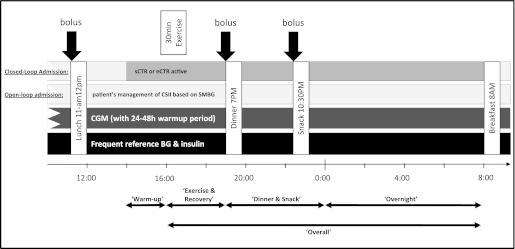
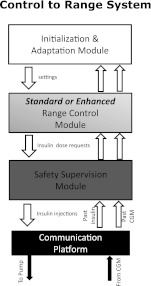
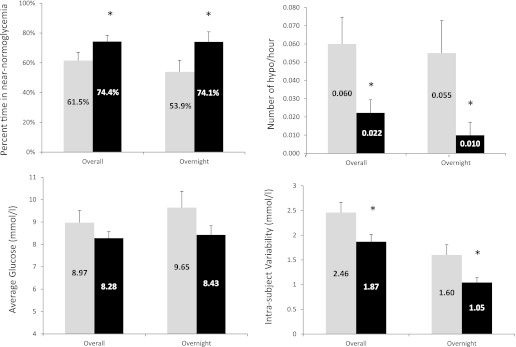
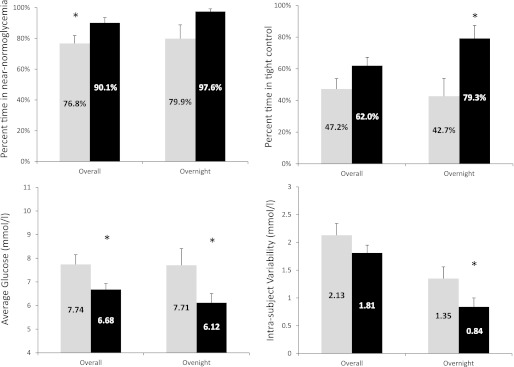
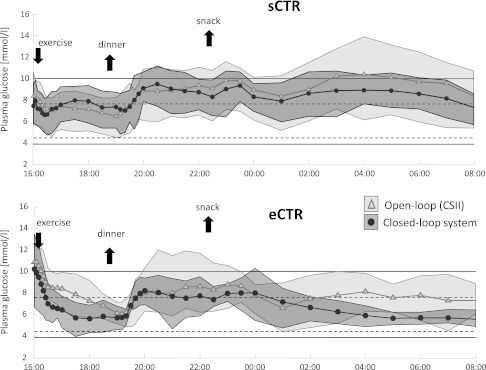
Integrated closed-loop control (CLC), combining continuous glucose monitoring (CGM) with insulin pump (continuous subcutaneous insulin infusion [CSII]), known as artificial pancreas, can help optimize glycemic control in diabetes. We present a fundamental modular concept for CLC design, illustrated by clinical studies involving 11 adolescents and 27 adults at the Universities of Virginia, Padova, and Montpellier. We tested two modular CLC constructs: standard control to range (sCTR), designed to augment pump plus CGM by preventing extreme glucose excursions; and enhanced control to range (eCTR), designed to truly optimize control within near normoglycemia of 3.9-10 mmol/L. The CLC system was fully integrated using automated data transfer CGM→algorithm→CSII. All studies used randomized crossover design comparing CSII versus CLC during identical 22-h hospitalizations including meals, overnight rest, and 30-min exercise. sCTR increased significantly the time in near normoglycemia from 61 to 74%, simultaneously reducing hypoglycemia 2.7-fold. eCTR improved mean blood glucose from 7.73 to 6.68 mmol/L without increasing hypoglycemia, achieved 97% in near normoglycemia and 77% in tight glycemic control, and reduced variability overnight. In conclusion, sCTR and eCTR represent sequential steps toward automated CLC, preventing extremes (sCTR) and further optimizing control (eCTR). This approach inspires compelling new concepts: modular assembly, sequential deployment, testing, and clinical acceptance of custom-built CLC systems tailored to individual patient needs.
Overview
The claims and statistics of this paper haven’t been checked yet.
Free: it reads the open-access text and checks the first 5 claims that cite a source we can check. Create a free account to check every claim.
Integrity signals
Registry
Cites
Statistics
Figures
Verification
Claims the paper makes
The claims and statistics of this paper haven’t been checked yet.
Free: it reads the open-access text and checks the first 5 claims that cite a source we can check. Create a free account to check every claim.
Claims other papers make about this one
Each is checked against this paper’s own text: does it say what the citing paper says it does?
The cited source says what the claim attributes to it.
In the citing paper
“The integrated closed-loop systems tested so far have reported favourable results;97”
From Type 1 diabetes (2014) · cites this paper as [97]
Self-check
Percentages, sums and reported differences re-computed from the paper’s own numbers.
The self-check needs the paper’s full text.
Citations
Cites
(1993) · New England Journal of Medicine · doi:10.1056/nejm199309303291401 · Cited by 24,667
Turner, R. C., Fox, C., Matthews, McElroy, H. H., Cull, C. A., Holman, R. R., Neil, P., Hadden, D. R., Wright, D., Manley, E., et al. (1998) · The Lancet · Cited by 8,419
In Silico Preclinical Trials: A Proof of Concept in Closed-Loop Control of Type 1 Diabetes
Kovatchev, B. P., Breton, M., Dalla Man, C., & Cobelli, C. (2009) · Journal of Diabetes Science and Technology · doi:10.1177/193229680900300106 · Cited by 760 · cited 1×
“The control algorithms used by studies 1 and 2—sCTR and eCTR, respectively—were designed and tested in silico using computer simulation (26), and each algorithm had a different focus: in study 1, the”
MethodSelf-citationArtificial Pancreas: Past, Present, Future
Cobelli, C., Renard, E., & Kovatchev, B. (2011) · Diabetes · doi:10.2337/db11-0654 · Cited by 600 · cited 3×
“The rationale behind MPC was presented in detail in a recent review (7).”
BackgroundMethodSelf-citationAbnormal patterns of insulin secretion in non-insulin-dependent diabetes mellitus.
Polonsky, K. S., Given, B. D., Hirsch, L. J., Tillil, H., Shapiro, E. T., Beebe, C., Frank, B. H., Galloway, J. A., & Van Cauter, E. (1988) · New England Journal of Medicine · doi:10.1056/nejm198805123181903 · Cited by 567 · cited 1×
“Diabetes 61:2230–2237, 2012 The maintenance of close-to-normal blood glucose (BG) levels slows the onset and progression of long-term microvascular complications in patients with type 1 diabetes (1); therefore, the ultimate therapeutic goal of type 1 diabetes is to restore near normoglycemia (2).”
BackgroundWeinzimer, S. A., Steil, G. M., Swan, K. L., Dziura, J., Kurtz, N., & Tamborlane, W. V. (2008) · Diabetes Care · doi:10.2337/dc07-1967 · Cited by 567
Diabetes: Models, Signals, and Control
Cobelli, C., Dalla Man, C., Sparacino, G., Magni, L., De Nicolao, G., & Kovatchev, B. P. (2009) · IEEE Reviews in Biomedical Engineering · doi:10.1109/rbme.2009.2036073 · Cited by 511
Self-citationFeasibility of Automating Insulin Delivery for the Treatment of Type 1 Diabetes
Steil, G. M., Rebrin, K., Darwin, C., Hariri, F., & Saad, M. F. (2006) · Diabetes · doi:10.2337/db06-0419 · Cited by 473 · cited 1×
“The development of both CGM and portable devices for continuous subcutaneous insulin infusion (CSII) incited the implementation of subcutaneous CLC systems (13).”
BackgroundHovorka, R., Allen, J. M., Elleri, D., Chassin, L. J., Harris, J., Xing, D., Kollman, C., Hovorka, T., Larsen, A. M. F., Nodale, M., et al. (2010) · The Lancet · doi:10.1016/s0140-6736(09)61998-x · Cited by 450 · cited 2×
“Previous studies report significant increase in time within target overnight (15) and reduction in glucose variability as shown by a recent across-trial meta-analysis (35).”
Background
Research works printed but not linked: 1
- Renard EM Farret A Place J Cobelli C Kovatchev BP Breton MD Closed-loop insulin delivery using subcutaneous infusion and glucose sensing, and equipped with a dedicated safety supervision algorithm, improves safety of glucose control in type 1 diabetes. Diabetologia 2010; 53(Suppl. 1): S25
Cited by
Items 301–354 of 354
Glucose Regulation for In-Silico Type 1 Diabetes Patients Using Reinforcement Learning
Hernández, T., & Ángel, M. (2021) · NVA (Nasjonalt vitenarkiv) · Cited by 1
Development of physiological metabolic models in diabetes based on data mining techniques
Γεώργα, Ε. (2018) · doi:10.12681/eadd/45289 · Cited by 1
Medical Cyber-Physical Systems: Challenges and Future Directions
Lee, I., Sokolsky, O. V., & Weimer, J. E. (2021) · Springer eBooks · doi:10.1007/978-3-030-44184-5_100115 · Cited by 1
Brahim, N. B. (2016) · theses.fr (ABES) · doi:10.70675/3935a360zf8a8z49e0z91f8z2d19a0fb1187 · Cited by 1
Design principles underlying nearly-homeostatic biological networksPreprint
Tang, Z. F., & McMillen, D. R. (2025) · bioRxiv (Cold Spring Harbor Laboratory) · doi:10.1101/2025.10.23.683559 · Cited by 1
“On the other hand, when it comes to maintaining blood glucose steady state by an insulin pump, it becomes crucial to avoid even a transient amount of extra acting insulin in the body that dramatically increases the risk of acutely dangerous hypoglycemia ( 3,4 ).”
Advanced insulin dosing algorithms for improving glycemic control in type 1 diabetes
El Fathi, A. (2020) · eScholarship@McGill (McGill) · doi:10.82308/2006 · Cited by 1
dos Santos, W. T. (2023) · LA Referencia (Red Federada de Repositorios Institucionales de Publicaciones Científicas) · Cited by 1
Nanogels de polysaccharides pour la délivrance d’insuline
Messager, L. (2012) · theses.fr (ABES) · doi:10.70675/bbdee31bz996dz4af0z952fz0318b20c76dd · Cited by 1
Keenan, D. B., & Steil, G. M. (2014) · Wiley eBooks · doi:10.1002/9781118873434.ch51
Technologie ter optimalisatie van interventies en behandelresultaten bij kinderen met diabetes
Markowitza, J. T., Harringtona, K. R., & Laffel, L. M. (2014) · Nederlands Tijdschrift voor Diabetologie · doi:10.1007/s12467-014-0022-5
Modeling as a Tool to Support Self-Management of Type 1 Diabetes
Bergenholm, L. (2013) · DiVA (Linkoping University)
The artificial pancreas, a challenge to research
van Bon, A. C. (2013) · UvA-DARE (University of Amsterdam)
Robust strategies for glucose control in type 1 diabetes
Tomás, A. R. (2015) · RiuNet (Universitat Politècnica de València) · doi:10.4995/thesis/10251/56001
Branco, R. G., & Tasker, R. C. (2013) · Pediatric Critical Care Medicine · doi:10.1097/pcc.0b013e3182a54c61
Eine künstliche Betazelle für die Therapie des Diabetes mellitus Typ 1
Pavlicek, V. (2015) · Der Diabetologe · doi:10.1007/s11428-015-0046-5
From In- to Out-patient Artificial Pancreas Studies: Results And New Developments
Favero, S. D., Magni, L., Kovatchev, B. P., & Cobelli, C. (2014) · IFAC Proceedings Volumes · doi:10.3182/20140824-6-za-1003.02514
Self-citationType 1 Diabetes: Past, Present, and Future Therapies
Singh, P., Kokil, G. R., Tupally, K. R., Poddar, K., Tan, A., Venkatesan, T., Parekh, H. S., & Pastorin, G. (2016) · SpringerBriefs in applied sciences and technology · doi:10.1007/978-981-10-0602-9_4
Introduction to Editorial Board Member: Professor Francis J. Doyle III
Bagheri, N., & Gunawan, R. (2017) · Bioengineering & Translational Medicine · doi:10.1002/btm2.10054
Caudal, A., Mulroy, M., Wagers, W., Atlas, E., & Dassau, E. (2015) · Diabetes Technology & Therapeutics · doi:10.1089/dia.2015.1504
Self-citationPart A: Type 1 Diabetes Mellitus
Zavitsanou, S., Mantalaris, A., Georgiadis, M. C., & Pistikopoulos, E. N. (2017) · Wiley eBooks · doi:10.1002/9781118965580.ch5
Forlenza, G. P. (2015) · University of Minnesota Digital Conservancy (University of Minnesota)
Risks reduction control techniques analysis in type-1 diabetes
Arif, H., Shuja, S., Imtiaz, S., Khaqan, A., Hasan, Q. U., Malik, S. A., Ahmed, J., & Riaz, R. A. (2018) · Biomedical Research - India · doi:10.4066/biomedicalresearch.29-17-3740
“Strategies like Model Predictive Control (MPC), Proportional Integral Derivative (PID) and adaptive control have been broadly implemented both in silico and in clinical trials [11-17].”
MethodRenard, É. (2019) · Springer eBooks · doi:10.1007/978-3-319-98119-2_6
Artificial pancreas development in type 1 diabetic patients
Boscari, F. (2018) · Padua@research (University of Padova)
Impact of Sensing and Actuation Characteristics on Artificial Pancreas Design
Huyett, L. M. (2016) · eScholarship (California Digital Library)
Jarollahi, F., & Karsaz, A. (2019) · Iranian Conference on Electrical Engineering · doi:10.1109/iraniancee.2019.8786476
“Some studies have shown that the artificial pancreas (AP) systems can be able to control blood glucose concentrations (BGC) [14]–[16].”
BackgroundIntelligent decision support for lung ventilation
Tehrani, F. T. (2020) · Elsevier eBooks · doi:10.1016/b978-0-12-817461-6.00012-3
The dawn of automated insulin delivery: from promise to product
Nally, L. M., & Sherr, J. L. (2020) · Elsevier eBooks · doi:10.1016/b978-0-12-816714-4.00016-8
Glandt, M., & Bloomgarden, Z. T. (2016) · Springer eBooks · doi:10.1007/978-3-319-20797-1_48-1
Use of artificial pancreas in management of diabetes mellitus
Islam, S. Y., Sharma, A. K., & Gupta, L. K. (2022) · Indian Journal of Clinical Anaesthesia · doi:10.18231/j.ijca.2022.001
Glandt, M., & Bloomgarden, Z. T. (2017) · Springer eBooks · doi:10.1007/978-3-319-18741-9_48
Ho, Y. (2018) · Springer theses · doi:10.1007/978-981-13-2402-4_3
Medical Cyber-Physical Systems: Challenges and Future Directions
Lee, I., Sokolsky, O. V., & Weimer, J. E. (2020) · Springer eBooks · doi:10.1007/978-1-4471-5102-9_100115-1
Bhat, O., Rabani, S. T., Saif, S. M., Jeelani, Z., & Lone, N. A. (2024) · Wiley eBooks · doi:10.1002/9781394287024.ch15
Banerjee, A., Lamrani, I., & Gupta, K. S. S. (2024) · IEEE Calcutta Conference (CALCON) · doi:10.1109/calcon63337.2024.10914061
Aspects of Sex Differences in Type 1 Diabetes
Tojjar, J. (2024) · Lund University Publications (Lund University)
Blauw, H. (2021) · Pure Amsterdam UMC
La Sostituzione beta-cellulare nel diabete mellito tipo 1
BECHI GENZANO, C. (2016) · Electronic Theses and Dissertations Repository (University of Pisa)
Marques, J. B. A. M. C. (2024) · Portuguese National Funding Agency for Science, Research and Technology (RCAAP Project by FCT) · doi:10.34626/1hq0-hn24
Camille, L. (2018) · theses.fr (ABES) · doi:10.70675/658e9cd6z2fcaz41a8zbeffz90f40fb754f1
Guilmin‐Crépon, S. (2019) · theses.fr (ABES) · doi:10.70675/5899a8c0z309fz4054zb769z5131506531f0
Licini, N., Trevisan, R., Lepore, G., Previdi, F., & Ferramosca, A. (2026) · IEEE Transactions on Control Systems Technology · doi:10.1109/tcst.2026.3676649
Ikemoto, J., Maruyama, S., & Hashimoto, K. (2026) · IEEE Transactions on Artificial Intelligence · doi:10.48550/arxiv.2604.26126
“Using the high-fidelity of such simulators, model-based controller design methods, including model predictive control (MPC), have been actively studied [10]–[14].”
L’insulinothérapie automatisée : du concept à la pratique clinique, une évolution ininterrompue
Renard, É. (2026) · Bulletin de l Académie Nationale de Médecine · doi:10.1016/j.banm.2026.02.013
Early Sound-Based Meal Onset Detection Using Hidden Markov Models (HMMs)
Lema-Pérez, L., Erntsen, M. G., Stavdahl, Ø., & Fougner, A. L. (2026) · IEEE Journal of Translational Engineering in Health and Medicine · doi:10.1109/jtehm.2026.3732514
Prediction of Type-2 Diabetes Level with the Smart Sensor System
Husain, A. A. M. (2023) · Journal of Pharmaceutical Negative Results · doi:10.47750/pnr.2023.14.03.140
Naik, V. V., Manzoni, E., Escorihuela‐Altaba, C., & Garcia‐Tirado, J. (2026) · Computer Methods and Programs in Biomedicine · doi:10.1016/j.cmpb.2026.109658
Metadata
- Authors
- Breton, M., Farret, A., Bruttomesso, D., Anderson, S., Magni, L., Patek, S., Dalla Man, C., Place, J., Demartini, S., Del Favero, S., Toffanin, C., Hughes-Karvetski, C., Dassau, E., Zisser, H., Doyle, F. J., De Nicolao, G., Avogaro, A., Cobelli, C., Renard, E., Kovatchev, B., & on behalf of The International Artificial Pancreas (iAP) Study Group
- Affiliations
- University of Virginia (US)
- Centre National de la Recherche Scientifique (FR)
- University of Padua (IT)
- University of Pavia (IT)
- Department of Information Engineering, University of Padova, Padova, Italy
- University Hospital of Montpellier, Department of Endocrinology, Diabetes, and Nutrition, INSERM Clinical Investigation Center 1001, Institute of Functional Genomics, CNRS UMR5203, INSERM U661, University of Montpellier, Montpellier, France
- University of Virginia, Center for Diabetes Technology, Charlottesville, Virginia
- University of California, Santa Barbara (US)
- Department of Computer Engineering and System Sciences, University of Pavia, Pavia, Italy
- Corresponding author
- Breton, Marc
- ORCID
- Venue
- Diabetes
- Publisher
- American Diabetes Association
- Published
- 2012-08-17
- Volume
- 61
- Issue
- 9
- Pages
- 2230-2237
- ISSN
- 0012-1797 (ISSN-L)
- 1939-327X
- PMC
- PMC3425406
- OpenAlex
- W2145097544
- Cited by
- 315
- References
- 34
- Citations by year
- 2026: 8 · 2025: 13 · 2024: 4 · 2023: 9 · 2022: 6 · 2021: 15 · 2020: 7 · 2019: 23 · 2018: 28 · 2017: 33 · 2016: 27 · 2015: 36 · 2014: 52 · 2013: 45 · 2012: 7
- FWCI
- 35.94
- Type
- journal article
- Language
- en
- Open access
- hybrid
- doi.org
- Licence
- Locations
- Diabetes (publishedVersion, cc-by-nc-nd)
- Europe PMC (PubMed Central) (publishedVersion, cc-by-nc-nd)
- PubMed Central (publishedVersion, cc-by-nc-nd)
- PubMed (publishedVersion)
- Padua Research Archive (University of Padova) (submittedVersion)
- Funders
- National Institute of Diabetes and Digestive and Kidney Diseases (R21DK085641, 5-R21-DK-85641)
- Topics
- Health Sciences › Medicine › Endocrinology, Diabetes and Metabolism › Diabetes Management and Research
- Health Sciences › Medicine › Endocrinology, Diabetes and Metabolism › Diabetes Management and Education
- Health Sciences › Medicine › Endocrinology, Diabetes and Metabolism › Pancreatic function and diabetes
- Keywords
- artificial pancreas, feedback control, type 1 diabetes, continuous glucose monitoring, insulin pump therapy, glycemic control, hypoglycemia prevention, time in range, automated data transfer, adolescents and adults
- MeSH terms
- Adolescent, Adult, Algorithms, Automation, Blood Glucose, Computer Simulation, Diabetes Mellitus, Type 1, Humans, Hypoglycemic Agents, Insulin Infusion Systems, Middle Aged, Cross-Over Studies, Pancreas, Artificial
About these checks
Registry, retraction, Cites and statistics results are computed, not judged, with one exception: a printed reference that no index lists is read once by a model before it counts as a citation error. Claims are extracted by a model and kept only when their quote appears verbatim in the text; each cited source is then checked, with a model’s help, for whether it says what the claim relies on. Those verdicts can be wrong — read the claim’s quote and the cited source before relying on one.
Statistics and arithmetic are recomputed, not judged.
Confidence bands are shown only for fields calibrated on our annotated test set. None is calibrated yet, so no band is shown.
What counts as a claim ›How we measure confidence ›How we check this ›
Are you an author, or do you see a problem with this page? Request a review
Data sources
Bibliographic data: Semantic Scholar, OpenAlex, Crossref.
Contains information from the Semantic Scholar Academic Graph Datasets, made available under the ODC Attribution License (ODC-BY 1.0).
Semantic Scholar’s data is described in: Kinney, R., et al. (2023). The Semantic Scholar Open Data Platform. arXiv:2301.10140.
