

The Possible Protective Role of Glucagon-Like Peptide 1 on Endothelium During the Meal and Evidence for an “Endothelial Resistance” to Glucagon-Like Peptide 1 in Diabetes
Open accessThe DOI matches its Crossref record; 21 of the 21 references it cites were found in a registry or an index.
Abstract
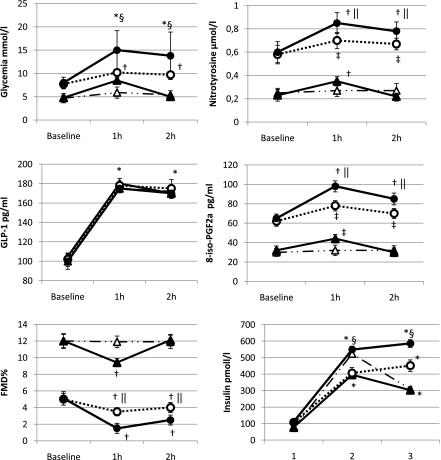
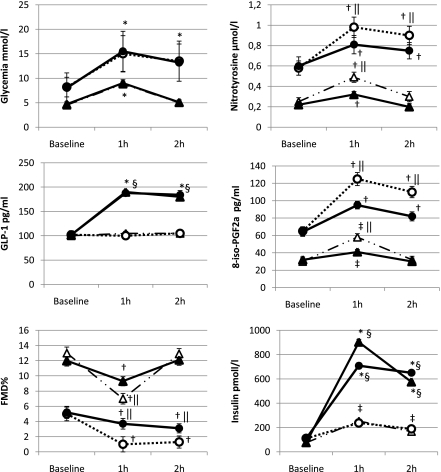
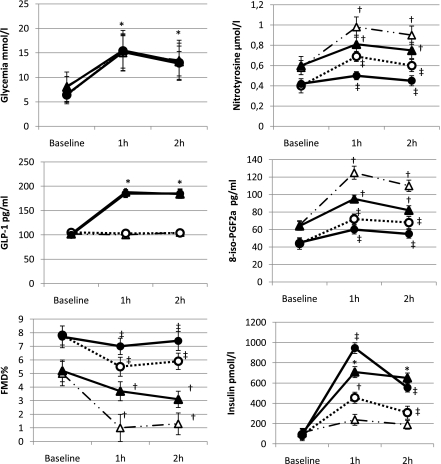
OBJECTIVE: Glucagon-like peptide 1 (GLP-1) stimulates insulin secretion. However, GLP-1 also improves endothelial function in diabetes. RESEARCH DESIGN AND METHODS: Sixteen type 2 diabetic patients and 12 control subjects received a meal, an oral glucose tolerance test (OGTT), and two hyperglycemic clamps, with or without GLP-1. The clamps were repeated in diabetic patients after 2 months of strict glycemic control. RESULTS: During the meal, glycemia, nitrotyrosine, and plasma 8-iso prostaglandin F2α (8-iso-PGF2a) remained unchanged in the control subjects, whereas they increased in diabetic patients. Flow-mediated vasodilation (FMD) decreased in diabetes, whereas GLP-1 increased in both groups. During the OGTT, an increase in glycemia, nitrotyrosine, and 8-iso-PGF2a and a decrease in FMD were observed at 1 h in the control subjects and at 1 and 2 h in the diabetic patients. In the same way, GLP-1 increased in both groups at the same levels of the meal. During the clamps, in both the control subjects and the diabetic patients, a significant increase in nitrotyrosine and 8-iso-PGF2a and a decrease in FMD were observed, effects that were significantly reduced by GLP-1. After improved glycemic control, hyperglycemia during the clamps was less effective in producing oxidative stress and endothelial dysfunction and the GLP-1 administration was most effective in reducing these effects. CONCLUSIONS: Our data suggest that during the meal GLP-1 can simultaneously exert an incretin effect on insulin secretion and a protective effect on endothelial function, reasonably controlling oxidative stress generation. The ability of GLP-1 in protecting endothelial function seems to depend on the level of glycemia, a phenomenon already described for insulin secretion.
Overview
The claims and statistics of this paper haven’t been checked yet.
Free: it reads the open-access text and checks the first 5 claims that cite a source we can check. Create a free account to check every claim.
Integrity signals
Registry
Cites
Statistics
Figures
Verification
Claims the paper makes
The claims and statistics of this paper haven’t been checked yet.
Free: it reads the open-access text and checks the first 5 claims that cite a source we can check. Create a free account to check every claim.
Claims other papers make about this one
Each is checked against this paper’s own text: does it say what the citing paper says it does?
The source backs part of the claim, not all of it — or backs it for a different population, condition or comparison.
In the citing paper
“Human studies provide conflicting information about the effect of GLP-1 or stable analogues on endothelial function.212-217”
From The Vasculature in Prediabetes (2018) · cites this paper as [216]
Experimental — accuracy not yet measured
Self-check
Percentages, sums and reported differences re-computed from the paper’s own numbers.
The self-check needs the paper’s full text.
Citations
Cites
The pathogenesis of atherosclerosis: a perspective for the 1990s
Ross, R. (1993) · Nature · doi:10.1038/362801a0 · Cited by 10,630 · cited 1×
“The response-to-injury hypothesis of atherosclerosis states that the initial damage affects the arterial endothelium, leading to endothelial dysfunction (3).”
BackgroundGlucose clamp technique: a method for quantifying insulin secretion and resistance.
DeFronzo, R. A., Tobin, J. D., & Andres, R. (1979) · American Journal of Physiology-Endocrinology and Metabolism · doi:10.1152/ajpendo.1979.237.3.e214 · Cited by 7,425 · cited 1×
“These tests were followed in a randomized order and on different days by two hyperglycemic clamps (11) with or without GLP-1.”
MethodCorretti, M. C., Anderson, T. J., Benjamin, E. J., Celermajer, D., Charbonneau, F., Creager, M. A., Deanfield, J., Drexler, H., Gerhard-Herman, M., Herrington, D., et al. (2002) · Journal of the American College of Cardiology · doi:10.1016/s0735-1097(01)01746-6 · Cited by 4,604
Atherogenesis: a postprandial phenomenon.
Zilversmit, D. B. (1979) · Circulation · doi:10.1161/01.cir.60.3.473 · Cited by 1,701 · cited 1×
“As pointed out by Zilversmit (8) many years ago, atherosclerosis could be considered to be a prandial phenomenon.”
BackgroundNauck, M. A., Heimesaat, M. M., Orskov, C., Holst, J. J., Ebert, R., & Creutzfeldt, W. (1993) · Journal of Clinical Investigation · doi:10.1172/jci116186 · Cited by 1,651
Postprandial Hyperglycemia and Diabetes Complications
Ceriello, A. (2005) · Diabetes · doi:10.2337/diabetes.54.1.1 · Cited by 945
Self-citationNyström, T., Gutniak, M. K., Zhang, Q., Zhang, F., Holst, J. J., Ahrén, B., & Sjöholm, Å. (2004) · American Journal of Physiology-Endocrinology and Metabolism · doi:10.1152/ajpendo.00237.2004 · Cited by 680 · cited 3×
“GLP-1 also improves endothelial dysfunction in diabetes (7).”
BackgroundMethodInfluentialKawano, H., Motoyama, T., Hirashima, O., Hirai, N., Miyao, Y., Sakamoto, T., Kugiyama, K., Ogawa, H., & Yasue, H. (1999) · Journal of the American College of Cardiology · doi:10.1016/s0735-1097(99)00168-0 · Cited by 676 · cited 1×
“However, at 1 h, during the OGTT, as already reported (15), when hyperglycemia appears, endothelial function and oxidative stress also appear.”
BackgroundMinireview: The Glucagon-Like Peptides
Drucker, D. J. (2001) · Endocrinology · doi:10.1210/en.142.2.521 · Cited by 421
Detection of nitrotyrosine in the diabetic plasma: evidence of oxidative stress
Mercuri, F., Tonutti, L., Taboga, C., Ceriello, A., Assaloni, R., Motz, E., & Quagliaro, L. (2001) · Diabetologia · doi:10.1007/s001250100529 · Cited by 419 · cited 3×
“Nitrotyrosine plasma concentration was assayed by enzyme-linked immunosorbent assay, recently validated by our laboratory (13).”
MethodSelf-citation
Cited by
Chatterjee, S., Khunti, K., & Davies, M. J. (2017) · The Lancet · doi:10.1016/s0140-6736(17)30058-2 · Cited by 2,577
Glucagon-like peptide 1 (GLP-1)
Müller, T. D., Finan, B., Bloom, S. R., D'Alessio, D., Drucker, D. J., Flatt, P. R., Fritsche, A., Gribble, F., Grill, H. J., Habener, J. F., et al. (2019) · Molecular Metabolism · doi:10.1016/j.molmet.2019.09.010 · Cited by 1,868
Cardiovascular Biology of the Incretin System
Ussher, J. R., & Drucker, D. J. (2012) · Endocrine Reviews · doi:10.1210/er.2011-1052 · Cited by 530
“Stromal cell-derived factor-1 (SDF-1 ) SDF-1 is a 7.97-kDa chemokine secreted from multiple cell types that promotes homing of endothelial pro- Figure 5. genitor cells to sites of cellular injury.”
BackgroundInfluentialRöhrborn, D. (2015) · Frontiers in Immunology · doi:10.3389/fimmu.2015.00386 · Cited by 440
“Accordingly, in humans, preliminary data confirm the ability of GLP-1 to protect from high glucose-induced endothelial dysfunction in the post-meal phase (194).”
BackgroundMartín-Peláez, S., Fito, M., & Castaner, O. (2020) · Nutrients · doi:10.3390/nu12082236 · Cited by 330
“It has been suggested that hyperglycemia induces GLP-1 resistance, mainly through the generation of oxidative stress [79].”
Background
Metadata
- Authors
- Ceriello, A., Esposito, K., Testa, R., Bonfigli, A. R., Marra, M., & Giugliano, D.
- Affiliations
- Consorci Institut D'Investigacions Biomediques August Pi I Sunyer (ES)
- University of Campania "Luigi Vanvitelli" (IT)
- Istituto Nazionale di Riposo e Cura per Anziani (IT)
- Corresponding author
- Ceriello, Antonio
- ORCID
- Venue
- Diabetes Care
- Publisher
- American Diabetes Association
- Published
- 2011-02-17
- Volume
- 34
- Issue
- 3
- Pages
- 697-702
- ISSN
- 0149-5992 (ISSN-L)
- 1935-5548
- PMC
- PMC3041210
- OpenAlex
- W2114481251
- Cited by
- 134
- References
- 21
- Citations by year
- 2026: 2 · 2025: 4 · 2024: 6 · 2023: 4 · 2022: 3 · 2021: 10 · 2020: 6 · 2019: 10 · 2018: 3 · 2017: 12 · 2016: 10 · 2015: 16 · 2014: 20 · 2013: 14 · 2012: 8
- FWCI
- 12.32
- Type
- journal article
- Language
- en
- Open access
- hybrid
- doi.org
- Licence
- Locations
- Diabetes Care (publishedVersion, cc-by-nc-nd)
- Europe PMC (PubMed Central) (publishedVersion, cc-by-nc-nd)
- PubMed Central (publishedVersion, cc-by-nc-nd)
- PubMed (publishedVersion)
- Archivio Istituzionale della Ricerca - Università degli Studi della Campania "Luigi Vanvitelli" (submittedVersion)
- Topics
- Health Sciences › Medicine › Endocrinology, Diabetes and Metabolism › Diabetes Treatment and Management
- Health Sciences › Medicine › Physiology (medical) › Nitric Oxide and Endothelin Effects
- Health Sciences › Medicine › Endocrinology, Diabetes and Metabolism › Diabetes, Cardiovascular Risks, and Lipoproteins
- Keywords
- glucagon-like peptide-1, endothelial function, endothelial dysfunction, type 2 diabetes, oxidative stress, nitrotyrosine, 8-isoprostane, flow-mediated dilation, hyperglycemia, glycemic control, incretin effect, insulin secretion
- MeSH terms
- Diabetes Mellitus, Endothelium, Vascular, Female, Glucose Tolerance Test, Humans, Male, Middle Aged, Tyrosine, Vasodilation, Glucagon-Like Peptide 1
About these checks
Registry, retraction, Cites and statistics results are computed, not judged, with one exception: a printed reference that no index lists is read once by a model before it counts as a citation error. Claims are extracted by a model and kept only when their quote appears verbatim in the text; each cited source is then checked, with a model’s help, for whether it says what the claim relies on. Those verdicts can be wrong — read the claim’s quote and the cited source before relying on one.
Statistics and arithmetic are recomputed, not judged.
Confidence bands are shown only for fields calibrated on our annotated test set. None is calibrated yet, so no band is shown.
What counts as a claim ›How we measure confidence ›How we check this ›
Are you an author, or do you see a problem with this page? Request a review
Data sources
Bibliographic data: Semantic Scholar, OpenAlex, Crossref.
Contains information from the Semantic Scholar Academic Graph Datasets, made available under the ODC Attribution License (ODC-BY 1.0).
Semantic Scholar’s data is described in: Kinney, R., et al. (2023). The Semantic Scholar Open Data Platform. arXiv:2301.10140.
