

The Possible Protective Role of Glucagon-Like Peptide 1 on Endothelium During the Meal and Evidence for an “Endothelial Resistance” to Glucagon-Like Peptide 1 in Diabetes
Open accessThe DOI matches its Crossref record; 21 of the 21 references it cites were found in a registry or an index.
Abstract
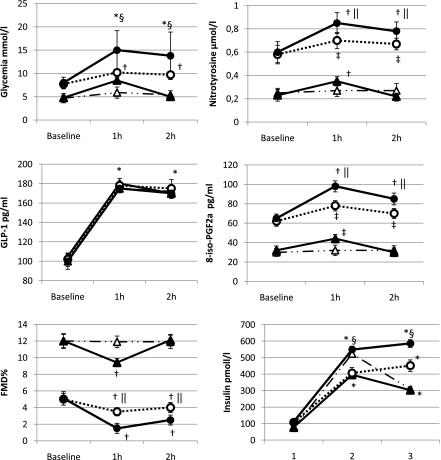
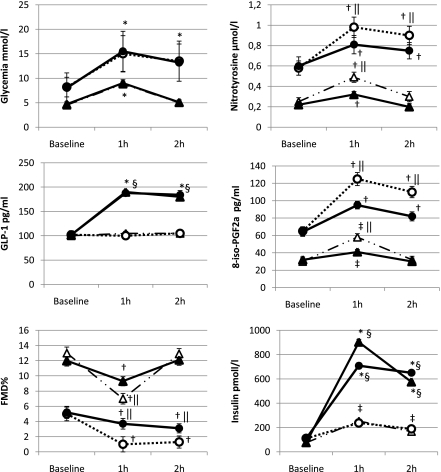
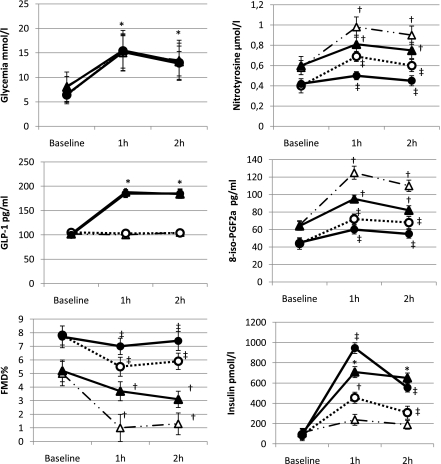
OBJECTIVE: Glucagon-like peptide 1 (GLP-1) stimulates insulin secretion. However, GLP-1 also improves endothelial function in diabetes. RESEARCH DESIGN AND METHODS: Sixteen type 2 diabetic patients and 12 control subjects received a meal, an oral glucose tolerance test (OGTT), and two hyperglycemic clamps, with or without GLP-1. The clamps were repeated in diabetic patients after 2 months of strict glycemic control. RESULTS: During the meal, glycemia, nitrotyrosine, and plasma 8-iso prostaglandin F2α (8-iso-PGF2a) remained unchanged in the control subjects, whereas they increased in diabetic patients. Flow-mediated vasodilation (FMD) decreased in diabetes, whereas GLP-1 increased in both groups. During the OGTT, an increase in glycemia, nitrotyrosine, and 8-iso-PGF2a and a decrease in FMD were observed at 1 h in the control subjects and at 1 and 2 h in the diabetic patients. In the same way, GLP-1 increased in both groups at the same levels of the meal. During the clamps, in both the control subjects and the diabetic patients, a significant increase in nitrotyrosine and 8-iso-PGF2a and a decrease in FMD were observed, effects that were significantly reduced by GLP-1. After improved glycemic control, hyperglycemia during the clamps was less effective in producing oxidative stress and endothelial dysfunction and the GLP-1 administration was most effective in reducing these effects. CONCLUSIONS: Our data suggest that during the meal GLP-1 can simultaneously exert an incretin effect on insulin secretion and a protective effect on endothelial function, reasonably controlling oxidative stress generation. The ability of GLP-1 in protecting endothelial function seems to depend on the level of glycemia, a phenomenon already described for insulin secretion.
Overview
The claims and statistics of this paper haven’t been checked yet.
Free: it reads the open-access text and checks the first 5 claims that cite a source we can check. Create a free account to check every claim.
Integrity signals
Registry
Cites
Statistics
Figures
Verification
Claims the paper makes
The claims and statistics of this paper haven’t been checked yet.
Free: it reads the open-access text and checks the first 5 claims that cite a source we can check. Create a free account to check every claim.
Claims other papers make about this one
Each is checked against this paper’s own text: does it say what the citing paper says it does?
The source backs part of the claim, not all of it — or backs it for a different population, condition or comparison.
In the citing paper
“Human studies provide conflicting information about the effect of GLP-1 or stable analogues on endothelial function.212-217”
From The Vasculature in Prediabetes (2018) · cites this paper as [216]
Experimental — accuracy not yet measured
Self-check
Percentages, sums and reported differences re-computed from the paper’s own numbers.
The self-check needs the paper’s full text.
Citations
Cites
The pathogenesis of atherosclerosis: a perspective for the 1990s
Ross, R. (1993) · Nature · doi:10.1038/362801a0 · Cited by 10,630 · cited 1×
“The response-to-injury hypothesis of atherosclerosis states that the initial damage affects the arterial endothelium, leading to endothelial dysfunction (3).”
BackgroundGlucose clamp technique: a method for quantifying insulin secretion and resistance.
DeFronzo, R. A., Tobin, J. D., & Andres, R. (1979) · American Journal of Physiology-Endocrinology and Metabolism · doi:10.1152/ajpendo.1979.237.3.e214 · Cited by 7,425 · cited 1×
“These tests were followed in a randomized order and on different days by two hyperglycemic clamps (11) with or without GLP-1.”
MethodCorretti, M. C., Anderson, T. J., Benjamin, E. J., Celermajer, D., Charbonneau, F., Creager, M. A., Deanfield, J., Drexler, H., Gerhard-Herman, M., Herrington, D., et al. (2002) · Journal of the American College of Cardiology · doi:10.1016/s0735-1097(01)01746-6 · Cited by 4,604
Atherogenesis: a postprandial phenomenon.
Zilversmit, D. B. (1979) · Circulation · doi:10.1161/01.cir.60.3.473 · Cited by 1,701 · cited 1×
“As pointed out by Zilversmit (8) many years ago, atherosclerosis could be considered to be a prandial phenomenon.”
BackgroundNauck, M. A., Heimesaat, M. M., Orskov, C., Holst, J. J., Ebert, R., & Creutzfeldt, W. (1993) · Journal of Clinical Investigation · doi:10.1172/jci116186 · Cited by 1,651
Postprandial Hyperglycemia and Diabetes Complications
Ceriello, A. (2005) · Diabetes · doi:10.2337/diabetes.54.1.1 · Cited by 945
Self-citationNyström, T., Gutniak, M. K., Zhang, Q., Zhang, F., Holst, J. J., Ahrén, B., & Sjöholm, Å. (2004) · American Journal of Physiology-Endocrinology and Metabolism · doi:10.1152/ajpendo.00237.2004 · Cited by 680 · cited 3×
“GLP-1 also improves endothelial dysfunction in diabetes (7).”
BackgroundMethodInfluentialKawano, H., Motoyama, T., Hirashima, O., Hirai, N., Miyao, Y., Sakamoto, T., Kugiyama, K., Ogawa, H., & Yasue, H. (1999) · Journal of the American College of Cardiology · doi:10.1016/s0735-1097(99)00168-0 · Cited by 676 · cited 1×
“However, at 1 h, during the OGTT, as already reported (15), when hyperglycemia appears, endothelial function and oxidative stress also appear.”
BackgroundMinireview: The Glucagon-Like Peptides
Drucker, D. J. (2001) · Endocrinology · doi:10.1210/en.142.2.521 · Cited by 421
Detection of nitrotyrosine in the diabetic plasma: evidence of oxidative stress
Mercuri, F., Tonutti, L., Taboga, C., Ceriello, A., Assaloni, R., Motz, E., & Quagliaro, L. (2001) · Diabetologia · doi:10.1007/s001250100529 · Cited by 419 · cited 3×
“Nitrotyrosine plasma concentration was assayed by enzyme-linked immunosorbent assay, recently validated by our laboratory (13).”
MethodSelf-citation
Cited by
Chatterjee, S., Khunti, K., & Davies, M. J. (2017) · The Lancet · doi:10.1016/s0140-6736(17)30058-2 · Cited by 2,577
Glucagon-like peptide 1 (GLP-1)
Müller, T. D., Finan, B., Bloom, S. R., D'Alessio, D., Drucker, D. J., Flatt, P. R., Fritsche, A., Gribble, F., Grill, H. J., Habener, J. F., et al. (2019) · Molecular Metabolism · doi:10.1016/j.molmet.2019.09.010 · Cited by 1,868
Cardiovascular Biology of the Incretin System
Ussher, J. R., & Drucker, D. J. (2012) · Endocrine Reviews · doi:10.1210/er.2011-1052 · Cited by 530
“Stromal cell-derived factor-1 (SDF-1 ) SDF-1 is a 7.97-kDa chemokine secreted from multiple cell types that promotes homing of endothelial pro- Figure 5. genitor cells to sites of cellular injury.”
BackgroundInfluentialRöhrborn, D. (2015) · Frontiers in Immunology · doi:10.3389/fimmu.2015.00386 · Cited by 440
“Accordingly, in humans, preliminary data confirm the ability of GLP-1 to protect from high glucose-induced endothelial dysfunction in the post-meal phase (194).”
BackgroundMartín-Peláez, S., Fito, M., & Castaner, O. (2020) · Nutrients · doi:10.3390/nu12082236 · Cited by 330
“It has been suggested that hyperglycemia induces GLP-1 resistance, mainly through the generation of oxidative stress [79].”
BackgroundShiraki, A., Oyama, J.-I., Komoda, H., Asaka, M., Komatsu, A., Sakuma, M., Kodama, K., Sakamoto, Y., Kotooka, N., Hirase, T., et al. (2012) · Atherosclerosis · doi:10.1016/j.atherosclerosis.2011.12.039 · Cited by 263
Effects of Glucagon-Like Peptide-1 on Oxidative Stress and Nrf2 Signaling
Oh, Y., & Jun, H.-S. (2017) · International Journal of Molecular Sciences · doi:10.3390/ijms19010026 · Cited by 217
“4 pmol/kg/min) for 2 h reduced 8-iso-prostaglandin F2α (8-iso-PGF2α) and nitrotyrosine (oxidative stress markers) in plasma during a hypoglycemia or hyperglycemia clamp in both type 1 and type 2 diabetic patients [108,109].”
BackgroundCardiovascular effects of DPP-4 inhibition: Beyond GLP-1
Fadini, G. P., & Avogaro, A. (2011) · Vascular Pharmacology · doi:10.1016/j.vph.2011.05.001 · Cited by 213
Ceriello, A., Novials, A., Ortega, E., Canivell, S., La Sala, L., Pujadas, G., Esposito, K., Giugliano, D., & Genovese, S. (2013) · Diabetes Care · doi:10.2337/dc12-2469 · Cited by 204
“Furthermore, studies are accumulating showing that GLP-1 and its analogs used in clinical practice have antioxidant activity (10,15,16).”
BackgroundMethodInfluentialSelf-citationMarsico, F., Paolillo, S., Gargiulo, P., Bruzzese, D., Dell’Aversana, S., Esposito, I., Renga, F., Esposito, L., Marciano, C., Dellegrottaglie, S., et al. (2020) · European Heart Journal · doi:10.1093/eurheartj/ehaa082 · Cited by 191
Krasner, N. M., Ido, Y., Ruderman, N. B., & Cacicedo, J. M. (2014) · PLoS ONE · doi:10.1371/journal.pone.0097554 · Cited by 186
“Likewise, two smaller prospective studies have suggested that GLP-1 mimetics diminish endothelial dysfunction [15,16].”
BackgroundCardiovascular effects of gliptins
Scheen, A. J. (2013) · Nature Reviews Cardiology · doi:10.1038/nrcardio.2012.183 · Cited by 175
Koska, J., Sands, M., Burciu, C., D’Souza, K. M., Raravikar, K., Liu, J., Truran, S., Franco, D. A., Schwartz, E. A., Schwenke, D. C., et al. (2015) · Diabetes · doi:10.2337/db14-0976 · Cited by 174
“Exenatide’s protection against high glucose–induced impairment of EF concurs with a previously reported effect of GLP-1 during in vivo hyperglycemia (21).”
Cardiovascular effects of Glucagon-like peptide 1 (GLP-1) receptor agonists
Saraiva, F. K., & Sposito, A. C. (2014) · Cardiovascular Diabetology · doi:10.1186/s12933-014-0142-7 · Cited by 143
“They assumed that improvements in endothelial function with GLP-1R agonists might be limited to the postprandial setting, particularly following the consumption of a high-fat meal [60].”
BackgroundInfluentialThe Vasculature in Prediabetes
Wasserman, D. H., Wang, T. J., & Brown, N. J. (2018) · Circulation Research · doi:10.1161/circresaha.118.311912 · Cited by 137
Andreadi, A., Bellia, A., Daniele, N. D., Meloni, M., Lauro, R., Della‐Morte, D., & Lauro, D. (2021) · Current Opinion in Pharmacology · doi:10.1016/j.coph.2021.11.010 · Cited by 147
Ayaori, M., Iwakami, N., Uto‐Kondo, H., Sato, H., Sasaki, M., Komatsu, T., Iizuka, M., Takiguchi, S., Yakushiji, E., Nakaya, K., et al. (2013) · Journal of the American Heart Association · doi:10.1161/jaha.112.003277 · Cited by 125
“It was also observed that both GLP-1(7-36) and GLP-1(9-36) resulted in relaxation responses of the mesenteric artery in mice lacking GLP-1R,(10) indicating that inactive GLP-1(9-36), and GLP-1(7-36) also promote arterial relaxation via GLP-1Rindependent pathways.”
BackgroundMethodInfluentialPostprandial hyperlipidemia, endothelial dysfunction and cardiovascular risk: focus on incretins
Ansar, S., Koska, J., & Reaven, P. D. (2011) · Cardiovascular Diabetology · doi:10.1186/1475-2840-10-61 · Cited by 112
Loader, J., Montero, D., Lorenzen, C. H., Watts, R., Méziat, C., Reboul, C., Stewart, S., & Walther, G. (2015) · Arteriosclerosis Thrombosis and Vascular Biology · doi:10.1161/atvbaha.115.305530 · Cited by 122
Rizzo, M., Chandalia, M., Patti, A. M., Di Bartolo, V., Rizvi, A. A., Montalto, G., & Abate, N. (2014) · Cardiovascular Diabetology · doi:10.1186/1475-2840-13-49 · Cited by 107
Kanie, T., Mizuno, A., Takaoka, Y., Suzuki, T., Yoneoka, D., Nishikawa, Y., Tam, W. W. S., Morze, J., Rynkiewicz, A., Xin, Y., et al. (2021) · Cochrane Database of Systematic Reviews · doi:10.1002/14651858.cd013650.pub2 · Cited by 127
Shi, L., Ji, Y., Jiang, X., Zhou, L., Xu, Y., Li, Y., Jiang, W., Meng, P., & Liu, X. (2015) · Cardiovascular Diabetology · doi:10.1186/s12933-015-0177-4 · Cited by 91
“GLP-1 also has multiple therapeutic effects on the cardiovascular system, improving cardiac function and exerting direct protective effects on cardiomyocytes [29-31], endothelial cells [32,33], macrophages [34-36], and VSMCs [37].”
BackgroundCeriello, A., Esposito, K., La Sala, L., Pujadas, G., De Nigris, V., Testa, R., Bucciarelli, L., Rondinelli, M., & Genovese, S. (2014) · Cardiovascular Diabetology · doi:10.1186/preaccept-9637501721433331 · Cited by 82
“Several studies confirm that acute hyperglycemia works by generating oxidative stress [2,10,28-30].”
BackgroundMethodSelf-citationCardiovascular Effects of Dipeptidyl Peptidase-4 Inhibitors: From Risk Factors to Clinical Outcomes
Scheen, A. J. (2013) · Postgraduate Medicine · doi:10.3810/pgm.2013.05.2659 · Cited by 82
GLP‐1 Receptor Agonists: Effects on Cardiovascular Risk Reduction
Lorber, D. (2013) · Cardiovascular Therapeutics · doi:10.1111/1755-5922.12000 · Cited by 77
Ceriello, A., Novials, A., Canivell, S., La Sala, L., Pujadas, G., Esposito, K., Testa, R., Bucciarelli, L., Rondinelli, M., & Genovese, S. (2014) · Diabetes Care · doi:10.2337/dc13-2618 · Cited by 78
“increasing the antioxidant defenses of the endothelium (8) and decreasing oxidative stress generation (6,7).”
BackgroundMethodSelf-citationLiraglutide improves cardiac function in patients with type 2 diabetes and chronic heart failure
Arturi, F., Succurro, E., Miceli, S., Cloro, C., Ruffo, M., Maio, R., Perticone, M., Sesti, G., & Perticone, F. (2016) · Endocrine · doi:10.1007/s12020-016-1166-4 · Cited by 79
Song, X., Jia, H., Jiang, Y., Wang, L., Zhang, Y., Mu, Y., & Liu, Y. (2015) · Scientific Reports · doi:10.1038/srep10202 · Cited by 76
Forst, T., Michelson, G., Ratter, F., Weber, M. M., Anders, S., Mitry, M., Wilhelm, B., & Pfützner, A. (2012) · Diabetic Medicine · doi:10.1111/j.1464-5491.2012.03589.x · Cited by 75
Zhong, J., Gong, Q., Goud, A., Srinivasamaharaj, S., & Rajagopalan, S. (2015) · Journal of Diabetes Research · doi:10.1155/2015/606031 · Cited by 72
“For example, it has been shown that acute infusion of GLP-1 improves endothelial dysfunction in patients with T2DM [85, 86] .”
BackgroundIrace, C., De Luca, S., Shehaj, E., Carallo, C., Loprete, A., Scavelli, F., & Gnasso, A. (2013) · Diabetes and Vascular Disease Research · doi:10.1177/1479164112449562 · Cited by 72
Taktaz, F., Fontanella, R. A., Scisciola, L., Pesapane, A., Basilicata, M. G., Ghosh, P., Franzese, M., Tortorella, G., Puocci, A., Vietri, M. T., et al. (2024) · Cardiovascular Diabetology · doi:10.1186/s12933-024-02319-7 · Cited by 74
“In a study comprising 16 patients with T2DM and 12 non-diabetic controls, flow-mediated vasodilation was enhanced in both groups by GLP1 infusion of 0.4 pmol/kg/min, administered during a 2-hour hyperglycemic clamp [106].”
MethodInfluentialDPP-4 inhibitors: pharmacological differences and their clinical implications
Ceriello, A., Sportiello, L., Rafaniello, C., & Rossi, F. (2014) · Expert Opinion on Drug Safety · doi:10.1517/14740338.2014.944862 · Cited by 76
“In fact, in condition of hyperglycemia, the endothelium seems to become less sensitive to GLP-1 [49].”
BackgroundSelf-citationPujadas, G., Nigris, V. D., Prattichizzo, F., Sala, L. L., Testa, R., & Ceriello, A. (2016) · Endocrine · doi:10.1007/s12020-016-1052-0 · Cited by 71
Self-citationVascular Biology of Glucagon Receptor Superfamily Peptides: Mechanistic and Clinical Relevance
Pujadas, G., & Drucker, D. J. (2016) · Endocrine Reviews · doi:10.1210/er.2016-1078 · Cited by 65
“were reduced, and FMD was significantly improved (110).”
BackgroundInfluentialCardiovascular safety of anti-diabetic drugs
Kumar, R. B., Kerins, D. M., & Walther, T. (2015) · European Heart Journal - Cardiovascular Pharmacotherapy · doi:10.1093/ehjcvp/pvv035 · Cited by 72
Ceriello, A., Novials, A., Ortega, E., Canivell, S., La Sala, L., Pujadas, G., Bucciarelli, L., Rondinelli, M., & Genovese, S. (2013) · Diabetes Care · doi:10.2337/dc13-0750 · Cited by 65
“resistance to the action of GLP-1, oxidative stress being the mediator of such a phenomenon (11).”
BackgroundResultInfluentialSelf-citationDietary Fat Modulation of Gut Microbiota and Impact on Regulatory Pathways Controlling Food Intake
Hamamah, S., Amin, A., Al-Kassir, A. L., Chuang, J., & Covașă, M. (2023) · Nutrients · doi:10.3390/nu15153365 · Cited by 65
Vergès, B., Bonnard, C., & Renard, E. (2011) · Diabetes & Metabolism · doi:10.1016/j.diabet.2011.07.001 · Cited by 58
Marrano, N., Biondi, G., Borrelli, A., Cignarelli, A., Perrini, S., Laviola, L., Giorgino, F., & Natalicchio, A. (2021) · Biomolecules · doi:10.3390/biom11020286 · Cited by 56
Liu, Y. (2014) · World Journal of Gastroenterology · doi:10.3748/wjg.v20.i27.9090 · Cited by 49
Belinova, L., Kahleova, H., Malinska, H., Topolcan, O., Vrzalova, J., Oliyarnyk, O., Kazdova, L., Hill, M., & Pelikanova, T. (2014) · PLoS ONE · doi:10.1371/journal.pone.0107561 · Cited by 48
“patients suffering from diabetes [49].”
Antidiabetic Agents and Endothelial Dysfunction – Beyond Glucose Control
Eriksson, L., & Nyström, T. (2015) · Basic & Clinical Pharmacology & Toxicology · doi:10.1111/bcpt.12402 · Cited by 52
van Genugten, R. E., Möller‐Goede, D. L., van Raalte, D. H., & Diamant, M. (2013) · Diabetes, Obesity and Metabolism · doi:10.1111/dom.12050 · Cited by 46
“GLP-1 infusion was able to protect from hyperglycaemia-related endothelial dysfunction in patients with T2DM, and this effect persisted after 2 months intensive insulin therapy [138].”
BackgroundSavarese, G., Butler, J., Lund, L. H., Bhatt, D. L., & Anker, S. D. (2021) · Cardiovascular Research · doi:10.1093/cvr/cvab271 · Cited by 48
Direct cardiovascular effects of glucagon like peptide-1
Sheikh, A. (2013) · Diabetology & Metabolic Syndrome · doi:10.1186/1758-5996-5-47 · Cited by 45
Forst, T., Weber, M. M., & Pfützner, A. (2012) · Experimental Diabetes Research · doi:10.1155/2012/635472 · Cited by 44
Urkon, M., Ferencz, E., Szász, J. A., Szabó, M. I. M., Orbán-Kis, K., Szatmári, S., & Nagy, E. E. (2025) · Pharmaceuticals · doi:10.3390/ph18050614 · Cited by 45
“Improvement of endothelial dysfunction followed by flow-mediated dilation was described in T2DM patients [62,119].”
Herzlinger, S., & Horton, E. S. (2013) · Diabetes Research and Clinical Practice · doi:10.1016/j.diabres.2012.11.009 · Cited by 46
Skrobucha, A., Pindlowski, P., Krajewska, N., Grabowski, M., & Jonik, S. (2024) · Frontiers in Cardiovascular Medicine · doi:10.3389/fcvm.2024.1446468 · Cited by 42
GLP-1 Agonists in Cardiovascular Diseases: Mechanisms, Clinical Evidence, and Emerging Therapies
Yang, H. (2025) · Journal of Clinical Medicine · doi:10.3390/jcm14196758 · Cited by 46
“GLP-1 agonists reduce mitochondrial reactive oxygen species (ROS) production by preserving mitochondrial membrane potential and enhancing the efficiency of the electron transport chain [33].”
The vascular endothelium in diabetes—a therapeutic target?
Mather, K. J. (2013) · Reviews in Endocrine and Metabolic Disorders · doi:10.1007/s11154-013-9237-9 · Cited by 45
Ceriello, A., Nigris, V. D., Iijima, H., Matsui, T., & Gouda, M. (2019) · Drugs · doi:10.1007/s40265-019-01086-0 · Cited by 43
“GLP-1 has a vascular protective effect, which enhances the antioxidative pathway; however, hyperglycemia reduces its positive effect, a phenomenon known as ‘GLP-1 endothelial resistance’ [62].”
BackgroundSelf-citationRecent Pharmacological Options in Type 2 Diabetes and Synergic Mechanism in Cardiovascular Disease
Andreadi, A., Muscoli, S., Tajmir, R., Meloni, M., Muscoli, C., Ilari, S., Mollace, V., Della‐Morte, D., Bellia, A., Daniele, N. D., et al. (2023) · International Journal of Molecular Sciences · doi:10.3390/ijms24021646 · Cited by 39
“4 pmol/kg/min—2 h) reduced blood concentrations of 8-iso-PGF2 and nitrotyrosine in T1D and T2D patients [72].”
BackgroundDoes drug therapy reverse endothelial progenitor cell dysfunction in diabetes?
Desouza, C. V. (2013) · Journal of Diabetes and its Complications · doi:10.1016/j.jdiacomp.2013.04.007 · Cited by 36
Jordan, J., Nilsson, P. M., Kotsis, V., Olsen, M. H., Grassi, G. M., Yumuk, V., Hauner, H., Zahorska‐Markiewicz, B., Toplak, H., Engeli, S., et al. (2015) · Journal of Hypertension · doi:10.1097/hjh.0000000000000473 · Cited by 36
Devin, J. K., Pretorius, M., Nian, H., Yu, C., Billings, F. T., & Brown, N. J. (2014) · Journal of the American Heart Association · doi:10.1161/jaha.114.001075 · Cited by 36
“GLP-1(9-36), which promotes endothelium-dependent vasodilation independent of the GLP-1 receptor.”
BackgroundMethodInfluentialPetersen, K. E., Rakipovski, G., Raun, K., & Lykkesfeldt, J. (2016) · Current Diabetes Reviews · doi:10.2174/1573399812666150918150608 · Cited by 38
Kanie, T., Mizuno, A., Yoneoka, D., Tam, W., Morze, J., Rynkiewicz, A., Xin, Y., Wu, O., & Kwong, J. S. (2020) · Cochrane Database of Systematic Reviews · doi:10.1002/14651858.cd013650 · Cited by 34
Rizzo, M., Nikolić, D., Banach, M., Giglio, R. V., Patti, A. M., Bartolo, V. D., Tamburello, A., Zabbara, A., Pecoraro, G., Montalto, G., et al. (2013) · Clinical Lipidology · doi:10.2217/clp.13.8 · Cited by 34
Jonik, S., Marchel, M., Grabowski, M., Opolski, G., & Mazurek, T. (2022) · Biology · doi:10.3390/biology11020288 · Cited by 33
“[81], both type 2 diabetic patients (n = 16) and healthy matched control subjects (n = 12) underwent the following studies: a standard meal and an oral glucose tolerance test (OGTT; 75 g glucose in 300 mL water) in randomized order on different days.”
MethodSmits, M. M., Tonneijck, L., Muskiet, M. H. A., Hoekstra, T., Kramer, M. H. H., Pieters, I. C., Cahen, D. L., Diamant, M., & van Raalte, D. H. (2015) · BMJ Open · doi:10.1136/bmjopen-2015-009579 · Cited by 30
Loader, J., Khouri, C., Taylor, F., Stewart, S., Lorenzen, C. H., Cracowski, J., Walther, G., & Roustit, M. (2019) · Obesity Reviews · doi:10.1111/obr.12831 · Cited by 36
Dokken, B. B., Piermarini, C. V., Teachey, M. K., Gura, M., Dameff, C. J., Heller, B., Krate, J., Asghar, A. M., Querin, L., Mitchell, J., et al. (2012) · American Journal of Physiology-Heart and Circulatory Physiology · doi:10.1152/ajpheart.00282.2012 · Cited by 31
Do incretins improve endothelial function?
Oyama, J., Higashi, Y., & Node, K. (2014) · Cardiovascular Diabetology · doi:10.1186/1475-2840-13-21 · Cited by 37
“On the other hand, nine studies previously reported that the endothelial function was improved by using GLP-1 and GLP-1-related drugs [37,41-48].”
BackgroundKim, G., Oh, S. W., Jin, S., Hur, K. Y., Kim, J. H., & Lee, M. (2017) · Expert Opinion on Pharmacotherapy · doi:10.1080/14656566.2017.1353080 · Cited by 35
Cardiovascular Actions of GLP-1 and Incretin-Based Pharmacotherapy
Avogaro, A., de Kreutzenberg, S. V., & Fadini, G. P. (2014) · Current Diabetes Reports · doi:10.1007/s11892-014-0483-3 · Cited by 31
Widlansky, M. E., Puppala, V. K., Suboc, T. M. B., Malik, M. A., Branum, A., Signorelli, K., Wang, J., Ying, R., Tanner, M. J., & Tyagi, S. (2017) · Vascular Medicine · doi:10.1177/1358863x16681486 · Cited by 30
Incretin Hormones: The Link between Glycemic Index and Cardiometabolic Diseases
Salvatore, T., Nevola, R., Pafundi, P. C., Monaco, L., Ricozzi, C., Imbriani, S., Rinaldi, L., & Sasso, F. C. (2019) · Nutrients · doi:10.3390/nu11081878 · Cited by 33
“Even if postprandial vasodilatation is mediated by insulin-induced release of nitric oxide [65], it has been demonstrated that GLP-1 per se has direct beneficial effects on endothelium-dependent vasodilatation, particularly in the postprandial state [66].”
BackgroundGLP-1R Agonists and Endothelial Dysfunction: More Than Just Glucose Lowering?
Lovshin, J. A., & Cherney, D. Z. I. (2015) · Diabetes · doi:10.2337/db15-0366 · Cited by 32
Cosenso‐Martin, L. N., Giollo-Júnior, L. T., Fernandes, L. A. B., Cesarino, C. B., Nakazone, M. A., Machado, M. D. N., Yugar‐Toledo, J. C., & Vilela-Martin, J. F. (2018) · Acta Diabetologica · doi:10.1007/s00592-018-1204-1 · Cited by 29
Gong, Q., Rajagopalan, S., & Zhong, J. (2015) · International Journal of Cardiology · doi:10.1016/j.ijcard.2015.06.076 · Cited by 32
“dysfunction in patients with type 2 diabetes [137,138].”
BackgroundZhao, L., Sun, T., & Wang, L. (2017) · Therapeutics and Clinical Risk Management · doi:10.2147/tcrm.s134039 · Cited by 27
Gargiulo, P., Savarese, G., D’Amore, C., Martino, F. D., Lund, L. H., Marsico, F., Dellegrottaglie, S., Marciano, C., Trimarco, B., & Filardi, P. P. (2017) · Nutrition Metabolism and Cardiovascular Diseases · doi:10.1016/j.numecd.2017.09.006 · Cited by 26
Yang, Z., Chen, S., Sun, W., Yang, Y., Xu, Y., Tang, Y., Jiang, W., Li, J., & Zhang, Y. (2024) · International Journal of Biological Macromolecules · doi:10.1016/j.ijbiomac.2024.132249 · Cited by 27
Clarke, S. J., McCormick, L. M., & Dutka, D. P. (2014) · Cardiovascular Diabetology · doi:10.1186/1475-2840-13-12 · Cited by 29
“GLP-1 has had beneficial effects on endothelial function in humans [75,76], and a study using a dose of 1.”
BackgroundTargeting One-Hour Postmeal Glucose: Is It Time for a Paradigm Switch in Diabetes Management?
Ceriello, A. (2017) · Diabetes Technology & Therapeutics · doi:10.1089/dia.2017.0135 · Cited by 28
“25,35,36 Finally, is also worth noting that short-term hyperglycemia impairs beta-cell function in vivo 37 and that the level of glycemia may worsen relative insulin secretion.”
Self-citationCeriello, A., Novials, A., Ortega, E., Canivell, S., Pujadas, G., Sala, L. L., Bucciarelli, L. G., Rondinelli, M., & Genovese, S. (2013) · Cardiovascular Diabetology · doi:10.1186/1475-2840-12-97 · Cited by 24
Self-citationHyperglycemic endothelial dysfunction: does it happen and does it matter?
Hoffman, R. P. (2015) · PubMed · doi:10.3978/j.issn.2072-1439.2015.10.24 · Cited by 24
Modulation of Diabetes by Natural Products and Medicinal Plants via Incretins
Ríos, J.-L., Andújar, I., Schinella, G. R., & Francini, F. (2019) · Planta Medica · doi:10.1055/a-0897-7492 · Cited by 21
Kim, G. S., Park, J. H., & Won, J. C. (2019) · Endocrinology and Metabolism · doi:10.3803/enm.2019.34.2.106 · Cited by 20
Malínská, H., Klementová, M., Kudláčková, M., Veleba, J., Hošková, E., Oliyarnyk, O., Marková, I., Thieme, L., Hill, M., Pelikánová, T., et al. (2021) · Nutrition & Metabolism · doi:10.1186/s12986-021-00609-5 · Cited by 20
“Abnormal postprandial elevations of plasma glucose and lipids in T2D are associated with oxidative stress, increased inflammation, hypercoagulation and impaired secretion of gastrointestinal hormones [4, 5].”
BackgroundPotential cardiovascular effects of incretin-based therapies
Deacon, C. F., & Marx, N. (2012) · Expert Review of Cardiovascular Therapy · doi:10.1586/erc.12.5 · Cited by 19
Wu, L., Liu, X., Wang, L.-X., Wang, Y., Wang, L., Guan, B., Chen, Z., & Liu, L. (2016) · Endocrine · doi:10.1007/s12020-016-1190-4 · Cited by 20
Liraglutide Improves Endothelial Function via the mTOR Signaling Pathway
Wu, H., Xiao, C., Zhao, Y., Yin, H., & Yu, M. (2021) · Journal of Diabetes Research · doi:10.1155/2021/2936667 · Cited by 18
Dietary therapy to halt the progression of diabetes to diabetic kidney disease
Hu, H., Ding, G., & Liang, W. (2025) · Food & Function · doi:10.1039/d4fo06011c · Cited by 19
Pujadas, G., Nigris, V. D., Sala, L. L., Testa, R., Genovese, S., & Ceriello, A. (2015) · Endocrine · doi:10.1007/s12020-015-0799-z · Cited by 17
“In agreement with previous findings [9, 15, 18], we observed that, in parallel, GLP-1r levels were reduced in cells cultured in HG (Fig.”
BackgroundResultSelf-citationThe potential of glucagon-like peptide-1 receptor agonists in heart failure
Kreiner, F. F., Hovingh, G. K., & von Scholten, B. J. (2022) · Frontiers in Physiology · doi:10.3389/fphys.2022.983961 · Cited by 17
“, 2021) and impaired vasodilation due to low nitrogen oxide bioavailability (Ceriello et al., 2011; Correale et al., 2021).”
BackgroundInfluentialCiuceis, C. D., Rosei, C. A., Rossini, C., Caletti, S., Coschignano, M. A., Ferrari‐Toninelli, G., Ragni, G., Cappelli, C., Cerudelli, B., Airó, P., et al. (2018) · High Blood Pressure & Cardiovascular Prevention · doi:10.1007/s40292-018-0279-7 · Cited by 17
Alharby, H., Abdelati, T., Rizk, M. M., Youssef, E. A., Gaber, N., Moghazy, K., & Yafei, S. (2019) · Diabetes & Metabolic Syndrome Clinical Research & Reviews · doi:10.1016/j.dsx.2019.01.031 · Cited by 16
Tricò, D., Nesti, L., Frascerra, S., Baldi, S., Mengozzi, A., & Natali, A. (2020) · Nutrients · doi:10.3390/nu12072053 · Cited by 15
“This gut hormone is released after a meal and has extra-glycemic positive effects on the cardiovascular system [14].”
BackgroundPotential cardioprotective action of GLP-1: from bench to bedside
Aronis, K. N., Tsoukas, M. A., & Mantzoros, C. S. (2014) · Metabolism · doi:10.1016/j.metabol.2014.05.009 · Cited by 15
Nigris, V. D., Prattichizzo, F., Mancuso, E., Spiga, R., Pujadas, G., & Ceriello, A. (2017) · Oncotarget · doi:10.18632/oncotarget.22849 · Cited by 13
“However, our group recently demonstrated that hyperglycemia induces “endothelial resistance” to the positive actions of GLP-1 [10].”
BackgroundSelf-citationAkbari, A., Hadizadeh, S., & Heidary, L. (2024) · Journal of Diabetes Research · doi:10.1155/2024/3212795 · Cited by 12
“Previous studies have shown that GLP-1 RA therapy lowers both systolic and diastolic blood pressure [71], improves endothelial dysfunction [72, 73], and reduces macrophage foam cell formation and atherosclerosis [74].”
BackgroundCardiovascular Outcome Trials of the Incretin-Based Therapies: What Do We Know So Far?
Mora, P. F., & Johnson, E. L. (2016) · Endocrine Practice · doi:10.4158/ep161481.ra · Cited by 12
Changes in meal composition and duration affect postprandial endothelial function in healthy humans
Thazhath, S. S., Wu, T., Bound, M. J., Checklin, H. L., Jones, K. L., Willoughby, S., Horowitz, M., & Rayner, C. K. (2014) · American Journal of Physiology-Gastrointestinal and Liver Physiology · doi:10.1152/ajpgi.00323.2014 · Cited by 15
NOGUCHI, K., Hirota, M., Miyoshi, T., Tani, Y., Noda, Y., Ito, H., & Nanba, S. (2014) · Experimental and Therapeutic Medicine · doi:10.3892/etm.2014.2051 · Cited by 12
“Clinical studies have demonstrated that GLP-1 analogs improve endothelial function in patients with type 2 diabetes (15-17).”
BackgroundProtective Role of Glucagon-Like Peptide-1 Against High-Glucose-Induced Endothelial Oxidative Damage
Guo, L., Qiao, Y., Zhang, L., & Pan, Q. (2015) · Medicine · doi:10.1097/md.0000000000002055 · Cited by 11
“D-glucose, GLP-1(7-36), MTT, and collagenase I were purchased from Sigma Aldrich (Shanghai, China).”
MethodTamura, H., Kondo, Y., Ito, K., Hasebe, M., Satoh, S., & Terauchi, Y. (2022) · PLoS ONE · doi:10.1371/journal.pone.0262831 · Cited by 12
“GLP-1 analog treatment enhances [35, 41], or has no effect on [42], endothelial function.”
BackgroundXiao, L., Ge, B., Chen, X., Chen, B., Qin, L., Hu, X., Pan, H., Chen, Y., Tian, L., Gao, Y., et al. (2019) · Frontiers in Aging Neuroscience · doi:10.3389/fnagi.2019.00033 · Cited by 10
Metadata
- Authors
- Ceriello, A., Esposito, K., Testa, R., Bonfigli, A. R., Marra, M., & Giugliano, D.
- Affiliations
- Consorci Institut D'Investigacions Biomediques August Pi I Sunyer (ES)
- University of Campania "Luigi Vanvitelli" (IT)
- Istituto Nazionale di Riposo e Cura per Anziani (IT)
- Corresponding author
- Ceriello, Antonio
- ORCID
- Venue
- Diabetes Care
- Publisher
- American Diabetes Association
- Published
- 2011-02-17
- Volume
- 34
- Issue
- 3
- Pages
- 697-702
- ISSN
- 0149-5992 (ISSN-L)
- 1935-5548
- PMC
- PMC3041210
- OpenAlex
- W2114481251
- Cited by
- 134
- References
- 21
- Citations by year
- 2026: 2 · 2025: 4 · 2024: 6 · 2023: 4 · 2022: 3 · 2021: 10 · 2020: 6 · 2019: 10 · 2018: 3 · 2017: 12 · 2016: 10 · 2015: 16 · 2014: 20 · 2013: 14 · 2012: 8
- FWCI
- 12.32
- Type
- journal article
- Language
- en
- Open access
- hybrid
- doi.org
- Licence
- Locations
- Diabetes Care (publishedVersion, cc-by-nc-nd)
- Europe PMC (PubMed Central) (publishedVersion, cc-by-nc-nd)
- PubMed Central (publishedVersion, cc-by-nc-nd)
- PubMed (publishedVersion)
- Archivio Istituzionale della Ricerca - Università degli Studi della Campania "Luigi Vanvitelli" (submittedVersion)
- Topics
- Health Sciences › Medicine › Endocrinology, Diabetes and Metabolism › Diabetes Treatment and Management
- Health Sciences › Medicine › Physiology (medical) › Nitric Oxide and Endothelin Effects
- Health Sciences › Medicine › Endocrinology, Diabetes and Metabolism › Diabetes, Cardiovascular Risks, and Lipoproteins
- Keywords
- glucagon-like peptide-1, endothelial function, endothelial dysfunction, type 2 diabetes, oxidative stress, nitrotyrosine, 8-isoprostane, flow-mediated dilation, hyperglycemia, glycemic control, incretin effect, insulin secretion
- MeSH terms
- Diabetes Mellitus, Endothelium, Vascular, Female, Glucose Tolerance Test, Humans, Male, Middle Aged, Tyrosine, Vasodilation, Glucagon-Like Peptide 1
About these checks
Registry, retraction, Cites and statistics results are computed, not judged, with one exception: a printed reference that no index lists is read once by a model before it counts as a citation error. Claims are extracted by a model and kept only when their quote appears verbatim in the text; each cited source is then checked, with a model’s help, for whether it says what the claim relies on. Those verdicts can be wrong — read the claim’s quote and the cited source before relying on one.
Statistics and arithmetic are recomputed, not judged.
Confidence bands are shown only for fields calibrated on our annotated test set. None is calibrated yet, so no band is shown.
What counts as a claim ›How we measure confidence ›How we check this ›
Are you an author, or do you see a problem with this page? Request a review
Data sources
Bibliographic data: Semantic Scholar, OpenAlex, Crossref.
Contains information from the Semantic Scholar Academic Graph Datasets, made available under the ODC Attribution License (ODC-BY 1.0).
Semantic Scholar’s data is described in: Kinney, R., et al. (2023). The Semantic Scholar Open Data Platform. arXiv:2301.10140.
