

Enhancing Cooperation through Selective Interaction and Long-term Experiences in Multi-Agent Reinforcement Learning
Open accessThe DOI matches its Crossref record; 49 of the 49 references it cites were found in a registry or an index; 4 of the 5 sources its claims cite were checked for support.
Abstract
The significance of network structures in promoting group cooperation within social dilemmas has been widely recognized. Prior studies attribute this facilitation to the assortment of strategies driven by spatial interactions. Although reinforcement learning has been employed to investigate the impact of dynamic interaction on the evolution of cooperation, there remains a lack of understanding about how agents develop neighbour selection behaviours and the formation of strategic assortment within an explicit interaction structure. To address this, our study introduces a computational framework based on multi-agent reinforcement learning in the spatial Prisoner's Dilemma game. This framework allows agents to select dilemma strategies and interacting neighbours based on their long-term experiences, differing from existing research that relies on preset social norms or external incentives. By modelling each agent using two distinct Q-networks, we disentangle the coevolutionary dynamics between cooperation and interaction. The results indicate that long-term experience enables agents to develop the ability to identify non-cooperative neighbours and exhibit a preference for interaction with cooperative ones. This emergent self-organizing behaviour leads to the clustering of agents with similar strategies, thereby increasing network reciprocity and enhancing group cooperation.
Overview
CoChat Summary
TL;DR
The paper introduces a multi-agent reinforcement learning framework in a spatial Prisoner’s Dilemma where agents learn both dilemma strategies and neighbour-selection strategies from long-term experience. It finds that selective interaction with cooperative neighbours increases network reciprocity and group cooperation, outperforming an evolutionary game theory baseline.
Key findings
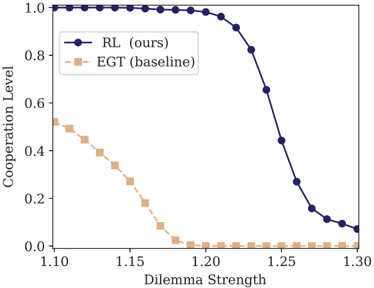
- RL agents maintain full cooperation until dilemma strength exceeds \(b > 1.2\), whereas the EGT baseline reaches only 54% cooperation even at \(b = 1.1\).
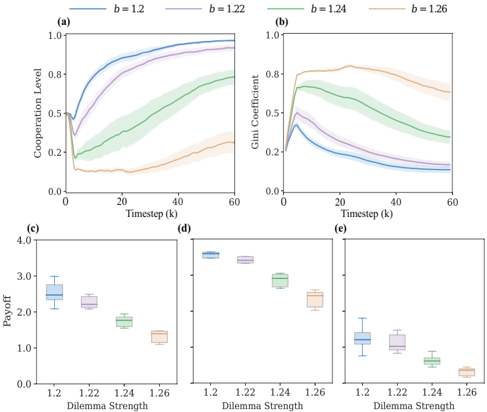
- As dilemma strength rises from \(b = 1.20\) to \(1.26\), cooperation falls from 0.987 to 0.294; from \(b = 1.20\) to \(1.22\), average payoff per episode drops from 2.67 to 2.25, with cooperative payoff falling from 3.52 to 3.41 and defector payoff from 1.44 to 1.10.
- Actual interaction frequency is 45.48% for defector–defector links but rises to 77.29% for cooperator–cooperator links, showing learned preference for cooperative partners.
- Longer memory improves cooperation: when dilemma strength increases from 1.2 to 1.22, agents recalling four timesteps maintain cooperation, while current-only agents drop from 0.64 to 0.19.
Methods
- Agents play a spatial Prisoner’s Dilemma on an \(L \times L\) square lattice with von Neumann neighbourhoods; each agent uses two DQN Q-networks, one for dilemma strategy and one for interaction selection, with replay memory, target networks, \(\epsilon\)-greedy exploration, and centralized training with decentralized execution.
- Training used 900 agents, 10 parallel arenas, 6,000 episodes of 10 timesteps each (60,000 steps), Adam optimizer, prioritized experience replay, and five replications; results average the final 10 episodes, with memory weight 0.6 (previous four rounds) unless stated.
- The utility function combines self-learning and social learning by comparing actual payoffs with counterfactual dilemma actions and average population payoffs; the EGT baseline uses Fermi-rule imitation of successful neighbours.
Limitations
- The paper does not present a dedicated limitations section; it states that integrating psychological complexity into the training framework is a promising future direction.
- Evident from the text: evaluation is simulation-only, restricted to a weak spatial PDG on a square lattice with fixed von Neumann neighbourhoods and specific parameters, with no human experiments or alternative network topologies tested.
- Evident from the text: results depend on hyperparameters such as memory length and on centralized training access to global average payoffs; scalability beyond 900 agents and 10 arenas is not tested.
Model-written summary. Check it against the paper before relying on it.
Integrity signals
Registry
Cites
Statistics
Figures



Verification
Claims the paper makes
3 Valid · 0 Not valid · 3 Not checked · 50 Own results and interpretations
The cited sources support only part of this claim — read each source’s verdict below.
In the paper
“our findings suggest that the performance of the learned interaction mechanism in promoting cooperation is attributed to its ability to help populations form homogeneous strategic clusters.”
What the sources say
- Partly supportedcites Szolnoki and Chen, 2020 sourceExperimental — accuracy not yet measured
The Results (pp. 6–8) show distinct strategic domains and report that selective cooperation can prevail over defection. But the Conclusion (p. 8) attributes that success to biased weakening at domain boundaries, which blocks defector invasion—not to helping populations form homogeneous strategic clusters. The paper also does not describe its investment rule as a learned interaction mechanism. (LLM, conf=0.82)
hedgedstates a cause- Asserted: passes — The authors put it forward as true.
- Checkable: passes — It can be checked against evidence.
- Load-bearing: passes — The paper’s conclusions depend on it.
- Based: passes — The paper gives a reason why it holds.
- Partly supported
The cited sources support only part of this claim — read each source’s verdict below.
In the paper
“Unlike existing RL cooperation studies, our approach does not rely on predefined social norms or external incentives [Ueshima et al. , 2023; Tennant et al. , 2023].”
What the sources say
- Partly supportedcites Ueshima et al., 2023 sourceExperimental — accuracy not yet measured
The Introduction and Related Work describe earlier cooperation studies that use predetermined behavioral policies or incentives. Ueshima et al. also test fixed ALLC and TFT policies (Methods, §3.2.2), which supports the contrast about predefined behavior. But their Methods (§3) explicitly say they do not incorporate incentive mechanisms that maximize group benefits, so this citation does not support treating Ueshima et al. as an example of a study reliant on external incentives. (LLM, conf=0.85)
- Supportedcites Tennant et al., 2023 source
The Background and Related Work section says that investigating pre-defined moral norms in social dilemmas is the paper’s focus. Section 3.2 implements a Deontological agent that follows a specified cooperation norm, so Tennant et al. is an example of an RL study relying on predefined norms. The citation need not establish that it also uses external incentives. (LLM, conf=0.90)
plain- Asserted: passes — The authors put it forward as true.
- Checkable: passes — It can be checked against evidence.
- Load-bearing: passes — The paper’s conclusions depend on it.
- Based: unclear — It is unclear why the paper says it holds.
- Partly supported
The cited sources support only part of this claim — read each source’s verdict below.
In the paper
“which in turn, aids the evolution of cooperative behaviors [Park et al. , 2022].”
What the sources say
- Partly supportedcites Park et al., 2022 sourceExperimental — accuracy not yet measured
The Introduction (page unavailable) says cooperation can evolve through repeated interactions, and the Discussion (page unavailable) says reciprocity can maintain cooperation. Neither passage identifies the correlation referred to as “this correlation” or shows that it aids cooperation’s evolution, so the specific causal claim is unsupported. (LLM, conf=0.78)
plainstates a cause- Asserted: passes — The authors put it forward as true.
- Checkable: passes — It can be checked against evidence.
- Load-bearing: passes — The paper’s conclusions depend on it.
- Based: passes — The paper gives a reason why it holds.
- Partly supported
A result the paper states — it cites no source for it, so there is none to check. The quote shows it is in the paper.
In the paper
“There is a general decrease in the average payoff as the dilemma increases, which aligns with expectations, given that cooperators are primarily the contributors to the group payoff.”
plainstates a cause- Asserted: passes — The authors put it forward as true.
- Checkable: passes — It can be checked against evidence.
- Load-bearing: unclear — It is unclear whether the paper’s conclusions depend on it.
- Based: passes — The paper gives a reason why it holds.
In the paper
“However, RL agents employing additional interaction strategies exhibit two evident phases in their learning process, aligning with observations from previous EGT experiments [Wang et al. , 2013]: the END period and the EXP period.”
What the sources say
- Not checked — no full text of the sourcecites Wang et al., 2013 source
plainstates a cause- Asserted: passes — The authors put it forward as true.
- Checkable: passes — It can be checked against evidence.
- Load-bearing: unclear — It is unclear whether the paper’s conclusions depend on it.
- Based: passes — The paper gives a reason why it holds.
33 more claims
Create a free account to see all 56 claims and every source verdict.
- It may state two separate claims as one. 15
- Probably not a substantial claim. 5
Self-check
Percentages, sums and reported differences re-computed from the paper’s own numbers.
Each contradiction between two passages listed here was confirmed by an independent check.
Rated minor: it would not touch a result — a value no result rests on, a p-value that stays on the same side of the significance level, or a conflict that is clerical, resolved elsewhere in the paper, or outside its own findings.
In the paper
§ 3.1 Prisoner's Dilemma Game · p. 3
“while mutual defection result in P = 0 . Unilateral cooperation against a defector incurs a cost S = c”
§ 3.1 Prisoner's Dilemma Game · p. 3
“In the PD, the conditions T > R > P > S and 2 R > T + S hold.”
Rated minor: it would not touch a result — a value no result rests on, a p-value that stays on the same side of the significance level, or a conflict that is clerical, resolved elsewhere in the paper, or outside its own findings.
In the paper
§ 5.5 Role of Long-term Experiences · p. 7
“Three memory weights were assessed, with α varying from 0.6 to 0, representing input scenarios based on observations from the last, second, and fourth rounds, respectively.”
§ 5.1 Experimental Setup · p. 5
“Unless otherwise stated, a memory weight of 0.6 is assigned, incorporating experiences from the previous four rounds as network input.”
Rated minor: it would not touch a result — a value no result rests on, a p-value that stays on the same side of the significance level, or a conflict that is clerical, resolved elsewhere in the paper, or outside its own findings.
In the paper
§ 3.1 Prisoner's Dilemma Game · p. 3
“where mutual cooperation yields a reward R = b -c”
§ 3.1 Prisoner's Dilemma Game · p. 3
“Our model employs a weak PDG with T = b (1 ≤ b ≤ 2) , R = 1 , and P = S = 0 [Nowak and May, 1993]. Here, the parameter b directly assesses the strength of the dilemma, given c = 0 .”
Citations
Cites
Adam: A Method for Stochastic Optimization
Kingma, D. P., & Ba, J. (2014) · arXiv · doi:10.48550/arxiv.1412.6980 · Cited by 98,946 · cited 1×
“We compute the gradient by using the Adam optimizer [Kingma and Ba, 2014] with a linear annealing schedule of learning rate.”
MethodHuman-level control through deep reinforcement learning
Mnih, V., Kavukcuoglu, K., Silver, D., Rusu, A. A., Veness, J., Bellemare, M. G., Graves, A., Riedmiller, M., Fidjeland, A. K., Ostrovski, G., et al. (2015) · Nature · doi:10.1038/nature14236 · Cited by 30,357 · cited 2×
“In this study, we construct a computational model using deep Q-learning (DQN) [Mnih et al. , 2015] to explore how agents can simultaneously learn both interaction and dilemma strategies from their long-term experiences.”
MethodFive Rules for the Evolution of Cooperation
Nowak, M. A. (2006) · Science · doi:10.1126/science.1133755 · Cited by 5,894 · cited 1×
“Notably, Nowak [2006] identifies five mechanisms central to understanding cooperation evolution.”
BackgroundMulti-Agent Actor-Critic for Mixed Cooperative-Competitive Environments
Lowe, R., Wu, Y., Tamar, A., Harb, J., Abbeel, P., & Mordatch, I. (2017) · arXiv · doi:10.48550/arxiv.1706.02275 · Cited by 3,377 · cited 2×
“During the training stage of our RL experiments, we employ a centralized training with decentralized execution approach [Lowe et al. , 2017].”
BackgroundMethodSchaul, T., Quan, J., Antonoglou, I., & Silver, D. (2015) · arXiv · doi:10.48550/arxiv.1511.05952 · Cited by 3,120
Markov games as a framework for multi-agent reinforcement learning
Littman, M. L. (1994) · Machine Learning Proceedings 1994 · doi:10.1016/b978-1-55860-335-6.50027-1 · Cited by 2,614 · cited 1×
“Within MARL, the IPD is conceptualized as a multi-agent extension of Markov decision processes (MDPs), termed partially observable general-sum Markov games [Littman, 1994].”
BackgroundEvolutionary prisoner’s dilemma game on a square lattice
Szabó, G., & Tőke, C. (1998) · Physical Review E · doi:10.1103/physreve.58.69 · Cited by 1,659 · cited 1×
“In EGT research, the Fermi rule is commonly used to model the dynamics of strategy evolution [Szab´o and T˝oke, 1998], reflecting social learning where neighbours tend to imitate the most successful policy observed.”
MethodStatistical physics of human cooperation
Perc, M., Jordan, J. J., Rand, D. G., Wang, Z., Boccaletti, S., & Szolnoki, A. (2017) · Physics Reports · doi:10.1016/j.physrep.2017.05.004 · Cited by 1,590
Evolutionary dynamics of group interactions on structured populations: a review
Perc, M., Gómez-Gardeñes, J., Szolnoki, A., Floría, L. M., & Moreno, Y. (2013) · Journal of The Royal Society Interface · doi:10.1098/rsif.2012.0997 · Cited by 1,340
Rand, D. G., & Nowak, M. A. (2013) · Trends in Cognitive Sciences · doi:10.1016/j.tics.2013.06.003 · Cited by 1,308
THE SPATIAL DILEMMAS OF EVOLUTION
NOWAK, M. A., & MAY, R. M. (1993) · International Journal of Bifurcation and Chaos · doi:10.1142/s0218127493000040 · Cited by 719 · cited 1×
“Our model employs a weak PDG with T = b (1 ≤ b ≤ 2) , R = 1 , and P = S = 0 [Nowak and May, 1993].”
Dynamic social networks promote cooperation in experiments with humans
Rand, D. G., Arbesman, S., & Christakis, N. A. (2011) · Proceedings of the National Academy of Sciences · doi:10.1073/pnas.1108243108 · Cited by 653 · cited 1×
“Ad-dressing this, Rand et al. [2011] found that dynamic interactions enhance multilateral cooperation by encouraging links with cooperators over defectors, promoting strategy clustering.”
BackgroundUniversal scaling for the dilemma strength in evolutionary games
Wang, Z., Kokubo, S., Jusup, M., & Tanimoto, J. (2015) · Physics of Life Reviews · doi:10.1016/j.plrev.2015.04.033 · Cited by 586 · cited 1×
“This payoff matrix forms four classical game structures [Wang et al. , 2015]: PD, chicken, harmony and stag hunt, each defined by specific payoff inequalities.”
BackgroundSocial learning promotes institutions for governing the commons
Sigmund, K., De Silva, H., Traulsen, A., & Hauert, C. (2010) · Nature · doi:10.1038/nature09203 · Cited by 580 · cited 2×
“However, maintaining cooperation in social dilemmas is challenging due to the conflict between individual interests and collective welfare [Sigmund, 2010].”
BackgroundMilinski, M. (2011) · doi:10.5860/choice.47-6917 · Cited by 558 · cited 1×
“However, maintaining cooperation in social dilemmas is challenging due to the conflict between individual interests and collective welfare [Sigmund, 2010].”
BackgroundCooperation Prevails When Individuals Adjust Their Social Ties
Santos, F. C., Pacheco, J. M., & Lenaerts, T. (2006) · PLoS Computational Biology · doi:10.1371/journal.pcbi.0020140 · Cited by 556 · cited 1×
“Traditional game theory and EGT emphasize social learning, where agents imitate nearby successful strategies [Sigmund et al. , 2010; Li et al. , 2016], overlooking learning through trial-and-error [Metcalfe, 2017].”
BackgroundMetcalfe, J. (2017) · Annual Review of Psychology · doi:10.1146/annurev-psych-010416-044022 · Cited by 483 · cited 1×
“Traditional game theory and EGT emphasize social learning, where agents imitate nearby successful strategies [Sigmund et al. , 2010; Li et al. , 2016], overlooking learning through trial-and-error [Metcalfe, 2017].”
BackgroundHuman strategy updating in evolutionary games
Traulsen, A., Semmann, D., Sommerfeld, R. D., Krambeck, H.-J., & Milinski, M. (2010) · Proceedings of the National Academy of Sciences · doi:10.1073/pnas.0912515107 · Cited by 412 · cited 1×
“Surprisingly, behavioural studies indicate that participants in structured settings tend to randomly change strategies instead of copying higher-payoff neighbours [Traulsen et al. , 2010], disrupting the clustering process and rendering cooperation less advantageous.”
BackgroundSocial norm complexity and past reputations in the evolution of cooperation
Santos, F. P., Santos, F. C., & Pacheco, J. M. (2018) · Nature · doi:10.1038/nature25763 · Cited by 259 · cited 1×
“Second, our agents operate without initial knowledge, developing high-order norms [Santos et al. , 2018] through experiences, which enables them to spontaneously establish interaction behaviours that stabilize network reciprocity, echoing findings from EGT literature [Van Segbroeck et al. , 2010].”
BackgroundInsight into the so-called spatial reciprocity.
Wang, Z., Kokubo, S., Tanimoto, J., Fukuda, E., & Shigaki, K. (2013) · Physical Review E · doi:10.1103/physreve.88.042145 · Cited by 254 · cited 1×
“Figure 3 additional interaction strategies exhibit two evident phases in their learning process, aligning with observations from previous EGT experiments [Wang et al. , 2013]: the END period and the EXP period.”
ResultSocial Influence as Intrinsic Motivation for Multi-Agent Deep Reinforcement Learning
Jaques, N., Lazaridou, A., Hughes, E., Gülçehre, Ç., Ortega, P. A., Strouse, D., Leibo, J. Z., & de Freitas, N. (2018) · arXiv (Cornell University) · doi:10.48550/arxiv.1810.08647 · Cited by 241
Sylwester, K., & Roberts, G. (2013) · Evolution and Human Behavior · doi:10.1016/j.evolhumbehav.2012.11.009 · Cited by 130 · cited 1×
“To unravel the intricate coevo-lutionary dynamics of agent behaviours, there is an increasing interest in leveraging advanced deep reinforcement learning (RL) algorithms [Perolat et al. , 2017; Du et al. , 2023; Willis et al. , 2023].”
BackgroundIntuitive Honesty Versus Dishonesty: Meta-Analytic Evidence
Köbis, N. C., Verschuere, B., Bereby-Meyer, Y., Rand, D., & Shalvi, S. (2019) · Perspectives on Psychological Science · doi:10.1177/1745691619851778 · Cited by 113 · cited 1×
“…examining evolutionary trajectories and conditions favouring cooperation, incorporating empirical data brings psychological nuances to these models [K¨obis et al. , 2019], which focus on imposed interaction structures and psychological mechanisms beyond laboratory settings [Rand and Nowak, 2013].”
BackgroundA multi-agent reinforcement learning model of common-pool resource appropriation
Perolat, J., Leibo, J. Z., Zambaldi, V., Beattie, C., Tuyls, K., & Graepel, T. (2017) · arXiv · doi:10.48550/arxiv.1707.06600 · Cited by 109 · cited 1×
“To unravel the intricate coevo-lutionary dynamics of agent behaviours, there is an increasing interest in leveraging advanced deep reinforcement learning (RL) algorithms [Perolat et al. , 2017; Du et al. , 2023; Willis et al. , 2023].”
BackgroundEvolution of cooperation with asymmetric social interactions
Su, Q., Allen, B., & Plotkin, J. B. (2022) · Proceedings of the National Academy of Sciences · doi:10.1073/pnas.2113468118 · Cited by 104 · cited 1×
“Research like Su et al. [2022] explores how cooperative strategies evolve and spread, particularly in unidirectional interactions, shedding light on shaping social interactions to promote cooperation.”
BackgroundA Review of Cooperation in Multi-agent LearningPreprint
Du, Y., Leibo, J. Z., Islam, U., Willis, R., & Sunehag, P. (2023) · arXiv (Cornell University) · doi:10.48550/arxiv.2312.05162 · Cited by 90 · cited 1×
“To unravel the intricate coevo-lutionary dynamics of agent behaviours, there is an increasing interest in leveraging advanced deep reinforcement learning (RL) algorithms [Perolat et al. , 2017; Du et al. , 2023; Willis et al. , 2023].”
BackgroundVinitsky, E., Koster, R., Agapiou, J., Duéñez‐Guzmán, E. A., Vezhnevets, A. S., & Leibo, J. Z. (2023) · Collective Intelligence · doi:10.1177/26339137231162025 · Cited by 88 · cited 1×
“…focus on understandingthe emergence of cooperation by integrating spatial and temporal dynamics relevant to realistic scenarios [Ren and Zeng, 2024; Vinitsky et al. , 2023; Tennant et al. , 2023], moving beyond traditional matrix games through the fusion of complex incentive structures [Leibo et…”
BackgroundExperimental Economics: Rethinking the Rules
Wilkening, T. S. (2011) · Economic Record · doi:10.1111/j.1475-4932.2010.00718.x · Cited by 80 · cited 1×
“However, such laboratory experiments often encounter challenges in terms of scalability and struggle with complex, larger-scale, or long-term scenarios [Moffatt et al. , 2009].”
BackgroundKnowing the past improves cooperation in the future
Danku, Z., Perc, M., & Szolnoki, A. (2019) · Scientific Reports · doi:10.1038/s41598-018-36486-x · Cited by 79 · cited 2×
“In this model, we incorporate learning from previous interactions by employing a weighted moving average of past payoffs [Danku et al. , 2019].”
MethodNegotiation and honesty in artificial intelligence methods for the board game of Diplomacy
Kramár, J., Eccles, T., Gemp, I., Tacchetti, A., McKee, K. R., Malinowski, M., Graepel, T., & Bachrach, Y. (2022) · Nature Communications · doi:10.1038/s41467-022-34473-5 · Cited by 66 · cited 1×
“The emergence of cooperation is fundamental to human civilization and evident in various biological and multi-agent systems [Rand and Nowak, 2013; Kram´ar et al. , 2022].”
BackgroundTanimoto, J. (2013) · Physical Review E · doi:10.1103/physreve.87.062136 · Cited by 64 · cited 1×
“In this domain, the concept of network assorta-tivity has been highlighted, revealing that agents with similar strategies often connect, thereby boosting group cooperation [Tanimoto, 2013; Ren and Zheng, 2021].”
BackgroundCooperation in alternating interactions with memory constraints
Park, P. S., Nowak, M. A., & Hilbe, C. (2022) · Nature Communications · doi:10.1038/s41467-022-28336-2 · Cited by 50 · cited 1×
“Additionally, we confirm a positive correlation between agent memory length and the effectiveness of interaction selection, which in turn, aids the evolution of cooperative behaviors [Park et al. , 2022].”
BackgroundReputation-Based Interaction Promotes Cooperation With Reinforcement Learning
Ren, T., & Zeng, X. (2023) · IEEE Transactions on Evolutionary Computation · doi:10.1109/tevc.2023.3304911 · Cited by 48 · cited 1×
“…applications also focus on understandingthe emergence of cooperation by integrating spatial and temporal dynamics relevant to realistic scenarios [Ren and Zeng, 2024; Vinitsky et al. , 2023; Tennant et al. , 2023], moving beyond traditional matrix games through the fusion of complex incentive…”
BackgroundSelf-citationLi, J., Zhang, C., Sun, Q., Chen, Z., & Zhang, J. (2016) · IEEE Transactions on Evolutionary Computation · doi:10.1109/tevc.2016.2628385 · Cited by 45 · cited 1×
“Traditional game theory and EGT emphasize social learning, where agents imitate nearby successful strategies [Sigmund et al. , 2010; Li et al. , 2016], overlooking learning through trial-and-error [Metcalfe, 2017].”
BackgroundBlocking defector invasion by focusing on the most successful partner
Szolnoki, A., & Chen, X. (2020) · Applied Mathematics and Computation · doi:10.1016/j.amc.2020.125430 · Cited by 43 · cited 1×
“Consistent with theoretical models [Szolnoki and Chen, 2020], our findings suggest that the performance of the learned interaction mechanism in promoting cooperation is attributed to its ability to help populations form homogeneous strategic clusters.”
ResultScaffolding cooperation in human groups with deep reinforcement learning
McKee, K. R., Tacchetti, A., Bakker, M. A., Balaguer, J., Campbell-Gillingham, L., Everett, R., & Botvinick, M. (2023) · Nature Human Behaviour · doi:10.1038/s41562-023-01686-7 · Cited by 43 · cited 1×
“Additionally, empirical studies employing experience-based learning face challenges in developing enduring strategies, particularly due to the complexities encountered in large population iterations [McKee et al. , 2023].”
BackgroundLearning to coordinate in complex networks
Segbroeck, S. V., de Jong, S., Nowé, A., Santos, F. C., & Lenaerts, T. (2010) · Adaptive Behavior · doi:10.1177/1059712310384282 · Cited by 41 · cited 1×
“Second, our agents operate without initial knowledge, developing high-order norms [Santos et al. , 2018] through experiences, which enables them to spontaneously establish interaction behaviours that stabilize network reciprocity, echoing findings from EGT literature [Van Segbroeck et al. , 2010].”
BackgroundSpurious normativity enhances learning of compliance and enforcement behavior in artificial agents
Köster, R., Hadfield-Menell, D., Everett, R., Weidinger, L., Hadfield, G. K., & Leibo, J. Z. (2022) · Proceedings of the National Academy of Sciences · doi:10.1073/pnas.2106028118 · Cited by 37 · cited 3×
“These methods are not only used to examine agents’ decision-making processes but also to investigate the emergence of their behaviours [K¨oster et al. , 2022].”
BackgroundMethodMulti-agent Reinforcement Learning in Sequential Social Dilemmas
Leibo, J. Z., Zambaldi, V., Lanctot, M., Marecki, J., & Graepel, T. (2017) · International Joint Conference on Autonomous Agents and Multiagent Systems · doi:10.65109/qmsu8421 · Cited by 35 · cited 1×
“…spatial and temporal dynamics relevant to realistic scenarios [Ren and Zeng, 2024; Vinitsky et al. , 2023; Tennant et al. , 2023], moving beyond traditional matrix games through the fusion of complex incentive structures [Leibo et al. , 2017; Jaques et al. , 2019; Abeywickrama et al. , 2023].”
BackgroundSocial Diversity and Social Preferences in Mixed-Motive Reinforcement Learning
McKee, K. R., Gemp, I., McWilliams, B., Duèñez-Guzmán, E. A., Hughes, E., & Leibo, J. Z. (2020) · International Joint Conference on Autonomous Agents and Multiagent Systems · doi:10.65109/dnuf7773 · Cited by 33 · cited 1×
“Specifically, we chose SVO [McKee et al. , 2020] and Self-ishness [Roesch et al. , 2024] approaches as MARL-based benchmarks for this comparative analysis.”
MethodRen, T., & Zheng, J. (2021) · Chaos Solitons & Fractals · doi:10.1016/j.chaos.2021.111241 · Cited by 27 · cited 1×
“In this domain, the concept of network assorta-tivity has been highlighted, revealing that agents with similar strategies often connect, thereby boosting group cooperation [Tanimoto, 2013; Ren and Zheng, 2021].”
BackgroundSelf-citationModeling Moral Choices in Social Dilemmas with Multi-Agent Reinforcement Learning
Tennant, E., Hailes, S., & Musolesi, M. (2023) · Proceedings of the Thirty-Second International Joint Conference on Artificial Intelligence · doi:10.24963/ijcai.2023/36 · Cited by 21 · cited 3×
“…emergence of cooperation by integrating spatial and temporal dynamics relevant to realistic scenarios [Ren and Zeng, 2024; Vinitsky et al. , 2023; Tennant et al. , 2023], moving beyond traditional matrix games through the fusion of complex incentive structures [Leibo et al. , 2017; Jaques et al.…”
BackgroundMethodResolving social dilemmas with minimal reward transfer
Willis, R., Du, Y., Leibo, J. Z., & Flucke, G. (2024) · Autonomous Agents and Multi-Agent Systems · doi:10.1007/s10458-024-09675-4 · Cited by 17 · cited 1×
“To unravel the intricate coevo-lutionary dynamics of agent behaviours, there is an increasing interest in leveraging advanced deep reinforcement learning (RL) algorithms [Perolat et al. , 2017; Du et al. , 2023; Willis et al. , 2023].”
BackgroundHuman Cooperation: Challenges for Science and Practice
Dreu, C. K. W. D. (2013) · Gothic.net · doi:10.1177/1529100613496959 · Cited by 4 · cited 2×
“The emergence of cooperation is fundamental to human civilization and evident in various biological and multi-agent systems [Rand and Nowak, 2013; Kram´ar et al. , 2022].”
BackgroundAnastassacos, N., Hailes, S., & Musolesi, M. (2020) · Proceedings of the AAAI Conference on Artificial Intelligence · doi:10.1609/aaai.v34i05.6190 · Cited by 4 · cited 2×
“Although studies introducing mechanisms like reputation [Anastassacos et al. , 2020] and moral rewards [Tennant et al. , 2023] to address these issues, these specialized approaches exhibit restricted applicability.”
BackgroundEmergence of norms in interactions with complex rewards
Abeywickrama, D. B., Griffiths, N., Xu, Z., & Mouzakitis, A. (2022) · Autonomous Agents and Multi-Agent Systems · doi:10.1007/s10458-022-09585-3 · Cited by 3 · cited 1×
“…spatial and temporal dynamics relevant to realistic scenarios [Ren and Zeng, 2024; Vinitsky et al. , 2023; Tennant et al. , 2023], moving beyond traditional matrix games through the fusion of complex incentive structures [Leibo et al. , 2017; Jaques et al. , 2019; Abeywickrama et al. , 2023].”
BackgroundDeconstructing Cooperation and Ostracism via Multi-Agent Reinforcement Learning
Ueshima, A., Omidshafiei, S., & Shirado, H. (2023) · arXiv · doi:10.48550/arxiv.2310.04623 · Cited by 1 · cited 2×
“Unlike existing RL cooperation studies, our approach does not rely on predefined social norms or external incentives [Ueshima et al. , 2023; Tennant et al. , 2023].”
MethodResolving social dilemmas with minimal reward transfer
Willis, R., Du, Y., Leibo, J. Z., et al. (2023) · arXiv · doi:10.48550/arxiv.2310.12928
Emergence of Norms in Interactions with Complex Rewards
Abeywickrama, D. B., Griffiths, N., Xu, Z., et al. (2023) · International Joint Conference on Autonomous Agents and Multiagent Systems · doi:10.65109/tisu9473
Research works printed but not linked: 2
- [Leibo et al. , 2017] Joel Z Leibo, Vinicius Zambaldi, Marc Lanctot, Janusz Marecki, and Thore Graepel. Multiagent reinforcement learning in sequential social dilemmas. In Proceedings of the 16th Conference on Autonomous Agents and MultiAgent Systems , pages 464-473, 2017.
- [Rapoport et al. , 1965] Anatol Rapoport, Albert M Chammah, and Carol J Orwant. Prisoner's dilemma: A study in conflict and cooperation . University of Michigan Press, 1965.
Cited by
ROSBag MCP Server: Analyzing Robot Data with LLMs for Agentic Embodied AI Applications
Fu, L., Salimpour, S., Militano, L., Edelman, H., Queralta, J. P., & Toffetti, G. (2025) · International Conference on Robotic Computing and Communication (RoboticCC) · doi:10.1109/roboticcc68732.2025.00025 · Cited by 7
“Other relevant works in this area included non-robotics agents for games such as Minecraft [19], [20].”
MulPlanLM: multimodal robotic task planning with vision-language models and physical feedback
Son, Y.-C., Lee, D.-H., & Lim, S. (2026) · Intelligent Service Robotics · doi:10.1007/s11370-026-00743-0
Towards Autonomous Building Construction: A Multi-agent Framework Leveraging Large Multimodal Models
Soma, W., Ding, D., & Ito, T. (2026) · Lecture notes in computer science · doi:10.1007/978-981-95-7081-2_17
MIMIC: Integrating Diverse Personality Traits for Better Game Testing Using Large Language Model
Chen, Y., Habchi, S., & Wei, L.-L. (2025) · International Conference on Automated Software Engineering · doi:10.1109/ase63991.2025.00012 · Cited by 2
“We further evaluated MIMIC in the widely used real-world game Minecraft [17], comparing it against the state-of-the-art agent ODYSSEY [18].”
InfluentialMMVPS: A Multimodal Large Model-Based Visual Perception System
Li, Z., Xie, X., Zeng, W., Yan, X., GuoFeng, L. U. O., Hou, X., Wang, C., Xu, L., & Chen, L. (2025) · IEEE Smart World Congress (SWC) · doi:10.1109/swc65939.2025.00180
“Odyssey [17] addresses goal decomposition, skill execution, and policy adaptation; Zheng et al. [18] proposed a multimodal end-to-end model improving agent vision; and MP5 [8] simulates human-like perception via active strategies.”
Metadata
- Authors
- Ren, T., & Zeng, X.-J.
- Affiliations
- University of Manchester (GB)
- Venue
- Proceedings of the Thirty-ThirdInternational Joint Conference on Artificial Intelligence
- Published
- 2024-08
- Pages
- 193-201
- OpenAlex
- W4401024623
- Cited by
- 8
- References
- 47
- Citations by year
- 2026: 4 · 2025: 4
- FWCI
- 7.07
- Type
- conference paper
- Language
- en
- Open access
- bronze
- doi.org
- Locations
- International Joint Conference on Artificial Intelligence (publishedVersion)
- Research Explorer (The University of Manchester) (publishedVersion, other-oa)
- arXiv (Cornell University) (submittedVersion, cc-by)
- arXiv (Cornell University) (cc-by)
- Funders
- University of Manchester
- Topics
- Social Sciences › Sociology and Political Science › Evolutionary Game Theory and Cooperation
- Social Sciences › Economics, Econometrics and Finance › Economics and Econometrics › Experimental Behavioral Economics Studies
- Social Sciences › Decision Sciences › Management Science and Operations Research › Game Theory and Applications
- Keywords
- evolution of cooperation, spatial prisoner's dilemma, multi-agent reinforcement learning, neighbor selection, long-term experience, network reciprocity, social dilemmas, Q-network
About these checks
Registry, retraction, Cites and statistics results are computed, not judged, with one exception: a printed reference that no index lists is read once by a model before it counts as a citation error. Claims are extracted by a model and kept only when their quote appears verbatim in the text; each cited source is then checked, with a model’s help, for whether it says what the claim relies on. Those verdicts can be wrong — read the claim’s quote and the cited source before relying on one.
The claim verdicts this report counts are experimental: their accuracy is not yet measured.
A language model drew the claims from the paper on 2026-10-10, under version 3 of the claim definition (model deepseek-v4.1-flash, prompt extract-v3).
A second model labelled each claim on 2026-10-10 (model jev-1.13-20260917, definition revision gold-guideline-v0.2).
Cited sources are checked with a language model’s help (gpt-6-sol).
Statistics and arithmetic are recomputed, not judged.
Confidence bands are shown only for fields calibrated on our annotated test set. None is calibrated yet, so no band is shown.
What counts as a claim ›How we measure confidence ›How we check this ›
Are you an author, or do you see a problem with this page? Request a review
Data sources
Bibliographic data: Semantic Scholar, OpenAlex, Crossref.
Contains information from the Semantic Scholar Academic Graph Datasets, made available under the ODC Attribution License (ODC-BY 1.0).
Semantic Scholar’s data is described in: Kinney, R., et al. (2023). The Semantic Scholar Open Data Platform. arXiv:2301.10140.
