

The DOI matches its Crossref record; 145 of the 146 references it cites were found in a registry or an index.
Digital Games, Design, and Learning: A Systematic Review and Meta-Analysis
Open accessAbstract
In this meta-analysis, we systematically reviewed research on digital games and learning for K–16 students. We synthesized comparisons of game versus nongame conditions (i.e., media comparisons) and comparisons of augmented games versus standard game designs (i.e., value-added comparisons). We used random-effects meta-regression models with robust variance estimates to summarize overall effects and explore potential moderator effects. Results from media comparisons indicated that digital games significantly enhanced student learning relative to nongame conditions ([Formula: see text] = 0.33, 95% confidence interval [0.19, 0.48], k = 57, n = 209). Results from value-added comparisons indicated significant learning benefits associated with augmented game designs ([Formula: see text] = 0.34, 95% confidence interval [0.17, 0.51], k = 20, n = 40). Moderator analyses demonstrated that effects varied across various game mechanics characteristics, visual and narrative characteristics, and research quality characteristics. Taken together, the results highlight the affordances of games for learning as well as the key role of design beyond medium.
Overview
The claims and statistics of this paper haven’t been checked yet.
Run the check — free, no account needed. It reads the open-access text and checks the sources it cites.
Integrity signals
Registry
Cites
Statistics
Figures
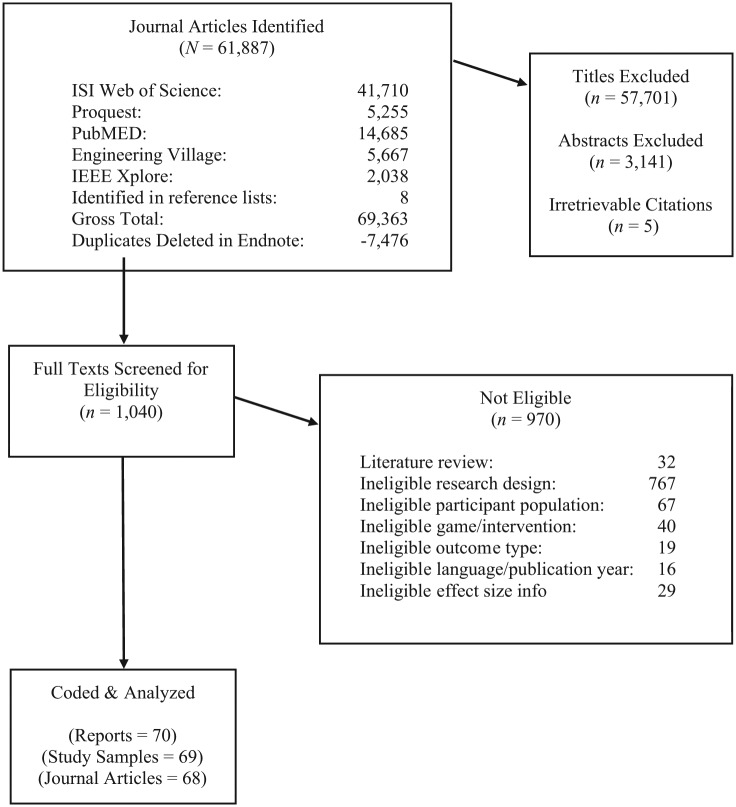
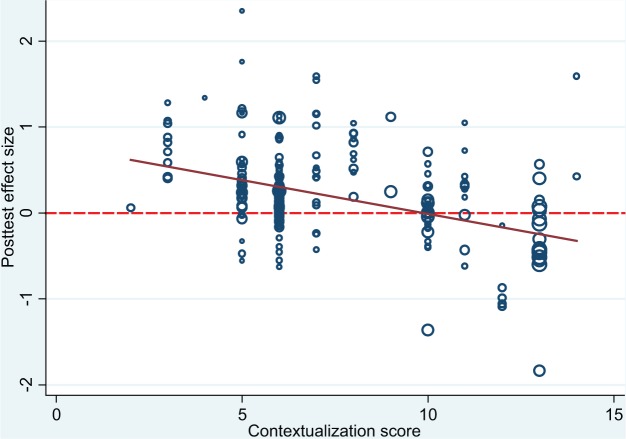
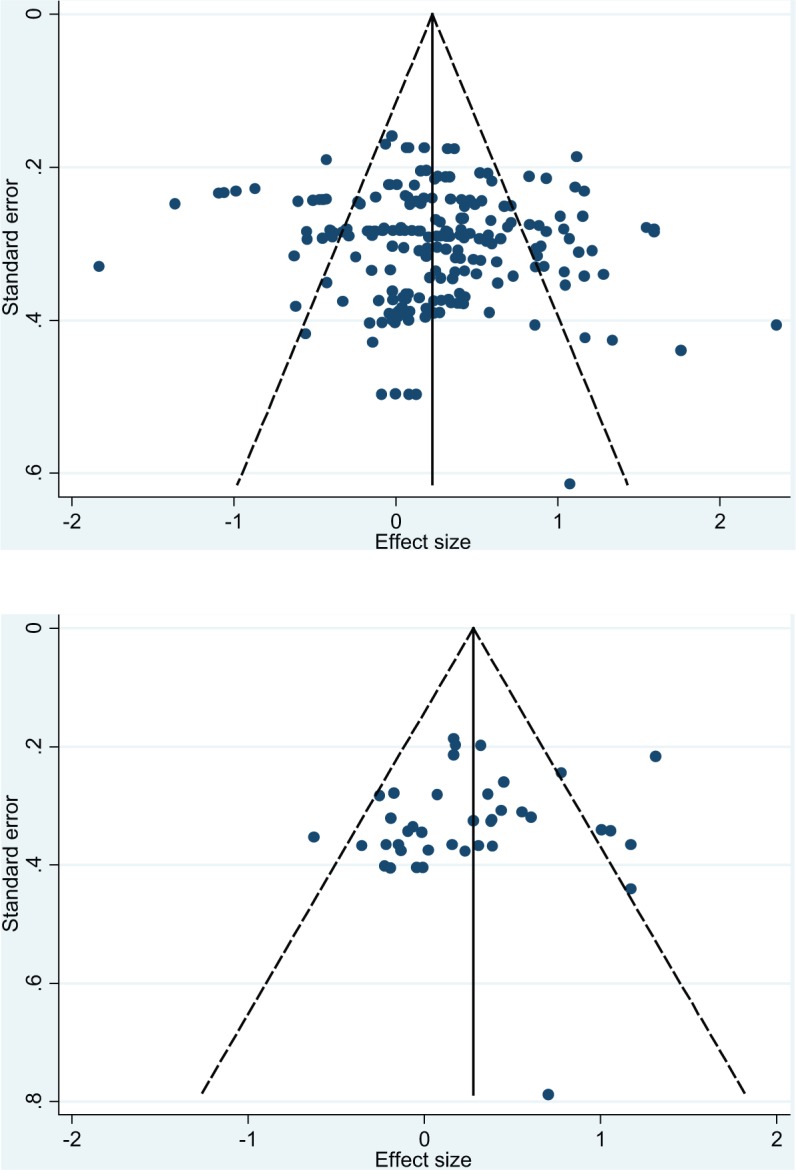
Verification
Claims the paper makes
The claims and statistics of this paper haven’t been checked yet.
Run the check — free, no account needed. It reads the open-access text and checks the sources it cites.
Claims other papers make about this one
Each is checked against this paper’s own text: does it say what the citing paper says it does?
The source backs part of the claim, not all of it — or backs it for a different population, condition or comparison.
In the citing paper
“Inclusion of game fiction is closely related to the use of narrative anchors and has been shown to be effective for learning as it situates and anchors learning in a context (Clark et al. 2016) and can further serve as a cognitive framework for problem solving (Dickey 2006).”
From The gamification of learning: a meta-analysis (2020) · cites this paper as Clark et al. 2016
Experimental — accuracy not yet measuredThe source backs part of the claim, not all of it — or backs it for a different population, condition or comparison.
In the citing paper
“In addition, the results of the summary effect analyses were similar to results from meta-analyses conducted in the context of games (see Clark et al. 2016;Wouters et al. 2013), indicating that the power of games can be transferred to non-game contexts by using game design elements.”
From The gamification of learning: a meta-analysis (2020) · cites this paper as Clark et al. 2016
Experimental — accuracy not yet measuredThe source backs part of the claim, not all of it — or backs it for a different population, condition or comparison.
In the citing paper
“This result for behavioral learning outcomes is in line with evidence from the context of games, showing that combinations of competition and collaboration in games are promising for learning (Clark et al. 2016).”
From The gamification of learning: a meta-analysis (2020) · cites this paper as Clark et al. 2016
Experimental — accuracy not yet measuredThe cited source says what the claim attributes to it.
In the citing paper
“Clark et al. (2016) included competition in their meta-analysis on digital games and found that combinations of competition and collaboration as well as single-player games without competitive elements can outperform games with mere competition.”
From The gamification of learning: a meta-analysis (2020) · cites this paper as Clark et al. 2016
In the citing paper
“The reviews have also documented the effects on students' learning outcomes and the key role of gamified designs (Alsawaier, 2018;Clark, Tanner-Smith & Killingsworth 2016).”
From Towards a motivational design? Connecting gamification user types and online learning activities (2020) · cites this paper as Clark, Tanner-Smith & Killingsworth 2016
Self-check
Percentages, sums and reported differences re-computed from the paper’s own numbers.
The self-check needs the paper’s full text.
Citations
Cites
Bias in meta-analysis detected by a simple, graphical test
Egger, M., Smith, G. D., Schneider, M., & Minder, C. (1997) · BMJ · doi:10.1136/bmj.315.7109.629 · Cited by 56,722
Self-efficacy: The exercise of control
Bandura, A., Freeman, W. H., & Lightsey, R. (1999) · Journal of Cognitive Psychotherapy · doi:10.1891/0889-8391.13.2.158 · Cited by 46,835
Situated Cognition and the Culture of Learning
Brown, J. S., Collins, A., & Duguid, P. (1989) · Educational Researcher · doi:10.3102/0013189x018001032 · Cited by 13,645
David, F. N., & Tukey, J. W. (1977) · Biometrics · doi:10.2307/2529486 · Cited by 12,707
Borenstein, M., Hedges, L. V., Higgins, J. P. T., & Rothstein, H. R. (2021) · doi:10.1002/9781119558378 · Cited by 9,799
What Video Games Have to Teach Us about Learning and Literacy
(2004) · Education + Training · doi:10.1108/et.2004.00446dae.002 · Cited by 6,674
Distribution Theory for Glass's Estimator of Effect Size and Related Estimators
Hedges, L. V. (1981) · Journal of Educational Statistics · doi:10.2307/1164588 · Cited by 5,695
The Handbook of Research Synthesis and Meta-Analysis
(2019) · doi:10.7758/9781610448864 · Cited by 4,553
Self-Efficacy and Academic Motivation
Schunk, D. H. (1991) · Educational Psychologist · doi:10.1080/00461520.1991.9653133 · Cited by 4,292
Pintrich, P. R. (2003) · Journal of Educational Psychology · doi:10.1037/0022-0663.95.4.667 · Cited by 3,459
Research works printed but not linked: 6
- Gleser L. J., 2009, The handbook of research synthesis and meta-analysis, 357
- 10.3102/10769986006002107 · DOI · Paper page
- Hedges L. V., 2007, Journal of Research in Rural Education, 22, 1
- López-López J. A., 2015, Assessing meta-regression models for examining moderator relationships with dependent effect sizes: A Monte Carlo simulation
- López-López J. A., 2010, Paper presented at the 5th annual meeting of the Society for Research Synthesis Methodology
- Raudenbush S. W., 2009, The handbook of research synthesis and meta-analysis, 295
Cited by
Sorted by citations
Items 501–600 of 1,000
Co-teaching with an immersive digital game: supporting teacher-game instructional partnerships
Mutch‐Jones, K., Boulden, D. C., Gasca, S., Lord, T., Wiebe, E., & Reichsman, F. (2021) · Educational Technology Research and Development · doi:10.1007/s11423-021-10000-z · Cited by 14
Games for Teaching and Learning History: a Systematic Literature Review
Oceja, J., Cubillo, D. A. A., & Trimállez, M. T. (2022) · European Conference on Games Based Learning · doi:10.34190/ecgbl.16.1.558 · Cited by 10
Digital Game-Based Learning: Learning with Games
Becker, K. (2016) · Springer eBooks · doi:10.1007/978-3-319-12223-6_2 · Cited by 13
Generating Game Levels to Develop Computer Science Competencies in Game-Based Learning Environments
Park, K., Mott, B., Min, W., Wiebe, E., Boyer, K. E., & Lester, J. C. (2020) · Lecture notes in computer science · doi:10.1007/978-3-030-52240-7_44 · Cited by 10
“Recent years have seen growing interest in game-based learning environments [1-4], which engage students in situated problem-solving challenges within rich virtual worlds [5].”
BackgroundInstructional integration of digital learning games in financial literacy education
Aprea, C., Schultheis, J., & Stolle, K. (2017) · MADOC (University of Mannheim) · Cited by 10
Higgins, S. (2018) · Cambridge University Press eBooks · doi:10.1017/9781139519618 · Cited by 26
Nicholas, J., Mills, B., Hansen, S. S., Bright, S. J., Scott, J. J., Ridout, I., Watson, J., Boyd, H., Brook, L., & Hopper, L. (2023) · Computers in Human Behavior · doi:10.1016/j.chb.2023.107774 · Cited by 9
Playful Approaches to Leadership Development: Three Innovative Uses of Games in the Classroom
Schrier, K. “., Zahradnik, A. G., & Shaenfield, D. E. (2023) · Organizational Behavior Teaching Review · doi:10.1177/10525629231215065 · Cited by 9
“Meta-analysis studies of game-based learning have suggested that well-designed game-based interventions are effective (Cai et al., 2023; Clark et al., 2016; Wang et al., 2022), though some results have been mixed due to different factors, such as the previous knowledge of students (Yang & Lu, 2021).”
The impact of goal assignment in a game‐based learning environment
Nietfeld, J. L., & Hoffmann, K. F. (2023) · Journal of Computer Assisted Learning · doi:10.1111/jcal.12919 · Cited by 10
Xu, H., Deng, T., Gu, X., & Gu, X. (2024) · Thinking Skills and Creativity · doi:10.1016/j.tsc.2024.101574 · Cited by 9
Shofiyah, N., Jatmiko, B., Suprapto, N., Prahanı, B. K., & Anggraeni, D. M. (2025) · Social Sciences & Humanities Open · doi:10.1016/j.ssaho.2025.101534 · Cited by 20
Marengo, A., Pagano, A., & Santamato, V. (2025) · Computers and Education Artificial Intelligence · doi:10.1016/j.caeai.2025.100469 · Cited by 13
Child engagement during interaction with digital and robotic activities: a systematic review
Margheri, V., Martucci, A., Bei, E., Graziani, D., Scatigna, S., Guazzini, A., & Pecini, C. (2025) · Frontiers in Education · doi:10.3389/feduc.2025.1568028 · Cited by 10
Schrader, P. G., Carroll, M. C., McCreery, M. P., & Head, D. L. (2019) · Journal of Educational Computing Research · doi:10.1177/0735633119878066 · Cited by 12
“…to design games, and game culture studies, there is an inadequate number of studies and findings to inform game design and instructional pedagogy (Bediou et al., 2018; Clark et al., 2016; Connolly et al., 2012; Girard et al., 2013; Ke, 2009; Mayer, 2015; Wouters et al., 2013; Young et al., 2012).”
BackgroundTsutsumi, M. M. A., Goulart, P. R. K., Júnior, M. D. S., Haydu, V. B., & Jiménez, É. L. D. O. (2020) · Revista Portuguesa de Educação · doi:10.21814/rpe.19130 · Cited by 9
Vanbecelaere, S., & Benton, L. (2021) · British Journal of Educational Technology · doi:10.1111/bjet.13150 · Cited by 9
“Informed by the media debate, several researchers argued to use value-added approaches to investigate which specific characteristics of the digital learning environment induce learning (Clark et al., 2016).”
Developing Fact Finders: A Mobile Game for Overcoming Intractable Conflicts
Nicolaidou, I. A., Egenfeldt‐Nielsen, S., Zupančіč, R., Hajslund, S., & Milioni, D. L. (2022) · Social Science Computer Review · doi:10.1177/08944393211073586 · Cited by 11
“Meta-analyses documented the impact of serious games in different domains and on different age groups (Clark et al., 2016; Lamb et al., 2018; Vogel et al., 2006).”
BackgroundApplication of artificial intelligence methods in the school educational process
Kataev, M. Y., Bulysheva, L., & Mosiaev, A. (2022) · Systems Research and Behavioral Science · doi:10.1002/sres.2873 · Cited by 10
Bhang, K. J., & Huh, J.-R. (2023) · Sustainability · doi:10.3390/su152216039 · Cited by 9
“A study on the awareness, knowledge, and attitude towards biotechnology among Ethiopian high school students found a correlation between students’ awareness and attitude [41].”
BackgroundToward a framework for analyzing adaptive digital games' research effectiveness
Vanbecelaere, S., Demedts, F., Reynvoet, B., & Depaepe, F. (2023) · International Journal of Serious Games · doi:10.17083/ijsg.v10i4.618 · Cited by 9
Kohpeisansukwattana, N., Siriwattananon, N., & Charoenwanit, E. (2024) · International Journal of Interactive Mobile Technologies (iJIM) · doi:10.3991/ijim.v18i04.42629 · Cited by 9
The Helping Hand in Ukraine: feasibility and potential impact
Raknes, S., & Chorna, T. (2024) · Pilot and Feasibility Studies · doi:10.1186/s40814-024-01520-5 · Cited by 11
Learning results and terminal values from the players of SimCity and The Sims
Lin, Y.-L., & Lin, H. (2016) · Behaviour and Information Technology · doi:10.1080/0144929x.2016.1208772 · Cited by 10
Educational Games as a Motivational Tool: Considerations on their Potential and Limitations
Passarelli, M., Dagnino, F. M., Earp, J., Manganello, F., Persico, D., Pozzi, F., Bailey, C., Perrotta, C., Buijtenweg, T. P., & Haggis, M. (2019) · International Conference on Computer Supported Education · doi:10.5220/0007586503300337 · Cited by 9
Szabó, N., Janurik, M., & Józsa, K. (2019) · EDULEARN proceedings · doi:10.21125/edulearn.2019.0212 · Cited by 9
Moon, J., & Liu, Z. (2019) · Smart computing and intelligence · doi:10.1007/978-981-32-9335-9_2 · Cited by 9
Intentional Learning Design for Educational Games: A Workflow Supporting Novices and Experts
Abbott, D. (2020) · Cited by 9
Motivational Potential of Leaderboards in a Team-Based Math Game Competition
Ninaus, M., de Freitas, S., & Kiili, K. J. M. (2020) · Lecture notes in computer science · doi:10.1007/978-3-030-63464-3_23 · Cited by 10
Fitzpatrick, D., & BURNS, J. L. (2019) · Campbell Systematic Reviews · doi:10.1002/cl2.1053 · Cited by 16
Elvsaas, I.-K. O., Garnweidner-Holme, L. M., Habib, L., & Molin, M. (2023) · JMIR Formative Research · doi:10.2196/44831 · Cited by 9
Muchira, J. M. (2023) · Information and Learning Sciences · doi:10.1108/ils-03-2022-0043 · Cited by 9
Digital game-based learning and technology-enhanced learning for theological education
Oliver, E. (2018) · Verbum et Ecclesia · doi:10.4102/ve.v39i1.1900 · Cited by 10
Kickmeier-Rust, M., Hann, P., & Leitner, M. (2019) · Lecture notes in computer science · doi:10.1007/978-3-030-34644-7_9 · Cited by 8
Multimedia Learning with Computer Games
Mayer, R. E. (2021) · Cambridge University Press eBooks · doi:10.1017/9781108894333.049 · Cited by 9
Assessment of an educational classroom app’s impact on preschoolers’ early numeracy skills
Tazouti, Y., Thomas, A., Hoareau, L., Jarlégan, A., Hubert, B., & Luxembourger, C. (2023) · European Journal of Psychology of Education · doi:10.1007/s10212-023-00698-1 · Cited by 16
“Furthermore, recent meta-analyses found medium-sized impacts of the use of educational apps on student learning and motivation outcomes (Clark et al., 2016; Sailer & Homner, 2020).”
Boussaha, K., Drissi, S., Rahab, A., Touhami, K. K., & Boudraa, C. E. A. T. (2025) · Entertainment Computing · doi:10.1016/j.entcom.2025.100927 · Cited by 8
Cai, Z., Liu, C., Yang, Y., & Li, B. (2025) · The Internet and Higher Education · doi:10.1016/j.iheduc.2025.101044 · Cited by 10
Cognition and Young Learners’ Language Development
Butler, Y. G. (2022) · Springer international handbooks of education · doi:10.1007/978-3-030-91662-6_2 · Cited by 10
The Effect of Virtual Reality Technology in Cross-Cultural Teaching and Training of Drones
Zhao, Z., & Wu, W. (2022) · Lecture notes in computer science · doi:10.1007/978-3-031-06047-2_10 · Cited by 8
Understanding Student Navigation Patterns in Game-Based Learning
Liu, M., Cai, Y. C., Han, S., & Shao, P. (2022) · Journal of Learning Analytics · doi:10.18608/jla.2022.7637 · Cited by 15
Benton, L., Joye, N., Sumner, E., Gauthier, A., Ibrahim, S. B., & Vasalou, A. (2023) · British Journal of Educational Technology · doi:10.1111/bjet.13318 · Cited by 10
“Thus, instructional supports may only be beneficial when they are clearly connected to the targeted learning objective (Clark et al., 2016).”
:null (2024) · Waxmann Verlag GmbH eBooks · doi:10.31244/9783830998761 · Cited by 11
E-Learning Strategies for Emerging Economies in the Knowledge Era
Baporikar, N. (2019) · Advances in higher education and professional development book series · doi:10.4018/978-1-5225-7435-4.ch008 · Cited by 8
Game-Based Learning in Future School
Shang, J., Ma, S., Hu, R., Pei, L., & Zhang, L. (2019) · Perspectives on rethinking and reforming education · doi:10.1007/978-981-13-9439-3_8 · Cited by 10
von Kotzebue, L., Franke, U., Schultz-Pernice, F., Aufleger, M., Neuhaus, B. J., & Fischer, F. (2019) · doi:10.4119/zdb-1735 · Cited by 8
Psyhophysiological Approaches to Instructional Design for Immersive Environments
Eremenko, Y. A., & Zalata, O. (2020) · Voprosy Obrazovaniya/ Educational Studies Moscow · doi:10.17323/1814-9545-2020-4-207-231 · Cited by 10
The designability paradox: rethinking authenticity and situatedness in educational video games
Dishon, G. (2021) · Educational Technology Research and Development · doi:10.1007/s11423-021-09992-5 · Cited by 11
Ramnarain, U. D., & Penn, M. (2021) · Gaming media and social effects · doi:10.1007/978-981-16-1361-6_7 · Cited by 8
I Don't Usually Listen, I Read: How Different Learner Groups Process Game Feedback
Gauthier, A., Benton, L., Bunting, L., Herbert, E., Sumner, E., Mavrikis, M., Révész, A., & Vasalou, A. (2022) · CHI Conference on Human Factors in Computing Systems · doi:10.1145/3491102.3517480 · Cited by 8
Individuelle Förderung mit digitalen Medien. Ein Problemaufriss
Schaumburg, H. (2022) · DDS – Die Deutsche Schule · doi:10.31244/dds.2022.03.02 · Cited by 8
Eğitimin Vazgeçilmez Parçası Dijital Oyunlar: Lisansüstü Tezlere Ait Bir Sentez Çalışması
Arslan, K., & Coştu, F. (2022) · Buca eğitim fakültesi dergisi (Online)/Buca Eğitim Fakültesi dergisi · doi:10.53444/deubefd.1169883 · Cited by 8
Video games lexicon included in Spanish language: a multiple case study
Casado, J. O., & Acuña, B. P. (2022) · Linguo Didáctica · doi:10.33776/linguodidactica.v1.7428 · Cited by 8
Data Analytics of Mobile Serious Games: Applying Bayesian Data Analysis Methods
Lukosch, H. K., & Cunningham, S. W. (2018) · International Journal of Serious Games · doi:10.17083/ijsg.v5i1.222 · Cited by 8
Goodwin, A. P., Petscher, Y., Tock, J. L., McFadden, S. E., Reynolds, D., Lantos, T., & Jones, S. J. (2020) · Assessment for Effective Intervention · doi:10.1177/1534508420966383 · Cited by 8
“Studies such as Clark et al. (2016) and Mitchell and Savill-Smith (2004) suggest gamifying can increase motivation and self-esteem.”
BackgroundWhy and How to Define Educational Video Games?
Cole, C., Parada, R. H., & Mackenzie, E. (2023) · Games and Culture · doi:10.1177/15554120231183495 · Cited by 7
“Video games and simulations share many similar characteristics, and often within educational research simulations and games are categorized together as educational technologies (Clark et al., 2016).”
Panjaburee, P., Hwang, G., Intarakamhang, U., Srisawasdi, N., & Chaipidech, P. (2024) · Cogent Education · doi:10.1080/2331186x.2024.2351275 · Cited by 13
Education and technology: elements of a relevant, comprehensive, and cumulative research agenda
Elen, J., & Depaepe, F. (2024) · Educational Technology Research and Development · doi:10.1007/s11423-024-10420-7 · Cited by 8
“A shift towards more value-added research comparing specific design aspects of the technology condition might be a more fruitful avenue for further research (Clark et al., 2016).”
Digital Media, Cognition, and Brain Development in Infancy and Childhood
Kirkorian, H. L., Barr, R., Coyne, S. M., Munzer, T. G., Paulus, M. P., & Thomason, M. E. (2024) · Springer eBooks · doi:10.1007/978-3-031-69362-5_3 · Cited by 12
Li, J., Zhang, X., & Liu, X. C. (2025) · Interactive Learning Environments · doi:10.1080/10494820.2024.2446536 · Cited by 11
“Studies have consistently shown that educational games can lead to positive outcomes in terms of knowledge acquisition, skill development, and motivation (Clark et al., 2016; Wouters et al., 2013).”
A systematic literature review of serious games teaching sign language
Oliveira, T., & Freire, M. (2025) · Interactive Learning Environments · doi:10.1080/10494820.2024.2444531 · Cited by 7
“While serious games show promise for authentic learning and engagement (Clark et al., 2016), evaluations generally lack comparability with each other, hindering informed decision-making.”
Jiang, Y., Kaplan, B., & Ko-Wong, L. (2025) · Review of Educational Research · doi:10.3102/00346543251339131 · Cited by 7
“To ensure the comprehensive inclusion of eligible studies, broad search terms, such as “teacher” and “language,” were used (Clark et al., 2016).”
Chao, C., & Weatherly, K. I. C. H. (2025) · Educational Research Review · doi:10.1016/j.edurev.2025.100710 · Cited by 16
Pickal, A. J., Stadler, M., Sailer, M., Bai, S., Ninaus, M., Greiff, S., Becker, N., & Koch, M. (2025) · Learning and Individual Differences · doi:10.1016/j.lindif.2025.102836 · Cited by 10
Kittelmann, F., Kraft, P., & Schmid, E. A. (2023) · Journal of International Education in Business · doi:10.1108/jieb-06-2022-0044 · Cited by 7
Lau, K. W. (2023) · Virtual Reality · doi:10.1007/s10055-023-00811-1 · Cited by 7
“The result of this research echoes some of the prior research (Liu et al. 2002; Clark et al. 2016; Mantovani 2001; Bulter 2000) that the use of immersive environments and virtual reality can foster students to become active learners in their learning process.”
ResultElementary Teachers’ Perceptions and Enactment of Supplemental, Game-Enhanced Fraction Intervention
Hunt, J. H., Taub, M., Duarte, A., Bentley, B., Womack-Adams, K., Marino, M. T., Holman, K., & Kuhlman, A. (2023) · Education Sciences · doi:10.3390/educsci13111071 · Cited by 7
Designing Game-based Learning Artefacts for Cybersecurity Processes Using Action Design Research
Rajendran, D. P. D., & Sundarraj, R. P. (2024) · Business & Information Systems Engineering · doi:10.1007/s12599-024-00852-z · Cited by 7
“Games in these domains provide greater learning opportunities for users (Clark et al. 2016).”
von Gillern, S., Olsen, A. A., Nash, B. L., & Stufft, C. J. (2024) · Computers & Education · doi:10.1016/j.compedu.2024.105155 · Cited by 7
Zhang, P., Li, J., & Cai, S. (2024) · British Journal of Educational Technology · doi:10.1111/bjet.13524 · Cited by 7
Enhancing EFL argumentative writing: the impact of an online collaborative argumentation environment
Wang, L.-J. (2025) · Computer Assisted Language Learning · doi:10.1080/09588221.2025.2482138 · Cited by 7
“A meta-analysis by Clark et al. (2016) indicated that digital tools and platforms significantly improve students’ argumentation skills by providing interactive and collaborative environments.”
The Learner and the Learning Process: Research and Practice in Technology-Enhanced Learning
Lai, K. (2017) · Springer international handbooks of education · doi:10.1007/978-3-319-53803-7_8-1 · Cited by 7
Huo, Y. (2019) · International Journal of Information and Education Technology · doi:10.18178/ijiet.2019.9.10.1290 · Cited by 10
Reaching Broad Audiences from a Science Center or Museum Setting
Ynnerman, A., Ljung, P., & Böck, A. (2020) · Springer eBooks · doi:10.1007/978-3-030-34444-3_19 · Cited by 7
Litster, K., Lommatsch, C. W., Novak, J. R., Moyer‐Packenham, P. S., Harmon, M. J., Roxburgh, A. L., & Bullock, E. P. (2020) · International Journal of Science and Mathematics Education · doi:10.1007/s10763-020-10111-8 · Cited by 8
Schlüter, C., & Kretschmer, V. (2020) · The ...International conference on modeling and applied simulation · doi:10.46354/i3m.2020.mas.018 · Cited by 7
A Comparative Study: Ant Colony Optimization Algorithm and Backtracking Algorithm for Sudoku Game
Hasanah, N. A., Atikah, L., Herumurti, D., & Yunanto, A. A. (2020) · International Seminar on Application for Technology of Information and Communication (iSemantic) · doi:10.1109/isemantic50169.2020.9234267 · Cited by 7
Yıldız, E., Ağgül, Ö., Çaliklar, Ş., & Şi̇mşek, Ü. (2020) · Anemon Muş Alparslan Üniversitesi Sosyal Bilimler Dergisi · doi:10.18506/anemon.671575 · Cited by 7
Assessing the Perception of Educational Content at Various Levels of Multimedia
Залата, О. А., & Eremenko, Y. A. (2020) · Integration of Education · doi:10.15507/1991-9468.101.024.202004.678-691 · Cited by 11
Towards Examining The Effects of Live Streaming an Educational Game
Hammad, N., Harpstead, E., & Hammer, J. (2021) · CHI Conference Extended Abstracts on Human Factors in Computing Systems (CHI EA) · doi:10.1145/3411763.3451616 · Cited by 7
Designing Role-Playing Games that Address the Holocaust
Hammer, J., & Turkington, M. (2021) · International Journal of Designs for Learning · doi:10.14434/ijdl.v12i1.31265 · Cited by 7
Platz, L., Jüttler, M., & Schumann, S. (2021) · Advances in game-based learning · doi:10.1007/978-3-030-75142-5_2 · Cited by 9
Research Trends in Educational Technology
Cheng, Y.-P., Huang, C.-H., & Hsu, L. C. (2021) · International Journal of Technology and Human Interaction · doi:10.4018/ijthi.293191 · Cited by 7
Blancas, M., Wierenga, S., Ribbens, K., Rieffe, C., Knoch, H., Billib, S., & Verschure, P. (2021) · Digital Holocaust Memory, Education and Research · doi:10.1007/978-3-030-83496-8_7 · Cited by 5
Mining for STEM Interest Behaviors in Minecraft
Gadbury, M., & Lane, H. C. (2022) · Lecture notes in computer science · doi:10.1007/978-3-031-11647-6_42 · Cited by 7
“Dijital Oyun” ile İlgili Çalışmaların İncelenmesi: Bir Bibliyometrik Analiz
ERGİN, B., & ERGİN, E. (2022) · TRT Akademi · doi:10.37679/trta.1142969 · Cited by 7
Identifying factors that impact online teaching effectiveness during COVID-19
Mohandas, L., Sorgenfrei, N., Drankoff, L., Sanchez, I., Furterer, S. L., Cudney, E. A., Laux, C. M., & Antony, J. (2022) · Quality Assurance in Education · doi:10.1108/qae-02-2022-0031 · Cited by 7
Digital game literacies and school learning: A sociocultural perspective
Bacalja, A. (2023) · Ludic Language Pedagogy · doi:10.55853/llp_v5art1 · Cited by 7
Mentoring and Argumentation in a Game-Infused Science Curriculum
Gould, D. L., & Parekh, P. (2017) · Journal of Science Education and Technology · doi:10.1007/s10956-017-9717-x · Cited by 7
Exploring EEG signals during the different phases of game-player interaction
Giannakos, M. N., Sharma, K., & Niforatos, E. (2019) · International Conference on Virtual Worlds and Games for Serious Applications (VS-Games) · doi:10.1109/vs-games.2019.8864519 · Cited by 7
Towards a Game-Design Framework for Evidence-Based Clinical Procedure Libraries
Schulz, R., Martínez, S., & Hara, T. (2019) · SeGAH ... IEEE ... International Conference on Serious Games and Applications for Health/IEEE International Conference on Serious Games and Applications for Health · doi:10.1109/segah.2019.8882474 · Cited by 7
Nguyen, H. A., Hou, X., Stamper, J. C., & McLaren, B. M. (2020) · Educational Data Mining · Cited by 7
Annotating digital text with phonemic cues to support decoding in struggling readers
Donnelly, P. M., Larson, K., Matskewich, T., & Yeatman, J. D. (2020) · PLoS ONE · doi:10.1371/journal.pone.0243435 · Cited by 15
Video Oyunların Eğitim Araştırmalarında Kullanımı: Bir Sistematik Tarama
Altınpulluk, H. (2021) · Anadolu Üniversitesi Sosyal Bilimler Dergisi · doi:10.18037/ausbd.902597 · Cited by 7
Um Modelo para Inter-relação entre Funções Executivas e Elementos de Jogos Digitais
Krause, K. K. G., Hounsell, M. D. S., & Gasparini, I. (2020) · Revista Brasileira de Informática na Educação · doi:10.5753/rbie.2020.28.0.596 · Cited by 7
Overview of Visuospatial Processing for Education in Health and Natural Sciences
Castro-Alonso, J. C. (2019) · Springer eBooks · doi:10.1007/978-3-030-20969-8_1 · Cited by 9
Library Not Found - The Disconnect between Gaming Research and Development
Passarelli, M., Earp, J., Dagnino, F. M., Manganello, F., Persico, D., Pozzi, F., Buijtenweg, T. P., Haggis, M., Bailey, C., & Perrotta, C. (2018) · International Conference on Computer Supported Education · doi:10.5220/0006773601340141 · Cited by 7
Wasserman, J. A., & Koban, K. (2019) · OSF Preprints (OSF Preprints) · Cited by 7
Learning Analytics in Serious Games as Predictors of Linguistic Competence in Students at Risk
Castro, S. S., Sevillano, M. Á. P., & Cadavieco, J. F. (2024) · Technology Knowledge and Learning · doi:10.1007/s10758-024-09726-5 · Cited by 6
“2 Screen capture of Walinwa’s gameplay mathematics-related skills (Clark et al., 2016; Fraga-Varela et al., 2021; Tokac et al., 2019; Wouters et al., 2013).”
InfluentialLee, S., Mott, B., Vandenberg, J. L., Spires, H. A., & Lester, J. C. (2024) · IEEE Transactions on Games · doi:10.1109/tg.2024.3424689 · Cited by 8
Barz, N., Benick, M., Dörrenbächer‐Ulrich, L., & Perels, F. (2024) · Frontiers in Education · doi:10.3389/feduc.2024.1445182 · Cited by 6
Metadata
- Authors
- Clark, D. B., Tanner-Smith, E. E., & Killingsworth, S. S.
- Affiliations
- Vanderbilt University (US)
- Vanderbilt University
- Venue
- Review of Educational Research
- Published
- 2016-03
- Volume
- 86
- Issue
- 1
- Pages
- 79-122
- ISSN
- 0034-6543 (ISSN-L)
- 1935-1046
- PMC
- PMC4748544
- OpenAlex
- W2099460238
- Cited by
- 1,274
- References
- 146
- Citations by year
- 2026: 159 · 2025: 129 · 2024: 126 · 2023: 120 · 2022: 125 · 2021: 163 · 2020: 125 · 2019: 122 · 2018: 103 · 2017: 59 · 2016: 28
- FWCI
- 169.76
- Type
- journal article
- Language
- en
- Open access
- hybrid
- doi.org
- Locations
- Review of Educational Research (publishedVersion, cc-by-nc)
- PubMed Central (publishedVersion, cc-by-nc)
- PubMed (publishedVersion)
- Topics
- Social Sciences › Psychology › Developmental and Educational Psychology › Educational Games and Gamification
- Social Sciences › Sociology and Political Science › Digital Games and Media
- Social Sciences › Psychology › Experimental and Cognitive Psychology › Visual and Cognitive Learning Processes
- Keywords
- video games, game-based learning, educational game design, game mechanics, game affordances, learning outcomes, K-16 education
About these checks
Registry, retraction, Cites and statistics results are computed, not judged, with one exception: a printed reference that no index lists is read once by a model before it counts as a citation error. Claims are extracted by a model and kept only when their quote appears verbatim in the text; each cited source is then checked, with a model’s help, for whether it says what the claim relies on. Those verdicts can be wrong — read the claim’s quote and the cited source before relying on one.
Statistics and arithmetic are recomputed, not judged.
Confidence bands are shown only for fields calibrated on our annotated test set. None is calibrated yet, so no band is shown.
What counts as a claim ›How we measure confidence ›How we check this ›
Are you an author, or do you see a problem with this page? Request a review
