

The DOI matches its Crossref record; 145 of the 146 references it cites were found in a registry or an index.
Digital Games, Design, and Learning: A Systematic Review and Meta-Analysis
Open accessAbstract
In this meta-analysis, we systematically reviewed research on digital games and learning for K–16 students. We synthesized comparisons of game versus nongame conditions (i.e., media comparisons) and comparisons of augmented games versus standard game designs (i.e., value-added comparisons). We used random-effects meta-regression models with robust variance estimates to summarize overall effects and explore potential moderator effects. Results from media comparisons indicated that digital games significantly enhanced student learning relative to nongame conditions ([Formula: see text] = 0.33, 95% confidence interval [0.19, 0.48], k = 57, n = 209). Results from value-added comparisons indicated significant learning benefits associated with augmented game designs ([Formula: see text] = 0.34, 95% confidence interval [0.17, 0.51], k = 20, n = 40). Moderator analyses demonstrated that effects varied across various game mechanics characteristics, visual and narrative characteristics, and research quality characteristics. Taken together, the results highlight the affordances of games for learning as well as the key role of design beyond medium.
Overview
The claims and statistics of this paper haven’t been checked yet.
Run the check — free, no account needed. It reads the open-access text and checks the sources it cites.
Integrity signals
Registry
Cites
Statistics
Figures
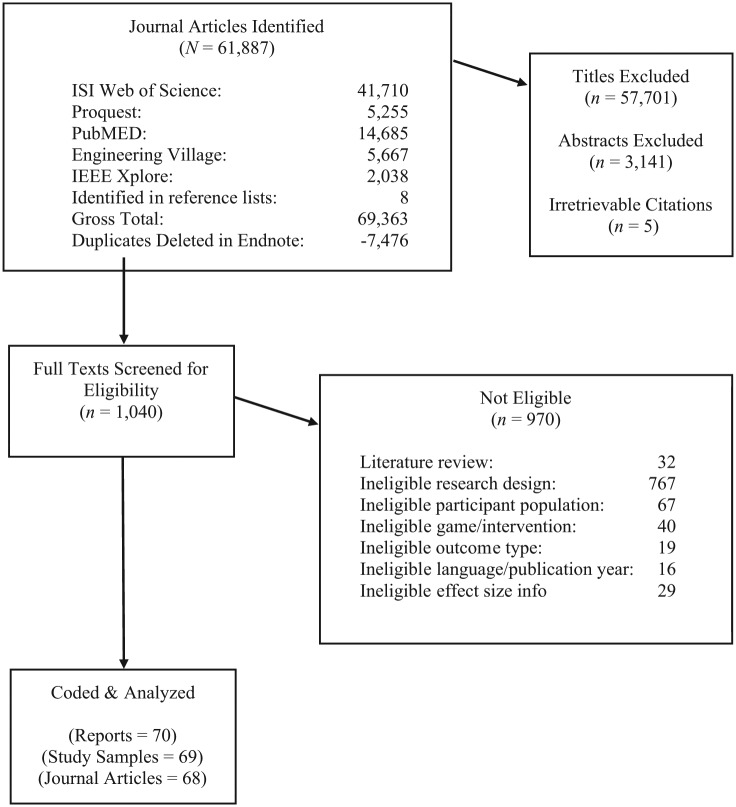
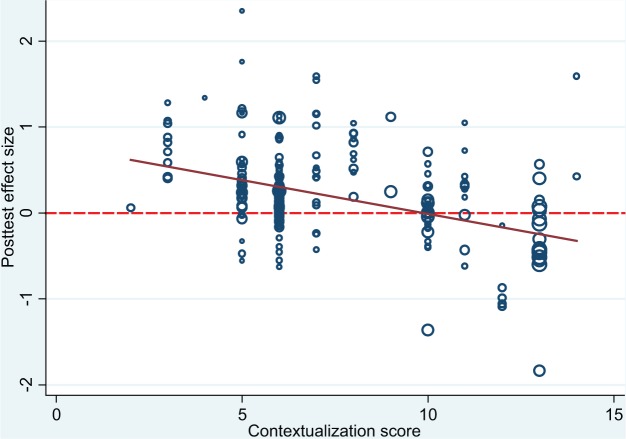
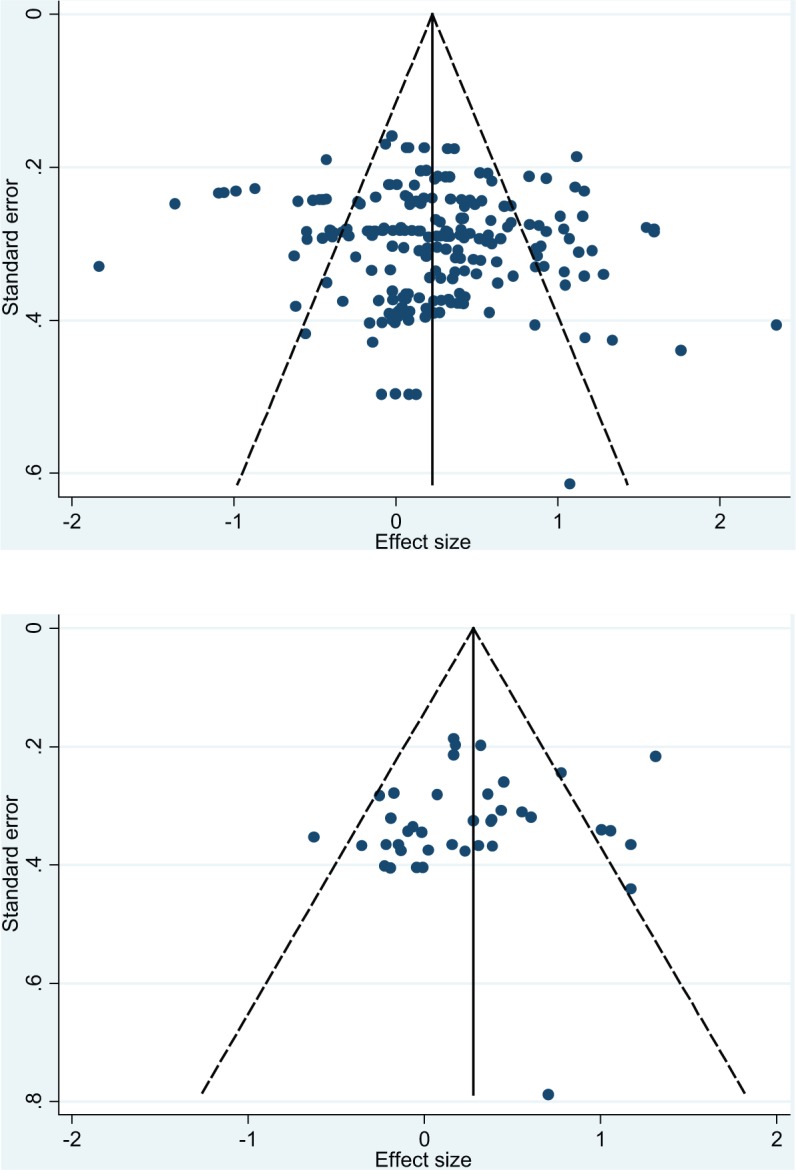
Verification
Claims the paper makes
The claims and statistics of this paper haven’t been checked yet.
Run the check — free, no account needed. It reads the open-access text and checks the sources it cites.
Claims other papers make about this one
Each is checked against this paper’s own text: does it say what the citing paper says it does?
The source backs part of the claim, not all of it — or backs it for a different population, condition or comparison.
In the citing paper
“Inclusion of game fiction is closely related to the use of narrative anchors and has been shown to be effective for learning as it situates and anchors learning in a context (Clark et al. 2016) and can further serve as a cognitive framework for problem solving (Dickey 2006).”
From The gamification of learning: a meta-analysis (2020) · cites this paper as Clark et al. 2016
Experimental — accuracy not yet measuredThe source backs part of the claim, not all of it — or backs it for a different population, condition or comparison.
In the citing paper
“In addition, the results of the summary effect analyses were similar to results from meta-analyses conducted in the context of games (see Clark et al. 2016;Wouters et al. 2013), indicating that the power of games can be transferred to non-game contexts by using game design elements.”
From The gamification of learning: a meta-analysis (2020) · cites this paper as Clark et al. 2016
Experimental — accuracy not yet measuredThe source backs part of the claim, not all of it — or backs it for a different population, condition or comparison.
In the citing paper
“This result for behavioral learning outcomes is in line with evidence from the context of games, showing that combinations of competition and collaboration in games are promising for learning (Clark et al. 2016).”
From The gamification of learning: a meta-analysis (2020) · cites this paper as Clark et al. 2016
Experimental — accuracy not yet measuredThe cited source says what the claim attributes to it.
In the citing paper
“Clark et al. (2016) included competition in their meta-analysis on digital games and found that combinations of competition and collaboration as well as single-player games without competitive elements can outperform games with mere competition.”
From The gamification of learning: a meta-analysis (2020) · cites this paper as Clark et al. 2016
In the citing paper
“The reviews have also documented the effects on students' learning outcomes and the key role of gamified designs (Alsawaier, 2018;Clark, Tanner-Smith & Killingsworth 2016).”
From Towards a motivational design? Connecting gamification user types and online learning activities (2020) · cites this paper as Clark, Tanner-Smith & Killingsworth 2016
Self-check
Percentages, sums and reported differences re-computed from the paper’s own numbers.
The self-check needs the paper’s full text.
Citations
Cites
Bias in meta-analysis detected by a simple, graphical test
Egger, M., Smith, G. D., Schneider, M., & Minder, C. (1997) · BMJ · doi:10.1136/bmj.315.7109.629 · Cited by 56,722
Self-efficacy: The exercise of control
Bandura, A., Freeman, W. H., & Lightsey, R. (1999) · Journal of Cognitive Psychotherapy · doi:10.1891/0889-8391.13.2.158 · Cited by 46,835
Situated Cognition and the Culture of Learning
Brown, J. S., Collins, A., & Duguid, P. (1989) · Educational Researcher · doi:10.3102/0013189x018001032 · Cited by 13,645
David, F. N., & Tukey, J. W. (1977) · Biometrics · doi:10.2307/2529486 · Cited by 12,707
Borenstein, M., Hedges, L. V., Higgins, J. P. T., & Rothstein, H. R. (2021) · doi:10.1002/9781119558378 · Cited by 9,799
What Video Games Have to Teach Us about Learning and Literacy
(2004) · Education + Training · doi:10.1108/et.2004.00446dae.002 · Cited by 6,674
Distribution Theory for Glass's Estimator of Effect Size and Related Estimators
Hedges, L. V. (1981) · Journal of Educational Statistics · doi:10.2307/1164588 · Cited by 5,695
The Handbook of Research Synthesis and Meta-Analysis
(2019) · doi:10.7758/9781610448864 · Cited by 4,553
Self-Efficacy and Academic Motivation
Schunk, D. H. (1991) · Educational Psychologist · doi:10.1080/00461520.1991.9653133 · Cited by 4,292
Pintrich, P. R. (2003) · Journal of Educational Psychology · doi:10.1037/0022-0663.95.4.667 · Cited by 3,459
Research works printed but not linked: 6
- Gleser L. J., 2009, The handbook of research synthesis and meta-analysis, 357
- 10.3102/10769986006002107 · DOI · Paper page
- Hedges L. V., 2007, Journal of Research in Rural Education, 22, 1
- López-López J. A., 2015, Assessing meta-regression models for examining moderator relationships with dependent effect sizes: A Monte Carlo simulation
- López-López J. A., 2010, Paper presented at the 5th annual meeting of the Society for Research Synthesis Methodology
- Raudenbush S. W., 2009, The handbook of research synthesis and meta-analysis, 295
Cited by
Sorted by citations
Items 801–900 of 1,000
Santos, V., Souza, L. D., Maia, Y., Darin, T., & Barcelos, T. (2019) · doi:10.5753/wiplay.2019.7837 · Cited by 2
Mphafudi, J., & Ramaila, S. M. (2020) · Education and new developments · doi:10.36315/2020end015 · Cited by 2
Paparistodemou, E., Meletiou-Mavrotheris, Μ., & Vasou, C. V. (2021) · Advances in game-based learning · doi:10.1007/978-3-030-76986-4_4 · Cited by 2
Checked Out? Videogame Programming in U.S. Libraries and Implications for Videogame Literacies
Abrams, S. S., & Eck, R. N. V. (2021) · Journal of Adolescent & Adult Literacy · doi:10.1002/jaal.1197 · Cited by 2
Breien, F., & Gkini, C. (2021) · Lecture notes in computer science · doi:10.1007/978-3-030-92182-8_23 · Cited by 2
The Impact of Competition on the Effectiveness of Cognitive Games
Mirzakhani, S., & Moradi, H. (2021) · International Serious Games Symposium (ISGS) · doi:10.1109/isgs54702.2021.9685013 · Cited by 2
Klingberg, T., & Sauce, B. (2022) · Cambridge University Press eBooks · doi:10.1017/9781108399838.034 · Cited by 2
Investigating the role of shared screen in a computer-supported classroom in learning
Shaikh, R., Nagarjuna, G., & Gupta, A. K. (2023) · Education and Information Technologies · doi:10.1007/s10639-022-11567-7 · Cited by 2
Juego y procesos lectores del alumnado de secundaria de zonas de necesidad de transformación social
León, A. M., Rodríguez-Ferrer, J. M., & Collado-Soler, R. (2023) · Bellaterra Journal of Teaching & Learning Language & Literature · doi:10.5565/rev/jtl3.1099 · Cited by 5
Analysis of the Effect of Applying VR Technology in Cross-Cultural Art Course
Wu, W., Liu, Y., Yu, L., & Wei, W. (2023) · Lecture notes in computer science · doi:10.1007/978-3-031-35946-0_24 · Cited by 2
Categorization of game-based learning in middle school mathematics - A review
Stohlmann, M. S. (2023) · Middle School Journal · doi:10.1080/00940771.2023.2254175 · Cited by 2
“In the past six years, several review articles have been written about game-based learning (Byun & Joung, 2018; Clark et al., 2016; Gao & Sun, 2020).”
BackgroundMethodUsing productive failure to learn genetics in a game-based environment
Cao, L., Lai, P. K., & Yang, H. (2023) · Instructional Science · doi:10.1007/s11251-023-09644-6 · Cited by 2
“Although the potential of GBL for learning scientific knowledge has been widely recognised (Clark et al., 2016, 2018; Sitzmann, 2011; Vogel et al., 2006; Wouters et al., 2013), how it can aid students in learning difficult knowledge and skills remains unknown.”
Improving Gamification Technology in Corporate Training in the Legal Industry
Firsov, Y., Vasilieva, O., & Kalugina, O. A. (2023) · Lecture notes in networks and systems · doi:10.1007/978-3-031-48020-1_20 · Cited by 2
Lee, S., Mott, B., Vandenberg, J. L., Spires, H. A., & Lester, J. C. (2023) · IEEE Conference on Games (CoG) · doi:10.1109/cog57401.2023.10333202 · Cited by 2
Educator-oriented Authoring Tools to Develop Rich Educational Media: A Systematic Review
Ahmad, A., Elaklouk, A. M., Edris, I., & Salleh, N. D. H. M. (2023) · International Conference on Applied Computational Intelligence in Information Systems (ACIIS) · doi:10.1109/aciis59385.2023.10367320 · Cited by 2
Pedagogical practices in a gaming affinity space and the motivating sting of Elden Ring
von Gillern, S., Robinson, B., & Czauderna, A. (2024) · E-Learning and Digital Media · doi:10.1177/20427530241232496 · Cited by 3
“Meta-analyses have shown that digital game-based learning is effective for promoting student learning in general (Clark et al., 2016; Wouters and Van Oostendorp, 2013) as well as in speci fi c academic disciplines including science (Lei et al., 2022), math (Tokac et al., 2019), and TESOL vocabulary…”
Bruco: a video game to learn the periodic table
Vadivel, D., Branciforti, D. S., & Dondi, D. (2024) · F1000Research · doi:10.12688/f1000research.130351.1 · Cited by 2
Citraningtyas, C. E. C., & Cendana, W. (2024) · Journal of Global Research in Education and Social Science · doi:10.56557/jogress/2024/v18i28693 · Cited by 2
ProBee: A Provenance-based Design for an Educational Game Analytics Model
Marques, F., Lignani, L., Quadros, J. R. D. T., Amorim, M., Viana, W., Ogasawara, E., & dos Santos, J. A. F. (2024) · Technology Knowledge and Learning · doi:10.1007/s10758-024-09758-x · Cited by 2
“The main goal is to enhance student learning while playing (Gee, 2007; Clark et al., 2016; Plass et al., 2020).”
Designing preschool children's educational games for enlightenment through decision analysis methods
Zhu, Y., Zhou, R., & Zhang, Y. (2024) · Multimedia Tools and Applications · doi:10.1007/s11042-024-19803-7 · Cited by 2
A Neurotechnological Study to Quantify Differences in Brain Activity Using Game-Based Learning
Varón, D. J., Juárez-Varón, M. Á., Recuerda, A. M., & Andrés, B. (2024) · International Journal of Game-Based Learning · doi:10.4018/ijgbl.349219 · Cited by 6
Physics card games to support knowledge organization: design considerations and teachers’ attitudes
Levy, S., Perl‐Nussbaum, D., & Yerushalmi, E. (2024) · Physics Education · doi:10.1088/1361-6552/ad61b2 · Cited by 2
Exploring the relationship between learning emotion and cognitive behaviors in a digital game
Chen, L., Zhan, Z., Chen, H., & Zheng, L. (2024) · Future in Educational Research · doi:10.1002/fer3.54 · Cited by 2
Design fit in gamified online programming learning environment
Wang, W., & Sari, M. K. (2025) · Learning and Instruction · doi:10.1016/j.learninstruc.2025.102087 · Cited by 5
Zhao, J., Shangguan, S., Long, G., & Yang, Q. (2025) · Journal of Science Education and Technology · doi:10.1007/s10956-025-10205-4 · Cited by 5
“Although games are a medium of affordance, Clark et al. (2016) suggested that the quality of a medium for learning depends on its design.”
Carvilhe, C., Moro, G. H. M., Vermonde, A., Filho, J. G. N., & Junior, C. N. S. (2024) · IEEE Frontiers in Education Conference (FIE) · doi:10.1109/fie61694.2024.10893337 · Cited by 2
Hunt, J. H., Taub, M., Marino, M. T., & Holman, K. (2025) · Education Sciences · doi:10.3390/educsci15091234 · Cited by 2
Chen, C., & Chen, C.-H. (2025) · Research in Science & Technological Education · doi:10.1080/02635143.2025.2561992 · Cited by 5
“In particular, DGBL has been shown to improve learning outcomes, problem-solving skills, and higher-order thinking, making it a promising tool for educational practices (Clark, Tanner-Smith, and Killingsworth 2016; Homer et al. 2018; Yang 2015).”
MINER TROUBLES: A GAMIFIED MATCHING-TO-SAMPLE
Regaço, A., Carvalho, F. C., de Souza, S. R., Rose, J. C. D., & de Souza, D. (2025) · Experimental Analysis of Human Behavior Bulletin · doi:10.14244/eahb.v35ispecialissue.9 · Cited by 2
Gamification as a tool to rise motivation of studying immunology in a medical university
Davidovich, N. V., Bashilova, E. N., Shestakova, M. V., & Kukalevskaya, N. N. (2021) · Professional education in the modern world · doi:10.20913/2618-7515-2020-4-21 · Cited by 2
Dynamic Serious Game for Developing Programming Skills
Skraparli, G., Karavidas, L., & Tsiatsos, Τ. (2022) · Lecture notes in networks and systems · doi:10.1007/978-3-030-96296-8_52 · Cited by 2
Perttula, A., Tuomi, P., Kiili, K. J. M., & Lindstedt, A. (2016) · International Academic Mindtrek Conference (Mindtrek) · doi:10.1145/2994310.2994328 · Cited by 2
Computational Thinking in Educational Digital Games
Haseski, H. İ., İLİÇ, U., & Tuğtekin, U. (2017) · Advances in early childhood and K-12 education · doi:10.4018/978-1-5225-3200-2.ch013 · Cited by 2
Beginning to understand variation in teaching approaches to game-based learning
Morelock, J. R., & Matusovich, H. (2017) · IEEE Frontiers in Education Conference (FIE) · doi:10.1109/fie.2017.8190440 · Cited by 2
“As recent meta-analyses and systematic reviews have summarized, this research has produced fruitful results by providing evidence that GBL tends to result in positive effects on learning outcomes [1, 10].”
ResultGaming to Learn astronomy, an innovation approach, two study cases
Μεταξά, Μ. (2019) · EPJ Web of Conferences · doi:10.1051/epjconf/201920001003 · Cited by 2
Digitale spil i undervisningen
Hanghøj, T. (2019) · Tidsskriftet Læring og Medier (LOM) · doi:10.7146/lom.v12i21.112888 · Cited by 2
3D Technology in the Sphere of Cultural Heritage and Serious Games
Milková, E., Chadimová, L., & Maněnová, M. (2019) · Lecture notes in electrical engineering · doi:10.1007/978-3-030-21507-1_28 · Cited by 2
Technology Transformation in Education: Consequences of Digitalization
Bondarenko, T. G., Максимова, Т. П., & Zhdanova, O. A. (2020) · Lecture notes in networks and systems · doi:10.1007/978-3-030-47458-4_75 · Cited by 2
Outcomes assessment pitfalls: challenges to quantifying knowledge gain in a sex education game
Bertozzi, E., Bertozzi-Villa, A., Padankatti, S., & Sridhar, A. (2021) · Gates Open Research · doi:10.12688/gatesopenres.13129.3 · Cited by 2
Cognition and Young Learners’ Language Development
Butler, Y. G. (2020) · Springer international handbooks of education · doi:10.1007/978-3-030-47073-9_2-1 · Cited by 4
Li, Y., Sutedjo, A., Ramos, S. J., Garcimartin, H. R., & André, T. (2021) · Advances in game-based learning · doi:10.1007/978-3-030-75142-5_10 · Cited by 2
Schultheis, J., & Aprea, C. (2021) · Advances in game-based learning · doi:10.1007/978-3-030-75142-5_1 · Cited by 5
Vocabulary interventions for second language (L2) learners up to six years
Hjetland, H. N., Hofslundsengen, H. C., Klem, M., Karlsen, J., Hagen, Å. M. M., Engevik, L. I., Geva, E., Norbury, C., Monsrud, M.-B., & Naess, K.-A. B. (2021) · Cochrane Database of Systematic Reviews · doi:10.1002/14651858.cd014890 · Cited by 3
Games, Dialogue and Learning: Exploring Research Perspectives
Hanghøj, T., Silseth, K., & Arnseth, H. C. (2021) · VBN Forskningsportal (Aalborg Universitet) · doi:10.34190/gbl.21.111 · Cited by 2
Multimedia Learning with Media
(2021) · Cambridge University Press eBooks · doi:10.1017/9781108894333.045 · Cited by 2
Multimedia Learning in e-Courses
Clark, R. C. (2021) · Cambridge University Press eBooks · doi:10.1017/9781108894333.054 · Cited by 5
Castro, S. S., & Sevillano, M. Á. P. (2022) · Edutec Revista Electrónica de Tecnología Educativa · doi:10.21556/edutec.2022.79.2371 · Cited by 2
Guiding Questions for Game-Based Learning
Schrier, K. “. (2018) · Springer international handbooks of education · doi:10.1007/978-3-319-71054-9_59 · Cited by 2
Learning from Social Impact Games to Support Integration into Middle School Classrooms
Jackson, R. E., & Sheepy, E. (2019) · Springer eBooks · doi:10.1007/978-981-13-2766-7_117 · Cited by 2
Rodi, M., & Geoffre, T. (2022) · SHS Web of Conferences · doi:10.1051/shsconf/202213806016 · Cited by 2
Rodi, M., Chapuis, N. D., Geoffre, T., & Alvarez, L. (2022) · Alsic · doi:10.4000/alsic.6065 · Cited by 5
Pallanti, L. (2022) · SHS Web of Conferences · doi:10.1051/shsconf/202214302008 · Cited by 2
Catch Me If you Can: An Educational Serious Game to Teach Grammatical English Rules
Ayman, R., Ayman, R., & Sharaf, N. (2022) · Lecture notes in computer science · doi:10.1007/978-3-031-15325-9_15 · Cited by 3
Cortés, L. E. P., Gao, Y., Kessner, T. M., Bernier, J., & Gee, E. R. (2022) · International Journal of Game-Based Learning · doi:10.4018/ijgbl.309127 · Cited by 3
Leuchter, I., & Kurtz, G. (2022) · International Journal of Advanced Corporate Learning (iJAC) · doi:10.3991/ijac.v15i2.30867 · Cited by 2
The Effectiveness of Adaptive Digital Games for Learning: Calling for a Broader View on Assessment
Vanbecelaere, S., Demedts, F., Reynvoet, B., & Depaepe, F. (2022) · Lecture notes in computer science · doi:10.1007/978-3-031-22124-8_26 · Cited by 2
Lomonaco, F., Taibi, D., Trianni, V., Buršić, S., Donabauer, G., & Ognibene, D. (2023) · Communications in computer and information science · doi:10.1007/978-3-031-29800-4_26 · Cited by 4
Sadanala, G., Xu, X., He, H., Bueno-Vesga, J. A., & Li, S. E. (2023) · Journal of Research on Technology in Education · doi:10.1080/15391523.2023.2210321 · Cited by 4
“Even though VR has sparked a lot of interest and many VR applications have entered the educational market, very few such applications have been developed specifically for the (Clark et al., 2016; Hanafi et al., 2017) context of online orientation.”
Baßeng, G., & Budke, A. (2024) · GW-Unterricht · doi:10.1553/gw-unterricht172s5 · Cited by 2
El impacto de los juegos epistémicos para aprender sobre naturaleza de la ciencia en primaria
Más, M. A. M., & Alonso, Á. V. (2024) · Enseñanza de las Ciencias Revista de investigación y experiencias didácticas · doi:10.5565/rev/ensciencias.5946 · Cited by 7
Gauthier, A. (2024) · Education Sciences · doi:10.3390/educsci14040366 · Cited by 10
“…not report the cultural make-up of participants, with one review finding that 67% of GBL studies did not include information regarding ethnicity [13]; this highlights the clear need for more research about the relationship between culture and the acceptability of game-based learning by…”
BackgroundResultA Process-Focused Experiential Approach to IT Education Using Peer Learning
John, J. S., & John, K. S. (2024) · Journal of Information Systems Education · doi:10.62273/ores9068 · Cited by 3
“In another meta-analysis of studies on the use of games for learning, Clark et al. (2016) found that, compared to non-game methods, game-based learning significantly enhanced student learning.”
ResultMeier, J. V., & Kaspar, K. (2024) · Frontiers in Education · doi:10.3389/feduc.2024.1379755 · Cited by 3
Lach, E. (2017) · Advances in intelligent systems and computing · doi:10.1007/978-3-319-67792-7_48 · Cited by 2
Projective Replay Analysis: A Reflective Approach for Aligning Educational Games to Their Goals
Harpstead, E. (2018) · KiltHub Repository · doi:10.1184/r1/6721163 · Cited by 2
Scaffolding and Assessing Teachers’ Examination of Games for Teaching and Learning
Shah, M. (2019) · Advances in game-based learning · doi:10.1007/978-3-030-15569-8_10 · Cited by 2
Assessing Game-Based Mathematics Learning in Action
Ke, F., Parajuli, B., & Smith, D. (2019) · Advances in game-based learning · doi:10.1007/978-3-030-15569-8_11 · Cited by 2
Promises and Prospects of Educational Technology, Evidence from Systematic Reviews and Meta-analyses
Borokhovski, E., Tamim, R. M., Bernard, R. M., & Schmid, R. F. (2020) · Springer eBooks · doi:10.1007/978-3-030-10576-1_99 · Cited by 2
Effects of Video Games on Child/Youth Cognitive Skills and Knowledge Gain
Brooks, P. J., & Rose, M. C. (2020) · Wiley eBooks · doi:10.1002/9781119011071.iemp0217 · Cited by 2
Ketelhut, D. J., & Nelson, B. (2021) · doi:10.1093/obo/9780199756810-0288 · Cited by 2
Perspectives on learning from the learning sciences
Fischer, F., Sommerhoff, D., & Keune, A. (2022) · Elsevier eBooks · doi:10.1016/b978-0-12-818630-5.14007-2 · Cited by 6
Fitzpatrick, D., & Burns, J. (2018) · Campbell Systematic Reviews: Better Evidence for a Better World · doi:10.1002/cl2.194 · Cited by 1
Slussareff, M., & Lukavská, K. (2021) · Pediatrie pro praxi · doi:10.36290/ped.2021.021 · Cited by 2
Minecraft and Elementary Literacy Learning
von Gillern, S., Stufft, C. J., Marlatt, R., & Nadolny, L. (2021) · Advances in game-based learning book series · doi:10.4018/978-1-7998-7271-9.ch017 · Cited by 1
Grounding Technology in the Learning Sciences
Sawyer, R. K. (2022) · Cambridge University Press eBooks · doi:10.1017/9781108888295.017 · Cited by 1
Tuomi, P., Fager, K., & Multisilta, J. (2022) · Advances in web technologies and engineering book series · doi:10.4018/978-1-6684-4291-3.ch005 · Cited by 1
A Bibliometric Analysis of Studies on Educational Games
Yasemin, K. U. Z. U., & Kuzu, O. (2022) · Ahi Evran Üniversitesi Sosyal Bilimler Enstitüsü Dergisi · doi:10.31592/aeusbed.1102403 · Cited by 1
Dijital Çözümlerle Yenilikçi Fen Öğretimi: Öğrenme Ortamları ve Teknolojiler
Yılmaz, Ö. (2023) · Özgür Yayınları eBooks · doi:10.58830/ozgur.pub123.c536 · Cited by 1
An educator-oriented method for designing serious role-playing games: An initial exploration
Ahmad, A., Law, E. L., & Yueh, L. K. (2023) · AIP conference proceedings · doi:10.1063/5.0180763 · Cited by 1
Lise Öğrencilerinin Dijital Oyunlarla Elde Ettikleri 21. Yüzyıl Becerilerine İlişkin Algı Ölçeği
Koçak, T., Korkmaz, Ö., & Saltan, F. (2024) · Bayburt Eğitim Fakültesi Dergisi · doi:10.35675/befdergi.1366252 · Cited by 1
Rome: The Game. Creating an online course as an interactive adventure game
Moser, C., & Thomas, C. (2024) · The journal of classics teaching · doi:10.1017/s2058631024000394 · Cited by 1
“The body of research that addresses this question is large and complex, but a comprehensive meta-analysis on digital games and learning (Clark et al ., 2016) provides an overview.”
Cloude, E. B., Dindar, M., Ninaus, M., & Kiili, K. J. M. (2024) · Lecture notes in computer science · doi:10.1007/978-3-031-72315-5_7 · Cited by 1
Kafka or Not? Concept for an AI-Supported Multi-touch Tabletop Game for Literature Classes
Kathmann, J., Gerjets, P. H., & Brucker, B. (2024) · Lecture notes in computer science · doi:10.1007/978-3-031-74138-8_27 · Cited by 1
Good luck have fun: The need for video game pedagogy in teacher education
Richardson, T. (2024) · Future in Educational Research · doi:10.1002/fer3.68 · Cited by 1
Gameplay Performance as a Predictor of Adaptive Expertise in Primary School Students
Rocha, M., & Dondio, P. (2024) · Lecture notes in computer science · doi:10.1007/978-3-031-78269-5_2 · Cited by 1
Playability heuristics for game interface design for children
Sungkaew, K., Kaewbamrung, C., Phirom, T., Chitjaruenyoo, W., Phophet, C., Phrommueang, P., Yingmuang, S., & Nizam, D. N. M. (2024) · CCF Transactions on Pervasive Computing and Interaction · doi:10.1007/s42486-024-00176-7 · Cited by 3
“According to a study by (Clark et al. 2016), educational games have shown positive effects on children’s cognitive abilities, including problem-solving skills and critical thinking.”
Adaptive serious games assessment: The case of the blood transfusion game in nursing education
Ifenthaler, D., Şahi̇n, M., Boo, I., Rajasegeran, D. D., & Yuh, A. S. (2024) · Computers and Education Artificial Intelligence · doi:10.1016/j.caeai.2024.100351 · Cited by 1
“In a widely cited meta-analysis, Clark et al. (2016) report that serious games had a moderate to strong effect on improving overall learning outcomes, including cognitive and interpersonal skills, compared to non-game conditions.”
Quality and Educational Value of Popular Digital Games in Younger School Age
Sadović, F. P., Demirović, E., Trtovac-Dedeić, A., & Karaahmetović, H. (2024) · Društvene i humanističke studije · doi:10.51558/2490-3647.2024.9.2.1119 · Cited by 1
WIP: Investigating Students' Emotions and Motivations in a Game-Based Learning Environment
Deeter, A., Goodall, G., Pham, K., Sundstrom, J. L., Qazilbash, A., Zastavker, Y. V., Harteveld, C., Bennett, V. G., & Abdoun, T. H. (2024) · IEEE Frontiers in Education Conference (FIE) · doi:10.1109/fie61694.2024.10893019 · Cited by 1
“…– from improving students’ “conceptual understanding and argumentation skills” to building “intellectual openness, work ethic and conscientiousness, and positive core self-evaluation” to having “a significant and positive impact on student engagement and academic performance” [2][3][4].”
WIP: For the Love of the Game: Exploring Student Motivation in Game-Based Learning Environments
Deeter, A., Pham, K., Sundstrom, J. L., Goodall, G., Qazilbash, A., Zastavker, Y. V., Harteveld, C., Bennett, V. G., & Abdoun, T. H. (2024) · IEEE Frontiers in Education Conference (FIE) · doi:10.1109/fie61694.2024.10893400 · Cited by 1
“…on non-cognitive learning outcomes demonstrated its supportive role in the development of both interpersonal skills, i.e., “intellec-tual openness, work ethic and conscientiousness, and positive core self-evaluation,” and intrapersonal skills, i.e., “teamwork, collaboration, and leadership” [5].”
Protocol for Bayesian Meta-analysis on Digital Game-Enhanced Vocabulary Learning
Shahiwala, S., & Rahul, D. R. (2025) · Research Synthesis in Applied Linguistics · doi:10.1080/29984475.2025.2490568 · Cited by 1
Buhay, C. M., & Tandog, L. C. (2025) · EIKI Journal of Effective Teaching Methods · doi:10.59652/jetm.v3i2.522 · Cited by 1
“This supports earlier findings that incorporating games into instruction can improve learners’ achievement in mathematics (Clark et al., 2016; Wouters et al., 2013) and foster clearer comprehension of mathematical concepts (Yusoff et al., 2014).”
Os, J. M. C. V., Cook, N. B., Ledesma, D., Cradock, R., Abraham, O., & Bräuer, M. (2025) · Journal of Dairy Science · doi:10.3168/jds.2025-26311 · Cited by 1
Dı́az, B. D., García‐Ramos, R., & Martín, S. A. (2025) · Cogent Education · doi:10.1080/2331186x.2025.2514974 · Cited by 1
Roux, G., Caicedo-Eraso, J. C., & Millán, G. C. S. (2025) · International Journal of Bilingual Education and Bilingualism · doi:10.1080/13670050.2025.2530217 · Cited by 1
“SVG create immersive and interactive learning environments that enhance engagement, knowledge acquisition, and problem-solving skills (Clark, Tanner-Smith, and Killingsworth 2016; Prensky 2001).”
Gupta, A., Min, W., Carpenter, D., Azevedo, R., & Lester, J. C. (2025) · Lecture notes in computer science · doi:10.1007/978-3-031-98459-4_32 · Cited by 2
Elemental Home: A Video Game to Explore Chemistry in Everyday Life
Juárez-González, P., Cano, M. J., Robles, D. C., & Mariscal, A. J. F. (2025) · Journal of Chemical Education · doi:10.1021/acs.jchemed.5c00168 · Cited by 1
Enhancing stealth assessment in game-based learning through goal recognition
Gupta, A., Min, W., Carpenter, D., Azevedo, R., & Lester, J. C. (2025) · Journal of Research on Technology in Education · doi:10.1080/15391523.2025.2555246 · Cited by 1
“Digital games are increasingly recognized for their ability to create engaging educational experiences that support learning across different domains (Clark et al., 2016; Qian & Clark, 2016; Plass et al., 2020).”
MathFlowLens: a classification and visualization tool for analyzing students’ procedural pathways
Pradhan, S. P., Ottmar, E., Gurung, A., & Lee, J. (2025) · Educational Technology Research and Development · doi:10.1007/s11423-025-10557-z · Cited by 2
van der Linden, A., Meulenbroeks, R. R., & van Joolingen, W. (2025) · International Journal of Physics & Chemistry Education · doi:10.51724/ijpce.v17i2.364 · Cited by 1
Metadata
- Authors
- Clark, D. B., Tanner-Smith, E. E., & Killingsworth, S. S.
- Affiliations
- Vanderbilt University (US)
- Vanderbilt University
- Venue
- Review of Educational Research
- Published
- 2016-03
- Volume
- 86
- Issue
- 1
- Pages
- 79-122
- ISSN
- 0034-6543 (ISSN-L)
- 1935-1046
- PMC
- PMC4748544
- OpenAlex
- W2099460238
- Cited by
- 1,274
- References
- 146
- Citations by year
- 2026: 159 · 2025: 129 · 2024: 126 · 2023: 120 · 2022: 125 · 2021: 163 · 2020: 125 · 2019: 122 · 2018: 103 · 2017: 59 · 2016: 28
- FWCI
- 169.76
- Type
- journal article
- Language
- en
- Open access
- hybrid
- doi.org
- Locations
- Review of Educational Research (publishedVersion, cc-by-nc)
- PubMed Central (publishedVersion, cc-by-nc)
- PubMed (publishedVersion)
- Topics
- Social Sciences › Psychology › Developmental and Educational Psychology › Educational Games and Gamification
- Social Sciences › Sociology and Political Science › Digital Games and Media
- Social Sciences › Psychology › Experimental and Cognitive Psychology › Visual and Cognitive Learning Processes
- Keywords
- video games, game-based learning, educational game design, game mechanics, game affordances, learning outcomes, K-16 education
About these checks
Registry, retraction, Cites and statistics results are computed, not judged, with one exception: a printed reference that no index lists is read once by a model before it counts as a citation error. Claims are extracted by a model and kept only when their quote appears verbatim in the text; each cited source is then checked, with a model’s help, for whether it says what the claim relies on. Those verdicts can be wrong — read the claim’s quote and the cited source before relying on one.
Statistics and arithmetic are recomputed, not judged.
Confidence bands are shown only for fields calibrated on our annotated test set. None is calibrated yet, so no band is shown.
What counts as a claim ›How we measure confidence ›How we check this ›
Are you an author, or do you see a problem with this page? Request a review
