

Learning Sentiment-Specific Word Embedding for Twitter Sentiment Classification
Open accessThe DOI matches its Crossref record; 56 of the 58 references it cites were found in a registry or an index.
Abstract
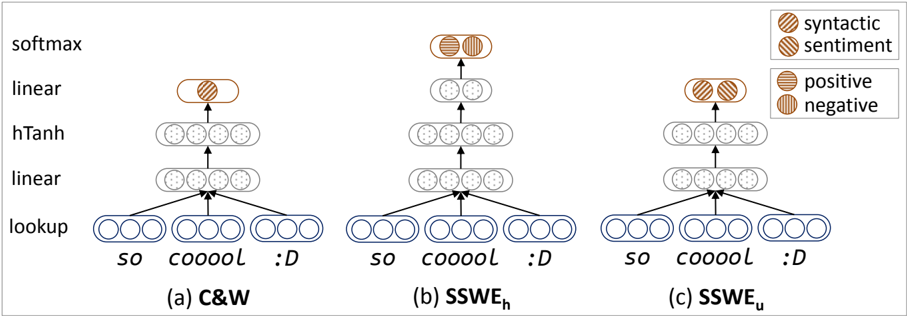
We present a method that learns word embedding for Twitter sentiment classification in this paper.Most existing algorithms for learning continuous word representations typically only model the syntactic context of words but ignore the sentiment of text.This is problematic for sentiment analysis as they usually map words with similar syntactic context but opposite sentiment polarity, such as good and bad, to neighboring word vectors.We address this issue by learning sentimentspecific word embedding (SSWE), which encodes sentiment information in the continuous representation of words.Specifically, we develop three neural networks to effectively incorporate the supervision from sentiment polarity of text (e.g.sentences or tweets) in their loss functions.To obtain large scale training corpora, we learn the sentiment-specific word embedding from massive distant-supervised tweets collected by positive and negative emoticons.Experiments on applying SS-WE to a benchmark Twitter sentiment classification dataset in SemEval 2013 show that (1) the SSWE feature performs comparably with hand-crafted features in the top-performed system; (2) the performance is further improved by concatenating SSWE with existing feature set.
Overview
The claims and statistics of this paper haven’t been checked yet.
Free: it reads the open-access text and checks the first 5 claims that cite a source we can check. Create a free account to check every claim.
Integrity signals
Registry
Cites
Statistics
Figures
Verification
Claims the paper makes
The claims and statistics of this paper haven’t been checked yet.
Free: it reads the open-access text and checks the first 5 claims that cite a source we can check. Create a free account to check every claim.
Claims other papers make about this one
Each is checked against this paper’s own text: does it say what the citing paper says it does?
The source backs part of the claim, not all of it — or backs it for a different population, condition or comparison.
In the citing paper
“Tang et al. [64] pioneered the Sentiment-Specific Word Embeddings (SSWE). Empirical results have shown its superior efficacy over other embeddings in integrating emotion labels at the word level for emotion-centric tasks.”
From A Survey of Deep Learning-Based Multimodal Emotion Recognition: Speech, Text, and Face (2023) · cites this paper as [64]
Experimental — accuracy not yet measured
Self-check
Percentages, sums and reported differences re-computed from the paper’s own numbers.
The self-check needs the paper’s full text.
Citations
Cites
(2003) · Journal of Machine Learning Research · doi:10.5555/944919.944937 · Cited by 32,337
Distributed Representations of Words and Phrases and their Compositionality
Mikolov, T., Sutskever, I., Chen, K., Corrado, G., & Dean, J. (2013) · arXiv · doi:10.48550/arxiv.1310.4546 · Cited by 24,533 · cited 2×
“Although existing word embedding learning algorithms (Collobert et al., 2011; Mikolov et al., 2013) are intuitive choices, they are not effective enough if directly used for sentiment classification.”
BackgroundRepresentation Learning: A Review and New Perspectives
Bengio, Y., Courville, A., & Vincent, P. (2013) · IEEE Transactions on Pattern Analysis and Machine Intelligence · doi:10.1109/tpami.2013.50 · Cited by 13,001
Blei, D. M., Ng, A. Y., & Jordan, M. I. (2002) · Advances in Neural Information Processing Systems 14 · doi:10.7551/mitpress/1120.003.0082 · Cited by 12,223
(2010) · Cited by 8,261
Mining and summarizing customer reviews
Hu, M., & Liu, B. (2004) · Proceedings of the tenth ACM SIGKDD international conference on Knowledge discovery and data mining · doi:10.1145/1014052.1014073 · Cited by 7,793
Thumbs up?: sentiment classification using machine learning techniques
Pang, B., Lee, L., & Vaithyanathan, S. (2002) · Proceedings of the ACL-02 conference on Empirical methods in natural language processing - EMNLP '02 · doi:10.3115/1118693.1118704 · Cited by 7,024
Learning Word Vectors for Sentiment Analysis
Maas, A. L., Daly, R. E., Pham, P. T., Huang, D., Ng, A. Y., & Potts, C. (2011) · Cited by 6,961
Recursive Deep Models for Semantic Compositionality Over a Sentiment Treebank
Socher, R., Perelygin, A., Wu, J., Chuang, J., Manning, C. D., Ng, A., & Potts, C. (2013) · Proceedings of the 2013 Conference on Empirical Methods in Natural Language Processing · doi:10.18653/v1/d13-1170 · Cited by 6,878
Opinion Mining and Sentiment Analysis
Pang, B., & Lee, L. (2008) · now publishers, Inc. eBooks · doi:10.1561/9781601981516 · Cited by 6,720
Research works printed but not linked: 5
- Alec Go, Richa Bhayani, and Lei Huang. 2009. Twit- ter sentiment classification using distant supervision. CS224N Project Report, Stanford, pages 1-12.
- Tomas Mikolov, Ilya Sutskever, Kai Chen, Greg Corra- do, and Jeffrey Dean. 2013. Distributed representa- tions of words and phrases and their compositionali- ty. The Conference on Neural Information Process- ing Systems.
- Preslav Nakov, Sara Rosenthal, Zornitsa Kozareva, Veselin Stoyanov, Alan Ritter, and Theresa Wilson. 2013. Semeval-2013 task 2: Sentiment analysis in twitter. In Proceedings of the International Work- shop on Semantic Evaluation, volume 13.
- Richard Socher, J. Pennington, E.H. Huang, A.Y. Ng, and C.D. Manning. 2011c. Semi-supervised recur- sive autoencoders for predicting sentiment distribu- tions. In Conference on Empirical Methods in Nat- ural Language Processing, pages 151-161.
- Richard Socher, Brody Huval, Christopher D. Man- ning, and Andrew Y. Ng. 2012. Semantic Com- positionality Through Recursive Matrix-Vector S- paces. In Proceedings of the Conference on Empiri- cal Methods in Natural Language Processing.
Cited by
Items 901–1,000 of 1,000
Enriching Lexicons with Ephemeral Words for Sentiment Analysis in Social Streams
Melidis, D. P., Campero, A. V., Iosifidis, V., Ntoutsi, E., & Spiliopoulou, M. (2018) · International Conference on Web Intelligence, Mining and Semantics · doi:10.1145/3227609.3227664 · Cited by 3
Přibáň, P., & Martínek, J. (2018) · Workshop on Computational Approaches to Subjectivity, Sentiment and Social Media Analysis (WASSA) · doi:10.18653/v1/w18-6232 · Cited by 3
Book2Vec: Representing Books in Vector Space Without Using the Contents
Anvari, S., & Amirkhani, H. (2018) · International Conference on Computer and Knowledge Engineering · doi:10.1109/iccke.2018.8566329 · Cited by 3
Improved Review Sentiment Analysis with a Syntax-Aware Encoder
Zeng, J., Yang, M., Zhou, K., Ma, X., Wang, Y., Xu, X., & Xiao, Z. (2019) · Lecture notes in computer science · doi:10.1007/978-3-030-26075-0_6 · Cited by 3
Rattanajariya, T., & Piromsopa, K. (2019) · International Conference on Natural Language Processing and Information Retrieval (NLPIR) · doi:10.1145/3342827.3342848 · Cited by 3
Specificity-Driven Cascading Approach for Unsupervised Sentiment Modification
Yang, P., Lin, J., Xu, J., Xie, J., Su, Q., & Sun, X. (2019) · Conference on Empirical Methods in Natural Language Processing (EMNLP) · doi:10.18653/v1/d19-1553 · Cited by 3
Multi-view Document Classification with Co-training
Sevım, S., Ekıncı, E., & Omurca, S. İ. (2020) · Signal Processing and Communications Applications Conference (SIU) · doi:10.1109/siu49456.2020.9302494 · Cited by 3
Learning Domain-Specific Word Embeddings from COVID-19 Tweets
Aigbe, S. A., & Eick, C. F. (2021) · IEEE International Conference on Big Data (BigData) · doi:10.1109/bigdata52589.2021.9671817 · Cited by 3
Sentiment Quantification of User-Generated Content
Sebastiani, F. (2017) · Springer eBooks · doi:10.1007/978-1-4614-7163-9_110170-1 · Cited by 3
Tataru, C. A., & David, M. M. (2019) · bioRxiv (Cold Spring Harbor Laboratory) · doi:10.1101/748152 · Cited by 3
Sriram, S. (2020) · Arrow - TU Dublin (Technological University Dublin) · doi:10.21427/5519-h979 · Cited by 6
Networks with pixels embedding: a method to improve noise resistance in images classificationPreprint
Liu, Y., Tu, H.-L., Zhou, C.-C., Liu, Y., & Zhang, F. (2020) · arXiv (Cornell University) · doi:10.48550/arxiv.2005.11679 · Cited by 3
Artificial intelligence prediction of stock prices using social mediaPreprint
Ranawat, K., & Giani, S. (2021) · arXiv (Cornell University) · doi:10.48550/arxiv.2101.08986 · Cited by 3
Sentiment Quantification of User-Generated Content
Sebastiani, F. (2018) · Springer eBooks · doi:10.1007/978-1-4939-7131-2_110170 · Cited by 3
A Simple Weakly-Supervised Contrastive Learning Framework for Few-shot Sentiment ClassificationPreprint
Chen, L., Ren, Z., Lu, S., Huang, X., Wang, W., Xu, C. X., Zhao, W. Z., & Guan, Z. (2023) · Research Square · doi:10.21203/rs.3.rs-2699220/v1 · Cited by 3
Expanding Corpora for Chinese Polarity Classification via Opinion Paraphrase Generation
Pan, D., Song, J., & Fu, G. (2016) · Communications in computer and information science · doi:10.1007/978-981-10-2053-7_32 · Cited by 2
Samskara: Minimal structural features for detecting subjectivity and polarity in Italian tweets
Russo, I., & Monachini, M. (2016) · Accademia University Press eBooks · doi:10.4000/books.aaccademia.2023 · Cited by 2
Estimating Telecommuting Rates in the USA Using Twitter Sentiment Analysis
Acosta-Sequeda, J., Mohammadi, M., Umesh, S. P., Mohammadian, A., & Derrible, S. (2024) · Data Science for Transportation · doi:10.1007/s42421-024-00114-0 · Cited by 2
Consumer Evaluation of Digital Device Innovations: Disentangling Effects of Novelty and Familiarity
Zhang, N., Boh, W. F., & Lee, G. (2025) · MIS Quarterly · doi:10.25300/misq/2025/18750 · Cited by 2
A global–local relational graph attention networks for aspect-level sentiment analysis
Zhang, M., Li, X., Chen, X., Du, Y., Huang, D., Wang, S., & Fan, Y. (2025) · Engineering Applications of Artificial Intelligence · doi:10.1016/j.engappai.2025.113037 · Cited by 2
A Topic Matching based CNN for Sentence Classification
Lao, Y., & Gao, S. (2019) · International Conference on Innovation in Artificial Intelligence (ICIAI) · doi:10.1145/3319921.3319928 · Cited by 2
Zhang, X., Wu, J. Y., & Dou, D. (2019) · Proceedings of the conference - Association for Computational Linguistics. Meeting · doi:10.18653/v1/p19-1322 · Cited by 2
IIT Gandhinagar at SemEval-2019 Task 3: Contextual Emotion Detection Using Deep Learning
Pamnani, A., Goel, R., Choudhari, J., & Singh, M. P. (2019) · International Workshop on Semantic Evaluation (SemEval) · doi:10.18653/v1/s19-2039 · Cited by 2
If you’ve got it, flaunt it: Making the most of fine-grained sentiment annotations
Barnes, J., Øvrelid, L., & Velldal, E. (2021) · Conference of the European Chapter of the Association for Computational Linguistics · doi:10.18653/v1/2021.eacl-main.5 · Cited by 2
Comparative Study of Emotion Annotation Approaches in Korean Dialogue
Lee, Y., & Choi, H. (2021) · IEEE International Conference on Big Data and Smart Computing (BigComp) · doi:10.1109/bigcomp51126.2021.00077 · Cited by 2
Sentence Subjectivity and Sentiment Classification
Liu, B. (2020) · Cambridge University Press eBooks · doi:10.1017/9781108639286.005 · Cited by 3
Approaches to Emotion and Sentiment Analysis
Canhoto, A. I. (2022) · SAGE Publications Ltd eBooks · doi:10.4135/9781529782493.n8 · Cited by 2
Re-Engineered Word Embeddings for Improved Document-Level Sentiment Analysis
Yang, S., & Deravi, F. (2022) · Applied Sciences · doi:10.3390/app12189287 · Cited by 2
Sentiment and Semantic Hierarchical Transformer for Utterance-level Emotion Recognition
Zhang, H., Chen, Y., Cao, Y., Zhao, Y., & Jiang, P. (2022) · International Joint Conference on Information and Communication Engineering (JCICE) · doi:10.1109/jcice56791.2022.00035 · Cited by 2
Multi-View Gated Graph Convolutional Network for Aspect-Level Sentiment Classification
Wu, L., Zhang, G., Lei, Z., Huang, Z., & Lu, G. (2022) · Lecture notes in computer science · doi:10.1007/978-3-031-22064-7_35 · Cited by 2
Multi-Layer Self-Attention Residual Network for Code Search
Hu, H., Liu, J., & Zhang, X. (2022) · Concurrency and Computation Practice and Experience · doi:10.1002/cpe.7650 · Cited by 2
An Aspect-Based Semi-supervised Generative Model for Online Review Spam Detection
Wang, S., Jiang, W., & Chen, S. (2023) · Communications in computer and information science · doi:10.1007/978-981-99-0272-9_14 · Cited by 2
Domain-dependent Dictionary Construction for Sentiment Analysis
Zhu, Z., Ma, Y., Chen, T., & Wang, T. (2023) · IEEE International Conference on Big Data and Artificial Intelligence (BDAI) · doi:10.1109/bdai59165.2023.10257048 · Cited by 2
A Cross-lingual Sentiment Embedding Model with Semantic and Sentiment Joint Learning
Xu, Y., Du, W., & Hu, L. (2023) · Lecture notes in computer science · doi:10.1007/978-3-031-44693-1_7 · Cited by 2
Mahajan, R. G. (2024) · Journal of Electrical Systems · doi:10.52783/jes.783 · Cited by 2
Leveraging Pre-Trained Word Embedding Models for Fake Review Identification
Muka, G., & Mukala, P. (2024) · Journal on artificial intelligence · doi:10.32604/jai.2024.049685 · Cited by 2
Anoop, K. R., Deepak, P., Gangan, M. P., Abraham, S. S., & Lajish, V. L. (2024) · Knowledge and Information Systems · doi:10.1007/s10115-024-02194-4 · Cited by 2
Yergesh, B., Kenzhina, L., & Mukanova, A. S. (2024) · International Conference on Control and Robotics (ICCR) · doi:10.1109/iccr64365.2024.10927480 · Cited by 2
Li, Q., Nourbakhsh, A., Liu, X., Fang, R., & Shah, S. (2017) · International Workshop on Semantic Evaluation (SemEval) · doi:10.18653/v1/s17-2125 · Cited by 2
XJSA at SemEval-2017 Task 4: A Deep System for Sentiment Classification in Twitter
Hao, Y., Lan, Y., Li, Y., & Li, C. (2017) · International Workshop on Semantic Evaluation (SemEval) · doi:10.18653/v1/s17-2122 · Cited by 2
Context Enhanced Word Vectors for Sentiment Analysis
Ye, Z., & Li, F. (2017) · Communications in computer and information science · doi:10.1007/978-981-10-6805-8_21 · Cited by 2
Sentiment Analysis of Social Media Texts
Mohammad, S. M., & Zhu, X. (2014) · Conference on Empirical Methods in Natural Language Processing (EMNLP) · Cited by 4
Sentence Subjectivity and Sentiment Classification
Liu, B. (2015) · Cambridge University Press eBooks · doi:10.1017/cbo9781139084789.005 · Cited by 3
Chinese Sentiment Analysis Exploiting Heterogeneous Segmentations
Pan, D., Zhang, M., & Fu, G. (2016) · Lecture notes in computer science · doi:10.1007/978-3-319-47674-2_32 · Cited by 2
Multilingual visual sentiment concept clustering and analysis
Pappas, N., Реди, М., Topkara, M., Liu, H., Jou, B., Chen, T., & Chang, S. (2017) · International Journal of Multimedia Information Retrieval · doi:10.1007/s13735-017-0120-4 · Cited by 2
ABiRCNN with neural tensor network for answer selection
He, X., Xu, H., Sun, X., Deng, J., & Li, J. (2017) · International Joint Conference on Neural Networks (IJCNN) · doi:10.1109/ijcnn.2017.7966171 · Cited by 2
Embedding-Based Feature Extraction Methods for Chinese Sentiment Classification
Zhang, S., Wang, H., Zhang, X., Cheng, J., Li, P., & Ding, Z. (2017) · IEEE International Conference on Data Science in Cyberspace · doi:10.1109/dsc.2017.46 · Cited by 2
Keynote: Profiling the Personality of Social Media Users
Daelemans, W. M. P. (2016) · Accademia University Press eBooks · doi:10.4000/books.aaccademia.1927 · Cited by 2
Hashtag Mining: Discovering Relationship Between Health Concepts and Hashtags
Li, Q., Shah, S., Fang, R., Nourbakhsh, A., & Liu, X. (2017) · Lecture notes in social networks · doi:10.1007/978-3-319-68604-2_5 · Cited by 2
Yeh, J., Tsai, J.-C., Wu, B.-W., & Kuang, T.-Y. (2017) · International Joint Conference on Natural Language Processing · Cited by 2
Construction and Application of Sentiment Lexicons in Finance
Seki, K., & Shibamoto, M. (2017) · International Journal of Multimedia Data Engineering and Management · doi:10.4018/ijmdem.2018010102 · Cited by 2
On the Reproducibility and Generalisation of the Linear Transformation of Word Embeddings
Yang, X., Ounis, I., McCreadie, R., Macdonald, C., & Fang, A. (2018) · Lecture notes in computer science · doi:10.1007/978-3-319-76941-7_20 · Cited by 2
A New Method for the Construction of Evolving Embedded Representations of Words
Bouraoui, A., Jamoussi, S., & Hamadou, A. B. (2017) · IEEE/ACS International Conference on Computer Systems and Applications (AICCSA) · doi:10.1109/aiccsa.2017.155 · Cited by 2
DualSentiNet: Dual Prediction of Word and Document Sentiments Using Shared Word Embedding
Lee, D., Ju, H., Yu, H., Park, J.-M., & Kim, K.-Y. (2018) · International Conference on Ubiquitous Information Management and Communication (IMCOM) · doi:10.1145/3164541.3164629 · Cited by 2
An Embedding-Based Approach for Oral Disease Diagnosis Prediction from Electronic Medical Records
Li, G., Zhang, S., Liang, J., Cao, Z., & Guo, C. (2018) · International Conference on Medical and Health Informatics (ICMHI) · doi:10.1145/3239438.3239451 · Cited by 2
Classification of Sentiments from Movie Reviews Using KNIME
Basha, S. M., Rajput, D. S., Thabitha, T. P., Srikanth, P., & Kumar, C. S. P. (2018) · Advances in intelligent systems and computing · doi:10.1007/978-981-13-1610-4_64 · Cited by 2
Learning Effective Distributed Representation of Complex Biomedical Concepts
Nguyen, K., & Ichise, R. (2018) · IEEE International Conference on Bioinformatics and Bioengineering (BIBE) · doi:10.1109/bibe.2018.00073 · Cited by 2
KGCNN: A New CNN with Keywords Group for Crime Classification Over Legal Articles
Xing, C., Xu, L., & Wang, P. (2018) · IEEE International Conference on Software Engineering and Service Science (ICSESS) · doi:10.1109/icsess.2018.8663826 · Cited by 2
The Role of Event-Based Biosurveillance in Biodefense
Hartley, D., Mui, W.-L., & Corley, C. D. (2019) · Springer eBooks · doi:10.1007/978-3-030-03053-7_3 · Cited by 2
Feature Optimization in Sentiment Analysis by Term Co-occurrence Fitness Evolution (TCFE)
Sonawane, S. S., & Kolhe, S. R. (2019) · International Journal of Information Technology and Web Engineering · doi:10.4018/ijitwe.2019070102 · Cited by 2
Machine Learning Methods for Opinion Mining In text: The Past and the Future
Kolovou, A. (2019) · Learning and analytics in intelligent systems · doi:10.1007/978-3-030-15628-2_13 · Cited by 2
An Integrated Word Embedding-Based Dual-Task Learning Method for Sentiment Analysis
Fu, Y., Liu, Y., & Peng, S. (2019) · Arabian Journal for Science and Engineering · doi:10.1007/s13369-019-04241-7 · Cited by 2
The Latent Semantic Power of Labels: Improving Image Classification via Natural Language Semantic
Jia, H., Yao, H. L., Tian, T., Yan, C., & Li, S. (2019) · Lecture notes in computer science · doi:10.1007/978-3-030-37429-7_18 · Cited by 2
Sentiment analysis via dually-born-again network and sample selection
Zhao, P., Han, Z., Yin, Q., Li, S., & Wu, O. (2020) · Intelligent Data Analysis · doi:10.3233/ida-194909 · Cited by 2
A New Ensemble Method for Classifying Sentiments of COVID-19-Related Tweets
Tsai, M. H., & Wang, Y. (2020) · International Conference on Computational Science and Computational Intelligence (CSCI) · doi:10.1109/csci51800.2020.00060 · Cited by 2
Reputation Analysis Based on Weakly-Supervised Bi-LSTM-Attention Network
Xiang, K., & Fujii, A. (2021) · Lecture notes in networks and systems · doi:10.1007/978-3-030-82193-7_4 · Cited by 2
Understanding the Impact of Data Parallelism on Neural Network Classification
Jini, S. S., & Indra, N. C. (2022) · Optical Memory and Neural Networks · doi:10.3103/s1060992x22010106 · Cited by 2
Sentiment Dictionary for Business Cycle Analysis and its Applications
Goshima, K., Shintani, M., & Takamura, H. (2022) · Journal of Natural Language Processing · doi:10.5715/jnlp.29.1233 · Cited by 2
Comparative Analyses of Multilingual Sentiment Analysis Systems for News and Social Media
Přibáň, P., & Balahur, A. (2023) · Lecture notes in computer science · doi:10.1007/978-3-031-24340-0_20 · Cited by 2
H.R.A.M.K, B., Ahamed, M. M. Z., Gamage, A., De Silva, S. H. D. Y., Asiri, M. A. R., & Caldera, A. (2023) · International Conference on Advancements in Computing (ICAC) · doi:10.1109/icac60630.2023.10417466 · Cited by 2
Context-aware Sentiment Word Identification: sentiword2vecPreprint
Yao, Y., & Li, G. (2016) · arXiv (Cornell University) · doi:10.48550/arxiv.1612.03769 · Cited by 2
Mining and learning from multilingual text collections using topic models and word embeddings
Balikas, G. (2017) · theses.fr (ABES) · doi:10.70675/0d821772z4583z4664z9535z3339585cdb27 · Cited by 2
Identifying Missing Component in the Bechdel Test Using Principal Component Analysis MethodPreprint
Lakhotia, R., Nagesh, C. K., & Madgula, K. (2019) · arXiv (Cornell University) · doi:10.5281/zenodo.3299334 · Cited by 2
Sentiment Analysis Challenges in Persian LanguagePreprint
Heydari, M. (2019) · arXiv (Cornell University) · doi:10.48550/arxiv.1907.04407 · Cited by 2
Gextext: Disease Network Extraction from Biomedical LiteraturePreprint
O'Shea, R. (2019) · arXiv (Cornell University) · doi:10.48550/arxiv.1911.02562 · Cited by 2
Understanding and Enhancing the Use of Context for Machine TranslationPreprint
Fadaee, M. (2021) · arXiv (Cornell University) · doi:10.48550/arxiv.2102.10437 · Cited by 3
Twitter Microblog Sentiment Analysis
Li, G., Chang, K., & Hoi, S. C. H. (2014) · Springer eBooks · doi:10.1007/978-1-4614-6170-8_265 · Cited by 2
Context-aware Sentiment Analysis on Refined Word Embeddings Word2Vec ModelPreprint
Sharma, D. A. (2022) · doi:10.36227/techrxiv.20278077 · Cited by 2
Riyadh, M. (2023) · Carleton University's Institutional Repository (MacOdrum Library, Carleton University) · doi:10.22215/etd/2023-15505 · Cited by 2
French Social Media Mining : Expertise and Sentiment
Abdaoui, A. (2016) · theses.fr (ABES) · doi:10.70675/284a1aa0z7d4dz4308zafbbze9d2ebd3aaa3 · Cited by 2
Sentiment analysis in social media
Hamdan, H. (2015) · theses.fr (ABES) · doi:10.70675/6f850aa3zdaa5z4355z913bz67d334833769 · Cited by 2
Une approche neuronale pour l’analyse d’opinions en arabe
Barhoumi, A. (2020) · theses.fr (ABES) · doi:10.70675/0f79583az62e7z4993za797za6fe63af54b7 · Cited by 5
Hierarchical Neural Network with Serial Attention Mechanism for Review Sentiment Classifification
Xiang, H., Zhang, J., Zhao, P., & Xiao-dong, M. (2023) · Neural Processing Letters · doi:10.1007/s11063-023-11308-y · Cited by 1
Cao, J. (2023) · Springer eBooks · doi:10.1007/978-981-99-3588-8_1 · Cited by 1
How NLP and Visual Analytics Can Improve Asset Management
Santos, P., Pato, M. P. M., Datia, N., & Sobral, J. (2024) · Studies in computational intelligence · doi:10.1007/978-3-031-46549-9_15 · Cited by 1
On the Role of Semantic Word Clusters — CluWords — in Natural Language Processing (NLP) Tasks
Viegas, F. A. R., da Rocha, L. C. D., & Gonçalves, M. A. (2024) · doi:10.5753/ctd.2024.2036 · Cited by 1
USING NATURAL LANGUAGE PROCESSING (NLP) FOR CATEGORIZING PAPER TITLES FROM GOOGLE FORMS
Lojić, A., Mašetić, Z., & Jukić, S. (2024) · International Conference on Contemporary Theory and Practice in Construction (STEPGRAD) · doi:10.61892/stp202401059l · Cited by 1
Jalali, M., Zahedi, M., Gharahbagh, A. A., Hajihashemi, V., Machado, J. J. M., & Tavares, J. M. R. S. (2024) · Information · doi:10.3390/info15090513 · Cited by 1
Insights from Machine Learning Models: Sentiment Trends on X (Formerly Twitter)
Agrawal, P., Kumar, C., Nagar, S., & Deshmukh, S. (2024) · International Journal of Electronics and Communication Engineering · doi:10.14445/23488549/ijece-v11i12p115 · Cited by 1
Network Data Fusion From Consumers: Modeling Purchase Intentions for Market Decision Support
Tian, M. (2025) · IEEE Access · doi:10.1109/access.2025.3623326 · Cited by 1
Nanthini, S., Sivabalan, R., DineshRaj, D., Brindha, P., Uma, S., & Rajkumar, N. S. (2025) · International Conference on New Frontiers in Communication, Automation, Management and Security (ICCAMS) · doi:10.1109/iccams65118.2025.11234047 · Cited by 1
Li, Y., & Hu, S. (2025) · Frontiers in Physics · doi:10.3389/fphy.2025.1725899 · Cited by 1
Zhang, H., Lan, Y., Guo, J., Xu, J., & Cheng, X. (2017) · Lecture notes in computer science · doi:10.1007/978-3-319-68699-8_1 · Cited by 1
CMUQ-Hybrid: Sentiment Classification By Feature Engineering and Parameter Tuning
Al-Mannai, K., Alshikhabobakr, H., Wasi, S. B., Neyaz, R., Bouamor, H., & Mohit, B. (2014) · International Workshop on Semantic Evaluation (SemEval) · doi:10.3115/v1/s14-2028 · Cited by 1
UIR-PKU: Twitter-OpinMiner System for Sentiment Analysis in Twitter at SemEval 2015
Han, X., Li, B., Ma, J., Zhang, Y., Ou, G., Wang, T., & Wong, K. (2015) · International Workshop on Semantic Evaluation (SemEval) · doi:10.18653/v1/s15-2111 · Cited by 1
A Hierarchical Knowledge Representation for Expert Finding on Social Media
Li, Y., Li, W., & Li, S. (2015) · doi:10.3115/v1/p15-2102 · Cited by 1
Classification Performance of Bio-Marker and Disease Word using Word Representation Models
Youn, Y.-S., Nam, K.-M., Song, H.-J., Kim, J.-D., Park, C.-Y., & Kim, Y.-S. (2016) · International Journal of Bio-Science and Bio-Technology · doi:10.14257/ijbsbt.2016.8.1.26 · Cited by 1
Opinion Summarization and Search
Liu, B. (2015) · Cambridge University Press eBooks · doi:10.1017/cbo9781139084789.010 · Cited by 2
Document Sentiment Classification
Liu, B. (2015) · Cambridge University Press eBooks · doi:10.1017/cbo9781139084789.004 · Cited by 2
Metadata
- Authors
- Tang, D., Wei, F., Yang, N., Zhou, M., Liu, T., & Qin, B.
- Affiliations
- Harbin Institute of Technology (CN)
- University of Science and Technology of China (CN)
- Venue
- Proceedings of the 52nd Annual Meeting of the Association for Computational Linguistics (Volume 1: Long Papers)
- Published
- 2014
- Pages
- 1555-1565
- ISSN
- 0736-587X (ISSN-L)
- OpenAlex
- W2250879510
- Cited by
- 1,181
- References
- 58
- Citations by year
- 2026: 6 · 2025: 17 · 2024: 45 · 2023: 80 · 2022: 88 · 2021: 107 · 2020: 163 · 2019: 155 · 2018: 177 · 2017: 144 · 2016: 110 · 2015: 80 · 2014: 9
- FWCI
- 67.34
- Type
- conference paper
- Language
- en
- Open access
- hybrid
- doi.org
- Licence
- cc-by
- Locations
- Proceedings of the conference - Association for Computational Linguistics. Meeting (publishedVersion, cc-by)
- Funders
- National Natural Science Foundation of China (61273321, 61300113, 61133012)
- Topics
- Physical Sciences › Computer Science › Artificial Intelligence › Sentiment Analysis and Opinion Mining
- Physical Sciences › Computer Science › Artificial Intelligence › Topic Modeling
- Physical Sciences › Computer Science › Artificial Intelligence › Hate Speech and Cyberbullying Detection
- Keywords
- sentiment polarity, distant supervision, emoticons, word representation learning, SemEval-2013
About these checks
Registry, retraction, Cites and statistics results are computed, not judged, with one exception: a printed reference that no index lists is read once by a model before it counts as a citation error. Claims are extracted by a model and kept only when their quote appears verbatim in the text; each cited source is then checked, with a model’s help, for whether it says what the claim relies on. Those verdicts can be wrong — read the claim’s quote and the cited source before relying on one.
Statistics and arithmetic are recomputed, not judged.
Confidence bands are shown only for fields calibrated on our annotated test set. None is calibrated yet, so no band is shown.
What counts as a claim ›How we measure confidence ›How we check this ›
Are you an author, or do you see a problem with this page? Request a review
Data sources
Bibliographic data: Semantic Scholar, OpenAlex, Crossref.
Contains information from the Semantic Scholar Academic Graph Datasets, made available under the ODC Attribution License (ODC-BY 1.0).
Semantic Scholar’s data is described in: Kinney, R., et al. (2023). The Semantic Scholar Open Data Platform. arXiv:2301.10140.
