

Learning Sentiment-Specific Word Embedding for Twitter Sentiment Classification
Open accessThe DOI matches its Crossref record; 56 of the 58 references it cites were found in a registry or an index.
Abstract
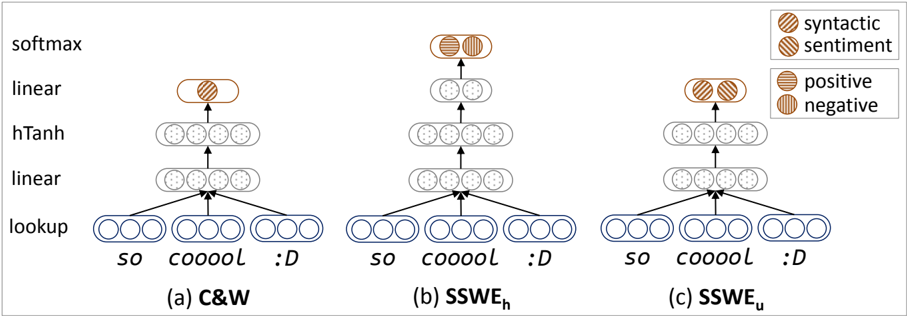
We present a method that learns word embedding for Twitter sentiment classification in this paper.Most existing algorithms for learning continuous word representations typically only model the syntactic context of words but ignore the sentiment of text.This is problematic for sentiment analysis as they usually map words with similar syntactic context but opposite sentiment polarity, such as good and bad, to neighboring word vectors.We address this issue by learning sentimentspecific word embedding (SSWE), which encodes sentiment information in the continuous representation of words.Specifically, we develop three neural networks to effectively incorporate the supervision from sentiment polarity of text (e.g.sentences or tweets) in their loss functions.To obtain large scale training corpora, we learn the sentiment-specific word embedding from massive distant-supervised tweets collected by positive and negative emoticons.Experiments on applying SS-WE to a benchmark Twitter sentiment classification dataset in SemEval 2013 show that (1) the SSWE feature performs comparably with hand-crafted features in the top-performed system; (2) the performance is further improved by concatenating SSWE with existing feature set.
Overview
The claims and statistics of this paper haven’t been checked yet.
Free: it reads the open-access text and checks the first 5 claims that cite a source we can check. Create a free account to check every claim.
Integrity signals
Registry
Cites
Statistics
Figures
Verification
Claims the paper makes
The claims and statistics of this paper haven’t been checked yet.
Free: it reads the open-access text and checks the first 5 claims that cite a source we can check. Create a free account to check every claim.
Claims other papers make about this one
Each is checked against this paper’s own text: does it say what the citing paper says it does?
The source backs part of the claim, not all of it — or backs it for a different population, condition or comparison.
In the citing paper
“Tang et al. [64] pioneered the Sentiment-Specific Word Embeddings (SSWE). Empirical results have shown its superior efficacy over other embeddings in integrating emotion labels at the word level for emotion-centric tasks.”
From A Survey of Deep Learning-Based Multimodal Emotion Recognition: Speech, Text, and Face (2023) · cites this paper as [64]
Experimental — accuracy not yet measured
Self-check
Percentages, sums and reported differences re-computed from the paper’s own numbers.
The self-check needs the paper’s full text.
Citations
Cites
(2003) · Journal of Machine Learning Research · doi:10.5555/944919.944937 · Cited by 32,337
Distributed Representations of Words and Phrases and their Compositionality
Mikolov, T., Sutskever, I., Chen, K., Corrado, G., & Dean, J. (2013) · arXiv · doi:10.48550/arxiv.1310.4546 · Cited by 24,533 · cited 2×
“Although existing word embedding learning algorithms (Collobert et al., 2011; Mikolov et al., 2013) are intuitive choices, they are not effective enough if directly used for sentiment classification.”
BackgroundRepresentation Learning: A Review and New Perspectives
Bengio, Y., Courville, A., & Vincent, P. (2013) · IEEE Transactions on Pattern Analysis and Machine Intelligence · doi:10.1109/tpami.2013.50 · Cited by 13,001
Blei, D. M., Ng, A. Y., & Jordan, M. I. (2002) · Advances in Neural Information Processing Systems 14 · doi:10.7551/mitpress/1120.003.0082 · Cited by 12,223
(2010) · Cited by 8,261
Mining and summarizing customer reviews
Hu, M., & Liu, B. (2004) · Proceedings of the tenth ACM SIGKDD international conference on Knowledge discovery and data mining · doi:10.1145/1014052.1014073 · Cited by 7,793
Thumbs up?: sentiment classification using machine learning techniques
Pang, B., Lee, L., & Vaithyanathan, S. (2002) · Proceedings of the ACL-02 conference on Empirical methods in natural language processing - EMNLP '02 · doi:10.3115/1118693.1118704 · Cited by 7,024
Learning Word Vectors for Sentiment Analysis
Maas, A. L., Daly, R. E., Pham, P. T., Huang, D., Ng, A. Y., & Potts, C. (2011) · Cited by 6,961
Recursive Deep Models for Semantic Compositionality Over a Sentiment Treebank
Socher, R., Perelygin, A., Wu, J., Chuang, J., Manning, C. D., Ng, A., & Potts, C. (2013) · Proceedings of the 2013 Conference on Empirical Methods in Natural Language Processing · doi:10.18653/v1/d13-1170 · Cited by 6,878
Opinion Mining and Sentiment Analysis
Pang, B., & Lee, L. (2008) · now publishers, Inc. eBooks · doi:10.1561/9781601981516 · Cited by 6,720
Research works printed but not linked: 5
- Alec Go, Richa Bhayani, and Lei Huang. 2009. Twit- ter sentiment classification using distant supervision. CS224N Project Report, Stanford, pages 1-12.
- Tomas Mikolov, Ilya Sutskever, Kai Chen, Greg Corra- do, and Jeffrey Dean. 2013. Distributed representa- tions of words and phrases and their compositionali- ty. The Conference on Neural Information Process- ing Systems.
- Preslav Nakov, Sara Rosenthal, Zornitsa Kozareva, Veselin Stoyanov, Alan Ritter, and Theresa Wilson. 2013. Semeval-2013 task 2: Sentiment analysis in twitter. In Proceedings of the International Work- shop on Semantic Evaluation, volume 13.
- Richard Socher, J. Pennington, E.H. Huang, A.Y. Ng, and C.D. Manning. 2011c. Semi-supervised recur- sive autoencoders for predicting sentiment distribu- tions. In Conference on Empirical Methods in Nat- ural Language Processing, pages 151-161.
- Richard Socher, Brody Huval, Christopher D. Man- ning, and Andrew Y. Ng. 2012. Semantic Com- positionality Through Recursive Matrix-Vector S- paces. In Proceedings of the Conference on Empiri- cal Methods in Natural Language Processing.
Cited by
Items 201–300 of 1,000
From Tweets to Wellness: Wellness Event Detection from Twitter Streams
Akbari, M., Hu, X., Nie, L., & Chua, T. (2016) · Proceedings of the AAAI Conference on Artificial Intelligence · doi:10.1609/aaai.v30i1.9975 · Cited by 63
Jiang, J., Chen, F., Chen, Y., & Wang, W. W. (2018) · Conference of the North American Chapter of the Association for Computational Linguistics: Human Language Technologies (NAACL-HLT) · doi:10.18653/v1/n18-1164 · Cited by 77
Deep Learning-Based Sentiment Classification: A Comparative Survey
Mabrouk, A., Redondo, R. P. D., & Kayed, M. (2020) · IEEE Access · doi:10.1109/access.2020.2992013 · Cited by 73
Reflections on Sentiment/Opinion Analysis
Li, J., & Hovy, E. H. (2017) · Socio-affective computing · doi:10.1007/978-3-319-55394-8_3 · Cited by 62
Learning Emotion-enriched Word Representations
Agrawal, A., An, A., & Papagelis, M. (2018) · International Conference on Computational Linguistics · Cited by 90
Feature engineering for sentiment analysis in e-health forums
Carrillo‐de‐Albornoz, J., Rodríguez‐Vidal, J., & Plaza, L. (2018) · PLoS ONE · doi:10.1371/journal.pone.0207996 · Cited by 71
Don't Count, Predict! An Automatic Approach to Learning Sentiment Lexicons for Short Text
Vo, D. T., & Zhang, Y. (2016) · Proceedings of the conference - Association for Computational Linguistics. Meeting · doi:10.18653/v1/p16-2036 · Cited by 67
An analysis of convolutional neural networks for sentence classification
Vieira, J. P. A., & Moura, R. S. (2017) · Latin American Computer Conference (CLEI) · doi:10.1109/clei.2017.8226381 · Cited by 64
Interactive Learning for Identifying Relevant Tweets to Support Real-time Situational Awareness
Snyder, L. S., Lin, Y., Karimzadeh, M., Goldwasser, D., & Ebert, D. S. (2019) · IEEE Transactions on Visualization and Computer Graphics · doi:10.1109/tvcg.2019.2934614 · Cited by 61
Gereme, F. B., Zhu, W., Ayall, T. A., & Alemu, D. (2021) · Information · doi:10.3390/info12010020 · Cited by 61
DeepCPDP: Deep Learning Based Cross-Project Defect Prediction
Chen, D., Chen, X., Li, H., Xie, J., & Mu, Y. (2019) · IEEE Access · doi:10.1109/access.2019.2961129 · Cited by 71
Wei, W., Liu, J., Mao, X.-L., Guo, G., Zhu, F., Zhou, P., & Hu, Y. (2021) · arXiv (Cornell University) · doi:10.48550/arxiv.2106.03044 · Cited by 59
Browne, T. O., Abedin, M., & Chowdhury, M. J. M. (2024) · International Journal of Information Security · doi:10.1007/s10207-024-00868-2 · Cited by 71
Hierarchical Convolutional Attention Networks for Text Classification
Gao, S. B., Ramanathan, A., & Tourassi, G. D. (2018) · Workshop on Representation Learning for NLP (RepL4NLP) · doi:10.18653/v1/w18-3002 · Cited by 67
Multiattentive Recurrent Neural Network Architecture for Multilingual Readability Assessment
Azpiazu, I. M., & Pera, M. S. (2019) · Transactions of the Association for Computational Linguistics · doi:10.1162/tacl_a_00278 · Cited by 60
Deep Learning in Natural Language Processing: A State-of-the-Art Survey
Chai, J., & Li, A. (2019) · International Conference on Machine Learning and Cybernetics · doi:10.1109/icmlc48188.2019.8949185 · Cited by 60
Explainable Sentiment Analysis with Applications in Medicine
Zucco, C., Liang, H., Fatta, G. D., & Cannataro, M. (2018) · 2018 IEEE International Conference on Bioinformatics and Biomedicine (BIBM) · doi:10.1109/bibm.2018.8621359 · Cited by 59
“been made [22], [23].”
Abid, F., Li, C., & Alam, M. (2020) · Computer Communications · doi:10.1016/j.comcom.2020.04.002 · Cited by 63
Learning Stock Market Sentiment Lexicon and Sentiment-Oriented Word Vector from StockTwits
Li, Q., & Shah, S. (2017) · Conference on Computational Natural Language Learning · doi:10.18653/v1/k17-1031 · Cited by 74
PlusEmo2Vec at SemEval-2018 Task 1: Exploiting emotion knowledge from emoji and #hashtags
Park, J. H., Xu, P., & Fung, P. (2018) · International Workshop on Semantic Evaluation (SemEval) · doi:10.18653/v1/s18-1039 · Cited by 58
DepecheMood++: A Bilingual Emotion Lexicon Built Through Simple Yet Powerful Techniques
Araque, Ó., Gatti, L., Staiano, J., & Guerini, M. (2019) · IEEE Transactions on Affective Computing · doi:10.1109/taffc.2019.2934444 · Cited by 58
Mitigating Gender Bias in Machine Learning Data Sets
Leavy, S., Meaney, G., Wade, K., & Greene, D. (2020) · Communications in computer and information science · doi:10.1007/978-3-030-52485-2_2 · Cited by 70
Cross-lingual sentiment classification in low-resource Bengali language
Sazzed, S. (2020) · Workshop on Noisy User-generated Text (W-NUT) · doi:10.18653/v1/2020.wnut-1.8 · Cited by 58
SeerNet at SemEval-2018 Task 1: Domain Adaptation for Affect in Tweets
Duppada, V., Jain, R., & Hiray, S. (2018) · International Workshop on Semantic Evaluation (SemEval) · doi:10.18653/v1/s18-1002 · Cited by 57
A Systematic Literature Review on Word Embeddings
Gutiérrez, L. F. G., & Keith, B. (2018) · Advances in intelligent systems and computing · doi:10.1007/978-3-030-01171-0_12 · Cited by 68
A Machine Learning Approach for Solar Power Technology Review and Patent Evolution Analysis
Trappey, A. J. C., Chen, P. P. J., Trappey, C. V., & Ma, L. (2019) · Applied Sciences · doi:10.3390/app9071478 · Cited by 61
A survey on semantic processing techniques
Mao, R., He, K., Zhang, X., Chen, G., Ni, J., Yang, Z., & Cambria, E. (2023) · Information Fusion · doi:10.1016/j.inffus.2023.101988 · Cited by 72
Deep Learning Techniques for Polarity Classification in Multimodal Sentiment Analysis
Mahendhiran, P. D., & Kannimuthu, S. (2018) · International Journal of Information Technology & Decision Making · doi:10.1142/s0219622018500128 · Cited by 56
A Sentiment Classification in Bengali and Machine Translated English Corpus
Sazzed, S., & Jayarathna, S. (2019) · IEEE International Conference on Information Reuse and Integration (IRI) · doi:10.1109/iri.2019.00029 · Cited by 56
A Survey on Sentiment Analysis and Opinion Mining in Greek Social Media
Alexandridis, G., Varlamis, I., Korovesis, K., Caridakis, G., & Tsantilas, P. (2021) · Information · doi:10.3390/info12080331 · Cited by 67
Acquiring Background Knowledge to Improve Moral Value Prediction
Lin, Y., Hoover, J., Portillo-Wightman, G., Park, C., Dehghani, M., & Ji, H. (2018) · IEEE/ACM International Conference on Advances in Social Networks Analysis and Mining (ASONAM) · doi:10.1109/asonam.2018.8508244 · Cited by 55
Sentiment-Specific Representation Learning for Document-Level Sentiment Analysis
Tang, D. (2015) · ACM International Conference on Web Search and Data Mining (WSDM) · doi:10.1145/2684822.2697035 · Cited by 65
Self-citationVector based sentiment and emotion analysis from text: A survey
Uymaz, H. A., & Metın, S. K. (2022) · Engineering Applications of Artificial Intelligence · doi:10.1016/j.engappai.2022.104922 · Cited by 58
TDParse: Multi-target-specific sentiment recognition on Twitter
Wang, B., Liakata, M., Zubiaga, A., & Procter, R. (2017) · Conference of the European Chapter of the Association for Computational Linguistics · doi:10.18653/v1/e17-1046 · Cited by 53
Han, J., Barman, U., Hayes, J., Du, J., Burgin, E., & Wan, D. (2018) · Proceedings of ACL 2018, System Demonstrations · doi:10.18653/v1/p18-4007 · Cited by 49
Stojanovski, D., Strezoski, G., Madjarov, G., Dimitrovski, I., & Chorbev, I. (2018) · Multimedia Tools and Applications · doi:10.1007/s11042-018-6168-1 · Cited by 57
Building and evaluating resources for sentiment analysis in the Greek language
Tsakalidis, A., Papadopoulos, S., Voskaki, R., Ioannidou, K., Boididou, C., Cristea, A. I., Liakata, M., & Kompatsiaris, I. Y. (2018) · Language Resources and Evaluation · doi:10.1007/s10579-018-9420-4 · Cited by 60
Emotion-Semantic-Enhanced Neural Network
Yang, G., He, H., & Chen, Q. (2018) · IEEE/ACM Transactions on Audio Speech and Language Processing · doi:10.1109/taslp.2018.2885775 · Cited by 55
Atzeni, M., & Reforgiato Recupero, D. (2020) · Future Generation Computer Systems · doi:10.1016/j.future.2019.10.012 · Cited by 50
A Helping Hand: Transfer Learning for Deep Sentiment Analysis
Dong, X., & de Melo, G. (2018) · Proceedings of the conference - Association for Computational Linguistics. Meeting · doi:10.18653/v1/p18-1235 · Cited by 60
Learning Domain Representation for Multi-Domain Sentiment Classification
Liu, Q., Zhang, Y., & Liu, J. (2018) · Conference of the North American Chapter of the Association for Computational Linguistics: Human Language Technologies (NAACL-HLT) · doi:10.18653/v1/n18-1050 · Cited by 61
Multilingual opinion mining on YouTube – A convolutional N-gram BiLSTM word embedding
Nguyen, H. T., & Nguyen, L.-M. (2018) · Information Processing & Management · doi:10.1016/j.ipm.2018.02.001 · Cited by 54
Shuang, K., Ren, X., Yang, Q., Li, R., & Loo, J. (2018) · Neurocomputing · doi:10.1016/j.neucom.2018.11.084 · Cited by 54
Guo, Z., Liu, S., Liu, J., Li, Y., Chen, L., Lu, H., & Zhou, Y. (2021) · ACM Transactions on Software Engineering and Methodology · doi:10.1145/3447247 · Cited by 61
Knowledge-based BERT word embedding fine-tuning for emotion recognition
Zhu, Z., & Mao, K. (2023) · Neurocomputing · doi:10.1016/j.neucom.2023.126488 · Cited by 62
Task-Oriented Learning of Word Embeddings for Semantic Relation Classification
Hashimoto, K., Stenetorp, P., Miwa, M., & Tsuruoka, Y. (2015) · Conference on Computational Natural Language Learning · doi:10.18653/v1/k15-1027 · Cited by 51
Recent advances in deep learning based sentiment analysis
Yuan, J., Wu, Y., Lu, X., Zhao, Y., Qin, B., & Liu, T. (2020) · Science China Technological Sciences · doi:10.1007/s11431-020-1634-3 · Cited by 52
Self-citationDeep Representation Learning: Fundamentals, Technologies, Applications, and Open Challenges
Payandeh, A., Baghaei, K. T., Fayyazsanavi, P., Ramezani, S. B., Chen, Z., & Rahimi, S. (2023) · IEEE Access · doi:10.1109/access.2023.3335196 · Cited by 64
Improving Attention Model Based on Cognition Grounded Data for Sentiment Analysis
Long, Y., Xiang, R., Lu, Q., Huang, C., & Li, M. (2019) · IEEE Transactions on Affective Computing · doi:10.1109/taffc.2019.2903056 · Cited by 55
A Novel Sentiment Polarity Detection Framework for Chinese
Ma, T., Rong, H., Hao, Y., Cao, J., Tian, Y., & Al‐Rodhaan, M. (2019) · IEEE Transactions on Affective Computing · doi:10.1109/taffc.2019.2932061 · Cited by 50
Understanding Medication Nonadherence from Social Media: A Sentiment-Enriched Deep Learning Approach
Xie, J., Liu, X., Zeng, D. D., & Fang, X. (2017) · MIS Quarterly · doi:10.25300/misq/2022/15336 · Cited by 59
Al-deen, H. S. S., Zeng, Z., Al-Sabri, R., & Hekmat, A. (2021) · Applied System Innovation · doi:10.3390/asi4040085 · Cited by 58
Deep learning-based application for multilevel sentiment analysis of Indonesian hotel reviews
Kusumaningrum, R., Nisa, I. Z., Jayanto, R., Nawangsari, R. P., & Wibowo, A. (2023) · Heliyon · doi:10.1016/j.heliyon.2023.e17147 · Cited by 49
The Automatic Analysis of Emotion in Political Speech Based on Transcripts
Cochrane, C., Rheault, L., Godbout, J., Whyte, T., Wong, M. W.-C., & Borwein, S. (2021) · Political Communication · doi:10.1080/10584609.2021.1952497 · Cited by 58
Contextual sentiment embeddings via bi-directional GRU language model
Wang, J., Zhang, Y., Yu, L., & Zhang, X. (2021) · Knowledge-Based Systems · doi:10.1016/j.knosys.2021.107663 · Cited by 55
Bag-of-embeddings for text classification
Jin, P., Zhang, Y., Chen, X., & Xia, Y. (2016) · International Joint Conference on Artificial Intelligence · Cited by 48
Sentiment analysis using deep learning on Persian texts
Roshanfekr, B., Khadivi, S., & Rahmati, M. (2017) · Iranian Conference on Electrical Engineering · doi:10.1109/iraniancee.2017.7985281 · Cited by 48
Niu, K., Luo, X., Zhang, S., Teng, Z., Zhang, T., & Zhao, Y. (2021) · Frontiers in Genetics · doi:10.3389/fgene.2021.665498 · Cited by 49
You, L., Han, F., Peng, J., Jin, H., & Claramunt, C. (2022) · Knowledge-Based Systems · doi:10.1016/j.knosys.2022.109511 · Cited by 51
Guellil, I., Adeel, A., Azouaou, F., Benali, F., Hachani, A.-E., Dashtipour, K. K., Gogate, M., Ieracitano, C., Kashani, R., & Hussain, A. (2021) · SN Computer Science · doi:10.1007/s42979-021-00510-1 · Cited by 50
Embedding Refinement Framework for Targeted Aspect-Based Sentiment Analysis
Liang, B., Yin, R., Du, J., Gui, L., He, Y., Yang, M., & Xu, R. (2021) · IEEE Transactions on Affective Computing · doi:10.1109/taffc.2021.3071388 · Cited by 47
Revisiting Word Embedding for Contrasting Meaning
Chen, Z., Lin, W., Chen, Q., Chen, X., Wei, S., Jiang, H., & Zhu, X. (2015) · doi:10.3115/v1/p15-1011 · Cited by 50
Improving sentiment analysis with multi-task learning of negation
Barnes, J., Velldal, E., & Øvrelid, L. (2020) · Natural Language Engineering · doi:10.1017/s1351324920000510 · Cited by 53
SENSEI-LIF at SemEval-2016 Task 4: Polarity embedding fusion for robust sentiment analysis
Rouvier, M., & Favre, B. (2016) · International Workshop on Semantic Evaluation (SemEval) · doi:10.18653/v1/s16-1030 · Cited by 45
Explicit Document Modeling through Weighted Multiple-Instance Learning
Pappas, N., & Popescu-Belis, A. (2017) · Journal of Artificial Intelligence Research · doi:10.1613/jair.5240 · Cited by 57
An ensemble method with sentiment features and clustering support
Nguyen, H. T., & Nguyen, L.-M. (2019) · Neurocomputing · doi:10.1016/j.neucom.2019.08.071 · Cited by 47
Nguyen, T., Le, N. Q. K., Ho, Q., Phan, D., & Ou, Y. (2019) · Analytical Biochemistry · doi:10.1016/j.ab.2019.04.011 · Cited by 50
Deep Learning in Sentiment Analysis
Tang, D., & Zhang, M. (2018) · Springer eBooks · doi:10.1007/978-981-10-5209-5_8 · Cited by 55
Self-citationData Sets: Word Embeddings Learned from Tweets and General Data
Li, Q., Shah, S., Liu, X., & Nourbakhsh, A. (2017) · Proceedings of the International AAAI Conference on Web and Social Media · doi:10.1609/icwsm.v11i1.14859 · Cited by 44
Easy-to-Deploy API Extraction by Multi-Level Feature Embedding and Transfer Learning
Ma, S., Xing, Z., Chen, C., Chen, C., Qu, L., & Li, G. (2019) · IEEE Transactions on Software Engineering · doi:10.1109/tse.2019.2946830 · Cited by 47
Analyzing bug fix for automatic bug cause classification
Ni, Z., Li, B., Sun, X., Chen, T., Tang, B., & Shi, X. (2020) · Journal of Systems and Software · doi:10.1016/j.jss.2020.110538 · Cited by 50
Hybrid ensemble approaches to online harassment detection in highly imbalanced data
Marwa, T., Ouadfel, S., & Meshoul, S. (2021) · Expert Systems with Applications · doi:10.1016/j.eswa.2021.114751 · Cited by 47
Barreto, S., Moura, R., Carvalho, J., Paes, A., & Plastino, A. (2022) · Data Mining and Knowledge Discovery · doi:10.1007/s10618-022-00853-0 · Cited by 48
Modeling temporal patterns of cyberbullying detection with hierarchical attention networks
Cheng, L., Guo, R., Silva, Y. N., Hall, D., & Liu, H. (2021) · ACM/IMS Transactions on Data Science · doi:10.1145/3441141 · Cited by 43
“Additional Key Words and Phrases: Cyberbullying, Temporal Analysis, Hierarchical Attention Network, Social Media ACM Reference Format: Lu Cheng, Ruocheng Guo, Yasin N. Silva, Deborah Hall, and Huan Liu.”
MethodChen, Z., He, Z., Liu, X., & Bian, J. (2018) · BMC Medical Informatics and Decision Making · doi:10.1186/s12911-018-0630-x · Cited by 49
Kobs, K., Zehe, A., Bernstetter, A., Chibane, J., Pfister, J., Tritscher, J., & Hotho, A. (2020) · ACM Transactions on Social Computing · doi:10.1145/3365523 · Cited by 50
Bi-directional LSTM–CNN Combined method for Sentiment Analysis in Part of Speech Tagging (PoS)
Kumar, N. K. S., & Malarvizhi, N. (2020) · International Journal of Speech Technology · doi:10.1007/s10772-020-09716-9 · Cited by 42
Multi-view ensemble learning method for microblog sentiment classification
Ye, X., Dai, H., Dong, L.-A., & Wang, X. (2020) · Expert Systems with Applications · doi:10.1016/j.eswa.2020.113987 · Cited by 45
Distance Metric Learning for Aspect Phrase GroupingPreprint
Xiong, S., Zhang, Y., Ji, D., & Lou, Y. (2016) · arXiv (Cornell University) · doi:10.48550/arxiv.1604.08672 · Cited by 42
Sentiment Intensity Ranking among Adjectives Using Sentiment Bearing Word Embeddings
Sharma, R., Somani, A., Kumar, L., & Bhattacharyya, P. (2017) · Conference on Empirical Methods in Natural Language Processing (EMNLP) · doi:10.18653/v1/d17-1058 · Cited by 41
Risk assessment for global supplier selection using text mining
Su, C., & Chen, Y. (2018) · Computers & Electrical Engineering · doi:10.1016/j.compeleceng.2018.03.042 · Cited by 49
Alnawas, A. A., & Arıcı, N. (2019) · ACM Transactions on Asian and Low-Resource Language Information Processing · doi:10.1145/3278605 · Cited by 41
Sentiment Lexicon Construction With Hierarchical Supervision Topic Model
Deng, D., Jing, L., Yu, J. Q., Sun, S., & Ng, M. K. (2019) · IEEE/ACM Transactions on Audio Speech and Language Processing · doi:10.1109/taslp.2019.2892232 · Cited by 44
Building a Twitter Sentiment Analysis System with Recurrent Neural Networks
Nistor, S. C., Moca, M., Moldovan, D., Oprean, D. B., & NISTOR, R. L. (2021) · Sensors · doi:10.3390/s21072266 · Cited by 44
Topic Detection and Tracking Techniques on Twitter: A Systematic Review
Asgari-Chenaghlu, M., Feizi‐Derakhshi, M., Farzinvash, L., Balafar, M. A., & Motamed, C. (2021) · Complexity · doi:10.1155/2021/8833084 · Cited by 41
Using J-K fold Cross Validation to Reduce Variance When Tuning NLP ModelsPreprint
Moss, H. B., Leslie, D. S., & Rayson, P. (2018) · arXiv (Cornell University) · doi:10.48550/arxiv.1806.07139 · Cited by 59
Weitzel, L., Prati, R. C., & Aguiar, R. F. (2016) · Studies in computational intelligence · doi:10.1007/978-3-319-30319-2_3 · Cited by 46
DAG-Structured Long Short-Term Memory for Semantic Compositionality
Zhu, X., Sobhani, P., & Guo, H. (2016) · Conference of the North American Chapter of the Association for Computational Linguistics: Human Language Technologies (NAACL-HLT) · doi:10.18653/v1/n16-1106 · Cited by 48
Li, Q., Shah, S., Fang, R., Nourbakhsh, A., & Liu, X. (2016) · IEEE/WIC/ACM International Conference on Web Intelligence · doi:10.1109/wi.2016.0097 · Cited by 40
Twitter Sentiment Detection via Ensemble Classification Using Averaged Confidence Scores
Hagen, M., Potthast, M., Büchner, M., & Stein, B. (2015) · Lecture notes in computer science · doi:10.1007/978-3-319-16354-3_81 · Cited by 40
Emotion Detection from Text via Ensemble Classification Using Word Embeddings
Herzig, J., Shmueli-Scheuer, M., & Konopnicki, D. (2017) · ACM SIGIR International Conference on Theory of Information Retrieval (ICTIR) · doi:10.1145/3121050.3121093 · Cited by 42
An Information Distillation Framework for Extractive Summarization
Chen, K.-Y., Liu, S., Chen, B., & Wang, H. (2017) · IEEE/ACM Transactions on Audio Speech and Language Processing · doi:10.1109/taslp.2017.2764545 · Cited by 43
A context-aware embeddings supported method to extract a fuzzy sentiment polarity dictionary
Bernabé-Moreno, J., Tejeda-Lorente, Á., Herce-Zelaya, J., Porcel, C., & Herrera‐Viedma, E. (2019) · Knowledge-Based Systems · doi:10.1016/j.knosys.2019.105236 · Cited by 40
Cross-Lingual Propagation for Deep Sentiment Analysis
Dong, X., & de Melo, G. (2018) · Proceedings of the AAAI Conference on Artificial Intelligence · doi:10.1609/aaai.v32i1.12071 · Cited by 39
A Lexicon-Based Supervised Attention Model for Neural Sentiment Analysis
Zou, Y., Gui, T., Zhang, Q., & Huang, X. (2018) · International Conference on Computational Linguistics · Cited by 53
Improving Negative Sampling for Word Representation using Self-embedded Features
Chen, L., Yuan, F., Jose, J. M., & Zhang, W. (2018) · ACM International Conference on Web Search and Data Mining (WSDM) · doi:10.1145/3159652.3159695 · Cited by 39
A Comprehensive Analysis of Preprocessing for Word Representation Learning in Affective Tasks
Babanejad, N., Agrawal, A., An, A., & Papagelis, M. (2020) · Proceedings of the conference - Association for Computational Linguistics. Meeting · doi:10.18653/v1/2020.acl-main.514 · Cited by 39
Sharma, S. S., & Dutta, G. (2020) · Information Processing & Management · doi:10.1016/j.ipm.2020.102412 · Cited by 47
Semantic Feature Learning via Dual Sequences for Defect Prediction
Lin, J., & Lu, L. (2021) · IEEE Access · doi:10.1109/access.2021.3051957 · Cited by 41
Cambria, E., & Hussain, A. (2015) · Springer eBooks · doi:10.1007/978-3-319-23654-4_2 · Cited by 44
Metadata
- Authors
- Tang, D., Wei, F., Yang, N., Zhou, M., Liu, T., & Qin, B.
- Affiliations
- Harbin Institute of Technology (CN)
- University of Science and Technology of China (CN)
- Venue
- Proceedings of the 52nd Annual Meeting of the Association for Computational Linguistics (Volume 1: Long Papers)
- Published
- 2014
- Pages
- 1555-1565
- ISSN
- 0736-587X (ISSN-L)
- OpenAlex
- W2250879510
- Cited by
- 1,181
- References
- 58
- Citations by year
- 2026: 6 · 2025: 17 · 2024: 45 · 2023: 80 · 2022: 88 · 2021: 107 · 2020: 163 · 2019: 155 · 2018: 177 · 2017: 144 · 2016: 110 · 2015: 80 · 2014: 9
- FWCI
- 67.34
- Type
- conference paper
- Language
- en
- Open access
- hybrid
- doi.org
- Licence
- cc-by
- Locations
- Proceedings of the conference - Association for Computational Linguistics. Meeting (publishedVersion, cc-by)
- Funders
- National Natural Science Foundation of China (61273321, 61300113, 61133012)
- Topics
- Physical Sciences › Computer Science › Artificial Intelligence › Sentiment Analysis and Opinion Mining
- Physical Sciences › Computer Science › Artificial Intelligence › Topic Modeling
- Physical Sciences › Computer Science › Artificial Intelligence › Hate Speech and Cyberbullying Detection
- Keywords
- sentiment polarity, distant supervision, emoticons, word representation learning, SemEval-2013
About these checks
Registry, retraction, Cites and statistics results are computed, not judged, with one exception: a printed reference that no index lists is read once by a model before it counts as a citation error. Claims are extracted by a model and kept only when their quote appears verbatim in the text; each cited source is then checked, with a model’s help, for whether it says what the claim relies on. Those verdicts can be wrong — read the claim’s quote and the cited source before relying on one.
Statistics and arithmetic are recomputed, not judged.
Confidence bands are shown only for fields calibrated on our annotated test set. None is calibrated yet, so no band is shown.
What counts as a claim ›How we measure confidence ›How we check this ›
Are you an author, or do you see a problem with this page? Request a review
Data sources
Bibliographic data: Semantic Scholar, OpenAlex, Crossref.
Contains information from the Semantic Scholar Academic Graph Datasets, made available under the ODC Attribution License (ODC-BY 1.0).
Semantic Scholar’s data is described in: Kinney, R., et al. (2023). The Semantic Scholar Open Data Platform. arXiv:2301.10140.
