

Learning Sentiment-Specific Word Embedding for Twitter Sentiment Classification
Open accessThe DOI matches its Crossref record; 56 of the 58 references it cites were found in a registry or an index.
Abstract
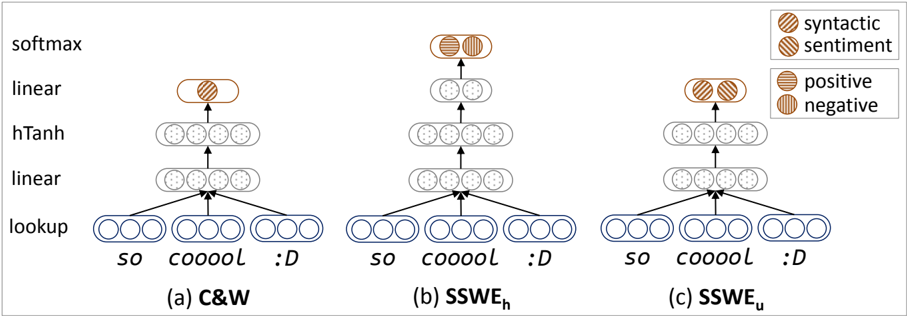
We present a method that learns word embedding for Twitter sentiment classification in this paper.Most existing algorithms for learning continuous word representations typically only model the syntactic context of words but ignore the sentiment of text.This is problematic for sentiment analysis as they usually map words with similar syntactic context but opposite sentiment polarity, such as good and bad, to neighboring word vectors.We address this issue by learning sentimentspecific word embedding (SSWE), which encodes sentiment information in the continuous representation of words.Specifically, we develop three neural networks to effectively incorporate the supervision from sentiment polarity of text (e.g.sentences or tweets) in their loss functions.To obtain large scale training corpora, we learn the sentiment-specific word embedding from massive distant-supervised tweets collected by positive and negative emoticons.Experiments on applying SS-WE to a benchmark Twitter sentiment classification dataset in SemEval 2013 show that (1) the SSWE feature performs comparably with hand-crafted features in the top-performed system; (2) the performance is further improved by concatenating SSWE with existing feature set.
Overview
The claims and statistics of this paper haven’t been checked yet.
Free: it reads the open-access text and checks the first 5 claims that cite a source we can check. Create a free account to check every claim.
Integrity signals
Registry
Cites
Statistics
Figures
Verification
Claims the paper makes
The claims and statistics of this paper haven’t been checked yet.
Free: it reads the open-access text and checks the first 5 claims that cite a source we can check. Create a free account to check every claim.
Claims other papers make about this one
Each is checked against this paper’s own text: does it say what the citing paper says it does?
The source backs part of the claim, not all of it — or backs it for a different population, condition or comparison.
In the citing paper
“Tang et al. [64] pioneered the Sentiment-Specific Word Embeddings (SSWE). Empirical results have shown its superior efficacy over other embeddings in integrating emotion labels at the word level for emotion-centric tasks.”
From A Survey of Deep Learning-Based Multimodal Emotion Recognition: Speech, Text, and Face (2023) · cites this paper as [64]
Experimental — accuracy not yet measured
Self-check
Percentages, sums and reported differences re-computed from the paper’s own numbers.
The self-check needs the paper’s full text.
Citations
Cites
(2003) · Journal of Machine Learning Research · doi:10.5555/944919.944937 · Cited by 32,337
Distributed Representations of Words and Phrases and their Compositionality
Mikolov, T., Sutskever, I., Chen, K., Corrado, G., & Dean, J. (2013) · arXiv · doi:10.48550/arxiv.1310.4546 · Cited by 24,533 · cited 2×
“Although existing word embedding learning algorithms (Collobert et al., 2011; Mikolov et al., 2013) are intuitive choices, they are not effective enough if directly used for sentiment classification.”
BackgroundRepresentation Learning: A Review and New Perspectives
Bengio, Y., Courville, A., & Vincent, P. (2013) · IEEE Transactions on Pattern Analysis and Machine Intelligence · doi:10.1109/tpami.2013.50 · Cited by 13,001
Blei, D. M., Ng, A. Y., & Jordan, M. I. (2002) · Advances in Neural Information Processing Systems 14 · doi:10.7551/mitpress/1120.003.0082 · Cited by 12,223
(2010) · Cited by 8,261
Mining and summarizing customer reviews
Hu, M., & Liu, B. (2004) · Proceedings of the tenth ACM SIGKDD international conference on Knowledge discovery and data mining · doi:10.1145/1014052.1014073 · Cited by 7,793
Thumbs up?: sentiment classification using machine learning techniques
Pang, B., Lee, L., & Vaithyanathan, S. (2002) · Proceedings of the ACL-02 conference on Empirical methods in natural language processing - EMNLP '02 · doi:10.3115/1118693.1118704 · Cited by 7,024
Learning Word Vectors for Sentiment Analysis
Maas, A. L., Daly, R. E., Pham, P. T., Huang, D., Ng, A. Y., & Potts, C. (2011) · Cited by 6,961
Recursive Deep Models for Semantic Compositionality Over a Sentiment Treebank
Socher, R., Perelygin, A., Wu, J., Chuang, J., Manning, C. D., Ng, A., & Potts, C. (2013) · Proceedings of the 2013 Conference on Empirical Methods in Natural Language Processing · doi:10.18653/v1/d13-1170 · Cited by 6,878
Opinion Mining and Sentiment Analysis
Pang, B., & Lee, L. (2008) · now publishers, Inc. eBooks · doi:10.1561/9781601981516 · Cited by 6,720
Research works printed but not linked: 5
- Alec Go, Richa Bhayani, and Lei Huang. 2009. Twit- ter sentiment classification using distant supervision. CS224N Project Report, Stanford, pages 1-12.
- Tomas Mikolov, Ilya Sutskever, Kai Chen, Greg Corra- do, and Jeffrey Dean. 2013. Distributed representa- tions of words and phrases and their compositionali- ty. The Conference on Neural Information Process- ing Systems.
- Preslav Nakov, Sara Rosenthal, Zornitsa Kozareva, Veselin Stoyanov, Alan Ritter, and Theresa Wilson. 2013. Semeval-2013 task 2: Sentiment analysis in twitter. In Proceedings of the International Work- shop on Semantic Evaluation, volume 13.
- Richard Socher, J. Pennington, E.H. Huang, A.Y. Ng, and C.D. Manning. 2011c. Semi-supervised recur- sive autoencoders for predicting sentiment distribu- tions. In Conference on Empirical Methods in Nat- ural Language Processing, pages 151-161.
- Richard Socher, Brody Huval, Christopher D. Man- ning, and Andrew Y. Ng. 2012. Semantic Com- positionality Through Recursive Matrix-Vector S- paces. In Proceedings of the Conference on Empiri- cal Methods in Natural Language Processing.
Cited by
Items 301–400 of 1,000
Wei, W., Liu, J., Mao, X., Guo, G., Zhu, F., Zhou, P., & Hu, Y. (2019) · ACM International Conference on Information and Knowledge Management (CIKM) · doi:10.1145/3357384.3357937 · Cited by 38
DocTag2Vec: An Embedding Based Multi-label Learning Approach for Document Tagging
Chen, S., Soni, A., Pappu, A., & Mehdad, Y. (2017) · Workshop on Representation Learning for NLP (RepL4NLP) · doi:10.18653/v1/w17-2614 · Cited by 39
Unified Instance and Knowledge Alignment Pretraining for Aspect-Based Sentiment Analysis
Liu, J., Zhong, Q., Ding, L., Jin, H., Du, B., & Tao, D. (2023) · IEEE/ACM Transactions on Audio Speech and Language Processing · doi:10.1109/taslp.2023.3290431 · Cited by 37
Wang, S., Shibghatullah, A. S., Iqbal, T. J., & Keoy, K. H. (2024) · Neural Computing and Applications · doi:10.1007/s00521-024-10371-3 · Cited by 40
Visual analysis of online social media to open up the investigation of stance phenomena
Kucher, K., Schamp-Bjerede, T., Kerren, A., Paradis, C., & Sahlgren, M. (2015) · Information Visualization · doi:10.1177/1473871615575079 · Cited by 42
Asgari-Chenaghlu, M., Feizi‐Derakhshi, M., Farzinvash, L., Balafar, M. A., & Motamed, C. (2021) · Chaos Solitons & Fractals · doi:10.1016/j.chaos.2021.111274 · Cited by 37
Detecting Cyberbullying Across Multiple Social Media Platforms Using Deep Learning
Mahat, M. (2021) · International Conference on Advance Computing and Innovative Technologies in Engineering (ICACITE) · doi:10.1109/icacite51222.2021.9404736 · Cited by 39
Learning Word Embeddings with Chi-Square Weights for Healthcare Tweet Classification
Kuang, S., & Davison, B. D. (2017) · Applied Sciences · doi:10.3390/app7080846 · Cited by 37
Proceedings of the Fourth Arabic Natural Language Processing Workshop
El-Hajj, W., Belguith, L. H., Bougares, F., Magdy, W., Zitouni, I., Tomeh, N., & El Hajj, M. (2019) · doi:10.18653/v1/w19-46 · Cited by 38
SentimentGPT: Leveraging GPT for Advancing Sentiment Analysis
Kheiri, K., & Karimi, H. R. (2024) · IEEE International Conference on Big Data (BigData) · doi:10.1109/bigdata62323.2024.10825350 · Cited by 36
Big Data Sentiment Analysis for Brand Monitoring in Social Media Streams by Cloud Computing
Benedetto, F., & Tedeschi, A. (2016) · Studies in computational intelligence · doi:10.1007/978-3-319-30319-2_14 · Cited by 36
The Impact of Sentiment Features on the Sentiment Polarity Classification in Persian Reviews
Asgarian, E., Kahani, M., & Sharifi, S. (2017) · Cognitive Computation · doi:10.1007/s12559-017-9513-1 · Cited by 36
Rozental, A., & Fleischer, D. (2018) · International Workshop on Semantic Evaluation (SemEval) · doi:10.18653/v1/s18-1033 · Cited by 36
Wang, J., Li, Y., Shan, J., Bao, J., Zong, C., & Zhao, L. (2019) · IEEE Access · doi:10.1109/access.2019.2955924 · Cited by 37
SentiVec: Learning Sentiment-Context Vector via Kernel Optimization Function for Sentiment Analysis
Zhu, L., Li, W., Shi, Y., & Guo, K. (2020) · IEEE Transactions on Neural Networks and Learning Systems · doi:10.1109/tnnls.2020.3006531 · Cited by 36
Sent2Vec: A New Sentence Embedding Representation With Sentimental Semantic
Moghadasi, M. N., & Zhuang, Y. (2020) · IEEE International Conference on Big Data (BigData) · doi:10.1109/bigdata50022.2020.9378337 · Cited by 50
Incorporating knowledge into neural network for text representation
Li, Y., Wei, B., Liu, Y., Yao, L., Chen, H., Yu, J., & Zhu, W. (2017) · Expert Systems with Applications · doi:10.1016/j.eswa.2017.11.037 · Cited by 39
Deep learning for online harassment detection in tweets
Marwa, T., Salima, O., & Souham, M. (2018) · 2018 3rd International Conference on Pattern Analysis and Intelligent Systems (PAIS) · doi:10.1109/pais.2018.8598530 · Cited by 35
“Moreover, SSWE pre-trained on 10 M tweets [13].”
MethodÇelikyılmaz, A., Hakkani-Tür, D. Z., Pasupat, P., & Sarikaya, R. (2015) · National Conference on Artificial Intelligence · Cited by 35
Lan, M., Zhang, Z., Lu, Y., & Wu, J. (2016) · International Joint Conference on Neural Networks (IJCNN) · doi:10.1109/ijcnn.2016.7727604 · Cited by 42
How ideas flow across multiple social groups
Wang, X., Liu, S., Chen, Y., Peng, T., Su, J. Y., Yang, J., & Guo, B. (2016) · IEEE Conference on Visual Analytics Science and Technology (VAST) · doi:10.1109/vast.2016.7883511 · Cited by 42
Exploring overall opinions for document level sentiment classification with structural SVM
Pu, X., Wu, G., & Yuan, C. (2017) · Multimedia Systems · doi:10.1007/s00530-017-0550-0 · Cited by 35
Unsupervised Learning of Parsimonious General-Purpose Embeddings for User and Location Modeling
Yang, J., & Eickhoff, C. (2018) · ACM Transactions on Information Systems · doi:10.1145/3182165 · Cited by 35
Udanor, C. N., & Anyanwu, C. C. (2019) · Data Technologies and Applications · doi:10.1108/dta-01-2019-0007 · Cited by 35
Sentiment aware word embeddings using refinement and senti-contextualized learning approach
Naderalvojoud, B., & Sezer, E. A. (2020) · Neurocomputing · doi:10.1016/j.neucom.2020.03.094 · Cited by 39
Learning user sentiment orientation in social networks for sentiment analysis
Chen, J., Song, N., Su, Y., Zhao, S. G., & Zhang, Y. (2022) · Information Sciences · doi:10.1016/j.ins.2022.10.135 · Cited by 38
Word2Vec and Doc2Vec in Unsupervised Sentiment Analysis of Clinical Discharge SummariesPreprint
Chen, Q., & Sokolova, M. (2018) · arXiv (Cornell University) · doi:10.48550/arxiv.1805.00352 · Cited by 35
Fake news detection: recent trends and challenges
Thakar, H. A., & Bhatt, B. (2024) · Social Network Analysis and Mining · doi:10.1007/s13278-024-01344-4 · Cited by 42
Kumar, S. S., Kumar, M. A., & Soman, K. P. (2017) · Lecture notes in computer science · doi:10.1007/978-3-319-71928-3_31 · Cited by 41
A Causal Inference Method for Reducing Gender Bias in Word Embedding Relations
Yang, Z., & Feng, J. (2020) · Proceedings of the AAAI Conference on Artificial Intelligence · doi:10.1609/aaai.v34i05.6486 · Cited by 34
Application of Deep Learning Approaches for Sentiment Analysis
Pathak, A. R., Agarwal, B., Pandey, M., & Rautaray, S. S. (2020) · Algorithms for intelligent systems · doi:10.1007/978-981-15-1216-2_1 · Cited by 44
Arabic Opinion Mining Using Combined CNN - LSTM Models
Elzayady, H., Badran, K. M., & Salama, G. I. (2020) · International Journal of Intelligent Systems and Applications · doi:10.5815/ijisa.2020.04.03 · Cited by 34
Interactive POS-aware network for aspect-level sentiment classification
Shuang, K., Gu, M., Li, R., Loo, J., & Su, S. (2020) · Neurocomputing · doi:10.1016/j.neucom.2020.08.013 · Cited by 38
Chen, Q., & Sokolova, M. (2021) · SN Computer Science · doi:10.1007/s42979-021-00807-1 · Cited by 34
Doc2vec-based link prediction approach using SAO structures: application to patent network
Yoon, B., Kim, S., Kim, S., & Seol, H. (2021) · Scientometrics · doi:10.1007/s11192-021-04187-4 · Cited by 34
Implicit Sentiment Analysis with Event-centered Text Representation
Zhou, D., Wang, J., Zhang, L., & He, Y. (2021) · Conference on Empirical Methods in Natural Language Processing (EMNLP) · doi:10.18653/v1/2021.emnlp-main.551 · Cited by 34
Natural Language Processing (NLP) for Sentiment Analysis in Social Media
Joseph, T. (2024) · International Journal of Computing and Engineering · doi:10.47941/ijce.2135 · Cited by 33
On the Automatic Learning of Sentiment Lexicons
Severyn, A., & Moschitti, A. (2015) · Conference of the North American Chapter of the Association for Computational Linguistics: Human Language Technologies (NAACL-HLT) · doi:10.3115/v1/n15-1159 · Cited by 33
Learning Sentiment-Specific Word Embedding via Global Sentiment Representation
Fu, P., Lin, Z., Yuan, F., Wang, W., & Meng, D. (2018) · Proceedings of the AAAI Conference on Artificial Intelligence · doi:10.1609/aaai.v32i1.11916 · Cited by 33
Violence Rating Prediction from Movie Scripts
Martínez, V. R., Somandepalli, K., Singla, K., Ramakrishna, A., Uhls, Y. T., & Narayanan, S. S. (2019) · Proceedings of the AAAI Conference on Artificial Intelligence · doi:10.1609/aaai.v33i01.3301671 · Cited by 42
Exploring Word Embedding Techniques to Improve Sentiment Analysis of Software Engineering Texts
Biswas, E., Vijay‐Shanker, K., & Pollock, L. (2019) · International Conference on Mining Software Repositories (MSR) · doi:10.1109/msr.2019.00020 · Cited by 33
Learning Domain-Sensitive and Sentiment-Aware Word Embeddings
Shi, B., Fu, Z., Bing, L., & Lam, W. P. (2018) · Proceedings of the conference - Association for Computational Linguistics. Meeting · doi:10.18653/v1/p18-1232 · Cited by 38
SOBA: Semi-automated Ontology Builder for Aspect-based sentiment analysis
Zhuang, L., Schouten, K., & Frăsincar, F. (2019) · Journal of Web Semantics · doi:10.1016/j.websem.2019.100544 · Cited by 33
Tweeting the High Line Life: A Social Media Lens on Urban Green Spaces
Sim, J., Miller, P. A., & Swarup, S. (2020) · Sustainability · doi:10.3390/su12218895 · Cited by 34
Extensive hotel reviews classification using long short term memory
Ishaq, A., Umer, M., Mushtaq, M. F., Medaglia, C. M., Siddiqui, H. U. R., Mehmood, A., & Choi, G. S. (2020) · Journal of Ambient Intelligence and Humanized Computing · doi:10.1007/s12652-020-02654-z · Cited by 37
Fei, H., Ren, Y., Wu, S., Li, B., & Ji, D. (2021) · International World Wide Web Conference (WWW) · doi:10.1145/3442381.3449789 · Cited by 33
DDoS Event Forecasting using Twitter Data
Wang, Z., & Zhang, Y. (2017) · International Joint Conference on Artificial Intelligence · doi:10.24963/ijcai.2017/580 · Cited by 33
Seq2Emo: A Sequence to Multi-Label Emotion Classification Model
Huang, C., Trabelsi, A., Qin, X., Farruque, N., Mou, L., & Zai͏̈ane, O. R. (2021) · Conference of the North American Chapter of the Association for Computational Linguistics: Human Language Technologies (NAACL-HLT) · doi:10.18653/v1/2021.naacl-main.375 · Cited by 44
Zhang, P., & He, Z. (2015) · Journal of Information Science · doi:10.1177/0165551515585264 · Cited by 32
Lyapunov filtering of objectivity for Spanish Sentiment Model
Chaturvedi, I., Cambria, E., & Vilares, D. (2016) · International Joint Conference on Neural Networks (IJCNN) · doi:10.1109/ijcnn.2016.7727785 · Cited by 34
Wang, F., Lan, M., & Wu, Y. (2017) · International Workshop on Semantic Evaluation (SemEval) · doi:10.18653/v1/s17-2086 · Cited by 32
Yu, H., Gui, L., Madaio, M., Ogan, A., Cassell, J., & Morency, L. (2017) · ACM International Conference on Multimedia (ACM MM) · doi:10.1145/3123266.3123413 · Cited by 34
Encoding Sentiment Information into Word Vectors for Sentiment Analysis
Ye, Z., Li, F., & Baldwin, T. (2018) · International Conference on Computational Linguistics · Cited by 32
Liu, F., Zheng, L., & Zheng, J. (2020) · Neurocomputing · doi:10.1016/j.neucom.2020.04.084 · Cited by 32
Liu, A., Yu, H., Hu, X., Li, S., Li, L., Ma, F., Yang, Y., & Wen, L. (2022) · Conference on Empirical Methods in Natural Language Processing (EMNLP) · doi:10.18653/v1/2022.emnlp-main.522 · Cited by 32
Learning Document Representation for Deceptive Opinion Spam Detection
Li, L., Ren, W., Qin, B., & Liu, T. (2015) · Lecture notes in computer science · doi:10.1007/978-3-319-25816-4_32 · Cited by 32
Self-citationShort-text feature construction and selection in social media data: a survey
Tommasel, A., & Godoy, D. L. (2016) · Artificial Intelligence Review · doi:10.1007/s10462-016-9528-0 · Cited by 32
A Survey of Computational Approaches and Challenges in Multimodal Sentiment Analysis
Huddar, M. G., Sannakki, S. S., & Rajpurohit, V. S. (2019) · International Journal of Computer Sciences and Engineering · doi:10.26438/ijcse/v7i1.876883 · Cited by 41
Sentiment Analysis using Topic-Document Embeddings
Mitroi, M., Truică, C., Apostol, E., & Florea, A. M. (2020) · IEEE International Conference on Intelligent Computer Communication and Processing (ICCP) · doi:10.1109/iccp51029.2020.9266181 · Cited by 31
SEOpinion: Summarization and Exploration of Opinion from E-Commerce Websites
Mabrouk, A., Redondo, R. P. D., & Kayed, M. (2021) · Sensors · doi:10.3390/s21020636 · Cited by 31
Exploiting Emojis in Sentiment Analysis: A Survey
Grover, V. (2021) · Journal of The Institution of Engineers (India) Series B · doi:10.1007/s40031-021-00620-7 · Cited by 31
Twitter Sentiment Analysis Using Enhanced BERT
Mann, S., Arora, J. K., Bhatia, M., Sharma, R., & Taragi, R. (2022) · Lecture notes in electrical engineering · doi:10.1007/978-981-19-6581-4_21 · Cited by 31
Sentiment analysis algorithms: evaluation performance of the Arabic and English language
Abo, M. E., Shah, N. A. K., Balakrishnan, V., & Abdelaziz, A. (2018) · International Conference on Computer, Control, Electrical, and Electronics Engineering (ICCCEEE) · doi:10.1109/iccceee.2018.8515844 · Cited by 34
Visual-Texual Emotion Analysis With Deep Coupled Video and Danmu Neural Networks
Li, C., Wang, J., Wang, H., Zhao, M., Li, W., & Deng, X. (2019) · IEEE Transactions on Multimedia · doi:10.1109/tmm.2019.2946477 · Cited by 31
Establishing a Strong Baseline for Privacy Policy Classification
Nejad, N. M., Jabat, P., Nedelchev, R., Scerri, S., & Graux, D. (2020) · IFIP advances in information and communication technology · doi:10.1007/978-3-030-58201-2_25 · Cited by 44
SiTAKA at SemEval-2017 Task 4: Sentiment Analysis in Twitter Based on a Rich Set of Features
Jabreel, M., & Moreno, A. (2017) · International Workshop on Semantic Evaluation (SemEval) · doi:10.18653/v1/s17-2115 · Cited by 30
Liu, X., Zhou, Y., & Wang, Z. (2019) · Journal of Visual Communication and Image Representation · doi:10.1016/j.jvcir.2019.02.001 · Cited by 31
Maglogiannis, I., Iliadis, L., & Pimenidis, E. (2020) · IFIP advances in information and communication technology · doi:10.1007/978-3-030-49186-4 · Cited by 30
Identifying complaints based on semi-supervised mincuts
Singh, A., Saha, S., Hasanuzzaman, M., & Jangra, A. (2021) · Expert Systems with Applications · doi:10.1016/j.eswa.2021.115668 · Cited by 30
Sentiment analysis via integrating distributed representations of variable-length word sequence
Cui, Z., Shi, X., & Chen, Y. (2015) · Neurocomputing · doi:10.1016/j.neucom.2015.07.129 · Cited by 30
Contradiction Detection with Contradiction-Specific Word Embedding
Li, L., Qin, B., & Liu, T. (2017) · Algorithms · doi:10.3390/a10020059 · Cited by 40
Self-citationA Hierarchical multi-input and output Bi-GRU Model for Sentiment Analysis on Customer Reviews
Zhang, L., Zhou, Y., Duan, X., & Chen, R. (2018) · IOP Conference Series Materials Science and Engineering · doi:10.1088/1757-899x/322/6/062007 · Cited by 30
Learning Word Representations from Scarce and Noisy Data with Embedding Subspaces
Astudillo, R. F., Amir, S., Wang, L., Silva, M. J., & Trancoso, I. M. (2015) · doi:10.3115/v1/p15-1104 · Cited by 29
Sentiment Analysis of Arabic Tweets about Violence Against Women using Machine Learning
Alzyout, M., Bashabsheh, E. A., Najadat, H., & Alaiad, A. (2021) · International Conference on Information and Communication Systems (ICICS) · doi:10.1109/icics52457.2021.9464600 · Cited by 29
A Deep Learning Approach Combining CNN and Bi-LSTM with SVM Classifier for Arabic Sentiment Analysis
Al-Harbi, O. (2021) · International Journal of Advanced Computer Science and Applications · doi:10.14569/ijacsa.2021.0120618 · Cited by 29
Ke, W., & Chan, K. (2021) · Applied Sciences · doi:10.3390/app112311344 · Cited by 29
Cyberbullying and Cyberviolence Detection: A Triangular User-Activity-Content View
Wang, S., Zhu, X., Ding, W., & Yengejeh, A. A. (2022) · IEEE/CAA Journal of Automatica Sinica · doi:10.1109/jas.2022.105740 · Cited by 30
Affective Representations for Sarcasm Detection
Agrawal, A., & An, A. (2018) · International ACM SIGIR Conference on Research and Development in Information Retrieval (SIGIR) · doi:10.1145/3209978.3210148 · Cited by 29
A topic BiLSTM model for sentiment classification
Huang, Y., Jiang, Y., Hasan, A. S. M. T., Jiang, Q., & Li, C. (2018) · International Conference on Innovation in Artificial Intelligence (ICIAI) · doi:10.1145/3194206.3194240 · Cited by 29
Deep Learning Adaptation with Word Embeddings for Sentiment Analysis on Online Course Reviews
Dessì, D., Dragoni, M., Fenu, G., Marras, M., & Recupero, D. R. (2020) · Algorithms for intelligent systems · doi:10.1007/978-981-15-1216-2_3 · Cited by 33
NELEC at SemEval-2019 Task 3: Think Twice Before Going Deep
Agrawal, P., & Suri, A. (2019) · International Workshop on Semantic Evaluation (SemEval) · doi:10.18653/v1/s19-2045 · Cited by 28
Huang, Y., Bai, X., Liu, Q., Peng, H. J., Yang, Q., & Wang, J. (2024) · Applied Soft Computing · doi:10.1016/j.asoc.2024.111231 · Cited by 28
Semantic Aspects in Sentiment Analysis
Nissim, M., & Patti, V. (2016) · Elsevier eBooks · doi:10.1016/b978-0-12-804412-4.00003-6 · Cited by 37
Zhang, L., & Chen, C. (2016) · International Conference on Computational Intelligence and Security (CIS) · doi:10.1109/cis.2016.0046 · Cited by 28
An Enhanced Neural Word Embedding Model for Transfer Learning
Kowsher, M., Sobuj, M. S. I., Shahriar, M. F., Prottasha, N. J., Arefin, M. S., Dhar, P. K., & Koshiba, T. (2022) · Applied Sciences · doi:10.3390/app12062848 · Cited by 27
Wang, L., Niu, J., Song, H., & Atiquzzaman, M. (2017) · Journal of Network and Computer Applications · doi:10.1016/j.jnca.2017.11.001 · Cited by 28
Dual memory network model for sentiment analysis of review text
Shen, J., Ma, M. D., Xiang, R., Lu, Q., Vallejos, E. P., Xu, G., Huang, C., & Long, Y. (2019) · Knowledge-Based Systems · doi:10.1016/j.knosys.2019.105004 · Cited by 30
Alkhatib, M., Barachi, M. E., AleAhmad, A., Oroumchian, F., & Shaalan, K. F. (2020) · Journal of Cleaner Production · doi:10.1016/j.jclepro.2020.121426 · Cited by 29
Electronic word of mouth analysis for new product positioning evaluation
Gregoriades, A., & Pampaka, M. (2020) · Electronic Commerce Research and Applications · doi:10.1016/j.elerap.2020.100986 · Cited by 27
Hybrid CNN-LSTM Model with GloVe Word Vector for Sentiment Analysis on Football Specific Tweets
Venkatesh, V., Hegde, S. U., Zaiba, A. S., & Nagaraju, Y. (2021) · International Conference on Advances in Electrical, Computing, Communication and Sustainable Technologies (ICAECT) · doi:10.1109/icaect49130.2021.9392516 · Cited by 27
Adaptive sentiment-aware one-class collaborative filtering
Pappas, N., & Popescu-Belis, A. (2015) · Expert Systems with Applications · doi:10.1016/j.eswa.2015.08.035 · Cited by 30
Girls Rule, Boys Drool: Extracting Semantic and Affective Stereotypes from Twitter
Joseph, K., Wei, W., & Carley, K. M. (2017) · ACM Conference on Computer Supported Cooperative Work (CSCW) · doi:10.1145/2998181.2998187 · Cited by 32
Semi-supervised instance population of an ontology using word vector embedding
Jayawardana, V., Lakmal, D., de Silva, N., Perera, A. S., Sugathadasa, K., Ayesha, B., & Perera, M. (2017) · International Conference on Advances in ICT for Emerging Regions · doi:10.1109/icter.2017.8257822 · Cited by 27
A Girl Has No Name: Automated Authorship Obfuscation using Mutant-X
Mahmood, A., Ahmad, F., Shafiq, Z., Srinivasan, P., & Zaffar, F. (2019) · Proceedings on Privacy Enhancing Technologies · doi:10.2478/popets-2019-0058 · Cited by 51
Joint Inference for Aspect-level Sentiment Analysis by Deep Neural Networks and Linguistic Hints
Wang, Y., Chen, Q., Ahmed, M., Li, Z., Pan, W., & Liu, H. (2019) · IEEE Transactions on Knowledge and Data Engineering · doi:10.1109/tkde.2019.2947587 · Cited by 28
A Review on Challenging Issues in Arabic Sentiment Analysis
Hamdi, A., Shaban, K. B., & Zainal, A. B. (2016) · Journal of Computer Science · doi:10.3844/jcssp.2016.471.481 · Cited by 28
Saitulasi, K., & Deepa, N. (2021) · International Conference on Computer Communication and Informatics (ICCCI) · doi:10.1109/iccci50826.2021.9456999 · Cited by 27
Dependency and AMR Embeddings for Drug-Drug Interaction Extraction from Biomedical Literature
Wang, Y., Liu, S., Rastegar-Mojarad, M., Wang, L., Shen, F., Liu, F., & Liu, H. (2017) · ACM International Conference on Bioinformatics, Computational Biology, and Health Informatics (ACM-BCB) · doi:10.1145/3107411.3107426 · Cited by 32
Koylu, C. (2018) · International Journal of Geographical Information Systems · doi:10.1080/13658816.2018.1458987 · Cited by 29
Towards Robust Text Classification with Semantics-Aware Recurrent Neural Architecture
Škrlj, B., Kralj, J., Lavrač, N., & Pollak, S. (2019) · Machine Learning and Knowledge Extraction · doi:10.3390/make1020034 · Cited by 28
Metadata
- Authors
- Tang, D., Wei, F., Yang, N., Zhou, M., Liu, T., & Qin, B.
- Affiliations
- Harbin Institute of Technology (CN)
- University of Science and Technology of China (CN)
- Venue
- Proceedings of the 52nd Annual Meeting of the Association for Computational Linguistics (Volume 1: Long Papers)
- Published
- 2014
- Pages
- 1555-1565
- ISSN
- 0736-587X (ISSN-L)
- OpenAlex
- W2250879510
- Cited by
- 1,181
- References
- 58
- Citations by year
- 2026: 6 · 2025: 17 · 2024: 45 · 2023: 80 · 2022: 88 · 2021: 107 · 2020: 163 · 2019: 155 · 2018: 177 · 2017: 144 · 2016: 110 · 2015: 80 · 2014: 9
- FWCI
- 67.34
- Type
- conference paper
- Language
- en
- Open access
- hybrid
- doi.org
- Licence
- cc-by
- Locations
- Proceedings of the conference - Association for Computational Linguistics. Meeting (publishedVersion, cc-by)
- Funders
- National Natural Science Foundation of China (61273321, 61300113, 61133012)
- Topics
- Physical Sciences › Computer Science › Artificial Intelligence › Sentiment Analysis and Opinion Mining
- Physical Sciences › Computer Science › Artificial Intelligence › Topic Modeling
- Physical Sciences › Computer Science › Artificial Intelligence › Hate Speech and Cyberbullying Detection
- Keywords
- sentiment polarity, distant supervision, emoticons, word representation learning, SemEval-2013
About these checks
Registry, retraction, Cites and statistics results are computed, not judged, with one exception: a printed reference that no index lists is read once by a model before it counts as a citation error. Claims are extracted by a model and kept only when their quote appears verbatim in the text; each cited source is then checked, with a model’s help, for whether it says what the claim relies on. Those verdicts can be wrong — read the claim’s quote and the cited source before relying on one.
Statistics and arithmetic are recomputed, not judged.
Confidence bands are shown only for fields calibrated on our annotated test set. None is calibrated yet, so no band is shown.
What counts as a claim ›How we measure confidence ›How we check this ›
Are you an author, or do you see a problem with this page? Request a review
Data sources
Bibliographic data: Semantic Scholar, OpenAlex, Crossref.
Contains information from the Semantic Scholar Academic Graph Datasets, made available under the ODC Attribution License (ODC-BY 1.0).
Semantic Scholar’s data is described in: Kinney, R., et al. (2023). The Semantic Scholar Open Data Platform. arXiv:2301.10140.
