

Learning Sentiment-Specific Word Embedding for Twitter Sentiment Classification
Open accessThe DOI matches its Crossref record; 56 of the 58 references it cites were found in a registry or an index.
Abstract
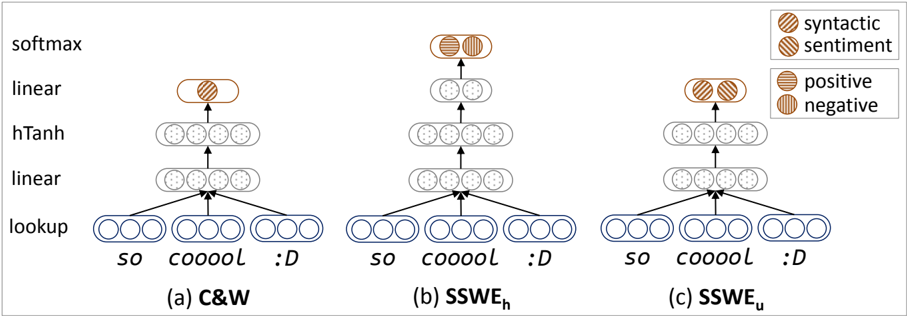
We present a method that learns word embedding for Twitter sentiment classification in this paper.Most existing algorithms for learning continuous word representations typically only model the syntactic context of words but ignore the sentiment of text.This is problematic for sentiment analysis as they usually map words with similar syntactic context but opposite sentiment polarity, such as good and bad, to neighboring word vectors.We address this issue by learning sentimentspecific word embedding (SSWE), which encodes sentiment information in the continuous representation of words.Specifically, we develop three neural networks to effectively incorporate the supervision from sentiment polarity of text (e.g.sentences or tweets) in their loss functions.To obtain large scale training corpora, we learn the sentiment-specific word embedding from massive distant-supervised tweets collected by positive and negative emoticons.Experiments on applying SS-WE to a benchmark Twitter sentiment classification dataset in SemEval 2013 show that (1) the SSWE feature performs comparably with hand-crafted features in the top-performed system; (2) the performance is further improved by concatenating SSWE with existing feature set.
Overview
The claims and statistics of this paper haven’t been checked yet.
Free: it reads the open-access text and checks the first 5 claims that cite a source we can check. Create a free account to check every claim.
Integrity signals
Registry
Cites
Statistics
Figures
Verification
Claims the paper makes
The claims and statistics of this paper haven’t been checked yet.
Free: it reads the open-access text and checks the first 5 claims that cite a source we can check. Create a free account to check every claim.
Claims other papers make about this one
Each is checked against this paper’s own text: does it say what the citing paper says it does?
The source backs part of the claim, not all of it — or backs it for a different population, condition or comparison.
In the citing paper
“Tang et al. [64] pioneered the Sentiment-Specific Word Embeddings (SSWE). Empirical results have shown its superior efficacy over other embeddings in integrating emotion labels at the word level for emotion-centric tasks.”
From A Survey of Deep Learning-Based Multimodal Emotion Recognition: Speech, Text, and Face (2023) · cites this paper as [64]
Experimental — accuracy not yet measured
Self-check
Percentages, sums and reported differences re-computed from the paper’s own numbers.
The self-check needs the paper’s full text.
Citations
Cites
(2003) · Journal of Machine Learning Research · doi:10.5555/944919.944937 · Cited by 32,337
Distributed Representations of Words and Phrases and their Compositionality
Mikolov, T., Sutskever, I., Chen, K., Corrado, G., & Dean, J. (2013) · arXiv · doi:10.48550/arxiv.1310.4546 · Cited by 24,533 · cited 2×
“Although existing word embedding learning algorithms (Collobert et al., 2011; Mikolov et al., 2013) are intuitive choices, they are not effective enough if directly used for sentiment classification.”
BackgroundRepresentation Learning: A Review and New Perspectives
Bengio, Y., Courville, A., & Vincent, P. (2013) · IEEE Transactions on Pattern Analysis and Machine Intelligence · doi:10.1109/tpami.2013.50 · Cited by 13,001
Blei, D. M., Ng, A. Y., & Jordan, M. I. (2002) · Advances in Neural Information Processing Systems 14 · doi:10.7551/mitpress/1120.003.0082 · Cited by 12,223
(2010) · Cited by 8,261
Mining and summarizing customer reviews
Hu, M., & Liu, B. (2004) · Proceedings of the tenth ACM SIGKDD international conference on Knowledge discovery and data mining · doi:10.1145/1014052.1014073 · Cited by 7,793
Thumbs up?: sentiment classification using machine learning techniques
Pang, B., Lee, L., & Vaithyanathan, S. (2002) · Proceedings of the ACL-02 conference on Empirical methods in natural language processing - EMNLP '02 · doi:10.3115/1118693.1118704 · Cited by 7,024
Learning Word Vectors for Sentiment Analysis
Maas, A. L., Daly, R. E., Pham, P. T., Huang, D., Ng, A. Y., & Potts, C. (2011) · Cited by 6,961
Recursive Deep Models for Semantic Compositionality Over a Sentiment Treebank
Socher, R., Perelygin, A., Wu, J., Chuang, J., Manning, C. D., Ng, A., & Potts, C. (2013) · Proceedings of the 2013 Conference on Empirical Methods in Natural Language Processing · doi:10.18653/v1/d13-1170 · Cited by 6,878
Opinion Mining and Sentiment Analysis
Pang, B., & Lee, L. (2008) · now publishers, Inc. eBooks · doi:10.1561/9781601981516 · Cited by 6,720
Research works printed but not linked: 5
- Alec Go, Richa Bhayani, and Lei Huang. 2009. Twit- ter sentiment classification using distant supervision. CS224N Project Report, Stanford, pages 1-12.
- Tomas Mikolov, Ilya Sutskever, Kai Chen, Greg Corra- do, and Jeffrey Dean. 2013. Distributed representa- tions of words and phrases and their compositionali- ty. The Conference on Neural Information Process- ing Systems.
- Preslav Nakov, Sara Rosenthal, Zornitsa Kozareva, Veselin Stoyanov, Alan Ritter, and Theresa Wilson. 2013. Semeval-2013 task 2: Sentiment analysis in twitter. In Proceedings of the International Work- shop on Semantic Evaluation, volume 13.
- Richard Socher, J. Pennington, E.H. Huang, A.Y. Ng, and C.D. Manning. 2011c. Semi-supervised recur- sive autoencoders for predicting sentiment distribu- tions. In Conference on Empirical Methods in Nat- ural Language Processing, pages 151-161.
- Richard Socher, Brody Huval, Christopher D. Man- ning, and Andrew Y. Ng. 2012. Semantic Com- positionality Through Recursive Matrix-Vector S- paces. In Proceedings of the Conference on Empiri- cal Methods in Natural Language Processing.
Cited by
Items 401–500 of 1,000
Karamitsos, I., Albarhami, S., & Apostolopoulos, C. (2019) · Journal of Data Analysis and Information Processing · doi:10.4236/jdaip.2019.74016 · Cited by 26
Serendipity—A Machine-Learning Application for Mining Serendipitous Drug Usage From Social Media
Ru, B., Li, D., Hu, Y., & Yao, L. (2019) · IEEE Transactions on NanoBioscience · doi:10.1109/tnb.2019.2909094 · Cited by 28
Ortiz, A. M., Salles-Bernal, S., & Orrequia-Barea, A. (2019) · Information Technology & Tourism · doi:10.1007/s40558-019-00155-0 · Cited by 25
Sentiment Analysis Using Autoregressive Language Modeling and Broad Learning System
Gong, X., Jin, J., & Zhang, T. (2019) · IEEE International Conference on Bioinformatics and Biomedicine (BIBM) · doi:10.1109/bibm47256.2019.8983025 · Cited by 25
Adversarial learning of sentiment word representations for sentiment analysis
Peng, B., Wang, J., & Zhang, X. (2020) · Information Sciences · doi:10.1016/j.ins.2020.06.044 · Cited by 25
Exploiting semantic relationships for unsupervised expansion of sentiment lexicons
Viegas, F. A. R., Alvim, M. S., Canuto, S., Rosa, T. C., Gonçalves, M. A., & da Rocha, L. C. D. (2020) · Information Systems · doi:10.1016/j.is.2020.101606 · Cited by 27
Dependency-based syntax-aware word representations
Zhang, M., Li, Z., Fu, G., & Zhang, M. (2020) · Artificial Intelligence · doi:10.1016/j.artint.2020.103427 · Cited by 26
Sentiment analysis: a convolutional neural networks perspective
Diwan, T., & Tembhurne, J. V. (2022) · Multimedia Tools and Applications · doi:10.1007/s11042-021-11759-2 · Cited by 26
Short text classification based on Wikipedia and Word2vec
Liu, W., Zewen, C., Wang, J., & Xiaoyi, W. (2016) · IEEE International Conference on Computer and Communications (ICCC) · doi:10.1109/compcomm.2016.7924894 · Cited by 25
Quantifying Content Polarization on Twitter
Yang, M., Wen, X., Lin, Y., & Deng, L. (2017) · IEEE International Conference on Collaboration and Internet Computing (CIC) · doi:10.1109/cic.2017.00047 · Cited by 34
Sentiment Classification towards Question-Answering with Hierarchical Matching Network
Shen, C., Sun, C., Wang, J., Kang, Y., Li, S., Liu, X., Si, L., Zhang, M., & Zhou, G. (2018) · Conference on Empirical Methods in Natural Language Processing (EMNLP) · doi:10.18653/v1/d18-1401 · Cited by 25
Thai Sentiment Analysis via Bidirectional LSTM-CNN Model with Embedding Vectors and Sentic Features
Ayutthaya, T. S. N., & Pasupa, K. (2018) · International Joint Symposium on Artificial Intelligence and Natural Language Processing (iSAI-NLP) · doi:10.1109/isai-nlp.2018.8692836 · Cited by 25
Evaluating Public Anxiety for Topic-Based Communities in Social Networks
Ta, N., Li, K., Yang, Y., Jiao, F., Tang, Z., & Li, G. (2020) · IEEE Transactions on Knowledge and Data Engineering · doi:10.1109/tkde.2020.2989759 · Cited by 25
TwiSE at SemEval-2016 Task 4: Twitter Sentiment Classification
Balikas, G., & Amini, M.-R. (2016) · International Workshop on Semantic Evaluation (SemEval) · doi:10.18653/v1/s16-1010 · Cited by 36
Intersubjectivity and Sentiment: From Language to Knowledge
Gui, L., Xu, R., He, Y., Lu, Q., & Wei, Z. (2017) · WORLD SCIENTIFIC eBooks · doi:10.1142/9789813223615_0010 · Cited by 24
Customer Experience towards the Product during a Coronavirus Outbreak
Wassan, S., Shen, T., Chen, X., Gulati, K., Vasan, D., & Suhail, B. (2022) · Behavioural Neurology · doi:10.1155/2022/4279346 · Cited by 24
RetractedPESCO: Prompt-enhanced Self Contrastive Learning for Zero-shot Text Classification
Wang, Y.-S., Chi, T.-C., Zhang, R., & Yang, Y. (2023) · Proceedings of the conference - Association for Computational Linguistics. Meeting · doi:10.18653/v1/2023.acl-long.832 · Cited by 31
Deriving a representative vector for ontology classes with instance word vector embeddings
Jayawardana, V., Lakmal, D., de Silva, N., Perera, A. S., Sugathadasa, K., & Ayesha, B. (2017) · International Conference on Innovative Computing Technology · doi:10.1109/intech.2017.8102426 · Cited by 24
Bag of meta-words: A novel method to represent document for the sentiment classification
Fu, M., Qu, H., Huang, L., & Lu, L. (2018) · Expert Systems with Applications · doi:10.1016/j.eswa.2018.06.052 · Cited by 24
Incorporating Extra Knowledge to Enhance Word Embedding
Roy, A., & Pan, S. (2020) · International Joint Conference on Artificial Intelligence · doi:10.24963/ijcai.2020/686 · Cited by 24
How do sentiments affect virality on Twitter?
Jiménez-Zafra, S. M., Sáez-Castillo, A. J., Sánchez, A. C., & Valdivia, M. T. M. (2021) · Royal Society Open Science · doi:10.1098/rsos.201756 · Cited by 24
Bucur, C., Tudorică, B.-G., Andrei, J. V., Dușmănescu, D., Paraschiv, D., & Teodor, C. (2024) · Frontiers in Environmental Science · doi:10.3389/fenvs.2024.1360304 · Cited by 27
Attentive Gated Lexicon Reader with Contrastive Contextual Co-Attention for Sentiment Classification
Tay, Y., Luu, A. T., Hui, S. C., & Su, J. (2018) · Conference on Empirical Methods in Natural Language Processing (EMNLP) · doi:10.18653/v1/d18-1381 · Cited by 23
Balaji, M., & Yuvaraj, N. R. (2019) · Journal of Physics Conference Series · doi:10.1088/1742-6596/1362/1/012039 · Cited by 23
Target-guided Emotion-aware Chat Machine
Wei, W., Liu, J., Mao, X.-L., Guo, G., Zhu, F., Zhou, P., Hu, Y., & Feng, S. (2021) · ACM Transactions on Information Systems · doi:10.1145/3456414 · Cited by 28
Online News Emotion Prediction with Bidirectional LSTM
Zhao, X. Z., Wang, C., Yang, Z., Zhang, Y., & Yuan, X. (2016) · Lecture notes in computer science · doi:10.1007/978-3-319-39958-4_19 · Cited by 23
A Study of Chinese Document Representation and Classification with Word2vec
Zhu, L., Wang, G., & Zou, X. (2016) · International Symposium on Computational Intelligence and Design · doi:10.1109/iscid.2016.1075 · Cited by 23
Bayesian Deep Convolution Belief Networks for Subjectivity Detection
Chaturvedi, I., Cambria, E., Poria, S., & Bajpai, R. (2016) · IEEE ... International Conference on Data Mining workshops · doi:10.1109/icdmw.2016.0134 · Cited by 23
Yin, Y., Song, Y., & Zhang, M. (2017) · International Workshop on Semantic Evaluation (SemEval) · doi:10.18653/v1/s17-2102 · Cited by 23
Cascading Multiway Attentions for Document-level Sentiment Classification
Ma, D., Li, S., Zhang, X., Wang, H., & Sun, X. (2017) · International Joint Conference on Natural Language Processing · Cited by 23
Tracking Dynamics of Opinion Behaviors with a Content-Based Sequential Opinion Influence Model
Chen, C., Wang, Z., & Li, W. (2018) · IEEE Transactions on Affective Computing · doi:10.1109/taffc.2018.2821123 · Cited by 23
Siamese Network-Based Supervised Topic Modeling
Huang, M., Rao, Y., Liu, Y., Xie, H., & Wang, F. L. (2018) · Conference on Empirical Methods in Natural Language Processing (EMNLP) · doi:10.18653/v1/d18-1494 · Cited by 23
Tataru, C. A., & David, M. M. (2020) · PLoS Computational Biology · doi:10.1371/journal.pcbi.1007859 · Cited by 26
Localising social network users and profiling their movement
Pellet, H., Shiaeles, S. N., & Stavrou, S. (2018) · Computers & Security · doi:10.1016/j.cose.2018.10.009 · Cited by 23
Evaluating neural word embeddings created from online course reviews for sentiment analysis
Dessì, D., Dragoni, M., Fenu, G., Marras, M., & Recupero, D. R. (2019) · ACM Symposium on Applied Computing · doi:10.1145/3297280.3297620 · Cited by 22
Verbal sentiment analysis and detection using recurrent neural network
Mohanty, M. D., & Mohanty, M. N. (2022) · Elsevier eBooks · doi:10.1016/b978-0-32-385708-6.00012-6 · Cited by 26
PyFin-sentiment: Towards a machine-learning-based model for deriving sentiment from financial tweets
Wilksch, M., & Abramova, O. (2023) · International Journal of Information Management Data Insights · doi:10.1016/j.jjimei.2023.100171 · Cited by 28
Xiong, H., Yan, Z., Wu, C., Lu, G., Pang, S., Xue, Y., & Cai, Q. (2023) · International Journal of Machine Learning and Cybernetics · doi:10.1007/s13042-023-01831-8 · Cited by 27
The Role of Preprocessing for Word Representation Learning in Affective Tasks
Babanejad, N., Davoudi, H., Agrawal, A., An, A., & Papagelis, M. (2023) · IEEE Transactions on Affective Computing · doi:10.1109/taffc.2023.3270115 · Cited by 25
Recent Trends in Deep Learning Based Textual Emotion Cause Extraction
Su, X., Huang, Z., Zhao, Y., Chen, Y., Dou, Y., & Pan, H. (2023) · IEEE/ACM Transactions on Audio Speech and Language Processing · doi:10.1109/taslp.2023.3254166 · Cited by 23
Development of Context-Based Sentiment Classification for Intelligent Stock Market Prediction
Smatov, N., Калашников, Р., & Kartbayev, A. Z. (2024) · Big Data and Cognitive Computing · doi:10.3390/bdcc8060051 · Cited by 24
Spoiler detection in TV program tweets
Jeon, S., Kim, S., & Yu, H. (2015) · Information Sciences · doi:10.1016/j.ins.2015.09.005 · Cited by 22
Joint Emoji Classification and Embedding Learning
Li, X., Yan, R., & Zhang, M. (2017) · Lecture notes in computer science · doi:10.1007/978-3-319-63564-4_4 · Cited by 22
A hierarchical lstm model with multiple features for sentiment analysis of sina weibo texts
Shi, S., Meng, Z., Guan, J., Li, Y., & Huang, H. (2017) · International Conference on Asian Language Processing · doi:10.1109/ialp.2017.8300622 · Cited by 22
SHE: Sentiment Hashtag Embedding Through Multitask Learning
Singh, L. G., Anil, A., & Singh, S. R. (2020) · IEEE Transactions on Computational Social Systems · doi:10.1109/tcss.2019.2962718 · Cited by 22
Gender bias in legal corpora and debiasing it
Sevim, N., Şahinuç, F., & Koç, A. (2022) · Natural Language Engineering · doi:10.1017/s1351324922000122 · Cited by 31
Microblogs data management: a survey
Magdy, A., Abdelhafeez, L., Kang, Y., Ong, E., & Mokbel, M. F. (2019) · The VLDB Journal · doi:10.1007/s00778-019-00569-6 · Cited by 21
Interactive Dual Attention Network for Text Sentiment Classification
Zhu, Y., Zheng, W., & Tang, H. (2020) · Computational Intelligence and Neuroscience · doi:10.1155/2020/8858717 · Cited by 21
Layer-wise Model Pruning based on Mutual Information
Fan, C. C., Li, J., Zhang, T., Ao, X., Wu, F. Q., Meng, Y., & Sun, X. (2021) · Conference on Empirical Methods in Natural Language Processing (EMNLP) · doi:10.18653/v1/2021.emnlp-main.246 · Cited by 36
Chowdhury, K. R., Sil, A., & Shukla, S. (2021) · Communications in computer and information science · doi:10.1007/978-3-030-81462-5_9 · Cited by 21
Decoding customer experiences in rail transport service: application of hybrid sentiment analysis
Mishra, D. N., & Panda, R. K. (2022) · Public Transport · doi:10.1007/s12469-021-00289-7 · Cited by 25
Deep Learning for Natural Language Processing: A Survey
Arkhangelskaya, E. O., & Nikolenko, S. (2023) · Journal of Mathematical Sciences · doi:10.1007/s10958-023-06519-6 · Cited by 27
LIA at SemEval-2017 Task 4: An Ensemble of Neural Networks for Sentiment Classification
Rouvier, M. (2017) · International Workshop on Semantic Evaluation (SemEval) · doi:10.18653/v1/s17-2128 · Cited by 21
Towards a Universal Sentiment Classifier in Multiple languages
Xu, K., & Wan, X. (2017) · Conference on Empirical Methods in Natural Language Processing (EMNLP) · doi:10.18653/v1/d17-1053 · Cited by 21
Tsakalidis, A., Liakata, M., Damoulas, T., & Cristea, A. I. (2019) · Lecture notes in computer science · doi:10.1007/978-3-030-10997-4_25 · Cited by 23
Dual Memory Network Model for Biased Product Review Classification
Long, Y., Ma, M., Lu, Q., Xiang, R., & Huang, C. (2018) · Workshop on Computational Approaches to Subjectivity, Sentiment and Social Media Analysis (WASSA) · doi:10.18653/v1/w18-6220 · Cited by 21
Osprey: Weak Supervision of Imbalanced Extraction Problems without Code
Bringer, E., Israeli, A., Shoham, Y., Ratner, A., & Ré, C. (2019) · doi:10.1145/3329486.3329492 · Cited by 21
Learning Cross-Lingual Word Embeddings from Twitter via Distant Supervision
Camacho-Collados, J., Doval, Y., Martínez‐Cámara, E., Espinosa-Anke, L., Barbieri, F., & Schockaert, S. (2020) · Proceedings of the International AAAI Conference on Web and Social Media · doi:10.1609/icwsm.v14i1.7280 · Cited by 27
Interpretable Word Embeddings via Informative Priors
Bodell, M. H., Arvidsson, M., & Magnusson, M. (2019) · Conference on Empirical Methods in Natural Language Processing (EMNLP) · doi:10.18653/v1/d19-1661 · Cited by 24
Feng, S., Song, K., Wang, D., Gao, W. G., & Zhang, Y. (2020) · International Journal of Machine Learning and Cybernetics · doi:10.1007/s13042-020-01181-9 · Cited by 21
Are Word Embedding Methods Stable and Should We Care About It?
Borah, A., Barman, M. P., & Awekar, A. C. (2021) · ACM Conference on Hypertext and Social Media (HT) · doi:10.1145/3465336.3475098 · Cited by 20
Bae, Y. S., Kim, K. H., Kim, H. K., Choi, S. W., Ko, T., Seo, H. H., Lee, H., & Jeon, H. (2021) · Applied Sciences · doi:10.3390/app11198812 · Cited by 25
Li, Y., Weng, L., Xia, M., Hu, K., & Lin, H. (2024) · Remote Sensing · doi:10.3390/rs16101665 · Cited by 20
A Joint Segmentation and Classification Framework for Sentiment Analysis
Tang, D., Wei, F., Qin, B., Dong, L., Liu, T., & Zhou, M. (2014) · Conference on Empirical Methods in Natural Language Processing (EMNLP) · doi:10.3115/v1/d14-1054 · Cited by 20
Self-citationModeling and Mining Domain Shared Knowledge for Sentiment Analysis
Zhou, G., & Huang, J. X. (2017) · ACM Transactions on Information Systems · doi:10.1145/3091995 · Cited by 22
Neural Review Rating Prediction with User and Product Memory
Yuan, Z., Wu, F., Liu, J., Wu, C., Huang, Y., & Xie, X. (2019) · ACM International Conference on Information and Knowledge Management (CIKM) · doi:10.1145/3357384.3358138 · Cited by 20
Feature Selection for Twitter Sentiment Analysis: An Experimental Study
Mansour, R., Hady, M. F. A., Hosam, E., Amr, H., & Ashour, A. (2015) · Lecture notes in computer science · doi:10.1007/978-3-319-18117-2_7 · Cited by 20
Predicting Emotional Word Ratings using Distributional Representations and Signed Clustering
Sedoc, J., Preoțiuc-Pietro, D., & Ungar, L. (2017) · Conference of the European Chapter of the Association for Computational Linguistics · doi:10.18653/v1/e17-2090 · Cited by 20
Augmented sentiment representation by learning context information
Hu, H., Bai, X., & Li, P. (2018) · Neural Computing and Applications · doi:10.1007/s00521-018-3698-4 · Cited by 20
Mercier, D., Rizvi, S., Rajashekar, V., Dengel, A., & Ahmed, S. (2021) · Proceedings of the 13th International Conference on Agents and Artificial Intelligence · doi:10.5220/0010235201590168 · Cited by 19
CADEN: A Context-Aware Deep Embedding Network for Financial Opinions Mining
Zhang, L., Xiao, K., Zhu, H., Liu, C., Yang, J., & Jin, B. (2018) · Proceedings · doi:10.1109/icdm.2018.00091 · Cited by 19
Representation learning from noisy user-tagged data for sentiment classification
Chen, L., Wang, F., Yang, R., Xie, F., Wang, W., Xu, C. X., Zhao, W. Z., & Guan, Z. (2022) · International Journal of Machine Learning and Cybernetics · doi:10.1007/s13042-022-01622-7 · Cited by 19
An Effective ELECTRA-Based Pipeline for Sentiment Analysis of Tourist Attraction Reviews
Fang, H., Xu, G., Long, Y., & Tang, W. (2022) · Applied Sciences · doi:10.3390/app122110881 · Cited by 19
A novel adaptive marker segmentation graph convolutional network for aspect-level sentiment analysis
Wang, P., Tao, L., Tang, M., Zhao, M., Wang, L., Xu, Y., Tian, J., & Meng, K. (2023) · Knowledge-Based Systems · doi:10.1016/j.knosys.2023.110559 · Cited by 20
Detecting political biases of named entities and hashtags on Twitter
Xiao, Z., Zhu, J. D., Wang, Y., Zhou, P., Lam, W. H., Porter, M. A., & Sun, Y. (2023) · EPJ Data Science · doi:10.1140/epjds/s13688-023-00386-6 · Cited by 25
Emotion identification in FIFA world cup tweets using convolutional neural network
Stojanovski, D., Strezoski, G., Madjarov, G., & Dimitrovski, I. (2015) · International Conference on Innovations in Information Technology · doi:10.1109/innovations.2015.7381514 · Cited by 19
Linking heterogeneous input features with pivots for domain adaptation
Zhou, G., He, T., Wu, W., & Hu, X. T. (2015) · International Conference on Artificial Intelligence · Cited by 20
UniPI at SemEval-2016 Task 4: Convolutional Neural Networks for Sentiment Classification
Attardi, G., & Sartiano, D. (2016) · International Workshop on Semantic Evaluation (SemEval) · doi:10.18653/v1/s16-1033 · Cited by 19
Predicting future personal life events on twitter via recurrent neural networks
Khodabakhsh, M., Kahani, M., & Bagheri, E. (2018) · Journal of Intelligent Information Systems · doi:10.1007/s10844-018-0519-2 · Cited by 19
Improving Sentiment Analysis in Twitter Using Sentiment Specific Word Embeddings
Othman, R., Abdelsadek, Y., Chelghoum, K., Kacem, I., & Faïz, R. (2019) · IEEE International Conference on Intelligent Data Acquisition and Advanced Computing Systems: Technology and Applications (IDAACS) · doi:10.1109/idaacs.2019.8924403 · Cited by 19
LessLex: Linking Multilingual Embeddings to SenSe Representations of LEXical Items
Colla, D., Mensa, E., & Radicioni, D. P. (2020) · Computational Linguistics · doi:10.1162/coli_a_00375 · Cited by 22
Incorporating pre-training in long short-term memory networks for tweet classification
Yuan, S., Wu, X., & Xiang, Y. (2018) · Social Network Analysis and Mining · doi:10.1007/s13278-018-0530-1 · Cited by 20
Context-sensitive lexicon for imbalanced text sentiment classification using bidirectional LSTM
Kumar, M. R. P., & Jayagopal, P. (2021) · Journal of Intelligent Manufacturing · doi:10.1007/s10845-021-01866-0 · Cited by 23
Adversarial Learning-Based Sentiment Analysis for Socially Implemented IoMT Systems
Xu, Y., Gao, H., Li, R., Jiang, Y., Mumtaz, S., Jiang, Z., Fang, J., & Dong, L. (2023) · IEEE Transactions on Computational Social Systems · doi:10.1109/tcss.2023.3252028 · Cited by 19
Semantic Word Clusters Using Signed Spectral Clustering
Sedoc, J., Gallier, J. H., Foster, D. P., & Ungar, L. (2017) · Proceedings of the conference - Association for Computational Linguistics. Meeting · doi:10.18653/v1/p17-1087 · Cited by 23
Learning and Applying Ontology for Machine Learning in Cyber Attack Detection
Zheng, H., Wang, Y., Han, C., Le, F., He, R., & Lu, J. (2018) · IEEE International Conference on Trust, Security and Privacy in Computing and Communications (TrustCom) · doi:10.1109/trustcom/bigdatase.2018.00180 · Cited by 19
Witness Identification in Twitter
Fang, R., Nourbakhsh, A., Liu, X., Shah, S., & Li, Q. (2016) · International Workshop on Natural Language Processing for Social Media (SocialNLP) · doi:10.18653/v1/w16-6210 · Cited by 20
Som, S., Chandra, N., Ahuja, L., Khatri, S. K., Som, S., & Monga, H. (2021) · Journal of Information Systems and Telecommunication (JIST) · doi:10.52547/jist.9.34.89 · Cited by 18
Ranjan, R., Pandey, D., Rai, A. K., Singh, P., Vidyarthi, A., Gupta, D., Kumar, P. R., & Mohanty, S. N. (2023) · Applied Sciences · doi:10.3390/app13053091 · Cited by 18
Learning sentiment-inherent word embedding for word-level and sentence-level sentiment analysis
Zhang, Z., & Lan, M. (2015) · International Conference on Asian Language Processing · doi:10.1109/ialp.2015.7451540 · Cited by 18
Deep Bi-directional Long Short-Term Memory Neural Networks for Sentiment Analysis of Social Data
Nguyen, N.-K., Le, A.-C., & Pham, H. T. (2016) · Lecture notes in computer science · doi:10.1007/978-3-319-49046-5_22 · Cited by 18
Tweet Topic Classification Using Distributed Language Representations
Li, Q., Shah, S., Liu, X., Nourbakhsh, A., & Fang, R. (2016) · IEEE/WIC/ACM International Conference on Web Intelligence · doi:10.1109/wi.2016.0022 · Cited by 18
A User Profile Modeling Method Based on Word2Vec
Hu, J., Jin, F., Zhang, G., Wang, J., & Yang, Y. (2017) · IEEE International Conference on Software Quality, Reliability and Security Companion (QRS-C) · doi:10.1109/qrs-c.2017.74 · Cited by 18
Testing word embeddings for Polish
Mykowiecka, A., Marciniak, M., & Rychlik, P. (2017) · Cognitive Studies | Études cognitives · doi:10.11649/cs.1468 · Cited by 21
Bilingual embeddings with random walks over multilingual wordnets
Goikoetxea, J., Soroa, A., & Agirre, E. (2018) · Knowledge-Based Systems · doi:10.1016/j.knosys.2018.03.017 · Cited by 18
Zero-Shot Multilingual Sentiment Analysis using Hierarchical Attentive Network and BERT
Sarkar, A., Reddy, S., & Iyengar, R. S. (2019) · International Conference on Natural Language Processing and Information Retrieval (NLPIR) · doi:10.1145/3342827.3342850 · Cited by 18
Sentiment Analysis of Text Classification Algorithms Using Confusion Matrix
Gaye, B., & Wulamu, A. (2019) · Communications in computer and information science · doi:10.1007/978-981-15-1922-2_16 · Cited by 22
Context-Aware Sliding Window for Sentiment Classification
Masood, M. A., Abbasi, R. A., & Ng, W. K. (2020) · IEEE Access · doi:10.1109/access.2019.2963586 · Cited by 18
An Extensive Survey on Some Deep-Learning Applications
Sultana, J., Rani, M. U., & Farquad, M. A. H. (2020) · Advances in intelligent systems and computing · doi:10.1007/978-981-15-0135-7_47 · Cited by 19
Metadata
- Authors
- Tang, D., Wei, F., Yang, N., Zhou, M., Liu, T., & Qin, B.
- Affiliations
- Harbin Institute of Technology (CN)
- University of Science and Technology of China (CN)
- Venue
- Proceedings of the 52nd Annual Meeting of the Association for Computational Linguistics (Volume 1: Long Papers)
- Published
- 2014
- Pages
- 1555-1565
- ISSN
- 0736-587X (ISSN-L)
- OpenAlex
- W2250879510
- Cited by
- 1,181
- References
- 58
- Citations by year
- 2026: 6 · 2025: 17 · 2024: 45 · 2023: 80 · 2022: 88 · 2021: 107 · 2020: 163 · 2019: 155 · 2018: 177 · 2017: 144 · 2016: 110 · 2015: 80 · 2014: 9
- FWCI
- 67.34
- Type
- conference paper
- Language
- en
- Open access
- hybrid
- doi.org
- Licence
- cc-by
- Locations
- Proceedings of the conference - Association for Computational Linguistics. Meeting (publishedVersion, cc-by)
- Funders
- National Natural Science Foundation of China (61273321, 61300113, 61133012)
- Topics
- Physical Sciences › Computer Science › Artificial Intelligence › Sentiment Analysis and Opinion Mining
- Physical Sciences › Computer Science › Artificial Intelligence › Topic Modeling
- Physical Sciences › Computer Science › Artificial Intelligence › Hate Speech and Cyberbullying Detection
- Keywords
- sentiment polarity, distant supervision, emoticons, word representation learning, SemEval-2013
About these checks
Registry, retraction, Cites and statistics results are computed, not judged, with one exception: a printed reference that no index lists is read once by a model before it counts as a citation error. Claims are extracted by a model and kept only when their quote appears verbatim in the text; each cited source is then checked, with a model’s help, for whether it says what the claim relies on. Those verdicts can be wrong — read the claim’s quote and the cited source before relying on one.
Statistics and arithmetic are recomputed, not judged.
Confidence bands are shown only for fields calibrated on our annotated test set. None is calibrated yet, so no band is shown.
What counts as a claim ›How we measure confidence ›How we check this ›
Are you an author, or do you see a problem with this page? Request a review
Data sources
Bibliographic data: Semantic Scholar, OpenAlex, Crossref.
Contains information from the Semantic Scholar Academic Graph Datasets, made available under the ODC Attribution License (ODC-BY 1.0).
Semantic Scholar’s data is described in: Kinney, R., et al. (2023). The Semantic Scholar Open Data Platform. arXiv:2301.10140.
