

Learning Sentiment-Specific Word Embedding for Twitter Sentiment Classification
Open accessThe DOI matches its Crossref record; 56 of the 58 references it cites were found in a registry or an index.
Abstract
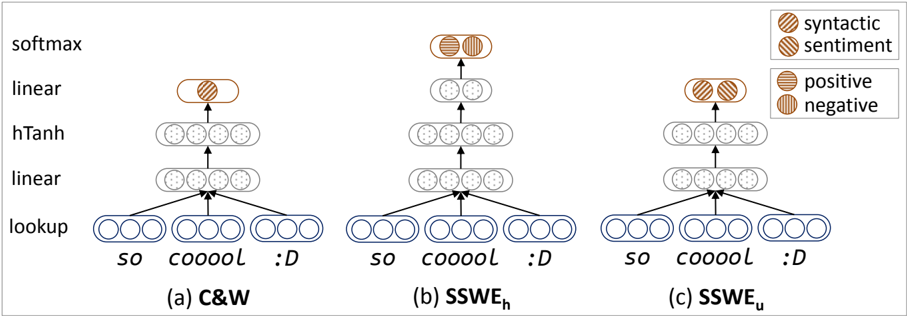
We present a method that learns word embedding for Twitter sentiment classification in this paper.Most existing algorithms for learning continuous word representations typically only model the syntactic context of words but ignore the sentiment of text.This is problematic for sentiment analysis as they usually map words with similar syntactic context but opposite sentiment polarity, such as good and bad, to neighboring word vectors.We address this issue by learning sentimentspecific word embedding (SSWE), which encodes sentiment information in the continuous representation of words.Specifically, we develop three neural networks to effectively incorporate the supervision from sentiment polarity of text (e.g.sentences or tweets) in their loss functions.To obtain large scale training corpora, we learn the sentiment-specific word embedding from massive distant-supervised tweets collected by positive and negative emoticons.Experiments on applying SS-WE to a benchmark Twitter sentiment classification dataset in SemEval 2013 show that (1) the SSWE feature performs comparably with hand-crafted features in the top-performed system; (2) the performance is further improved by concatenating SSWE with existing feature set.
Overview
The claims and statistics of this paper haven’t been checked yet.
Free: it reads the open-access text and checks the first 5 claims that cite a source we can check. Create a free account to check every claim.
Integrity signals
Registry
Cites
Statistics
Figures
Verification
Claims the paper makes
The claims and statistics of this paper haven’t been checked yet.
Free: it reads the open-access text and checks the first 5 claims that cite a source we can check. Create a free account to check every claim.
Claims other papers make about this one
Each is checked against this paper’s own text: does it say what the citing paper says it does?
The source backs part of the claim, not all of it — or backs it for a different population, condition or comparison.
In the citing paper
“Tang et al. [64] pioneered the Sentiment-Specific Word Embeddings (SSWE). Empirical results have shown its superior efficacy over other embeddings in integrating emotion labels at the word level for emotion-centric tasks.”
From A Survey of Deep Learning-Based Multimodal Emotion Recognition: Speech, Text, and Face (2023) · cites this paper as [64]
Experimental — accuracy not yet measured
Self-check
Percentages, sums and reported differences re-computed from the paper’s own numbers.
The self-check needs the paper’s full text.
Citations
Cites
(2003) · Journal of Machine Learning Research · doi:10.5555/944919.944937 · Cited by 32,337
Distributed Representations of Words and Phrases and their Compositionality
Mikolov, T., Sutskever, I., Chen, K., Corrado, G., & Dean, J. (2013) · arXiv · doi:10.48550/arxiv.1310.4546 · Cited by 24,533 · cited 2×
“Although existing word embedding learning algorithms (Collobert et al., 2011; Mikolov et al., 2013) are intuitive choices, they are not effective enough if directly used for sentiment classification.”
BackgroundRepresentation Learning: A Review and New Perspectives
Bengio, Y., Courville, A., & Vincent, P. (2013) · IEEE Transactions on Pattern Analysis and Machine Intelligence · doi:10.1109/tpami.2013.50 · Cited by 13,001
Blei, D. M., Ng, A. Y., & Jordan, M. I. (2002) · Advances in Neural Information Processing Systems 14 · doi:10.7551/mitpress/1120.003.0082 · Cited by 12,223
(2010) · Cited by 8,261
Mining and summarizing customer reviews
Hu, M., & Liu, B. (2004) · Proceedings of the tenth ACM SIGKDD international conference on Knowledge discovery and data mining · doi:10.1145/1014052.1014073 · Cited by 7,793
Thumbs up?: sentiment classification using machine learning techniques
Pang, B., Lee, L., & Vaithyanathan, S. (2002) · Proceedings of the ACL-02 conference on Empirical methods in natural language processing - EMNLP '02 · doi:10.3115/1118693.1118704 · Cited by 7,024
Learning Word Vectors for Sentiment Analysis
Maas, A. L., Daly, R. E., Pham, P. T., Huang, D., Ng, A. Y., & Potts, C. (2011) · Cited by 6,961
Recursive Deep Models for Semantic Compositionality Over a Sentiment Treebank
Socher, R., Perelygin, A., Wu, J., Chuang, J., Manning, C. D., Ng, A., & Potts, C. (2013) · Proceedings of the 2013 Conference on Empirical Methods in Natural Language Processing · doi:10.18653/v1/d13-1170 · Cited by 6,878
Opinion Mining and Sentiment Analysis
Pang, B., & Lee, L. (2008) · now publishers, Inc. eBooks · doi:10.1561/9781601981516 · Cited by 6,720
Research works printed but not linked: 5
- Alec Go, Richa Bhayani, and Lei Huang. 2009. Twit- ter sentiment classification using distant supervision. CS224N Project Report, Stanford, pages 1-12.
- Tomas Mikolov, Ilya Sutskever, Kai Chen, Greg Corra- do, and Jeffrey Dean. 2013. Distributed representa- tions of words and phrases and their compositionali- ty. The Conference on Neural Information Process- ing Systems.
- Preslav Nakov, Sara Rosenthal, Zornitsa Kozareva, Veselin Stoyanov, Alan Ritter, and Theresa Wilson. 2013. Semeval-2013 task 2: Sentiment analysis in twitter. In Proceedings of the International Work- shop on Semantic Evaluation, volume 13.
- Richard Socher, J. Pennington, E.H. Huang, A.Y. Ng, and C.D. Manning. 2011c. Semi-supervised recur- sive autoencoders for predicting sentiment distribu- tions. In Conference on Empirical Methods in Nat- ural Language Processing, pages 151-161.
- Richard Socher, Brody Huval, Christopher D. Man- ning, and Andrew Y. Ng. 2012. Semantic Com- positionality Through Recursive Matrix-Vector S- paces. In Proceedings of the Conference on Empiri- cal Methods in Natural Language Processing.
Cited by
Items 801–900 of 1,000
Graph-Based Attention Networks for Aspect Level Sentiment Analysis
Chen, J., Hou, H., Ji, Y., Gao, J., & Bai, T. (2019) · IEEE International Conference on Tools with Artificial Intelligence (ICTAI) · doi:10.1109/ictai.2019.00164 · Cited by 8
Parsimonious Morpheme Segmentation with an Application to Enriching Word Embeddings
El-Kishky, A., Xu, F. F., Zhang, A., & Han, J. (2019) · IEEE International Conference on Big Data (BigData) · doi:10.1109/bigdata47090.2019.9005957 · Cited by 10
Yan, M., Lin, Y., Hwa, R., Ertugrul, A. M., Guo, M., & Chung, W. (2020) · Proceedings of the International AAAI Conference on Web and Social Media · doi:10.1609/icwsm.v14i1.7339 · Cited by 5
Effective Vietnamese Sentiment Analysis Model Using Sentiment Word Embedding and Transfer Learning
Huang, Y., Liu, S., Qu, L., & Li, Y. (2020) · Communications in computer and information science · doi:10.1007/978-981-15-7984-4_3 · Cited by 5
EmoChannelAttn: Exploring Emotional Construction Towards Multi-Class Emotion Classification
Li, Z., Chen, X., Xie, H., Li, Q., & Tao, X. (2020) · IEEE/WIC/ACM International Conference on Web Intelligence and Intelligent Agent Technology (WI-IAT) · doi:10.1109/wiiat50758.2020.00036 · Cited by 7
Enhanced Word Embeddings with Sentiment Contextualized Vectors for Sentiment Analysis
Kasri, M., Birjali, M., El-Ansari, A., & Beni‐Hssane, A. (2022) · Lecture notes in networks and systems · doi:10.1007/978-3-030-91738-8_8 · Cited by 5
Twitter-Based Disaster Response Using Recurrent Nets
Lamsal, R., & Kumar, T. V. V. (2022) · IGI Global eBooks · doi:10.4018/978-1-6684-7145-6.ch031 · Cited by 5
Muneer, I., & Nawab, R. M. A. (2022) · Language Resources and Evaluation · doi:10.1007/s10579-022-09613-4 · Cited by 6
Information block multi-head subspace based long short-term memory networks for sentiment analysis
Zhang, X., Chen, Y., & He, L. (2022) · Applied Intelligence · doi:10.1007/s10489-022-03998-z · Cited by 5
Towards a multi-modal Deep Learning Architecture for User Modeling
Tato, A. A. N., & Nkambou, R. (2023) · Proceedings of the ... International Florida Artificial Intelligence Research Society Conference · doi:10.32473/flairs.36.133328 · Cited by 5
Rizvi, S. T. R., Ahmed, S., & Dengel, A. R. (2023) · Social Network Analysis and Mining · doi:10.1007/s13278-023-01085-w · Cited by 5
DFBICA: A new distributed approach for sentiment analysis of bibliographic citations
Abdi, M. E., Smine, B., & Yahia, S. B. (2018) · International Conference on Research Challenges in Information Science (RCIS) · doi:10.1109/rcis.2018.8406672 · Cited by 5
Learning Affect with Distributional Semantic Models
Passaro, L., Bondielli, A., & Lenci, A. (2017) · Italian Journal of Computational Linguistics · doi:10.4000/ijcol.550 · Cited by 5
Qiu, W., Lie, D., & Austin, L. (2020) · arXiv (Cornell University) · doi:10.48550/arxiv.2008.02954 · Cited by 5
Sentiment Analysis, Basic Tasks of
Chaturvedi, I., Poria, S., & Cambria, E. (2017) · Springer eBooks · doi:10.1007/978-1-4614-7163-9_110159-1 · Cited by 5
Zhou, Y., Lan, M., & Wu, Y. (2018) · Lecture notes in computer science · doi:10.1007/978-3-319-73618-1_38 · Cited by 4
Investigation of Gender Bias in Turkish Word Embeddings
Sevim, N., & Koç, A. (2021) · Signal Processing and Communications Applications Conference (SIU) · doi:10.1109/siu53274.2021.9477774 · Cited by 4
Arnob, S. S., Shikder, M. A. A., Ovey, T. A., Rhythm, E. R., & Rasel, A. A. (2023) · International Conference on Computer and Information Technology (ICCIT) · doi:10.1109/iccit60459.2023.10441156 · Cited by 4
Advancing Multilingual Sentiment Understanding with XGBoost, SVM, and XLM-RoBERTa
Gaikwad, A., Belhekar, P., & Kottawar, V. G. (2024) · Lecture notes in electrical engineering · doi:10.1007/978-981-97-8043-3_155 · Cited by 4
Seo, J., Yoo, K., Choi, S., Kim, Y. A., & Han, S. (2018) · Multimedia Tools and Applications · doi:10.1007/s11042-018-6211-2 · Cited by 4
Syntactical Analysis of the Weaknesses of Sentiment Analyzers
Verma, R., Kim, S., & Walter, D. (2018) · Conference on Empirical Methods in Natural Language Processing (EMNLP) · doi:10.18653/v1/d18-1141 · Cited by 4
Domain Adaptation for Word Sense Disambiguation Using Word Embeddings
Komiya, K., Suzuki, S., Sasaki, M., Shinnou, H., & Okumura, M. (2018) · Lecture notes in computer science · doi:10.1007/978-3-319-77113-7_16 · Cited by 4
Towards a Multi-Dataset for Complex Emotions Learning Based on Deep Neural Networks
Belainine, B., Sadat, F., Boukadoum, M., & Lounis, H. (2020) · Cited by 4
Feasibility of Adding Twitter Data to Aid Drought Depiction: Case Study in Colorado
Mukherjee, S., Wang, S., Hirschfeld, D., Lisonbee, J., Deng, L., & Gillies, R. R. (2022) · Water · doi:10.3390/w14182773 · Cited by 4
SKE-MSA: Enhancing Representation Learning with VAD Lexicon for Multimodal Sentiment Analysis
Yang, Y., Dong, X., Qiang, Y., & Si, W. (2025) · IEEE International Conference on Acoustics Speech and Signal Processing · doi:10.1109/icassp49660.2025.10890333 · Cited by 4
The Problem of Sentiment Analysis
Liu, B. (2015) · Cambridge University Press eBooks · doi:10.1017/cbo9781139084789.003 · Cited by 5
A Moral Judgment System using Distributed Representation and Associative Information
YAMAMOTO, M., & Hagiwara, M. (2016) · Transactions of Japan Society of Kansei Engineering · doi:10.5057/jjske.tjske-d-16-00020 · Cited by 4
Zhou, H., Yang, Y., Liu, Z., Lin, Y., Zhu, P., & Huang, D. (2017) · Lecture notes in computer science · doi:10.1007/978-3-319-68699-8_12 · Cited by 4
Automatic emotional spoken language text corpus construction from written dialogs in fictions
Chen, J., Liu, C., & Li, M. (2017) · International Conference on Affective Computing and Intelligent Interaction and workshops · doi:10.1109/acii.2017.8273619 · Cited by 4
Building Sentiment Lexicon with Representation Learning Based on Contrast and Label of Sentiment
Wang, X., Chen, J., Hawbani, A., Miao, F., & Shao, C. (2018) · International Conference on Big Data Computing and Communications (BigCom) · doi:10.1109/bigcom.2018.00032 · Cited by 4
Emotion Analysis for the Upcoming Response in Open-Domain Human-Computer Conversation
Li, X., & Zhang, M. (2018) · Lecture notes in computer science · doi:10.1007/978-3-030-01298-4_29 · Cited by 4
Semi-Supervised Target-Dependent Sentiment Classification for Micro-Blogs
Abudalfa, S. I., & Ahmed, M. (2019) · Journal of Computer Science and Technology · doi:10.24215/16666038.19.e06 · Cited by 4
A distant supervision based approach to medical persona classification
Pattisapu, N., Gupta, M., Kumaraguru, P., & Varma, V. (2019) · Journal of Biomedical Informatics · doi:10.1016/j.jbi.2019.103205 · Cited by 4
Sentiment classification improvement using semantically enriched information
Scheicher, R. B., Sinoara, R. A., Felinto, J. C., & Rezende, S. O. (2019) · ACM Symposium on Document Engineering (DocEng) · doi:10.1145/3342558.3345410 · Cited by 4
Joint Fine-Grained Components Continuously Enhance Chinese Word Embeddings
Zhuang, C., Zheng, Y., Huang, W., & Jia, W. (2019) · IEEE Access · doi:10.1109/access.2019.2956822 · Cited by 4
Exploiting Class Labels to Boost Performance on Embedding-based Text Classification
Zubiaga, A. (2020) · ACM International Conference on Information and Knowledge Management (CIKM) · doi:10.1145/3340531.3417444 · Cited by 4
On the Learnability of Concepts: With Applications to Comparing Word Embedding Algorithms
Sutton, A., & Cristianini, N. (2020) · IFIP advances in information and communication technology · doi:10.1007/978-3-030-49186-4_35 · Cited by 4
A formal representation of appraisal categories for social data analysis
Dragos, V., Battistelli, D., & Kelodjoue, E. (2020) · Procedia Computer Science · doi:10.1016/j.procs.2020.09.088 · Cited by 4
The effect of online reviews on addressing endogeneity in discrete choice models
Tan, X., & Xiao, Y. (2021) · Data Science and Management · doi:10.1016/j.dsm.2021.02.006 · Cited by 4
How Does Chinese Segmentation Strategy Effect on Sentiment Analysis of Short Text?
Lei, Q., Li, H., & Chen, Y. (2021) · IEEE International Conference on Pattern Recognition and Machine Learning (PRML) · doi:10.1109/prml52754.2021.9520738 · Cited by 4
Supervised Learning Techniques for Sentiment Analysis
Sharma, N., Mangla, M., & Mohanty, S. N. (2022) · Lecture notes in networks and systems · doi:10.1007/978-981-19-4052-1_43 · Cited by 5
Attention-based Emotion-assisted Sentiment Forecasting in Dialogue
Zou, C., Yin, Y., & Huang, F. (2022) · International Joint Conference on Neural Networks (IJCNN) · doi:10.1109/ijcnn55064.2022.9892452 · Cited by 4
Structure Graph Refined Information Propagate Network for Aspect-Based Sentiment Analysis
Huang, W., Cai, S., Li, H., & Cai, Q. (2023) · International Journal of Data Warehousing and Mining · doi:10.4018/ijdwm.321107 · Cited by 4
Wang, H. (2023) · 3C Tecnología_Glosas de innovación aplicadas a la pyme · doi:10.17993/3ctecno.2023.v12n1e43.142-157 · Cited by 4
Feng, S., Lubis, N., Ruppik, B., Geishauser, C., Heck, M. C., Lin, H.-C., van Niekerk, C., Vukovic, R., & Gašić, M. (2023) · Annual Meeting of the Special Interest Group on Discourse and Dialogue · doi:10.18653/v1/2023.sigdial-1.8 · Cited by 11
Multi-label, Multi-class Classification Using Polylingual Embeddings
Balikas, G., & Amini, M.-R. (2016) · Lecture notes in computer science · doi:10.1007/978-3-319-30671-1_59 · Cited by 4
Context-Aware Text Representation for Social Relation Aided Sentiment Analysis
Nguyen, L. M. (2016) · International World Wide Web Conference (WWW) · doi:10.1145/2872518.2889347 · Cited by 4
Can We Neglect Function Words in Word Embedding?
Tang, G., Rao, G., Yu, D., & Xun, E. (2016) · Lecture notes in computer science · doi:10.1007/978-3-319-50496-4_47 · Cited by 4
Entity disambiguation with decomposable neural networks
Sun, Y., Ji, Z., Lin, L., Tang, D., & Wang, X. (2017) · Wiley Interdisciplinary Reviews Data Mining and Knowledge Discovery · doi:10.1002/widm.1215 · Cited by 4
Self-citationEstimation of Cross-Lingual News Similarities Using Text-Mining Methods
Wang, Z., Liu, E., Sakaji, H., Ito, T., Izumi, K., Tsubouchi, K., & Yamashita, T. (2018) · Journal of risk and financial management · doi:10.3390/jrfm11010008 · Cited by 4
Learning representations for sentiment classification using Multi-task framework
Meisheri, H., & Khadilkar, H. (2018) · Workshop on Computational Approaches to Subjectivity, Sentiment and Social Media Analysis (WASSA) · doi:10.18653/v1/w18-6244 · Cited by 4
Detecting Serendipitous Drug Usage in Social Media with Deep Neural Network Models
Ru, B., Li, D., & Yao, L. (2018) · IEEE International Conference on Bioinformatics and Biomedicine (BIBM) · doi:10.1109/bibm.2018.8621252 · Cited by 4
A Word Embedding Model Learned from Political Tweets
Alnajran, N., Crockett, K. A., McLean, D., & Latham, A. (2018) · International Conference on Computer Engineering & Systems (ICCES) · doi:10.1109/icces.2018.8639217 · Cited by 4
Kelime Vektörü Yöntemlerinin Model Oluşturma Sürelerinin Karşılaştırılması
Bilgin, M. (2019) · Bilişim Teknolojileri Dergisi · doi:10.17671/gazibtd.472226 · Cited by 4
Pasti, R., Vilasbôas, F. G., da Silva, I. R. R., & de Castro, L. N. (2019) · Advances in intelligent systems and computing · doi:10.1007/978-3-030-23887-2_23 · Cited by 4
Personalized word representations carrying personalized semantics learned from social network posts
Lin, Z.-W., Sung, T.-W., Lee, H.-Y., & Lee, L.-S. (2017) · IEEE Workshop on Automatic Speech Recognition and Understanding (ASRU) · doi:10.1109/asru.2017.8268982 · Cited by 4
Boosting Causal Embeddings via Potential Verb-Mediated Causal Patterns
Xie, Z., & Mu, F. (2019) · International Joint Conference on Artificial Intelligence · doi:10.24963/ijcai.2019/266 · Cited by 4
Ensemble Methods for Word Embedding Model Based on Judicial Text
Xia, C., He, T., Wan, J., & Wang, H. (2019) · Lecture notes in computer science · doi:10.1007/978-3-030-30952-7_31 · Cited by 4
Classifying Travel-related Intents in Textual Data
(2016) · International journal of computing, communication and instrumentation engineering · doi:10.15242/ijccie.er01161004 · Cited by 4
Cambria, E., & Hussain, A. (2015) · Springer eBooks · doi:10.1007/978-3-319-23654-4_1 · Cited by 5
An Integrated Single Framework for Text, Image and Voice for Sentiment Mining of Social Media Posts
Gubbala, K., & Sowjanya, A. M. (2022) · Revue d intelligence artificielle · doi:10.18280/ria.360305 · Cited by 4
Barnes, J. (2019) · arXiv (Cornell University) · doi:10.48550/arxiv.1906.07599 · Cited by 4
Target Guided Emotion Aware Chat MachinePreprint
Wei, W., Liu, J., Mao, X.-L., Guo, G., Zhu, F., Zhou, P., Hu, Y., & Feng, S. (2020) · arXiv (Cornell University) · doi:10.48550/arxiv.2011.07432 · Cited by 4
Knowledge Integration and Representation for Biomedical Analysis
Alachram, H. (2021) · eDiss (Georg-August-Universität Göttingen) · doi:10.53846/goediss-8464 · Cited by 5
Cost-sensitive PLM-based Approach for Arabic and English Cyberbullying Classification
Harbaoui, A., Benaissa, A. R., & ghezala, H. B. (2023) · doi:10.21203/rs.3.rs-2524732/v1 · Cited by 3
Sentiment analysis in SemEval: a review of sentiment identification approaches
Haddaoui, B. E., Chiheb, R., Faizi, R., & Afia, A. E. (2023) · International Journal of Power Electronics and Drive Systems/International Journal of Electrical and Computer Engineering · doi:10.11591/ijece.v13i3.pp3322-3338 · Cited by 3
Enhancing Low Carbon Awareness in Social Media Discourse: A Fuzzy Clustering Approach
Han, C., & Sun, X. (2023) · IEEE Access · doi:10.1109/access.2023.3348123 · Cited by 3
Abril-Espin, E., Escobar, K. M., de la Hoz-M, J., Fiallos, F. R. G., & Salas-Macías, C. A. (2024) · Journal of Berry Research · doi:10.1177/18785093241284955 · Cited by 3
Advancing News Text Classification: A Comparative Analysis of Deep Neural Network Models
Said, N. A. (2025) · Journal of Advances in Information Technology · doi:10.12720/jait.16.5.686-695 · Cited by 3
Li, Q., Shah, S., Nourbakhsh, A., Fang, R., & Liu, X. (2017) · International Workshop on Semantic Evaluation (SemEval) · doi:10.18653/v1/s17-2145 · Cited by 3
Topic-Adaptive Sentiment Analysis on Tweets via Learning from Multi-sources Data
Tong, Y.-Z., Zhou, B., & Huang, J. (2017) · International Symposium on Computational Intelligence and Design · doi:10.1109/iscid.2017.143 · Cited by 3
What Makes You Stressed? Finding Reasons From Tweets
Pillai, R. G., Thelwall, M. A., & Orǎsan, C. (2018) · Workshop on Computational Approaches to Subjectivity, Sentiment and Social Media Analysis (WASSA) · doi:10.18653/v1/w18-6239 · Cited by 3
Asgarnezhad, R., Monadjemi, A., & Soltanaghaei, M. (2020) · DOAJ (DOAJ: Directory of Open Access Journals) · doi:10.22061/jecei.2020.7295.379 · Cited by 3
Competing Views of Word Meaning: Word Embeddings and Word Senses
Grefenstette, G., & Hanks, P. (2023) · International Journal of Lexicography · doi:10.1093/ijl/ecad005 · Cited by 3
Sentiment analysis applied on Amazon reviews
Li, J., Pan, Q., & Wang, Y. (2024) · Applied and Computational Engineering · doi:10.54254/2755-2721/44/20230079 · Cited by 3
Robust Hybrid Model for Social Media Sentiment Analysis
Jahnavi, D., Sami, S., Pulata, S., Mohan, G. B., & Kumar, R. P. (2024) · International Conference on Computing, Communication and Networking Technologies (ICCCNT) · doi:10.1109/icccnt61001.2024.10725264 · Cited by 3
Gupta, J., Sharma, V., Kumar, Y., & Madan, S. (2024) · International Journal of Research -GRANTHAALAYAH · doi:10.29121/granthaalayah.v12.i5.2024.6096 · Cited by 3
Zhou, Y., Lan, M., & Wu, Y. (2018) · International Workshop on Semantic Evaluation (SemEval) · doi:10.18653/v1/s18-1165 · Cited by 3
Sentiment Classification Using Neural Networks with Sentiment Centroids
Wang, M., Chen, S., & He, L. (2018) · Lecture notes in computer science · doi:10.1007/978-3-319-93034-3_5 · Cited by 3
Classification of Thai Tweets: Mining Treasures from Tweet Heap
Chanudom, A., Chan, K., & Suzuki, Y. (2018) · International Conference on Systems and Informatics (ICSAI) · doi:10.1109/icsai.2018.8599398 · Cited by 3
Distributional Semantics of Clinical Words
Krishna, V., Mujjiga, S., Chakravarthil, K., & Vijayananda, J. (2019) · IEEE International Conference on Semantic Computing (ICSC) · doi:10.1109/icosc.2019.8665548 · Cited by 3
Towards language-agnostic alignment of product titles and descriptions: a neural approach
Stein, D., Shterionov, D., & Way, A. (2019) · International World Wide Web Conference (WWW) · doi:10.1145/3308560.3316602 · Cited by 3
Kwon, J., Kobayashi, N., Kamigaito, H., Takamura, H., & Okumura, M. (2019) · IEEE/WIC/ACM International Conference on Web Intelligence · doi:10.1145/3350546.3352508 · Cited by 3
Distributed Representations for Arithmetic Word Problems
Sundaram, S. S., Deepak, P., & Abraham, S. S. (2020) · Proceedings of the AAAI Conference on Artificial Intelligence · doi:10.1609/aaai.v34i05.6432 · Cited by 3
Text Classification Using Scope Based Convolutional Neural Network
Wang, J., Shan, J., Li, Y., Ren, Y. C., Zhai, D., & Bao, J. (2019) · International Conference on Ubiquitous Computing and Communications (IUCC) · doi:10.1109/iucc/dsci/smartcns.2019.00093 · Cited by 3
Dynamic Data Retrieval Using Incremental Clustering and Indexing
Uma Priya, D., & Thilagam, P. S. (2020) · International Journal of Information Retrieval Research · doi:10.4018/ijirr.2020070105 · Cited by 3
Score Prediction Model for Sentiment Classification Using Machine Learning Algorithms
Sharma, P., & Sharma, A. K. (2020) · Smart innovation, systems and technologies · doi:10.1007/978-981-15-7062-9_75 · Cited by 3
Learning Spherical Word Vectors for Opinion Mining and Applying on Hotel Reviews
Rizkallah, S., Atiya, A. F., & Shaheen, S. I. (2021) · Advances in intelligent systems and computing · doi:10.1007/978-3-030-71187-0_19 · Cited by 4
The Problem of Sentiment Analysis
Liu, B. (2020) · Cambridge University Press eBooks · doi:10.1017/9781108639286.003 · Cited by 4
Sentiment Analysis on Bangla Financial News
Chowdhury, K., & Shatabda, S. (2021) · IEEE International Women in Engineering (WIE) Conference on Electrical and Computer Engineering (WIECON-ECE) · doi:10.1109/wiecon-ece54711.2021.9829684 · Cited by 3
A Session-Based Recommendation Approach with Word Embeddings
Bayrak, A. T. (2022) · International Conference on Innovations in Intelligent Systems and Applications (INISTA) · doi:10.1109/inista55318.2022.9894161 · Cited by 3
Emotion research on education public opinion based on text analysis and deep learning
Niu, S. (2022) · Frontiers in Psychology · doi:10.3389/fpsyg.2022.992419 · Cited by 3
Fundamentals of Vector-Based Text Representation and Word Embeddings
Malik, N., Singh, S., Biswas, P., & Sharan, A. (2024) · Transactions on computer systems and networks · doi:10.1007/978-981-97-3962-2_9 · Cited by 3
Multi-representation approach to text regression of financial risks
Trusov, R., Natekin, A., Kalaidin, P., Ovcharenko, S., Knoll, A., & Fazylova, A. (2015) · Artificial Intelligence and Natural Language · doi:10.1109/ainl-ismw-fruct.2015.7382979 · Cited by 5
HaCohen‐Kerner, Y., Sabag, A., Liparas, D., Moumtzidou, A., Vrochidis, S., & Kompatsiaris, I. Y. (2015) · Lecture notes in computer science · doi:10.1007/978-3-319-27932-9_6 · Cited by 4
Discovering Opinion Changes in Online Reviews via Learning Fine-Grained Sentiments
Liu, Z., Lin, Y., Wang, M., & Lu, Z. (2016) · IEEE International Conference on Collaboration and Internet Computing (CIC) · doi:10.1109/cic.2016.015 · Cited by 3
Dimensional Sentiment Analysis for Chinese words Based on synonym lexicon and Word Embedding
Cheng, W., Song, Y., Zhu, Y. F., & Jian, P. (2016) · International Conference on Asian Language Processing · doi:10.1109/ialp.2016.7875994 · Cited by 3
Embedding Learning of Figurative Phrases for Emotion Classification in Micro-Blog Texts
Mundra, S., Mannarswamy, S. S., Sinha, M., & Sen, A. (2017) · doi:10.1145/3041823.3041828 · Cited by 3
attr2vec: Jointly Learning Word and Contextual Attribute Embeddings with Factorization Machines
Petroni, F., Plachouras, V., Nugent, T., & Leidner, J. L. (2018) · Conference of the North American Chapter of the Association for Computational Linguistics: Human Language Technologies (NAACL-HLT) · doi:10.18653/v1/n18-1042 · Cited by 3
Adaptive Attention Network for Review Sentiment Classification
Zong, C., Feng, W., Zheng, V. W., & Zhuo, H. H. (2018) · Lecture notes in computer science · doi:10.1007/978-3-319-93034-3_53 · Cited by 3
Metadata
- Authors
- Tang, D., Wei, F., Yang, N., Zhou, M., Liu, T., & Qin, B.
- Affiliations
- Harbin Institute of Technology (CN)
- University of Science and Technology of China (CN)
- Venue
- Proceedings of the 52nd Annual Meeting of the Association for Computational Linguistics (Volume 1: Long Papers)
- Published
- 2014
- Pages
- 1555-1565
- ISSN
- 0736-587X (ISSN-L)
- OpenAlex
- W2250879510
- Cited by
- 1,181
- References
- 58
- Citations by year
- 2026: 6 · 2025: 17 · 2024: 45 · 2023: 80 · 2022: 88 · 2021: 107 · 2020: 163 · 2019: 155 · 2018: 177 · 2017: 144 · 2016: 110 · 2015: 80 · 2014: 9
- FWCI
- 67.34
- Type
- conference paper
- Language
- en
- Open access
- hybrid
- doi.org
- Licence
- cc-by
- Locations
- Proceedings of the conference - Association for Computational Linguistics. Meeting (publishedVersion, cc-by)
- Funders
- National Natural Science Foundation of China (61273321, 61300113, 61133012)
- Topics
- Physical Sciences › Computer Science › Artificial Intelligence › Sentiment Analysis and Opinion Mining
- Physical Sciences › Computer Science › Artificial Intelligence › Topic Modeling
- Physical Sciences › Computer Science › Artificial Intelligence › Hate Speech and Cyberbullying Detection
- Keywords
- sentiment polarity, distant supervision, emoticons, word representation learning, SemEval-2013
About these checks
Registry, retraction, Cites and statistics results are computed, not judged, with one exception: a printed reference that no index lists is read once by a model before it counts as a citation error. Claims are extracted by a model and kept only when their quote appears verbatim in the text; each cited source is then checked, with a model’s help, for whether it says what the claim relies on. Those verdicts can be wrong — read the claim’s quote and the cited source before relying on one.
Statistics and arithmetic are recomputed, not judged.
Confidence bands are shown only for fields calibrated on our annotated test set. None is calibrated yet, so no band is shown.
What counts as a claim ›How we measure confidence ›How we check this ›
Are you an author, or do you see a problem with this page? Request a review
Data sources
Bibliographic data: Semantic Scholar, OpenAlex, Crossref.
Contains information from the Semantic Scholar Academic Graph Datasets, made available under the ODC Attribution License (ODC-BY 1.0).
Semantic Scholar’s data is described in: Kinney, R., et al. (2023). The Semantic Scholar Open Data Platform. arXiv:2301.10140.
