

Learning Sentiment-Specific Word Embedding for Twitter Sentiment Classification
Open accessThe DOI matches its Crossref record; 56 of the 58 references it cites were found in a registry or an index.
Abstract
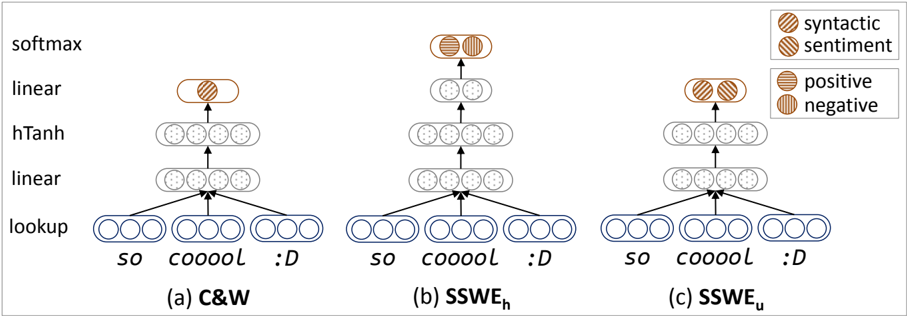
We present a method that learns word embedding for Twitter sentiment classification in this paper.Most existing algorithms for learning continuous word representations typically only model the syntactic context of words but ignore the sentiment of text.This is problematic for sentiment analysis as they usually map words with similar syntactic context but opposite sentiment polarity, such as good and bad, to neighboring word vectors.We address this issue by learning sentimentspecific word embedding (SSWE), which encodes sentiment information in the continuous representation of words.Specifically, we develop three neural networks to effectively incorporate the supervision from sentiment polarity of text (e.g.sentences or tweets) in their loss functions.To obtain large scale training corpora, we learn the sentiment-specific word embedding from massive distant-supervised tweets collected by positive and negative emoticons.Experiments on applying SS-WE to a benchmark Twitter sentiment classification dataset in SemEval 2013 show that (1) the SSWE feature performs comparably with hand-crafted features in the top-performed system; (2) the performance is further improved by concatenating SSWE with existing feature set.
Overview
The claims and statistics of this paper haven’t been checked yet.
Free: it reads the open-access text and checks the first 5 claims that cite a source we can check. Create a free account to check every claim.
Integrity signals
Registry
Cites
Statistics
Figures
Verification
Claims the paper makes
The claims and statistics of this paper haven’t been checked yet.
Free: it reads the open-access text and checks the first 5 claims that cite a source we can check. Create a free account to check every claim.
Claims other papers make about this one
Each is checked against this paper’s own text: does it say what the citing paper says it does?
The source backs part of the claim, not all of it — or backs it for a different population, condition or comparison.
In the citing paper
“Tang et al. [64] pioneered the Sentiment-Specific Word Embeddings (SSWE). Empirical results have shown its superior efficacy over other embeddings in integrating emotion labels at the word level for emotion-centric tasks.”
From A Survey of Deep Learning-Based Multimodal Emotion Recognition: Speech, Text, and Face (2023) · cites this paper as [64]
Experimental — accuracy not yet measured
Self-check
Percentages, sums and reported differences re-computed from the paper’s own numbers.
The self-check needs the paper’s full text.
Citations
Cites
(2003) · Journal of Machine Learning Research · doi:10.5555/944919.944937 · Cited by 32,337
Distributed Representations of Words and Phrases and their Compositionality
Mikolov, T., Sutskever, I., Chen, K., Corrado, G., & Dean, J. (2013) · arXiv · doi:10.48550/arxiv.1310.4546 · Cited by 24,533 · cited 2×
“Although existing word embedding learning algorithms (Collobert et al., 2011; Mikolov et al., 2013) are intuitive choices, they are not effective enough if directly used for sentiment classification.”
BackgroundRepresentation Learning: A Review and New Perspectives
Bengio, Y., Courville, A., & Vincent, P. (2013) · IEEE Transactions on Pattern Analysis and Machine Intelligence · doi:10.1109/tpami.2013.50 · Cited by 13,001
Blei, D. M., Ng, A. Y., & Jordan, M. I. (2002) · Advances in Neural Information Processing Systems 14 · doi:10.7551/mitpress/1120.003.0082 · Cited by 12,223
(2010) · Cited by 8,261
Mining and summarizing customer reviews
Hu, M., & Liu, B. (2004) · Proceedings of the tenth ACM SIGKDD international conference on Knowledge discovery and data mining · doi:10.1145/1014052.1014073 · Cited by 7,793
Thumbs up?: sentiment classification using machine learning techniques
Pang, B., Lee, L., & Vaithyanathan, S. (2002) · Proceedings of the ACL-02 conference on Empirical methods in natural language processing - EMNLP '02 · doi:10.3115/1118693.1118704 · Cited by 7,024
Learning Word Vectors for Sentiment Analysis
Maas, A. L., Daly, R. E., Pham, P. T., Huang, D., Ng, A. Y., & Potts, C. (2011) · Cited by 6,961
Recursive Deep Models for Semantic Compositionality Over a Sentiment Treebank
Socher, R., Perelygin, A., Wu, J., Chuang, J., Manning, C. D., Ng, A., & Potts, C. (2013) · Proceedings of the 2013 Conference on Empirical Methods in Natural Language Processing · doi:10.18653/v1/d13-1170 · Cited by 6,878
Opinion Mining and Sentiment Analysis
Pang, B., & Lee, L. (2008) · now publishers, Inc. eBooks · doi:10.1561/9781601981516 · Cited by 6,720
Research works printed but not linked: 5
- Alec Go, Richa Bhayani, and Lei Huang. 2009. Twit- ter sentiment classification using distant supervision. CS224N Project Report, Stanford, pages 1-12.
- Tomas Mikolov, Ilya Sutskever, Kai Chen, Greg Corra- do, and Jeffrey Dean. 2013. Distributed representa- tions of words and phrases and their compositionali- ty. The Conference on Neural Information Process- ing Systems.
- Preslav Nakov, Sara Rosenthal, Zornitsa Kozareva, Veselin Stoyanov, Alan Ritter, and Theresa Wilson. 2013. Semeval-2013 task 2: Sentiment analysis in twitter. In Proceedings of the International Work- shop on Semantic Evaluation, volume 13.
- Richard Socher, J. Pennington, E.H. Huang, A.Y. Ng, and C.D. Manning. 2011c. Semi-supervised recur- sive autoencoders for predicting sentiment distribu- tions. In Conference on Empirical Methods in Nat- ural Language Processing, pages 151-161.
- Richard Socher, Brody Huval, Christopher D. Man- ning, and Andrew Y. Ng. 2012. Semantic Com- positionality Through Recursive Matrix-Vector S- paces. In Proceedings of the Conference on Empiri- cal Methods in Natural Language Processing.
Cited by
Items 501–600 of 1,000
Liu, Z., Kan, H., Zhang, T., & Li, Y. (2020) · Applied Sciences · doi:10.3390/app10072348 · Cited by 18
TNFPred: identifying tumor necrosis factors using hybrid features based on word embeddings
Nguyen, T., Le, N. Q. K., Ho, Q., Phan, D., & Ou, Y. (2020) · BMC Medical Genomics · doi:10.1186/s12920-020-00779-w · Cited by 18
Can we predict the Oscar winner? A machine learning approach with social network services
Kim, J., Hwang, S., & Park, E. (2021) · Entertainment Computing · doi:10.1016/j.entcom.2021.100441 · Cited by 18
CBVoSD: context based vectors over sentiment domain ensemble model for review classification
Wankhade, M., Annavarapu, C. S. R., & Verma, M. K. (2021) · The Journal of Supercomputing · doi:10.1007/s11227-021-04132-5 · Cited by 18
Spinde, T. (2021) · IEEE ... International Conference on Data Mining workshops · doi:10.1109/icdmw53433.2021.00144 · Cited by 18
An Unsupervised Cross-Lingual Topic Model Framework for Sentiment Classification
Lin, Z., Jin, X., Xu, X., Wang, Y., Cheng, X., Wang, W., & Meng, D. (2015) · IEEE/ACM Transactions on Audio Speech and Language Processing · doi:10.1109/taslp.2015.2512041 · Cited by 18
ArbEngVec : Arabic-English Cross-Lingual Word Embedding Model
Lachraf, R., Nagoudi, E. M. B., Ayachi, Y., Abdelalí, A., & Schwab, D. (2019) · Arabic Natural Language Processing Workshop (WANLP) · doi:10.18653/v1/w19-4605 · Cited by 21
You, L., & Tunçer, B. (2016) · IEEE/ACM International Conference on Advances in Social Networks Analysis and Mining (ASONAM) · doi:10.1109/asonam.2016.7752312 · Cited by 18
Proceedings of the 4th BioNLP Shared Task Workshop
(2016) · doi:10.18653/v1/w16-30 · Cited by 18
Proceedings of the Workshop on Noisy User-generated Text
(2015) · doi:10.18653/v1/w15-43 · Cited by 18
On the Robustness of Unsupervised and Semi-supervised Cross-lingual Word Embedding LearningPreprint
Doval, Y., Camacho-Collados, J., Espinosa-Anke, L., & Schockaert, S. (2019) · arXiv (Cornell University) · doi:10.48550/arxiv.1908.07742 · Cited by 18
Yang, M., Chen, X., Tan, L., Lan, X., & Luo, Y. (2022) · Information Processing & Management · doi:10.1016/j.ipm.2022.103186 · Cited by 17
Refining Word Embeddings with Sentiment Information for Sentiment Analysis
Kasri, M., Birjali, M., Nabil, M., Beni‐Hssane, A., El-Ansari, A., & Fissaoui, M. E. (2022) · Journal of ICT Standardization · doi:10.13052/jicts2245-800x.1031 · Cited by 17
Gu, D., Wang, Q., Chai, Y., Yang, X., Zhao, W., Li, M., Золотарев, О., Xu, Z., & Zhang, G. (2024) · Journal of Medical Internet Research · doi:10.2196/48324 · Cited by 20
The Impact of Artificial Intelligence on Digital Media Content Creation
Hussain, A. (2024) · International Journal of Innovative Science and Research Technology (IJISRT) · doi:10.38124/ijisrt/ijisrt24jul927 · Cited by 22
Neural Network Doc2vec in Automated Sentiment Analysis for Short Informal Texts
Маслова, Н. В., & Потапов, В. В. (2017) · Lecture notes in computer science · doi:10.1007/978-3-319-66429-3_54 · Cited by 17
SNNN: Promoting Word Sentiment and Negation in Neural Sentiment Classification
Hu, Q., Zhou, J., Chen, Q., & He, L. (2018) · Proceedings of the AAAI Conference on Artificial Intelligence · doi:10.1609/aaai.v32i1.11665 · Cited by 17
Enriching Word Embeddings with Domain Knowledge for Readability Assessment
Jiang, Z., Gu, Q., Yin, Y., & Chen, D. (2018) · International Conference on Computational Linguistics · Cited by 29
Graph Convolutional Networks with Structural Attention Model for Aspect Based Sentiment Analysis
Chen, J., Hou, H., Ji, Y., & Gao, J. (2019) · International Joint Conference on Neural Networks (IJCNN) · doi:10.1109/ijcnn.2019.8852093 · Cited by 20
Event evolution model for cybersecurity event mining in tweet streams
Liu, X., Fu, J., & Chen, Y. (2020) · Information Sciences · doi:10.1016/j.ins.2020.03.048 · Cited by 19
Incorporating emotion for response generation in multi-turn dialogues
Mao, Y., Cai, F., Guo, Y., & Chen, H. (2021) · Applied Intelligence · doi:10.1007/s10489-021-02819-z · Cited by 18
Ma, J., Shi, G., Li, Y., & Zhao, Z. (2022) · Sensors · doi:10.3390/s22030888 · Cited by 17
Relia, K., Akbari, M., Duncan, D. T., & Chunara, R. (2018) · Proceedings of the ACM on Human-Computer Interaction · doi:10.1145/3274414 · Cited by 17
Public Health Policy Monitoring through Public Perceptions: A Case of COVID-19 Tweet Analysis
Li, C.-Y., Renda, M., Yusuf, F., Geller, J., & Chun, S. A. (2022) · Information · doi:10.3390/info13110543 · Cited by 17
Enhancing Decision Making Capacity in Tourism Domain Using Social Media Analytics
Abeysinghe, S., Manchanayake, I., Samarajeewa, C., Rathnayaka, P., Walpola, M., Nawaratne, R., Bandaragoda, T., & Alahakoon, D. (2018) · International Conference on Advances in ICT for Emerging Regions · doi:10.1109/icter.2018.8615462 · Cited by 18
Augmenting Semantic Representation of Depressive Language: From Forums to Microblogs
Farruque, N., Zai͏̈ane, O. R., & Goebel, R. G. (2020) · Lecture notes in computer science · doi:10.1007/978-3-030-46133-1_22 · Cited by 18
Kasri, M., Birjali, M., & Beni‐Hssane, A. (2020) · Concurrency and Computation Practice and Experience · doi:10.1002/cpe.6149 · Cited by 17
Word Embeddings for Sentiment Analysis: A Comprehensive Empirical SurveyPreprint
Çano, E., & Morisio, M. (2019) · arXiv (Cornell University) · doi:10.48550/arxiv.1902.00753 · Cited by 17
Comparison of Short-Text Sentiment Analysis Methods for Croatian
Rotim, L., & Šnajder, J. (2017) · Workshop on Balto-Slavic Natural Language Processing (BSNLP) · doi:10.18653/v1/w17-1411 · Cited by 16
Readers’ affect: predicting and understanding readers’ emotions with deep learning
Anoop, K. R., Deepak, P., Abraham, S. S., Lajish, V. L., & Gangan, M. P. (2022) · Journal Of Big Data · doi:10.1186/s40537-022-00614-2 · Cited by 20
Speculative text mining for document-level sentiment classification
Wen, J., Zhang, G., Zhang, H., Yin, W., & Ma, J. (2020) · Neurocomputing · doi:10.1016/j.neucom.2020.06.024 · Cited by 17
ArAutoSenti: automatic annotation and new tendencies for sentiment classification of Arabic messages
Guellil, I., Azouaou, F., & Chiclana, F. (2020) · Social Network Analysis and Mining · doi:10.1007/s13278-020-00688-x · Cited by 16
Bashiri, H., & Naderi, H. (2024) · Social Network Analysis and Mining · doi:10.1007/s13278-024-01268-z · Cited by 16
Using N-Gram Graphs for Sentiment Analysis: An Extended Study on Twitter
Aisopos, F., Tzannetos, D., Violos, J., & Varvarigou, T. A. (2016) · IEEE International Conference on Big Data Computing Service and Applications (BigDataService) · doi:10.1109/bigdataservice.2016.13 · Cited by 16
Affective awareness in neural sentiment analysis
Xiang, R., Li, J., Wan, M., Gu, J., Lu, Q., Li, W., & Huang, C. (2021) · Knowledge-Based Systems · doi:10.1016/j.knosys.2021.107137 · Cited by 16
Analyzing Multiple Medical Corpora Using Word Embedding
Huang, J. L., Xu, K., & Vydiswaran, V. G. V. (2016) · IEEE International Conference on Healthcare Informatics (ICHI) · doi:10.1109/ichi.2016.94 · Cited by 15
Convolutional Neural Networks for Sentiment Analysis on Italian Tweets
Attardi, G., Sartiano, D., Alzetta, C., & Semplici, F. (2016) · Accademia University Press eBooks · doi:10.4000/books.aaccademia.1995 · Cited by 15
Breaking the Curse of Class Imbalance: Bangla Text Classification
Rafi-Ur-Rashid, M., Mahbub, M., & Adnan, M. A. (2022) · ACM Transactions on Asian and Low-Resource Language Information Processing · doi:10.1145/3511601 · Cited by 19
A data-driven large-scale group decision-making framework for managing ratings and text reviews
Zamora, D. G., Dutta, B., Jin, L., Chen, Z., & Martínez, L. M. (2024) · Expert Systems with Applications · doi:10.1016/j.eswa.2024.125726 · Cited by 15
A valences-totaling model for English sentiment classification
Phu, V. N., Chau, V. T. N., Dat, N. D., Tran, V. T. N., & Nguyen, T. A. (2017) · Knowledge and Information Systems · doi:10.1007/s10115-017-1054-0 · Cited by 15
Word2Vec Approach for Sentiment Classification Relating to Hotel Reviews
Polpinij, J., Srikanjanapert, N., & Sopon, P. (2017) · Advances in intelligent systems and computing · doi:10.1007/978-3-319-60663-7_29 · Cited by 15
Application of Machine Learning Techniques for Hate Speech Detection in Mobile Applications
Raufi, B., & Xhaferri, I. (2018) · International Conference on Information Technologies (InfoTech) · doi:10.1109/infotech.2018.8510738 · Cited by 15
Distributed Representations of Emotion Categories in Emotion Space
Wang, X., & Zong, C. (2021) · doi:10.18653/v1/2021.acl-long.184 · Cited by 20
Treasures Outside Contexts: Improving Event Detection via Global Statistics
Li, R., Zhao, W., Yang, C. H., & Su, S. (2021) · Conference on Empirical Methods in Natural Language Processing (EMNLP) · doi:10.18653/v1/2021.emnlp-main.206 · Cited by 15
A local context‐aware LDA model for topic modeling in a document network
Liu, Y., & Xu, S. (2017) · Journal of the Association for Information Science and Technology · doi:10.1002/asi.23822 · Cited by 15
Sentiment-specific word embedding for Indonesian sentiment analysis
Farhan, A. N., & Khodra, M. L. (2017) · International Conference on Advanced Informatics: Concepts, Theory and Applications (ICAICTA) · doi:10.1109/icaicta.2017.8090964 · Cited by 15
Survey on Target Dependent Sentiment Analysis of Micro-Blogs in Social Media
Abudalfa, S. I., & Ahmed, M. (2017) · IEEE GCC Conference and Exhibition (GCCCE) · doi:10.1109/ieeegcc.2017.8448158 · Cited by 17
Embedding Projection for Targeted Cross-lingual Sentiment: Model Comparisons and a Real-World Study
Barnes, J., & Klinger, R. (2019) · Journal of Artificial Intelligence Research · doi:10.1613/jair.1.11561 · Cited by 18
Combining External Sentiment Knowledge for Emotion Cause Detection
Hu, J., Shi, S., & Huang, H. (2019) · Lecture notes in computer science · doi:10.1007/978-3-030-32233-5_55 · Cited by 15
An analysis of unconscious gender bias in academic texts by means of a decision algorithm
Orgeira-Crespo, P., Míguez‐Álvarez, C., Alonso, M. C., & Rivo-López, E. (2021) · PLoS ONE · doi:10.1371/journal.pone.0257903 · Cited by 17
Sensing Emotions in Text Messages: An Application and Deployment Study of EmotionPushPreprint
Wang, S., Li, C., Lo, Y.-C., Huang, T.-H., & Ku, L. (2016) · arXiv (Cornell University) · doi:10.48550/arxiv.1610.04758 · Cited by 15
Truth discovery with memory network
Li, L., Qin, B., Ren, W., & Liu, T. (2017) · Tsinghua Science and Technology · doi:10.23919/tst.2017.8195344 · Cited by 14
Self-citationMicrosummarization of Online Reviews: An Experimental Study
Mason, R., Gaska, B. J., Durme, B. V., Choudhury, P., Hart, T., Dolan, B., Toutanova, K., & Mitchell, M. (2016) · Proceedings of the AAAI Conference on Artificial Intelligence · doi:10.1609/aaai.v30i1.10396 · Cited by 14
Semantic Text Encoding for Text Classification Using Convolutional Neural Networks
Gallo, I., Nawaz, S., & Calefati, A. (2017) · IAPR International Conference on Document Analysis and Recognition (ICDAR) · doi:10.1109/icdar.2017.323 · Cited by 14
Radical Enhanced Chinese Word Embedding
Chen, Z., & Hu, K. (2018) · Lecture notes in computer science · doi:10.1007/978-3-030-01716-3_1 · Cited by 14
Learning class-specific word embeddings
Kuang, S., & Davison, B. D. (2019) · The Journal of Supercomputing · doi:10.1007/s11227-019-03024-z · Cited by 14
Arzube, O. O. A., García-Díaz, J. A., Medina-Moreira, J., Luna-Aveiga, H., & Valencia‐García, R. (2020) · Mathematics · doi:10.3390/math8112075 · Cited by 14
Modeling Tweet Dependencies with Graph Convolutional Networks for Sentiment Analysis
Keramatfar, A., Amirkhani, H., & Bidgoly, A. J. (2022) · Cognitive Computation · doi:10.1007/s12559-021-09986-8 · Cited by 14
Accurate and prompt answering framework based on customer reviews and question-answer pairs
Kim, E., Yoon, H., Lee, J., & Kim, M. (2022) · Expert Systems with Applications · doi:10.1016/j.eswa.2022.117405 · Cited by 16
Combining heterogeneous user generated data to sense well-being
Tsakalidis, A., Liakata, M., Damoulas, T., Jellinek, B., Guo, W., & Cristea, A. I. (2016) · Warwick Research Archive Portal (University of Warwick) · doi:10.82444/warw.33727657 · Cited by 14
Word Embedding Based Event Detection on Social Media
Ertugrul, A. M., Velioglu, B., & Karagöz, P. (2017) · Lecture notes in computer science · doi:10.1007/978-3-319-59650-1_1 · Cited by 14
Tens-embedding: A Tensor-based document embedding method
Rahimi, Z., & Homayounpour, M. M. (2020) · Expert Systems with Applications · doi:10.1016/j.eswa.2020.113770 · Cited by 14
Persian Emoji Prediction Using Deep Learning and Emoji Embedding
Tavan, E., Rahmati, A., & Keyvanrad, M. A. (2020) · International Conference on Computer and Knowledge Engineering · doi:10.1109/iccke50421.2020.9303639 · Cited by 14
GSITK: A sentiment analysis framework for agile replication and development
Araque, Ó., Sánchez-Rada, J. F., & Iglesias, C. Á. (2022) · SoftwareX · doi:10.1016/j.softx.2021.100921 · Cited by 15
Zhao, Z., Gao, M., Luo, F., Zhang, Y., & Xiong, Q. (2020) · 2020 International Joint Conference on Neural Networks (IJCNN) · doi:10.1109/ijcnn48605.2020.9207640 · Cited by 13
Asgarnezhad, R., Monadjemi, S. A., & Soltanaghaei, M. (2021) · Concurrency and Computation Practice and Experience · doi:10.1002/cpe.6594 · Cited by 13
Cháves-Villota, A., Jiménez-Martín, A., Jojoa, M., Bahillo, A., & García-Domínguez, J. J. (2025) · Computer Speech & Language · doi:10.1016/j.csl.2025.101873 · Cited by 15
Self-Reflective Sentiment Analysis
Shickel, B., Heesacker, M., Benton, S. A., Ebadi, A., Nickerson, P., & Rashidi, P. (2016) · Workshop on Computational Linguistics and Clinical Psychology (CLPsych) · doi:10.18653/v1/w16-0303 · Cited by 13
Automatic Detection of Verbal Aggression for Russian and American Imageboards
Gordeev, D. (2016) · Procedia - Social and Behavioral Sciences · doi:10.1016/j.sbspro.2016.12.022 · Cited by 13
Deep Learning for Period Classification of Historical Hebrew Texts
Liebeskind, C., & Liebeskind, S. (2020) · Journal of Data Mining & Digital Humanities · doi:10.46298/jdmdh.5864 · Cited by 30
An Enhanced Sentiment Analysis Framework Based on Pre-Trained Word Embedding
Mohamed, E. H., Moussa, M. E., & Haggag, M. H. (2020) · International Journal of Computational Intelligence and Applications · doi:10.1142/s1469026820500315 · Cited by 13
Deepa, D. (2021) · Turkish Journal of Computer and Mathematics Education (TURCOMAT) · doi:10.17762/turcomat.v12i7.3055 · Cited by 13
Analyzing and retrieving illicit drug-related posts from social media
Ding, T., Roy, A., Chen, Z., Zhu, Q., & Pan, S. (2016) · IEEE International Conference on Bioinformatics and Biomedicine (BIBM) · doi:10.1109/bibm.2016.7822752 · Cited by 13
Improving Word Representations with Document Labels
Yang, L., Chen, X., Liu, Z., & Sun, M. (2017) · IEEE/ACM Transactions on Audio Speech and Language Processing · doi:10.1109/taslp.2017.2658019 · Cited by 13
Araque, Ó., Zhu, G., García‐Amado, M., & Iglesias, C. Á. (2016) · IEEE ... International Conference on Data Mining workshops · doi:10.1109/icdmw.2016.0132 · Cited by 14
Word embedding with hellinger PCA to detect the sentiment of bengali text
Islam, M. S., Al-Amin, M., & Uzzal, S. D. (2016) · International Conference on Computer and Information Technology (ICCIT) · doi:10.1109/iccitechn.2016.7860224 · Cited by 13
Rotim, L., Tutek, M., & Šnajder, J. (2017) · International Workshop on Semantic Evaluation (SemEval) · doi:10.18653/v1/s17-2148 · Cited by 13
Leveraging word embeddings for spoken document summarization
Chen, K., Liu, S.-H., Wang, H., Chen, B., & Chen, H. (2015) · Interspeech (USB) · doi:10.21437/interspeech.2015-53 · Cited by 13
Exploring Occupation Differences in Reactions to COVID-19 Pandemic on Twitter
Zhao, Y., Xi, H., & Zhang, C. (2020) · Data and Information Management · doi:10.2478/dim-2020-0032 · Cited by 13
Detecting singleton spams in reviews via learning deep anomalous temporal aspect-sentiment patterns
Shaalan, Y., Zhang, X., Chan, J., & Salehi, M. (2021) · Data Mining and Knowledge Discovery · doi:10.1007/s10618-020-00725-5 · Cited by 14
D’Anniballe, V. M., Tushar, F. I., Faryna, K., Han, S., Mazurowski, M. A., Rubin, G. D., & Lo, J. Y.-C. (2022) · BMC Medical Informatics and Decision Making · doi:10.1186/s12911-022-01843-4 · Cited by 14
Learning Topic-Oriented Word Embedding for Query Classification
Yang, H., Hu, Q., & He, L. (2015) · Lecture notes in computer science · doi:10.1007/978-3-319-18038-0_15 · Cited by 13
SCARE ― The Sentiment Corpus of App Reviews with Fine-grained Annotations in German
Sänger, M., Leser, U., Kemmerer, S., Adolphs, P., & Klinger, R. (2016) · Language Resources and Evaluation Conference (LREC) · doi:10.63317/4vdw8rm2qc5t · Cited by 13
Lee, Y., & Cho, S. (2019) · International Journal of Human-Computer Interaction · doi:10.1080/10447318.2019.1680921 · Cited by 13
MAT: A simple yet strong baseline for identifying self-admitted technical debtPreprint
Guo, Z., Liu, S., Liu, J., Li, Y., Chen, L., Lu, H., Zhou, Y., & Xu, B. (2019) · arXiv (Cornell University) · doi:10.48550/arxiv.1910.13238 · Cited by 14
Padhy, M., Modibbo, U. M., Rautray, R., Tripathy, S. S., & Bebortta, S. (2024) · Algorithms · doi:10.3390/a17110486 · Cited by 12
Zhu, X., Guo, H., & Sobhani, P. (2015) · Joint Conference on Lexical and Computational Semantics · doi:10.18653/v1/s15-1001 · Cited by 12
Wang, F., Zhang, Z., & Lan, M. (2016) · International Workshop on Semantic Evaluation (SemEval) · doi:10.18653/v1/s16-1080 · Cited by 12
Language Independent Sentiment Analysis with Sentiment-Specific Word Embeddings
Saroufim, C., Almatarky, A., & Hady, M. A. (2018) · Workshop on Computational Approaches to Subjectivity, Sentiment and Social Media Analysis (WASSA) · doi:10.18653/v1/w18-6204 · Cited by 12
Han, Y., Xu, L. D., Cai, H., Li, S., Xu, B., & Jiang, L. (2019) · IEEE Transactions on Industrial Informatics · doi:10.1109/tii.2019.2957517 · Cited by 12
Aggarwal, A., Maurya, K., & Chaudhary, A. (2020) · International Conference on Intelligent Computing and Control Systems (ICICCS) · doi:10.1109/iciccs48265.2020.9121046 · Cited by 12
A Semantic and Syntactic Similarity Measure for Political Tweets
Little, C. L., McLean, D., Crockett, K. A., & Edmonds, B. (2020) · IEEE Access · doi:10.1109/access.2020.3017797 · Cited by 12
TensSent: a tensor based sentimental word embedding method
Rahimi, Z., & Homayounpour, M. M. (2021) · Applied Intelligence · doi:10.1007/s10489-020-02163-8 · Cited by 12
Pronunciation-Enhanced Chinese Word Embedding
Yang, Q., Xie, H., Cheng, G., Wang, F. L., & Rao, Y. (2021) · Cognitive Computation · doi:10.1007/s12559-021-09850-9 · Cited by 14
Traffic event detection as a slot filling problem
Yang, X., Bekoulis, G., & Deligiannis, N. (2023) · Engineering Applications of Artificial Intelligence · doi:10.1016/j.engappai.2023.106202 · Cited by 12
Hohner, J., Schulze, H., Greipl, S., & Rieger, D. (2022) · Studies in Communication and Media · doi:10.5771/2192-4007-2022-2-304 · Cited by 12
Stöhr, F. (2024) · Journal of Computational Social Science · doi:10.1007/s42001-024-00286-3 · Cited by 11
You, L., & Tunçer, B. (2016) · Advances in Social Networks Analysis and Mining · doi:10.5555/3192424.3192555 · Cited by 12
Learning Representations Specialized in Spatial Knowledge: Leveraging Language and Vision
Collell, G., & Moens, M. (2018) · Transactions of the Association for Computational Linguistics · doi:10.1162/tacl_a_00010 · Cited by 12
Metadata
- Authors
- Tang, D., Wei, F., Yang, N., Zhou, M., Liu, T., & Qin, B.
- Affiliations
- Harbin Institute of Technology (CN)
- University of Science and Technology of China (CN)
- Venue
- Proceedings of the 52nd Annual Meeting of the Association for Computational Linguistics (Volume 1: Long Papers)
- Published
- 2014
- Pages
- 1555-1565
- ISSN
- 0736-587X (ISSN-L)
- OpenAlex
- W2250879510
- Cited by
- 1,181
- References
- 58
- Citations by year
- 2026: 6 · 2025: 17 · 2024: 45 · 2023: 80 · 2022: 88 · 2021: 107 · 2020: 163 · 2019: 155 · 2018: 177 · 2017: 144 · 2016: 110 · 2015: 80 · 2014: 9
- FWCI
- 67.34
- Type
- conference paper
- Language
- en
- Open access
- hybrid
- doi.org
- Licence
- cc-by
- Locations
- Proceedings of the conference - Association for Computational Linguistics. Meeting (publishedVersion, cc-by)
- Funders
- National Natural Science Foundation of China (61273321, 61300113, 61133012)
- Topics
- Physical Sciences › Computer Science › Artificial Intelligence › Sentiment Analysis and Opinion Mining
- Physical Sciences › Computer Science › Artificial Intelligence › Topic Modeling
- Physical Sciences › Computer Science › Artificial Intelligence › Hate Speech and Cyberbullying Detection
- Keywords
- sentiment polarity, distant supervision, emoticons, word representation learning, SemEval-2013
About these checks
Registry, retraction, Cites and statistics results are computed, not judged, with one exception: a printed reference that no index lists is read once by a model before it counts as a citation error. Claims are extracted by a model and kept only when their quote appears verbatim in the text; each cited source is then checked, with a model’s help, for whether it says what the claim relies on. Those verdicts can be wrong — read the claim’s quote and the cited source before relying on one.
Statistics and arithmetic are recomputed, not judged.
Confidence bands are shown only for fields calibrated on our annotated test set. None is calibrated yet, so no band is shown.
What counts as a claim ›How we measure confidence ›How we check this ›
Are you an author, or do you see a problem with this page? Request a review
Data sources
Bibliographic data: Semantic Scholar, OpenAlex, Crossref.
Contains information from the Semantic Scholar Academic Graph Datasets, made available under the ODC Attribution License (ODC-BY 1.0).
Semantic Scholar’s data is described in: Kinney, R., et al. (2023). The Semantic Scholar Open Data Platform. arXiv:2301.10140.
