

Learning Sentiment-Specific Word Embedding for Twitter Sentiment Classification
Open accessThe DOI matches its Crossref record; 56 of the 58 references it cites were found in a registry or an index.
Abstract
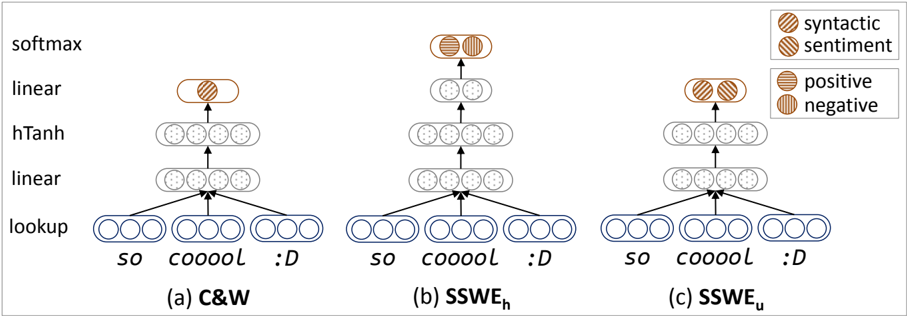
We present a method that learns word embedding for Twitter sentiment classification in this paper.Most existing algorithms for learning continuous word representations typically only model the syntactic context of words but ignore the sentiment of text.This is problematic for sentiment analysis as they usually map words with similar syntactic context but opposite sentiment polarity, such as good and bad, to neighboring word vectors.We address this issue by learning sentimentspecific word embedding (SSWE), which encodes sentiment information in the continuous representation of words.Specifically, we develop three neural networks to effectively incorporate the supervision from sentiment polarity of text (e.g.sentences or tweets) in their loss functions.To obtain large scale training corpora, we learn the sentiment-specific word embedding from massive distant-supervised tweets collected by positive and negative emoticons.Experiments on applying SS-WE to a benchmark Twitter sentiment classification dataset in SemEval 2013 show that (1) the SSWE feature performs comparably with hand-crafted features in the top-performed system; (2) the performance is further improved by concatenating SSWE with existing feature set.
Overview
The claims and statistics of this paper haven’t been checked yet.
Free: it reads the open-access text and checks the first 5 claims that cite a source we can check. Create a free account to check every claim.
Integrity signals
Registry
Cites
Statistics
Figures
Verification
Claims the paper makes
The claims and statistics of this paper haven’t been checked yet.
Free: it reads the open-access text and checks the first 5 claims that cite a source we can check. Create a free account to check every claim.
Claims other papers make about this one
Each is checked against this paper’s own text: does it say what the citing paper says it does?
The source backs part of the claim, not all of it — or backs it for a different population, condition or comparison.
In the citing paper
“Tang et al. [64] pioneered the Sentiment-Specific Word Embeddings (SSWE). Empirical results have shown its superior efficacy over other embeddings in integrating emotion labels at the word level for emotion-centric tasks.”
From A Survey of Deep Learning-Based Multimodal Emotion Recognition: Speech, Text, and Face (2023) · cites this paper as [64]
Experimental — accuracy not yet measured
Self-check
Percentages, sums and reported differences re-computed from the paper’s own numbers.
The self-check needs the paper’s full text.
Citations
Cites
(2003) · Journal of Machine Learning Research · doi:10.5555/944919.944937 · Cited by 32,337
Distributed Representations of Words and Phrases and their Compositionality
Mikolov, T., Sutskever, I., Chen, K., Corrado, G., & Dean, J. (2013) · arXiv · doi:10.48550/arxiv.1310.4546 · Cited by 24,533 · cited 2×
“Although existing word embedding learning algorithms (Collobert et al., 2011; Mikolov et al., 2013) are intuitive choices, they are not effective enough if directly used for sentiment classification.”
BackgroundRepresentation Learning: A Review and New Perspectives
Bengio, Y., Courville, A., & Vincent, P. (2013) · IEEE Transactions on Pattern Analysis and Machine Intelligence · doi:10.1109/tpami.2013.50 · Cited by 13,001
Blei, D. M., Ng, A. Y., & Jordan, M. I. (2002) · Advances in Neural Information Processing Systems 14 · doi:10.7551/mitpress/1120.003.0082 · Cited by 12,223
(2010) · Cited by 8,261
Mining and summarizing customer reviews
Hu, M., & Liu, B. (2004) · Proceedings of the tenth ACM SIGKDD international conference on Knowledge discovery and data mining · doi:10.1145/1014052.1014073 · Cited by 7,793
Thumbs up?: sentiment classification using machine learning techniques
Pang, B., Lee, L., & Vaithyanathan, S. (2002) · Proceedings of the ACL-02 conference on Empirical methods in natural language processing - EMNLP '02 · doi:10.3115/1118693.1118704 · Cited by 7,024
Learning Word Vectors for Sentiment Analysis
Maas, A. L., Daly, R. E., Pham, P. T., Huang, D., Ng, A. Y., & Potts, C. (2011) · Cited by 6,961
Recursive Deep Models for Semantic Compositionality Over a Sentiment Treebank
Socher, R., Perelygin, A., Wu, J., Chuang, J., Manning, C. D., Ng, A., & Potts, C. (2013) · Proceedings of the 2013 Conference on Empirical Methods in Natural Language Processing · doi:10.18653/v1/d13-1170 · Cited by 6,878
Opinion Mining and Sentiment Analysis
Pang, B., & Lee, L. (2008) · now publishers, Inc. eBooks · doi:10.1561/9781601981516 · Cited by 6,720
Research works printed but not linked: 5
- Alec Go, Richa Bhayani, and Lei Huang. 2009. Twit- ter sentiment classification using distant supervision. CS224N Project Report, Stanford, pages 1-12.
- Tomas Mikolov, Ilya Sutskever, Kai Chen, Greg Corra- do, and Jeffrey Dean. 2013. Distributed representa- tions of words and phrases and their compositionali- ty. The Conference on Neural Information Process- ing Systems.
- Preslav Nakov, Sara Rosenthal, Zornitsa Kozareva, Veselin Stoyanov, Alan Ritter, and Theresa Wilson. 2013. Semeval-2013 task 2: Sentiment analysis in twitter. In Proceedings of the International Work- shop on Semantic Evaluation, volume 13.
- Richard Socher, J. Pennington, E.H. Huang, A.Y. Ng, and C.D. Manning. 2011c. Semi-supervised recur- sive autoencoders for predicting sentiment distribu- tions. In Conference on Empirical Methods in Nat- ural Language Processing, pages 151-161.
- Richard Socher, Brody Huval, Christopher D. Man- ning, and Andrew Y. Ng. 2012. Semantic Com- positionality Through Recursive Matrix-Vector S- paces. In Proceedings of the Conference on Empiri- cal Methods in Natural Language Processing.
Cited by
Items 101–200 of 1,000
A topic-enhanced word embedding for Twitter sentiment classification
Ren, Y., Wang, R., & Ji, D. (2016) · Information Sciences · doi:10.1016/j.ins.2016.06.040 · Cited by 138
Cognitive-inspired domain adaptation of sentiment lexicons
Xing, F., Pallucchini, F., & Cambria, E. (2019) · Information Processing & Management · doi:10.1016/j.ipm.2018.11.002 · Cited by 132
Ultradense Word Embeddings by Orthogonal Transformation
Rothe, S., Ebert, S., & Schütze, H. (2016) · Proceedings of the 2016 Conference of the North American Chapter of the Association for Computational Linguistics: Human Language Technologies · doi:10.18653/v1/n16-1091 · Cited by 116
INSIGHT-1 at SemEval-2016 Task 5: Deep Learning for Multilingual Aspect-based Sentiment Analysis
Ruder, S., Ghaffari, P., & Breslin, J. G. (2016) · Proceedings of the 10th International Workshop on Semantic Evaluation (SemEval-2016) · doi:10.18653/v1/s16-1053 · Cited by 115
Visual Exploration of Semantic Relationships in Neural Word Embeddings
Liu, S., Bremer, P., Thiagarajan, J. J., Srikumar, V., Wang, B., Livnat, Y., & Pascucci, V. (2017) · IEEE Transactions on Visualization and Computer Graphics · doi:10.1109/tvcg.2017.2745141 · Cited by 139
Supervised word mover's distance
Huang, G. M., Quo, C., Kusner, M. J., Sun, Y., Weinberger, K. Q., & Sha, F. (2016) · PolyPublie (École Polytechnique de Montréal) · doi:10.5555/3157382.3157641 · Cited by 123
Learning User and Product Distributed Representations Using a Sequence Model for Sentiment Analysis
Chen, T., Xu, R., He, Y., Xia, Y., & Wang, X. (2016) · IEEE Computational Intelligence Magazine · doi:10.1109/mci.2016.2572539 · Cited by 133
Dou, Z.-Y. (2017) · Conference on Empirical Methods in Natural Language Processing (EMNLP) · doi:10.18653/v1/d17-1054 · Cited by 132
Joint Embeddings of Chinese Words, Characters, and Fine-grained Subcharacter Components
Yu, J., Jian, X., Xin, H., & Song, Y. (2017) · Conference on Empirical Methods in Natural Language Processing (EMNLP) · doi:10.18653/v1/d17-1027 · Cited by 132
Zhang, Z., Zou, Y., & Gan, C. (2017) · Neurocomputing · doi:10.1016/j.neucom.2017.09.080 · Cited by 126
Corpus-based dictionaries for sentiment analysis of specialized vocabularies
Rice, D. R., & Zorn, C. (2021) · Political Science Research and Methods · doi:10.1017/psrm.2019.10 · Cited by 119
Alatawi, H. S., Alhothali, A. M., & Moria, K. M. (2021) · IEEE Access · doi:10.1109/access.2021.3100435 · Cited by 111
Radical-Enhanced Chinese Character Embedding
Sun, Y., Lin, L., Yang, N., Ji, Z., & Wang, X. (2014) · Lecture notes in computer science · doi:10.1007/978-3-319-12640-1_34 · Cited by 137
Self-citationSimple task-specific bilingual word embeddings
Gouws, S., & Søgaard, A. (2015) · Conference of the North American Chapter of the Association for Computational Linguistics: Human Language Technologies (NAACL-HLT) · doi:10.3115/v1/n15-1157 · Cited by 120
Representation Learning for Aspect Category Detection in Online Reviews
Zhou, X., Wan, X., & Xiao, J. (2015) · Proceedings of the AAAI Conference on Artificial Intelligence · doi:10.1609/aaai.v29i1.9194 · Cited by 125
Learning Word Embeddings from Wikipedia for Content-Based Recommender Systems
Musto, C., Semeraro, G. M., de Gemmis, M., & Lops, P. (2016) · Lecture notes in computer science · doi:10.1007/978-3-319-30671-1_60 · Cited by 118
Encoding Syntactic Knowledge in Neural Networks for Sentiment Classification
Huang, M., Qian, Q., & Zhu, X. (2017) · ACM Transactions on Information Systems · doi:10.1145/3052770 · Cited by 130
Cyberbullying Detection using Pre-Trained BERT Model
Yadav, J., Kumar, D., & Chauhan, D. (2020) · 2020 International Conference on Electronics and Sustainable Communication Systems (ICESC) · doi:10.1109/icesc48915.2020.9155700 · Cited by 116
Learning Entity Representation for Named Entity Disambiguation
Cai, R., Wang, H., & Zhang, J. (2015) · Lecture notes in computer science · doi:10.1007/978-3-319-25816-4_22 · Cited by 117
Statistical Learning Theory and ELM for Big Social Data Analysis
Oneto, L., Bisio, F., Cambria, E., & Anguita, D. (2016) · IEEE Computational Intelligence Magazine · doi:10.1109/mci.2016.2572540 · Cited by 113
Improving Twitter Sentiment Classification Using Topic-Enriched Multi-Prototype Word Embeddings
Ren, Y., Zhang, Y., Zhang, M., & Ji, D. (2016) · Proceedings of the AAAI Conference on Artificial Intelligence · doi:10.1609/aaai.v30i1.10370 · Cited by 126
Learning Bilingual Sentiment Word Embeddings for Cross-language Sentiment Classification
Zhou, H., Chen, L., Shi, F., & Huang, D. (2015) · doi:10.3115/v1/p15-1042 · Cited by 119
DeepHate: Hate Speech Detection via Multi-Faceted Text Representations
Cao, R., Lee, R. K.-W., & Hoang, T.-A. (2020) · ACM Web Science Conference (WebSci) · doi:10.1145/3394231.3397890 · Cited by 115
Artificial intelligence for anti-money laundering: a review and extension
Han, J., Huang, Y., Liu, S., & Towey, K. (2020) · Digital Finance · doi:10.1007/s42521-020-00023-1 · Cited by 113
“The sentence-level model is also a CNN-based classifier (Tang et al. 2014; Deriu et al. 2016); it is used for social media data.”
Duong, V., Luo, J., Pham, P., Yang, T., & Wang, Y. (2020) · 2020 IEEE/ACM International Conference on Advances in Social Networks Analysis and Mining (ASONAM) · doi:10.1109/asonam49781.2020.9381379 · Cited by 110
Lexicon-Enhanced LSTM With Attention for General Sentiment Analysis
Fu, X., Yang, J., Li, J., Fang, M., & Wang, H. H. (2018) · IEEE Access · doi:10.1109/access.2018.2878425 · Cited by 119
DEEPCASE: Semi-Supervised Contextual Analysis of Security Events
Ede, T. V., Aghakhani, H., Spahn, N., Bortolameotti, R., Cova, M., Continella, A., Steen, M. V., Peter, A., Kruegel, C., & Vigna, G. (2022) · 2022 IEEE Symposium on Security and Privacy (SP) · doi:10.1109/sp46214.2022.9833671 · Cited by 90
Constructing domain-dependent sentiment dictionary for sentiment analysis
Ahmed, M., Chen, Q., & Li, Z. (2020) · Neural Computing and Applications · doi:10.1007/s00521-020-04824-8 · Cited by 110
A Sentiment-and-Semantics-Based Approach for Emotion Detection in Textual ConversationsPreprint
Gupta, U., Chatterjee, A., Srikanth, R., & Agrawal, P. (2017) · arXiv (Cornell University) · doi:10.48550/arxiv.1707.06996 · Cited by 118
Representation Learning for Natural Language Processing
Liu, Z., Lin, Y., & Sun, M. (2020) · Springer eBooks · doi:10.1007/978-981-15-5573-2 · Cited by 140
Sangeetha, K., & Prabha, D. (2020) · Journal of Ambient Intelligence and Humanized Computing · doi:10.1007/s12652-020-01791-9 · Cited by 103
RetractedWord Embedding-based Antonym Detection using Thesauri and Distributional Information
Ono, M., Miwa, M., & Sasaki, Y. (2015) · Conference of the North American Chapter of the Association for Computational Linguistics: Human Language Technologies (NAACL-HLT) · doi:10.3115/v1/n15-1100 · Cited by 102
Emotion detection for misinformation: A review
Liu, Z., Zhang, T., Yang, K., Thompson, P., Yu, Z., & Ananiadou, S. (2024) · Information Fusion · doi:10.1016/j.inffus.2024.102300 · Cited by 132
Component-Enhanced Chinese Character Embeddings
Li, Y., Li, W., Sun, F., & Li, S. (2015) · Conference on Empirical Methods in Natural Language Processing (EMNLP) · doi:10.18653/v1/d15-1098 · Cited by 101
DSS: A hybrid deep model for fake news detection using propagation tree and stance network
Davoudi, M., Moosavi, M. R., & Sadreddini, M. H. (2022) · Expert Systems with Applications · doi:10.1016/j.eswa.2022.116635 · Cited by 116
Sentiment Analysis and Opinion Mining
Zong, C., Xia, R., & Zhang, J. (2021) · Springer eBooks · doi:10.1007/978-981-16-0100-2_8 · Cited by 104
Başarslan, M. S., & Kayaalp, F. (2023) · Journal of Cloud Computing Advances Systems and Applications · doi:10.1186/s13677-022-00386-3 · Cited by 99
Application of Convolutional Neural Network in Natural Language Processing
Wang, W., & Gang, J. (2018) · 2018 International Conference on Information Systems and Computer Aided Education (ICISCAE) · doi:10.1109/iciscae.2018.8666928 · Cited by 80
Neural Media Bias Detection Using Distant Supervision With BABE - Bias Annotations By Experts
Spinde, T., Plank, M., Krieger, J.-D., Ruas, T., Gipp, B., & Aizawa, A. (2021) · Findings of the Association for Computational Linguistics: EMNLP (Findings of EMNLP) · doi:10.18653/v1/2021.findings-emnlp.101 · Cited by 153
Towards Deep Learning Prospects: Insights for Social Media Analytics
Hayat, M. K., Daud, A. Y., Alshdadi, A. A., Banjar, A., Abbasi, R. A., Bao, Y., & Dawood, H. (2019) · IEEE Access · doi:10.1109/access.2019.2905101 · Cited by 111
Wu, Z., Dai, X.-Y., Yin, C., Huang, S., & Chen, J. (2018) · Proceedings of the AAAI Conference on Artificial Intelligence · doi:10.1609/aaai.v32i1.12054 · Cited by 90
Hierarchical Attention Networks for Cyberbullying Detection on the Instagram Social Network
Cheng, L., Guo, R., Silva, Y., Hall, D., & Liu, H. (2019) · Proceedings of the 2019 SIAM International Conference on Data Mining · doi:10.1137/1.9781611975673.27 · Cited by 95
Towards Twitter sentiment classification by multi-level sentiment-enriched word embeddings
Xiong, S., Hai-lian, L., Zhao, W., & Ji, D. (2017) · Neurocomputing · doi:10.1016/j.neucom.2017.11.023 · Cited by 100
Sentiment analysis with deep neural networks: comparative study and performance assessment
Wadawadagi, R. S., & Pagi, V. B. (2020) · Artificial Intelligence Review · doi:10.1007/s10462-020-09845-2 · Cited by 107
Social media information sharing for natural disaster response
Dong, Z. S., Lingyu, M., Christenson, L., & Fulton, L. V. (2021) · Natural Hazards · doi:10.1007/s11069-021-04528-9 · Cited by 106
Context-augmented convolutional neural networks for twitter sarcasm detection
Ren, Y., Ji, D., & Ren, H. (2018) · Neurocomputing · doi:10.1016/j.neucom.2018.03.047 · Cited by 99
CNN- and LSTM-based Claim Classification in Online User Comments
Guggilla, C., Miller, T., & Gurevych, I. (2016) · TUbilio (Technical University of Darmstadt) · Cited by 111
Multi-channel LSTM-CNN model for Vietnamese sentiment analysis
Vo, Q.-H., Nguyen, H. T., Le, B. H., & Nguyen, L.-M. (2017) · International Conference on Knowledge and Systems Engineering/Proceedings · doi:10.1109/kse.2017.8119429 · Cited by 106
Gan, C., Wang, L., Zhang, Z., & Wang, Z. (2019) · Knowledge-Based Systems · doi:10.1016/j.knosys.2019.06.035 · Cited by 91
Sentiment Analysis in Social Networks
Fersini, E. (2016) · Elsevier eBooks · doi:10.1016/b978-0-12-804412-4.00006-1 · Cited by 98
A Survey and Comparative Study of Tweet Sentiment Analysis via Semi-Supervised Learning
da Silva, N. F. F., Coletta, L. F. S., & Hruschka, E. R. (2016) · ACM Computing Surveys · doi:10.1145/2932708 · Cited by 109
Word2Vec for Indonesian Sentiment Analysis towards Hotel Reviews: An Evaluation Study
Nawangsari, R. P., Kusumaningrum, R., & Wibowo, A. (2019) · Procedia Computer Science · doi:10.1016/j.procs.2019.08.178 · Cited by 89
Improving the Accuracy of Pre-trained Word Embeddings for Sentiment AnalysisPreprint
Rezaeinia, S. M., Ghodsi, A., & Rahmani, R. (2017) · arXiv (Cornell University) · doi:10.48550/arxiv.1711.08609 · Cited by 100
Deep Memory Networks for Attitude Identification
Li, C., Guo, X., & Mei, Q. (2017) · ACM International Conference on Web Search and Data Mining (WSDM) · doi:10.1145/3018661.3018714 · Cited by 92
KNN classifier based approach for multi-class sentiment analysis of twitter data
Hota, S., & Pathak, S. (2018) · International Journal of Engineering & Technology · doi:10.14419/ijet.v7i3.12656 · Cited by 88
Webis: An Ensemble for Twitter Sentiment Detection
Hagen, M., Potthast, M., Büchner, M., & Stein, B. (2015) · International Workshop on Semantic Evaluation (SemEval) · doi:10.18653/v1/s15-2097 · Cited by 96
The CLSA Model: A Novel Framework for Concept-Level Sentiment Analysis
Cambria, E., Poria, S., Bisio, F., Bajpai, R., & Chaturvedi, I. (2015) · Lecture notes in computer science · doi:10.1007/978-3-319-18117-2_1 · Cited by 96
On the evaluation and combination of state-of-the-art features in Twitter sentiment analysis
Carvalho, J., & Plastino, A. (2020) · Artificial Intelligence Review · doi:10.1007/s10462-020-09895-6 · Cited by 102
When the Timeline Meets the Pipeline: A Survey on Automated Cyberbullying Detection
Elsafoury, F., Katsigiannis, S., Pervez, Z., & Ramzan, N. (2021) · IEEE Access · doi:10.1109/access.2021.3098979 · Cited by 73
Evolving techniques in sentiment analysis: a comprehensive review
Kumar, M., Khan, L., & Chang, H.-T. (2025) · PeerJ Computer Science · doi:10.7717/peerj-cs.2592 · Cited by 98
A Joint Segmentation and Classification Framework for Sentence Level Sentiment Classification
Tang, D., Qin, B., Wei, F., Li, D., Liu, T., & Zhou, M. X. (2015) · IEEE/ACM Transactions on Audio Speech and Language Processing · doi:10.1109/taslp.2015.2449071 · Cited by 94
Self-citationA Cognition Based Attention Model for Sentiment Analysis
Long, Y., Lu, Q., Xiang, R., Li, M., & Huang, C. (2017) · Conference on Empirical Methods in Natural Language Processing (EMNLP) · doi:10.18653/v1/d17-1048 · Cited by 90
Jin, W., Zhao, B., Zhang, L., Liu, C., & Yu, H. (2023) · Information Processing & Management · doi:10.1016/j.ipm.2022.103260 · Cited by 84
Sentiment analysis of Bengali comments with Word2Vec and sentiment information of words
Al-Amin, M., Islam, M. S., & Uzzal, S. D. (2017) · International Conference on Electrical, Computer and Communication Engineering · doi:10.1109/ecace.2017.7912903 · Cited by 83
Surface and Deep Features Ensemble for Sentiment Analysis of Arabic Tweets
Al-Twairesh, N., & Al-Negheimish, H. (2019) · IEEE Access · doi:10.1109/access.2019.2924314 · Cited by 90
Assessing State-of-the-Art Sentiment Models on State-of-the-Art Sentiment Datasets
Barnes, J., Klinger, R., & Schulte im Walde, S. (2017) · Proceedings of the 8th Workshop on Computational Approaches to Subjectivity, Sentiment and Social Media Analysis · doi:10.18653/v1/w17-5202 · Cited by 70
Attention-Based Radar PRI Modulation Recognition With Recurrent Neural Networks
Li, X., Liu, Z., & Huang, Z. (2020) · IEEE Access · doi:10.1109/access.2020.2982654 · Cited by 82
Sentiment classification with modified RoBERTa and recurrent neural networks
Cheruku, R., Hussain, K., Kavati, I., Reddy, A. M., & Reddy, K. S. (2023) · Multimedia Tools and Applications · doi:10.1007/s11042-023-16833-5 · Cited by 79
Online Visual Analytics of Text Streams
Liu, S., Yin, J., Wang, X., Cui, W., Cao, K., & Pei, J. (2015) · IEEE Transactions on Visualization and Computer Graphics · doi:10.1109/tvcg.2015.2509990 · Cited by 84
Du, Y., Li, T., Pathan, M. S., Teklehaimanot, H. K., & Yang, Z. (2021) · Cognitive Computation · doi:10.1007/s12559-021-09832-x · Cited by 77
Asgari, E., McHardy, A. C., & Mofrad, M. R. K. (2019) · Scientific Reports · doi:10.1038/s41598-019-38746-w · Cited by 80
Twitter Sentiment Analysis Using Deep Convolutional Neural Network
Stojanovski, D., Strezoski, G., Madjarov, G., & Dimitrovski, I. (2015) · Lecture notes in computer science · doi:10.1007/978-3-319-19644-2_60 · Cited by 85
Carducci, G., Rizzo, G. F., Monti, D., Palumbo, E., & Morisio, M. (2018) · Information · doi:10.3390/info9050127 · Cited by 92
Relia, K., Li, Z., Cook, S., & Chunara, R. (2019) · Proceedings of the International AAAI Conference on Web and Social Media · doi:10.1609/icwsm.v13i01.3354 · Cited by 98
Wang, L. Y., & Xia, R. (2017) · Conference on Empirical Methods in Natural Language Processing (EMNLP) · doi:10.18653/v1/d17-1052 · Cited by 74
Cross-Domain Label-Adaptive Stance Detection
Hardalov, M., Arora, A., Nakov, P., & Augenstein, I. (2021) · Conference on Empirical Methods in Natural Language Processing (EMNLP) · doi:10.18653/v1/2021.emnlp-main.710 · Cited by 111
Deepfake tweets classification using stacked Bi-LSTM and words embedding
Rupapara, V., Rustam, F., Amaar, A., Washington, P. B., Lee, E., & Ashraf, I. (2021) · PeerJ Computer Science · doi:10.7717/peerj-cs.745 · Cited by 74
Lexicon-Based Sentiment Convolutional Neural Networks for Online Review Analysis
Huang, M., Xie, H., Rao, Y., Liu, Y., Poon, L. K. M., & Wang, F. L. (2020) · IEEE Transactions on Affective Computing · doi:10.1109/taffc.2020.2997769 · Cited by 89
Write-a-speaker: Text-based Emotional and Rhythmic Talking-head Generation
Li, L., Wang, S., Zhang, Z., Ding, Y., Zheng, Y., Yu, X., & Fan, C. (2021) · Proceedings of the AAAI Conference on Artificial Intelligence · doi:10.1609/aaai.v35i3.16286 · Cited by 67
Yao, F., & Wang, Y. (2020) · Computers Environment and Urban Systems · doi:10.1016/j.compenvurbsys.2020.101522 · Cited by 78
Utilizing Twitter data for analysis of chemotherapy
Zhang, L., Hall, M., & Bastola, D. (2018) · International Journal of Medical Informatics · doi:10.1016/j.ijmedinf.2018.10.002 · Cited by 66
Combining bag-of-words and sentiment features of annual reports to predict abnormal stock returns
Hájek, P. (2017) · Neural Computing and Applications · doi:10.1007/s00521-017-3194-2 · Cited by 77
Redmond, K., Luo, L., & Zeng, Q. (2019) · Workshop on Binary Analysis Research (BAR) · doi:10.14722/bar.2019.23057 · Cited by 76
A combined rule-based and machine learning approach for automated GDPR compliance checking
Hamdani, R. E., Mustapha, M., Amariles, D. R., Troussel, A., Meeùs, S., & Krasnashchok, K. (2021) · International Conference on Artificial Intelligence and Law · doi:10.1145/3462757.3466081 · Cited by 80
Intelligent sentiment analysis approach using edge computing‐based deep learning technique
Sankar, H. R., Subramaniyaswamy, V., Vijayakumar, V., Sangaiah, A. K., Ravi, L., & Umamakeswari, A. (2019) · Software Practice and Experience · doi:10.1002/spe.2687 · Cited by 74
Bilingual Sentiment Embeddings: Joint Projection of Sentiment Across Languages
Barnes, J., Klinger, R., & Walde, S. S. I. (2018) · Proceedings of the conference - Association for Computational Linguistics. Meeting · doi:10.18653/v1/p18-1231 · Cited by 80
Early depression detection in social media based on deep learning and underlying emotions
Figuerêdo, J. S. L., Maia, A. L. L. M., & Calumby, R. T. (2022) · Online Social Networks and Media · doi:10.1016/j.osnem.2022.100225 · Cited by 76
Hu, Z., Huang, P.-Y., Deng, Y., Gao, Y., & Xing, E. P. (2015) · doi:10.3115/v1/p15-1125 · Cited by 68
Real-Time Novel Event Detection from Social Media
Li, Q., Nourbakhsh, A., Shah, S., & Liu, X. (2017) · IEEE International Conference on Data Engineering (ICDE) · doi:10.1109/icde.2017.157 · Cited by 68
Hybrid Deep Sequential Modeling for Social Text-Driven Stock Prediction
Wu, H., Zhang, W., Shen, W., & Wang, J. (2018) · ACM International Conference on Information and Knowledge Management (CIKM) · doi:10.1145/3269206.3269290 · Cited by 110
Learning representations from heterogeneous network for sentiment classification of product reviews
Gui, L., Zhou, Y., Xu, R., He, Y., & Lu, Q. (2017) · Knowledge-Based Systems · doi:10.1016/j.knosys.2017.02.030 · Cited by 69
An Attention-Based Unsupervised Adversarial Model for Movie Review Spam Detection
Gao, Y., Gong, M., Xie, Y., & Qin, A. K. (2020) · IEEE Transactions on Multimedia · doi:10.1109/tmm.2020.2990085 · Cited by 72
Emotion and sentiment analysis of tweets using BERT.
Chiorrini, A., Diamantini, C., Mircoli, A., & Potena, D. (2021) · Università Politecnica delle Marche (Università Politecnica delle Marche) · Cited by 67
An Intelligent Hybrid Neural Collaborative Filtering Approach for True Recommendations
Ibrahim, M., Bajwa, I. S., Sarwar, N., Hajjej, F., & Sakr, H. A. (2023) · IEEE Access · doi:10.1109/access.2023.3289751 · Cited by 78
An Approach for Radicalization Detection Based on Emotion Signals and Semantic Similarity
Araque, Ó., & Iglesias, C. Á. (2020) · IEEE Access · doi:10.1109/access.2020.2967219 · Cited by 69
Combining Discrete and Neural Features for Sequence Labeling
Yang, J., Teng, Z., Zhang, M., & Zhang, Y. (2018) · Lecture notes in computer science · doi:10.1007/978-3-319-75477-2_9 · Cited by 66
Bi-Transferring Deep Neural Networks for Domain Adaptation
Zhou, G., Xie, Z., Huang, J. X., & He, T. (2016) · Proceedings of the conference - Association for Computational Linguistics. Meeting · doi:10.18653/v1/p16-1031 · Cited by 70
Distantly Supervised Lifelong Learning for Large-Scale Social Media Sentiment Analysis
Xia, R., Jiang, J., & He, H. (2017) · IEEE Transactions on Affective Computing · doi:10.1109/taffc.2017.2771234 · Cited by 70
Overview of NLPCC Shared Task 4: Stance Detection in Chinese Microblogs
Xu, R., Zhou, Y., Wu, D., Gui, L., Du, J., & Xue, Y. (2016) · Lecture notes in computer science · doi:10.1007/978-3-319-50496-4_85 · Cited by 64
AENeT: an attention-enabled neural architecture for fake news detection using contextual features
Jain, V., Kaliyar, R. K., Goswami, A., Narang, P., & Sharma, Y. (2021) · Neural Computing and Applications · doi:10.1007/s00521-021-06450-4 · Cited by 67
Metadata
- Authors
- Tang, D., Wei, F., Yang, N., Zhou, M., Liu, T., & Qin, B.
- Affiliations
- Harbin Institute of Technology (CN)
- University of Science and Technology of China (CN)
- Venue
- Proceedings of the 52nd Annual Meeting of the Association for Computational Linguistics (Volume 1: Long Papers)
- Published
- 2014
- Pages
- 1555-1565
- ISSN
- 0736-587X (ISSN-L)
- OpenAlex
- W2250879510
- Cited by
- 1,181
- References
- 58
- Citations by year
- 2026: 6 · 2025: 17 · 2024: 45 · 2023: 80 · 2022: 88 · 2021: 107 · 2020: 163 · 2019: 155 · 2018: 177 · 2017: 144 · 2016: 110 · 2015: 80 · 2014: 9
- FWCI
- 67.34
- Type
- conference paper
- Language
- en
- Open access
- hybrid
- doi.org
- Licence
- cc-by
- Locations
- Proceedings of the conference - Association for Computational Linguistics. Meeting (publishedVersion, cc-by)
- Funders
- National Natural Science Foundation of China (61273321, 61300113, 61133012)
- Topics
- Physical Sciences › Computer Science › Artificial Intelligence › Sentiment Analysis and Opinion Mining
- Physical Sciences › Computer Science › Artificial Intelligence › Topic Modeling
- Physical Sciences › Computer Science › Artificial Intelligence › Hate Speech and Cyberbullying Detection
- Keywords
- sentiment polarity, distant supervision, emoticons, word representation learning, SemEval-2013
About these checks
Registry, retraction, Cites and statistics results are computed, not judged, with one exception: a printed reference that no index lists is read once by a model before it counts as a citation error. Claims are extracted by a model and kept only when their quote appears verbatim in the text; each cited source is then checked, with a model’s help, for whether it says what the claim relies on. Those verdicts can be wrong — read the claim’s quote and the cited source before relying on one.
Statistics and arithmetic are recomputed, not judged.
Confidence bands are shown only for fields calibrated on our annotated test set. None is calibrated yet, so no band is shown.
What counts as a claim ›How we measure confidence ›How we check this ›
Are you an author, or do you see a problem with this page? Request a review
Data sources
Bibliographic data: Semantic Scholar, OpenAlex, Crossref.
Contains information from the Semantic Scholar Academic Graph Datasets, made available under the ODC Attribution License (ODC-BY 1.0).
Semantic Scholar’s data is described in: Kinney, R., et al. (2023). The Semantic Scholar Open Data Platform. arXiv:2301.10140.
