

Learning Sentiment-Specific Word Embedding for Twitter Sentiment Classification
Open accessThe DOI matches its Crossref record; 56 of the 58 references it cites were found in a registry or an index.
Abstract
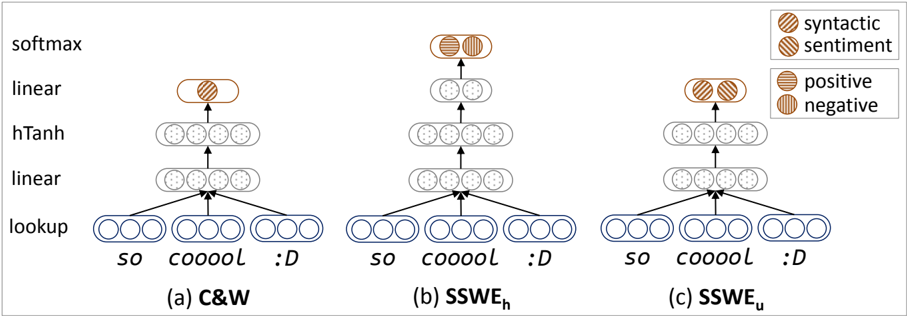
We present a method that learns word embedding for Twitter sentiment classification in this paper.Most existing algorithms for learning continuous word representations typically only model the syntactic context of words but ignore the sentiment of text.This is problematic for sentiment analysis as they usually map words with similar syntactic context but opposite sentiment polarity, such as good and bad, to neighboring word vectors.We address this issue by learning sentimentspecific word embedding (SSWE), which encodes sentiment information in the continuous representation of words.Specifically, we develop three neural networks to effectively incorporate the supervision from sentiment polarity of text (e.g.sentences or tweets) in their loss functions.To obtain large scale training corpora, we learn the sentiment-specific word embedding from massive distant-supervised tweets collected by positive and negative emoticons.Experiments on applying SS-WE to a benchmark Twitter sentiment classification dataset in SemEval 2013 show that (1) the SSWE feature performs comparably with hand-crafted features in the top-performed system; (2) the performance is further improved by concatenating SSWE with existing feature set.
Overview
The claims and statistics of this paper haven’t been checked yet.
Free: it reads the open-access text and checks the first 5 claims that cite a source we can check. Create a free account to check every claim.
Integrity signals
Registry
Cites
Statistics
Figures
Verification
Claims the paper makes
The claims and statistics of this paper haven’t been checked yet.
Free: it reads the open-access text and checks the first 5 claims that cite a source we can check. Create a free account to check every claim.
Claims other papers make about this one
Each is checked against this paper’s own text: does it say what the citing paper says it does?
The source backs part of the claim, not all of it — or backs it for a different population, condition or comparison.
In the citing paper
“Tang et al. [64] pioneered the Sentiment-Specific Word Embeddings (SSWE). Empirical results have shown its superior efficacy over other embeddings in integrating emotion labels at the word level for emotion-centric tasks.”
From A Survey of Deep Learning-Based Multimodal Emotion Recognition: Speech, Text, and Face (2023) · cites this paper as [64]
Experimental — accuracy not yet measured
Self-check
Percentages, sums and reported differences re-computed from the paper’s own numbers.
The self-check needs the paper’s full text.
Citations
Cites
(2003) · Journal of Machine Learning Research · doi:10.5555/944919.944937 · Cited by 32,337
Distributed Representations of Words and Phrases and their Compositionality
Mikolov, T., Sutskever, I., Chen, K., Corrado, G., & Dean, J. (2013) · arXiv · doi:10.48550/arxiv.1310.4546 · Cited by 24,533 · cited 2×
“Although existing word embedding learning algorithms (Collobert et al., 2011; Mikolov et al., 2013) are intuitive choices, they are not effective enough if directly used for sentiment classification.”
BackgroundRepresentation Learning: A Review and New Perspectives
Bengio, Y., Courville, A., & Vincent, P. (2013) · IEEE Transactions on Pattern Analysis and Machine Intelligence · doi:10.1109/tpami.2013.50 · Cited by 13,001
Blei, D. M., Ng, A. Y., & Jordan, M. I. (2002) · Advances in Neural Information Processing Systems 14 · doi:10.7551/mitpress/1120.003.0082 · Cited by 12,223
(2010) · Cited by 8,261
Mining and summarizing customer reviews
Hu, M., & Liu, B. (2004) · Proceedings of the tenth ACM SIGKDD international conference on Knowledge discovery and data mining · doi:10.1145/1014052.1014073 · Cited by 7,793
Thumbs up?: sentiment classification using machine learning techniques
Pang, B., Lee, L., & Vaithyanathan, S. (2002) · Proceedings of the ACL-02 conference on Empirical methods in natural language processing - EMNLP '02 · doi:10.3115/1118693.1118704 · Cited by 7,024
Learning Word Vectors for Sentiment Analysis
Maas, A. L., Daly, R. E., Pham, P. T., Huang, D., Ng, A. Y., & Potts, C. (2011) · Cited by 6,961
Recursive Deep Models for Semantic Compositionality Over a Sentiment Treebank
Socher, R., Perelygin, A., Wu, J., Chuang, J., Manning, C. D., Ng, A., & Potts, C. (2013) · Proceedings of the 2013 Conference on Empirical Methods in Natural Language Processing · doi:10.18653/v1/d13-1170 · Cited by 6,878
Opinion Mining and Sentiment Analysis
Pang, B., & Lee, L. (2008) · now publishers, Inc. eBooks · doi:10.1561/9781601981516 · Cited by 6,720
Research works printed but not linked: 5
- Alec Go, Richa Bhayani, and Lei Huang. 2009. Twit- ter sentiment classification using distant supervision. CS224N Project Report, Stanford, pages 1-12.
- Tomas Mikolov, Ilya Sutskever, Kai Chen, Greg Corra- do, and Jeffrey Dean. 2013. Distributed representa- tions of words and phrases and their compositionali- ty. The Conference on Neural Information Process- ing Systems.
- Preslav Nakov, Sara Rosenthal, Zornitsa Kozareva, Veselin Stoyanov, Alan Ritter, and Theresa Wilson. 2013. Semeval-2013 task 2: Sentiment analysis in twitter. In Proceedings of the International Work- shop on Semantic Evaluation, volume 13.
- Richard Socher, J. Pennington, E.H. Huang, A.Y. Ng, and C.D. Manning. 2011c. Semi-supervised recur- sive autoencoders for predicting sentiment distribu- tions. In Conference on Empirical Methods in Nat- ural Language Processing, pages 151-161.
- Richard Socher, Brody Huval, Christopher D. Man- ning, and Andrew Y. Ng. 2012. Semantic Com- positionality Through Recursive Matrix-Vector S- paces. In Proceedings of the Conference on Empiri- cal Methods in Natural Language Processing.
Cited by
Items 701–800 of 1,000
Topic Modeling in Embedding Spaces for Depression Assessment
Armstrong, M. D., Maupomé, D., & Meurs, M. (2021) · doi:10.21428/594757db.9e67a9f0 · Cited by 8
(2019) · International Journal of Recent Technology and Engineering (IJRTE) · doi:10.35940/ijrte.b1158.0982s1019 · Cited by 8
Fine-Grained Opinion Mining from Mobile App Reviews with Word Embedding Features
Sänger, M., Leser, U., & Klinger, R. (2017) · Lecture notes in computer science · doi:10.1007/978-3-319-59569-6_1 · Cited by 8
A word-building method based on neural network for text classification
Shuang, K., Guo, H., Zhang, Z., Loo, J., & Su, S. (2019) · Journal of Experimental & Theoretical Artificial Intelligence · doi:10.1080/0952813x.2019.1572654 · Cited by 8
Social Network Polluting Contents Detection through Deep Learning Techniques
Martinelli, F., Mercaldo, F., & Santone, A. (2019) · International Joint Conference on Neural Networks (IJCNN) · doi:10.1109/ijcnn.2019.8852080 · Cited by 9
Semantic Sentiment Analysis of Twitter Data
Nakov, P. (2017) · Springer eBooks · doi:10.1007/978-1-4614-7163-9_110167-1 · Cited by 10
Yang, Y. (2025) · ICT Express · doi:10.1016/j.icte.2025.06.017 · Cited by 7
Entropy-Based Subword Mining with an Application to Word Embeddings
El-Kishky, A., Xu, F. F., Zhang, A., Macke, S., & Han, J. (2018) · Proceedings of the Second Workshop on Subword/Character LEvel Models · doi:10.18653/v1/w18-1202 · Cited by 7
Novel Regularization Method Exploiting Mutual Information for Deep Neural Networks
Song, Z., Chen, Z., & Xia, S. (2023) · International Conference on Robotics, Artificial Intelligence and Intelligent Control (RAIIC) · doi:10.1109/raiic59453.2023.10280939 · Cited by 7
Chen, J., Huang, H., Ye, H., Peng, Z., Li, C., & Wang, C. (2024) · CHI Conference on Human Factors in Computing Systems · doi:10.1145/3613904.3642944 · Cited by 7
WarwickDCS: From Phrase-Based to Target-Specific Sentiment Recognition
Townsend, R., Tsakalidis, A., Zhou, Y., Wang, B., Liakata, M., Zubiaga, A., Cristea, A. I., & Procter, R. (2015) · International Workshop on Semantic Evaluation (SemEval) · doi:10.18653/v1/s15-2110 · Cited by 7
Incorporating paragraph embeddings and density peaks clustering for spoken document summarization
Chen, K.-Y., Shih, K.-W., Liu, S., Chen, B., & Wang, H. (2015) · IEEE Workshop on Automatic Speech Recognition and Understanding (ASRU) · doi:10.1109/asru.2015.7404796 · Cited by 7
Sentiment Classification with Convolutional Neural Network using Multiple Word Representations
Ju, H., & Yu, H. (2018) · International Conference on Ubiquitous Information Management and Communication (IMCOM) · doi:10.1145/3164541.3164610 · Cited by 7
Kabakuş, A. T. (2021) · Journal of Web Engineering · doi:10.13052/jwe1540-9589.2082 · Cited by 7
Knowledge Infusion for Context-Aware Sensor-Based Human Activity Recognition
Arrotta, L., Civitarese, G., & Bettini, C. (2022) · International Conference on Smart Computing · doi:10.1109/smartcomp55677.2022.00016 · Cited by 9
Reflection of people’s professions on social media platforms
Dağıstanlı, Ö., Erbay, H., Kör, H., & Yurttakal, A. H. (2022) · Neural Computing and Applications · doi:10.1007/s00521-022-07987-8 · Cited by 7
Sentic Computing for Social Network Analysis
Bisio, F., Oneto, L., & Cambria, E. (2016) · Elsevier eBooks · doi:10.1016/b978-0-12-804412-4.00005-x · Cited by 8
Incorporating Pre-Training in Long Short-Term Memory Networks for Tweets Classification
Yuan, S., Wu, X., & Xiang, Y. (2016) · Proceedings · doi:10.1109/icdm.2016.0181 · Cited by 7
Incorporating Positional Information into Deep Belief Networks for Sentiment Classification
Jin, Y., Zhang, H., & Du, D. (2017) · Lecture notes in computer science · doi:10.1007/978-3-319-62701-4_1 · Cited by 7
Class-Specific Word Embedding through Linear Compositionality
Kuang, S., & Davison, B. D. (2018) · IEEE International Conference on Big Data and Smart Computing (BigComp) · doi:10.1109/bigcomp.2018.00064 · Cited by 7
Santaniello, D., Colace, F., Lombardi, M., Pascale, F., & Clarizia, F. (2019) · European Society for Fuzzy Logic and Technology Conference · doi:10.2991/eusflat-19.2019.36 · Cited by 7
Feature-Based Learning in Drug Prescription System for Medical Clinics
Goh, W. P., Tao, X., Zhang, J., & Yong, J. (2020) · Neural Processing Letters · doi:10.1007/s11063-020-10296-7 · Cited by 7
Learning Word Embeddings for Aspect-Based Sentiment Analysis
Pham, D.-H., Le, A.-C., & Le, T.-K.-C. (2018) · Communications in computer and information science · doi:10.1007/978-981-10-8438-6_3 · Cited by 9
Chowdhury, S., Rahman, M. L., Ali, S. N., & Alam, M. J. (2020) · International Conference on Electrical and Computer Engineering (ICECE) · doi:10.1109/icece51571.2020.9393137 · Cited by 7
Liu, B. (2020) · Cambridge University Press eBooks · doi:10.1017/9781108639286.002 · Cited by 7
Generative Text Convolutional Neural Network for Hierarchical Document Representation Learning
Wang, C., Chen, B., Duan, Z., Chen, W., Zhang, H., & Zhou, M. (2022) · IEEE Transactions on Pattern Analysis and Machine Intelligence · doi:10.1109/tpami.2022.3192319 · Cited by 7
Self-citationAn Empirical Study on the Fairness of Pre-trained Word Embeddings
Sesari, E., Hort, M., & Sarro, F. (2022) · Workshop on Gender Bias in Natural Language Processing (GeBNLP) · doi:10.18653/v1/2022.gebnlp-1.15 · Cited by 11
Short Text Classification with Tolerance-Based Soft Computing Method
Patel, V., Ramanna, S., Kotecha, K. V., & Walambe, R. A. (2022) · Algorithms · doi:10.3390/a15080267 · Cited by 10
He, J., Jiang, W., Chen, G.-B., Le, Y., & Ding, X. (2022) · Journal of Computer Science and Technology · doi:10.1007/s11390-022-2125-6 · Cited by 7
Generating effective label description for label-aware sentiment classification
Zhu, X., Peng, Z., Guo, J., & Dietze, S. (2022) · Expert Systems with Applications · doi:10.1016/j.eswa.2022.119194 · Cited by 7
The Rating Game: Sentiment Rating Reproducibility from Text
Borgholt, L., Simonsen, P., & Hovy, D. (2015) · Conference on Empirical Methods in Natural Language Processing (EMNLP) · doi:10.18653/v1/d15-1301 · Cited by 7
Zhang, P., & Komachi, M. (2015) · Institutional Repositories DataBase (IRDB) · Cited by 7
Zhou, Y., Lan, M., & Wu, Y. (2017) · International Workshop on Semantic Evaluation (SemEval) · doi:10.18653/v1/s17-2137 · Cited by 7
A Multivalued Emotion Lexicon Created and Evaluated by the Crowd
Haralabopoulos, G., Wagner, C., McAuley, D., & Simperl, E. P. B. (2018) · International Conference on Social Networks Analysis, Management and Security (SNAMS) · doi:10.1109/snams.2018.8554956 · Cited by 7
Attention-based ResNet for Chinese Text Sentiment Classification
Han, H., Bai, X., & Liu, J. (2018) · International Conference on Computer Science, Electronics and Communication Engineering (CSECE) · doi:10.2991/csece-18.2018.108 · Cited by 7
Moore, A., & Rayson, P. (2018) · Lancaster EPrints (Lancaster University) · doi:10.5281/zenodo.1411230 · Cited by 15
Multi-Label Classification of Historical Documents by Using Hierarchical Attention Networks
Kim, D.-K., Lee, B., Kim, D., & Jeong, H. (2020) · Journal of the Korean Physical Society · doi:10.3938/jkps.76.368 · Cited by 7
Gundapusunil at SemEval-2020 Task 8: Multimodal Memotion Analysis
Gundapu, S., & Mamidi, R. (2020) · International Workshop on Semantic Evaluation (SemEval) · doi:10.18653/v1/2020.semeval-1.147 · Cited by 7
Critical Sentence Identification in Legal Cases Using Multi-Class Classification
Jayasinghe, S., Rambukkanage, L., Silva, A., de Silva, N., & Perera, A. S. (2021) · IEEE International Conference on Industrial and Information Systems (ICIIS) · doi:10.1109/iciis53135.2021.9660657 · Cited by 7
Exploiting Geo-tagged Tweets to Understand Localized Language Diversity
Magdy, A., Ghanem, T. M., Musleh, M., & Mokbel, M. F. (2014) · doi:10.1145/2619112.2619114 · Cited by 7
Effect of Word Embedding Variable Parameters on Arabic Sentiment Analysis PerformancePreprint
Alnawas, A. A., & Arıcı, N. (2021) · arXiv (Cornell University) · doi:10.48550/arxiv.2101.02906 · Cited by 7
Sociolinguistic Properties of Word EmbeddingsPreprint
Arseniev‐Koehler, A., & Foster, J. G. (2020) · SocArXiv (OSF Preprints) · doi:10.31235/osf.io/b8kud · Cited by 8
Context-aware credit card fraud detection
Jurgovsky, J. (2019) · theses.fr (ABES) · doi:10.70675/213be119z0eb7z4255za41dz6a9cef1b4c70 · Cited by 18
Saidi, W., & Saidi, W. (2023) · Journal of Southwest Jiaotong University · doi:10.35741/issn.0258-2724.58.5.28 · Cited by 6
Sentimental analysis using natural language processing
Kumar, A., Bhatia, A., Kumar, S., Kumar, R., & Yadav, V. (2025) · AIP conference proceedings · doi:10.1063/5.0246883 · Cited by 6
A Study on the Use of Word Embeddings and PageRank for Vietnamese Text Summarization
Phung, V. L., & Vine, L. D. (2015) · Australasian Document Computing Symposium · doi:10.1145/2838931.2838935 · Cited by 6
Transfer Learning for Multi-language Twitter Election Classification
Yang, X., Mccreadie, R., Macdonald, C., & Ounis, I. (2017) · International Conference on Advances in Social Networks Analysis and Mining · doi:10.1145/3110025.3110059 · Cited by 9
Relia, K., Akbari, M., Duncan, D. T., & Chunara, R. (2018) · PubMed · doi:10.48550/arxiv.1803.09002 · Cited by 6
Pretraining Sentiment Classifiers with Unlabeled Dialog Data
Shimizu, T., Shimizu, N., & Kobayashi, H. (2018) · Proceedings of the conference - Association for Computational Linguistics. Meeting · doi:10.18653/v1/p18-2121 · Cited by 6
Comment Relevance Classification in Facebook
Liebeskind, C., Liebeskind, S., & HaCohen‐Kerner, Y. (2018) · Lecture notes in computer science · doi:10.1007/978-3-319-77116-8_18 · Cited by 6
Fake News Classification of Social Media Through Sentiment Analysis
Ding, L., Ding, L., & Sinnott, R. (2020) · Lecture notes in computer science · doi:10.1007/978-3-030-59612-5_5 · Cited by 6
Wei, C., Noh, S., & Chang, H.-C. H. (2025) · International World Wide Web Conference (WWW) · doi:10.1145/3701716.3715556 · Cited by 6
Bisio, F., Meda, C., Gastaldo, P., Zunino, R., & Cambria, E. (2016) · Studies in computational intelligence · doi:10.1007/978-3-319-30319-2_8 · Cited by 6
Parallel Multi-feature Attention on Neural Sentiment Classification
Zhu, P., & Yujiu, Y. (2017) · International Symposium on Information and Communication Technology · doi:10.1145/3155133.3155193 · Cited by 6
Unsupervised Sentiment Analysis of Objective Texts
Chen, Q., & Sokolova, M. (2019) · Lecture notes in computer science · doi:10.1007/978-3-030-18305-9_45 · Cited by 6
Causally Denoise Word Embeddings Using Half-Sibling Regression
Yang, Z., & Liu, T. (2020) · Proceedings of the AAAI Conference on Artificial Intelligence · doi:10.1609/aaai.v34i05.6485 · Cited by 6
Self-citationWord2vec to behavior: morphology facilitates the grounding of language in machines
Matthews, D., Kriegman, S., Cappelle, C., & Bongard, J. (2019) · IEEE/RSJ International Conference on Intelligent Robots and Systems (IROS) · doi:10.1109/iros40897.2019.8967639 · Cited by 7
Rajagopal, S., Anoop, K. R., & Lajish, V. L. (2018) · International Conference on Inventive Computation Technologies (ICICT) · doi:10.1109/icict43934.2018.9034272 · Cited by 6
Semantic Enhanced Dual-Channel Graph Communication Network for Aspect-Based Sentiment Analysis
Yan, Z., Pang, S., & Xue, Y. (2021) · Lecture notes in computer science · doi:10.1007/978-3-030-88480-2_42 · Cited by 6
Deep Sentiment Extraction using Fuzzy-Rule Based Deep Sentiment Analysis
Jasti, S., & Rajkumar, G. V. S. (2022) · International Journal of Advanced Computer Science and Applications · doi:10.14569/ijacsa.2022.0130650 · Cited by 6
Forecasting movie rating using k-nearest neighbor based collaborative filtering
Rokade, P., Rao, P. P., & Kumari, D. A. (2022) · International Journal of Power Electronics and Drive Systems/International Journal of Electrical and Computer Engineering · doi:10.11591/ijece.v12i6.pp6506-6512 · Cited by 7
Artificial intelligence exceeds humans in epidemiological job coding
Langezaal, M. A., van den Broek, E. L., Peters, S., Goldberg, M., Rey, G., Friesen, M. C., Locke, S. J., Rothman, N., Lan, Q., & Vermeulen, R. C. H. (2023) · Communications Medicine · doi:10.1038/s43856-023-00397-4 · Cited by 6
Novel Word Embedding and Translation-based Language Modeling for Extractive Speech Summarization
Chen, K.-Y., Liu, S., Chen, B., Wang, H., & Chen, H. (2016) · ACM International Conference on Multimedia (ACM MM) · doi:10.1145/2964284.2967246 · Cited by 6
Improving Chinese Sentiment Analysis via Segmentation-Based Representation Using Parallel CNN
Hao, Y., Zheng, Q., Lan, Y., Li, Y., Wang, M., Wang, S., & Li, C. (2017) · Lecture notes in computer science · doi:10.1007/978-3-319-69179-4_47 · Cited by 6
Sentiment Analysis of Online Communities Using Swarm Intelligence Algorithms
Goel, L., & Prakash, A. (2016) · International Conference on Computational Intelligence and Communication Networks (CICN) · doi:10.1109/cicn.2016.71 · Cited by 6
Bias‐Sentiment‐Topic model for microblog sentiment analysis
Guo, J., & Xue, C. (2018) · Concurrency and Computation Practice and Experience · doi:10.1002/cpe.4417 · Cited by 6
Leveraging the Dynamic Changes from Items to Improve Recommendation
Jin, Z., Zhang, Y., Mu, W., Wang, W., & Jin, H. (2018) · Lecture notes in computer science · doi:10.1007/978-3-030-00847-5_37 · Cited by 6
Naderalvojoud, B., Uçan, A., & Sezer, E. A. (2018) · Workshop on Computational Approaches to Subjectivity, Sentiment and Social Media Analysis (WASSA) · doi:10.18653/v1/w18-6225 · Cited by 6
Tweet Analysis Based on Distinct Opinion of Social Media Users’
Geetha, S., & Kumar, K. V. (2018) · Advances in intelligent systems and computing · doi:10.1007/978-981-13-1882-5_23 · Cited by 6
Anuyah, O., Azpiazu, I. M., & Pera, M. S. (2019) · International World Wide Web Conference (WWW) · doi:10.1145/3308560.3316583 · Cited by 6
Sentiment Analysis using Novel Distributed Word Embedding for Movie Reviews
Dhanani, J., Mehta, R. G., Rana, D. P., & Tidke, B. (2018) · International Conference on Advanced Computing · doi:10.1109/icoac44903.2018.8939104 · Cited by 7
Syntax-ignorant N-gram embeddings for dialectal Arabic sentiment analysis
Mulki, H., Haddad, H., Gridach, M., & Babaoğlu, İ. (2020) · Natural Language Engineering · doi:10.1017/s135132492000008x · Cited by 6
Emotion Detection from TextPreprint
Gupta, U., Chatterjee, A., Srikanth, R., & Agrawal, P. (2017) · arXiv (Cornell University) · Cited by 6
Nalluru, G., Pandey, R., & Purohit, H. (2019) · arXiv (Cornell University) · doi:10.48550/arxiv.1911.05165 · Cited by 6
Sentiment and emotion analysis using pretrained deep learning models
Aidam, D. K., Benuwa, B., Oppong, S. O., & Nwiah, E. (2024) · Journal of Data Information and Management · doi:10.1007/s42488-024-00129-w · Cited by 5
TakeLab-QA at SemEval-2017 Task 3: Classification Experiments for Answer Retrieval in Community QA
Šaina, F., Kukurin, T., Puljić, L., Karan, M., & Šnajder, J. (2017) · International Workshop on Semantic Evaluation (SemEval) · doi:10.18653/v1/s17-2055 · Cited by 5
Neural relevance-aware query modeling for spoken document retrieval
Lo, T.-H., Chen, Y., Chen, K., Wang, H., & Chen, B. (2017) · IEEE Workshop on Automatic Speech Recognition and Understanding (ASRU) · doi:10.1109/asru.2017.8268973 · Cited by 5
Word Embedding for Emotional Analysis: An Overview
MohammadiBaghmolaei, R., & Ahmadi, A. (2020) · Iranian Conference on Electrical Engineering · doi:10.1109/icee50131.2020.9260585 · Cited by 5
Word embedding for mixed-emotions analysis
MohammadiBaghmolaei, R., & Ahmadi, A. (2022) · Journal of Intelligent Information Systems · doi:10.1007/s10844-022-00720-w · Cited by 5
Nagulapati, V., Rapelli, S. R., Fadlullah, Z. M., Fouda, M. M., Alasmary, W., & Guizani, M. (2022) · International Conference on Communications · doi:10.1109/icc45855.2022.9838544 · Cited by 6
Sentiment and Objectivity in Iranian State-Sponsored Propaganda on Twitter
Barrows, M., Haig, E., & Conduit, D. (2023) · IEEE Transactions on Computational Social Systems · doi:10.1109/tcss.2023.3273729 · Cited by 6
Towards Energy-Efficient Sentiment Classification with Spiking Neural Networks
Chen, J., Ye, X., Sun, J., & Li, C. (2023) · Lecture notes in computer science · doi:10.1007/978-3-031-44204-9_43 · Cited by 5
Stock Price Analysis Using Sentiment Analysis of Twitter Data
Sonia, J. J., Goenka, A., & Jain, A. (2024) · International Conference on Intelligent Systems for Cybersecurity (ISCS) · doi:10.1109/iscs61804.2024.10581251 · Cited by 5
Partitioned Sampling of Public Opinions Based on Their Social Dynamics
Huang, W., Li, L., & Chen, W. (2017) · Proceedings of the AAAI Conference on Artificial Intelligence · doi:10.1609/aaai.v31i1.10507 · Cited by 5
Sentiment Lexicon Creation using Continuous Latent Space and Neural Networks
Cardoso, P. M. D., & Roy, A. (2016) · Workshop on Computational Approaches to Subjectivity, Sentiment and Social Media Analysis (WASSA) · doi:10.18653/v1/w16-0409 · Cited by 5
Extracting Opinion Expression with Neural Attention
Du, J., Gui, L., & Xu, R. (2016) · Communications in computer and information science · doi:10.1007/978-981-10-2993-6_13 · Cited by 5
Abudalfa, S. I. (2018) · International Journal of Computing and Digital Systems · doi:10.12785/ijcds/070304 · Cited by 5
González, J.-Á., Hurtado, L.-F., & Plà, F. (2019) · International Workshop on Semantic Evaluation (SemEval) · doi:10.18653/v1/s19-2031 · Cited by 5
Incorporating Domain Knowledge in Learning Word Embedding
Roy, A., Park, Y. H., & Pan, S. (2019) · IEEE International Conference on Tools with Artificial Intelligence (ICTAI) · doi:10.1109/ictai.2019.00226 · Cited by 5
Lee, Y., Lim, C.-G., & Choi, H. (2020) · Language Resources and Evaluation · Cited by 5
A High-Performance Model based on Ensembles for Twitter Sentiment Classification
Asgarnezhad, R., Monadjemi, A., & Soltanaghaei, M. (2020) · DOAJ (DOAJ: Directory of Open Access Journals) · doi:10.22061/jecei.2020.7100.357 · Cited by 5
Auto Defect Detection Using Customer Reviews for Product Recall Insurance Analysis
Fong, T. H. Y., Sarkani, S., & Fossaceca, J. M. (2021) · Frontiers in Applied Mathematics and Statistics · doi:10.3389/fams.2021.632847 · Cited by 5
Deep Learning Techniques for Social Media Analytics
Kurni, M., Mrunalini, M., & Saritha, K. (2021) · Smart innovation, systems and technologies · doi:10.1007/978-981-16-3398-0_18 · Cited by 5
Opinion mining from machine translated Bangla reviews with stacked contractive auto-encoders
Bodini, M. (2022) · Journal of Ambient Intelligence and Humanized Computing · doi:10.1007/s12652-022-03760-w · Cited by 6
Data Stream Classification by Using Stacked CARU Networks
Chan, K., & Im, S. (2022) · IEEE International Conference on Big Data and Smart Computing (BigComp) · doi:10.1109/bigcomp54360.2022.00087 · Cited by 5
Beyond Polarity: The Potential Applications and Impacts of Sentiment Analysis and Emotion Detection
Tuama, M. H., Mashloosh, W. M., Albehadili, H. M., Alazzawi, M. A., & Al-Shareeda, . A. (2023) · AlKadhum Journal of Science · doi:10.61710/akjs.v1i2.51 · Cited by 5
TIMEX3 and event extraction using recurrent neural networks
Kim, Z. M., & Jeong, Y.-S. (2016) · International Conference on Big Data and Smart Computing · doi:10.1109/bigcomp.2016.7425968 · Cited by 5
Strength in Numbers: Using Big Data to Simplify Sentiment Classification
Filippas, A., & Lappas, T. (2017) · Big Data · doi:10.1089/big.2017.0020 · Cited by 5
Combining Vector Space Features and Convolution Neural Network for Text Sentiment Analysis
Wang, Y., An, W. X., Jindan, Z., & Yu, C. (2018) · Advances in intelligent systems and computing · doi:10.1007/978-3-319-93659-8_71 · Cited by 5
Resources to Examine the Quality of Word Embedding Models Trained on n-Gram Data
Elekes, Á., Englhardt, A., Schäler, M., & Böhm, K. (2018) · Conference on Computational Natural Language Learning · doi:10.18653/v1/k18-1041 · Cited by 5
Metadata
- Authors
- Tang, D., Wei, F., Yang, N., Zhou, M., Liu, T., & Qin, B.
- Affiliations
- Harbin Institute of Technology (CN)
- University of Science and Technology of China (CN)
- Venue
- Proceedings of the 52nd Annual Meeting of the Association for Computational Linguistics (Volume 1: Long Papers)
- Published
- 2014
- Pages
- 1555-1565
- ISSN
- 0736-587X (ISSN-L)
- OpenAlex
- W2250879510
- Cited by
- 1,181
- References
- 58
- Citations by year
- 2026: 6 · 2025: 17 · 2024: 45 · 2023: 80 · 2022: 88 · 2021: 107 · 2020: 163 · 2019: 155 · 2018: 177 · 2017: 144 · 2016: 110 · 2015: 80 · 2014: 9
- FWCI
- 67.34
- Type
- conference paper
- Language
- en
- Open access
- hybrid
- doi.org
- Licence
- cc-by
- Locations
- Proceedings of the conference - Association for Computational Linguistics. Meeting (publishedVersion, cc-by)
- Funders
- National Natural Science Foundation of China (61273321, 61300113, 61133012)
- Topics
- Physical Sciences › Computer Science › Artificial Intelligence › Sentiment Analysis and Opinion Mining
- Physical Sciences › Computer Science › Artificial Intelligence › Topic Modeling
- Physical Sciences › Computer Science › Artificial Intelligence › Hate Speech and Cyberbullying Detection
- Keywords
- sentiment polarity, distant supervision, emoticons, word representation learning, SemEval-2013
About these checks
Registry, retraction, Cites and statistics results are computed, not judged, with one exception: a printed reference that no index lists is read once by a model before it counts as a citation error. Claims are extracted by a model and kept only when their quote appears verbatim in the text; each cited source is then checked, with a model’s help, for whether it says what the claim relies on. Those verdicts can be wrong — read the claim’s quote and the cited source before relying on one.
Statistics and arithmetic are recomputed, not judged.
Confidence bands are shown only for fields calibrated on our annotated test set. None is calibrated yet, so no band is shown.
What counts as a claim ›How we measure confidence ›How we check this ›
Are you an author, or do you see a problem with this page? Request a review
Data sources
Bibliographic data: Semantic Scholar, OpenAlex, Crossref.
Contains information from the Semantic Scholar Academic Graph Datasets, made available under the ODC Attribution License (ODC-BY 1.0).
Semantic Scholar’s data is described in: Kinney, R., et al. (2023). The Semantic Scholar Open Data Platform. arXiv:2301.10140.
