

Learning Sentiment-Specific Word Embedding for Twitter Sentiment Classification
Open accessThe DOI matches its Crossref record; 56 of the 58 references it cites were found in a registry or an index.
Abstract
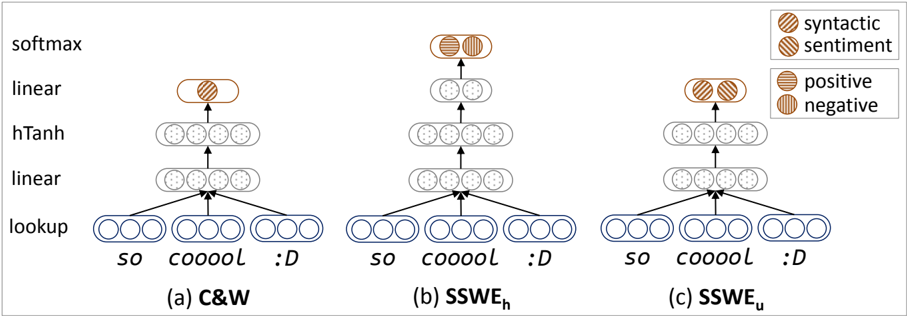
We present a method that learns word embedding for Twitter sentiment classification in this paper.Most existing algorithms for learning continuous word representations typically only model the syntactic context of words but ignore the sentiment of text.This is problematic for sentiment analysis as they usually map words with similar syntactic context but opposite sentiment polarity, such as good and bad, to neighboring word vectors.We address this issue by learning sentimentspecific word embedding (SSWE), which encodes sentiment information in the continuous representation of words.Specifically, we develop three neural networks to effectively incorporate the supervision from sentiment polarity of text (e.g.sentences or tweets) in their loss functions.To obtain large scale training corpora, we learn the sentiment-specific word embedding from massive distant-supervised tweets collected by positive and negative emoticons.Experiments on applying SS-WE to a benchmark Twitter sentiment classification dataset in SemEval 2013 show that (1) the SSWE feature performs comparably with hand-crafted features in the top-performed system; (2) the performance is further improved by concatenating SSWE with existing feature set.
Overview
The claims and statistics of this paper haven’t been checked yet.
Free: it reads the open-access text and checks the first 5 claims that cite a source we can check. Create a free account to check every claim.
Integrity signals
Registry
Cites
Statistics
Figures
Verification
Claims the paper makes
The claims and statistics of this paper haven’t been checked yet.
Free: it reads the open-access text and checks the first 5 claims that cite a source we can check. Create a free account to check every claim.
Claims other papers make about this one
Each is checked against this paper’s own text: does it say what the citing paper says it does?
The source backs part of the claim, not all of it — or backs it for a different population, condition or comparison.
In the citing paper
“Tang et al. [64] pioneered the Sentiment-Specific Word Embeddings (SSWE). Empirical results have shown its superior efficacy over other embeddings in integrating emotion labels at the word level for emotion-centric tasks.”
From A Survey of Deep Learning-Based Multimodal Emotion Recognition: Speech, Text, and Face (2023) · cites this paper as [64]
Experimental — accuracy not yet measured
Self-check
Percentages, sums and reported differences re-computed from the paper’s own numbers.
The self-check needs the paper’s full text.
Citations
Cites
(2003) · Journal of Machine Learning Research · doi:10.5555/944919.944937 · Cited by 32,337
Distributed Representations of Words and Phrases and their Compositionality
Mikolov, T., Sutskever, I., Chen, K., Corrado, G., & Dean, J. (2013) · arXiv · doi:10.48550/arxiv.1310.4546 · Cited by 24,533 · cited 2×
“Although existing word embedding learning algorithms (Collobert et al., 2011; Mikolov et al., 2013) are intuitive choices, they are not effective enough if directly used for sentiment classification.”
BackgroundRepresentation Learning: A Review and New Perspectives
Bengio, Y., Courville, A., & Vincent, P. (2013) · IEEE Transactions on Pattern Analysis and Machine Intelligence · doi:10.1109/tpami.2013.50 · Cited by 13,001
Blei, D. M., Ng, A. Y., & Jordan, M. I. (2002) · Advances in Neural Information Processing Systems 14 · doi:10.7551/mitpress/1120.003.0082 · Cited by 12,223
(2010) · Cited by 8,261
Mining and summarizing customer reviews
Hu, M., & Liu, B. (2004) · Proceedings of the tenth ACM SIGKDD international conference on Knowledge discovery and data mining · doi:10.1145/1014052.1014073 · Cited by 7,793
Thumbs up?: sentiment classification using machine learning techniques
Pang, B., Lee, L., & Vaithyanathan, S. (2002) · Proceedings of the ACL-02 conference on Empirical methods in natural language processing - EMNLP '02 · doi:10.3115/1118693.1118704 · Cited by 7,024
Learning Word Vectors for Sentiment Analysis
Maas, A. L., Daly, R. E., Pham, P. T., Huang, D., Ng, A. Y., & Potts, C. (2011) · Cited by 6,961
Recursive Deep Models for Semantic Compositionality Over a Sentiment Treebank
Socher, R., Perelygin, A., Wu, J., Chuang, J., Manning, C. D., Ng, A., & Potts, C. (2013) · Proceedings of the 2013 Conference on Empirical Methods in Natural Language Processing · doi:10.18653/v1/d13-1170 · Cited by 6,878
Opinion Mining and Sentiment Analysis
Pang, B., & Lee, L. (2008) · now publishers, Inc. eBooks · doi:10.1561/9781601981516 · Cited by 6,720
Research works printed but not linked: 5
- Alec Go, Richa Bhayani, and Lei Huang. 2009. Twit- ter sentiment classification using distant supervision. CS224N Project Report, Stanford, pages 1-12.
- Tomas Mikolov, Ilya Sutskever, Kai Chen, Greg Corra- do, and Jeffrey Dean. 2013. Distributed representa- tions of words and phrases and their compositionali- ty. The Conference on Neural Information Process- ing Systems.
- Preslav Nakov, Sara Rosenthal, Zornitsa Kozareva, Veselin Stoyanov, Alan Ritter, and Theresa Wilson. 2013. Semeval-2013 task 2: Sentiment analysis in twitter. In Proceedings of the International Work- shop on Semantic Evaluation, volume 13.
- Richard Socher, J. Pennington, E.H. Huang, A.Y. Ng, and C.D. Manning. 2011c. Semi-supervised recur- sive autoencoders for predicting sentiment distribu- tions. In Conference on Empirical Methods in Nat- ural Language Processing, pages 151-161.
- Richard Socher, Brody Huval, Christopher D. Man- ning, and Andrew Y. Ng. 2012. Semantic Com- positionality Through Recursive Matrix-Vector S- paces. In Proceedings of the Conference on Empiri- cal Methods in Natural Language Processing.
Cited by
Items 601–700 of 1,000
Distributed Representation of Words in Cause and Effect Spaces
Xie, Z., & Mu, F. (2019) · Proceedings of the AAAI Conference on Artificial Intelligence · doi:10.1609/aaai.v33i01.33017330 · Cited by 12
Tackling Toxic Online Communication with Recurrent Capsule Networks
Deshmukh, S., & Rade, R. (2018) · IEEE Conference on Information and Communication Technology (CICT) · doi:10.1109/infocomtech.2018.8722433 · Cited by 12
Constructing Semantic Models From Words, Images, and Emojis
Rotaru, A. S., & Vigliocco, G. (2020) · Cognitive Science · doi:10.1111/cogs.12830 · Cited by 12
Representation Learning from Limited Educational Data with Crowdsourced Labels
Wang, W., Xu, G., Ding, W., Huang, Y., Li, G., Tang, J., & Liu, Z. (2020) · IEEE Transactions on Knowledge and Data Engineering · doi:10.1109/tkde.2020.3017122 · Cited by 16
Sentiment Analysis System using Hybrid Word Embeddings with Convolutional Recurrent Neural Network
Alotaibi, F. S., & Gupta, V. G. (2022) · The International Arab Journal of Information Technology · doi:10.34028/iajit/19/3/6 · Cited by 17
Task Independent Fine Tuning for Word Embeddings
Yang, X., & Mao, K. (2016) · IEEE/ACM Transactions on Audio Speech and Language Processing · doi:10.1109/taslp.2016.2644863 · Cited by 12
Discovering Correlations between Sparse Features in Distant Supervision for Relation Extraction
Qu, J., Ouyang, D., Hua, W., Ye, Y., & Zhou, X. (2019) · ACM International Conference on Web Search and Data Mining (WSDM) · doi:10.1145/3289600.3291004 · Cited by 12
Predicting environmental features by learning spatiotemporal embeddings from social media
Jeawak, S. S., Jones, C. B., & Schockaert, S. (2019) · Ecological Informatics · doi:10.1016/j.ecoinf.2019.101031 · Cited by 12
Liu, Z., Lin, Y., & Sun, M. (2020) · Springer eBooks · doi:10.1007/978-981-15-5573-2_2 · Cited by 12
Convolutional Poisson Gamma Belief NetworkPreprint
Wang, C., Chen, B., Xiao, S., & Zhou, M. (2019) · arXiv (Cornell University) · doi:10.48550/arxiv.1905.05394 · Cited by 12
Self-citationCombining Discrete and Continuous Features for Deterministic Transition-based Dependency Parsing
Zhang, M., & Zhang, Y. (2015) · Conference on Empirical Methods in Natural Language Processing (EMNLP) · doi:10.18653/v1/d15-1153 · Cited by 11
A Dynamic Strategy for Classifying Sentiment From Bengali Text by Utilizing Word2vector Model
Rahman, M., Talukder, M. R. A., Setu, L. A., & Das, A. K. (2022) · Journal of Information Technology Research · doi:10.4018/jitr.299919 · Cited by 11
Network embedding aided vaccine skepticism detection
Béres, F., Michaletzky, T. V., Csoma, R., & Benczúr, A. A. (2023) · Applied Network Science · doi:10.1007/s41109-023-00534-x · Cited by 11
Pal, M., & Prasad, R. S. (2023) · International Conference on Advances in Intelligent Computing and Applications (AICAPS) · doi:10.1109/aicaps57044.2023.10074510 · Cited by 11
eslamieh, P., Shajari, M., & Nickabadi, A. (2023) · Mathematics · doi:10.3390/math11132950 · Cited by 11
LitWay, Discriminative Extraction for Different Bio-Events
Li, C., Rao, Z., & Zhang, X. (2016) · doi:10.18653/v1/w16-3004 · Cited by 11
TexRep: A Text Mining Framework for Online Reputation Monitoring
Saleiro, P., Rodrigues, E. M., Soares, C., & Oliveira, E. (2017) · New Generation Computing · doi:10.1007/s00354-017-0021-3 · Cited by 11
A unified knowledge compiler to provide support the scientific community
Fernández-Isabel, A., Prieto, J. C., Ortega, F., de Diego, I. M., Moguerza, J. M., Mena, J., Galindo, S., & Napalkova, L. (2018) · Knowledge-Based Systems · doi:10.1016/j.knosys.2018.07.044 · Cited by 11
Beyond Sentiments and Opinions: Exploring Social Media with Appraisal Categories
Dragos, V., Battistelli, D., & Kelodjoue, E. (2018) · International Conference on Information Fusion (FUSION) · doi:10.23919/icif.2018.8455751 · Cited by 11
Semi-Supervised Multimodal Deep Learning Model for Polarity Detection in Arguments
Tato, A. A. N., Nkambou, R., Dufresne, A., & Frasson, C. (2018) · International Joint Conference on Neural Networks (IJCNN) · doi:10.1109/ijcnn.2018.8489342 · Cited by 11
A New Scheme for Citation Classification based on Convolutional Neural Networks
Bakhti, K., Niu, Z., & Nyamawe, A. S. (2018) · Proceedings/Proceedings of the ... International Conference on Software Engineering and Knowledge Engineering · doi:10.18293/seke2018-141 · Cited by 11
Sentiment Analysis Based on Attention Mechanisms and Bi-Directional LSTM Fusion Model
Wang, M., Zhu, Y., Liu, S., Song, C., Wang, Z., Wang, P., & Qin, X. (2019) · IEEE SmartWorld, Ubiquitous Intelligence & Computing, Advanced & Trusted Computing, Scalable Computing & Communications, Cloud & Big Data Computing, Internet of People and Smart City Innovation (SmartWorld/SCALCOM/UIC/ATC/CBDCom/IOP/SCI) · doi:10.1109/smartworld-uic-atc-scalcom-iop-sci.2019.00177 · Cited by 11
Improved method of word embedding for efficient analysis of human sentiments
Sagnika, S., Mishra, B. S. P., & Meher, S. K. (2020) · Multimedia Tools and Applications · doi:10.1007/s11042-020-09632-9 · Cited by 12
Multi-channel word embeddings for sentiment analysis
Lin, J.-W., Thanh, T. D., & Chang, R. (2022) · Soft Computing · doi:10.1007/s00500-022-07267-6 · Cited by 11
A hybrid method for multi-class sentiment analysis of micro-blogs
Shi, Y., Wu, J., Wang, L., & Wang, Q. (2016) · International Conference on Service Systems and Service Management · doi:10.1109/icsssm.2016.7538628 · Cited by 11
Multi-task Representation Learning for Enhanced Emotion Categorization in Short Text
Sen, A., Sinha, M., Mannarswamy, S. S., & Roy, S. (2017) · Lecture notes in computer science · doi:10.1007/978-3-319-57529-2_26 · Cited by 11
Gong, Z., Cai, T., Thill, J., Hale, S. A., & Graham, M. (2020) · PLoS ONE · doi:10.1371/journal.pone.0233660 · Cited by 11
SLT-Based ELM for Big Social Data Analysis
Oneto, L., Bisio, F., Cambria, E., & Anguita, D. (2016) · Cognitive Computation · doi:10.1007/s12559-016-9440-6 · Cited by 11
A Polarity Capturing Sphere for Word to Vector Representation
Rizkallah, S., Atiya, A. F., & Shaheen, S. I. (2020) · Applied Sciences · doi:10.3390/app10124386 · Cited by 10
Learning emotional word embeddings for sentiment analysis
Zeng, Q., Zhao, X., Hu, X., Duan, H., Zhao, Z., & Li, C. (2021) · Journal of Intelligent & Fuzzy Systems · doi:10.3233/jifs-201993 · Cited by 10
Domain structure-based transfer learning for cross-domain word representation
Huang, H., & Liu, Q. (2021) · Information Fusion · doi:10.1016/j.inffus.2021.05.013 · Cited by 10
Semantically Consistent Visual Representation for Adversarial Robustness
Kuang, H., Liu, H., Wu, Y., & Ji, R. (2023) · IEEE Transactions on Information Forensics and Security · doi:10.1109/tifs.2023.3306933 · Cited by 15
A Multi-Level Embedding Framework for Decoding Sarcasm Using Context, Emotion, and Sentiment Feature
Najafabadi, M. K., Ko, T. Z. C., Chaeikar, S. S., & Shabani, N. (2024) · Electronics · doi:10.3390/electronics13224429 · Cited by 15
Travel intention-based attraction network for recommending travel destinations
Oh, K.-J., Kim, Z., Oh, H., Lim, C.-G., & Gweon, G. (2016) · International Conference on Big Data and Smart Computing · doi:10.1109/bigcomp.2016.7425927 · Cited by 10
Improving Deep Belief Networks via Delta Rule for Sentiment Classification
Jin, Y., Zhang, H., & Du, D. (2016) · IEEE International Conference on Tools with Artificial Intelligence (ICTAI) · doi:10.1109/ictai.2016.0069 · Cited by 10
Sentiment Extraction from Consumer-Generated Noisy Short Texts
Meisheri, H., Ranjan, K., & Dey, L. (2017) · IEEE ... International Conference on Data Mining workshops · doi:10.1109/icdmw.2017.58 · Cited by 10
Song, H.-J., Yoon, B.-H., Youn, Y.-S., Park, C.-Y., Kim, J.-D., & Kim, Y.-S. (2018) · BioMedical Engineering OnLine · doi:10.1186/s12938-018-0583-4 · Cited by 10
Lexical Features Are More Vulnerable, Syntactic Features Have More Predictive Power
Novikova, J., Balagopalan, A., Shkaruta, K., & Rudzicz, F. (2019) · Workshop on Noisy User-generated Text (W-NUT) · doi:10.18653/v1/d19-5556 · Cited by 12
Sentiment Analysis of Finnish Customer Reviews
Vankka, J., Myllykoski, H., Peltonen, T., & Riippa, K. (2019) · International Conference on Social Networks Analysis, Management and Security (SNAMS) · doi:10.1109/snams.2019.8931724 · Cited by 10
English vs Arabic Sentiment Analysis: A Survey Presenting 100 Work Studies, Resources and Tools
Guellil, I., Azouaou, F., & Valitutti, A. (2019) · IEEE/ACS International Conference on Computer Systems and Applications (AICCSA) · doi:10.1109/aiccsa47632.2019.9035299 · Cited by 10
SentiInc: Incorporating Sentiment Information into Sentiment Transfer Without Parallel Data
Pant, K., Verma, Y., & Mamidi, R. (2020) · Lecture notes in computer science · doi:10.1007/978-3-030-45442-5_39 · Cited by 10
Task-specific dependency-based word embedding methods
Wei, C., Wang, B., & Kuo, C. ‐. J. (2022) · Pattern Recognition Letters · doi:10.1016/j.patrec.2022.05.016 · Cited by 10
Byrkjeland, M., de Lichtenberg, F. G., & Gambäck, B. (2018) · Workshop on Computational Approaches to Subjectivity, Sentiment and Social Media Analysis (WASSA) · doi:10.18653/v1/w18-6215 · Cited by 10
A Multilingual BPE Embedding Space for Universal Sentiment Lexicon Induction
Zhao, M., & Schütze, H. (2019) · Proceedings of the conference - Association for Computational Linguistics. Meeting · doi:10.18653/v1/p19-1341 · Cited by 14
Moubayed, N. A., McGough, A. S., & Hasan, B. A. S. (2020) · PeerJ Computer Science · doi:10.7717/peerj-cs.252 · Cited by 10
Tweet Analysis Based on Distinct Opinion of Social Media Users'
Geetha, S., & Kaliappan, V. K. (2018) · International Conference on Soft-computing and Network Security (ICSNS) · doi:10.1109/icsns.2018.8573619 · Cited by 10
Cloud-Based Sentiment Analysis for Interactive Agents
Keijsers, M., Bartneck, C., & Kazmi, H. S. (2019) · Proceedings of the 7th International Conference on Human-Agent Interaction · doi:10.1145/3349537.3351883 · Cited by 9
“Learning these representations (or word embeddings in natural language processing jargon) has brought about state-of-the-art results in most language tasks including sentiment analysis [8, 39].”
BackgroundSplusplus: A Feature-Rich Two-stage Classifier for Sentiment Analysis of Tweets
Dong, L. M., Wei, F., Yin, Y., Zhou, M., & Xu, K. (2015) · International Workshop on Semantic Evaluation (SemEval) · doi:10.18653/v1/s15-2086 · Cited by 9
Self-citationEmotion-enriched word embeddings for Turkish
Uymaz, H. A., & Metın, S. K. (2023) · Expert Systems with Applications · doi:10.1016/j.eswa.2023.120011 · Cited by 11
Al‐Wesabi, F. N., Obayya, M. I., Alsamrib, J., Alabdan, R., Aljehane, N. O., Alazwari, S., Alruwaili, F. F., Hamza, M. A., & Swathi, A. (2024) · IEEE Transactions on Big Data · doi:10.1109/tbdata.2024.3409939 · Cited by 11
Zhou, Y., Zhang, Z., & Lan, M. (2016) · International Workshop on Semantic Evaluation (SemEval) · doi:10.18653/v1/s16-1040 · Cited by 9
Tweaking Word Embeddings for FAQ Ranking
Fonseca, E., Magnolini, S., Feltracco, A., Qwaider, M. R. H., & Magnini, B. (2016) · Accademia University Press eBooks · doi:10.4000/books.aaccademia.1981 · Cited by 13
Bai, T., Dou, H., Zhao, W. X., Yang, D., & Wen, J.-R. (2017) · Journal of Computer Science and Technology · doi:10.1007/s11390-017-1763-6 · Cited by 9
Fine-Tuning Word Embeddings for Aspect-Based Sentiment Analysis
Pham, D.-H., Nguyen, T.-T.-T., & Le, A.-C. (2017) · Lecture notes in computer science · doi:10.1007/978-3-319-64206-2_56 · Cited by 10
Uninorm operators for sentence-level score aggregation in sentiment analysis
Basiri, M. E., & Kabiri, A. (2018) · International Conference on Web Research (ICWR) · doi:10.1109/icwr.2018.8387244 · Cited by 9
Incorporating Multi-Level User Preference into Document-Level Sentiment Classification
Li, J., Li, H., Kang, X., Yang, H., & Zong, C. (2018) · ACM Transactions on Asian and Low-Resource Language Information Processing · doi:10.1145/3234512 · Cited by 9
Evaluation of taxonomic and neural embedding methods for calculating semantic similarity
Yang, D., & Yin, Y. (2021) · Natural Language Engineering · doi:10.1017/s1351324921000279 · Cited by 10
Liao, C., Feng, C., Yang, S., & Huang, H. (2016) · Journal of Computer Science and Technology · doi:10.1007/s11390-016-1649-z · Cited by 9
Content-based influence modeling for opinion behavior prediction
Chen, C., Wang, Z., Yu, L., & Li, W. (2016) · PolyU Institutional Research Archive (Hong Kong Polytechnic University) · Cited by 9
MOCA: Multi-Objective, Collaborative, and Attentive Sentiment Analysis
Zhang, J.-D., & Chow, C.-Y. (2019) · IEEE Access · doi:10.1109/access.2019.2891019 · Cited by 9
Cold-Start Aware Deep Memory Network for Multi-Entity Aspect-Based Sentiment Analysis
Song, K., Gao, W. G., Zhao, L., Lin, J. T., Sun, C., & Liu, X. (2019) · International Joint Conference on Artificial Intelligence · doi:10.24963/ijcai.2019/722 · Cited by 9
MARIE: A Context-Aware Term Mapping with String Matching and Embedding Vectors
Kim, H. K., Choi, S. W., Bae, Y. S., Choi, J., Kwon, H., Lee, C. P., Lee, H., & Ko, T. (2020) · Applied Sciences · doi:10.3390/app10217831 · Cited by 9
Sentiment Analysis on Online Transportation Services Using Convolutional Neural Network Method
Ashari, D. S., Irawan, B., & Setianingsih, C. (2021) · Proceeding of the Electrical Engineering Computer Science and Informatics · doi:10.23919/eecsi53397.2021.9624261 · Cited by 9
Product Insights: Analyzing Product Intents in Web Search
Rao, N., Bansal, C., Mukherjee, S., & Maddila, C. (2020) · ACM International Conference on Information and Knowledge Management (CIKM) · doi:10.1145/3340531.3412090 · Cited by 13
Learning Turkish Hypernymy Using Word Embeddings
Yıldırım, S., & Yıldız, T. (2017) · International Journal of Computational Intelligence Systems · doi:10.2991/ijcis.11.1.28 · Cited by 9
Learning Continuous User Representations through Hybrid Filtering with doc2vecPreprint
Stiebellehner, S., Wang, J., & Yuan, S. (2017) · arXiv (Cornell University) · doi:10.48550/arxiv.1801.00215 · Cited by 9
Semantic Sentiment Analysis of Twitter Data
Nakov, P. (2018) · Springer eBooks · doi:10.1007/978-1-4939-7131-2_110167 · Cited by 9
NRC: Infused Phrase Vectors for Named Entity Recognition in Twitter
Cherry, C., Guo, H., & Dai, C. (2015) · Workshop on Noisy User-generated Text (W-NUT) · doi:10.18653/v1/w15-4307 · Cited by 8
A locality-preserving essence vector modeling framework for spoken document retrieval
Chen, K., Liu, S., Chen, B., & Wang, H. (2017) · IEEE International Conference on Acoustics Speech and Signal Processing · doi:10.1109/icassp.2017.7953241 · Cited by 8
Sentiment analysis in Portuguese tweets: an evaluation of diverse word representation models
Vianna, D., Carneiro, F., Carvalho, J., Plastino, A., & Paes, A. (2023) · Language Resources and Evaluation · doi:10.1007/s10579-023-09661-4 · Cited by 8
Semantic word embedding neural network language models for automatic speech recognition
Audhkhasi, K., Sethy, A., & Ramabhadran, B. (2016) · IEEE International Conference on Acoustics Speech and Signal Processing · doi:10.1109/icassp.2016.7472828 · Cited by 8
SG++: Word Representation with Sentiment and Negation for Twitter Sentiment Classification
Hu, Q., Pei, Y., Chen, Q., & He, L. (2016) · International ACM SIGIR Conference on Research and Development in Information Retrieval (SIGIR) · doi:10.1145/2911451.2914718 · Cited by 8
SentiSys at SemEval-2016 Task 4: Feature-Based System for Sentiment Analysis in Twitter
Hamdan, H. (2016) · International Workshop on Semantic Evaluation (SemEval) · doi:10.18653/v1/s16-1028 · Cited by 8
Convolutional Neural Network Based Semantic Tagging with Entity Embeddings
Çelikyılmaz, A., & Hakkani-Tür, D. Z. (2015) · neural information processing systems · Cited by 8
A Comparison of Domain-based Word Polarity Estimation using different Word Embeddings
Pablos, A. G., Cuadros, M., & Rigau, G. (2016) · Language Resources and Evaluation Conference (LREC) · doi:10.63317/24rnrjsuraet · Cited by 11
Twitter Sentiment Analysis Experiments Using Word Embeddings on Datasets of Various Scales
Arslan, Y., Küçük, D., & Birtürk, A. (2018) · Lecture notes in computer science · doi:10.1007/978-3-319-91947-8_4 · Cited by 8
DeepMiner at SemEval-2018 Task 1: Emotion Intensity Recognition Using Deep Representation Learning
Naderi, H., Soleimani, B. H., Mohammad, S. M., Kiritchenko, S., & Matwin, S. (2018) · International Workshop on Semantic Evaluation (SemEval) · doi:10.18653/v1/s18-1045 · Cited by 8
LinkLive: discovering Web learning resources for developers from Q&A discussions
Li, J., Xing, Z., & Sun, A. (2018) · World Wide Web · doi:10.1007/s11280-018-0621-y · Cited by 11
Curatr: A Platform for Semantic Analysis and Curation of Historical Literary Texts
Leavy, S., Meaney, G., Wade, K., & Greene, D. (2019) · Communications in computer and information science · doi:10.1007/978-3-030-36599-8_31 · Cited by 8
Improve Offensive Language Detection with Ensemble Classifiers
Ekıncı, E., Omurca, S. İ., & Sevım, S. (2020) · International Journal of Intelligent Systems and Applications in Engineering · doi:10.18201/ijisae.2020261592 · Cited by 8
Leveraging Personalized Sentiment Lexicons for Sentiment Analysis
Seyler, D., Shen, J., Xiao, J., Wang, Y., & Zhai, C. (2020) · ACM SIGIR International Conference on Theory of Information Retrieval (ICTIR) · doi:10.1145/3409256.3409850 · Cited by 8
An Attention-based Approach to Detect Emotion from Tweets
Ahmed, S., Reyadh, A. S., Tabsun, F., Shah, F. M., & Shaafi, A. I. (2020) · International Conference of Computer and Informatics Engineering (IC2IE) · doi:10.1109/ic2ie50715.2020.9274600 · Cited by 8
Hybrid sentiment analysis with textual and interactive information
Wen, J., Huang, A., Zhong, M., Ma, J., & Wei, Y. (2022) · Expert Systems with Applications · doi:10.1016/j.eswa.2022.118960 · Cited by 8
EDP-BGCNN: Effective Defect Prediction via BERT-based Graph Convolutional Neural Network
Shen, H., Ju, X., Chen, X., & Yang, G. (2023) · IEEE Annual International Computer Software and Applications Conference (COMPSAC) · doi:10.1109/compsac57700.2023.00114 · Cited by 11
GeoVeX: Geospatial Vectors with Hexagonal Convolutional Autoencoders
Donghi, D., & Morvan, A. (2023) · ACM SIGSPATIAL International Workshop on AI for Geographic Knowledge Discovery (GeoAI) · doi:10.1145/3615886.3627750 · Cited by 12
Convolutional Neural Network for Automatic Detection of Sociomoral Reasoning Level.
Tato, A. A. N., Nkambou, R., Dufresne, A., & Beauchamp, M. H. (2017) · Espace ÉTS (ETS) · Cited by 8
Jeawak, S. S., Jones, C. B., & Schockaert, S. (2019) · Lecture notes in computer science · doi:10.1007/978-3-030-15712-8_4 · Cited by 9
Classifying Eligibility Criteria in Clinical Trials Using Active Deep Learning
Chuan, C. (2018) · International Conference on Machine Learning and Applications · doi:10.1109/icmla.2018.00052 · Cited by 11
Learning from User Social Relation for Document Sentiment Classification
Zhao, K., Zhang, Y., Zhang, Y., Xing, C., & Li, C. (2019) · Lecture notes in computer science · doi:10.1007/978-3-030-18579-4_6 · Cited by 8
Sakiyama, K. M., Silva, A. Q. B., & Matsubara, E. T. (2019) · International Joint Conference on Neural Networks (IJCNN) · doi:10.1109/ijcnn.2019.8852394 · Cited by 8
Aspect-level Sentiment Classification with Reinforcement Learning
Wang, T., Zhou, J., Hu, Q., & He, L. J. (2019) · International Joint Conference on Neural Networks (IJCNN) · doi:10.1109/ijcnn.2019.8852204 · Cited by 10
TEND: A Target-Dependent Representation Learning Framework for News Document
Duan, J., Ding, X., Zhang, Y., & Liu, T. (2019) · IEEE/ACM Transactions on Audio Speech and Language Processing · doi:10.1109/taslp.2019.2947364 · Cited by 8
Self-citationLearning Local and Global Multi-context Representations for Document Classification
Liu, Y., Yuan, H., & Ji, S. (2019) · Proceedings · doi:10.1109/icdm.2019.00153 · Cited by 8
An Empirical Study of Deep Neural Networks Models for Sentiment Classification on Movie Reviews
Hourrane, O., Idrissi, N., & Benlahmar, E. H. (2019) · International Conference on Smart Systems and Data Science (ICSSD) · doi:10.1109/icssd47982.2019.9003171 · Cited by 8
Spyder: Aggression Detection on Multilingual Tweets
Datta, A., Si, S., Chakraborty, U., & Naskar, S. K. (2020) · Cited by 13
Türkçe Otel Yorumlarıyla Eğitilen Kelime Vektörü Modellerinin Duygu Analizi ile İncelenmesi
Ahmetoğlu, H., & Daş, R. (2020) · Süleyman Demirel Üniversitesi Fen Bilimleri Enstitüsü Dergisi · doi:10.19113/sdufenbed.645579 · Cited by 8
ESTeR: Combining Word Co-occurrences and Word Associations for Unsupervised Emotion Detection
Gollapalli, S. D., Rozenshtein, P., & Ng, S.-K. (2020) · Findings of the Association for Computational Linguistics: EMNLP (Findings of EMNLP) · doi:10.18653/v1/2020.findings-emnlp.93 · Cited by 8
An Empirical Study of Korean Sentence Representation with Various Tokenizations
Cho, D., Lee, H., & Kang, S.-S. (2021) · Electronics · doi:10.3390/electronics10070845 · Cited by 11
Metadata
- Authors
- Tang, D., Wei, F., Yang, N., Zhou, M., Liu, T., & Qin, B.
- Affiliations
- Harbin Institute of Technology (CN)
- University of Science and Technology of China (CN)
- Venue
- Proceedings of the 52nd Annual Meeting of the Association for Computational Linguistics (Volume 1: Long Papers)
- Published
- 2014
- Pages
- 1555-1565
- ISSN
- 0736-587X (ISSN-L)
- OpenAlex
- W2250879510
- Cited by
- 1,181
- References
- 58
- Citations by year
- 2026: 6 · 2025: 17 · 2024: 45 · 2023: 80 · 2022: 88 · 2021: 107 · 2020: 163 · 2019: 155 · 2018: 177 · 2017: 144 · 2016: 110 · 2015: 80 · 2014: 9
- FWCI
- 67.34
- Type
- conference paper
- Language
- en
- Open access
- hybrid
- doi.org
- Licence
- cc-by
- Locations
- Proceedings of the conference - Association for Computational Linguistics. Meeting (publishedVersion, cc-by)
- Funders
- National Natural Science Foundation of China (61273321, 61300113, 61133012)
- Topics
- Physical Sciences › Computer Science › Artificial Intelligence › Sentiment Analysis and Opinion Mining
- Physical Sciences › Computer Science › Artificial Intelligence › Topic Modeling
- Physical Sciences › Computer Science › Artificial Intelligence › Hate Speech and Cyberbullying Detection
- Keywords
- sentiment polarity, distant supervision, emoticons, word representation learning, SemEval-2013
About these checks
Registry, retraction, Cites and statistics results are computed, not judged, with one exception: a printed reference that no index lists is read once by a model before it counts as a citation error. Claims are extracted by a model and kept only when their quote appears verbatim in the text; each cited source is then checked, with a model’s help, for whether it says what the claim relies on. Those verdicts can be wrong — read the claim’s quote and the cited source before relying on one.
Statistics and arithmetic are recomputed, not judged.
Confidence bands are shown only for fields calibrated on our annotated test set. None is calibrated yet, so no band is shown.
What counts as a claim ›How we measure confidence ›How we check this ›
Are you an author, or do you see a problem with this page? Request a review
Data sources
Bibliographic data: Semantic Scholar, OpenAlex, Crossref.
Contains information from the Semantic Scholar Academic Graph Datasets, made available under the ODC Attribution License (ODC-BY 1.0).
Semantic Scholar’s data is described in: Kinney, R., et al. (2023). The Semantic Scholar Open Data Platform. arXiv:2301.10140.
