

Folk Psychological Attributions of Consciousness to Large Language Models
Open accessThe DOI matches its Crossref record; 42 of the 44 references it cites were found in a registry or an index.
Abstract
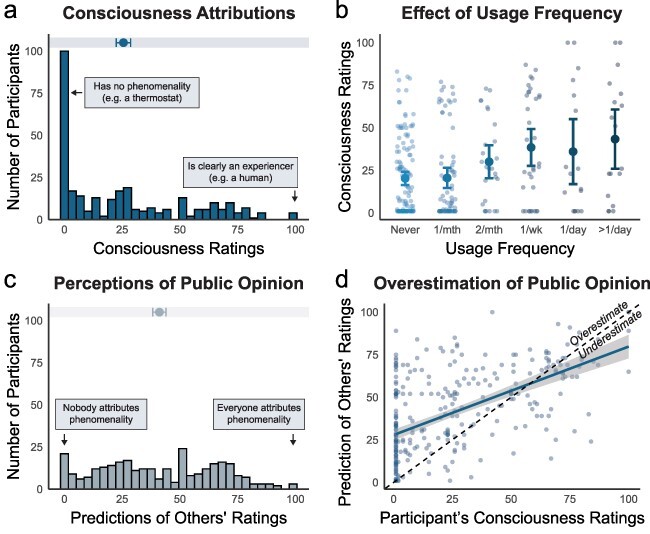
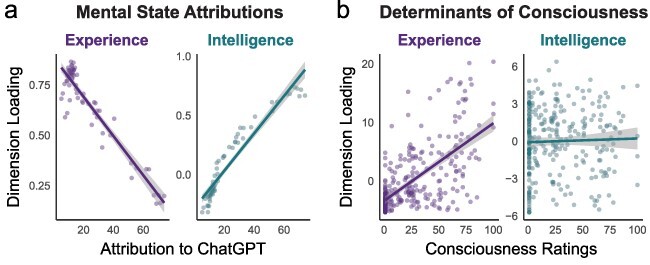
Technological advances raise new puzzles and challenges for cognitive science and thestudy of how humans think about and interact with artificial intelligence (AI). For example, theadvent of Large Language Models and their human-like linguistic abilities has raised substantialdebate regarding whether or not AI could be conscious. Here we consider the question ofwhether AI could have subjective experiences such as feelings and sensations(“phenomenological consciousness”). While experts from many fields have weighed in on thisissue in academic and public discourse, it remains unknown how the general populationattributes phenomenology to AI. We surveyed a sample of US residents (N=300) and found thata majority of participants were willing to attribute phenomenological consciousness to LLMs.These attributions were robust, as they predicted attributions of mental states typically associatedwith phenomenology – but also flexible, as they were sensitive to individual differences such asusage frequency. Overall, these results show how folk intuitions about AI consciousness candiverge from expert intuitions – with important implications for the legal and ethical status of AI.
Overview
The claims and statistics of this paper haven’t been checked yet.
Free: it reads the open-access text and checks the first 5 claims that cite a source we can check. Create a free account to check every claim.
Integrity signals
Registry
Cites
Statistics
Figures
Verification
Claims the paper makes
The claims and statistics of this paper haven’t been checked yet.
Free: it reads the open-access text and checks the first 5 claims that cite a source we can check. Create a free account to check every claim.
Claims other papers make about this one
Each is checked against this paper’s own text: does it say what the citing paper says it does?
The source backs part of the claim, not all of it — or backs it for a different population, condition or comparison.
In the citing paper
“Several recent scienti fi c articles have assumed that LLMs are not conscious (Chalmers, 2023a; Colombatto and Fleming, 2023; DodigCrnkovic, 2023)”
From A clarification of the conditions under which Large language Models could be conscious (2024) · cites this paper as Colombatto and Fleming, 2023
Experimental — accuracy not yet measured
Self-check
Percentages, sums and reported differences re-computed from the paper’s own numbers.
The self-check needs the paper’s full text.
Citations
Cites
Nagel, T. (1974) · The Philosophical Review · doi:10.2307/2183914 · Cited by 7,440
On a confusion about a function of consciousness
Block, N. (1995) · Behavioral and Brain Sciences · doi:10.1017/s0140525x00038188 · Cited by 3,364
Gray, H. M., Gray, K., & Wegner, D. M. (2007) · Science · doi:10.1126/science.1134475 · Cited by 2,342
Chalmers, D. J. (1996) · Cited by 1,998
Causes and consequences of mind perception
Waytz, A., Gray, K., Epley, N., & Wegner, D. M. (2010) · Trends in Cognitive Sciences · doi:10.1016/j.tics.2010.05.006 · Cited by 759
Moral typecasting: Divergent perceptions of moral agents and moral patients.
Gray, K., & Wegner, D. M. (2009) · Journal of Personality and Social Psychology · doi:10.1037/a0013748 · Cited by 535
The Benefits of Interactions with Physically Present Robots over Video-Displayed Agents
Bainbridge, W. A., Hart, J. W., Kim, E. S., & Scassellati, B. (2011) · International Journal of Social Robotics · doi:10.1007/s12369-010-0082-7 · Cited by 478
More than a body: Mind perception and the nature of objectification.
Gray, K., Knobe, J., Sheskin, M., Bloom, P., & Barrett, L. F. (2011) · Journal of Personality and Social Psychology · doi:10.1037/a0025883 · Cited by 277
Subhuman, Inhuman, and Superhuman: Contrasting Humans with Nonhumans in Three Cultures
Haslam, N., Kashima, Y., Loughnan, S., Shi, J., & Suitner, C. (2008) · Social Cognition · doi:10.1521/soco.2008.26.2.248 · Cited by 247
Intuitions about consciousness: experimental studies
Knobe, J., & Prinz, J. (2008) · Phenomenology and the Cognitive Sciences · doi:10.1007/s11097-007-9066-y · Cited by 227
Two conceptions of subjective experience
Sytsma, J., & Machery, E. (2010) · Philosophical Studies · doi:10.1007/s11098-009-9439-x · Cited by 213
Distortions of mind perception in psychopathology
Gray, K., Jenkins, A. C., Heberlein, A. S., & Wegner, D. M. (2011) · Proceedings of the National Academy of Sciences · doi:10.1073/pnas.1015493108 · Cited by 205
Consciousness in Artificial Intelligence: Insights from the Science of Consciousness
Butlin, P., Long, R., Elmoznino, E., Bengio, Y., Birch, J., Constant, A., Deane, G., Fleming, S. M., Frith, C., Ji, X., et al. (2023) · arXiv · doi:10.48550/arxiv.2308.08708 · Cited by 196
Self-citationRethinking people’s conceptions of mental life
Weisman, K., Dweck, C. S., & Markman, E. M. (2017) · Proceedings of the National Academy of Sciences · doi:10.1073/pnas.1704347114 · Cited by 182
Consciousness and Moral Status
Shepherd, J. (2018) · doi:10.4324/9781315396347 · Cited by 161
Perceiving Animacy and Intentionality
Scholl, B. J., & Gao, T. (2013) · Social Perception · doi:10.7551/mitpress/9780262019279.003.0009 · Cited by 160
Could a Large Language Model be Conscious?
Chalmers, D. J. (2023) · arXiv · doi:10.48550/arxiv.2303.07103 · Cited by 143
To escape blame, don't be a hero—Be a victim
Gray, K. J., & Wegner, D. M. (2010) · Journal of Experimental Social Psychology · doi:10.1016/j.jesp.2010.12.012 · Cited by 124
The Folk Psychology of Consciousness*
ARICO, A., FIALA, B., GOLDBERG, R. F., & NICHOLS, S. (2011) · Mind & Language · doi:10.1111/j.1468-0017.2011.01420.x · Cited by 102
What Does the Nation of China Think About Phenomenal States?
Huebner, B., Bruno, M. G., & Sarkissian, H. (2009) · Review of Philosophy and Psychology · doi:10.1007/s13164-009-0009-0 · Cited by 85
The Phenomenal Stance Revisited
Jack, A. I., & Robbins, P. (2012) · Review of Philosophy and Psychology · doi:10.1007/s13164-012-0104-5 · Cited by 84
Commonsense concepts of phenomenal consciousness: does anyone care about functional zombies?
Huebner, B. (2010) · Phenomenology and the Cognitive Sciences · doi:10.1007/s11097-009-9126-6 · Cited by 72
Consciousness beyond the human case
LeDoux, J., Birch, J., Andrews, K., Clayton, N. S., Daw, N. D., Frith, C., Lau, H., Peters, M. A. K., Schneider, S., Seth, A., et al. (2023) · Current Biology · doi:10.1016/j.cub.2023.06.067 · Cited by 67
How to study folk intuitions about phenomenal consciousness1
Sytsma, J. M., & Machery, E. (2009) · Philosophical Psychology · doi:10.1080/09515080802703653 · Cited by 63
Folk Psychology, Consciousness, and Context Effects
Arico, A. J. (2010) · Review of Philosophy and Psychology · doi:10.1007/s13164-010-0029-9 · Cited by 55
(2019) · eScholarship (California Digital Library) · Cited by 50
No problem: Evidence that the concept of phenomenal consciousness is not widespread
Sytsma, J. M., & Ozdemir, E. (2022) · PhilSci-Archive (University of Pittsburgh) · doi:10.25455/wgtn.21136159 · Cited by 48
Function and feeling machines: a defense of the philosophical conception of subjective experience
Buckwalter, W., & Phelan, M. (2012) · Philosophical Studies · doi:10.1007/s11098-012-0039-9 · Cited by 47
Thinking things and feeling things: on an alleged discontinuity in folk metaphysics of mind
Phelan, M., Arico, A. J., & Nichols, S. (2012) · Phenomenology and the Cognitive Sciences · doi:10.1007/s11097-012-9278-7 · Cited by 47
Do You Mind? User Perceptions of Machine Consciousness
Scott, A. E., Neumann, D., Niess, J., & Woźniak, P. W. (2023) · Proceedings of the 2023 CHI Conference on Human Factors in Computing Systems · doi:10.1145/3544548.3581296 · Cited by 46
Blurring two conceptions of subjective experience: folk versus philosophical phenomenality
Peressini, A. (2014) · Philosophical Psychology · doi:10.1080/09515089.2013.793150 · Cited by 32
The scientific study of consciousness cannot, and should not, be morally neutralPreprint
Mazor, M., Brown, S. A. B., Ciaunica, A., Athena Demertzi, A., Fahrenfort, J. J., Faivre, N., Francken, J. C., Lamy, D., Lenggenhager, B., Moutoussis, M., et al. (2021) · doi:10.31234/osf.io/8nb2c · Cited by 26
The Robots of the Dawn of Experimental Philosophy of Mind
Sytsma, J. M. (2014) · Routledge eBooks · doi:10.4324/9780203122884-4 · Cited by 21
Sytsma, J. (2014) · WIREs Cognitive Science · doi:10.1002/wcs.1320 · Cited by 20
The irrelevance of folk intuitions to the “hard problem” of consciousness
Talbot, B. (2012) · Consciousness and Cognition · doi:10.1016/j.concog.2010.12.005 · Cited by 20
The scientific study of consciousness cannot and should not be morally neutral
Mazor, M., Brown, S., Ciaunica, A., Demertzi, A., Fahrenfort, J., Faivre, N., Francken, J. C., Lamy, D., Lenggenhager, B., Moutoussis, M., et al. (2023) · Perspectives on Psychological Science · doi:10.1177/17456916221110222 · Cited by 17
Deanthropomorphising NLP: Can a language model be conscious?
Shardlow, M., & Przybyła, P. (2024) · PLoS ONE · doi:10.1371/journal.pone.0307521 · Cited by 16
Illusions of Confidence in Artificial SystemsPreprint
Colombatto, C., & Fleming, S. M. (2023) · PsyArXiv (OSF Preprints) · doi:10.31234/osf.io/mjx2v · Cited by 9
Self-citationExperimental Philosophy of Consciousness
Reuter, K. (2024) · Oxford University Press eBooks · doi:10.1093/9780198918905.003.0017 · Cited by 8
Phenomenal Consciousness Disembodied
(2014) · Bloomsbury Academic eBooks · doi:10.5040/9781472594136.ch-003 · Cited by 7
On the Relevance of Folk Intuitions: A Reply to TalbotPreprint
Sytsma, J. M., & Machery, É. (2011) · PhilSci-Archive (University of Pittsburgh) · Cited by 6
Experimental Philosophy of Mind: Conscious State Attribution
Phelan, M. (2023) · De Gruyter eBooks · doi:10.1515/9783110716931-012 · Cited by 4
Research works printed but not linked: 1
- Wiese W. 2023 Could large language models be conscious? A perspective from the free energy principle. Preprint at Philpapers, https://philpapers.org/rec/WIECLL
Cited by
The benefits and dangers of anthropomorphic conversational agents
Peter, S., Riemer, K., & West, J. D. (2025) · Proceedings of the National Academy of Sciences · doi:10.1073/pnas.2415898122 · Cited by 110
Conscious artificial intelligence and biological naturalism
Seth, A. K. (2026) · Behavioral and Brain Sciences · doi:10.1017/s0140525x25000032 · Cited by 87
Identifying indicators of consciousness in AI systems
Butlin, P., Long, R., Bayne, T., Bengio, Y., Birch, J., Chalmers, D., Constant, A., Deane, G., Elmoznino, E., Fleming, S. M., et al. (2026) · Trends in Cognitive Sciences · doi:10.1016/j.tics.2025.10.011 · Cited by 56
Self-citationCompanionship in code: AI's role in the future of human connection
Andersson, M. (2025) · Humanities and Social Sciences Communications · doi:10.1057/s41599-025-05536-x · Cited by 39
Consciousness science: where are we, where are we going, and what if we get there?
Cleeremans, A., Mudrik, L., & Seth, A. K. (2025) · Frontiers in Science · doi:10.3389/fsci.2025.1546279 · Cited by 51
Metadata
- Authors
- Colombatto, C., & Fleming, S. M.
- Affiliations
- University of Waterloo (CA)
- Wellcome Centre for Human Neuroimaging (GB)
- Corresponding author
- Colombatto, Clara
- Venue
- Neuroscience of Consciousness
- Publisher
- Center for Open Science
- Published
- 2023-11-22
- Volume
- 2024
- Issue
- 1
- Pages
- niae013-niae013
- ISSN
- 2057-2107 (ISSN-L)
- PMC
- PMC11008499
- OpenAlex
- W4394716098
- Cited by
- 96
- References
- 44
- Citations by year
- 2026: 47 · 2025: 44 · 2024: 5
- FWCI
- 39.27
- Type
- journal article
- Language
- en
- Open access
- gold
- doi.org
- Locations
- Neuroscience of Consciousness (publishedVersion, cc-by-nc)
- PubMed Central (publishedVersion, cc-by-nc)
- PubMed (publishedVersion)
- UCL Discovery (University College London) (submittedVersion)
- MPG.PuRe (Max Planck Society) (submittedVersion)
- PsyArXiv (OSF Preprints) (submittedVersion, public-domain)
- Funders
- Canadian Institute for Advanced Research
- Wellcome Trust (Z/17/Z, 206648/Z/17/Z)
- UK Research and Innovation
- Engineering and Physical Sciences Research Council (EP/V000748/1)
- Topics
- Social Sciences › Arts and Humanities › Philosophy › Philosophy and Theoretical Science
- Social Sciences › Arts and Humanities › History and Philosophy of Science › Cybernetics and Technology in Society
- Life Sciences › Neuroscience › Cognitive Neuroscience › Embodied and Extended Cognition
- Keywords
- phenomenal consciousness, large language models, folk psychology, artificial intelligence, subjective experience, public attitudes toward AI, individual differences, usage frequency
About these checks
Registry, retraction, Cites and statistics results are computed, not judged, with one exception: a printed reference that no index lists is read once by a model before it counts as a citation error. Claims are extracted by a model and kept only when their quote appears verbatim in the text; each cited source is then checked, with a model’s help, for whether it says what the claim relies on. Those verdicts can be wrong — read the claim’s quote and the cited source before relying on one.
Statistics and arithmetic are recomputed, not judged.
Confidence bands are shown only for fields calibrated on our annotated test set. None is calibrated yet, so no band is shown.
What counts as a claim ›How we measure confidence ›How we check this ›
Are you an author, or do you see a problem with this page? Request a review
Data sources
Bibliographic data: Semantic Scholar, OpenAlex, Crossref.
Contains information from the Semantic Scholar Academic Graph Datasets, made available under the ODC Attribution License (ODC-BY 1.0).
Semantic Scholar’s data is described in: Kinney, R., et al. (2023). The Semantic Scholar Open Data Platform. arXiv:2301.10140.
