

The DOI matches its Crossref record; 197 of the 199 references it cites were found in a registry or an index; 28 of the 93 sources its claims cite were checked for support.
Biomass-Based Adsorbents for Removal of Dyes From Wastewater: A Review
Open accessAbstract
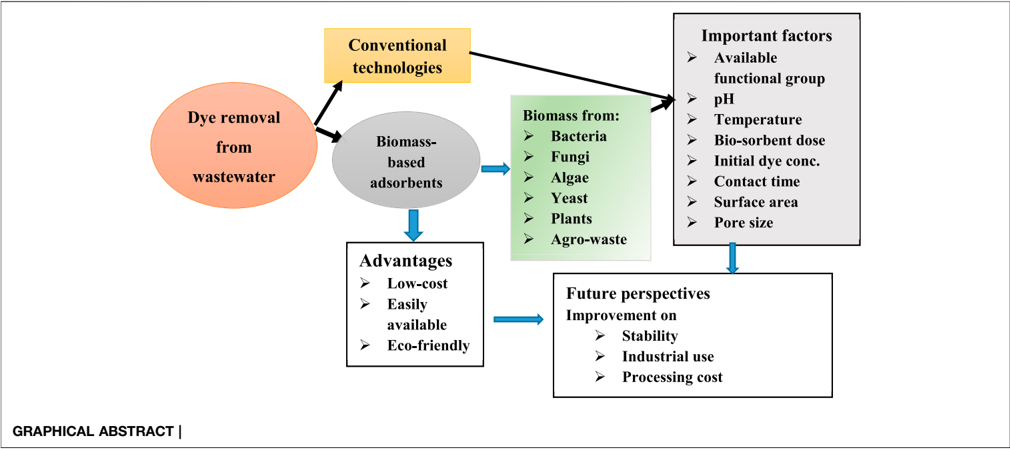
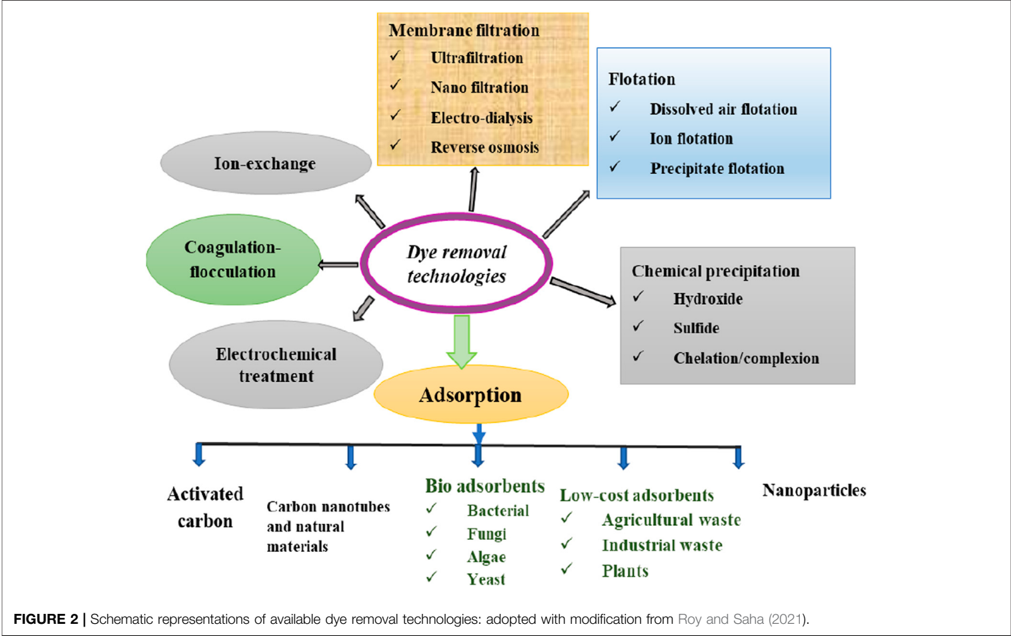
Dyes, especially azo dyes contained in wastewaters released from textile, pigment, and leather industries, are entering into natural waterbodies. This results in environmental deterioration and serious health damages (for example carcinogenicity and mutagenesis) through food chains. Physiochemical, membrane processes, electrochemical technology, advanced oxidation processes, reverse osmosis, ion exchange, electrodialysis, electrolysis, and adsorption techniques are commonly used conventional treatment technologies. However, the limitations of most of these methods include the generation of toxic sludge, high operational and maintenance costs. Thus, technological advancements are in use to remediate dyes from effluents. Adsorption using the nonconventional biomass-based sorbents is the greatest attractive alternatives because of their low cost, sustainability, availability, and eco-friendly. We present and reviewed up-to-date publications on biomass-based sorbents used for dye removal. Conceptualization and synthesizing their state-of-the-art knowledge on their characteristics, experimental conditions used were also discussed. The merits and limitations of various biosorbents were also reflected. The maximum dye adsorption capacities of various biosorbents were reviewed and synthesized in the order of the biomass type (algae, agricultural, fungal, bacterial, activated carbon, yeast, and others). Surface chemistry, pH, initial dye concentration, temperature, contact time, and adsorbent dose as well as the ways of the preparations of materials affect the biosorption process. Based on the average dye adsorption capacity, those sorbents were arranged and prioritized. The best fit of the adsorption isotherms (for example Freundlich and Langmuir models) and basic operating parameters on the removal dyes were retrieved. Which biomass-based adsorbents have greater potential for dye removal based on their uptake nature, cost-effectiveness, bulk availability, and mono to multilayer adsorption behavior was discussed. The basic limitations including the desorption cycles of biomass-based adsorbent preparation and operation for the implementation of this technology were forwarded.
Overview
AI snapshot
Written from the paper’s full text.
TL;DR
This review synthesizes literature on biomass-based adsorbents (algae, agricultural, fungal, bacterial, activated carbon, yeast, and others) for removing dyes from wastewater, emphasizing adsorption as a low-cost, eco-friendly alternative to conventional treatments. It reports that performance depends on surface chemistry, pH, initial dye concentration, temperature, contact time, adsorbent dose, and preparation/modification, with many biomasses achieving up to 99% removal.
Key findings
- Dye pollution is large: 0.7–1.6 million tons of dyes are produced yearly, with 10–15% discharged as wastewater; conventional treatments often generate toxic sludge and have high operational/maintenance costs.
- Biomass-based adsorbents can outperform commercial activated carbon in some cases: *Spirulina platensis* reached 482.2 mg/g for Reactive Red 120 versus 267.2 mg/g for commercial activated carbon at pH 2 and 25°C; other reported capacities include 190.2 mg/g for Reactive Yellow 86 on free *Lentinus concinnus*, 279.14 mg/g for crystal violet on citric acid-functionalized brown algae, 225.2 mg/g for methylene blue on polysulfone–*E. coli* composite, and 212.05 mg/g for methylene blue/malachite green on brewer’s yeast biomass.
- Adsorption isotherms and kinetics varied, but Langmuir and pseudo-second-order models were most commonly best fits across fungal, algal, bacterial, yeast, and agricultural adsorbents; pH controls whether anionic or cationic dyes are favored.
- Cost and regeneration are key: biochar from groundnut shell had the least cost (₹0.91/g) and highest capacity (46.3 mg/g) among coconut shell, groundnut shell, and rice husk for Basic Red 09; mandarin peel adsorbent maintained >50% capacity after four cycles, while banana peel removal decreased from 100 to 64% (MG) and 76% (MB) after five uses.
Methods
- Narrative review and synthesis of up-to-date publications on biomass-based sorbents for dye removal, covering characteristics, experimental conditions, merits/limitations, and adsorption capacities by biomass type.
- Literature search included PubMed with the query “biosorbents for the removal of dyes” (2002–2020; 209 papers) and Google Scholar; retrieved publications were filtered and prioritized by relevance to the review scope.
- Data were compiled into tables summarizing adsorbent source/species, modification, dye type, adsorption capacity, fitted isotherm/kinetic models, mixing time, sorbent dose, dye concentration, pH, and removal efficiency.
Limitations
- The paper states most biomass-based adsorption studies are laboratory-scale and use simulated wastewater, so cost analysis is limited, particularly for microbial biomass; comparison among studies is difficult because each uses different parameters for efficiency determination.
- The paper states desorption/regeneration, scaling up, cost analysis, and safe disposal of spent adsorbents and eluents remain constraints; more work is needed in mixed/multi-pollutant systems representative of real wastewater.
- Evident from the text: this is a narrative review without quantitative meta-analysis, and its PubMed search is described as not comprehensive (Google Scholar was added), so synthesized rankings and comparisons depend on the selected literature.
Model-written summary. Check it against the paper before relying on it.
Integrity signals
Registry
Cites
Statistics
Figures
Verification
Claims the paper makes
36 No full text of the sources · 25 No basis given · 15 Own interpretation · 9 Partly supported · 8 Supported · 7 Supported so far · 6 Sources not found · 5 Own result · 4 Not checked yet · 1 Couldn’t confirm · accuracy not yet measured
The cited sources support only part of this claim — read each source’s verdict below.
In the paper
“Besides the high sorption capacity toward dye, the dye removal performance can be improved by combining the biosorption process with the biodegradation processes by living cells (Singh and Singh, 2017;Roy et al., 2018).”
§ Biomass-Based Adsorbents for Removal of Dyes From Wastewater: A Review > 3 BIOADSORBENTS
What the sources say
- Partly supportedcites Singh and Singh, 2017 sourceExperimental — accuracy not yet measured
The “Biological Methods of Decolorization and Degradation of Azo Dyes” section (page not identified in our copy) describes biosorption and biodegradation by living cells as two ways to remove azo dyes. The “Biosorption” section says biosorption has good removal performance but can suffer early saturation. Neither passage says that combining the two processes improves performance beyond sorption alone. (LLM, conf=0.84)
- Not checked — no full text of the sourcecites Roy et al., 2018 source
plaindirect- Asserted: passes — The authors put it forward as true.
- Checkable: passes — It can be checked against evidence.
- Load-bearing: unclear — It is unclear whether the paper’s conclusions depend on it.
- Based: passes — The paper gives a reason why it holds.
- Partly supported
The sources with a verdict support this claim; the rest weren’t checked yet, have no full text we could read, or their verdicts aren’t rated yet.
In the paper
“Comparatively, the adsorption method is considered a better treatment process in wastewater treatment technologies due to ease of operation, convenience, and simplicity of design (Aragaw and Angerasa, 2020;Aragaw, 2020), but it has a limitation of sludge generation (spent adsorbents after use) as other removal processes (Patel, 2021;Vakili et al., 2019).”
§ Biomass-Based Adsorbents for Removal of Dyes From Wastewater: A Review > 1 INTRODUCTION
What the sources say
- Supportedcites Patel, 2021 source
The Introduction identifies spent adsorbent left after adsorption as solid waste and calls it a main disadvantage of the process. This supports the cited point that adsorption generates a waste material after use, described in the citing sentence as spent adsorbent. (LLM, conf=0.90)
- Not checked — no full text of the sourcecites Vakili et al., 2019 source
plaindirect- Asserted: passes — The authors put it forward as true.
- Checkable: passes — It can be checked against evidence.
- Load-bearing: unclear — It is unclear whether the paper’s conclusions depend on it.
- Based: passes — The paper gives a reason why it holds.
- Supported
The cited sources support only part of this claim — read each source’s verdict below.
In the paper
“Comparatively, the adsorption method is considered a better treatment process in wastewater treatment technologies due to ease of operation, convenience, and simplicity of design (Aragaw and Angerasa, 2020;Aragaw, 2020), but it has a limitation of sludge generation (spent adsorbents after use) as other removal processes (Patel, 2021;Vakili et al., 2019).”
§ Biomass-Based Adsorbents for Removal of Dyes From Wastewater: A Review > 1 INTRODUCTION
What the sources say
- Partly supportedcites Aragaw and Angerasa, 2020 sourceExperimental — accuracy not yet measured
The Introduction describes adsorption as a potential technology for dye removal from wastewater and says natural adsorbents are widely used owing to their simplicity. It does not establish that adsorption is better than other wastewater treatments because of ease of operation, convenience, or simplicity of design. No page number is available in our copy. (LLM, conf=0.82)
- Not matchedcites Aragaw, 2020
Couldn’t be matched to a paper in Crossref, so it can’t be checked.
- Partly supportedcites Patel, 2021 sourceExperimental — accuracy not yet measured
Patel is cited for the limitation in the second clause, not for the preceding claim about ease of operation and design. The Introduction identifies spent adsorbent as a solid hazardous waste produced after use, but does not describe it as sludge or establish that adsorption generates sludge as other removal processes do. (LLM, conf=0.84)
plaindirect- Asserted: passes — The authors put it forward as true.
- Checkable: passes — It can be checked against evidence.
- Load-bearing: passes — The paper’s conclusions depend on it.
- Based: passes — The paper gives a reason why it holds.
- Partly supported
Every source the paper cites for this claim was checked and supports it.
In the paper
“They found that 90% of RR 141 and 50% of RB 19 was adsorbed at pH 6.0, initial dye concentration of 100 mg/L, and 2 g/L biomass dose, but when the dosage of biomass was increased to 6 g/L the adsorption of RB 19 increased to 90%.”
§ Biomass-Based Adsorbents for Removal of Dyes From Wastewater: A Review > 3.4 Adsorbents From Yeasts
What the sources say
- Supportedcites Ruscasso et al., 2021 source
The Abstract reports that D. hansenii F39A adsorbed around 90% of Reactive Red 141 and 50% of Reactive Blue 19 at pH 6.0, with 100 mg/l initial dye concentration and 2 g/l biomass loading. It also reports uptake of up to 90% for Reactive Blue 19 when biomass loading increased to 6 g/l. (LLM, conf=0.94)
plaindirect- Asserted: passes — The authors put it forward as true.
- Checkable: passes — It can be checked against evidence.
- Load-bearing: unclear — It is unclear whether the paper’s conclusions depend on it.
- Based: passes — The paper gives a reason why it holds.
- Supported
Every source the paper cites for this claim was checked and supports it.
In the paper
“Charcoal, peat, chitin, microbial biomass (fungi, bacteria, yeast, etc.), wood GRAPHICAL ABSTRACT | bark, and other agricultural and industrial wastes are frequently used bio-adsorbents (Kumar et al., 2021).”
§ Biomass-Based Adsorbents for Removal of Dyes From Wastewater: A Review > 1 INTRODUCTION
What the sources say
- Supportedcites Kumar et al., 2021 source
The Abstract lists charcoal, chitin, peat, fungal and microbial biomass, wood bark, and agricultural wastes as commonly used bio-adsorbents. The Introduction also identifies fungi, bacteria, and waste materials from industry as biosorbent sources; yeast is encompassed by the paper’s broader term “microbial biomass.” (LLM, conf=0.91)
plain- Asserted: passes — The authors put it forward as true.
- Checkable: passes — It can be checked against evidence.
- Load-bearing: unclear — It is unclear whether the paper’s conclusions depend on it.
- Based: passes — The paper gives a reason why it holds.
- Supported
The sources with a verdict support this claim; the rest weren’t checked yet, have no full text we could read, or their verdicts aren’t rated yet.
In the paper
“Among them, biological methods are the most promising due to environmentally safe treatment capability (Przystaś et al., 2018;Batool and Valiyaveettil, 2021).”
§ Biomass-Based Adsorbents for Removal of Dyes From Wastewater: A Review > 3 BIOADSORBENTS
What the sources say
- Supportedcites Przystaś et al., 2018 source
The Abstract states that biological processes are the most promising for decolorizing dye-containing wastewater because they seem environmentally safe. The Introduction likewise describes microbial bioremediation as an environmentally friendly alternative. (LLM, conf=0.94)
- Not checked — no full text of the sourcecites Batool and Valiyaveettil, 2021 source
plaindirect- Asserted: passes — The authors put it forward as true.
- Checkable: passes — It can be checked against evidence.
- Load-bearing: unclear — It is unclear whether the paper’s conclusions depend on it.
- Based: passes — The paper gives a reason why it holds.
- Supported
The cited sources support only part of this claim — read each source’s verdict below.
In the paper
“but when the dosage of biomass was increased to 6 g/L the adsorption of RB 19 increased to 90%.”
§ Biomass-Based Adsorbents for Removal of Dyes From Wastewater: A Review > 3.4 Adsorbents From Yeasts
What the sources say
- Partly supportedcites Ruscasso et al., 2021 sourceExperimental — accuracy not yet measured
The Effect of the adsorbent dose section reports that increasing D. hansenii biomass from 1 to 6 g/L raised RB-19 removal from 34.03% to 84.63%. This supports the direction of the claim and the 6 g/L dosage, but the reported result is 84.63%, not 90%. (LLM, conf=0.84)
plaindirectSingle case- Asserted: passes — The authors put it forward as true.
- Checkable: passes — It can be checked against evidence.
- Load-bearing: unclear — It is unclear whether the paper’s conclusions depend on it.
- Based: passes — The paper gives a reason why it holds.
- Partly supported
The sources with a verdict support this claim; the rest weren’t checked yet, have no full text we could read, or their verdicts aren’t rated yet.
In the paper
“The presence of a large pore volume allows the binding of the highest number of dye molecules to the adsorbent (Hassan and Carr, 2021;Moosavi et al., 2020).”
§ Biomass-Based Adsorbents for Removal of Dyes From Wastewater: A Review > 3 BIOADSORBENTS
What the sources say
- Not checked — no full text of the sourcecites Hassan and Carr, 2021 source
- Supportedcites Moosavi et al., 2020 source
The Physical and Chemical Properties of Activated Carbon section (Table 2) says that larger pore volume increases adsorption capacity. The Adsorption of Activated Carbon and Dependent Factors section adds that pore size and volume must accommodate the adsorbate molecules. Together, these support the claim that a larger pore volume can allow more dye molecules to be adsorbed. (LLM, conf=0.90)
plaindirect- Asserted: passes — The authors put it forward as true.
- Checkable: passes — It can be checked against evidence.
- Load-bearing: unclear — It is unclear whether the paper’s conclusions depend on it.
- Based: passes — The paper gives a reason why it holds.
Every source the paper cites for this claim was checked and supports it.
In the paper
“They concluded that the AC prepared from this plant material was approximately six times cheaper than conventional AC.”
§ Biomass-Based Adsorbents for Removal of Dyes From Wastewater: A Review > 4 Cost Analysis of Biomass-Based Adsorbents
What the sources say
- Supportedcites Bello et al., 2019 source
The Cost analysis section states that activated carbon prepared from locust bean pod (ALBP) was approximately six times cheaper than commercial activated carbon (CAC). Table 9 gives costs of $42.52/kg and $259.50/kg, respectively. (LLM, conf=0.95)
plainSingle case- Asserted: passes — The authors put it forward as true.
- Checkable: passes — It can be checked against evidence.
- Load-bearing: unclear — It is unclear whether the paper’s conclusions depend on it.
- Based: passes — The paper gives a reason why it holds.
- Supported
The sources with a verdict support this claim; the rest weren’t checked yet, have no full text we could read, or their verdicts aren’t rated yet.
In the paper
“Different studies show that the dye adsorption abilities of those biomasses mainly depend on the types of dyes as well as the techniques of processing (Deniz and Kepekci, 2017); (Kharat, 2015).”
§ Biomass-Based Adsorbents for Removal of Dyes From Wastewater: A Review > 3.5 Adsorbents From Forest or Agricultural Debris Wastes
What the sources say
- Not checked — no full text of the sourcecites Deniz and Kepekci, 2017 source
- Supportedcites Kharat, 2015 source
The Abstract states that dye adsorption capacities of non-conventional biomasses largely depend on processing methods and dye types. This directly supports the citing sentence’s paraphrase. (LLM, conf=0.94)
plaindirect- Asserted: passes — The authors put it forward as true.
- Checkable: passes — It can be checked against evidence.
- Load-bearing: unclear — It is unclear whether the paper’s conclusions depend on it.
- Based: passes — The paper gives a reason why it holds.
- Probably not a substantial claim. 29
- It may state two separate claims as one. 59
- The quote only partly states this claim. 4
Every source the paper cites for this claim was checked and supports it.
In the paper
“Coal-derived activated carbon was supposed to be the most efficient type of activated carbon in adsorption.The efficiency of treatment is 99.8%, and it can treat various types of dyes (Yeow et al., 2021).”
§ Biomass-Based Adsorbents for Removal of Dyes From Wastewater: A Review > 2.9 Adsorption
What the sources say
- Supportedcites Yeow et al., 2021 source
The Conclusions state that coal-derived activated carbon is the most efficient type for adsorption, give a treatment efficiency of 99.8%, and say it can treat various dyes. Section 4.1 also describes its capacity to remove various types of dye. (LLM, conf=0.95)
hedged- Asserted: passes — The authors put it forward as true.
- Checkable: passes — It can be checked against evidence.
- Load-bearing: fails — The paper’s conclusions may not depend on it.
- Based: passes — The paper gives a reason why it holds.
Probably not a substantial claim. The paper’s conclusions may not depend on it. It may state two separate claims as one.
- Supported
The cited sources support only part of this claim — read each source’s verdict below.
In the paper
“Excessive exposure to dye causes skin irritation, respiratory problems and some dyes even increase the risk of cancer in humans (Amirza et al., 2017).”
§ Biomass-Based Adsorbents for Removal of Dyes From Wastewater: A Review > 1 INTRODUCTION
What the sources say
- Partly supportedcites Amirza et al., 2017 sourceExperimental — accuracy not yet measured
The Introduction (page not provided) says dyes can cause skin irritation and describes potential carcinogenic effects, including effects on human cells. It does not mention respiratory problems or establish an exposure threshold for these harms; it also frames carcinogenicity as potential rather than a demonstrated increase in human cancer risk. (LLM, conf=0.88)
plaindirect- Asserted: passes — The authors put it forward as true.
- Checkable: passes — It can be checked against evidence.
- Load-bearing: passes — The paper’s conclusions depend on it.
- Based: passes — The paper gives a reason why it holds.
It may state two separate claims as one.
- Partly supported
The cited sources support only part of this claim — read each source’s verdict below.
In the paper
“To satisfy the modern need, it is assessed that 0.7-1.6 million tons of dyes are delivered yearly and 10-15% of this volume is disposed of as wastewater, making it major water pollutants (Bhatia et al., 2017;Varghese et al., 2019;Syafiuddin and Fulazzaky, 2020).”
§ Biomass-Based Adsorbents for Removal of Dyes From Wastewater: A Review > 1 INTRODUCTION
What the sources say
- Not checked — no full text of the sourcecites Bhatia et al., 2017 source
- Not checked — no full text of the sourcecites Varghese et al., 2019 source
- Partly supportedcites Syafiuddin and Fulazzaky, 2020 sourceExperimental — accuracy not yet measured
The Introduction (page not supplied) reports approximately 700,000 metric tons of annual dye production and a 10–15% loss of colorants during dyeing. It also describes environmental harm from dyes released into water, but does not give the 1.6-million-ton upper estimate or state that all of the 10–15% loss is disposed of as wastewater. (LLM, conf=0.87)
hedgeddirect- Asserted: passes — The authors put it forward as true.
- Checkable: passes — It can be checked against evidence.
- Load-bearing: fails — The paper’s conclusions may not depend on it.
- Based: passes — The paper gives a reason why it holds.
Probably not a substantial claim. The paper’s conclusions may not depend on it. It may state two separate claims as one.
The sources with a verdict support this claim; the rest weren’t checked yet, have no full text we could read, or their verdicts aren’t rated yet.
In the paper
“Dyes are usually classified based on their chemical structure, such as anionic, cationic, and nonionic; reactive dyes are stable and anionic, and display resistance toward light (Heidari et al., 2019;Dai et al., 2018).”
§ Biomass-Based Adsorbents for Removal of Dyes From Wastewater: A Review > 2 WASTEWATER TREATMENT TECHNIQUES FOR DYES REMOVAL
What the sources say
plain- Asserted: passes — The authors put it forward as true.
- Checkable: passes — It can be checked against evidence.
- Load-bearing: fails — The paper’s conclusions may not depend on it.
- Based: passes — The paper gives a reason why it holds.
Probably not a substantial claim. The paper’s conclusions may not depend on it. It may state two separate claims as one.
The cited sources support only part of this claim — read each source’s verdict below.
In the paper
“Biotreatment of dyecontaining wastewater effluent by fungal cell was provided a cost-effective, easily applicable, eco-friendly (Salem et al., 2019;(Argumedo-Delira et al., 2021), and absence of nutrient needs (Ghany et al., 2019).”
§ Biomass-Based Adsorbents for Removal of Dyes From Wastewater: A Review > 3.1 Adsorbents From Fungal Biomass
What the sources say
- Supportedcites Salem et al., 2019 source
The Introduction describes biological treatment as low-cost and eco-friendly and says fungi are easy to manipulate, supporting the qualities attributed to Salem et al. The separate claim about having no nutrient needs is cited to Ghany et al., not Salem et al., so it is not part of this verdict. (LLM, conf=0.88)
- Partly supportedcites Argumedo-Delira et al., 2021 sourceExperimental — accuracy not yet measured
The Introduction says biological dye-removal methods, including fungal treatments, are less costly than chemical methods and are eco-friendly. It does not establish that fungal-cell treatment is easily applicable. The separate claim about having no nutrient needs is attributed to Ghany et al., not to this source. (LLM, conf=0.84)
- Not checked — no full text of the sourcecites Ghany et al., 2019 source
plain- Asserted: passes — The authors put it forward as true.
- Checkable: passes — It can be checked against evidence.
- Load-bearing: unclear — It is unclear whether the paper’s conclusions depend on it.
- Based: passes — The paper gives a reason why it holds.
It may state two separate claims as one.
- Supported
The cited sources that could be checked couldn’t confirm or dispute this claim.
In the paper
“Also worthy of note are disadvantages, among which the one linked to the high cost of disposal of the remaining concentrated residue following the separation, the high management costs and the inability to deal with high flow rates, and frequent clogging of membrane pores by the dye molecules (Collivignarelli et al., 2019).”
§ Biomass-Based Adsorbents for Removal of Dyes From Wastewater: A Review > 2.4 Membrane Technologies
What the sources say
- Could not verifycites Collivignarelli et al., 2019 sourceExperimental — accuracy not yet measured
The available copy contains a repository listing and PDF link, but no article passage discussing membrane technologies. Searches for concentrated-residue disposal, management costs, high flow rates, and dye-related pore clogging returned no relevant text, so the attributed disadvantages cannot be verified from this copy. (LLM, conf=0.77)
plaincorrelational- Asserted: passes — The authors put it forward as true.
- Checkable: passes — It can be checked against evidence.
- Load-bearing: unclear — It is unclear whether the paper’s conclusions depend on it.
- Based: passes — The paper gives a reason why it holds.
It may state two separate claims as one.
- Could not verify
The cited sources support only part of this claim — read each source’s verdict below.
In the paper
“Algae are considered one of the sources of the most favorable types of bio-sorbents because they have high biosorption capacity and are easily available in large amounts (Singh and Singh, 2017;Azam et al., 2020).”
§ Biomass-Based Adsorbents for Removal of Dyes From Wastewater: A Review > 3.2 Adsorbents From Algae Biomass
What the sources say
- Partly supportedcites Singh and Singh, 2017 sourceExperimental — accuracy not yet measured
The Biosorption section describes algae as potent biosorbents, citing their availability in fresh and salt water, relatively high surface area, and high binding affinity. It does not establish that algae are easily available in large amounts; availability across habitats is not evidence of quantity. (LLM, conf=0.83)
- Not checked — no full text of the sourcecites Azam et al., 2020 source
plaindirect- Asserted: passes — The authors put it forward as true.
- Checkable: passes — It can be checked against evidence.
- Load-bearing: unclear — It is unclear whether the paper’s conclusions depend on it.
- Based: passes — The paper gives a reason why it holds.
It may state two separate claims as one.
- Partly supported
Every source the paper cites for this claim was checked and supports it.
In the paper
“Adsorption is found to be a very effective, cheap, and commonly used method among all available dye removal techniques (Kandisa and Saibaba KV, 2016).”
§ Biomass-Based Adsorbents for Removal of Dyes From Wastewater: A Review > 2.9 Adsorption
What the sources say
- Supportedcites Kandisa and Saibaba KV, 2016 source
The Abstract calls adsorption a very effective and cheap dye-removal method. The Conclusion says it has low capital and operating costs and is commonly used to remove pollutants from industrial wastewater. (LLM, conf=0.94)
plain- Asserted: passes — The authors put it forward as true.
- Checkable: passes — It can be checked against evidence.
- Load-bearing: unclear — It is unclear whether the paper’s conclusions depend on it.
- Based: passes — The paper gives a reason why it holds.
It may state two separate claims as one.
- Supported
The cited sources support only part of this claim — read each source’s verdict below.
In the paper
“Sludge production in the case of Fenton reagent, formation of toxic byproduct in the case of photocatalyst, and high cost due to the use of expensive reagents (for example, H 2 O 2 ) and energy consumption (generation of O 3 or UV radiation) are the major drawback of AOPs for dye removal (Cuerda-Correa et al., 2020;Moosavi et al., 2020).”
§ Biomass-Based Adsorbents for Removal of Dyes From Wastewater: A Review > 2.6 Advanced Oxidation Processes
What the sources say
- Partly supportedcites Cuerda-Correa et al., 2020 sourceExperimental — accuracy not yet measured
The paper identifies Fenton sludge in its Conclusions and states that expensive reagents such as H₂O₂ and energy for ozone or UV make AOPs costly. It also warns that AOPs can produce toxic byproducts, but does not establish this specifically as a drawback of photocatalysis for dye removal; the review focuses on antibiotics in water. The cited passages have no page numbers in our copy. (LLM, conf=0.88)
- Partly supportedcites Moosavi et al., 2020 sourceExperimental — accuracy not yet measured
Table 1 in the Introduction identifies sludge production as a disadvantage of Fenton reagents, toxic byproduct formation for photocatalysts, and high operational cost for ozonation. It does not attribute AOP costs to H₂O₂, ozone generation, or UV radiation; it instead lists low-cost reagents for Fenton treatment and low operational cost for photocatalysis. (LLM, conf=0.89)
plaindirect- Asserted: passes — The authors put it forward as true.
- Checkable: passes — It can be checked against evidence.
- Load-bearing: passes — The paper’s conclusions depend on it.
- Based: passes — The paper gives a reason why it holds.
It may state two separate claims as one.
- Partly supported
Every source the paper cites for this claim was checked and supports it.
In the paper
“Potato peel biochar was considered a promising adsorbent for removing Cibacron Blue dye.The sorption ability of this waste follows the order: calcined > activated > native materials (Bouhadjra et al., 2021).”
§ Biomass-Based Adsorbents for Removal of Dyes From Wastewater: A Review > 3.5 Adsorbents From Forest or Agricultural Debris Wastes
What the sources say
- Supportedcites Bouhadjra et al., 2021 source
The Abstract directly identifies potato peel biochar (PPc) as a promising adsorbent and states that Cibacron Blue sorption follows the order calcined > activated > native materials. The Conclusion also reports higher adsorption capacity for PPc than for activated or native potato peels. (LLM, conf=0.95)
plaindirect- Asserted: passes — The authors put it forward as true.
- Checkable: passes — It can be checked against evidence.
- Load-bearing: unclear — It is unclear whether the paper’s conclusions depend on it.
- Based: passes — The paper gives a reason why it holds.
It may state two separate claims as one.
- Supported
The sources with a verdict support this claim; the rest weren’t checked yet, have no full text we could read, or their verdicts aren’t rated yet.
In the paper
“For example, phosphoric acid stimulates bond cleavage in agricultural waste biomass to increase the carbon yield (Bello et al., 2019).Phosphoric acid promoted dye biosorption by grafting phosphate functions onto the biomass and enhancing the acid functions involved in dye fixation (Benabbas et al., 2021).”
§ Biomass-Based Adsorbents for Removal of Dyes From Wastewater: A Review > 3.5 Adsorbents From Forest or Agricultural Debris Wastes
What the sources say
- Supportedcites Bello et al., 2019 source
The Preparation of functionalized activated carbon section states that orthophosphoric acid promotes bond cleavage in agricultural waste biomass and increases carbon yield. The separate statement about phosphate functions and dye fixation is attributed to Benabbas et al. (2021), not to Bello et al. (2019). (LLM, conf=0.95)
- Not checked — no full text of the sourcecites Benabbas et al., 2021 source
plaindirect- Asserted: passes — The authors put it forward as true.
- Checkable: passes — It can be checked against evidence.
- Load-bearing: unclear — It is unclear whether the paper’s conclusions depend on it.
- Based: passes — The paper gives a reason why it holds.
It may state two separate claims as one.
- Supported
The sources with a verdict support this claim; the rest weren’t checked yet, have no full text we could read, or their verdicts aren’t rated yet.
In the paper
“Some authors stated that the recovery step of powder-activated carbons is very costly, time-consuming, and not very efficient so that they are not suitable for industrial applications (Moosavi et al., 2020), and more particularly reusability is almost impossible for low-cost products (Saha et al., 2020).”
§ Biomass-Based Adsorbents for Removal of Dyes From Wastewater: A Review > 5 Regeneration of Bioadsorbents
What the sources say
- Supportedcites Moosavi et al., 2020 source
The Regeneration Technology section states that separating and recovering powdered activated carbon is costly, time-consuming, and inefficient, making it unsuitable for industrial applications. The separate claim about low-cost products is attributed to Saha et al., not Moosavi et al., and is outside this verdict. (LLM, conf=0.95)
- Not checked — no full text of the sourcecites Saha et al., 2020 source
hedgeddirect- Asserted: fails — The authors may not put it forward as true.
- Checkable: passes — It can be checked against evidence.
- Load-bearing: fails — The paper’s conclusions may not depend on it.
- Based: passes — The paper gives a reason why it holds.
Probably not a substantial claim. The authors may not put it forward as true. The paper’s conclusions may not depend on it. It may state two separate claims as one.
- Supported
Every source the paper cites for this claim was checked and supports it.
In the paper
“The pH of the solution affects both the chemistry of the aqueous solution and the binding sites present on the surface of adsorbents (Kumar et al., 2021).”
§ Biomass-Based Adsorbents for Removal of Dyes From Wastewater: A Review > 3.5 Adsorbents From Forest or Agricultural Debris Wastes
What the sources say
- Supportedcites Kumar et al., 2021 source
The section “Effect of initial pH concentration” (page not provided) states the claim verbatim and explains how pH affects ionization in solution and active sites on the adsorbent. (LLM, conf=0.95)
plaindirect- Asserted: passes — The authors put it forward as true.
- Checkable: passes — It can be checked against evidence.
- Load-bearing: unclear — It is unclear whether the paper’s conclusions depend on it.
- Based: passes — The paper gives a reason why it holds.
It may state two separate claims as one.
- Supported
The paper states this without a source or data behind it here, so there is nothing to check it against. The quote shows it is in the paper.
In the paper
“Most species of fungi potentially achieved more than 90% of a specific type of dye except Pleurotus ostreatus, Aspergillus flavus, and Diaporthe schini which had a removal efficiency of 53%, 53.62, and 87%, respectively.”
§ Biomass-Based Adsorbents for Removal of Dyes From Wastewater: A Review > 3.1 Adsorbents From Fungal Biomass
hedged- Asserted: passes — The authors put it forward as true.
- Checkable: passes — It can be checked against evidence.
- Load-bearing: unclear — It is unclear whether the paper’s conclusions depend on it.
- Based: passes — The paper gives a reason why it holds.
It may state two separate claims as one.
A result the paper reports from its own data — it cites no other source for it, so there is none to check. The quote shows it is in the paper.
In the paper
“Table 4 revealed that Langmuir isotherm was fitted by most biosorption studies, indicating that the monolayer coverage adsorption was the dominant process.”
§ Biomass-Based Adsorbents for Removal of Dyes From Wastewater: A Review > 3.3 Adsorbents From Bacterial Biomass
hedgeddirect- Asserted: passes — The authors put it forward as true.
- Checkable: passes — It can be checked against evidence.
- Load-bearing: unclear — It is unclear whether the paper’s conclusions depend on it.
- Based: passes — The paper gives a reason why it holds.
It may state two separate claims as one.
A result the paper reports from its own data — it cites no other source for it, so there is none to check. The quote shows it is in the paper.
In the paper
“Table 4 revealed that Spirulina and Chlorella species are common types of microalgae studied and achieved up to 99% removal efficiency.”
§ Biomass-Based Adsorbents for Removal of Dyes From Wastewater: A Review > 3.2 Adsorbents From Algae Biomass
plain- Asserted: passes — The authors put it forward as true.
- Checkable: passes — It can be checked against evidence.
- Load-bearing: unclear — It is unclear whether the paper’s conclusions depend on it.
- Based: passes — The paper gives a reason why it holds.
It may state two separate claims as one.
A result the paper reports from its own data — it cites no other source for it, so there is none to check. The quote shows it is in the paper.
In the paper
“Similarly, the pseudo-2 nd -order kinetic model showed the best model fit.”
§ Biomass-Based Adsorbents for Removal of Dyes From Wastewater: A Review > 3.3 Adsorbents From Bacterial Biomass
plaincorrelational- Asserted: passes — The authors put it forward as true.
- Checkable: passes — It can be checked against evidence.
- Load-bearing: unclear — It is unclear whether the paper’s conclusions depend on it.
- Based: passes — The paper gives a reason why it holds.
The quote only partly states this claim.
The paper states this without a source or data behind it here, so there is nothing to check it against. The quote shows it is in the paper.
In the paper
“Similarly, Sargassum species of macro algae are commonly studied and can remove more than 90% of dyes.”
§ Biomass-Based Adsorbents for Removal of Dyes From Wastewater: A Review > 3.2 Adsorbents From Algae Biomass
plaindirect- Asserted: passes — The authors put it forward as true.
- Checkable: passes — It can be checked against evidence.
- Load-bearing: fails — The paper’s conclusions may not depend on it.
- Based: fails — The paper may give no reason why it holds.
Probably not a substantial claim. The paper’s conclusions may not depend on it. The paper may give no reason why it holds. It may state two separate claims as one.
A result the paper reports from its own data — it cites no other source for it, so there is none to check. The quote shows it is in the paper.
In the paper
“The retrieved publications were found as adsorbents prepared from different biomasses activated and/or modified with various chemicals or techniques.”
§ Biomass-Based Adsorbents for Removal of Dyes From Wastewater: A Review > 1 INTRODUCTION
plain- Asserted: passes — The authors put it forward as true.
- Checkable: passes — It can be checked against evidence.
- Load-bearing: fails — The paper’s conclusions may not depend on it.
- Based: passes — The paper gives a reason why it holds.
Probably not a substantial claim. The paper’s conclusions may not depend on it.
None of the sources cited for this claim have been checked yet.
In the paper
“Table 6 revealed that most studies showed the best fit for Langmuir isotherm and pseudo-second-order kinetic models, suggesting the dominance of monolayer chemoadsorption except some yeast species in which the Freundlich and Temkin isotherm models showed the best fit model.”
§ Biomass-Based Adsorbents for Removal of Dyes From Wastewater: A Review > 3.4 Adsorbents From Yeasts
hedgedcorrelational- Asserted: passes — The authors put it forward as true.
- Checkable: passes — It can be checked against evidence.
- Load-bearing: unclear — It is unclear whether the paper’s conclusions depend on it.
- Based: passes — The paper gives a reason why it holds.
It may state two separate claims as one.
The paper states this without a source or data behind it here, so there is nothing to check it against. The quote shows it is in the paper.
In the paper
“Although most biomasses achieved a good removal efficiency, each study reviewed has considered different parameters for efficiency determination.”
§ Biomass-Based Adsorbents for Removal of Dyes From Wastewater: A Review > 7 CONCLUSION AND RECOMMENDATION
plain- Asserted: passes — The authors put it forward as true.
- Checkable: passes — It can be checked against evidence.
- Load-bearing: passes — The paper’s conclusions depend on it.
- Based: passes — The paper gives a reason why it holds.
Probably not a substantial claim.
The paper states this without a source or data behind it here, so there is nothing to check it against. The quote shows it is in the paper.
In the paper
“Among different available adsorbents, biomass-based treatments are found to be the recent materials employed at various sectors to remove dyes and other pollutants.”
§ Biomass-Based Adsorbents for Removal of Dyes From Wastewater: A Review > 7 CONCLUSION AND RECOMMENDATION
plain- Asserted: passes — The authors put it forward as true.
- Checkable: passes — It can be checked against evidence.
- Load-bearing: fails — The paper’s conclusions may not depend on it.
- Based: fails — The paper may give no reason why it holds.
Probably not a substantial claim. The paper’s conclusions may not depend on it. The paper may give no reason why it holds.
The paper states this without a source or data behind it here, so there is nothing to check it against. The quote shows it is in the paper.
In the paper
“The review reveals that the conventional dye treatment methods have some particular limitations related to operation efficiency, total cost, energy, and generation of toxic by-products, although they have good performances to a particular pollutant.”
§ Biomass-Based Adsorbents for Removal of Dyes From Wastewater: A Review > 7 CONCLUSION AND RECOMMENDATION
plaincorrelational- Asserted: passes — The authors put it forward as true.
- Checkable: passes — It can be checked against evidence.
- Load-bearing: passes — The paper’s conclusions depend on it.
- Based: passes — The paper gives a reason why it holds.
It may state two separate claims as one.
The paper states this without a source or data behind it here, so there is nothing to check it against. The quote shows it is in the paper.
In the paper
“Unfortunately, most studies on biomassbased adsorption have been conducted on the laboratory scale using simulated wastewater, so that the cost analysis of the biomass-based adsorbents is limited, particularly for microbial biomass.”
§ Biomass-Based Adsorbents for Removal of Dyes From Wastewater: A Review > 4 Cost Analysis of Biomass-Based Adsorbents
plaindirect- Asserted: passes — The authors put it forward as true.
- Checkable: passes — It can be checked against evidence.
- Load-bearing: unclear — It is unclear whether the paper’s conclusions depend on it.
- Based: passes — The paper gives a reason why it holds.
It may state two separate claims as one.
The paper states this without a source or data behind it here, so there is nothing to check it against. The quote shows it is in the paper.
In the paper
“The bio-sorption process is affected by various environmental parameters such as pH, initial dye concentration, temperature, contact time, and adsorbent dose as well as the ways of the preparations of materials.”
§ Biomass-Based Adsorbents for Removal of Dyes From Wastewater: A Review > 7 CONCLUSION AND RECOMMENDATION
plaindirect- Asserted: passes — The authors put it forward as true.
- Checkable: passes — It can be checked against evidence.
- Load-bearing: passes — The paper’s conclusions depend on it.
- Based: passes — The paper gives a reason why it holds.
Probably not a substantial claim.
The paper states this without a source or data behind it here, so there is nothing to check it against. The quote shows it is in the paper.
In the paper
“Most of the studies on biomass-based adsorption concentrated on the removal of a single pollutant”
§ Biomass-Based Adsorbents for Removal of Dyes From Wastewater: A Review > 7 CONCLUSION AND RECOMMENDATION
plain- Asserted: passes — The authors put it forward as true.
- Checkable: passes — It can be checked against evidence.
- Load-bearing: passes — The paper’s conclusions depend on it.
- Based: fails — The paper may give no reason why it holds.
Probably not a substantial claim. The paper may give no reason why it holds.
A conclusion the paper draws from its own results — it cites no other source for it, so there is none to check. The quote shows it is in the paper.
In the paper
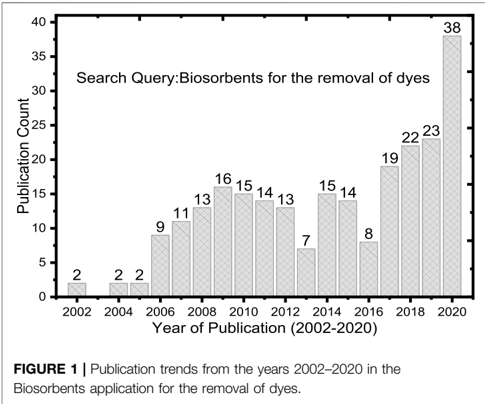
“As it can be observed, publication counts from 2017 to 2020 are highly consistently increased suggested that the nonconventional adsorbents from biomass are recently attracting attention for dye removal.”
§ Biomass-Based Adsorbents for Removal of Dyes From Wastewater: A Review > 1 INTRODUCTION
hedgedcorrelational- Asserted: passes — The authors put it forward as true.
- Checkable: passes — It can be checked against evidence.
- Load-bearing: unclear — It is unclear whether the paper’s conclusions depend on it.
- Based: passes — The paper gives a reason why it holds.
It may state two separate claims as one.
In the paper
“It has been observed that (Table 3) in low pH solutions, the removal rate of anionic dyes is increased while the removal rate of cationic dyes is lower.Conversely, a high pH solution increases the removal of the cationic dyes and causes a low removal percentage for anionic dyes (Ahmed and Ebrahim, 2020).”
§ Biomass-Based Adsorbents for Removal of Dyes From Wastewater: A Review > 3.1 Adsorbents From Fungal Biomass
What the sources say
- Not matchedcites Ahmed and Ebrahim, 2020
Couldn’t be matched to a paper in Crossref, so it can’t be checked.
plaindirect- Asserted: passes — The authors put it forward as true.
- Checkable: passes — It can be checked against evidence.
- Load-bearing: unclear — It is unclear whether the paper’s conclusions depend on it.
- Based: passes — The paper gives a reason why it holds.
It may state two separate claims as one.
- Not matched
None of the sources cited for this claim have been checked yet.
In the paper
“Dyes from the industrial wastewater effluents are effectively removed by using activated carbon; however, it has some constraints such as capital cost, energy consumption, and loss of its ability after sorption-desorption cycles.”
§ Biomass-Based Adsorbents for Removal of Dyes From Wastewater: A Review > 2.9 Adsorption
plaindirect- Asserted: passes — The authors put it forward as true.
- Checkable: passes — It can be checked against evidence.
- Load-bearing: passes — The paper’s conclusions depend on it.
- Based: passes — The paper gives a reason why it holds.
It may state two separate claims as one.
In the paper
“Yeast is a single-celled organism, a member of the kingdom of fungi that have many favorable applications in the treatment of dye-containing solutions due to their high capacity to adsorb and accumulate pollutants, fast growth, faster decolorization than filamentous fungi, and the ability to survive unfavorable environments (Sen et al., 2016).”
§ Biomass-Based Adsorbents for Removal of Dyes From Wastewater: A Review > 3.4 Adsorbents From Yeasts
What the sources say
- Not checked — no full text of the sourcecites Sen et al., 2016 source
plaindirect- Asserted: passes — The authors put it forward as true.
- Checkable: passes — It can be checked against evidence.
- Load-bearing: unclear — It is unclear whether the paper’s conclusions depend on it.
- Based: passes — The paper gives a reason why it holds.
It may state two separate claims as one.
The paper states this without a source or data behind it here, so there is nothing to check it against. The quote shows it is in the paper.
In the paper
“For example, the bioadsorbents may be activated with acid/base (such as HCl, NaOH) and thermal activation, and also some are composited with inorganic and/or organic nanomaterials.”
§ Biomass-Based Adsorbents for Removal of Dyes From Wastewater: A Review > 1 INTRODUCTION
hedgedconditional- Asserted: passes — The authors put it forward as true.
- Checkable: passes — It can be checked against evidence.
- Load-bearing: fails — The paper’s conclusions may not depend on it.
- Based: passes — The paper gives a reason why it holds.
Probably not a substantial claim. The paper’s conclusions may not depend on it. It may state two separate claims as one.
A claim is checked only against the cited paper’s full text, never its abstract, and none is available for its sources.
In the paper
“It also blocks sunlight penetration thereby inhibiting photosynthesis (Bello et al., 2015;Dey et al., 2017).”
§ Biomass-Based Adsorbents for Removal of Dyes From Wastewater: A Review > 2 WASTEWATER TREATMENT TECHNIQUES FOR DYES REMOVAL
What the sources say
plaindirect- Asserted: passes — The authors put it forward as true.
- Checkable: passes — It can be checked against evidence.
- Load-bearing: fails — The paper’s conclusions may not depend on it.
- Based: passes — The paper gives a reason why it holds.
Probably not a substantial claim. The paper’s conclusions may not depend on it.
The paper states this without a source or data behind it here, so there is nothing to check it against. The quote shows it is in the paper.
In the paper
“Surface chemistry, pH, initial dye concentration, temperature, contact time, and adsorbent dose as well as the ways of the preparations of materials affect the biosorption process.”
§ Biomass-Based Adsorbents for Removal of Dyes From Wastewater: A Review > Abstract
plaindirect- Asserted: passes — The authors put it forward as true.
- Checkable: passes — It can be checked against evidence.
- Load-bearing: passes — The paper’s conclusions depend on it.
- Based: passes — The paper gives a reason why it holds.
It may state two separate claims as one.
In the paper
“The sorbent had maximum sorption capacity for acridine orange (193.8 mg/g) but lower for malachite green (110.4 mg/ g) at 2 h contact time.”
§ Biomass-Based Adsorbents for Removal of Dyes From Wastewater: A Review > 3.2 Adsorbents From Algae Biomass
What the sources say
- Not checked — no full text of the sourcecites Angelova et al., 2016 source
plain- Asserted: passes — The authors put it forward as true.
- Checkable: passes — It can be checked against evidence.
- Load-bearing: unclear — It is unclear whether the paper’s conclusions depend on it.
- Based: passes — The paper gives a reason why it holds.
It may state two separate claims as one. The quote only partly states this claim.
A conclusion the paper draws from its own results — it cites no other source for it, so there is none to check. The quote shows it is in the paper.
In the paper
“Dye removal from wastewater using bio-based adsorbents is a promising alternative.”
§ Biomass-Based Adsorbents for Removal of Dyes From Wastewater: A Review > HIGHLIGHTS
plain- Asserted: passes — The authors put it forward as true.
- Checkable: fails — It may be too vague to check against evidence.
- Load-bearing: passes — The paper’s conclusions depend on it.
- Based: fails — The paper may give no reason why it holds.
Probably not a substantial claim. It may be too vague to check against evidence. The paper may give no reason why it holds.
In the paper
“The removal of color by coagulation is strongly dependent on the structure of dye molecules (chromophores and auxochromes), so structural considerations of dyes are very important when choosing the most appropriate coagulant for dye removal (Mcyotto et al., 2021).”
§ Biomass-Based Adsorbents for Removal of Dyes From Wastewater: A Review > 2.8 Coagulation-Flocculation
What the sources say
- Not checked — no full text of the sourcecites Mcyotto et al., 2021 source
boosteddirect- Asserted: passes — The authors put it forward as true.
- Checkable: passes — It can be checked against evidence.
- Load-bearing: unclear — It is unclear whether the paper’s conclusions depend on it.
- Based: passes — The paper gives a reason why it holds.
It may state two separate claims as one.
A claim is checked only against the cited paper’s full text, never its abstract, and none is available for its sources.
In the paper
“Advanced oxidation processes (AOPs) involve the generation of oxidizing species such as hydroxyl radicals and sulfate radicals in sufficient quantity to interact with the organic compounds of the medium (Wang and Wang, 2020;Duan et al., 2020).”
§ Biomass-Based Adsorbents for Removal of Dyes From Wastewater: A Review > 2.6 Advanced Oxidation Processes
What the sources say
plaindirect- Asserted: passes — The authors put it forward as true.
- Checkable: passes — It can be checked against evidence.
- Load-bearing: fails — The paper’s conclusions may not depend on it.
- Based: passes — The paper gives a reason why it holds.
Probably not a substantial claim. The paper’s conclusions may not depend on it.
In the paper
“It has some advantages such as appreciable resistance to temperature, good resistance to adverse chemical environment, and excellent performance of color removal (Roy et al., 2018).”
§ Biomass-Based Adsorbents for Removal of Dyes From Wastewater: A Review > 2.4 Membrane Technologies
What the sources say
- Not checked — no full text of the sourcecites Roy et al., 2018 source
plain- Asserted: passes — The authors put it forward as true.
- Checkable: passes — It can be checked against evidence.
- Load-bearing: unclear — It is unclear whether the paper’s conclusions depend on it.
- Based: passes — The paper gives a reason why it holds.
It may state two separate claims as one.
None of the sources cited for this claim have been checked yet.
In the paper
“Fungal biomasses are composed of sugars, proteins, and lipids, and different functional groups (alcohols, carboxyl, and alkanes) which provide it certain properties and applications as a biosorption in treatments of wastewater (Isaza-Pérez et al., 2020;Ahmed and Ebrahim, 2020).”
§ Biomass-Based Adsorbents for Removal of Dyes From Wastewater: A Review > 3.1 Adsorbents From Fungal Biomass
What the sources say
- Not checked — no full text of the sourcecites Isaza-Pérez et al., 2020 source
- Not matchedcites Ahmed and Ebrahim, 2020
Couldn’t be matched to a paper in Crossref, so it can’t be checked.
plaindirect- Asserted: passes — The authors put it forward as true.
- Checkable: passes — It can be checked against evidence.
- Load-bearing: unclear — It is unclear whether the paper’s conclusions depend on it.
- Based: passes — The paper gives a reason why it holds.
It may state two separate claims as one.
The paper states this without a source or data behind it here, so there is nothing to check it against. The quote shows it is in the paper.
In the paper
“Sludge generation, the extra operational cost for sludge disposal, and high maintenance costs are major challenges in applying this process.”
§ Biomass-Based Adsorbents for Removal of Dyes From Wastewater: A Review > 2.1 Chemical Precipitation
plaindirect- Asserted: passes — The authors put it forward as true.
- Checkable: passes — It can be checked against evidence.
- Load-bearing: passes — The paper’s conclusions depend on it.
- Based: passes — The paper gives a reason why it holds.
It may state two separate claims as one.
The paper states this without a source or data behind it here, so there is nothing to check it against. The quote shows it is in the paper.
In the paper
“Coagulation-flocculation is among the most widespread physiochemical processes for the removal and distraction of coloring substances in wastewater.”
§ Biomass-Based Adsorbents for Removal of Dyes From Wastewater: A Review > 2.8 Coagulation-Flocculation
plain- Asserted: passes — The authors put it forward as true.
- Checkable: passes — It can be checked against evidence.
- Load-bearing: fails — The paper’s conclusions may not depend on it.
- Based: passes — The paper gives a reason why it holds.
Probably not a substantial claim. The paper’s conclusions may not depend on it.
In the paper
“An optimum monolayer uptake capacity of 279.14 mg/g was reported for the modified algal adsorbent (Essekri et al., 2021).”
§ Biomass-Based Adsorbents for Removal of Dyes From Wastewater: A Review > 3.2 Adsorbents From Algae Biomass
What the sources say
- Not checked — no full text of the sourcecites Essekri et al., 2021 source
plain- Asserted: passes — The authors put it forward as true.
- Checkable: passes — It can be checked against evidence.
- Load-bearing: unclear — It is unclear whether the paper’s conclusions depend on it.
- Based: passes — The paper gives a reason why it holds.
The quote only partly states this claim.
In the paper
“Their small size, ubiquity, and capability to grow under varying environmental conditions make them good adsorbents (Singh et al., 2018).”
§ Biomass-Based Adsorbents for Removal of Dyes From Wastewater: A Review > 3.3 Adsorbents From Bacterial Biomass
What the sources say
- Not checked — no full text of the sourcecites Singh et al., 2018 source
plaindirect- Asserted: passes — The authors put it forward as true.
- Checkable: passes — It can be checked against evidence.
- Load-bearing: unclear — It is unclear whether the paper’s conclusions depend on it.
- Based: passes — The paper gives a reason why it holds.
It may state two separate claims as one.
The paper states this without a source or data behind it here, so there is nothing to check it against. The quote shows it is in the paper.
In the paper
“Anionic dyes are removed in acidic conditions and cationic dyes (e.g.MB) in alkaline conditions.”
§ Biomass-Based Adsorbents for Removal of Dyes From Wastewater: A Review > 3.2 Adsorbents From Algae Biomass
plaindirect- Asserted: passes — The authors put it forward as true.
- Checkable: passes — It can be checked against evidence.
- Load-bearing: unclear — It is unclear whether the paper’s conclusions depend on it.
- Based: passes — The paper gives a reason why it holds.
It may state two separate claims as one.
In the paper
“The maximum sorption capacity for basic blue dye was found to be 139.74mg/g from the Langmuir adsorption isotherm.”
§ Biomass-Based Adsorbents for Removal of Dyes From Wastewater: A Review > 3.3 Adsorbents From Bacterial Biomass
What the sources say
- Not checked — no full text of the sourcecites Kim et al., 2015 source
plain- Asserted: passes — The authors put it forward as true.
- Checkable: passes — It can be checked against evidence.
- Load-bearing: unclear — It is unclear whether the paper’s conclusions depend on it.
- Based: passes — The paper gives a reason why it holds.
The quote only partly states this claim.
A claim is checked only against the cited paper’s full text, never its abstract, and none is available for its sources.
In the paper
“Various types of dyes and metal ions are the major pollutants encountered in wastewater effluent, which disturb the aquatic environment (Varghese et al., 2019;Saravanan et al., 2021).Dyes are organic compounds that are released from several industrial sources including textile, paper, leather, rubber, cosmetic, and printing industries (Piaskowski et al., 2018;Katheresan et al., 2018).”
§ Biomass-Based Adsorbents for Removal of Dyes From Wastewater: A Review > 1 INTRODUCTION
What the sources say
plaindirect- Asserted: passes — The authors put it forward as true.
- Checkable: passes — It can be checked against evidence.
- Load-bearing: passes — The paper’s conclusions depend on it.
- Based: passes — The paper gives a reason why it holds.
It may state two separate claims as one.
A conclusion the paper draws from its own results — it cites no other source for it, so there is none to check. The quote shows it is in the paper.
In the paper
“Higher surface area, higher porosity, and low ash content lead to high adsorption capacity.”
§ Biomass-Based Adsorbents for Removal of Dyes From Wastewater: A Review > 3 BIOADSORBENTS
plaindirect- Asserted: passes — The authors put it forward as true.
- Checkable: passes — It can be checked against evidence.
- Load-bearing: unclear — It is unclear whether the paper’s conclusions depend on it.
- Based: unclear — It is unclear why the paper says it holds.
It may state two separate claims as one.
In the paper
“Among the above three methods, steam activation is the best environmentally and economically viable option, while chemical activation results in the highest surface area and porosity (Rahimian and Zarinabadi, 2020).”
§ Biomass-Based Adsorbents for Removal of Dyes From Wastewater: A Review > 2.9 Adsorption
What the sources say
- Not matchedcites Rahimian and Zarinabadi, 2020
Couldn’t be matched to a paper in Crossref, so it can’t be checked.
plaindirect- Asserted: passes — The authors put it forward as true.
- Checkable: passes — It can be checked against evidence.
- Load-bearing: unclear — It is unclear whether the paper’s conclusions depend on it.
- Based: passes — The paper gives a reason why it holds.
It may state two separate claims as one.
- Not matched
The paper states this without a source or data behind it here, so there is nothing to check it against. The quote shows it is in the paper.
In the paper
“The application of waste organic materials (e.g., compounds extracted from peels, leaves, barks) and microbial biomasses (fungus bio-sorbent, bacterial, and green algal biomasses) is gaining an increasing interest being effective, low-cost, and ecologically friendly sorbents.”
§ Biomass-Based Adsorbents for Removal of Dyes From Wastewater: A Review > 2.9 Adsorption
plain- Asserted: passes — The authors put it forward as true.
- Checkable: passes — It can be checked against evidence.
- Load-bearing: fails — The paper’s conclusions may not depend on it.
- Based: passes — The paper gives a reason why it holds.
Probably not a substantial claim. The paper’s conclusions may not depend on it.
The paper states this without a source or data behind it here, so there is nothing to check it against. The quote shows it is in the paper.
In the paper
“Recently, advanced oxidation processes (AOPs) have been effectively investigated in the removal of a variety of contaminants from water and wastewater.”
§ Biomass-Based Adsorbents for Removal of Dyes From Wastewater: A Review > 2.6 Advanced Oxidation Processes
plaindirect- Asserted: passes — The authors put it forward as true.
- Checkable: passes — It can be checked against evidence.
- Load-bearing: fails — The paper’s conclusions may not depend on it.
- Based: passes — The paper gives a reason why it holds.
Probably not a substantial claim. The paper’s conclusions may not depend on it.
The paper states this without a source or data behind it here, so there is nothing to check it against. The quote shows it is in the paper.
In the paper
“The carboxyl groups have a negative charge at a higher pH, which results in electrostatic binding of the cationic dyes.”
§ Biomass-Based Adsorbents for Removal of Dyes From Wastewater: A Review > 3.2 Adsorbents From Algae Biomass
plaindirect- Asserted: passes — The authors put it forward as true.
- Checkable: passes — It can be checked against evidence.
- Load-bearing: passes — The paper’s conclusions depend on it.
- Based: passes — The paper gives a reason why it holds.
It may state two separate claims as one.
In the paper
“Activated carbon (AC) is a commonly used adsorbent that refers to a group of carbon materials with high oscillation and high internal surface which are unique because of their remarkable interior area, pore structure, high adsorption capacity, surface reactivity, and low cost compared to inorganic adsorbents such as zeolite (Hasanzadeh et al., 2020).”
§ Biomass-Based Adsorbents for Removal of Dyes From Wastewater: A Review > 2.9 Adsorption
What the sources say
- Not checked — no full text of the sourcecites Hasanzadeh et al., 2020 source
plain- Asserted: passes — The authors put it forward as true.
- Checkable: passes — It can be checked against evidence.
- Load-bearing: unclear — It is unclear whether the paper’s conclusions depend on it.
- Based: passes — The paper gives a reason why it holds.
It may state two separate claims as one.
A conclusion the paper draws from its own results — it cites no other source for it, so there is none to check. The quote shows it is in the paper.
In the paper
“Adsorption using the nonconventional biomass-based sorbents is the greatest attractive alternatives because of their low cost, sustainability, availability, and eco-friendly.”
§ Biomass-Based Adsorbents for Removal of Dyes From Wastewater: A Review > Abstract
boosteddirect- Asserted: passes — The authors put it forward as true.
- Checkable: fails — It may be too vague to check against evidence.
- Load-bearing: passes — The paper’s conclusions depend on it.
- Based: fails — The paper may give no reason why it holds.
Probably not a substantial claim. It may be too vague to check against evidence. The paper may give no reason why it holds.
- Rests on an assumption: Biomass-based adsorbents are eco-friendly, low-cost, and have good surface characteristics.
In the paper
“However, the limitations of most of these methods include the generation of toxic sludge, high operational and maintenance costs, and the intricate technique involved in the treatment (Yahiaoui et al., 2021).”
§ Biomass-Based Adsorbents for Removal of Dyes From Wastewater: A Review > 1 INTRODUCTION
What the sources say
- Not checked — no full text of the sourcecites Yahiaoui et al., 2021 source
plaindirect- Asserted: passes — The authors put it forward as true.
- Checkable: passes — It can be checked against evidence.
- Load-bearing: passes — The paper’s conclusions depend on it.
- Based: passes — The paper gives a reason why it holds.
It may state two separate claims as one.
In the paper
“The adsorption involves valency forces through the sharing or exchange of electrons between the adsorbent and dye molecules by covalent forces and ion exchange (Mohd Nasir et al., 2021).”
§ Biomass-Based Adsorbents for Removal of Dyes From Wastewater: A Review > 3.3 Adsorbents From Bacterial Biomass
What the sources say
- Not checked — no full text of the sourcecites Mohd Nasir et al., 2021 source
plaindirect- Asserted: passes — The authors put it forward as true.
- Checkable: passes — It can be checked against evidence.
- Load-bearing: fails — The paper’s conclusions may not depend on it.
- Based: passes — The paper gives a reason why it holds.
Probably not a substantial claim. The paper’s conclusions may not depend on it.
In the paper
“Activated carbon is undoubtedly considered a universal adsorbent for effluent treatment and is commonly used for the remo//val of several pollutants (Rahimian and Zarinabadi, 2020).”
§ Biomass-Based Adsorbents for Removal of Dyes From Wastewater: A Review > 1 INTRODUCTION
What the sources say
- Not matchedcites Rahimian and Zarinabadi, 2020
Couldn’t be matched to a paper in Crossref, so it can’t be checked.
boosted- Asserted: passes — The authors put it forward as true.
- Checkable: passes — It can be checked against evidence.
- Load-bearing: fails — The paper’s conclusions may not depend on it.
- Based: passes — The paper gives a reason why it holds.
Probably not a substantial claim. The paper’s conclusions may not depend on it. It may state two separate claims as one.
- Not matched
In the paper
“The EC process is successful in the removal of organic dyes, fine suspended particles, heavy metals, and oil and grease (or other heavier hydrocarbons) from diverse industrial effluents (Mondal et al., 2018).”
§ Biomass-Based Adsorbents for Removal of Dyes From Wastewater: A Review > 2.7 Electrochemical Techniques
What the sources say
- Not checked — no full text of the sourcecites Mondal et al., 2018 source
plaindirect- Asserted: passes — The authors put it forward as true.
- Checkable: passes — It can be checked against evidence.
- Load-bearing: unclear — It is unclear whether the paper’s conclusions depend on it.
- Based: passes — The paper gives a reason why it holds.
It may state two separate claims as one.
The paper states this without a source or data behind it here, so there is nothing to check it against. The quote shows it is in the paper.
In the paper
“Algae, yeast, bacterial, fungal, agro-waste, and plant debris are potential bioadsorbent sources.”
§ Biomass-Based Adsorbents for Removal of Dyes From Wastewater: A Review > HIGHLIGHTS
plain- Asserted: passes — The authors put it forward as true.
- Checkable: passes — It can be checked against evidence.
- Load-bearing: passes — The paper’s conclusions depend on it.
- Based: fails — The paper may give no reason why it holds.
Probably not a substantial claim. The paper may give no reason why it holds.
In the paper
“When pH is greater than pH pzc , it is favorable for cationic dye adsorption due to the existence of functional groups (OH -, COO -), whereas anionic dye adsorption is favorable at pH less than pH pzc because the surfaces of adsorbents become positively charged (Zhou et al., 2019).”
§ Biomass-Based Adsorbents for Removal of Dyes From Wastewater: A Review > 3.1 Adsorbents From Fungal Biomass
What the sources say
- Not checked — no full text of the sourcecites Zhou et al., 2019 source
plaindirect- Asserted: passes — The authors put it forward as true.
- Checkable: passes — It can be checked against evidence.
- Load-bearing: unclear — It is unclear whether the paper’s conclusions depend on it.
- Based: passes — The paper gives a reason why it holds.
It may state two separate claims as one.
A conclusion the paper draws from its own results — it cites no other source for it, so there is none to check. The quote shows it is in the paper.
In the paper
“Owing to eco-friendly, low cost, and good surface characteristics, biomass-based adsorbents are attracting attention and are widely studied.”
§ Biomass-Based Adsorbents for Removal of Dyes From Wastewater: A Review > 1 INTRODUCTION
plain- Asserted: passes — The authors put it forward as true.
- Checkable: passes — It can be checked against evidence.
- Load-bearing: fails — The paper’s conclusions may not depend on it.
- Based: passes — The paper gives a reason why it holds.
Probably not a substantial claim. The paper’s conclusions may not depend on it. It may state two separate claims as one.
- Rests on an assumption: Biomass-based adsorbents are eco-friendly, low-cost, and have good surface characteristics.
The paper states this without a source or data behind it here, so there is nothing to check it against. The quote shows it is in the paper.
In the paper
“The pore volume of the bioadsorbents and functional groups of dyes are the deciding factors in achieving high dye adsorption.”
§ Biomass-Based Adsorbents for Removal of Dyes From Wastewater: A Review > 3 BIOADSORBENTS
plaindirect- Asserted: passes — The authors put it forward as true.
- Checkable: passes — It can be checked against evidence.
- Load-bearing: fails — The paper’s conclusions may not depend on it.
- Based: fails — The paper may give no reason why it holds.
Probably not a substantial claim. The paper’s conclusions may not depend on it. The paper may give no reason why it holds.
In the paper
“They found 90.3 and 83.7% desorption for biomass and commercial AC, respectively, from dye-loaded adsorbents (Saha et al., 2020).Moreover, the adsorbents were effective up to two adsorption-desorption cycles.”
§ Biomass-Based Adsorbents for Removal of Dyes From Wastewater: A Review > 5 Regeneration of Bioadsorbents
What the sources say
- Not checked — no full text of the sourcecites Saha et al., 2020 source
plain- Asserted: passes — The authors put it forward as true.
- Checkable: passes — It can be checked against evidence.
- Load-bearing: unclear — It is unclear whether the paper’s conclusions depend on it.
- Based: passes — The paper gives a reason why it holds.
It may state two separate claims as one.
In the paper
“The common desorption methods include thermal treatment, acid (H 2 SO 4 , HNO 3 , HCl, H 3 PO 4 , NaOH) treatment, organic solvents (methanol and ethanol), biological methods, and vacuum methods (Hassan and Carr, 2021).”
§ Biomass-Based Adsorbents for Removal of Dyes From Wastewater: A Review > 5 Regeneration of Bioadsorbents
What the sources say
- Not checked — no full text of the sourcecites Hassan and Carr, 2021 source
plain- Asserted: passes — The authors put it forward as true.
- Checkable: passes — It can be checked against evidence.
- Load-bearing: fails — The paper’s conclusions may not depend on it.
- Based: passes — The paper gives a reason why it holds.
Probably not a substantial claim. The paper’s conclusions may not depend on it. It may state two separate claims as one.
In the paper
“It was estimated that the cost of 1 g of adsorbent is ₹4.54, ₹0.91, and ₹0.97 for Coconut shell, Groundnut shell, and Rice husk, respectively, by considering operational costs including manufacturing costs, maintenance costs, feedstock costs, transportation costs, labor costs, and the distribution costs (Praveen et al., 2021).”
§ Biomass-Based Adsorbents for Removal of Dyes From Wastewater: A Review > 4 Cost Analysis of Biomass-Based Adsorbents
What the sources say
- Not checked — no full text of the sourcecites Praveen et al., 2021 source
hedged- Asserted: passes — The authors put it forward as true.
- Checkable: passes — It can be checked against evidence.
- Load-bearing: passes — The paper’s conclusions depend on it.
- Based: passes — The paper gives a reason why it holds.
It may state two separate claims as one.
In the paper
“They found that the two biosorbents had a dye removal capacity of 8.66 mg/g and 7.96 mg/g respectively at a pH of 2 (Semião et al., 2020).”
§ Biomass-Based Adsorbents for Removal of Dyes From Wastewater: A Review > 3.4 Adsorbents From Yeasts
What the sources say
- Not checked — no full text of the sourcecites Semião et al., 2020 source
plain- Asserted: passes — The authors put it forward as true.
- Checkable: passes — It can be checked against evidence.
- Load-bearing: unclear — It is unclear whether the paper’s conclusions depend on it.
- Based: passes — The paper gives a reason why it holds.
It may state two separate claims as one.
A conclusion the paper draws from its own results — it cites no other source for it, so there is none to check. The quote shows it is in the paper.
In the paper
“Several authors reported that the cost of bioadsorbents prepared from microbes and forest and agricultural waste is low as compared with conventional treatment technologies, although they did not incorporate cost-benefit analysis in their study.”
§ Biomass-Based Adsorbents for Removal of Dyes From Wastewater: A Review > 4 Cost Analysis of Biomass-Based Adsorbents
plaincorrelational- Asserted: passes — The authors put it forward as true.
- Checkable: passes — It can be checked against evidence.
- Load-bearing: unclear — It is unclear whether the paper’s conclusions depend on it.
- Based: passes — The paper gives a reason why it holds.
It may state two separate claims as one.
A conclusion the paper draws from its own results — it cites no other source for it, so there is none to check. The quote shows it is in the paper.
In the paper
“One of the important features for the use of biomass-derived adsorbent for removal of dyes is that it can be used on a large scale because of its huge availability.”
§ Biomass-Based Adsorbents for Removal of Dyes From Wastewater: A Review > 6 Biosorbent Prospects for Dye Adsorption
plaindirect- Asserted: passes — The authors put it forward as true.
- Checkable: passes — It can be checked against evidence.
- Load-bearing: fails — The paper’s conclusions may not depend on it.
- Based: passes — The paper gives a reason why it holds.
Probably not a substantial claim. The paper’s conclusions may not depend on it.
In the paper
“Sewu et al. (2017) prepared biochar from Korean cabbage (KC), rice straw, and wood chip and can be used as an alternative to activated carbon to remove congo red and CV (Sewu et al., 2017), but KC had better absorption performance than others.”
§ Biomass-Based Adsorbents for Removal of Dyes From Wastewater: A Review > 3.5 Adsorbents From Forest or Agricultural Debris Wastes
What the sources say
- Not checked — no full text of the sourcecites Sewu et al., 2017 source
plaindirect- Asserted: passes — The authors put it forward as true.
- Checkable: passes — It can be checked against evidence.
- Load-bearing: unclear — It is unclear whether the paper’s conclusions depend on it.
- Based: passes — The paper gives a reason why it holds.
It may state two separate claims as one.
In the paper
“The adsorption capacity of the modified biochar was significantly enhanced from 78.18 to 523.12 mg/g at equilibrium.Up to 98% of AO7 was removed by triethylenetetramine-modified biochar, while 96% removal was achieved using unmodified biochar (El-Nemr et al., 2020).”
§ Biomass-Based Adsorbents for Removal of Dyes From Wastewater: A Review > 3.5 Adsorbents From Forest or Agricultural Debris Wastes
What the sources say
- Not matchedcites El-Nemr et al., 2020
Couldn’t be matched to a paper in Crossref, so it can’t be checked.
plaindirect- Asserted: passes — The authors put it forward as true.
- Checkable: passes — It can be checked against evidence.
- Load-bearing: unclear — It is unclear whether the paper’s conclusions depend on it.
- Based: passes — The paper gives a reason why it holds.
It may state two separate claims as one.
- Not matched
In the paper
“Groundnut shellbased biochar had maximum adsorption capacity (46.3 mg/g) as well as the least cost (₹0.91)per unit gram of Basic Red 09 dye removal.”
§ Biomass-Based Adsorbents for Removal of Dyes From Wastewater: A Review > 4 Cost Analysis of Biomass-Based Adsorbents
What the sources say
- Not checked — no full text of the sourcecites Praveen et al., 2021 source
plain- Asserted: passes — The authors put it forward as true.
- Checkable: passes — It can be checked against evidence.
- Load-bearing: unclear — It is unclear whether the paper’s conclusions depend on it.
- Based: passes — The paper gives a reason why it holds.
It may state two separate claims as one.
A conclusion the paper draws from its own results — it cites no other source for it, so there is none to check. The quote shows it is in the paper.
In the paper
“Among all the adsorbents, the biomassderived adsorbent is preferred comparatively having the highest surface area, regardless of the activation techniques, depending on source types resulted in increasing the adsorption of the contaminants.”
§ Biomass-Based Adsorbents for Removal of Dyes From Wastewater: A Review > 6 Biosorbent Prospects for Dye Adsorption
plaindirect- Asserted: passes — The authors put it forward as true.
- Checkable: passes — It can be checked against evidence.
- Load-bearing: fails — The paper’s conclusions may not depend on it.
- Based: fails — The paper may give no reason why it holds.
Probably not a substantial claim. The paper’s conclusions may not depend on it. The paper may give no reason why it holds. It may state two separate claims as one.
In the paper
“After the adsorption process is accomplished, the desorption process is of great importance to regenerate and reuse those used adsorbents and to reduce the generation of waste as well as to keep the process price down (Zhou et al., 2019).”
§ Biomass-Based Adsorbents for Removal of Dyes From Wastewater: A Review > 5 Regeneration of Bioadsorbents
What the sources say
- Not checked — no full text of the sourcecites Zhou et al., 2019 source
plaindirect- Asserted: passes — The authors put it forward as true.
- Checkable: passes — It can be checked against evidence.
- Load-bearing: unclear — It is unclear whether the paper’s conclusions depend on it.
- Based: passes — The paper gives a reason why it holds.
It may state two separate claims as one.
In the paper
“The sorption study revealed that the capacity of prepared watermelon biochars was ranged between 76.94 and 462.18 mg/g at pH of 1.0, contact time of 3 h, and room temperature, and more than 96% removal of AY11 was achieved.”
§ Biomass-Based Adsorbents for Removal of Dyes From Wastewater: A Review > 3.5 Adsorbents From Forest or Agricultural Debris Wastes
What the sources say
- Not matchedcites El Nemr et al., 2020
Couldn’t be matched to a paper in Crossref, so it can’t be checked.
plain- Asserted: passes — The authors put it forward as true.
- Checkable: passes — It can be checked against evidence.
- Load-bearing: unclear — It is unclear whether the paper’s conclusions depend on it.
- Based: passes — The paper gives a reason why it holds.
It may state two separate claims as one.
- Not matched
In the paper
“The potential solutions for safely disposing of the final effluent include stabilization and immobilization, for example, using a cement-based system as a binding agent (Dey et al., 2017).”
§ Biomass-Based Adsorbents for Removal of Dyes From Wastewater: A Review > 6 Biosorbent Prospects for Dye Adsorption
What the sources say
- Not checked — no full text of the sourcecites Dey et al., 2017 source
plain- Asserted: passes — The authors put it forward as true.
- Checkable: passes — It can be checked against evidence.
- Load-bearing: fails — The paper’s conclusions may not depend on it.
- Based: passes — The paper gives a reason why it holds.
Probably not a substantial claim. The paper’s conclusions may not depend on it.
A conclusion the paper draws from its own results — it cites no other source for it, so there is none to check. The quote shows it is in the paper.
In the paper
“Consequently, difficulties are faced in the comparison among them.”
§ Biomass-Based Adsorbents for Removal of Dyes From Wastewater: A Review > 6 Biosorbent Prospects for Dye Adsorption
plain- Asserted: passes — The authors put it forward as true.
- Checkable: passes — It can be checked against evidence.
- Load-bearing: passes — The paper’s conclusions depend on it.
- Based: passes — The paper gives a reason why it holds.
Probably not a substantial claim.
In the paper
“Agricultural and forestry wastes are generally rich in cellulose, hemicellulose, and lignin.Its surface comprises several active groups including hydroxyl, carboxyl, amino, carboxyl, methyl, and so on (Zhou et al., 2019).”
§ Biomass-Based Adsorbents for Removal of Dyes From Wastewater: A Review > 3.5 Adsorbents From Forest or Agricultural Debris Wastes
What the sources say
- Not checked — no full text of the sourcecites Zhou et al., 2019 source
plain- Asserted: passes — The authors put it forward as true.
- Checkable: passes — It can be checked against evidence.
- Load-bearing: passes — The paper’s conclusions depend on it.
- Based: passes — The paper gives a reason why it holds.
It may state two separate claims as one.
A conclusion the paper draws from its own results — it cites no other source for it, so there is none to check. The quote shows it is in the paper.
In the paper
“Distinctive surface chemistry with the incorporation of several functional groups (alcohol, ketones, aldehydes, carboxylic, ether, phenol) makes those bio-sorbents with a high attraction toward dye and makes the biomass-based adsorbents effective material for dye removal.”
§ Biomass-Based Adsorbents for Removal of Dyes From Wastewater: A Review > 7 CONCLUSION AND RECOMMENDATION
plaindirect- Asserted: passes — The authors put it forward as true.
- Checkable: passes — It can be checked against evidence.
- Load-bearing: passes — The paper’s conclusions depend on it.
- Based: passes — The paper gives a reason why it holds.
Probably not a substantial claim. It may state two separate claims as one.
In the paper
“The maximum monolayer adsorption capacities of BYB for MB, MG, and SO were 212.05, 212.05, and 76.77 mg/g, respectively.”
§ Biomass-Based Adsorbents for Removal of Dyes From Wastewater: A Review > 3.4 Adsorbents From Yeasts
What the sources say
- Not checked — no full text of the sourcecites Lin et al., 2019 source
plain- Asserted: passes — The authors put it forward as true.
- Checkable: passes — It can be checked against evidence.
- Load-bearing: unclear — It is unclear whether the paper’s conclusions depend on it.
- Based: passes — The paper gives a reason why it holds.
It may state two separate claims as one.
In the paper
“Moreover, the biomass-derived adsorbents are commonly cellulose-based structures and can produce a good porous carbon that can adsorb various types of contaminants in the natural environment.”
§ Biomass-Based Adsorbents for Removal of Dyes From Wastewater: A Review > 6 Biosorbent Prospects for Dye Adsorption
What the sources say
- Not checked — no full text of the sourcecites Sherugar et al., 2022 source
plaindirect- Asserted: passes — The authors put it forward as true.
- Checkable: passes — It can be checked against evidence.
- Load-bearing: unclear — It is unclear whether the paper’s conclusions depend on it.
- Based: passes — The paper gives a reason why it holds.
It may state two separate claims as one.
In the paper
“Activated carbon provided from Persea Americana was suggested for basic yellow dye removal from wastewater with 98% removal.This activated carbon can substitute the commercially available adsorbents (Regti et al., 2017).”
§ Biomass-Based Adsorbents for Removal of Dyes From Wastewater: A Review > 3.5 Adsorbents From Forest or Agricultural Debris Wastes
What the sources say
- Not checked — no full text of the sourcecites Regti et al., 2017 source
hedgeddirect- Asserted: passes — The authors put it forward as true.
- Checkable: passes — It can be checked against evidence.
- Load-bearing: unclear — It is unclear whether the paper’s conclusions depend on it.
- Based: passes — The paper gives a reason why it holds.
It may state two separate claims as one.
The paper relies on this without support.
Biomass-based adsorbents are eco-friendly, low-cost, and have good surface characteristics.
“Owing to eco-friendly, low cost, and good surface characteristics, biomass-based adsorbents are attracting attention and are widely studied.”
The paper relies on this without support.
Commercial activated carbon cost is high for industrial applications.
“Although the removal of dye using CAC is efficient, its cost is high for industrial applications.”
The paper relies on this without support.
Some biomass-based activated carbons prepared at laboratory scale have superior adsorption capacity to commercial activated carbon, but limited information exists on industrial application.
“And some studies reported that the adsorption capacities of some biomass-based activated carbons prepared in the laboratory scale showed superior adsorption capacity than CAC; however, limited information is available on the application of biomass-based activated carbon at the industrial level.”
The paper relies on this without support.
Scaling up and cost analysis is a significant constraint for utilizing biomass-derived adsorbents for dye removal.
“The other most significant constraint for utilizing biomassderived adsorbents for dye removal is the scaling up and cost analysis.”
The paper relies on this without support.
Recovery or regeneration procedures may require a significant amount of energy and solvents depending on the activation processes used.
“In addition, the recovery or regeneration procedure may also need a significant amount of energy and solvents depending on the activation processes used.”
The paper relies on this without support.
Real dye-containing wastewater, such as textile industry wastewater, usually comprises a mixture of many dyes.
“in real dye-containing wastewater, like textile industries that usually comprise a mixture of many dyes.”
Self-check
Percentages, sums and reported differences re-computed from the paper’s own numbers.
Each contradiction between two passages listed here was confirmed by an independent check.
Rated minor: it would not touch a result — a value no result rests on, a p-value that stays on the same side of the significance level, or a conflict that is clerical, resolved elsewhere in the paper, or outside its own findings.
In the paper
§ Biomass-Based Adsorbents for Removal of Dyes From Wastewater: A Review > 4 Cost Analysis of Biomass-Based Adsorbents
“Groundnut shellbased biochar had maximum adsorption capacity (46.3 mg/g) as well as the least cost (₹0.91)per unit gram of Basic Red 09 dye removal.”
§ Biomass-Based Adsorbents for Removal of Dyes From Wastewater: A Review > 4 Cost Analysis of Biomass-Based Adsorbents
“It was estimated that the cost of 1 g of adsorbent is ₹4.54, ₹0.91, and ₹0.97 for Coconut shell, Groundnut shell, and Rice husk, respectively”
Rated minor: it would not touch a result — a value no result rests on, a p-value that stays on the same side of the significance level, or a conflict that is clerical, resolved elsewhere in the paper, or outside its own findings.
In the paper
§ Biomass-Based Adsorbents for Removal of Dyes From Wastewater: A Review > 3.1 Adsorbents From Fungal Biomass
“Most species of fungi potentially achieved more than 90% of a specific type of dye except Pleurotus ostreatus, Aspergillus flavus, and Diaporthe schini which had a removal efficiency of 53%, 53.62, and 87%, respectively.”
§ Biomass-Based Adsorbents for Removal of Dyes From Wastewater: A Review > 7 CONCLUSION AND RECOMMENDATION
“| Trametes sp. | heat-treated | Acid Blue 161 | 221.6 | Langmuir | Avrami | 6 | | 600 | | 89.47 | Puchana-Rosero |”
Citations
Cites
Evaluation of advanced oxidation processes for water and wastewater treatment – A critical review
Miklos, D. B., Remy, C., Jekel, M. R., Linden, K. G., Drewes, J. E., & Hübner, U. (2018) · Water Research · doi:10.1016/j.watres.2018.03.042 · Cited by 3,169
Removal of synthetic dyes from wastewaters: a review
Forgacs, E., Cserháti, T., & Oros, G. (2004) · Environment International · doi:10.1016/j.envint.2004.02.001 · Cited by 3,008
Efficiency of various recent wastewater dye removal methods: A review
Katheresan, V., Kansedo, J., & Lau, S. Y. (2018) · Journal of Environmental Chemical Engineering · doi:10.1016/j.jece.2018.06.060 · Cited by 2,752
Reactive Species in Advanced Oxidation Processes: Formation, Identification and Reaction Mechanism
Wang, J., & Wang, S. (2020) · Chemical Engineering Journal · doi:10.1016/j.cej.2020.126158 · Cited by 1,585
Methods for preparation and activation of activated carbon: a review
Heidarinejad, Z., Dehghani, M. H., Heidari, M., Javedan, G., Ali, I., & Sillanpää, M. E. T. (2020) · Environmental Chemistry Letters · doi:10.1007/s10311-019-00955-0 · Cited by 1,480
An overview on engineering the surface area and porosity of biochar
Leng, L., Xiong, Q., Yang, L., Li, H., Zhou, Y., Zhang, W., Jiang, S., Li, H., & Huang, H. (2020) · The Science of The Total Environment · doi:10.1016/j.scitotenv.2020.144204 · Cited by 1,414
Recent advances for dyes removal using novel adsorbents: A review
Zhou, Y., Lu, J., Zhou, Y., & Liu, Y. (2019) · Environmental Pollution · doi:10.1016/j.envpol.2019.05.072 · Cited by 1,355
The Removal of Colour from Textile Wastewater Using Whole Bacterial Cells: A Review
Pearce, C. (2003) · Dyes and Pigments · doi:10.1016/s0143-7208(03)00064-0 · Cited by 1,297
Ahmad, A., Mohd-Setapar, S. H., Chuong, C. S., Khatoon, A., Wani, W. A., Kumar, R., & Rafatullah, M. (2015) · RSC Advances · doi:10.1039/c4ra16959j · Cited by 1,112
Removal of methylene blue by adsorption onto activated carbon developed from Ficus carica bast
Pathania, D., Sharma, S., & Singh, P. (2017) · Arabian Journal of Chemistry · doi:10.1016/j.arabjc.2013.04.021 · Cited by 1,028
Research works printed but not linked: 6
- Ahmad, Oil Palm Biomass-Based Adsorbents for the Removal of Water Pollutants-A Review, J. Environ. Sci. Health Part C, 29, 177, 10.1080/10590501.2011.601847 · DOI
- Amreen, 2020, Fast and Efficient Elimination of Malachite Green Dye by Activated Carbon Derived from Fresh Water Micro Algae : Kinetics and Thermodynamic Studies, 2581
- Gnanadoss, 2013, Bioremediation of Textile Dye Using White Rot Fungi: a Review, Rev. Int. J. Cur Res. Rev., 5, 1
- Gowtham, 2021, Experimental Study on Performance Assessment of Fenton and Photo- Fenton Oxidation Process for Methylene Blue, Proc. Int. Acad. Ecol. Environ. Sci., 11, 43
- Karthik, 2016, Bioremediation of Dye Bearing Effluents Using Microbial Biomass, Ecol. Environ. Conserv, 22, S423
- Mahmoudi, Investigation and Optimization of the Performance of Sono-Photo-Electro-Fenton Process for Removal of Acid Black 172 and Disperse Blue 56 from Polluted Water: Comparison of the Degradation Activity with electro-Fenton-based Processes, Int. J. Environ. Sci. Technol., 1, 10.1007/s13762-021-03296-0 · DOI
Cited by
Sorted by citations
Items 201–300 of 360
Li, C., Yang, J., Liu, S., Liu, N., Zhang, L., & Ren, L. (2025) · Separations · doi:10.3390/separations12100286 · Cited by 3
Muna, N. Y., Mim, S., Jewel, A. H., Karim, M. S., & Uddin, M. E. (2026) · Results in Surfaces and Interfaces · doi:10.1016/j.rsurfi.2026.100710 · Cited by 3
Kandil, H., Nour, S. A., & Abdelhamid, A. E.-S. (2026) · Journal of Polymer Research · doi:10.1007/s10965-025-04727-z · Cited by 3
Photocatalytic Degradation of Various Dyes using Spinel Aluminates and Their Composites: A Review
Solanki, K. D., Tanna, A. R., & Desai, H. B. (2026) · EPJ Web of Conferences · doi:10.1051/epjconf/202634803005 · Cited by 3
Mtweve, B. B., Managa, M., Moja, T. N., & Mubiayi, M. P. (2026) · Processes · doi:10.3390/pr14040710 · Cited by 3
Chen, H., & Song, Y. (2026) · Gels · doi:10.3390/gels12020184 · Cited by 3
Majumdar, A., Chakraborty, S., & Kausor, M. A. (2026) · ChemistrySelect · doi:10.1002/slct.73292 · Cited by 3
Agha, H. M., Jawad, A. H., Viscusi, G., & Kazem, H. A. (2026) · Journal of Chemical Technology & Biotechnology · doi:10.1002/jctb.70194 · Cited by 3
Mnif, I., Mekki, S., & Ghribi, D. (2023) · Journal of Dispersion Science and Technology · doi:10.1080/01932691.2023.2202252 · Cited by 3
Aryee, A. A., Han, R., & Qu, L. (2023) · Environmental Science and Pollution Research · doi:10.1007/s11356-023-31565-7 · Cited by 3
Mohammed, A.-A., & Karaghool, H. (2024) · Al Rafidain Journal of Engineering Sciences · doi:10.61268/tr03jq61 · Cited by 3
Plant Mediated Nanocomposites for Water Remediation
Aththanayaka, S., Ramaraj, N., Thiripuranathar, G., Attanayake, K., & Ekanayake, S. (2022) · Springer eBooks · doi:10.1007/978-981-19-4811-4_13 · Cited by 3
Use of Nature Based Materials for Textile Wastewater Treatment - A Review
Giwa, S. O. (2023) · International journal of engineering research in Africa · doi:10.4028/p-6ope95 · Cited by 3
Customized High-Value Agricultural Residue Conversion: Applications in Wastewater Treatment
Tan, X., Wang, H., Guo, X., & Ho, S. (2023) · Catalysts · doi:10.3390/catal13091247 · Cited by 3
Júnior, A. G. D. R., de Oliveira, I. P. R. A., de Souza, J. B., Melo, T. N. T. D. F., Vieira, R. A. D. S., Souza, Y. C. D. S., Xavier, M. D. S., de Queiroz, L. R., Alves, J. I. S., de Menezes, F. L. G., et al. (2023) · Zeitschrift für Physikalische Chemie · doi:10.1515/zpch-2023-0346 · Cited by 3
In situ heterogeneous oxidative degradation of adsorbed cellulose-reactive anionic dye
Teshager, F. M., Penev, K. I., Habtu, N. G., & Mequanint, K. (2023) · Case Studies in Chemical and Environmental Engineering · doi:10.1016/j.cscee.2023.100549 · Cited by 3
Doughmi, O., Farah, M., Addar, F. Z., Hsini, A., Tahaikt, M., & Shaim, A. (2023) · International Journal of Environmental & Analytical Chemistry · doi:10.1080/03067319.2023.2289634 · Cited by 3
Narayanan, M. (2024) · Biomass Conversion and Biorefinery · doi:10.1007/s13399-024-05417-4 · Cited by 3
Selenium-Doped Biochar for Removal of Anionic Acid Red and Cationic Crystal Violet Dye
Velayudhan, J., & Subramanian, S. (2024) · NANO · doi:10.1142/s1793292024500322 · Cited by 3
Cellulosic materials for the removal of ciprofloxacin from aqueous environments
Chikowe, I., & Bala, M. D. (2024) · Green Processing and Synthesis · doi:10.1515/gps-2023-0190 · Cited by 3
Dye wastewater treatment with rice husk-derived silica xerogel: An eco-friendly process
Jaturapiree, A., Sukrat, K., Chaichana, E., Chidthong, R., & Saowapark, T. (2024) · Journal of Applied and Natural Science · doi:10.31018/jans.v16i3.5805 · Cited by 3
Navigating neoteric solvents: An overview for sustainable chemistry
Chenthamara, B., Shaibuna, M., & Gardas, R. L. (2025) · Elsevier eBooks · doi:10.1016/b978-0-443-21962-7.00003-1 · Cited by 3
Composites Based on Cellulose and Metal-Organic Frameworks for Removing Dye from Wastewater
Panchenko, V. N., Zubkova, E. Y., & Timofeeva, M. N. (2025) · Catalysis in Industry · doi:10.1134/s2070050425700102 · Cited by 2
Kang, S. B., Min, B.-C., Go, K.-I., Li, Y., Yun, Y., & Won, S. W. (2025) · Korean Journal of Chemical Engineering · doi:10.1007/s11814-025-00548-4 · Cited by 2
Tubo, A. R. I., Doblas, R. G., Hallasgo, K. C. N., Dulas, A. M. C., Bullecer, J. G. B., Mabayo, V. I. F., & Pagalan, E. A. (2025) · Biomass Conversion and Biorefinery · doi:10.1007/s13399-025-06890-1 · Cited by 2
Application of Green Nanomaterials in Textile Biotechnology
Shair, F., Ahmad, K., Kashif, M., Ashfaq, M., & Khan, M. A. (2025) · SDGs and textiles · doi:10.1007/978-981-95-0347-6_6 · Cited by 2
Patra, S. R., & Mishra, S. P. (2026) · Sustainable Environment · doi:10.1080/27658511.2026.2615533 · Cited by 2
Brewer’s Spent Yeast as a Biosorbent for the Synthetic Dye Tartrazine Yellow
Lourenço, L. N. N., Itabaiana, I., & Lemes, A. C. (2026) · ACS Omega · doi:10.1021/acsomega.5c05650 · Cited by 2
Mostafa, A. M. A., Hamed, S. M., Hameed, M. S. A., Shimi, H. I. E., Aal, A. A. A., & Hammouda, O. (2026) · Beni-Suef University Journal of Basic and Applied Sciences · doi:10.1186/s43088-025-00724-9 · Cited by 2
Copper MOG for efficient anionic dyes adsorption and tunable transformation into single crystal MOF
Kajal, N., Raj, A., Tatikonda, R., Hietala, S., & Haukka, M. (2026) · Results in Chemistry · doi:10.1016/j.rechem.2026.103223 · Cited by 2
Ali, A., Matsumoto, M., Tahara, Y., Khan, S., Ali, A., & Rahman, A. U. (2026) · Materials · doi:10.3390/ma19102110 · Cited by 2
Dong, S., Zhai, S., Zhu, K., An, Q., Xiao, Z., & Hao, J. (2026) · Colloids and Surfaces A Physicochemical and Engineering Aspects · doi:10.1016/j.colsurfa.2026.141486 · Cited by 2
(2023) · Global NEST Journal · doi:10.30955/gnj.005294 · Cited by 2
Tabib, S.-R., Royatvand-Ghiyasvand, G., Khalili, H., Parad, F., Faramarzi, M. A., & Mojtabavi, S. (2024) · Journal of environmental chemical engineering · doi:10.1016/j.jece.2024.112660 · Cited by 2
Adsorptive separation of Acid Red 33 by groundnut shell–based activated carbon
Jain, S. N., Bhandari, P. S., Bodkhe, M., Chavan, G., Korade, O., Parmar, M., Daware, G. B., & Gautam, N. B. (2024) · Biomass Conversion and Biorefinery · doi:10.1007/s13399-024-06424-1 · Cited by 2
Kunakham, T., Hoijang, S., Nguyen, M. D., Ananta, S., Lee, T. R., & Srisombat, L. (2022) · Industrial & Engineering Chemistry Research · doi:10.1021/acs.iecr.2c03206 · Cited by 2
Bachmann, S. A. L., Calvete, T., Estumano, D. C., & Féris, L. A. (2024) · Discover Chemistry. · doi:10.1007/s44371-024-00011-z · Cited by 2
Fixed-bed column adsorption modeling using Zr biocomposites for fluoride removal
Robledo-Peralta, A., Valle‐Cervantes, S., Torres-Castañón, L. A., & Reynoso-Cuevas, L. (2023) · Environmental Technology · doi:10.1080/09593330.2023.2283783 · Cited by 1
Composites based on cellulose and metal-organic frameworks for dye removal from wastewater
Panchenko, V. N., Zubkova, E. Y., & Timofeeva, M. N. (2024) · Kataliz v promyshlennosti · doi:10.18412/1816-0387-2024-5-81-96 · Cited by 1
Njine-Bememba, C. B., Tchekwagep, P. M. S., Ngana, B. N., Banks, C. E., Dedzo, G. K., Nanseu‐Njiki, C. P., & Ngameni, E. (2025) · International Journal of Environmental & Analytical Chemistry · doi:10.1080/03067319.2025.2529971 · Cited by 1
Imani, H., Gharanjig, K., Kazemian, H., Goudarzi, S., & Gharanjig, H. (2025) · Sustainable Chemistry and Pharmacy · doi:10.1016/j.scp.2025.102247 · Cited by 1
Eggshell‐Based Biochar for Superior Adsorption of Crystal Violet Dye and Fluoride From Wastewater
Mounika, T., Reddy, A. V. B., Madhavi, V., & Devi, K. V. S. (2025) · Asia-Pacific Journal of Chemical Engineering · doi:10.1002/apj.70160 · Cited by 1
Potential of horseshoe crab shell waste as adsorbent for wastewater treatment: mini review
Zaini, A. S., Putra, N. R., Faizal, A. N. M., Aziz, A. H. A., Rahman, H. A., & Zaini, M. A. A. (2025) · International Journal of Environmental Science and Technology · doi:10.1007/s13762-025-06813-7 · Cited by 1
Lebbihi, R., Haddad, L., Laiche, A. T., Zepeda-Valles, G., Hernández-Ortiz, M., de Loera, J. B., Cruz-Dominguez, O., Guirette-Barbosa, O., Labiod, C., Tarchoun, N., et al. (2025) · Materials Today Communications · doi:10.1016/j.mtcomm.2025.114394 · Cited by 1
Alotaibi, N. F., Hakami, A., Alanazi, A. H., Alanazi, F. K., El‐Hashemy, M. A., Alrashdi, B. M., Rawway, M., & Nassar, A. (2025) · ChemistrySelect · doi:10.1002/slct.202504481 · Cited by 1
Escorcia, R. S., & Piña-Velásquez, D. A. (2025) · TecnoLógicas · doi:10.22430/22565337.3455 · Cited by 1
Zahaf, F., saiah, O., Marouf, R., & Schott, J. (2026) · Desalination and Water Treatment · doi:10.1016/j.dwt.2026.101670 · Cited by 1
Sustainable dye removal using thermally treated ostrich eggshell as a high-performance adsorbent
Tonk, S., & Rápó, E. (2026) · Journal of Hazardous Materials Advances · doi:10.1016/j.hazadv.2026.101086 · Cited by 1
Wang, G. (2026) · Desalination and Water Treatment · doi:10.1016/j.dwt.2026.101688 · Cited by 1
Beltran, L. B., Ribeiro, A. C., de Oliveira, A. M., Ferri, B. B., Filho, B. A. D. A., Bergamasco, R., Cusioli, L. F., Vieira, M. F., & Vieira, A. M. S. (2026) · Microporous and Mesoporous Materials · doi:10.1016/j.micromeso.2026.114091 · Cited by 1
Shelke, H. D., Survase, A. A., Bhosale, S. R., Kaur, J., Raut, V. S., & Mohite, A. A. (2026) · Applied Materials Today · doi:10.1016/j.apmt.2026.103162 · Cited by 1
Bellala, H., & Boukhalfa, N. (2026) · Desalination and Water Treatment · doi:10.1016/j.dwt.2026.101740 · Cited by 1
Mollo, L., Norici, A., Raffaelli, L., & Amato, A. (2026) · Bioengineering · doi:10.3390/bioengineering13040373 · Cited by 1
A Sustainable Approach to Ink Colorant Removal Using Modified Cellulose From Wastepaper
Kara, F., Bi̇rtane, H., Kandırmaz, E. A., & Çiğil, A. B. (2026) · Polymer Engineering and Science · doi:10.1002/pen.70537 · Cited by 1
Chaurasia, P. K., Bharati, S. L., Saqr, A. M., Pant, R. R., & Yadava, S. (2026) · Water Air & Soil Pollution · doi:10.1007/s11270-026-09527-9 · Cited by 1
Yousefvand, A., & Kakanejadifard, A. (2026) · Journal of Molecular Liquids · doi:10.1016/j.molliq.2026.129673 · Cited by 1
DDT and environmental persistence: Ecological traces of a pesticide
MUSTAFAOĞLU, D. Ç., & SAĞSÖZ, Y. D. (2026) · Environmental Research and Technology · doi:10.35208/ert.1613973 · Cited by 1
Reyes-Valdes, E., Coria-Zamudio, I., Domínguez-González, K. G., Rodríguez‐Calderón, A. G., Alfaro‐Cuevas‐Villanueva, R., & Cortés‐Martínez, R. (2026) · Sustainability · doi:10.3390/su18125849 · Cited by 1
Basumatary, P., Deuri, K., & Dey, A. K. (2026) · Separation Science and Technology · doi:10.1080/01496395.2026.2693514 · Cited by 1
Copper-modified SrFeO3-δ perovskites for enhanced adsorptive removal of azo dyes
Raza, A., Rasheed, S., Sun, J., Yang, Y., Cai, B., Imtiaz, Q., & Almas, Q. (2026) · Separation and Purification Technology · doi:10.1016/j.seppur.2026.139071 · Cited by 1
Sendi, M., Rahrouj, A., Lgaz, H., Mabrouk, K. E., Oumirdine, A., Zarrik, B., Messali, M., Alrashdi, A. A., Abou–Krisha, M. M., Messaoudi, N. E., et al. (2026) · Journal of Molecular Structure · doi:10.1016/j.molstruc.2026.146959 · Cited by 1
Tamer, T. M., Hassan, M. A., Krasia‐Christoforou, T., Eldin, M. S. M., & Pashalidis, I. (2026) · Sustainability · doi:10.3390/su18136691 · Cited by 1
Sharafat, M. K., Amin, R., Rashid, M. H. A., Rahman, M. M., Rahman, M. M., Ahmad, H., Rahman, A., Hoque, S. M., & Shyed, A. (2026) · RSC Advances · doi:10.1039/d6ra03945f · Cited by 1
Next-Gen Dye Wastewater Treatment: A Review of Waste-Derived Bio-Adsorbents and AI Integration
Mubarak, M. F., Abdelhamid, M. M., Ella, A. A. A., Ali, M. A., Kadry, G. A., & Bendary, H. I. (2026) · Circular Economy and Sustainability · doi:10.1007/s43615-026-01111-x · Cited by 1
Chikh, H., Cherifi, Z., Derdar, H., Viscusi, G., Gorrasi, G., Riccardi, D., Chikh, C., Rizzo, P., Chebout, R., Bacharı, K., et al. (2026) · Materials Today Communications · doi:10.1016/j.mtcomm.2026.116252 · Cited by 1
Agricultural Biomass/Waste-Derived Adsorbents for the Abatement of Dye Pollutants in (Waste)Water
Haskis, P., Ioannidis, I., Mpeza, P., Giannopoulos, G., BAROUCHAS, P. E., Selvasembian, R., Pashalidis, I., & Anastopoulos, I. P. (2024) · Springer eBooks · doi:10.1007/978-3-031-53208-5_8 · Cited by 1
Photoremediation—An Emerging Approach for Dye Degradation in Wastewater Treatment
Tamargo, R. J. I., & Magallanes-Nava, J. V. (2024) · Springer eBooks · doi:10.1007/978-981-97-8205-5_9 · Cited by 1
(2024) · Letters in Applied NanoBioScience · doi:10.33263/lianbs132.067 · Cited by 1
Quaicoe, I., Lasidzi, N. A., Amartey, L. K., & Simeon, S. (2025) · Journal of Geoscience and Environment Protection · doi:10.4236/gep.2025.134014 · Cited by 1
Dogra, S., & Rana, A. K. (2023) · Textile & Leather Review · doi:10.31881/tlr.2023.140
ADSORPTION OF DEEP RED ON AC PREPARED FROM CHESTNUT SHELL
Selengil, U., Yıldız, D., & Tan, B. (2023) · Bartın University International Journal of Natural and Applied Sciences · doi:10.55930/jonas.1374658
Rahman, M. W., Nipa, S. T., Shefa, N. R., Akter, R., Khan, M. M. R., & Uddin, M. J. (2024) · Inorganic Chemistry Communications · doi:10.1016/j.inoche.2024.112472
Lira, P. D. R., Cornélio, J. P. D. L., Lira, P. D. R., Thue, P. S., Lima, E. C., Menezes, J. W., & Valsecchi, C. (2024) · Ciência e Natura · doi:10.5902/2179460x80262
Biomass Derived Adsorbent Materials for Removal of Environmental Pollutants
George, J., Roy, R., Eldhose, M., Joseph, A., & George, C. (2024) · Materials horizons · doi:10.1007/978-981-97-4300-1_7
Sequestration of Dyes from Water into Poly(α-Olefins) Using Polyisobutylene Sequestering Agents
Rosenfeld, N. A., Alonso, M. P., Humphries, C., & Bergbreiter, D. E. (2024) · Technologies · doi:10.3390/technologies12080138
Pseudomonas sp., a Powerful Tool for Degradation of Toxic Dyes in Wastewater
Gunjal, A. B. (2024) · Progress in soil science · doi:10.1007/978-3-031-71487-0_9
Borra do café: capacidade biosortiva dos íons Zn2+ e Ni2+ e estudo cinético
de Oliveira, J. D., de Sousa, H. S., & Parente, R. M. (2024) · Caderno Pedagógico · doi:10.54033/cadpedv21n12-231
Cutting-edge approaches for the removal of microplastics from industrial effluents
Singh, R., Sinha, S., & Singh, A. (2024) · Advances in chemical pollution, environmental management and protection · doi:10.1016/bs.apmp.2024.10.004
TEKSTİL ATIKSULARINDAKİ BOYARMADDENİN ADSORPSİYON YÖNTEMİ İLE GİDERİMİ
Delikanlı, N. E., Gemici, B. T., Seğmen, F., Turan, E., Yaşa, B., & Özel, H. U. (2024) · Mühendislik Bilimleri ve Tasarım Dergisi · doi:10.21923/jesd.1560545
Yahuza, S., Manogaran, M., Yasid, N. A., Othman, A. R., & Shukor, M. Y. A. (2024) · Asia-Pacific Journal of Molecular Biology and Biotechnology · doi:10.35118/apjmbb.2024.032.4(special).11
Muhammad, I., Anjum, M., Qadeer, S., Nawaz, R., Khurshid, S., & Elahi, I. (2025) · Zoo botanica. · doi:10.55627/zoobotanica.002.02.0662
Bio-based nanomaterials for dye removal
Ng, C. H., Ling, F. W. M., Syukri, M. S. M., Lim, K. G., Lamaming, J., & Teo, S. H. (2025) · Elsevier eBooks · doi:10.1016/b978-0-443-21701-2.00016-7
Biological Approach for Degradation of Toxic Dyes from Textile Effluent
Gunjal, A. B. (2025) · Sustainable landscape planning and natural resources management · doi:10.1007/978-3-031-80845-6_14
Türe, H., & Şirin, P. A. (2025) · Ege Journal of Fisheries and Aquatic Sciences · doi:10.12714/egejfas.42.2.04
Soliman, E., Fouly, E. A., & Hasanin, T. H. A. (2025) · Water Environment Research · doi:10.1002/wer.70144
Pavithra, R., & Poonkothai, M. (2025) · Bioremediation Journal · doi:10.1080/10889868.2025.2548455
Exploring the Adsorption Performance of Eggshell Powder for Methylene Blue Removal from Wastewater
Kayhan, E. (2025) · Black Sea Journal of Engineering and Science · doi:10.34248/bsengineering.1746982
Taşar, Ş., Kardaş, E., Kaya, F., Yιlgιn, M., & Duranay, N. (2025) · Journal of the Turkish Chemical Society Section B Chemical Engineering · doi:10.58692/jotcsb.1692136
Vyshak, C., Sowndarya, S., Gopikrishna, M., & Ramprasad, C. (2025) · Lecture notes in civil engineering · doi:10.1007/978-981-95-0241-7_17
Asgharnia, H., Haddadi, M., Gerinasab, Z., Vosoughi, M., Aligholizadeh, F., Tabarinia, H., & Shirmardi, M. (2025) · Environmental Health Engineering and Management · doi:10.34172/ehem.1498
Adsorption of anionic azo dyes on cationic surfactant-modified corn stalks: optimization studies
Soldatkina, L. M., & Yanar, M. A. (2025) · Himia Fizika ta Tehnologia Poverhni · doi:10.15407/hftp16.04.545
Taşar, Ş., Özer, G., Kaya, F., Duranay, N., & Yιlgιn, M. (2025) · International Journal of Pure and Applied Sciences · doi:10.29132/ijpas.1673310
Nedić, N. Ž., Tadić, T. T., Marković, B. M., Nastasović, A. B., Popović, A. R., & Bulatović, S. S. (2025) · Journal of the Serbian Chemical Society · doi:10.2298/jsc250909092n
Jung, H.-J., Ha, Y.-Y., Kwon, Y.-R., & Ahn, J. (2025) · 대한환경공학회지 · doi:10.4491/ksee.2025.47.12.776
Graphene Oxide-based Adsorbents for Pulp and Paper Wastewater Treatment: A Comprehensive Review
Chaudhari, M., & Chaudhari, L. B. (2026) · Journal of Environmental Nanotechnology · doi:10.13074/jent.2025.12.2531756
Photocatalytic Degradation of Various Dyes using Spinel Aluminates and Their Composites: A Review
Solanki, K. D., Tanna, A. R., & Desai, H. B. (2026) · Springer Link (Chiba Institute of Technology) · doi:10.1051/epjconf/202634803005/pdf
Chaiyarat, A., Khumbundit, W., & Saejung, C. (2026) · Journal of Hazardous Materials Advances · doi:10.1016/j.hazadv.2026.101076
Kim, J.-Y., Kweon, S. W., Jang, D.-H., Kim, H. J., Ryu, J. H., & Lee, T. J. (2026) · Journal of Korea Technical Association of The Pulp and Paper Industry · doi:10.7584/jktappi.2026.2.58.1.54
Nitrogen and phosphorus removal and recovery in wastewater by natural adsorbents
Parde, D., Dash, R. R., & Behera, M. (2026) · Elsevier eBooks · doi:10.1016/b978-0-443-40602-7.00014-0
Taib, N. I., Saleh, R., Fisol, A. A., Ismail, I. I., & Ismail, N. N. (2024) · UiTM Institutional Repositories (Universiti Teknologi MARA)
Metadata
- Authors
- Aragaw, T. A., & Bogale, F. M.
- Affiliations
- Bahir Dar University (ET)
- Corresponding author
- Aragaw, Tadele Assefa
- Venue
- Frontiers in Environmental Science
- Publisher
- Frontiers Media SA
- Published
- 2021-12-09
- Volume
- 9
- ISSN
- 2296-665X (ISSN-L)
- OpenAlex
- W4200145837
- Cited by
- 360
- References
- 199
- Citations by year
- 2026: 102 · 2025: 83 · 2024: 84 · 2023: 58 · 2022: 31 · 2021: 2
- FWCI
- 13.31
- Type
- journal article
- Language
- en
- Open access
- gold
- doi.org
- Licence
- Locations
- Frontiers in Environmental Science (publishedVersion, cc-by)
- DOAJ (DOAJ: Directory of Open Access Journals) (submittedVersion, cc-by-sa)
- Topics
- Physical Sciences › Environmental Science › Water Science and Technology › Adsorption and biosorption for pollutant removal
- Physical Sciences › Environmental Science › Water Science and Technology › Coagulation and Flocculation Studies
- Life Sciences › Immunology and Microbiology › Applied Microbiology and Biotechnology › Enzyme-mediated dye degradation
- Keywords
- dye removal, azo dyes, biomass-derived adsorbents, biosorption, textile wastewater, adsorption isotherms, Langmuir isotherm, Freundlich isotherm, multilayer adsorption, agricultural waste adsorbent, activated carbon, yeast, desorption, low-cost wastewater treatment
About these checks
Registry, retraction, Cites and statistics results are computed, not judged, with one exception: a printed reference that no index lists is read once by a model before it counts as a citation error. Claims are extracted by a model and kept only when their quote appears verbatim in the text; each cited source is then checked, with a model’s help, for whether it says what the claim relies on. Those verdicts can be wrong — read the claim’s quote and the cited source before relying on one.
A language model drew the claims from the paper on 2026-11-08, under version 3 of the claim definition (model deepseek-v4.1-flash, prompt extract-v3).
A second model labelled each claim on 2026-11-08 (model jev-1.13-20260917, definition revision gold-guideline-v0.2).
Cited sources are checked with a language model’s help (gpt-6-sol).
Statistics and arithmetic are recomputed, not judged.
Confidence bands are shown only for fields calibrated on our annotated test set. None is calibrated yet, so no band is shown.
What counts as a claim ›How we measure confidence ›How we check this ›
Are you an author, or do you see a problem with this page? Request a review
