

The DOI matches its Crossref record; 207 of the 207 references it cites were found in a registry or an index.
Neuropharmacological Effects of Quercetin: A Literature-Based Review
Open accessAbstract
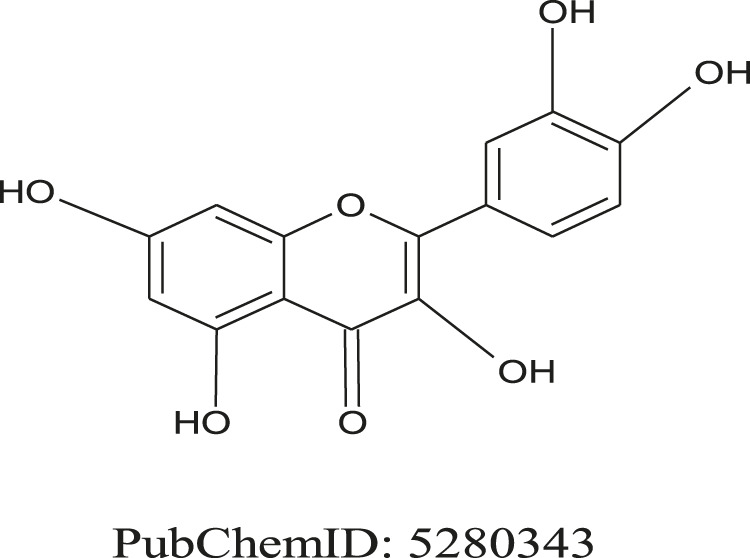
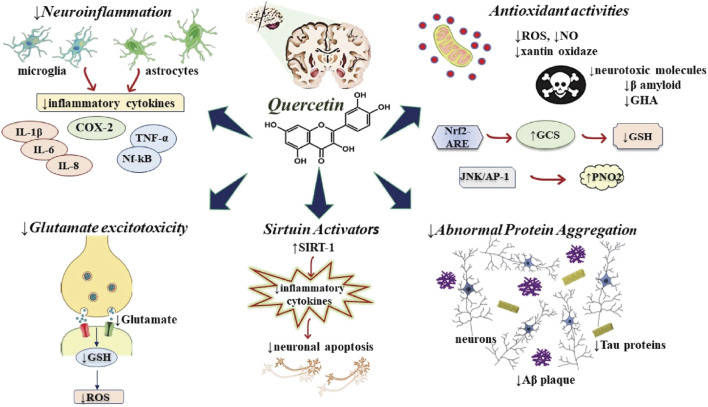
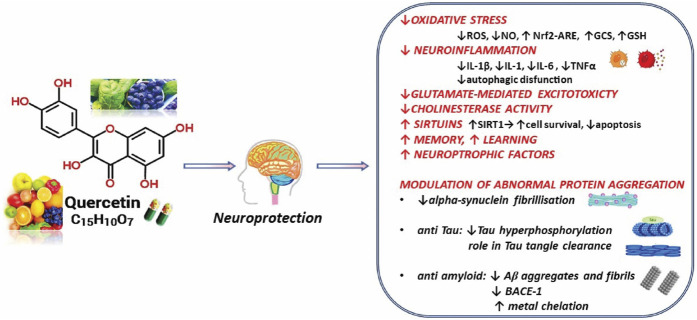
animal experiments and human trials. QUR protects the organism against neurotoxic chemicals and also can prevent the evolution and development of neuronal injury and neurodegeneration. The present work aimed to summarize the literature about the neuroprotective effect of QUR using known database sources. Besides, this review focuses on the assessment of the potential utilization of QUR as a complementary or alternative medicine for preventing and treating neurodegenerative diseases. An up-to-date search was conducted in PubMed, Science Direct and Google Scholar for published work dealing with the neuroprotective effects of QUR against neurotoxic chemicals or in neuronal injury, and in the treatment of neurodegenerative diseases. Findings suggest that QUR possess neuropharmacological protective effects in neurodegenerative brain disorders such as Alzheimer's disease, Amyloid β peptide, Parkinson's disease, Huntington's disease, multiple sclerosis, and amyotrophic lateral sclerosis. In summary, this review emphasizes the neuroprotective effects of QUR and its advantages in being used in complementary medicine for the prevention and treatment o of different neurodegenerative diseases.
Overview
The claims and statistics of this paper haven’t been checked yet.
Run the check — free, no account needed. It reads the open-access text and checks the sources it cites.
Integrity signals
Registry
Cites
Statistics
Figures
Verification
Claims the paper makes
The claims and statistics of this paper haven’t been checked yet.
Run the check — free, no account needed. It reads the open-access text and checks the sources it cites.
Claims other papers make about this one
Each is checked against this paper’s own text: does it say what the citing paper says it does?
In the citing paper
“After several decades of research in nanotechnology to transport drugs to the CNS, it is possible to have nanoparticles that allow an adequate transport of phytochemicals in a targeted way and with a control in the release time [213,214].”
From Multi-Target Mechanisms of Phytochemicals in Alzheimer’s Disease: Effects on Oxidative Stress, Neuroinflammation and Protein Aggregation (2022) · cites this paper as [214]
Self-check
Percentages, sums and reported differences re-computed from the paper’s own numbers.
The self-check needs the paper’s full text.
Citations
Cites
Neuroinflammation in Alzheimer's disease
Heneka, M. T., Carson, M. J., Khoury, J. E., Landreth, G. E., Brosseron, F., Feinstein, D. L., Jacobs, A. H., Wyss-Coray, T., Vitorica, J., Ransohoff, R. M., et al. (2015) · The Lancet Neurology · doi:10.1016/s1474-4422(15)70016-5 · Cited by 6,226
Mechanisms underlying inflammation in neurodegeneration
Glass, C. K., Saijo, K., Winner, B., Marchetto, M. C., & Gage, F. H. (2010) · Cell · doi:10.1016/j.cell.2010.02.016 · Cited by 3,580
Uttara, B., Singh, A., Zamboni, P., & Mahajan, R. (2009) · Current Neuropharmacology · doi:10.2174/157015909787602823 · Cited by 3,378
Acetylcholinesterase Inhibitors: Pharmacology and Toxicology
Colovic, M. B., Krstic, D. Z., Lazarevic-Pasti, T. D., Bondzic, A. M., & Vasic, V. M. (2013) · Current Neuropharmacology · doi:10.2174/1570159x11311030006 · Cited by 2,611
Choi, D. W. (1992) · Journal of Neurobiology · doi:10.1002/neu.480230915 · Cited by 2,329
The role of autophagy in neurodegenerative disease
Nixon, R. A. (2013) · Nature Medicine · doi:10.1038/nm.3232 · Cited by 2,059
Sharifi-Rad, M., Anil Kumar, N. V., Zucca, P., Varoni, E. M., Dini, L., Panzarini, E., Rajkovic, J., Tsouh Fokou, P. V., Azzini, E., Peluso, I., et al. (2020) · Frontiers in Physiology · doi:10.3389/fphys.2020.00694 · Cited by 1,971
Self-citation(1998) · Europe PMC (PubMed Central) · Cited by 1,594
The microglial sensome revealed by direct RNA sequencing
Hickman, S. E., Kingery, N. D., Ohsumi, T. K., Borowsky, M. L., Wang, L.-C., Means, T. K., & El Khoury, J. (2013) · Nature Neuroscience · doi:10.1038/nn.3554 · Cited by 1,511
Dong, X.-X., Wang, Y., & Qin, Z.-H. (2009) · Acta Pharmacologica Sinica · doi:10.1038/aps.2009.24 · Cited by 1,297
Research works printed but not linked: 4
- Assi, 1998, Evaluation of the Anti-inflammatory Profile of Quercetin Enhancing its Effects by Beta-Cyclodextrin, J. Drug Res. Egypt., 22, 293
- 2010, Agency Response Letter GRAS Notice No. GRN 000341
- Nussbaum, 2017, Modern Treatment Approaches in Psychoses. Pharmacogenetic, Neuroimagistic and Clinical Implications, Farmacia, 65, 75
- Pany, 2014, Neuroprotective Effect of Quercetin in Neurotoxicity Induced Rats: Role of Neuroinflammation in Neurodegeneration, Asian J. Pharm. Clin. Res., 7, 152
Cited by
Sorted by citations
Sharifi-Rad, J., Rapposelli, S., Sestito, S., Herrera-Bravo, J., Arancibia-Diaz, A., Salazar, L. A., Yeskaliyeva, B., Beyatli, A., Leyva-Gómez, G., González-Contreras, C., et al. (2022) · Journal of Personalized Medicine · doi:10.3390/jpm12091515 · Cited by 125
Self-citationWróbel-Biedrawa, D., Grabowska, K., Galanty, A., Sobolewska, D., & Podolak, I. (2022) · Life · doi:10.3390/life12040591 · Cited by 95
Therapeutic Applications of Curcumin in Diabetes: A Review and Perspective
Quispe, C., Herrera-Bravo, J., Javed, Z., Khan, K., Raza, S., Gulsunoglu-Konuskan, Z., Daştan, S. D., Sytar, O., Martorell, M., Sharifi-Rad, J., et al. (2022) · BioMed Research International · doi:10.1155/2022/1375892 · Cited by 92
Self-citationAmin, R., Quispe, C., Docea, A. O., Ydyrys, A., Kulbayeva, M., Durna Daştan, S., Calina, D., & Sharifi-Rad, J. (2022) · Neurochemistry International · doi:10.1016/j.neuint.2022.105376 · Cited by 74
Self-citationReversal of brain aging by targeting telomerase: A nutraceutical approach
Tsoukalas, D., Buga, A., Docea, A., Sarandi, E., Mitrut, R., Renieri, E., Spandidos, D., Rogoveanu, I., Cercelaru, L., Niculescu, M., et al. (2021) · International Journal of Molecular Medicine · doi:10.3892/ijmm.2021.5032 · Cited by 40
Self-citation
Metadata
- Authors
- Islam, M. S., Quispe, C., Hossain, R., Islam, M. T., Al-Harrasi, A., Al-Rawahi, A., Martorell, M., Mamurova, A., Seilkhan, A., Altybaeva, N., Abdullayeva, B., Docea, A. O., Calina, D., & Sharifi-Rad, J.
- Affiliations
- Gopalganj Science and Technology University (BD)
- Arturo Prat University (CL)
- University of Nizwa (OM)
- University of Concepción (CL)
- Al-Farabi Kazakh National University (KZ)
- University of Medicine and Pharmacy of Craiova (RO)
- Corresponding author
- Islam, Muhammad Torequl
- ORCID
- Venue
- Frontiers in Pharmacology
- Publisher
- Frontiers Media SA
- Published
- 2021-06-17
- Volume
- 12
- Pages
- 665031-665031
- ISSN
- 1663-9812 (ISSN-L)
- PMC
- PMC8248808
- OpenAlex
- W3175593057
- Cited by
- 165
- References
- 207
- Citations by year
- 2026: 25 · 2025: 25 · 2024: 30 · 2023: 42 · 2022: 36 · 2021: 7
- FWCI
- 6.60
- Type
- journal article
- Language
- en
- Open access
- gold
- doi.org
- Licence
- Locations
- Frontiers in Pharmacology (publishedVersion, cc-by)
- PubMed Central (publishedVersion, cc-by)
- PubMed (publishedVersion)
- DOAJ (DOAJ: Directory of Open Access Journals) (submittedVersion, cc-by-sa)
- Greater South Information System
- Topics
- Health Sciences › Medicine › Complementary and alternative medicine › Medicinal Plants and Neuroprotection
- Health Sciences › Medicine › Pharmacology (medical) › Flavonoids in Medical Research
- Life Sciences › Neuroscience › Neurology › Neuroprotection in Cerebral Ischemia
- Keywords
- quercetin, neuroprotection, neurodegenerative diseases, neurotoxicity, Alzheimer's disease, amyloid-beta, Parkinson's disease, Huntington's disease, multiple sclerosis, amyotrophic lateral sclerosis, complementary and alternative medicine, flavonoids
About these checks
Registry, retraction, Cites and statistics results are computed, not judged, with one exception: a printed reference that no index lists is read once by a model before it counts as a citation error. Claims are extracted by a model and kept only when their quote appears verbatim in the text; each cited source is then checked, with a model’s help, for whether it says what the claim relies on. Those verdicts can be wrong — read the claim’s quote and the cited source before relying on one.
Statistics and arithmetic are recomputed, not judged.
Confidence bands are shown only for fields calibrated on our annotated test set. None is calibrated yet, so no band is shown.
What counts as a claim ›How we measure confidence ›How we check this ›
Are you an author, or do you see a problem with this page? Request a review
