

The DOI matches its Crossref record; 69 of the 72 references it cites were found in a registry or an index; none of the 36 sources its claims cite is checked for support yet.
The impostor phenomenon among doctoral students: a scoping review
Open accessAbstract
Emerging evidence suggests that the Impostor Phenomenon (IP) among doctoral students is a serious problem worldwide academic. Although previous studies demonstrate that IP can endanger doctoral students’ academic advancement and psychological well-being, limited studies systematically and comprehensively explore the IP among those population. Thus, the fundamental goal of this study is to conduct a scoping review of IP among doctoral students so as to clarify the reality of their situation. Systematic searches were conducted using 5 databases: Springer, Google Scholar, Web of Science, PubMed, and JSTOR for empirical studies published from 1978 to 2023. Two reviewers independently carried out the literature search, study selection, data extraction and assessment of study; disagreements were resolved by a third reviewer. Thirty empirical studies covering four specific domains were include in current research, including the characteristics of IP among doctoral students, factors contributing to IP among doctoral students, correlation of IP with doctoral students’ mental illness, and measurement of IP. The findings of this study may provide insight to improving the comprehension of IP among doctoral students and establishing the groundwork for future research in this field.
Overview
AI snapshot
Written from the paper’s full text.
TL;DR
This scoping review maps 30 empirical studies on the impostor phenomenon (IP) among doctoral students across characteristics, contributing factors, mental-health correlations, and measurement. It finds IP is prevalent and linked to anxiety, depression, burnout, and academic difficulties, while noting that CIPS is widely used and the DIS scale is tailored to doctoral students.
Key findings
- Across 30 included empirical studies, IP among doctoral students was organized into four domains: characteristics of IP, factors contributing to IP, correlation of IP with mental illness, and measurement of IP.
- Publication trends: two-thirds of the 30 papers were published between 2010 and 2023; over half were conducted in the United States; disciplines included medicine (6), psychology (4), STEM (3), clinical psychology (2), and others (7). The Clance Impostor Phenomenon Scale (CIPS) was used in 10 studies; study types were 24 surveys, 4 qualitative studies, and 2 narrative reviews.
- Reported prevalence in reviewed studies included 50.6% of PhD students at ECOOM Ghent University believing they suffer from IP, 56.15% of 130 Romanian psychology graduate students experiencing high/intense IP, and 73% of 1,450 Canadian medical students having moderate or severe IP symptoms. Nori and Vanttaja surveyed 1,694 Finnish doctoral students and developed the 10-item Doctoral Impostor Syndrome (DIS) scale.
- IP was associated with anxiety, fear, depression, burnout, procrastination, and perfectionism; in 169 Russian college students, IP fully mediated the link between perfectionism and anxiety and partially mediated perfectionism and depression, and in Maftei et al. (2021) IP mediated the relationship between procrastination and anxiety. CIPS was described as the “gold standard” for measuring IP, while DIS was considered more appropriate for doctoral candidates specifically.
Methods
- Scoping review following Arksey and O’Malley’s five-step framework and reported according to PRISMA-ScR; two reviewers independently conducted the literature search, study selection, data extraction, and assessment, with disagreements resolved by a third reviewer.
- Searched Springer, Google Scholar, Web of Science, PubMed, and JSTOR for English-language empirical studies published from 1978 to 2023; inclusion required focus on IP among doctoral students, English language, full-text access, and peer-reviewed journal study.
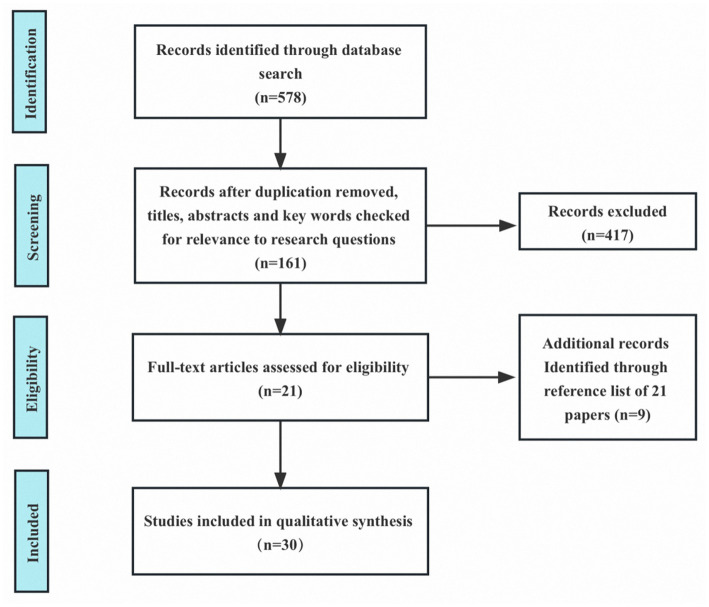
- The initial search yielded 578 articles; after title/abstract review, 161 remained; 21 full-text articles addressed doctoral impostor phenomenon, and 9 additional articles were found from reference lists, yielding 30 included studies. Data were charted into general overview, target group, study design, and results.
Limitations
- The paper states that it focused exclusively on English-language publications, potentially overlooking research in Spanish, French, and Russian; that it did not assess the quality of the literature, which may reduce the accuracy of conclusions; and that conclusions may not be verified due to lack of actual inquiry.
- Evident from the text: the included studies are heterogeneous in design, sample, discipline, and measure (e.g., surveys, qualitative studies, narrative reviews; CIPS, DIS, PFS, BSI), so findings are summarized descriptively rather than pooled, and no meta-analysis or formal quality appraisal is reported.
Model-written summary. Check it against the paper before relying on it.
Integrity signals
Registry
Cites
Statistics
Figures
Verification
Claims the paper makes
24 No basis given · 20 No full text of the sources · 16 Not checked yet · 14 Own interpretation · 8 Own result · 5 Own method · 2 Sources not found · 1 Check pending
The paper states this without a source or data behind it here, so there is nothing to check it against. The quote shows it is in the paper.
In the paper
“limited studies systematically and comprehensively explore the IP among those population.”
§ The impostor phenomenon among doctoral students: a scoping review > Abstract
plain- Asserted: passes — The authors put it forward as true.
- Checkable: passes — It can be checked against evidence.
- Load-bearing: passes — The paper’s conclusions depend on it.
- Based: passes — The paper gives a reason why it holds.
The paper states this without a source or data behind it here, so there is nothing to check it against. The quote shows it is in the paper.
In the paper
“empirical studies suggest that the pursuit of higher education does not necessarily foster a strong sense of self-efficacy among doctoral students.”
§ The impostor phenomenon among doctoral students: a scoping review > Results > Characteristics of the impostor phenomenon among doctoral students
hedged- Asserted: passes — The authors put it forward as true.
- Checkable: passes — It can be checked against evidence.
- Load-bearing: unclear — It is unclear whether the paper’s conclusions depend on it.
- Based: passes — The paper gives a reason why it holds.
In the paper
“Out of low self-esteem, fear, and self-protection, they will try to avoid tasks that are beyond their ability to handle (Leary et al., 2000).”
§ The impostor phenomenon among doctoral students: a scoping review > Results > Factors contributing to IP among doctoral students
What the sources say
- Not checked — no full text of the sourcecites Leary et al., 2000 source
plaindirect- Asserted: passes — The authors put it forward as true.
- Checkable: passes — It can be checked against evidence.
- Load-bearing: unclear — It is unclear whether the paper’s conclusions depend on it.
- Based: passes — The paper gives a reason why it holds.
The paper states this without a source or data behind it here, so there is nothing to check it against. The quote shows it is in the paper.
In the paper
“Doctoral students with IP often feel anxious and fearful of facing the dilemma of failing the challenge when their abilities and intelligence may be judged implicitly or explicitly.”
§ The impostor phenomenon among doctoral students: a scoping review > Results > Characteristics of the impostor phenomenon among doctoral students
plain- Asserted: passes — The authors put it forward as true.
- Checkable: passes — It can be checked against evidence.
- Load-bearing: unclear — It is unclear whether the paper’s conclusions depend on it.
- Based: passes — The paper gives a reason why it holds.
A result the paper reports from its own data — it cites no other source for it, so there is none to check. The quote shows it is in the paper.
In the paper
“two-thirds of the 30 papers reviewed were published between 2010 and 2023.”
§ The impostor phenomenon among doctoral students: a scoping review > Results
plain- Asserted: passes — The authors put it forward as true.
- Checkable: passes — It can be checked against evidence.
- Load-bearing: unclear — It is unclear whether the paper’s conclusions depend on it.
- Based: passes — The paper gives a reason why it holds.
A claim is checked only against the cited paper’s full text, never its abstract, and none is available for its sources.
In the paper
“On the one hand, Ph.D. students with IP are accompanied by a variety of psychological problems including anxiety, fear, and depression (Craddock et al., 2011; Lane, 2015).”
§ The impostor phenomenon among doctoral students: a scoping review > Results > Correlation of IP with doctoral students’ mental illness
What the sources say
plaincorrelational- Asserted: passes — The authors put it forward as true.
- Checkable: passes — It can be checked against evidence.
- Load-bearing: passes — The paper’s conclusions depend on it.
- Based: passes — The paper gives a reason why it holds.
A result the paper reports from its own data — it cites no other source for it, so there is none to check. The quote shows it is in the paper.
In the paper
“we meticulously examined the reference lists within these articles and unearthed an additional 9 articles that related to impostor phenomenon among doctoral students.”
§ The impostor phenomenon among doctoral students: a scoping review > Methods > Study selection
plain- Asserted: passes — The authors put it forward as true.
- Checkable: passes — It can be checked against evidence.
- Load-bearing: unclear — It is unclear whether the paper’s conclusions depend on it.
- Based: passes — The paper gives a reason why it holds.
The paper states this without a source or data behind it here, so there is nothing to check it against. The quote shows it is in the paper.
In the paper
“Students with IP focus on the recognition of others and external feedback instead of measuring their ability by what they have actually achieved.”
§ The impostor phenomenon among doctoral students: a scoping review > Results > Characteristics of the impostor phenomenon among doctoral students
plain- Asserted: passes — The authors put it forward as true.
- Checkable: passes — It can be checked against evidence.
- Load-bearing: unclear — It is unclear whether the paper’s conclusions depend on it.
- Based: passes — The paper gives a reason why it holds.
In the paper
“many doctoral students cannot view themselves as talented and competent students, after successfully completing baccalaureate and master’s degrees (Craddock et al., 2011).”
§ The impostor phenomenon among doctoral students: a scoping review > Results > Characteristics of the impostor phenomenon among doctoral students
What the sources say
- Not checked — no full text of the sourcecites Craddock et al., 2011 source
plain- Asserted: passes — The authors put it forward as true.
- Checkable: passes — It can be checked against evidence.
- Load-bearing: unclear — It is unclear whether the paper’s conclusions depend on it.
- Based: passes — The paper gives a reason why it holds.
The paper states this without a source or data behind it here, so there is nothing to check it against. The quote shows it is in the paper.
In the paper
“Third, doctoral students with IP can fall into an abyss of fear.”
§ The impostor phenomenon among doctoral students: a scoping review > Results > Characteristics of the impostor phenomenon among doctoral students
plainconditional- Asserted: passes — The authors put it forward as true.
- Checkable: passes — It can be checked against evidence.
- Load-bearing: unclear — It is unclear whether the paper’s conclusions depend on it.
- Based: passes — The paper gives a reason why it holds.
The paper states this without a source or data behind it here, so there is nothing to check it against. The quote shows it is in the paper.
In the paper
“Overall, the Harvey Impostor Phenomenon Scale (HIPS) and the Clance Impostor Phenomenon Scale (CIPS) are two widely used measures for imposter feelings.”
§ The impostor phenomenon among doctoral students: a scoping review > Results > Scales measuring IP
plain- Asserted: passes — The authors put it forward as true.
- Checkable: passes — It can be checked against evidence.
- Load-bearing: unclear — It is unclear whether the paper’s conclusions depend on it.
- Based: passes — The paper gives a reason why it holds.
None of the sources cited for this claim have been checked yet.
In the paper
“First, most doctoral students who have experienced IP indicate a lack of adequate academic preparation, specifically the ability of read, write, and academic think (Cisco, 2020).”
§ The impostor phenomenon among doctoral students: a scoping review > Results > Factors contributing to IP among doctoral students
What the sources say
- Not checked yetcites Cisco, 2020 source
Checked before — its earlier verdict is held back until a new check runs.
hedgedcorrelational- Asserted: passes — The authors put it forward as true.
- Checkable: passes — It can be checked against evidence.
- Load-bearing: unclear — It is unclear whether the paper’s conclusions depend on it.
- Based: passes — The paper gives a reason why it holds.
- Not checked yet
In the paper
“Additionally, IP can effectively mediate the relationship between procrastination and anxiety (Maftei et al., 2021).”
§ The impostor phenomenon among doctoral students: a scoping review > Results > Correlation of IP with doctoral students’ mental illness
What the sources say
- Not checked — no full text of the sourcecites Maftei et al., 2021 source
plaindirect- Asserted: passes — The authors put it forward as true.
- Checkable: passes — It can be checked against evidence.
- Load-bearing: unclear — It is unclear whether the paper’s conclusions depend on it.
- Based: passes — The paper gives a reason why it holds.
In the paper
“The survey revealed that those who experienced IP tended to attribute failure outcomes internally and globally.”
§ The impostor phenomenon among doctoral students: a scoping review > Results > Characteristics of the impostor phenomenon among doctoral students
What the sources say
- Not matchedcites Niles, 1994
Couldn’t be matched to a paper in Crossref, so it can’t be checked.
plaincorrelational- Asserted: passes — The authors put it forward as true.
- Checkable: passes — It can be checked against evidence.
- Load-bearing: unclear — It is unclear whether the paper’s conclusions depend on it.
- Based: passes — The paper gives a reason why it holds.
- Not matched
None of the sources cited for this claim have been checked yet.
In the paper
“Previous studies have shown that IP is significantly associated with psychological problems among doctoral students.”
§ The impostor phenomenon among doctoral students: a scoping review > Results > Correlation of IP with doctoral students’ mental illness
boostedcorrelational- Asserted: passes — The authors put it forward as true.
- Checkable: passes — It can be checked against evidence.
- Load-bearing: passes — The paper’s conclusions depend on it.
- Based: passes — The paper gives a reason why it holds.
- Rests on an assumption: The included studies are representative of doctoral students worldwide.
The paper states this without a source or data behind it here, so there is nothing to check it against. The quote shows it is in the paper.
In the paper
“current research indicates that this population may be particularly susceptible to experiencing feelings of intellectual fraudulence and self-doubt.”
§ The impostor phenomenon among doctoral students: a scoping review > Conclusion
hedgedconditional- Asserted: passes — The authors put it forward as true.
- Checkable: passes — It can be checked against evidence.
- Load-bearing: passes — The paper’s conclusions depend on it.
- Based: passes — The paper gives a reason why it holds.
None of the sources cited for this claim have been checked yet.
In the paper
“On the other hand, IP can also act as a mediator, moderating the relationship between perfectionism or procrastination and anxiety.”
§ The impostor phenomenon among doctoral students: a scoping review > Results > Correlation of IP with doctoral students’ mental illness
plainconditional- Asserted: passes — The authors put it forward as true.
- Checkable: passes — It can be checked against evidence.
- Load-bearing: unclear — It is unclear whether the paper’s conclusions depend on it.
- Based: passes — The paper gives a reason why it holds.
In the paper
“However, when positive feedback is not received, their good sense of self will then plummet (Langford and Clance, 1993).”
§ The impostor phenomenon among doctoral students: a scoping review > Results > Characteristics of the impostor phenomenon among doctoral students
What the sources say
- Not checked — no full text of the sourcecites Langford and Clance, 1993 source
plaindirect- Asserted: passes — The authors put it forward as true.
- Checkable: passes — It can be checked against evidence.
- Load-bearing: unclear — It is unclear whether the paper’s conclusions depend on it.
- Based: passes — The paper gives a reason why it holds.
A check of a cited source is scheduled, or we don’t hold its full text yet; the claim is checked once it runs.
In the paper
““Drifting” into doctoral education can exacerbate feelings of unease, incompetence, and low self-esteem (Nori and Vanttaja, 2022).”
§ The impostor phenomenon among doctoral students: a scoping review > Results > Factors contributing to IP among doctoral students
What the sources say
- Not checked yetcites Nori and Vanttaja, 2022 source
A check is scheduled.
plaindirect- Asserted: passes — The authors put it forward as true.
- Checkable: passes — It can be checked against evidence.
- Load-bearing: unclear — It is unclear whether the paper’s conclusions depend on it.
- Based: passes — The paper gives a reason why it holds.
- Not checked yet
None of the sources cited for this claim have been checked yet.
In the paper
“Second, doctoral students with IP have a more negative attributional style.”
§ The impostor phenomenon among doctoral students: a scoping review > Results > Characteristics of the impostor phenomenon among doctoral students
plaincorrelational- Asserted: passes — The authors put it forward as true.
- Checkable: passes — It can be checked against evidence.
- Load-bearing: passes — The paper’s conclusions depend on it.
- Based: passes — The paper gives a reason why it holds.
A result the paper reports from its own data — it cites no other source for it, so there is none to check. The quote shows it is in the paper.
In the paper
“we were able to locate 21 articles that specifically addressed the subject of doctoral impostor phenomenon.”
§ The impostor phenomenon among doctoral students: a scoping review > Methods > Study selection
plain- Asserted: passes — The authors put it forward as true.
- Checkable: passes — It can be checked against evidence.
- Load-bearing: passes — The paper’s conclusions depend on it.
- Based: passes — The paper gives a reason why it holds.
A result the paper reports from its own data — it cites no other source for it, so there is none to check. The quote shows it is in the paper.
In the paper
“Additionally, a wide range of disciplines (i.e., management, clinical psychology, business, psychology, STEM, and medicine) studied this topic.”
§ The impostor phenomenon among doctoral students: a scoping review > Results
plain- Asserted: passes — The authors put it forward as true.
- Checkable: passes — It can be checked against evidence.
- Load-bearing: unclear — It is unclear whether the paper’s conclusions depend on it.
- Based: passes — The paper gives a reason why it holds.
The paper states this without a source or data behind it here, so there is nothing to check it against. The quote shows it is in the paper.
In the paper
“Second, the impostorism of doctoral students is closely linked to their perceptions of role identity.”
§ The impostor phenomenon among doctoral students: a scoping review > Results > Factors contributing to IP among doctoral students
plaincorrelational- Asserted: passes — The authors put it forward as true.
- Checkable: passes — It can be checked against evidence.
- Load-bearing: unclear — It is unclear whether the paper’s conclusions depend on it.
- Based: passes — The paper gives a reason why it holds.
A result the paper reports from its own data — it cites no other source for it, so there is none to check. The quote shows it is in the paper.
In the paper
“Thirty empirical studies covering four specific domains were include in current research”
- Also stated in: § Study selection · plain
“In the end, 30 articles met our inclusion criteria”
§ The impostor phenomenon among doctoral students: a scoping review > Abstract
plain- Asserted: passes — The authors put it forward as true.
- Checkable: passes — It can be checked against evidence.
- Load-bearing: unclear — It is unclear whether the paper’s conclusions depend on it.
- Based: passes — The paper gives a reason why it holds.
- Also stated in: § Study selection · plain
A conclusion the paper draws from its own results — it cites no other source for it, so there is none to check. The quote shows it is in the paper.
In the paper
“Poor academic performance and academic psychological problems can further contribute to the development of IP in doctoral students, generating a cycle.”
§ The impostor phenomenon among doctoral students: a scoping review > Results > Correlation of IP with doctoral students’ mental illness
plaindirect- Asserted: passes — The authors put it forward as true.
- Checkable: passes — It can be checked against evidence.
- Load-bearing: passes — The paper’s conclusions depend on it.
- Based: passes — The paper gives a reason why it holds.
A conclusion the paper draws from its own results — it cites no other source for it, so there is none to check. The quote shows it is in the paper.
In the paper
“Thus, they are in a very different situation from genuine impostors who lack ability and intellectual talent.”
§ The impostor phenomenon among doctoral students: a scoping review > Discussion
plain- Asserted: passes — The authors put it forward as true.
- Checkable: passes — It can be checked against evidence.
- Load-bearing: passes — The paper’s conclusions depend on it.
- Based: passes — The paper gives a reason why it holds.
- Rests on an assumption: Ph.D. students undergo a heavy competitive selection process to gain admission, which serves as evidence of their ability to complete their studies.
In the paper
“For the measurement of IP among doctoral students, Nori and Vanttaja developed the Doctoral Impostor Syndrome (DIS) scale, according to a survey in 2015 that included 1,694 Finnish doctoral students.”
§ The impostor phenomenon among doctoral students: a scoping review > Results > Scales measuring IP
What the sources say
- Not checked yetcites Nori and Vanttaja, 2022 source
plain- Asserted: passes — The authors put it forward as true.
- Checkable: passes — It can be checked against evidence.
- Load-bearing: unclear — It is unclear whether the paper’s conclusions depend on it.
- Based: passes — The paper gives a reason why it holds.
In the paper
“Their results indicated that 56.15% of the participants experienced high and intensity IP.”
§ The impostor phenomenon among doctoral students: a scoping review > Introduction
What the sources say
- Not checked — no full text of the sourcecites Maftei et al., 2021 source
hedged- Asserted: passes — The authors put it forward as true.
- Checkable: passes — It can be checked against evidence.
- Load-bearing: unclear — It is unclear whether the paper’s conclusions depend on it.
- Based: passes — The paper gives a reason why it holds.
A conclusion the paper draws from its own results — it cites no other source for it, so there is none to check. The quote shows it is in the paper.
In the paper
“When consciously struggling to meet the demands of their studies, they may consider themselves impostors.”
§ The impostor phenomenon among doctoral students: a scoping review > Results > Factors contributing to IP among doctoral students
hedgedconditional- Asserted: passes — The authors put it forward as true.
- Checkable: passes — It can be checked against evidence.
- Load-bearing: unclear — It is unclear whether the paper’s conclusions depend on it.
- Based: passes — The paper gives a reason why it holds.
In the paper
“Scoping reviews, a type of knowledge synthesis, are now seen as a valid approach (Daudt et al., 2013).”
§ The impostor phenomenon among doctoral students: a scoping review > Methods
What the sources say
- Not checked yetcites Daudt et al., 2013 source
plain- Asserted: passes — The authors put it forward as true.
- Checkable: passes — It can be checked against evidence.
- Load-bearing: passes — The paper’s conclusions depend on it.
- Based: passes — The paper gives a reason why it holds.
A conclusion the paper draws from its own results — it cites no other source for it, so there is none to check. The quote shows it is in the paper.
In the paper
“These characteristics can be used as indicators of impostor among doctoral students.”
§ The impostor phenomenon among doctoral students: a scoping review > Results > Characteristics of the impostor phenomenon among doctoral students
plaincorrelational- Asserted: passes — The authors put it forward as true.
- Checkable: passes — It can be checked against evidence.
- Load-bearing: passes — The paper’s conclusions depend on it.
- Based: passes — The paper gives a reason why it holds.
In the paper
“Subsequently, Clance developed the Clance Impostor Phenomenon Scale, and identified a three-factor model including self-doubts about ones’ own intelligence and abilities (Fake), tendency to attribute success to chance/luck (Luck), and the inability to admit a good performance (Discount) (Clance, 1985).”
§ The impostor phenomenon among doctoral students: a scoping review > Results > Scales measuring IP
What the sources say
- Not checked — no full text of the sourcecites Clance, 1985
plain- Asserted: passes — The authors put it forward as true.
- Checkable: passes — It can be checked against evidence.
- Load-bearing: unclear — It is unclear whether the paper’s conclusions depend on it.
- Based: passes — The paper gives a reason why it holds.
A conclusion the paper draws from its own results — it cites no other source for it, so there is none to check. The quote shows it is in the paper.
In the paper
“Emerging evidence suggests that the Impostor Phenomenon (IP) among doctoral students is a serious problem worldwide academic.”
§ The impostor phenomenon among doctoral students: a scoping review > Abstract
hedged- Asserted: passes — The authors put it forward as true.
- Checkable: passes — It can be checked against evidence.
- Load-bearing: passes — The paper’s conclusions depend on it.
- Based: unclear — It is unclear why the paper says it holds.
A conclusion the paper draws from its own results — it cites no other source for it, so there is none to check. The quote shows it is in the paper.
In the paper
“These psychological problems can, in turn, lead to behavioral tendencies such as academic burnout, procrastination, or perfectionism.”
§ The impostor phenomenon among doctoral students: a scoping review > Results > Correlation of IP with doctoral students’ mental illness
plaindirect- Asserted: passes — The authors put it forward as true.
- Checkable: passes — It can be checked against evidence.
- Load-bearing: unclear — It is unclear whether the paper’s conclusions depend on it.
- Based: unclear — It is unclear why the paper says it holds.
In the paper
“Likewise, discrepancies between reflected evaluations and ones perceived standards can spawn anxiety and distressing emotions (Higgins, 1989).”
§ The impostor phenomenon among doctoral students: a scoping review > Results > Correlation of IP with doctoral students’ mental illness
What the sources say
- Not checked — no full text of the sourcecites Higgins, 1989 source
plaindirect- Asserted: passes — The authors put it forward as true.
- Checkable: passes — It can be checked against evidence.
- Load-bearing: unclear — It is unclear whether the paper’s conclusions depend on it.
- Based: passes — The paper gives a reason why it holds.
In the paper
“Specifically, discrepancies between reflected evaluations and one’s ideal self-image (what one would like to be) can lead to depression.”
§ The impostor phenomenon among doctoral students: a scoping review > Results > Correlation of IP with doctoral students’ mental illness
What the sources say
- Not checked — no full text of the sourcecites Higgins, 1989 source
plaindirect- Asserted: passes — The authors put it forward as true.
- Checkable: passes — It can be checked against evidence.
- Load-bearing: unclear — It is unclear whether the paper’s conclusions depend on it.
- Based: passes — The paper gives a reason why it holds.
In the paper
“73% of 1,450 medical students from three Canadian institutions had moderate or severe IP symptoms (Neufeld et al., 2023).”
§ The impostor phenomenon among doctoral students: a scoping review > Introduction
What the sources say
- Not checked — no full text of the sourcecites Neufeld et al., 2023 source
plain- Asserted: passes — The authors put it forward as true.
- Checkable: passes — It can be checked against evidence.
- Load-bearing: unclear — It is unclear whether the paper’s conclusions depend on it.
- Based: passes — The paper gives a reason why it holds.
None of the sources cited for this claim have been checked yet.
In the paper
“The impostor phenomenon is common among doctoral students, as evidenced by various research.”
§ The impostor phenomenon among doctoral students: a scoping review > Introduction
plain- Asserted: passes — The authors put it forward as true.
- Checkable: passes — It can be checked against evidence.
- Load-bearing: passes — The paper’s conclusions depend on it.
- Based: passes — The paper gives a reason why it holds.
- Rests on an assumption: The included studies are representative of doctoral students worldwide.
What the paper did — it cites no source for this, so there is none to check. The quote shows it is in the paper.
In the paper
“this study exclusively focused on English-language publications, potentially overlooking the extensive utilization of other languages such as Spanish, French, and Russian in academic publishing and dissemination.”
§ The impostor phenomenon among doctoral students: a scoping review > Limitations
hedgedconditional- Asserted: passes — The authors put it forward as true.
- Checkable: passes — It can be checked against evidence.
- Load-bearing: unclear — It is unclear whether the paper’s conclusions depend on it.
- Based: passes — The paper gives a reason why it holds.
- It may state two separate claims as one. 36
- Probably not a substantial claim. 23
The paper states this without a source or data behind it here, so there is nothing to check it against. The quote shows it is in the paper.
In the paper
“Ph.D. students from the middle- or upper-class families, on the other hand, are under tremendous pressure to succeed from their families, which leads them to feel insecure about their abilities and fear that they will not be able to surpass the success of the previous generation.”
§ The impostor phenomenon among doctoral students: a scoping review > Results > Factors contributing to IP among doctoral students
plaindirect- Asserted: passes — The authors put it forward as true.
- Checkable: passes — It can be checked against evidence.
- Load-bearing: unclear — It is unclear whether the paper’s conclusions depend on it.
- Based: passes — The paper gives a reason why it holds.
It may state two separate claims as one.
The paper states this without a source or data behind it here, so there is nothing to check it against. The quote shows it is in the paper.
In the paper
“Fourth, doctoral students with IP may perform poorly academically and thus gradually drift off the academic track.”
§ The impostor phenomenon among doctoral students: a scoping review > Results > Characteristics of the impostor phenomenon among doctoral students
hedgedconditional- Asserted: passes — The authors put it forward as true.
- Checkable: passes — It can be checked against evidence.
- Load-bearing: unclear — It is unclear whether the paper’s conclusions depend on it.
- Based: passes — The paper gives a reason why it holds.
It may state two separate claims as one.
The paper states this without a source or data behind it here, so there is nothing to check it against. The quote shows it is in the paper.
In the paper
“Individuals often alter their self-presentation to make themselves appear to have natural, primitive, and extraordinary intelligence.”
§ The impostor phenomenon among doctoral students: a scoping review > Results > Factors contributing to IP among doctoral students
plain- Asserted: passes — The authors put it forward as true.
- Checkable: passes — It can be checked against evidence.
- Load-bearing: fails — The paper’s conclusions may not depend on it.
- Based: fails — The paper may give no reason why it holds.
Probably not a substantial claim. The paper’s conclusions may not depend on it. The paper may give no reason why it holds.
The paper states this without a source or data behind it here, so there is nothing to check it against. The quote shows it is in the paper.
In the paper
“Doctoral students with IP often struggle with low self-efficacy and suffer from negative attributions and fears, which can hinder their academic performance and derail their academic paths.”
§ The impostor phenomenon among doctoral students: a scoping review > Conclusion
plainconditional- Asserted: passes — The authors put it forward as true.
- Checkable: passes — It can be checked against evidence.
- Load-bearing: passes — The paper’s conclusions depend on it.
- Based: passes — The paper gives a reason why it holds.
It may state two separate claims as one.
The paper states this without a source or data behind it here, so there is nothing to check it against. The quote shows it is in the paper.
In the paper
“Evidence also suggests that poor mental health can have negative impacts on academic success, and that interventions aimed at improving mental health may also lead to improvements in academic outcomes.”
§ The impostor phenomenon among doctoral students: a scoping review > Conclusion
hedgedconditional- Asserted: passes — The authors put it forward as true.
- Checkable: passes — It can be checked against evidence.
- Load-bearing: passes — The paper’s conclusions depend on it.
- Based: unclear — It is unclear why the paper says it holds.
It may state two separate claims as one.
The paper states this without a source or data behind it here, so there is nothing to check it against. The quote shows it is in the paper.
In the paper
“one of the contributions of our study is to summarize the characteristics of doctoral students experiencing IP, including low self-efficacy, a tendency toward negative attributions, heightened anxiety, and lower academic performance.”
§ The impostor phenomenon among doctoral students: a scoping review > Discussion
plaincorrelational- Asserted: passes — The authors put it forward as true.
- Checkable: passes — It can be checked against evidence.
- Load-bearing: passes — The paper’s conclusions depend on it.
- Based: passes — The paper gives a reason why it holds.
It may state two separate claims as one.
The paper states this without a source or data behind it here, so there is nothing to check it against. The quote shows it is in the paper.
In the paper
“research on interventions still needs to be enriched.”
§ The impostor phenomenon among doctoral students: a scoping review > Discussion
plain- Asserted: passes — The authors put it forward as true.
- Checkable: fails — It may be too vague to check against evidence.
- Load-bearing: passes — The paper’s conclusions depend on it.
- Based: passes — The paper gives a reason why it holds.
Probably not a substantial claim. It may be too vague to check against evidence.
A result the paper reports from its own data — it cites no other source for it, so there is none to check. The quote shows it is in the paper.
In the paper
“Over half studies conducted in the United States”
§ The impostor phenomenon among doctoral students: a scoping review > Results
plain- Asserted: passes — The authors put it forward as true.
- Checkable: passes — It can be checked against evidence.
- Load-bearing: fails — The paper’s conclusions may not depend on it.
- Based: passes — The paper gives a reason why it holds.
Probably not a substantial claim. The paper’s conclusions may not depend on it.
In the paper
“For example, a survey of 169 Russian college students indicated that imposter Phenomenon fully mediated the link between perfectionism and anxiety, whereas it served as a partial mediator between perfectionism and depression (Wang et al., 2019).”
§ The impostor phenomenon among doctoral students: a scoping review > Results > Correlation of IP with doctoral students’ mental illness
What the sources say
- Not checked — no full text of the sourcecites Wang et al., 2019 source
hedgeddirect- Asserted: passes — The authors put it forward as true.
- Checkable: passes — It can be checked against evidence.
- Load-bearing: unclear — It is unclear whether the paper’s conclusions depend on it.
- Based: passes — The paper gives a reason why it holds.
It may state two separate claims as one.
The paper states this without a source or data behind it here, so there is nothing to check it against. The quote shows it is in the paper.
In the paper
“Moreover, factors such as inadequate academic preparation and support, and the influence of the genius culture can all contribute to the emergence of IP among doctoral students and may have negative impacts on academic progress and mental health.”
§ The impostor phenomenon among doctoral students: a scoping review > Conclusion
hedgedconditional- Asserted: passes — The authors put it forward as true.
- Checkable: passes — It can be checked against evidence.
- Load-bearing: passes — The paper’s conclusions depend on it.
- Based: passes — The paper gives a reason why it holds.
It may state two separate claims as one.
In the paper
“Currently, many Ph.D. students enter the academic world with enthusiasm but cannot break free from the continuous evaluation, monitoring of results, and glorification of excellence, some doctoral students might begin to demand too much from themselves and feel like an impostor who is not good enough for doctoral studies (Nori and Vanttaja, 2022).”
§ The impostor phenomenon among doctoral students: a scoping review > Results > Factors contributing to IP among doctoral students
What the sources say
- Not checked yetcites Nori and Vanttaja, 2022 source
hedgedconditional- Asserted: passes — The authors put it forward as true.
- Checkable: passes — It can be checked against evidence.
- Load-bearing: unclear — It is unclear whether the paper’s conclusions depend on it.
- Based: passes — The paper gives a reason why it holds.
It may state two separate claims as one.
The paper states this without a source or data behind it here, so there is nothing to check it against. The quote shows it is in the paper.
In the paper
“For example, doctoral students from the working class or low-income families typically face more barriers such as financial pressures and cognitive limitations, in large part because they are the first generation of college students in their families.”
§ The impostor phenomenon among doctoral students: a scoping review > Results > Factors contributing to IP among doctoral students
plaindirect- Asserted: passes — The authors put it forward as true.
- Checkable: passes — It can be checked against evidence.
- Load-bearing: unclear — It is unclear whether the paper’s conclusions depend on it.
- Based: unclear — It is unclear why the paper says it holds.
It may state two separate claims as one.
In the paper
“However, studies have found that experiences of IP were evident, regardless of the home background (Nori and Vanttaja, 2022), though be differences in the degree of IP.”
§ The impostor phenomenon among doctoral students: a scoping review > Results > Factors contributing to IP among doctoral students
What the sources say
- Not checked yetcites Nori and Vanttaja, 2022 source
plain- Asserted: passes — The authors put it forward as true.
- Checkable: passes — It can be checked against evidence.
- Load-bearing: unclear — It is unclear whether the paper’s conclusions depend on it.
- Based: passes — The paper gives a reason why it holds.
It may state two separate claims as one.
The paper states this without a source or data behind it here, so there is nothing to check it against. The quote shows it is in the paper.
In the paper
“Although there are two commonly used scales, HIPS and CIPS, that can measure the impostor phenomenon (IP), the DIS scale developed by Nori is considered more appropriate in assessing IP among doctoral candidates specifically.”
§ The impostor phenomenon among doctoral students: a scoping review > Conclusion
plain- Asserted: passes — The authors put it forward as true.
- Checkable: passes — It can be checked against evidence.
- Load-bearing: passes — The paper’s conclusions depend on it.
- Based: fails — The paper may give no reason why it holds.
Probably not a substantial claim. The paper may give no reason why it holds.
The paper states this without a source or data behind it here, so there is nothing to check it against. The quote shows it is in the paper.
In the paper
“Research has shown that symptoms of anxiety, depression, and burnout are common among this population, and may be related to feelings of imposture as well as other factors.”
§ The impostor phenomenon among doctoral students: a scoping review > Conclusion
hedgedcorrelational- Asserted: passes — The authors put it forward as true.
- Checkable: passes — It can be checked against evidence.
- Load-bearing: passes — The paper’s conclusions depend on it.
- Based: passes — The paper gives a reason why it holds.
It may state two separate claims as one.
The paper states this without a source or data behind it here, so there is nothing to check it against. The quote shows it is in the paper.
In the paper
“The studies also highlight the impact of the impostor phenomenon on the mental health of doctoral students and explore the potential relationship between mental health status and IP.”
§ The impostor phenomenon among doctoral students: a scoping review > Discussion
hedgedcorrelational- Asserted: passes — The authors put it forward as true.
- Checkable: passes — It can be checked against evidence.
- Load-bearing: passes — The paper’s conclusions depend on it.
- Based: passes — The paper gives a reason why it holds.
It may state two separate claims as one.
A result the paper reports from its own data — it cites no other source for it, so there is none to check. The quote shows it is in the paper.
In the paper
“The initial electronic database search yielded 578 articles that fulfilled the search criteria.”
§ The impostor phenomenon among doctoral students: a scoping review > Methods > Study selection
plain- Asserted: passes — The authors put it forward as true.
- Checkable: passes — It can be checked against evidence.
- Load-bearing: fails — The paper’s conclusions may not depend on it.
- Based: passes — The paper gives a reason why it holds.
Probably not a substantial claim. The paper’s conclusions may not depend on it.
None of the sources cited for this claim have been checked yet.
In the paper
“On the other hand, their confidence in their ability may be tested by unfamiliar academic practices making them feel vulnerable and marginalized (Housee and Richards, 2011).”
§ The impostor phenomenon among doctoral students: a scoping review > Results > Factors contributing to IP among doctoral students
What the sources say
- Not checked yetcites Housee and Richards, 2011 source
Checked before — its earlier verdict is held back until a new check runs.
hedgedconditional- Asserted: passes — The authors put it forward as true.
- Checkable: passes — It can be checked against evidence.
- Load-bearing: unclear — It is unclear whether the paper’s conclusions depend on it.
- Based: passes — The paper gives a reason why it holds.
It may state two separate claims as one.
- Not checked yet
In the paper
“When faced with a new task, individuals with IP usually doubt their ability to cope with the challenge and become overly concerned with their social image, which can lead to inefficient completion of the task (Maftei et al., 2021).”
§ The impostor phenomenon among doctoral students: a scoping review > Results > Characteristics of the impostor phenomenon among doctoral students
What the sources say
- Not checked — no full text of the sourcecites Maftei et al., 2021 source
plaindirect- Asserted: passes — The authors put it forward as true.
- Checkable: passes — It can be checked against evidence.
- Load-bearing: unclear — It is unclear whether the paper’s conclusions depend on it.
- Based: passes — The paper gives a reason why it holds.
It may state two separate claims as one.
In the paper
“On the one hand, it is typical of them to feel they do not deserve to be in higher education and constantly need to prove themselves (O’Donnell and Tobbell, 2007).”
§ The impostor phenomenon among doctoral students: a scoping review > Results > Factors contributing to IP among doctoral students
What the sources say
- Not checked — no full text of the sourcecites O’Donnell and Tobbell, 2007 source
plain- Asserted: passes — The authors put it forward as true.
- Checkable: passes — It can be checked against evidence.
- Load-bearing: unclear — It is unclear whether the paper’s conclusions depend on it.
- Based: passes — The paper gives a reason why it holds.
It may state two separate claims as one.
The paper states this without a source or data behind it here, so there is nothing to check it against. The quote shows it is in the paper.
In the paper
“Third, as far as the current educational environment is concerned, a culture of genius seems to permeate all stages of learning.”
§ The impostor phenomenon among doctoral students: a scoping review > Results > Factors contributing to IP among doctoral students
hedged- Asserted: passes — The authors put it forward as true.
- Checkable: passes — It can be checked against evidence.
- Load-bearing: fails — The paper’s conclusions may not depend on it.
- Based: fails — The paper may give no reason why it holds.
Probably not a substantial claim. The paper’s conclusions may not depend on it. The paper may give no reason why it holds.
In the paper
“Indeed, these feelings are not caused by an external competitive environment or measures of success (e.g., publication or awards), but rather stem from a deep-seated personal denial of self”
§ The impostor phenomenon among doctoral students: a scoping review > Results > Characteristics of the impostor phenomenon among doctoral students
What the sources say
- Not checked yetcites Nori and Vanttaja, 2022 source
plaindirect- Asserted: passes — The authors put it forward as true.
- Checkable: passes — It can be checked against evidence.
- Load-bearing: unclear — It is unclear whether the paper’s conclusions depend on it.
- Based: passes — The paper gives a reason why it holds.
It may state two separate claims as one.
The paper states this without a source or data behind it here, so there is nothing to check it against. The quote shows it is in the paper.
In the paper
“Simply put, participants tended to attribute their successes to external factors and blame themselves for their failures.”
§ The impostor phenomenon among doctoral students: a scoping review > Results > Characteristics of the impostor phenomenon among doctoral students
plain- Asserted: passes — The authors put it forward as true.
- Checkable: passes — It can be checked against evidence.
- Load-bearing: unclear — It is unclear whether the paper’s conclusions depend on it.
- Based: passes — The paper gives a reason why it holds.
It may state two separate claims as one.
In the paper
“They also had an external locus of control in situations with successful outcomes and an internal locus of control for failure outcomes.”
§ The impostor phenomenon among doctoral students: a scoping review > Results > Characteristics of the impostor phenomenon among doctoral students
What the sources say
- Not matchedcites Niles, 1994
Couldn’t be matched to a paper in Crossref, so it can’t be checked.
plaincorrelational- Asserted: passes — The authors put it forward as true.
- Checkable: passes — It can be checked against evidence.
- Load-bearing: unclear — It is unclear whether the paper’s conclusions depend on it.
- Based: passes — The paper gives a reason why it holds.
It may state two separate claims as one.
- Not matched
The paper states this without a source or data behind it here, so there is nothing to check it against. The quote shows it is in the paper.
In the paper
“Throughout their doctoral studies, these students experience a pervasive sense of intellectual inadequacy, often believing that they lack the necessary skills for academic research.”
§ The impostor phenomenon among doctoral students: a scoping review > Results > Characteristics of the impostor phenomenon among doctoral students
plain- Asserted: passes — The authors put it forward as true.
- Checkable: passes — It can be checked against evidence.
- Load-bearing: unclear — It is unclear whether the paper’s conclusions depend on it.
- Based: passes — The paper gives a reason why it holds.
It may state two separate claims as one.
A result the paper reports from its own data — it cites no other source for it, so there is none to check. The quote shows it is in the paper.
In the paper
“After a thorough evaluation of titles and abstracts, publications, there were 161 articles left for further examination.”
§ The impostor phenomenon among doctoral students: a scoping review > Methods > Study selection
plain- Asserted: passes — The authors put it forward as true.
- Checkable: passes — It can be checked against evidence.
- Load-bearing: fails — The paper’s conclusions may not depend on it.
- Based: passes — The paper gives a reason why it holds.
Probably not a substantial claim. The paper’s conclusions may not depend on it.
None of the sources cited for this claim have been checked yet.
In the paper
“Overall, both quantitative and qualitative research have the comparable findings that IP exists among Ph.D. students and is not an intended consequence but has spread throughout the doctoral student population.”
§ The impostor phenomenon among doctoral students: a scoping review > Introduction
plain- Asserted: passes — The authors put it forward as true.
- Checkable: passes — It can be checked against evidence.
- Load-bearing: passes — The paper’s conclusions depend on it.
- Based: passes — The paper gives a reason why it holds.
It may state two separate claims as one.
- Rests on an assumption: The included studies are representative of doctoral students worldwide.
None of the sources cited for this claim have been checked yet.
In the paper
“A study by the Centre for Excellence in Teaching and Learning at the University of Waterloo (2016) found that graduate students with IP tend to have less contact with other students, struggle to effectively perform their duties as teaching assistants, and are less involved in practical activities, which can hinder their competence (Meurer and Costa, 2020).”
§ The impostor phenomenon among doctoral students: a scoping review > Results > Characteristics of the impostor phenomenon among doctoral students
What the sources say
- Not checked yetcites Meurer and Costa, 2020 source
Checked before — its earlier verdict is held back until a new check runs.
plaincorrelational- Asserted: passes — The authors put it forward as true.
- Checkable: passes — It can be checked against evidence.
- Load-bearing: unclear — It is unclear whether the paper’s conclusions depend on it.
- Based: passes — The paper gives a reason why it holds.
It may state two separate claims as one.
- Not checked yet
What the paper did — it cites no source for this, so there is none to check. The quote shows it is in the paper.
In the paper
“We reported the study according to PRISMA-ScR”
§ The impostor phenomenon among doctoral students: a scoping review > Methods
plain- Asserted: passes — The authors put it forward as true.
- Checkable: passes — It can be checked against evidence.
- Load-bearing: fails — The paper’s conclusions may not depend on it.
- Based: passes — The paper gives a reason why it holds.
Probably not a substantial claim. The paper’s conclusions may not depend on it.
In the paper
“Fourth, IP is a habit-related phenomenon that can date back to early stages in the life course, i.e., deeply influenced by the family (Clance and Imes, 1978).”
§ The impostor phenomenon among doctoral students: a scoping review > Results > Factors contributing to IP among doctoral students
What the sources say
- Not checked — no full text of the sourcecites Clance and Imes, 1978 source
plaindirect- Asserted: passes — The authors put it forward as true.
- Checkable: passes — It can be checked against evidence.
- Load-bearing: unclear — It is unclear whether the paper’s conclusions depend on it.
- Based: passes — The paper gives a reason why it holds.
It may state two separate claims as one.
None of the sources cited for this claim have been checked yet.
In the paper
“Since the concept of impostor phenomenon was introduced, attention to it has increased dramatically in the past decade, both in academic research articles and in the popular media (Feenstra et al., 2020).”
§ The impostor phenomenon among doctoral students: a scoping review > Discussion
What the sources say
- Not checked yetcites Feenstra et al., 2020 source
Checked before — its earlier verdict is held back until a new check runs.
plain- Asserted: passes — The authors put it forward as true.
- Checkable: passes — It can be checked against evidence.
- Load-bearing: fails — The paper’s conclusions may not depend on it.
- Based: passes — The paper gives a reason why it holds.
Probably not a substantial claim. The paper’s conclusions may not depend on it. It may state two separate claims as one.
- Not checked yet
A conclusion the paper draws from its own results — it cites no other source for it, so there is none to check. The quote shows it is in the paper.
In the paper
“This imposter feeling had a serious impact on doctoral students’ daily life and academic performance and threatened their psychological health.”
§ The impostor phenomenon among doctoral students: a scoping review > Introduction
plaindirect- Asserted: passes — The authors put it forward as true.
- Checkable: passes — It can be checked against evidence.
- Load-bearing: passes — The paper’s conclusions depend on it.
- Based: fails — The paper may give no reason why it holds.
Probably not a substantial claim. The paper may give no reason why it holds. It may state two separate claims as one.
The paper states this without a source or data behind it here, so there is nothing to check it against. The quote shows it is in the paper.
In the paper
“Studies on similar groups suggests that IP is not unique to a particular culture but may be a product of professional characteristics, namely, IP plays an important role in successful career development.”
§ The impostor phenomenon among doctoral students: a scoping review > Discussion
hedgedconditional- Asserted: passes — The authors put it forward as true.
- Checkable: passes — It can be checked against evidence.
- Load-bearing: fails — The paper’s conclusions may not depend on it.
- Based: fails — The paper may give no reason why it holds.
Probably not a substantial claim. The paper’s conclusions may not depend on it. The paper may give no reason why it holds. It may state two separate claims as one.
What the paper did — it cites no source for this, so there is none to check. The quote shows it is in the paper.
In the paper
“Two reviewers independently carried out the literature search, study selection, data extraction and assessment of study; disagreements were resolved by a third reviewer.”
§ The impostor phenomenon among doctoral students: a scoping review > Abstract
plain- Asserted: passes — The authors put it forward as true.
- Checkable: passes — It can be checked against evidence.
- Load-bearing: fails — The paper’s conclusions may not depend on it.
- Based: passes — The paper gives a reason why it holds.
Probably not a substantial claim. The paper’s conclusions may not depend on it. It may state two separate claims as one.
A conclusion the paper draws from its own results — it cites no other source for it, so there is none to check. The quote shows it is in the paper.
In the paper
“Ph.D. students with IP, by focusing too much on the role of intelligence in the learning phase, may attribute their failures to a lack of ability when they faced frustrations in their research, further exacerbating the sense of impostorism.”
§ The impostor phenomenon among doctoral students: a scoping review > Results > Factors contributing to IP among doctoral students
hedgedconditional- Asserted: passes — The authors put it forward as true.
- Checkable: passes — It can be checked against evidence.
- Load-bearing: fails — The paper’s conclusions may not depend on it.
- Based: fails — The paper may give no reason why it holds.
Probably not a substantial claim. The paper’s conclusions may not depend on it. The paper may give no reason why it holds.
What the paper did — it cites no source for this, so there is none to check. The quote shows it is in the paper.
In the paper
“not assessing the quality of the literature may lead to a lack of accuracy in the conclusions drawn from them.”
§ The impostor phenomenon among doctoral students: a scoping review > Limitations
hedgedconditional- Asserted: passes — The authors put it forward as true.
- Checkable: passes — It can be checked against evidence.
- Load-bearing: fails — The paper’s conclusions may not depend on it.
- Based: fails — The paper may give no reason why it holds.
Probably not a substantial claim. The paper’s conclusions may not depend on it. The paper may give no reason why it holds.
What the paper did — it cites no source for this, so there is none to check. The quote shows it is in the paper.
In the paper
“the conclusions drawn from these studies may not be verified due to the lack of actual inquiry.”
§ The impostor phenomenon among doctoral students: a scoping review > Limitations
hedgedconditional- Asserted: passes — The authors put it forward as true.
- Checkable: passes — It can be checked against evidence.
- Load-bearing: fails — The paper’s conclusions may not depend on it.
- Based: passes — The paper gives a reason why it holds.
Probably not a substantial claim. The paper’s conclusions may not depend on it.
In the paper
“Therefore, CIPS is more sensitive and reliable, and is considered as the “gold standard” for measuring IP (Holmes et al., 1993).”
§ The impostor phenomenon among doctoral students: a scoping review > Results > Scales measuring IP
What the sources say
- Not checked — no full text of the sourcecites Holmes et al., 1993 source
plain- Asserted: passes — The authors put it forward as true.
- Checkable: passes — It can be checked against evidence.
- Load-bearing: unclear — It is unclear whether the paper’s conclusions depend on it.
- Based: passes — The paper gives a reason why it holds.
It may state two separate claims as one.
A conclusion the paper draws from its own results — it cites no other source for it, so there is none to check. The quote shows it is in the paper.
In the paper
“In summary, the DIS scale provides a more accurately and scientifically grounded assessment of IP among Finnish doctoral students.”
§ The impostor phenomenon among doctoral students: a scoping review > Results > Scales measuring IP
plain- Asserted: passes — The authors put it forward as true.
- Checkable: passes — It can be checked against evidence.
- Load-bearing: passes — The paper’s conclusions depend on it.
- Based: passes — The paper gives a reason why it holds.
It may state two separate claims as one.
A conclusion the paper draws from its own results — it cites no other source for it, so there is none to check. The quote shows it is in the paper.
In the paper
“By adhering to the guidance of PRISMA-ScR, the quality and transparency of the research can be ensured.”
§ The impostor phenomenon among doctoral students: a scoping review > Methods
plaindirect- Asserted: passes — The authors put it forward as true.
- Checkable: passes — It can be checked against evidence.
- Load-bearing: fails — The paper’s conclusions may not depend on it.
- Based: passes — The paper gives a reason why it holds.
Probably not a substantial claim. The paper’s conclusions may not depend on it.
In the paper
“Certainly, first-generation Ph.D. students tend to experience IP more frequently and to a greater extent (Terenzini et al., 1996).”
§ The impostor phenomenon among doctoral students: a scoping review > Results > Factors contributing to IP among doctoral students
What the sources say
- Not checked — no full text of the sourcecites Terenzini et al., 1996 source
boostedcorrelational- Asserted: passes — The authors put it forward as true.
- Checkable: passes — It can be checked against evidence.
- Load-bearing: unclear — It is unclear whether the paper’s conclusions depend on it.
- Based: passes — The paper gives a reason why it holds.
It may state two separate claims as one.
A conclusion the paper draws from its own results — it cites no other source for it, so there is none to check. The quote shows it is in the paper.
In the paper
“In summary, with the changing academic career landscape and increasing competition, the psychological pressures on doctoral students have intensified, which exacerbate doctoral student’s perception that they do not have the ability to reach the requirements of academic career, and finally leading to a growing number of cases of IP among doctoral students.”
§ The impostor phenomenon among doctoral students: a scoping review > Discussion
plaindirect- Asserted: passes — The authors put it forward as true.
- Checkable: passes — It can be checked against evidence.
- Load-bearing: passes — The paper’s conclusions depend on it.
- Based: fails — The paper may give no reason why it holds.
Probably not a substantial claim. The paper may give no reason why it holds. It may state two separate claims as one.
A conclusion the paper draws from its own results — it cites no other source for it, so there is none to check. The quote shows it is in the paper.
In the paper
“It should be noted that the emergency of IP among doctoral students is not only about individual academic literacy but also directly linked to the mismatch between the purpose of doctoral education, the student’s vision, and their actual situation both in and out of academia.”
§ The impostor phenomenon among doctoral students: a scoping review > Discussion
plaincorrelational- Asserted: passes — The authors put it forward as true.
- Checkable: fails — It may be too vague to check against evidence.
- Load-bearing: passes — The paper’s conclusions depend on it.
- Based: fails — The paper may give no reason why it holds.
Probably not a substantial claim. It may be too vague to check against evidence. The paper may give no reason why it holds. It may state two separate claims as one.
A claim is checked only against the cited paper’s full text, never its abstract, and none is available for its sources.
In the paper
“In summary, both these two scales have a stable factor structure and are practical tools for measuring IP among clinical or no-clinical sample, and confirmed by previous studies (Edwards et al., 1987; Chrisman et al., 1995).”
§ The impostor phenomenon among doctoral students: a scoping review > Results > Scales measuring IP
What the sources say
plain- Asserted: passes — The authors put it forward as true.
- Checkable: passes — It can be checked against evidence.
- Load-bearing: unclear — It is unclear whether the paper’s conclusions depend on it.
- Based: passes — The paper gives a reason why it holds.
It may state two separate claims as one.
In the paper
“the impostor phenomenon describes the self-attribution of success to luck and interpersonal skills rather than to intelligence and ability (Sightler and Wilson, 2001).”
§ The impostor phenomenon among doctoral students: a scoping review > Results > Characteristics of the impostor phenomenon among doctoral students
What the sources say
- Not checked — no full text of the sourcecites Sightler and Wilson, 2001 source
plain- Asserted: passes — The authors put it forward as true.
- Checkable: passes — It can be checked against evidence.
- Load-bearing: fails — The paper’s conclusions may not depend on it.
- Based: passes — The paper gives a reason why it holds.
Probably not a substantial claim. The paper’s conclusions may not depend on it.
A conclusion the paper draws from its own results — it cites no other source for it, so there is none to check. The quote shows it is in the paper.
In the paper
“In summary, with the changing academic career landscape and increasing competition, the psychological pressures on doctoral students have intensified, which exacerbate doctoral student’s perception that they do not have the ability to reach the requirements of academic career, and finally leading to a growing number of cases of IP among doctoral students.”
§ The impostor phenomenon among doctoral students: a scoping review > Discussion
plaindirect- Asserted: passes — The authors put it forward as true.
- Checkable: passes — It can be checked against evidence.
- Load-bearing: passes — The paper’s conclusions depend on it.
- Based: fails — The paper may give no reason why it holds.
Probably not a substantial claim. The paper may give no reason why it holds.
None of the sources cited for this claim have been checked yet.
In the paper
“50.6% of Ph.D. students in ECOOM Ghent University believed they suffer from IP (Van de Velde et al., 2019).”
§ The impostor phenomenon among doctoral students: a scoping review > Introduction
What the sources say
- Not checked yetcites Van de Velde et al., 2019
Checked before — its earlier verdict is held back until a new check runs.
plain- Asserted: passes — The authors put it forward as true.
- Checkable: passes — It can be checked against evidence.
- Load-bearing: fails — The paper’s conclusions may not depend on it.
- Based: passes — The paper gives a reason why it holds.
Probably not a substantial claim. The paper’s conclusions may not depend on it.
- Not checked yet
None of the sources cited for this claim have been checked yet.
In the paper
“Indeed, previous studies have suggested two types of IP: “True” impostors characterized by the negative self-views associated with the construct definition, and more “strategic” impostors who seem to be less encumbered by self-doubt.”
§ The impostor phenomenon among doctoral students: a scoping review > Discussion
What the sources say
- Not checked yetcites Leonhardt et al., 2017 source
Checked before — its earlier verdict is held back until a new check runs.
hedgedcorrelational- Asserted: passes — The authors put it forward as true.
- Checkable: passes — It can be checked against evidence.
- Load-bearing: fails — The paper’s conclusions may not depend on it.
- Based: passes — The paper gives a reason why it holds.
Probably not a substantial claim. The paper’s conclusions may not depend on it. It may state two separate claims as one.
- The authors state this as an assumption: Strategic impostors are characterized by a form of deliberate self-presentation.
- Not checked yet
In the paper
“IP feelings seem to be predicted by parenting patterns, suggesting family environments emphasizing grade-related achievement are associated with higher occurrences of IP (King and Cooley, 1995).”
§ The impostor phenomenon among doctoral students: a scoping review > Results > Factors contributing to IP among doctoral students
What the sources say
- Not checked — no full text of the sourcecites King and Cooley, 1995 source
hedgedcorrelational- Asserted: passes — The authors put it forward as true.
- Checkable: passes — It can be checked against evidence.
- Load-bearing: unclear — It is unclear whether the paper’s conclusions depend on it.
- Based: passes — The paper gives a reason why it holds.
It may state two separate claims as one.
In the paper
“In addition, doctoral students generally face multiple dilemmas such as difficult coursework, an increasingly competitive academic environment, and low levels of social support, which contribute to a challenging and stressful doctoral phase (McCauley and Hinojosa, 2020).”
§ The impostor phenomenon among doctoral students: a scoping review > Results > Factors contributing to IP among doctoral students
What the sources say
- Not checked — no full text of the sourcecites McCauley and Hinojosa, 2020 source
plaindirect- Asserted: passes — The authors put it forward as true.
- Checkable: passes — It can be checked against evidence.
- Load-bearing: unclear — It is unclear whether the paper’s conclusions depend on it.
- Based: passes — The paper gives a reason why it holds.
It may state two separate claims as one.
A conclusion the paper draws from its own results — it cites no other source for it, so there is none to check. The quote shows it is in the paper.
In the paper
“There is no doubt that the research conducted over the past few decades has deepened our understanding of IP and equipped us with frameworks and strategies to recognize, comprehend, and address this psychological phenomenon.”
§ The impostor phenomenon among doctoral students: a scoping review > Discussion
boosteddirect- Asserted: passes — The authors put it forward as true.
- Checkable: fails — It may be too vague to check against evidence.
- Load-bearing: fails — The paper’s conclusions may not depend on it.
- Based: passes — The paper gives a reason why it holds.
Probably not a substantial claim. It may be too vague to check against evidence. The paper’s conclusions may not depend on it. It may state two separate claims as one.
The paper relies on this without support.
The included studies are representative of doctoral students worldwide.
“Collectively, these studies provide valuable insights into the prevalence, causes, and consequences of IP among doctoral students across different contexts and fields of study.”
The paper relies on this without support.
The search strategy captured all relevant studies on Impostor Phenomenon among doctoral students.
“Since scoping reviews require access to as comprehensive a literature as possible (Arksey and O’Malley, 2005), we identified several widely used electronic databases in academic research to ensure a comprehensive and up-to-date review of the existing literature”
The paper relies on this without support.
The English-language restriction did not bias the findings.
“We restricted our searches to English as it is the primary language of scholarly publication and dissemination.”
The paper relies on this without support.
The quality of the included studies is adequate to support the review's conclusions.
“Two reviewers independently carried out the literature search, study selection, data extraction and assessment of study; disagreements were resolved by a third reviewer.”
The paper relies on this without support.
The four domains identified cover the field of Impostor Phenomenon among doctoral students.
“Thirty empirical studies covering four specific domains were include in current research”
The paper relies on this without support.
Ph.D. students undergo a heavy competitive selection process to gain admission, which serves as evidence of their ability to complete their studies.
“In the current educational environment, Ph.D. students undergo a heavy competitive selection process to gain admission, which serves as evidence of their ability to complete their studies.”
The authors state this as an assumption.
Strategic impostors are characterized by a form of deliberate self-presentation.
“It is assumed that “strategic impostors” are characterized by a form of deliberate self-presentation (Leonhardt et al., 2017).”
Claims other papers make about this one
Each is checked against this paper’s own text: does it say what the citing paper says it does?
In the citing paper
“In another review, Wang and Li (2023) found that 50–75% of doctoral students experienced elevated IP (Pervez et al., 2020; Lee et al., 2020).”
From Exploring relationships between self-compassion, impostor phenomenon, and mental health among doctoral students (2025) · cites this paper as Wang and Li, 2023
In the citing paper
“Impostor phenomenon (IP) is widespread in doctoral education and is strongly linked to mental distress.”
From Exploring relationships between self-compassion, impostor phenomenon, and mental health among doctoral students (2025) · cites this paper as Wang and Li, 2023
Self-check
Percentages, sums and reported differences re-computed from the paper’s own numbers.
Each contradiction between two passages listed here was confirmed by an independent check.
Rated minor: it would not touch a result — a value no result rests on, a p-value that stays on the same side of the significance level, or a conflict that is clerical, resolved elsewhere in the paper, or outside its own findings.
In the paper
§ The impostor phenomenon among doctoral students: a scoping review > Abstract
“Thirty empirical studies covering four specific domains were include in current research”
§ The impostor phenomenon among doctoral students: a scoping review > Methods > Data extraction
“| Study type | Narrative review | 2 |”
Rated minor: it would not touch a result — a value no result rests on, a p-value that stays on the same side of the significance level, or a conflict that is clerical, resolved elsewhere in the paper, or outside its own findings.
In the paper
§ The impostor phenomenon among doctoral students: a scoping review > Methods > Study selection
“the oldest study was published in 1978 and the most recent study was published in 2023”
§ The impostor phenomenon among doctoral students: a scoping review > Methods > Data extraction
“| Decade | 1990’s | 4 | | Decade | 2000’s | 4 | | Decade | 2010’s | 13 | | Decade | 2020’s | 9 |”
Rated minor: it would not touch a result — a value no result rests on, a p-value that stays on the same side of the significance level, or a conflict that is clerical, resolved elsewhere in the paper, or outside its own findings.
In the paper
§ The impostor phenomenon among doctoral students: a scoping review > Results
“two-thirds of the 30 papers reviewed were published between 2010 and 2023”
§ The impostor phenomenon among doctoral students: a scoping review > Methods > Data extraction
“| Decade | 2010’s | 13 | | Decade | 2020’s | 9 |”
Rated minor: it would not touch a result — a value no result rests on, a p-value that stays on the same side of the significance level, or a conflict that is clerical, resolved elsewhere in the paper, or outside its own findings.
In the paper
§ The impostor phenomenon among doctoral students: a scoping review > Results
“the remaining studies were conducted in the United Kingdom, Australia, Canada, Finland, Israel, Romania, and Russia.”
§ The impostor phenomenon among doctoral students: a scoping review > Methods > Data extraction
“| Country | Indian | 1 | | Country | Brazil | 1 |”
Citations
Cites
PRISMA Extension for Scoping Reviews (PRISMA-ScR): Checklist and Explanation
Tricco, A. C., Lillie, E., Zarin, W., O'Brien, K. K., Colquhoun, H., Levac, D., Moher, D., Peters, M. D. J., Horsley, T., Weeks, L., et al. (2018) · Annals of Internal Medicine · doi:10.7326/m18-0850 · Cited by 43,565
Scoping studies: towards a methodological framework
Arksey, H., & O'Malley, L. (2005) · International Journal of Social Research Methodology · doi:10.1080/1364557032000119616 · Cited by 36,742
The imposter phenomenon in high achieving women: Dynamics and therapeutic intervention.
Clance, P. R., & Imes, S. A. (1978) · Psychotherapy: Theory, Research & Practice · doi:10.1037/h0086006 · Cited by 2,212
New directions in attribution research
Harvey, J. H., Ickes, W. J., & Kidd, R. F. (1976) · Medical Entomology and Zoology · Cited by 1,994
Daudt, H. M., van Mossel, C., & Scott, S. J. (2013) · BMC Medical Research Methodology · doi:10.1186/1471-2288-13-48 · Cited by 1,891
Evidence for a mental health crisis in graduate education
Evans, T. M., Bira, L., Gastelum, J. B., Weiss, L. T., & Vanderford, N. L. (2018) · Nature Biotechnology · doi:10.1038/nbt.4089 · Cited by 1,441
First-generation college students: Characteristics, experiences, and cognitive development
Terenzini, P. T., Springer, L., Yaeger, P. M., Pascarella, E. T., & Nora, A. (1996) · Research in Higher Education · doi:10.1007/bf01680039 · Cited by 1,040
Beyond self-esteem: influence of multiple motives on identity construction.
Vignoles, V. L., Regalia, C., Manzi, C., Golledge, J., & Scabini, E. (2006) · Journal of Personality and Social Psychology · doi:10.1037/0022-3514.90.2.308 · Cited by 805
Prevalence, Predictors, and Treatment of Impostor Syndrome: a Systematic Review
Bravata, D. M., Watts, S. A., Keefer, A. L., Madhusudhan, D. K., Taylor, K. T., Clark, D. M., Nelson, R. S., Cokley, K. O., & Hagg, H. K. (2020) · Journal of General Internal Medicine · doi:10.1007/s11606-019-05364-1 · Cited by 688
Henning, K., Ey, S., & Shaw, D. L. (1998) · Medical Education · doi:10.1046/j.1365-2923.1998.00234.x · Cited by 618
Research works printed but not linked: 8
- Deaux, 1976, Sex and the attribution process
- Harvey, 1981, The impostor phenomenon and achievement: a failure to internalize success, Diss. Abstr. Int., 42, 4969B
- Hirschficld, 1982, The lmposter phenomenon in successful career women, Diss. Abstr. Int., 43, 1722
- Niles, 1994, The impostor phenomenon among clinical psychologists: a study of attributionalstyle and locus-of-control(unpublished doctoral dissertation)
- Topping, 1985, The imposter phenomenon: feeling phony, Acad. Psychol. Bull., 7, 213
- Van Gennep, 2019, The rites of passage
- White, 2001, The impostor phenomenon andself experiences: The role ofshame andself-cohesion in perceived fraudulence
- Zorn, 2005, Academic culture feeds the imposter phenomenon, Acad. Lead., 21, 1
Cited by
Sorted by citations
Assessing the well-being of PhD scholars: a scoping review
Mahsood, N., Mahboob, U., Asim, M., & Shaheen, N. (2025) · BMC Psychology · doi:10.1186/s40359-025-02668-2 · Cited by 30
Correlation between impostor syndrome among doctoral students and supervisor empathy in Tunisia
Slimi, O., Muscella, A., Marsigliante, S., & Bahloul, M. (2024) · Frontiers in Psychology · doi:10.3389/fpsyg.2024.1382969 · Cited by 12
Newar, R., Gupta, R. K., Krishnan, R. G., Shekhawat, K., & Walia, Y. (2025) · International Journal of Adolescence and Youth · doi:10.1080/02673843.2025.2496449 · Cited by 12
Kennie‐Kaulbach, N., & Janke, K. K. (2025) · American Journal of Pharmaceutical Education · doi:10.1016/j.ajpe.2025.101369 · Cited by 9
Toward Reliable and Reproducible Research in Organic Photocatalysis by Carbon Nitride
Grando, G., Sportelli, G., Castellani, G., Filippini, G., Prato, M., Melchionna, M., & Fornasiero, P. (2025) · ACS Catalysis · doi:10.1021/acscatal.5c04794 · Cited by 8
Metadata
- Authors
- Wang, Y., & Li, W.
- Affiliations
- Tianjin University (CN)
- Corresponding author
- Li, Wanhe
- ORCID
- Wang, Yanyan
- Venue
- Frontiers in Psychology
- Publisher
- Frontiers Media SA
- Published
- 2023-10-02
- Volume
- 14
- Pages
- 1233434-1233434
- ISSN
- 1664-1078 (ISSN-L)
- PMC
- PMC10581342
- OpenAlex
- W4387305213
- Cited by
- 50
- References
- 72
- Citations by year
- 2026: 33 · 2025: 16 · 2024: 1
- FWCI
- 1.94
- Type
- journal article
- Language
- en
- Open access
- gold
- doi.org
- Licence
- Locations
- Frontiers in Psychology (publishedVersion, cc-by)
- PubMed Central (publishedVersion, cc-by)
- PubMed (publishedVersion)
- DOAJ (DOAJ: Directory of Open Access Journals) (submittedVersion, cc-by-sa)
- Funders
- National Natural Science Foundation of China
- Topics
- Social Sciences › Psychology › Clinical Psychology › Perfectionism, Procrastination, Anxiety Studies
- Social Sciences › Education › Doctoral Education Challenges and Solutions
- Social Sciences › Psychology › Developmental and Educational Psychology › Student Stress and Coping
- Keywords
- impostor syndrome, doctoral students, graduate students, psychological well-being, mental illness, academic advancement
About these checks
Registry, retraction, Cites and statistics results are computed, not judged, with one exception: a printed reference that no index lists is read once by a model before it counts as a citation error. Claims are extracted by a model and kept only when their quote appears verbatim in the text; each cited source is then checked, with a model’s help, for whether it says what the claim relies on. Those verdicts can be wrong — read the claim’s quote and the cited source before relying on one.
A language model drew the claims from the paper on 2026-11-11, under version 3 of the claim definition (model deepseek-v4.1-flash, prompt extract-v3).
A second model labelled each claim on 2026-11-11 (model jev-1.13-20260917, definition revision gold-guideline-v0.2).
Statistics and arithmetic are recomputed, not judged.
Confidence bands are shown only for fields calibrated on our annotated test set. None is calibrated yet, so no band is shown.
What counts as a claim ›How we measure confidence ›How we check this ›
Are you an author, or do you see a problem with this page? Request a review
