

The DOI matches its Crossref record; 79 of the 80 references it cites were found in a registry or an index, and 1 are not checked yet; 1 of the 42 sources its claims cite were checked for support.
Sleep deprivation alters utilization of negative feedback in risky decision-making
Open accessAbstract
Background: Sleep loss has sometimes catastrophic effects on risky decision-making. However, it is unknown to what extent such deficits are exacerbated with increasing duration of sleep deprivation (SD) and whether sustained vigilant attention mediates this sleep deprivation-induced deficit. Methods: The present study aimed to investigate the effect of 36 hours of SD on 37 male college students’ arousal, emotion, vigilant attention, and risky decision-making, using the Psychomotor Vigilance Test, the Game of Dice Task, and scales assessing fatigue, sleep, and emotions. Results: Compared to baseline, SD significantly increased sleepiness, fatigue, and negative emotions, decreased positive emotions and vigilant attention, and led to a shift toward risky decision-making, and these effects often appeared 15 or 20 hours after SD. Interestingly, participants’ ability to employ positive feedback was maintained, whereas their performance to utilize negative feedback was impaired even after 8 hours of sleep deprivation. Meanwhile, vigilant attention acted as a mediator between SD and risky decision-making (z = -1.97, 95% [-6.00, -0.30]). Discussion: These results suggest that sleep-deprived individuals are unable to use negative feedback to optimize their judgments, which may account for their poor decision-making under risk.
Verified 2026-11-11 · 1 reference not checked yet
Overview
AI snapshot
Written from the paper’s full text.
TL;DR
In 37 male college students, 36 hours of sleep deprivation increased sleepiness, fatigue, pressure, and negative affect, decreased positive affect and vigilant attention, and shifted decision-making toward risk. Negative feedback use was impaired from 8 hours of sleep deprivation, while positive feedback use was maintained, and vigilant attention partially mediated the sleep deprivation–risky decision-making relationship.
Key findings
- Sleep deprivation significantly increased fatigue [F(6,111)=24.49, p<0.001], sleepiness [F(6,137)=15.60, p<0.001], and pressure [F(6,160)=6.13, p<0.001]; compared with baseline, these were significant at 15, 20, 25, 32, and 36 hours, with the 36th hour highest for fatigue (t=9.56) and sleepiness (t=8.15, p<0.001).
- POMS showed increased negative emotion subscales and decreased positive affect subscales with sleep deprivation (ps<0.01); fatigue and vigor changed significantly from 8 hours, anger and self-esteem from 15 hours, depression from 20 hours, and confusion and tension from 25 hours (ps<0.05).
- PVT reaction times differed across time [F(6,181)=5.20, p<0.001], with significant differences from baseline at 20, 25, 32, and 36 hours (ps<0.01). GDT negative feedback frequency differed across time [F(6,137)=3.01, p<0.01] and was significantly lower than baseline at 8, 15, 20, 25, and 32 hours (ps<0.05); GDT net scores differed across time [F(6,130)=3.15, p<0.01] and were significantly lower than baseline at 20, 32, and 36 hours (ps<0.05). Positive feedback frequency did not change after sleep deprivation.
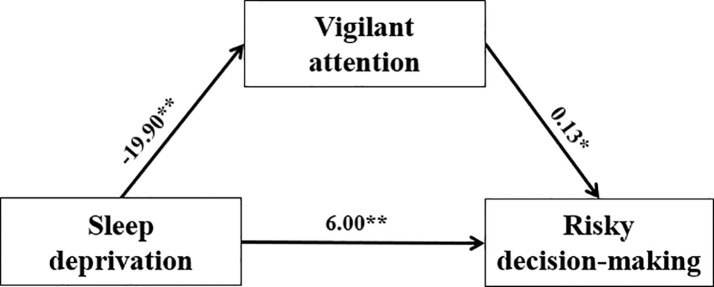
- Vigilant attention partially mediated the effect of sleep deprivation on risky decision-making (Sobel test, z=-1.97, p<0.05; bias-corrected bootstrap 95% CI [-6.00, -0.30]).
Methods
- Thirty-seven male college students in Beijing, China (age 23.18 ± 1.98; BMI 21.50 ± 3.04), with no history of mental health, neurological, or organic disease; participants kept a regular sleep schedule and refrained from alcohol, caffeine, and chocolate for at least 1 week before the study.
- In-laboratory 36-hour sleep deprivation from 7:00 AM, with measures at baseline, 8, 15, 20, 25, 32, and 36 hours: Stanford Sleepiness Scale, stress/fatigue ratings, abbreviated Profile of Mood States, 5-minute Psychomotor Vigilance Test (50 trials), and Game of Dice Task (18 rounds with explicit gain/loss rules).
- Mixed linear models with AR(1) covariance, time as a fixed effect, random intercept, and LSD post hoc comparisons; correlation/partial correlation analyses; mediation analysis using MEMORE Model 1 for two-instance repeated measures with 5,000 bootstrap resamples.
Limitations
- The paper states that the number of participants was limited due to the long experiment and many test items, so the mediation effect of vigilant attention is exploratory; subjective scales were sensitive within subjects but between-subject differences were small, reducing correlations with other indicators; and the college-student sample has low ecological validity, with future research needed in workers, doctors, and other groups.
- Evident from the text: the study used a single-arm, within-subject design without a non-sleep-deprived control group, and only male participants were included, limiting generalizability to women.
Model-written summary. Check it against the paper before relying on it.
Integrity signals
Registry
Cites
Statistics
Figures
Verification
Claims the paper makes
44 Own result · 14 Check pending · 13 Own interpretation · 5 Own method · 5 No basis given · 3 Not checked yet · 2 No full text of the sources · 1 Supported so far
A result the paper reports from its own data — it cites no other source for it, so there is none to check. The quote shows it is in the paper.
In the paper
“The 15th, 20th, 25th, 32nd, and 36th hours were statistically significant (ps<0.01) when compared to the baseline.”
§ Sleep deprivation alters utilization of negative feedback in risky decision-making > Results > Fatigue, sleepiness, and pressure
plaindirect- Asserted: passes — The authors put it forward as true.
- Checkable: passes — It can be checked against evidence.
- Load-bearing: unclear — It is unclear whether the paper’s conclusions depend on it.
- Based: passes — The paper gives a reason why it holds.
A result the paper reports from its own data — it cites no other source for it, so there is none to check. The quote shows it is in the paper.
In the paper
“Meanwhile, compared to baseline, vigor was significant from the 8th hour, and self-esteem was significant from the 15th hour (ps<0.05).”
§ Sleep deprivation alters utilization of negative feedback in risky decision-making > Results > Affect response
plaincorrelational- Asserted: passes — The authors put it forward as true.
- Checkable: passes — It can be checked against evidence.
- Load-bearing: unclear — It is unclear whether the paper’s conclusions depend on it.
- Based: passes — The paper gives a reason why it holds.
A result the paper reports from its own data — it cites no other source for it, so there is none to check. The quote shows it is in the paper.
In the paper
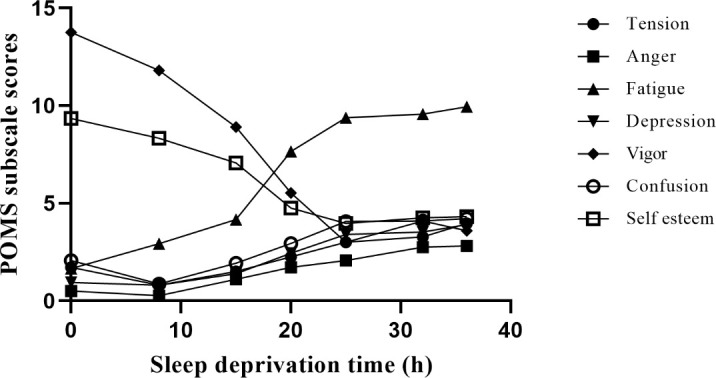
“In negative emotions, compared to baseline, fatigue was significant from the 8th hour, anger from the 15th hour, depression from the 20th hour, and confusion and tension from the 25th hour (ps<0.05).”
§ Sleep deprivation alters utilization of negative feedback in risky decision-making > Results > Affect response
plaindirect- Asserted: passes — The authors put it forward as true.
- Checkable: passes — It can be checked against evidence.
- Load-bearing: unclear — It is unclear whether the paper’s conclusions depend on it.
- Based: passes — The paper gives a reason why it holds.
A result the paper reports from its own data — it cites no other source for it, so there is none to check. The quote shows it is in the paper.
In the paper
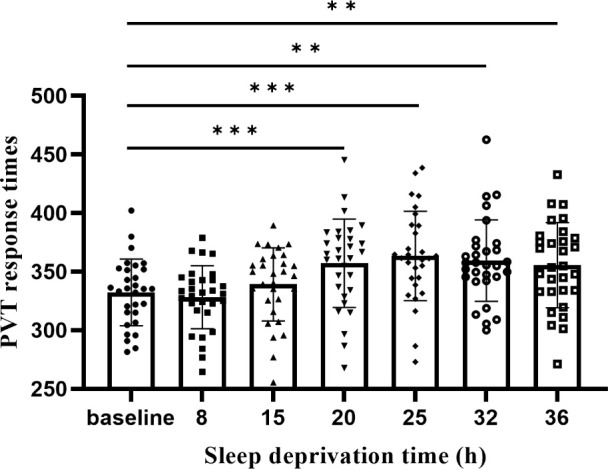
“the result showed that the differences between the mean PVT RTs at different time points were statistically significant [F(6,181) = 5.20, p<0.001].”
§ Sleep deprivation alters utilization of negative feedback in risky decision-making > Results > PVT
plain- Asserted: passes — The authors put it forward as true.
- Checkable: passes — It can be checked against evidence.
- Load-bearing: unclear — It is unclear whether the paper’s conclusions depend on it.
- Based: passes — The paper gives a reason why it holds.
A result the paper reports from its own data — it cites no other source for it, so there is none to check. The quote shows it is in the paper.
In the paper
“the mixed liner model of POMS revealed an increase of five subscales related to negative emotion (tension, fatigue, anger, depression, and confusion; ps<0.01) and a decrease of two subscales of positive affection (vigor and esteem-related affect; ps<0.01) with the duration of SD.”
§ Sleep deprivation alters utilization of negative feedback in risky decision-making > Results > Affect response
plaindirect- Asserted: passes — The authors put it forward as true.
- Checkable: passes — It can be checked against evidence.
- Load-bearing: unclear — It is unclear whether the paper’s conclusions depend on it.
- Based: passes — The paper gives a reason why it holds.
A result the paper reports from its own data — it cites no other source for it, so there is none to check. The quote shows it is in the paper.
In the paper
“There was no difference (ps> 0.05) between the 8th, 15th, 20th, 25th, and 32nd hours.”
§ Sleep deprivation alters utilization of negative feedback in risky decision-making > Results > GDT
plain- Asserted: passes — The authors put it forward as true.
- Checkable: passes — It can be checked against evidence.
- Load-bearing: unclear — It is unclear whether the paper’s conclusions depend on it.
- Based: passes — The paper gives a reason why it holds.
A result the paper reports from its own data — it cites no other source for it, so there is none to check. The quote shows it is in the paper.
In the paper
“There was no difference in the net scores between the 20th, 32nd, and 36th hours (ps>0.05).”
§ Sleep deprivation alters utilization of negative feedback in risky decision-making > Results > GDT
plain- Asserted: passes — The authors put it forward as true.
- Checkable: passes — It can be checked against evidence.
- Load-bearing: unclear — It is unclear whether the paper’s conclusions depend on it.
- Based: passes — The paper gives a reason why it holds.
A result the paper reports from its own data — it cites no other source for it, so there is none to check. The quote shows it is in the paper.
In the paper
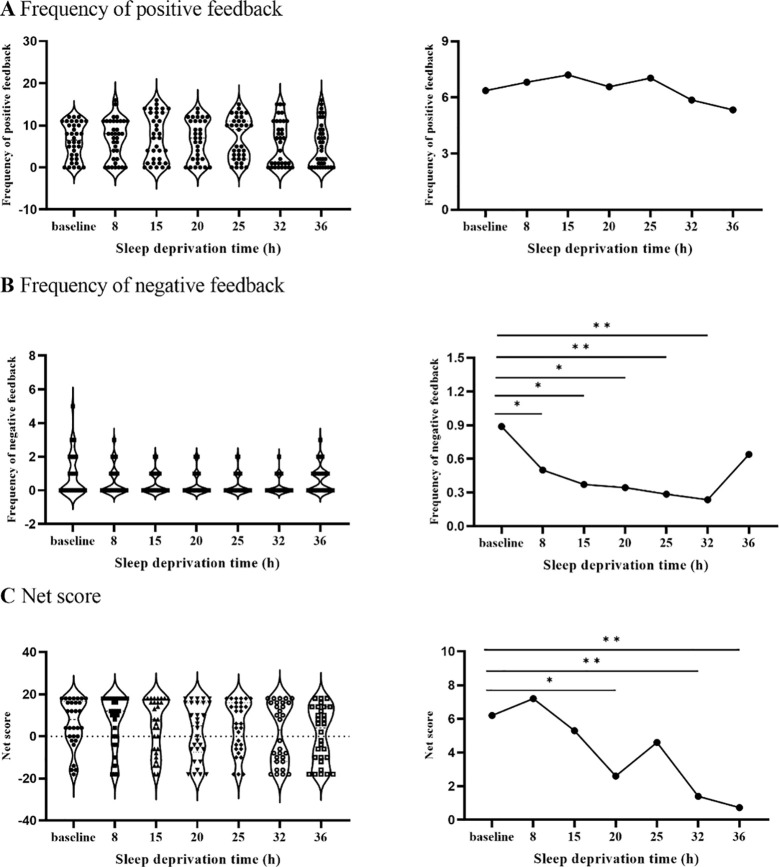
“When compared to the baseline, the differences between the 8th, 15th, 20th, 25th, and 32nd hours were statistically significant (ps<0.05, Figure 4 ).”
§ Sleep deprivation alters utilization of negative feedback in risky decision-making > Results > GDT
plain- Asserted: passes — The authors put it forward as true.
- Checkable: passes — It can be checked against evidence.
- Load-bearing: passes — The paper’s conclusions depend on it.
- Based: passes — The paper gives a reason why it holds.
A result the paper reports from its own data — it cites no other source for it, so there is none to check. The quote shows it is in the paper.
In the paper
“Meanwhile, compared to baseline, vigor was significant from the 8th hour, and self-esteem was significant from the 15th hour (ps<0.05).”
§ Sleep deprivation alters utilization of negative feedback in risky decision-making > Results > Affect response
plaindirect- Asserted: passes — The authors put it forward as true.
- Checkable: passes — It can be checked against evidence.
- Load-bearing: unclear — It is unclear whether the paper’s conclusions depend on it.
- Based: passes — The paper gives a reason why it holds.
A result the paper reports from its own data — it cites no other source for it, so there is none to check. The quote shows it is in the paper.
In the paper
“The difference in weariness was found to be statistically significant at seven time periods [F(6,111)=24.49, p<0.001].”
§ Sleep deprivation alters utilization of negative feedback in risky decision-making > Results > Fatigue, sleepiness, and pressure
plain- Asserted: passes — The authors put it forward as true.
- Checkable: passes — It can be checked against evidence.
- Load-bearing: unclear — It is unclear whether the paper’s conclusions depend on it.
- Based: passes — The paper gives a reason why it holds.
A result the paper reports from its own data — it cites no other source for it, so there is none to check. The quote shows it is in the paper.
In the paper
“The differences between the 20th, 32nd, and 36th hours were statistically significant compared with the baseline (ps<0.05).”
§ Sleep deprivation alters utilization of negative feedback in risky decision-making > Results > GDT
plain- Asserted: passes — The authors put it forward as true.
- Checkable: passes — It can be checked against evidence.
- Load-bearing: passes — The paper’s conclusions depend on it.
- Based: passes — The paper gives a reason why it holds.
A result the paper reports from its own data — it cites no other source for it, so there is none to check. The quote shows it is in the paper.
In the paper
“The pressure difference between time points was statistically significant [F(6,160)=6.13, p<0.001].”
§ Sleep deprivation alters utilization of negative feedback in risky decision-making > Results > Fatigue, sleepiness, and pressure
plain- Asserted: passes — The authors put it forward as true.
- Checkable: passes — It can be checked against evidence.
- Load-bearing: unclear — It is unclear whether the paper’s conclusions depend on it.
- Based: passes — The paper gives a reason why it holds.
A result the paper reports from its own data — it cites no other source for it, so there is none to check. The quote shows it is in the paper.
In the paper
“In negative emotions, compared to baseline, fatigue was significant from the 8th hour, anger from the 15th hour, depression from the 20th hour, and confusion and tension from the 25th hour (ps<0.05).”
§ Sleep deprivation alters utilization of negative feedback in risky decision-making > Results > Affect response
plaindirect- Asserted: passes — The authors put it forward as true.
- Checkable: passes — It can be checked against evidence.
- Load-bearing: unclear — It is unclear whether the paper’s conclusions depend on it.
- Based: passes — The paper gives a reason why it holds.
A result the paper reports from its own data — it cites no other source for it, so there is none to check. The quote shows it is in the paper.
In the paper
“A mediation analysis further confirmed that the level of SD impacted risk decision-making through decreasing vigilant attention (Sobel test, z = -1.97, p <0.05, partial mediation; Figure 5 ).”
§ Sleep deprivation alters utilization of negative feedback in risky decision-making > Results > Mediation analysis of repeated measurement data
boosteddirect- Asserted: passes — The authors put it forward as true.
- Checkable: passes — It can be checked against evidence.
- Load-bearing: passes — The paper’s conclusions depend on it.
- Based: passes — The paper gives a reason why it holds.
A result the paper reports from its own data — it cites no other source for it, so there is none to check. The quote shows it is in the paper.
In the paper
“(A) illustrates that the frequency of positive feedback did not change after SD.”
- Also stated in: § Results · plain
“Interestingly, participants’ ability to employ positive feedback was maintained, whereas their performance to utilize negative feedback was impaired even after 8 hours of sleep deprivation.”
§ Sleep deprivation alters utilization of negative feedback in risky decision-making > Results > GDT
plain- Asserted: passes — The authors put it forward as true.
- Checkable: passes — It can be checked against evidence.
- Load-bearing: passes — The paper’s conclusions depend on it.
- Based: passes — The paper gives a reason why it holds.
- Also stated in: § Results · plain
A result the paper reports from its own data — it cites no other source for it, so there is none to check. The quote shows it is in the paper.
In the paper
“Compared to baseline, the 15th, 20th, 25th, 32nd, and 36th hours were statistically significant (ps<0.01), with the 36th hour having the highest significance (t=9.56, 0.001).”
§ Sleep deprivation alters utilization of negative feedback in risky decision-making > Results > Fatigue, sleepiness, and pressure
plaindirect- Asserted: passes — The authors put it forward as true.
- Checkable: passes — It can be checked against evidence.
- Load-bearing: unclear — It is unclear whether the paper’s conclusions depend on it.
- Based: passes — The paper gives a reason why it holds.
A result the paper reports from its own data — it cites no other source for it, so there is none to check. The quote shows it is in the paper.
In the paper
“A bias-corrected bootstrap resampling analysis (5,000 resamples) of the effect size indicated that the mediator effect was different from zero with 95% confidence ([-6.00, -0.30]).”
§ Sleep deprivation alters utilization of negative feedback in risky decision-making > Results > Mediation analysis of repeated measurement data
hedgeddirect- Asserted: passes — The authors put it forward as true.
- Checkable: passes — It can be checked against evidence.
- Load-bearing: passes — The paper’s conclusions depend on it.
- Based: passes — The paper gives a reason why it holds.
A result the paper reports from its own data — it cites no other source for it, so there is none to check. The quote shows it is in the paper.
In the paper
“Compared to baseline, the 15th, 20th, 25th, 32nd, and 36th hours were statistically significant (ps<0.01), with the 36th hour having the highest significance (t=8.15, p<0.001).”
§ Sleep deprivation alters utilization of negative feedback in risky decision-making > Results > Fatigue, sleepiness, and pressure
plain- Asserted: passes — The authors put it forward as true.
- Checkable: passes — It can be checked against evidence.
- Load-bearing: unclear — It is unclear whether the paper’s conclusions depend on it.
- Based: passes — The paper gives a reason why it holds.
A result the paper reports from its own data — it cites no other source for it, so there is none to check. The quote shows it is in the paper.
In the paper
“(C) illustrates that the net score decreased significantly after 20 hours of SD.”
§ Sleep deprivation alters utilization of negative feedback in risky decision-making > Results > GDT
boosteddirect- Asserted: passes — The authors put it forward as true.
- Checkable: passes — It can be checked against evidence.
- Load-bearing: passes — The paper’s conclusions depend on it.
- Based: passes — The paper gives a reason why it holds.
A result the paper reports from its own data — it cites no other source for it, so there is none to check. The quote shows it is in the paper.
In the paper
“There was no difference between the 20th, 25th, 32nd, and 36th hours (ps> 0.05).”
§ Sleep deprivation alters utilization of negative feedback in risky decision-making > Results > PVT
plain- Asserted: passes — The authors put it forward as true.
- Checkable: passes — It can be checked against evidence.
- Load-bearing: unclear — It is unclear whether the paper’s conclusions depend on it.
- Based: passes — The paper gives a reason why it holds.
A result the paper reports from its own data — it cites no other source for it, so there is none to check. The quote shows it is in the paper.
In the paper
“The findings revealed that the variations in sleepiness at various time points were statistically significant [F(6,137)=15.60, p<0.001].”
§ Sleep deprivation alters utilization of negative feedback in risky decision-making > Results > Fatigue, sleepiness, and pressure
plain- Asserted: passes — The authors put it forward as true.
- Checkable: passes — It can be checked against evidence.
- Load-bearing: unclear — It is unclear whether the paper’s conclusions depend on it.
- Based: passes — The paper gives a reason why it holds.
A result the paper reports from its own data — it cites no other source for it, so there is none to check. The quote shows it is in the paper.
In the paper
“The results showed that there were statistically significant differences in the frequency of negative feedback from GDT at different time points [F(6,137)=3.01, p<0.01].”
§ Sleep deprivation alters utilization of negative feedback in risky decision-making > Results > GDT
plain- Asserted: passes — The authors put it forward as true.
- Checkable: passes — It can be checked against evidence.
- Load-bearing: unclear — It is unclear whether the paper’s conclusions depend on it.
- Based: passes — The paper gives a reason why it holds.
A result the paper reports from its own data — it cites no other source for it, so there is none to check. The quote shows it is in the paper.
In the paper
“The result showed that the differences between the net scores of GDT at different time points were statistically significant [F(6,130) = 3.15, p<0.01].”
§ Sleep deprivation alters utilization of negative feedback in risky decision-making > Results > GDT
plain- Asserted: passes — The authors put it forward as true.
- Checkable: passes — It can be checked against evidence.
- Load-bearing: passes — The paper’s conclusions depend on it.
- Based: passes — The paper gives a reason why it holds.
A result the paper reports from its own data — it cites no other source for it, so there is none to check. The quote shows it is in the paper.
In the paper
“The differences between the 20th, 25th, 32nd, and 36th hours were statistically significant compared with the baseline (ps<0.01).”
§ Sleep deprivation alters utilization of negative feedback in risky decision-making > Results > PVT
plaindirect- Asserted: passes — The authors put it forward as true.
- Checkable: passes — It can be checked against evidence.
- Load-bearing: unclear — It is unclear whether the paper’s conclusions depend on it.
- Based: passes — The paper gives a reason why it holds.
A result the paper reports from its own data — it cites no other source for it, so there is none to check. The quote shows it is in the paper.
In the paper
“In negative emotions, compared to baseline, fatigue was significant from the 8th hour, anger from the 15th hour, depression from the 20th hour, and confusion and tension from the 25th hour (ps<0.05).”
§ Sleep deprivation alters utilization of negative feedback in risky decision-making > Results > Affect response
plaindirect- Asserted: passes — The authors put it forward as true.
- Checkable: passes — It can be checked against evidence.
- Load-bearing: unclear — It is unclear whether the paper’s conclusions depend on it.
- Based: passes — The paper gives a reason why it holds.
A result the paper reports from its own data — it cites no other source for it, so there is none to check. The quote shows it is in the paper.
In the paper
“the mixed liner model of POMS revealed an increase of five subscales related to negative emotion (tension, fatigue, anger, depression, and confusion; ps<0.01) and a decrease of two subscales of positive affection (vigor and esteem-related affect; ps<0.01) with the duration of SD.”
§ Sleep deprivation alters utilization of negative feedback in risky decision-making > Results > Affect response
plaindirect- Asserted: passes — The authors put it forward as true.
- Checkable: passes — It can be checked against evidence.
- Load-bearing: unclear — It is unclear whether the paper’s conclusions depend on it.
- Based: passes — The paper gives a reason why it holds.
The paper states this without a source or data behind it here, so there is nothing to check it against. The quote shows it is in the paper.
In the paper
“Interestingly, we found that after 24 hours, vigilant attention was slightly restored.”
§ Sleep deprivation alters utilization of negative feedback in risky decision-making > Discussion
plaindirect- Asserted: passes — The authors put it forward as true.
- Checkable: passes — It can be checked against evidence.
- Load-bearing: unclear — It is unclear whether the paper’s conclusions depend on it.
- Based: passes — The paper gives a reason why it holds.
A result the paper reports from its own data — it cites no other source for it, so there is none to check. The quote shows it is in the paper.
In the paper
“In the context of decision-making under risk, GDT net scores and the frequency of negative feedback decreased as SD increased, reflecting risk propensity increasing.”
§ Sleep deprivation alters utilization of negative feedback in risky decision-making > Discussion
plaincorrelational- Asserted: passes — The authors put it forward as true.
- Checkable: passes — It can be checked against evidence.
- Load-bearing: passes — The paper’s conclusions depend on it.
- Based: passes — The paper gives a reason why it holds.
The paper states this without a source or data behind it here, so there is nothing to check it against. The quote shows it is in the paper.
In the paper
“Furthermore, sleep deprivation influences risk decision-making ability, with negative feedback processing being particularly affected even at 8 hours of deprivation.”
§ Sleep deprivation alters utilization of negative feedback in risky decision-making > Conclusions
plaindirect- Asserted: passes — The authors put it forward as true.
- Checkable: passes — It can be checked against evidence.
- Load-bearing: passes — The paper’s conclusions depend on it.
- Based: passes — The paper gives a reason why it holds.
A result the paper reports from its own data — it cites no other source for it, so there is none to check. The quote shows it is in the paper.
In the paper
“In the context of decision-making under risk, GDT net scores and the frequency of negative feedback decreased as SD increased, reflecting risk propensity increasing.”
§ Sleep deprivation alters utilization of negative feedback in risky decision-making > Discussion
plaincorrelational- Asserted: passes — The authors put it forward as true.
- Checkable: passes — It can be checked against evidence.
- Load-bearing: passes — The paper’s conclusions depend on it.
- Based: passes — The paper gives a reason why it holds.
A result the paper reports from its own data — it cites no other source for it, so there is none to check. The quote shows it is in the paper.
In the paper
“Interestingly, participants’ ability to employ positive feedback was maintained, whereas their performance to utilize negative feedback was impaired even after 8 hours of sleep deprivation.”
§ Sleep deprivation alters utilization of negative feedback in risky decision-making > Abstract > Results
plain- Asserted: passes — The authors put it forward as true.
- Checkable: passes — It can be checked against evidence.
- Load-bearing: passes — The paper’s conclusions depend on it.
- Based: passes — The paper gives a reason why it holds.
A result the paper reports from its own data — it cites no other source for it, so there is none to check. The quote shows it is in the paper.
In the paper
“Interestingly, we found that the influence of SD on individuals’ responsiveness to negative feedback manifested significantly after 8 hours of SD.”
- Also stated in: § Discussion · hedged
“Despite these shortcomings, this study observed a dynamic effect of sleep deprivation on negative feedback in risky decision-making, which appeared after 8 hours of SD.”
§ Sleep deprivation alters utilization of negative feedback in risky decision-making > Discussion
plaindirect- Asserted: passes — The authors put it forward as true.
- Checkable: passes — It can be checked against evidence.
- Load-bearing: passes — The paper’s conclusions depend on it.
- Based: passes — The paper gives a reason why it holds.
- Also stated in: § Discussion · hedged
A result the paper reports from its own data — it cites no other source for it, so there is none to check. The quote shows it is in the paper.
In the paper
“Interestingly, participants’ ability to employ positive feedback was maintained, whereas their performance to utilize negative feedback was impaired even after 8 hours of sleep deprivation.”
§ Sleep deprivation alters utilization of negative feedback in risky decision-making > Abstract > Results
plaindirect- Asserted: passes — The authors put it forward as true.
- Checkable: passes — It can be checked against evidence.
- Load-bearing: passes — The paper’s conclusions depend on it.
- Based: passes — The paper gives a reason why it holds.
A result the paper reports from its own data — it cites no other source for it, so there is none to check. The quote shows it is in the paper.
In the paper
“We found that vigilant attention acted as a mediator between SD and risky decision-making.”
- Also stated in: § Conclusions · hedged
“Additionally, it seems possible that vigilant attention served as a go-between for SD and risky decision-making.”
§ Sleep deprivation alters utilization of negative feedback in risky decision-making > Discussion
plaindirect- Asserted: passes — The authors put it forward as true.
- Checkable: passes — It can be checked against evidence.
- Load-bearing: passes — The paper’s conclusions depend on it.
- Based: passes — The paper gives a reason why it holds.
- Also stated in: § Conclusions · hedged
A result the paper reports from its own data — it cites no other source for it, so there is none to check. The quote shows it is in the paper.
In the paper
“In summary, this study has identified that sleep deprivation has a detrimental effect on individuals’ arousal, emotional state, and vigilant attention, and this effect is consistently seen 15 to 20 hours after sleep deprivation.”
§ Sleep deprivation alters utilization of negative feedback in risky decision-making > Conclusions
plaindirect- Asserted: passes — The authors put it forward as true.
- Checkable: passes — It can be checked against evidence.
- Load-bearing: passes — The paper’s conclusions depend on it.
- Based: passes — The paper gives a reason why it holds.
The paper states this without a source or data behind it here, so there is nothing to check it against. The quote shows it is in the paper.
In the paper
“This dynamic change declined rapidly at first and then slowly.”
§ Sleep deprivation alters utilization of negative feedback in risky decision-making > Discussion
plain- Asserted: passes — The authors put it forward as true.
- Checkable: passes — It can be checked against evidence.
- Load-bearing: unclear — It is unclear whether the paper’s conclusions depend on it.
- Based: passes — The paper gives a reason why it holds.
A result the paper reports from its own data — it cites no other source for it, so there is none to check. The quote shows it is in the paper.
In the paper
“In summary, this study has identified that sleep deprivation has a detrimental effect on individuals’ arousal, emotional state, and vigilant attention, and this effect is consistently seen 15 to 20 hours after sleep deprivation.”
§ Sleep deprivation alters utilization of negative feedback in risky decision-making > Conclusions
plaindirect- Asserted: passes — The authors put it forward as true.
- Checkable: passes — It can be checked against evidence.
- Load-bearing: passes — The paper’s conclusions depend on it.
- Based: passes — The paper gives a reason why it holds.
A result the paper reports from its own data — it cites no other source for it, so there is none to check. The quote shows it is in the paper.
In the paper
“In the study, after 36 hours of SD, PVT-RTs increased, reflecting vigilant attention decreased.”
§ Sleep deprivation alters utilization of negative feedback in risky decision-making > Discussion
plaindirect- Asserted: passes — The authors put it forward as true.
- Checkable: passes — It can be checked against evidence.
- Load-bearing: unclear — It is unclear whether the paper’s conclusions depend on it.
- Based: passes — The paper gives a reason why it holds.
A result the paper reports from its own data — it cites no other source for it, so there is none to check. The quote shows it is in the paper.
In the paper
“Meanwhile, we found that SD led to decreased sensitivity to negative feedback.”
- Also stated in: § Discussion · hedged
“This suggests that participants’ sensitivity to negative feedback decreased as SD increased.”
§ Sleep deprivation alters utilization of negative feedback in risky decision-making > Discussion
plaindirect- Asserted: passes — The authors put it forward as true.
- Checkable: passes — It can be checked against evidence.
- Load-bearing: passes — The paper’s conclusions depend on it.
- Based: passes — The paper gives a reason why it holds.
- Also stated in: § Discussion · hedged
The paper states this without a source or data behind it here, so there is nothing to check it against. The quote shows it is in the paper.
In the paper
“SD could directly predict risky decisions.”
§ Sleep deprivation alters utilization of negative feedback in risky decision-making > Discussion
hedgedconditional- Asserted: passes — The authors put it forward as true.
- Checkable: passes — It can be checked against evidence.
- Load-bearing: passes — The paper’s conclusions depend on it.
- Based: passes — The paper gives a reason why it holds.
A result the paper reports from its own data — it cites no other source for it, so there is none to check. The quote shows it is in the paper.
In the paper
“Furthermore, sleep deprivation influences risk decision-making ability, with negative feedback processing being particularly affected even at 8 hours of deprivation.”
§ Sleep deprivation alters utilization of negative feedback in risky decision-making > Conclusions
plaindirect- Asserted: passes — The authors put it forward as true.
- Checkable: passes — It can be checked against evidence.
- Load-bearing: passes — The paper’s conclusions depend on it.
- Based: passes — The paper gives a reason why it holds.
A result the paper reports from its own data — it cites no other source for it, so there is none to check. The quote shows it is in the paper.
In the paper
“In summary, this study has identified that sleep deprivation has a detrimental effect on individuals’ arousal, emotional state, and vigilant attention, and this effect is consistently seen 15 to 20 hours after sleep deprivation.”
§ Sleep deprivation alters utilization of negative feedback in risky decision-making > Conclusions
plaindirect- Asserted: passes — The authors put it forward as true.
- Checkable: passes — It can be checked against evidence.
- Load-bearing: passes — The paper’s conclusions depend on it.
- Based: passes — The paper gives a reason why it holds.
The paper states this without a source or data behind it here, so there is nothing to check it against. The quote shows it is in the paper.
In the paper
“In summary, this study has identified that sleep deprivation has a detrimental effect on individuals’ arousal, emotional state, and vigilant attention, and this effect is consistently seen 15 to 20 hours after sleep deprivation.”
§ Sleep deprivation alters utilization of negative feedback in risky decision-making > Conclusions
plaindirect- Asserted: passes — The authors put it forward as true.
- Checkable: passes — It can be checked against evidence.
- Load-bearing: passes — The paper’s conclusions depend on it.
- Based: passes — The paper gives a reason why it holds.
A conclusion the paper draws from its own results — it cites no other source for it, so there is none to check. The quote shows it is in the paper.
In the paper
“In the present study, the effects on positive moods were greater than those on negative moods, which suggested that the influence of the circadian phase on general negative affect is particularly strong (68).”
§ Sleep deprivation alters utilization of negative feedback in risky decision-making > Discussion
plain- Asserted: passes — The authors put it forward as true.
- Checkable: passes — It can be checked against evidence.
- Load-bearing: unclear — It is unclear whether the paper’s conclusions depend on it.
- Based: passes — The paper gives a reason why it holds.
A conclusion the paper draws from its own results — it cites no other source for it, so there is none to check. The quote shows it is in the paper.
In the paper
“These results suggest that sleep-deprived individuals are unable to use negative feedback to optimize their judgments, which may account for their poor decision-making under risk.”
§ Sleep deprivation alters utilization of negative feedback in risky decision-making > Abstract > Discussion
hedgeddirect- Asserted: passes — The authors put it forward as true.
- Checkable: passes — It can be checked against evidence.
- Load-bearing: passes — The paper’s conclusions depend on it.
- Based: unclear — It is unclear why the paper says it holds.
A conclusion the paper draws from its own results — it cites no other source for it, so there is none to check. The quote shows it is in the paper.
In the paper
“These results suggest that sleep-deprived individuals are unable to use negative feedback to optimize their judgments, which may account for their poor decision-making under risk.”
§ Sleep deprivation alters utilization of negative feedback in risky decision-making > Abstract > Discussion
hedgedconditional- Asserted: passes — The authors put it forward as true.
- Checkable: passes — It can be checked against evidence.
- Load-bearing: passes — The paper’s conclusions depend on it.
- Based: passes — The paper gives a reason why it holds.
A conclusion the paper draws from its own results — it cites no other source for it, so there is none to check. The quote shows it is in the paper.
In the paper
“In the study, after 36 hours of SD, PVT-RTs increased, reflecting vigilant attention decreased.”
§ Sleep deprivation alters utilization of negative feedback in risky decision-making > Discussion
plaindirect- Asserted: passes — The authors put it forward as true.
- Checkable: passes — It can be checked against evidence.
- Load-bearing: unclear — It is unclear whether the paper’s conclusions depend on it.
- Based: passes — The paper gives a reason why it holds.
A conclusion the paper draws from its own results — it cites no other source for it, so there is none to check. The quote shows it is in the paper.
In the paper
“Consequently, participants tended to depend more on their intuition while making decisions.”
§ Sleep deprivation alters utilization of negative feedback in risky decision-making > Discussion
plaindirect- Asserted: passes — The authors put it forward as true.
- Checkable: passes — It can be checked against evidence.
- Load-bearing: passes — The paper’s conclusions depend on it.
- Based: passes — The paper gives a reason why it holds.
A check of a cited source is scheduled, or we don’t hold its full text yet; the claim is checked once it runs.
In the paper
“SD leads to significant impairment of vigilant attention and accelerates alertness decline (70, 71).”
§ Sleep deprivation alters utilization of negative feedback in risky decision-making > Discussion
What the sources say
plaindirect- Asserted: passes — The authors put it forward as true.
- Checkable: passes — It can be checked against evidence.
- Load-bearing: unclear — It is unclear whether the paper’s conclusions depend on it.
- Based: passes — The paper gives a reason why it holds.
A conclusion the paper draws from its own results — it cites no other source for it, so there is none to check. The quote shows it is in the paper.
In the paper
“Our findings suggest that these groups may be at risk for ignoring warnings due to SD and reduce risky behavior by intervening with negative feedback cues.”
§ Sleep deprivation alters utilization of negative feedback in risky decision-making > Discussion
hedgedconditional- Asserted: passes — The authors put it forward as true.
- Checkable: passes — It can be checked against evidence.
- Load-bearing: passes — The paper’s conclusions depend on it.
- Based: passes — The paper gives a reason why it holds.
A conclusion the paper draws from its own results — it cites no other source for it, so there is none to check. The quote shows it is in the paper.
In the paper
“There was a linear relationship between SD and mental states and moods over a 24-hour period.”
§ Sleep deprivation alters utilization of negative feedback in risky decision-making > Discussion
plaincorrelational- Asserted: passes — The authors put it forward as true.
- Checkable: passes — It can be checked against evidence.
- Load-bearing: unclear — It is unclear whether the paper’s conclusions depend on it.
- Based: passes — The paper gives a reason why it holds.
In the paper
“In a decision task, blunted reactions to feedback while sleep-deprived underlie failures to adapt to uncertainty and changing contingencies (78).”
§ Sleep deprivation alters utilization of negative feedback in risky decision-making > Discussion
What the sources say
- Check pendingcites [78] Whitney, 2015, Feedback blunting: total sleep deprivation impairs decision making that requires updating based on feedback, Sleep source
plaindirect- Asserted: passes — The authors put it forward as true.
- Checkable: passes — It can be checked against evidence.
- Load-bearing: passes — The paper’s conclusions depend on it.
- Based: passes — The paper gives a reason why it holds.
A conclusion the paper draws from its own results — it cites no other source for it, so there is none to check. The quote shows it is in the paper.
In the paper
“Taken together, these results suggest that an inability to utilize negative feedback may contribute significantly to poor decision-making in the context of sleep deprivation.”
§ Sleep deprivation alters utilization of negative feedback in risky decision-making > Conclusions
hedgedconditional- Asserted: passes — The authors put it forward as true.
- Checkable: passes — It can be checked against evidence.
- Load-bearing: passes — The paper’s conclusions depend on it.
- Based: passes — The paper gives a reason why it holds.
A conclusion the paper draws from its own results — it cites no other source for it, so there is none to check. The quote shows it is in the paper.
In the paper
“As the duration of SD increases, their ability to effectively utilize negative feedback in evaluating risks diminishes.”
§ Sleep deprivation alters utilization of negative feedback in risky decision-making > Discussion
plaindirect- Asserted: passes — The authors put it forward as true.
- Checkable: passes — It can be checked against evidence.
- Load-bearing: passes — The paper’s conclusions depend on it.
- Based: passes — The paper gives a reason why it holds.
A conclusion the paper draws from its own results — it cites no other source for it, so there is none to check. The quote shows it is in the paper.
In the paper
“In the context of decision-making under risk, GDT net scores and the frequency of negative feedback decreased as SD increased, reflecting risk propensity increasing.”
§ Sleep deprivation alters utilization of negative feedback in risky decision-making > Discussion
plaindirect- Asserted: passes — The authors put it forward as true.
- Checkable: passes — It can be checked against evidence.
- Load-bearing: passes — The paper’s conclusions depend on it.
- Based: passes — The paper gives a reason why it holds.
- Probably not a substantial claim. 25
- It may state two separate claims as one. 13
- The quote only partly states this claim. 1
The sources with a verdict support this claim; the rest weren’t checked yet, have no full text we could read, or their verdicts aren’t rated yet.
In the paper
“The Psychomotor Vigilance Test (PVT) is highly sensitive to behavioral alertness deficits due to sleep loss (31) in both acute SD and partial SD (32).”
§ Sleep deprivation alters utilization of negative feedback in risky decision-making > Introduction
What the sources say
- Check pendingcites [31] Honn, 2022, Paradoxical effects from stimulus density manipulation provide new insight into the impact of sleep deprivation on PVT performance, Sleep Advances: A J Sleep Res Soc source
- Supportedcites [32] Basner, 2011, Validity and sensitivity of a brief psychomotor vigilance test (PVT-B) to total and partial sleep deprivation, Acta astronautica source
The Introduction states that the standard PVT is very sensitive to acute total and chronic partial sleep deprivation. It also identifies the PVT as a measure of behavioral alertness, supporting the claim attributed to this source. (LLM, conf=0.94)
plaindirect- Asserted: passes — The authors put it forward as true.
- Checkable: passes — It can be checked against evidence.
- Load-bearing: fails — The paper’s conclusions may not depend on it.
- Based: passes — The paper gives a reason why it holds.
Probably not a substantial claim. The paper’s conclusions may not depend on it.
A result the paper reports from its own data — it cites no other source for it, so there is none to check. The quote shows it is in the paper.
In the paper
“Our findings revealed no significant correlations among these variables.”
§ Sleep deprivation alters utilization of negative feedback in risky decision-making > Methods > Participants
plain- Asserted: passes — The authors put it forward as true.
- Checkable: passes — It can be checked against evidence.
- Load-bearing: fails — The paper’s conclusions may not depend on it.
- Based: passes — The paper gives a reason why it holds.
Probably not a substantial claim. The paper’s conclusions may not depend on it.
A result the paper reports from its own data — it cites no other source for it, so there is none to check. The quote shows it is in the paper.
In the paper
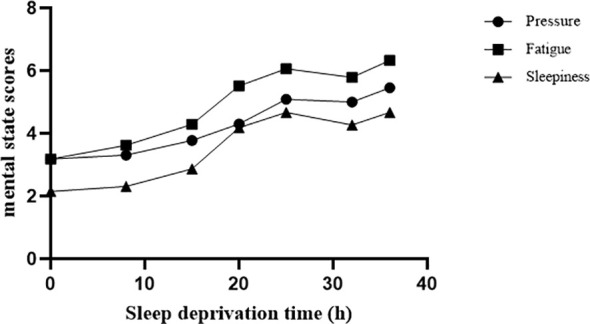
“As shown in Figure 1 , fatigue, sleepiness and pressure increased with the duration of SD.”
§ Sleep deprivation alters utilization of negative feedback in risky decision-making > Results > Fatigue, sleepiness, and pressure
plaindirect- Asserted: passes — The authors put it forward as true.
- Checkable: passes — It can be checked against evidence.
- Load-bearing: unclear — It is unclear whether the paper’s conclusions depend on it.
- Based: passes — The paper gives a reason why it holds.
It may state two separate claims as one.
A result the paper reports from its own data — it cites no other source for it, so there is none to check. The quote shows it is in the paper.
In the paper
“Pearson correlation coefficients of five subscales related to negative emotion (e.g., anger and fatigue) were significant after 36 hours of SD (ps<0.01), and the Pearson correlation coefficient of two subscales related to positive emotion (i.e., vigor and tension) was significant after 36 hours of SD (p<0.01).”
§ Sleep deprivation alters utilization of negative feedback in risky decision-making > Results > Affect response
plaincorrelational- Asserted: passes — The authors put it forward as true.
- Checkable: passes — It can be checked against evidence.
- Load-bearing: fails — The paper’s conclusions may not depend on it.
- Based: passes — The paper gives a reason why it holds.
Probably not a substantial claim. The paper’s conclusions may not depend on it.
A result the paper reports from its own data — it cites no other source for it, so there is none to check. The quote shows it is in the paper.
In the paper
“Meanwhile, the Pearson correlation coefficients of sleepiness and fatigue were significant at different time points (ps<0.01).”
§ Sleep deprivation alters utilization of negative feedback in risky decision-making > Results > Fatigue, sleepiness, and pressure
plaincorrelational- Asserted: passes — The authors put it forward as true.
- Checkable: passes — It can be checked against evidence.
- Load-bearing: fails — The paper’s conclusions may not depend on it.
- Based: passes — The paper gives a reason why it holds.
Probably not a substantial claim. The paper’s conclusions may not depend on it.
In the paper
“Studies have shown that SD decreases attention span and reduces vigilant attention (2, 26, 27).”
§ Sleep deprivation alters utilization of negative feedback in risky decision-making > Introduction
What the sources say
- Check pendingcites [2] Schumann, 2022, Restoration of attention by rest in a multitasking world: Theory, methodology, and empirical evidence, Front Psychol source
- Not checked — no full text of the sourcecites [26] Rosenbloom, 2018, Assessment of performance impairment after short naps with and without sleep inertia, Transportation Res Part Ftraffic Psychol Behav source
- Not checked — no full text of the sourcecites [27] Thomas, 2000, Neural basis of alertness and cognitive performance impairments during sleepiness. I. Effects of 24 h of sleep deprivation on waking human regional brain activity, J Sleep Res source
boosteddirect- Asserted: passes — The authors put it forward as true.
- Checkable: passes — It can be checked against evidence.
- Load-bearing: passes — The paper’s conclusions depend on it.
- Based: passes — The paper gives a reason why it holds.
It may state two separate claims as one.
In the paper
“Studies of patients with attention-deficit/hyperactivity disorder (ADHD) have confirmed that vigilant attention has been found to heavily influence inappropriate or risky decisions (36–38).”
§ Sleep deprivation alters utilization of negative feedback in risky decision-making > Introduction
What the sources say
- Not checked — no full text of the sourcecites [36] Dekkers, 2016, Risky decision making in attention-deficit/hyperactivity disorder: A meta-regression analysis, Clin Psychol Rev source
- Check pendingcites [37] Ibanez, 2012, The neural basis of decision-making and reward processing in adults with euthymic bipolar disorder or attention-deficit/hyperactivity disorder (ADHD), PloS One source
- Check pendingcites [38] Williams, 2006, The evolution of hyperactivity, impulsivity and cognitive diversity, J R Soc Interface source
boosteddirect- Asserted: passes — The authors put it forward as true.
- Checkable: passes — It can be checked against evidence.
- Load-bearing: passes — The paper’s conclusions depend on it.
- Based: passes — The paper gives a reason why it holds.
Probably not a substantial claim.
In the paper
“The GDT can be considered a well-established task to measure decision-making in laboratory situations, showing good criterion validity and good discriminant validity (25, 59).”
§ Sleep deprivation alters utilization of negative feedback in risky decision-making > Methods > GDT
What the sources say
- Not checked — no full text of the sourcecites [25] Bayard, 2011, Do facets of self-reported impulsivity predict decision-making under ambiguity and risk? Evidence from a community sample, Psychiatry Res source
- Check pendingcites [59] Schäfer, 2020, The Cards and Lottery Task: Validation of a new paradigm assessing decision making under risk in individuals with severe obesity, Front Psychiatry source
boosted- Asserted: passes — The authors put it forward as true.
- Checkable: passes — It can be checked against evidence.
- Load-bearing: fails — The paper’s conclusions may not depend on it.
- Based: passes — The paper gives a reason why it holds.
Probably not a substantial claim. The paper’s conclusions may not depend on it. It may state two separate claims as one.
In the paper
“Meanwhile, acute SD has been shown to significantly impair various cognitive capabilities, including working memory, cognitive control, and emotional regulation (10–13).”
§ Sleep deprivation alters utilization of negative feedback in risky decision-making > Introduction
What the sources say
- Not checked — no full text of the sourcecites [10] Giacobbo, 2016, Could BDNF be involved in compensatory mechanisms to maintain cognitive performance despite acute sleep deprivation? An exploratory study, Int J Psychophysiol source
- Not checked — no full text of the sourcecites [11] Li, 2022, Effects of total sleep deprivation on execution lapses during vigilance tasks, Chronobiology Int source
- Check pendingcites [12] Peng, 2023, Recovery sleep attenuates impairments in working memory following total sleep deprivation, Front Neurosci source
- Not checked yetcites [13] Tomaso, 2021, The effect of sleep deprivation and restriction on mood, emotion, and emotion regulation: three meta-analyses in one, Sleep source
boosteddirect- Asserted: passes — The authors put it forward as true.
- Checkable: passes — It can be checked against evidence.
- Load-bearing: fails — The paper’s conclusions may not depend on it.
- Based: passes — The paper gives a reason why it holds.
Probably not a substantial claim. The paper’s conclusions may not depend on it. It may state two separate claims as one.
In the paper
“An earlier SD study by Kaida and Niki (45), showed an increase in negative affect (POMS: the POMS subscale scores of sleepiness, confusion, fatigue, and anger) and a decrease in positive affect (the POMS subscale scores of vigor).”
§ Sleep deprivation alters utilization of negative feedback in risky decision-making > Introduction
What the sources say
- Check pendingcites [45] Kaida, 2013, Total sleep deprivation decreases flow experience and mood status, Neuropsychiatr Dis Treat source
plaindirect- Asserted: passes — The authors put it forward as true.
- Checkable: passes — It can be checked against evidence.
- Load-bearing: fails — The paper’s conclusions may not depend on it.
- Based: passes — The paper gives a reason why it holds.
Probably not a substantial claim. The paper’s conclusions may not depend on it. It may state two separate claims as one.
What the paper did — it cites no source for this, so there is none to check. The quote shows it is in the paper.
In the paper
“The Cronbach’s alphas in our study were 0.83.”
§ Sleep deprivation alters utilization of negative feedback in risky decision-making > Methods > Subjective scale
plain- Asserted: passes — The authors put it forward as true.
- Checkable: passes — It can be checked against evidence.
- Load-bearing: fails — The paper’s conclusions may not depend on it.
- Based: passes — The paper gives a reason why it holds.
Probably not a substantial claim. The paper’s conclusions may not depend on it.
In the paper
“Whether it is subjective scale (40), heart rate variability analysis (41, 42), or electroencephalograph (EEG) analysis (43), SD increased fatigue and sleepiness.”
§ Sleep deprivation alters utilization of negative feedback in risky decision-making > Introduction
What the sources say
- Check pendingcites [40] Wali, 2013, Effect of on-call-related sleep deprivation on physicians’ mood and alertness, Ann Thorac Med source
- Not checked — no full text of the sourcecites [41] Vicente, 2011, Detection of driver’s drowsiness by means of HRV analysis
- Not checked — no full text of the sourcecites [42] Vicente, 2016, Drowsiness detection using heart rate variability, Med Biol Eng computing source
- Not checked — no full text of the sourcecites [43] Smith, 2002, The impact of moderate sleep loss on neurophysiologic signals during working-memory task performance, Sleep source
plaindirect- Asserted: passes — The authors put it forward as true.
- Checkable: passes — It can be checked against evidence.
- Load-bearing: fails — The paper’s conclusions may not depend on it.
- Based: passes — The paper gives a reason why it holds.
Probably not a substantial claim. The paper’s conclusions may not depend on it. It may state two separate claims as one.
What the paper did — it cites no source for this, so there is none to check. The quote shows it is in the paper.
In the paper
“The Cronbach’s alphas in the study were 0.79.”
§ Sleep deprivation alters utilization of negative feedback in risky decision-making > Methods > Subjective scale
plain- Asserted: passes — The authors put it forward as true.
- Checkable: passes — It can be checked against evidence.
- Load-bearing: fails — The paper’s conclusions may not depend on it.
- Based: passes — The paper gives a reason why it holds.
Probably not a substantial claim. The paper’s conclusions may not depend on it. The quote only partly states this claim.
A conclusion the paper draws from its own results — it cites no other source for it, so there is none to check. The quote shows it is in the paper.
In the paper
“But after 24 hours, the individual’s mental state and mood reached a peak, remained relatively stable, and even slightly decreased.”
§ Sleep deprivation alters utilization of negative feedback in risky decision-making > Discussion
plain- Asserted: passes — The authors put it forward as true.
- Checkable: passes — It can be checked against evidence.
- Load-bearing: unclear — It is unclear whether the paper’s conclusions depend on it.
- Based: passes — The paper gives a reason why it holds.
It may state two separate claims as one.
In the paper
“The individuals’ varied mental states and emotions showed linear and non-linear shifts while staying awake for 36 hours (44), which might be attributed to circadian factors (69).”
§ Sleep deprivation alters utilization of negative feedback in risky decision-making > Discussion
What the sources say
- Not checked — no full text of the sourcecites [44] Akerstedt, 2013, The daily variation in sleepiness and its relation to the preceding sleep episode-a prospective study across 42 days of normal living, J sleep Res source
plaincorrelational- Asserted: passes — The authors put it forward as true.
- Checkable: passes — It can be checked against evidence.
- Load-bearing: fails — The paper’s conclusions may not depend on it.
- Based: passes — The paper gives a reason why it holds.
Probably not a substantial claim. The paper’s conclusions may not depend on it.
What the paper did — it cites no source for this, so there is none to check. The quote shows it is in the paper.
In the paper
“Therefore, due to the sample size, the effect that vigilant attention mediates the effects of sleep deprivation on risky decision-making is exploratory.”
§ Sleep deprivation alters utilization of negative feedback in risky decision-making > Discussion
plainconditional- Asserted: passes — The authors put it forward as true.
- Checkable: passes — It can be checked against evidence.
- Load-bearing: fails — The paper’s conclusions may not depend on it.
- Based: passes — The paper gives a reason why it holds.
Probably not a substantial claim. The paper’s conclusions may not depend on it.
In the paper
“The individuals’ varied mental states and emotions showed linear and non-linear shifts while staying awake for 36 hours (44), which might be attributed to circadian factors (69).”
§ Sleep deprivation alters utilization of negative feedback in risky decision-making > Discussion
What the sources say
- Check pendingcites [69] Hudson, 2020, Sleep deprivation, vigilant attention, and brain function: a review, Neuropsychopharmacology source
hedgedconditional- Asserted: passes — The authors put it forward as true.
- Checkable: passes — It can be checked against evidence.
- Load-bearing: fails — The paper’s conclusions may not depend on it.
- Based: passes — The paper gives a reason why it holds.
Probably not a substantial claim. The paper’s conclusions may not depend on it.
None of the sources cited for this claim have been checked yet.
In the paper
“SD leads to significant impairment of vigilant attention and accelerates alertness decline (70, 71).”
§ Sleep deprivation alters utilization of negative feedback in risky decision-making > Discussion
What the sources say
plaindirect- Asserted: passes — The authors put it forward as true.
- Checkable: passes — It can be checked against evidence.
- Load-bearing: fails — The paper’s conclusions may not depend on it.
- Based: passes — The paper gives a reason why it holds.
Probably not a substantial claim. The paper’s conclusions may not depend on it.
What the paper did — it cites no source for this, so there is none to check. The quote shows it is in the paper.
In the paper
“In addition, in this study, the subjects were college students, and the ecological validity was low.”
§ Sleep deprivation alters utilization of negative feedback in risky decision-making > Discussion
plain- Asserted: passes — The authors put it forward as true.
- Checkable: passes — It can be checked against evidence.
- Load-bearing: fails — The paper’s conclusions may not depend on it.
- Based: passes — The paper gives a reason why it holds.
Probably not a substantial claim. The paper’s conclusions may not depend on it. It may state two separate claims as one.
In the paper
“More and more jobs, such as doctors, workers, and pilots, are required to work overtime and even reverse day and night in high-risk work (79–82).”
§ Sleep deprivation alters utilization of negative feedback in risky decision-making > Discussion
What the sources say
- Check pendingcites [79] Alnofaiey, 2020, Sleep disturbances among physicians during COVID-19 pandemic, BMC Res Notes source
- Check pendingcites [80] Perotta, 2021, Sleepiness, sleep deprivation, quality of life, mental symptoms and perception of academic environment in medical students, BMC Med Educ source
- Check pendingcites [81] Pilcher, 2020, Sleep and organizational behavior: implications for workplace productivity and safety, Front Psychol source
- Check pendingcites [82] Reis, 2016, Sleep complaints and fatigue of airline pilots, Sleep Sci source
plain- Asserted: passes — The authors put it forward as true.
- Checkable: passes — It can be checked against evidence.
- Load-bearing: fails — The paper’s conclusions may not depend on it.
- Based: passes — The paper gives a reason why it holds.
Probably not a substantial claim. The paper’s conclusions may not depend on it.
In the paper
“Attention tended to decline during the first day after SD, but it was to recover the next day (68).”
§ Sleep deprivation alters utilization of negative feedback in risky decision-making > Discussion
What the sources say
- Check pendingcites [68] Groeger, 2022, Contrasting effects of sleep restriction, total sleep deprivation, and sleep timing on positive and negative affect, Front Behav Neuroscience 16 source
hedgeddirect- Asserted: passes — The authors put it forward as true.
- Checkable: passes — It can be checked against evidence.
- Load-bearing: fails — The paper’s conclusions may not depend on it.
- Based: passes — The paper gives a reason why it holds.
Probably not a substantial claim. The paper’s conclusions may not depend on it. It may state two separate claims as one.
In the paper
“The rational-analysis system of risky decision-making is affected by insufficient cognitive resources and reduces the performance of decision-making (75).”
§ Sleep deprivation alters utilization of negative feedback in risky decision-making > Discussion
What the sources say
- Not checked — no full text of the sourcecites [75] Starcke, 2011, Decision-making under risk conditions is susceptible to interference by a secondary executive task, Cogn Process source
plaindirect- Asserted: passes — The authors put it forward as true.
- Checkable: passes — It can be checked against evidence.
- Load-bearing: passes — The paper’s conclusions depend on it.
- Based: passes — The paper gives a reason why it holds.
Probably not a substantial claim. It may state two separate claims as one.
In the paper
“Hence, after SD, with reduced risky awareness, participants pay more attention to potential rewards and focus more on maximizing gains, while their sensitivity to losses diminishes (22).”
§ Sleep deprivation alters utilization of negative feedback in risky decision-making > Discussion
What the sources say
- Check pendingcites [22] Mullette-Gillman, 2015, Sleep deprivation alters choice strategy without altering uncertainty or loss aversion preferences, Front Neurosci source
plaindirect- Asserted: passes — The authors put it forward as true.
- Checkable: passes — It can be checked against evidence.
- Load-bearing: passes — The paper’s conclusions depend on it.
- Based: passes — The paper gives a reason why it holds.
It may state two separate claims as one.
A conclusion the paper draws from its own results — it cites no other source for it, so there is none to check. The quote shows it is in the paper.
In the paper
“It seems that when people lose sleep, their vigilant attention declines, leading to a higher risk bias.”
§ Sleep deprivation alters utilization of negative feedback in risky decision-making > Discussion
hedgeddirect- Asserted: passes — The authors put it forward as true.
- Checkable: passes — It can be checked against evidence.
- Load-bearing: passes — The paper’s conclusions depend on it.
- Based: passes — The paper gives a reason why it holds.
It may state two separate claims as one.
In the paper
“The temporal dynamics of vigilant attention deficits across hours and days are influenced by physiological processes, specifically sleep homeostasis and circadian regulation (69).”
§ Sleep deprivation alters utilization of negative feedback in risky decision-making > Discussion
What the sources say
- Check pendingcites [69] Hudson, 2020, Sleep deprivation, vigilant attention, and brain function: a review, Neuropsychopharmacology source
plaindirect- Asserted: passes — The authors put it forward as true.
- Checkable: passes — It can be checked against evidence.
- Load-bearing: fails — The paper’s conclusions may not depend on it.
- Based: passes — The paper gives a reason why it holds.
Probably not a substantial claim. The paper’s conclusions may not depend on it.
In the paper
“In the present study, the effects on positive moods were greater than those on negative moods, which suggested that the influence of the circadian phase on general negative affect is particularly strong (68).”
§ Sleep deprivation alters utilization of negative feedback in risky decision-making > Discussion
What the sources say
- Check pendingcites [68] Groeger, 2022, Contrasting effects of sleep restriction, total sleep deprivation, and sleep timing on positive and negative affect, Front Behav Neuroscience 16 source
hedgedcorrelational- Asserted: passes — The authors put it forward as true.
- Checkable: passes — It can be checked against evidence.
- Load-bearing: fails — The paper’s conclusions may not depend on it.
- Based: passes — The paper gives a reason why it holds.
Probably not a substantial claim. The paper’s conclusions may not depend on it.
What the paper did — it cites no source for this, so there is none to check. The quote shows it is in the paper.
In the paper
“The number of participants collected in this study is limited due to the long experiment period and numerous test items.”
§ Sleep deprivation alters utilization of negative feedback in risky decision-making > Discussion
plaindirect- Asserted: passes — The authors put it forward as true.
- Checkable: passes — It can be checked against evidence.
- Load-bearing: passes — The paper’s conclusions depend on it.
- Based: passes — The paper gives a reason why it holds.
Probably not a substantial claim.
None of the sources cited for this claim have been checked yet.
In the paper
“Some research suggests that learning from feedback is necessary for advantageous performance in decision-making tasks (9, 76, 77).”
§ Sleep deprivation alters utilization of negative feedback in risky decision-making > Discussion
What the sources say
- Not checked yetcites [9] Kurinec, 2021, Sleep deprivation impairs binding of information with its context, Sleep source
- Not checked — no full text of the sourcecites [76] Honn, 2019, Cognitive flexibility: a distinct element of performance impairment due to sleep deprivation, Accident Anal Prev source
- Not checked — no full text of the sourcecites [77] McKenna, 2007, The effects of one night of sleep deprivation on known-risk and ambiguous-risk decisions, J sleep Res source
hedgeddirect- Asserted: passes — The authors put it forward as true.
- Checkable: passes — It can be checked against evidence.
- Load-bearing: fails — The paper’s conclusions may not depend on it.
- Based: passes — The paper gives a reason why it holds.
Probably not a substantial claim. The paper’s conclusions may not depend on it.
None of the sources cited for this claim have been checked yet.
In the paper
“Previous research has revealed that risky decision processing is divided into two systems: cognitive analysis and emotional heuristics (72–74), especially in GDT (60).”
§ Sleep deprivation alters utilization of negative feedback in risky decision-making > Discussion
What the sources say
- Not checked — no full text of the sourcecites [72] Gerrard, 2008, A dual-process approach to health risk decision making: The prototype willingness model, Dev Rev source
- Not checked yetcites [73] Kahneman, 2011
- Not checked yetcites [74] Slovic, 2014, Risk as analysis and risk as feelings: Some thoughts about affect, reason, risk and rationality
- Not checked — no full text of the sourcecites [60] Brand, 2005, Decision-making deficits of korsakoff patients in a new gambling task with explicit rules: associations with executive functions, Neuropsychology source
plain- Asserted: passes — The authors put it forward as true.
- Checkable: passes — It can be checked against evidence.
- Load-bearing: passes — The paper’s conclusions depend on it.
- Based: passes — The paper gives a reason why it holds.
Probably not a substantial claim.
A conclusion the paper draws from its own results — it cites no other source for it, so there is none to check. The quote shows it is in the paper.
In the paper
“So, due to the decrease in alertness and continuous attention, individuals may be unaware of risks and changes in the environment, which leads to risk preference.”
§ Sleep deprivation alters utilization of negative feedback in risky decision-making > Discussion
hedgedconditional- Asserted: passes — The authors put it forward as true.
- Checkable: passes — It can be checked against evidence.
- Load-bearing: passes — The paper’s conclusions depend on it.
- Based: passes — The paper gives a reason why it holds.
It may state two separate claims as one.
The authors state this as an assumption.
It is unknown to what extent sleep deprivation-induced deficits in risky decision-making are exacerbated with increasing duration of sleep deprivation and whether sustained vigilant attention mediates this deficit.
“However, it is unknown to what extent such deficits are exacerbated with increasing duration of sleep deprivation (SD) and whether sustained vigilant attention mediates this sleep deprivation-induced deficit.”
The authors state this as an assumption.
Few previous studies collected data multiple times during sleep deprivation due to the complexity of the sleep deprivation process and the negative emotions of participants.
“According to a summary of previous studies, few studies collected data multiple times due to the complexity of the SD process and the negative emotions of the participants.”
The paper relies on this without support.
Attention, memory, thinking, and other cognitive capabilities must work together to make risky choices.
“Attention, memory, thinking, and other cognitive capabilities must work together to make risky choices.”
The paper relies on this without support.
When people rely too much on their intuition, they frequently have a propensity to ignore or undervalue the dangers that could come with losses because they are more concerned with the possibility of maximizing rewards.
“When people rely too much on their intuition, they frequently have a propensity to ignore or undervalue the dangers that could come with losses because they are more concerned with the possibility of maximizing rewards (e.g., earning points in the GDT).”
Statistics recomputed
Every reported test result, recomputed from its test statistic and degrees of freedom. A result shows as not adding up only once an independent check has confirmed it.
- ConsistentF(6, 111) = 24.49reported p < .001 · recomputed p < .001
“F(6,111)=24.49, p < .001”
- ConsistentF(6, 137) = 15.6reported p < .001 · recomputed p < .001
“F(6,137)=15.60, p < .001”
- ConsistentF(6, 160) = 6.13reported p < .001 · recomputed p < .001
“F(6,160)=6.13, p < .001”
- ConsistentF(6, 181) = 5.2reported p < .001 · recomputed p < .001
“F(6,181) = 5.20, p < .001”
- ConsistentF(6, 137) = 3.01reported p < .01 · recomputed p = .009
“F(6,137)=3.01, p < .01”
- ConsistentF(6, 130) = 3.15reported p < .01 · recomputed p = .006
“F(6,130) = 3.15, p < .01”
- Consistentz = -1.97reported p < .05 · recomputed p = .049
“z = -1.97, p < .05”
Self-check
Percentages, sums and reported differences re-computed from the paper’s own numbers.
Each contradiction between two passages listed here was confirmed by an independent check.
Rated minor: it would not touch a result — a value no result rests on, a p-value that stays on the same side of the significance level, or a conflict that is clerical, resolved elsewhere in the paper, or outside its own findings.
In the paper
§ Sleep deprivation alters utilization of negative feedback in risky decision-making > Results > Affect response
“the Pearson correlation coefficient of two subscales related to positive emotion (i.e., vigor and tension) was significant after 36 hours of SD (p<0.01).”
§ Sleep deprivation alters utilization of negative feedback in risky decision-making > Results > Affect response
“an increase of five subscales related to negative emotion (tension, fatigue, anger, depression, and confusion; ps<0.01) and a decrease of two subscales of positive affection (vigor and esteem-related affect; ps<0.01)”
Citations
Cites
Risk as Analysis and Risk as Feelings: Some Thoughts about Affect, Reason, Risk, and Rationality
Slovic, P., Finucane, M. L., Peters, E., & MacGregor, D. G. (2004) · Risk Analysis · doi:10.1111/j.0272-4332.2004.00433.x · Cited by 3,885
Neurocognitive consequences of sleep deprivation
Goel, N., Rao, H., Durmer, J., & Dinges, D. (2009) · Seminars in Neurology · doi:10.1055/s-0029-1237117 · Cited by 2,154
Effects of Sleep Deprivation on Performance: A Meta-Analysis
Pilcher, J. J., & Huffcutt, A. I. (1996) · Sleep · doi:10.1093/sleep/19.4.318 · Cited by 1,549
Sitkin, S. B., & Weingart, L. R. (1995) · Academy of Management Journal · doi:10.2307/256844 · Cited by 1,254
The impact of sleep deprivation on decision making: A review.
Harrison, Y., & Horne, J. A. (2000) · Journal of Experimental Psychology: Applied · doi:10.1037/1076-898x.6.3.236 · Cited by 1,238
Thomas, M., Sing, H., Belenky, G., Holcomb, H., Mayberg, H., Dannals, R., Wagner JR., H., Thorne, D., Popp, K., Rowland, L., et al. (2000) · Journal of Sleep Research · doi:10.1046/j.1365-2869.2000.00225.x · Cited by 1,066
The Global Problem of Insufficient Sleep and Its Serious Public Health Implications
Chattu, V. K., Manzar, M. D., Kumary, S., Burman, D., Spence, D. W., & Pandi-Perumal, S. R. (2018) · Healthcare · doi:10.3390/healthcare7010001 · Cited by 1,028
Two-condition within-participant statistical mediation analysis: A path-analytic framework.
Montoya, A. K., & Hayes, A. F. (2016) · Psychological Methods · doi:10.1037/met0000086 · Cited by 1,004
Sleep health: Reciprocal regulation of sleep and innate immunity
Irwin, M. R., & Opp, M. R. (2017) · Neuropsychopharmacology · doi:10.1038/npp.2016.148 · Cited by 624
A dual-process approach to health risk decision making: The prototype willingness model
Gerrard, M., Gibbons, F. X., Houlihan, A. E., Stock, M. L., & Pomery, E. A. (2008) · Developmental Review · doi:10.1016/j.dr.2007.10.001 · Cited by 567
Research works printed but not linked: 3
- Weber, 2002, A domain-specific risk-attitude scale: Measuring risk perceptions and risk behaviors, J Behav decision making, 15, 10.1002/bdm.v15:4 · DOI
- Roszkowski, 2010, Risk perception and risk tolerance changes attributable to the 2008 economic crisis: A subtle but critical difference, Journal of Financial Service Professionals, 64, 42
- Kahneman, 2011, Thinking, fast and slow
Cited by
Sorted by citations
Examining the Effects of Sleep Deprivation on Decision-Making: A Scoping Review
Agyapong-Opoku, F., Agyapong-Opoku, N., & Agyapong, B. (2025) · Behavioral Sciences · doi:10.3390/bs15060823 · Cited by 8
Contextual incongruency selectively modulates emotion and reward sensitivity
Wang, J., Zhang, Y., & Sun, S. (2026) · Neuropsychologia · doi:10.1016/j.neuropsychologia.2026.109417
Metadata
- Authors
- Xu, W., Wang, L., Yang, L., Zhu, Y., & Chen, P.
- Affiliations
- Institute of Basic Medical Sciences of the Chinese Academy of Medical Sciences (CN)
- Air Force Medical University (CN)
- Corresponding author
- Chen, Pinhong
- Venue
- Frontiers in Psychiatry
- Publisher
- Frontiers Media SA
- Published
- 2024-11-19
- Volume
- 15
- Pages
- 1307408-1307408
- ISSN
- 1664-0640 (ISSN-L)
- PMC
- PMC11611806
- OpenAlex
- W4404509445
- Semantic Scholar
- f8e3896c89b209648dbe8f83fb36db907d32a3b8
- Cited by
- 2
- References
- 80
- Citations by year
- 2026: 1 · 2025: 1
- FWCI
- 0.55
- Type
- journal article
- Language
- en
- Open access
- gold
- doi.org
- Licence
- Locations
- Frontiers in Psychiatry (publishedVersion, cc-by)
- PubMed Central (publishedVersion, cc-by)
- PubMed (publishedVersion)
- DOAJ (DOAJ: Directory of Open Access Journals) (submittedVersion, cc-by-sa)
- Funders
- Aeronautical Science Foundation of China (61673391, JCKY2019548B001)
- Topics
- Social Sciences › Psychology › Experimental and Cognitive Psychology › Sleep and Work-Related Fatigue
- Life Sciences › Neuroscience › Cognitive Neuroscience › Sleep and Wakefulness Research
- Life Sciences › Neuroscience › Cognitive Neuroscience › Mind wandering and attention
- Keywords
- sleep deprivation, risky decision making, negative feedback, positive feedback, vigilant attention, arousal, emotions, fatigue, sleepiness, Game of Dice Task, psychomotor vigilance test
About these checks
Registry, retraction, Cites and statistics results are computed, not judged, with one exception: a printed reference that no index lists is read once by a model before it counts as a citation error. Claims are extracted by a model and kept only when their quote appears verbatim in the text; each cited source is then checked, with a model’s help, for whether it says what the claim relies on. Those verdicts can be wrong — read the claim’s quote and the cited source before relying on one.
A language model drew the claims from the paper on 2026-11-11, under version 3 of the claim definition (model deepseek-v4.1-flash, prompt extract-v3).
A second model labelled each claim on 2026-11-11 (model jev-1.13-20260917, definition revision gold-guideline-v0.2).
Cited sources are checked with a language model’s help (gpt-6-sol).
Statistics and arithmetic are recomputed, not judged.
Confidence bands are shown only for fields calibrated on our annotated test set. None is calibrated yet, so no band is shown.
What counts as a claim ›How we measure confidence ›How we check this ›
Are you an author, or do you see a problem with this page? Request a review
