

Neurocognitive function among individuals with problematic social media use
Open accessThe DOI matches its Crossref record; 86 of the 86 references it cites were found in a registry or an index; 12 of the 50 sources its claims cite were checked for support.
Abstract
Background: With the development of technology and the internet, social networks gained momentum quickly and play a central role in daily activities. Despite this, there is a public health concern over excessive or problematic social media use. There is also a debate whether excessive social media use should be considered as a behavioral addiction characterized by impulsivity or an impulse control disorder characterized by compulsivity. The goal of this study is to use neurocognitive tasks to investigate impulsivity and compulsivity among excessive social media users compared with non-excessive users. Method: The study included 79 participants (age range 18 to 37), divided into two groups: 34 participants who excessively use social media (Mean Age = 23.03, SD = 2.71) and 45 participants who do not excessively use social media (Mean Age = 25.47, SD = 4.3). Participants filled out a demographic questionnaire, questionnaires on social media use, impulsivity, compulsivity, anxiety, and depression. They performed computerized cognitive tasks: GO/NO-GO (with Facebook and traffic sign pictures), Experimental Delay Discounting (EDT), and the Wisconsin Card Sorting Test (WCST). Results: Excessive users of social media exhibited a lower ability to delay gratification on the EDT, indicating impulsivity. They made fewer non-perseverative errors on the WCST, which indicated high flexibility and test shifting, which is a contradicting evidence for compulsivity. Furthermore, on the GO/NO-GO task, individuals who excessively use social media made more omission errors in response to the “Facebook” sign compared to traffic signs (GO condition), indicating impaired selective attention. Finally, they also showed higher subjective ratings of anxiety, depression, impulsivity, and compulsivity. Discussion: The results of this study provide evidence for impulsivity indicated by delay discounting tendency, which supports the behavioral addiction model, impaired selection attention and lack of evidence for compulsivity in excessive social media users. Further research on neurocognitive function in excessive social media users is required in order to determine whether it should be considered a behavioral addiction or an impulse control disorder.
Overview
CoChat Summary
## TL;DR
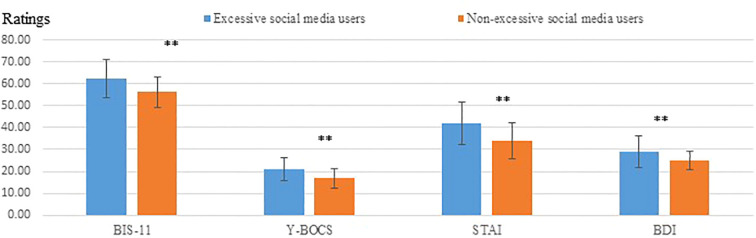
This cross-sectional study compared 34 “excessive” and 45 “non-excessive” social media users on questionnaires and computerized tasks and found stronger evidence for impulsivity than compulsivity in the excessive-use group. Excessive users showed higher delay discounting, higher BIS-11, Y-BOCS, trait anxiety, and BDI scores, but no clear inhibition deficit and no evidence of WCST-based inflexibility.
## Key findings
- Excessive social media users scored higher than non-excessive users on the BIS-11: F(1,76) = 8.7, p = .004, ηp² = .103.
- Excessive users scored higher on the Y-BOCS: F(1,76) = 9.11, p = .003, ηp² = .107; they also had higher trait anxiety (M = 42.41, SD = 9.68 vs M = 33.75, SD = 8.36; F(1,76) = 11.5, p = .001, ηp² = .131) and BDI scores (M = 29.47, SD = 7.22 vs M = 24.47, SD = 4.25; F(1,76) = 9.62, p = .003, ηp² = .112).
- On the EDT, excessive users showed steeper delay discounting: K = -0.1 (SD = 0.1) vs -0.04 (SD = 0.1); F(1,75) = 4.55, p = .04, ηp² = .06.
- On the GO/NO-GO, there was no group difference in overall reaction time or errors, but excessive users made more omission errors to “Facebook” signs (t(96) = -2.26, p = .026, ηp² = .12). On the WCST, excessive users made fewer non-perseverative errors (M = 4.84, SD = 2.16 vs M = 6.38, SD = 4.02; F(1,73) = 4.5, p = .037, ηp² = .058), with no difference in perseverative errors.
## Methods
- Design: Cross-sectional comparison of excessive vs non-excessive social media users.
- Sample/data: 79 participants aged 18–37 (16 males, 63 females), with 34 classified as excessive users and 45 as non-excessive users using the BSMAS cut-off of 19; 4 participants were excluded for inadequate task performance.
- Analysis: Group comparisons used ANCOVA (age as covariate) for questionnaires and tasks; the GO/NO-GO used a two-way mixed repeated-measures ANCOVA; the WCST used one-way ANCOVAs; Pearson correlations tested links between questionnaire scores and task performance.
## Limitations
- The paper explicitly states that this was a cross-sectional study, so causality cannot be inferred.
- The authors note the sample was mostly women (80%), which may affect task performance on impulsivity measures; this is a stated limitation, and the text also makes evident that the sample is gender-imbalanced.
- The authors state that the BSMAS cut-off of 19 may create classification bias because it is a lenient threshold; this is a stated limitation.
- The authors state there was no correlation between subjective reports and cognitive-task performance, and that assessing compulsivity with cognitive tasks is problematic; the text also makes evident that some data were incomplete due to technical reasons and that participants were recruited from university/social-network sources, which may limit generalizability.
Model-written summary. Check it against the paper before relying on it.
Integrity signals
Registry
Cites
Statistics
Figures



Verification
Claims the paper makes
9 Valid · 3 Not valid · 33 Not checked · 59 Own results and interpretations
At least one cited source doesn’t support this claim or points to a different paper, and none confirmed it — see the verdicts below.
In the paper
“There is little evidence for impaired cognitive and executive function in excessive social media users.”
What the sources say
- Not checked yetcites [9] Aydın, 2020, Associations between executive functions and problematic social networking sites use, J Clin Exp Neuropsychol. source
- Disputedcites [10] Gao, 2019, Inhibitory control in excessive social networking users: evidence from an event-related potential-based go-nogo task, Front Psychol sourceExperimental — accuracy not yet measured
Our copy of Gao et al. (2019) concludes the opposite of the claim: the Abstract and the Discussion's closing paragraph report that excessive SNS users showed larger N2 and smaller Nogo-P3 amplitudes than non-excessive users, indicating they are 'inefficient in allocating monitoring resources' and 'show difficulty in late inhibitory control procedure' — i.e., electrophysiological evidence of impaired inhibitory control, a core executive function. The only part of the claim the paper supports is the null behavioural result (Results, Behavioral Results: main effect of group not significant for accuracy, RT and signal-detection indices; Discussion: 'No differences between excessive users and non-excessive users were observed at the behavioral level'), which the authors themselves attribute to insensitive behavioural measures rather than to an absence of impairment. The paper also does not address cognitive/executive function broadly, and its sample is 42 Chinese young-adult WeChat/QQ users, so 'little evidence for impaired cognitive and executive function in excessive social media users' overstates and inverts what this source reports. (LLM, conf=0.82)
Checked by a reasoning model — may be wrong.
plain- Asserted: passes — The authors put it forward as true.
- Checkable: passes — It can be checked against evidence.
- Load-bearing: unclear — It is unclear whether the paper’s conclusions depend on it.
- Based: passes — The paper gives a reason why it holds.
The cited sources support only part of this claim — read each source’s verdict below.
In the paper
“These findings indicate that tasks that measure flexibility and set-shifting, like the WCST, may be suitable to measure compulsivity.”
What the sources say
- Supportedcites [13] Fineberg, 2014, New developments in human neurocognition: clinical, genetic, and brain imaging correlates of impulsivity and compulsivity, CNS Spectr source
The Compulsivity section describes flexibility and set-shifting tasks as neurocognitive measures of compulsivity. The treatment-response section identifies perseveration errors on the WCST as a measure relating to cognitive flexibility. Together, these support the qualified claim that a task like the WCST may be suitable for measuring compulsivity; page numbers are unavailable in our copy. (LLM, conf=0.90)
- Not checked yetcites [14] Abbruzzese, 1995, Wisconsin card sorting test performance in obsessive-compulsive disorder: no evidence for involvement of dorsolateral prefrontal cortex, Psychiatry Res source
- Partly supportedcites [15] Watkins, 2005, Executive function in Tourette’s syndrome and obsessive-compulsive disorder, Psychol Med sourceExperimental — accuracy not yet measured
In Cognitive performance in OCD (p. 9), the authors link impaired cognitive flexibility and set-shifting to compulsive tendencies, supporting the proposed use of such tasks. However, their study used an attentional set-shifting test, not the WCST; the WCST is mentioned only in a discussion of an earlier Tourette’s study (p. 10). This paper therefore does not establish the WCST specifically as suitable for measuring compulsivity. (LLM, conf=0.84)
hedgedstates an association- Asserted: passes — The authors put it forward as true.
- Checkable: passes — It can be checked against evidence.
- Load-bearing: passes — The paper’s conclusions depend on it.
- Based: passes — The paper gives a reason why it holds.
- Supported
Every source the paper cites for this claim was checked and supports it.
In the paper
“Impulsivity, executive functions, and decision-making are key features of addictive behaviors, yet research on these functions in problematic social-network use is rare, and there are inconsistent findings ( 25 ).”
What the sources say
- Supportedcites [25] Müller, 2021, Deficits in executive functions but not in decision making under risk in individuals with problematic social-network use, Comp Psychiatry source
The Introduction states that impulsivity, executive functions, and decision making are critically involved in addictive behaviors, while research on these functions in problematic social-network use is fragmented and its findings inconsistent. It also describes mixed findings for executive functions and risky decision making. (LLM, conf=0.95)
plain- Asserted: passes — The authors put it forward as true.
- Checkable: passes — It can be checked against evidence.
- Load-bearing: passes — The paper’s conclusions depend on it.
- Based: passes — The paper gives a reason why it holds.
- Supported
The cited sources support only part of this claim — read each source’s verdict below.
In the paper
“Impulsivity, executive functions, and decision-making are key features of addictive behaviors, yet research on these functions in problematic social-network use is rare, and there are inconsistent findings ( 25 ).”
What the sources say
- Partly supportedcites [25] Müller, 2021, Deficits in executive functions but not in decision making under risk in individuals with problematic social-network use, Comp Psychiatry sourceExperimental — accuracy not yet measured
The Introduction (page unavailable) says research on these functions in problematic social-network use is fragmented and its findings inconsistent. It specifically calls research on risky decision-making relatively rare, but does not characterize research on impulsivity and executive functions as rare. (LLM, conf=0.82)
plain- Asserted: passes — The authors put it forward as true.
- Checkable: passes — It can be checked against evidence.
- Load-bearing: passes — The paper’s conclusions depend on it.
- Based: passes — The paper gives a reason why it holds.
- Partly supported
A result the paper reports from its own data — it cites no other source for it, so there is none to check. The quote shows it is in the paper.
In the paper
“high scores on the BIS-11 questionnaire that measures impulsivity”
plainstates an association- Asserted: passes — The authors put it forward as true.
- Checkable: passes — It can be checked against evidence.
- Load-bearing: passes — The paper’s conclusions depend on it.
- Based: passes — The paper gives a reason why it holds.
40 more claims
Create a free account to see all 104 claims and to verify the 38 references still open.
- Probably not a substantial claim. 42
- It may state two separate claims as one. 29
- The quote only partly states this claim. 2
Statistics that don’t add up
Each reported p-value recomputed from its test statistic and degrees of freedom.
Rated minor: it would not touch a result — a value no result rests on, a p-value that stays on the same side of the significance level, or a conflict that is clerical, resolved elsewhere in the paper, or outside its own findings.
In the paper
“F (1, 75) = 4.02, p = .04”
Reported p = .04 · recomputed p = .049
Statistics recomputed
Every reported test result, recomputed from its test statistic and degrees of freedom. A result shows as not adding up only once an independent check has confirmed it.
- Doesn’t add upF(1, 75) = 4.02reported p = .04 · recomputed p = .049
“F (1, 75) = 4.02, p = .04”
- ConsistentF(1, 78) = 106.5reported p = .01 · recomputed p < .001
“F (1, 78) = 106.5, p = .01”
The paper prints p at a floor (such as p < .001)
- ConsistentF(1, 76) = 8.7reported p = .004 · recomputed p = .004
“F (1, 76) = 8.7, p = .004”
- ConsistentF(1, 76) = 9.11reported p = .003 · recomputed p = .003
“F (1, 76) = 9.11, p = .003”
- ConsistentF(1, 76) = 11.5reported p = .001 · recomputed p = .001
“F (1, 76) = 11.5, p = .001”
16 more recomputed tests
Create a free account to see every test the Stats check recomputed.
Self-check
Percentages, sums and reported differences re-computed from the paper’s own numbers.
Each contradiction between two passages listed here was confirmed by an independent check.
Rated major: it would touch a result — a value a result rests on, reported and recomputed p-values on opposite sides of the significance level, two passages that conflict with no sign which is right, or a cited work retracted before this paper was published.
In the paper
“The total mean K score of the excessive social media use was -0.1 (S.D. = 0.1), and the total mean score of the non-excessive social media use was -0.04 (S.D. = 0.1), suggesting that the excessive social media users had steeper slopes and were more impulsive.”
“Higher k-values indicate more rapid discounting, which has been defined as more impulsive”
Rated major: it would touch a result — a value a result rests on, reported and recomputed p-values on opposite sides of the significance level, two passages that conflict with no sign which is right, or a cited work retracted before this paper was published.
In the paper
“omission errors, which were falsely pressing the button in “NO-GO” trials.”
“The higher number of omission errors to “Facebook” signs in the GO condition in excessive social media users may indicate impaired attention and not inhibition, since participants are required to respond to the sign (GO)”
Rated minor: it would not touch a result — a value no result rests on, a p-value that stays on the same side of the significance level, or a conflict that is clerical, resolved elsewhere in the paper, or outside its own findings.
In the paper
“This number is expected to increase to almost six billion by 2027.”
“In October 2025, over 6.04 billion people worldwide used social media”
Rated minor: it would not touch a result — a value no result rests on, a p-value that stays on the same side of the significance level, or a conflict that is clerical, resolved elsewhere in the paper, or outside its own findings.
In the paper
“but there was significant group effect”
“F (1, 75) = 1.32, p=.25, ηp 2 = .02) or sign type effect (F (1, 75) = 1.43, p=.23, ηp 2 = .02)”
Citations
Cites
Diagnostic and Statistical Manual of Mental Disorders
American Psychiatric Association (2013) · doi:10.1176/appi.books.9780890425596 · Cited by 116,369
Statistical power analyses using G∗Power 3.1: tests for correlation and regression analyses
Faul, F., Erdfelder, E., Buchner, A., & Lang, A.-G. (2009) · Behavior Research Methods · doi:10.3758/brm.41.4.1149 · Cited by 37,615 · cited 1×
“Power calculation of the ANOVA model was conducted using G*Power 3.1.9.7 (57, 58) based on ANCOVA and two-way mixed-design repeated-measures ANCOVA in accordance with the relevant literature (11).”
InfluentialDiamond, A. (2013) · Annual Review of Psychology · doi:10.1146/annurev-psych-113011-143750 · Cited by 13,268 · cited 1×
“Inhibitory control includes the ability to control attention in order to avoid internal urges, and to act appropriately; without inhibitory control, we would act upon impulses and old habits (74).”
Psychometric properties of the Beck Depression Inventory: Twenty-five years of evaluation
Beck, A. T., Steer, R. A., & Carbin, M. G. (1988) · Clinical Psychology Review · doi:10.1016/0272-7358(88)90050-5 · Cited by 11,696
The Yale-Brown Obsessive Compulsive Scale: I. Development, Use, and Reliability
Goodman, W. K. (1989) · Archives of General Psychiatry · doi:10.1001/archpsyc.1989.01810110048007 · Cited by 7,712
A “components” model of addiction within a biopsychosocial framework
Griffiths, M. (2005) · Journal of Substance Use · doi:10.1080/14659890500114359 · Cited by 3,088
Sample size determination and power analysis using the G*Power software
Kang, H. (2021) · Journal of Educational Evaluation for Health Professions · doi:10.3352/jeehp.2021.18.17 · Cited by 2,572 · cited 1×
“Power calculation of the ANOVA model was conducted using G*Power 3.1.9.7 (57, 58) based on ANCOVA and two-way mixed-design repeated-measures ANCOVA in accordance with the relevant literature (11).”
InfluentialEvaluation of a behavioral measure of risk taking: The balloon analogue risk task (BART)
Lejuez, C. W., Read, J. P., Kahler, C. W., Richards, J. B., Ramsey, S. E., Stuart, G. L., Strong, D. R., & Brown, R. A. (2002) · Journal of Experimental Psychology: Applied · doi:10.1037/1076-898x.8.2.75 · Cited by 2,336
A Note on Measurement of Utility
Samuelson, P. A. (1937) · The Review of Economic Studies · doi:10.2307/2967612 · Cited by 2,164
Andreassen, C. S., Billieux, J., Griffiths, M. D., Kuss, D. J., Demetrovics, Z., Mazzoni, E., & Pallesen, S. (2016) · Psychology of Addictive Behaviors · doi:10.1037/adb0000160 · Cited by 2,095 · cited 2×
“Although excessive social media users show evidence for subjective compulsivity (5), few studies have used computerized cognitive tasks assessing compulsivity in them.”
The future of social media in marketing
Appel, G., Grewal, L., Hadi, R., & Stephen, A. T. (2020) · Journal of the Academy of Marketing Science · doi:10.1007/s11747-019-00695-1 · Cited by 1,893
Social networking sites and addiction: Ten lessons learned
Kuss, D., & Griffiths, M. (2017) · International Journal of Environmental Research and Public Health · doi:10.3390/ijerph14030311 · Cited by 1,603
SUBJECTIVE PROBABILITY AND DELAY
Rachlin, H., Raineri, A., & Cross, D. (1991) · Journal of the Experimental Analysis of Behavior · doi:10.1901/jeab.1991.55-233 · Cited by 1,341
Introduction to Behavioral Addictions
Grant, J. E., Potenza, M. N., Weinstein, A., & Gorelick, D. A. (2010) · The American Journal of Drug and Alcohol Abuse · doi:10.3109/00952990.2010.491884 · Cited by 1,242
Self-citationOnline Social Network Site Addiction: A Comprehensive Review
Andreassen, C. S. (2015) · Current Addiction Reports · doi:10.1007/s40429-015-0056-9 · Cited by 1,212
Online communication, social media and adolescent wellbeing: A systematic narrative review
Best, P., Manktelow, R., & Taylor, B. (2014) · Children and Youth Services Review · doi:10.1016/j.childyouth.2014.03.001 · Cited by 1,067 · cited 1×
“The bene fi ts are increased self-esteem, social support, social capital, testing safe identity, and a higher chance for self-disclosure (88).”
Problematic social media use: Results from a large-scale nationally representative adolescent sample
Bányai, F., Zsila, Á., Király, O., Maraz, A., Elekes, Z., Griffiths, M. D., Andreassen, C. S., & Demetrovics, Z. (2017) · PLOS ONE · doi:10.1371/journal.pone.0169839 · Cited by 984 · cited 1×
“The score of 19 typically indicates “ at-risk ” behavior, and it was derived from a study (39) using latent pro fi le analysis to identify at-risk youth.”
Social media use and perceived social isolation among young adults in the U.S
Primack, B. A., Shensa, A., Sidani, J. E., Whaite, E. O., Lin, L. Y., Rosen, D., Colditz, J. B., Radovic, A., & Miller, E. (2017) · American Journal of Preventive Medicine · doi:10.1016/j.amepre.2017.01.010 · Cited by 889
Dimensions of impulsive behavior: Personality and behavioral measures
Reynolds, B., Ortengren, A., Richards, J. B., & de Wit, H. (2006) · Personality and Individual Differences · doi:10.1016/j.paid.2005.03.024 · Cited by 885 · cited 1×
“Impulsivity was also de fi ned as a predisposition to look for excitement or adventure, impatience, and a lack of the ability to foresee the consequences of one ’ s actions, and to behave without control or inhibition (62, 63).”
DISCOUNTING OF DELAYED REWARDS: MODELS OF INDIVIDUAL CHOICE
Myerson, J., & Green, L. (1995) · Journal of the Experimental Analysis of Behavior · doi:10.1901/jeab.1995.64-263 · Cited by 841
Beck, A. T., Ward, C. H., Mendelson, M., Mock, J., & Erbauch, J. (2011) · PsycTESTS Dataset · doi:10.1037/t00741-000 · Cited by 815
DELAY OR PROBABILITY DISCOUNTING IN A MODEL OF IMPULSIVE BEHAVIOR: EFFECT OF ALCOHOL
Richards, J. B., Zhang, L., Mitchell, S. H., & de Wit, H. (1999) · Journal of the Experimental Analysis of Behavior · doi:10.1901/jeab.1999.71-121 · Cited by 791 · cited 1×
“High k-values indicate rapid discounting (e.g., 47 – 49 ).”
Preference Reversals Due to Myopic Discounting of Delayed Reward
Kirby, K. N., & Herrnstein, R. J. (1995) · Psychological Science · doi:10.1111/j.1467-9280.1995.tb00311.x · Cited by 591
Fineberg, N. A., Chamberlain, S. R., Goudriaan, A. E., Stein, D. J., Vanderschuren, L. J. M. J., Gillan, C. M., Shekar, S., Gorwood, P. A. P. M., Voon, V., Morein-Zamir, S., et al. (2014) · CNS Spectrums · doi:10.1017/s1092852913000801 · Cited by 488 · cited 1×
“An impaired ability to shift sets could indicate a diminished ability to disengage from repetitive acts or obsessive thoughts (13).”
Meta‐analysis of neuroimaging studies of the Wisconsin Card‐Sorting task and component processes
Buchsbaum, B. R., Greer, S., Chang, W., & Berman, K. F. (2005) · Human Brain Mapping · doi:10.1002/hbm.20128 · Cited by 477 · cited 1×
“A modi fi ed short version of the Wisconsin Card Sorting-like Task (WCST) (55, 56) was used for measuring cognitive fl exibility.”
Excessive discounting of delayed rewards in substance abusers with gambling problems
Petry, N. M., & Casarella, T. (1999) · Drug and Alcohol Dependence · doi:10.1016/s0376-8716(99)00010-1 · Cited by 432 · cited 1×
“Both pathological gamblers and individuals with substance use disorders quickly discount rewards (59).”
Some cognitive effects of frontal-lobe lesions in man
Milner, B. A. (1982) · Philosophical Transactions of the Royal Society of London. B, Biological Sciences · doi:10.1098/rstb.1982.0083 · Cited by 426 · cited 1×
“A modi fi ed short version of the Wisconsin Card Sorting-like Task (WCST) (55, 56) was used for measuring cognitive fl exibility.”
Gomez, P., Ratcliff, R., & Perea, M. (2007) · Journal of Experimental Psychology: General · doi:10.1037/0096-3445.136.3.389 · Cited by 415 · cited 1×
“Gomez et al. (54) describe the GO/NO-GO task, originally developed by Luria in the 1940s.”
Brand, M., Rumpf, H.-J., Demetrovics, Z., MÜller, A., Stark, R., King, D. L., Goudriaan, A. E., Mann, K., Trotzke, P., Fineberg, N. A., et al. (2020) · Journal of Behavioral Addictions · doi:10.1556/2006.2020.00035 · Cited by 398 · cited 1×
“(33 – 35).”
Psychological risk factors of addiction to social networking sites among Chinese smartphone users
Wu, A. M. S., Cheung, V. I., Ku, L., & Hung, E. P. W. (2013) · Journal of Behavioral Addictions · doi:10.1556/jba.2.2013.006 · Cited by 353 · cited 2×
“Young smartphone users, who spent more time on social networking sites reported higher addictive tendencies, which positively correlated with impulsivity (65).”
Measuring state changes in human delay discounting: an experiential discounting task
REYNOLDS, B., & SCHIFFBAUER, R. (2004) · Behavioural Processes · doi:10.1016/s0376-6357(04)00140-8 · Cited by 352 · cited 1×
“The score of delay discounting was calculated by adding all choices and times of delay following the method described by Saville et al. (2001) (45) and Reynolds and Schiffbauer (46).”
Social media and depression symptoms: a meta-analysis
Cunningham, S., Hudson, C. C., & Harkness, K. (2021) · Research on Child and Adolescent Psychopathology · doi:10.1007/s10802-020-00715-7 · Cited by 308 · cited 1×
“In a meta-analysis, depressive symptoms were correlated with time spent using social media and intensity of social media use (87).”
Gender differences in delay of gratification: a meta-analysis
Silverman, I. W. (2003) · Sex Roles · doi:10.1023/a:1025872421115 · Cited by 303 · cited 1×
“A meta-analysis of 33 studies of delay discounting, revealed that women have a better ability to delay grati fi cation, although this advantage had a small effect size presumably due problems in the precision of the instruments and small sample sizes (80).”
Both random and perseverative errors underlie WCST deficits in prefrontal patients
Barceló, F., & Knight, R. T. (2002) · Neuropsychologia · doi:10.1016/s0028-3932(01)00110-5 · Cited by 295 · cited 1×
“…does not discriminate between errors related to the ef fi cient test of hypotheses ( ‘ ef fi cient TABLE 3 Pearson correlations between BIS-11 and YBOCS questionnaire means and EDT, WCST, GO\NO-GO tasks ( N=79 ). errors ’ ) or makes random failures to maintain set ( ‘ random errors ’ ) (66).”
Cognitive deficits in problematic internet use: meta-analysis of 40 studies
Ioannidis, K., Hook, R., Goudriaan, A. E., Vlies, S., Fineberg, N. A., Grant, J. E., & Chamberlain, S. R. (2019) · British Journal of Psychiatry · doi:10.1192/bjp.2019.3 · Cited by 246 · cited 1×
“Problematic Internet use was associated with de fi cits in decision making that were assessed on the Iowa Gambling Task, Balloon Analogue Risk Task (BART), Cambridge Gambling Task, and Game of Dice Task (18).”
Sex differences in impulsive action and impulsive choice
Weafer, J., & de Wit, H. (2014) · Addictive Behaviors · doi:10.1016/j.addbeh.2013.10.033 · Cited by 239 · cited 2×
“Furthermore, males fail to inhibit a pre-potent response on the Go/ No-Go task whereas women make more errors on the Stop Signal Task than men (82).”
Executive function in Tourette’s syndrome and obsessive–compulsive disorder
WATKINS, L. H., SAHAKIAN, B. J., ROBERTSON, M. M., VEALE, D. M., ROGERS, R. D., PICKARD, K. M., AITKEN, M. R. F., & ROBBINS, T. W. (2005) · Psychological Medicine · doi:10.1017/s0033291704003691 · Cited by 210 · cited 1×
“OCD patients showed impaired extra-dimensional shifting on the set-shifting test and impaired reversal of response set on the Go/NO-GO task (15).”
Examination of neural systems sub-serving facebook addiction
Turel, O., He, Q., Xue, G., Xiao, L., & Bechara, A. (2014) · Psychological Reports · doi:10.2466/18.pr0.115c31z8 · Cited by 206 · cited 4×
“…evidence for impulsivity in excessive social media users is based on a negative correlation between social media scores and performance on the Iowa Gambling Task (11) and a correlation between Facebook addiction-like symptoms and activation of the amygdala-striatal (impulsive) brain system (12).”
InfluentialLuo, T., Qin, L., Cheng, L., Wang, S., Zhu, Z., Xu, J., Chen, H., Liu, Q., Hu, M., Tong, J., et al. (2021) · Journal of Behavioral Addictions · doi:10.1556/2006.2021.00025 · Cited by 170 · cited 1×
“It is regarded as a lenient threshold compared to higher cut-offs like 24, employed by Luo et al. (83).”
Dimensions of impulsive behavior in adolescents: Laboratory behavioral assessments.
Reynolds, B., Penfold, R. B., & Patak, M. (2008) · Experimental and Clinical Psychopharmacology · doi:10.1037/1064-1297.16.2.124 · Cited by 167 · cited 1×
“Impulsivity was also de fi ned as a predisposition to look for excitement or adventure, impatience, and a lack of the ability to foresee the consequences of one ’ s actions, and to behave without control or inhibition (62, 63).”
Internet Addiction and Delay Discounting in College Students
Saville, B. K., Gisbert, A., Kopp, J., & Telesco, C. (2010) · The Psychological Record · doi:10.1007/bf03395707 · Cited by 150 · cited 1×
“The score of delay discounting was calculated by adding all choices and times of delay following the method described by Saville et al. (2001) (45) and Reynolds and Schiffbauer (46).”
Wegmann, E., Müller, S. M., Turel, O., & Brand, M. (2020) · Scientific Reports · doi:10.1038/s41598-020-60819-4 · Cited by 145 · cited 3×
“Recent research demonstrated that the severity of symptoms associated with social media use correlated with attentional impulsivity, but not with executive function or inhibitory control of social media-related cues (27).”
Abbruzzese, M., Ferri, S., & Scarone, S. (1995) · Psychiatry Research · doi:10.1016/0165-1781(95)02670-r · Cited by 138 · cited 1×
“OCD patients showed no impairment in performance on the WCST, and no differences in WCST performance were observed in patients with OCD who were treated with fl uvoxamine compared with non-treated patients (14).”
Understanding Social Media Addiction: A Deep Dive
Amirthalingam, J., & Khera, A. (2024) · Cureus · doi:10.7759/cureus.72499 · Cited by 124 · cited 1×
“The term encompasses more than just spending excessive time online; it involves compulsively checking for updates, feeling anxious when of fl ine, and experiencing negative impacts on real-life relationships and responsibilities (3).”
The Association Between Internet Addiction and Adolescents’ Mental Health: A Meta-Analytic Review
Soriano-Molina, E., Gras, R. M. L., Patró-Hernández, R. M., & Rubio‐Aparicio, M. (2025) · Behavioral Sciences · doi:10.3390/bs15020116 · Cited by 112 · cited 1×
“Higher level of suicidal risk is related to emotional problems, conduct problems and with poorer quality of life (7; see a review by 8).”
Sassover, E., & Weinstein, A. (2020) · Journal of Behavioral Addictions · doi:10.1556/2006.2020.00055 · Cited by 100 · cited 1×
“The lack of rigorous scienti fi c evidence raised our doubts as well as others ’ about whether compulsive sexual behavior should be considered a behavioral addiction (89).”
Self-citationLatent traits of impulsivity and compulsivity: toward dimensional psychiatry
Chamberlain, S. R., Stochl, J., Redden, S. A., & Grant, J. E. (2018) · Psychological Medicine · doi:10.1017/s0033291717002185 · Cited by 99 · cited 1×
“(72).”
Xie, W., & Karan, K. (2019) · Journal of Behavioral Addictions · doi:10.1556/2006.8.2019.09 · Cited by 89 · cited 1×
“Anxiety correlated with the intensity of “ Facebook ” use (85).”
Excessive social media users demonstrate impaired decision making in the Iowa Gambling Task
Meshi, D., Elizarova, A., Bender, A., & Verdejo-Garcia, A. (2019) · Journal of Behavioral Addictions · doi:10.1556/2006.7.2018.138 · Cited by 88 · cited 10×
“In contrast, all studies of impulsive choice that used the Delay Discounting Task, which measures how much people evaluate rewards over time, or the Iowa Gambling Task which assesses decision-making under uncertainty, revealed a relationship with problematic social media use.”
InfluentialReynolds, B. (2006) · Behavioural Pharmacology · doi:10.1097/01.fbp.0000190684.77360.c0 · Cited by 86
Turel, O., He, Q., Brevers, D., & Bechara, A. (2018) · Cognitive, Affective, & Behavioral Neuroscience · doi:10.3758/s13415-018-0597-1 · Cited by 84 · cited 2×
“Social media addiction symptoms in social media users negatively correlated with Gray Matter Volumes (GMVs) of the bilateral posterior insula, and this association was mediated by delay discounting, indicating impulsivity (26).”
Is Impulsivity a Male Trait Rather than Female Trait? Exploring the Sex Difference in Impulsivity
Weinstein, A. M., & Dannon, P. N. (2015) · Current Behavioral Neuroscience Reports · doi:10.1007/s40473-015-0031-8 · Cited by 81 · cited 2×
“Furthermore, this sex difference emerges early in development and it is moderated by hormonal changes during the menstrual cycle (81).”
Self-citationThe hierarchical structure of self-reported impulsivity
Kirby, K. N., & Finch, J. C. (2010) · Personality and Individual Differences · doi:10.1016/j.paid.2010.01.019 · Cited by 81 · cited 1×
“Impulsivity is the inclination of an individual to act upon urges or the inability to plan or consider various options before making a decision (61).”
Selective decision-making deficits in at-risk gamblers
Grant, J. E., Chamberlain, S. R., Schreiber, L. R. N., Odlaug, B. L., & Kim, S. W. (2011) · Psychiatry Research · doi:10.1016/j.psychres.2011.05.034 · Cited by 73 · cited 1×
“There are different aspects of decision-making that involve increased risk-taking, impulsivity, and impaired judgment in behavioral addictions like gambling disorder (17).”
Gao, Q., Jia, G., Zhao, J., & Zhang, D. (2019) · Frontiers in Psychology · doi:10.3389/fpsyg.2019.01810 · Cited by 71 · cited 2×
“However, excessive users showed larger ERP responses to social media stimuli, indicating inef fi cient processing and inhibitory control mechanisms (10).”
Disentangling the role of users’ preferences and impulsivity traits in problematic Facebook use
Rothen, S., Briefer, J.-F., Deleuze, J., Karila, L., Andreassen, C. S., Achab, S., Thorens, G., Khazaal, Y., Zullino, D., & Billieux, J. (2018) · PLOS ONE · doi:10.1371/journal.pone.0201971 · Cited by 70 · cited 2×
“Research demonstrated that impulsive traits such as positive and negative urgency and lack of perseverance are associated with problematic social media use (64).”
Cheng, Y., Ko, H., Sun, C., & Yeh, P. (2020) · Addictive Behaviors · doi:10.1016/j.addbeh.2020.106751 · Cited by 70 · cited 1×
“See reviews and meta-analyses about delay discounting/risky decision-making by Cheng et al. (28) and Müller et al. (29).”
Problematic Social Networking Site use-effects on mental health and the brain
Weinstein, A. M. (2023) · Frontiers in Psychiatry · doi:10.3389/fpsyt.2022.1106004 · Cited by 70 · cited 3×
“Motivations for using social media vary, including handling boredom, increasing social rewards ( “ likes ” ), social comparisons, social connections, and high expectations of having a large network (6).”
InfluentialSelf-citationWeinstein, A., Abu, H. B., Timor, A., & Mama, Y. (2016) · Journal of Behavioral Addictions · doi:10.1556/2006.5.2016.081 · Cited by 65 · cited 5×
“Problematic Internet use was associated with de fi cits in decision making that were assessed on the Iowa Gambling Task, Balloon Analogue Risk Task (BART), Cambridge Gambling Task, and Game of Dice Task (18).”
InfluentialSelf-citationImpact of social media use on executive function
Reed, P. (2023) · Computers in Human Behavior · doi:10.1016/j.chb.2022.107598 · Cited by 64 · cited 4×
“These fi ndings are in accordance with the results of Reed et al. (24) who reported a weak association between excessive social media use and attention.”
InfluentialOstendorf, S., Müller, S. M., & Brand, M. (2020) · Frontiers in Psychology · doi:10.3389/fpsyg.2020.543388 · Cited by 51 · cited 1×
“Problematic social media users also displayed high self-disclosure, posting on social media sites while disregarding long-term risks (77).”
Suicidal Risk, Psychopathology, and Quality of Life in a Clinical Population of Adolescents
Balazs, J., Miklosi, M., Halasz, J., Horváth, L. O., Szentiványi, D., & Vida, P. (2018) · Frontiers in Psychiatry · doi:10.3389/fpsyt.2018.00017 · Cited by 47 · cited 1×
“Higher level of suicidal risk is related to emotional problems, conduct problems and with poorer quality of life (7; see a review by 8).”
Associations between executive functions and problematic social networking sites use
Aydın, O., Obuća, F., Boz, C., & Ünal-Aydın, P. (2020) · Journal of Clinical and Experimental Neuropsychology · doi:10.1080/13803395.2020.1798358 · Cited by 47 · cited 2×
“However, ratings of social media addiction were found to correlate with the categories achieved and the number of perseverative errors on the WCST (9).”
Müller, S. M., Wegmann, E., García Arias, M., Bernabéu Brotóns, E., Marchena Giráldez, C., & Brand, M. (2021) · Comprehensive Psychiatry · doi:10.1016/j.comppsych.2021.152228 · Cited by 42 · cited 7×
“Impulsivity, executive functions, and decision-making are key features of addictive behaviors, yet research on these functions in problematic social-network use is rare, and there are inconsistent fi ndings (25).”
InfluentialNaidu, S., Chand, A., Pandaram, A., & Patel, A. (2023) · Personality and Individual Differences · doi:10.1016/j.paid.2022.111915 · Cited by 42 · cited 1×
“Among college students, heightened social anxiety and low self-esteem result in overusing the internet and social network sites due to fear of negative evaluation from others (86).”
Problematic Social Media Use and Impulsivity
Lewin, K. M., Kaur, A., & Meshi, D. (2023) · Current Addiction Reports · doi:10.1007/s40429-023-00495-2 · Cited by 41 · cited 1×
“Lewin et al. (76) asserted that a positive correlation exists problematic social media use and impulsivity, encompassing attentional impulsivity and impulsive decision-making.”
Wegmann, E., Stodt, B., & Brand, M. (2018) · Addiction Research & Theory · doi:10.1080/16066359.2017.1367385 · Cited by 38
Cognitive Functions in Compulsive Buying-Shopping Disorder: a Systematic Review
Thomas, T. A., Joshi, M., Trotzke, P., Steins-Loeber, S., & Müller, A. (2023) · Current Behavioral Neuroscience Reports · doi:10.1007/s40473-023-00255-6 · Cited by 36 · cited 1×
“Examination of the research in this area does not indicate strong evidence for an impairment of executive function in BSD, leading Thomas et al. (90) to conclude that future research is required to systematically examine affective and cognitive interactions in compulsive BSD.”
Müller, S. M., Antons, S., Wegmann, E., Ioannidis, K., King, D. L., Potenza, M. N., Chamberlain, S. R., & Brand, M. (2023) · Neuroscience & Biobehavioral Reviews · doi:10.1016/j.neubiorev.2023.105271 · Cited by 36
Messina, B., Fuentes, D., Tavares, H., Abdo, C. H. N., & Scanavino, M. D. T. (2017) · The Journal of Sexual Medicine · doi:10.1016/j.jsxm.2016.12.235 · Cited by 34
Neurocognitive impairment does not predict treatment outcome in obsessive-compulsive disorder
Moritz, S., Kloss, M., Jacobsen, D., Fricke, S., Cuttler, C., Brassen, S., & Hand, I. (2005) · Behaviour Research and Therapy · doi:10.1016/j.brat.2004.06.012 · Cited by 33 · cited 6×
“Even in a clinical population of OCD patients, the results are mixed.”
InfluentialDimensionality of Cognitions in Behavioral Addiction
Morris, L. S., & Voon, V. (2016) · Current Behavioral Neuroscience Reports · doi:10.1007/s40473-016-0068-3 · Cited by 33 · cited 1×
“This conclusion is supported by a recent review by Morris and Voon (67), who provided evidence that tasks measuring fl exibility like the WCST showed mixed results in behavioral addic-tions.”
Müller, S. M., Antons, S., Schmid, A. M., Thomas, T. A., Kessling, A., Joshi, M., Krikova, K., Kampa, M., Mallon, L., Schmidt, L. D., et al. (2025) · American Journal of Psychiatry · doi:10.1176/appi.ajp.20240486 · Cited by 32 · cited 3×
“Müller et al. (25) used decision-making tasks like the Cards and Lottery Task (CLT) and the Modi fi ed Card Sorting Test (MCST), Barratt Impulsiveness Scale (BIS) in participants with excessive social media use and found attentional impulsivity but no differences in decision-making compared with those with no excessive…”
Facebook addiction and impulsive decision-making
Delaney, D., Stein, L. A. R., & Gruber, R. (2018) · Addiction Research & Theory · doi:10.1080/16066359.2017.1406482 · Cited by 29 · cited 1×
“Our results are also compatible with those reported by Delaney et al. (60), who found that those addicted to “ Facebook ” discounted delayed rewards more quickly than control participants, suggesting that they may be more impulsive than non-addicted individuals.”
Do pathological gambling and obsessive-compulsive disorder overlap? a neurocognitive perspective
Hur, J.-W., Shin, N. Y., Kim, S. N., Jang, J. H., Choi, J.-S., Shin, Y.-C., & Kwon, J. S. (2012) · CNS Spectrums · doi:10.1017/s1092852912000545 · Cited by 24
Meshi, D., Ulusoy, E., Özdem-Mertens, C., Grady, S. M., Freestone, D. M., Eden, A., & Ellithorpe, M. E. (2020) · Psychology of Addictive Behaviors · doi:10.1037/adb0000558 · Cited by 23 · cited 1×
“There was no association with problematic social media use (78), except for a study in which problematic social media correlated with a greater af fi nity for high-risk situations under both risk and ambiguity, in the absence of learning (79).”
Impulsivity and compulsivity in compulsive buying
Eliyahu, S., Rahamim, S., Natan, N., & Weinstein, A. M. (2025) · Frontiers in Psychiatry · doi:10.3389/fpsyt.2025.1665182 · Cited by 17 · cited 3×
“…study using questionnaires assessing subjective ratings of impulsivity or compulsivity and tasks ’ performance in compulsive buyers found that there was little correlation between subjective questionnaires and cognitive tasks, suggesting that these examine different cognitive mechanisms (71).”
Self-citationAdaptations of the balloon analog risk task for neuroimaging settings: a systematic review
Compagne, C., Mayer, J. T., Gabriel, D., Comte, A., Magnin, É., Bennabi, D., & Tannou, T. (2023) · Frontiers in Neuroscience · doi:10.3389/fnins.2023.1237734 · Cited by 16
Solly, J. E., Albertella, L., Ioannidis, K., Fineberg, N. A., Grant, J. E., & Chamberlain, S. R. (2025) · Current Addiction Reports · doi:10.1007/s40429-025-00621-2 · Cited by 13
Meshi, D., Freestone, D. M., & Ozdem-Mertens, C. (2021) · Journal of Behavioral Addictions · doi:10.1556/2006.2021.00047 · Cited by 12 · cited 1×
“There was no association with problematic social media use (78), except for a study in which problematic social media correlated with a greater af fi nity for high-risk situations under both risk and ambiguity, in the absence of learning (79).”
Effah, R., Ioannidis, K., Grant, J. E., & Chamberlain, S. R. (2024) · Psychological Medicine · doi:10.1017/s0033291724000746 · Cited by 9 · cited 1×
“The Cambridge Gambling Task measures risk-taking under known risks (22).”
Magis‐Weinberg, L., & Davis, K. S. (2024) · Elsevier eBooks · doi:10.1016/b978-0-323-96023-6.00105-6 · Cited by 8
Disentangling associations between impulsivity, compulsivity, and performance monitoring
Overmeyer, R., & Endraß, T. (2024) · Psychophysiology · doi:10.1111/psyp.14539 · Cited by 6 · cited 1×
“The discrepancy often highlights that subjective experience and specialized cognitive performance tests measure different, although related, aspects of impulsivity and compulsivity (71 – 73).”
Editorial: Impulsivity and compulsivity related to substance use disorders
López-Torrecillas, F. (2025) · Frontiers in Psychiatry · doi:10.3389/fpsyt.2025.1599890 · Cited by 5 · cited 1×
“When these mechanisms become dysfunctional, they contribute to a wide range of psychiatric disorders, like drug and behavioral addictions, imposing major personal, social, and economic burdens on individuals (30).”
Cognitive Impairment and Problematic Internet Use
Weinstein, A. M. (2025) · American Journal of Psychiatry · doi:10.1176/appi.ajp.20250373 · Cited by 3 · cited 1×
“This evidence lacks consistent neuro-cognitive fi ndings of impulsivity, which is an important component of behavioral addictions (see 91).”
Self-citationFactor structure of the Barratt impulsiveness scale
Patton, J. H., Stanford, M. S., & Barratt, E. S. (1995) · Journal of Clinical Psychology · doi:10.1002/1097-4679(199511)51:6<768::aid-jclp2270510607>3.0.co;2-1
Research works printed but not linked: 6
- 2014, Public health implications of excessive use of the internet, computers, smartphones and similar electronic devices
- Spielberger, 1983, Manual for the State-Trait Anxiety Inventory
- Mazur, 1987, An adjusting procedure for studying delayed reinforcement, 55
- Rachlin, 2000, The Science of Self-Control
- Loewenstein, 1992, The fall and rise of psychological explanations in the economics of intertemporal choice
- Posner, 1998, Executive attention: conflict, target detection, and cognitive control
Metadata
- Authors
- Almog, I., Mama, Y., & Weinstein, A. M.
- Affiliations
- Ariel University (IL)
- Corresponding author
- Weinstein, Aviv M
- ORCID
- Mama, Yaniv
- Venue
- Frontiers in Psychiatry
- Publisher
- Frontiers Media SA
- Published
- 2026-05-18
- Volume
- 17
- Pages
- 1825888-1825888
- ISSN
- 1664-0640 (ISSN-L)
- PMC
- PMC13223338
- OpenAlex
- W7161539425
- Cited by
- 1
- References
- 86
- Citations by year
- 2026: 1
- FWCI
- 11.24
- Type
- journal article
- Language
- en
- Open access
- gold
- doi.org
- Licence
- Locations
- Frontiers in Psychiatry (publishedVersion, cc-by)
- PubMed (publishedVersion)
- PubMed Central (publishedVersion, cc-by)
- DOAJ (DOAJ: Directory of Open Access Journals) (submittedVersion, cc-by-sa)
- Topics
- Social Sciences › Sociology and Political Science › Impact of Technology on Adolescents
- Social Sciences › Psychology › Clinical Psychology › Gambling Behavior and Treatments
- Social Sciences › Psychology › Clinical Psychology › Sexuality, Behavior, and Technology
- Keywords
- social media addiction, excessive social media use, impulsivity, compulsivity, behavioral addiction, impulse control disorders, delay discounting, selective attention, cognitive flexibility, anxiety, depression, neurocognitive function
About these checks
Registry, retraction, Cites and statistics results are computed, not judged, with one exception: a printed reference that no index lists is read once by a model before it counts as a citation error. Claims are extracted by a model and kept only when their quote appears verbatim in the text; each cited source is then checked, with a model’s help, for whether it says what the claim relies on. Those verdicts can be wrong — read the claim’s quote and the cited source before relying on one.
The claim verdicts this report counts are experimental: their accuracy is not yet measured.
A language model drew the claims from the paper on 2026-10-11, under version 3 of the claim definition (model deepseek-v4.1-flash, prompt extract-v3).
A second model labelled each claim on 2026-10-11 (model jev-1.13-20260917, definition revision gold-guideline-v0.2).
Cited sources are checked with a language model’s help (qwen3.8-omni-flash and gpt-6-sol).
Statistics and arithmetic are recomputed, not judged.
Confidence bands are shown only for fields calibrated on our annotated test set. None is calibrated yet, so no band is shown.
What counts as a claim ›How we measure confidence ›How we check this ›
Are you an author, or do you see a problem with this page? Request a review
Data sources
Bibliographic data: Semantic Scholar, OpenAlex, Crossref.
Contains information from the Semantic Scholar Academic Graph Datasets, made available under the ODC Attribution License (ODC-BY 1.0).
Semantic Scholar’s data is described in: Kinney, R., et al. (2023). The Semantic Scholar Open Data Platform. arXiv:2301.10140.
