

The DOI matches its Crossref record; 164 of the 164 references it cites were found in a registry or an index; 9 of the 107 sources its claims cite were checked for support.
Immune Clearance of Senescent Cells to Combat Ageing and Chronic Diseases
Open accessAbstract
Senescent cells are generally characterized by permanent cell cycle arrest, metabolic alteration and activation, and apoptotic resistance in multiple organs due to various stressors. Excessive accumulation of senescent cells in numerous tissues leads to multiple chronic diseases, tissue dysfunction, age-related diseases and organ ageing. Immune cells can remove senescent cells. Immunaging or impaired innate and adaptive immune responses by senescent cells result in persistent accumulation of various senescent cells. Although senolytics—drugs that selectively remove senescent cells by inducing their apoptosis—are recent hot topics and are making significant research progress, senescence immunotherapies using immune cell-mediated clearance of senescent cells are emerging and promising strategies to fight ageing and multiple chronic diseases. This short review provides an overview of the research progress to date concerning senescent cell-caused chronic diseases and tissue ageing, as well as the regulation of senescence by small-molecule drugs in clinical trials and different roles and regulation of immune cells in the elimination of senescent cells. Mounting evidence indicates that immunotherapy targeting senescent cells combats ageing and chronic diseases and subsequently extends the healthy lifespan.
Overview
AI snapshot
Written from the paper’s full text.
TL;DR
This review argues that excessive senescent cells drive ageing and chronic diseases, and that immune-mediated clearance by macrophages, NK cells, cytotoxic T cells, and dendritic cells is a promising anti-ageing strategy. It surveys senolytics and small-molecule drugs in preclinical and clinical development and outlines immune mechanisms and future directions for senescence immunotherapy.
Key findings
- Senescent cells accumulate with age and causally contribute to tissue dysfunction, organ ageing, and chronic diseases including cardiovascular disease, cancer, neurodegenerative diseases, and osteoarthritis; immune cells can remove them, but immunosenescence and impaired innate/adaptive responses promote persistent accumulation.
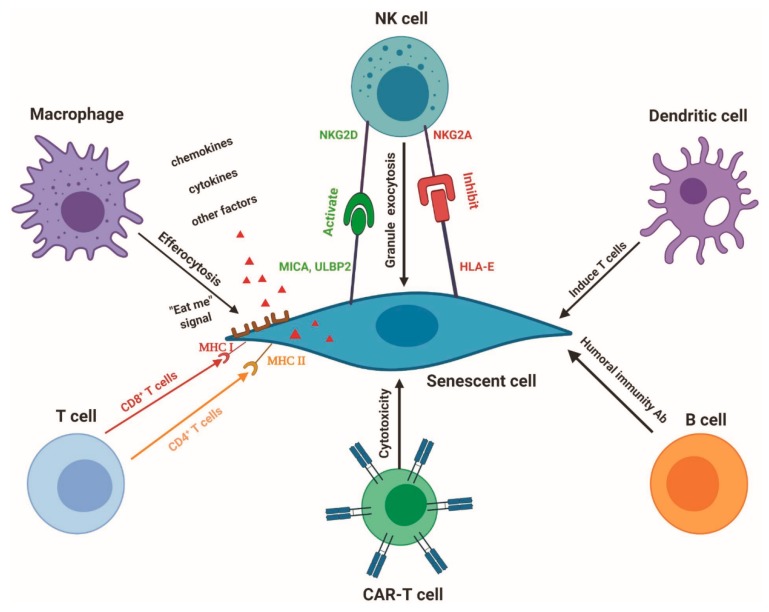
- Senescence immunotherapy is emerging as an alternative or complement to senolytics: macrophages, NK cells, cytotoxic T cells, and dendritic cells recognize distinct senescent-cell ligands, such as NKG2D ligands MICA/ULBP2 on senescent cells, while HLA-E–NKG2A interaction inhibits NK/CD8+ T-cell clearance.
- Small molecules and senolytics show reported benefits: dasatinib plus quercetin (D + Q) eliminates senescent cells in human adipose tissue and skin and improves physical function in idiopathic pulmonary fibrosis; nicotinamide mononucleotide (NMN) was safe after single oral administration in healthy men; topical rapamycin reduced p16 expression in human skin; metformin has entered multiple clinical trials including MILES and TAME.
- In human immune ageing, supercentenarians older than 110 years had increased CD4+ cytotoxic T lymphocytes (~25.3% of total T cells) versus only 2.8% in young controls (~50–80 year olds), with a dramatic reduction in B-cell number compared with controls.
Methods
- Narrative review synthesizing preclinical animal models, human samples, mechanistic studies, and clinical trials; no systematic review or meta-analysis is described.
- Main analysis is qualitative and organized around senescent-cell features, senescent-cell-driven diseases and tissue ageing, small-molecule regulation of senescence, and immune cell types involved in senescent-cell clearance.
- Clinical trial examples cited include NCT03151239 for NMN safety, NCT03103893 for topical rapamycin, the Metformin in Longevity Study (MILES), NCT02570672 for metformin and frailty, NCT02915198 for metformin in pre-diabetes and atherosclerotic cardiovascular disease, and the proposed TAME trial.
Limitations
- The paper states that the precise mechanism underlying senescent cell accumulation within tissues is still debatable, and it is unknown whether this is due to senescent cell increase exceeding immune clearance or immune cell dysfunction.
- The paper states that whether macrophages remove senescent cells in aged or diseased systems remains to be elucidated, and it remains extremely unknown whether and how dendritic cells eliminate apoptotic or senescent cells to prevent chronic diseases including atherosclerosis.
- The paper states that senescence immunotherapy is not cost-free and does have side effects, and future investigations are needed for personal ageing biomarkers, unique senescent-cell antigens or ligands, and inclusion of both genders; evident from the text, many proposed immunotherapies such as CAR-T/CAR-NK targeting senescent cells and anti-NKG2A strategies are still speculative or not yet established in clinical senescence settings.
Model-written summary. Check it against the paper before relying on it.
Integrity signals
Registry
Cites
Statistics
Figures
Verification
Claims the paper makes
74 Not checked yet · 8 Own interpretation · 2 Supported · 2 Partly supported · 2 No basis given · 1 Supported so far · 1 Couldn’t confirm · accuracy not yet measured
The sources with a verdict support this claim; the rest weren’t checked yet, have no full text we could read, or their verdicts aren’t rated yet.
In the paper
“Cellular senescence plays beneficial critical roles in numerous biological processes [5], such as tumor suppression [6,7], embryonic tissue remodeling [8] and wound healing after injury [9].”
§ Immune Clearance of Senescent Cells to Combat Ageing and Chronic Diseases > 1. Introduction
What the sources say
- Supportedcites [5] Burton, 2014, Physiological and pathological consequences of cellular senescence, Cell Mol. Life Sci. source
The Overview states that short-term cellular senescence has beneficial roles in tumor suppression and wound healing, and possibly embryonic development. This supports the broad statement attached to citation [5]; the specific examples in the citing sentence have separate citations. (LLM, conf=0.92)
- Supportedcites [6] Lin, 2010, Skp2 targeting suppresses tumorigenesis by arf-p53-independent cellular senescence, Nature source
This citation is attached to tumor suppression, not to the separately cited examples of embryonic remodeling or wound healing. The paper’s introduction says cellular senescence can restrict tumor development in vivo, and its Discussion reports that Skp2-deficiency-associated senescence restricts tumorigenesis. (LLM, conf=0.94)
- Not checked yetcites [7] Braig, 2005, Oncogene-induced senescence as an initial barrier in lymphoma development, Nature source
- Supportedcites [8] Canamero, 2013, Programmed cell senescence during mammalian embryonic development, Cell source
Citation [8] is attached to embryonic tissue remodeling, not to tumor suppression or wound healing. The Abstract states that developmentally programmed senescence is followed by tissue remodeling and concludes that it promotes that process. (LLM, conf=0.94)
plaindirect- Asserted: passes — The authors put it forward as true.
- Checkable: passes — It can be checked against evidence.
- Load-bearing: unclear — It is unclear whether the paper’s conclusions depend on it.
- Based: passes — The paper gives a reason why it holds.
- Supported
The cited sources support only part of this claim — read each source’s verdict below.
In the paper
“Excessive senescent cells have been demonstrated to play a causal role in driving ageing [26] and chronic diseases [18] using genetic and pharmacologic approaches.”
§ Immune Clearance of Senescent Cells to Combat Ageing and Chronic Diseases > 2. Cellular Senescence Causally Contributes to Ageing and Chronic Diseases
What the sources say
- Partly supportedcites [26] Campisi, 2019, From discoveries in ageing research to therapeutics for healthy ageing, Nature sourceExperimental — accuracy not yet measured
The Senescence section reports that selectively eliminating senescent cells in transgenic mice established a causal role in many age-related phenotypes and pathologies. It also describes promising senolytic drug results in mice and human cells or tissues, but does not establish that senescent cells drive ageing generally or that pharmacologic approaches have demonstrated this in humans. The copy provides section labels but no page numbers. (LLM, conf=0.83)
- Supportedcites [18] Bussian, 2018, Clearance of senescent glial cells prevents tau-dependent pathology and cognitive decline, Nature source
The paper’s main text reports a causal link between senescent-cell accumulation and tau-dependent disease in a mouse model. It describes both genetic clearance of senescent cells, which prevented pathology and cognitive decline, and pharmacological senolytic treatment, which attenuated tau phosphorylation. The citation supports the chronic-disease portion of the sentence; the ageing portion is cited separately. (LLM, conf=0.87)
boosteddirect- Asserted: passes — The authors put it forward as true.
- Checkable: passes — It can be checked against evidence.
- Load-bearing: passes — The paper’s conclusions depend on it.
- Based: passes — The paper gives a reason why it holds.
- Partly supported
The cited sources support only part of this claim — read each source’s verdict below.
In the paper
“Additionally, macrophage senescence instigates features of plaque instability, such as elastic fiber defects and fibrous cap thinning in the brachiocephalic artery and descending aorta [47].”
§ Immune Clearance of Senescent Cells to Combat Ageing and Chronic Diseases > 2. Cellular Senescence Causally Contributes to Ageing and Chronic Diseases > 2.2. Senescent Cells Drive Ageing and Various Chronic Diseases
What the sources say
- Partly supportedcites [47] Childs, 2016, Senescent intimal foam cells are deleterious at all stages of atherosclerosis, Science sourceExperimental — accuracy not yet measured
The histopathology passage (indexed as Abstract; page unavailable) reports fibrous cap thinning and elastic fiber disruption in the descending aorta, and reduced cap thickness in brachiocephalic arteries; clearing senescent cells improved these measures. But the paper attributes advanced-plaque instability to senescent cells of several types, not specifically to macrophage senescence, and does not report elastic fiber defects in the brachiocephalic arteries. (LLM, conf=0.87)
plaindirect- Asserted: passes — The authors put it forward as true.
- Checkable: passes — It can be checked against evidence.
- Load-bearing: unclear — It is unclear whether the paper’s conclusions depend on it.
- Based: passes — The paper gives a reason why it holds.
- Partly supported
The cited sources that could be checked couldn’t confirm or dispute this claim.
In the paper
“Different senescent cells with unique features have distinct functions in tissue ageing and various chronic diseases.”
- Also stated in: § 2.1. Features of Cellular Senescence · hedged
“It is noteworthy that different senescent cells have unique features, which may lead to distinct types of ageing patterns in different individuals [38].”
§ Immune Clearance of Senescent Cells to Combat Ageing and Chronic Diseases > 2. Cellular Senescence Causally Contributes to Ageing and Chronic Diseases
What the sources say
- Could not verifycites [38] Ahadi, 2020, Personal aging markers and ageotypes revealed by deep longitudinal profiling, Nat. Med. sourceExperimental — accuracy not yet measured
The paper’s ageotype discussion (section labeled Abstract; page unavailable) describes distinct aging patterns among individuals, not distinct functions of senescent cells. A search for senescent cells, cellular senescence, and their roles in tissue aging or chronic disease found no passage addressing the claim; cellular senescence appears only in a reference title. (LLM, conf=0.78)
plaindirect- Asserted: passes — The authors put it forward as true.
- Checkable: passes — It can be checked against evidence.
- Load-bearing: unclear — It is unclear whether the paper’s conclusions depend on it.
- Based: passes — The paper gives a reason why it holds.
- Also stated in: § 2.1. Features of Cellular Senescence · hedged
Every source the paper cites for this claim was checked and supports it.
In the paper
“cyclin-dependent kinase inhibitor 2B (CDKN2B)-deficient apoptotic cells show decreased expression of calreticulin [149]”
§ Immune Clearance of Senescent Cells to Combat Ageing and Chronic Diseases > 3. Immunosurveillance of Senescent Cells > 3.2. Immunotherapy to Eliminate Senescent Cells
What the sources say
- Supportedcites [149] Kojima, 2014, Cyclin-dependent kinase inhibitor 2b regulates efferocytosis and atherosclerosis, J. Clin. Investig. source
The Figure 2 legend reports that CDKN2B-deficient human coronary artery smooth muscle cells expressed less calreticulin than controls both at baseline and during apoptosis (Figure 2D). (LLM, conf=0.94)
plaindirect- Asserted: passes — The authors put it forward as true.
- Checkable: passes — It can be checked against evidence.
- Load-bearing: passes — The paper’s conclusions depend on it.
- Based: passes — The paper gives a reason why it holds.
- Supported
A conclusion the paper draws from its own results — it cites no other source for it, so there is none to check. The quote shows it is in the paper.
In the paper
“Although senolytics—drugs that selectively remove senescent cells by inducing their apoptosis—are recent hot topics and are making significant research progress, senescence immunotherapies using immune cell-mediated clearance of senescent cells are emerging and promising strategies to fight ageing and multiple chronic diseases.”
§ Immune Clearance of Senescent Cells to Combat Ageing and Chronic Diseases > Abstract
plaindirect- Asserted: passes — The authors put it forward as true.
- Checkable: passes — It can be checked against evidence.
- Load-bearing: passes — The paper’s conclusions depend on it.
- Based: passes — The paper gives a reason why it holds.
None of the sources cited for this claim have been checked yet.
In the paper
“Immune cells can remove senescent cells.”
- Also stated in: § 3. Immunosurveillance of Senescent Cells · plain
“Generally, senescent cells can be removed by apoptosis and the immune system [121,122].”
§ Immune Clearance of Senescent Cells to Combat Ageing and Chronic Diseases > Abstract
What the sources say
plaindirect- Asserted: passes — The authors put it forward as true.
- Checkable: passes — It can be checked against evidence.
- Load-bearing: passes — The paper’s conclusions depend on it.
- Based: passes — The paper gives a reason why it holds.
- Also stated in: § 3. Immunosurveillance of Senescent Cells · plain
In the paper
“Immunaging or impaired innate and adaptive immune responses by senescent cells result in persistent accumulation of various senescent cells.”
- Also stated in: § 3. Immunosurveillance of Senescent Cells · plain
“Senescent cells recruit and make immune cells senescent and dysfunctional via SASP, leading to persistent and excessive accumulation of senescent cells [122].”
§ Immune Clearance of Senescent Cells to Combat Ageing and Chronic Diseases > Abstract
What the sources say
- Not checked yetcites [122] Prata, 2018, Senescent cell clearance by the immune system: Emerging therapeutic opportunities, Semin. Immunol. source
plaindirect- Asserted: passes — The authors put it forward as true.
- Checkable: passes — It can be checked against evidence.
- Load-bearing: passes — The paper’s conclusions depend on it.
- Based: passes — The paper gives a reason why it holds.
- Also stated in: § 3. Immunosurveillance of Senescent Cells · plain
In the paper
“Senescent cells in patients with idiopathic pulmonary fibrosis (IPF) drive physical dysfunction [45].”
§ Immune Clearance of Senescent Cells to Combat Ageing and Chronic Diseases > 2. Cellular Senescence Causally Contributes to Ageing and Chronic Diseases > 2.2. Senescent Cells Drive Ageing and Various Chronic Diseases
What the sources say
- Not checked yetcites [45] Justice, 2019, Senolytics in idiopathic pulmonary fibrosis: Results from a first-in-human, open-label, pilot study, EBioMedicine source
plaindirect- Asserted: passes — The authors put it forward as true.
- Checkable: passes — It can be checked against evidence.
- Load-bearing: unclear — It is unclear whether the paper’s conclusions depend on it.
- Based: passes — The paper gives a reason why it holds.
In the paper
“Zhang et al. employed a senolytic cocktail of dasatinib plus quercetin (D + Q) to validate that senescent OLIG2- and NG2-expressing oligodendrocyte progenitor cells (OPCs) contribute to cognitive impairment in an AD mouse model [56].”
§ Immune Clearance of Senescent Cells to Combat Ageing and Chronic Diseases > 2. Cellular Senescence Causally Contributes to Ageing and Chronic Diseases > 2.2. Senescent Cells Drive Ageing and Various Chronic Diseases
What the sources say
- Not checked yetcites [56] Zhang, 2019, Senolytic therapy alleviates aβ-associated oligodendrocyte progenitor cell senescence and cognitive deficits in an alzheimer’s disease model, Nat. Neurosci. source
boosteddirect- Asserted: passes — The authors put it forward as true.
- Checkable: passes — It can be checked against evidence.
- Load-bearing: passes — The paper’s conclusions depend on it.
- Based: passes — The paper gives a reason why it holds.
- Probably not a substantial claim. 5
- It may state two separate claims as one. 25
Every source the paper cites for this claim was checked and supports it.
In the paper
“p16Ink4a (encoded by the INK4a/ARF locus, also known as CDKN2a, hereafter referred to as p16)-induced senescence of mouse and human pancreatic beta cells also promotes insulin secretion [10].”
§ Immune Clearance of Senescent Cells to Combat Ageing and Chronic Diseases > 1. Introduction
What the sources say
- Supportedcites [10] Helman, 2016, P16(ink4a)-induced senescence of pancreatic beta cells enhances insulin secretion, Nat. Med. source
The Results section reports that p16-expressing mouse islets secreted more insulin after glucose stimulation than controls. In the human beta-cell-line experiments, silencing p16 prevented the increase in glucose-stimulated insulin secretion, supporting the claim for human cells as well. Page numbers are not available in our copy. (LLM, conf=0.92)
plaindirect- Asserted: passes — The authors put it forward as true.
- Checkable: passes — It can be checked against evidence.
- Load-bearing: fails — The paper’s conclusions may not depend on it.
- Based: passes — The paper gives a reason why it holds.
Probably not a substantial claim. The paper’s conclusions may not depend on it.
- Supported
None of the sources cited for this claim have been checked yet.
In the paper
“However, excessive accumulation of senescent cells causally shortens the healthy lifespan [11] and drives organ ageing [12], age-related organ deterioration/disorders [13,14], tissue dysfunction and chronic diseases, including cardiovascular diseases (CVDs) [15,16], cancer [2], neurodegenerative diseases [17,18] and osteoarthritis [19].”
§ Immune Clearance of Senescent Cells to Combat Ageing and Chronic Diseases > 1. Introduction
What the sources say
- Not checked yetcites [11] Baker, 2016, Naturally occurring p16(ink4a)-positive cells shorten healthy lifespan, Nature source
- Not checked yetcites [12] Childs, 2015, Cellular senescence in aging and age-related disease: From mechanisms to therapy, Nat. Med. source
- Not checked yetcites [13] Baker, 2011, Clearance of p16ink4a-positive senescent cells delays ageing-associated disorders, Nature source
- Not checked yetcites [14] Childs, 2017, Senescent cells: An emerging target for diseases of ageing, Nat. Rev. Drug Discov. source
plaindirect- Asserted: passes — The authors put it forward as true.
- Checkable: passes — It can be checked against evidence.
- Load-bearing: passes — The paper’s conclusions depend on it.
- Based: passes — The paper gives a reason why it holds.
It may state two separate claims as one.
A conclusion the paper draws from its own results — it cites no other source for it, so there is none to check. The quote shows it is in the paper.
In the paper
“Mounting evidence indicates that immunotherapy targeting senescent cells combats ageing and chronic diseases and subsequently extends the healthy lifespan.”
§ Immune Clearance of Senescent Cells to Combat Ageing and Chronic Diseases > Abstract
hedgeddirect- Asserted: passes — The authors put it forward as true.
- Checkable: passes — It can be checked against evidence.
- Load-bearing: passes — The paper’s conclusions depend on it.
- Based: unclear — It is unclear why the paper says it holds.
It may state two separate claims as one.
- Rests on an assumption: Findings from animal models and preclinical studies of senescent cell clearance will translate to human ageing and chronic diseases.
- Rests on an assumption: Targeting or clearing senescent cells can be done safely without eliminating beneficial functions of acute or transient senescence.
None of the sources cited for this claim have been checked yet.
In the paper
“Cellular senescence is a cell state in which the cell-cycle is generally irreversibly stopped [1], with cell-cycle reentry being a plausible scenario under specific circumstances, particularly in tumor cells [2].”
§ Immune Clearance of Senescent Cells to Combat Ageing and Chronic Diseases > 1. Introduction
What the sources say
hedged- Asserted: passes — The authors put it forward as true.
- Checkable: passes — It can be checked against evidence.
- Load-bearing: fails — The paper’s conclusions may not depend on it.
- Based: passes — The paper gives a reason why it holds.
Probably not a substantial claim. The paper’s conclusions may not depend on it. It may state two separate claims as one.
In the paper
“Senescent cells are generally characterized by permanent cell cycle arrest, metabolic alteration and activation, and apoptotic resistance in multiple organs due to various stressors.”
§ Immune Clearance of Senescent Cells to Combat Ageing and Chronic Diseases > Abstract
What the sources say
- Not checked yetcites [1] Gorgoulis, 2019, Cellular senescence: Defining a path forward, Cell source
plaindirect- Asserted: passes — The authors put it forward as true.
- Checkable: passes — It can be checked against evidence.
- Load-bearing: passes — The paper’s conclusions depend on it.
- Based: passes — The paper gives a reason why it holds.
It may state two separate claims as one.
None of the sources cited for this claim have been checked yet.
In the paper
“Excessive accumulation of senescent cells in numerous tissues leads to multiple chronic diseases, tissue dysfunction, age-related diseases and organ ageing.”
- Also stated in: § 1. Introduction · plain
“However, excessive accumulation of senescent cells causally shortens the healthy lifespan [11] and drives organ ageing [12], age-related organ deterioration/disorders [13,14], tissue dysfunction and chronic diseases, including cardiovascular diseases (CVDs) [15,16], cancer [2], neurodegenerative diseases [17,18] and osteoarthritis [19].”
§ Immune Clearance of Senescent Cells to Combat Ageing and Chronic Diseases > Abstract
What the sources say
- Not checked yetcites [11] Baker, 2016, Naturally occurring p16(ink4a)-positive cells shorten healthy lifespan, Nature source
- Not checked yetcites [12] Childs, 2015, Cellular senescence in aging and age-related disease: From mechanisms to therapy, Nat. Med. source
- Not checked yetcites [13] Baker, 2011, Clearance of p16ink4a-positive senescent cells delays ageing-associated disorders, Nature source
- Not checked yetcites [14] Childs, 2017, Senescent cells: An emerging target for diseases of ageing, Nat. Rev. Drug Discov. source
plaindirect- Asserted: passes — The authors put it forward as true.
- Checkable: passes — It can be checked against evidence.
- Load-bearing: passes — The paper’s conclusions depend on it.
- Based: passes — The paper gives a reason why it holds.
It may state two separate claims as one.
- Also stated in: § 1. Introduction · plain
None of the sources cited for this claim have been checked yet.
In the paper
“There are two major types of cellular senescence: stress-induced premature cellular senescence [3] and replicative senescence due to a repeated cell cycle, which is usually mediated by telomere shortening [4].”
§ Immune Clearance of Senescent Cells to Combat Ageing and Chronic Diseases > 1. Introduction
What the sources say
- Not checked yetcites [3] Liu, 2015, Impact of er stress-regulated atf4/p16 signaling on the premature senescence of renal tubular epithelial cells in diabetic nephropathy, Am. J. Physiol. Cell Physiol. source
- Not checked yetcites [4] Mao, 2012, Replicatively senescent cells are arrested in g1 and g2 phases, Aging source
plaindirect- Asserted: passes — The authors put it forward as true.
- Checkable: passes — It can be checked against evidence.
- Load-bearing: fails — The paper’s conclusions may not depend on it.
- Based: passes — The paper gives a reason why it holds.
Probably not a substantial claim. The paper’s conclusions may not depend on it. It may state two separate claims as one.
In the paper
“Recently, cyclic guanosine monophosphate-adenosine monophosphate (GMP-AMP) synthase (cGAS) was shown to recognize cytosolic DNA in senescent cells to produce cGAMP, which triggers the generation of SASP factors via stimulator of interferon genes (STING) and promotes paracrine senescence [35].”
§ Immune Clearance of Senescent Cells to Combat Ageing and Chronic Diseases > 2. Cellular Senescence Causally Contributes to Ageing and Chronic Diseases > 2.1. Features of Cellular Senescence
What the sources say
- Not checked yetcites [35] Gluck, 2017, Innate immune sensing of cytosolic chromatin fragments through cgas promotes senescence, Nat. Cell Biol. source
plaindirect- Asserted: passes — The authors put it forward as true.
- Checkable: passes — It can be checked against evidence.
- Load-bearing: unclear — It is unclear whether the paper’s conclusions depend on it.
- Based: passes — The paper gives a reason why it holds.
It may state two separate claims as one.
None of the sources cited for this claim have been checked yet.
In the paper
“The first-in-human open-label pilot study indicates that D + Q directly eliminates senescent cells in human adipose tissue and skin [120] and significantly improves the physical function of participants with idiopathic pulmonary fibrosis [45].”
§ Immune Clearance of Senescent Cells to Combat Ageing and Chronic Diseases > 2. Cellular Senescence Causally Contributes to Ageing and Chronic Diseases > 2.3. Regulation of Cellular Senescence and Consequent Tissue Ageing and Disorders
What the sources say
- Not checked yetcites [120] Hickson, 2019, Senolytics decrease senescent cells in humans: Preliminary report from a clinical trial of dasatinib plus quercetin in individuals with diabetic kidney disease, EBioMedicine source
- Not checked yetcites [45] Justice, 2019, Senolytics in idiopathic pulmonary fibrosis: Results from a first-in-human, open-label, pilot study, EBioMedicine source
hedgeddirect- Asserted: passes — The authors put it forward as true.
- Checkable: passes — It can be checked against evidence.
- Load-bearing: passes — The paper’s conclusions depend on it.
- Based: passes — The paper gives a reason why it holds.
It may state two separate claims as one.
None of the sources cited for this claim have been checked yet.
In the paper
“Senescent cells generally demonstrate an enlarged and flattened cell morphology [27] and expanded nucleoli [28,29], enhanced senescence-associated beta-galactosidase (SA-β-gal) activity [30], telomere shortening, elevation of the cyclin-dependent kinase inhibitor p16 [11,31] or p21 [32], macromolecular damage and metabolism dysfunction [1].”
§ Immune Clearance of Senescent Cells to Combat Ageing and Chronic Diseases > 2. Cellular Senescence Causally Contributes to Ageing and Chronic Diseases > 2.1. Features of Cellular Senescence
What the sources say
- Not checked yetcites [27] Mammoto, 2019, Effects of age-dependent changes in cell size on endothelial cell proliferation and senescence through yap1, Aging source
- Not checked yetcites [28] Buchwalter, 2017, Nucleolar expansion and elevated protein translation in premature aging, Nat. Commun. source
- Not checked yetcites [29] Tiku, 2017, Small nucleoli are a cellular hallmark of longevity, Nat. Commun. source
- Not checked yetcites [30] Matthews, 2006, Vascular smooth muscle cells undergo telomere-based senescence in human atherosclerosis: Effects of telomerase and oxidative stress, Circ. Res. source
plain- Asserted: passes — The authors put it forward as true.
- Checkable: passes — It can be checked against evidence.
- Load-bearing: unclear — It is unclear whether the paper’s conclusions depend on it.
- Based: passes — The paper gives a reason why it holds.
It may state two separate claims as one.
In the paper
“Lipofuscin is an emerging and more sensitive biomarker than SA-β-gal activity for cellular senescence in vitro and in vivo.”
§ Immune Clearance of Senescent Cells to Combat Ageing and Chronic Diseases > 2. Cellular Senescence Causally Contributes to Ageing and Chronic Diseases > 2.1. Features of Cellular Senescence
What the sources say
- Not checked yetcites [37] Evangelou, 2017, Robust, universal biomarker assay to detect senescent cells in biological specimens, Aging Cell. source
plaincorrelational- Asserted: passes — The authors put it forward as true.
- Checkable: passes — It can be checked against evidence.
- Load-bearing: fails — The paper’s conclusions may not depend on it.
- Based: passes — The paper gives a reason why it holds.
Probably not a substantial claim. The paper’s conclusions may not depend on it.
In the paper
“Bussian et al. reported that clearance of p16+ senescent astrocytes and microglia using INKATTAC transgene restrains gliosis, super-phosphorylation of both soluble and insoluble tau resulting in neurofibrillary tangle deposition and degeneration of cortical and hippocampal neurons, thus restoring cognitive function.”
§ Immune Clearance of Senescent Cells to Combat Ageing and Chronic Diseases > 2. Cellular Senescence Causally Contributes to Ageing and Chronic Diseases > 2.2. Senescent Cells Drive Ageing and Various Chronic Diseases
What the sources say
- Not checked yetcites [18] Bussian, 2018, Clearance of senescent glial cells prevents tau-dependent pathology and cognitive decline, Nature source
plaindirect- Asserted: passes — The authors put it forward as true.
- Checkable: passes — It can be checked against evidence.
- Load-bearing: passes — The paper’s conclusions depend on it.
- Based: passes — The paper gives a reason why it holds.
It may state two separate claims as one.
A conclusion the paper draws from its own results — it cites no other source for it, so there is none to check. The quote shows it is in the paper.
In the paper
“Cellular senescence accumulation usually arises from increased stresses-induced cellular senescence and reduction of senescent cell removal due to apoptosis evasion and/or immune system dysfunction.”
§ Immune Clearance of Senescent Cells to Combat Ageing and Chronic Diseases > 1. Introduction
plaindirect- Asserted: passes — The authors put it forward as true.
- Checkable: passes — It can be checked against evidence.
- Load-bearing: passes — The paper’s conclusions depend on it.
- Based: passes — The paper gives a reason why it holds.
It may state two separate claims as one.
In the paper
“DRP1-deficient macrophages present impaired efferocytosis in vivo and subsequently increased plaque necrosis in advanced atherosclerotic lesions of Western diet-fed LDLR knockout mice [147].”
§ Immune Clearance of Senescent Cells to Combat Ageing and Chronic Diseases > 3. Immunosurveillance of Senescent Cells > 3.2. Immunotherapy to Eliminate Senescent Cells
What the sources say
- Not checked yetcites [147] Wang, 2017, Mitochondrial fission promotes the continued clearance of apoptotic cells by macrophages, Cell source
plaindirect- Asserted: passes — The authors put it forward as true.
- Checkable: passes — It can be checked against evidence.
- Load-bearing: passes — The paper’s conclusions depend on it.
- Based: passes — The paper gives a reason why it holds.
It may state two separate claims as one.
The paper states this without a source or data behind it here, so there is nothing to check it against. The quote shows it is in the paper.
In the paper
“Both macrophage and apoptotic or senescent cells control macrophage efferocytosis ability.”
§ Immune Clearance of Senescent Cells to Combat Ageing and Chronic Diseases > 3. Immunosurveillance of Senescent Cells > 3.2. Immunotherapy to Eliminate Senescent Cells
plaindirect- Asserted: passes — The authors put it forward as true.
- Checkable: passes — It can be checked against evidence.
- Load-bearing: unclear — It is unclear whether the paper’s conclusions depend on it.
- Based: passes — The paper gives a reason why it holds.
It may state two separate claims as one.
In the paper
“These senescent tumor cells recruit innate immune cells, such as macrophages, leading to the eradication of senescent tumor cells and subsequent tumor regression [145].”
§ Immune Clearance of Senescent Cells to Combat Ageing and Chronic Diseases > 3. Immunosurveillance of Senescent Cells > 3.2. Immunotherapy to Eliminate Senescent Cells
What the sources say
- Not checked yetcites [145] Xue, 2007, Senescence and tumour clearance is triggered by p53 restoration in murine liver carcinomas, Nature source
plaindirect- Asserted: passes — The authors put it forward as true.
- Checkable: passes — It can be checked against evidence.
- Load-bearing: passes — The paper’s conclusions depend on it.
- Based: passes — The paper gives a reason why it holds.
It may state two separate claims as one.
In the paper
“Antibodies blocking CD47 reactivate efferocytosis of diseased vascular tissue without altering cellular apoptosis, as well as alleviate atherosclerosis in both the aortic sinus and en face of the aorta in multiple mouse models [148].”
§ Immune Clearance of Senescent Cells to Combat Ageing and Chronic Diseases > 3. Immunosurveillance of Senescent Cells > 3.2. Immunotherapy to Eliminate Senescent Cells
What the sources say
- Not checked yetcites [148] Kojima, 2016, Cd47-blocking antibodies restore phagocytosis and prevent atherosclerosis, Nature source
plaindirect- Asserted: passes — The authors put it forward as true.
- Checkable: passes — It can be checked against evidence.
- Load-bearing: passes — The paper’s conclusions depend on it.
- Based: passes — The paper gives a reason why it holds.
It may state two separate claims as one.
In the paper
“Senescent cells recruit and make immune cells senescent and dysfunctional via SASP, leading to persistent and excessive accumulation of senescent cells [122].”
§ Immune Clearance of Senescent Cells to Combat Ageing and Chronic Diseases > 3. Immunosurveillance of Senescent Cells
What the sources say
- Not checked yetcites [122] Prata, 2018, Senescent cell clearance by the immune system: Emerging therapeutic opportunities, Semin. Immunol. source
plaindirect- Asserted: passes — The authors put it forward as true.
- Checkable: passes — It can be checked against evidence.
- Load-bearing: passes — The paper’s conclusions depend on it.
- Based: passes — The paper gives a reason why it holds.
It may state two separate claims as one.
In the paper
“F4/80+ macrophages are also key players in the removal of senescent uterine cells after parturition to keep postpartum uterine functionality in wild-type mice and maintain the success rate of a second pregnancy in a preterm birth mouse model [135].”
§ Immune Clearance of Senescent Cells to Combat Ageing and Chronic Diseases > 3. Immunosurveillance of Senescent Cells > 3.2. Immunotherapy to Eliminate Senescent Cells
What the sources say
- Not checked yetcites [135] Egashira, 2017, F4/80+ macrophages contribute to clearance of senescent cells in the mouse postpartum uterus, Endocrinology source
plaindirect- Asserted: passes — The authors put it forward as true.
- Checkable: passes — It can be checked against evidence.
- Load-bearing: unclear — It is unclear whether the paper’s conclusions depend on it.
- Based: passes — The paper gives a reason why it holds.
It may state two separate claims as one.
In the paper
“Kang et al. demonstrated that CD4+ T cells require monocytes/macrophages but not NK cells, to remove pre-malignant senescent hepatocytes, subsequently blocking liver tumor development [130].”
§ Immune Clearance of Senescent Cells to Combat Ageing and Chronic Diseases > 3. Immunosurveillance of Senescent Cells > 3.2. Immunotherapy to Eliminate Senescent Cells
What the sources say
- Not checked yetcites [130] Kang, 2011, Senescence surveillance of pre-malignant hepatocytes limits liver cancer development, Nature source
boosteddirect- Asserted: passes — The authors put it forward as true.
- Checkable: passes — It can be checked against evidence.
- Load-bearing: unclear — It is unclear whether the paper’s conclusions depend on it.
- Based: passes — The paper gives a reason why it holds.
It may state two separate claims as one.
None of the sources cited for this claim have been checked yet.
In the paper
“The impaired ability of macrophage efferocytosis would enhance atherogenesis [139,140,141] and atherosclerotic plaque instability [142,143,144].”
§ Immune Clearance of Senescent Cells to Combat Ageing and Chronic Diseases > 3. Immunosurveillance of Senescent Cells > 3.2. Immunotherapy to Eliminate Senescent Cells
What the sources say
- Not checked yetcites [139] Proto, 2018, Regulatory t cells promote macrophage efferocytosis during inflammation resolution, Immunity source
- Not checked yetcites [140] Schrijvers, 2005, Phagocytosis of apoptotic cells by macrophages is impaired in atherosclerosis, Arterioscler. Thromb. Vasc. Biol. source
- Not checked yetcites [141] Kojima, 2017, The role of efferocytosis in atherosclerosis, Circulation source
- Not checked yetcites [142] Seneviratne, 2017, Interferon regulatory factor 5 controls necrotic core formation in atherosclerotic lesions by impairing efferocytosis, Circulation source
- Not checked yetcites [143] Thorp, 2008, Mertk receptor mutation reduces efferocytosis efficiency and promotes apoptotic cell accumulation and plaque necrosis in atherosclerotic lesions of apoe-/- mice, Arterioscler. Thromb. Vasc. Biol. source
- Not checked yetcites [144] Yurdagul, 2017, Mechanisms and consequences of defective efferocytosis in atherosclerosis, Front. Cardiovasc Med. source
hedgeddirect- Asserted: passes — The authors put it forward as true.
- Checkable: passes — It can be checked against evidence.
- Load-bearing: unclear — It is unclear whether the paper’s conclusions depend on it.
- Based: passes — The paper gives a reason why it holds.
It may state two separate claims as one.
A conclusion the paper draws from its own results — it cites no other source for it, so there is none to check. The quote shows it is in the paper.
In the paper
“Excessive and persistent accumulation of different senescent cells drives unique ageing and chronic disease development.”
§ Immune Clearance of Senescent Cells to Combat Ageing and Chronic Diseases > 4. Conclusions and Future Perspectives
plaindirect- Asserted: passes — The authors put it forward as true.
- Checkable: passes — It can be checked against evidence.
- Load-bearing: passes — The paper’s conclusions depend on it.
- Based: fails — The paper may give no reason why it holds.
Probably not a substantial claim. The paper may give no reason why it holds.
In the paper
“p53-expressing senescent liver tumor cells recruit NK cells by inducing the chemokine CCL2 but not CCL3, CCL4 or CCL5, in senescent tumor cells without affecting the ligand expression of RAE-1 proteins in the tumor cells [153].”
§ Immune Clearance of Senescent Cells to Combat Ageing and Chronic Diseases > 3. Immunosurveillance of Senescent Cells > 3.2. Immunotherapy to Eliminate Senescent Cells
What the sources say
- Not checked yetcites [153] Iannello, 2013, P53-dependent chemokine production by senescent tumor cells supports nkg2d-dependent tumor elimination by natural killer cells, J. Exp. Med. source
plaindirect- Asserted: passes — The authors put it forward as true.
- Checkable: passes — It can be checked against evidence.
- Load-bearing: unclear — It is unclear whether the paper’s conclusions depend on it.
- Based: passes — The paper gives a reason why it holds.
It may state two separate claims as one.
In the paper
“Thus, apoptotic cells without CDKN2B impair macrophages efferocytosis and result in the development of advanced atherosclerotic plaques with large necrotic cores.”
§ Immune Clearance of Senescent Cells to Combat Ageing and Chronic Diseases > 3. Immunosurveillance of Senescent Cells > 3.2. Immunotherapy to Eliminate Senescent Cells
What the sources say
- Not checked yetcites [149] Kojima, 2014, Cyclin-dependent kinase inhibitor 2b regulates efferocytosis and atherosclerosis, J. Clin. Investig. source
plaindirect- Asserted: passes — The authors put it forward as true.
- Checkable: passes — It can be checked against evidence.
- Load-bearing: passes — The paper’s conclusions depend on it.
- Based: passes — The paper gives a reason why it holds.
It may state two separate claims as one.
In the paper
“the adoptive constitution of engineered specific CAR-CD8+ T cells selectively targeting FAP notably alleviates cardiac fibrosis and reverses both systolic and diastolic cardiac function in angiotensin II and phenylephrine-treated mice [134].”
§ Immune Clearance of Senescent Cells to Combat Ageing and Chronic Diseases > 3. Immunosurveillance of Senescent Cells > 3.2. Immunotherapy to Eliminate Senescent Cells
What the sources say
- Not checked yetcites [134] Aghajanian, 2019, Targeting cardiac fibrosis with engineered t cells, Nature source
plaindirect- Asserted: passes — The authors put it forward as true.
- Checkable: passes — It can be checked against evidence.
- Load-bearing: passes — The paper’s conclusions depend on it.
- Based: passes — The paper gives a reason why it holds.
It may state two separate claims as one.
In the paper
“mice with defects in granule exocytosis accumulate senescent stellate cells and display stronger liver fibrosis in response to a fibrogenic agent [131].”
§ Immune Clearance of Senescent Cells to Combat Ageing and Chronic Diseases > 3. Immunosurveillance of Senescent Cells > 3.2. Immunotherapy to Eliminate Senescent Cells
What the sources say
- Not checked yetcites [131] Sagiv, 2013, Granule exocytosis mediates immune surveillance of senescent cells, Oncogene source
plaindirect- Asserted: passes — The authors put it forward as true.
- Checkable: passes — It can be checked against evidence.
- Load-bearing: passes — The paper’s conclusions depend on it.
- Based: passes — The paper gives a reason why it holds.
It may state two separate claims as one.
None of the sources cited for this claim have been checked yet.
In the paper
“Notably, ligands or antigens to activate the receptors NKG2D and DNAM-1 or ligands HLA-E for the inhibitory receptor NKG2A, have demonstrated expression in senescent cells.”
§ Immune Clearance of Senescent Cells to Combat Ageing and Chronic Diseases > 3. Immunosurveillance of Senescent Cells > 3.2. Immunotherapy to Eliminate Senescent Cells
boostedcorrelational- Asserted: passes — The authors put it forward as true.
- Checkable: passes — It can be checked against evidence.
- Load-bearing: passes — The paper’s conclusions depend on it.
- Based: passes — The paper gives a reason why it holds.
It may state two separate claims as one.
None of the sources cited for this claim have been checked yet.
In the paper
“NK cell activation by polyinosinic-polycytidylic acid [152] decreases the senescent cell number in the liver in vivo, leading to reduced liver fibrosis [20].”
§ Immune Clearance of Senescent Cells to Combat Ageing and Chronic Diseases > 3. Immunosurveillance of Senescent Cells > 3.2. Immunotherapy to Eliminate Senescent Cells
What the sources say
- Not checked yetcites [152] Radaeva, 2006, Natural killer cells ameliorate liver fibrosis by killing activated stellate cells in nkg2d-dependent and tumor necrosis factor-related apoptosis-inducing ligand-dependent manners, Gastroenterology source
- Not checked yetcites [20] Krizhanovsky, 2008, Senescence of activated stellate cells limits liver fibrosis, Cell source
plaindirect- Asserted: passes — The authors put it forward as true.
- Checkable: passes — It can be checked against evidence.
- Load-bearing: passes — The paper’s conclusions depend on it.
- Based: passes — The paper gives a reason why it holds.
It may state two separate claims as one.
The paper relies on this without support.
Findings from animal models and preclinical studies of senescent cell clearance will translate to human ageing and chronic diseases.
“Mounting evidence indicates that immunotherapy targeting senescent cells combats ageing and chronic diseases and subsequently extends the healthy lifespan.”
The paper relies on this without support.
Targeting or clearing senescent cells can be done safely without eliminating beneficial functions of acute or transient senescence.
“Usually, sudden or acute senescence will exert beneficial functions such as anti-fibrosis [20] and wound healing [21].”
The paper relies on this without support.
Maintaining immune system function is sufficient to prevent or reduce pathological accumulation of senescent cells.
“A study investigating human ageing at the individual level by frequent sampling and prolonged deep molecular profiling indicates that immune pathways are one of the significant pathways that alter with age [38].”
The paper relies on this without support.
Selectivity and efficiency of cytotoxic T cells decline with age.
“However, the selectivity and efficiency of cytotoxic T cells decline with age.”
The paper relies on this without support.
Senescent cells are beneficial in the short term.
“Because senescent cells are also beneficial in the short term, the homeostasis of senescent cells is critical for healthy ageing.”
Claims other papers make about this one
Each is checked against this paper’s own text: does it say what the citing paper says it does?
The source backs part of the claim, not all of it — or backs it for a different population, condition or comparison.
In the citing paper
“the mechanisms underlying this immune escape closely mirror those utilized by tumor cells, offering valuable insights and a conceptual framework for the development of immune-based senotherapeutic strategies57,58.”
From Emerging strategies in senotherapeutics: from broad-spectrum senolysis to precision reprogramming (2026) · cites this paper as [58]
Experimental — accuracy not yet measuredThe cited source says what the claim attributes to it.
In the citing paper
“On the other hand, immune cell-mediated clearance of senescent cells is emerging as a promising strategy to fight multiple chronic diseases and aging.349”
From Inflammation and aging: signaling pathways and intervention therapies (2023) · cites this paper as [349]
In the citing paper
“the mechanisms underlying this immune escape closely mirror those utilized by tumor cells, offering valuable insights and a conceptual framework for the development of immune-based senotherapeutic strategies57,58.”
From Emerging strategies in senotherapeutics: from broad-spectrum senolysis to precision reprogramming (2026) · cites this paper as [58]
Citations
Cites
Rapamycin fed late in life extends lifespan in genetically heterogeneous mice
Harrison, D. E., Strong, R., Sharp, Z. D., Nelson, J. F., Astle, C. M., Flurkey, K., Nadon, N. L., Wilkinson, J. E., Frenkel, K., Carter, C. S., et al. (2009) · Nature · doi:10.1038/nature08221 · Cited by 3,766 · cited 1×
“Moreover, rapamycin, the US Food and Drug Administration-approved mTOR inhibitor, has been shown to extend the median and maximal lifespans of both male and female genetically heterogeneous mice [99].”
BackgroundClearance of p16Ink4a-positive senescent cells delays ageing-associated disorders
Baker, D. J., Wijshake, T., Tchkonia, T., LeBrasseur, N. K., Childs, B. G., van de Sluis, B., Kirkland, J. L., & van Deursen, J. M. (2011) · Nature · doi:10.1038/nature10600 · Cited by 3,670 · cited 1×
“However, excessive accumulation of senescent cells causally shortens the healthy lifespan [11] and drives organ ageing [12], age-related organ deterioration/disorders [13,14], tissue dysfunction and chronic diseases, including cardiovascular diseases (CVDs) [15,16], cancer [2], neurodegenerative diseases [17,18] and o…”
BackgroundCellular Senescence: Defining a Path Forward
Gorgoulis, V., Adams, P. D., Alimonti, A., Bennett, D. C., Bischof, O., Bishop, C., Campisi, J., Collado, M., Evangelou, K., Ferbeyre, G., et al. (2019) · Cell · doi:10.1016/j.cell.2019.10.005 · Cited by 3,225 · cited 8×
“Senescent cells generally demonstrate an enlarged and flattened cell morphology [27] and expanded nucleoli [28,29], enhanced senescence-associated beta-galactosidase (SA-β-gal) activity [30], telomere shortening, elevation of the cyclin-dependent kinase inhibitor p16 [11,31] or p21 [32], macromolecular damage and meta…”
BackgroundInfluentialCar t cell immunotherapy for human cancer
June, C. H., O’Connor, R. S., Kawalekar, O. U., Ghassemi, S., & Milone, M. C. (2018) · Science · doi:10.1126/science.aar6711 · Cited by 3,207 · cited 1×
“Reinstructing cytotoxic T cells to identify specific antigens on cancer cells using either a modified T-cell receptor or a chimeric antigen receptor (CAR) has been successfully used for specific cancer therapies [156].”
BackgroundNaturally occurring p16Ink4a-positive cells shorten healthy lifespan
Baker, D. J., Childs, B. G., Durik, M., Wijers, M. E., Sieben, C. J., Zhong, J., A. Saltness, R., Jeganathan, K. B., Verzosa, G. C., Pezeshki, A., et al. (2016) · Nature · doi:10.1038/nature16932 · Cited by 2,876
The role of senescent cells in ageing
van Deursen, J. M. (2014) · Nature · doi:10.1038/nature13193 · Cited by 2,623
Senescence and tumour clearance is triggered by p53 restoration in murine liver carcinomas
Xue, W., Zender, L., Miething, C., Dickins, R. A., Hernando, E., Krizhanovsky, V., Cordon-Cardo, C., & Lowe, S. W. (2007) · Nature · doi:10.1038/nature05529 · Cited by 2,473 · cited 1×
“These senescent tumor cells recruit innate immune cells, such as macrophages, leading to the eradication of senescent tumor cells and subsequent tumor regression [145].”
BackgroundCellular senescence in aging and age-related disease: from mechanisms to therapy
Childs, B. G., Durik, M., Baker, D. J., & van Deursen, J. M. (2015) · Nature Medicine · doi:10.1038/nm.4000 · Cited by 2,363 · cited 1×
“However, excessive accumulation of senescent cells causally shortens the healthy lifespan [11] and drives organ ageing [12], age-related organ deterioration/disorders [13,14], tissue dysfunction and chronic diseases, including cardiovascular diseases (CVDs) [15,16], cancer [2], neurodegenerative diseases [17,18] and o…”
BackgroundSenolytics improve physical function and increase lifespan in old age
Xu, M., Pirtskhalava, T., Farr, J. N., Weigand, B. M., Palmer, A. K., Weivoda, M. M., Inman, C. L., Ogrodnik, M. B., Hachfeld, C. M., Fraser, D. G., et al. (2018) · Nature Medicine · doi:10.1038/s41591-018-0092-9 · Cited by 2,287 · cited 1×
“Although senescent cells can be induced to undergo apoptosis by senolytics [45,60,78,81,120], these apoptotic cells must be finally cleared by the immune system.”
BackgroundThe ketone metabolite β-hydroxybutyrate blocks NLRP3 inflammasome-mediated inflammatory disease
Youm, Y.-H., Nguyen, K. Y., Grant, R. W., Goldberg, E. L., Bodogai, M., Kim, D., D'Agostino, D., Planavsky, N., Lupfer, C., Kanneganti, T. D., et al. (2015) · Nature Medicine · doi:10.1038/nm.3804 · Cited by 2,172
Cited by
Sorted by citations
Inflammation and aging: signaling pathways and intervention therapies
Li, X., Li, C., Zhang, W., Wang, Y., Qian, P., & Huang, H. (2023) · Signal Transduction and Targeted Therapy · doi:10.1038/s41392-023-01502-8 · Cited by 1,443
“(CAR-)T/NK for eliminating senescent cells On the other hand, immune cell-mediated clearance of senescent cells is emerging as a promising strategy to fight multiple chronic diseases and aging.(349) It was found that anti-uPAR-CAR-T cells were effective in removing senescent cells in vitro and precancerous and maligna…”
BackgroundImmunosenescence and inflammaging in the aging process: age-related diseases or longevity?
Santoro, A., Bientinesi, E., & Monti, D. (2021) · Ageing Research Reviews · doi:10.1016/j.arr.2021.101422 · Cited by 603
Personal aging markers and ageotypes revealed by deep longitudinal profiling
Ahadi, S., Zhou, W., Schüssler-Fiorenza Rose, S. M., Sailani, M. R., Contrepois, K., Avina, M., Ashland, M., Brunet, A., & Snyder, M. (2020) · Nature Medicine · doi:10.1038/s41591-019-0719-5 · Cited by 408
Cellular Senescence Is Immunogenic and Promotes Antitumor Immunity
Marín, I., Boix, O., García-Garijo, A., Sirois, I., Caballé, A., Zarzuela, E., Ruano, I., Attolini, C. S., Prats, N., Lopez-Dominguez, J. A., et al. (2022) · Cancer Discovery · doi:10.1158/2159-8290.cd-22-0523 · Cited by 365
“The immune clearance of senescent cells is mediated by different populations of leukocytes, being better studied those belonging to the innate immune system (5, 16, 17).”
BackgroundSenescence mechanisms and targets in the heart
Chen, M. S., Lee, R. T., & Garbern, J. C. (2021) · Cardiovascular Research · doi:10.1093/cvr/cvab161 · Cited by 353
Neuroinflammation in Alzheimer’s Disease
Onyango, I. G., Jauregui, G. V., Čarná, M., Bennett, J. P., & Stokin, G. B. (2021) · Biomedicines · doi:10.3390/biomedicines9050524 · Cited by 330
Interconnections between Inflammageing and Immunosenescence during Ageing
Teissier, T., Boulanger, É., & Cox, L. S. (2022) · Cells · doi:10.3390/cells11030359 · Cited by 323
“NK cells or macrophages to remove senescent cells has also been suggested [26,406].”
BackgroundTargeting immune dysfunction in aging
Borgoni, S., Kudryashova, K. S., Burka, K., & de Magalhães, J. P. (2021) · Ageing Research Reviews · doi:10.1016/j.arr.2021.101410 · Cited by 232
“NK cells are also thought to be pivotal in the removal of senescent cells in the organism, and their alteration during aging results in an accumulation of these deleterious cells (Song et al., 2020).”
miR-21 and miR-146a: The microRNAs of inflammaging and age-related diseases
Olivieri, F., Prattichizzo, F., Giuliani, A., Matacchione, G., Rippo, M. R., Sabbatinelli, J., & Bonafè, M. (2021) · Ageing Research Reviews · doi:10.1016/j.arr.2021.101374 · Cited by 228
Aging of the Immune System: Focus on Natural Killer Cells Phenotype and Functions
Brauning, A., Rae, M., Zhu, G., Fulton, E., Admasu, T. D., Stolzing, A., & Sharma, A. (2022) · Cells · doi:10.3390/cells11061017 · Cited by 215
Immunosenescence, aging and successful aging
Wang, Y., Chen, D., Han, Y., Gu, Z., & Sun, C. C. (2022) · Frontiers in Immunology · doi:10.3389/fimmu.2022.942796 · Cited by 237
P16INK4A—More Than a Senescence Marker
Safwan‐Zaiter, H., Wagner, N., & Wagner, K. (2022) · Life · doi:10.3390/life12091332 · Cited by 204
Lee, K. S., Lin, S., Copland, D. A., Dick, A. D., & Liu, J. (2021) · Journal of Neuroinflammation · doi:10.1186/s12974-021-02088-0 · Cited by 150
“However, aged phagocytes such as macrophages and neutrophils demonstrate reduced phagocytotic activity and clearance capacity [50, 83].”
BackgroundInfluentialThe multifaceted role of the SASP in atherosclerosis: from mechanisms to therapeutic opportunities
Sun, Y., Wang, X., Liu, T., Zhu, X., & Pan, X. (2022) · Cell & Bioscience · doi:10.1186/s13578-022-00815-5 · Cited by 156
The role of cellular senescence in skin aging and age-related skin pathologies
Chin, T., Lee, X. E., Ng, P. Y., Lee, Y., & Dreesen, O. (2023) · Frontiers in Physiology · doi:10.3389/fphys.2023.1297637 · Cited by 164
“This increase in Tregs and impairment of immune effector cells could reduce the clearance of senescent cells (Song et al., 2020).”
BackgroundMetformin prevents age-associated ovarian fibrosis by modulating the immune landscape in female mice
Landry, D. A., Yakubovich, E., Cook, D. P., Fasih, S., Upham, J., & Vanderhyden, B. C. (2022) · Science Advances · doi:10.1126/sciadv.abq1475 · Cited by 138
Cellular Senescence: Pathogenic Mechanisms in Lung Fibrosis
Parimon, T., Hohmann, M. S., & Yao, C. (2021) · International Journal of Molecular Sciences · doi:10.3390/ijms22126214 · Cited by 123
“Not only that, impaired immune surveillance is responsible for the accumulation of senescent cells in aging lungs [191].”
BackgroundBiological basis and treatment of frailty and sarcopenia
Sato, R., Vatic, M., da Fonseca, G. W. P., Anker, S. D., & von Haehling, S. (2024) · Cardiovascular Research · doi:10.1093/cvr/cvae073 · Cited by 130
Cellular Senescence as the Pathogenic Hub of Diabetes-Related Wound Chronicity
Berlanga‐Acosta, J., Guillén, G. E., Rodríguez-Rodríguez, N., Mendoza‐Marí, Y., Bringas-Vega, M. L., Berlanga-Saez, J. O., Herrera, D. G. D. B., Martínez-Jiménez, I., Hernandez-Gutierrez, S., & Valdes-Sosa, P. A. (2020) · Frontiers in Endocrinology · doi:10.3389/fendo.2020.573032 · Cited by 125
Rapamycin directly activates lysosomal mucolipin TRP channels independent of mTOR
Zhang, X., Chen, W., Gao, Q., Yang, J., Yan, X., Zhao, H., Su, L., Yang, M., Gao, C., Yao, Y., et al. (2019) · PLoS Biology · doi:10.1371/journal.pbio.3000252 · Cited by 110
Self‐Reinforced MOF‐Based Nanogel Alleviates Osteoarthritis by Long‐Acting Drug Release
Sun, Y., Ding, S., Zhao, X., Sun, D., Yang, Y., Chen, M., Zhu, C., Jiang, B., Gu, Q., Liu, H., et al. (2024) · Advanced Materials · doi:10.1002/adma.202401094 · Cited by 96
The redox-senescence axis and its therapeutic targeting
Ngoi, N. Y. L., Liew, A. Q. X., Chong, S. J. F., Davids, M. S., Clement, M., & Pervaiz, S. (2021) · Redox Biology · doi:10.1016/j.redox.2021.102032 · Cited by 94
The old guard: Age-related changes in microglia and their consequences
Costa, J., Martins, S., Ferreira, P. A., Cardoso, A. M., Guedes, J. R., Peça, J., & Cardoso, A. L. (2021) · Mechanisms of Ageing and Development · doi:10.1016/j.mad.2021.111512 · Cited by 88
Emerging insights in senescence: pathways from preclinical models to therapeutic innovations
Mansfield, L., Ramponi, V., Gupta, K., Stevenson, T., Mathew, A. B., Barinda, A. J., Herbstein, F., & Morsli, S. (2024) · npj Aging · doi:10.1038/s41514-024-00181-1 · Cited by 88
Cellular Senescence in Sarcopenia: Possible Mechanisms and Therapeutic Potential
He, Y., Xie, W., Li, H., Jin, H., Zhang, Y., & Li, Y. (2022) · Frontiers in Cell and Developmental Biology · doi:10.3389/fcell.2021.793088 · Cited by 84
Nan, L., Guo, P., Hui, W., Xia, F., & Yi, C. (2025) · Frontiers in Pharmacology · doi:10.3389/fphar.2025.1592596 · Cited by 84
Aging, Cellular Senescence, and Progressive Multiple Sclerosis
Papadopoulos, D., Magliozzi, R., Mitsikostas, D. D., Gorgoulis, V. G., & Nicholas, R. S. (2020) · Frontiers in Cellular Neuroscience · doi:10.3389/fncel.2020.00178 · Cited by 80
Sharma, R. (2022) · Probiotics and Antimicrobial Proteins · doi:10.1007/s12602-021-09903-3 · Cited by 81
“This study advanced the idea that deleterious widespread functional and phenotypic changes in aging immune cells (immunosenescence) can result in impaired immunosurveillance and cytotoxic effector functions that may promote SC accumulation [46].”
BackgroundCellular senescence in the aging brain: A promising target for neurodegenerative diseases
Sahu, M. R., Rani, L., Subba, R., & Mondal, A. C. (2022) · Mechanisms of Ageing and Development · doi:10.1016/j.mad.2022.111675 · Cited by 75
Innate and Adaptive Immunity in Aging and Longevity: The Foundation of Resilience
Moskalev, A., Stambler, I., & Caruso, C. (2020) · Aging and Disease · doi:10.14336/ad.2020.0603 · Cited by 73
“Immunosenescence could be the reason for the dysfunction of immune clearance of senescent cells [66].”
BackgroundExploring the Relationship between the Gut Microbiota and Ageing: A Possible Age Modulator
Salazar, J., Durán, P., Díaz, M. P., Chacín, M., Santeliz, R., Mengual, E., Gutiérrez, E., León, X., Díaz, A., Bernal, M., et al. (2023) · International Journal of Environmental Research and Public Health · doi:10.3390/ijerph20105845 · Cited by 71
Targeting Mitochondrial Oxidative Stress as a Strategy to Treat Aging and Age-Related Diseases
Lee, Y. H., Kuk, M. U., So, M. K., Song, E. S., Lee, H., Ahn, S. K., Kwon, H. W., Park, J. T., & Park, S. C. (2023) · Antioxidants · doi:10.3390/antiox12040934 · Cited by 72
Yaakov, T. B., Wasserman, T., Aknin, E., & Savir, Y. (2023) · eLife · doi:10.7554/elife.74915 · Cited by 69
Targeting senescent cells with NKG2D-CAR T cells
Deng, Y., Kumar, A., Xie, K., Schaaf, K., Scifo, E., Morsy, S., Li, T., Ehninger, A., Bano, D., & Ehninger, D. (2024) · Cell Death Discovery · doi:10.1038/s41420-024-01976-7 · Cited by 75
Cellular senescence in lymphoid organs and immunosenescence
Budamagunta, V., Foster, T. C., & Zhou, D. (2021) · Aging · doi:10.18632/aging.203405 · Cited by 73
Sharma, R., Kumar, R., Sharma, A., Goel, A., & Padwad, Y. S. (2022) · The Journal of Nutritional Biochemistry · doi:10.1016/j.jnutbio.2022.109068 · Cited by 80
Targeting AMPK signaling by polyphenols: a novel strategy for tackling aging
Xu, W., Luo, Y., Yin, J., Huang, M., & Luo, F. (2022) · Food & Function · doi:10.1039/d2fo02688k · Cited by 72
Pancreatic Cancer and Cellular Senescence: Tumor Microenvironment under the Spotlight
Cortesi, M., Zanoni, M., Pirini, F., Tumedei, M. M., Ravaioli, S., Rapposelli, I. G., Frassineti, G. L., & Bravaccini, S. (2021) · International Journal of Molecular Sciences · doi:10.3390/ijms23010254 · Cited by 62
Oxidative Stress-Induced Cellular Senescence in Aging Retina and Age-Related Macular Degeneration
Terao, R., Ahmed, T., Suzumura, A., & Terasaki, H. (2022) · Antioxidants · doi:10.3390/antiox11112189 · Cited by 62
Sun, X., & Feinberg, M. W. (2021) · Frontiers in Physiology · doi:10.3389/fphys.2021.693067 · Cited by 56
Calabrò, A., Accardi, G., Aiello, A., Caruso, C., Galimberti, D., & Candore, G. (2024) · International Journal of Molecular Sciences · doi:10.3390/ijms25031792 · Cited by 57
Periodontal Disease and Senescent Cells: New Players for an Old Oral Health Problem?
Aquino-Martínez, R., Khosla, S., Farr, J. N., & Monroe, D. G. (2020) · International Journal of Molecular Sciences · doi:10.3390/ijms21207441 · Cited by 59
Merkt, W., Zhou, Y., Han, H., & Lagares, D. (2021) · Wound Repair and Regeneration · doi:10.1111/wrr.12952 · Cited by 62
“and in vivo, including innate immune cells such as natural killer (NK) cells, macrophages and neutrophils,(61) but also T cells.(59,62,63) In the context of wound healing, NK cells expressing TRAIL have been involved in the res-”
Therapeutic potential of Polygala saponins in neurological diseases
Zhang, L., Yong, Y.-Y., Deng, L., Wang, J., Law, B. Y. K., Hu, M.-L., Wu, J., Yu, L., Wong, V. K. W., Yu, C., et al. (2022) · Phytomedicine · doi:10.1016/j.phymed.2022.154483 · Cited by 53
Clinical Trials Targeting Aging
Nielsen, J. L., Bakula, D., & Scheibye‐Knudsen, M. (2022) · Frontiers in Aging · doi:10.3389/fragi.2022.820215 · Cited by 53
“, 2020), senescence immunotherapy (Song et al., 2020), microbiome augmentation (Wilmanski et al.”
BackgroundLiu, L., Yue, X., Sun, Z., Hambright, W. S., Feng, Q., Cui, Y., Huard, J., Robbins, P. D., Wang, Z., & Mu, X. (2022) · Aging · doi:10.18632/aging.204275 · Cited by 50
Wu, D., Sun, J. K., & Chow, H. (2024) · PLoS Biology · doi:10.1371/journal.pbio.3002559 · Cited by 50
Curcumin: A therapeutic potential in ageing-related disorders
Vaiserman, A. M., Koliada, A. K., Zayachkivska, A., & Lushchak, O. V. (2020) · PharmaNutrition · doi:10.1016/j.phanu.2020.100226 · Cited by 44
Klepacki, H., Kowalczuk, K., Łepkowska, N., & Hermanowicz, J. M. (2025) · Cells · doi:10.3390/cells14130942 · Cited by 49
“The loss of balance caused by the accumulation of senescent cells leads to the occurrence of diseases, including cardiovascular diseases, cancers, neurodegenerative, and degenerative diseases [13].”
Zheng, L., He, S., Wang, H., Li, J., Liu, Y., & Liu, S. (2024) · Aging and Disease · doi:10.14336/ad.2024.0206 · Cited by 46
“The aging phenotype varies depending on the environment and triggers, and it is clear that different types of immune systems are involved in the clearance of SnCs, with different immune cell types synergistically clearing SnCs from different tissues [366].”
Senescence of Tumor Cells in Anticancer Therapy—Beneficial and Detrimental Effects
Piskorz, W. M., & Cechowska‐Pasko, M. (2022) · International Journal of Molecular Sciences · doi:10.3390/ijms231911082 · Cited by 39
Taming expectations of metformin as a treatment to extend healthspan
Konopka, A. R., & Miller, B. F. (2019) · GeroScience · doi:10.1007/s11357-019-00057-3 · Cited by 42
Natural killer cells in aging and age-related diseases
Qi, C., & Liu, Q. (2023) · Neurobiology of Disease · doi:10.1016/j.nbd.2023.106156 · Cited by 41
“(Antonangeli et al., 2019; Song et al., 2020; Kale et al., 2020) The distinct alterations of NK cell number and activity in the CNS versus periphery may contribute to the potential consequences of NK cell dysfunction for health in older adults and deserve future investigations.”
BackgroundTing, K. K., Coleman, P. R., Zhao, Y., Vadas, M. A., & Gamble, J. R. (2021) · Vascular Biology · doi:10.1530/vb-20-0013 · Cited by 40
Transplanting old organs promotes senescence in young recipients
Iske, J., Roesel, M. J., Martin, F., Schroeter, A., Matsunaga, T., Maenosono, R., Tripathi, U., Xiao, Y., Nian, Y., Caldarone, B. J., et al. (2023) · American Journal of Transplantation · doi:10.1016/j.ajt.2023.10.013 · Cited by 35
Młynarska, E., Kowalik, A., Krajewska, A., Krupińska, N., Marcinkowska, W., Motor, J., Przybylak, A., Tłustochowicz, K., Rysz, J., & Franczyk, B. (2025) · Biomolecules · doi:10.3390/biom15101452 · Cited by 36
“Macrophages mediate clearance of senescent cells but also promote senescence via NLRP3 inflammasome activation and IL-1 β secretion, contributing to electrophysiological alterations and calcium dysregulation in diabetic hearts [54,55].”
Endothelial Senescence and Chronic Fatigue Syndrome, a COVID-19 Based Hypothesis
Sfera, A., Osorio, C. P., del Campo, C. M. Z.-M., Pereida, S., Maurer, S., Maldonado, J. C., & Kozlakidis, Z. (2021) · Frontiers in Cellular Neuroscience · doi:10.3389/fncel.2021.673217 · Cited by 34
“ANG II upregulates SASP, while ADAM17 sheds these molecules from the cell plasma membranes, facilitating their dissemination throughout the body (Effenberger et al., 2014; Rajeevan et al., 2018; Aviv, 2020; Simões et al., 2020; Song et al., 2020; Takeshita et al., 2020).”
BackgroundMarongiu, F., & DeGregori, J. V. (2022) · Molecular Oncology · doi:10.1002/1878-0261.13275 · Cited by 38
Ali, I., Zhang, H., Zaidi, S. A. A., & Zhou, G. (2024) · Ageing Research Reviews · doi:10.1016/j.arr.2024.102273 · Cited by 36
Exploration of the mechanism and therapy of ovarian aging by targeting cellular senescence
Tang, W., Wang, K., Feng, Y., Tsui, K., Singh, K. K., Stout, M. B., Wang, S., & Wu, M. (2025) · Life Medicine · doi:10.1093/lifemedi/lnaf004 · Cited by 37
“Senescent cells contribute to an inflammatory environment through the SASP, leading to immune cell response and clearance via phagocytosis (by macrophages) or killing (by natural T (NT) cells or NK cells) [153].”
Senescent cells as a target for anti-aging interventions: From senolytics to immune therapies
Fu, T., & Zhou, Z. (2025) · Journal of Translational Internal Medicine · doi:10.1515/jtim-2025-0005 · Cited by 35
“[88] Key mechanisms involved in this process include natural killer (NK) cell-mediated granule exocytosis, cytotoxicity mediated by CD8 + /CD4 + T cells, macrophage-driven efferocytosis and indirect clearance through dendritic cell regulation of T cells.”
Brain cellular senescence in mouse models of Alzheimer’s disease
Dorigatti, A. O., Riordan, R., Yu, Z., Ross, G., Wang, R., Reynolds-Lallement, N. C., Magnusson, K. R., Galván, V., & Pérez, V. (2022) · GeroScience · doi:10.1007/s11357-022-00531-5 · Cited by 34
“Cellular senescence contributes to the development of chronic inflammation and tissue damage in a variety of tissues [4]; thus, it is a suitable target for therapeutic interventions in age-related diseases, including those of the central nervous system where inflammation is causally involved [5].”
Medicinal Properties of Lilium candidum L. and Its Phytochemicals
Zaccai, M., Yarmolinsky, L., Khalfin, B., Budovsky, A., Gorelick, J., Dahan, A., & Ben‐Shabat, S. (2020) · Plants · doi:10.3390/plants9080959 · Cited by 34
Lü, S., Zhou, J., Yang, C., Zhang, X., Shi, Y., Liu, J., Yan, X., Liang, J., Liu, X., Luo, L., et al. (2022) · Food & Function · doi:10.1039/d2fo01246d · Cited by 33
Khan, A. H., Chowers, I., & Lotery, A. J. (2023) · Cells · doi:10.3390/cells12131708 · Cited by 31
Sahu, P., & Satapathy, T. (2025) · Inflammopharmacology · doi:10.1007/s10787-025-01867-y · Cited by 30
“Although senescent cells are initially recognized and targeted for elimination by the immune system, they can adopt various strategies to evade immune clearance, allowing them to persist within tissues (Song et al. 2020).”
Okuno, K., Cicalese, S. M., Elliott, K. J., Kawai, T., Hashimoto, T. N., & Eguchi, S. (2020) · International Journal of Molecular Sciences · doi:10.3390/ijms21186579 · Cited by 28
Gao, L., Zheng, W.-G., Wu, X., Du, G., & Qin, X. (2021) · ACS Chemical Neuroscience · doi:10.1021/acschemneuro.1c00024 · Cited by 27
Khan, D., Zhou, H., You, J., Kaiser, V. A., Khajuria, R. K., & Muhammad, S. (2024) · Cell Communication and Signaling · doi:10.1186/s12964-024-01594-x · Cited by 27
“The selective removal of senescent cells reduced the disease burden and increased the life span in animal models [6, 10, 14–16].”
BackgroundTargeting senescent cells for vascular aging and related diseases
Ding, Y.-N., Wang, H.-Y., Chen, H., & Liu, D. (2021) · Journal of Molecular and Cellular Cardiology · doi:10.1016/j.yjmcc.2021.08.009 · Cited by 30
Adoptive NK cell therapy: a potential revolutionary approach in longevity therapeutics
Deng, X., & Terunuma, H. (2024) · Immunity & Ageing · doi:10.1186/s12979-024-00451-2 · Cited by 28
“…elucidation regarding their efficacy in eliminating SNCs. Nonetheless, the immunosenescence of human NK cells emerges as a significant contributor to AADs [9, 12, 51], given their pivotal role in surveilling SNCs, the accumulation of which is a primary driver of SASPs with aging [10, 32, 33] (Fig.”
BackgroundInfluentialTargeting Senescent Tendon Stem/Progenitor Cells to Prevent or Treat Age-Related Tendon Disorders
Wang, H., Dai, G.-C., Li, Y., Chen, M., Lu, P., Zhang, Y., Mingzhang, Cao, M., & Rui, Y. (2022) · Stem Cell Reviews and Reports · doi:10.1007/s12015-022-10488-9 · Cited by 28
Senotherapeutics in Cancer and HIV
Sánchez-Díaz, L., Espinosa-Sánchez, A., Blanco, J. R., & Carnero, A. (2022) · Cells · doi:10.3390/cells11071222 · Cited by 27
Role of low-dose radiation in senescence and aging: A beneficial perspective
Xu, J., Liu, D., Zhao, D., Jiang, X. M., Meng, X., Jiang, L., Meina, Y., Zhang, L., & Jiang, H. (2022) · Life Sciences · doi:10.1016/j.lfs.2022.120644 · Cited by 30
Beyond the Hayflick limit: How microbes influence cellular aging
Abavisani, M., Faraji, S., Ebadpour, N., Karav, S., & Sahebkar, A. (2025) · Ageing Research Reviews · doi:10.1016/j.arr.2025.102657 · Cited by 24
Senescence and Type 2 Diabetic Cardiomyopathy: How Young Can You Die of Old Age?
Henson, S. M., & Aksentijević, D. (2021) · Frontiers in Pharmacology · doi:10.3389/fphar.2021.716517 · Cited by 23
“Altering the suppressive activity of regulatory T cells (Tregs) may also provide a useful strategy, as both aged mice and humans have an increased proportion of Tregs which suppress T effector cell function (Song et al., 2020).”
BackgroundResearch progress on interferon and cellular senescence
Wang, D., Chen, K., Wang, Z., Wu, H., & Li, Y. (2024) · The FASEB Journal · doi:10.1096/fj.202400808rr · Cited by 23
“31 Mitochondrial dysfunction due to the occurrence of multiple intertwined mechanisms (accumulation of mtDNA mutations, defects in protease homeostasis of the respiratory chain complex, reduced organelle turnover, and changes in mitochondrial dynamics), which in turn enhances the production of ROS…”
Novel strategies in Parkinson’s disease treatment: a review
Mitchell, C. L., & Kurouski, D. (2024) · Frontiers in Molecular Neuroscience · doi:10.3389/fnmol.2024.1431079 · Cited by 27
“NK cells act as scavengers and are a first line of defense against viruses, intracellular pathogens, microbes, or malignant cells (Vivier et al., 2008; Brauning et al., 2022), with a more recent discovery in the clearance of senescent cells (Antonangeli et al., 2019; Song et al., 2020).”
BackgroundImpact of HIV infection on aging and immune status
Blanco, J. R., Negredo, E., Bernal, E., & Blanco, J. (2020) · Expert Review of Anti-infective Therapy · doi:10.1080/14787210.2021.1848546 · Cited by 22
“senescent cells leads to multiple chronic diseases, tissue dysfunction, age-related diseases and organ aging [171].”
BackgroundThe context-dependent effect of cellular senescence: From embryogenesis and wound healing to aging
Lavarti, R., Alvarez-Diaz, T., Marti, K., Kar, P., & Raju, R. P. (2025) · Ageing Research Reviews · doi:10.1016/j.arr.2025.102760 · Cited by 21
COVID-19, ferrosenescence and neurodegeneration, a mini-review
Sfera, A., Osorio, C. P., Maguire, G. A., Rahman, L., Jafri, A., Cummings, M. A., & Maldonado, J. C. (2020) · Progress in Neuro-Psychopharmacology and Biological Psychiatry · doi:10.1016/j.pnpbp.2020.110230 · Cited by 21
Saleh, T., Khasawneh, A. I., Himsawi, N. M., Abu-Raideh, J. A., Ejeilat, V., Elshazly, A. M., & Gewirtz, D. A. (2022) · International Journal of Molecular Sciences · doi:10.3390/ijms232415512 · Cited by 21
The Impact of T-cell Aging on Alloimmunity and Inflammaging
Iske, J., Dedeilia, A., Xiao, Y., Martin, F., Emmert, M. Y., Sage, P. T., Abdi, R., Zhou, H., & Tullius, S. G. (2023) · Transplantation · doi:10.1097/tp.0000000000004715 · Cited by 22
“86 Indeed, transgenic mice exhibiting a knockout of perforin required for the cytotoxic activity of NK and T cells displayed augmented numbers of senescent cells in a broad range of murine organs associated with physical dysfunction, impaired tissue structure, and compromised life span.”
BackgroundQamsari, E. S., & Stewart, D. J. (2024) · Frontiers in Immunology · doi:10.3389/fimmu.2024.1403669 · Cited by 22
“An alternative therapeutic strategy to target senescence involve the manipulation of immune cells to enhance the clearance of SCs is a rapidly evolving fi eld of research (78 – 80).”
BackgroundSharma, R. (2021) · PharmaNutrition · doi:10.1016/j.phanu.2021.100281 · Cited by 22
Liu, H., Zhao, D. H., Li, H., Zhang, W., Lin, Q., Wang, X., Zheng, S., Zhang, L., Li, L., Hu, S., et al. (2022) · Cell Death and Disease · doi:10.1038/s41419-022-04611-4 · Cited by 21
Molecular Mechanisms to Target Cellular Senescence in Aging and Disease
Marcozzi, S., Beltrami, A. P., & Malavolta, M. (2022) · Cells · doi:10.3390/cells11233732 · Cited by 20
Chen, F., Pan, J., Yu, L., Wang, S., Zhang, C., Zhao, J., Narbad, A., Zhai, Q., & Tian, F. (2023) · Food & Function · doi:10.1039/d3fo03377e · Cited by 19
Janjetović, Z., & Slominski, A. T. (2024) · Cosmetics · doi:10.3390/cosmetics11020037 · Cited by 23
“The pathological conditions create an accumulation of senescent cells, which can further hinder tissue repair and regeneration [115–117], as seen in many age-related diseases, such as diabetes and atherosclerosis [118–122].”
Molnár, A., Pásztor, D. T., & Merkely, B. P. (2022) · Cells · doi:10.3390/cells11213389 · Cited by 18
Li, J., Zhang, Y., You, Y., Huang, Z., Wu, L., Liang, C., Weng, B., Pan, L., Huang, Y., Huang, Y., et al. (2024) · Frontiers in Immunology · doi:10.3389/fimmu.2024.1360687 · Cited by 21
Targeting cellular senescence to combat cancer and ageing
Wang, C., Hao, X., & Zhang, R. (2022) · Molecular Oncology · doi:10.1002/1878-0261.13266 · Cited by 20
The Well-Forgotten Old: Platelet-Rich Plasma in Modern Anti-Aging Therapy
Gorodilova, A. V., Kharisova, C. B., Osinnikova, M. N., Kitaeva, K. V., Filin, I. Y., Mayasin, Y. P., Solovyeva, V. V., & Rizvanov, A. A. (2024) · Cells · doi:10.3390/cells13211755 · Cited by 17
Pan, W., Huang, Q., Zhou, L., Lin, J., Du, X., Qian, X., Jiang, T., & Chen, W. (2024) · Clinical Epigenetics · doi:10.1186/s13148-024-01647-5 · Cited by 18
“In addition, DNA damage can be triggered by cellular stressors, like excessive mechanical stress, metabolic stress, and oxidative stress, referred to as stress-induced premature cellular senescence [32, 33].”
BackgroundAging and Cancer: The Waning of Community Bonds
Laconi, E., Cheri, S., Fanti, M., & Marongiu, F. (2021) · Cells · doi:10.3390/cells10092269 · Cited by 18
Single‐cell transcriptome analysis of aging mouse liver
Lin, Y., Li, Y., Liang, G., Yang, X. Y., Yang, J., Hu, Q., Sun, J., Zhang, C., Fang, H., & Liu, A. (2024) · The FASEB Journal · doi:10.1096/fj.202302282r · Cited by 17
“49 Moreover, NK cells are pivotal in the removal of senescent cells, 50 while their number and activity decrease with age.”
BackgroundCellular Senescence and Immunosenescence in Melanoma: Insights From the Tumor Microenvironment
Xiong, L., & Cheng, J. (2025) · Cancer Medicine · doi:10.1002/cam4.71223 · Cited by 17
“Moreover, premature clearance of senescent immune cells may impair the delicate balance between tumor clearance and tissue homeostasis, particularly in aged individuals with reduced regenerative capacity [124].”
T-cell immunity against senescence: potential role and perspectives
Matveeva, K. S., Vasilieva, M., Minskaia, E., Александрович, Р. С., & Shevyrev, D. (2024) · Frontiers in Immunology · doi:10.3389/fimmu.2024.1360109 · Cited by 17
“Many of these factors are pro-in fl ammatory and attract macrophages, NK and NKT cells, neutrophils, other immune system cells, and natural IgM antibodies that provide the removal of old cells (30, 31, 34).”
BackgroundThe Role of Aging and Senescence in Immune Checkpoint Inhibitor Response and Toxicity
Jain, S. S., Sojo, G. B., Sun, H., Friedland, B. N., McNamara, M. E., Schmidt, M. O., & Wellstein, A. (2024) · International Journal of Molecular Sciences · doi:10.3390/ijms25137013 · Cited by 17
Jiang, S.-L., Wang, D., Zou, C., Zhu, Z., Luo, C., & Wang, Z. (2025) · Pharmacology & Therapeutics · doi:10.1016/j.pharmthera.2025.108906 · Cited by 14
Metadata
- Authors
- Song, P., An, J., & Zou, M.-H.
- Affiliations
- Georgia State University (US)
- Corresponding author
- Song, Ping
- Venue
- Cells
- Publisher
- MDPI AG
- Published
- 2020-03-10
- Volume
- 9
- Issue
- 3
- Pages
- 671
- ISSN
- 2073-4409 (ISSN-L)
- PMC
- PMC7140645
- OpenAlex
- W3011483812
- Semantic Scholar
- 533bd613fedce791195cd41b29206c4ed982619d
- Cited by
- 198
- References
- 164
- Citations by year
- 2026: 22 · 2025: 37 · 2024: 40 · 2023: 23 · 2022: 38 · 2021: 24 · 2020: 12
- FWCI
- 3.09
- Type
- journal article
- Language
- en
- Open access
- gold
- dx.doi.org
- Licence
- Locations
- Cells (publishedVersion, cc-by)
- PubMed Central (publishedVersion, cc-by)
- PubMed (publishedVersion)
- DOAJ (DOAJ: Directory of Open Access Journals) (submittedVersion, cc-by-sa)
- Funders
- Foundation for the National Institutes of Health (AG047776, HL089920, HL110488, HL128014, HL132500, HL137371, HL140954, CA213022)
- Topics
- Life Sciences › Biochemistry, Genetics and Molecular Biology › Cell Biology › Telomeres, Telomerase, and Senescence
- Life Sciences › Biochemistry, Genetics and Molecular Biology › Aging › Genetics, Aging, and Longevity in Model Organisms
- Life Sciences › Immunology and Microbiology › Immunology › Phagocytosis and Immune Regulation
- Keywords
- senescent cells, immune clearance, immunosenescence, senolytics, aging, chronic disease, tissue aging, immune cells, apoptosis, healthspan, small molecule drugs
- MeSH terms
- Aging, Chronic Disease, Humans, Immunotherapy, Cellular Senescence
About these checks
Registry, retraction, Cites and statistics results are computed, not judged, with one exception: a printed reference that no index lists is read once by a model before it counts as a citation error. Claims are extracted by a model and kept only when their quote appears verbatim in the text; each cited source is then checked, with a model’s help, for whether it says what the claim relies on. Those verdicts can be wrong — read the claim’s quote and the cited source before relying on one.
A language model drew the claims from the paper on 2026-10-10, under version 3 of the claim definition (model deepseek-v4.1-flash, prompt extract-v3).
A second model labelled each claim on 2026-10-10 (model jev-1.13-20260917, definition revision gold-guideline-v0.2).
Cited sources are checked with a language model’s help (gpt-6-sol).
Statistics and arithmetic are recomputed, not judged.
Confidence bands are shown only for fields calibrated on our annotated test set. None is calibrated yet, so no band is shown.
What counts as a claim ›How we measure confidence ›How we check this ›
Are you an author, or do you see a problem with this page? Request a review
