

Enhanced Vitamin C Delivery: A Systematic Literature Review Assessing the Efficacy and Safety of Alternative Supplement Forms in Healthy Adults
Open accessThe DOI matches its Crossref record; 41 of the 47 references it cites were found in a registry or an index; 51 of the 140 sources its claims cite were checked for support.
Abstract
Vitamin C is an antioxidant and is essential for immune function and infection resistance. Supplementation is necessary when a sufficient amount of vitamin C is not obtained through the diet. Alternative formulations of vitamin C may enhance its bioavailability and retention over traditional ascorbic acid. This systematic review consolidates the evidence on this and the effects on immunity and infection. A systematic literature search was conducted in October 2024 in Embase and Medline, focused on healthy adults (Population); oral forms of liposomal-encapsulated ascorbic acid, liposomal-encapsulated lipid metabolite ascorbic acid, calcium ascorbate, slow-release ascorbic acid, or lipid metabolite ascorbic acid (Intervention); compared to placebo/others (Comparison); in terms of bioavailability, absorption, vitamin C concentration in plasma, serum, and leukocytes, and impacts on tolerability, immunity, and infection (Outcome); and included randomized or non-randomized controlled trials, single-arm trials, and observational studies (Study design). Thirteen studies were included, several evaluating calcium ascorbate in combination with vitamin C metabolites, including L-threonate, referred to here as Calcium ascorbate EC (Ester C®; n = 7). No safety or tolerability concerns were noted with Calcium ascorbate EC vs. placebo or ascorbic acid. Calcium ascorbate EC showed better tolerability and fewer epigastric adverse events, improved quality of life, and induced favorable oxalate changes vs. ascorbic acid. Four studies reported leukocyte vitamin C concentration, some showing higher concentrations with Calcium ascorbate EC vs. ascorbic acid; seven reported more favorable plasma concentrations with the alternative forms over ascorbic acid or placebo; one reported higher serum vitamin C levels with vitamin C lipid metabolites than with Calcium ascorbate EC, calcium ascorbate, and ascorbic acid. No study reported retention in tissues. One study reported a favorable impact of Calcium ascorbate EC on immune parameters, and one found an association of Calcium ascorbate EC with fewer colds and a shorter duration of severe symptoms vs. placebo. Findings suggest that alternative vitamin C forms can improve leukocyte vitamin C, sometimes without affecting plasma levels. Most studies (77%) had a low risk of bias. In conclusion, the type and delivery modality of vitamin C can impact its bioavailability and functionality. Studies highlight the advantages of Calcium ascorbate EC over traditional ascorbic acid in terms of its tolerability and its potential to increase leukocyte vitamin C concentrations, crucial for immune function and protection against infection. However, further research is required to conclusively establish its effects on immune health.
Overview
CoChat Summary
TL;DR
This systematic review of 13 randomized trials in healthy adults found that alternative vitamin C forms, especially Calcium ascorbate EC (Ester-C®), may improve leukocyte vitamin C retention and tolerability compared with conventional ascorbic acid. Evidence for immune health remains limited because few studies measured cellular/tissue retention, and study designs varied substantially.
Key findings
- Across 14 articles reporting 13 unique RCTs, 7 studies used Calcium ascorbate EC; no safety or tolerability concerns were noted with Calcium ascorbate EC vs placebo or ascorbic acid, and 77% of studies (10/13) had low risk of bias.
- Calcium ascorbate EC at 1000 mg increased leukocyte vitamin C at 24 h by 1.3–1.7 times vs ascorbic acid alone (p < 0.0001) in one study; another reported higher maximum plasma concentration (Cmax 7.73 ± 3.12 µg/mL vs 1.83 ± 2.07 µg/mL for placebo and 6.37 ± 2.26 µg/mL for ascorbic acid) and a significant leukocyte vitamin C increase at 24 h (p = 0.036).
- Liposomal vitamin C at 500 mg showed higher Cmax (plasma +27%, leukocytes +20%) and AUC0–24 h (plasma +21%, leukocytes +8%) vs standard ascorbic acid (p < 0.001); another liposomal study reported 1.8-times greater bioavailability than non-liposomal vitamin C.
- Safety/tolerability: one study found 56% of participants reported 88 epigastric adverse effects, with 37.5% on Calcium ascorbate EC vs 62.5% on ascorbic acid; “very good” tolerability was 72% vs 54% (p < 0.05). Another reported fewer colds (37 vs 50, p < 0.05) and shorter severe symptoms (1.8 vs 3.1 days, p < 0.03) with Calcium ascorbate EC vs placebo.
Methods
- PRISMA-guided systematic literature review (not registered) searching Embase and OVID Medline from 2000 to October 2024, using PICOS: healthy adults ≥18 years; oral liposomal-encapsulated ascorbic acid, liposomal-encapsulated lipid metabolite ascorbic acid, Calcium ascorbate EC, slow-release ascorbic acid, or lipid metabolite ascorbic acid; placebo/other comparators; outcomes of bioavailability, absorption, plasma/serum/leukocyte vitamin C, tolerability, immunity, and infection; RCTs, non-RCTs, single-arm, and observational studies.
- Two independent reviewers screened titles/abstracts and full texts, with third-reviewer arbitration; data were extracted into a standardized Excel template, and study quality was assessed with the NICE checklist.
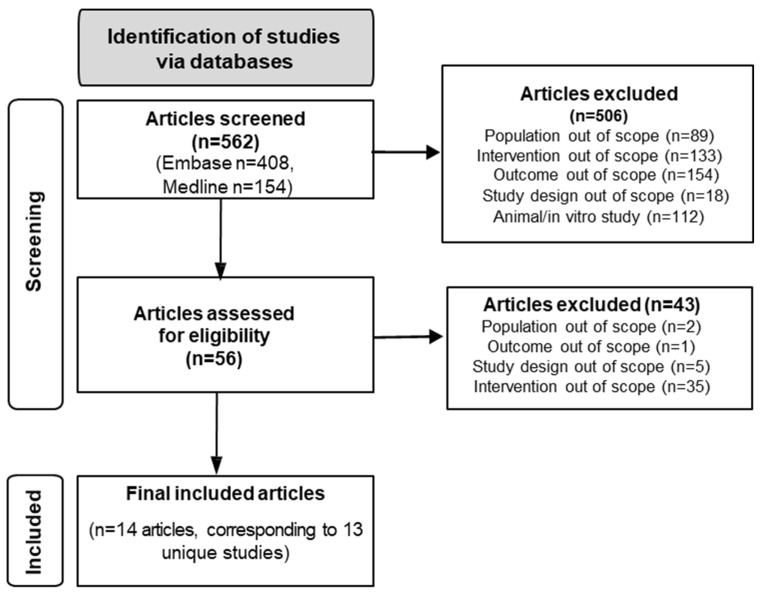
- From 562 identified articles, 56 were full-text reviewed and 14 articles reporting 13 unique RCTs were included.
Limitations
- Stated by the paper: the review was not registered; substantial variation in reported metrics/outcomes prevented adequate comparison; most studies focused on safety, tolerability, and plasma concentration rather than cellular/tissue retention; no study reported vitamin C retention in tissues; only four studies reported leukocyte vitamin C; sustained-release studies were only placebo-controlled; liposomal studies were early-stage; only one trial studied lipid metabolite vitamin C; and serum vs plasma measurements prevented direct comparison across some studies.
- Stated by the paper: further research is needed with larger and more diverse cohorts, immune stressors, standardized immune/inflammation markers, longer durations, and active comparators rather than placebo alone.
- Evident from the text: the evidence base is skewed toward Calcium ascorbate EC (7 of 13 studies), several studies had small samples (e.g., n = 9, 11, 15, 24, 27, or 30 with data), and two studies assessed only males; two studies had high risk of bias and one had unclear risk of bias.
Model-written summary. Check it against the paper before relying on it.
Integrity signals
Registry
Cites
Statistics
Figures
Verification
Claims the paper makes
37 Valid · 2 Not valid · 53 Not checked · 47 Own results and interpretations
At least one cited source doesn’t support this claim or points to a different paper, and none confirmed it — see the verdicts below.
In the paper
“Its low chemical stability in the gastrointestinal tract necessitates an efficient delivery mode for vitamin C supplements [13].”
§ Enhanced Vitamin C Delivery: A Systematic Literature Review Assessing the Efficacy and Safety of Alternative Supplement Forms in Healthy Adults > 1. Introduction
What the sources say
- Disputedcites [13] Michels A.J. Frei B. Myths, artifacts, and fatal flaws: Identifying limitations and opportunities in vitamin C research Nutrients 2013 5 5161 5192 10.3390/nu5125161 24352093 PMC3875932 sourceExperimental — accuracy not yet measured
In §2.3.4, “Supplementing C: From Formulation to Dose” (page not provided), the paper says there is no evidence that different ascorbate formulations measurably affect vitamin C bioavailability in humans. The Human Studies section also reports nearly complete oral bioavailability at 200 mg/day. Its discussion of chemical instability concerns biological samples outside the body, not vitamin C in the gastrointestinal tract; the paper therefore does not support the claimed need for a special delivery mode. (LLM, conf=0.84)
Checked by a reasoning model — may be wrong.
plainstates a cause- Asserted: passes — The authors put it forward as true.
- Checkable: passes — It can be checked against evidence.
- Load-bearing: passes — The paper’s conclusions depend on it.
- Based: passes — The paper gives a reason why it holds.
- Disputed
At least one cited source doesn’t support this claim or points to a different paper, and none confirmed it — see the verdicts below.
In the paper
“Pharmacokinetic analysis showed Calcium ascorbate EC had a greater volume of distribution and clearance from the blood compared to ascorbic acid, especially at a dosage of 500 mg, indicating its more effective utilization by the body.”
§ Enhanced Vitamin C Delivery: A Systematic Literature Review Assessing the Efficacy and Safety of Alternative Supplement Forms in Healthy Adults > 3. Results > 3.4. Summary of Evidence on the Efficacy of the Interventions
What the sources say
- Disputedcites [30] Dickerson B. Gonzalez D.E. Sowinski R. Xing D. Leonard M. Kendra J. Jenkins V. Gopalakrishnan S. Yoo C. Ko J. Comparative effectiveness of ascorbic acid vs. calcium ascorbate ingestion on pharmacokinetic profiles and immune biomarkers in healthy adults: A preliminary study Nutrients 2024 16 3358 10.3390/nu16193358 39408325 PMC11479081 sourceExperimental — accuracy not yet measured
The Results (§4.6, page unavailable) report that at 500 mg, total vitamin C volume of distribution significantly decreased with calcium ascorbate, contrary to the claimed increase. Clearance measures only tended to be higher (p = 0.073 and 0.058), so the results also do not establish greater clearance or more effective utilization. (LLM, conf=0.88)
Checked by a reasoning model — may be wrong.
plainstates a causen = 47- Asserted: passes — The authors put it forward as true.
- Checkable: passes — It can be checked against evidence.
- Load-bearing: passes — The paper’s conclusions depend on it.
- Based: passes — The paper gives a reason why it holds.
- Disputed
Every source the paper cites for this claim was checked and supports it.
In the paper
“Due to the inability of the human body to produce endogenous vitamin C, supplementation of the diet can be used to maintain adequate amounts of the nutrient [8].”
§ Enhanced Vitamin C Delivery: A Systematic Literature Review Assessing the Efficacy and Safety of Alternative Supplement Forms in Healthy Adults > 1. Introduction
What the sources say
- Supportedcites [8] Li Y. Schellhorn H.E. New developments and novel therapeutic perspectives for vitamin C J. Nutr. 2007 137 2171 2184 10.1093/jn/137.10.2171 17884994 source
The Introduction states that humans lost the ability to synthesize vitamin C endogenously because of mutations in the GULO gene. It also says humans normally acquire vitamin C from dietary sources. (LLM, conf=0.95)
plain- Asserted: passes — The authors put it forward as true.
- Checkable: passes — It can be checked against evidence.
- Load-bearing: passes — The paper’s conclusions depend on it.
- Based: passes — The paper gives a reason why it holds.
- Supported
The sources with a verdict support this claim; the rest weren’t checked yet, have no full text we could read, or their verdicts aren’t rated yet.
In the paper
“This form of vitamin C has a neutral pH (nonacidic) and has been shown in clinical studies to have a longer retention (up to 24 h) in immune cells (leukocytes) [15,16,17].”
§ Enhanced Vitamin C Delivery: A Systematic Literature Review Assessing the Efficacy and Safety of Alternative Supplement Forms in Healthy Adults > 1. Introduction
What the sources say
- Not matchedcites [15] The C That’s Crazy Good for You Available online: https://www.esterc.com/ (accessed on 13 August 2024)
We searched by its title and found no matching paper.
- Supportedcites [16] Mitmesser S.H. Ye Q. Evans M. Combs M. Determination of plasma and leukocyte vitamin C concentrations in a randomized, double-blind, placebo-controlled trial with Ester-C(®) Springerplus 2016 5 1161 10.1186/s40064-016-2605-7 27512620 PMC4960105 source
The Background describes Ester-C as containing calcium ascorbate and having a neutralized pH. The Discussion reports significantly higher leukocyte vitamin C levels at 8 and 24 hours after Ester-C than after ascorbic acid or placebo, supporting the longer-retention claim. (LLM, conf=0.94)
- Not checked — no full text of the sourcecites [17] Jacob R.A. Assessment of human vitamin C status J. Nutr. 1990 120 (Suppl. S11) 1480 1485 10.1093/jn/120.suppl_11.1480 2243292 source
plainstates a cause- Asserted: passes — The authors put it forward as true.
- Checkable: passes — It can be checked against evidence.
- Load-bearing: unclear — It is unclear whether the paper’s conclusions depend on it.
- Based: passes — The paper gives a reason why it holds.
- Not matched
The cited sources support only part of this claim — read each source’s verdict below.
In the paper
“However, at 500 mg, Calcium ascorbate EC significantly increased dehydroascorbic acid levels in plasma, indicating better absorption compared to ascorbic acid, suggesting that calcium ascorbate EC can enhance vitamin C bioavailability at higher doses.”
§ Enhanced Vitamin C Delivery: A Systematic Literature Review Assessing the Efficacy and Safety of Alternative Supplement Forms in Healthy Adults > 3. Results > 3.4. Summary of Evidence on the Efficacy of the Interventions
What the sources say
- Partly supportedcites [30] Dickerson B. Gonzalez D.E. Sowinski R. Xing D. Leonard M. Kendra J. Jenkins V. Gopalakrishnan S. Yoo C. Ko J. Comparative effectiveness of ascorbic acid vs. calcium ascorbate ingestion on pharmacokinetic profiles and immune biomarkers in healthy adults: A preliminary study Nutrients 2024 16 3358 10.3390/nu16193358 39408325 PMC11479081 sourceExperimental — accuracy not yet measured
The Results (section 4.3) report significantly higher plasma dehydroascorbic acid AUC after 500 mg calcium ascorbate than after ascorbic acid, and the Discussion (section 5.1) reports higher levels at most post-dose time points. However, the Methods (section 2.4) identify the tested material as calcium ascorbate, not a formulation designated “EC,” so that added specificity is not established by our copy. (LLM, conf=0.82)
hedgedstates a causen = 47- Asserted: passes — The authors put it forward as true.
- Checkable: passes — It can be checked against evidence.
- Load-bearing: passes — The paper’s conclusions depend on it.
- Based: passes — The paper gives a reason why it holds.
- Partly supported
60 more claims · 16 with their cited sources checked
Create a free account to see all 139 claims and to verify the 16 references still open.
- Probably not a substantial claim. 24
- It may state two separate claims as one. 59
Self-check
Percentages, sums and reported differences re-computed from the paper’s own numbers.
Each contradiction between two passages listed here was confirmed by an independent check.
Rated major: it would touch a result — a value a result rests on, reported and recomputed p-values on opposite sides of the significance level, two passages that conflict with no sign which is right, or a cited work retracted before this paper was published.
In the paper
§ Enhanced Vitamin C Delivery: A Systematic Literature Review Assessing the Efficacy and Safety of Alternative Supplement Forms in Healthy Adults > 3. Results > 3.4. Summary of Evidence on the Efficacy of the Interventions
“Van Straten and Josling [28] studied 168 participants who were randomly assigned to receive either a placebo or a 1000 mg Calcium ascorbate EC supplement daily over a 60-day period.”
§ Enhanced Vitamin C Delivery: A Systematic Literature Review Assessing the Efficacy and Safety of Alternative Supplement Forms in Healthy Adults > 3. Results > 3.3. Characteristics of the Retrieved Studies: Outcomes
“| Van Straten and Josling 2002 [28] | RDBPC | CA EC; 500 mg/day for 60 days | Placebo | N | CA EC: 84 | 48 | 18/82 | NR | NR | NR |”
Rated minor: it would not touch a result — a value no result rests on, a p-value that stays on the same side of the significance level, or a conflict that is clerical, resolved elsewhere in the paper, or outside its own findings.
In the paper
“Following title and abstract screening, 506 irrelevant articles were eliminated and 56 were reviewed for full text eligibility. Of these, 43 articles were excluded due to study design (n = 5), population (n = 2), intervention (n = 35), or outcomes (n = 1) not being relevant to SLR objectives. Finally, 14 articles (reporting on 13 primary RCTs) were deemed eligible for inclusion (Figure 1).”
§ Enhanced Vitamin C Delivery: A Systematic Literature Review Assessing the Efficacy and Safety of Alternative Supplement Forms in Healthy Adults > 3. Results > 3.1. Search Results
Reported 14 · recomputed 13
Citations
Cites
Carr, A., & Maggini, S. (2017) · Nutrients · doi:10.3390/nu9111211 · Cited by 2,035
Liposomes: Structure, composition, types, and clinical applications
Nsairat, H., Khater, D., Sayed, U., Odeh, F., Al Bawab, A., & Alshaer, W. (2022) · Heliyon · doi:10.1016/j.heliyon.2022.e09394 · Cited by 1,561
Sackett, D. L. (1997) · Seminars in Perinatology · doi:10.1016/s0146-0005(97)80013-4 · Cited by 1,061
Vitamin C pharmacokinetics: Implications for oral and intravenous use
Padayatty, S. J., Sun, H., Wang, Y., Riordan, H. D., Hewitt, S. M., Katz, A., Wesley, R. A., & Levine, M. (2004) · Annals of Internal Medicine · doi:10.7326/0003-4819-140-7-200404060-00010 · Cited by 992
Criteria and recommendations for vitamin C intake
Levine, M. (1999) · JAMA · doi:10.1001/jama.281.15.1415 · Cited by 559
New developments and novel therapeutic perspectives for vitamin C
Li, Y., & Schellhorn, H. E. (2007) · The Journal of Nutrition · doi:10.1093/jn/137.10.2171 · Cited by 508
A Consideration of Biomarkers to be Used for Evaluation of Inflammation in Human Nutritional Studies
Calder, P. C., Ahluwalia, N., Albers, R., Bosco, N., Bourdet-Sicard, R., Haller, D., Holgate, S. T., Jönsson, L. S., Latulippe, M. E., Marcos, A., et al. (2013) · British Journal of Nutrition · doi:10.1017/s0007114512005119 · Cited by 425
Self-citationCarr, A. C., Rosengrave, P. C., Bayer, S., Chambers, S., Mehrtens, J., & Shaw, G. M. (2017) · Critical Care · doi:10.1186/s13054-017-1891-y · Cited by 413
Markers to measure immunomodulation in human nutrition intervention studies
Albers, R., Antoine, J.-M., Bourdet-Sicard, R., Calder, P. C., Gleeson, M., Lesourd, B., Samartín, S., Sanderson, I. R., Van Loo, J., Vas Dias, F. W., et al. (2005) · British Journal of Nutrition · doi:10.1079/bjn20051469 · Cited by 286
Self-citationBiological Significance of Ascorbic Acid (Vitamin C) in Human Health - A Review
Iqbal, K., Khan, A., & Khan Khattak, M. M. A. (2003) · Pakistan Journal of Nutrition · doi:10.3923/pjn.2004.5.13 · Cited by 270
Research works printed but not linked: 2
- Bender D.A. Ascorbic acid (vitamin C) Nutritional Biochemistry of the Vitamins Cambridge University Press Cambridge, UK 1992 360 393
- National Institute for Health and Care Excellence Methods for the Development of NICE Public Health Guidance National Institute for Health and Care Excellence London, UK 2012 27905711
Cited by
Carr, A. C. (2025) · Basic & Clinical Pharmacology & Toxicology · doi:10.1111/bcpt.70067 · Cited by 9
“However, recent research has indicated that liposomal ascorbate may have enhanced bioavailability [12].”
Elbanna, P. T., Hammad, M. A., Abdallah, I. A., Locatelli, M., & Mansour, F. R. (2025) · Analytica—A Journal of Analytical Chemistry and Chemical Analysis · doi:10.3390/analytica7010001 · Cited by 4
“Ascorbic acid (ASC), commonly known as Vitamin C, is a powerful water-soluble antioxidant that plays a crucial role in protecting cells from oxidative damage [13].”
Zhao, Y., Wang, S., Zhang, H., et al. (2025) · Foods · doi:10.3390/foods14173106 · Cited by 2
“V C plays an essential role in immune function, collagen, and cortisol synthesis, and it could remove free radical intermediates that initiate damaging reactions [7,8].”
Vitamins A, E, and C: Mechanisms of Antioxidant Action and Physiological Impact
Koca, F., Yılmaz, E., & Çimen, L. (2025) · Sağlık Bilimleri Dergisi · doi:10.34108/eujhs.1727061 · Cited by 2
Abu-Hadal, L. S., Al-Humaidy, N. M., & Al-Hameedawi, D. F. (2025) · Academia Open · doi:10.21070/acopen.11.2026.13115 · Cited by 1
Babatunde, J., Kindoussy, F. E., & de Souza, P. M. (2026) · Food Reviews International · doi:10.1080/87559129.2026.2703245 · Cited by 1
Undifferentiated connective tissue dysplasia and skin: what to do? Dietitian’s position
Никитина, Е. А., Орлова, С. В., Batysheva, T. T., Balashova, N. V., & Alekseeva, М. V. (2025) · Medical alphabet · doi:10.33667/2078-5631-2025-19-60-70
Woo, Y. M., Lee, K. W., & Kim, A. (2025) · Journal of Functional Foods · doi:10.1016/j.jff.2025.107103 · Cited by 1
Intradermal Delivery of Catalase via Extracellular Vesicles for Targeted Photoaging Therapy
Zhang, P., Pan, B., Chen, J., Jiang, H., Wang, X., Chen, Y., Wang, W., Li, M., Zeng, Q., & Yang, Z. (2026) · Biomaterials Research · doi:10.34133/bmr.0329
“…of small-molecular antioxidants such as vitamin C and resveratrol has been reported, the efficient delivery of large enzymatic proteins (e.g., CAT, ∼ 240-kDa tetramer) remains highly challenging because of their structural complexity and propensity for denaturation during loading [ 32 , 33 ].”
Ventre, A., Dato, E., Salvo, M. D., Casciaro, M., & Gangemi, S. (2026) · Applied Sciences · doi:10.3390/app16115544 · Cited by 2
Bajić, D., Andrijević, L., Todorović, N., Lalic-Popovic, M. N., Zarić, B., Dimić, S., Maletić, J. S., Lendak, D. F., Milijašević, B., & Milosevic, N. P. (2026) · Medical Sciences · doi:10.3390/medsci14030400
Dong, Y., Li, J., Han, W., et al. (2026) · Analytical Methods · doi:10.1039/d6ay01199c
Narakie, K., Ghaneyi, M., & Nourian, Y. H. (2026) · Jundishapur Journal of Natural Pharmaceutical Products · doi:10.5812/jjnpp-173406
Metadata
- Authors
- Calder, P. C., Kreider, R. B., & McKay, D. L.
- Affiliations
- University Hospital Southampton NHS Foundation Trust (GB)
- Texas A&M University (US)
- Tufts University (US)
- Corresponding author
- Calder, Philip C.
- Venue
- Nutrients
- Publisher
- MDPI AG
- Published
- 2025-01-14
- Volume
- 17
- Issue
- 2
- Pages
- 279
- ISSN
- 2072-6643 (ISSN-L)
- PMC
- PMC11767823
- OpenAlex
- W4406371652
- Cited by
- 16
- References
- 47
- Citations by year
- 2026: 9 · 2025: 7
- FWCI
- 1.69
- Type
- journal article
- Language
- en
- Open access
- gold
- doi.org
- Licence
- Locations
- Nutrients (publishedVersion, cc-by)
- PubMed Central (publishedVersion, cc-by)
- PubMed (publishedVersion)
- ePrints Soton (University of Southampton) (acceptedVersion)
- Funders
- Nestlé Health Science
- Topics
- Health Sciences › Nursing › Nutrition and Dietetics › Vitamin C and Antioxidants Research
- Health Sciences › Medicine › Biochemistry (medical) › Antioxidant Activity and Oxidative Stress
- Health Sciences › Medicine › Public Health, Environmental and Occupational Health › Nutrition and Health Studies
- Keywords
- vitamin C, vitamin C supplementation, bioavailability, calcium ascorbate, plasma vitamin C, immune function, infection, cold symptoms, tolerability, oxalate, healthy adults, quality of life
- MeSH terms
- Adult, Antioxidants, Ascorbic Acid, Biological Availability, Female, Humans, Liposomes, Male, Dietary Supplements, Healthy Volunteers
About these checks
Registry, retraction, Cites and statistics results are computed, not judged, with one exception: a printed reference that no index lists is read once by a model before it counts as a citation error. Claims are extracted by a model and kept only when their quote appears verbatim in the text; each cited source is then checked, with a model’s help, for whether it says what the claim relies on. Those verdicts can be wrong — read the claim’s quote and the cited source before relying on one.
The claim verdicts this report counts are experimental: their accuracy is not yet measured.
A language model drew the claims from the paper on 2026-10-10, under version 3 of the claim definition (model deepseek-v4.1-flash, prompt extract-v3).
A second model labelled each claim on 2026-10-10 (model jev-1.13-20260917, definition revision gold-guideline-v0.2).
Cited sources are checked with a language model’s help (gpt-6-sol).
Statistics and arithmetic are recomputed, not judged.
Confidence bands are shown only for fields calibrated on our annotated test set. None is calibrated yet, so no band is shown.
What counts as a claim ›How we measure confidence ›How we check this ›
Are you an author, or do you see a problem with this page? Request a review
Data sources
Bibliographic data: Semantic Scholar, OpenAlex, Crossref.
Contains information from the Semantic Scholar Academic Graph Datasets, made available under the ODC Attribution License (ODC-BY 1.0).
Semantic Scholar’s data is described in: Kinney, R., et al. (2023). The Semantic Scholar Open Data Platform. arXiv:2301.10140.
