

Challenges of the Standard Cosmological Model
Open accessThe DOI matches its Crossref record; 114 of the 122 references it cites were found in a registry or an index; 83 of the 104 sources its claims cite were checked for support.
Abstract
Measurements of the temperature and polarization anisotropy of the cosmic microwave background (CMB) provided strong confirmation of the vanilla flat ΛCDM model of structure formation. Even if this model fits incredibly well, the cosmological and astrophysical observations in a wide range of scales and epochs, some interesting tensions between the cosmological probes, and anomalies in the CMB data, have emerged. These discrepancies have different statistical significance, and although some parts may be due to systematic errors, their persistence strongly indicates possible cracks in the standard ΛCDM cosmological scenario.
Overview
CoChat Summary
TL;DR
This review argues that flat ΛCDM fits many observations but faces persistent tensions and anomalies, especially the Hubble constant disagreement. It concludes that although systematics may contribute, the robustness of several signals suggests possible cracks in the standard cosmological model.
Key findings
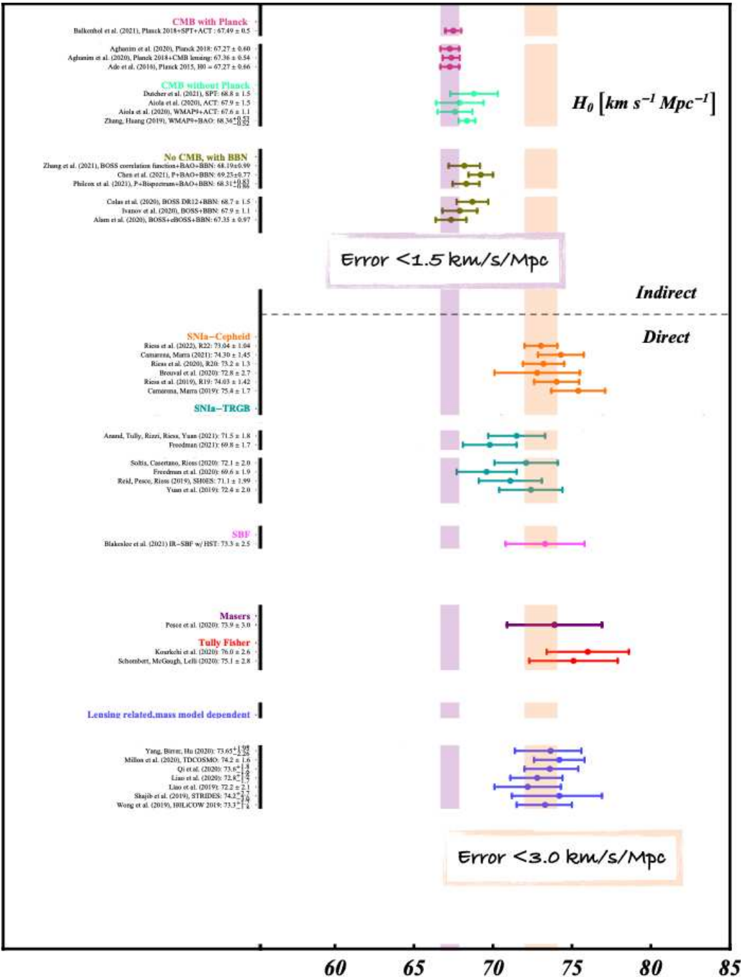
- The \(H_0\) tension is reported as a 5σ disagreement between Planck 2018 ΛCDM, \(H_0=67.27\pm0.60\ \mathrm{km/s/Mpc}\), and SH0ES, \(H_0=73.04\pm1.04\ \mathrm{km/s/Mpc}\). Combining late-universe measurements gives \(H_0=72.97\pm0.63\ \mathrm{km/s/Mpc}\) (about 6.55σ), a conservative \(72.73\pm0.80\ \mathrm{km/s/Mpc}\) (about 5.5σ), and an ultraconservative \(73.3\pm1.1\ \mathrm{km/s/Mpc}\) (4.8σ) with Planck.
- The \(S_8\) tension is reported between Planck, \(S_8=0.834^{+0.016}_{-0.016}\), and KiDS-1000, \(S_8=0.766^{+0.020}_{-0.014}\) at 3.1σ, and DES-Y3, \(S_8=0.759^{+0.025}_{-0.025}\) at 2.5σ.
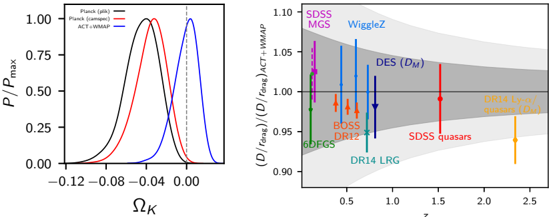
- Planck CMB power spectra prefer \(A_{\rm lens}>1\) at 2.8σ with TTTEEE, with \(\Delta\chi^2\sim9\) improvement for TT, while Planck lensing reconstruction is compatible with \(A_{\rm lens}=1\). Planck alone indicates a closed Universe at about 3.4σ, with 99% region \(-0.095\le\Omega_k\le-0.007\), whereas Planck+lensing+BAO gives \(\Omega_k=0.0007\pm0.0019\).
- Ground-based CMB experiments give different curvature results: ACT-DR4+WMAP finds \(\Omega_k=-0.001\pm0.012\), SPT-3G finds \(\Omega_k=0.001^{+0.018}_{-0.019}\), and Planck vs ACT shows a global 2.6σ tension assuming ΛCDM; ACT/SPT also show indications for running spectral index, nonzero neutrino mass, and early dark energy.
Methods
- This is a brief review/overview paper; the Data availability statement says “No new data are used.” It synthesizes published cosmological measurements and tensions, drawing on the Cosmology Intertwined review and SNOWMASS letters of interest.
- The paper focuses mainly on the \(H_0\) tension, then discusses \(S_8\), \(A_{\rm lens}\), \(\Omega_k\), and ground-based CMB experiment discrepancies. It uses published parameter constraints and, for late-universe \(H_0\), an arithmetic/weighted averaging scheme across measurement groups.
Limitations
- Stated: some discrepancies may have systematic origins; many signals are controversial and debated; there is no consensus on models solving the \(H_0\) problem; BAO is model-dependent and may need case-by-case revision in exotic dark-energy cosmologies; the Planck collaboration considers the \(A_{\rm lens}\) anomaly only a statistical fluctuation.
- Stated: the late-universe \(H_0\) combination lacks a full covariance matrix, so the paper uses conservative averaging with the smallest or largest error bars depending on the test.
- Evident: as a short overview, the paper is selective and mainly focuses on \(H_0\), relying on literature values rather than new independent data analysis.
Model-written summary. Check it against the paper before relying on it.
Integrity signals
Registry
Cites
Statistics
Figures
Verification
Claims the paper makes
66 Valid · 5 Not valid · 17 Not checked · 43 Own results and interpretations
Every source the paper cites for this claim was checked and supports it.
In the paper
“If we now focus on the late Universe measurements since 2020 of Figure 2 of Ref. [18], we see that they are instead preferring higher values of H 0 .”
§ Challenges of the Standard Cosmological Model > 2.1. The H 0 Measurements
What the sources say
- Supportedcites [18] Abdalla, E.; Abellán, G.F.; Aboubrahim, A.; Agnello, A.; Akarsu, O.; Akrami, Y.; Alestas, G.; Aloni, D.; Amendola, L.; Anchordoqui, L.A.; et al. Cosmology intertwined: A review of the particle physics, astrophysics, and cosmology associated with the cosmological tensions and anomalies. J. High Energy Astrophys. 2022, 34, 49-211. https://doi.org/10.1016/j.jheap.2022.04.002. source
Section IV.A says late H₀ measurements generally agree with a higher value than the CMB estimate. Section IV identifies Figure 2 as a summary of H₀ estimates and includes a 2021 late-Universe measurement of 73.04 ± 1.04 km s⁻¹ Mpc⁻¹, compared with Planck’s 67.27 ± 0.60. (LLM, conf=0.90)
plainstates an association- Asserted: passes — The authors put it forward as true.
- Checkable: passes — It can be checked against evidence.
- Load-bearing: unclear — It is unclear whether the paper’s conclusions depend on it.
- Based: passes — The paper gives a reason why it holds.
- Supported
The cited sources support only part of this claim — read each source’s verdict below.
In the paper
“with just six free parameters, it manages to fit well all the current cosmological observations [8][9][10][11][12][13][14][15][16][17].”
§ Challenges of the Standard Cosmological Model > 1. Introduction
What the sources say
- Supportedcites [8] Hinshaw, G. et al. [WMAP]. Nine-Year Wilkinson Microwave Anisotropy Probe (WMAP) Observations: Cosmological Parameter Results. Astrophys. J. Suppl. 2013, 208, 19. https://doi.org/10.1088/0067-0049/208/2/19. source
Section 3 identifies the six parameters of the basic ΛCDM model. Section 3.5 says the model produces an acceptable fit to all available data, supporting the claim in the context of the observations analyzed by the paper. (LLM, conf=0.94)
- Not matchedcites [12] Aghanim, N. et al. [Planck]. Planck 2018 results. VI. Cosmological parameters. Astron. Astrophys. 2020, 641, A6; Erratum: Astron. Astrophys. 2021, 652, C4. https://doi.org/10.1051/0004-6361/201833910.
More than one paper fits this citation.
- Partly supportedcites [17] Abbott, T.M.C. et al. [DES]. Dark Energy Survey Year 3 results: Cosmological constraints from galaxy clustering and weak lensing. Phys. Rev. D 2022, 105, 023520. https://doi.org/10.1103/PhysRevD.105.023520. sourceExperimental — accuracy not yet measured
“B. Parametrization and priors” says ΛCDM has six free cosmological parameters, but the paper’s fiducial analysis also uses 25 nuisance parameters. Section VII reports that combinations of the cosmological datasets it examines can fit ΛCDM; it does not establish a good fit to all current cosmological observations. The Introduction also notes a possible Hubble tension. (LLM, conf=0.88)
plainstates a cause- Asserted: passes — The authors put it forward as true.
- Checkable: passes — It can be checked against evidence.
- Load-bearing: passes — The paper’s conclusions depend on it.
- Based: passes — The paper gives a reason why it holds.
- Supported
The cited sources support only part of this claim — read each source’s verdict below.
In the paper
“the early time solutions proposed to alleviate the H 0 tension increase the S 8 tension”
§ Challenges of the Standard Cosmological Model > 2.2.3. The H 0r d -Ω m Plane
What the sources say
- Partly supportedcites [56] Jedamzik, K.; Pogosian, L.; Zhao, G.B. Why reducing the cosmic sound horizon alone can not fully resolve the Hubble tension. Commun. Phys. 2021, 4, 123. https://doi.org/10.1038/s42005-021-00628-x. sourceExperimental — accuracy not yet measured
The Results and discussion section says early-time models with higher matter density run into tension with DES and KiDS measurements of S8. But the paper does not say all proposed early-time solutions increase the S8 tension: it says models with lower matter density instead face BAO tension, and describes an exception involving additional physics. No page number is available in our copy. (LLM, conf=0.87)
plainstates a cause- Asserted: passes — The authors put it forward as true.
- Checkable: passes — It can be checked against evidence.
- Load-bearing: passes — The paper’s conclusions depend on it.
- Based: passes — The paper gives a reason why it holds.
- Partly supported
Every source the paper cites for this claim was checked and supports it.
In the paper
“a model that simply changes the value of the sound horizon r d would not completely resolve the tension, as it will affect the inferred value of the matter density Ω m and transfer the tension to it.”
§ Challenges of the Standard Cosmological Model > 2.2.3. The H 0r d -Ω m Plane
What the sources say
- Supportedcites [56] Jedamzik, K.; Pogosian, L.; Zhao, G.B. Why reducing the cosmic sound horizon alone can not fully resolve the Hubble tension. Commun. Phys. 2021, 4, 123. https://doi.org/10.1038/s42005-021-00628-x. source
The Results and discussion section says that reconciling the CMB, BAO and local Hubble measurements by reducing r_d requires a higher value of Ω_m h², which would create tension with galaxy weak-lensing surveys. Its conclusion states that reducing the sound horizon alone cannot fully resolve the Hubble tension without conflicting with BAO or weak-lensing data. The paper expresses the relevant matter-density change primarily as Ω_m h² rather than Ω_m alone. (LLM, conf=0.90)
hedgedstates a cause- Asserted: passes — The authors put it forward as true.
- Checkable: passes — It can be checked against evidence.
- Load-bearing: passes — The paper’s conclusions depend on it.
- Based: passes — The paper gives a reason why it holds.
- Supported
The cited sources support only part of this claim — read each source’s verdict below.
In the paper
“This is why varying Ω k or A lens gives a similar best fit of the lensing reconstruction data (see Figure 5 of Ref. [86]).”
§ Challenges of the Standard Cosmological Model > 3.3. The Ω k Tension
What the sources say
- Partly supportedcites [86] Di Valentino, E.; Melchiorri, A.; Silk, J. Planck evidence for a closed Universe and a possible crisis for cosmology. Nat. Astron. 2019, 4, 196-203 https://doi.org/10.1038/s41550-019-0906-9. sourceExperimental — accuracy not yet measured
The discussion of Fig. 5 (page not supplied) says the best-fit closed model and the model with elevated A_lens predict very similar lensing-potential spectra. But those are fits to the PL18 power spectra, not to the lensing reconstruction data; the paper says the closed model predicts too much lensing compared with that data. (LLM, conf=0.88)
plainstates an association- Asserted: passes — The authors put it forward as true.
- Checkable: passes — It can be checked against evidence.
- Load-bearing: passes — The paper’s conclusions depend on it.
- Based: passes — The paper gives a reason why it holds.
- Partly supported
63 more claims · 32 with their cited sources checked
Create a free account to see all 131 claims and to verify the 6 references still open.
- It may state two separate claims as one. 57
- Probably not a substantial claim. 7
- The quote only partly states this claim. 1
Self-check
Percentages, sums and reported differences re-computed from the paper’s own numbers.
Each contradiction between two passages listed here was confirmed by an independent check.
Rated minor: it would not touch a result — a value no result rests on, a p-value that stays on the same side of the significance level, or a conflict that is clerical, resolved elsewhere in the paper, or outside its own findings.
In the paper
§ Challenges of the Standard Cosmological Model > 3.1. The S 8 Tension
“3.1σ with KiDS-100 [77]”
§ Challenges of the Standard Cosmological Model > 3.3. The Ω k Tension
“3.8σ with KiDS-1000 [77]”
Rated minor: it would not touch a result — a value no result rests on, a p-value that stays on the same side of the significance level, or a conflict that is clerical, resolved elsewhere in the paper, or outside its own findings.
In the paper
§ Challenges of the Standard Cosmological Model > 3.2. The A lens Anomaly
“In a few words, A lens = 1 is a failed consistency check of the Planck data”
§ Challenges of the Standard Cosmological Model > 3.2. The A lens Anomaly
“In other words, A lens > 1 is a failed consistency check of Planck 2018 data.”
Citations
Cites
Observational Evidence from Supernovae for an Accelerating Universe and a Cosmological Constant
Riess, A. G., Filippenko, A. V., Challis, P., Clocchiatti, A., Diercks, A., Garnavich, P. M., Gilliland, R. L., Hogan, C. J., Jha, S., Kirshner, R. P., et al. (1998) · The Astronomical Journal · doi:10.1086/300499 · Cited by 19,704
Measurements of Ω and Λ from 42 High‐Redshift Supernovae
Perlmutter, S., Aldering, G., Goldhaber, G., Knop, R. A., Nugent, P., Castro, P. G., Deustua, S., Fabbro, S., Goobar, A., Groom, D. E., et al. (1999) · The Astrophysical Journal · doi:10.1086/307221 · Cited by 18,062
Planck 2018 results: VI. Cosmological parameters
Planck Collaboration, Aghanim, N., Akrami, Y., Ashdown, M., Aumont, J., Baccigalupi, C., Ballardini, M., Banday, A. J., Barreiro, R. B., Bartolo, N., et al. (2020) · Astronomy & Astrophysics · doi:10.1051/0004-6361/201833910 · Cited by 14,258
Self-citationInflationary universe: A possible solution to the horizon and flatness problems
Guth, A. H. (1981) · Physical Review D · doi:10.1103/physrevd.23.347 · Cited by 9,983
NINE-YEAR WILKINSON MICROWAVE ANISOTROPY PROBE ( WMAP ) OBSERVATIONS: COSMOLOGICAL PARAMETER RESULTS
Hinshaw, G., Larson, D., Komatsu, E., Spergel, D. N., Bennett, C. L., Dunkley, J., Nolta, M. R., Halpern, M., Hill, R. S., Odegard, N., et al. (2013) · The Astrophysical Journal Supplement Series · doi:10.1088/0067-0049/208/2/19 · Cited by 5,121
Lewis, A., Challinor, A., & Lasenby, A. (2000) · The Astrophysical Journal · doi:10.1086/309179 · Cited by 4,920
Cosmological parameters from CMB and other data: A Monte Carlo approach
Lewis, A., & Bridle, S. (2002) · Physical Review D · doi:10.1103/physrevd.66.103511 · Cited by 3,495
Alam, S., Ata, M., Bailey, S., Beutler, F., Bizyaev, D., Blazek, J. A., Bolton, A. S., Brownstein, J. R., Burden, A., Chuang, C.-H., et al. (2017) · Monthly Notices of the Royal Astronomical Society · doi:10.1093/mnras/stx721 · Cited by 3,056
Beutler, F., Blake, C., Colless, M., Jones, D. H., Staveley-Smith, L., Campbell, L., Parker, Q., Saunders, W., & Watson, F. (2011) · Monthly Notices of the Royal Astronomical Society · doi:10.1111/j.1365-2966.2011.19250.x · Cited by 2,590
Riess, A. G., Yuan, W., Macri, L. M., Scolnic, D., Brout, D., Casertano, S., Jones, D. O., Murakami, Y., Anand, G. S., Breuval, L., et al. (2022) · The Astrophysical Journal Letters · doi:10.3847/2041-8213/ac5c5b · Cited by 2,380
The Cosmic Linear Anisotropy Solving System (CLASS). Part II: Approximation schemes
Blas, D., Lesgourgues, J., & Tram, T. (2011) · Journal of Cosmology and Astroparticle Physics · doi:10.1088/1475-7516/2011/07/034 · Cited by 2,305
In the realm of the Hubble tension—a review of solutions *
Di Valentino, E., Mena, O., Pan, S., Visinelli, L., Yang, W., Melchiorri, A., Mota, D. F., Riess, A. G., & Silk, J. (2021) · Classical and Quantum Gravity · doi:10.1088/1361-6382/ac086d · Cited by 2,065
Rotation of the Andromeda Nebula from a Spectroscopic Survey of Emission Regions
Rubin, V. C., & Ford, W. K., Jr. (1970) · The Astrophysical Journal · doi:10.1086/150317 · Cited by 1,942
First-order phase transition of a vacuum and the expansion of the Universe
Sato, K. (1981) · Monthly Notices of the Royal Astronomical Society · doi:10.1093/mnras/195.3.467 · Cited by 1,792
The clustering of the SDSS DR7 main Galaxy sample – I. A 4 per cent distance measure at z=0.15
Ross, A. J., Samushia, L., Howlett, C., Percival, W. J., Burden, A., & Manera, M. (2015) · Monthly Notices of the Royal Astronomical Society · doi:10.1093/mnras/stv154 · Cited by 1,745
Planck 2018 results: I. Overview and the cosmological legacy of Planck
Planck Collaboration, Aghanim, N., Akrami, Y., Arroja, F., Ashdown, M., Aumont, J., Baccigalupi, C., Ballardini, M., Banday, A. J., Barreiro, R. B., et al. (2020) · Astronomy & Astrophysics · doi:10.1051/0004-6361/201833880 · Cited by 1,635
Self-citationTensions between the early and late Universe
Verde, L., Treu, T., & Riess, A. G. (2019) · Nature Astronomy · doi:10.1038/s41550-019-0902-0 · Cited by 1,380
Alam, S., Aubert, M., Avila, S., Balland, C., Bautista, J. E., Bershady, M. A., Bizyaev, D., Blanton, M. R., Bolton, A. S., Bovy, J., et al. (2021) · Physical Review D · doi:10.1103/physrevd.103.083533 · Cited by 1,337
Planck 2018 results: V. CMB power spectra and likelihoods
Planck Collaboration, Aghanim, N., Akrami, Y., Ashdown, M., Aumont, J., Baccigalupi, C., Ballardini, M., Banday, A. J., Barreiro, R. B., Bartolo, N., et al. (2020) · Astronomy & Astrophysics · doi:10.1051/0004-6361/201936386 · Cited by 1,197
Self-citationDark Energy Survey Year 3 results: Cosmological constraints from galaxy clustering and weak lensing
Abbott, T. M. C., Aguena, M., Alarcon, A., Allam, S., Alves, O., Amon, A., Andrade-Oliveira, F., Annis, J., Avila, S., Bacon, D., et al. (2022) · Physical Review D · doi:10.1103/physrevd.105.023520 · Cited by 1,124
Early Dark Energy can Resolve the Hubble Tension
Poulin, V., Smith, T. L., Karwal, T., & Kamionkowski, M. (2019) · Physical Review Letters · doi:10.1103/physrevlett.122.221301 · Cited by 1,014
Challenges for Λ CDM: An update
Perivolaropoulos, L., & Skara, F. (2022) · New Astronomy Reviews · doi:10.1016/j.newar.2022.101659 · Cited by 902
Riess, A. G., Casertano, S., Yuan, W., Bowers, J. B., Macri, L., Zinn, J. C., & Scolnic, D. (2021) · The Astrophysical Journal Letters · doi:10.3847/2041-8213/abdbaf · Cited by 815
Existence and Nature of Dark Matter in the Universe
Trimble, V. (1987) · Annual Review of Astronomy and Astrophysics · doi:10.1146/annurev.aa.25.090187.002233 · Cited by 776
Heymans, C., Tröster, T., Asgari, M., Blake, C., Hildebrandt, H., Joachimi, B., Kuijken, K., Lin, C.-A., Sánchez, A. G., van den Busch, J. L., et al. (2021) · Astronomy & Astrophysics · doi:10.1051/0004-6361/202039063 · Cited by 772
Planck 2018 results: VIII. Gravitational lensing
Planck Collaboration, Aghanim, N., Akrami, Y., Ashdown, M., Aumont, J., Baccigalupi, C., Ballardini, M., Banday, A. J., Barreiro, R. B., Bartolo, N., et al. (2020) · Astronomy & Astrophysics · doi:10.1051/0004-6361/201833886 · Cited by 747
Self-citationMontePython 3: Boosted MCMC sampler and other features
Brinckmann, T., & Lesgourgues, J. (2019) · Physics of the Dark Universe · doi:10.1016/j.dark.2018.100260 · Cited by 683
Planck evidence for a closed Universe and a possible crisis for cosmology
Di Valentino, E., Melchiorri, A., & Silk, J. (2019) · Nature Astronomy · doi:10.1038/s41550-019-0906-9 · Cited by 673
Hubble constant hunter’s guide
Knox, L., & Millea, M. (2020) · Physical Review D · doi:10.1103/physrevd.101.043533 · Cited by 638
The Atacama Cosmology Telescope: DR4 maps and cosmological parameters
Aiola, S., Calabrese, E., Maurin, L., Naess, S., Schmitt, B. L., Abitbol, M. H., Addison, G. E., Ade, P. A. R., Alonso, D., Amiri, M., et al. (2020) · Journal of Cosmology and Astroparticle Physics · doi:10.1088/1475-7516/2020/12/047 · Cited by 636
Heymans, C., Tröster, T., Asgari, M., Blake, C., Hildebrandt, H., Joachimi, B., Kuijken, K. H., Lin, C.-A., Sánchez, A. G., van den Busch, J. L., et al. (2021) · UCL Discovery (University College London) · Cited by 584
Measurements of the Hubble Constant: Tensions in Perspective
Freedman, W. L. (2021) · The Astrophysical Journal · doi:10.3847/1538-4357/ac0e95 · Cited by 577
The Atacama Cosmology Telescope: DR4 maps and cosmological parameters
Aiola, S., Calabrese, E., Maurin, L., Næss, S., Schmitt, B., Abitbol, M., Addison, G., Ade, P. A. R., Alonso, D., Amiri, M., et al. (2020) · eScholarship (California Digital Library) · Cited by 544
New physics in light of the H0 tension: An alternative view
Vagnozzi, S. (2020) · Physical Review D · doi:10.1103/physrevd.102.023518 · Cited by 516
Snowmass2021—Letter of interest cosmology intertwined II: The hubble constant tension
Di Valentino, E., Anchordoqui, L. A., Akarsu, Ö., Ali-Haimoud, Y., Amendola, L., Arendse, N., Asgari, M., Ballardini, M., Basilakos, S., Battistelli, E., et al. (2021) · Astroparticle Physics · doi:10.1016/j.astropartphys.2021.102605 · Cited by 513
The $H_0$ Olympics: A fair ranking of proposed models
Schöneberg, N., Abellán, G. F., Sánchez, A. P., Witte, S. J., Poulin, V., & Lesgourgues, J. (2021) · arXiv · doi:10.48550/arxiv.2107.10291 · Cited by 463
The Expansion of the Universe is Faster than Expected
Riess, A. G. (2019) · Nature Reviews Physics · doi:10.1038/s42254-019-0137-0 · Cited by 461
Dark Energy Survey Year 3 results: Cosmology from cosmic shear and robustness to data calibration
Amon, A., Gruen, D., Troxel, M. A., MacCrann, N., Dodelson, S., Choi, A., Doux, C., Secco, L. F., Samuroff, S., Krause, E., et al. (2022) · Physical Review D · doi:10.1103/physrevd.105.023514 · Cited by 437
The creation of the universe as a quantum phenomenon
Brout, R., Englert, F., & Gunzig, E. (1978) · Annals of Physics · doi:10.1016/0003-4916(78)90176-8 · Cited by 431
Cosmology intertwined III: fσ8 and S8
Di Valentino, E., Anchordoqui, L. A., Akarsu, Ö., Ali-Haimoud, Y., Amendola, L., Arendse, N., Asgari, M., Ballardini, M., Basilakos, S., Battistelli, E., et al. (2021) · Astroparticle Physics · doi:10.1016/j.astropartphys.2021.102604 · Cited by 417
Self-citationCalibration of the Tip of the Red Giant Branch
Freedman, W. L., Madore, B. F., Hoyt, T., Jang, I. S., Beaton, R., Lee, M. G., Monson, A., Neeley, J., & Rich, J. (2020) · The Astrophysical Journal · doi:10.3847/1538-4357/ab7339 · Cited by 407
Birrer (2020) · doi:10.1051/0004-6361/202038861 · Cited by 396
Curvature tension: Evidence for a closed Universe
Handley, W. (2021) · Physical Review D · doi:10.1103/physrevd.103.l041301 · Cited by 377
The Megamaser Cosmology Project. XIII. Combined Hubble Constant Constraints
Pesce, D. W., Braatz, J. A., Reid, M. J., Riess, A. G., Scolnic, D., Condon, J. J., Gao, F., Henkel, C., Impellizzeri, C. M. V., Kuo, C. Y., et al. (2020) · The Astrophysical Journal Letters · doi:10.3847/2041-8213/ab75f0 · Cited by 371
Reconciling Planck with the local value of H 0 in extended parameter space
Di Valentino, E., Melchiorri, A., & Silk, J. (2016) · Physics Letters B · doi:10.1016/j.physletb.2016.08.043 · Cited by 358
Self-citationDi Valentino, E., Melchiorri, A., Mena, O., & Vagnozzi, S. (2020) · Physics of the Dark Universe · doi:10.1016/j.dark.2020.100666 · Cited by 344
Self-citationCosmoSIS: Modular cosmological parameter estimation
Zuntz, J., Paterno, M., Jennings, E., Rudd, D., Manzotti, A., Dodelson, S., Bridle, S., Sehrish, S., & Kowalkowski, J. (2015) · Astronomy and Computing · doi:10.1016/j.ascom.2015.05.005 · Cited by 313
CosmoSIS: modular cosmological parameter estimationPreprint
Zuntz, J., Paterno, M., Jennings, E., Rudd, D. H., Manzotti, A., Dodelson, S., Bridle, S., Sehrish, S., Kowalkowski, J., & Jodrell Bank Centre for Astrophysics (2014) · Cited by 300
Alves, J., Forveille, T., Pentericci, L., & Shore, S. (2020) · Astronomy & Astrophysics · doi:10.1051/0004-6361/202039265 · Cited by 264
Efstathiou, G. (2021) · Monthly Notices of the Royal Astronomical Society · doi:10.1093/mnras/stab1588 · Cited by 254
Dutcher, D., Balkenhol, L., Ade, P. A. R., Ahmed, Z., Anderes, E., Anderson, A. J., Archipley, M., Avva, J. S., Aylor, K., Barry, P. S., et al. (2021) · Physical Review D · doi:10.1103/physrevd.104.022003 · Cited by 249
Local determination of the Hubble constant and the deceleration parameter
Camarena, D., & Marra, V. (2020) · Physical Review Research · doi:10.1103/physrevresearch.2.013028 · Cited by 243
Why reducing the cosmic sound horizon alone can not fully resolve the Hubble tension
Jedamzik, K., Pogosian, L., & Zhao, G.-B. (2021) · Communications Physics · doi:10.1038/s42005-021-00628-x · Cited by 237
Quantifying discordance in the 2015 Planck CMB spectrum
Addison, G. E., Huang, Y., Watts, D. J., Bennett, C. L., Halpern, M., Hinshaw, G., & Weiland, J. L. (2016) · The Astrophysical Journal · doi:10.3847/0004-637x/818/2/132 · Cited by 235
CMB power spectra and cosmological parameters from Planck PR4 with CamSpec
Rosenberg, E., Gratton, S., & Efstathiou, G. (2022) · Monthly Notices of the Royal Astronomical Society · doi:10.1093/mnras/stac2744 · Cited by 225
Cosmic microwave weak lensing data as a test for the dark universe
Calabrese, E., Slosar, A., Melchiorri, A., Smoot, G. F., & Zahn, O. (2008) · Physical Review D · doi:10.1103/physrevd.77.123531 · Cited by 224
Is the low cosmic microwave background quadrupole a signature of spatial curvature?
Efstathiou, G. (2003) · Monthly Notices of the Royal Astronomical Society · doi:10.1046/j.1365-8711.2003.06940.x · Cited by 210
The evidence for a spatially flat Universe
Efstathiou, G., & Gratton, S. (2020) · Monthly Notices of the Royal Astronomical Society: Letters · doi:10.1093/mnrasl/slaa093 · Cited by 203
A buyer’s guide to the Hubble constant
Shah, P., Lemos, P., & Lahav, O. (2021) · The Astronomy and Astrophysics Review · doi:10.1007/s00159-021-00137-4 · Cited by 196
Camarena, D., & Marra, V. (2021) · Monthly Notices of the Royal Astronomical Society · doi:10.1093/mnras/stab1200 · Cited by 194
The Hubble Constant from Infrared Surface Brightness Fluctuation Distances*
Blakeslee, J. P., Jensen, J. B., Ma, C.-P., Milne, P. A., & Greene, J. E. (2021) · The Astrophysical Journal · doi:10.3847/1538-4357/abe86a · Cited by 178
Investigating Cosmic Discordance
Di Valentino, E., Melchiorri, A., & Silk, J. (2021) · The Astrophysical Journal Letters · doi:10.3847/2041-8213/abe1c4 · Cited by 166
Riess, A. G., Yuan, W., Macri, L. M., et al. (2021) · arXiv (Cornell University) · doi:10.48550/arxiv.2112.04510 · Cited by 163
A 5 per cent measurement of the Hubble–Lemaître constant from Type II supernovae
de Jaeger, T., Galbany, L., Riess, A. G., Stahl, B. E., Shappee, B. J., Filippenko, A. V., & Zheng, W. (2022) · Monthly Notices of the Royal Astronomical Society · doi:10.1093/mnras/stac1661 · Cited by 160
Di Valentino, E. (2021) · Monthly Notices of the Royal Astronomical Society · doi:10.1093/mnras/stab187 · Cited by 138
The galaxy power spectrum take on spatial curvature and cosmic concordance
Vagnozzi, S., Di Valentino, E., Gariazzo, S., Melchiorri, A., Mena, O., & Silk, J. (2021) · Physics of the Dark Universe · doi:10.1016/j.dark.2021.100851 · Cited by 138
A measurement of the Hubble constant from Type II supernovae
de Jaeger, T., Stahl, B. E., Zheng, W., Filippenko, A. V., Riess, A. G., & Galbany, L. (2020) · Monthly Notices of the Royal Astronomical Society · doi:10.1093/mnras/staa1801 · Cited by 134
Abbott, T. M. C., Aguena, M., Alarcon, A., Alves, O., Amon, A., Andrade-Oliveira, F., Annis, J., Avila, S., Bacon, D., Baxter, E., et al. (2023) · Physical Review D · doi:10.1103/physrevd.107.083504 · Cited by 131
Self-citationCosmological constraints in extended parameter space from the Planck 2018 Legacy release
Valentino, E. D., Melchiorri, A., & Silk, J. (2020) · Journal of Cosmology and Astroparticle Physics · doi:10.1088/1475-7516/2020/01/013 · Cited by 130
Self-citationAngular Baryon Acoustic Oscillation measure at z =2.225 from the SDSS quasar survey
de Carvalho, E., Bernui, A., Carvalho, G. C., Novaes, C. P., & Xavier, H. S. (2018) · Journal of Cosmology and Astroparticle Physics · doi:10.1088/1475-7516/2018/04/064 · Cited by 129
Khetan, N., Izzo, L., Branchesi, M., Wojtak, R., Cantiello, M., Murugeshan, C., Agnello, A., Cappellaro, E., Della Valle, M., Gall, C., et al. (2021) · Astronomy & Astrophysics · doi:10.1051/0004-6361/202039196 · Cited by 127
Cosmicflows-4: The Calibration of Optical and Infrared Tully–Fisher Relations
Kourkchi, E., Tully, R. B., Anand, G. S., Courtois, H. M., Dupuy, A., Neill, J. D., Rizzi, L., & Seibert, M. (2020) · The Astrophysical Journal · doi:10.3847/1538-4357/ab901c · Cited by 123
Atacama Cosmology Telescope: Constraints on prerecombination early dark energy
Hill, J. C., Calabrese, E., Aiola, S., Battaglia, N., Bolliet, B., Choi, S. K., Devlin, M. J., Duivenvoorden, A. J., Dunkley, J., Ferraro, S., et al. (2022) · Physical Review D · doi:10.1103/physrevd.105.123536 · Cited by 122
Using the Baryonic Tully–Fisher Relation to Measure Ho
Schombert, J., McGaugh, S., & Lelli, F. (2020) · The Astronomical Journal · doi:10.3847/1538-3881/ab9d88 · Cited by 121
Soltis, J., Casertano, S., & Riess, A. G. (2021) · The Astrophysical Journal Letters · doi:10.3847/2041-8213/abdbad · Cited by 118
Dark energy at early times and ACT data: A larger Hubble constant without late-time priors
Poulin, V., Smith, T. L., & Bartlett, A. (2021) · Physical Review D · doi:10.1103/physrevd.104.123550 · Cited by 112
Anand, G. S., Tully, R. B., Rizzi, L., Riess, A. G., & Yuan, W. (2022) · The Astrophysical Journal · doi:10.3847/1538-4357/ac68df · Cited by 109
Early recombination as a solution to the H0 tension
Sekiguchi, T., & Takahashi, T. (2021) · Physical Review D · doi:10.1103/physrevd.103.083507 · Cited by 105
Cosmic dissonance: Are new physics or systematics behind a short sound horizon?
Arendse, N., Wojtak, R. J., Agnello, A., Chen, G. C.-F., Fassnacht, C. D., Sluse, D., Hilbert, S., Millon, M., Bonvin, V., Wong, K. C., et al. (2020) · Astronomy & Astrophysics · doi:10.1051/0004-6361/201936720 · Cited by 93
Tracing the sound horizon scale with photometric redshift surveys
Sánchez, E., Carnero, A., García-Bellido, J., Gaztañaga, E., de Simoni, F., Crocce, M., Cabré, A., Fosalba, P., & Alonso, D. (2011) · Monthly Notices of the Royal Astronomical Society · doi:10.1111/j.1365-2966.2010.17679.x · Cited by 89
Baryon acoustic oscillations from the SDSS DR10 galaxies angular correlation function
Carvalho, G. C., Bernui, A., Benetti, M., Carvalho, J. C., & Alcaniz, J. S. (2016) · Physical Review D · doi:10.1103/physrevd.93.023530 · Cited by 87
Di Valentino, E., Anchordoqui, L. A., Akarsu, Ö., Ali-Haimoud, Y., Amendola, L., Arendse, N., Asgari, M., Ballardini, M., Basilakos, S., Battistelli, E., et al. (2021) · Astroparticle Physics · doi:10.1016/j.astropartphys.2021.102607 · Cited by 85
Self-citationConstraints on ΛCDM extensions from the SPT-3G 2018 EE and TE power spectra
Balkenhol, L., Dutcher, D., Ade, P. A. R., Ahmed, Z., Anderes, E., Anderson, A. J., Archipley, M., Avva, J. S., Aylor, K., Barry, P. S., et al. (2021) · Physical Review D · doi:10.1103/physrevd.104.083509 · Cited by 84
Snowmass2021 - Letter of interest cosmology intertwined I: Perspectives for the next decade
Di Valentino, E., Anchordoqui, L. A., Akarsu, Ö., Ali-Haimoud, Y., Amendola, L., Arendse, N., Asgari, M., Ballardini, M., Basilakos, S., Battistelli, E., et al. (2021) · Astroparticle Physics · doi:10.1016/j.astropartphys.2021.102606 · Cited by 82
Self-citationJones, D. O., Mandel, K. S., Kirshner, R., Thorp, S., Challis, P., Avelino, A., Brout, D., Burns, C. R., Foley, R. J., Pan, Y. C., et al. (2022) · The Astrophysical Journal · doi:10.3847/1538-4357/ac755b · Cited by 81
Exploring the Tension between Current Cosmic Microwave Background and Cosmic Shear Data
Di Valentino, E., & Bridle, S. (2018) · Symmetry · doi:10.3390/sym10110585 · Cited by 80
Determining Model-independent H0 and Consistency Tests
Liao, K., Shafieloo, A., Keeley, R. E., & Linder, E. V. (2020) · The Astrophysical Journal Letters · doi:10.3847/2041-8213/ab8dbb · Cited by 80
Quantifying the global parameter tensions between ACT, SPT, and Planck
Handley, W., & Lemos, P. (2021) · Physical Review D · doi:10.1103/physrevd.103.063529 · Cited by 77
Neutrino Mass Bounds in the Era of Tension Cosmology
Di Valentino, E., & Melchiorri, A. (2022) · The Astrophysical Journal Letters · doi:10.3847/2041-8213/ac6ef5 · Cited by 71
Full-shape galaxy power spectra and the curvature tension
Glanville, A., Howlett, C., & Davis, T. (2022) · Monthly Notices of the Royal Astronomical Society · doi:10.1093/mnras/stac2891 · Cited by 69
Bernal, J. L., Smith, T. L., Boddy, K. K., & Kamionkowski, M. (2020) · Physical Review D · doi:10.1103/physrevd.102.123515 · Cited by 69
Breuval, L., Kervella, P., Anderson, R. I., Riess, A. G., Arenou, F., Trahin, B., Mérand, A., Gallenne, A., Gieren, W., Storm, J., et al. (2020) · Astronomy & Astrophysics · doi:10.1051/0004-6361/202038633 · Cited by 68
The Hubble constant from eight time-delay galaxy lenses
Denzel, P., Coles, J. P., Saha, P., & Williams, L. L. R. (2020) · Monthly Notices of the Royal Astronomical Society · doi:10.1093/mnras/staa3603 · Cited by 60
The transverse baryonic acoustic scale from the SDSS DR11 galaxies
Carvalho, G. C., Bernui, A., Benetti, M., Carvalho, J. C., de Carvalho, E., & Alcaniz, J. S. (2020) · Astroparticle Physics · doi:10.1016/j.astropartphys.2020.102432 · Cited by 58
Qi, J.-Z., Zhao, J.-W., Cao, S., Biesiada, M., & Liu, Y. (2021) · Monthly Notices of the Royal Astronomical Society · doi:10.1093/mnras/stab638 · Cited by 52
Cosmological constraints on slow roll inflation: An update
Forconi, M., Giarè, W., Di Valentino, E., & Melchiorri, A. (2021) · Physical Review D · doi:10.1103/physrevd.104.103528 · Cited by 48
Gonzalez, J. E., Benetti, M., von Marttens, R., & Alcaniz, J. (2021) · Journal of Cosmology and Astroparticle Physics · doi:10.1088/1475-7516/2021/11/060 · Cited by 47
Measuring Baryon Acoustic Oscillations with Angular Two-Point Correlation Function
Alcaniz, J. S., Carvalho, G. C., Bernui, A., Carvalho, J. C., & Benetti, M. (2017) · Fundamental Theories of Physics · doi:10.1007/978-3-319-51700-1_2 · Cited by 44
Dhawan, S., Goobar, A., Johansson, J., Jang, I. S., Rigault, M., Harvey, L., Maguire, K., Freedman, W. L., Madore, B. F., Smith, M., et al. (2022) · The Astrophysical Journal · doi:10.3847/1538-4357/ac7ceb · Cited by 42
Yang, T., Birrer, S., & Hu, B. (2020) · Monthly Notices of the Royal Astronomical Society: Letters · doi:10.1093/mnrasl/slaa107 · Cited by 38
Abdalla, E., Abellán, G. F., Aboubrahim, A., Agnello, A., Akarsu, Ö., Akrami, Y., Alestas, G., Aloni, D., Amendola, L., Anchordoqui, L. A., et al. (2022) · Journal of High Energy Astrophysics · doi:10.1016/j.jheap.2022.04.002 · Cited by 37
Self-citationWhat is flat ΛCDM, and may we choose it?
Anselmi, S., Carney, M. F., Giblin, J. T., Kumar, S., Mertens, J. B., O'Dwyer, M., Starkman, G. D., & Tian, C. (2023) · Journal of Cosmology and Astroparticle Physics · doi:10.1088/1475-7516/2023/02/049 · Cited by 29
Quantifying the accuracy of the Alcock-Paczyński scaling of baryon acoustic oscillation measurements
Heinesen, A., Blake, C., & Wiltshire, D. L. (2020) · Journal of Cosmology and Astroparticle Physics · doi:10.1088/1475-7516/2020/01/038 · Cited by 29
The $$H_0$$ Tensions to Discriminate Among Concurring Models
Di Valentino, E. (2021) · Modified Gravity and Cosmology · doi:10.1007/978-3-030-83715-0_32 · Cited by 2
Full-Shape Galaxy Power Spectra and the Curvature Tension
Glanville, A., Howlett, C., & Davis, T. M. (2022) · arXiv · doi:10.48550/arxiv.2205.05892
CMB power spectra and cosmological parameters from Planck PR4 with CamSpec
Rosenberg, E., Gratton, S., & Efstathiou, G. (2022) · arXiv · doi:10.48550/arxiv.2205.10869
What is flat ΛCDM, and may we choose it?
Anselmi, S., Carney, M. F., Giblin, J. T., et al. (2022) · arXiv · doi:10.48550/arxiv.2207.06547
Abbott, T. M. C., Aguena, M., Alarcon, A., et al. (2022) · arXiv · doi:10.48550/arxiv.2207.05766
Calibration of the Tip of the Red Giant Branch (TRGB)
Freedman, W. L., Madore, B. F., Hoyt, T., et al. (2020) · arXiv · doi:10.48550/arxiv.2002.01550
Jones, D. O., Mandel, K. S., Kirshner, R. P., et al. (2022) · arXiv · doi:10.48550/arxiv.2201.07801
Dhawan, S., Goobar, A., Johansson, J., et al. (2022) · arXiv · doi:10.48550/arxiv.2203.04241
A 5% measurement of the Hubble constant from Type II supernovae
de Jaeger, T., Galbany, L., Riess, A. G., et al. (2022) · arXiv · doi:10.48550/arxiv.2203.08974
Challenges for $Λ$CDM: An update
Perivolaropoulos, L., & Skara, F. (2021) · arXiv · doi:10.48550/arxiv.2105.05208
The Atacama Cosmology Telescope: Constraints on Pre-Recombination Early Dark Energy
Hill, J. C., Calabrese, E., Aiola, S., et al. (2021) · arXiv · doi:10.48550/arxiv.2109.04451
Cited by
Seven Hints That Early-Time New Physics Alone Is Not Sufficient to Solve the Hubble Tension
Vagnozzi, S. (2023) · Universe · doi:10.3390/universe9090393 · Cited by 343
Hubble Tension: The Evidence of New Physics
Hu, J.-P., & Wang, F.-Y. (2023) · Universe · doi:10.3390/universe9020094 · Cited by 251
Jiang, J.-Q., Pedrotti, D., da Costa, S. S., & Vagnozzi, S. (2024) · Physical review. D/Physical review. D. · doi:10.1103/physrevd.110.123519 · Cited by 236
Dark energy in light of the early JWST observations: case for a negative cosmological constant?
Adil, S. A., Mukhopadhyay, U., Sen, A. A., & Vagnozzi, S. (2023) · Journal of Cosmology and Astroparticle Physics · doi:10.1088/1475-7516/2023/10/072 · Cited by 127
Jiang, J.-Q., Giarè, W., Gariazzo, S., Dainotti, M. G., Valentino, E. D., Mena, O., Pedrotti, D., da Costa, S. S., & Vagnozzi, S. (2025) · Journal of Cosmology and Astroparticle Physics · doi:10.1088/1475-7516/2025/01/153 · Cited by 166
Self-citation
Metadata
- Authors
- Di Valentino, E.
- Affiliations
- School of Mathematics and Statistics, University of Sheffield, Hounsfield Road, Sheffield S3 7RH, UK
- Venue
- Universe
- Publisher
- MDPI AG
- Published
- 2022-07-29
- Volume
- 8
- Issue
- 8
- Pages
- 399
- ISSN
- 2218-1997 (ISSN-L)
- OpenAlex
- W4289529755
- Cited by
- 125
- References
- 122
- Citations by year
- 2026: 35 · 2025: 37 · 2024: 26 · 2023: 24 · 2022: 3
- FWCI
- 6.78
- Type
- journal article
- Language
- en
- Open access
- gold
- doi.org
- Licence
- Locations
- Universe (publishedVersion, cc-by)
- White Rose Research Online (University of Leeds, The University of Sheffield, University of York) (acceptedVersion)
- DOAJ (DOAJ: Directory of Open Access Journals) (submittedVersion, cc-by-sa)
- Funders
- Royal Society Dorothy Hodgkin Research Fellowship
- Topics
- Physical Sciences › Physics and Astronomy › Astronomy and Astrophysics › Cosmology and Gravitation Theories
- Physical Sciences › Physics and Astronomy › Nuclear and High Energy Physics › Dark Matter and Cosmic Phenomena
- Physical Sciences › Physics and Astronomy › Astronomy and Astrophysics › Galaxies: Formation, Evolution, Phenomena
- Keywords
- cosmic microwave background, CMB temperature anisotropies, CMB polarization, cosmological tensions, CMB anomalies, structure formation, flat universe, systematic errors
About these checks
Registry, retraction, Cites and statistics results are computed, not judged, with one exception: a printed reference that no index lists is read once by a model before it counts as a citation error. Claims are extracted by a model and kept only when their quote appears verbatim in the text; each cited source is then checked, with a model’s help, for whether it says what the claim relies on. Those verdicts can be wrong — read the claim’s quote and the cited source before relying on one.
The claim verdicts this report counts are experimental: their accuracy is not yet measured.
A language model drew the claims from the paper on 2026-10-10, under version 3 of the claim definition (model deepseek-v4.1-flash, prompt extract-v3).
A second model labelled each claim on 2026-10-10 (model jev-1.13-20260917, definition revision gold-guideline-v0.2).
Cited sources are checked with a language model’s help (gpt-6-sol).
Statistics and arithmetic are recomputed, not judged.
Confidence bands are shown only for fields calibrated on our annotated test set. None is calibrated yet, so no band is shown.
What counts as a claim ›How we measure confidence ›How we check this ›
Are you an author, or do you see a problem with this page? Request a review
Data sources
Bibliographic data: Semantic Scholar, OpenAlex, Crossref.
Contains information from the Semantic Scholar Academic Graph Datasets, made available under the ODC Attribution License (ODC-BY 1.0).
Semantic Scholar’s data is described in: Kinney, R., et al. (2023). The Semantic Scholar Open Data Platform. arXiv:2301.10140.
